Energy at Home
Calculations Lesson
Learning Goals:
• To calculate power or energy use
• To calculate energy efficiency
• To calculate the cost of energy to run
appliances
Energy Use
• Electrical power is the amount of energy
converted into light, heat, sound, or motion
every second. The units for power are
watts, given the symbol “W”.
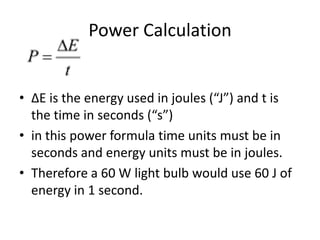
Power Calculation
• ΔE is the energy used in joules (“J”) and t is
the time in seconds (“s”)
• in this power formula time units must be in
seconds and energy units must be in joules.
• Therefore a 60 W light bulb would use 60 J of
energy in 1 second.
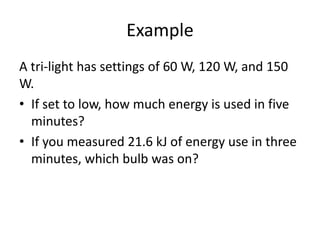
Example
A tri-light has settings of 60 W, 120 W, and 150
W.
• If set to low, how much energy is used in five
minutes?
• If you measured 21.6 kJ of energy use in three
minutes, which bulb was on?
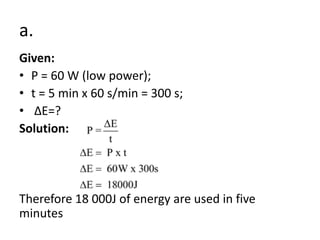
a.
Given:
• P = 60 W (low power);
• t = 5 min x 60 s/min = 300 s;
• ΔE=?
Solution:
Therefore 18 000J of energy are used in five
minutes
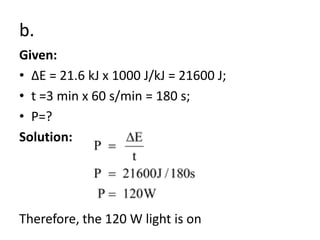
b.
Given:
• ΔE = 21.6 kJ x 1000 J/kJ = 21600 J;
• t =3 min x 60 s/min = 180 s;
• P=?
Solution:
Therefore, the 120 W light is on
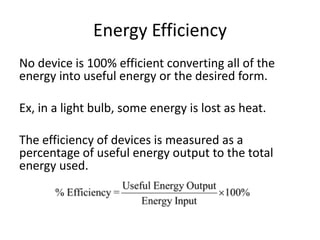
Energy Efficiency
No device is 100% efficient converting all of the
energy into useful energy or the desired form.
Ex, in a light bulb, some energy is lost as heat.
The efficiency of devices is measured as a
percentage of useful energy output to the total
energy used.
Example 1
Determine the percent efficiency of a 60 W
fluorescent light bulb that uses 2 000 J of
electrical energy to produce 400 J of light
energy.
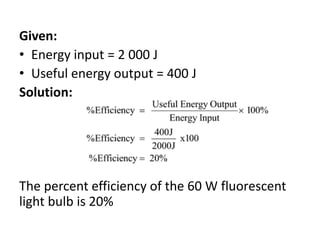
Given:
• Energy input = 2 000 J
• Useful energy output = 400 J
Solution:
The percent efficiency of the 60 W fluorescent
light bulb is 20%
Example 2
A kettle uses 1 300 W of power and was used to
boil 1L of water, which requires 290 kJ of energy.
If it took the kettle five minutes to boil the
water, what is its efficiency?
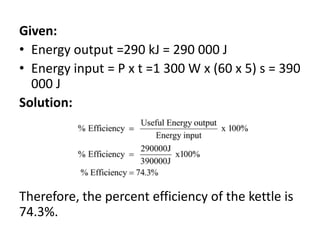
Given:
• Energy output =290 kJ = 290 000 J
• Energy input = P x t =1 300 W x (60 x 5) s = 390
000 J
Solution:
Therefore, the percent efficiency of the kettle is
74.3%.
Energy Consumption and Cost
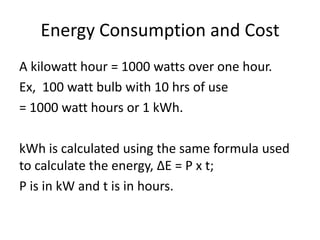
A kilowatt hour = 1000 watts over one hour.
Ex, 100 watt bulb with 10 hrs of use
= 1000 watt hours or 1 kWh.
kWh is calculated using the same formula used
to calculate the energy, ΔE = P x t;
P is in kW and t is in hours.
Example
Find the electric energy used by a TV for one
month, if the TV was on for 64.5 h and has a
power rating of 0.21 kilowatts.
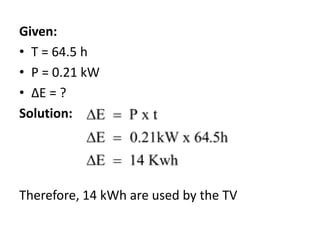
Given:
• T = 64.5 h
• P = 0.21 kW
• ΔE = ?
Solution:
Therefore, 14 kWh are used by the TV
Example
Calculate the cost of the electricity needed to
operate a hair dryer (3 200 W) for one month if
it is used for a total of 9.3 hours in the month.
The rate charged for electricity is $0.07/kWh.
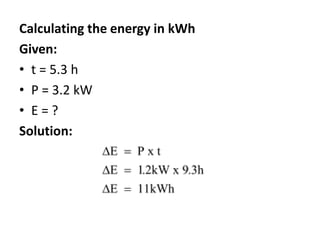
Calculating the energy in kWh
Given:
• t = 5.3 h
• P = 3.2 kW
• E = ?
Solution:
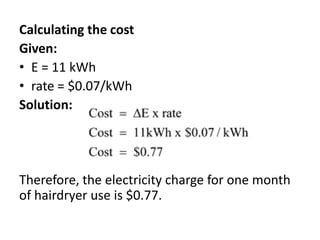
Calculating the cost
Given:
• E = 11 kWh
• rate = $0.07/kWh
Solution:
Therefore, the electricity charge for one month
of hairdryer use is $0.77.
Lighting and Heating Your Home
When designing new homes and offices, availability
of natural light should be considered, as natural light
is free.
Incandescent lights - average 5% of the energy
converted to visible light (lost energy converted to
heat).
Compact fluorescent lamps (CFL) - use 75% less
energy, last five to ten times longer These bulbs are
the only ones that carry an ENERGY STAR rating.
Turning down your furnace or air conditioner
when the house is empty could save up to 50%
of energy used for heating and air conditioning.
Programmable thermostats automatically turn
the heat down during the day when there is
nobody at home.

Energy at home calculation lesson

  • 1.
  • 2.
    Learning Goals: • Tocalculate power or energy use • To calculate energy efficiency • To calculate the cost of energy to run appliances
  • 3.
    Energy Use • Electricalpower is the amount of energy converted into light, heat, sound, or motion every second. The units for power are watts, given the symbol “W”.
  • 4.
    Power Calculation • ΔEis the energy used in joules (“J”) and t is the time in seconds (“s”) • in this power formula time units must be in seconds and energy units must be in joules. • Therefore a 60 W light bulb would use 60 J of energy in 1 second.
  • 5.
    Example A tri-light hassettings of 60 W, 120 W, and 150 W. • If set to low, how much energy is used in five minutes? • If you measured 21.6 kJ of energy use in three minutes, which bulb was on?
  • 6.
    a. Given: • P =60 W (low power); • t = 5 min x 60 s/min = 300 s; • ΔE=? Solution: Therefore 18 000J of energy are used in five minutes
  • 7.
    b. Given: • ΔE =21.6 kJ x 1000 J/kJ = 21600 J; • t =3 min x 60 s/min = 180 s; • P=? Solution: Therefore, the 120 W light is on
  • 8.
    Energy Efficiency No deviceis 100% efficient converting all of the energy into useful energy or the desired form. Ex, in a light bulb, some energy is lost as heat. The efficiency of devices is measured as a percentage of useful energy output to the total energy used.
  • 9.
    Example 1 Determine thepercent efficiency of a 60 W fluorescent light bulb that uses 2 000 J of electrical energy to produce 400 J of light energy.
  • 10.
    Given: • Energy input= 2 000 J • Useful energy output = 400 J Solution: The percent efficiency of the 60 W fluorescent light bulb is 20%
  • 11.
    Example 2 A kettleuses 1 300 W of power and was used to boil 1L of water, which requires 290 kJ of energy. If it took the kettle five minutes to boil the water, what is its efficiency?
  • 12.
    Given: • Energy output=290 kJ = 290 000 J • Energy input = P x t =1 300 W x (60 x 5) s = 390 000 J Solution: Therefore, the percent efficiency of the kettle is 74.3%.
  • 13.
    Energy Consumption andCost A kilowatt hour = 1000 watts over one hour. Ex, 100 watt bulb with 10 hrs of use = 1000 watt hours or 1 kWh. kWh is calculated using the same formula used to calculate the energy, ΔE = P x t; P is in kW and t is in hours.
  • 14.
    Example Find the electricenergy used by a TV for one month, if the TV was on for 64.5 h and has a power rating of 0.21 kilowatts.
  • 15.
    Given: • T =64.5 h • P = 0.21 kW • ΔE = ? Solution: Therefore, 14 kWh are used by the TV
  • 16.
    Example Calculate the costof the electricity needed to operate a hair dryer (3 200 W) for one month if it is used for a total of 9.3 hours in the month. The rate charged for electricity is $0.07/kWh.
  • 17.
    Calculating the energyin kWh Given: • t = 5.3 h • P = 3.2 kW • E = ? Solution:
  • 18.
    Calculating the cost Given: •E = 11 kWh • rate = $0.07/kWh Solution: Therefore, the electricity charge for one month of hairdryer use is $0.77.
  • 19.
    Lighting and HeatingYour Home When designing new homes and offices, availability of natural light should be considered, as natural light is free. Incandescent lights - average 5% of the energy converted to visible light (lost energy converted to heat). Compact fluorescent lamps (CFL) - use 75% less energy, last five to ten times longer These bulbs are the only ones that carry an ENERGY STAR rating.
  • 20.
    Turning down yourfurnace or air conditioner when the house is empty could save up to 50% of energy used for heating and air conditioning. Programmable thermostats automatically turn the heat down during the day when there is nobody at home.