Pick One Setof Questions to Answer
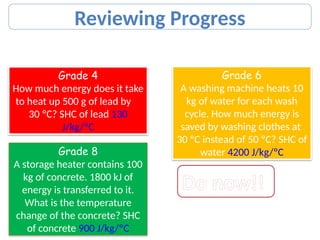
Grade 4
How much energy does it take
to heat up 500 g of lead by
30 ºC? SHC of lead 130
J/kg/ºC
Grade 6
A washing machine heats 10
kg of water for each wash
cycle. How much energy is
saved by washing clothes at
30 ºC instead of 50 ºC? SHC of
water 4200 J/kg/ºC
Grade 8
A storage heater contains 100
kg of concrete. 1800 kJ of
energy is transferred to it.
What is the temperature
change of the concrete? SHC
of concrete 900 J/kg/ºC
Reviewing Progress
Do now!!
3.
Answers
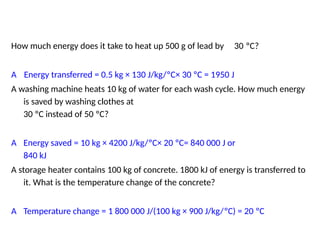
How much energydoes it take to heat up 500 g of lead by 30 ºC?
A Energy transferred = 0.5 kg × 130 J/kg/ºC× 30 ºC = 1950 J
A washing machine heats 10 kg of water for each wash cycle. How much energy
is saved by washing clothes at
30 ºC instead of 50 ºC?
A Energy saved = 10 kg × 4200 J/kg/ºC× 20 ºC= 840 000 J or
840 kJ
A storage heater contains 100 kg of concrete. 1800 kJ of energy is transferred to
it. What is the temperature change of the concrete?
A Temperature change = 1 800 000 J/(100 kg × 900 J/kg/ºC) = 20 ºC
4.
Sit in yourallocated seat, get out your equipment and
write the title, LQ and date,
and begin the starter.
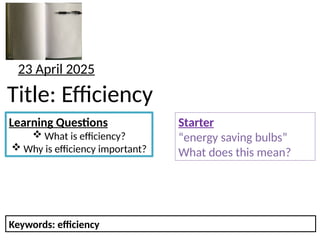
Title: Efficiency
23 April 2025
Keywords: efficiency
Learning Questions
What is efficiency?
Why is efficiency important?
Starter
“energy saving bulbs”
What does this mean?
5.
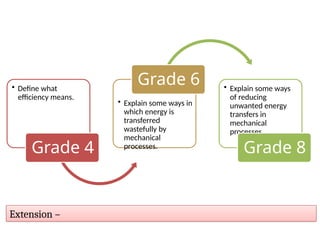
Success criteria
Extension –
•Define what
efficiency means.
Grade 4
• Explain some ways in
which energy is
transferred
wastefully by
mechanical
processes.
Grade 6 • Explain some ways
of reducing
unwanted energy
transfers in
mechanical
processes.
Grade 8
6.
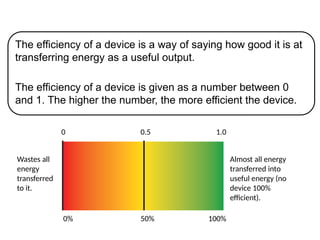
The efficiency ofa device is a way of saying how good it is at
transferring energy as a useful output.
The efficiency of a device is given as a number between 0
and 1. The higher the number, the more efficient the device.
What is efficiency?
0
0%
0.5
50%
1.0
100%
Wastes all
energy
transferred
to it.
Almost all energy
transferred into
useful energy (no
device 100%
efficient).
7.
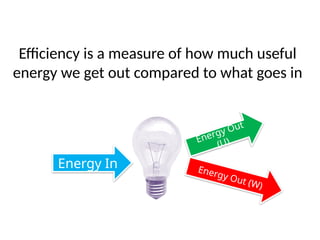
Efficiency is ameasure of how much useful
energy we get out compared to what goes in
Energy In
Energy Out
(U)
Energy Out (W)
What is efficiency?
8.
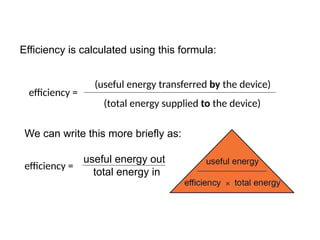
(useful energy transferredby the device)
Efficiency is calculated using this formula:
efficiency =
We can write this more briefly as:
useful energy out
total energy in
efficiency =
(total energy supplied to the device)
How do we calculate efficiency?
9.
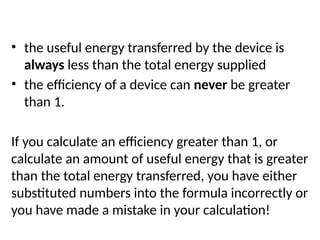
Things to rememberwhen you are using the formula:
• the useful energy transferred by the device is
always less than the total energy supplied
• the efficiency of a device can never be greater
than 1.
If you calculate an efficiency greater than 1, or
calculate an amount of useful energy that is greater
than the total energy transferred, you have either
substituted numbers into the formula incorrectly or
you have made a mistake in your calculation!
10.
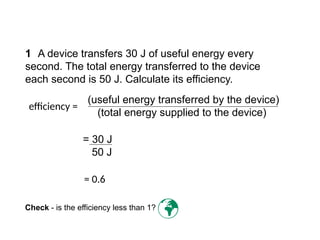
1 A devicetransfers 30 J of useful energy every
second. The total energy transferred to the device
each second is 50 J. Calculate its efficiency.
= 30 J
50 J
Check - is the efficiency less than 1?
= 0.6
(useful energy transferred by the device)
(total energy supplied to the device)
efficiency =
Progress Questions
11.
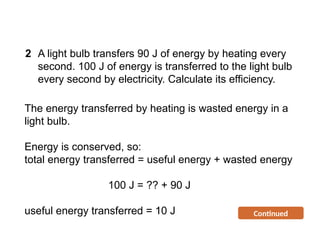
The energy transferredby heating is wasted energy in a
light bulb.
Energy is conserved, so:
total energy transferred = useful energy + wasted energy
100 J = ?? + 90 J
useful energy transferred = 10 J Continued
2 A light bulb transfers 90 J of energy by heating every
second. 100 J of energy is transferred to the light bulb
every second by electricity. Calculate its efficiency.
Progress Questions
12.
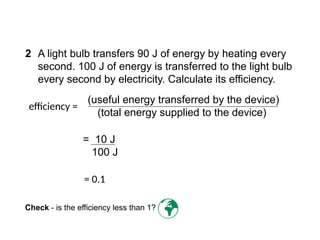
2 A lightbulb transfers 90 J of energy by heating every
second. 100 J of energy is transferred to the light bulb
every second by electricity. Calculate its efficiency.
(useful energy transferred by the device)
(total energy supplied to the device)
efficiency =
= 10 J
100 J
= 0.1
Check - is the efficiency less than 1?
Progress Questions
13.
Efficiency practical
Introduction: Thepower rating of an electric kettle tells us
how many joules of energy are transferred in the heating
element every second. So an electric kettle with a power
rating of 3 kW transfers 3000 joules (3 kJ) of energy every
second.
Aim: To test a kettle to see how much electrical energy it
actually uses to do this.
In theory, it takes 336 000 J of energy to heat 1 litre of water
from 20 °C (roughly room temperature) to boiling point.
14.
Planning
You need tomeasure the following things:
• 1 litre (1 kg) of water into the kettle
• the time to reach boiling point in seconds after
the kettle is turned on.
• Write a step-by-step plan for your investigation.
Think about how to measure the amount of
water accurately, how to measure the time to
boil the water and how to tell when the water is
boiling.
15.
Efficiency practical
Recording yourresults
1. How many seconds did the kettle take to boil 1 litre of water?
2. What was the power of your kettle in watts? (Convert kW to
W by multiplying by 1000.)
3. Use this formula to calculate the energy transferred by the
kettle.
energy (in J) = power (in W) × time (in seconds)
Considering your results/conclusions
4. What do you notice about the amount of energy actually
needed to boil the water compared with the theoretical
value?
5. Why is there a difference?
6. Calculate the efficiency of the kettle.
Check - isthe efficiency less than 1?
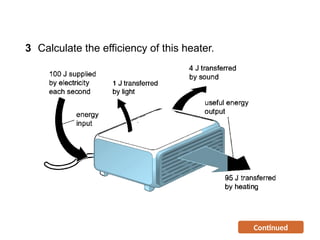
= 95 J
100 J
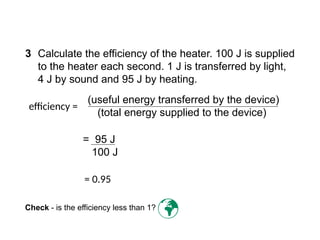
(useful energy transferred by the device)
(total energy supplied to the device)
efficiency =
= 0.95
3 Calculate the efficiency of the heater. 100 J is supplied
to the heater each second. 1 J is transferred by light,
4 J by sound and 95 J by heating.
Progress Questions
18.
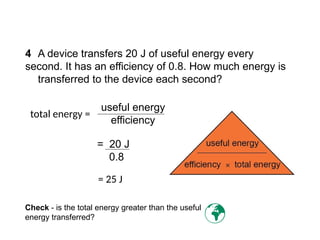
4 A devicetransfers 20 J of useful energy every
second. It has an efficiency of 0.8. How much energy is
transferred to the device each second?
useful energy
efficiency
total energy =
= 20 J
0.8
= 25 J
Check - is the total energy greater than the useful
energy transferred?
Progress Questions
19.
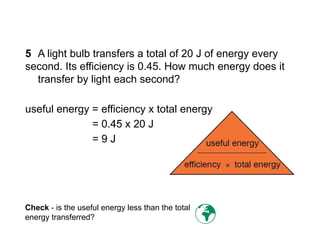
5 A lightbulb transfers a total of 20 J of energy every
second. Its efficiency is 0.45. How much energy does it
transfer by light each second?
useful energy = efficiency x total energy
= 0.45 x 20 J
= 9 J
Check - is the useful energy less than the total
energy transferred?
Progress Questions
20.
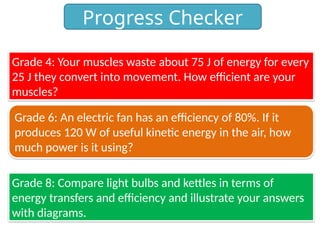
Progress Checker
Grade 4:Your muscles waste about 75 J of energy for every
25 J they convert into movement. How efficient are your
muscles?
Grade 6: An electric fan has an efficiency of 80%. If it
produces 120 W of useful kinetic energy in the air, how
much power is it using?
Grade 8: Compare light bulbs and kettles in terms of
energy transfers and efficiency and illustrate your answers
with diagrams.
21.
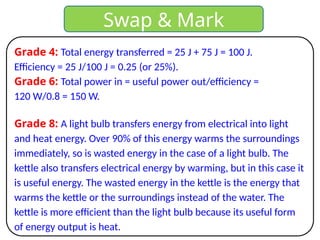
Grade 4: Totalenergy transferred = 25 J + 75 J = 100 J.
Efficiency = 25 J/100 J = 0.25 (or 25%).
Grade 6: Total power in = useful power out/efficiency =
120 W/0.8 = 150 W.
Grade 8: A light bulb transfers energy from electrical into light
and heat energy. Over 90% of this energy warms the surroundings
immediately, so is wasted energy in the case of a light bulb. The
kettle also transfers electrical energy by warming, but in this case it
is useful energy. The wasted energy in the kettle is the energy that
warms the kettle or the surroundings instead of the water. The
kettle is more efficient than the light bulb because its useful form
of energy output is heat.
Swap & Mark
22.
Progress– plenary task(6 mark
question)
Grade 4 2 marks
Grade 6 4 marks
Grade 8 6 marks
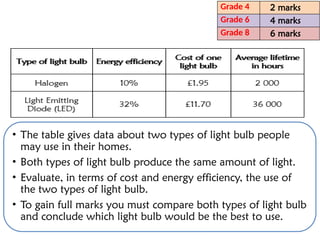
• The table gives data about two types of light bulb people
may use in their homes.
• Both types of light bulb produce the same amount of light.
• Evaluate, in terms of cost and energy efficiency, the use of
the two types of light bulb.
• To gain full marks you must compare both types of light bulb
and conclude which light bulb would be the best to use.
23.
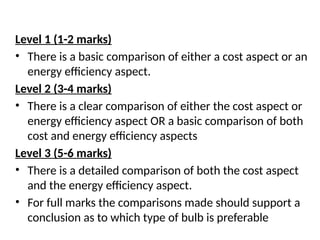
Level 1 (1-2marks)
• There is a basic comparison of either a cost aspect or an
energy efficiency aspect.
Level 2 (3-4 marks)
• There is a clear comparison of either the cost aspect or
energy efficiency aspect OR a basic comparison of both
cost and energy efficiency aspects
Level 3 (5-6 marks)
• There is a detailed comparison of both the cost aspect
and the energy efficiency aspect.
• For full marks the comparisons made should support a
conclusion as to which type of bulb is preferable
24.
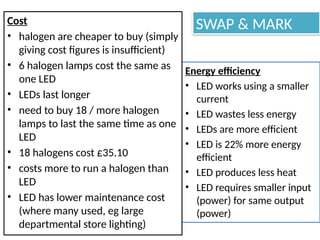
Energy efficiency
• LEDworks using a smaller
current
• LED wastes less energy
• LEDs are more efficient
• LED is 22% more energy
efficient
• LED produces less heat
• LED requires smaller input
(power) for same output
(power)
Cost
• halogen are cheaper to buy (simply
giving cost figures is insufficient)
• 6 halogen lamps cost the same as
one LED
• LEDs last longer
• need to buy 18 / more halogen
lamps to last the same time as one
LED
• 18 halogens cost £35.10
• costs more to run a halogen than
LED
• LED has lower maintenance cost
(where many used, eg large
departmental store lighting)
SWAP & MARK
25.
Progression questions
1. Whatdoes efficiency mean?
2. How do we calculate the efficiency of an energy
transfer?
3. How can we reduce unwanted energy transfers
in machines?
26.
Plenary
What can youdo now?
define what efficiency means
recall and use the formula for calculating energy
efficiency
explain some ways in which energy is transferred
wastefully by mechanical processes
explain some ways of reducing unwanted energy
transfers in mechanical processes.
27.
Homework
In your planners:
Learnand study the
questions ‘n’
answers
You will be tested in
next lesson- no
excuses!!
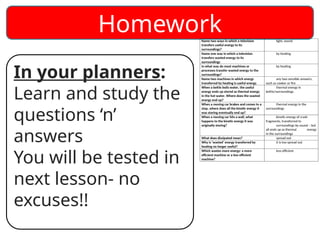
Quick Progress Quiz
Name two ways in which a television
transfers useful energy to its
surroundings?
light, sound
Name one way in which a television
transfers wasted energy to its
surroundings
by heating
In what way do most machines or
processes transfer wasted energy to the
surroundings?
by heating
Name two machines in which energy
transferred by heating is useful energy.
any two sensible answers,
such as cooker or fire
When a kettle boils water, the useful
energy ends up stored as thermal energy
in the hot water. Where does the wasted
energy end up?
thermal energy in
kettle/surroundings
When a moving car brakes and comes to a
stop, where does all the kinetic energy it
was storing eventually end up?
thermal energy in the
surroundings
When a moving car hits a wall, what
happens to the kinetic energy it was
originally storing?
kinetic energy of crash
fragments, transferred to
surroundings by sound – but
all ends up as thermal energy
in the surroundings
What does dissipated mean? spread out
Why is ‘wasted’ energy transferred by
heating no longer useful?
it is too spread out
Which wastes more energy: a more
efficient machine or a less efficient
machine?
less efficient
Editor's Notes
#2 How much energy does it take to heat up 500 g of lead by 30 ºC?
A Energy transferred = 0.5 kg × 130 J/kg/ºC× 30 ºC = 1950 J
A washing machine heats 10 kg of water for each wash cycle. How much energy is saved by washing clothes at
30 ºC instead of 50 ºC?
A Energy saved = 10 kg × 4200 J/kg/ºC× 20 ºC= 840 000 J or
840 kJ
A storage heater contains 100 kg of concrete. 1800 kJ of energy is transferred to it. What is the temperature change of the concrete?
A Temperature change = 1 800 000 J/(100 kg × 900 J/kg/ºC) = 20 ºC