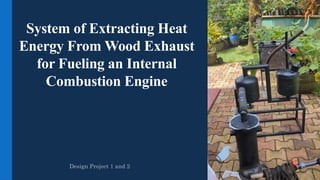
System of Extracting Heat
Energy From Wood Exhaust
for Fueling an Internal
Combustion Engine
Design Project 1 and 2
Group Members
 MM/20/0486 - K.H.S.Sandeepa
 MM/20/0501 - M.V.S.Yasas
 MM/20/0504 - J.Sugitharan
Group No: 21
Principles of Gasification
 Gasification is defined as the conversion of biomass into a gaseous-
energy carrier by means of partial oxidation at the elevated
temperature.
 This process involves a sequence of chemical and thermal reactions
like the oxidation and reduction.
 Gasification process convert solid biomass with a limited quantity
of air into Producer gas.
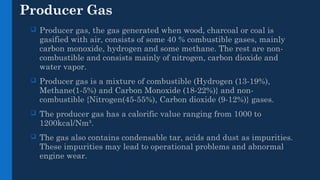
Producer Gas
 Producer gas, the gas generated when wood, charcoal or coal is
gasified with air, consists of some 40 % combustible gases, mainly
carbon monoxide, hydrogen and some methane. The rest are non-
combustible and consists mainly of nitrogen, carbon dioxide and
water vapor.
 Producer gas is a mixture of combustible (Hydrogen (13-19%),
Methane(1-5%) and Carbon Monoxide (18-22%)} and non-
combustible {Nitrogen(45-55%), Carbon dioxide (9-12%)} gases.
 The producer gas has a calorific value ranging from 1000 to
1200kcal/Nm³.
 The gas also contains condensable tar, acids and dust as impurities.
These impurities may lead to operational problems and abnormal
engine wear.
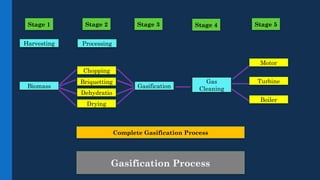
Stage 1 Stage 2 Stage 3 Stage 4 Stage 5
Harvesting Processing
Chopping
Briquetting
Dehydratio
n
Drying
Biomass Gasification
Gas
Cleaning
Boiler
Turbine
Motor
Complete Gasification Process
Gasification Process
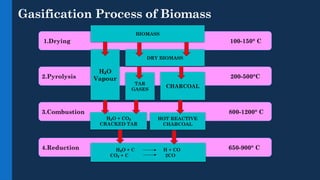
Gasification Process of Biomass
1.Drying 100-150° C
2.Pyrolysis 200-500°C
3.Combustion 800-1200° C
4.Reduction 650-900° C
BIOMASS
H O + C H + CO
₂
CO + C 2CO
₂
H O
₂
Vapour
DRY BIOMASS
TAR
GASES
CHARCOAL
H O + CO
₂ ₂
CRACKED TAR
HOT REACTIVE
CHARCOAL
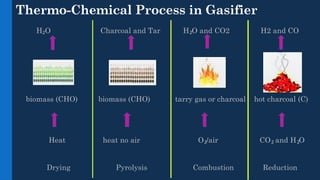
Thermo-Chemical Process in Gasifier
H O Charcoal and Tar H O and CO2 H2 and CO
₂ ₂
biomass (CHO) biomass (CHO) tarry gas or charcoal hot charcoal (C)
Heat heat no air O /air CO and H O
₂ ₂ ₂
Drying Pyrolysis Combustion Reduction
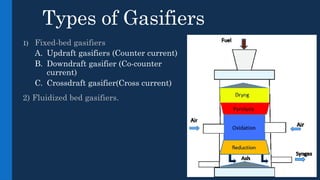
Types of Gasifiers
1) Fixed-bed gasifiers
A. Updraft gasifiers (Counter current)
B. Downdraft gasifier (Co-counter
current)
C. Crossdraft gasifier(Cross current)
2) Fluidized bed gasifiers.
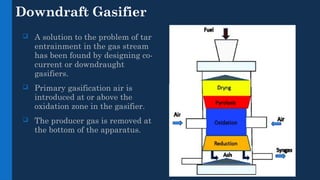
Downdraft Gasifier
 A solution to the problem of tar
entrainment in the gas stream
has been found by designing co-
current or downdraught
gasifiers.
 Primary gasification air is
introduced at or above the
oxidation zone in the gasifier.
 The producer gas is removed at
the bottom of the apparatus.
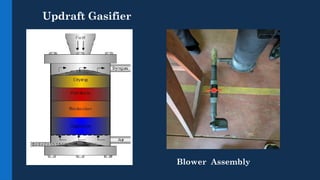
Updraft Gasifier
Blower Assembly
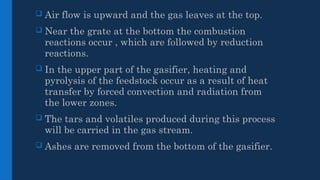
 Air flow is upward and the gas leaves at the top.
 Near the grate at the bottom the combustion
reactions occur , which are followed by reduction
reactions.
 In the upper part of the gasifier, heating and
pyrolysis of the feedstock occur as a result of heat
transfer by forced convection and radiation from
the lower zones.
 The tars and volatiles produced during this process
will be carried in the gas stream.
 Ashes are removed from the bottom of the gasifier.
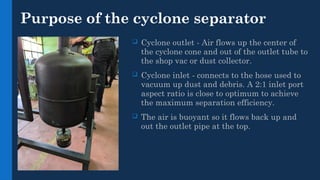
 Cyclone outlet - Air flows up the center of
the cyclone cone and out of the outlet tube to
the shop vac or dust collector.
 Cyclone inlet - connects to the hose used to
vacuum up dust and debris. A 2:1 inlet port
aspect ratio is close to optimum to achieve
the maximum separation efficiency.
 The air is buoyant so it flows back up and
out the outlet pipe at the top.
Purpose of the cyclone separator
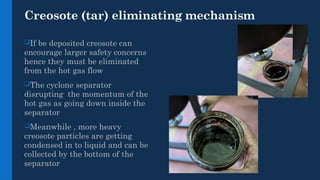
Creosote (tar) eliminating mechanism
If be deposited creosote can
encourage larger safety concerns
hence they must be eliminated
from the hot gas flow
The cyclone separator
disrupting the momentum of the
hot gas as going down inside the
separator
Meanwhile , more heavy
creosote particles are getting
condensed in to liquid and can be
collected by the bottom of the
separator
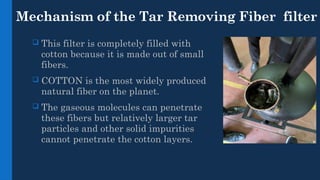
Mechanism of the Tar Removing Fiber filter
 This filter is completely filled with
cotton because it is made out of small
fibers.
 COTTON is the most widely produced
natural fiber on the planet.
 The gaseous molecules can penetrate
these fibers but relatively larger tar
particles and other solid impurities
cannot penetrate the cotton layers.
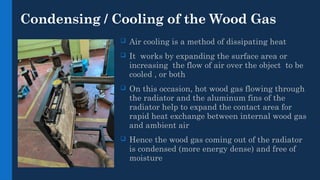
Condensing / Cooling of the Wood Gas
 Air cooling is a method of dissipating heat
 It works by expanding the surface area or
increasing the flow of air over the object to be
cooled , or both
 On this occasion, hot wood gas flowing through
the radiator and the aluminum fins of the
radiator help to expand the contact area for
rapid heat exchange between internal wood gas
and ambient air
 Hence the wood gas coming out of the radiator
is condensed (more energy dense) and free of
moisture
Achievements
 We were able to produce synthesis gas from Carbonaceous
materials.
 Through gasification we recovered more energy and higher heat
capacity in contrast to Pyrolysis and combustion.
 Via this project, the use of the fossil fuels can be reduced and
waste gasification is used to enhance programs for recycling.
 Pure wood charcol which is a by product of this system's
operation can be used for as a alternative for Coal.
 Furthermore purification of creosote can will lead to the
generation of useful low grade fuel which can be an option for
boiler fael.
References
 National Institute of Technology, Srinagar(Retrieved March 09, 2024,
from https://www.nitsri.ac.in/)
 Bioeconomy Institute(Retrieved March 15, 2024, from -Bioeconomy
Institute (iastate.edu))
 Alternative Energy Promotion Centre(Retrieved March 15, 2024, from -
AEPC)
 Bio Energy Association of Sri Lanka(Retrieved March 15, 2024, from -
Bio Energy Association of Sri Lanka (bioenergysrilanka.lk])
 Food and Agriculture Organization of the United Nations(Retrieved
March 15, 2024, from https://www.fao.org/home/en)
Thank You

Gasifier construction and demonstration.pptx

  • 1.
    System of ExtractingHeat Energy From Wood Exhaust for Fueling an Internal Combustion Engine Design Project 1 and 2
  • 2.
    Group Members  MM/20/0486- K.H.S.Sandeepa  MM/20/0501 - M.V.S.Yasas  MM/20/0504 - J.Sugitharan Group No: 21
  • 3.
    Principles of Gasification Gasification is defined as the conversion of biomass into a gaseous- energy carrier by means of partial oxidation at the elevated temperature.  This process involves a sequence of chemical and thermal reactions like the oxidation and reduction.  Gasification process convert solid biomass with a limited quantity of air into Producer gas.
  • 4.
    Producer Gas  Producergas, the gas generated when wood, charcoal or coal is gasified with air, consists of some 40 % combustible gases, mainly carbon monoxide, hydrogen and some methane. The rest are non- combustible and consists mainly of nitrogen, carbon dioxide and water vapor.  Producer gas is a mixture of combustible (Hydrogen (13-19%), Methane(1-5%) and Carbon Monoxide (18-22%)} and non- combustible {Nitrogen(45-55%), Carbon dioxide (9-12%)} gases.  The producer gas has a calorific value ranging from 1000 to 1200kcal/Nm³.  The gas also contains condensable tar, acids and dust as impurities. These impurities may lead to operational problems and abnormal engine wear.
  • 5.
    Stage 1 Stage2 Stage 3 Stage 4 Stage 5 Harvesting Processing Chopping Briquetting Dehydratio n Drying Biomass Gasification Gas Cleaning Boiler Turbine Motor Complete Gasification Process Gasification Process
  • 6.
    Gasification Process ofBiomass 1.Drying 100-150° C 2.Pyrolysis 200-500°C 3.Combustion 800-1200° C 4.Reduction 650-900° C BIOMASS H O + C H + CO ₂ CO + C 2CO ₂ H O ₂ Vapour DRY BIOMASS TAR GASES CHARCOAL H O + CO ₂ ₂ CRACKED TAR HOT REACTIVE CHARCOAL
  • 7.
    Thermo-Chemical Process inGasifier H O Charcoal and Tar H O and CO2 H2 and CO ₂ ₂ biomass (CHO) biomass (CHO) tarry gas or charcoal hot charcoal (C) Heat heat no air O /air CO and H O ₂ ₂ ₂ Drying Pyrolysis Combustion Reduction
  • 8.
    Types of Gasifiers 1)Fixed-bed gasifiers A. Updraft gasifiers (Counter current) B. Downdraft gasifier (Co-counter current) C. Crossdraft gasifier(Cross current) 2) Fluidized bed gasifiers.
  • 9.
    Downdraft Gasifier  Asolution to the problem of tar entrainment in the gas stream has been found by designing co- current or downdraught gasifiers.  Primary gasification air is introduced at or above the oxidation zone in the gasifier.  The producer gas is removed at the bottom of the apparatus.
  • 10.
  • 11.
     Air flowis upward and the gas leaves at the top.  Near the grate at the bottom the combustion reactions occur , which are followed by reduction reactions.  In the upper part of the gasifier, heating and pyrolysis of the feedstock occur as a result of heat transfer by forced convection and radiation from the lower zones.  The tars and volatiles produced during this process will be carried in the gas stream.  Ashes are removed from the bottom of the gasifier.
  • 12.
     Cyclone outlet- Air flows up the center of the cyclone cone and out of the outlet tube to the shop vac or dust collector.  Cyclone inlet - connects to the hose used to vacuum up dust and debris. A 2:1 inlet port aspect ratio is close to optimum to achieve the maximum separation efficiency.  The air is buoyant so it flows back up and out the outlet pipe at the top. Purpose of the cyclone separator
  • 13.
    Creosote (tar) eliminatingmechanism If be deposited creosote can encourage larger safety concerns hence they must be eliminated from the hot gas flow The cyclone separator disrupting the momentum of the hot gas as going down inside the separator Meanwhile , more heavy creosote particles are getting condensed in to liquid and can be collected by the bottom of the separator
  • 14.
    Mechanism of theTar Removing Fiber filter  This filter is completely filled with cotton because it is made out of small fibers.  COTTON is the most widely produced natural fiber on the planet.  The gaseous molecules can penetrate these fibers but relatively larger tar particles and other solid impurities cannot penetrate the cotton layers.
  • 15.
    Condensing / Coolingof the Wood Gas  Air cooling is a method of dissipating heat  It works by expanding the surface area or increasing the flow of air over the object to be cooled , or both  On this occasion, hot wood gas flowing through the radiator and the aluminum fins of the radiator help to expand the contact area for rapid heat exchange between internal wood gas and ambient air  Hence the wood gas coming out of the radiator is condensed (more energy dense) and free of moisture
  • 16.
    Achievements  We wereable to produce synthesis gas from Carbonaceous materials.  Through gasification we recovered more energy and higher heat capacity in contrast to Pyrolysis and combustion.  Via this project, the use of the fossil fuels can be reduced and waste gasification is used to enhance programs for recycling.  Pure wood charcol which is a by product of this system's operation can be used for as a alternative for Coal.  Furthermore purification of creosote can will lead to the generation of useful low grade fuel which can be an option for boiler fael.
  • 17.
    References  National Instituteof Technology, Srinagar(Retrieved March 09, 2024, from https://www.nitsri.ac.in/)  Bioeconomy Institute(Retrieved March 15, 2024, from -Bioeconomy Institute (iastate.edu))  Alternative Energy Promotion Centre(Retrieved March 15, 2024, from - AEPC)  Bio Energy Association of Sri Lanka(Retrieved March 15, 2024, from - Bio Energy Association of Sri Lanka (bioenergysrilanka.lk])  Food and Agriculture Organization of the United Nations(Retrieved March 15, 2024, from https://www.fao.org/home/en)
  • 18.