22PCOAM16 Unit 2 Session 16 Interpolations and Basic Functions.pptx
1.
21/03/2025 1
Department ofComputer Science & Engineering (SB-ET)
III B. Tech -I Semester
MACHINE LEARNING
SUBJECT CODE: 22PCOAM16
AcademicY
ear: 2023-2024
by
Dr. M.Gokilavani
GNITC
Department of CSE (SB-ET)
2.
21/03/2025 Department ofCSE (SB-ET) 2
22PCOAM16 MACHINE LEARNING
UNIT – II
Syllabus
Multi-layer Perceptron– Going Forwards – Going Backwards: Back
Propagation Error – Multi-layer Perceptron in Practice – Examples of
using the MLP – Overview – Deriving Back-Propagation – Radial Basis
Functions and Splines – Concepts – RBF Network – Curse of
Dimensionality – Interpolations and Basis Functions – Support Vector
Machines.
3.
21/03/2025 3
TEXTBOOK:
• StephenMarsland, Machine Learning - An Algorithmic Perspective, Second Edition,
Chapman and Hall/CRC.
• Machine Learning and Pattern Recognition Series, 2014.
REFERENCES:
• Tom M Mitchell, Machine Learning, First Edition, McGraw Hill Education, 2013.
• Ethem Alpaydin, Introduction to Machine Learning 3e (Adaptive Computation and
Machine
No of Hours Required: 13
Department of CSE (SB-ET)
UNIT - II LECTURE - 16
4.
21/03/2025 Department ofCSE (SB-ET) 4
Interpolations and Basic Functions
UNIT - II LECTURE - 16
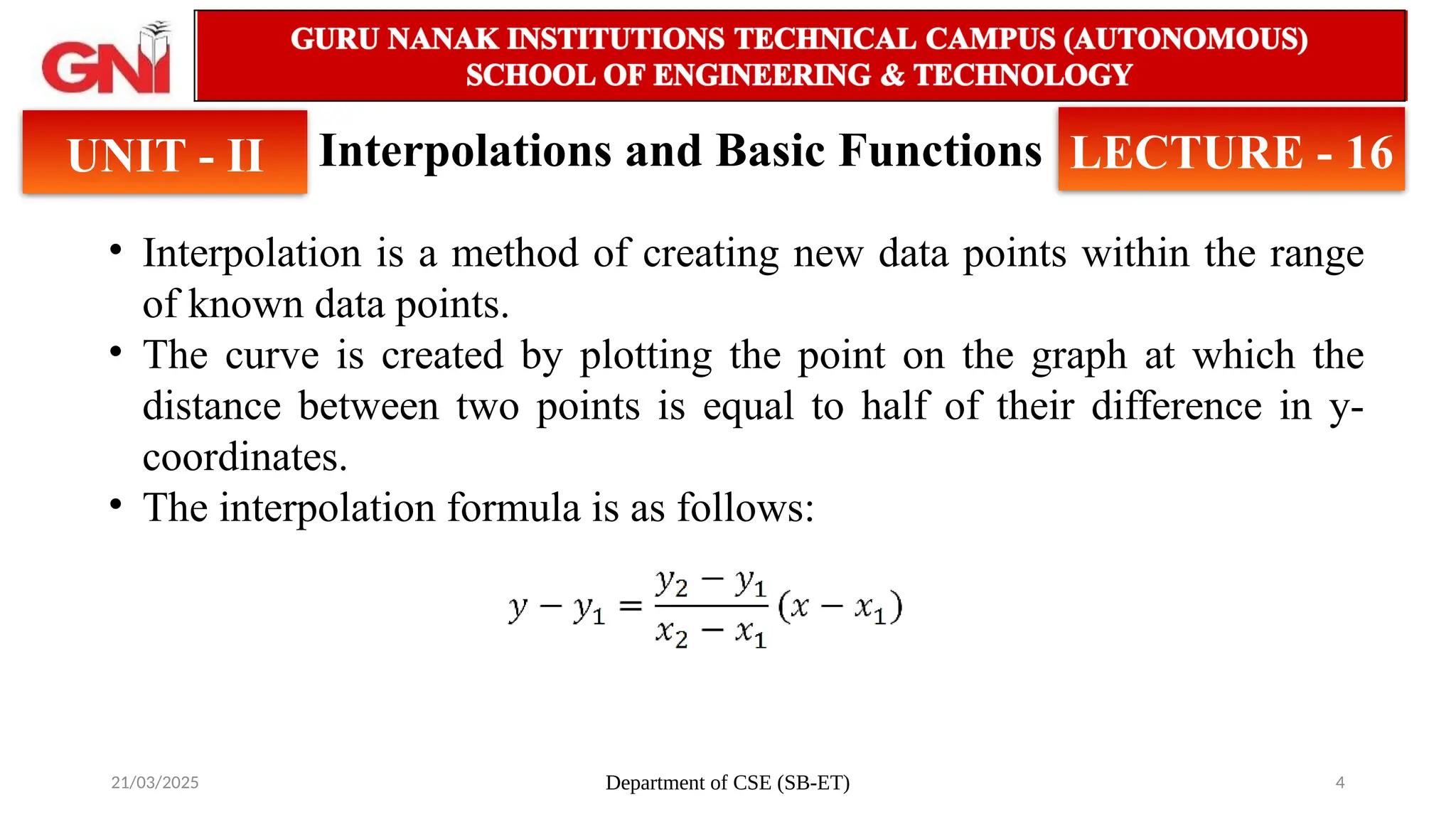
• Interpolation is a method of creating new data points within the range
of known data points.
• The curve is created by plotting the point on the graph at which the
distance between two points is equal to half of their difference in y-
coordinates.
• The interpolation formula is as follows:
5.
21/03/2025 Department ofCSE (SB-ET) 5
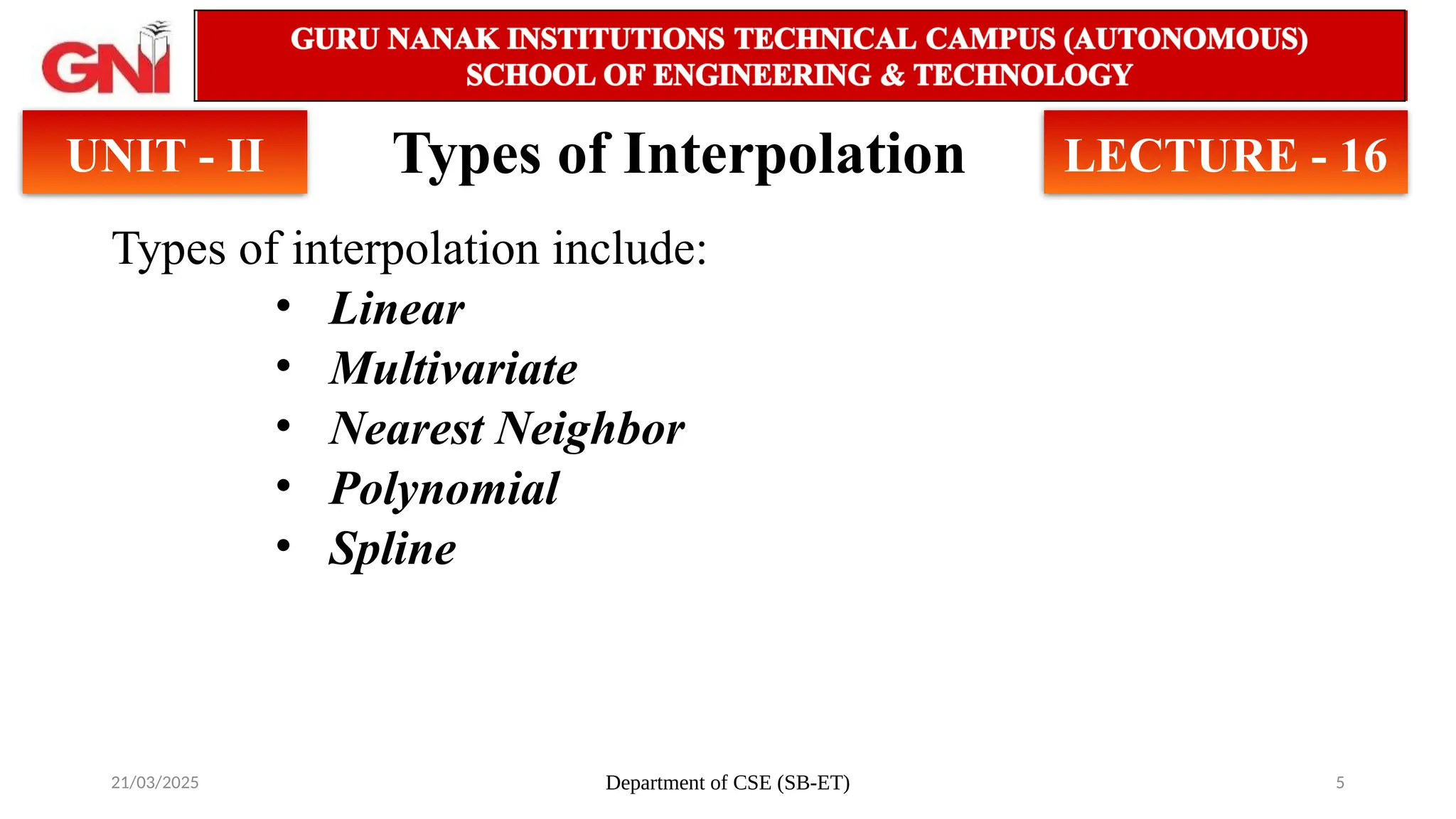
Types of Interpolation
Types of interpolation include:
• Linear
• Multivariate
• Nearest Neighbor
• Polynomial
• Spline
UNIT - II LECTURE - 16
6.
21/03/2025 Department ofCSE (SB-ET) 6
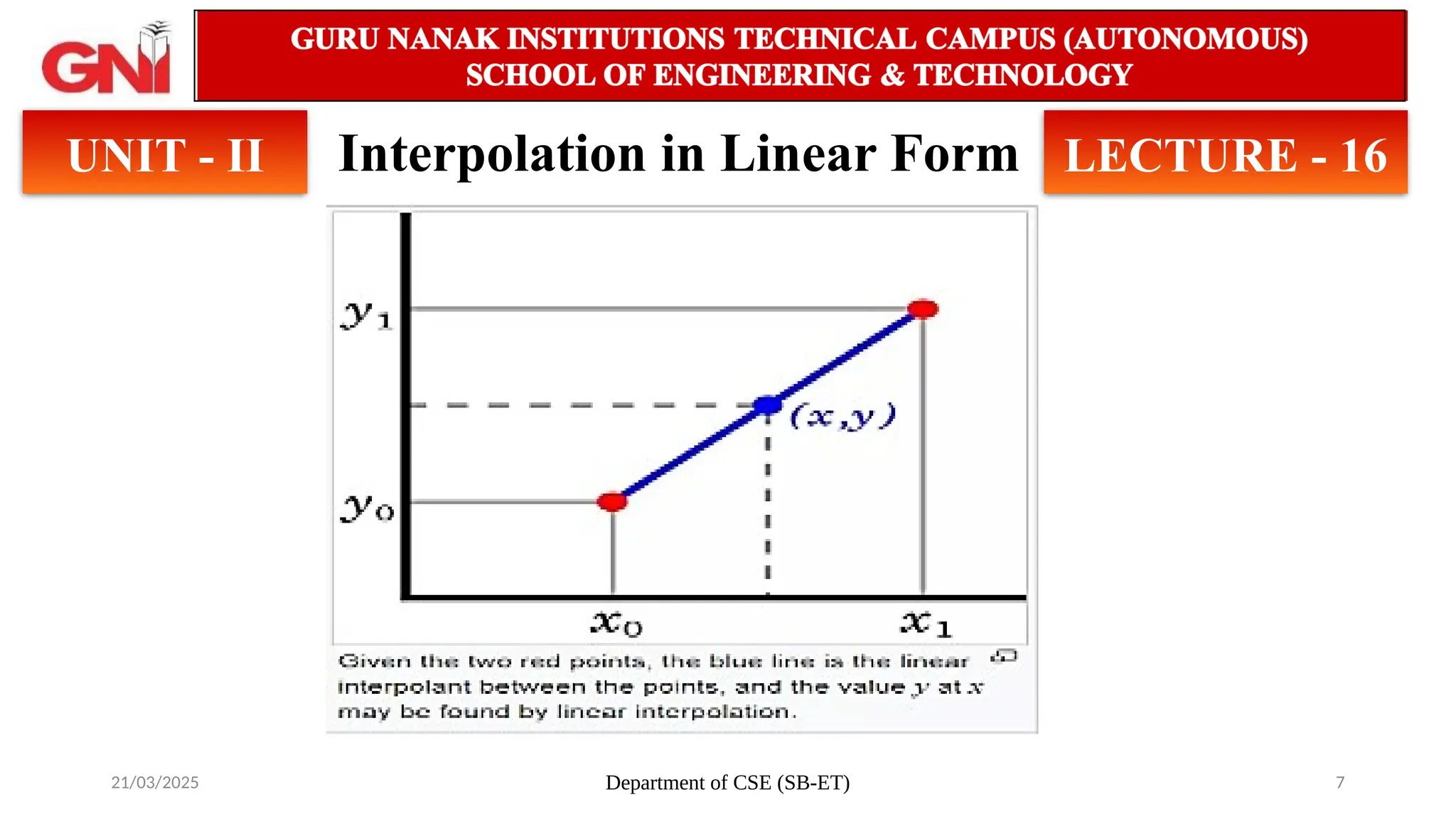
Interpolation in Linear Form
• Linear interpolation creates a continuous function out of discrete
data.
• It’s a foundational building block for the gradient descent
algorithm, which is used in the training of just about every machine
learning technique.
• Interpolation of a data set Linear interpolation on a set of data
points (x0, y0), (x1, y1), ..., (xn, yn) is defined as the concatenation
of linear interpolants between each pair of data points.
• This results in a continuous curve.
UNIT - II LECTURE - 16
21/03/2025 Department ofCSE (SB-ET) 8
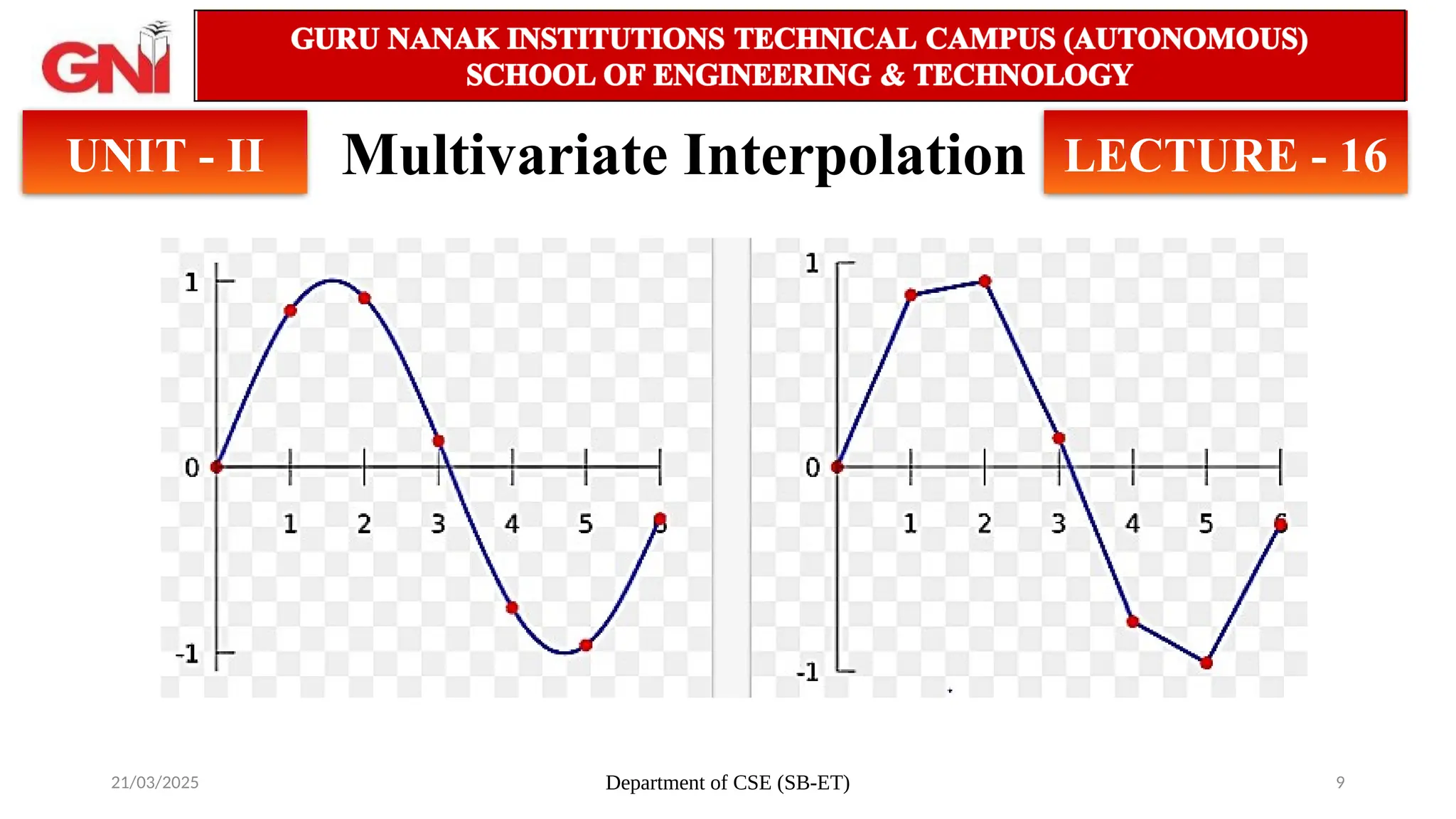
Multivariate Interpolation
• In numerical analysis, multivariate interpolation is
interpolation on functions of more than one variable; when
the variates are spatial coordinates, it is also known as
spatial interpolation.
• The function to be interpolated is known at given
points(xi,yi,zi,….) and the interpolation problem consists of
yielding values at arbitrary points(x,y,z,…).
UNIT - II LECTURE - 16
21/03/2025 Department ofCSE (SB-ET) 10
Nearest Neighbor Interpolation
UNIT - II LECTURE - 16
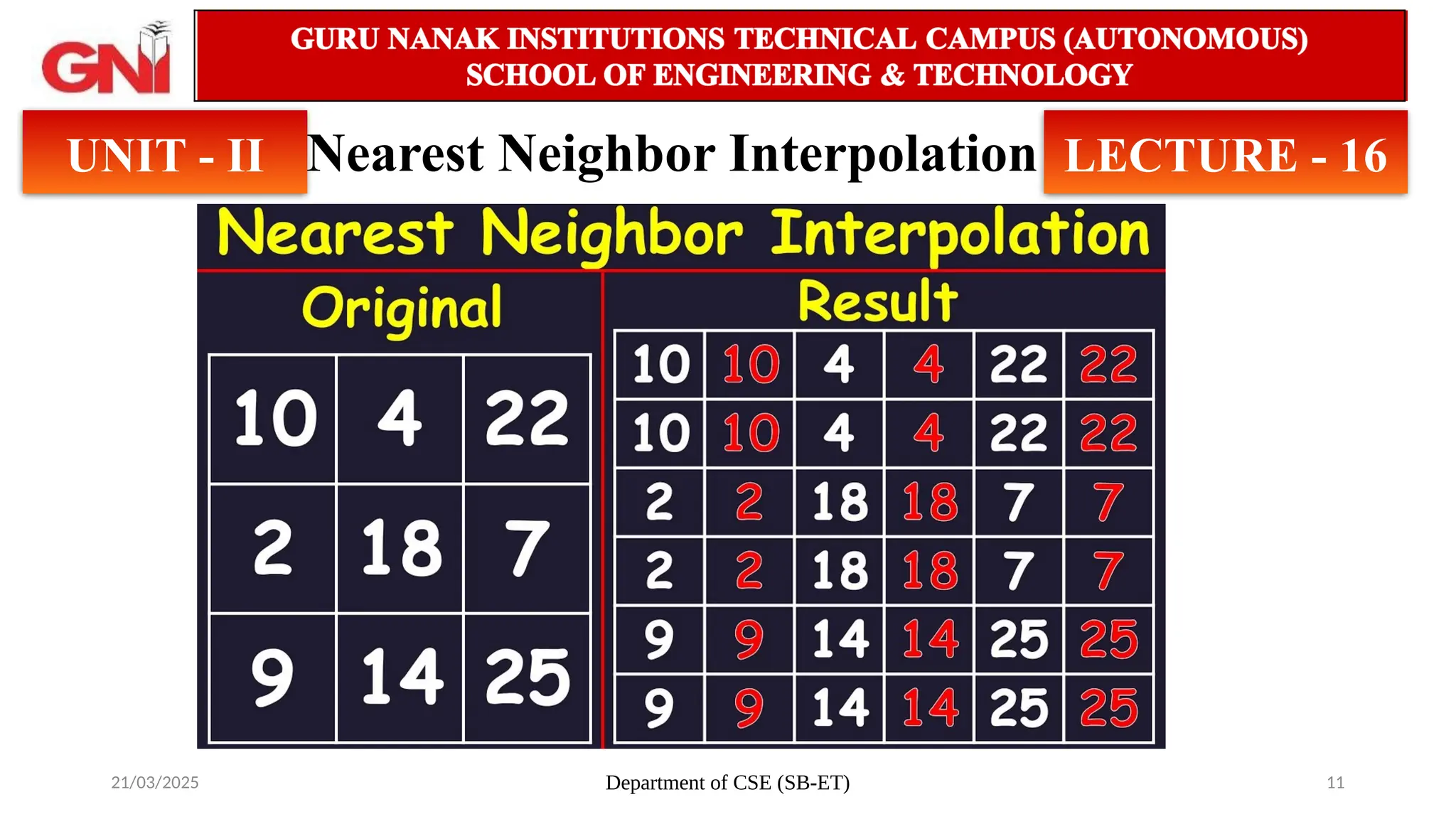
•Nearest-neighbor interpolation is a simple method of multivariate
interpolation in one or more dimensions.
•Interpolation is the problem of approximating the value of a function
for a non-given point in some space when given the value of that
function in points around (neighboring) that point.
•The nearest neighbor algorithm selects the value of the nearest point
and does not consider the values of neighboring points at all, yielding a
piecewise-constant interpolant.
•The algorithm is very simple to implement and is commonly used in
real-time 3D rendering to select color values for a textured surface.
21/03/2025 Department ofCSE (SB-ET) 12
Polynomial Interpolation
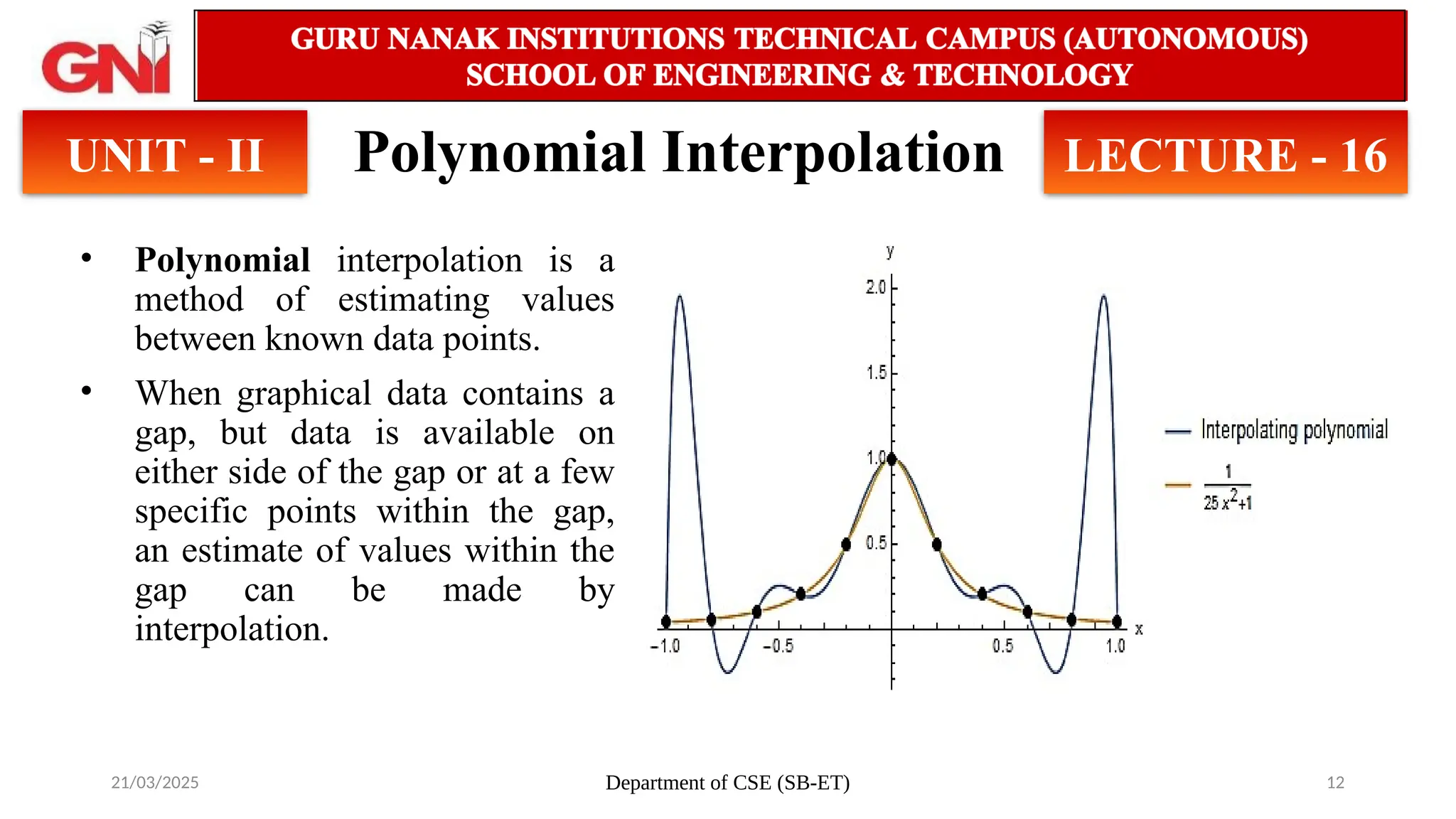
• Polynomial interpolation is a
method of estimating values
between known data points.
• When graphical data contains a
gap, but data is available on
either side of the gap or at a few
specific points within the gap,
an estimate of values within the
gap can be made by
interpolation.
UNIT - II LECTURE - 16
13.
21/03/2025 Department ofCSE (SB-ET) 13
Spline Interpolation
UNIT - II LECTURE - 16
• Spline interpolation is a method of interpolation where the interpolating
function is a piecewise-defined polynomial called a spline.
• Unlike polynomial interpolation, which uses a single polynomial to fit all
the data points, spline interpolation divides the data into smaller
segments and fits a separate polynomial to each segment.
• This approach results in a smoother interpolating function that can better
capture the local behavior of the data.
14.
21/03/2025 Department ofCSE (SB-ET) 14
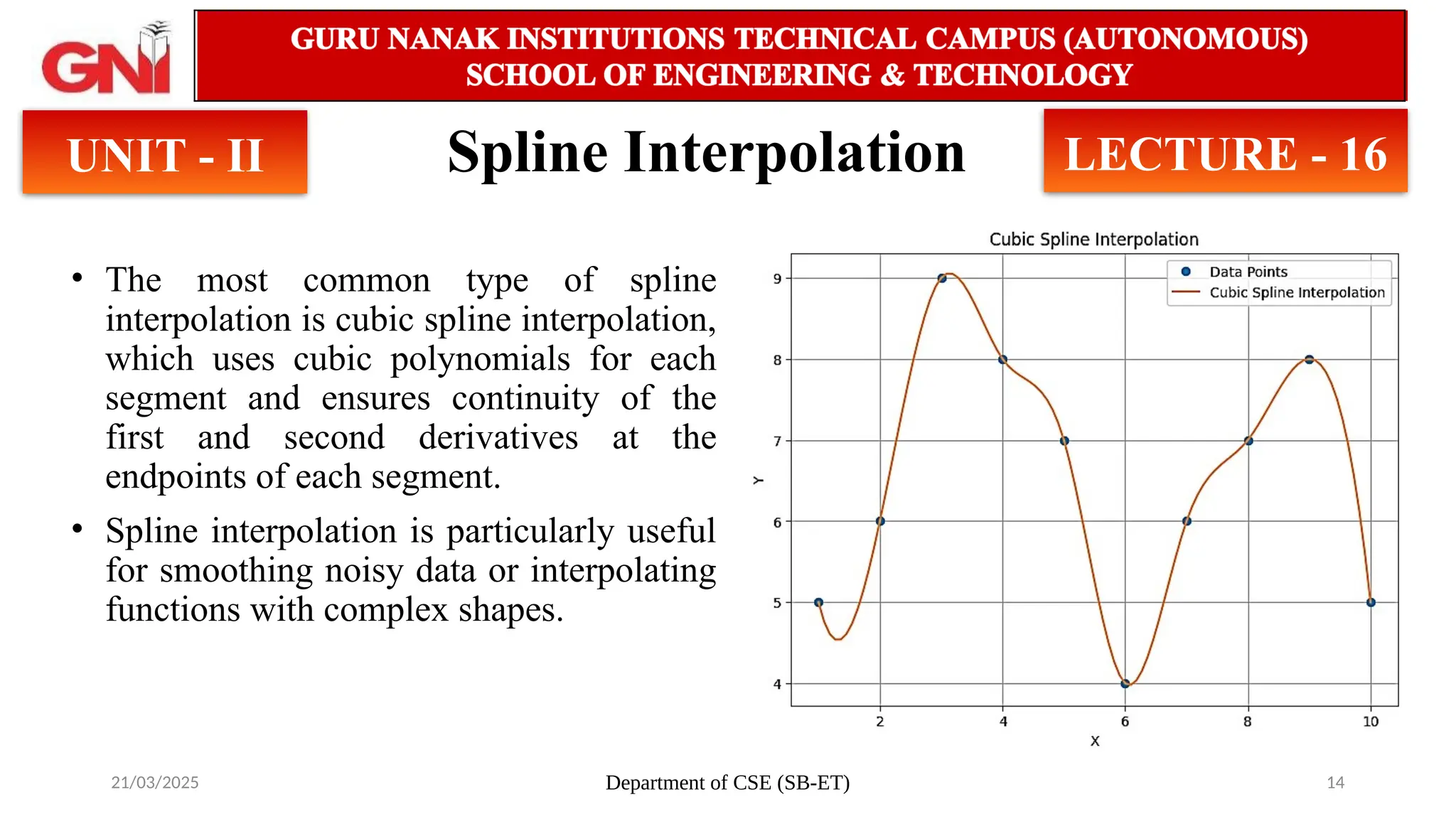
Spline Interpolation
• The most common type of spline
interpolation is cubic spline interpolation,
which uses cubic polynomials for each
segment and ensures continuity of the
first and second derivatives at the
endpoints of each segment.
• Spline interpolation is particularly useful
for smoothing noisy data or interpolating
functions with complex shapes.
UNIT - II LECTURE - 16
15.
21/03/2025 Department ofCSE (SB-ET) 15
Applications of Interpolation
• Image Processing
• Computer Graphics
• Numerical Analysis
• Signal Processing
• Mathematical Modeling
• Geographic Information Systems (GIS)
• Audio Processing
UNIT - II LECTURE - 16
16.
21/03/2025 Department ofCSE (SB-ET) 16
Topics to be covered in next session 17
• Support Vector Machines
Thank you!!!
UNIT - II LECTURE - 16