AI3391 ARTIFICAL INTELLIGENCE
(II YEAR (III Sem))
Department of Artificial Intelligence and Data Science
Session 20
by
Asst.Prof.M.Gokilavani
NIET
1/24/2024 Department of AI & DS 1
TEXTBOOK:
• Artificial Intelligence A modern Approach, Third Edition, Stuart
Russell and Peter Norvig, Pearson Education.
REFERENCES:
• Artificial Intelligence, 3rd Edn, E. Rich and K.Knight (TMH).
• Artificial Intelligence, 3rd Edn, Patrick Henny Winston, Pearson
Education.
• Artificial Intelligence, Shivani Goel, Pearson Education.
• Artificial Intelligence and Expert Systems- Patterson, Pearson
Education.
1/24/2024 Department of AI & DS 2
Topics covered in session 20
1/24/2024 Department of AI & DS 3
• Game theory
• optimal decision in games
• alpha beta Search
• Monte Carlo tree search
• stochastic games
• partially observed games
• Constraint satisfaction problem
• Constraint propagation
• Backtracking search for CSP
• Local search for CSP
• structure of CSP.
Partially Observable Games
• Partial observability means that an agent does not know the state of the
world or that the agents act simultaneously.
• Partial observability for the multiagent case is more complicated than
the fully observable multiagent case or the partially observable single-
agent case.
• The following simple examples show some important issues that arise
even in the case of two agents, each with a few choices.
1/24/2024 Department of AI & DS 4
Partially Observable Games
• A partially observable system is one in which the entire state of the
system is not fully visible to an external sensor.
• In a partially observable system the observer may utilize a memory
system in order to add information to the observer's understanding of
the system.
• An example of a partially observable system would be a card game in
which some of the cards are discarded into a pile face down.
• In this case the observer is only able to view their own cards and
potentially those of the dealer.
1/24/2024 Department of AI & DS 5
Partially Observable Games
• They are not able to view the face-down (used) cards, nor the cards
which will be dealt at some stage in the future.
• A memory system can be used to remember the previously dealt cards
that are now on the used pile (large collection arranged one over
other).
• This adds to the total sum of knowledge that the observer can use to
make decisions.
1/24/2024 Department of AI & DS 6
Partially Observable Games
• In contrast, a fully observable system would be that of chess.
• In chess (apart from the 'who is moving next' state) the full state of the
system is observable at any point in time.
• Partially observable is a term used in a variety of mathematical
settings, including that of Artificial Intelligence and Partially
observable Markov decision processes.
1/24/2024 Department of AI & DS 7
Partially Observable Games
• Chess has often been described as war in miniature, but it lacks at least
one major characteristic of real wars, namely, partial observability.
• In the “fog of war,” the existence and disposition of enemy units is
often unknown until revealed by direct contact.
• As a result, warfare includes the use of scouts and spies together
information and the use of concealment and bluff to confuse the
enemy.
• Partially observable games share these characteristics and are thus
qualitatively different from other observable games.
1/24/2024 Department of AI & DS 8
Partially Observable Games
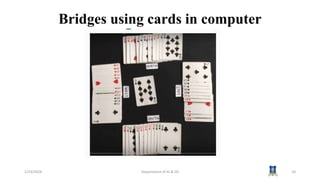
• Note : Optimal play in games of imperfect information, such as
Kriegspiel (Chess) and bridge, requires reasoning about the current
and future belief states of each player.
• A simple approximation can be obtained by averaging the value of an
action over each possible configuration of missing information.
1/24/2024 Department of AI & DS 9
Bridges using cards in computer
1/24/2024 Department of AI & DS 10
State-of-the-art Game Programs
• State-of-the-art game programs are blindingly fast, highly optimized
machines that incorporate the latest engineering advances, but they
aren’t much use for doing the shopping or driving off-road.
• Racing and game-playing generate excitement and a steady stream of
innovations that have been adopted by the wider community.
1/24/2024 Department of AI & DS 11
Example:1 Chess
• Various games for explaining state-of-the-art-game programs :
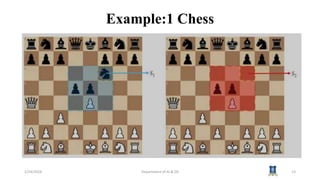
• Chess: Chess is a two-player strategy board game played on a
chessboard, a checkered game board with 64 squares arranged in an
8×8 grid.
• The game is played by millions of people worldwide.
• Chess is believed to have originated in India sometime before the 7th
century.
• The game was derived from the Indian game chaturanga .
1/24/2024 Department of AI & DS 12
Example:1 Chess
1/24/2024 Department of AI & DS 13
Example 2: Go Game
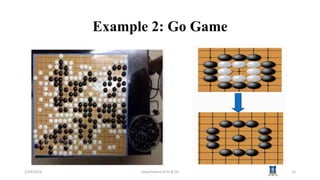
• Go : It is the most popular board game in Asia.
• Because the board is 19 × 19 and moves are allowed into (almost)
every empty square, the branching factor starts at 361, which is too
daunting for regular alpha–beta search methods.
• In addition, it is difficult to write an evaluation function because
control of territory is often very unpredictable until the endgame.
• Therefore the top programs, such as MOGO, avoid alpha–beta search
and instead use Monte Carlo rollouts.
• The trick is to decide what moves to make in the course of the rollout.
• There is no aggressive pruning; all moves are possible.
1/24/2024 Department of AI & DS 14
Example 2: Go Game
1/24/2024 Department of AI & DS 15
Example 3: Checkers
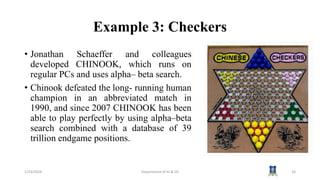
• Jonathan Schaeffer and colleagues
developed CHINOOK, which runs on
regular PCs and uses alpha– beta search.
• Chinook defeated the long- running human
champion in an abbreviated match in
1990, and since 2007 CHINOOK has been
able to play perfectly by using alpha–beta
search combined with a database of 39
trillion endgame positions.
1/24/2024 Department of AI & DS 16
Example 4:Othello
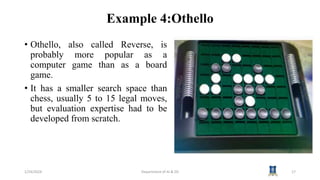
• Othello, also called Reverse, is
probably more popular as a
computer game than as a board
game.
• It has a smaller search space than
chess, usually 5 to 15 legal moves,
but evaluation expertise had to be
developed from scratch.
1/24/2024 Department of AI & DS 17
Example : 5 Scrabble
• Most people think the hard part about Scrabble is coming up with
good words, but given the official dictionary, it turns out to be rather
easy to program a move generator to find the highest-scoring move
(Gordon, 1994).
• That doesn’t mean the game is solved, however: merely taking the top-
scoring move each turn results in a good but not expert player.
• The problem is that Scrabble is both partially observable and
stochastic: you don’t know what letters the other player has or what
letters you will draw next.
• So playing Scrabble well combines the difficulties of backgammon
and bridge.
1/24/2024 Department of AI & DS 18
Example : 5 Scrabble
1/24/2024 Department of AI & DS 19
Topics to be covered in next session 21
• CSP
1/24/2024 Department of AI & DS 20
Thank you!!!

AI3391 Artificial Intelligence Session 20 partially observed games.pptx

  • 1.
    AI3391 ARTIFICAL INTELLIGENCE (IIYEAR (III Sem)) Department of Artificial Intelligence and Data Science Session 20 by Asst.Prof.M.Gokilavani NIET 1/24/2024 Department of AI & DS 1
  • 2.
    TEXTBOOK: • Artificial IntelligenceA modern Approach, Third Edition, Stuart Russell and Peter Norvig, Pearson Education. REFERENCES: • Artificial Intelligence, 3rd Edn, E. Rich and K.Knight (TMH). • Artificial Intelligence, 3rd Edn, Patrick Henny Winston, Pearson Education. • Artificial Intelligence, Shivani Goel, Pearson Education. • Artificial Intelligence and Expert Systems- Patterson, Pearson Education. 1/24/2024 Department of AI & DS 2
  • 3.
    Topics covered insession 20 1/24/2024 Department of AI & DS 3 • Game theory • optimal decision in games • alpha beta Search • Monte Carlo tree search • stochastic games • partially observed games • Constraint satisfaction problem • Constraint propagation • Backtracking search for CSP • Local search for CSP • structure of CSP.
  • 4.
    Partially Observable Games •Partial observability means that an agent does not know the state of the world or that the agents act simultaneously. • Partial observability for the multiagent case is more complicated than the fully observable multiagent case or the partially observable single- agent case. • The following simple examples show some important issues that arise even in the case of two agents, each with a few choices. 1/24/2024 Department of AI & DS 4
  • 5.
    Partially Observable Games •A partially observable system is one in which the entire state of the system is not fully visible to an external sensor. • In a partially observable system the observer may utilize a memory system in order to add information to the observer's understanding of the system. • An example of a partially observable system would be a card game in which some of the cards are discarded into a pile face down. • In this case the observer is only able to view their own cards and potentially those of the dealer. 1/24/2024 Department of AI & DS 5
  • 6.
    Partially Observable Games •They are not able to view the face-down (used) cards, nor the cards which will be dealt at some stage in the future. • A memory system can be used to remember the previously dealt cards that are now on the used pile (large collection arranged one over other). • This adds to the total sum of knowledge that the observer can use to make decisions. 1/24/2024 Department of AI & DS 6
  • 7.
    Partially Observable Games •In contrast, a fully observable system would be that of chess. • In chess (apart from the 'who is moving next' state) the full state of the system is observable at any point in time. • Partially observable is a term used in a variety of mathematical settings, including that of Artificial Intelligence and Partially observable Markov decision processes. 1/24/2024 Department of AI & DS 7
  • 8.
    Partially Observable Games •Chess has often been described as war in miniature, but it lacks at least one major characteristic of real wars, namely, partial observability. • In the “fog of war,” the existence and disposition of enemy units is often unknown until revealed by direct contact. • As a result, warfare includes the use of scouts and spies together information and the use of concealment and bluff to confuse the enemy. • Partially observable games share these characteristics and are thus qualitatively different from other observable games. 1/24/2024 Department of AI & DS 8
  • 9.
    Partially Observable Games •Note : Optimal play in games of imperfect information, such as Kriegspiel (Chess) and bridge, requires reasoning about the current and future belief states of each player. • A simple approximation can be obtained by averaging the value of an action over each possible configuration of missing information. 1/24/2024 Department of AI & DS 9
  • 10.
    Bridges using cardsin computer 1/24/2024 Department of AI & DS 10
  • 11.
    State-of-the-art Game Programs •State-of-the-art game programs are blindingly fast, highly optimized machines that incorporate the latest engineering advances, but they aren’t much use for doing the shopping or driving off-road. • Racing and game-playing generate excitement and a steady stream of innovations that have been adopted by the wider community. 1/24/2024 Department of AI & DS 11
  • 12.
    Example:1 Chess • Variousgames for explaining state-of-the-art-game programs : • Chess: Chess is a two-player strategy board game played on a chessboard, a checkered game board with 64 squares arranged in an 8×8 grid. • The game is played by millions of people worldwide. • Chess is believed to have originated in India sometime before the 7th century. • The game was derived from the Indian game chaturanga . 1/24/2024 Department of AI & DS 12
  • 13.
  • 14.
    Example 2: GoGame • Go : It is the most popular board game in Asia. • Because the board is 19 × 19 and moves are allowed into (almost) every empty square, the branching factor starts at 361, which is too daunting for regular alpha–beta search methods. • In addition, it is difficult to write an evaluation function because control of territory is often very unpredictable until the endgame. • Therefore the top programs, such as MOGO, avoid alpha–beta search and instead use Monte Carlo rollouts. • The trick is to decide what moves to make in the course of the rollout. • There is no aggressive pruning; all moves are possible. 1/24/2024 Department of AI & DS 14
  • 15.
    Example 2: GoGame 1/24/2024 Department of AI & DS 15
  • 16.
    Example 3: Checkers •Jonathan Schaeffer and colleagues developed CHINOOK, which runs on regular PCs and uses alpha– beta search. • Chinook defeated the long- running human champion in an abbreviated match in 1990, and since 2007 CHINOOK has been able to play perfectly by using alpha–beta search combined with a database of 39 trillion endgame positions. 1/24/2024 Department of AI & DS 16
  • 17.
    Example 4:Othello • Othello,also called Reverse, is probably more popular as a computer game than as a board game. • It has a smaller search space than chess, usually 5 to 15 legal moves, but evaluation expertise had to be developed from scratch. 1/24/2024 Department of AI & DS 17
  • 18.
    Example : 5Scrabble • Most people think the hard part about Scrabble is coming up with good words, but given the official dictionary, it turns out to be rather easy to program a move generator to find the highest-scoring move (Gordon, 1994). • That doesn’t mean the game is solved, however: merely taking the top- scoring move each turn results in a good but not expert player. • The problem is that Scrabble is both partially observable and stochastic: you don’t know what letters the other player has or what letters you will draw next. • So playing Scrabble well combines the difficulties of backgammon and bridge. 1/24/2024 Department of AI & DS 18
  • 19.
    Example : 5Scrabble 1/24/2024 Department of AI & DS 19
  • 20.
    Topics to becovered in next session 21 • CSP 1/24/2024 Department of AI & DS 20 Thank you!!!