Classification of Bacteria on the basis of
phenetic, genetic, and phylogenetic.
Presented By-
Name- Bharati Raul
Branch- M.Sc. Zoology
Regd.no- 220705180056
School- School of Applied Sciences
Department of Zoology
Contents
• Introduction
• Classification of Bacteria on the basis of-
1. Phenetic
2. Genetic
3.Phylogenetic
• Reference
Introduction
• Bacteria are mostly free-living unicellular organisms belonging to the
prokaryotic group where the organisms lack a few organelles and a true
nucleus.
• These are found almost everywhere on earth and viral to the planets
ecosystem. Most of the bacteria present inside the body are harmless and
some are even helpful.
• A relatively small number of species
can cause disease.
• Superficially, bacteria appear to be microscopic
forms of life; in fact they are Sophisticated
and highly adaptable.
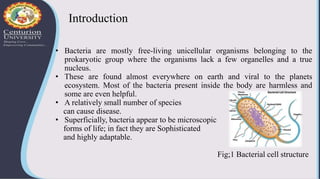
Fig;1 Bacterial cell structure
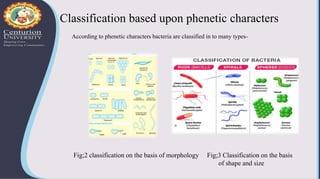
Classification based upon phenetic characters
According to phenetic characters bacteria are classified in to many types-
Fig;2 classification on the basis of morphology Fig;3 Classification on the basis
of shape and size
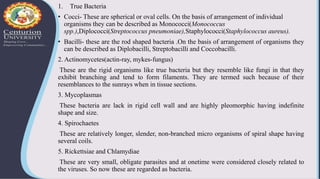
1. True Bacteria
• Cocci- These are spherical or oval cells. On the basis of arrangement of individual
organisms they can be described as Monococci(Monococcus
spp.),Diplococci(Streptococcus pneumoniae),Staphylococci(Staphylococcus aureus).
• Bacilli- these are the rod shaped bacteria .On the basis of arrangement of organisms they
can be described as Diplobacilli, Streptobacilli and Coccobacilli.
2. Actinomycetes(actin-ray, mykes-fungus)
These are the rigid organisms like true bacteria but they resemble like fungi in that they
exhibit branching and tend to form filaments. They are termed such because of their
resemblances to the sunrays when in tissue sections.
3. Mycoplasmas
These bacteria are lack in rigid cell wall and are highly pleomorphic having indefinite
shape and size.
4. Spirochaetes
These are relatively longer, slender, non-branched micro organisms of spiral shape having
several coils.
5. Rickettsiae and Chlamydiae
These are very small, obligate parasites and at onetime were considered closely related to
the viruses. So now these are regarded as bacteria.
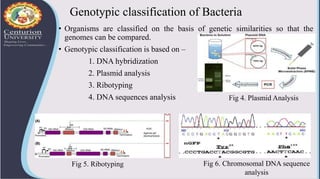
Genotypic classification of Bacteria
Fig 4. Plasmid Analysis
Fig 6. Chromosomal DNA sequence
analysis
Fig 5. Ribotyping
• Organisms are classified on the basis of genetic similarities so that the
genomes can be compared.
• Genotypic classification is based on –
1. DNA hybridization
2. Plasmid analysis
3. Ribotyping
4. DNA sequences analysis
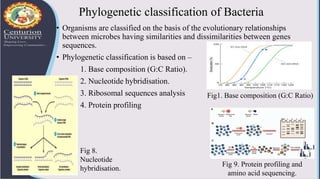
Phylogenetic classification of Bacteria
Fig1. Base composition (G:C Ratio)
Fig 8.
Nucleotide
hybridisation.
Fig 9. Protein profiling and
amino acid sequencing.
• Organisms are classified on the basis of the evolutionary relationships
between microbes having similarities and dissimilarities between genes
sequences.
• Phylogenetic classification is based on –
1. Base composition (G:C Ratio).
2. Nucleotide hybridisation.
3. Ribosomal sequences analysis
4. Protein profiling
Reference
Woese CR, Kandler O, Wheelis ML(June 1990).”Towards a natural system of
organisms; proposal for the domains Archae,Bacteria, and Eucarya”.
Proceedings of the National Academy of Sciences of the United States of
America.87(12):4576- 79
220705180056 bacterial classification.pptx

220705180056 bacterial classification.pptx

  • 1.
    Classification of Bacteriaon the basis of phenetic, genetic, and phylogenetic. Presented By- Name- Bharati Raul Branch- M.Sc. Zoology Regd.no- 220705180056 School- School of Applied Sciences Department of Zoology
  • 2.
    Contents • Introduction • Classificationof Bacteria on the basis of- 1. Phenetic 2. Genetic 3.Phylogenetic • Reference
  • 3.
    Introduction • Bacteria aremostly free-living unicellular organisms belonging to the prokaryotic group where the organisms lack a few organelles and a true nucleus. • These are found almost everywhere on earth and viral to the planets ecosystem. Most of the bacteria present inside the body are harmless and some are even helpful. • A relatively small number of species can cause disease. • Superficially, bacteria appear to be microscopic forms of life; in fact they are Sophisticated and highly adaptable. Fig;1 Bacterial cell structure
  • 4.
    Classification based uponphenetic characters According to phenetic characters bacteria are classified in to many types- Fig;2 classification on the basis of morphology Fig;3 Classification on the basis of shape and size
  • 5.
    1. True Bacteria •Cocci- These are spherical or oval cells. On the basis of arrangement of individual organisms they can be described as Monococci(Monococcus spp.),Diplococci(Streptococcus pneumoniae),Staphylococci(Staphylococcus aureus). • Bacilli- these are the rod shaped bacteria .On the basis of arrangement of organisms they can be described as Diplobacilli, Streptobacilli and Coccobacilli. 2. Actinomycetes(actin-ray, mykes-fungus) These are the rigid organisms like true bacteria but they resemble like fungi in that they exhibit branching and tend to form filaments. They are termed such because of their resemblances to the sunrays when in tissue sections. 3. Mycoplasmas These bacteria are lack in rigid cell wall and are highly pleomorphic having indefinite shape and size. 4. Spirochaetes These are relatively longer, slender, non-branched micro organisms of spiral shape having several coils. 5. Rickettsiae and Chlamydiae These are very small, obligate parasites and at onetime were considered closely related to the viruses. So now these are regarded as bacteria.
  • 6.
    Genotypic classification ofBacteria Fig 4. Plasmid Analysis Fig 6. Chromosomal DNA sequence analysis Fig 5. Ribotyping • Organisms are classified on the basis of genetic similarities so that the genomes can be compared. • Genotypic classification is based on – 1. DNA hybridization 2. Plasmid analysis 3. Ribotyping 4. DNA sequences analysis
  • 7.
    Phylogenetic classification ofBacteria Fig1. Base composition (G:C Ratio) Fig 8. Nucleotide hybridisation. Fig 9. Protein profiling and amino acid sequencing. • Organisms are classified on the basis of the evolutionary relationships between microbes having similarities and dissimilarities between genes sequences. • Phylogenetic classification is based on – 1. Base composition (G:C Ratio). 2. Nucleotide hybridisation. 3. Ribosomal sequences analysis 4. Protein profiling
  • 8.
    Reference Woese CR, KandlerO, Wheelis ML(June 1990).”Towards a natural system of organisms; proposal for the domains Archae,Bacteria, and Eucarya”. Proceedings of the National Academy of Sciences of the United States of America.87(12):4576- 79