CLASSIFICATION OF
BACTERIA
BASED ON SEVERAL MAJOR
PROPERITIES
• Morphology
• Flagella
• Gram staining
• Spore Formation
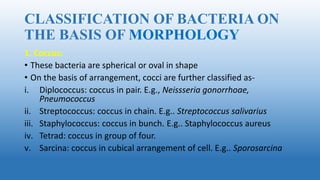
CLASSIFICATION OF BACTERIA ON
THE BASIS OF MORPHOLOGY
1. Coccus:
• These bacteria are spherical or oval in shape
• On the basis of arrangement, cocci are further classified as-
i. Diplococcus: coccus in pair. E.g., Neissseria gonorrhoae,
Pneumococcus
ii. Streptococcus: coccus in chain. E.g.. Streptococcus salivarius
iii. Staphylococcus: coccus in bunch. E.g.. Staphylococcus aureus
iv. Tetrad: coccus in group of four.
v. Sarcina: coccus in cubical arrangement of cell. E.g.. Sporosarcina
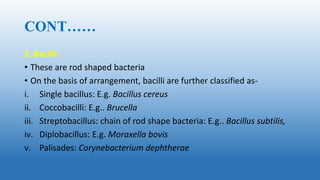
CONT……
2. Bacilli:
• These are rod shaped bacteria
• On the basis of arrangement, bacilli are further classified as-
i. Single bacillus: E.g. Bacillus cereus
ii. Coccobacilli: E.g.. Brucella
iii. Streptobacillus: chain of rod shape bacteria: E.g.. Bacillus subtilis,
iv. Diplobacillus: E.g. Moraxella bovis
v. Palisades: Corynebacterium dephtherae
CONT……
3. Mycoplasma
• They are cell wall lacking bacteria
• Also known as PLO (Pleuropneumonia like organism)
• E.g. Mycoplasma pneumonia
4. Spirillus:
• They are spiral shaped bacteria
• E.g. Triponema palladium
CONT……
5. Rickettsia and Chlamydia:
• They are obligate intracellular parasites resemble more closely to
viruses than bacteria
6. Actinomycetes:
• They have filamentous or branching structure
• They resemble more closely to Fungi than bacteria
• Example: Streptomyces
CLASSIFICATION OF BACTERIA ON THE
BASIS OF GRAM STAINING
1. Gram positive bacteria:
• cell wall of these bacteria is composed of peptidoglycan layer only.
• They give purple color on staining
• E.g. Staphylococcus, Streptococcus, micrococcus
2. Gram negative bacteria:
• cell wall of these bacteria is composed of Peptidoglycan and outer
membrane.
• They give pink color on staining
• E.g.. E. coli, Salmonella
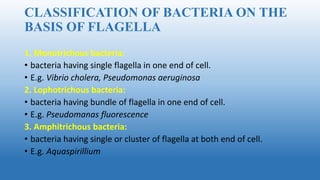
CLASSIFICATION OF BACTERIA ON THE
BASIS OF FLAGELLA
1. Monotrichous bacteria:
• bacteria having single flagella in one end of cell.
• E.g. Vibrio cholera, Pseudomonas aeruginosa
2. Lophotrichous bacteria:
• bacteria having bundle of flagella in one end of cell.
• E.g. Pseudomanas fluorescence
3. Amphitrichous bacteria:
• bacteria having single or cluster of flagella at both end of cell.
• E.g. Aquaspirillium
CONT……
4. Peritrichous bacteria:
• bacteria having flagella all over the cell surface.
• E.g. E.coli, Salmonella, Klebsiella
5. Atrichous bacteria:
• bacteria without flagella.
• E.g. Shigella
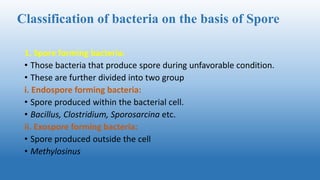
Classification of bacteria on the basis of Spore
1. Spore forming bacteria:
• Those bacteria that produce spore during unfavorable condition.
• These are further divided into two group
i. Endospore forming bacteria:
• Spore produced within the bacterial cell.
• Bacillus, Clostridium, Sporosarcina etc.
ii. Exospore forming bacteria:
• Spore produced outside the cell
• Methylosinus
CONT……
2. Non sporing bacteria:
• those bacteria which do not produce spore.
• E.g.. E. coli, Salmonella
Bacteria
Bacteria

Bacteria

  • 3.
  • 4.
    BASED ON SEVERALMAJOR PROPERITIES • Morphology • Flagella • Gram staining • Spore Formation
  • 5.
    CLASSIFICATION OF BACTERIAON THE BASIS OF MORPHOLOGY 1. Coccus: • These bacteria are spherical or oval in shape • On the basis of arrangement, cocci are further classified as- i. Diplococcus: coccus in pair. E.g., Neissseria gonorrhoae, Pneumococcus ii. Streptococcus: coccus in chain. E.g.. Streptococcus salivarius iii. Staphylococcus: coccus in bunch. E.g.. Staphylococcus aureus iv. Tetrad: coccus in group of four. v. Sarcina: coccus in cubical arrangement of cell. E.g.. Sporosarcina
  • 7.
    CONT…… 2. Bacilli: • Theseare rod shaped bacteria • On the basis of arrangement, bacilli are further classified as- i. Single bacillus: E.g. Bacillus cereus ii. Coccobacilli: E.g.. Brucella iii. Streptobacillus: chain of rod shape bacteria: E.g.. Bacillus subtilis, iv. Diplobacillus: E.g. Moraxella bovis v. Palisades: Corynebacterium dephtherae
  • 9.
    CONT…… 3. Mycoplasma • Theyare cell wall lacking bacteria • Also known as PLO (Pleuropneumonia like organism) • E.g. Mycoplasma pneumonia 4. Spirillus: • They are spiral shaped bacteria • E.g. Triponema palladium
  • 12.
    CONT…… 5. Rickettsia andChlamydia: • They are obligate intracellular parasites resemble more closely to viruses than bacteria 6. Actinomycetes: • They have filamentous or branching structure • They resemble more closely to Fungi than bacteria • Example: Streptomyces
  • 13.
    CLASSIFICATION OF BACTERIAON THE BASIS OF GRAM STAINING 1. Gram positive bacteria: • cell wall of these bacteria is composed of peptidoglycan layer only. • They give purple color on staining • E.g. Staphylococcus, Streptococcus, micrococcus 2. Gram negative bacteria: • cell wall of these bacteria is composed of Peptidoglycan and outer membrane. • They give pink color on staining • E.g.. E. coli, Salmonella
  • 16.
    CLASSIFICATION OF BACTERIAON THE BASIS OF FLAGELLA 1. Monotrichous bacteria: • bacteria having single flagella in one end of cell. • E.g. Vibrio cholera, Pseudomonas aeruginosa 2. Lophotrichous bacteria: • bacteria having bundle of flagella in one end of cell. • E.g. Pseudomanas fluorescence 3. Amphitrichous bacteria: • bacteria having single or cluster of flagella at both end of cell. • E.g. Aquaspirillium
  • 17.
    CONT…… 4. Peritrichous bacteria: •bacteria having flagella all over the cell surface. • E.g. E.coli, Salmonella, Klebsiella 5. Atrichous bacteria: • bacteria without flagella. • E.g. Shigella
  • 19.
    Classification of bacteriaon the basis of Spore 1. Spore forming bacteria: • Those bacteria that produce spore during unfavorable condition. • These are further divided into two group i. Endospore forming bacteria: • Spore produced within the bacterial cell. • Bacillus, Clostridium, Sporosarcina etc. ii. Exospore forming bacteria: • Spore produced outside the cell • Methylosinus
  • 20.
    CONT…… 2. Non sporingbacteria: • those bacteria which do not produce spore. • E.g.. E. coli, Salmonella