Foundations of English Language Teaching
Imed Ben Abdallah Sdiri
Expert in Curriculum Development and Language Planning
www.facebook.com/imed.benabdallah.sdiri
www.linkedin.com/in/imed-sdiri
imedsdiri@yahoo.fr
In this presentation you will learn about the Foundations of
English Language Teaching. You will gain a deep understanding of
the following:
1. General Learning Principles
2. Foundations of English Language Learning
3. Language Teaching Principles
1- How do learners learn?
2- Which factors help learners to learn?
1. Nature of the learning process:
• Learning is an intentional process of constructing meaning from
information and experience.
• Educators must assist learners in creating meaningful learning goals that
are consistent with both personal and educational aspirations and
interests.
2- Construction of knowledge.
• The successful learner can link new information with existing
knowledge in meaningful ways.
• Unless new knowledge becomes integrated with the learner's prior knowledge and

understanding, this new knowledge remains isolated, cannot be used most
effectively in new tasks, and does not transfer readily to new situations.
3- Context of learning.
• Learning is influenced by environmental factors, including
culture, technology, and instructional practices.
4- Motivational and emotional influences on learning.
• What and how much is learned is influenced by the motivation.
• Factors that influence learning and performance.
• Students' beliefs about themselves
• Positive emotions
• Intense negative emotions (e.g., anxiety, panic, rage, insecurity) and
related thoughts (e.g., worrying about competence, fearing punishment,
ridicule, or stigmatizing labels) generally detract from motivation, interfere
with learning, and contribute to low performance.
5- Effects of motivation on effort.
• Acquisition of complex knowledge and skills requires extended:
1. learner effort
2. persistence over time
3. guided practice
• Educators have to use effective strategies that include purposeful
learning activities, guided by practices that enhance positive emotions
and intrinsic motivation to learn, and methods that increase learners'
perceptions that a task is interesting and personally relevant.
6- Developmental influences on learning.
• Learning is most effective when differential development within
and across physical, intellectual, emotional, and social domains is
taken into account.
• Individuals learn best when material is appropriate to their developmental level and
is presented in an enjoyable and interesting way.
• Awareness and understanding of developmental differences among children with
and without emotional, physical, or intellectual disabilities, can facilitate the
creation of optimal learning contexts.
7- Social influences on learning.
• Learning is influenced by social interactions, interpersonal relations,
and communication with others.
• Learning can be enhanced when the learner has an opportunity to interact and to
collaborate with others on instructional tasks.
• Quality personal relationships that provide stability, trust, and caring can increase
learners' sense of belonging, self-respect and self-acceptance, and provide a
positive climate for optimal learning.
• Positive learning climates help learners feel safe to share ideas, actively participate
in the learning process, and create a learning community.
8- Individual differences in learning.
• Students are different by nature.
• Educators need to be sensitive to individual differences, in
general.
• Differentiation
• Personalized Learning
9- Standards and assessment.
• Setting appropriately high and challenging standards and assessing the
learner as well as learning progress -- including diagnostic, process, and
outcome assessment -- are integral parts of the learning process.
• Assessment provides important information to both the learner and
teacher at all stages of the learning process. Effective learning takes place
when learners feel challenged to work towards appropriately high goals.
• Ongoing assessment of the learner's understanding of the curricular
material can provide valuable feedback to both learners and teachers
about progress toward the learning goals.
• Who do we teach?
• Why do we teach?
• What do we teach?
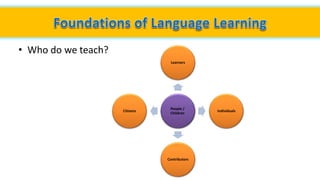
• Who do we teach?
People /
Children
Learners
Individuals
Contributors
Citizens
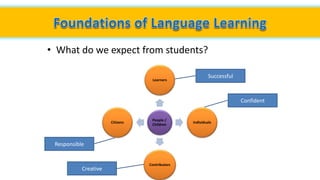
• What do we expect from students?
People /
Children
Learners
Individuals
Contributors
Citizens
Successful
Confident
Creative
Responsible
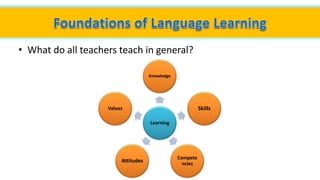
• What do all teachers teach in general?
Learning
Knowledge
Skills
Compete
ncies
Attitudes
Values
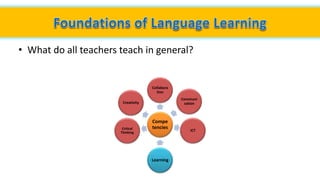
• What do all teachers teach in general?
Learning
Compe
tencies
Collabora
tion
Communi
cationCreativity
ICTCritical
Thinking
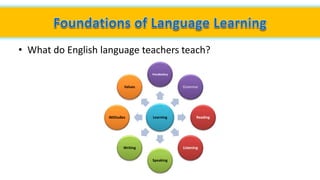
• What do English language teachers teach?
Learning
Vocabulary
Grammar
Reading
Listening
Speaking
Writing
Attitudes
Values
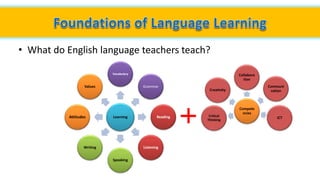
• What do English language teachers teach?
Learning
Vocabulary
Grammar
Reading
Listening
Speaking
Writing
Attitudes
Values
Collabora
tion
Communi
cationCreativity
ICTCritical
Thinking
Compete
ncies
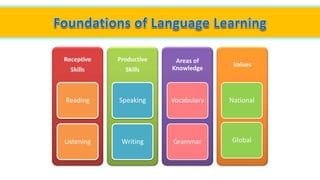
Receptive
Skills
Reading
Listening
Productive
Skills
Speaking
Writing
Areas of
Knowledge
Vocabulary
Grammar
Values
National
Global
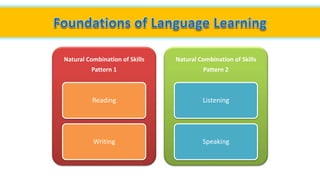
Natural Combination of Skills
Pattern 1
Reading
Writing
Natural Combination of Skills
Pattern 2
Listening
Speaking
• How do we teach?
• What are the teacher’s roles?
• Contextualization:
• Learning tasks and activities should be designed for students to learn
the language in authentic and meaningful contexts of use.
• Lessons are planned around learning outcomes, a theme, or a type of
text to help pupils use related language skills, grammatical items/
structures and vocabulary appropriately in spoken and written language
to suit the purpose, audience, context and culture.
• Learner-centeredness:
Learners are at the centre of the teaching-learning process. Teaching
should be differentiated according to pupils’ needs, abilities and
interests. Effective pedagogies will be used to engage them and to
strengthen their language development.
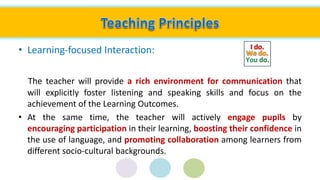
• Learning-focused Interaction:
The teacher will provide a rich environment for communication that
will explicitly foster listening and speaking skills and focus on the
achievement of the Learning Outcomes.
• At the same time, the teacher will actively engage pupils by
encouraging participation in their learning, boosting their confidence in
the use of language, and promoting collaboration among learners from
different socio-cultural backgrounds.
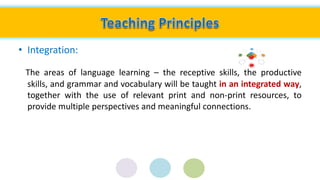
• Integration:
The areas of language learning – the receptive skills, the productive
skills, and grammar and vocabulary will be taught in an integrated way,
together with the use of relevant print and non-print resources, to
provide multiple perspectives and meaningful connections.
• Process Orientation:
The development of language skills and knowledge about language
involves the teaching of processes. The teacher will model and scaffold
such processes for pupils, while guiding them to put together their final
spoken, written and/or multimodal products.
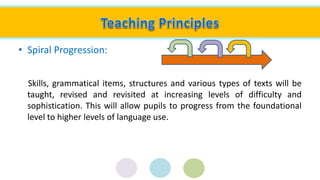
• Spiral Progression:
Skills, grammatical items, structures and various types of texts will be
taught, revised and revisited at increasing levels of difficulty and
sophistication. This will allow pupils to progress from the foundational
level to higher levels of language use.
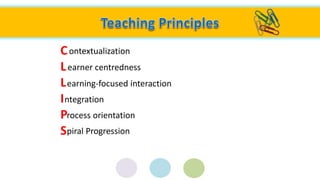
C
L
L
I
P
S
ontextualization
earner centredness
earning-focused interaction
ntegration
rocess orientation
piral Progression
• Write your big idea from this
section
• How can you use this idea in
your classroom?
1. American Psychological Association, Coalition for Psychology in Schools and Education. (2015). Top 20 principles from psychology for
preK–12 teaching and learning. Retrieved from http:// www.apa.org/ed/schools/cpse/top-twenty-principles.pdf
2. Australian Curriculum, Assessment and Reporting Authority. (2010). The Shape of the Australian Curriculum: Version 2.0. ACARA.
3. Curriculum Planning & Development Division. (2010). English language syllabus, 2010: Primary & secondary (express/normal
[academic]).
4. Flint, A. S., Kitson, L., Lowe, K., Shaw, K., Feez, S., Humphrey, S., & Vicars, M. (2017). Literacy in Australia: Pedagogies for
engagement. John Wiley & Sons.
5. Hunkins, F. P., & Ornstein, A. C. (2016). Curriculum: Foundations, principles, and issues. Pearson Education.
6. Kivunja, C. (2015). Exploring the pedagogical meaning and implications of the 4Cs “super skills” for the 21st century through Bruner’s
5E lenses of knowledge construction to improve pedagogies of the new learning paradigm. Creative Education, 6(02), 224.
7. Lesaux, N. K., Koda, K. C., Siegel, L. C., & Shanahan, T. C. (2006). Development of Literacy.
8. Ollerhead, S. (2018). Pedagogical language knowledge: preparing Australian pre-service teachers to support English language
learners. Asia-Pacific Journal of Teacher Education, 46(3), 256-266.
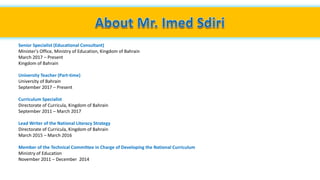
Senior Specialist (Educational Consultant)
Minister's Office, Ministry of Education, Kingdom of Bahrain
March 2017 – Present
Kingdom of Bahrain
University Teacher (Part-time)
University of Bahrain
September 2017 – Present
Curriculum Specialist
Directorate of Curricula, Kingdom of Bahrain
September 2011 – March 2017
Lead Writer of the National Literacy Strategy
Directorate of Curricula, Kingdom of Bahrain
March 2015 – March 2016
Member of the Technical Committee in Charge of Developing the National Curriculum
Ministry of Education
November 2011 – December 2014
Foundations
of English Language Teaching
Imed Ben Abdallah Sdiri
Expert in Curriculum Development
and Language Planning
www.facebook.com/imed.benabdallah.sdiri
www.linkedin.com/in/imed-sdiri
imedsdiri@yahoo.fr

Foundations of English Language Teaching

  • 1.
    Foundations of EnglishLanguage Teaching Imed Ben Abdallah Sdiri Expert in Curriculum Development and Language Planning www.facebook.com/imed.benabdallah.sdiri www.linkedin.com/in/imed-sdiri imedsdiri@yahoo.fr
  • 2.
    In this presentationyou will learn about the Foundations of English Language Teaching. You will gain a deep understanding of the following: 1. General Learning Principles 2. Foundations of English Language Learning 3. Language Teaching Principles
  • 4.
    1- How dolearners learn? 2- Which factors help learners to learn?
  • 5.
    1. Nature ofthe learning process: • Learning is an intentional process of constructing meaning from information and experience. • Educators must assist learners in creating meaningful learning goals that are consistent with both personal and educational aspirations and interests.
  • 6.
    2- Construction ofknowledge. • The successful learner can link new information with existing knowledge in meaningful ways. • Unless new knowledge becomes integrated with the learner's prior knowledge and understanding, this new knowledge remains isolated, cannot be used most effectively in new tasks, and does not transfer readily to new situations.
  • 7.
    3- Context oflearning. • Learning is influenced by environmental factors, including culture, technology, and instructional practices.
  • 8.
    4- Motivational andemotional influences on learning. • What and how much is learned is influenced by the motivation. • Factors that influence learning and performance. • Students' beliefs about themselves • Positive emotions • Intense negative emotions (e.g., anxiety, panic, rage, insecurity) and related thoughts (e.g., worrying about competence, fearing punishment, ridicule, or stigmatizing labels) generally detract from motivation, interfere with learning, and contribute to low performance.
  • 9.
    5- Effects ofmotivation on effort. • Acquisition of complex knowledge and skills requires extended: 1. learner effort 2. persistence over time 3. guided practice • Educators have to use effective strategies that include purposeful learning activities, guided by practices that enhance positive emotions and intrinsic motivation to learn, and methods that increase learners' perceptions that a task is interesting and personally relevant.
  • 10.
    6- Developmental influenceson learning. • Learning is most effective when differential development within and across physical, intellectual, emotional, and social domains is taken into account. • Individuals learn best when material is appropriate to their developmental level and is presented in an enjoyable and interesting way. • Awareness and understanding of developmental differences among children with and without emotional, physical, or intellectual disabilities, can facilitate the creation of optimal learning contexts.
  • 11.
    7- Social influenceson learning. • Learning is influenced by social interactions, interpersonal relations, and communication with others. • Learning can be enhanced when the learner has an opportunity to interact and to collaborate with others on instructional tasks. • Quality personal relationships that provide stability, trust, and caring can increase learners' sense of belonging, self-respect and self-acceptance, and provide a positive climate for optimal learning. • Positive learning climates help learners feel safe to share ideas, actively participate in the learning process, and create a learning community.
  • 12.
    8- Individual differencesin learning. • Students are different by nature. • Educators need to be sensitive to individual differences, in general. • Differentiation • Personalized Learning
  • 13.
    9- Standards andassessment. • Setting appropriately high and challenging standards and assessing the learner as well as learning progress -- including diagnostic, process, and outcome assessment -- are integral parts of the learning process. • Assessment provides important information to both the learner and teacher at all stages of the learning process. Effective learning takes place when learners feel challenged to work towards appropriately high goals. • Ongoing assessment of the learner's understanding of the curricular material can provide valuable feedback to both learners and teachers about progress toward the learning goals.
  • 16.
    • Who dowe teach? • Why do we teach? • What do we teach?
  • 17.
    • Who dowe teach? People / Children Learners Individuals Contributors Citizens
  • 18.
    • What dowe expect from students? People / Children Learners Individuals Contributors Citizens Successful Confident Creative Responsible
  • 19.
    • What doall teachers teach in general? Learning Knowledge Skills Compete ncies Attitudes Values
  • 20.
    • What doall teachers teach in general? Learning Compe tencies Collabora tion Communi cationCreativity ICTCritical Thinking
  • 21.
    • What doEnglish language teachers teach? Learning Vocabulary Grammar Reading Listening Speaking Writing Attitudes Values
  • 22.
    • What doEnglish language teachers teach? Learning Vocabulary Grammar Reading Listening Speaking Writing Attitudes Values Collabora tion Communi cationCreativity ICTCritical Thinking Compete ncies
  • 23.
  • 24.
    Natural Combination ofSkills Pattern 1 Reading Writing Natural Combination of Skills Pattern 2 Listening Speaking
  • 25.
    • How dowe teach? • What are the teacher’s roles?
  • 28.
    • Contextualization: • Learningtasks and activities should be designed for students to learn the language in authentic and meaningful contexts of use. • Lessons are planned around learning outcomes, a theme, or a type of text to help pupils use related language skills, grammatical items/ structures and vocabulary appropriately in spoken and written language to suit the purpose, audience, context and culture.
  • 29.
    • Learner-centeredness: Learners areat the centre of the teaching-learning process. Teaching should be differentiated according to pupils’ needs, abilities and interests. Effective pedagogies will be used to engage them and to strengthen their language development.
  • 30.
    • Learning-focused Interaction: Theteacher will provide a rich environment for communication that will explicitly foster listening and speaking skills and focus on the achievement of the Learning Outcomes. • At the same time, the teacher will actively engage pupils by encouraging participation in their learning, boosting their confidence in the use of language, and promoting collaboration among learners from different socio-cultural backgrounds.
  • 31.
    • Integration: The areasof language learning – the receptive skills, the productive skills, and grammar and vocabulary will be taught in an integrated way, together with the use of relevant print and non-print resources, to provide multiple perspectives and meaningful connections.
  • 32.
    • Process Orientation: Thedevelopment of language skills and knowledge about language involves the teaching of processes. The teacher will model and scaffold such processes for pupils, while guiding them to put together their final spoken, written and/or multimodal products.
  • 33.
    • Spiral Progression: Skills,grammatical items, structures and various types of texts will be taught, revised and revisited at increasing levels of difficulty and sophistication. This will allow pupils to progress from the foundational level to higher levels of language use.
  • 34.
  • 35.
    • Write yourbig idea from this section • How can you use this idea in your classroom?
  • 37.
    1. American PsychologicalAssociation, Coalition for Psychology in Schools and Education. (2015). Top 20 principles from psychology for preK–12 teaching and learning. Retrieved from http:// www.apa.org/ed/schools/cpse/top-twenty-principles.pdf 2. Australian Curriculum, Assessment and Reporting Authority. (2010). The Shape of the Australian Curriculum: Version 2.0. ACARA. 3. Curriculum Planning & Development Division. (2010). English language syllabus, 2010: Primary & secondary (express/normal [academic]). 4. Flint, A. S., Kitson, L., Lowe, K., Shaw, K., Feez, S., Humphrey, S., & Vicars, M. (2017). Literacy in Australia: Pedagogies for engagement. John Wiley & Sons. 5. Hunkins, F. P., & Ornstein, A. C. (2016). Curriculum: Foundations, principles, and issues. Pearson Education. 6. Kivunja, C. (2015). Exploring the pedagogical meaning and implications of the 4Cs “super skills” for the 21st century through Bruner’s 5E lenses of knowledge construction to improve pedagogies of the new learning paradigm. Creative Education, 6(02), 224. 7. Lesaux, N. K., Koda, K. C., Siegel, L. C., & Shanahan, T. C. (2006). Development of Literacy. 8. Ollerhead, S. (2018). Pedagogical language knowledge: preparing Australian pre-service teachers to support English language learners. Asia-Pacific Journal of Teacher Education, 46(3), 256-266.
  • 38.
    Senior Specialist (EducationalConsultant) Minister's Office, Ministry of Education, Kingdom of Bahrain March 2017 – Present Kingdom of Bahrain University Teacher (Part-time) University of Bahrain September 2017 – Present Curriculum Specialist Directorate of Curricula, Kingdom of Bahrain September 2011 – March 2017 Lead Writer of the National Literacy Strategy Directorate of Curricula, Kingdom of Bahrain March 2015 – March 2016 Member of the Technical Committee in Charge of Developing the National Curriculum Ministry of Education November 2011 – December 2014
  • 39.
    Foundations of English LanguageTeaching Imed Ben Abdallah Sdiri Expert in Curriculum Development and Language Planning www.facebook.com/imed.benabdallah.sdiri www.linkedin.com/in/imed-sdiri imedsdiri@yahoo.fr