The 4 C sBy Jenny Carolna Martínez
Ten years ago, NEA helped establish the Partnership for 21st Century Skills (P21)
and in 2002 began a two-year journey to develop what became known as a
“Framework for 21st Century Learning,” highlighting 18 different skills. In the
last eight years, 16 states joined P21 and agreed to build 21st century outcomes
into their standards, professional development, and assessments.
Over the years it became clear that the framework was too long and
complicated. To resolve this issue, we interviewed leaders of all kinds to
determine which of the 21st century skills were the most important for K-12
education. There was near unanimity that four specific skills were the most
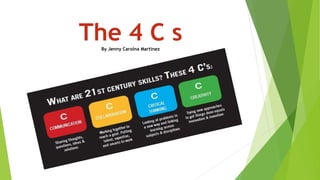
important. They became known as the “Four Cs”:
Now the challenge is building the “Four Cs” into K-12
education. Discussions on this topic are pending at the
federal and state levels and in many school districts around
the country. To encourage more members and leaders to
incorporate this policy into their own instruction, NEA
developed this guide to introduce educators to the concept,
stress the importance of the “Four Cs,” and put 21st century
education into classroom practice.
Let Your Students Lead The Learning
 Learning takes place best in environments where students
feel empowered to learn. Effective teachers are more like
moderators, offering inspiration and guiding students to
discover for themselves. Give students the opportunity to
be self-learners, which guarantees lifelong learning. This
brings us directly to the second point.
Create an Inquiry-Based Classroom
Environment
 If students are to lead the way to learning, they need to
be able to ask questions – and then find the means to
answer them. Students (and teachers) need to “wonder
out loud” as they encounter new information. A KWL chart
(What do you Know? What do you Want to know? What
have you Learned?) can guide students toward true self-
motivated learning.
Encourage Collaboration
 “We are greater than the sum of our parts.” Herein is
the heart of collaboration. A healthy, active classroom is a
sharing classroom. Students are social beings, and even
more so in a language class. Find every opportunity to
allow students to form pairs and small groups. Not only
does this encourage the development of speaking and
listening skills, but it also teaches students how to
effectively achieve goals together.
Develop Critical Thinking Skills
 Learning is more than memorizing and remembering.
Critical thinking skills take students well beyond simple
comprehension of information. Students use these skills to
solve problems in new situations, make inferences and
generalizations, combine information in new patterns, and
make judgments based on evidence and criteria.
Introduce activities in your lessons that build critical
thinking skills along with language skills.
Encourage Creativity
 Encourage your students to be creative throughout each lesson.
Creative activities allow students to express what they’ve
learned in a new way. This synthesizing and personalizing of
knowledge consolidates learning, and creates an experience
that remains with students long after the class is over.
 By keeping these strategies in mind as you plan each lesson,
you will be encouraging the development of 21st Century skills.
Of course, your students may also need time to adjust to this
new way of learning. However, they will soon begin to feel
empowered to think more critically, to ask questions and seek
answers, and to express themselves creatively. Most
importantly, their communication skills will become much
stronger as a result, which always remains our main objective!

The 4 cs

  • 1.
    The 4 CsBy Jenny Carolna Martínez
  • 2.
    Ten years ago,NEA helped establish the Partnership for 21st Century Skills (P21) and in 2002 began a two-year journey to develop what became known as a “Framework for 21st Century Learning,” highlighting 18 different skills. In the last eight years, 16 states joined P21 and agreed to build 21st century outcomes into their standards, professional development, and assessments. Over the years it became clear that the framework was too long and complicated. To resolve this issue, we interviewed leaders of all kinds to determine which of the 21st century skills were the most important for K-12 education. There was near unanimity that four specific skills were the most important. They became known as the “Four Cs”:
  • 3.
    Now the challengeis building the “Four Cs” into K-12 education. Discussions on this topic are pending at the federal and state levels and in many school districts around the country. To encourage more members and leaders to incorporate this policy into their own instruction, NEA developed this guide to introduce educators to the concept, stress the importance of the “Four Cs,” and put 21st century education into classroom practice.
  • 4.
    Let Your StudentsLead The Learning  Learning takes place best in environments where students feel empowered to learn. Effective teachers are more like moderators, offering inspiration and guiding students to discover for themselves. Give students the opportunity to be self-learners, which guarantees lifelong learning. This brings us directly to the second point.
  • 5.
    Create an Inquiry-BasedClassroom Environment  If students are to lead the way to learning, they need to be able to ask questions – and then find the means to answer them. Students (and teachers) need to “wonder out loud” as they encounter new information. A KWL chart (What do you Know? What do you Want to know? What have you Learned?) can guide students toward true self- motivated learning.
  • 6.
    Encourage Collaboration  “Weare greater than the sum of our parts.” Herein is the heart of collaboration. A healthy, active classroom is a sharing classroom. Students are social beings, and even more so in a language class. Find every opportunity to allow students to form pairs and small groups. Not only does this encourage the development of speaking and listening skills, but it also teaches students how to effectively achieve goals together.
  • 7.
    Develop Critical ThinkingSkills  Learning is more than memorizing and remembering. Critical thinking skills take students well beyond simple comprehension of information. Students use these skills to solve problems in new situations, make inferences and generalizations, combine information in new patterns, and make judgments based on evidence and criteria. Introduce activities in your lessons that build critical thinking skills along with language skills.
  • 8.
    Encourage Creativity  Encourageyour students to be creative throughout each lesson. Creative activities allow students to express what they’ve learned in a new way. This synthesizing and personalizing of knowledge consolidates learning, and creates an experience that remains with students long after the class is over.  By keeping these strategies in mind as you plan each lesson, you will be encouraging the development of 21st Century skills. Of course, your students may also need time to adjust to this new way of learning. However, they will soon begin to feel empowered to think more critically, to ask questions and seek answers, and to express themselves creatively. Most importantly, their communication skills will become much stronger as a result, which always remains our main objective!