An Empiricist TheoryOf Knowledge Bruce Aune
download
https://ebookbell.com/product/an-empiricist-theory-of-knowledge-
bruce-aune-1644510
Explore and download more ebooks at ebookbell.com
2.
Here are somerecommended products that we believe you will be
interested in. You can click the link to download.
Empiricism And Subjectivity An Essay On Humes Theory Of Human Nature
Paperback Gilles Deleuze Constantin V Boundas
https://ebookbell.com/product/empiricism-and-subjectivity-an-essay-on-
humes-theory-of-human-nature-paperback-gilles-deleuze-constantin-v-
boundas-9997488
Pragmatics And Semantics An Empiricist Theory Carol A Kates
https://ebookbell.com/product/pragmatics-and-semantics-an-empiricist-
theory-carol-a-kates-51673812
Mostly Harmless Econometrics An Empiricists Companion Joshua D Angrist
Jrnsteffen Pischke
https://ebookbell.com/product/mostly-harmless-econometrics-an-
empiricists-companion-joshua-d-angrist-jrnsteffen-pischke-51955056
Mostly Harmless Econometrics An Empiricists Companion Joshua David
Angrist Jrnsteffen Pischke
https://ebookbell.com/product/mostly-harmless-econometrics-an-
empiricists-companion-joshua-david-angrist-jrnsteffen-pischke-34751624
3.
What Does ItMean To Be An Empiricist Empiricisms In Eighteenth
Century Sciences Siegfried Bodenmann
https://ebookbell.com/product/what-does-it-mean-to-be-an-empiricist-
empiricisms-in-eighteenth-century-sciences-siegfried-bodenmann-7049732
Foundations Of Quantum Mechanics An Empiricist Approach 1st Edition
Willem M De Muynck Auth
https://ebookbell.com/product/foundations-of-quantum-mechanics-an-
empiricist-approach-1st-edition-willem-m-de-muynck-auth-4207396
How To Keep An Open Mind An Ancient Guide To Thinking Like A Skeptic
Sextus Empiricus Richard Bett
https://ebookbell.com/product/how-to-keep-an-open-mind-an-ancient-
guide-to-thinking-like-a-skeptic-sextus-empiricus-richard-
bett-51946390
How To Keep An Open Mind Sextus Empiricus
https://ebookbell.com/product/how-to-keep-an-open-mind-sextus-
empiricus-33328010
An Introduction To Early Buddhist Soteriology Freedom Of Mind And
Freedom By Wisdom G A Somaratne
https://ebookbell.com/product/an-introduction-to-early-buddhist-
soteriology-freedom-of-mind-and-freedom-by-wisdom-g-a-
somaratne-44887694
ii
CONTENTS
PREFACE iv
Chapter One:WHAT IS KNOWLEDGE?
Conceptions of Knowing 1
Epistemic Contextualism 4
Lewis’s Contextualism 6
A Dual Analysis of Knowledge 11
Problems for Two Senses of “Knows” 14
Avoiding Gettier Counterexamples 15
Concluding Remarks 19
Chapter Two: THE CLAIMS OF RATIONALISM 23
The A Priori, Universality, and Necessity 23
Axioms and Primitive Rules of Inference 26
General Doubts about Intuitive Knowledge 28
Logical Truths and Rules of Inference 32
Alleged Self-evident Factual Truths 36
Three Final Examples, Two Old and One New 40
An Indirect Argument for Rationalism 43
Chapter Three: EMPIRICISM AND THE A PRIORI 47
Quine’s Criticism of Analyticity 47
Quine’s Later View of Analytic Truth 50
Analyticity, Logic, and Everyday Language 52
Analyticity Extended 57
Some Examples and Arguments by Kripke 63
Beliefs, Propositions, and Analyticity 64
Chapter Four: PROPERTIES AND CONCEPTS 71
What are Properties? 71
Problems with A-theories and T-theories 73
Predication 76
Advantages of F-theories 78
What are Concepts? 80
Some Problems about DSTs 83
More about Concepts 85
Concepts, Predicates, and the World 87
Meaning, Intending, and Content Clauses 88
Concluding Remarks 93
9.
Contents iii
Chapter Five:OBSERVATIONAL KNOWLEDGE 95
A Problem about Observation 95
Evaluating Observational Beliefs 97
Does Knowledge Need a Foundation? 99
Alternatives to Foundationalism 102
Knowledge and the World: Some Problems 104
Semantic Externalism 107
Criticism of Semantic Externalism 110
A Skeptical Problem Restated 114
Chapter Six: MEMORY AND A POSTERIORI KNOWLEDGE 115
Memory as a Source of Knowledge 115
What is Induction? 122
Induction: Arguments Pro and Con 124
Induction and Laws 126
Inference to the Best Explanation 128
Inferences Based on Bayes’ Theorem 130
Ascertaining Prior Probabilities 133
Basic Prior Probabilities 136
The BIV Hypothesis Again 138
Concluding Remarks 142
APPENDICES 145
1. Armstrong’s New Hypothesis About Universals 145
2. Boghossian and Field on Basic Logical Principles 146
3. Stipulation, Proper Definitions, and Truth 149
4. “What is Said” and Propositions 152
5. Chisholm’s Defense of the Principle CP 155
6. Analytic Probability Principles 156
REFERENCES 159
INDEX 162
10.
iv
Preface
hen I beganto teach philosophy, almost every responsible analytic philoso-
pher was an acknowledged empiricist. Today, many analytic philosophers
repudiate central tenets of the position, rejecting at least an ana-
lytic/synthetic distinction and often pursuing metaphysical questions that main-line
empiricists set aside decades ago. I regard this development as unfortunate, a
backward step in philosophy that needs to be corrected. Bas van Fraassen and Anil
Gupta have recently taken important steps in the right direction. I try to do my part
in this book, attacking well-known criticisms of empiricist doctrine and defending the
sort of empiricist theory that I consider acceptable.
There is no essence to empiricism: different positions have been defended
under the name “empiricism,” and the practice will no doubt continue.1
The empiri-
cism I learned as a student was called “logical empiricism,” the qualifier marking the
importance of formal logic to this version of the theory. One of my teachers, Herbert
Feigl, discussed the distinctive claims of an earlier form of this empiricism in a pro-
grammatic article called “Logical Empiricism,” which was regarded as something of a
manifesto in its day. The adjective Feigl attached to “empiricism” was chiefly owing
to the logical and semantical work of Rudolf Carnap, another of my teachers,2
who
was the dominant figure among the empiricists whose views Feigl was promoting.
Carnap’s epistemological views changed significantly over his long philosophical ca-
reer, and his later views represent a development of empiricism that deserves to be
better known by today’s critics of the doctrine.
The objections to empiricism that W. V. Quine formulated in “Two Dogmas of
Empiricism” (1951) are still widely regarded as successful. The supposed dogmas in
question are, Quine said, a belief in a fundamental cleavage between analytic and
synthetic truths, on the one hand, and reductionism, the belief that each meaningful
statement is equivalent to some logical construct upon terms referring to immediate
experience, on the other. As it happens, logical empiricists did not hold the second
dogma when Quine’s paper was published. Feigl explicitly denounced it in “Logical
Empiricism” (first published in 1943) and Carnap left it behind in the middle thirties.3
The first dogma—“assumption” is really a better word here—was indeed accepted, at
least as an ideal, by logical empiricists, and I shall therefore discuss Quine’s objec-
tions to it carefully and at length. Although Quine has long been one of my philoso-
phical heroes, I have to say that his objections to analyticity fail to undermine the
position Carnap defended in his later years. Carnap was right to set them aside as
unsuccessful.
Quine’s criticism was not the only cause of empiricism’s decline; another was
the rise of epistemological rationalism. The cause of this phenomenon is complex;
no doubt it had something to do with the revival of interest in metaphysics that re-
sulted from Kripke’s revolutionary ideas on identity, necessity, and essential proper-
ties. But whatever the actual cause may be, the most influential exponent of the
new analytical rationalism turned out to be R. M. Chisholm. As Alvin Plantinga re-
marked in 1990, Chisholm’s thought “has [in fact]…dominated American epistemol-
ogy for more than thirty years”;4
if this is an exaggeration, as I believe it is, it is
nevertheless not very far from the truth. To defend a version of empiricism at the
present time it is therefore not sufficient to overcome the criticism of Quine;
1
See van Fraassen (2002), Appendix B, “A History of the Name ‘Empiricism’.”
2
As a graduate student, I spent a year at UCLA, where he was then teaching.
3
He rejected it in Carnap (1936).
4
Plantinga (1990), p. 366.
W
11.
Preface v
one shouldalso criticize the arguments supporting the alternative position that
Chisholm was instrumental in initiating.
Criticizing an alternative position is unfortunately an awkward task. There is
always more than one version of such a position and always more than one advocate
to confront. Alvin Plantinga, George Bealer, Laurence BonJour, Christopher Peacock,
and Robert Audi have defended well-considered versions of epistemological rational-
ism, but I cannot examine all of them in a book like this. Instead of focusing atten-
tion on particular versions of the doctrine, I shall for the most part attend to what I
regard as the most important arguments rationalists offer for synthetic a priori
truths. These arguments feature a number of examples that are cited again and
again; in 2005 Laurence BonJour offered the examples that Chisholm gave as early
as 1966.1
I therefore attend to them closely. My positive arguments against episte-
mological rationalism depend not on the peculiarities of different rationalist theories
but on structural weaknesses common to them all. The propositions they take to be
intuitively decidable synthetic truths are actually warranted, if they are actually true,
by facts that are far too discursive and stipulative to be a confirming element in any
rationalist theory.
In the past twenty years or so academic philosophy has become highly spe-
cialized, with the result that philosophers working in epistemology often do not have
well-considered views in related subjects such as metaphysics, formal semantics,
and philosophy of science. Topics in these related subjects are nevertheless crucially
important for basic epistemological disputes. As far as a priori knowledge is con-
cerned, the pertinent topics belong mainly to metaphysics and formal semantics.
Specific issues concern the reality and nature of properties and propositions, which
rationalists typically regard as providing the foundation for synthetic a priori knowl-
edge. Because recent work in metaphysics and formal semantics puts older views of
these supposed objects into serious doubt, I devote part of one chapter to proposi-
tions and a whole chapter to properties. Writing this material has reinforced my be-
lief that it is absolutely essential for a responsible treatment of a priori knowledge.
Although critics of empiricism have typically concentrated on an ana-
lytic/synthetic distinction, a satisfactory empiricist philosophy must provide an ac-
ceptable account of a posteriori knowledge. In my final chapters I therefore discuss
problems with the sources of empirical knowledge that empiricists almost always ac-
cept: observation, memory, and what Hume called experimental inference. I open
chapter five with a consideration of some of these problems, but I soon address the
doctrine of semantic externalism that Hilary Putnam developed in criticizing his well-
known “brains in a vat” version of a perennial skeptical hypothesis. Although Put-
nam evidently considered his externalism to be opposed to traditional views of
meaning and reference, I argue that it is in fact quite close to the verificationism that
was espoused by logical positivists, and I reject it for reasons that apply to that once
popular doctrine. As I see it, the empiricists’ historical repudiation of empirical enti-
ties that cannot possibly be observed is something that an acceptable empiricism
must leave behind.
In chapter six I am mainly concerned with “inductive” or a posteriori infer-
ence, which has been seriously neglected by main-line epistemologists with rational-
ist sympathies. (Chisholm had almost nothing to say about this kind of inference in
the last edition of his influential Theory of Knowledge.) Since inductive methods
raise more problems than most philosophers seem to realize, I provide a critical
overview of the standard alternatives. My assessment of these methods is generally
negative—even for the current favorite, Inference to the Best Explanation. Arguing
1
See Chisholm (1989) and BonJour (2005). Chisholm used the same examples in earlier editions of his
Theory of Knowledge; the first was published in 1966.
12.
Bruce Aune
vi
that theproblems familiar methods are supposed to solve can be disposed of only by
relying on Bayes’ theorem of probability theory, I end up discussing this theorem and
its relation to what can be called “evidential” probability. This kind of probability is
often viewed as a measure of subjective belief, but I argue that it must be under-
stood differently if well-known problems are to be avoided. I view it as a measure of
certainty and evidential support, a position I do my best to justify. Although some
epistemologists are very knowledgeable about probability theory, the subject is evi-
dently daunting to many philosophers. Believing this, I took special pains to make
my discussion understandable to those entirely new to the subject. Sophisticated
readers can simply skip the explanatory passages I include here and there.
To deal with certain side issues that are highly significant for some philoso-
phers but of minimal interest to many, I followed the example of Fogelin (1994) and
van Fraassen (2002) and included a number of appendices. These appendices are
generally too long to be footnotes but they are well suited to the end of the book
where readers who recognize their importance can consult them. Each is concerned
with matters that, in my experience, always eventually arise when philosophical ri-
vals debate epistemological issues.
A number of friends contributed to the manuscript in one way or another. Joe
LaPorte, Steve Braude, Jeffrey Sicha, and Lynne Baker made helpful comments on
the chapters they read. LaPorte was particularly helpful with chapters one and six,
and Sicha subjected the whole manuscript to very careful scrutiny, doing the sort of
thing he did many years ago when I was writing my first book. I am greatly in-
debted to his good judgment and critical acuity. The late Gregory Fitch offered illu-
minating remarks on some questions I had with Kripke’s footnote about the “neces-
sity of origins”; he was not himself critical of the argument Kripke seemed to give,
but his remarks were instrumental in leading me to the criticism I formulate in chap-
ter three. My wonderful wife, Anne, to whom I dedicate this book, was helpful from
start to finish. She read every version of the manuscript and always discovered er-
rors that I had somehow missed.
This is my fourth book on epistemology. The first was principally indebted to
the work of Wilfrid Sellars, whose influence is discernible here mainly in chapters
four and five. The logical empiricist doctrines that I absorbed from Herbert Feigl,
Rudolf Carnap, and Grover Maxwell are evident in chapters two and three, and the
logical and semantic theory I learned from Donald Kalish and Richard Montague is
also apparent there. Montague introduced me to the logical foundations of probabil-
ity, but my views on that subject are more strongly indebted to the writing of my
one-time students Roger Rosenkrantz and Brian Skyrms. The fact that these people,
and certain writers whom I have not mentioned, do not agree on all philosophical
matters may help to explain the independence of my own philosophical thinking,
such as it is. I have had no single path to follow.
13.
1
Chapter 1
WHAT ISKNOWLEDGE?
ost of the topics I shall be concerned with in this book concern kinds of
knowledge: a priori knowledge, observational knowledge, and the possibility
of having knowledge about objects and processes that, like the feelings of
others or the micro-objects of current physics, cannot possibly be perceived. But
these kinds of knowledge make sense only as instances of knowledge in a generic
sense. Plato discussed knowledge of this generic sort in his Theaetetus, the first
analytical study in epistemology, and the nature of knowledge so understood has
been the most widely discussed topic in recent work on the subject. Since current
disputes about the general nature of knowledge are closely tied to competing strate-
gies for making progress in philosophy, a discussion of this topic is an appropriate
starting point for the argument of this book. What I say here provides a foundation
for what I shall argue in later chapters.
Conceptions of Knowing
An analytical study of knowledge ought to acknowledge that the word “knowledge” is
significantly ambiguous—as are its equivalents in other languages, such as the Greek
epistêmê, from which “epistemology” is derived. The principal meanings of these
words can be arranged into three groups. The first group concerns abilities of vari-
ous kinds, primarily cognitive abilities that result from learning but sometimes even
motor abilities. One can know German or know how to walk on stilts; one can know
how to give a rousing speech, how to use the library, how get to the airport, but also
how to do a handstand or back flip. Another group involves acquaintance, familiar-
ity, personal experience, and corresponding recognitional abilities. One can know a
former teacher; one can know a person by name or by sight; one can know fear,
love, or disappointment; and can know New York, Boston, or the neighboring univer-
sity campus. The last group of meanings—perhaps it is a single meaning—concerns
“facts gathered by study, observation, or experience,” and conclusions inferred from
such facts (as when one has an in-depth knowledge of particle physics).”1 What the
dictionary describes as knowledge of facts can be described more plainly as knowl-
edge-that:2 knowledge that snow is while, that grass is green, or that 2+2 = 4. It is
this last sort of knowledge that is central to recent work in epistemology.
In the early part of the last century some philosophers, notably Bertrand Rus-
sell, considered acquaintance or direct experience the fundamental source of empiri-
cal knowledge; for them, knowledge-that ultimately arises from knowledge of. As
they saw it, our subjective experiences are elements of our consciousness, and eve-
rything we know by perception arises from our experiences. This view is no longer
widely held: most philosophers now contend that acquaintance involves a substantial
amount of knowledge-that, and the directly experienced residue in experience is little
more than a stimulus for interpretive acts that result in more knowledge-that. Just
think of your knowledge of your own hometown. You know that it has various build-
ings, various streets, various parks; you know where your house or apartment was—
you know that it was in such and such a place. You can call up memory images of
1
See the entry under “knowledge in” The Oxford American Desk Dictionary and Thesaurus.
2
I here assume that knowledge-who, knowledge-what, knowledge-when, and so on, are special cases of
knowledge-that. For example, “Tom knows who wrote the Declaration of Independence” attributes to Tom
the knowledge that X wrote the Declaration of Independence, where X is the person, namely Thomas Jef-
ferson, who wrote that document.
M
14.
Bruce Aune
2
places yourecall, but these images simply bring more facts to mind. The prevalence
of this new view of acquaintance—the idea that it is not a distinctive kind of knowl-
edge more basic than knowledge-that—owes a lot to Wittgenstein’s attack on what
he called ”private languages,” 3
and it may or may not be right or defensible. I shall
have more to say about acquaintance in chapter five.
Before 1963 analytically-minded philosophers mostly agreed that knowledge-
that could be understood as justified true belief. Edmund Gettier’s now famous criti-
cism of this account destroyed the agreement and stimulated a plethora of attempts
to provide an improved definition.4
The philosophers seeking an improvement had
two desiderata specifically in mind. They wanted a definition incorporating standards
that would make it possible for ordinary human beings to know most of what they
think they know, and they wanted a definition that would avoid Gettier examples and
others relevantly like them. A definition having the first feature would be instrumen-
tal in avoiding skepticism, an outcome that could be expected if the required stan-
dards of evidence were set too high. They also assumed that a definition having the
desired features would require a knower to possess an appropriate true belief.
The great number and variety of attempts to provide a definition satisfying
the desiderata I mentioned5
make it fairly clear that the philosophers attempting to
provide such an improvement were not working with a single knowledge concept that
already existed and was generally accepted. They may have had illusions about what
they were doing, but the reality is that they were attempting to create a knowledge
concept that was philosophically preferable to the simple one that Gettier criticized.
They wanted a better analytical account of what knowledge could be taken to be. As
it happened, they did not definitely succeed in this endeavor: no generally accepted
conception or account of the desired kind was ever created. Many philosophers con-
tinue with the hunt, but some have basically given up on it. Among the latter, Timo-
thy Williamson came to the conclusion that “knowing does not factorize as standard
analyses require.”6
Instead of attempting to provide a definition of knowledge, Wil-
liamson offered a “modest nonreductive analysis,” describing knowing as “the most
general factive, stative [human] attitude”—factive in being attached only to truths,
and stative in being a state rather than a process.7
But Williamson’s nonreductive
analysis does not appear to have attracted many adherents. Most philosophers ap-
pear to want a more informative account of knowing than Williamson’s analysis pro-
vides.8
The consensus that once existed on seeking an improved justified-true-belief
(or JTB+) analysis of knowing broke down for other reasons. Some philosophers,
such as Peter Unger and Robert Fogelin, did not believe that skepticism should be
ruled out by easily satisfied standards for knowing. These philosophers even wrote
books supporting versions of that generally abhorred doctrine.9
In taking a skeptical
3
See Wittgenstein (1959),§§ 243- 272. I critically assess Wittgenstein’s argument in Aune (1991), pp.
115-130.
4
See Gettier (1963).
5
The principal definitions given in the first twenty years after Getter’s paper was published are ably dis-
cussed in Shope (1983).
6
See Williamson (2000), p. 4.
7
Ibid, p. 34.
8
Hilary Kornblith (1999) defends a singular account of knowing that I do not consider here. He argues
that knowledge is a natural kind, instances of which may be possessed by birds or monkeys as well as
human beings. I do not deny that a knowing concept with a wide application of this kind is possible, but
like Hacking (2005), I find problems in the very concept of a natural kind, and I think the word “knowing”
is in any case applied to a more diverse variety of instances than is happily accommodated by Kornblith’s
single conception. As I see it, when we describe birds or monkeys as knowing things, we are using the
word “knowing” in an extended, analogical sense.
9
See Unger (1975) and Fogelin (1994) and (2000).
15.
What is Knowledge?3
line they had little trouble satisfying the other desideratum for a JTB+ analysis of
knowledge, the one requiring the avoidance of Gettier examples. Each of the exam-
ples Gettier actually gave presupposed that a person may know that P on the basis
of inconclusive evidence--evidence that does not exclude the possibility that P is ac-
tually false.10
But supporters of skepticism normally endorse higher standards for
knowing: they seek evidence that is logically conclusive.11
Since a skeptical scenario
featuring Descartes’ evil genius or Putnam’s brains in a vat cannot be conclusively
refuted (or ruled out with utter certainty) by any evidence plausibly available to an
observer, a philosopher requiring conclusive evidence for knowing will end up with
the view that no alternative scenario incompatible with skepticism can possibly be
known to be true.
Thus far I have been speaking of assumptions about knowledge that philoso-
phers have held since 1963. Before that further differences existed, particularly if
we go back far enough. Plato held that knowledge (epistêmê) is infallible and, unlike
belief, directed to an immutable object.12
Aristotle held knowledge to be either im-
mediately certain or a demonstrative consequence, via the syllogism, of immediately
certain premises.13
Descartes did not limit necessary inference to the syllogism, but
like Aristotle he thought properly scientific knowledge, or scientia, required rational
certainty: the subject’s evidential basis for such knowledge must be conclusive.14
Earlier twentieth-century philosophers had a more flexible attitude to knowing. G. E.
Moore held that “I know that P” sometimes does, and sometimes does not, imply “I
know that P with utter certainty”;15
and in 1952 Norman Malcolm distinguished a
strong from a weak sense of “knows,” one implying that the subject is certain of
something, the other not.16
In everyday life we often apparently do speak of knowledge in what Malcolm
called the weak sense; we seem to assume that people often have genuine knowl-
edge when their evidence is logically inconclusive, when it does not exclude the pos-
sibility of error. We seem to assume this when, having looked at our watch, we say
we know what time it is; we seem to assume it when, watching a television news-
cast, we say we know the Twin Towers have been destroyed by a terrorist attack;
and so on. But sometimes we speak of it in what is pretty clearly a stronger sense,
one requiring that a subject’s evidence be logically conclusive or very close to it.
(One way of describing logically conclusive evidence is to say that E is logically con-
clusive for P when the evidential probability of P on the basis of E is 1, an idea I ex-
10
This is easily seen. In setting forth his counter-examples, Gettier described cases in which a subject, S,
has an adequately justified belief that P, which nevertheless happens to be false. Not knowing that P is
false but knowing elementary logic, S forms the belief that Q, and this belief, because of its known logical
relation to the adequately justified P, is adequately justified as well. But Q, unlike P, happens to be true,
and true for reasons having nothing to with the evidence S possesses. S therefore satisfies the justified-
true-belief conditions for knowing that Q, but because of the logically fortuitous character of Q’s truth, S
clearly does not possess this knowledge.
11
The adjective “logical” here is customary but it is not really happy, since P can provide conclusive evi-
dence for Q without it being a logical truth that P only if Q. It is not a logical truth that if Sarah is a sister,
Sarah is female, but the former provides conclusive evidence for the latter. I pursue matters of this kind
in chapter three.
12
Republic 511d.
13
Posterior Analytics I, 71b.
14
In The Principles of Philosophy Descartes described this as “perfect” knowledge; his Latin equivalent
was “scientia”; see Cottingham, et al (1985), vol. 1, pp. 10n and 179. In addition to the “absolute cer-
tainty” provided by perfect knowledge, Descartes accepted a conception of moral certainty, which is close
to what Malcolm (see note 14 below) considered knowledge in the weak sense; see Cottingham, ibid. p.
290.
15
Moore (1959), p. 236f.
16
Malcolm (1963). Malcolm’s position is actually more complicated than I indicate in the text; it involves
qualifications that are difficult to spell out in a brief statement.
16.
Bruce Aune
4
plain fullyin chapter six.) In a recent letter to the Scientific American, a man calcu-
lated that to win the $160-million with his lottery ticket, he would have to beat the
winning odds of 1 to 120,526,770. In spite of these odds, he was willing to buy the
ticket, and when he bought it we would not agree that if his friend Tom believes he
will lose, Tom knows he will lose if that is what will happen. In spite of the very
strong evidence Tom possesses, the possibility remains that the man will win--and
this is enough to defeat Tom's claim to know he will lose. In this case, actually
knowing that the man will lose seems to require rational certainty: our evidence
must be sufficient to rule out the possibility that he will win.
The idea that we do in fact commonly apply different standards of evidence or
different levels of certainty in deciding whether this or that person has knowledge
under these or those circumstances is now widely accepted,17
but some philosophers
give “invariant” accounts of this diversity.18
According to some, knowledge-
ascriptions based on weak standards are usually in fact false, though they may have
some practical value;19
according to others, negative ascriptions (“S does not know
that P”) based on exceptionally strong standards are actually false, though they
seem plausible in the context of some well-known skeptical arguments.20
The key
issue in the whole debate is how the diversity that is apparent in assertions involving
“knows that” is best accommodated theoretically, and what account of how knowl-
edge may be understood is most illuminating. As it happens, I shall be defending a
dual account in what follows, one in which a concept of knowing for certain is distin-
guished from a minimal concept that does not require rational certainty. My ap-
proach is not widely accepted at the present time, however; the most widely dis-
cussed alternative in recent years is some form of contextualism. Because of its
popularity as well as its complexity and suggestiveness, I want to consider this sort
of view first.
Epistemic Contextualism
Although the term “contextualism” has been applied for more than a decade to the
view that ascriptions of the form “s knows that p” are properly evaluated by stronger
or weaker standards in differing contexts, some writers have recently emphasized
that this view is more aptly described as “epistemic relativism.”21
The new terminol-
ogy is supported by the consideration that many knowledge ascriptions whose truth-
values differ in different contexts do so for reasons having nothing to do with varying
epistemic standards.22
A representative example is “Tom knows that George is six
feet tall,” which, since “knows that P” implies “P,” conveys the idea that George is six
feet tall at the time Tom is said to have this knowledge. But George’s height
changes over the course of his life. For most of his boyhood George is far from tall;
at maturity he may be six feet tall; and as an old man he will be shorter than this.
So if George is six feet tall when Tom is said to know he has that height, the knowl-
edge ascription is true; if he is taller or shorter when Tom is said to be this tall, the
knowledge ascription is false. As a general matter, the indexical elements—the pro-
17
See, e.g., DeRose (1995), Lewis (1996) and Cohen (2000).
18
This adjective is commonly used to identify the opponents of epistemic contextualists. See Conee
(2005) or Bach (2005). Macfarlane also uses the adjective but he distinguishes two kinds of invariantism,
strict and sensitive, only the former being incompatible with contextualism. See Macfarlane (2005), p.
199.
19
Unger (1975), Fogelin (1994)
20
Bach (2005).
21
See Macfarlane (2005), offers an illuminating taxonomy of recent views about the semantics of “know.”
22
Feldman (1999) may have been the first to emphasize this.
17.
What is Knowledge?5
nouns, tensed verbs, and other contextual indicators—in both the “that”-clause and
the words preceding it in a knowledge ascription (for instance in “Tom once knew”)
may have a decisive effect on the ascription’s truth, and this effect has nothing to do
with varying standards of evaluation.
Are there clear cases in which different utterances of a knowledge-ascription
type are rightly evaluated by epistemic standards of varying stringency? The word
“rightly” is the crucial modifier here. Contextualists or epistemic relativists say yes;
invariantists, as they are sometimes called, say no. How are we to decide who is
right? Or is there perhaps no fact of the matter to be right about? The differing par-
ties here obviously have access to the same linguistic or behavioral data. They
might not, of course, attend to all the data equally well. I have shown that different
philosophers have had in the past, and have now, different convictions about the na-
ture of knowledge; and recent investigation shows that different groups of non-
philosophers—and sometimes even the same ones—speak about knowledge in incon-
sistent ways.23
Philosophers almost always say that knowing that P implies it is true
that P, but ordinary people sometimes say that they have known things that turned
out to be false.24
Similarly, although most philosophers insist that knowing that P
implies believing that P, David Lewis rejects this implication, building his conception
of knowledge on its denial.25
Contextualists and invariantists (whether skeptics or
dogmatists) who argue about the plurality of proper or acceptable epistemic stan-
dards augment these instances of disagreement. A plethora of varying usages also
turn up in Google searches focused on “‘knows’ and evidential standards” and
“’knows’ and certainty.”26
The only reasonable conclusion to draw from these incom-
patibilities in belief and usage, it seems to me, is that there is really no single objec-
tive fact of the matter—no single property, concept, or standard—that is available to
prove that one position in the debate is right and the others wrong.
I hasten to add that even if there is no decisive fact of the matter here, one
position may nevertheless be philosophically more satisfactory, all things considered,
than the others. Respecting existing usage is not a decisive requirement for an ac-
ceptable philosophical analysis or conceptual clarification. Some usage is clearly
more discerning than others; some is better-informed and more relevant to philoso-
phical issues than others; and some is even inconsistent, raising more problems than
it solves. As I shall argue at length in chapter three, philosophical analysis is inher-
ently and inevitably revisionary or, to use Carnap’s term, reconstructive.27
If contex-
tualism is preferable to the alternatives I have mentioned, it is so only because it can
be spelled out in such a way that it succeeds in resolving pertinent philosophical is-
sues more satisfactorily than those alternatives are capable of doing.
Two matters that should be explained by a satisfactory contextualist (or epis-
temically relativist) theory are (a) what, according to it, knowledge is or consists of
and (b) how the alternative epistemic standards it postulates are to be identified.
The only contextualist theory so far developed that deals with both matters in a de-
tailed way is the one developed by David Lewis. I shall therefore comment briefly on
the basic elements of his view. I shall, as I implied, reject his contextualism, but I
shall nevertheless accept some of the key ideas on which it is based. Although the
distinction I mentioned between the context-dependence owing to a formula’s in-
dexical features and its alleged susceptibility to evaluation by stronger or weaker
23
See Nichols, Stitch, and Weinberg (2003).
24
Bach (2005), p. 62. Jay Rosenberg is a philosopher who comes close to siding with the ordinary people
on this point; he holds that “S knows that P” is consistent with “Not-p.” See Rosenberg (2002), pp. 1-2. I
discuss Rosenberg’s view thoroughly in “Rosenberg on Knowing” (in preparation).
25
Lewis (1996).
26
See Ludlow (2005).
27
See below, footnote 41.
18.
Bruce Aune
6
standards needsto be incorporated into Lewis’s theory, I shall ignore it here. It is
not pertinent to the issues that concern me.
Lewis’s Contextualism
Instead of holding that there is more than one sense of "knows," Lewis says that the
formula "S knows that P" can be given a single definition by means of which we may
ascertain the truth-conditions for utterances conforming to it in this or that context.
If “knows that P” is truly ascribed to a subject S in a context C, S must possess evi-
dence, Lewis says, that eliminates every alternative possibility relevant in C. Possi-
bilities relevant this way have two distinguishing features: they include ∼P and they
are properly ignored in C. Lewis does not intend that a subject’s evidence should
eliminate the possibilities including ∼P at one fell swoop, by directly supporting the
truth of P, which is incompatible with these possibilities. He intends that the evi-
dence should eliminate each relevant not-P possibility directly; and as the result of
eliminating all these possibilities, it will thereby support the proposition P as the only
remaining alternative.
To understand Lewis’s position fully, we need to know what he means by evi-
dence, how he thinks evidence can rule out a possibility, and how he identifies the
possibilities that are relevant in a given epistemic context. As for a subject’s evi-
dence, Lewis takes this to be the subject’s “entire perceptual experience and mem-
ory.”28
If I were observing an Airedale terrier, I would have a characteristic percep-
tual experience, one different from what I would have if I were observing a tiger, a
phone booth, or a Volkswagen beetle. Of course, my perceptual experience in ob-
serving an Airedale is not itself sufficient for knowing that what I see is an Airedale; I
must have some background knowledge about Airedales and other things I might be
observing. I possess this knowledge because I remember what I have previously
learned about these things and what I have experienced in connection with them.
What I perceive in a given context and everything I remember pertinent to it is the
evidence at my disposal for the case at hand.
The evidence, thus understood, that I have in a given context rules out any
relevant possibility in which my entire perceptual experience and memory are not as
they are in actuality. Lewis understands actuality to be the possibility that actually
obtains. My evidence thus rules out any relevant possibility that does not match ac-
tuality with respect to my entire perceptual experience and memory. If a possibility
does match reality in this way, it is uneliminated by my evidence. It is important to
emphasize that some possibilities that do match actuality with respect to my evi-
dence may yet be ruled out because they are deemed not relevant to the subject at
hand. My evidence may match the possibility that I am being deceived by Descartes’
evil demon, but that possibility can normally be disregarded as not relevant to the
question of what I now know: normally, it is not a possibility that must be ruled out
by my evidence here and now.
Lewis provides seven rules for identifying possibilities that may or may not
properly be ignored in a given context. Since the criticism I shall make of Lewis’s
definition does not depend on the details of these rules, I shall describe them briefly
and not comment on subtleties pertinent to them. I shall say just enough to give the
reader a sense of how they may be deployed in responding to objections that might
be raised against Lewis’s definition.
28
Lewis (1999), p. 424.
19.
What is Knowledge?7
Four of Lewis’s rules identify possibilities than cannot properly be ignored.
The first is the Rule of Actuality. According to this rule, a possibility that actually ob-
tains is never properly ignored. A possibility that actually obtains does not, of
course, have to be eliminated in showing that someone knows something, but in at-
tending to it one may become obliged by other rules to consider further possibilities
that might have to be eliminated. The other three rules have this effect. According
to the Rule of Belief, we cannot ignore anything the subject believes to obtain or,
given his available evidence, should believe to obtain. Since what a subject believes
or should believe to obtain may occasionally be at odds with his or her actual evi-
dence (something belonging to actuality), the Rule of Belief may identify possibilities
that have to be eliminated in deciding what the subject actually knows. The Rule of
Resemblance introduces further possibilities of this kind. If two possibilities saliently
resemble one another, then if one may not properly be ignored because of a rule
other than this one, the other may not properly be ignored either. Lewis qualifies29
this rule by adding that the salience of the relevant similarity should pertain mainly
to the subject’s evidence: if a possibility differs radically from actuality except for its
resemblance to the subject’s evidence, the Rule of Resemblance does not apply.
This qualification has the effect of opposing skepticism. If my total evidence when I
am actually perceiving a brilliant sunrise saliently resembles the evidence I would
have if I were being deceived by Descartes’ evil demon, the radical difference be-
tween my actual situation and the deceptive one renders the Rule of Resemblance
inapplicable in this case. Another rule could conceivably require me to eliminate this
skeptical possibility, but the Rule of Resemblance would not require me to do so.
The final rule, Attention, has the effect of making knowledge elusive in philosophical
contexts. It says that a possibility that is not ignored is not properly ignored, no
matter how likely it may be in view of the evidence.
Lewis’s last three rules tell us what we may properly ignore in determining
whether someone knows something. Like his qualification to the Rule of Resem-
blance, the first three of these rules provide impediments to unbridled skepticism.
Lewis calls the first one the Rule of Reliability. According to this rule, perception,
memory, and the testimony of others may be considered generally reliable; as a re-
sult, we may—“defeasibly,” Lewis says—ignore possibilities in which they fail. (In
saying that ignoring these possibilities is defeasible, Lewis means that the presump-
tion that these sources of knowledge are reliable may be defeated, or overridden, by
evidence that casts doubt on them in a particular case.) Lewis’s second rule in this
group concerns Permissible Rules of Method. According to it, we may assume, de-
feasibly, that our evidence samples are representative and that the “best explana-
tion” of our evidence—the available explanatory account that, if true, would provide
the best explanation of our evidence—is in fact true. Lewis’s third rule is the Rule of
Conservatism. We may, defeasibly, ignore possibilities that we know are commonly
ignored by those around us.30
Although Lewis, in elaborating his definition, is sensitive to subtle details
about the way the predicate "knows that" is commonly used, he does not explicitly
say whether he intends his definition to be an analysis of what is actually meant by
29
The qualification is important because in conjunction with his final three rules, it enables Lewis to rebut
objections raised by such writers as Jonathan Vogel. Vogel (1999) described several troublesome possibili-
ties that saliently resemble actuality so far as the subject’s evidence is concerned but that cannot, as he
saw it, be eliminated Lewis’s rules. Vogel did not, however, at least in my opinion, take adequate account
of Lewis’s rules of Reliability, Method, and Conservatism, which can show that these possibilities deserve
to be ignored in any normal context. (In fairness to Vogel I should add that in his appendix to the paper
he expressed a cautious attitude toward his criticism, saying that it “should be taken as exploratory rather
than final” (p. 172).
30
These last three rules are described on pp. 242f of Lewis (1999).
20.
Bruce Aune
8
the predicate,at least in some favored dialect, or a reconstruction of what is thus
meant. I think it is obvious that his definition does not capture what is actually
meant by most careful speakers of English. According to his definition, people know
many things they have no conception of, for their evidence on numerous occasions
fails to match the relevant alternatives to an actual possibility that they cannot actu-
ally comprehend. As an illustration of this, consider little Patty who is standing be-
fore a kangaroo in a zoo. I am not sure what the relevant alternative possibilities to
an instance of seeing an actual kangaroo may be, but little Patty’s entire perceptual
experience and memory on this occasion may fail to match all of them. (The experi-
ence of perceiving an adult kangaroo in good light is not realistically similar to per-
ceiving anything else that I can think of.) Yet little Patty may have no idea what a
kangaroo is, even though perceiving such a thing does fit her perceptual experience.
In this sort of case her evidence does eliminate the relative alternatives to seeing a
kangaroo, but most discerning speakers would not agree that little Patty therefore
knows she is perceiving a kangaroo. There are, of course, many things little Patty
does know in this situation: she knows she is seeing a large furry animal with a large
funny tail, for instance. But there is nothing in Lewis’s definition, which is focused on
possibilities matching perceptual experience and memory, that requires a person to
understand (or comprehend) the possibility that his or her evidence fails to elimi-
nate.
Lewis, true to my conception, at least, of routine cases of knowledge-that, in-
sists that knowing does not require belief or even a justification the subject can give,
but he overlooks a requirement that I would emphasize—namely, that a knower pos-
sess appropriate information. In speaking of information here I have in mind some-
thing propositional and true that one can mentally possess as the result of learning
and then retain without necessarily believing that one possesses it or thinking that it
is true. An example of information so understood is what I learned when I was
taught, or discovered,31
the expansion of π to five decimal places. One might think
of this as knowledge, but I am thinking of it, perhaps idiosyncratically, as something
more elemental, something one could possess unknowingly and without supporting
evidence.32
If I have learned that the decimal expansion of π to five decimal places
is 3.14159, I may come to believe that I have forgotten it, have no belief about what
it is, and no longer recall how or from whom I learned it. If I am urged to identify
the sequence of integers defining it, I may nevertheless succeed in producing it and
be surprised by my accomplishment, deciding that I did not forget it after all. If,
generally speaking, I actually retain certain information, I must be able to produce it
if I am called upon to do so or stimulated by some reminder. There is no doubt a
fine line between being reminded and being taught in the way the slave boy in the
Meno was taught a geometrical theorem by Socrates’ questions, but it is clear that a
person can genuinely possess information without realizing it and without being able
to bring it to mind except by means of some information-eliciting reminder.
As I see it, then, we are prepared to say that someone knows that P only
when we are convinced that he or she possesses the information that P33
and that
this information is adequately supported, though not necessarily insured, by appro-
31
I am not sure how I gained this information. I probably obtained it from a teacher in middle school, but
I have no doubt that I subsequently verified it by computations I carried out myself. I mention this be-
cause it is a simple example of an important phenomenon: We are generally uncertain about the source
of much of our information, or the evidence we have for many of the things we say we know.
32
My conception of information here is significantly different from the quantitative concept belonging to
information theory that was introduced into epistemology by Dretske (1982).
33
This conviction is also expressed by Bach (2005); see p. 63.
21.
What is Knowledge?9
priate evidence possessed by that person.34
I myself, like Lewis, would not require a
knower to have some specific belief, but unlike Lewis I would require a knower to
possess corresponding information in the sense I have described.35
Such information
is closely related to true belief, but it is not the same thing. Belief normally accom-
panies it, but not always.
Another shortcoming in Lewis's definition, if it is understood as an analysis of
existing discourse, can be traced to his Rule of Attention. According to this rule, a
possibility that is not ignored is not properly ignored. But real speakers, if they are
self-confident, would insist on ignoring the possibility that the thing a child takes to
be her kitty is really a robot, indistinguishable to sight and feeling from a real kitten,
that aliens have perversely introduced. Instead of conceding that the child really
doesn't know she has a kitty, they would normally dismiss this possibility as too far-
fetched to be taken seriously. Norman Malcolm would have said that the child fails
to know for certain that she has a kitten, but he would have no doubt that she knows
it in a weak sense of “knows.”36
The mention of possibilities normally considered re-
mote or far-fetched may make knowledge elusive if the hearer is someone with the
sensibility of David Lewis, but not every sophisticated speaker of English would re-
spond in the same way.37
The basic idea on which Lewis's definition rests--that a definite class of rele-
vant possibilities is always pertinent to ascriptions of knowledge--is also very doubt-
ful so far as existing usage is concerned. If we say that little Patty knows her name-
-knows that it is "Patty"--we need not have any alternatives in mind, other than the
possibility that she does not know this;38
and if I say that I know my neighbor's dog
is an Airedale, my claim is unlikely to be assessed by ruling out some set of alterna-
tive possibilities, such as that it is a Scotty, a Welsh terrier, or a large mongrel with
kinky hair. (No one familiar with Airedales would confuse one with any other ani-
mal.) We sometimes do have a number of alternative possibilities in mind when we
assess a knowledge claim, but we do not always have a group of them in mind, and
the ones that we might consider are not plausibly a function of our epistemic situa-
tion or that of someone ascribing knowledge to us. Fred Dretske, who originally in-
troduced the alternative-possibilities idea into discussions of knowledge,39
did not
make a compelling case for the epistemic necessity of such alternatives, for he in ef-
fect used the idea of relevant alternatives to disambiguate a claim to knowledge.
But if what someone might know is stated in unambiguous terms, no relative alter-
natives need to be mentioned. Thus, instead of clarifying the ambiguous "Lefty killed
Otto" by saying "It was Lefty rather than George or Mike who killed Otto," one could
say "Lefty was the person who killed Otto." And instead of saying, "Lefty killed Otto
rather than injuring or threatening him," one could say, "What Lefty did to Otto was
to kill him."40
34
I am thinking of evidence here the way Lewis does: “the subject’s entire perceptual experience and
memory.” Evidence so understood is a subject’s total evidence at a time. See footnote 46 below.
35
I therefore reject the widely accepted idea, defended by Plantinga, that knowing that P is having a true
belief that P and a proper warrant for it. See Plantinga (1993).
36
See above, p. 5.
37
I discuss this further below. But see also Bach (2005), p. 86.
38
This is my basic objection to the contrastivist position defended by Jonathan Schaffer (2005). Perhaps
a more telling example against him is this. If I say “Tommy certainly knows what a sexual virgin is,” I
imply that Tommy knows that a sexual virgin is a person who has not engaged in sexual intercourse, but I
do not imply that Tommy knows this rather than some other thing that I am or anyone else is apt to men-
tion.
39
See Fred Dretske (1970).
40
Schaffer is well aware of this fact, but he holds a disjunctive view nevertheless. See Schaffer (2005),
251f.
22.
Bruce Aune
10
If Lewis'sdefinition is understood not as an analysis of an existing meaning
but an “explication” or "rational reconstruction" of it, the objections I have been
making do not apply--or may not apply, depending on how close to the vernacular
such a reconstruction is expected to be.41
I believe that Lewis' definition is not suffi-
ciently close to be an acceptable reconstruction, at least as I understand the verb
“knows,” but his definition can be modified to bring it closer. An obvious way of do-
ing this is to add an appropriate conjunct to his definition--specifically, that the sub-
ject understands and indeed has the information that P. The idea of having informa-
tion in my sense is of course vague, but Lewis's definition, in spite of its surface
crispness, is considerably vague already. This is evident in his formulation of the
rules for identifying possibilities that may or may not be properly ignored in deter-
mining whether a subject knows that P in a particular context.
Although Lewis's reconstruction (for that is really what it is) can be brought
closer to existing usage, it will remain unacceptably distant, at least for me, because
of the alternative-possibility idea on which it is based. There are two difficulties I
have in mind here. The first is that ascriptions of knowledge that would normally be
regarded as inconsistent may turn out to be compatible on Lewis’s reconstruction. If
I say that Harry knows that his dog is safe at home and Mary denies this a little
later, saying that for all Harry actually knows his dog may have got out of the house
and taken to the streets, my claim and Mary’s counter-claim would normally be re-
garded as inconsistent, one of us being right and the other wrong. But if our claims
are, in effect, relativized to different sets of alternatives that Harry’s evidence is sup-
posed to rule out, they appear to be compatible, since “Harry’s evidence rules the
alternatives in set A” would seem to be consistent with “Harry’s evidence rules out
the alternatives in set B” if A is distinct from or not included in B. The second diffi-
culty concerns the task of ruling out all the possibilities that are supposed to be rele-
vant in a particular case. How can we be sure that we have done this? Are our eve-
ryday knowledge ascriptions really so precise in their implications that the relative
alternatives form a determinate set? I should say no. Yet even if a definite set is
assumed to exist in a particular case, Lewis's Rule of Attention may nevertheless
frustrate our efforts to identify a single survivor, for it may generate further possibili-
ties that become relevant merely because, wondering if they are relevant, we bring
them to mind. Thus the question whether a subject’s evidence is adequate for
knowledge even in some humdrum case may prove to be persistently elusive for a
conscientious and imaginative investigator.
A reconstructed concept is actually a new concept, not a clarified version of
an old one; and if someone wants to adopt Lewis's concept, he or she may certainly
do so in spite of the problems I think it involves. For my part, there is no need to do
struggle with such problems; a dual conception of knowing that is more in line with
existing usage can actually be provided. The conception I shall develop is not a form
of contextualism or epistemic relativism, but theories of those kinds other than
Lewis’s have thus far failed to show how the stronger or weaker standards of as-
sessment that they speak of are to be identified in a given context and how a given
standard can be shown to be correct. Until this is done, a contextualist theory not
featuring the relevant-alternatives idea that I find objectionable is not preferable to
the theory that Lewis developed. To my mind, his is the best of its kind.42
41
The notion of an “explication” or “rational reconstruction” was central to the analytical work of Rudolf
Carnap; I will discuss it further in Ch. 3. See Carnap (1956), pp. 7f.
42
Feldman (1999), p. 109, complains that Lewis is committed to the view that a person’s evidence never
eliminates a possibility on theoretical grounds having to do with theory choice and the like. But Lewis’s
Rules of Method may justify us in ignoring possibilities on such grounds, at least if we don’t explicitly con-
sider those possibilities. As my criticism of Lewis above makes clear, I would agree with Feldman that
Lewis’s Rule of Attention is excessively demanding and should be revised.
BERRY GUESSING CONTEST
1.What berry is red when it's green? Blackberry.
2. What berry is used for making ladies'
dresses?
Mulberry.
3. What berry is found on the grass? Dewberry.
4. What berry is a dunce? Gooseberry.
5. What berry is irritating? Raspberry.
6. What berry is used for bedding cattle? Strawberry.
7. What berry is celebrating a great festival? Holly berry.
8. What berry is should be respected for its
age?
Elderberry.
9. What berry is is melancholy? Blueberry.
10. What berry is named for a month? Juneberry.
11. What berry is used in sewing? Thimbleberry.
12. What berry is named for a bird? Pigeonberry.
25.
BIBLE CONTEST
The gameof Bible Contest cards can be played very profitably and is
very instructive. It can be found in any book store in large cities or
can be had of the United Society of Christian Endeavor, Boston,
Mass. The cost is very little. Or the cards may be written out as
follows:
1. Give the first and last words of the Bible.
2. Whose three daughters were the fairest in all the land?
3. How old was Methuselah when he died?
4. Who was called "a ready scribe in the law of Moses"?
5. Give the names of the three persons who were put in the fiery
furnace.
6. Who was the author of the expression, "What hath God
wrought?"
7. With how many men did Gideon conquer the Midianites?
8. Who was Moses' brother?
9. Who went down into a pit on a snowy day and slew a lion?
10. Who said "The harvest is past, the summer is ended, and we
are not saved"?
11. Who was the mother of Samuel?
12. Who commanded the gates of Jerusalem to be closed on the
Sabbath?
13. Whose flock was Moses tending when he saw the burning bush?
26.
14. What citywas saved from famine by lepers?
15. Who waxed fat and kicked?
Name. No. No.
Have the cards distributed; then on a given signal have the answers
written out; as fast as finished have them handed in to be examined
by the committee who afterward returns them. The first blank for
number is for the order in which the cards are handed in, and the
second for the order of correctness of the answers.
27.
BIBLE EVENING
Here isa well-known alphabet of Scripture proper names, which may
be utilized at a social by ranking the members on two sides, and
reading these lines one at a time, in the same way that a spelling-
bee is carried on:
A was a monarch who reigned in the East (Esth. 1: 1).
B was a Chaldee who made a great feast (Dan. 5: 1-4).
C was veracious, when others told lies (Num. 13: 30-33).
D was a woman, heroic and wise (Judg. 4: 4-14).
E was a refuge, where David spared Saul (1 Sam. 24: 1-7).
F was a Roman, accuser of Paul (Acts 26: 24).
G was a garden, a favorite resort (John 18: 1, 2; Matt. 26: 36).
H was a city where David held court (2 Sam. 2: 11).
I was a mocker, a very bad boy (Gen. 16: 16).
J was a city, preferred as a joy (Ps. 137: 6).
K was a father, whose son was quite tall (1 Sam. 9: 1, 2).
L was a proud one, who had a great fall (Isa. 14: 12).
M was a nephew, whose uncle was good (Col. 4: 10; Acts 11:
24).
N was a city, long hid where it stood (Zeph. 2: 13).
O was a servant, acknowledged a brother (Philem. 16).
28.
P was aChristian greeting another (2 Tim. 1: 1, 2).
R was a damsel who knew a man's voice (Acts 12: 13, 14).
S was a sovereign who made a bad choice (1 Kings 11: 4-11).
T was a seaport, where preaching was long (Acts 20: 6, 7).
U was a teamster, struck dead for his wrong (2 Sam. 6: 7).
V was a cast-off, and never restored (Esth. 1: 19).
Z was a ruin with sorrow deplored (Ps. 137: 1).
29.
BIBLE NAMES
Choose sidesas in a spelling match, and let the leader of the first
side give the first syllable of the name of some Bible character. The
leader of the opposite side will then complete the name, if he can.
Failing this, his side loses a member, selected by the leader of the
opposite side. And so the contest goes on down the line, first one
side and then the other proposing the first syllable of some name.
30.
BIBLE READINGS
A goodway to promote study of the Bible is a "Bible oratorical
contest," in which four or five contestants recite, or give as readings,
selections from the Bible. If well done, it will prove most
entertaining, and many people will go home surprised that the Bible
is such an interesting book.
31.
BIRD CARNIVAL
The invitationsto the carnival had various kinds of birds painted
upon them, and each guest was requested to come representing the
kind of bird designated on his or her invitation. There were two
invitations of each kind, one sent to a lady and one to a gentleman,
that there might be a "pair" of each variety of bird. As the guests
arrived, each was labeled with the name of the bird he or she
represented, and in this way it was easy for them to find their
"mates" for refreshments. The house was profusely trimmed with
flowers, vines, and leaves (many of them artificial, borrowed from a
near-by store); every available space was covered, the banisters, the
mantel posts, the door- and window-frames, the archways, etc., and
even the walls of the dining-room were hung with the trailing vines,
so that the place looked like a veritable woodland dell. All the stuffed
birds that could be secured were perched here and there among the
vines and branches, some on nests with their mates beside them; a
large owl was placed high in one corner, and in a cozy nook in
another corner was the nest of a meadow lark, with father and
mother birds teaching their young ones to fly. Besides this canaries
in cages were distributed throughout the house, lending their music
to the general effect. Bird eggs of every description were also used
to help decorate. In the centre of the dining table a nest was
arranged, containing a mother bird and her little ones, while
suspended from the gas jet by gayly colored ribbons and reaching
almost to the nest, were many prettily decorated egg shells, the
contents having been "blown" from them by means of small holes
made in each end. Twenty-five rhymes about birds were pinned
about the rooms, the guests being required to answer them.
Following are given the rhymes and their answers. The hostess kept
32.
the "key" andread the correct list at the close of the contest, when
a canary bird in a cage was given as first prize and a stuffed bird as
second to the most successful contestants. At the close of the
contest, the roll was called and each "bird" present responded by an
appropriate quotation, these having been previously distributed by
the hostess.
Bird Pie
After refreshments were served, an enormous "bird pie" was placed
upon the table and each guest was given a slice. This pie was made
of pie crust, and was filled with tiny trifles wrapped in tissue paper,
most of them representing birds, eggs, nests, etc. On the top of the
pie twenty-four little birds cut out of black paper were perched by
means of pins stuck through their feet. Also pinned to the pie was
this verse:
When this pie is opened
The birds begin to sing?
That is where you all are fooled;
We won't do such a thing!
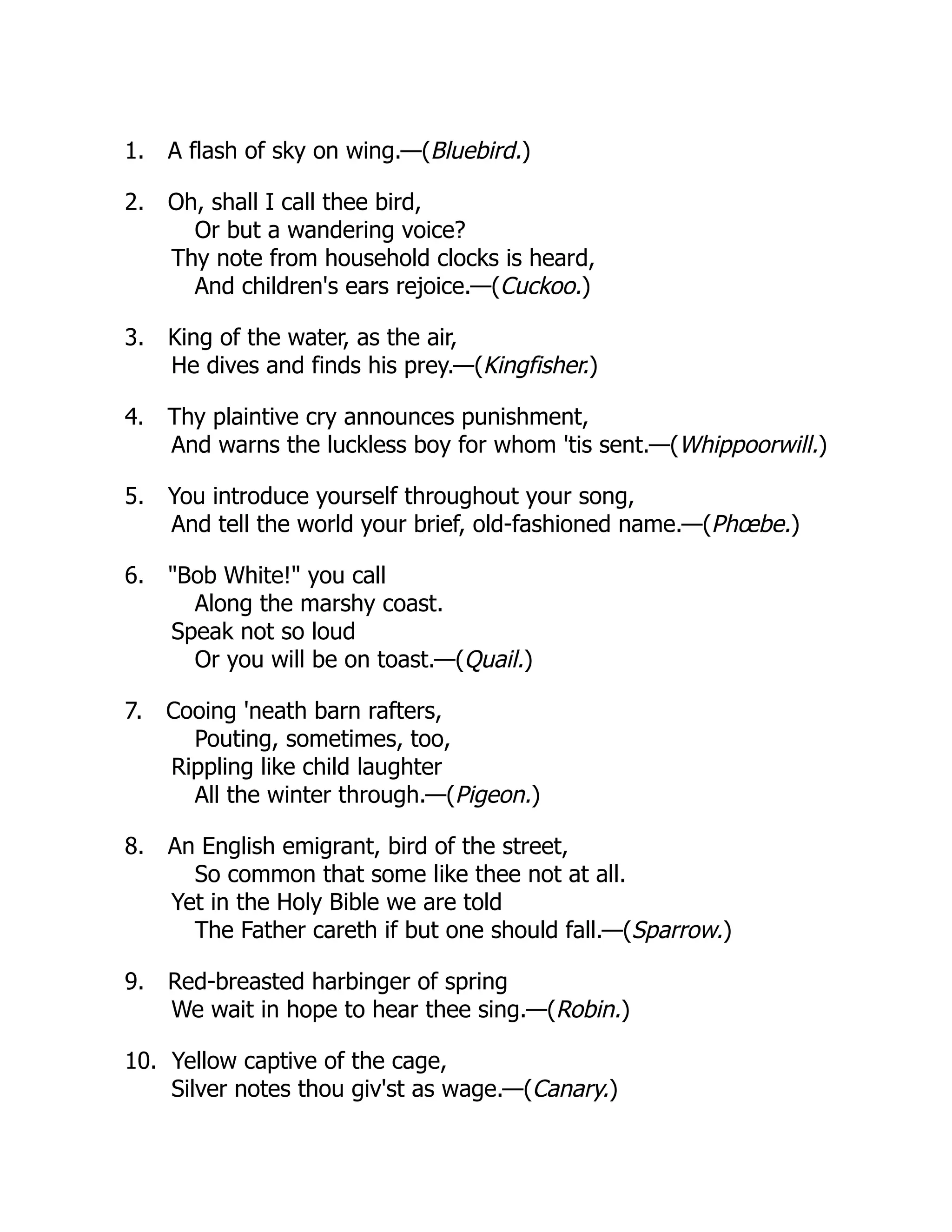
1. A flashof sky on wing.—(Bluebird.)
2. Oh, shall I call thee bird,
Or but a wandering voice?
Thy note from household clocks is heard,
And children's ears rejoice.—(Cuckoo.)
3. King of the water, as the air,
He dives and finds his prey.—(Kingfisher.)
4. Thy plaintive cry announces punishment,
And warns the luckless boy for whom 'tis sent.—(Whippoorwill.)
5. You introduce yourself throughout your song,
And tell the world your brief, old-fashioned name.—(Phœbe.)
6. "Bob White!" you call
Along the marshy coast.
Speak not so loud
Or you will be on toast.—(Quail.)
7. Cooing 'neath barn rafters,
Pouting, sometimes, too,
Rippling like child laughter
All the winter through.—(Pigeon.)
8. An English emigrant, bird of the street,
So common that some like thee not at all.
Yet in the Holy Bible we are told
The Father careth if but one should fall.—(Sparrow.)
9. Red-breasted harbinger of spring
We wait in hope to hear thee sing.—(Robin.)
10. Yellow captive of the cage,
Silver notes thou giv'st as wage.—(Canary.)
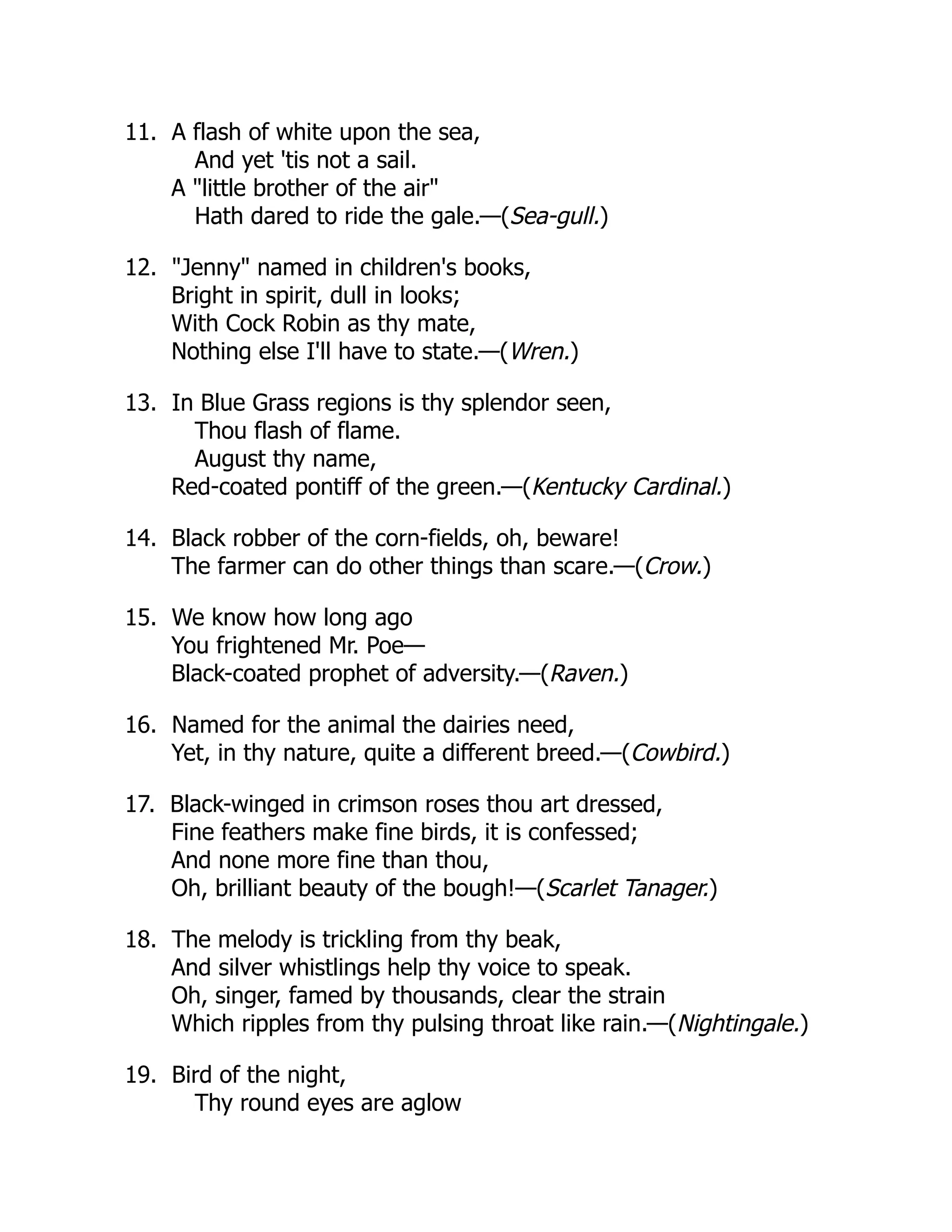
35.
11. A flashof white upon the sea,
And yet 'tis not a sail.
A "little brother of the air"
Hath dared to ride the gale.—(Sea-gull.)
12. "Jenny" named in children's books,
Bright in spirit, dull in looks;
With Cock Robin as thy mate,
Nothing else I'll have to state.—(Wren.)
13. In Blue Grass regions is thy splendor seen,
Thou flash of flame.
August thy name,
Red-coated pontiff of the green.—(Kentucky Cardinal.)
14. Black robber of the corn-fields, oh, beware!
The farmer can do other things than scare.—(Crow.)
15. We know how long ago
You frightened Mr. Poe—
Black-coated prophet of adversity.—(Raven.)
16. Named for the animal the dairies need,
Yet, in thy nature, quite a different breed.—(Cowbird.)
17. Black-winged in crimson roses thou art dressed,
Fine feathers make fine birds, it is confessed;
And none more fine than thou,
Oh, brilliant beauty of the bough!—(Scarlet Tanager.)
18. The melody is trickling from thy beak,
And silver whistlings help thy voice to speak.
Oh, singer, famed by thousands, clear the strain
Which ripples from thy pulsing throat like rain.—(Nightingale.)
19. Bird of the night,
Thy round eyes are aglow
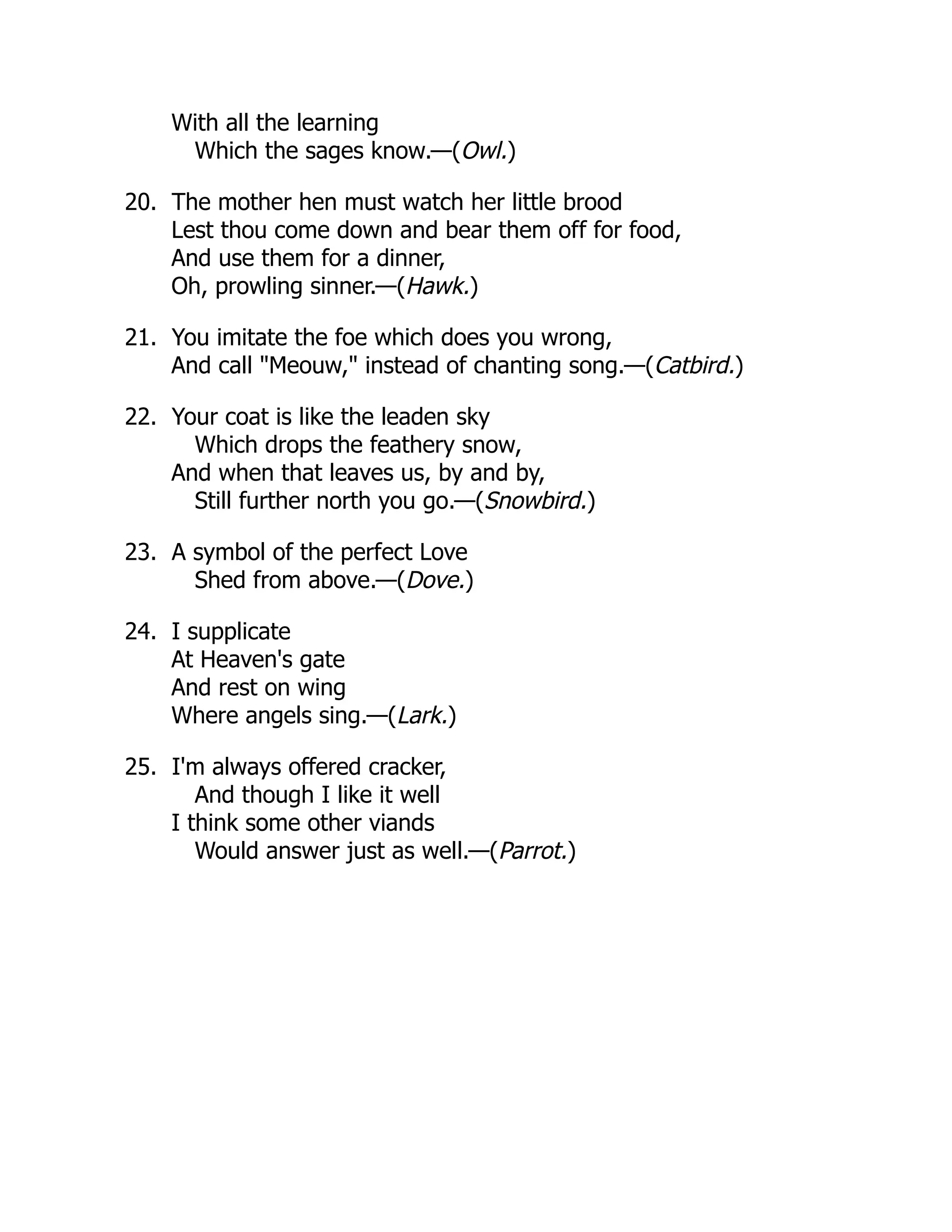
36.
With all thelearning
Which the sages know.—(Owl.)
20. The mother hen must watch her little brood
Lest thou come down and bear them off for food,
And use them for a dinner,
Oh, prowling sinner.—(Hawk.)
21. You imitate the foe which does you wrong,
And call "Meouw," instead of chanting song.—(Catbird.)
22. Your coat is like the leaden sky
Which drops the feathery snow,
And when that leaves us, by and by,
Still further north you go.—(Snowbird.)
23. A symbol of the perfect Love
Shed from above.—(Dove.)
24. I supplicate
At Heaven's gate
And rest on wing
Where angels sing.—(Lark.)
25. I'm always offered cracker,
And though I like it well
I think some other viands
Would answer just as well.—(Parrot.)
37.
BIRTHDAY PARTY
We herewithextend a most kind invitation
To you and your friends or any relation
To come to a party. This little silk sack
Is intended to furnish a good place to pack
As many pennies as you are years old.
We promise the secret shall never be told.
If Methuselah's age would be the right sum
Of the years to which you already have come,
If objections to exposing your age should arise,
One hundred would be a splendid disguise.
A musical program of very rare merit
Will be given to those who will just come and hear it.
We'll give you good cheer for the weak inner man
And a gallery of pictures unique to well scan;
We'll meet young and old with greetings most hearty
As you come, one and all, to your own Birthday Party.
These invitations can be given and sent out beforehand, each
accompanied by a tiny silk bag to hold the money. Prepare a nice
musical treat and something good to eat. Have each member of the
society giving the entertainment bring a picture of himself when a
baby or small child, and have a picture gallery. Do not forget to be
very social and make every one feel that he is welcome, not only for
the money he brings, but for himself also.
38.
BISHOP'S RIDDLE
A mosteccentric yet interesting man was Bishop Brooks of
Brookville; although not a large or strong man, wherever he went,
night or day, he was always either accompanied by or carrying:
Two playful animals—calves.
A number of small animals of a less tame breed—hares (hairs).
A member of the deer family—hart (heart).
A number of whips without handles—lashes (eyelashes).
Some weapons of warfare—arms.
The steps of a hotel—inn steps (insteps).
The House of Representatives when a vote is taken—ayes and noes
(eyes and nose).
Some Spanish grandees to wait upon him—ten dons (tendons).
Two places of worship—temples.
Two scholars—pupils.
What Napoleon wished to leave his son—crown.
Two coverings of kettles—lids (eyelids).
Two musical instruments—drums.
Two established measures—feet and hands.
39.
Two coverings forthe head—caps (kneecaps).
Several articles that a carpenter cannot do without—nails.
A couple of fish—soles.
A number of shell-fish—mussels (muscles).
Two lofty trees—palms.
Two kinds of flowers—tulips and iris.
40.
BOX PARTY
A boxparty can be made very enjoyable if every one enters into the
contest.
Each lady should pack a box with lunch for two and at the party the
boxes can be auctioneered off to the highest bidder.
Or, if there is any objection to that, the ladies' names can be placed
on slips of paper and the papers put into a hat and passed to the
gentlemen; the slip each draws contains the name of the one with
whom he is to eat refreshments.
If this party is to make money for some society the wisest way will
be to sell the boxes.
The same plan may also be followed for a Sunday-school or other
picnic.
41.
CAKE SALE
Probably thedescription of a cake sale that was held for the benefit
of a library fund may not come amiss to show just how attractive
and successful such an affair can be made. The principal feature of
this sale was the cake contest—a game, with cake prizes. This game
was devised to take the place of raffling, which was voted out of
date. It was played by groups of ten, who on paying a fee were
given printed lists of questions to be answered. Each list had to be
signed with the player's name and put in the "post-office" by a
certain time in the evening, and later the names of the prize-winners
in each group were announced. To promote sociability and fun, a
lady's and a gentleman's first prize, and a lady's and a gentleman's
booby were given in each group. The prizes were cakes, iced and
fancifully decorated with colored candies, and each cake was put on
a wooden plate, covered with a frill of crepe paper. The boobies
were ginger and sugar horsecakes. Below is the list of questions and
answers used in the contest, which may be lengthened or shortened
at will:
Which cake did the society woman buy? Reception. The schoolgirl?
Composition. The grocer? Sugar. The artist? Exhibition. The farmer?
Harvest. The mean man? Sponge. The tramp? Loaf. The minister?
Scripture. The milliner? Feather. The maiden aunt? Tea. The
dairyman? Cream. The champion? Cup. The pretty girls? Ribbon. The
jockey? Horse. The shoemaker? The last. The sculptor? Marble. The
small boys? Snowballs. The gossip? Spice. The Bryan man? Silver.
The young man for his sweetheart? Angel. The fond mamma for her
daughter? Wedding. The candidate for office? Election. The
politician? Plum.
42.
Then there werecakes for sale, whole or cut. Small tables were
placed at one end of the hall; and here cake was served with tea,
coffee or chocolate. The cake booths were attractively decorated
with crepe paper and flags. Posters announced the specialties and
prices at each. Watermelon cakes were the novelty at one booth;
apple lemon cakes at another; a plentiful supply of cookies,
dominoes, horsecakes, gingerbread dolls, and little patty pan cakes,
containing a prize to attract the patronage of the children, at
another. Little china dolls, marbles, china dogs, cats, vases, etc.,
were put in the dough when the little pans were filled. These china
toys were not injured by the baking and delighted the children
beyond measure.
At a cake sale recently held for the benefit of a church, a novel
feature was introduced in the sale of "Scripture cake."
The cakes were baked in several different sizes, and sold for from
twenty-five cents to one dollar. With each cake sold was given a
copy of the recipe by which it was made, which was as follows:
Scripture Cake
1 cup of butter Judges 5:25
3½ cups flour I Kings 4:22
3 cups sugar Jeremiah 6:20
2 cups raisins I Samuel 30:12
2 cups figs I Samuel 30:12
1 cup water Genesis 24:17
1 cup almonds Genesis 43:11
6 eggs Isaiah 10:14
1 tablespoonful honey Exodus 16:21
A pinch of salt Leviticus 16:13
43.
Spices to tasteI Kings 10:10
2 tablespoonfuls baking-powder I Cor. 5:6
Follow Solomon's advice for making good boys, and you will have a
good cake. Proverbs 23:14.
44.
CAKE WALK (Novelkind)
I hope this will not shock any of my readers, and I don't think it will
after it is read. It can be held in a church or Sunday school room
without any qualms of conscience on any one's part. Have each one
come to represent a cake. For instance, sponge cake can be
represented by having sponges all over the body; batter cake, by
young man wearing baseball suit of clothes and carrying bat; cup
cake, by wearing cups around the neck and waist; fruit cake, by
carrying baskets of different kinds of small fruits; angel cake, by
wearing pictures of angels on the dress and hair; one, two, three,
four cake, by wearing the figures 1, 2, 3, 4 pinned on dress or coat;
cooky, by wearing chef's cap and apron and a large letter E making
that person cook-e; plain cake, by dressing very plainly; orange
cake, by carrying orange in each hand; nut cake, by carrying nuts.
Any other cake can be represented by carrying out the same idea.
All should keep moving around so that the people can see what each
one represents. A prize of a cake can be given to the one guessing
the greatest number of cakes correctly. Refreshments should consist
of every variety of cake served with cocoa or coffee.
45.
CALICO CARNIVAL
The societywho gave it had the oddly written announcement given
below published in the local papers a week in advance. They also
used it as a handbill:
Calico Carnival
"Consider yourself cordially invited to be present at the
correctly constructed and considerately combined calico
carnival to be held at —— Hall, Friday night, February —,
1905, admission fifteen cents.
"Conspicuous courses served in confused compactness:
One conglomerated compound circle; one cup
communicative cordial (containing no chickory), or one
cup of Chinese cheer, or one cup of choice churned
cream; one cider cured cucumber; and one cup of cold
comfort.
"Rules and regulations: All ladies to wear calico gowns,
also requested to bring half a pound of carefully cut
carpet rags each. All gentlemen to wear calico ties and
requested to bring thimbles.
"Fines will be imposed for the following: Any lady who fails
to wear a calico gown, ten cents; any lady who fails to
bring half a pound of carefully cut carpet rags, ten cents;
any gentleman who fails to wear a calico tie, twenty-five
cents; any gentleman who fails to bring a thimble, five
cents.
46.
"P. S.—There willbe for sale, cheap, cunning calico
conveniences that will be a constant comfort.
"N. B.—Any person who sits in a corner and refuses to
converse will be fined five cents.
"The sale of calico conveniences will begin at ——."
Of course, everybody came. The fines and admissions alone would
have paid the ladies for the trouble of getting up the carnival.
The "conspicuous courses" consisted of cake; coffee, tea, or
buttermilk; pickles; and ice water.
Among the "calico conveniences" which sold readily were the
following articles: Dusting caps, button bags and bags of every
description, chair cushions, aprons with bibs and aprons without,
and, in fact, everything that could possibly be manufactured from
calico.
The carpet rags were given to the gentlemen to sew. An inexpensive
prize was given to the one who first finished his task.
47.
CAN FACTORY
The wordsto be guessed all begin with CAN—the definitions of the
whole words being here given. Booklets with tiny pencils attached,
and containing the verses, may be distributed among the guests
and, after the contest is decided, returned as souvenirs of the
occasion.
48.
1. Though thiscan is a can, you all will agree,
The can is termed thus because it holds tea.
2. This long, narrow can holds so precious a stock,
That oft you will find it has more than one lock.
3. The most wick-éd can, tho' safe from police,
Should you search for its heart you will find it in grease.
4. This can is a can that delights you and me,
It always is "open" and likewise is "free."
5. Where breezes blow and surges roll,
With swelling form and manner proud,
This can in triumph rides the waves,
The sailor's living and his shroud.
6. Here's a can, which, bear in mind,
Lives on others of its kind.
7. They say empty cans will produce the most noise,
But, if properly filled, this will startle the boys.
8. Most cans are hardly fit to eat,
Yet you'll like this kind, nice and sweet.
9. The waltz or the glee or the bold martial strain,
Each one, as his favorite, endorses;
But for those who prefer oratorio style,
This can sweetest music discourses.
10. Now who would elect in a can to reside,
Yet this as a shelter is known far and wide.
11. A can of most sagacious mind,
'Tis "frugal, prudent, shrewd," you'll find.
49.
Welcome to ourwebsite – the perfect destination for book lovers and
knowledge seekers. We believe that every book holds a new world,
offering opportunities for learning, discovery, and personal growth.
That’s why we are dedicated to bringing you a diverse collection of
books, ranging from classic literature and specialized publications to
self-development guides and children's books.
More than just a book-buying platform, we strive to be a bridge
connecting you with timeless cultural and intellectual values. With an
elegant, user-friendly interface and a smart search system, you can
quickly find the books that best suit your interests. Additionally,
our special promotions and home delivery services help you save time
and fully enjoy the joy of reading.
Join us on a journey of knowledge exploration, passion nurturing, and
personal growth every day!
ebookbell.com



![iv
Preface
hen I began to teach philosophy, almost every responsible analytic philoso-
pher was an acknowledged empiricist. Today, many analytic philosophers
repudiate central tenets of the position, rejecting at least an ana-
lytic/synthetic distinction and often pursuing metaphysical questions that main-line
empiricists set aside decades ago. I regard this development as unfortunate, a
backward step in philosophy that needs to be corrected. Bas van Fraassen and Anil
Gupta have recently taken important steps in the right direction. I try to do my part
in this book, attacking well-known criticisms of empiricist doctrine and defending the
sort of empiricist theory that I consider acceptable.
There is no essence to empiricism: different positions have been defended
under the name “empiricism,” and the practice will no doubt continue.1
The empiri-
cism I learned as a student was called “logical empiricism,” the qualifier marking the
importance of formal logic to this version of the theory. One of my teachers, Herbert
Feigl, discussed the distinctive claims of an earlier form of this empiricism in a pro-
grammatic article called “Logical Empiricism,” which was regarded as something of a
manifesto in its day. The adjective Feigl attached to “empiricism” was chiefly owing
to the logical and semantical work of Rudolf Carnap, another of my teachers,2
who
was the dominant figure among the empiricists whose views Feigl was promoting.
Carnap’s epistemological views changed significantly over his long philosophical ca-
reer, and his later views represent a development of empiricism that deserves to be
better known by today’s critics of the doctrine.
The objections to empiricism that W. V. Quine formulated in “Two Dogmas of
Empiricism” (1951) are still widely regarded as successful. The supposed dogmas in
question are, Quine said, a belief in a fundamental cleavage between analytic and
synthetic truths, on the one hand, and reductionism, the belief that each meaningful
statement is equivalent to some logical construct upon terms referring to immediate
experience, on the other. As it happens, logical empiricists did not hold the second
dogma when Quine’s paper was published. Feigl explicitly denounced it in “Logical
Empiricism” (first published in 1943) and Carnap left it behind in the middle thirties.3
The first dogma—“assumption” is really a better word here—was indeed accepted, at
least as an ideal, by logical empiricists, and I shall therefore discuss Quine’s objec-
tions to it carefully and at length. Although Quine has long been one of my philoso-
phical heroes, I have to say that his objections to analyticity fail to undermine the
position Carnap defended in his later years. Carnap was right to set them aside as
unsuccessful.
Quine’s criticism was not the only cause of empiricism’s decline; another was
the rise of epistemological rationalism. The cause of this phenomenon is complex;
no doubt it had something to do with the revival of interest in metaphysics that re-
sulted from Kripke’s revolutionary ideas on identity, necessity, and essential proper-
ties. But whatever the actual cause may be, the most influential exponent of the
new analytical rationalism turned out to be R. M. Chisholm. As Alvin Plantinga re-
marked in 1990, Chisholm’s thought “has [in fact]…dominated American epistemol-
ogy for more than thirty years”;4
if this is an exaggeration, as I believe it is, it is
nevertheless not very far from the truth. To defend a version of empiricism at the
present time it is therefore not sufficient to overcome the criticism of Quine;
1
See van Fraassen (2002), Appendix B, “A History of the Name ‘Empiricism’.”
2
As a graduate student, I spent a year at UCLA, where he was then teaching.
3
He rejected it in Carnap (1936).
4
Plantinga (1990), p. 366.
W](https://image.slidesharecdn.com/822255-250526232654-7abce6c7/75/An-Empiricist-Theory-Of-Knowledge-Bruce-Aune-10-2048.jpg)
![Bruce Aune
2
places you recall, but these images simply bring more facts to mind. The prevalence
of this new view of acquaintance—the idea that it is not a distinctive kind of knowl-
edge more basic than knowledge-that—owes a lot to Wittgenstein’s attack on what
he called ”private languages,” 3
and it may or may not be right or defensible. I shall
have more to say about acquaintance in chapter five.
Before 1963 analytically-minded philosophers mostly agreed that knowledge-
that could be understood as justified true belief. Edmund Gettier’s now famous criti-
cism of this account destroyed the agreement and stimulated a plethora of attempts
to provide an improved definition.4
The philosophers seeking an improvement had
two desiderata specifically in mind. They wanted a definition incorporating standards
that would make it possible for ordinary human beings to know most of what they
think they know, and they wanted a definition that would avoid Gettier examples and
others relevantly like them. A definition having the first feature would be instrumen-
tal in avoiding skepticism, an outcome that could be expected if the required stan-
dards of evidence were set too high. They also assumed that a definition having the
desired features would require a knower to possess an appropriate true belief.
The great number and variety of attempts to provide a definition satisfying
the desiderata I mentioned5
make it fairly clear that the philosophers attempting to
provide such an improvement were not working with a single knowledge concept that
already existed and was generally accepted. They may have had illusions about what
they were doing, but the reality is that they were attempting to create a knowledge
concept that was philosophically preferable to the simple one that Gettier criticized.
They wanted a better analytical account of what knowledge could be taken to be. As
it happened, they did not definitely succeed in this endeavor: no generally accepted
conception or account of the desired kind was ever created. Many philosophers con-
tinue with the hunt, but some have basically given up on it. Among the latter, Timo-
thy Williamson came to the conclusion that “knowing does not factorize as standard
analyses require.”6
Instead of attempting to provide a definition of knowledge, Wil-
liamson offered a “modest nonreductive analysis,” describing knowing as “the most
general factive, stative [human] attitude”—factive in being attached only to truths,
and stative in being a state rather than a process.7
But Williamson’s nonreductive
analysis does not appear to have attracted many adherents. Most philosophers ap-
pear to want a more informative account of knowing than Williamson’s analysis pro-
vides.8
The consensus that once existed on seeking an improved justified-true-belief
(or JTB+) analysis of knowing broke down for other reasons. Some philosophers,
such as Peter Unger and Robert Fogelin, did not believe that skepticism should be
ruled out by easily satisfied standards for knowing. These philosophers even wrote
books supporting versions of that generally abhorred doctrine.9
In taking a skeptical
3
See Wittgenstein (1959),§§ 243- 272. I critically assess Wittgenstein’s argument in Aune (1991), pp.
115-130.
4
See Gettier (1963).
5
The principal definitions given in the first twenty years after Getter’s paper was published are ably dis-
cussed in Shope (1983).
6
See Williamson (2000), p. 4.
7
Ibid, p. 34.
8
Hilary Kornblith (1999) defends a singular account of knowing that I do not consider here. He argues
that knowledge is a natural kind, instances of which may be possessed by birds or monkeys as well as
human beings. I do not deny that a knowing concept with a wide application of this kind is possible, but
like Hacking (2005), I find problems in the very concept of a natural kind, and I think the word “knowing”
is in any case applied to a more diverse variety of instances than is happily accommodated by Kornblith’s
single conception. As I see it, when we describe birds or monkeys as knowing things, we are using the
word “knowing” in an extended, analogical sense.
9
See Unger (1975) and Fogelin (1994) and (2000).](https://image.slidesharecdn.com/822255-250526232654-7abce6c7/75/An-Empiricist-Theory-Of-Knowledge-Bruce-Aune-14-2048.jpg)