Sampled Functions


21.5
Introduction
A sequence can be obtained by sampling a continuous function or signal and in this Section we
show first of all how to extend our knowledge of z-transforms so as to be able to deal with sampled
signals. We then show how the z-transform of a sampled signal is related to the Laplace transform
of the unsampled version of the signal.
'

$
%
Prerequisites
Before starting this Section you should . . .
• possess an outline knowledge of Laplace
transforms and of z-transforms
9
8
6
7
Learning Outcomes
On completion you should be able to . . .
• take the z-transform of a sequence obtained
by sampling
• state the relation between the z-transform of
a sequence obtained by sampling and the
Laplace transform of the underlying
continuous signal
HELM (2005):
Section 21.5: Sampled Functions
85
1. Sampling theory
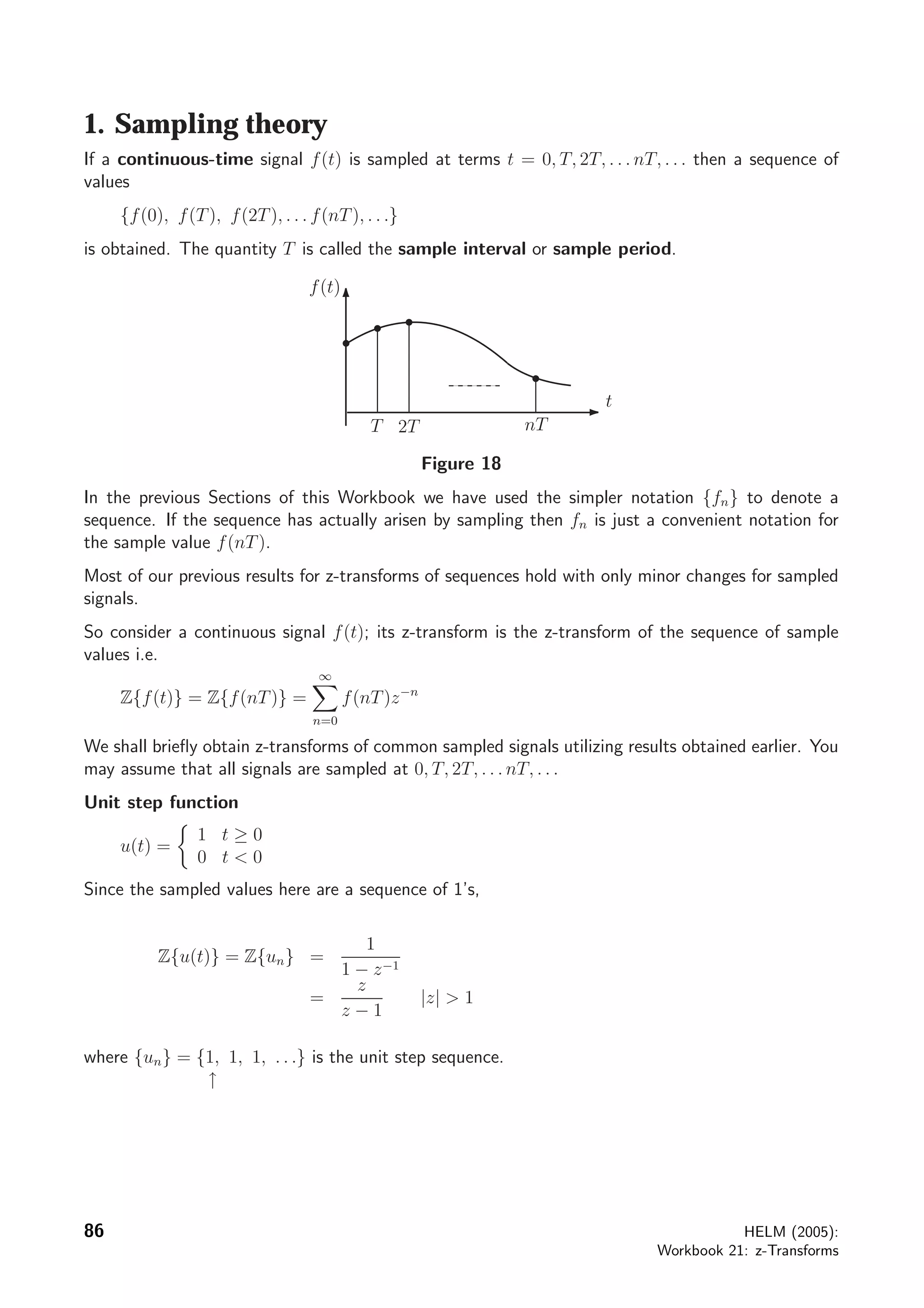
If a continuous-time signal f(t) is sampled at terms t = 0, T, 2T, . . . nT, . . . then a sequence of
values
{f(0), f(T), f(2T), . . . f(nT), . . .}
is obtained. The quantity T is called the sample interval or sample period.
t
T 2T nT
f(t)
Figure 18
In the previous Sections of this Workbook we have used the simpler notation {fn} to denote a
sequence. If the sequence has actually arisen by sampling then fn is just a convenient notation for
the sample value f(nT).
Most of our previous results for z-transforms of sequences hold with only minor changes for sampled
signals.
So consider a continuous signal f(t); its z-transform is the z-transform of the sequence of sample
values i.e.
Z{f(t)} = Z{f(nT)} =
∞
n=0
f(nT)z−n
We shall briefly obtain z-transforms of common sampled signals utilizing results obtained earlier. You
may assume that all signals are sampled at 0, T, 2T, . . . nT, . . .
Unit step function
u(t) =
1 t ≥ 0
0 t  0
Since the sampled values here are a sequence of 1’s,
Z{u(t)} = Z{un} =
1
1 − z−1
=
z
z − 1
|z|  1
where {un} = {1, 1, 1, . . .} is the unit step sequence.
↑
86 HELM (2005):
Workbook 21: z-Transforms
Ramp function
r(t) =
t t ≥ 0
0 t  0
The sample values here are
{r(nT)} = {0, T, 2T, . . .}
The ramp sequence {rn} = {0, 1, 2, . . .} has z-transform
z
(z − 1)2
.
Hence Z{r(nT)} =
Tz
(z − 1)2
since {r(nT)} = T{rn}.
TaskTask
Obtain the z-transform of the exponential signal
f(t) =
e−αt
t ≥ 0
0 t  0.
[Hint: use the z-transform of the geometric sequence {an
}.]
Your solution
Answer
The sample values of the exponential are
{1, e−αT
, e−α2T
, . . . , e−αnT
, . . .}
i.e. f(nT) = e−αnT
= (e−αT
)n
.
But Z{an
} =
z
z − a
∴ Z{(e−αT
)n
} =
z
z − e−αT
=
1
1 − e−αT z−1
HELM (2005):
Section 21.5: Sampled Functions
87
Sampled sinusoids
Earlier in this Workbook we obtained the z-transform of the sequence {cos ωn} i.e.
Z{cos ωn} =
z2
− z cos ω
z2 − 2z cos ω + 1
Hence, since sampling the continuous sinusoid
f(t) = cos ωt
yields the sequence {cos nωT} we have, simply replacing ω by ωT in the z-transform:
Z{cos ωt} = Z{cos nωT}
=
z2
− z cos ωT
z2 − 2z cos ωT + 1
TaskTask
Obtain the z-transform of the sampled version of the sine wave f(t) = sin ωt.
Your solution
Answer
Z{sin ωn} =
z sin ω
z2 − 2z cos ω + 1
∴ Z{sin ωt} = Z{sin nωT}
=
z sin ωT
z2 − 2z cos ωT + 1
88 HELM (2005):
Workbook 21: z-Transforms
Shift theorems
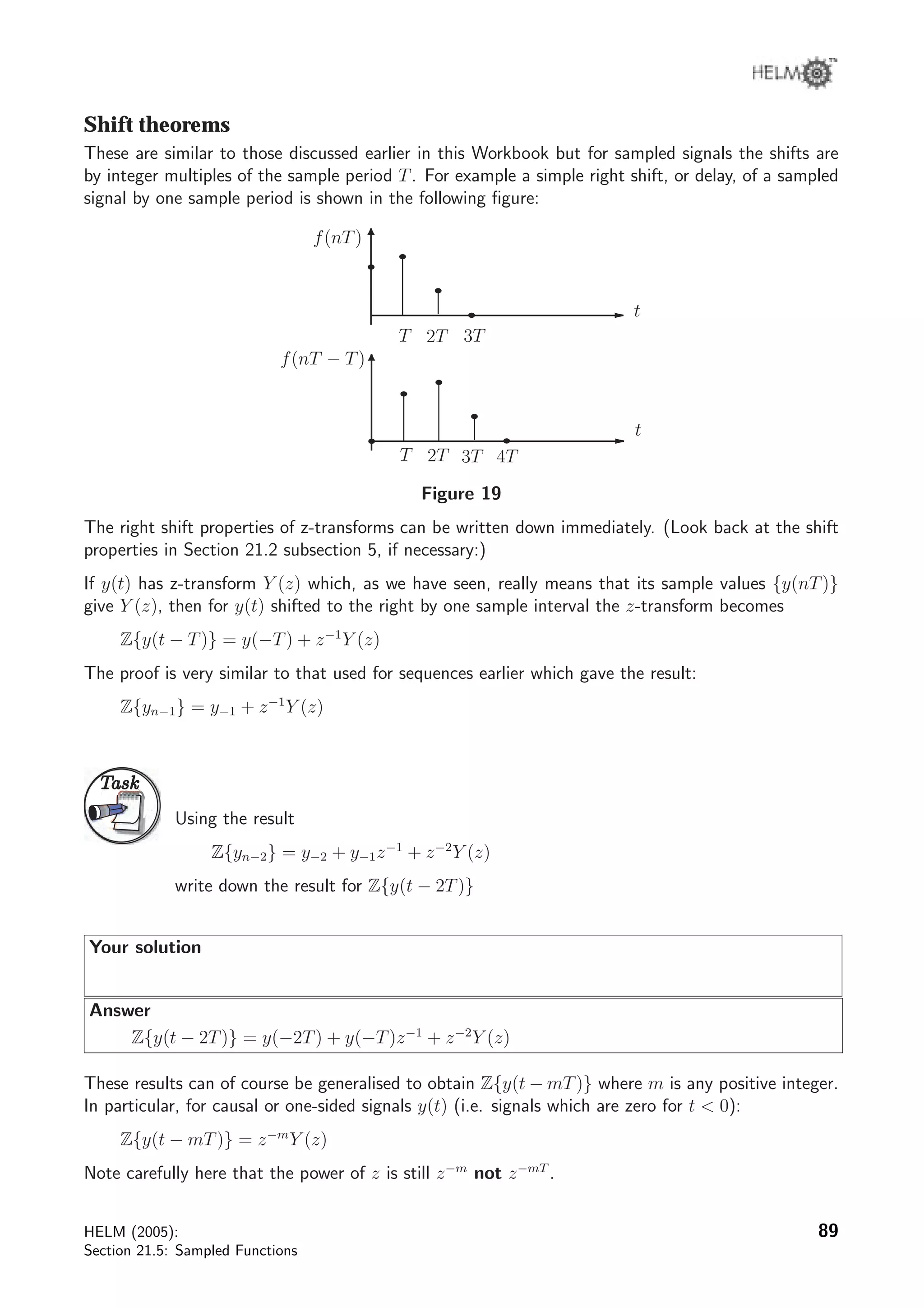
These are similar to those discussed earlier in this Workbook but for sampled signals the shifts are
by integer multiples of the sample period T. For example a simple right shift, or delay, of a sampled
signal by one sample period is shown in the following figure:
t
T 2T
t
T 2T
3T
3T
f(nT)
f(nT − T)
4T
Figure 19
The right shift properties of z-transforms can be written down immediately. (Look back at the shift
properties in Section 21.2 subsection 5, if necessary:)
If y(t) has z-transform Y (z) which, as we have seen, really means that its sample values {y(nT)}
give Y (z), then for y(t) shifted to the right by one sample interval the z-transform becomes
Z{y(t − T)} = y(−T) + z−1
Y (z)
The proof is very similar to that used for sequences earlier which gave the result:
Z{yn−1} = y−1 + z−1
Y (z)
TaskTask
Using the result
Z{yn−2} = y−2 + y−1z−1
+ z−2
Y (z)
write down the result for Z{y(t − 2T)}
Your solution
Answer
Z{y(t − 2T)} = y(−2T) + y(−T)z−1
+ z−2
Y (z)
These results can of course be generalised to obtain Z{y(t − mT)} where m is any positive integer.
In particular, for causal or one-sided signals y(t) (i.e. signals which are zero for t  0):
Z{y(t − mT)} = z−m
Y (z)
Note carefully here that the power of z is still z−m
not z−mT
.
HELM (2005):
Section 21.5: Sampled Functions
89
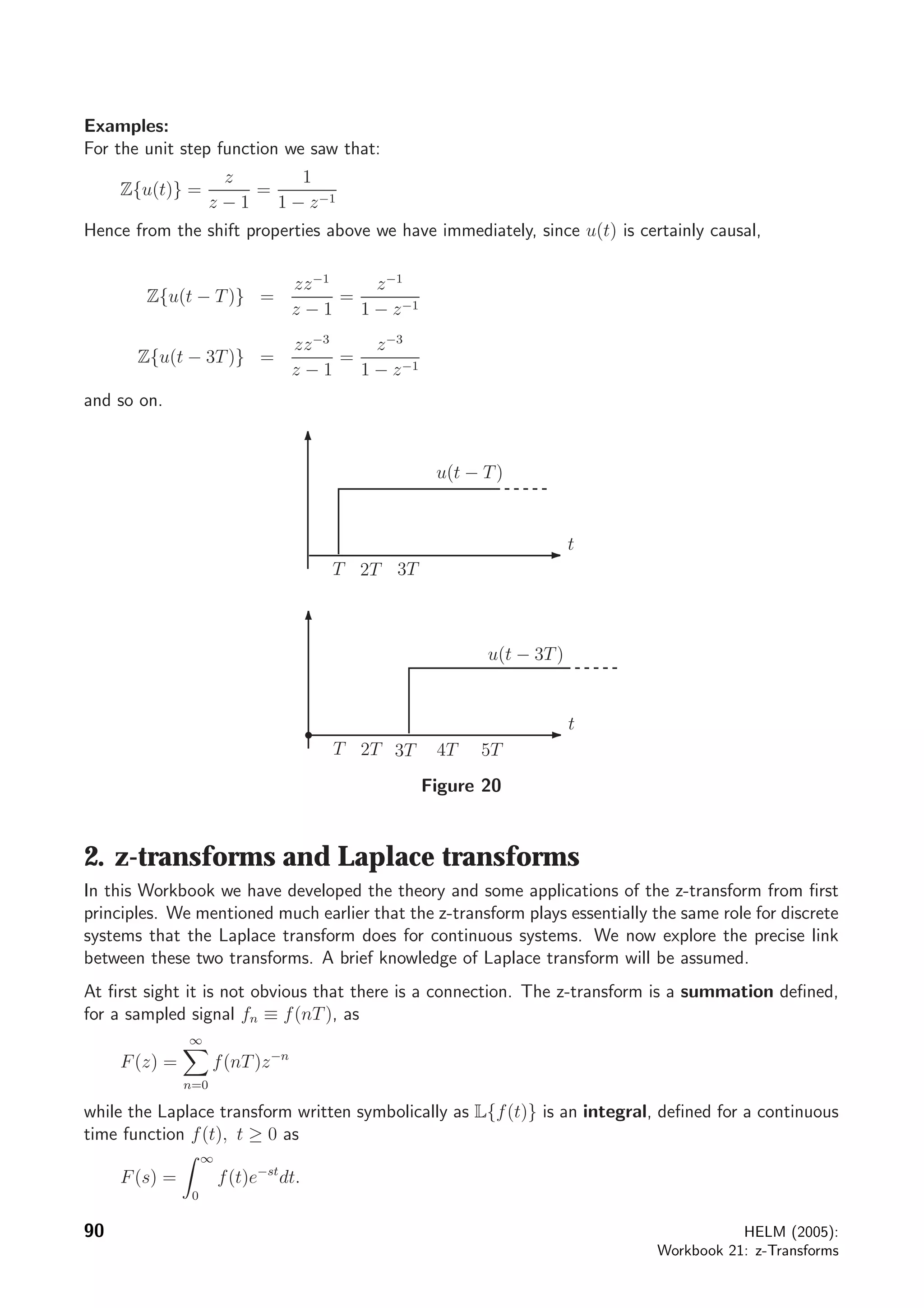
Examples:
For the unit step function we saw that:
Z{u(t)} =
z
z − 1
=
1
1 − z−1
Hence from the shift properties above we have immediately, since u(t) is certainly causal,
Z{u(t − T)} =
zz−1
z − 1
=
z−1
1 − z−1
Z{u(t − 3T)} =
zz−3
z − 1
=
z−3
1 − z−1
and so on.
t
T 2T
t
T 2T
3T
3T 5T4T
u(t − T)
u(t − 3T)
Figure 20
2. z-transforms and Laplace transforms
In this Workbook we have developed the theory and some applications of the z-transform from first
principles. We mentioned much earlier that the z-transform plays essentially the same role for discrete
systems that the Laplace transform does for continuous systems. We now explore the precise link
between these two transforms. A brief knowledge of Laplace transform will be assumed.
At first sight it is not obvious that there is a connection. The z-transform is a summation defined,
for a sampled signal fn ≡ f(nT), as
F(z) =
∞
n=0
f(nT)z−n
while the Laplace transform written symbolically as L{f(t)} is an integral, defined for a continuous
time function f(t), t ≥ 0 as
F(s) =
∞
0
f(t)e−st
dt.
90 HELM (2005):
Workbook 21: z-Transforms
Thus, for example, if
f(t) = e−αt
(continuous time exponential)
L{f(t)} = F(s) =
1
s + α
which has a (simple) pole at s = −α = s1 say.
As we have seen, sampling f(t) gives the sequence {f(nT)} = {e−αnT
} with z-transform
F(z) =
1
1 − e−αT z−1
=
z
z − e−αT
.
The z-transform has a pole when z = z1 where
z1 = e−αT
= es1T
[Note the abuse of notations in writing both F(s) and F(z) here since in fact these are different
functions.]
TaskTask
The continuous time function f(t) = te−αt
has Laplace transform
F(s) =
1
(s + α)2
Firstly write down the pole of this function and its order:
Your solution
Answer
F(s) =
1
(s + α)2
has its pole at s = s1 = −α. The pole is second order.
Now obtain the z-transform F(z) of the sampled version of f(t), locate the pole(s) of F(z) and
state the order:
Your solution
HELM (2005):
Section 21.5: Sampled Functions
91
Answer
Consider f(nT) = nTe−αnT
= (nT)(e−αT
)n
The ramp sequence {nT} has z-transform
Tz
(z − 1)2
∴ f(nT) has z-transform
F(z) =
TzeαT
(zeαT − 1)2
=
Tze−αT
(z − e−αT )2
(see Key Point 8)
This has a (second order) pole when z = z1 = e−αT
= es1T
.
We have seen in both the above examples a close link between the pole s1 of the Laplace transform
of f(t) and the pole z1 of the z-transform of the sampled version of f(t) i.e.
z1 = es1T
(1)
where T is the sample interval.
Multiple poles lead to similar results i.e. if F(s) has poles s1, s2, . . . then F(z) has poles z1, z2, . . .
where zi = esiT
.
The relation (1) between the poles is, in fact, an example of a more general relation between the
values of s and z as we shall now investigate.
Key Point 19
The unit impulse function δ(t) can be defined informally as follows:
t
1
P (t)
Figure 21
The rectangular pulse P (t) of width ε and height
1
ε
shown in Figure 21 encloses unit area and has
Laplace transform
Pε(s) =
ε
0
1
ε
e−st
=
1
εs
(1 − e−εs
) (2)
As ε becomes smaller Pε(t) becomes taller and narrower but still encloses unit area. The unit impulse
function δ(t) (sometimes called the Dirac delta function) can be defined as
92 HELM (2005):
Workbook 21: z-Transforms
δ(t) = lim
ε→0
Pε(t)
The Laplace transform, say ∆(s), of δ(t) can be obtained correspondingly by letting → 0 in (2),
i.e.
∆(s) = lim
ε→0
1
εs
(1 − e−εs
)
= lim
ε→0
1 − (1 − εs +
(εs)2
2!
− . . .)
εs
(Using the Maclaurin seies expansion of e−εs
)
= lim
ε→0
εs −
(εs)2
2!
+
(εs)3
3!
+ . . .
εs
= 1
i.e. Lδ(t) = 1 (3)
TaskTask
A shifted unit impulse δ(t − nT) is defined as lim
ε→0
Pε(t − nT) as illustrated below.
t
1
nT nT +
P (t − nT)
Obtain the Laplace transform of this rectangular pulse and, by letting ε → 0,
obtain the Laplace transform of δ(t − nT).
Your solution
HELM (2005):
Section 21.5: Sampled Functions
93
Answer
L{Pε(t − nT)} =
nT+ε
nT
1
ε
e−st
dt =
1
εs
− e−st
nT+ε
nT
=
1
εs
e−snT
− e−s(nT+ε)
=
1
εs
e−snT
(1 − e−sε
) → e−snT
as ε → 0
Hence L{δ(t − nT)} = e−snT
(4)
which reduces to the result (3)
L{δ(t)} = 1 when n = 0
These results (3) and (4) can be compared with the results
Z{δn} = 1
Z{δn−m} = z−m
for discrete impulses of height 1.
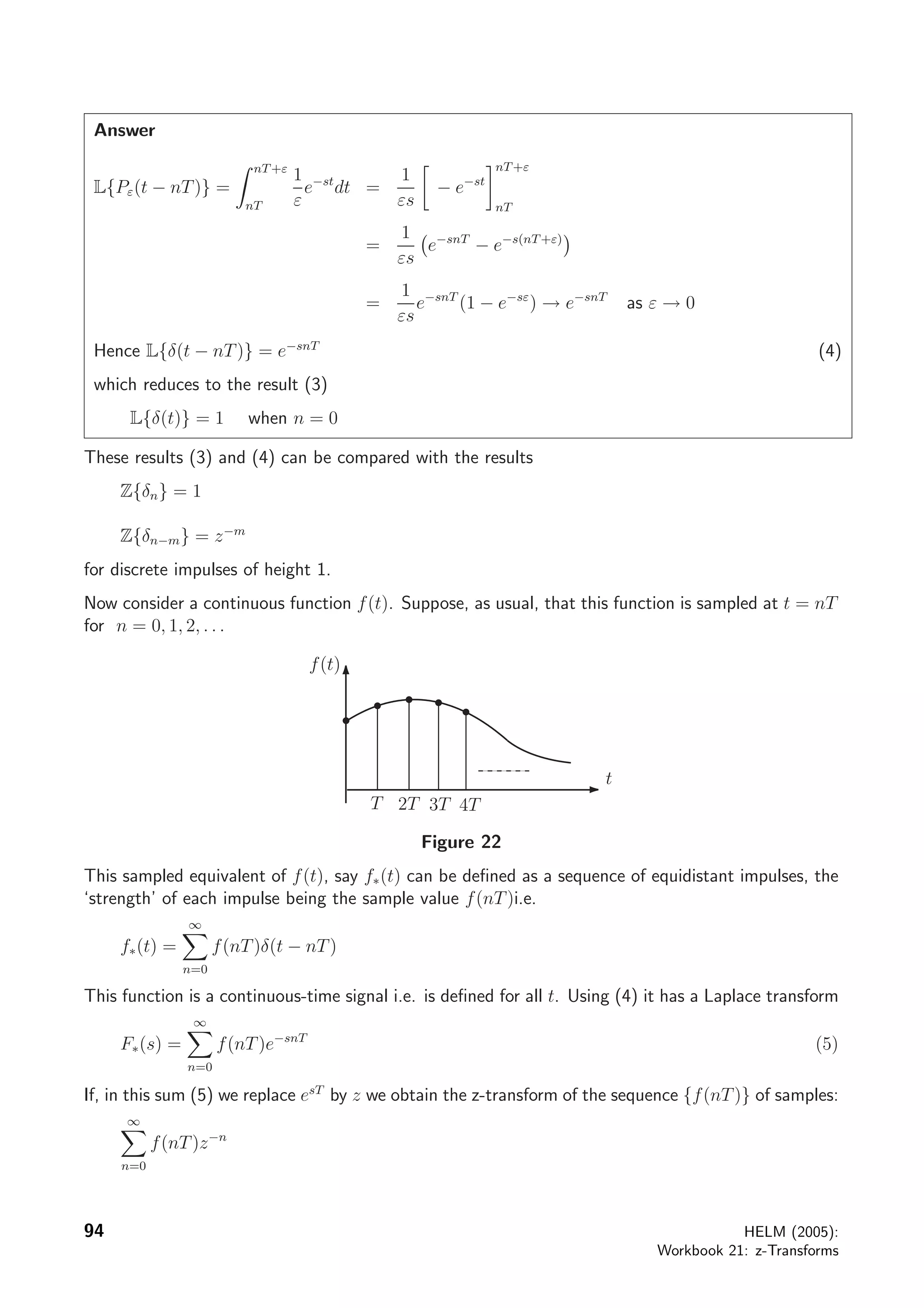
Now consider a continuous function f(t). Suppose, as usual, that this function is sampled at t = nT
for n = 0, 1, 2, . . .
t
T 2T
f(t)
4T3T
Figure 22
This sampled equivalent of f(t), say f∗(t) can be defined as a sequence of equidistant impulses, the
‘strength’ of each impulse being the sample value f(nT)i.e.
f∗(t) =
∞
n=0
f(nT)δ(t − nT)
This function is a continuous-time signal i.e. is defined for all t. Using (4) it has a Laplace transform
F∗(s) =
∞
n=0
f(nT)e−snT
(5)
If, in this sum (5) we replace esT
by z we obtain the z-transform of the sequence {f(nT)} of samples:
∞
n=0
f(nT)z−n
94 HELM (2005):
Workbook 21: z-Transforms
Key Point 20
The Laplace transform
F(s) =
∞
n=0
f(nT)e−snT
of a sampled function is equivalent to the z-transform F(z) of the sequence {f(nT)} of sample
values with z = esT
.
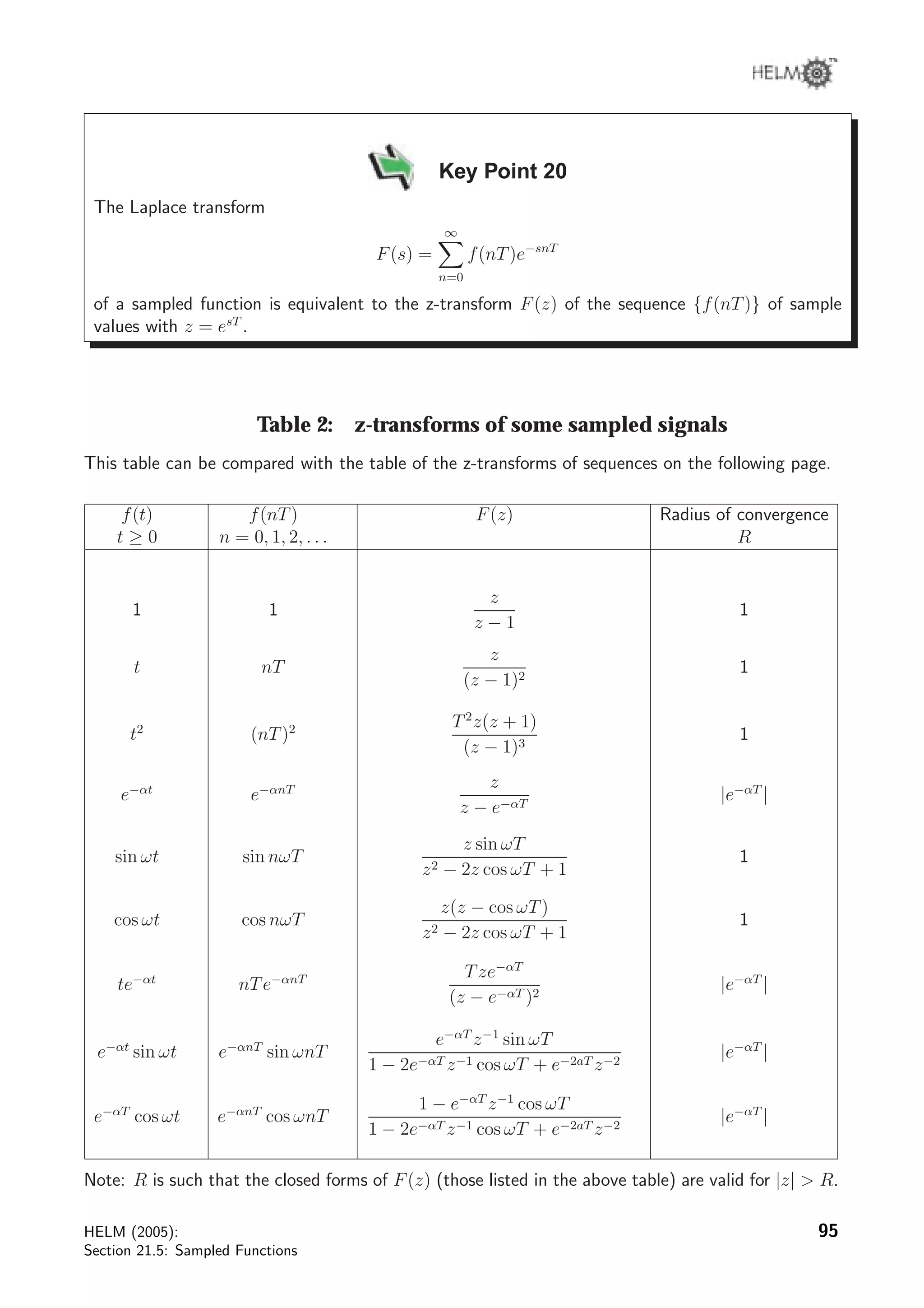
Table 2: z-transforms of some sampled signals
This table can be compared with the table of the z-transforms of sequences on the following page.
f(t) f(nT) F(z) Radius of convergence
t ≥ 0 n = 0, 1, 2, . . . R
1 1
z
z − 1
1
t nT
z
(z − 1)2
1
t2
(nT)2 T2
z(z + 1)
(z − 1)3
1
e−αt
e−αnT z
z − e−αT
|e−αT
|
sin ωt sin nωT
z sin ωT
z2 − 2z cos ωT + 1
1
cos ωt cos nωT
z(z − cos ωT)
z2 − 2z cos ωT + 1
1
te−αt
nTe−αnT Tze−αT
(z − e−αT )2
|e−αT
|
e−αt
sin ωt e−αnT
sin ωnT
e−αT
z−1
sin ωT
1 − 2e−αT z−1 cos ωT + e−2aT z−2
|e−αT
|
e−αT
cos ωt e−αnT
cos ωnT
1 − e−αT
z−1
cos ωT
1 − 2e−αT z−1 cos ωT + e−2aT z−2
|e−αT
|
Note: R is such that the closed forms of F(z) (those listed in the above table) are valid for |z|  R.
HELM (2005):
Section 21.5: Sampled Functions
95
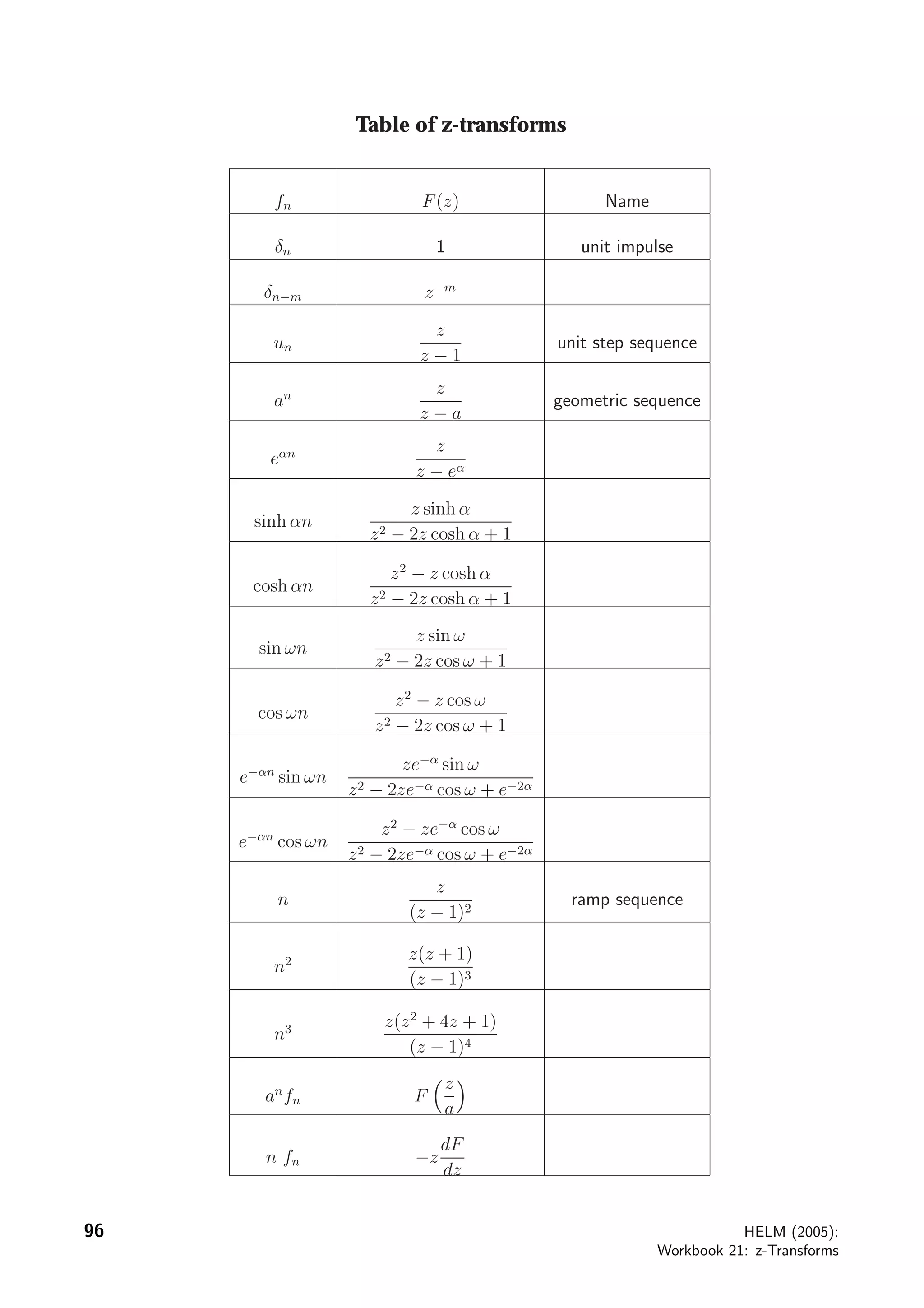
Table of z-transforms
fn F(z) Name
δn 1 unit impulse
δn−m z−m
un
z
z − 1
unit step sequence
an z
z − a
geometric sequence
eαn z
z − eα
sinh αn
z sinh α
z2 − 2z cosh α + 1
cosh αn
z2
− z cosh α
z2 − 2z cosh α + 1
sin ωn
z sin ω
z2 − 2z cos ω + 1
cos ωn
z2
− z cos ω
z2 − 2z cos ω + 1
e−αn
sin ωn
ze−α
sin ω
z2 − 2ze−α cos ω + e−2α
e−αn
cos ωn
z2
− ze−α
cos ω
z2 − 2ze−α cos ω + e−2α
n
z
(z − 1)2
ramp sequence
n2 z(z + 1)
(z − 1)3
n3 z(z2
+ 4z + 1)
(z − 1)4
an
fn F
z
a
n fn −z
dF
dz
96 HELM (2005):
Workbook 21: z-Transforms

21 5 ztransform

  • 1.
    Sampled Functions 21.5 Introduction A sequencecan be obtained by sampling a continuous function or signal and in this Section we show first of all how to extend our knowledge of z-transforms so as to be able to deal with sampled signals. We then show how the z-transform of a sampled signal is related to the Laplace transform of the unsampled version of the signal. ' $ % Prerequisites Before starting this Section you should . . . • possess an outline knowledge of Laplace transforms and of z-transforms 9 8 6 7 Learning Outcomes On completion you should be able to . . . • take the z-transform of a sequence obtained by sampling • state the relation between the z-transform of a sequence obtained by sampling and the Laplace transform of the underlying continuous signal HELM (2005): Section 21.5: Sampled Functions 85
  • 2.
    1. Sampling theory Ifa continuous-time signal f(t) is sampled at terms t = 0, T, 2T, . . . nT, . . . then a sequence of values {f(0), f(T), f(2T), . . . f(nT), . . .} is obtained. The quantity T is called the sample interval or sample period. t T 2T nT f(t) Figure 18 In the previous Sections of this Workbook we have used the simpler notation {fn} to denote a sequence. If the sequence has actually arisen by sampling then fn is just a convenient notation for the sample value f(nT). Most of our previous results for z-transforms of sequences hold with only minor changes for sampled signals. So consider a continuous signal f(t); its z-transform is the z-transform of the sequence of sample values i.e. Z{f(t)} = Z{f(nT)} = ∞ n=0 f(nT)z−n We shall briefly obtain z-transforms of common sampled signals utilizing results obtained earlier. You may assume that all signals are sampled at 0, T, 2T, . . . nT, . . . Unit step function u(t) = 1 t ≥ 0 0 t 0 Since the sampled values here are a sequence of 1’s, Z{u(t)} = Z{un} = 1 1 − z−1 = z z − 1 |z| 1 where {un} = {1, 1, 1, . . .} is the unit step sequence. ↑ 86 HELM (2005): Workbook 21: z-Transforms
  • 3.
    Ramp function r(t) = tt ≥ 0 0 t 0 The sample values here are {r(nT)} = {0, T, 2T, . . .} The ramp sequence {rn} = {0, 1, 2, . . .} has z-transform z (z − 1)2 . Hence Z{r(nT)} = Tz (z − 1)2 since {r(nT)} = T{rn}. TaskTask Obtain the z-transform of the exponential signal f(t) = e−αt t ≥ 0 0 t 0. [Hint: use the z-transform of the geometric sequence {an }.] Your solution Answer The sample values of the exponential are {1, e−αT , e−α2T , . . . , e−αnT , . . .} i.e. f(nT) = e−αnT = (e−αT )n . But Z{an } = z z − a ∴ Z{(e−αT )n } = z z − e−αT = 1 1 − e−αT z−1 HELM (2005): Section 21.5: Sampled Functions 87
  • 4.
    Sampled sinusoids Earlier inthis Workbook we obtained the z-transform of the sequence {cos ωn} i.e. Z{cos ωn} = z2 − z cos ω z2 − 2z cos ω + 1 Hence, since sampling the continuous sinusoid f(t) = cos ωt yields the sequence {cos nωT} we have, simply replacing ω by ωT in the z-transform: Z{cos ωt} = Z{cos nωT} = z2 − z cos ωT z2 − 2z cos ωT + 1 TaskTask Obtain the z-transform of the sampled version of the sine wave f(t) = sin ωt. Your solution Answer Z{sin ωn} = z sin ω z2 − 2z cos ω + 1 ∴ Z{sin ωt} = Z{sin nωT} = z sin ωT z2 − 2z cos ωT + 1 88 HELM (2005): Workbook 21: z-Transforms
  • 5.
    Shift theorems These aresimilar to those discussed earlier in this Workbook but for sampled signals the shifts are by integer multiples of the sample period T. For example a simple right shift, or delay, of a sampled signal by one sample period is shown in the following figure: t T 2T t T 2T 3T 3T f(nT) f(nT − T) 4T Figure 19 The right shift properties of z-transforms can be written down immediately. (Look back at the shift properties in Section 21.2 subsection 5, if necessary:) If y(t) has z-transform Y (z) which, as we have seen, really means that its sample values {y(nT)} give Y (z), then for y(t) shifted to the right by one sample interval the z-transform becomes Z{y(t − T)} = y(−T) + z−1 Y (z) The proof is very similar to that used for sequences earlier which gave the result: Z{yn−1} = y−1 + z−1 Y (z) TaskTask Using the result Z{yn−2} = y−2 + y−1z−1 + z−2 Y (z) write down the result for Z{y(t − 2T)} Your solution Answer Z{y(t − 2T)} = y(−2T) + y(−T)z−1 + z−2 Y (z) These results can of course be generalised to obtain Z{y(t − mT)} where m is any positive integer. In particular, for causal or one-sided signals y(t) (i.e. signals which are zero for t 0): Z{y(t − mT)} = z−m Y (z) Note carefully here that the power of z is still z−m not z−mT . HELM (2005): Section 21.5: Sampled Functions 89
  • 6.
    Examples: For the unitstep function we saw that: Z{u(t)} = z z − 1 = 1 1 − z−1 Hence from the shift properties above we have immediately, since u(t) is certainly causal, Z{u(t − T)} = zz−1 z − 1 = z−1 1 − z−1 Z{u(t − 3T)} = zz−3 z − 1 = z−3 1 − z−1 and so on. t T 2T t T 2T 3T 3T 5T4T u(t − T) u(t − 3T) Figure 20 2. z-transforms and Laplace transforms In this Workbook we have developed the theory and some applications of the z-transform from first principles. We mentioned much earlier that the z-transform plays essentially the same role for discrete systems that the Laplace transform does for continuous systems. We now explore the precise link between these two transforms. A brief knowledge of Laplace transform will be assumed. At first sight it is not obvious that there is a connection. The z-transform is a summation defined, for a sampled signal fn ≡ f(nT), as F(z) = ∞ n=0 f(nT)z−n while the Laplace transform written symbolically as L{f(t)} is an integral, defined for a continuous time function f(t), t ≥ 0 as F(s) = ∞ 0 f(t)e−st dt. 90 HELM (2005): Workbook 21: z-Transforms
  • 7.
    Thus, for example,if f(t) = e−αt (continuous time exponential) L{f(t)} = F(s) = 1 s + α which has a (simple) pole at s = −α = s1 say. As we have seen, sampling f(t) gives the sequence {f(nT)} = {e−αnT } with z-transform F(z) = 1 1 − e−αT z−1 = z z − e−αT . The z-transform has a pole when z = z1 where z1 = e−αT = es1T [Note the abuse of notations in writing both F(s) and F(z) here since in fact these are different functions.] TaskTask The continuous time function f(t) = te−αt has Laplace transform F(s) = 1 (s + α)2 Firstly write down the pole of this function and its order: Your solution Answer F(s) = 1 (s + α)2 has its pole at s = s1 = −α. The pole is second order. Now obtain the z-transform F(z) of the sampled version of f(t), locate the pole(s) of F(z) and state the order: Your solution HELM (2005): Section 21.5: Sampled Functions 91
  • 8.
    Answer Consider f(nT) =nTe−αnT = (nT)(e−αT )n The ramp sequence {nT} has z-transform Tz (z − 1)2 ∴ f(nT) has z-transform F(z) = TzeαT (zeαT − 1)2 = Tze−αT (z − e−αT )2 (see Key Point 8) This has a (second order) pole when z = z1 = e−αT = es1T . We have seen in both the above examples a close link between the pole s1 of the Laplace transform of f(t) and the pole z1 of the z-transform of the sampled version of f(t) i.e. z1 = es1T (1) where T is the sample interval. Multiple poles lead to similar results i.e. if F(s) has poles s1, s2, . . . then F(z) has poles z1, z2, . . . where zi = esiT . The relation (1) between the poles is, in fact, an example of a more general relation between the values of s and z as we shall now investigate. Key Point 19 The unit impulse function δ(t) can be defined informally as follows: t 1 P (t) Figure 21 The rectangular pulse P (t) of width ε and height 1 ε shown in Figure 21 encloses unit area and has Laplace transform Pε(s) = ε 0 1 ε e−st = 1 εs (1 − e−εs ) (2) As ε becomes smaller Pε(t) becomes taller and narrower but still encloses unit area. The unit impulse function δ(t) (sometimes called the Dirac delta function) can be defined as 92 HELM (2005): Workbook 21: z-Transforms
  • 9.
    δ(t) = lim ε→0 Pε(t) TheLaplace transform, say ∆(s), of δ(t) can be obtained correspondingly by letting → 0 in (2), i.e. ∆(s) = lim ε→0 1 εs (1 − e−εs ) = lim ε→0 1 − (1 − εs + (εs)2 2! − . . .) εs (Using the Maclaurin seies expansion of e−εs ) = lim ε→0 εs − (εs)2 2! + (εs)3 3! + . . . εs = 1 i.e. Lδ(t) = 1 (3) TaskTask A shifted unit impulse δ(t − nT) is defined as lim ε→0 Pε(t − nT) as illustrated below. t 1 nT nT + P (t − nT) Obtain the Laplace transform of this rectangular pulse and, by letting ε → 0, obtain the Laplace transform of δ(t − nT). Your solution HELM (2005): Section 21.5: Sampled Functions 93
  • 10.
    Answer L{Pε(t − nT)}= nT+ε nT 1 ε e−st dt = 1 εs − e−st nT+ε nT = 1 εs e−snT − e−s(nT+ε) = 1 εs e−snT (1 − e−sε ) → e−snT as ε → 0 Hence L{δ(t − nT)} = e−snT (4) which reduces to the result (3) L{δ(t)} = 1 when n = 0 These results (3) and (4) can be compared with the results Z{δn} = 1 Z{δn−m} = z−m for discrete impulses of height 1. Now consider a continuous function f(t). Suppose, as usual, that this function is sampled at t = nT for n = 0, 1, 2, . . . t T 2T f(t) 4T3T Figure 22 This sampled equivalent of f(t), say f∗(t) can be defined as a sequence of equidistant impulses, the ‘strength’ of each impulse being the sample value f(nT)i.e. f∗(t) = ∞ n=0 f(nT)δ(t − nT) This function is a continuous-time signal i.e. is defined for all t. Using (4) it has a Laplace transform F∗(s) = ∞ n=0 f(nT)e−snT (5) If, in this sum (5) we replace esT by z we obtain the z-transform of the sequence {f(nT)} of samples: ∞ n=0 f(nT)z−n 94 HELM (2005): Workbook 21: z-Transforms
  • 11.
    Key Point 20 TheLaplace transform F(s) = ∞ n=0 f(nT)e−snT of a sampled function is equivalent to the z-transform F(z) of the sequence {f(nT)} of sample values with z = esT . Table 2: z-transforms of some sampled signals This table can be compared with the table of the z-transforms of sequences on the following page. f(t) f(nT) F(z) Radius of convergence t ≥ 0 n = 0, 1, 2, . . . R 1 1 z z − 1 1 t nT z (z − 1)2 1 t2 (nT)2 T2 z(z + 1) (z − 1)3 1 e−αt e−αnT z z − e−αT |e−αT | sin ωt sin nωT z sin ωT z2 − 2z cos ωT + 1 1 cos ωt cos nωT z(z − cos ωT) z2 − 2z cos ωT + 1 1 te−αt nTe−αnT Tze−αT (z − e−αT )2 |e−αT | e−αt sin ωt e−αnT sin ωnT e−αT z−1 sin ωT 1 − 2e−αT z−1 cos ωT + e−2aT z−2 |e−αT | e−αT cos ωt e−αnT cos ωnT 1 − e−αT z−1 cos ωT 1 − 2e−αT z−1 cos ωT + e−2aT z−2 |e−αT | Note: R is such that the closed forms of F(z) (those listed in the above table) are valid for |z| R. HELM (2005): Section 21.5: Sampled Functions 95
  • 12.
    Table of z-transforms fnF(z) Name δn 1 unit impulse δn−m z−m un z z − 1 unit step sequence an z z − a geometric sequence eαn z z − eα sinh αn z sinh α z2 − 2z cosh α + 1 cosh αn z2 − z cosh α z2 − 2z cosh α + 1 sin ωn z sin ω z2 − 2z cos ω + 1 cos ωn z2 − z cos ω z2 − 2z cos ω + 1 e−αn sin ωn ze−α sin ω z2 − 2ze−α cos ω + e−2α e−αn cos ωn z2 − ze−α cos ω z2 − 2ze−α cos ω + e−2α n z (z − 1)2 ramp sequence n2 z(z + 1) (z − 1)3 n3 z(z2 + 4z + 1) (z − 1)4 an fn F z a n fn −z dF dz 96 HELM (2005): Workbook 21: z-Transforms