Moment Closure Based Parameter
 Inference of Stochastic Kinetic Models


                 Colin Gillespie


School of Mathematics & Statistics
Overview

Talk outline
    An introduction to moment closure
    Parameter inference
    Conclusion


                                               2/25
Birth-death process

Birth-death model
                       X −→ 2X        and 2X −→ X

which has the propensity functions λX and µX .

Deterministic representation
The deterministic model is

                         dX (t )
                                   = ( λ − µ )X (t ) ,
                             dt

which can be solved to give X (t ) = X (0) exp[(λ − µ)t ].


                                                                 3/25
Birth-death process

Birth-death model
                       X −→ 2X        and 2X −→ X

which has the propensity functions λX and µX .

Deterministic representation
The deterministic model is

                         dX (t )
                                   = ( λ − µ )X (t ) ,
                             dt

which can be solved to give X (t ) = X (0) exp[(λ − µ)t ].


                                                                 3/25
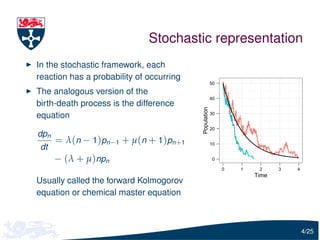
Stochastic representation
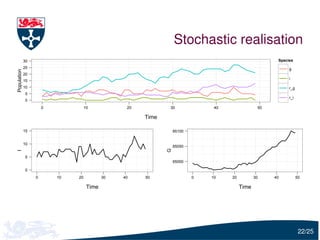
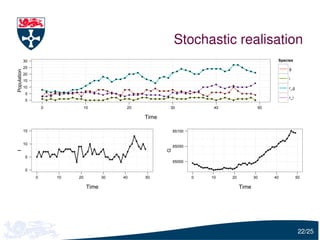
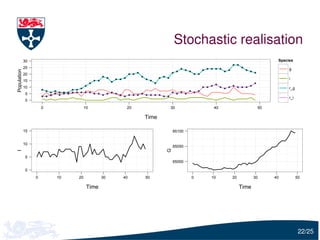
In the stochastic framework, each
reaction has a probability of occurring
                                                       50

The analogous version of the
                                                       40
birth-death process is the difference


                                          Population
equation                                               30


                                                       20
dpn
      = λ(n − 1)pn−1 + µ(n + 1)pn+1                    10
 dt
      − (λ + µ)npn                                     0

                                                            0   1    2     3   4
                                                                    Time
Usually called the forward Kolmogorov
equation or chemical master equation


                                                                                   4/25
Moment equations
Multiply the CME by enθ and sum over n, to obtain

                 ∂M                            ∂M
                    = [λ(eθ − 1) + µ(e−θ − 1)]
                 ∂t                            ∂θ
where
                                       ∞
                        M (θ; t ) =   ∑ e n θ pn ( t )
                                      n =0

If we differentiate this p.d.e. w.r.t θ and set θ = 0, we get

                     dE[N (t )]
                                  = (λ − µ)E[N (t )]
                         dt

where E[N (t )] is the mean

                                                                5/25
The mean equation

                 dE[N (t )]
                              = (λ − µ)E[N (t )]
                     dt

This ODE is solvable - the associated forward Kolmogorov equation is
also solvable
The equation for the mean and deterministic ODE are identical
When the rate laws are linear, the stochastic mean and deterministic
solution always correspond


                                                                       6/25
The variance equation
If we differentiate the p.d.e. w.r.t θ twice and set θ = 0, we get:

         dE[N (t )2 ]
                        = (λ − µ)E[N (t )] + 2(λ − µ)E[N (t )2 ]
              dt

and hence the variance Var[N (t )] = E[N (t )2 ] − E[N (t )]2 .
Differentiating three times gives an expression for the skewness, etc


                                                                        7/25
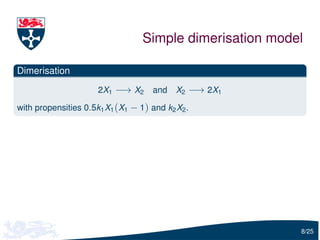
Simple dimerisation model

Dimerisation
                      2X1 −→ X2      and   X2 −→ 2X1

with propensities 0.5k1 X1 (X1 − 1) and k2 X2 .


                                                          8/25
Dimerisation moment equations
We formulate the dimer model in terms of moment equations

     dE[X1 ]               2
               = 0.5k1 (E[X1 ] − E[X1 ]) − k2 E[X1 ]
      dt
         2
    dE[X1 ]             2                               2
               = k1 (E[X1 X2 ] − E[X1 X2 ]) + 0.5k1 (E[X1 ] − E[X1 ])
       dt
                                    2
                 + k2 (E[X1 ] − 2E[X1 ])

where E[X1 ] is the mean of X1 and E[X1 ] − E[X1 ]2 is the variance
                                      2

The i th moment equation depends on the (i + 1)th equation


                                                                        9/25
Deterministic approximates stochastic
Rewriting
                 dE[X1 ]               2
                           = 0.5k1 (E[X1 ] − E[X1 ]) − k2 E[X1 ]
                    dt
in terms of its variance, i.e. E[X1 ] = Var[X1 ] + E[X1 ]2 , we get
                                  2


       dE[X1 ]
                 = 0.5k1 E [X1 ](E[X1 ] − 1) + 0.5k1 Var[X1 ] − k2 E[X1 ]   (1)
            dt

     Setting Var[X1 ] = 0 in (1), recovers the deterministic equation
     So we can consider the deterministic model as an approximation to
     the stochastic
     When we have polynomial rate laws, setting the variance to zero
     results in the deterministic equation

                                                                             10/25
Deterministic approximates stochastic
Rewriting
                 dE[X1 ]               2
                           = 0.5k1 (E[X1 ] − E[X1 ]) − k2 E[X1 ]
                    dt
in terms of its variance, i.e. E[X1 ] = Var[X1 ] + E[X1 ]2 , we get
                                  2


       dE[X1 ]
                 = 0.5k1 E [X1 ](E[X1 ] − 1) + 0.5k1 Var[X1 ] − k2 E[X1 ]   (1)
            dt

     Setting Var[X1 ] = 0 in (1), recovers the deterministic equation
     So we can consider the deterministic model as an approximation to
     the stochastic
     When we have polynomial rate laws, setting the variance to zero
     results in the deterministic equation

                                                                             10/25
Simple dimerisation model
To close the equations, we assume an underlying distribution
The easiest option is to assume an underlying Normal distribution, i.e.

                    E[X1 ] = 3E[X1 ]E[X1 ] − 2E[X1 ]3
                       3         2


But we could also use, the Poisson

                    3
                 E[X1 ] = E[X1 ] + 3E[X1 ]2 + E[X1 ]3

or the Log normal
                                            2     3
                               3       E [ X1 ]
                          E [ X1 ] =
                                       E [ X1 ]


                                                                     11/25
Simple dimerisation model
To close the equations, we assume an underlying distribution
The easiest option is to assume an underlying Normal distribution, i.e.

                    E[X1 ] = 3E[X1 ]E[X1 ] − 2E[X1 ]3
                       3         2


But we could also use, the Poisson

                    3
                 E[X1 ] = E[X1 ] + 3E[X1 ]2 + E[X1 ]3

or the Log normal
                                            2     3
                               3       E [ X1 ]
                          E [ X1 ] =
                                       E [ X1 ]


                                                                     11/25
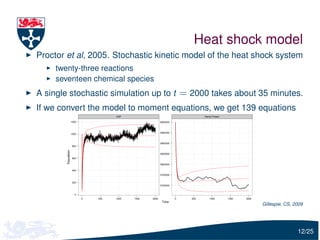
Heat shock model
Proctor et al, 2005. Stochastic kinetic model of the heat shock system
     twenty-three reactions
     seventeen chemical species
A single stochastic simulation up to t = 2000 takes about 35 minutes.
If we convert the model to moment equations, we get 139 equations
                                      ADP                                      Native Protein

                     1200                                  6000000


                                                           5950000
                     1000


                                                           5900000
                     800
        Population


                                                           5850000
                     600

                                                           5800000

                     400
                                                           5750000


                     200
                                                           5700000


                        0
                            0   500   1000   1500   2000             0   500       1000         1500   2000
                                                            Time
                                                                                                              Gillespie, CS, 2009


                                                                                                                              12/25
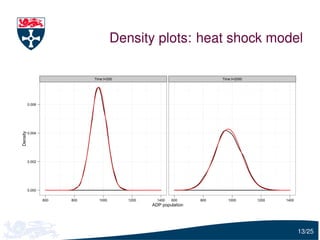
Density plots: heat shock model

                              Time t=200                                 Time t=2000


          0.006
Density


          0.004


          0.002


          0.000

                  600   800     1000       1200     1400   600     800      1000       1200   1400
                                                  ADP population


                                                                                                     13/25
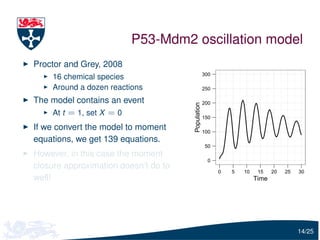
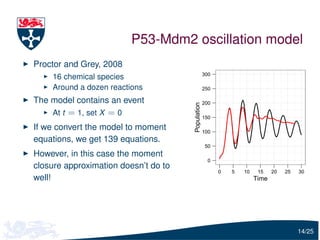
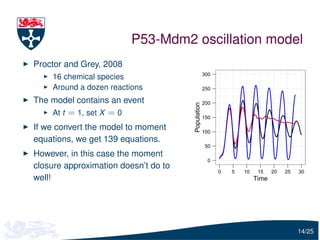
P53-Mdm2 oscillation model
Proctor and Grey, 2008
                                                   300
    16 chemical species
    Around a dozen reactions                       250

The model contains an event                        200


                                      Population
    At t = 1, set X = 0                            150

If we convert the model to moment                  100
equations, we get 139 equations.
                                                   50
However, in this case the moment
                                                     0
closure approximation doesn’t do to
                                                         0   5   10    15    20   25   30
well!                                                                 Time


                                                                                       14/25
P53-Mdm2 oscillation model
Proctor and Grey, 2008
                                                   300
    16 chemical species
    Around a dozen reactions                       250

The model contains an event                        200


                                      Population
    At t = 1, set X = 0                            150

If we convert the model to moment                  100
equations, we get 139 equations.
                                                   50
However, in this case the moment
                                                     0
closure approximation doesn’t do to
                                                         0   5   10    15    20   25   30
well!                                                                 Time


                                                                                       14/25
P53-Mdm2 oscillation model
Proctor and Grey, 2008
                                                   300
    16 chemical species
    Around a dozen reactions                       250

The model contains an event                        200


                                      Population
    At t = 1, set X = 0                            150

If we convert the model to moment                  100
equations, we get 139 equations.
                                                   50
However, in this case the moment
                                                     0
closure approximation doesn’t do to
                                                         0   5   10    15    20   25   30
well!                                                                 Time


                                                                                       14/25
What went wrong?
The moment closure (tends) to fail when there is a large difference
between the deterministic and stochastic formulations
In this particular case, strongly correlated species
Typically when the MC approximation fails, it gives a negative
variance
The MC approximation does work well for other parameter values for
the p53 model


                                                                      15/25
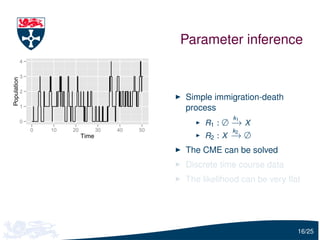
Parameter inference
             4

             3
Population


             2
                                                     Simple immigration-death
             1                                       process
                                                                 k1
             0                                            R1 : ∅ − X
                                                                 →
                 0   10   20          30   40   50               k2
                               Time                       R2 : X − ∅
                                                                 →
                                                     The CME can be solved
                                                     Discrete time course data
                                                     The likelihood can be very flat


                                                                                  16/25
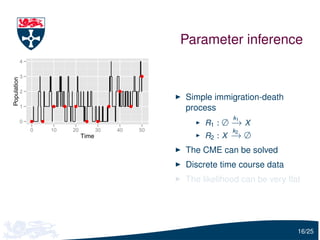
Parameter inference
             4

             3                                                  q
Population


             2                                         q
                                                                     Simple immigration-death
             1           q    q   q                q        q
                                                                     process
                                                                                 k1
             0   q   q                  q     q
                                                                          R1 : ∅ − X
                                                                                 →
                 0       10       20          30       40       50               k2
                                       Time                               R2 : X − ∅
                                                                                 →
                                                                     The CME can be solved
                                                                     Discrete time course data
                                                                     The likelihood can be very flat


                                                                                                  16/25
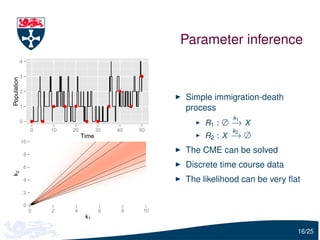
Parameter inference
             4

             3                                                      q
Population


             2                                             q
                                                                          Simple immigration-death
             1               q    q   q                q        q
                                                                          process
                                                                                      k1
             0       q   q                  q     q
                                                                               R1 : ∅ − X
                                                                                      →
                     0       10       20          30       40       50                k2
                                           Time                                R2 : X − ∅
                                                                                      →
             10

                 8
                                                                          The CME can be solved
                 6                                                        Discrete time course data
k2


                 4                                                        The likelihood can be very flat
                 2

                 0
                     0       2        4            6        8        10
                                            k1

                                                                                                       16/25
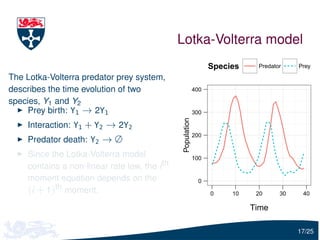
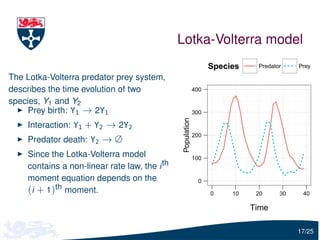
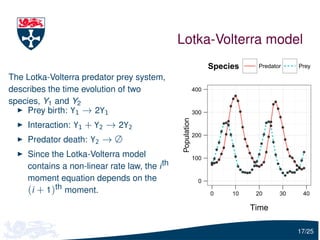
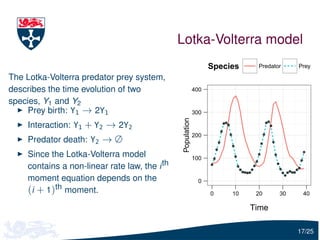
Lotka-Volterra model
                                                                  Species    Predator    Prey

The Lotka-Volterra predator prey system,
describes the time evolution of two                         400

species, Y1 and Y2
    Prey birth: Y1 → 2Y1                                    300


                                               Population
    Interaction: Y1 + Y2 → 2Y2
                                                            200
    Predator death: Y2 → ∅
    Since the Lotka-Volterra model                          100
    contains a non-linear rate law, the i th
    moment equation depends on the                            0
    (i + 1)th moment.                                             0    10    20     30    40

                                                                            Time

                                                                                         17/25
Lotka-Volterra model
                                                                  Species    Predator    Prey

The Lotka-Volterra predator prey system,
describes the time evolution of two                         400

species, Y1 and Y2
    Prey birth: Y1 → 2Y1                                    300


                                               Population
    Interaction: Y1 + Y2 → 2Y2
                                                            200
    Predator death: Y2 → ∅
    Since the Lotka-Volterra model                          100
    contains a non-linear rate law, the i th
    moment equation depends on the                            0
    (i + 1)th moment.                                             0    10    20     30    40

                                                                            Time

                                                                                         17/25
Lotka-Volterra model
                                                                  Species    Predator    Prey

The Lotka-Volterra predator prey system,
describes the time evolution of two                         400

species, Y1 and Y2
    Prey birth: Y1 → 2Y1                                    300


                                               Population
    Interaction: Y1 + Y2 → 2Y2
                                                            200
    Predator death: Y2 → ∅
    Since the Lotka-Volterra model                          100
    contains a non-linear rate law, the i th
    moment equation depends on the                            0
    (i + 1)th moment.                                             0    10    20     30    40

                                                                            Time

                                                                                         17/25
Lotka-Volterra model
                                                                  Species    Predator    Prey

The Lotka-Volterra predator prey system,
describes the time evolution of two                         400

species, Y1 and Y2
    Prey birth: Y1 → 2Y1                                    300


                                               Population
    Interaction: Y1 + Y2 → 2Y2
                                                            200
    Predator death: Y2 → ∅
    Since the Lotka-Volterra model                          100
    contains a non-linear rate law, the i th
    moment equation depends on the                            0
    (i + 1)th moment.                                             0    10    20     30    40

                                                                            Time

                                                                                         17/25
Parameter estimation
Let Y(tu ) = (Y1 (tu ), Y2 (tu )) be the vector of the observed predator
and prey
To infer c1 , c2 and c3 , we need to estimate

                         Pr[Y(tu )| Y(tu −1 ), c]

i.e. the solution of the forward Kolmogorov equation
We will use moment closure to estimate this distribution:

                 Y(tu ) | Y(tu −1 ), c ∼ N (ψu −1 , Σu −1 )

where ψu −1 and Σu −1 are calculated using the moment closure
approximation

                                                                       18/25
Parameter estimation
Let Y(tu ) = (Y1 (tu ), Y2 (tu )) be the vector of the observed predator
and prey
To infer c1 , c2 and c3 , we need to estimate

                         Pr[Y(tu )| Y(tu −1 ), c]

i.e. the solution of the forward Kolmogorov equation
We will use moment closure to estimate this distribution:

                 Y(tu ) | Y(tu −1 ), c ∼ N (ψu −1 , Σu −1 )

where ψu −1 and Σu −1 are calculated using the moment closure
approximation

                                                                       18/25
Bayesian parameter inference
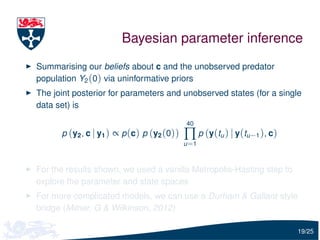
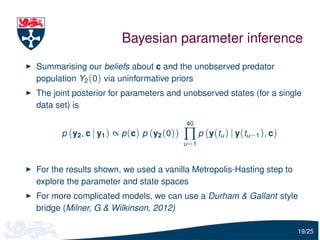
Summarising our beliefs about c and the unobserved predator
population Y2 (0) via uninformative priors
The joint posterior for parameters and unobserved states (for a single
data set) is

                                            40
      p (y2 , c | y1 ) ∝ p (c) p (y2 (0))   ∏ p (y(tu ) | y(tu−1 ), c)
                                            u =1


For the results shown, we used a vanilla Metropolis-Hasting step to
explore the parameter and state spaces
For more complicated models, we can use a Durham & Gallant style
bridge (Milner, G & Wilkinson, 2012)

                                                                         19/25
Bayesian parameter inference
Summarising our beliefs about c and the unobserved predator
population Y2 (0) via uninformative priors
The joint posterior for parameters and unobserved states (for a single
data set) is

                                            40
      p (y2 , c | y1 ) ∝ p (c) p (y2 (0))   ∏ p (y(tu ) | y(tu−1 ), c)
                                            u =1


For the results shown, we used a vanilla Metropolis-Hasting step to
explore the parameter and state spaces
For more complicated models, we can use a Durham & Gallant style
bridge (Milner, G & Wilkinson, 2012)

                                                                         19/25
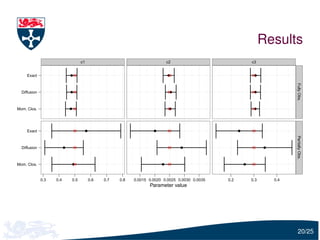
Results
                                    c1                                          c2                                c3


     Exact                    q                                                 q                                  q


                                                                                                                                  Fully Obs.
  Diffusion                   q                                                  q                                 q


Mom. Clos.                    q                                                  q                                 q


     Exact                               q                              q                                 q


                                                                                                                                  Partially Obs.
  Diffusion               q                                                          q                                  q


Mom. Clos.                    q                                             q                                 q


              0.3   0.4       0.5            0.6   0.7   0.8   0.0015 0.0020 0.0025 0.0030 0.0035   0.2           0.3       0.4
                                                                      Parameter value


                                                                                                                                    20/25
Auto regulation system
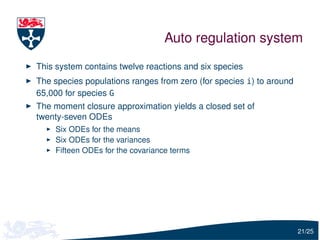
This system contains twelve reactions and six species
The species populations ranges from zero (for species i) to around
65,000 for species G
The moment closure approximation yields a closed set of
twenty-seven ODEs
    Six ODEs for the means
    Six ODEs for the variances
    Fifteen ODEs for the covariance terms


                                                                     21/25
Stochastic realisation
             30                                                                                        Species
             25                                                                                             g
Population


             20
                                                                                                            i
             15
             10                                                                                             r_g
             5
                                                                                                            r_i
             0
                      0             10            20          30               40                50

                                                       Time

             15                                                   65100


             10
                                                                  65050


                                                              G
I


             5
                                                                  65000

             0
                  0       10   20           30   40    50                 0   10    20          30    40          50

                                     Time                                                Time


                                                                                                                   22/25
Stochastic realisation
             30                                                                                        Species
             25                                                                                             g
Population


             20
                                                                                                            i
             15
             10                                                                                             r_g
             5
                                                                                                            r_i
             0
                      0             10            20          30               40                50

                                                       Time

             15                                                   65100


             10
                                                                  65050


                                                              G
I


             5
                                                                  65000

             0
                  0       10   20           30   40    50                 0   10    20          30    40          50

                                     Time                                                Time


                                                                                                                   22/25
Stochastic realisation
             30                                                                                        Species
             25                                                                                             g
Population


             20
                                                                                                            i
             15
             10                                                                                             r_g
             5
                                                                                                            r_i
             0
                      0             10            20          30               40                50

                                                       Time

             15                                                   65100


             10
                                                                  65050


                                                              G
I


             5
                                                                  65000

             0
                  0       10   20           30   40    50                 0   10    20          30    40          50

                                     Time                                                Time


                                                                                                                   22/25
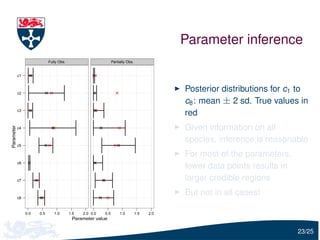
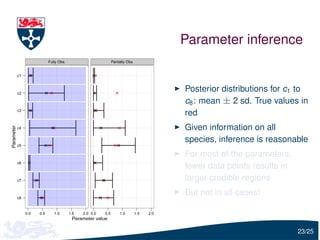
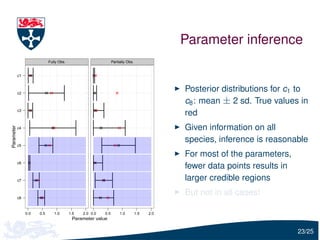
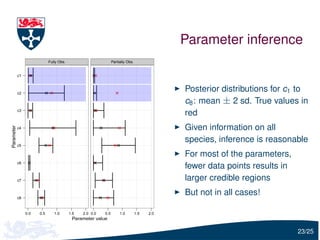
Parameter inference
                             Fully Obs.                         Partially Obs.


            c1


            c2
                                                                                             Posterior distributions for c1 to
                                                                                             c8 : mean ± 2 sd. True values in
            c3
                                                                                             red
                                                                                             Given information on all
Parameter


            c4


                                                                                             species, inference is reasonable
            c5

                                                                                             For most of the parameters,
            c6
                                                                                             fewer data points results in
            c7                                                                               larger credible regions

            c8
                                                                                             But not in all cases!

                 0.0   0.5      1.0       1.5   2.0 0.0   0.5        1.0         1.5   2.0
                                           Parameter value

                                                                                                                            23/25
Parameter inference
                             Fully Obs.                         Partially Obs.


            c1


            c2
                                                                                             Posterior distributions for c1 to
                                                                                             c8 : mean ± 2 sd. True values in
            c3
                                                                                             red
                                                                                             Given information on all
Parameter


            c4


                                                                                             species, inference is reasonable
            c5

                                                                                             For most of the parameters,
            c6
                                                                                             fewer data points results in
            c7                                                                               larger credible regions

            c8
                                                                                             But not in all cases!

                 0.0   0.5      1.0       1.5   2.0 0.0   0.5        1.0         1.5   2.0
                                           Parameter value

                                                                                                                            23/25
Parameter inference
                             Fully Obs.                         Partially Obs.


            c1


            c2
                                                                                             Posterior distributions for c1 to
                                                                                             c8 : mean ± 2 sd. True values in
            c3
                                                                                             red
                                                                                             Given information on all
Parameter


            c4


                                                                                             species, inference is reasonable
            c5

                                                                                             For most of the parameters,
            c6
                                                                                             fewer data points results in
            c7                                                                               larger credible regions

            c8
                                                                                             But not in all cases!

                 0.0   0.5      1.0       1.5   2.0 0.0   0.5        1.0         1.5   2.0
                                           Parameter value

                                                                                                                            23/25
Parameter inference
                             Fully Obs.                         Partially Obs.


            c1


            c2
                                                                                             Posterior distributions for c1 to
                                                                                             c8 : mean ± 2 sd. True values in
            c3
                                                                                             red
                                                                                             Given information on all
Parameter


            c4


                                                                                             species, inference is reasonable
            c5

                                                                                             For most of the parameters,
            c6
                                                                                             fewer data points results in
            c7                                                                               larger credible regions

            c8
                                                                                             But not in all cases!

                 0.0   0.5      1.0       1.5   2.0 0.0   0.5        1.0         1.5   2.0
                                           Parameter value

                                                                                                                            23/25
Future work
Techniques for assessing the moment closure approximation
Better closure techniques
    Computer emulation for moments
Using the moment closure approximation as a proposal distribution in
an MCMC algorithm
    The proposal can be (almost) anything we want
    The likelihood can be calculated using anything we want


                                                                   24/25
Acknowledgements
   Peter Milner                                                           Darren Wilkinson


References
   Gillespie, CS Moment closure approximations for mass-action models. IET Systems Biology 2009.

   Gillespie, CS, Golightly, A Bayesian inference for generalized stochastic population growth models with application to aphids.
   Journal of the Royal Statistical Society, Series C 2010.
   Milner, P, Gillespie, CS, Wilkinson, DJ Moment closure approximations for stochastic kinetic models with rational rate laws.
   Mathematical Biosciences 2011.
   Milner, P, Gillespie, CS and Wilkinson, DJ Moment closure based parameter inference of stochastic kinetic models.
   Statistics and Computing 2012.


                                                                                                                                    25/25

Moment Closure Based Parameter Inference of Stochastic Kinetic Models

  • 1.
    Moment Closure BasedParameter Inference of Stochastic Kinetic Models Colin Gillespie School of Mathematics & Statistics
  • 2.
    Overview Talk outline An introduction to moment closure Parameter inference Conclusion 2/25
  • 3.
    Birth-death process Birth-death model X −→ 2X and 2X −→ X which has the propensity functions λX and µX . Deterministic representation The deterministic model is dX (t ) = ( λ − µ )X (t ) , dt which can be solved to give X (t ) = X (0) exp[(λ − µ)t ]. 3/25
  • 4.
    Birth-death process Birth-death model X −→ 2X and 2X −→ X which has the propensity functions λX and µX . Deterministic representation The deterministic model is dX (t ) = ( λ − µ )X (t ) , dt which can be solved to give X (t ) = X (0) exp[(λ − µ)t ]. 3/25
  • 5.
    Stochastic representation In thestochastic framework, each reaction has a probability of occurring 50 The analogous version of the 40 birth-death process is the difference Population equation 30 20 dpn = λ(n − 1)pn−1 + µ(n + 1)pn+1 10 dt − (λ + µ)npn 0 0 1 2 3 4 Time Usually called the forward Kolmogorov equation or chemical master equation 4/25
  • 6.
    Moment equations Multiply theCME by enθ and sum over n, to obtain ∂M ∂M = [λ(eθ − 1) + µ(e−θ − 1)] ∂t ∂θ where ∞ M (θ; t ) = ∑ e n θ pn ( t ) n =0 If we differentiate this p.d.e. w.r.t θ and set θ = 0, we get dE[N (t )] = (λ − µ)E[N (t )] dt where E[N (t )] is the mean 5/25
  • 7.
    The mean equation dE[N (t )] = (λ − µ)E[N (t )] dt This ODE is solvable - the associated forward Kolmogorov equation is also solvable The equation for the mean and deterministic ODE are identical When the rate laws are linear, the stochastic mean and deterministic solution always correspond 6/25
  • 8.
    The variance equation Ifwe differentiate the p.d.e. w.r.t θ twice and set θ = 0, we get: dE[N (t )2 ] = (λ − µ)E[N (t )] + 2(λ − µ)E[N (t )2 ] dt and hence the variance Var[N (t )] = E[N (t )2 ] − E[N (t )]2 . Differentiating three times gives an expression for the skewness, etc 7/25
  • 9.
    Simple dimerisation model Dimerisation 2X1 −→ X2 and X2 −→ 2X1 with propensities 0.5k1 X1 (X1 − 1) and k2 X2 . 8/25
  • 10.
    Dimerisation moment equations Weformulate the dimer model in terms of moment equations dE[X1 ] 2 = 0.5k1 (E[X1 ] − E[X1 ]) − k2 E[X1 ] dt 2 dE[X1 ] 2 2 = k1 (E[X1 X2 ] − E[X1 X2 ]) + 0.5k1 (E[X1 ] − E[X1 ]) dt 2 + k2 (E[X1 ] − 2E[X1 ]) where E[X1 ] is the mean of X1 and E[X1 ] − E[X1 ]2 is the variance 2 The i th moment equation depends on the (i + 1)th equation 9/25
  • 11.
    Deterministic approximates stochastic Rewriting dE[X1 ] 2 = 0.5k1 (E[X1 ] − E[X1 ]) − k2 E[X1 ] dt in terms of its variance, i.e. E[X1 ] = Var[X1 ] + E[X1 ]2 , we get 2 dE[X1 ] = 0.5k1 E [X1 ](E[X1 ] − 1) + 0.5k1 Var[X1 ] − k2 E[X1 ] (1) dt Setting Var[X1 ] = 0 in (1), recovers the deterministic equation So we can consider the deterministic model as an approximation to the stochastic When we have polynomial rate laws, setting the variance to zero results in the deterministic equation 10/25
  • 12.
    Deterministic approximates stochastic Rewriting dE[X1 ] 2 = 0.5k1 (E[X1 ] − E[X1 ]) − k2 E[X1 ] dt in terms of its variance, i.e. E[X1 ] = Var[X1 ] + E[X1 ]2 , we get 2 dE[X1 ] = 0.5k1 E [X1 ](E[X1 ] − 1) + 0.5k1 Var[X1 ] − k2 E[X1 ] (1) dt Setting Var[X1 ] = 0 in (1), recovers the deterministic equation So we can consider the deterministic model as an approximation to the stochastic When we have polynomial rate laws, setting the variance to zero results in the deterministic equation 10/25
  • 13.
    Simple dimerisation model Toclose the equations, we assume an underlying distribution The easiest option is to assume an underlying Normal distribution, i.e. E[X1 ] = 3E[X1 ]E[X1 ] − 2E[X1 ]3 3 2 But we could also use, the Poisson 3 E[X1 ] = E[X1 ] + 3E[X1 ]2 + E[X1 ]3 or the Log normal 2 3 3 E [ X1 ] E [ X1 ] = E [ X1 ] 11/25
  • 14.
    Simple dimerisation model Toclose the equations, we assume an underlying distribution The easiest option is to assume an underlying Normal distribution, i.e. E[X1 ] = 3E[X1 ]E[X1 ] − 2E[X1 ]3 3 2 But we could also use, the Poisson 3 E[X1 ] = E[X1 ] + 3E[X1 ]2 + E[X1 ]3 or the Log normal 2 3 3 E [ X1 ] E [ X1 ] = E [ X1 ] 11/25
  • 15.
    Heat shock model Proctoret al, 2005. Stochastic kinetic model of the heat shock system twenty-three reactions seventeen chemical species A single stochastic simulation up to t = 2000 takes about 35 minutes. If we convert the model to moment equations, we get 139 equations ADP Native Protein 1200 6000000 5950000 1000 5900000 800 Population 5850000 600 5800000 400 5750000 200 5700000 0 0 500 1000 1500 2000 0 500 1000 1500 2000 Time Gillespie, CS, 2009 12/25
  • 16.
    Density plots: heatshock model Time t=200 Time t=2000 0.006 Density 0.004 0.002 0.000 600 800 1000 1200 1400 600 800 1000 1200 1400 ADP population 13/25
  • 17.
    P53-Mdm2 oscillation model Proctorand Grey, 2008 300 16 chemical species Around a dozen reactions 250 The model contains an event 200 Population At t = 1, set X = 0 150 If we convert the model to moment 100 equations, we get 139 equations. 50 However, in this case the moment 0 closure approximation doesn’t do to 0 5 10 15 20 25 30 well! Time 14/25
  • 18.
    P53-Mdm2 oscillation model Proctorand Grey, 2008 300 16 chemical species Around a dozen reactions 250 The model contains an event 200 Population At t = 1, set X = 0 150 If we convert the model to moment 100 equations, we get 139 equations. 50 However, in this case the moment 0 closure approximation doesn’t do to 0 5 10 15 20 25 30 well! Time 14/25
  • 19.
    P53-Mdm2 oscillation model Proctorand Grey, 2008 300 16 chemical species Around a dozen reactions 250 The model contains an event 200 Population At t = 1, set X = 0 150 If we convert the model to moment 100 equations, we get 139 equations. 50 However, in this case the moment 0 closure approximation doesn’t do to 0 5 10 15 20 25 30 well! Time 14/25
  • 20.
    What went wrong? Themoment closure (tends) to fail when there is a large difference between the deterministic and stochastic formulations In this particular case, strongly correlated species Typically when the MC approximation fails, it gives a negative variance The MC approximation does work well for other parameter values for the p53 model 15/25
  • 21.
    Parameter inference 4 3 Population 2 Simple immigration-death 1 process k1 0 R1 : ∅ − X → 0 10 20 30 40 50 k2 Time R2 : X − ∅ → The CME can be solved Discrete time course data The likelihood can be very flat 16/25
  • 22.
    Parameter inference 4 3 q Population 2 q Simple immigration-death 1 q q q q q process k1 0 q q q q R1 : ∅ − X → 0 10 20 30 40 50 k2 Time R2 : X − ∅ → The CME can be solved Discrete time course data The likelihood can be very flat 16/25
  • 23.
    Parameter inference 4 3 q Population 2 q Simple immigration-death 1 q q q q q process k1 0 q q q q R1 : ∅ − X → 0 10 20 30 40 50 k2 Time R2 : X − ∅ → 10 8 The CME can be solved 6 Discrete time course data k2 4 The likelihood can be very flat 2 0 0 2 4 6 8 10 k1 16/25
  • 24.
    Lotka-Volterra model Species Predator Prey The Lotka-Volterra predator prey system, describes the time evolution of two 400 species, Y1 and Y2 Prey birth: Y1 → 2Y1 300 Population Interaction: Y1 + Y2 → 2Y2 200 Predator death: Y2 → ∅ Since the Lotka-Volterra model 100 contains a non-linear rate law, the i th moment equation depends on the 0 (i + 1)th moment. 0 10 20 30 40 Time 17/25
  • 25.
    Lotka-Volterra model Species Predator Prey The Lotka-Volterra predator prey system, describes the time evolution of two 400 species, Y1 and Y2 Prey birth: Y1 → 2Y1 300 Population Interaction: Y1 + Y2 → 2Y2 200 Predator death: Y2 → ∅ Since the Lotka-Volterra model 100 contains a non-linear rate law, the i th moment equation depends on the 0 (i + 1)th moment. 0 10 20 30 40 Time 17/25
  • 26.
    Lotka-Volterra model Species Predator Prey The Lotka-Volterra predator prey system, describes the time evolution of two 400 species, Y1 and Y2 Prey birth: Y1 → 2Y1 300 Population Interaction: Y1 + Y2 → 2Y2 200 Predator death: Y2 → ∅ Since the Lotka-Volterra model 100 contains a non-linear rate law, the i th moment equation depends on the 0 (i + 1)th moment. 0 10 20 30 40 Time 17/25
  • 27.
    Lotka-Volterra model Species Predator Prey The Lotka-Volterra predator prey system, describes the time evolution of two 400 species, Y1 and Y2 Prey birth: Y1 → 2Y1 300 Population Interaction: Y1 + Y2 → 2Y2 200 Predator death: Y2 → ∅ Since the Lotka-Volterra model 100 contains a non-linear rate law, the i th moment equation depends on the 0 (i + 1)th moment. 0 10 20 30 40 Time 17/25
  • 28.
    Parameter estimation Let Y(tu) = (Y1 (tu ), Y2 (tu )) be the vector of the observed predator and prey To infer c1 , c2 and c3 , we need to estimate Pr[Y(tu )| Y(tu −1 ), c] i.e. the solution of the forward Kolmogorov equation We will use moment closure to estimate this distribution: Y(tu ) | Y(tu −1 ), c ∼ N (ψu −1 , Σu −1 ) where ψu −1 and Σu −1 are calculated using the moment closure approximation 18/25
  • 29.
    Parameter estimation Let Y(tu) = (Y1 (tu ), Y2 (tu )) be the vector of the observed predator and prey To infer c1 , c2 and c3 , we need to estimate Pr[Y(tu )| Y(tu −1 ), c] i.e. the solution of the forward Kolmogorov equation We will use moment closure to estimate this distribution: Y(tu ) | Y(tu −1 ), c ∼ N (ψu −1 , Σu −1 ) where ψu −1 and Σu −1 are calculated using the moment closure approximation 18/25
  • 30.
    Bayesian parameter inference Summarisingour beliefs about c and the unobserved predator population Y2 (0) via uninformative priors The joint posterior for parameters and unobserved states (for a single data set) is 40 p (y2 , c | y1 ) ∝ p (c) p (y2 (0)) ∏ p (y(tu ) | y(tu−1 ), c) u =1 For the results shown, we used a vanilla Metropolis-Hasting step to explore the parameter and state spaces For more complicated models, we can use a Durham & Gallant style bridge (Milner, G & Wilkinson, 2012) 19/25
  • 31.
    Bayesian parameter inference Summarisingour beliefs about c and the unobserved predator population Y2 (0) via uninformative priors The joint posterior for parameters and unobserved states (for a single data set) is 40 p (y2 , c | y1 ) ∝ p (c) p (y2 (0)) ∏ p (y(tu ) | y(tu−1 ), c) u =1 For the results shown, we used a vanilla Metropolis-Hasting step to explore the parameter and state spaces For more complicated models, we can use a Durham & Gallant style bridge (Milner, G & Wilkinson, 2012) 19/25
  • 32.
    Results c1 c2 c3 Exact q q q Fully Obs. Diffusion q q q Mom. Clos. q q q Exact q q q Partially Obs. Diffusion q q q Mom. Clos. q q q 0.3 0.4 0.5 0.6 0.7 0.8 0.0015 0.0020 0.0025 0.0030 0.0035 0.2 0.3 0.4 Parameter value 20/25
  • 33.
    Auto regulation system Thissystem contains twelve reactions and six species The species populations ranges from zero (for species i) to around 65,000 for species G The moment closure approximation yields a closed set of twenty-seven ODEs Six ODEs for the means Six ODEs for the variances Fifteen ODEs for the covariance terms 21/25
  • 34.
    Stochastic realisation 30 Species 25 g Population 20 i 15 10 r_g 5 r_i 0 0 10 20 30 40 50 Time 15 65100 10 65050 G I 5 65000 0 0 10 20 30 40 50 0 10 20 30 40 50 Time Time 22/25
  • 35.
    Stochastic realisation 30 Species 25 g Population 20 i 15 10 r_g 5 r_i 0 0 10 20 30 40 50 Time 15 65100 10 65050 G I 5 65000 0 0 10 20 30 40 50 0 10 20 30 40 50 Time Time 22/25
  • 36.
    Stochastic realisation 30 Species 25 g Population 20 i 15 10 r_g 5 r_i 0 0 10 20 30 40 50 Time 15 65100 10 65050 G I 5 65000 0 0 10 20 30 40 50 0 10 20 30 40 50 Time Time 22/25
  • 37.
    Parameter inference Fully Obs. Partially Obs. c1 c2 Posterior distributions for c1 to c8 : mean ± 2 sd. True values in c3 red Given information on all Parameter c4 species, inference is reasonable c5 For most of the parameters, c6 fewer data points results in c7 larger credible regions c8 But not in all cases! 0.0 0.5 1.0 1.5 2.0 0.0 0.5 1.0 1.5 2.0 Parameter value 23/25
  • 38.
    Parameter inference Fully Obs. Partially Obs. c1 c2 Posterior distributions for c1 to c8 : mean ± 2 sd. True values in c3 red Given information on all Parameter c4 species, inference is reasonable c5 For most of the parameters, c6 fewer data points results in c7 larger credible regions c8 But not in all cases! 0.0 0.5 1.0 1.5 2.0 0.0 0.5 1.0 1.5 2.0 Parameter value 23/25
  • 39.
    Parameter inference Fully Obs. Partially Obs. c1 c2 Posterior distributions for c1 to c8 : mean ± 2 sd. True values in c3 red Given information on all Parameter c4 species, inference is reasonable c5 For most of the parameters, c6 fewer data points results in c7 larger credible regions c8 But not in all cases! 0.0 0.5 1.0 1.5 2.0 0.0 0.5 1.0 1.5 2.0 Parameter value 23/25
  • 40.
    Parameter inference Fully Obs. Partially Obs. c1 c2 Posterior distributions for c1 to c8 : mean ± 2 sd. True values in c3 red Given information on all Parameter c4 species, inference is reasonable c5 For most of the parameters, c6 fewer data points results in c7 larger credible regions c8 But not in all cases! 0.0 0.5 1.0 1.5 2.0 0.0 0.5 1.0 1.5 2.0 Parameter value 23/25
  • 41.
    Future work Techniques forassessing the moment closure approximation Better closure techniques Computer emulation for moments Using the moment closure approximation as a proposal distribution in an MCMC algorithm The proposal can be (almost) anything we want The likelihood can be calculated using anything we want 24/25
  • 42.
    Acknowledgements Peter Milner Darren Wilkinson References Gillespie, CS Moment closure approximations for mass-action models. IET Systems Biology 2009. Gillespie, CS, Golightly, A Bayesian inference for generalized stochastic population growth models with application to aphids. Journal of the Royal Statistical Society, Series C 2010. Milner, P, Gillespie, CS, Wilkinson, DJ Moment closure approximations for stochastic kinetic models with rational rate laws. Mathematical Biosciences 2011. Milner, P, Gillespie, CS and Wilkinson, DJ Moment closure based parameter inference of stochastic kinetic models. Statistics and Computing 2012. 25/25