Source, Citation and Research
Hello!
I am Nirmal Kumar Swain
Dr. Nirmal Kumar Swain
Professor & Head
Dept of Lib & Inf. Science
Maharshi Dayanand University , Rohtak – 124001 (Haryana)
Ph: 01262-393017 (O) / M: 9416516771 / E-Mail: drnkswain@gmail.com
2
(June_23_2021)
Lecture Delivered
At Faculty Development Programme (June 21 -29, 2021)
10:00 AM to 12:00 AM
Amity University, Mumbai, India
3
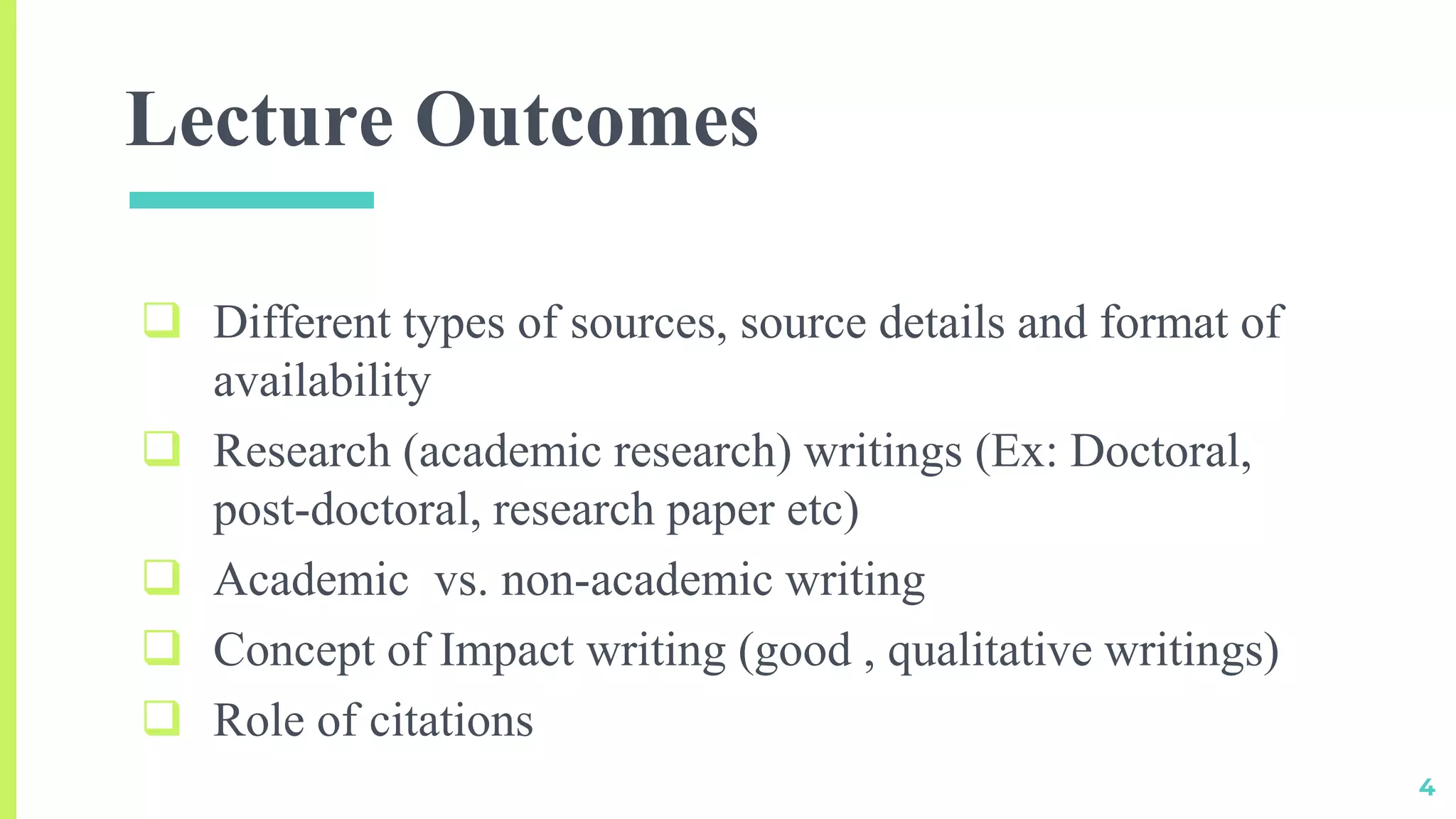
Lecture Outcomes
 Different types of sources, source details and format of
availability
 Research (academic research) writings (Ex: Doctoral,
post-doctoral, research paper etc)
 Academic vs. non-academic writing
 Concept of Impact writing (good , qualitative writings)
 Role of citations
4
Different types of sources, source details
 Sources includes where the researchers report their research findings,
record their ideas with conformation of authorship
 Example: Books, book chapters, research papers, articles, book
reviews, blogs, YouTube etc
 Each source has its own ethos in terms of content and its description
 Researchers use these sources according to their own writings
 This differs from authors to authors depending upon, experience,
reading, research and by gradual over all development by age,
situation, workplace, mingle with others
5
Few examples of sources used in academics
▣ Books: Books are the easily available sources and having
initial orientation with the readers at early age
▣ Books by and large contains the old information including
the very old and recent old hence considered as secondary
sources. Its usefulness is required as a researcher must have
used, read or studied some of those if not all
▣ It structured the understanding of a researcher hich is very
much required for any academic writings
6
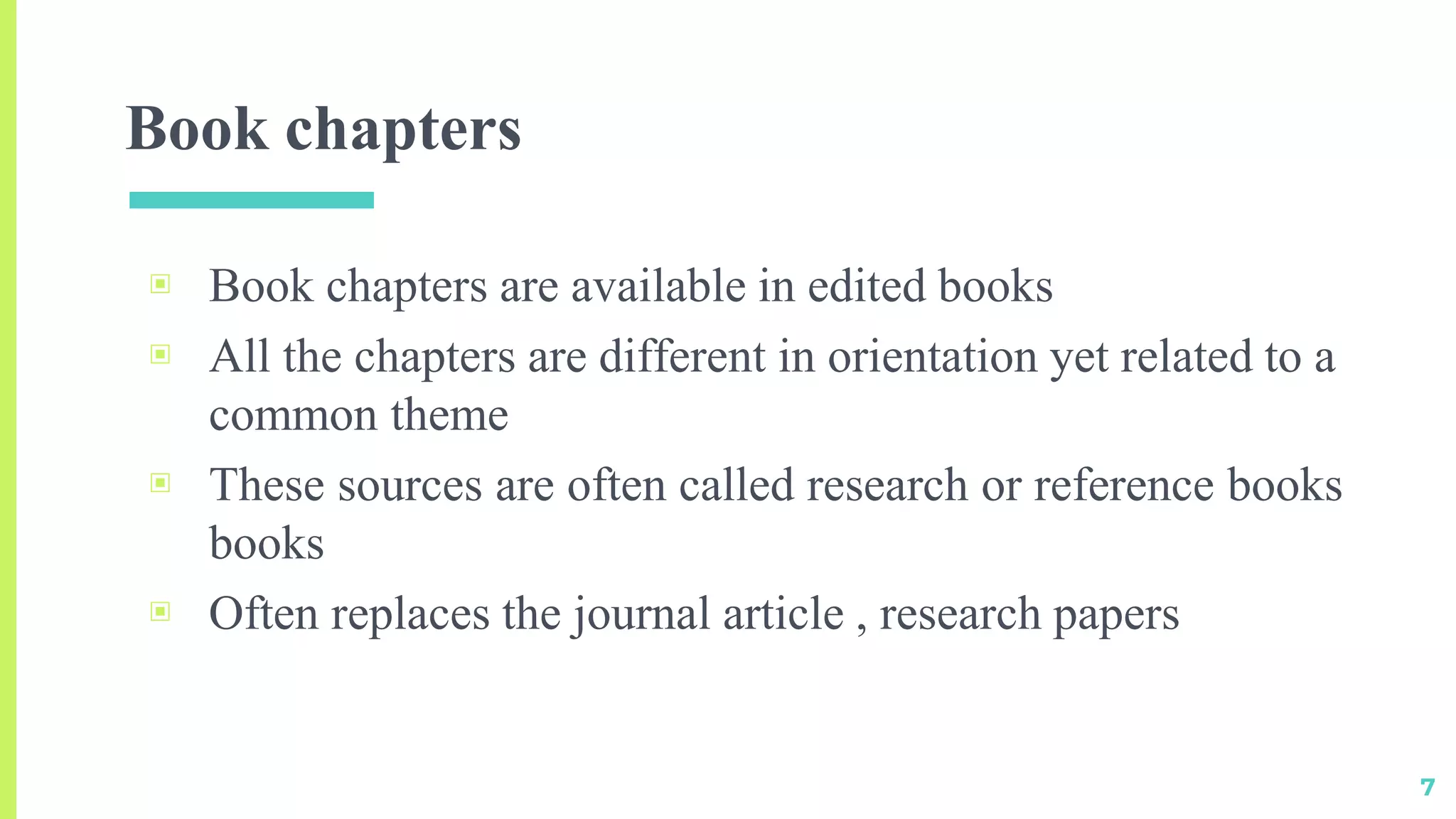
Book chapters
▣ Book chapters are available in edited books
▣ All the chapters are different in orientation yet related to a
common theme
▣ These sources are often called research or reference books
books
▣ Often replaces the journal article , research papers
7
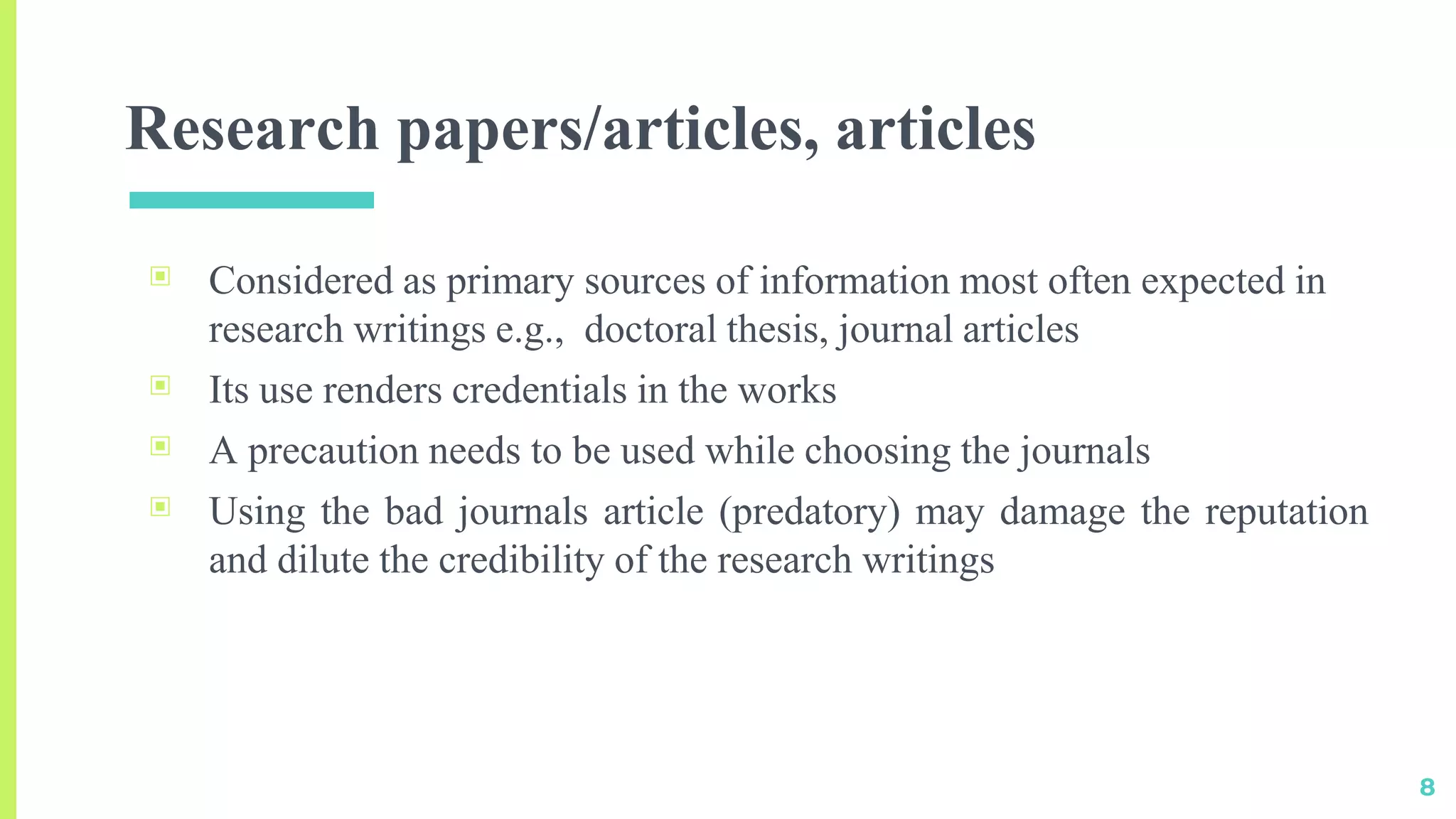
Research papers/articles, articles
▣ Considered as primary sources of information most often expected in
research writings e.g., doctoral thesis, journal articles
▣ Its use renders credentials in the works
▣ A precaution needs to be used while choosing the journals
▣ Using the bad journals article (predatory) may damage the reputation
and dilute the credibility of the research writings
8
Concept of source details
▣ Sources serve two broad points
▣ The content written in it as well details must be available for
verification
▣ If you have used must be used by others hence details about the
source must be available
▣ Making available at least full details is the ethical role of the author
▣ Sources are available in deferent formats print and non-print, online ,
electronic form etc
▣ A particular source is available by different publishers and databases
▣ Which source have been used must be clear about as readers verifies
9
Research and research writings
▣ You are not the only researcher working on the area or topic
▣ The works have already been done in some form or other
▣ The area / topic you are working or writing is continuously been done
or stopped for sometime and you are have taken up now, all matters is
the context of using the sources
10
Reorientation to research
 Research is an ongoing activity
 Research is a debate
 There is no fixed arrival
 Final point or results goes on shifting like the deconstructionist argue
 This is the beauty of the research
 Research provides new theme, retrieving the old concepts, policing
the ideology, critiquing the acceptable views
 New ideas proposed to be replced
11
Research writings
 Research is represented through the presenting the findings
 A view needs to be popularized
 A new idea is propagated
 All done by the researcher, author, writer
 Research provides new theme, retrieving the old concepts, policing
the ideology, critiquing the acceptable views
 New ideas proposed to be replaced
 It needs to be the game of language , narration and narratives of the
author
12
Citation
 Citation is using the borrowing materials with proper
acknowledgement
 Citation provides the strength in arguments of the author
 Citation shows the sincerity and genuineness of the authors
 As you are NOT the only author talking about a theme
 An author needs to encompass the others’ views
 As an author must be agreement and disagreement with others’ views
and those case hint about those authors and source must be
accompanied
13
Citation . . .
 What to cite
 Why to cite
 Where to cite
 How to cite
14
What to cite
 What to cite is called cited matter
 Author only know what kind of cited matters fits into the citation
 The source from which the cited matter to be lent or borrowed
author is the sole authority
 Depend upon the author’s experience, academic culture and
credentials
15
Why to cite
 Citation strengthens the author’s claim of knowledge
 It supports and corroborate the author’s views
 Readers give credibility
 Readers come across the other sources
 Creates curiosity among the readers
 Citation helps in honoring the cited authors
 The same mechanisms also applies to you as author
16
Where to cite
 Citation is provided at the lesser known facts or knowledge in
private domain
 Knowledge in public and private domain
 Author is the sole master to say which knowledge is in public or
private domain
 It differs from author to author
 Based on authors’ academic growth, experience, large reading
and writing
17
How to cite
 Citation is done in an uniform way
 This uniformity may be maintained by individual
 The uniformity makes Style
 Styles are the norms or rules for referencing or bibliographic
organization
 Style books are called style manual
 Different styles are available APA, MLA, Chicago Manual etc for
social science and humanities and for science and technology
others are also available
18
Two points to remember
 Citation is done through using cited matter in own writing inside
the text (in-text citation)
 In in-text citation a source hint given
 Source hint is given by two types: parenthetical (author date
type) and superscription example: Swain 1 with 1 superscribed
 Secondly don’t forget to provide a list of sources of cited matter
in the form of ‘References’, ‘Works cited’, ‘Notes and references’
etc
19
Thanks!
Bye bye, See you someday somewhere
20

2021 amity mumbai_source, citation and research

  • 1.
  • 2.
    Hello! I am NirmalKumar Swain Dr. Nirmal Kumar Swain Professor & Head Dept of Lib & Inf. Science Maharshi Dayanand University , Rohtak – 124001 (Haryana) Ph: 01262-393017 (O) / M: 9416516771 / E-Mail: drnkswain@gmail.com 2
  • 3.
    (June_23_2021) Lecture Delivered At FacultyDevelopment Programme (June 21 -29, 2021) 10:00 AM to 12:00 AM Amity University, Mumbai, India 3
  • 4.
    Lecture Outcomes  Differenttypes of sources, source details and format of availability  Research (academic research) writings (Ex: Doctoral, post-doctoral, research paper etc)  Academic vs. non-academic writing  Concept of Impact writing (good , qualitative writings)  Role of citations 4
  • 5.
    Different types ofsources, source details  Sources includes where the researchers report their research findings, record their ideas with conformation of authorship  Example: Books, book chapters, research papers, articles, book reviews, blogs, YouTube etc  Each source has its own ethos in terms of content and its description  Researchers use these sources according to their own writings  This differs from authors to authors depending upon, experience, reading, research and by gradual over all development by age, situation, workplace, mingle with others 5
  • 6.
    Few examples ofsources used in academics ▣ Books: Books are the easily available sources and having initial orientation with the readers at early age ▣ Books by and large contains the old information including the very old and recent old hence considered as secondary sources. Its usefulness is required as a researcher must have used, read or studied some of those if not all ▣ It structured the understanding of a researcher hich is very much required for any academic writings 6
  • 7.
    Book chapters ▣ Bookchapters are available in edited books ▣ All the chapters are different in orientation yet related to a common theme ▣ These sources are often called research or reference books books ▣ Often replaces the journal article , research papers 7
  • 8.
    Research papers/articles, articles ▣Considered as primary sources of information most often expected in research writings e.g., doctoral thesis, journal articles ▣ Its use renders credentials in the works ▣ A precaution needs to be used while choosing the journals ▣ Using the bad journals article (predatory) may damage the reputation and dilute the credibility of the research writings 8
  • 9.
    Concept of sourcedetails ▣ Sources serve two broad points ▣ The content written in it as well details must be available for verification ▣ If you have used must be used by others hence details about the source must be available ▣ Making available at least full details is the ethical role of the author ▣ Sources are available in deferent formats print and non-print, online , electronic form etc ▣ A particular source is available by different publishers and databases ▣ Which source have been used must be clear about as readers verifies 9
  • 10.
    Research and researchwritings ▣ You are not the only researcher working on the area or topic ▣ The works have already been done in some form or other ▣ The area / topic you are working or writing is continuously been done or stopped for sometime and you are have taken up now, all matters is the context of using the sources 10
  • 11.
    Reorientation to research Research is an ongoing activity  Research is a debate  There is no fixed arrival  Final point or results goes on shifting like the deconstructionist argue  This is the beauty of the research  Research provides new theme, retrieving the old concepts, policing the ideology, critiquing the acceptable views  New ideas proposed to be replced 11
  • 12.
    Research writings  Researchis represented through the presenting the findings  A view needs to be popularized  A new idea is propagated  All done by the researcher, author, writer  Research provides new theme, retrieving the old concepts, policing the ideology, critiquing the acceptable views  New ideas proposed to be replaced  It needs to be the game of language , narration and narratives of the author 12
  • 13.
    Citation  Citation isusing the borrowing materials with proper acknowledgement  Citation provides the strength in arguments of the author  Citation shows the sincerity and genuineness of the authors  As you are NOT the only author talking about a theme  An author needs to encompass the others’ views  As an author must be agreement and disagreement with others’ views and those case hint about those authors and source must be accompanied 13
  • 14.
    Citation . ..  What to cite  Why to cite  Where to cite  How to cite 14
  • 15.
    What to cite What to cite is called cited matter  Author only know what kind of cited matters fits into the citation  The source from which the cited matter to be lent or borrowed author is the sole authority  Depend upon the author’s experience, academic culture and credentials 15
  • 16.
    Why to cite Citation strengthens the author’s claim of knowledge  It supports and corroborate the author’s views  Readers give credibility  Readers come across the other sources  Creates curiosity among the readers  Citation helps in honoring the cited authors  The same mechanisms also applies to you as author 16
  • 17.
    Where to cite Citation is provided at the lesser known facts or knowledge in private domain  Knowledge in public and private domain  Author is the sole master to say which knowledge is in public or private domain  It differs from author to author  Based on authors’ academic growth, experience, large reading and writing 17
  • 18.
    How to cite Citation is done in an uniform way  This uniformity may be maintained by individual  The uniformity makes Style  Styles are the norms or rules for referencing or bibliographic organization  Style books are called style manual  Different styles are available APA, MLA, Chicago Manual etc for social science and humanities and for science and technology others are also available 18
  • 19.
    Two points toremember  Citation is done through using cited matter in own writing inside the text (in-text citation)  In in-text citation a source hint given  Source hint is given by two types: parenthetical (author date type) and superscription example: Swain 1 with 1 superscribed  Secondly don’t forget to provide a list of sources of cited matter in the form of ‘References’, ‘Works cited’, ‘Notes and references’ etc 19
  • 20.
    Thanks! Bye bye, Seeyou someday somewhere 20