APPROPRIATE USE OF SOURCES
IN ACADEMIC WRITING

Vassiliki Rizomilioti
Wednesday 7/12/11


                             1
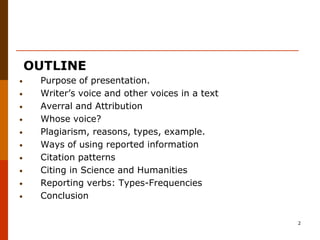
OUTLINE
•    Purpose of presentation.
•    Writer’s voice and other voices in a text
•    Averral and Attribution
•    Whose voice?
•    Plagiarism, reasons, types, example.
•    Ways of using reported information
•    Citation patterns
•    Citing in Science and Humanities
•    Reporting verbs: Types-Frequencies
•    Conclusion

                                                 2
Purpose of this presentation
   Awareness raising regarding issues of source reference
   Sensitation to variability in the way of using reference to
    sources depending on discipline.


                                                                  3
. Writer‟s voice and other voices in a text


 Task :Try to answer the questions:
 A. Is an academic written text a monologue or a
  dialogue?
 B. Whose voices are involved in an academic text?
 C. If you do not attribute claim who do imply is the
  source?


                                                         4
Averral-Attribution
 Attribution (Tadros 1993: 98, citing Sinclair 1985) is
  the marked case where the sources of authority are
  clearly signalled.
 Text averall is evidenced in the unmarked parts of the
  text, where the utterances are assumed to be
  attributed to the author.


                                                       5
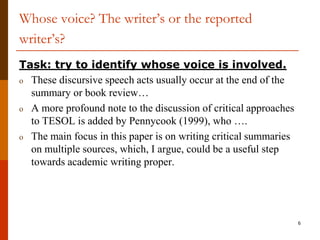
Whose voice? The writer’s or the reported
writer’s?
Task: try to identify whose voice is involved.
o These discursive speech acts usually occur at the end of the
  summary or book review…
o A more profound note to the discussion of critical approaches
  to TESOL is added by Pennycook (1999), who ….
o The main focus in this paper is on writing critical summaries
  on multiple sources, which, I argue, could be a useful step
  towards academic writing proper.


                                                                  6
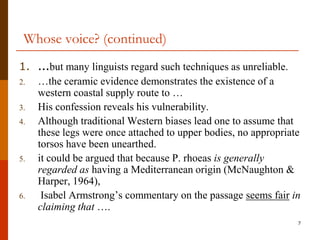
Whose voice? (continued)
1.   …but many linguists regard such techniques as unreliable.
2.   …the ceramic evidence demonstrates the existence of a
     western coastal supply route to …
3.   His confession reveals his vulnerability.
4.   Although traditional Western biases lead one to assume that
     these legs were once attached to upper bodies, no appropriate
     torsos have been unearthed.
5.   it could be argued that because P. rhoeas is generally
     regarded as having a Mediterranean origin (McNaughton &
     Harper, 1964),
6.    Isabel Armstrong‟s commentary on the passage seems fair in
     claiming that ….
                                                                 7
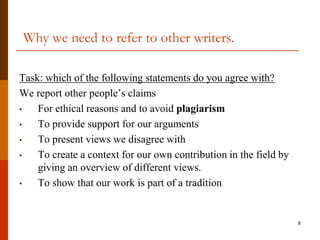
Why we need to refer to other writers.

Task: which of the following statements do you agree with?
We report other people‟s claims
•   For ethical reasons and to avoid plagiarism
•   To provide support for our arguments
•   To present views we disagree with
•   To create a context for our own contribution in the field by
    giving an overview of different views.
•   To show that our work is part of a tradition


                                                                   8
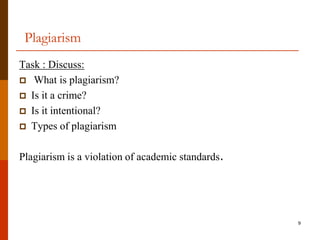
Plagiarism
Task : Discuss:
 What is plagiarism?
 Is it a crime?
 Is it intentional?
 Types of plagiarism


Plagiarism is a violation of academic standards.


                                                   9
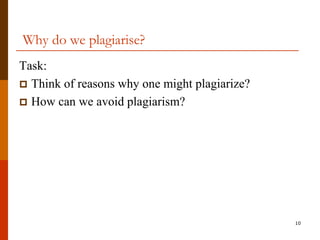
Why do we plagiarise?
Task:
 Think of reasons why one might plagiarize?
 How can we avoid plagiarism?


                                               10
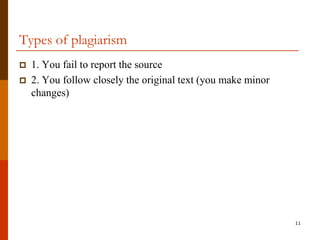
Types of plagiarism
   1. You fail to report the source
   2. You follow closely the original text (you make minor
    changes)


                                                              11
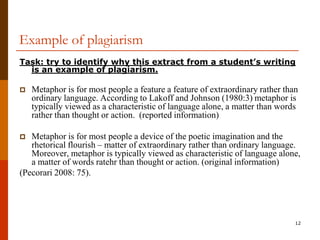
Example of plagiarism
Task: try to identify why this extract from a student’s writing
  is an example of plagiarism.

   Metaphor is for most people a feature a feature of extraordinary rather than
    ordinary language. According to Lakoff and Johnson (1980:3) metaphor is
    typically viewed as a characteristic of language alone, a matter than words
    rather than thought or action. (reported information)

  Metaphor is for most people a device of the poetic imagination and the
   rhetorical flourish – matter of extraordinary rather than ordinary language.
   Moreover, metaphor is typically viewed as characteristic of language alone,
   a matter of words ratehr than thought or action. (original information)
(Pecorari 2008: 75).


                                                                               12
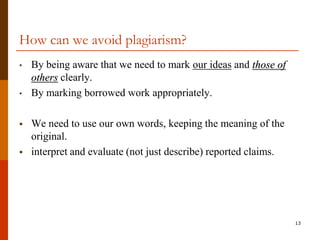
How can we avoid plagiarism?
•   By being aware that we need to mark our ideas and those of
    others clearly.
•   By marking borrowed work appropriately.

   We need to use our own words, keeping the meaning of the
    original.
   interpret and evaluate (not just describe) reported claims.


                                                                  13
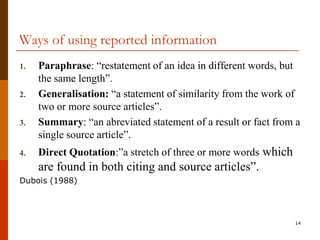
Ways of using reported information
1.   Paraphrase: “restatement of an idea in different words, but
     the same length”.
2.   Generalisation: “a statement of similarity from the work of
     two or more source articles”.
3.   Summary: “an abreviated statement of a result or fact from a
     single source article”.
4.   Direct Quotation:”a stretch of three or more words which
     are found in both citing and source articles”.
Dubois (1988)


                                                                14
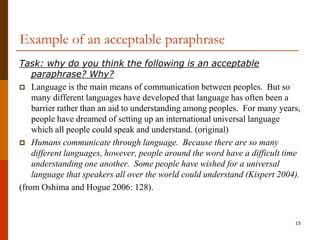
Example of an acceptable paraphrase
Task: why do you think the following is an acceptable
    paraphrase? Why?
 Language is the main means of communication between peoples. But so
    many different languages have developed that language has often been a
    barrier rather than an aid to understanding among peoples. For many years,
    people have dreamed of setting up an international universal language
    which all people could speak and understand. (original)
 Humans communicate through language. Because there are so many
    different languages, however, people around the word have a difficult time
    understanding one another. Some people have wished for a universal
    language that speakers all over the world could understand (Kispert 2004).
(from Oshima and Hogue 2006: 128).


                                                                            15
. Task: can you identify different types of
   reporting in the following:
   Yet, it was reported that the diameter of the Web is 19. [5].
   According to Vygotsky, one of the developmental outcomes of learning
    leading development in the ZPD is that the child becomes able (as does the
    adult) to engage in developmental activity volitionally
   The discourse of lectures has been examined in naturalistic conditions
    (Chaudron 1983, Kelly 1977, McKenna 1987)
    Over the years, many protocols have been designed for maintaining
    synchronization of physical clocks over computer networks [6,14, 21, 27].
   Additionally, relatively high levels of retinoic acid have been reported to be
    present in mature cow and mouse retinas (McCaffery and Drager 1993).


                                                                                16
Quotations
   word level quotes e.g. The two strategies are “splitting” and
    “lumping” (Moon 1987)
   phrase level quotes e.g. Many reports from the late 1980s and
    early 1990s showed that the science education in the United
    States has been “less than adequate” (Buxton, 1998, p. 343),
   sentence level quotes e.g. Edge concluded that "the real test of
    good notes is their usefulness.“
   Whole paragraphs which should be indented and in smaller
    fonts.


                                                                   17
   Task: when you discuss others‟ or own previous work in your
    writing which of the following do you we use more often?
    Paraphrase, Generalisation, Summary, Direct quotation.
   Is direct quotation common in your discipline?


                                                              18
Citation types (Swales 1990)
  Integral: a.With a reporting verb e.g. X reported that …/ The
   quality of…was established by X (2000)/ X‟s theory (2000)
   claims that…
b. Without a reporting verb e.g. X‟s theory (2000) of…has
   general support/ According to X (2000)
 Non-integral: a. With a reporting verb e.g. Previous research
   has shown that …(X 2000)/ It has been shown that…(X
   2000)/It has been reported that …[1-3]
b.Without a reporting verb e.g. It is probably the case that …(X
   2000)/ The …may be made of…[1-3]The ….may be made
   of….(but cf. X2 2003).

   Task: discuss which of those citation types are common in
                                                                   19
    your discipline.
Types of reporting verbs
1.   verbal e.g. state, term, challenge, write
2.   Mental e.g. believe, think, focus on
3.   Research e.g. measure, calculate, obtain.

Thompson and Ye (1994: 130):


                                                 20
   Task: reflect: „West argues that…‟, what other verbs do you
    think you can use to report information in academic writing?


                                                                   21
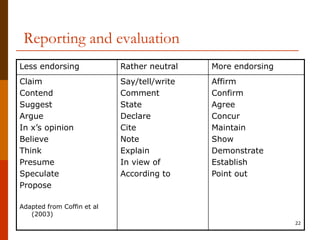
Reporting and evaluation
Less endorsing              Rather neutral   More endorsing
Claim                       Say/tell/write   Affirm
Contend                     Comment          Confirm
Suggest                     State            Agree
Argue                       Declare          Concur
In x’s opinion              Cite             Maintain
Believe                     Note             Show
Think                       Explain          Demonstrate
Presume                     In view of       Establish
Speculate                   According to     Point out
Propose

Adapted from Coffin et al
   (2003)
                                                              22
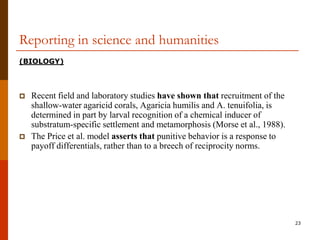
Reporting in science and humanities
(BIOLOGY)


   Recent field and laboratory studies have shown that recruitment of the
    shallow-water agaricid corals, Agaricia humilis and A. tenuifolia, is
    determined in part by larval recognition of a chemical inducer of
    substratum-specific settlement and metamorphosis (Morse et al., 1988).
   The Price et al. model asserts that punitive behavior is a response to
    payoff differentials, rather than to a breech of reciprocity norms.


                                                                             23
24. Engineering
   Recent advances in miniaturization and low-cost, low-power design have
    led to active research in large-scale, highly distributed systems of small,
    wireless, low-power, unattended sensors and actuators [2]. While
    individual sensor nodes have only limited functionality, the global behavior
    of a sensor network can be quite complex. …… There are many examples
    of sensor network tasks that require synchronized time: for example, to
    save energy by forming a sleep and wakeup schedule [3]; create a
    distributed acoustic beam forming platform [15] and integrate a time-series
    of proximity detections into a velocity estimate [4].


                                                                              24
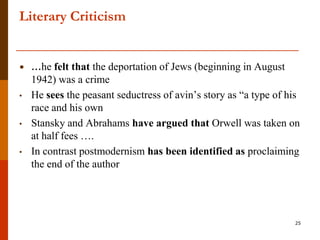
Literary Criticism


•   …he felt that the deportation of Jews (beginning in August
    1942) was a crime
•   He sees the peasant seductress of avin‟s story as “a type of his
    race and his own
•   Stansky and Abrahams have argued that Orwell was taken on
    at half fees ….
•   In contrast postmodernism has been identified as proclaiming
    the end of the author


                                                                  25
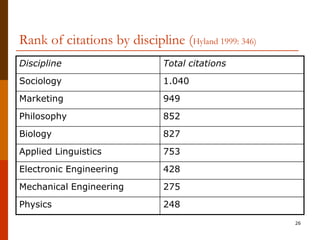
Rank of citations by discipline (Hyland 1999: 346)
Discipline                    Total citations
Sociology                     1.040
Marketing                     949
Philosophy                    852
Biology                       827
Applied Linguistics           753
Electronic Engineering        428
Mechanical Engineering        275
Physics                       248
                                                     26
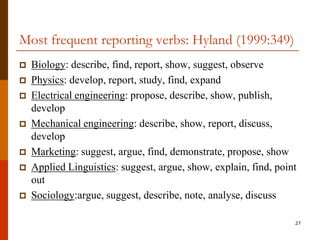
Most frequent reporting verbs: Hyland (1999:349)
   Biology: describe, find, report, show, suggest, observe
   Physics: develop, report, study, find, expand
   Electrical engineering: propose, describe, show, publish,
    develop
   Mechanical engineering: describe, show, report, discuss,
    develop
   Marketing: suggest, argue, find, demonstrate, propose, show
   Applied Linguistics: suggest, argue, show, explain, find, point
    out
   Sociology:argue, suggest, describe, note, analyse, discuss

                                                                  27
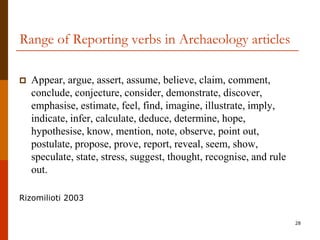
Range of Reporting verbs in Archaeology articles

   Appear, argue, assert, assume, believe, claim, comment,
    conclude, conjecture, consider, demonstrate, discover,
    emphasise, estimate, feel, find, imagine, illustrate, imply,
    indicate, infer, calculate, deduce, determine, hope,
    hypothesise, know, mention, note, observe, point out,
    postulate, propose, prove, report, reveal, seem, show,
    speculate, state, stress, suggest, thought, recognise, and rule
    out.

Rizomilioti 2003


                                                                      28
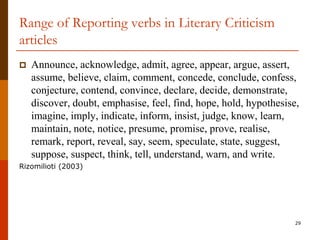
Range of Reporting verbs in Literary Criticism
articles
   Announce, acknowledge, admit, agree, appear, argue, assert,
    assume, believe, claim, comment, concede, conclude, confess,
    conjecture, contend, convince, declare, decide, demonstrate,
    discover, doubt, emphasise, feel, find, hope, hold, hypothesise,
    imagine, imply, indicate, inform, insist, judge, know, learn,
    maintain, note, notice, presume, promise, prove, realise,
    remark, report, reveal, say, seem, speculate, state, suggest,
    suppose, suspect, think, tell, understand, warn, and write.
Rizomilioti (2003)


                                                                   29
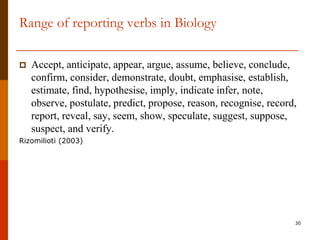
Range of reporting verbs in Biology

   Accept, anticipate, appear, argue, assume, believe, conclude,
    confirm, consider, demonstrate, doubt, emphasise, establish,
    estimate, find, hypothesise, imply, indicate infer, note,
    observe, postulate, predict, propose, reason, recognise, record,
    report, reveal, say, seem, show, speculate, suggest, suppose,
    suspect, and verify.
Rizomilioti (2003)


                                                                   30
Humanities: similarities-differences
   The disciplines belonging with the humanities e.g. Philosophy
    and Literary Criticism, have the majority of integral citations.
    They also have more quotations.
   In science and engineering there is a tendency for non-integral
    and non-subject citation forms.

Rizomilioti (2003)
Hyland (1999)


                                                                   31
Accounting for differences across disciplines
Knowledge is constructed in different ways in different
   disciplinary areas.
In the physical sciences author prominence is reduced and thus
   an impression of objectivity is obtained.
In the humanities personal views are valued and thus the writer
   tends to be given a prominent position in the sentence
   (INTEGRAL CITATIONS).


                                                              32
CONCLUSION
It is important to
1.   Be able to make clear what is one’s own claim or view,
     what belongs to others and evaluate properly reported
     information.
2.   Acknowledge properly borrowed information exploring what
     conventions exist in our discipline and genre (e.g. research
     article).


                                                                33
REFERENCES
Coffin C., Curry M. J., Goodman S., Hewings A, Lillis T. and Swann J. (2003).
   Teaching academic writing: A toolkit for higher education. London: Routledge.
Dubois B.L. (1988). Citation in Biomedical Journal Articles. English for Specific
   purposes, 7, 181-193.
Hyland K. (1999). Academic Attribution: Citation and the construction of disciplinary
   knowledge. Applied Linguistics 20, 3, 341-367.
Oshima A and Hogue A. (2006). Writing Academic English. New York: Pearson,
   Longman.
    Pecorari D. (2008). Academic Writing and Plagiarism. London: Continuum.
Rizomilioti (2003). Epistemic Modality in Academic Writing: A Corpus-linguistic
   approach. Unpublished PhD thesis. University of Birmingham.
Swales J. M. (1990). Genre Analysis: English in Academic and Research Settings,
   Cambridge: Cambridge University Press.
Tadros A. (1993). „The Pragmatics of Text Averral and Attribution in academic texts‟.
   In Hoey M. (ed.) Data, Description, Discourse: Papers on the English language in
   honour of John McH Sinclair. London: Harper Collins.
Thompson G. and Y. Ye (1991) „Evaluation in the Reporting Verbs used in Academic
   papers‟. Applied Linguistics, 12:365-382.
                                                                                   34
HOME STUDY
 Read the Introduction and Discussion sections of two research articles
    from major journals in your field written by native speakers of
    English:
a) If possible try to identify some reporting claims and the way they were
    presented in the original source (article or book). How do the writers alter
    the attributed claims?
b) Do the writers tend to generalise, summarise, quote, or paraphrase?
c) What type of citation do the writers use more often ? Integral or non-
    integral? If integral, what reporting verbs are used? are they of the neutral,
    less or more endorsing type?


.
                                                                                 35

Appropriate use of sources in academic writing

  • 1.
    APPROPRIATE USE OFSOURCES IN ACADEMIC WRITING Vassiliki Rizomilioti Wednesday 7/12/11 1
  • 2.
    OUTLINE • Purpose of presentation. • Writer’s voice and other voices in a text • Averral and Attribution • Whose voice? • Plagiarism, reasons, types, example. • Ways of using reported information • Citation patterns • Citing in Science and Humanities • Reporting verbs: Types-Frequencies • Conclusion 2
  • 3.
    Purpose of thispresentation  Awareness raising regarding issues of source reference  Sensitation to variability in the way of using reference to sources depending on discipline. 3
  • 4.
    . Writer‟s voiceand other voices in a text  Task :Try to answer the questions:  A. Is an academic written text a monologue or a dialogue?  B. Whose voices are involved in an academic text?  C. If you do not attribute claim who do imply is the source? 4
  • 5.
    Averral-Attribution  Attribution (Tadros1993: 98, citing Sinclair 1985) is the marked case where the sources of authority are clearly signalled.  Text averall is evidenced in the unmarked parts of the text, where the utterances are assumed to be attributed to the author. 5
  • 6.
    Whose voice? Thewriter’s or the reported writer’s? Task: try to identify whose voice is involved. o These discursive speech acts usually occur at the end of the summary or book review… o A more profound note to the discussion of critical approaches to TESOL is added by Pennycook (1999), who …. o The main focus in this paper is on writing critical summaries on multiple sources, which, I argue, could be a useful step towards academic writing proper. 6
  • 7.
    Whose voice? (continued) 1. …but many linguists regard such techniques as unreliable. 2. …the ceramic evidence demonstrates the existence of a western coastal supply route to … 3. His confession reveals his vulnerability. 4. Although traditional Western biases lead one to assume that these legs were once attached to upper bodies, no appropriate torsos have been unearthed. 5. it could be argued that because P. rhoeas is generally regarded as having a Mediterranean origin (McNaughton & Harper, 1964), 6. Isabel Armstrong‟s commentary on the passage seems fair in claiming that …. 7
  • 8.
    Why we needto refer to other writers. Task: which of the following statements do you agree with? We report other people‟s claims • For ethical reasons and to avoid plagiarism • To provide support for our arguments • To present views we disagree with • To create a context for our own contribution in the field by giving an overview of different views. • To show that our work is part of a tradition 8
  • 9.
    Plagiarism Task : Discuss: What is plagiarism?  Is it a crime?  Is it intentional?  Types of plagiarism Plagiarism is a violation of academic standards. 9
  • 10.
    Why do weplagiarise? Task:  Think of reasons why one might plagiarize?  How can we avoid plagiarism? 10
  • 11.
    Types of plagiarism  1. You fail to report the source  2. You follow closely the original text (you make minor changes) 11
  • 12.
    Example of plagiarism Task:try to identify why this extract from a student’s writing is an example of plagiarism.  Metaphor is for most people a feature a feature of extraordinary rather than ordinary language. According to Lakoff and Johnson (1980:3) metaphor is typically viewed as a characteristic of language alone, a matter than words rather than thought or action. (reported information)  Metaphor is for most people a device of the poetic imagination and the rhetorical flourish – matter of extraordinary rather than ordinary language. Moreover, metaphor is typically viewed as characteristic of language alone, a matter of words ratehr than thought or action. (original information) (Pecorari 2008: 75). 12
  • 13.
    How can weavoid plagiarism? • By being aware that we need to mark our ideas and those of others clearly. • By marking borrowed work appropriately.  We need to use our own words, keeping the meaning of the original.  interpret and evaluate (not just describe) reported claims. 13
  • 14.
    Ways of usingreported information 1. Paraphrase: “restatement of an idea in different words, but the same length”. 2. Generalisation: “a statement of similarity from the work of two or more source articles”. 3. Summary: “an abreviated statement of a result or fact from a single source article”. 4. Direct Quotation:”a stretch of three or more words which are found in both citing and source articles”. Dubois (1988) 14
  • 15.
    Example of anacceptable paraphrase Task: why do you think the following is an acceptable paraphrase? Why?  Language is the main means of communication between peoples. But so many different languages have developed that language has often been a barrier rather than an aid to understanding among peoples. For many years, people have dreamed of setting up an international universal language which all people could speak and understand. (original)  Humans communicate through language. Because there are so many different languages, however, people around the word have a difficult time understanding one another. Some people have wished for a universal language that speakers all over the world could understand (Kispert 2004). (from Oshima and Hogue 2006: 128). 15
  • 16.
    . Task: canyou identify different types of reporting in the following:  Yet, it was reported that the diameter of the Web is 19. [5].  According to Vygotsky, one of the developmental outcomes of learning leading development in the ZPD is that the child becomes able (as does the adult) to engage in developmental activity volitionally  The discourse of lectures has been examined in naturalistic conditions (Chaudron 1983, Kelly 1977, McKenna 1987)  Over the years, many protocols have been designed for maintaining synchronization of physical clocks over computer networks [6,14, 21, 27].  Additionally, relatively high levels of retinoic acid have been reported to be present in mature cow and mouse retinas (McCaffery and Drager 1993). 16
  • 17.
    Quotations  word level quotes e.g. The two strategies are “splitting” and “lumping” (Moon 1987)  phrase level quotes e.g. Many reports from the late 1980s and early 1990s showed that the science education in the United States has been “less than adequate” (Buxton, 1998, p. 343),  sentence level quotes e.g. Edge concluded that "the real test of good notes is their usefulness.“  Whole paragraphs which should be indented and in smaller fonts. 17
  • 18.
    Task: when you discuss others‟ or own previous work in your writing which of the following do you we use more often? Paraphrase, Generalisation, Summary, Direct quotation.  Is direct quotation common in your discipline? 18
  • 19.
    Citation types (Swales1990)  Integral: a.With a reporting verb e.g. X reported that …/ The quality of…was established by X (2000)/ X‟s theory (2000) claims that… b. Without a reporting verb e.g. X‟s theory (2000) of…has general support/ According to X (2000)  Non-integral: a. With a reporting verb e.g. Previous research has shown that …(X 2000)/ It has been shown that…(X 2000)/It has been reported that …[1-3] b.Without a reporting verb e.g. It is probably the case that …(X 2000)/ The …may be made of…[1-3]The ….may be made of….(but cf. X2 2003).  Task: discuss which of those citation types are common in 19 your discipline.
  • 20.
    Types of reportingverbs 1. verbal e.g. state, term, challenge, write 2. Mental e.g. believe, think, focus on 3. Research e.g. measure, calculate, obtain. Thompson and Ye (1994: 130): 20
  • 21.
    Task: reflect: „West argues that…‟, what other verbs do you think you can use to report information in academic writing? 21
  • 22.
    Reporting and evaluation Lessendorsing Rather neutral More endorsing Claim Say/tell/write Affirm Contend Comment Confirm Suggest State Agree Argue Declare Concur In x’s opinion Cite Maintain Believe Note Show Think Explain Demonstrate Presume In view of Establish Speculate According to Point out Propose Adapted from Coffin et al (2003) 22
  • 23.
    Reporting in scienceand humanities (BIOLOGY)  Recent field and laboratory studies have shown that recruitment of the shallow-water agaricid corals, Agaricia humilis and A. tenuifolia, is determined in part by larval recognition of a chemical inducer of substratum-specific settlement and metamorphosis (Morse et al., 1988).  The Price et al. model asserts that punitive behavior is a response to payoff differentials, rather than to a breech of reciprocity norms. 23
  • 24.
    24. Engineering  Recent advances in miniaturization and low-cost, low-power design have led to active research in large-scale, highly distributed systems of small, wireless, low-power, unattended sensors and actuators [2]. While individual sensor nodes have only limited functionality, the global behavior of a sensor network can be quite complex. …… There are many examples of sensor network tasks that require synchronized time: for example, to save energy by forming a sleep and wakeup schedule [3]; create a distributed acoustic beam forming platform [15] and integrate a time-series of proximity detections into a velocity estimate [4]. 24
  • 25.
    Literary Criticism • …he felt that the deportation of Jews (beginning in August 1942) was a crime • He sees the peasant seductress of avin‟s story as “a type of his race and his own • Stansky and Abrahams have argued that Orwell was taken on at half fees …. • In contrast postmodernism has been identified as proclaiming the end of the author 25
  • 26.
    Rank of citationsby discipline (Hyland 1999: 346) Discipline Total citations Sociology 1.040 Marketing 949 Philosophy 852 Biology 827 Applied Linguistics 753 Electronic Engineering 428 Mechanical Engineering 275 Physics 248 26
  • 27.
    Most frequent reportingverbs: Hyland (1999:349)  Biology: describe, find, report, show, suggest, observe  Physics: develop, report, study, find, expand  Electrical engineering: propose, describe, show, publish, develop  Mechanical engineering: describe, show, report, discuss, develop  Marketing: suggest, argue, find, demonstrate, propose, show  Applied Linguistics: suggest, argue, show, explain, find, point out  Sociology:argue, suggest, describe, note, analyse, discuss 27
  • 28.
    Range of Reportingverbs in Archaeology articles  Appear, argue, assert, assume, believe, claim, comment, conclude, conjecture, consider, demonstrate, discover, emphasise, estimate, feel, find, imagine, illustrate, imply, indicate, infer, calculate, deduce, determine, hope, hypothesise, know, mention, note, observe, point out, postulate, propose, prove, report, reveal, seem, show, speculate, state, stress, suggest, thought, recognise, and rule out. Rizomilioti 2003 28
  • 29.
    Range of Reportingverbs in Literary Criticism articles  Announce, acknowledge, admit, agree, appear, argue, assert, assume, believe, claim, comment, concede, conclude, confess, conjecture, contend, convince, declare, decide, demonstrate, discover, doubt, emphasise, feel, find, hope, hold, hypothesise, imagine, imply, indicate, inform, insist, judge, know, learn, maintain, note, notice, presume, promise, prove, realise, remark, report, reveal, say, seem, speculate, state, suggest, suppose, suspect, think, tell, understand, warn, and write. Rizomilioti (2003) 29
  • 30.
    Range of reportingverbs in Biology  Accept, anticipate, appear, argue, assume, believe, conclude, confirm, consider, demonstrate, doubt, emphasise, establish, estimate, find, hypothesise, imply, indicate infer, note, observe, postulate, predict, propose, reason, recognise, record, report, reveal, say, seem, show, speculate, suggest, suppose, suspect, and verify. Rizomilioti (2003) 30
  • 31.
    Humanities: similarities-differences  The disciplines belonging with the humanities e.g. Philosophy and Literary Criticism, have the majority of integral citations. They also have more quotations.  In science and engineering there is a tendency for non-integral and non-subject citation forms. Rizomilioti (2003) Hyland (1999) 31
  • 32.
    Accounting for differencesacross disciplines Knowledge is constructed in different ways in different disciplinary areas. In the physical sciences author prominence is reduced and thus an impression of objectivity is obtained. In the humanities personal views are valued and thus the writer tends to be given a prominent position in the sentence (INTEGRAL CITATIONS). 32
  • 33.
    CONCLUSION It is importantto 1. Be able to make clear what is one’s own claim or view, what belongs to others and evaluate properly reported information. 2. Acknowledge properly borrowed information exploring what conventions exist in our discipline and genre (e.g. research article). 33
  • 34.
    REFERENCES Coffin C., CurryM. J., Goodman S., Hewings A, Lillis T. and Swann J. (2003). Teaching academic writing: A toolkit for higher education. London: Routledge. Dubois B.L. (1988). Citation in Biomedical Journal Articles. English for Specific purposes, 7, 181-193. Hyland K. (1999). Academic Attribution: Citation and the construction of disciplinary knowledge. Applied Linguistics 20, 3, 341-367. Oshima A and Hogue A. (2006). Writing Academic English. New York: Pearson, Longman. Pecorari D. (2008). Academic Writing and Plagiarism. London: Continuum. Rizomilioti (2003). Epistemic Modality in Academic Writing: A Corpus-linguistic approach. Unpublished PhD thesis. University of Birmingham. Swales J. M. (1990). Genre Analysis: English in Academic and Research Settings, Cambridge: Cambridge University Press. Tadros A. (1993). „The Pragmatics of Text Averral and Attribution in academic texts‟. In Hoey M. (ed.) Data, Description, Discourse: Papers on the English language in honour of John McH Sinclair. London: Harper Collins. Thompson G. and Y. Ye (1991) „Evaluation in the Reporting Verbs used in Academic papers‟. Applied Linguistics, 12:365-382. 34
  • 35.
    HOME STUDY Readthe Introduction and Discussion sections of two research articles from major journals in your field written by native speakers of English: a) If possible try to identify some reporting claims and the way they were presented in the original source (article or book). How do the writers alter the attributed claims? b) Do the writers tend to generalise, summarise, quote, or paraphrase? c) What type of citation do the writers use more often ? Integral or non- integral? If integral, what reporting verbs are used? are they of the neutral, less or more endorsing type? . 35