STARTING YOUR
                       RESEARCH PAPER
                                                 11/15/12


                                                                      http://viewpure.com/X-cUbUKYPOI
“GCA: Working topro   vide an exemplary individualized and engaging
 educational experience f or all students “
TODAY WE WILL LOOK AT:

• Review of Thesis
• Sources: What are they? How do we find them?
• What is an analysis?

• CCGPS covered:
  •   ELACC9-10RI1
  •   ELACC9-10RI2
  •   ELACC9-10RI5
  •   ELACC9-10W1
  •   ELACC9-10W5
  •   ELACC9-10W7
  •   ELACC9-10W8
  •   ELACC9-10W9
REVIEWING THESIS

• What is a thesis
  statement?

 • The thesis is a
   statement
 • It is the overarching
   focus of your paper
 • It is arguable

 http://viewpure.com/Wura5m8mStk
HOW DO YOU FORM A THESIS?

             • Topic + Opinion =
               Thesis
              • Start with your topic
              • Add your opinion
                about something to
                do with that topic
              • It needs to be
                arguable and
                provable!
EXAMPLE:

• Topic: The authorship of Shakespeare’s plays.
• Opinion: Shakespeare was not the author of his
  plays.


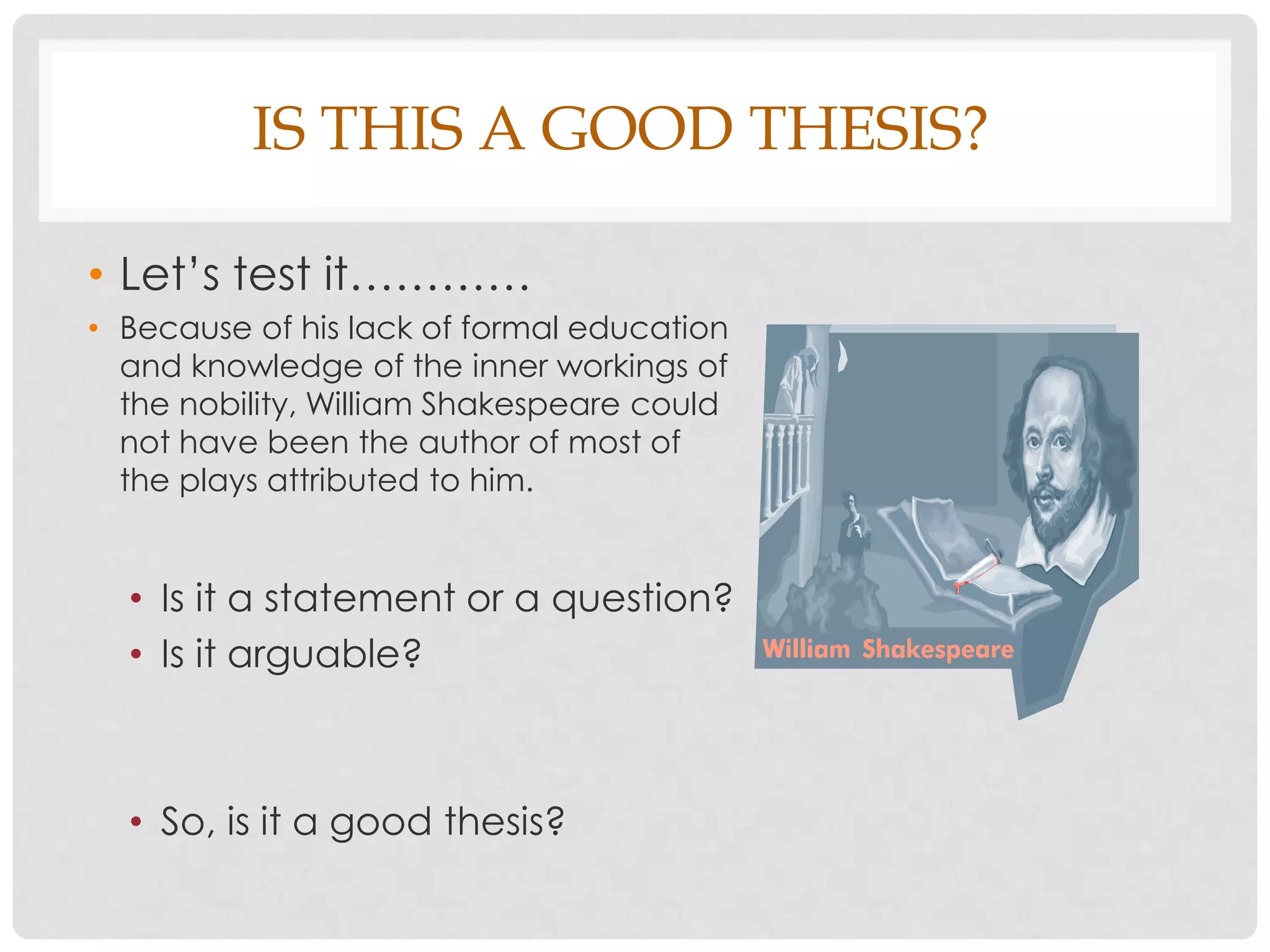
• Thesis: Because of his lack of formal education and
  knowledge of the inner workings of the
  nobility, William Shakespeare could not have been
  the author of most of the plays attributed to him.
IS THIS A GOOD THESIS?

• Let’s test it…………
• Because of his lack of formal education
  and knowledge of the inner workings of
  the nobility, William Shakespeare could
  not have been the author of most of
  the plays attributed to him.


  • Is it a statement or a question?
  • Is it arguable?


  • So, is it a good thesis?
HOW DID I FORM MY OPINION?

• RESEARCH!!
 • I knew what my opinion was because I looked up different
   books and non-print sources about it.

 • Some of what I could use are:
   • encyclopedia entries on authors, their works, or the time period during
     which the authors lived
   • biographies of authors
   • books about the history of British literature
   • books about British history
   • works of literary criticism, including articles or books
   • websites about your author or British history
   • online databases that contain articles about your author or British
     history
HOW MANY SOURCES DO I NEED?

• Not every paper
  needs to include
  every type of
  source.

• Remember that you
  need at least three
  sources.
WHAT KIND OF SOURCES ARE THERE?

                                  • Primary Sources
                                  • A primary source is one
                                  that was created during the
                                  historic period you are
                                  researching. An example of
                                  a primary source for your
                                  research paper would be a
                                  letter written by the author
                                  you are studying.

http://viewpure.com/xIdm6RguzRM
ALSO:

• Secondary Sources
• A secondary source is one
that was created after the
time about which you are
writing. For your research
paper, a recent critical
article or a biography of the
author would be a
secondary source.
FACTUAL AND ANALYTICAL
              INFORMATION

            Factual                          Analytical
• You know the difference           • Analytical information is
between fact and opinion. A         more than just
fact can be proved, but an          opinion, though. It is an
opinion can't. Similarly, factual   interpretation of the
information can be                  facts, derived from evidence.
proved, and analytical              An opinion doesn't always give
information can't.                  solid reasons. An analysis
                                    does.
SOMETIMES YOU CAN RECOGNIZE ANALYTICAL INFORMATION FROM THE
       WAY IT IS INTRODUCED. KEY WORDS AND PHRASES ARE:


• "The writer suggests"
• "It seems as if"
• "Perhaps the author"
IN YOUR RESEARCH, YOU WILL FIND AND USE
    FACTUAL AND ANALYTICAL INFORMATION.


• In your paper, you will include your own analysis of
literature, with facts to support the analysis. When citing
analytical information in your research paper, be sure to identify
the author who originally wrote the analysis.
RELIABILITY OF WEBSITES

• Some websites contain reliable information and others don't. The
search engine results alone can give you a few clues to how reliable
a website is, including:


• the title of the website

• the URL of the website

• a couple of lines from the website's text, including your keywords

• However, you need to open the website and examine its contents to be sure it's reliable.


• http://viewpure.com/dKVL1ehDQB0
DOMAIN SUFFIXES
• How can a website's URL help you figure out whether the site is
reliable? Look at the domain name suffix. The small group of letters than
follows the dot, such as .com, .org, .edu, or .gov. These suffixes give clues
to the reliability of a website:
• .com is for companies or individuals. The reliability of these sites varies greatly.
• .org is for organizations, such as charities or political parties. Such groups may
  offer a great deal of information, but the organizations may have biases.
• .edu is for schools and universities. Sites written by professors are usually
  reliable, but students' pages are less so.
• .gov refers to government websites. Such websites are usually reliable but
  probably not useful for your topic.
SOURCE QUALITY
• When you find a print source, such as a book about an
author, look for clues that an expert wrote it. The clues include
the following:
• The author is a scholar, such as a college professor or an
experienced biographer. Look in the About the Author note at
the end of the book or on the back flap of the dust jacket.
• The source contains detailed interpretation, not just facts or
personal opinions.
ALSO…


• There is an index that includes many detailed topics.
• There are bibliographical notes and perhaps footnotes.
• Indexes and notes show that the author has done a thorough
job and that he or she expects other experts in the field to read
the book.
SITES NOT TO USE
• Wikis: A wiki is a site that any reader can write for or edit. The most well-
known wiki is Wikipedia, the online encyclopedia. Because anyone can
contribute or change information, Wikipedia's articles are not as authoritative
as those in standard encyclopedias.
• E-rooms, chat forums, and blogs: In all kinds of fields, including
literature, groups and individuals discuss their favorite topics. These sites can
be exciting to read and contribute to. However, these sites may not be
created by experts, so they aren't good sources for research papers.
• Essay sales sites: Some companies sell research papers to students. Their
URLs may show up on your search results. Buying another person's paper and
presenting it as your own is cheating. In addition, the content of such papers
is not reliable or expert.
YOU HAVE FOUND YOUR SOURCES.
               NOW WHAT?
• When you locate a source of
information, you want to make
sure that you can find it again.
• You'll need to refer to that
source often as you plan and
write.
• In addition, you will have to
put the source information in
the Works Cited section at the
end of your paper.
SO WHAT DO I DO WITH WHAT I’VE
              FOUND?
• When you locate a source of information, you want to make
sure that you can find it again. You'll need to refer to that source
often as you plan and write. In addition, you will have to put the
source information in the Works Cited section at the end of your
paper.


• You need to write down the source information in an
  organized way.
• File transfer research paper organizer form & notecard information/forms
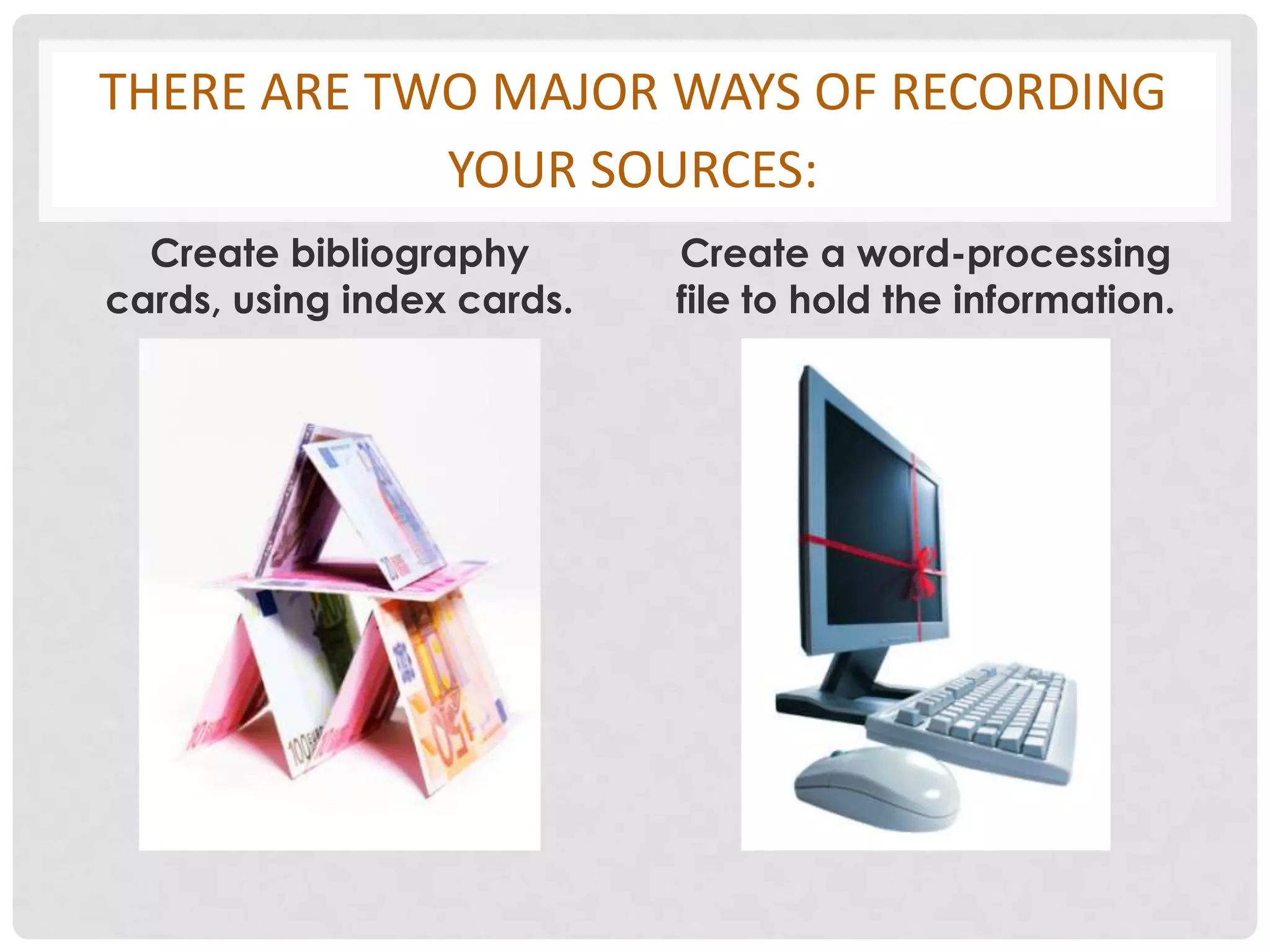
THERE ARE TWO MAJOR WAYS OF RECORDING
            YOUR SOURCES:
  Create bibliography       Create a word-processing
cards, using index cards.   file to hold the information.
BIBLIOGRAPHY CARDS

• Index cards are among the most handy research tools ever
invented. Here's the how-to of recording your sources'
bibliographic information on index cards:
• Make a separate card for each source.
• Give each source a tracking number.
• For a book, include the author, title, publisher, and publication date.
• For a periodical, also include the page numbers of the article.
• For a website, include the title, the sponsors and authors or editors if
  known, the date the site was created or updated, and the date you
  accessed the site.
BIBLIOGRAPHY CARDS


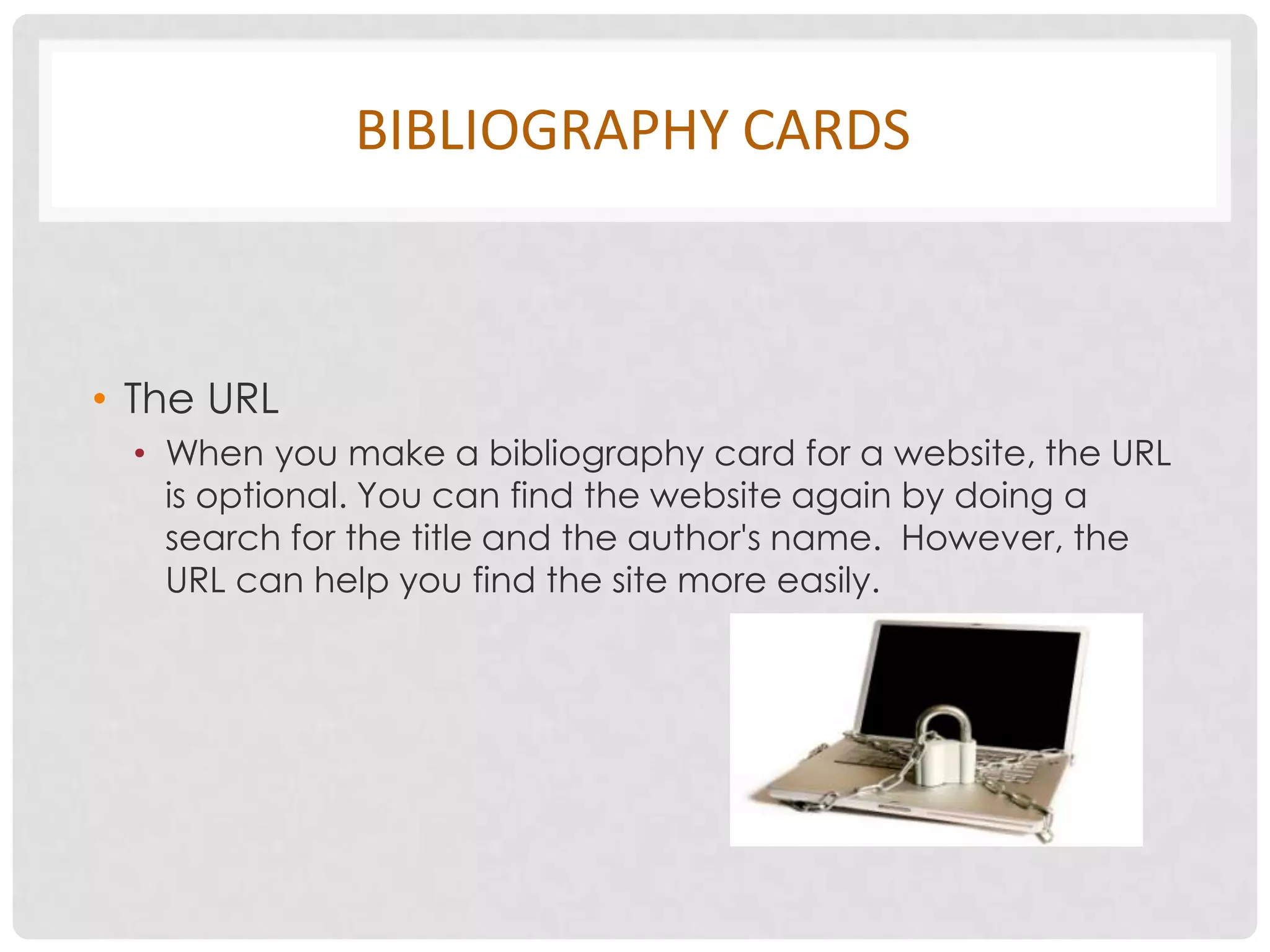
• The URL
 • When you make a bibliography card for a website, the URL
   is optional. You can find the website again by doing a
   search for the title and the author's name. However, the
   URL can help you find the site more easily.
ELECTRONIC FILES

• The same
  information would
  be included in your
  electronic files.

• Be sure to name
  files so that you can
  find them!
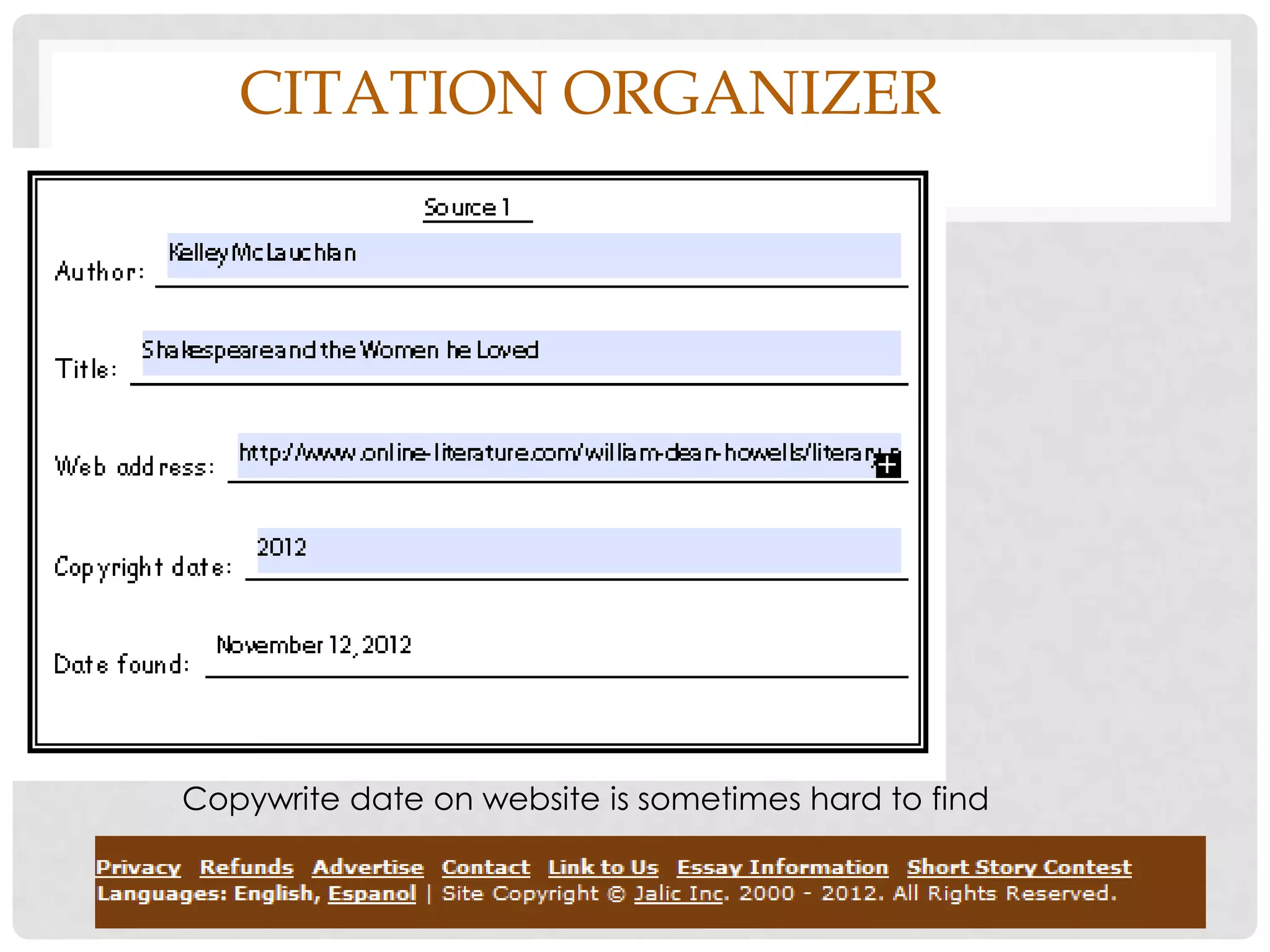
CITATION ORGANIZER

• coc


   Copywrite date on website is sometimes hard to find
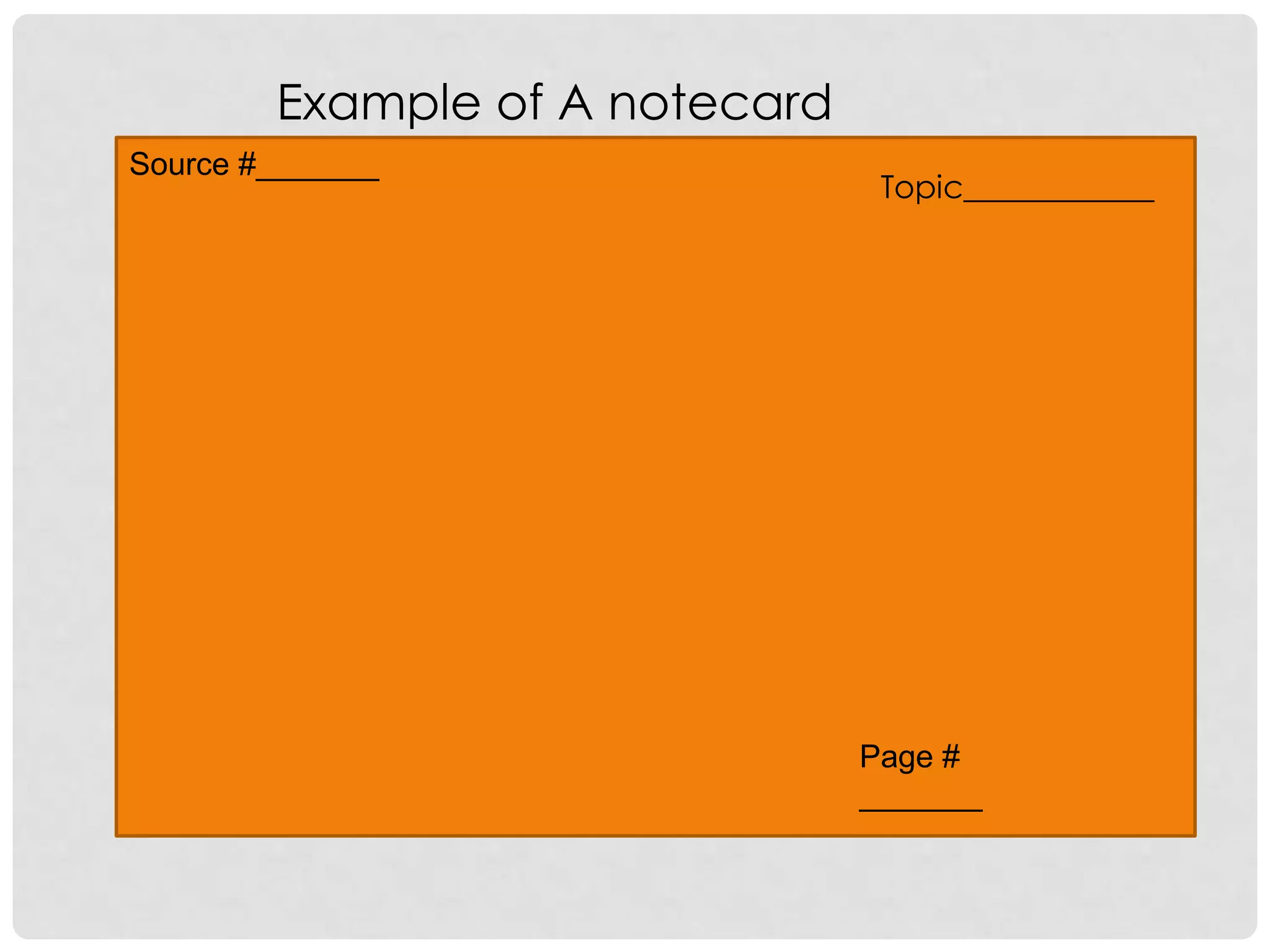
Example of A notecard
Source #_______
                                 Topic____________


                                Page #
                                _______
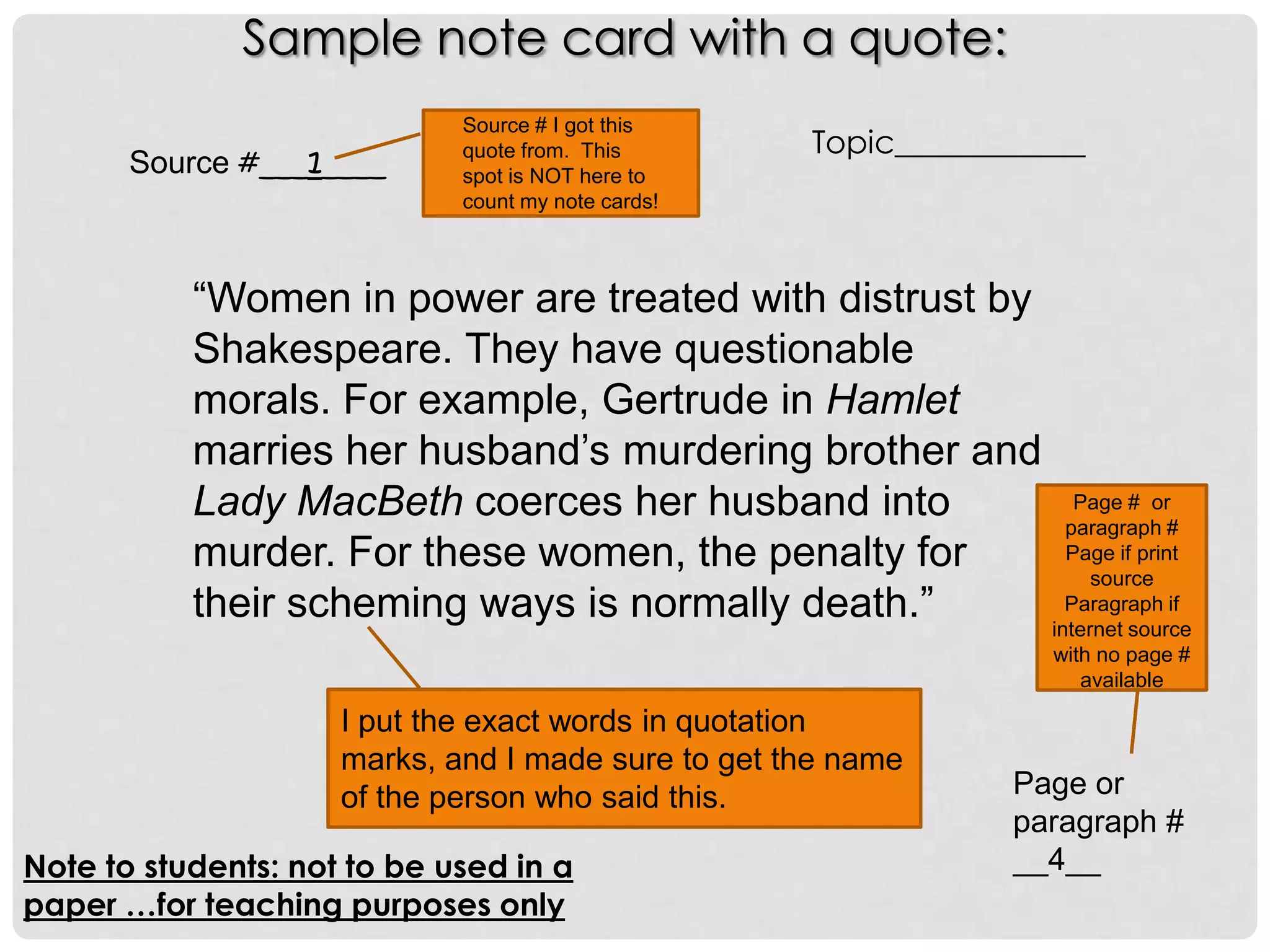
Sample note card with a quote:
                             Source # I got this
                                                    Topic____________
       Source #___1____      quote from. This
                             spot is NOT here to
                             count my note cards!


           “Women in power are treated with distrust by
           Shakespeare. They have questionable
           morals. For example, Gertrude in Hamlet
           marries her husband’s murdering brother and
           Lady MacBeth coerces her husband into           Page # or
                                                          paragraph #
           murder. For these women, the penalty for       Page if print
                                                             source
           their scheming ways is normally death.”        Paragraph if
                                                        internet source
                                                                   with no page #
                                                                      available

                     I put the exact words in quotation
                     marks, and I made sure to get the name
                     of the person who said this.               Page or
                                                                paragraph #
Note to students: not to be used in a                           __4__
paper …for teaching purposes only
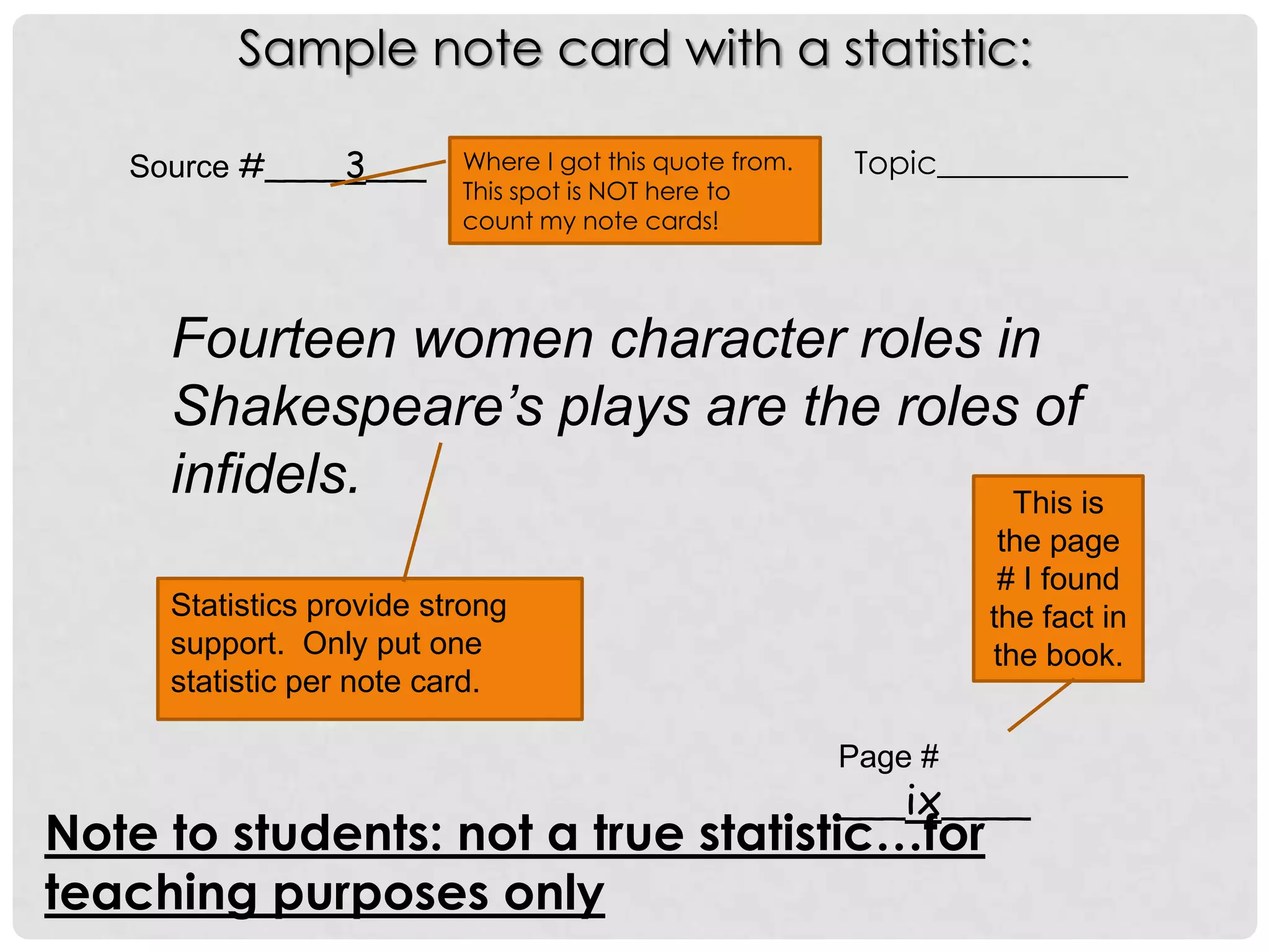
Sample note card with a statistic:

   Source #____3___       Where I got this quote from.   Topic____________
                          This spot is NOT here to
                          count my note cards!


     Fourteen women character roles in
     Shakespeare’s plays are the roles of
     infidels.                        This is
                                                                   the page
                                                                   # I found
     Statistics provide strong                                    the fact in
     support. Only put one                                        the book.
     statistic per note card.

                                                         Page #
                                                         ___ix____
Note to students: not a true statistic…for
teaching purposes only
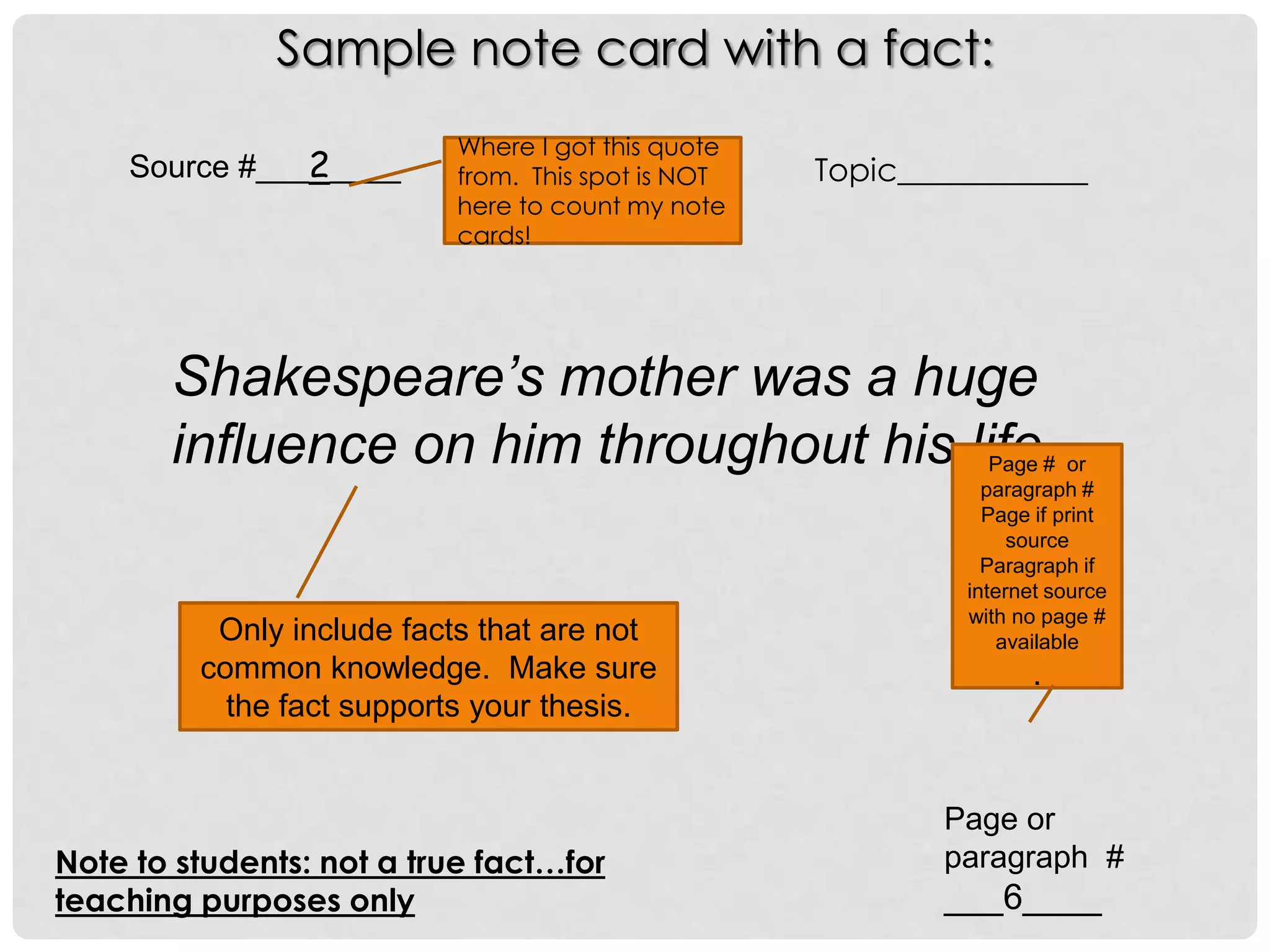
Sample note card with a fact:
                           Where I got this quote
    Source #___2____       from. This spot is NOT   Topic____________
                           here to count my note
                           cards!


       Shakespeare’s mother was a huge
       influence on him throughout his life..
                                        No page                 Page # or
                                                               paragraph #
                                                               Page# print
                                                                     if
                                                                  source
                                                              because
                                                               Paragraph if
                                                                it is an
                                                             internet source
                                                             with no page #
                                                               Internet
          Only include facts that are not                        available
         common knowledge. Make sure                           source
                                                                  .
           the fact supports your thesis.


                                                            Page or
Note to students: not a true fact…for                       paragraph #
teaching purposes only                                      ___6____
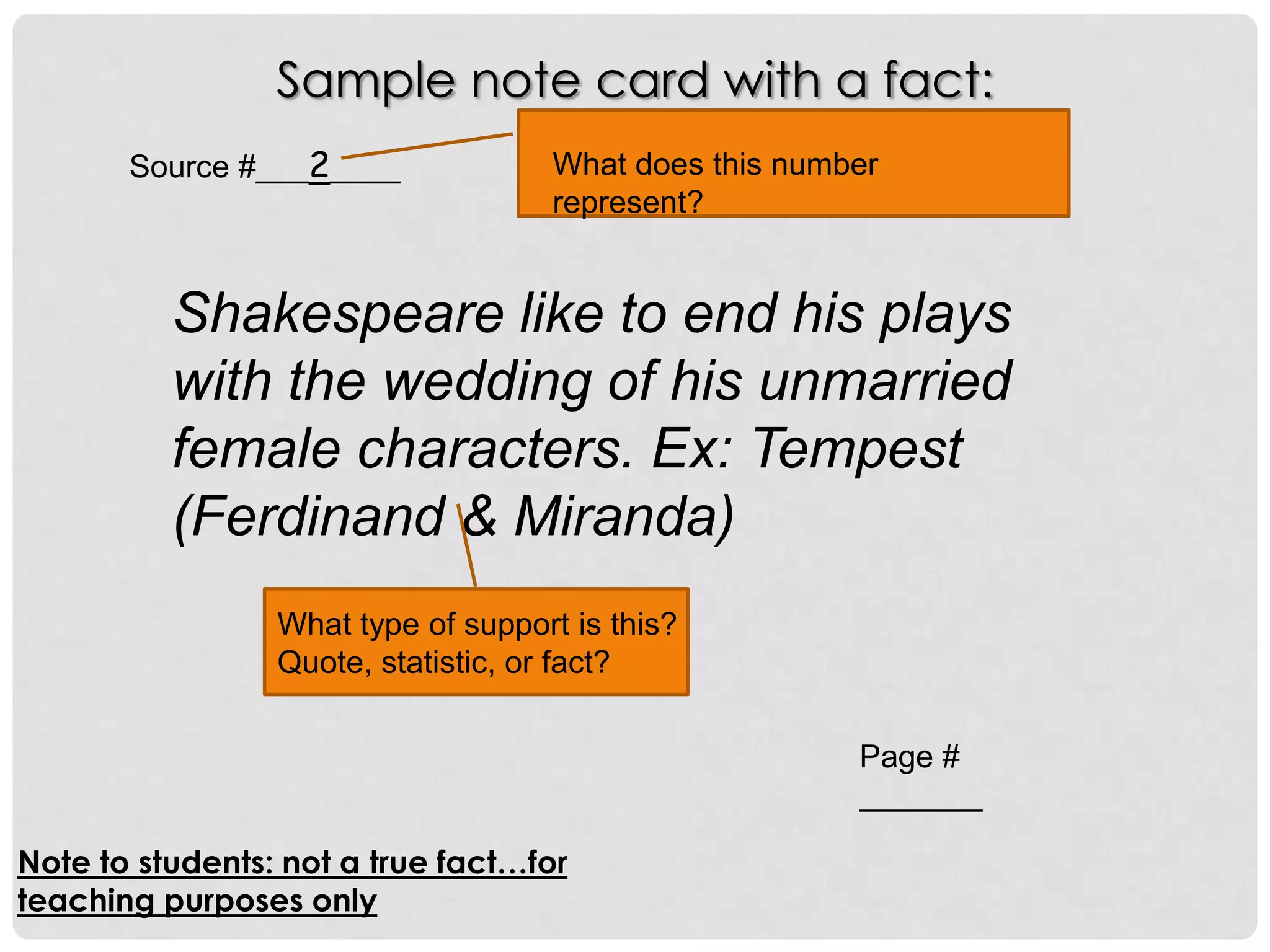
Sample note card with a fact:
       Source #___2____             What does this number
                                    represent?


          Shakespeare like to end his plays
          with the wedding of his unmarried
          female characters. Ex: Tempest
          (Ferdinand & Miranda)
                 What type of support is this?
                 Quote, statistic, or fact?

                                                       Page #
                                                       _______

Note to students: not a true fact…for
teaching purposes only
WHAT IS LITERARY CRITICISM?

• Literary criticism is writing that analyzes literature. In
literature, criticism doesn't mean saying that a work is bad. It
means explaining the meaning of the work.
WHO WRITES LITERARY CRITICISM?

• Literary criticism is usually written by experts, especially
professors of literature.
• To do research for your paper, you'll read literary criticism to
absorb scholars' ideas about the topic you have chosen. By
thinking about scholars' ideas, you'll understand your topic
better.
TRAITS OF LITERARY CRITICISM

• Literary criticism focuses on the elements in a work of
literature, such as
characters, setting, style, imagery, themes, and symbols.
• Literary criticism offers analysis and interpretation, not
opinion.
• Literary criticism may examine both the flaws and the
strengths of the literary work.
WHAT LITERARY CRITICISM IS NOT

• The following are not acceptable sources of literary criticism:


• papers by other students
• Internet sites that sell papers
• summaries or synopses of literary works
• blogs
• fan sites
• discussion rooms
FINDING LITERARY CRITICISM

• The place to begin looking for literary criticism is the library. Use
the librarian as a resource. Tell the librarian that you need to find
literary criticism on your research paper's topic.
• Use the catalog, too. Try a subject search rather than a search for
the title or the author. This kind of search will show you what
materials the library owns about Wordsworth, not just works by
him.
• To do a subject search about an author, use the author's name as
your keyword. For example, perform a subject search for
"Wordsworth" to see what kind of results you get.
LITERARY CRITICISM IN JOURNALS
• Literary criticism comes in article form as well as in book form.
Professors publish articles in journals of literary criticism. Your
library might not have literary journals, but you can find articles
from them online.
• To begin an Internet search for literary criticism, try the
website LiteraryHistory.com.
• It is a site created by a librarian to direct researchers to other
websites that contain criticism on a wide array of authors.
EVALUATING SOURCES


• The titles and subtitles of works of literary criticism often help you
decide how relevant they are to your paper.
• For example, an article titled "Wordsworth and the French
Revolution" would not have been relevant to the topic that the writer
of the Model Research Paper in the LMS chose. Her paper was about
the Industrial Revolution, not the French one.
CRITICAL ARTICLES

• Critical articles sometimes begin with brief summaries called
abstracts. The abstract tells you the article's main points. That
information can help you give an article a "Yes" or "No" as to
whether you should read it.
• Often, however, you have to read at least part of the article to
know whether it is relevant for you.
INTERPRETATIONS
• Remember that a work of literary criticism gives one person's
interpretation.
• Different people interpret things differently. If you find two
different articles about the same literary text, they may disagree
with each other. That's okay.
• Your job is to decide what you think about the literary text. Use
literary criticism to support your ideas, not to replace your own
thinking.
WHAT SHOULD I BE DOING NOW?

• Check the WCA and
  Doc Sharing for all
  assignments and        • Have a wonderful
  instructions.            break!
• Contact me with any
  questions!
• Keep up to date with
  assignments.
• Use the break to
  catch up if needed.
• Note: if you want a little more direction on thesis
  statements…stay.. I have more information on this
  presentation……
YOUR TOPIC/QUESTION IS TOO BROAD

• Topic: Compare and                • Your question is
  contrast class structure in the     broad, because you ask
  society of Shakespeare’s            about your topic in a
  time, and the times of Hamlet       general way. To make it the
                                      right size for a paper of 2-3
• In what ways did                    pages, I suggest you choose
  Shakespeare’s works contrast        a more narrowed aspect of
  class structure in the society      your topic.
  of his time?                      • Pose a question that requires
                                      a critical analysis of specific
                                      elements of the works and
• Topic: Class structure in           that connects them to their
  Shakespeare’s time---How            times.
  Shakespeare highlighted in        • Remember the paper only
  his plays                           has to be 2-3 pages with the
                                      4 page a works cited page.
• Opinion:                            Choose 3 items to focus on
                                      and find evidence in the
• Arguable points:                    book to support your claims.
BOOKS ARE WRITTEN ON THIS TOPIC
• I want you to narrow down how Shakespeare used class structure in society (research what that
  is), in his plays.

•    For example... Love and relationships.... in Hamlet, Ophelia had a love for Hamlet, but because
    they were in different "classes", that love would never work out (put aside all of the other issues
    going on in the story ) Remember the conversations between Polonius, Laertes, and Ophelia

• .....We also find out near the end that Hamlet, did indeed have feelings for Ophleia (remember
  the scene at the cemetery between Laertes and Hamlet)

• So, you would discuss how class structure in Shakespeare's time affected love and
  relationships, (use research and references to back up your claim that it did indeed affect
  relationships), and then you would use the situation between Hamlet and Ophelia... take quotes
  and lines from the play to highlight your point with evidence to show how Shakespeare used this
  issue of class structure in his plays.

• other areas you can look at are:
      • Family life
      • Occupations
      • Education
      • Marriage and children
      • Daily
• You can research background on different Shakespeare plays to see if they point these out and
  you can use
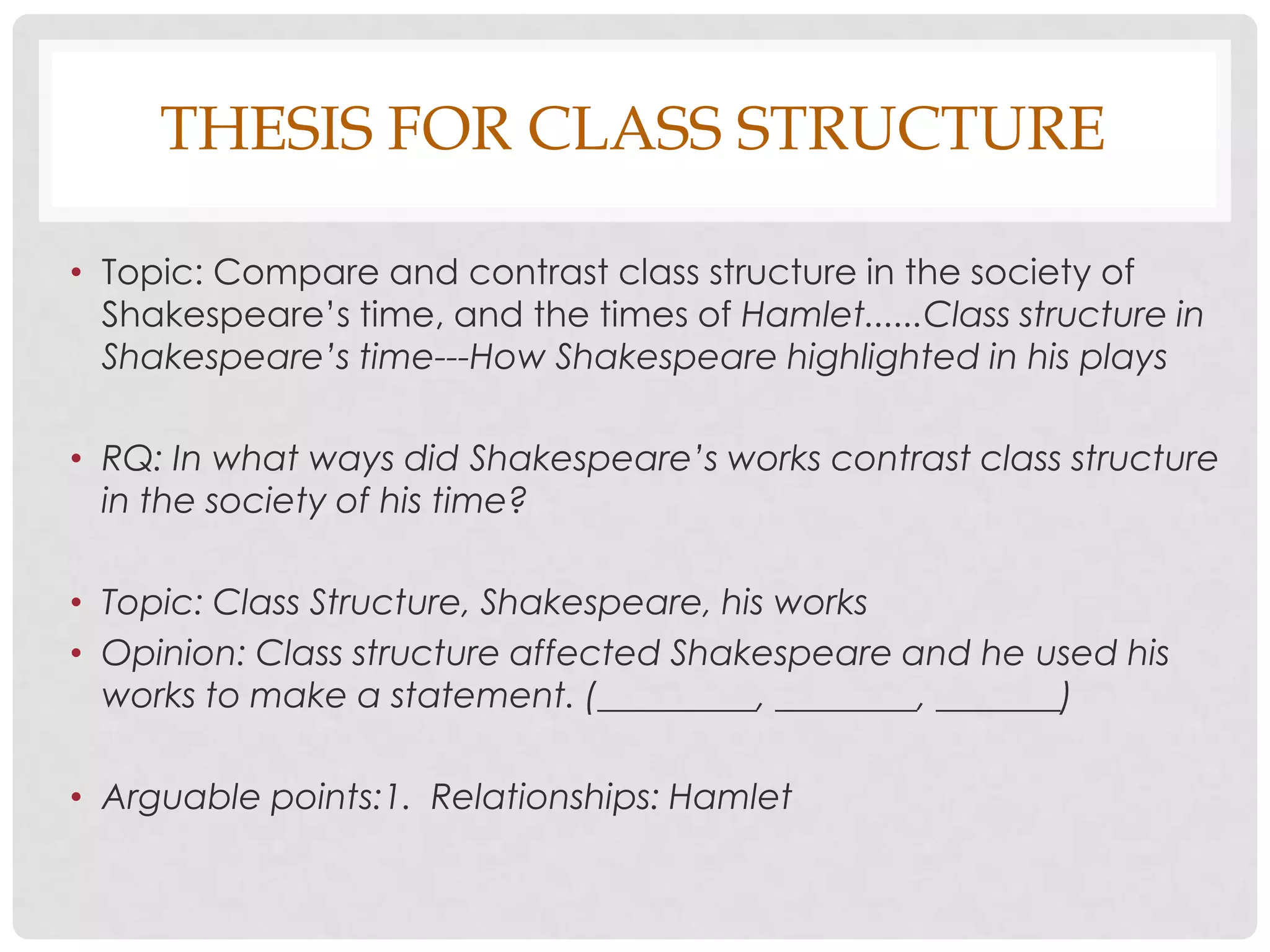
THESIS FOR CLASS STRUCTURE

• Topic: Compare and contrast class structure in the society of
  Shakespeare’s time, and the times of Hamlet......Class structure in
  Shakespeare’s time---How Shakespeare highlighted in his plays

• RQ: In what ways did Shakespeare’s works contrast class structure
  in the society of his time?

• Topic: Class Structure, Shakespeare, his works
• Opinion: Class structure affected Shakespeare and he used his
  works to make a statement. (_________, ________, _______)

• Arguable points:1. Relationships: Hamlet
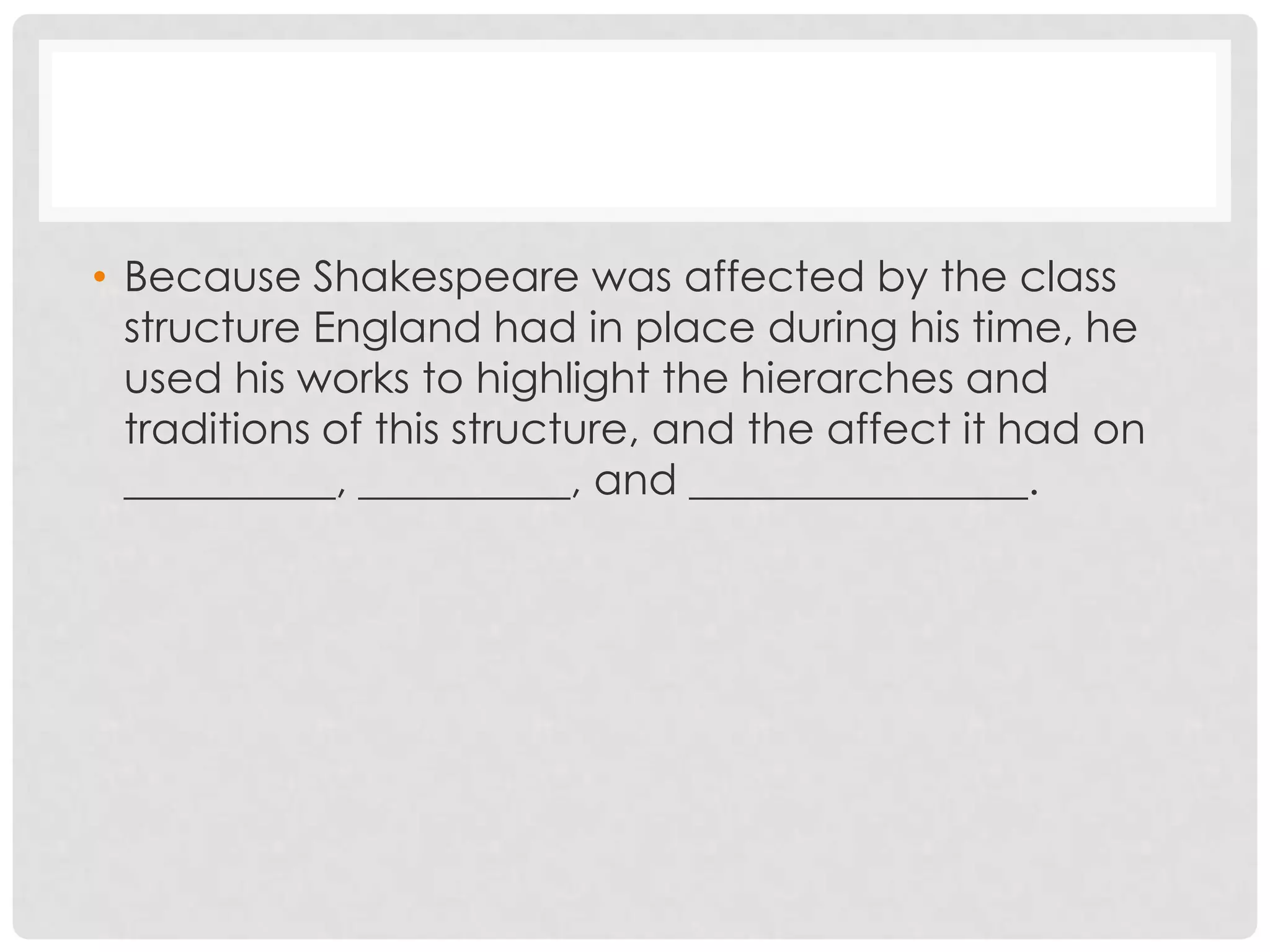
• Because Shakespeare was affected by the class
  structure England had in place during his time, he
  used his works to highlight the hierarches and
  traditions of this structure, and the affect it had on
  __________, __________, and ________________.
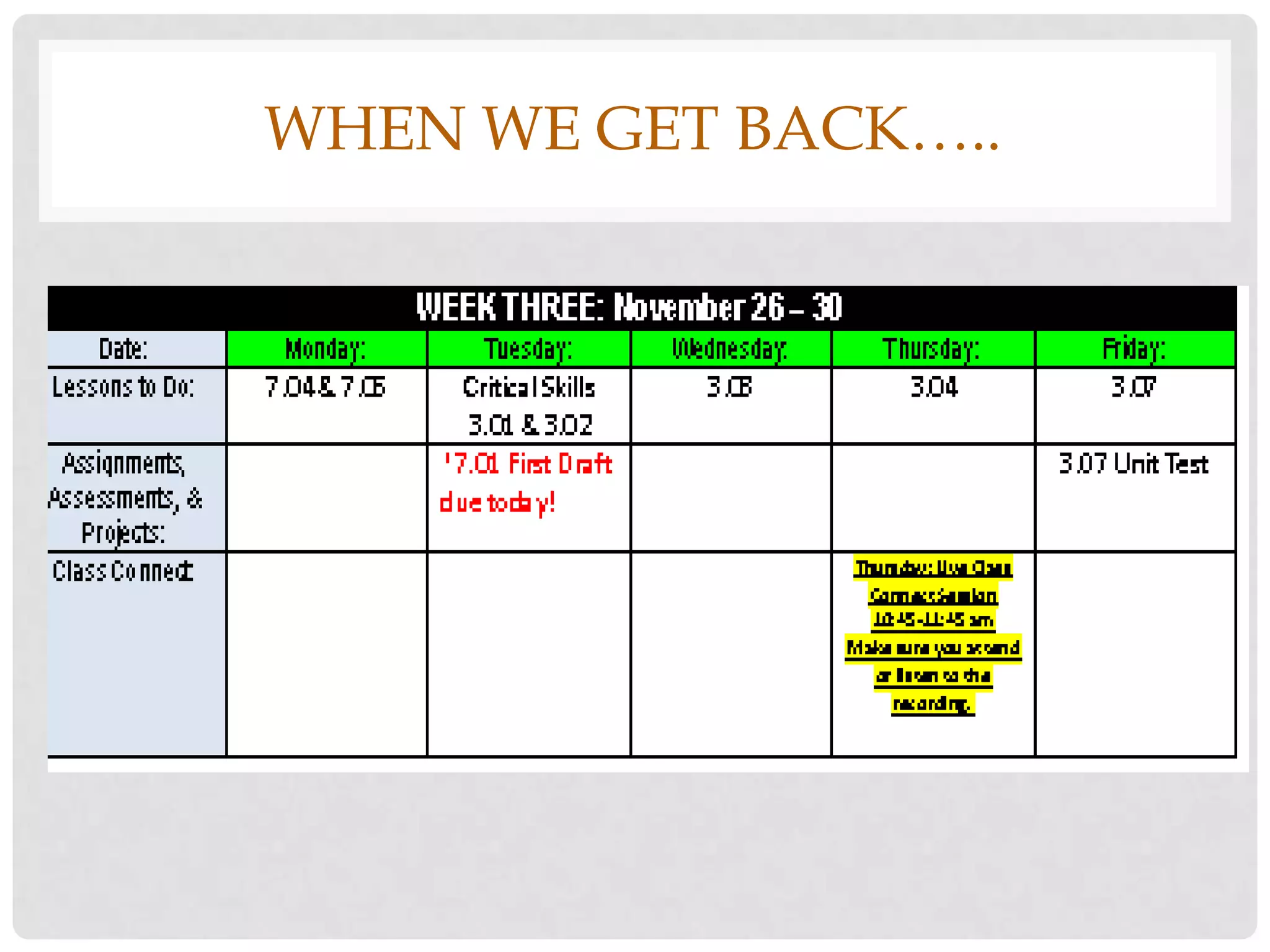
WHEN WE GET BACK…..

Research paper ppt 11 15 12session2ss

  • 1.
    STARTING YOUR RESEARCH PAPER 11/15/12 http://viewpure.com/X-cUbUKYPOI “GCA: Working topro vide an exemplary individualized and engaging educational experience f or all students “
  • 2.
    TODAY WE WILLLOOK AT: • Review of Thesis • Sources: What are they? How do we find them? • What is an analysis? • CCGPS covered: • ELACC9-10RI1 • ELACC9-10RI2 • ELACC9-10RI5 • ELACC9-10W1 • ELACC9-10W5 • ELACC9-10W7 • ELACC9-10W8 • ELACC9-10W9
  • 3.
    REVIEWING THESIS • Whatis a thesis statement? • The thesis is a statement • It is the overarching focus of your paper • It is arguable http://viewpure.com/Wura5m8mStk
  • 4.
    HOW DO YOUFORM A THESIS? • Topic + Opinion = Thesis • Start with your topic • Add your opinion about something to do with that topic • It needs to be arguable and provable!
  • 5.
    EXAMPLE: • Topic: Theauthorship of Shakespeare’s plays. • Opinion: Shakespeare was not the author of his plays. • Thesis: Because of his lack of formal education and knowledge of the inner workings of the nobility, William Shakespeare could not have been the author of most of the plays attributed to him.
  • 6.
    IS THIS AGOOD THESIS? • Let’s test it………… • Because of his lack of formal education and knowledge of the inner workings of the nobility, William Shakespeare could not have been the author of most of the plays attributed to him. • Is it a statement or a question? • Is it arguable? • So, is it a good thesis?
  • 7.
    HOW DID IFORM MY OPINION? • RESEARCH!! • I knew what my opinion was because I looked up different books and non-print sources about it. • Some of what I could use are: • encyclopedia entries on authors, their works, or the time period during which the authors lived • biographies of authors • books about the history of British literature • books about British history • works of literary criticism, including articles or books • websites about your author or British history • online databases that contain articles about your author or British history
  • 8.
    HOW MANY SOURCESDO I NEED? • Not every paper needs to include every type of source. • Remember that you need at least three sources.
  • 9.
    WHAT KIND OFSOURCES ARE THERE? • Primary Sources • A primary source is one that was created during the historic period you are researching. An example of a primary source for your research paper would be a letter written by the author you are studying. http://viewpure.com/xIdm6RguzRM
  • 10.
    ALSO: • Secondary Sources •A secondary source is one that was created after the time about which you are writing. For your research paper, a recent critical article or a biography of the author would be a secondary source.
  • 11.
    FACTUAL AND ANALYTICAL INFORMATION Factual Analytical • You know the difference • Analytical information is between fact and opinion. A more than just fact can be proved, but an opinion, though. It is an opinion can't. Similarly, factual interpretation of the information can be facts, derived from evidence. proved, and analytical An opinion doesn't always give information can't. solid reasons. An analysis does.
  • 12.
    SOMETIMES YOU CANRECOGNIZE ANALYTICAL INFORMATION FROM THE WAY IT IS INTRODUCED. KEY WORDS AND PHRASES ARE: • "The writer suggests" • "It seems as if" • "Perhaps the author"
  • 13.
    IN YOUR RESEARCH,YOU WILL FIND AND USE FACTUAL AND ANALYTICAL INFORMATION. • In your paper, you will include your own analysis of literature, with facts to support the analysis. When citing analytical information in your research paper, be sure to identify the author who originally wrote the analysis.
  • 14.
    RELIABILITY OF WEBSITES •Some websites contain reliable information and others don't. The search engine results alone can give you a few clues to how reliable a website is, including: • the title of the website • the URL of the website • a couple of lines from the website's text, including your keywords • However, you need to open the website and examine its contents to be sure it's reliable. • http://viewpure.com/dKVL1ehDQB0
  • 15.
    DOMAIN SUFFIXES • Howcan a website's URL help you figure out whether the site is reliable? Look at the domain name suffix. The small group of letters than follows the dot, such as .com, .org, .edu, or .gov. These suffixes give clues to the reliability of a website: • .com is for companies or individuals. The reliability of these sites varies greatly. • .org is for organizations, such as charities or political parties. Such groups may offer a great deal of information, but the organizations may have biases. • .edu is for schools and universities. Sites written by professors are usually reliable, but students' pages are less so. • .gov refers to government websites. Such websites are usually reliable but probably not useful for your topic.
  • 16.
    SOURCE QUALITY • Whenyou find a print source, such as a book about an author, look for clues that an expert wrote it. The clues include the following: • The author is a scholar, such as a college professor or an experienced biographer. Look in the About the Author note at the end of the book or on the back flap of the dust jacket. • The source contains detailed interpretation, not just facts or personal opinions.
  • 17.
    ALSO… • There isan index that includes many detailed topics. • There are bibliographical notes and perhaps footnotes. • Indexes and notes show that the author has done a thorough job and that he or she expects other experts in the field to read the book.
  • 18.
    SITES NOT TOUSE • Wikis: A wiki is a site that any reader can write for or edit. The most well- known wiki is Wikipedia, the online encyclopedia. Because anyone can contribute or change information, Wikipedia's articles are not as authoritative as those in standard encyclopedias. • E-rooms, chat forums, and blogs: In all kinds of fields, including literature, groups and individuals discuss their favorite topics. These sites can be exciting to read and contribute to. However, these sites may not be created by experts, so they aren't good sources for research papers. • Essay sales sites: Some companies sell research papers to students. Their URLs may show up on your search results. Buying another person's paper and presenting it as your own is cheating. In addition, the content of such papers is not reliable or expert.
  • 19.
    YOU HAVE FOUNDYOUR SOURCES. NOW WHAT? • When you locate a source of information, you want to make sure that you can find it again. • You'll need to refer to that source often as you plan and write. • In addition, you will have to put the source information in the Works Cited section at the end of your paper.
  • 20.
    SO WHAT DOI DO WITH WHAT I’VE FOUND? • When you locate a source of information, you want to make sure that you can find it again. You'll need to refer to that source often as you plan and write. In addition, you will have to put the source information in the Works Cited section at the end of your paper. • You need to write down the source information in an organized way. • File transfer research paper organizer form & notecard information/forms
  • 21.
    THERE ARE TWOMAJOR WAYS OF RECORDING YOUR SOURCES: Create bibliography Create a word-processing cards, using index cards. file to hold the information.
  • 22.
    BIBLIOGRAPHY CARDS • Indexcards are among the most handy research tools ever invented. Here's the how-to of recording your sources' bibliographic information on index cards: • Make a separate card for each source. • Give each source a tracking number. • For a book, include the author, title, publisher, and publication date. • For a periodical, also include the page numbers of the article. • For a website, include the title, the sponsors and authors or editors if known, the date the site was created or updated, and the date you accessed the site.
  • 23.
    BIBLIOGRAPHY CARDS • TheURL • When you make a bibliography card for a website, the URL is optional. You can find the website again by doing a search for the title and the author's name. However, the URL can help you find the site more easily.
  • 24.
    ELECTRONIC FILES • Thesame information would be included in your electronic files. • Be sure to name files so that you can find them!
  • 25.
    CITATION ORGANIZER • coc Copywrite date on website is sometimes hard to find
  • 26.
    Example of Anotecard Source #_______ Topic____________ Page # _______
  • 27.
    Sample note cardwith a quote: Source # I got this Topic____________ Source #___1____ quote from. This spot is NOT here to count my note cards! “Women in power are treated with distrust by Shakespeare. They have questionable morals. For example, Gertrude in Hamlet marries her husband’s murdering brother and Lady MacBeth coerces her husband into Page # or paragraph # murder. For these women, the penalty for Page if print source their scheming ways is normally death.” Paragraph if internet source with no page # available I put the exact words in quotation marks, and I made sure to get the name of the person who said this. Page or paragraph # Note to students: not to be used in a __4__ paper …for teaching purposes only
  • 28.
    Sample note cardwith a statistic: Source #____3___ Where I got this quote from. Topic____________ This spot is NOT here to count my note cards! Fourteen women character roles in Shakespeare’s plays are the roles of infidels. This is the page # I found Statistics provide strong the fact in support. Only put one the book. statistic per note card. Page # ___ix____ Note to students: not a true statistic…for teaching purposes only
  • 29.
    Sample note cardwith a fact: Where I got this quote Source #___2____ from. This spot is NOT Topic____________ here to count my note cards! Shakespeare’s mother was a huge influence on him throughout his life.. No page Page # or paragraph # Page# print if source because Paragraph if it is an internet source with no page # Internet Only include facts that are not available common knowledge. Make sure source . the fact supports your thesis. Page or Note to students: not a true fact…for paragraph # teaching purposes only ___6____
  • 30.
    Sample note cardwith a fact: Source #___2____ What does this number represent? Shakespeare like to end his plays with the wedding of his unmarried female characters. Ex: Tempest (Ferdinand & Miranda) What type of support is this? Quote, statistic, or fact? Page # _______ Note to students: not a true fact…for teaching purposes only
  • 31.
    WHAT IS LITERARYCRITICISM? • Literary criticism is writing that analyzes literature. In literature, criticism doesn't mean saying that a work is bad. It means explaining the meaning of the work.
  • 32.
    WHO WRITES LITERARYCRITICISM? • Literary criticism is usually written by experts, especially professors of literature. • To do research for your paper, you'll read literary criticism to absorb scholars' ideas about the topic you have chosen. By thinking about scholars' ideas, you'll understand your topic better.
  • 33.
    TRAITS OF LITERARYCRITICISM • Literary criticism focuses on the elements in a work of literature, such as characters, setting, style, imagery, themes, and symbols. • Literary criticism offers analysis and interpretation, not opinion. • Literary criticism may examine both the flaws and the strengths of the literary work.
  • 34.
    WHAT LITERARY CRITICISMIS NOT • The following are not acceptable sources of literary criticism: • papers by other students • Internet sites that sell papers • summaries or synopses of literary works • blogs • fan sites • discussion rooms
  • 35.
    FINDING LITERARY CRITICISM •The place to begin looking for literary criticism is the library. Use the librarian as a resource. Tell the librarian that you need to find literary criticism on your research paper's topic. • Use the catalog, too. Try a subject search rather than a search for the title or the author. This kind of search will show you what materials the library owns about Wordsworth, not just works by him. • To do a subject search about an author, use the author's name as your keyword. For example, perform a subject search for "Wordsworth" to see what kind of results you get.
  • 36.
    LITERARY CRITICISM INJOURNALS • Literary criticism comes in article form as well as in book form. Professors publish articles in journals of literary criticism. Your library might not have literary journals, but you can find articles from them online. • To begin an Internet search for literary criticism, try the website LiteraryHistory.com. • It is a site created by a librarian to direct researchers to other websites that contain criticism on a wide array of authors.
  • 37.
    EVALUATING SOURCES • Thetitles and subtitles of works of literary criticism often help you decide how relevant they are to your paper. • For example, an article titled "Wordsworth and the French Revolution" would not have been relevant to the topic that the writer of the Model Research Paper in the LMS chose. Her paper was about the Industrial Revolution, not the French one.
  • 38.
    CRITICAL ARTICLES • Criticalarticles sometimes begin with brief summaries called abstracts. The abstract tells you the article's main points. That information can help you give an article a "Yes" or "No" as to whether you should read it. • Often, however, you have to read at least part of the article to know whether it is relevant for you.
  • 39.
    INTERPRETATIONS • Remember thata work of literary criticism gives one person's interpretation. • Different people interpret things differently. If you find two different articles about the same literary text, they may disagree with each other. That's okay. • Your job is to decide what you think about the literary text. Use literary criticism to support your ideas, not to replace your own thinking.
  • 40.
    WHAT SHOULD IBE DOING NOW? • Check the WCA and Doc Sharing for all assignments and • Have a wonderful instructions. break! • Contact me with any questions! • Keep up to date with assignments. • Use the break to catch up if needed.
  • 41.
    • Note: ifyou want a little more direction on thesis statements…stay.. I have more information on this presentation……
  • 42.
    YOUR TOPIC/QUESTION ISTOO BROAD • Topic: Compare and • Your question is contrast class structure in the broad, because you ask society of Shakespeare’s about your topic in a time, and the times of Hamlet general way. To make it the right size for a paper of 2-3 • In what ways did pages, I suggest you choose Shakespeare’s works contrast a more narrowed aspect of class structure in the society your topic. of his time? • Pose a question that requires a critical analysis of specific elements of the works and • Topic: Class structure in that connects them to their Shakespeare’s time---How times. Shakespeare highlighted in • Remember the paper only his plays has to be 2-3 pages with the 4 page a works cited page. • Opinion: Choose 3 items to focus on and find evidence in the • Arguable points: book to support your claims.
  • 43.
    BOOKS ARE WRITTENON THIS TOPIC • I want you to narrow down how Shakespeare used class structure in society (research what that is), in his plays. • For example... Love and relationships.... in Hamlet, Ophelia had a love for Hamlet, but because they were in different "classes", that love would never work out (put aside all of the other issues going on in the story ) Remember the conversations between Polonius, Laertes, and Ophelia • .....We also find out near the end that Hamlet, did indeed have feelings for Ophleia (remember the scene at the cemetery between Laertes and Hamlet) • So, you would discuss how class structure in Shakespeare's time affected love and relationships, (use research and references to back up your claim that it did indeed affect relationships), and then you would use the situation between Hamlet and Ophelia... take quotes and lines from the play to highlight your point with evidence to show how Shakespeare used this issue of class structure in his plays. • other areas you can look at are: • Family life • Occupations • Education • Marriage and children • Daily • You can research background on different Shakespeare plays to see if they point these out and you can use
  • 44.
    THESIS FOR CLASSSTRUCTURE • Topic: Compare and contrast class structure in the society of Shakespeare’s time, and the times of Hamlet......Class structure in Shakespeare’s time---How Shakespeare highlighted in his plays • RQ: In what ways did Shakespeare’s works contrast class structure in the society of his time? • Topic: Class Structure, Shakespeare, his works • Opinion: Class structure affected Shakespeare and he used his works to make a statement. (_________, ________, _______) • Arguable points:1. Relationships: Hamlet
  • 45.
    • Because Shakespearewas affected by the class structure England had in place during his time, he used his works to highlight the hierarches and traditions of this structure, and the affect it had on __________, __________, and ________________.
  • 46.
    WHEN WE GETBACK…..

Editor's Notes

  • #2 http://viewpure.com/X-cUbUKYPOI http://www.youtube.com/watch?v=X-cUbUKYPOI
  • #4 http://viewpure.com/Wura5m8mStkhttp://www.youtube.com/watch?v=Wura5m8mStk&feature=fvwrel
  • #7 Because Shakespeare was affected by the class structure England had in place during his time, he used his works to highlight the hierarches and traditions of this structure, and the affect it had on __________, __________, and ________________.
  • #10 http://www.youtube.com/watch?v=xIdm6RguzRM&feature=fvwrelhttp://viewpure.com/xIdm6RguzRM
  • #15 http://www.youtube.com/watch?v=dKVL1ehDQB0&feature=related http://viewpure.com/dKVL1ehDQB0
  • #42 https://docs.google.com/spreadsheet/viewform?fromEmail=true&formkey=dHVqajhMaGZrbHV5S0NwQmZ6MzdLM1E6MQ
  • #43 Class structure is a huge and broad topic that encompasses many things. Books are written on the topic, and you are only required to write 2-3 pages..... I want you to narrow down how Shakespeare used  class structure in society (research what that is), in his plays.  For example... Love and relationships.... in Hamlet, Ophelia had a love for Hamlet, but because they were in different "classes", that love would never work out (put aside all of the other issues going on in the story ) Remember the conversations between Polonius, Laertes, and Ophelia.....We also find out near the end that Hamlet, did indeed have feelings for Ophleia (remember the scene at the cemetary between Laertes and Hamlet)So, you would discuss how class structure in Shakespeare's time affected love and relationships, (use research and references to back up your claim that it did indeed affect relationships), and then you would use the situation between Hamlet and Ophelia... take quotes and lines from the play to highlight your point with evidence.other areas you can look at are:                                          i.    Family life                                         ii.    Occupations                                        iii.    Education                                       iv.    Marriage and children                                        v.    Daily lifeYou can research background on different Shakespeare plays to see if they point these out and you can use them for evidence.Please let me know if this clears it up for you.
  • #45 Because Shakespeare was affected by the class structure England had in place during his time, he used his works to highlight the hierarches and traditions of this structure, and the affect it had on __________, __________, and ________________.