EXDS 2001 Global
Mathematics
Professor Traci Welch Moritz
Public Services Librarian
What we’ll do today
• Resources for research
• Primary, secondary, tertiary
resources
• Hints, tips and tricks for the
assignment
• Citing in powerpoints
2
Research Guide
3
Primary
Secondary
Tertiary
Primary resources in the
sciences most often
consists or original
research.
• the work researchers
do in the laboratory
and then write up and
publish in formal lab
reports and/or
research articles .
• Primary sources
provide
• A detailed description
of experiments
• References to other
experiments and
scientists in the field
• Source material
for latest findings
4
Primary
Secondary
Tertiary
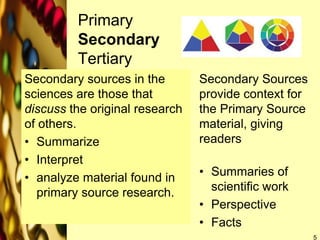
Secondary sources in the
sciences are those that
discuss the original research
of others.
• Summarize
• Interpret
• analyze material found in
primary source research.
Secondary Sources
provide context for
the Primary Source
material, giving
readers
• Summaries of
scientific work
• Perspective
• Facts
5
Primary
Secondary
Tertiary
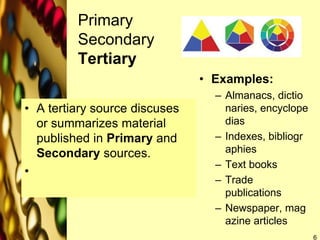
• A tertiary source discuses
or summarizes material
published in Primary and
Secondary sources.
•
• Examples:
– Almanacs, dictio
naries, encyclope
dias
– Indexes, bibliogr
aphies
– Text books
– Trade
publications
– Newspaper, mag
azine articles
6
How to conduct research
• Consider the information sought
• Who cares?
Who would write about it?
Who would read what they
wrote?
Where would you expect this
information to be published?
7
What about the web?
www.brainybetty.com 8
Wikipedia, Go
ogle, web
based
resources need
to be used at
the proper
time for the
proper
reasons.
Sherlock Holmes in
Babylon
• Cuneiform tablet
• Babylonia
• Babylonian
numerals
• Otto Neugebauer
• Abraham Sachs
www.brainybetty.com 9
Biographical
10
Wiki + Biography Reference Bank + Oxford
Reference
Search
• POLAR
• Article-level searching for all
EBSCO databases
• Article-level searching for a variety
of other databases: JSTOR,
Hoover’s, AccessPharmacy, etc.
• Title-level searching for most other
databases: IEEE, CIAO, Proquest
Nursing & Allied Health
• OhioLink central catalog
11
Research Ethics
• Plagiarism - “...the wrongful
appropriation or purloining, and publication
as one’s own, the ideas or the expression
of the ideas
(literary, artistic, musical, mechanical, etc.)
of an other.” – see Heterick Help
Page, Also Student Code of Conduct
• Copyright - intended to promote the
arts and the sciences. It does this by
providing authors of original
literary, dramatic, musical, artistic, and
certain other intellectual works the ability to
control how their work is used by others.
Research Ethics
• In other words, to plagiarize is
to copy someone else’s work
without giving him/her credit.
• Plagiarism is not always intentional.
You can do it by accident, but it is
still against the law. If you ever have
a question about whether something
is plagiarized, please ask!
1
1. How not to plagiarize your report -- Shannon Hosier Mersand
1
Research Ethics
• Identify any information that would not be
considered common knowledge
• Unless in direct quotes, make sure you
paraphrase what the original author said
• Use a quote if you can’t think of a way to
paraphrase the information
• always, Always, ALWAYS cite the source of any
information in your paper which is not
considered common knowledge. If you are
unsure if something is common knowledge, cite
it!
2 How not to plagiarize your report -- Shannon Hosier Mersand
How may I avoid plagiarizing?2
Research Ethics
Things that are found in a number of
places, and are likely to be known by a large
number of people.
Examples:
– The sky is blue
– Grass is usually green
– George Washington was the 1st president of the
United States
So what is common knowledge
3 How not to plagiarize your report -- Shannon Hosier Mersand
3
Research Ethics
Main Entry: para·phrase
1 : a restatement of a text,
passage, or work giving the
meaning in another form
What does paraphrase mean?
Research Ethics
When you paraphrase something, it is
different than putting it in your own words.
When you put something in your own
words, you are making a statement about
the information you have found, rather
than just restating the information. Usually
there is an opinion of some sort in
something “in your own words”
What does it mean to put something
in my own words?
4 How not to plagiarize your report -- Shannon Hosier Mersand
4
18
Research Ethics
• Main Entry: quote
1 a : to speak or write (a
passage) from another usually
with credit acknowledgment b :
to repeat a passage from,
especially in substantiation or
illustration
What is a quote?
Research Ethics
• A citation is how you indicate where your
information came from.
• There are four citation styles that are in frequent
use at the college level. They are:
• MLA (Modern Language Association)
• APA (American Psychological Association)
• CMS (Chicago Manual of Style)
• Turabian (Kate Turabian's A Manual for Writers of
Term Papers, Theses, and Dissertations, 6th ed.,
1996 )
• Each style has a way to do in-text citations, a way
to do a bibliography, and a way to do footnotes
and endnotes.
• Always confirm with each instructor the style
required.
• You need to learn how to do citations, etc., but
there is a citation software management tool
available to all ONU students, faculty and staff…
What is a citation?
20
Research Ethics
• Whenever you use information that is
not common knowledge
• Whenever you use information that you
did not know before doing the research
• Whenever you quote another person’s
ideas or word, whether they are written
or spoken
• Whenever you paraphrase another
person’s written or spoken words or
ideas
When should I cite my sources?
5 How not to plagiarize your report -- Shannon Hosier Mersand
5
How to cite in a ppt
• Commonly accepted practices
include
– A citation within a slide
– A citation in the notes field of each
slide for which you need to note
others’ work
– A slide at the end with appropriate
citations
• Always ask the instructor if
preferences are not noted in the
syllabus
21
Questions?
• Communications Skills Center
• reference@onu.edu t-moritz@onu.edu
22
121 Research
Consultations
with the
Librarians of
Heterick Memorial Library
Need a little extra help with your research?
Finding plenty of resources, but not exactly what you are looking for?
Has it been suggested by instructor to meet with a librarian?
An in-depth research consultation with the librarian of your choice is available
by appointment.
Sessions may run for 30-60 minutes and are designed to assist students with
finding and evaluating resources
Schedule an appointment by visiting
http://libguides.onu.edu/aecontent.php?pid=199190&sid=2118629

Exds 2001 global mathematics

  • 1.
    EXDS 2001 Global Mathematics ProfessorTraci Welch Moritz Public Services Librarian
  • 2.
    What we’ll dotoday • Resources for research • Primary, secondary, tertiary resources • Hints, tips and tricks for the assignment • Citing in powerpoints 2
  • 3.
  • 4.
    Primary Secondary Tertiary Primary resources inthe sciences most often consists or original research. • the work researchers do in the laboratory and then write up and publish in formal lab reports and/or research articles . • Primary sources provide • A detailed description of experiments • References to other experiments and scientists in the field • Source material for latest findings 4
  • 5.
    Primary Secondary Tertiary Secondary sources inthe sciences are those that discuss the original research of others. • Summarize • Interpret • analyze material found in primary source research. Secondary Sources provide context for the Primary Source material, giving readers • Summaries of scientific work • Perspective • Facts 5
  • 6.
    Primary Secondary Tertiary • A tertiarysource discuses or summarizes material published in Primary and Secondary sources. • • Examples: – Almanacs, dictio naries, encyclope dias – Indexes, bibliogr aphies – Text books – Trade publications – Newspaper, mag azine articles 6
  • 7.
    How to conductresearch • Consider the information sought • Who cares? Who would write about it? Who would read what they wrote? Where would you expect this information to be published? 7
  • 8.
    What about theweb? www.brainybetty.com 8 Wikipedia, Go ogle, web based resources need to be used at the proper time for the proper reasons.
  • 9.
    Sherlock Holmes in Babylon •Cuneiform tablet • Babylonia • Babylonian numerals • Otto Neugebauer • Abraham Sachs www.brainybetty.com 9
  • 10.
    Biographical 10 Wiki + BiographyReference Bank + Oxford Reference
  • 11.
    Search • POLAR • Article-levelsearching for all EBSCO databases • Article-level searching for a variety of other databases: JSTOR, Hoover’s, AccessPharmacy, etc. • Title-level searching for most other databases: IEEE, CIAO, Proquest Nursing & Allied Health • OhioLink central catalog 11
  • 12.
    Research Ethics • Plagiarism- “...the wrongful appropriation or purloining, and publication as one’s own, the ideas or the expression of the ideas (literary, artistic, musical, mechanical, etc.) of an other.” – see Heterick Help Page, Also Student Code of Conduct • Copyright - intended to promote the arts and the sciences. It does this by providing authors of original literary, dramatic, musical, artistic, and certain other intellectual works the ability to control how their work is used by others.
  • 13.
    Research Ethics • Inother words, to plagiarize is to copy someone else’s work without giving him/her credit. • Plagiarism is not always intentional. You can do it by accident, but it is still against the law. If you ever have a question about whether something is plagiarized, please ask! 1 1. How not to plagiarize your report -- Shannon Hosier Mersand 1
  • 14.
    Research Ethics • Identifyany information that would not be considered common knowledge • Unless in direct quotes, make sure you paraphrase what the original author said • Use a quote if you can’t think of a way to paraphrase the information • always, Always, ALWAYS cite the source of any information in your paper which is not considered common knowledge. If you are unsure if something is common knowledge, cite it! 2 How not to plagiarize your report -- Shannon Hosier Mersand How may I avoid plagiarizing?2
  • 15.
    Research Ethics Things thatare found in a number of places, and are likely to be known by a large number of people. Examples: – The sky is blue – Grass is usually green – George Washington was the 1st president of the United States So what is common knowledge 3 How not to plagiarize your report -- Shannon Hosier Mersand 3
  • 16.
    Research Ethics Main Entry:para·phrase 1 : a restatement of a text, passage, or work giving the meaning in another form What does paraphrase mean?
  • 17.
    Research Ethics When youparaphrase something, it is different than putting it in your own words. When you put something in your own words, you are making a statement about the information you have found, rather than just restating the information. Usually there is an opinion of some sort in something “in your own words” What does it mean to put something in my own words? 4 How not to plagiarize your report -- Shannon Hosier Mersand 4
  • 18.
    18 Research Ethics • MainEntry: quote 1 a : to speak or write (a passage) from another usually with credit acknowledgment b : to repeat a passage from, especially in substantiation or illustration What is a quote?
  • 19.
    Research Ethics • Acitation is how you indicate where your information came from. • There are four citation styles that are in frequent use at the college level. They are: • MLA (Modern Language Association) • APA (American Psychological Association) • CMS (Chicago Manual of Style) • Turabian (Kate Turabian's A Manual for Writers of Term Papers, Theses, and Dissertations, 6th ed., 1996 ) • Each style has a way to do in-text citations, a way to do a bibliography, and a way to do footnotes and endnotes. • Always confirm with each instructor the style required. • You need to learn how to do citations, etc., but there is a citation software management tool available to all ONU students, faculty and staff… What is a citation?
  • 20.
    20 Research Ethics • Wheneveryou use information that is not common knowledge • Whenever you use information that you did not know before doing the research • Whenever you quote another person’s ideas or word, whether they are written or spoken • Whenever you paraphrase another person’s written or spoken words or ideas When should I cite my sources? 5 How not to plagiarize your report -- Shannon Hosier Mersand 5
  • 21.
    How to citein a ppt • Commonly accepted practices include – A citation within a slide – A citation in the notes field of each slide for which you need to note others’ work – A slide at the end with appropriate citations • Always ask the instructor if preferences are not noted in the syllabus 21
  • 22.
    Questions? • Communications SkillsCenter • reference@onu.edu t-moritz@onu.edu 22 121 Research Consultations with the Librarians of Heterick Memorial Library Need a little extra help with your research? Finding plenty of resources, but not exactly what you are looking for? Has it been suggested by instructor to meet with a librarian? An in-depth research consultation with the librarian of your choice is available by appointment. Sessions may run for 30-60 minutes and are designed to assist students with finding and evaluating resources Schedule an appointment by visiting http://libguides.onu.edu/aecontent.php?pid=199190&sid=2118629

Editor's Notes

  • #10 Consider this article. I’m reading through it and right away know I need to look up some things.I know what a cuneiform tablet is and I some things about Babylonia but nothing about their mathematics.So what am I going to do? Head to Wikipedia and Google.