Osteoporosis
Dr.Rahul kapoor
MBBS, 2nd yr. ortho
Defination
• Osteoporosis is a systemic disorder of the skeleton
characterized by low total skeletal bone mass and
microarchitectural deterioration of bone tissue with
a consiquent increase in bone fragility and
susceptibility to fracture .
Acknowledgement
• Most common metabolic bone disease
• 3x more common in women than men
• Fewer than 1/3rd cases are diagnosed
• Only 1/7th receive treatment
• Hip # have 20% mortality in first yr.
• 50% of women(>65yr) have spinal compression # and
2/3rd unrecognised
• Multifactorial origin
• Classified as :- primary :- type I & type II
secondary
• other :- involutional , post-climacteric and
idiopathip transient osteoporosis of the hip
• Type I :- result of estrogen loss
increased osteoclastic bone resorption
• Type II :- slow progressive decline in osteoblastic
activity with ageing
• Unfortunately the elderly female often suffers the
effect of both
Risk factors
• h/o # in adults ( >40 yrs.)
• Low body weight ( < 127 lbs)
• Smoking
• Alcohol (> 60 ml)
• Corticosteroid therapy ( >3 months)
• Impaired vision
• Early Estrogen deficiency (<45yr)
• Prolonged premenopausal amenorrhoea(>1yr)
• Low physical activity
• Low calcium intake
• dementia
Secondary osteoporosis
• Affect any age group
• Men and women equally affected
• Results from chronic medical conditions & prolong
use of medication
causes
• Drugs :-
 Steroids
 Heparin
 Anticonvulsant
 Cytotoxins
 Lithium
 Aluminium
 cytotoxins
• Malignancy :-
 Multiple myeloma
 Leukemia
 Lymphoma
• Disuse prolonged immobilization
• Endocrine diseases:-
 Diabetes
 Thyroid disease
 Cushing syndrome
 Hyperparathyroidism
 Exercise induced amenorrhea
 Eating disorders
• Gastrointestinal disorders:-
 Gastrectomy
 Malabsorption syndrome
 Liver diseases
 Inflammatory conditions
 sprue
Clinical features
• Asymptomatic silent bone changes
• Spontaneous vertebral fractures
• Acute or chronic back ache
• Loss of height
• Protuberant abdomen
• dowager’s hump
• Oral alveolar bone loss
WHO
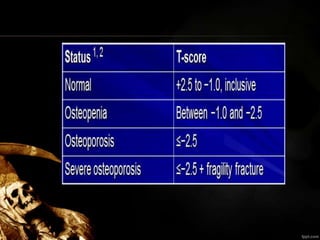
• The world health organization has estblished an
operational definition depending on BMD, commonly
expressed as T- score.
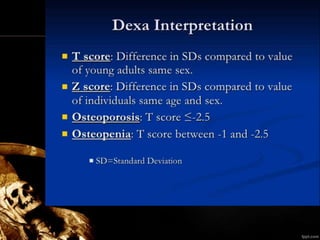
• A T – score of atleast - 2.5 SD and below the young
adult mean
• A T score represents a pateints bone density
expressed as the number of SD above or below the
mean BMD value of normal young adult
BMD
• Proxy to measure bone strength
• Predicts the risk of fracture
• Expressed as SD in T AND Z score
• 50%-100% increase in fracture risk for each SD
decline in bone density
• DEXA is the standard for measuring BMD
• 3 Sites
1) Radius distal end
2) Hip
3) Spine
Others
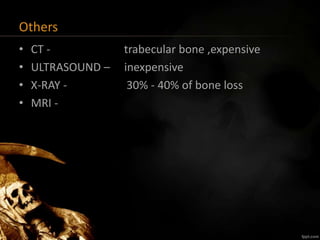
• CT - trabecular bone ,expensive
• ULTRASOUND – inexpensive
• X-RAY - 30% - 40% of bone loss
• MRI -
Laboratory Assessment
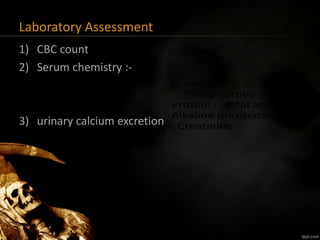
1) CBC count
2) Serum chemistry :-
3) urinary calcium excretion
Additional
1. Serum thyrotropin
2. ESR
3. Serum PTH
4. Serum 25-hydroxyvitamin D concentration
5. Urinary free cortisol
6. Serum electrolyte
7. Serum or unine protein electrophoresis
8. Bone marrow biopsy or aspiration
9. Biochemical markers of bone turnover
Biochemical markers
• Assessing fracture risk in elderly
• Therapeutic response to antiresorptive agents
• Identifying patients with high bone turnover
Prevention goals
1) Optimize skeletal development in the young
2) Maximize peak bone mass at skeletal maturity
3) Prevent bone loss (age , secondary causes)
4) Preserve the structural integrity of skeleton
5) Prevent fractures
Preventive measures
• Adequate calcium diet
• Good general nutrition
• Adequate vitamin D intake
• Regular weight bearing exercise
• Avoiding tobacco and caffeine
Additional measures
• Pharmacological agents to pevent bone loss
• Bisphosphonate for all on prednisolone > 3 mths
• Periodic monitoring of thyroid function
• Identification and treatment of conditions that
predispose to low peak bone mass
• Identification of patients predisposed to fall
Goals of treatment
1) Preventing fractures
2) Increase in bone mass
3) Relieving symptoms of fracture
4) Maximizing physical function
Candidates for treatment
• Women with T-score -1.5 with at least one risk factor
• Women with ineffective nonpharmacological
measures
• Postmenopausal osteoporosis
• Men with hypogonadism
Management
• Pharmacological measures
• Hormone treatment
• SERMs
• Surgical
Pharmacology options
• Calcium supplements
• Bisphosphonates
• Raloxifine
• Salmon calcitonin
• Teriparatide
Calcium supplements
• Recommended intake is 1500mg/day
• Safe upper limit is 2500mg/day
• Judicialy used in kidney stones pt.
• S/E :- flatulence and constipation
• Eg. Calcium carbonate ,

• calcium citrate ,
• calcium phosphate
Vitamin D
• 200 IU for young adults < 50 yrs.
• 400 IU for 50 – 70 yrs.
• 600 IU for > 70 yrs.
• Higher doses in malabsorption syndrome
• Safe upper limit :- 2000 IU
Bisphosphonates
• Synthetic analogs of pyrophosphate
• Natural inhibitor of bone resorption
• Use :- prevention (35mg/week)
• treatment (70mg/week)
• steroid induced osteoporosis
• Weekly administration reduce side effects
• Duration :- alendronate (< 7yrs.)
• risendronate (< 3yrs.) 35mg/week
• zoledronate (5mg/yr ) iv
• idanbronate ( 150mg/month)
Calcitonin
• Hormone secreted by thyroid gland
• Diminishes bone resorption
• Useful when hormones and bisphosphonates are
contraindicated
• Recombinant salmon calcitonin more potent
• Route :- injection or nasal spray
• Dose :- 200 IU/day by spray
• 50 – 100 IU/day im or sc
Teriparatide
• Recombinant human PTH
• Directly stimulates osteoblasts to form new bone
• Dose :- 20 mcg/day sc for max. 2 yrs
• S/E :- osteosarcoma
• Contraindicated :- hypercalcemia , pagets ds.,
open epiphysis ,
Hormone treatment
• Estradiol level of 40-60 pg/ml
• Best if started 5 – 10 yrs. after menopause
• Comnbination with progestins
• S/E :- Myocardial infarction , stroke , breast cancer
venous thromboimbolism , dementia
• Reduction in colon cancer
SERMs
• Raloxifene , a potent teratogen
• No effect on endometrium
• Benefits :- reduce incidence of breast cancer,
lowers LDL , cholesterol
• S/E :- deep vein thrombosis ,
pulmonary embolism
Combined therapy
• Calcium + vitamin D
• Teriparatide + bisphosphonate
• Testosterone replacements in hypogonadism
SURGERY
• ORIF with pins and plates
• Hemi- arthroplasty
• Arthroplasties
• Vertebroplasty / kyphoplasty
Follow up
• DEXA is done at least 1 yr. apart
• Post- menopausal screening @ yr.
• Pt. on prevention programme every yr.
• Pts. with normal BMD every 2yrs.
•
• Thank you
• Have a nice day
• bye –bye

osteoporosis

  • 1.
  • 2.
    Defination • Osteoporosis isa systemic disorder of the skeleton characterized by low total skeletal bone mass and microarchitectural deterioration of bone tissue with a consiquent increase in bone fragility and susceptibility to fracture .
  • 3.
    Acknowledgement • Most commonmetabolic bone disease • 3x more common in women than men • Fewer than 1/3rd cases are diagnosed • Only 1/7th receive treatment • Hip # have 20% mortality in first yr. • 50% of women(>65yr) have spinal compression # and 2/3rd unrecognised
  • 4.
    • Multifactorial origin •Classified as :- primary :- type I & type II secondary • other :- involutional , post-climacteric and idiopathip transient osteoporosis of the hip
  • 5.
    • Type I:- result of estrogen loss increased osteoclastic bone resorption • Type II :- slow progressive decline in osteoblastic activity with ageing • Unfortunately the elderly female often suffers the effect of both
  • 6.
    Risk factors • h/o# in adults ( >40 yrs.) • Low body weight ( < 127 lbs) • Smoking • Alcohol (> 60 ml) • Corticosteroid therapy ( >3 months) • Impaired vision • Early Estrogen deficiency (<45yr) • Prolonged premenopausal amenorrhoea(>1yr) • Low physical activity • Low calcium intake • dementia
  • 7.
    Secondary osteoporosis • Affectany age group • Men and women equally affected • Results from chronic medical conditions & prolong use of medication
  • 8.
    causes • Drugs :- Steroids  Heparin  Anticonvulsant  Cytotoxins  Lithium  Aluminium  cytotoxins
  • 9.
    • Malignancy :- Multiple myeloma  Leukemia  Lymphoma • Disuse prolonged immobilization
  • 10.
    • Endocrine diseases:- Diabetes  Thyroid disease  Cushing syndrome  Hyperparathyroidism  Exercise induced amenorrhea  Eating disorders
  • 11.
    • Gastrointestinal disorders:- Gastrectomy  Malabsorption syndrome  Liver diseases  Inflammatory conditions  sprue
  • 12.
    Clinical features • Asymptomaticsilent bone changes • Spontaneous vertebral fractures • Acute or chronic back ache • Loss of height • Protuberant abdomen • dowager’s hump • Oral alveolar bone loss
  • 13.
    WHO • The worldhealth organization has estblished an operational definition depending on BMD, commonly expressed as T- score. • A T – score of atleast - 2.5 SD and below the young adult mean • A T score represents a pateints bone density expressed as the number of SD above or below the mean BMD value of normal young adult
  • 14.
    BMD • Proxy tomeasure bone strength • Predicts the risk of fracture • Expressed as SD in T AND Z score • 50%-100% increase in fracture risk for each SD decline in bone density • DEXA is the standard for measuring BMD
  • 15.
    • 3 Sites 1)Radius distal end 2) Hip 3) Spine
  • 18.
    Others • CT -trabecular bone ,expensive • ULTRASOUND – inexpensive • X-RAY - 30% - 40% of bone loss • MRI -
  • 19.
    Laboratory Assessment 1) CBCcount 2) Serum chemistry :- 3) urinary calcium excretion
  • 20.
    Additional 1. Serum thyrotropin 2.ESR 3. Serum PTH 4. Serum 25-hydroxyvitamin D concentration 5. Urinary free cortisol 6. Serum electrolyte 7. Serum or unine protein electrophoresis 8. Bone marrow biopsy or aspiration 9. Biochemical markers of bone turnover
  • 21.
    Biochemical markers • Assessingfracture risk in elderly • Therapeutic response to antiresorptive agents • Identifying patients with high bone turnover
  • 22.
    Prevention goals 1) Optimizeskeletal development in the young 2) Maximize peak bone mass at skeletal maturity 3) Prevent bone loss (age , secondary causes) 4) Preserve the structural integrity of skeleton 5) Prevent fractures
  • 23.
    Preventive measures • Adequatecalcium diet • Good general nutrition • Adequate vitamin D intake • Regular weight bearing exercise • Avoiding tobacco and caffeine
  • 24.
    Additional measures • Pharmacologicalagents to pevent bone loss • Bisphosphonate for all on prednisolone > 3 mths • Periodic monitoring of thyroid function • Identification and treatment of conditions that predispose to low peak bone mass • Identification of patients predisposed to fall
  • 25.
    Goals of treatment 1)Preventing fractures 2) Increase in bone mass 3) Relieving symptoms of fracture 4) Maximizing physical function
  • 26.
    Candidates for treatment •Women with T-score -1.5 with at least one risk factor • Women with ineffective nonpharmacological measures • Postmenopausal osteoporosis • Men with hypogonadism
  • 27.
    Management • Pharmacological measures •Hormone treatment • SERMs • Surgical
  • 28.
    Pharmacology options • Calciumsupplements • Bisphosphonates • Raloxifine • Salmon calcitonin • Teriparatide
  • 29.
    Calcium supplements • Recommendedintake is 1500mg/day • Safe upper limit is 2500mg/day • Judicialy used in kidney stones pt. • S/E :- flatulence and constipation • Eg. Calcium carbonate , • calcium citrate , • calcium phosphate
  • 30.
    Vitamin D • 200IU for young adults < 50 yrs. • 400 IU for 50 – 70 yrs. • 600 IU for > 70 yrs. • Higher doses in malabsorption syndrome • Safe upper limit :- 2000 IU
  • 31.
    Bisphosphonates • Synthetic analogsof pyrophosphate • Natural inhibitor of bone resorption • Use :- prevention (35mg/week) • treatment (70mg/week) • steroid induced osteoporosis • Weekly administration reduce side effects • Duration :- alendronate (< 7yrs.) • risendronate (< 3yrs.) 35mg/week • zoledronate (5mg/yr ) iv • idanbronate ( 150mg/month)
  • 32.
    Calcitonin • Hormone secretedby thyroid gland • Diminishes bone resorption • Useful when hormones and bisphosphonates are contraindicated • Recombinant salmon calcitonin more potent • Route :- injection or nasal spray • Dose :- 200 IU/day by spray • 50 – 100 IU/day im or sc
  • 33.
    Teriparatide • Recombinant humanPTH • Directly stimulates osteoblasts to form new bone • Dose :- 20 mcg/day sc for max. 2 yrs • S/E :- osteosarcoma • Contraindicated :- hypercalcemia , pagets ds., open epiphysis ,
  • 34.
    Hormone treatment • Estradiollevel of 40-60 pg/ml • Best if started 5 – 10 yrs. after menopause • Comnbination with progestins • S/E :- Myocardial infarction , stroke , breast cancer venous thromboimbolism , dementia • Reduction in colon cancer
  • 35.
    SERMs • Raloxifene ,a potent teratogen • No effect on endometrium • Benefits :- reduce incidence of breast cancer, lowers LDL , cholesterol • S/E :- deep vein thrombosis , pulmonary embolism
  • 36.
    Combined therapy • Calcium+ vitamin D • Teriparatide + bisphosphonate • Testosterone replacements in hypogonadism
  • 37.
    SURGERY • ORIF withpins and plates • Hemi- arthroplasty • Arthroplasties • Vertebroplasty / kyphoplasty
  • 38.
    Follow up • DEXAis done at least 1 yr. apart • Post- menopausal screening @ yr. • Pt. on prevention programme every yr. • Pts. with normal BMD every 2yrs.
  • 39.
    • • Thank you •Have a nice day • bye –bye