“Study Of Peltier Device as Thermoelectric Cooler”
NITTE MEENAKSHI INSTITUTE OF TECHNOLOGY
(Yelahanka, Bangalore – 560064)
Name: Suraj D Naik USN : 1NT20ERE07
Mini Project On
1
Under the guidance of
Mr. CH V Ramesh
Asst Professor
Department of Electrical and Electronics Engineering
NMIT
Department of Electrical and Electronics Engineering
MTech in Renewable Energy
Introduction
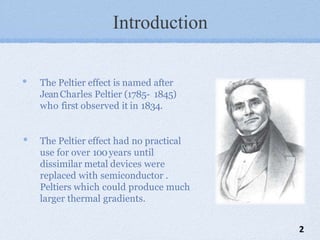
The Peltier effect is named after
JeanCharles Peltier (1785- 1845)
who first observed it in 1834.
The Peltier effect had no practical
use for over 100years until
dissimilar metal devices were
replaced with semiconductor .
Peltiers which could produce much
larger thermal gradients.
2
Literature Survey
3
REFERENCE Tools Used /Type of Study OBSERVATION
1. Rohit Sharma, Vivek Kumar
Sehgal, Nitin, Abhinav
Thakur, Adnan Munir Khan,
Ashish Sharma.
Implementation of solar power
to thermoelectric device
This paper demonstrates the
use of novel and innovative
technologies for
implementation of an air
conditioning system.
2. Reiyu Chein, Yehong
Chen.
Study Of Heat Sink In this paper a TEC integrated
with a microchannel heat sink
was employed to cool a fixed
amount of water in a tank with
an initial temperature.
3. K.N. Khamila, M.F.M.
Sabria, M.S.Sharuddin.
MATLAB / Simulink Modelling and Simulation of
the Performance Analysis for
Peltier Module and Seebeck
Module using
MATLAB/Simulink
Seebeck Effect
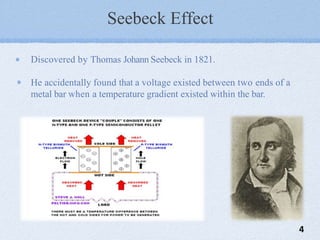
Discovered by Thomas Johann Seebeck in 1821.
He accidentally found that a voltage existed between two ends of a
metal bar when a temperature gradient existed within the bar.
4
What is a Peltier Cooler?
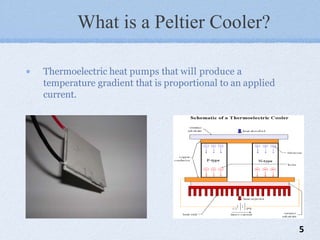
Thermoelectric heat pumps that will produce a
temperature gradient that is proportional to an applied
current.
5
Device Construction
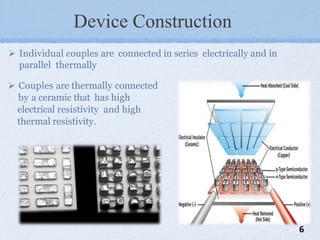
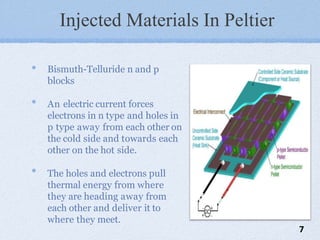
 Individual couples are connected in series electrically and in
parallel thermally
 Couples are thermally connected
by a ceramic that has high
electrical resistivity and high
thermal resistivity.
6
Injected Materials In Peltier
Bismuth-Telluride n and p
blocks
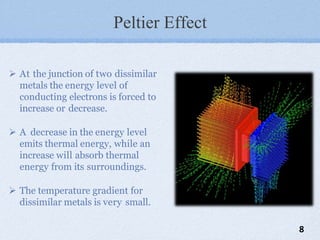
An electric current forces
electrons in n type and holes in
p type away from each other on
the cold side and towards each
other on the hot side.
The holes and electrons pull
thermal energy from where
they are heading away from
each other and deliver it to
where they meet.
7
Peltier Effect
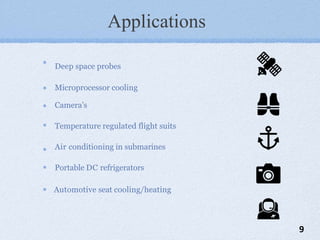
 At the junction of two dissimilar
metals the energy level of
conducting electrons is forced to
increase or decrease.
 A decrease in the energy level
emits thermal energy, while an
increase will absorb thermal
energy from its surroundings.
 The temperature gradient for
dissimilar metals is very small.
8
Applications
Deep space probes
Microprocessor cooling
Camera’s
Temperature regulated flight suits
Air conditioning in submarines
Portable DC refrigerators
Automotive seat cooling/heating
9
Pros and Cons
Pros
Solid state (no moving parts)
No maintenance
Long service lifetime
Cons
Large electrical power requirements
Inefficient compared to phase change cooling
10
Result’s Interms Of Performance - MATLAB
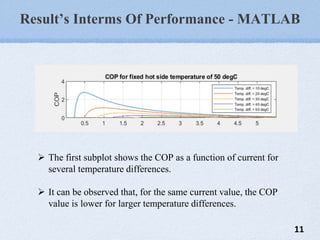
 The first subplot shows the COP as a function of current for
several temperature differences.
 It can be observed that, for the same current value, the COP
value is lower for larger temperature differences.
11
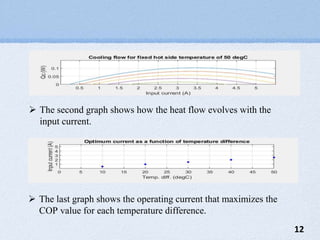
 The second graph shows how the heat flow evolves with the
input current.
 The last graph shows the operating current that maximizes the
COP value for each temperature difference.
12
References
 K.N.Khamila, Sabria, R.Mohamed, M.S.Sharuddin
Paper: Modelling and Simulation of the Performance Analysis for Peltier
Module and Seebeck Module using MATLAB/Simulink.
 Reiyu Chein, Yehong Chen
Paper : Performances of thermoelectric cooler integrated with microchannel
heat sinks.
 S. B. Riffatn,y and Xiaoli Ma
Paper: Improving the coefficient of performance of thermoelectric cooling
systems.
 http://www.heatsink-guide.com/content.php?content=peltierinfo.shtml,
 http://saturn.jpl.nasa.gov/index.cfm
13
14

Peltier Module As Thermo Electric Application

  • 1.
    “Study Of PeltierDevice as Thermoelectric Cooler” NITTE MEENAKSHI INSTITUTE OF TECHNOLOGY (Yelahanka, Bangalore – 560064) Name: Suraj D Naik USN : 1NT20ERE07 Mini Project On 1 Under the guidance of Mr. CH V Ramesh Asst Professor Department of Electrical and Electronics Engineering NMIT Department of Electrical and Electronics Engineering MTech in Renewable Energy
  • 2.
    Introduction The Peltier effectis named after JeanCharles Peltier (1785- 1845) who first observed it in 1834. The Peltier effect had no practical use for over 100years until dissimilar metal devices were replaced with semiconductor . Peltiers which could produce much larger thermal gradients. 2
  • 3.
    Literature Survey 3 REFERENCE ToolsUsed /Type of Study OBSERVATION 1. Rohit Sharma, Vivek Kumar Sehgal, Nitin, Abhinav Thakur, Adnan Munir Khan, Ashish Sharma. Implementation of solar power to thermoelectric device This paper demonstrates the use of novel and innovative technologies for implementation of an air conditioning system. 2. Reiyu Chein, Yehong Chen. Study Of Heat Sink In this paper a TEC integrated with a microchannel heat sink was employed to cool a fixed amount of water in a tank with an initial temperature. 3. K.N. Khamila, M.F.M. Sabria, M.S.Sharuddin. MATLAB / Simulink Modelling and Simulation of the Performance Analysis for Peltier Module and Seebeck Module using MATLAB/Simulink
  • 4.
    Seebeck Effect Discovered byThomas Johann Seebeck in 1821. He accidentally found that a voltage existed between two ends of a metal bar when a temperature gradient existed within the bar. 4
  • 5.
    What is aPeltier Cooler? Thermoelectric heat pumps that will produce a temperature gradient that is proportional to an applied current. 5
  • 6.
    Device Construction  Individualcouples are connected in series electrically and in parallel thermally  Couples are thermally connected by a ceramic that has high electrical resistivity and high thermal resistivity. 6
  • 7.
    Injected Materials InPeltier Bismuth-Telluride n and p blocks An electric current forces electrons in n type and holes in p type away from each other on the cold side and towards each other on the hot side. The holes and electrons pull thermal energy from where they are heading away from each other and deliver it to where they meet. 7
  • 8.
    Peltier Effect  Atthe junction of two dissimilar metals the energy level of conducting electrons is forced to increase or decrease.  A decrease in the energy level emits thermal energy, while an increase will absorb thermal energy from its surroundings.  The temperature gradient for dissimilar metals is very small. 8
  • 9.
    Applications Deep space probes Microprocessorcooling Camera’s Temperature regulated flight suits Air conditioning in submarines Portable DC refrigerators Automotive seat cooling/heating 9
  • 10.
    Pros and Cons Pros Solidstate (no moving parts) No maintenance Long service lifetime Cons Large electrical power requirements Inefficient compared to phase change cooling 10
  • 11.
    Result’s Interms OfPerformance - MATLAB  The first subplot shows the COP as a function of current for several temperature differences.  It can be observed that, for the same current value, the COP value is lower for larger temperature differences. 11
  • 12.
     The secondgraph shows how the heat flow evolves with the input current.  The last graph shows the operating current that maximizes the COP value for each temperature difference. 12
  • 13.
    References  K.N.Khamila, Sabria,R.Mohamed, M.S.Sharuddin Paper: Modelling and Simulation of the Performance Analysis for Peltier Module and Seebeck Module using MATLAB/Simulink.  Reiyu Chein, Yehong Chen Paper : Performances of thermoelectric cooler integrated with microchannel heat sinks.  S. B. Riffatn,y and Xiaoli Ma Paper: Improving the coefficient of performance of thermoelectric cooling systems.  http://www.heatsink-guide.com/content.php?content=peltierinfo.shtml,  http://saturn.jpl.nasa.gov/index.cfm 13
  • 14.