Parth P. Parekh Int. Journal of Engineering Research and Applications www.ijera.com 
ISSN : 2248-9622, Vol. 4, Issue 7( Version 2), July 2014, pp.09-13 
www.ijera.com 9 | P a g e 
Experimental and Exergy Analysis of A Double Pipe Heat Exchanger for Parallel Flow Arrangement Parth P. Parekh*, Dr.Neeraj K. Chavda** *M. E. Student, Department of Mechanical Engineering A.D.I.T., New V.V. Nagar, India **Associate Professor, Department of Mechanical Engineering, A.D.I.T., New V.V. Nagar, India ABSTRACT 
This paper presents For Experimental and Exergy Analysis of a Double Pipe Heat Exchanger for Parallel- flow Arrangement. The Double pipe heat exchanger is one of the Different types of heat exchangers. double- pipe exchanger because one fluid flows inside a pipe and the other fluid flows between that pipe and another pipe that surrounds the first.In a parallel flow, both the hot and cold fluids enter the Heatexchanger at same end andmove in same direction. The present work is taken up to carry experimental work and the exergy analysis based on second law analysis of a Double-Pipe Heat Exchanger. In experimental set up hot water and cold water will be used working fluids. The inlet Hot water will be varied from 40 0C and 50 0C and cold water temperature will be varied from between 15 and 20. It has been planned to find effects of the inlet condition of both working fluid flowing through the heat exchanger on the heat transfer characteristics, entropy generation, and Exergy loss. The Mathematical modelling of heat exchanger will based on the conservation equation of mass, energy and based on second law of thermodynamics to find entropy generation and exergy losses. 
I. INTRODUCTION 
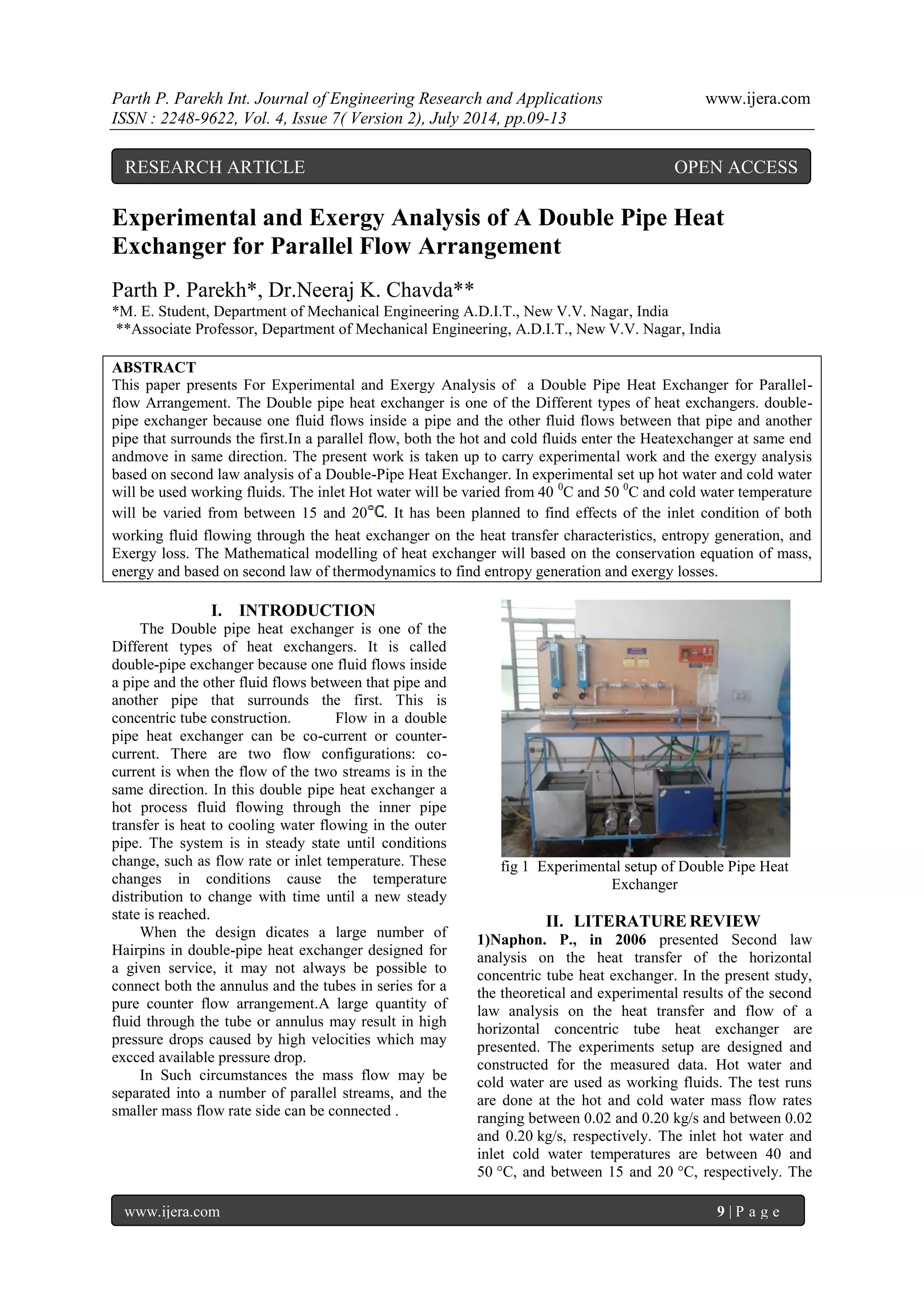
The Double pipe heat exchanger is one of the Different types of heat exchangers. It is called double-pipe exchanger because one fluid flows inside a pipe and the other fluid flows between that pipe and another pipe that surrounds the first. This is concentric tube construction. Flow in a double pipe heat exchanger can be co-current or counter- current. There are two flow configurations: co- current is when the flow of the two streams is in the same direction. In this double pipe heat exchanger a hot process fluid flowing through the inner pipe transfer is heat to cooling water flowing in the outer pipe. The system is in steady state until conditions change, such as flow rate or inlet temperature. These changes in conditions cause the temperature distribution to change with time until a new steady state is reached. When the design dicates a large number of Hairpins in double-pipe heat exchanger designed for a given service, it may not always be possible to connect both the annulus and the tubes in series for a pure counter flow arrangement.A large quantity of fluid through the tube or annulus may result in high pressure drops caused by high velocities which may excced available pressure drop. In Such circumstances the mass flow may be separated into a number of parallel streams, and the smaller mass flow rate side can be connected . 
fig 1 Experimental setup of Double Pipe Heat Exchanger 
II. LITERATURE REVIEW 
1)Naphon. P., in 2006 presented Second law analysis on the heat transfer of the horizontal concentric tube heat exchanger. In the present study, the theoretical and experimental results of the second law analysis on the heat transfer and flow of a horizontal concentric tube heat exchanger are presented. The experiments setup are designed and constructed for the measured data. Hot water and cold water are used as working fluids. The test runs are done at the hot and cold water mass flow rates ranging between 0.02 and 0.20 kg/s and between 0.02 and 0.20 kg/s, respectively. The inlet hot water and inlet cold water temperatures are between 40 and 50 °C, and between 15 and 20 °C, respectively. The 
RESEARCH ARTICLE OPEN ACCESS
Parth P. Parekh Int. Journal of Engineering Research and Applications www.ijera.com 
ISSN : 2248-9622, Vol. 4, Issue 7( Version 2), July 2014, pp.09-13 
www.ijera.com 10 | P a g e 
effects of the inlet conditions of both working fluids flowing through the heat exchanger on the heat transfer characteristics, entropy generation, and exergy loss are discussed. The mathematical model based on the conservation equations of energy is developed and solved by the central finite difference method to obtain temperature distribution, entropy generation, and exergy loss. 2)Hepbasil A., in 2013 presented Low exergy modelling and performance analysis of greenhouses coupled to closed earth-to-air heat exchangers (EAHEs) The present study deals with modelling, analyzing and assessing the performance of greenhouse heating systems with earth–pipe–air heat exchangers (EAHEs) in closed loop mode. In this regard, an EAHE system is considered as an illustrative example. This system starts with the power plant, through the production of heat (EAHE), via a distribution system, to the heating system and from there, via the greenhouse air, across the greenhouse envelope to the outside environment. 
III. EXPERIMENT ON DOUBLE PIPE HEAT EXCHANGER 
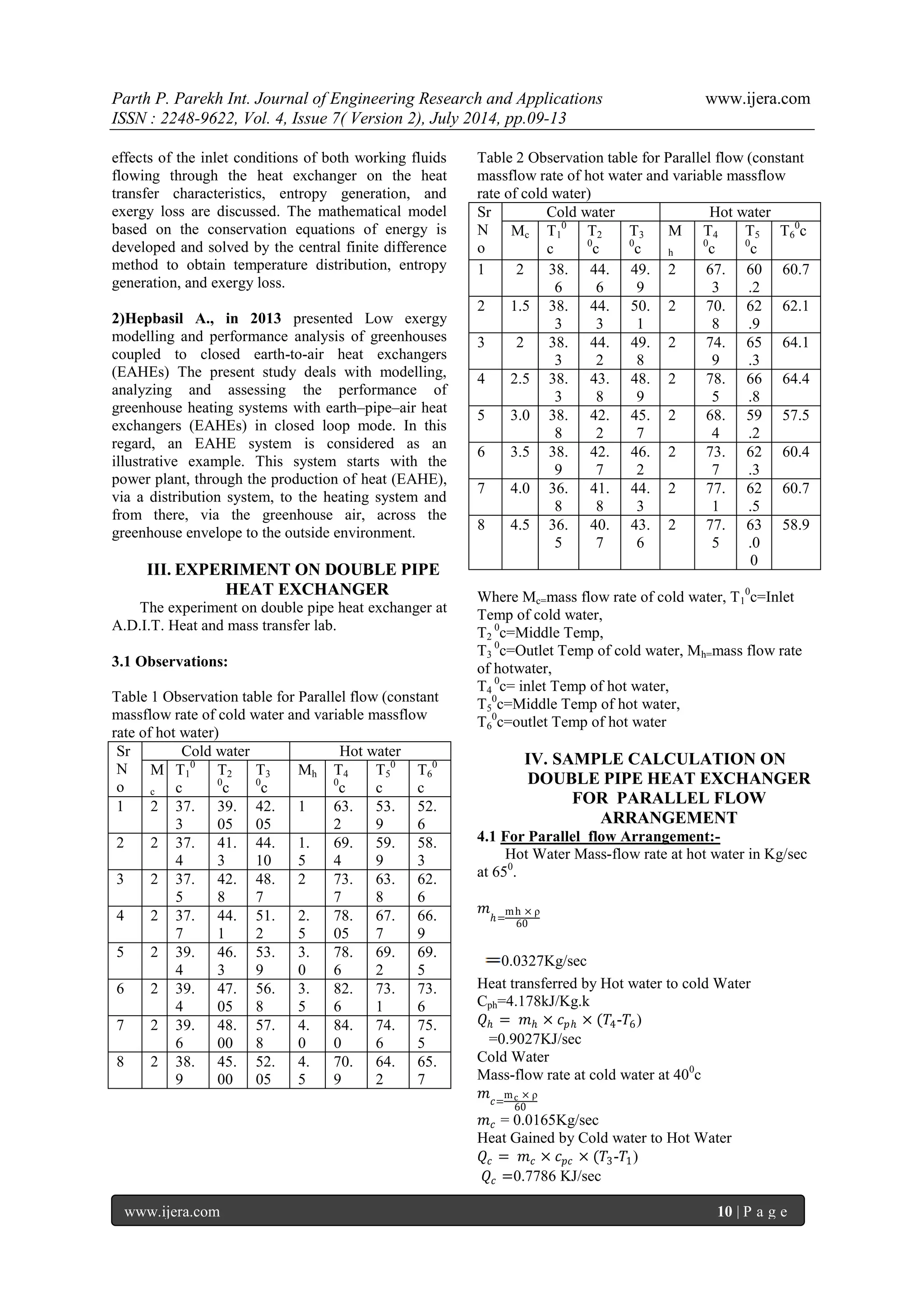
The experiment on double pipe heat exchanger at A.D.I.T. Heat and mass transfer lab. 3.1 Observations: Table 1 Observation table for Parallel flow (constant massflow rate of cold water and variable massflow rate of hot water) 
Sr No 
Cold water 
Hot water 
Mc 
T10c 
T2 0c 
T3 0c 
Mh 
T4 0c 
T50c 
T60c 
1 
2 
37.3 
39.05 
42.05 
1 
63.2 
53.9 
52.6 
2 
2 
37.4 
41.3 
44.10 
1.5 
69.4 
59.9 
58.3 
3 
2 
37.5 
42.8 
48.7 
2 
73.7 
63.8 
62.6 
4 
2 
37.7 
44.1 
51.2 
2.5 
78.05 
67.7 
66.9 
5 
2 
39.4 
46.3 
53.9 
3.0 
78.6 
69.2 
69.5 
6 
2 
39.4 
47.05 
56.8 
3.5 
82.6 
73.1 
73.6 
7 
2 
39.6 
48.00 
57.8 
4.0 
84.0 
74.6 
75.5 
8 
2 
38.9 
45.00 
52.05 
4.5 
70.9 
64.2 
65.7 
Table 2 Observation table for Parallel flow (constant massflow rate of hot water and variable massflow rate of cold water) 
Sr No 
Cold water 
Hot water 
Mc 
T10c 
T2 0c 
T3 0c 
Mh 
T4 0c 
T50c 
T60c 
1 
2 
38.6 
44.6 
49.9 
2 
67.3 
60.2 
60.7 
2 
1.5 
38.3 
44.3 
50.1 
2 
70.8 
62.9 
62.1 
3 
2 
38.3 
44.2 
49.8 
2 
74.9 
65.3 
64.1 
4 
2.5 
38.3 
43.8 
48.9 
2 
78.5 
66.8 
64.4 
5 
3.0 
38.8 
42.2 
45.7 
2 
68.4 
59.2 
57.5 
6 
3.5 
38.9 
42.7 
46.2 
2 
73.7 
62.3 
60.4 
7 
4.0 
36.8 
41.8 
44.3 
2 
77.1 
62.5 
60.7 
8 
4.5 
36.5 
40.7 
43.6 
2 
77.5 
63.00 
58.9 
Where Mc=mass flow rate of cold water, T10c=Inlet Temp of cold water, T2 0c=Middle Temp, T3 0c=Outlet Temp of cold water, Mh=mass flow rate of hotwater, T4 0c= inlet Temp of hot water, T50c=Middle Temp of hot water, T60c=outlet Temp of hot water 
IV. SAMPLE CALCULATION ON DOUBLE PIPE HEAT EXCHANGER FOR PARALLEL FLOW ARRANGEMENT 
4.1 For Parallel flow Arrangement:- Hot Water Mass-flow rate at hot water in Kg/sec at 650. 푚 푕= mh × ρ60 0.0327Kg/sec Heat transferred by Hot water to cold Water Cph=4.178kJ/Kg.k 푄푕= 푚푕×푐푝푕×(푇4-푇6) =0.9027KJ/sec Cold Water Mass-flow rate at cold water at 400c 푚 푐= mc × ρ60 푚푐 = 0.0165Kg/sec Heat Gained by Cold water to Hot Water 푄푐= 푚푐×푐푝푐×(푇3-푇1) 푄푐=0.7786 KJ/sec
Parth P. Parekh Int. Journal of Engineering Research and Applications www.ijera.com 
ISSN : 2248-9622, Vol. 4, Issue 7( Version 2), July 2014, pp.09-13 
www.ijera.com 11 | P a g e 
Average Heat Transfer Coefficient Q = 푄퐻+ 푄푐 2 Q =1.3333 KJ/sec Area A= π do L = .1696 m2 ΔT= T4−T1 − T6−T3 ln T4−T1 T6−T3 =18.31 0c Overall heat transfer co-efficient Uo= 푄 퐴×ΔT Uo= 0.2707 W/m2 0c CC = mc Cpc = 0.0.0689 Ch= mh Cph = 0.1368 Ch > Cc Considering case B in [Ref paper no 4 ] Cr = Cmin / Cmax =0.5037 Ɛ= T3−T1 T4−T1 = 0.3937 S! gen=(mcp)h× ln 푇6 푇4 +(mcp)cln 푇3 푇1 =0.0036 W/0c Entropy Generation Number Ns= S!genC min =0.0522 Exergy Loss I!=T0S! gen = 0.1426 Reynold Number For Hot Water at 650c V= 푚푕 휌×퐴푕 퐴푕= 휋 4×D2 퐴푕=1.767×10⁻⁴m2 V=0.1887 m/sec Re= 휌×푉×푑 휇 =6394.7126 Pr=2.77 at 650c f=(3.64log Re-3.28)-2 f=0.008945 Nu == (f/2)×(Re−1000)×pr1+12.7× 푓 2 0.5×((pr) 23−1) Nu =36.6042 Nu=hd/k Hhot= Nu×k/d Hhot(Thero)=1618.1497W/m2k QH= Hhot×A×(65-45) Hhot(Practical)=0.2661 W/m2k Reynold Number For Cold Water at 450c Ac=π/4 (Di2-do2) Ac=5.4978×10⁻⁴ m2 
푉퐶 = 푚푐 휌×퐴푐 
푉퐶 =0.0303 m/sec 
Pr=4.89 Dc=Di-d0 Dc =0.014m Re= 휌×푉×푑 휇 Re =704.7343 Re ˂ 2300 D/L=4.6667×10-3 Nu =3.657+ 0.0677× Re×pr×DL 1.331+0.1×pr Re×DL 0.33 Nu=4.6562 Nu=hcold×d/k hcold=212.9879 W/m2k Qc=hcold×A×(65-45) hcold(practical)=0.2295 W/m2k [ Table 3 Result Table Case-I] 
Sr No 
1 
2 
3 
4 
5 
6 
7 
8 
T1 
60.7 
62.1 
64.1 
64.4 
57.5 
60.4 
60.7 
58.9 
T2 
49.9 
50.1 
49.8 
48.9 
45.7 
46.2 
44.3 
43.6 
푀푕 
0.0327 
0.0327 
0.0326 
0.0326 
0.0328 
0.0327 
0.0326 
0.0326 
푀푐 
0.0165 
0.0248 
0.033 
0.0413 
0.0496 
0.0579 
0.0615 
0.0744 
푄푕 
0.9027 
1.1899 
1.4742 
1.9246 
1.4937 
1.819 
2.2385 
2.5388 
푄푐 
0.7786 
1.1703 
1.5848 
1.8282 
1.4285 
1.7642 
1.9253 
2.2049 
퐻푕표푡(푃푟푎푐) 
0.26661 
0.3508 
0.3477 
0.4539 
0.44036 
0.429 
0.4399 
0.4989 
퐻푕표푡(푡푕푒표) 
1618.1497 
1618.1497 
1684.9024 
1684.9024 
1543.7251 
1618.1497 
1684.8712 
1684.8712 
퐻푐표푙푑(푃푟푎푐) 
0.2295 
0.345 
0.3738 
0.4312 
0.4211 
0.4161 
0.3784 
0.4333 
퐻푐표푙푑(푇푕푒표) 
212.9879 
284.5708 
331.1783 
380.5531 
376.394 
418.3046 
634.4367 
824.1156 
푈0(푃푟푎푐) 
0.2707 
0.3376 
0.38 
0.4268 
0.4452 
0.4597 
0.4618 
0.5365
Parth P. Parekh Int. Journal of Engineering Research and Applications www.ijera.com 
ISSN : 2248-9622, Vol. 4, Issue 7( Version 2), July 2014, pp.09-13 
www.ijera.com 12 | P a g e 
푈0(푇푕푒표) 
163.5088 
202.6392 
226.7111 
248.8057 
243.112 
262.372 
336.9715 
383.9052 
€ 
0.5113 
0.4809 
0.2951 
0.3507 
0.3682 
0.3822 
0.4069 
0.4537 
푆푔푒푛 
0.0036 
0.0087 
0.0149 
0.0151 
0.0109 
0.0144 
0.015 
0. 0177 
푁푠 
0.0522 
0.0839 
0.1092 
0.1106 
0.0737 
0.1053 
0.1099 
0.1297 
퐼! 
0.1426 
0.3445 
0.59 
0.5979 
0.3999 
0.5702 
0.594 
0.7009 
Sr No 
1 
2 
3 
4 
5 
6 
7 
8 
T1 
52.6 
58.3 
62.6 
66.9 
69.5 
73.6 
75.5 
65.7 
T2 
42.05 
44.1 
48.7 
51.2 
53.9 
56.8 
57.8 
52.05 
푀푕 
0.0164 
0.0246 
0.0327 
0.0407 
0.0487 
0.0569 
0.0648 
0.0735 
푀푐 
0.0331 
0.0331 
0.0331 
0.033 
0.033 
0.033 
0.0329 
0.033 
푄푕 
0.7263 
1.1408 
1.5181 
1.9 
1.8587 
2.1462 
2.3106 
1.5986 
푄푐 
0.6563 
0.9257 
1.5474 
1.8604 
2.0006 
2.3979 
2.5017 
1.8122 
퐻푕표푡(푃푟푎푐) 
0.2855 
0.3363 
0.358 
0.4481 
0.3653 
0.4218 
0.4541 
0.3142 
퐻푕표푡(푡푕푒표) 
676.593 
2131.3773 
1618.1497 
2066.8433 
2512.8589 
2877.5357 
3298.47 
3355.9093 
퐻푐표푙푑(푃푟푎푐) 
0.2579 
0.2729 
0.3649 
0.4388 
0.3932 
0.4713 
0.4917 
0.5343 
퐻푐표푙푑(푇푕푒표) 
296.4418 
173.4659 
296.4418 
331.1783 
331.192 
331.192 
306.3589 
331.1783 
푈0(푃푟푎푐) 
0.2385 
0.2781 
0.3879 
0.4245 
0.4443 
0.4793 
0.4887 
0.4668 
푈0(푇푕푒표) 
171 
14 
208. 
23 
239 
24 
23 
24 
.6417 
2.7142 
5906 
3.6836 
.4561 
2.9773 
2.1748 
6.5319 
€ 
0.4093 
0.3469 
0.3066 
0.3346 
0.3699 
0.4028 
0.4099 
0.4109 
푆푔푒푛 
0.004 
0.0049 
0.0138 
0.0159 
0.0181 
0.0229 
0.023 
0.0167 
푁푠 
0.0584 
0.0477 
0.1009 
0.1154 
0.1312 
0.1662 
0.1673 
0.1212 
퐼! 
0.1584 
0.194 
0.5465 
0.6296 
0.7168 
0.9068 
0.9108 
0.6613 
[Table 4 Result Table for Parallel Flow(case-II).] 
Fig 2 Fig 2 shows that Effectiveness of the case1 is higher to the effectiveness of the case-2.Fig 2 indicate the Effectiveness vs No of Reading. 
Fig 3 Fig 3 shows that Entropy generation of case2 is higher to the Entropy generation of the case-1.Fig 3 indicate the Entropy generation vs No of Reading.
Parth P. Parekh Int. Journal of Engineering Research and Applications www.ijera.com 
ISSN : 2248-9622, Vol. 4, Issue 7( Version 2), July 2014, pp.09-13 
www.ijera.com 13 | P a g e 
Fig 4 Fig 4 shows that Entropy generation Number of case2 is higher to the Entropy generation Number of the case-1.Fig 4 indicate the Entropy generation Number vs No of Reading. Fig 5shows that Overall Heat Transfer Co- efficient-Practicalof case1 is a Gradually Higher to the Overall Heat Transfer Co-efficient-Practical of the case-2.Fig 5 indicate the Overall Heat Transfer Co-efficient Practical vs No of Reading. 
Fig 6 Fig 6 shows that Overall Heat Transfer Co- efficient-Theoraticalof case1 is higher to the Overall Heat Transfer Co-efficient –Theoratical of the case- 2.Fig 6 indicate the Overall Heat Transfer Co- efficient-Theoretical vs No of Reading. Fig 7 shows that Exergy lossof case2 is higher to the of the Exergy lossof case-1.Fig 7 indicate the Exergy loss vs No of Reading. 
Fig 7 
V. Conclusion 
The Second Law analysis on the Heat Transfer of Horizontal Double tube Heat exchanger are presented. The Outcome of the Double Pipe Heat Exchanger for a parallel Arrangement. 
 As the const mc and varies mh Effectiveness is higher to the const mh and varies mc 
 As the const mh and Varies mc Entropy Generation is higher to const mc and varies mh. 
 As the const mh and Varies mc Entropy Generation no is higher to const mc and varies mh. 
 As the const mc and varies mh overall heat transfer coefficient practical is higher to the const mh and Varies mc. 
 As the const mc and varies mh overall heat transfer coefficient theoretical is higher to the const mh and Varies mc. 
 As the const mh and Varies mc Exergy Loss is Higher to the const mc and varies mh. 
References 
[1] Khairul M.A; Heat transfer performance and exergy analyses of a corrugated plate heat exchanger using metal oxide nano fluids. International Communications in Heat and Mass Transfer.,2013. 
[2] Hepbasil. A; Low exergy modelling and performance analysis of greenhouses coupled to closed earth-to-air heat exchangers (EAHEs) ., Energy and Buildings,2013, Volume 64, Pages 224-230. 
[3] Qureshi .B .A and Zubair. S.M; Second- law-based performance evaluation of cooling towers and evaporative heat exchangers, International Journal of Thermal Sciences, 2007; Pages 188-198. 
[4] Naphon. P.; Second law analysis on the heat transfer of the horizontal concentric tube heat exchanger. International Communications in Heat and Mass Transfer,2006; Pages 1029-1041. 
[5] Akpinarn. K. E and Bicer; Investigation of heat transfer and exergy loss in a concentric double pipe exchanger equipped with swirl generators, International Journal of Thermal Sciences,2005, Pages 598-607.

Experimental and Exergy Analysis of A Double Pipe Heat Exchanger for Parallel Flow Arrangement

  • 1.
    Parth P. ParekhInt. Journal of Engineering Research and Applications www.ijera.com ISSN : 2248-9622, Vol. 4, Issue 7( Version 2), July 2014, pp.09-13 www.ijera.com 9 | P a g e Experimental and Exergy Analysis of A Double Pipe Heat Exchanger for Parallel Flow Arrangement Parth P. Parekh*, Dr.Neeraj K. Chavda** *M. E. Student, Department of Mechanical Engineering A.D.I.T., New V.V. Nagar, India **Associate Professor, Department of Mechanical Engineering, A.D.I.T., New V.V. Nagar, India ABSTRACT This paper presents For Experimental and Exergy Analysis of a Double Pipe Heat Exchanger for Parallel- flow Arrangement. The Double pipe heat exchanger is one of the Different types of heat exchangers. double- pipe exchanger because one fluid flows inside a pipe and the other fluid flows between that pipe and another pipe that surrounds the first.In a parallel flow, both the hot and cold fluids enter the Heatexchanger at same end andmove in same direction. The present work is taken up to carry experimental work and the exergy analysis based on second law analysis of a Double-Pipe Heat Exchanger. In experimental set up hot water and cold water will be used working fluids. The inlet Hot water will be varied from 40 0C and 50 0C and cold water temperature will be varied from between 15 and 20. It has been planned to find effects of the inlet condition of both working fluid flowing through the heat exchanger on the heat transfer characteristics, entropy generation, and Exergy loss. The Mathematical modelling of heat exchanger will based on the conservation equation of mass, energy and based on second law of thermodynamics to find entropy generation and exergy losses. I. INTRODUCTION The Double pipe heat exchanger is one of the Different types of heat exchangers. It is called double-pipe exchanger because one fluid flows inside a pipe and the other fluid flows between that pipe and another pipe that surrounds the first. This is concentric tube construction. Flow in a double pipe heat exchanger can be co-current or counter- current. There are two flow configurations: co- current is when the flow of the two streams is in the same direction. In this double pipe heat exchanger a hot process fluid flowing through the inner pipe transfer is heat to cooling water flowing in the outer pipe. The system is in steady state until conditions change, such as flow rate or inlet temperature. These changes in conditions cause the temperature distribution to change with time until a new steady state is reached. When the design dicates a large number of Hairpins in double-pipe heat exchanger designed for a given service, it may not always be possible to connect both the annulus and the tubes in series for a pure counter flow arrangement.A large quantity of fluid through the tube or annulus may result in high pressure drops caused by high velocities which may excced available pressure drop. In Such circumstances the mass flow may be separated into a number of parallel streams, and the smaller mass flow rate side can be connected . fig 1 Experimental setup of Double Pipe Heat Exchanger II. LITERATURE REVIEW 1)Naphon. P., in 2006 presented Second law analysis on the heat transfer of the horizontal concentric tube heat exchanger. In the present study, the theoretical and experimental results of the second law analysis on the heat transfer and flow of a horizontal concentric tube heat exchanger are presented. The experiments setup are designed and constructed for the measured data. Hot water and cold water are used as working fluids. The test runs are done at the hot and cold water mass flow rates ranging between 0.02 and 0.20 kg/s and between 0.02 and 0.20 kg/s, respectively. The inlet hot water and inlet cold water temperatures are between 40 and 50 °C, and between 15 and 20 °C, respectively. The RESEARCH ARTICLE OPEN ACCESS
  • 2.
    Parth P. ParekhInt. Journal of Engineering Research and Applications www.ijera.com ISSN : 2248-9622, Vol. 4, Issue 7( Version 2), July 2014, pp.09-13 www.ijera.com 10 | P a g e effects of the inlet conditions of both working fluids flowing through the heat exchanger on the heat transfer characteristics, entropy generation, and exergy loss are discussed. The mathematical model based on the conservation equations of energy is developed and solved by the central finite difference method to obtain temperature distribution, entropy generation, and exergy loss. 2)Hepbasil A., in 2013 presented Low exergy modelling and performance analysis of greenhouses coupled to closed earth-to-air heat exchangers (EAHEs) The present study deals with modelling, analyzing and assessing the performance of greenhouse heating systems with earth–pipe–air heat exchangers (EAHEs) in closed loop mode. In this regard, an EAHE system is considered as an illustrative example. This system starts with the power plant, through the production of heat (EAHE), via a distribution system, to the heating system and from there, via the greenhouse air, across the greenhouse envelope to the outside environment. III. EXPERIMENT ON DOUBLE PIPE HEAT EXCHANGER The experiment on double pipe heat exchanger at A.D.I.T. Heat and mass transfer lab. 3.1 Observations: Table 1 Observation table for Parallel flow (constant massflow rate of cold water and variable massflow rate of hot water) Sr No Cold water Hot water Mc T10c T2 0c T3 0c Mh T4 0c T50c T60c 1 2 37.3 39.05 42.05 1 63.2 53.9 52.6 2 2 37.4 41.3 44.10 1.5 69.4 59.9 58.3 3 2 37.5 42.8 48.7 2 73.7 63.8 62.6 4 2 37.7 44.1 51.2 2.5 78.05 67.7 66.9 5 2 39.4 46.3 53.9 3.0 78.6 69.2 69.5 6 2 39.4 47.05 56.8 3.5 82.6 73.1 73.6 7 2 39.6 48.00 57.8 4.0 84.0 74.6 75.5 8 2 38.9 45.00 52.05 4.5 70.9 64.2 65.7 Table 2 Observation table for Parallel flow (constant massflow rate of hot water and variable massflow rate of cold water) Sr No Cold water Hot water Mc T10c T2 0c T3 0c Mh T4 0c T50c T60c 1 2 38.6 44.6 49.9 2 67.3 60.2 60.7 2 1.5 38.3 44.3 50.1 2 70.8 62.9 62.1 3 2 38.3 44.2 49.8 2 74.9 65.3 64.1 4 2.5 38.3 43.8 48.9 2 78.5 66.8 64.4 5 3.0 38.8 42.2 45.7 2 68.4 59.2 57.5 6 3.5 38.9 42.7 46.2 2 73.7 62.3 60.4 7 4.0 36.8 41.8 44.3 2 77.1 62.5 60.7 8 4.5 36.5 40.7 43.6 2 77.5 63.00 58.9 Where Mc=mass flow rate of cold water, T10c=Inlet Temp of cold water, T2 0c=Middle Temp, T3 0c=Outlet Temp of cold water, Mh=mass flow rate of hotwater, T4 0c= inlet Temp of hot water, T50c=Middle Temp of hot water, T60c=outlet Temp of hot water IV. SAMPLE CALCULATION ON DOUBLE PIPE HEAT EXCHANGER FOR PARALLEL FLOW ARRANGEMENT 4.1 For Parallel flow Arrangement:- Hot Water Mass-flow rate at hot water in Kg/sec at 650. 푚 푕= mh × ρ60 0.0327Kg/sec Heat transferred by Hot water to cold Water Cph=4.178kJ/Kg.k 푄푕= 푚푕×푐푝푕×(푇4-푇6) =0.9027KJ/sec Cold Water Mass-flow rate at cold water at 400c 푚 푐= mc × ρ60 푚푐 = 0.0165Kg/sec Heat Gained by Cold water to Hot Water 푄푐= 푚푐×푐푝푐×(푇3-푇1) 푄푐=0.7786 KJ/sec
  • 3.
    Parth P. ParekhInt. Journal of Engineering Research and Applications www.ijera.com ISSN : 2248-9622, Vol. 4, Issue 7( Version 2), July 2014, pp.09-13 www.ijera.com 11 | P a g e Average Heat Transfer Coefficient Q = 푄퐻+ 푄푐 2 Q =1.3333 KJ/sec Area A= π do L = .1696 m2 ΔT= T4−T1 − T6−T3 ln T4−T1 T6−T3 =18.31 0c Overall heat transfer co-efficient Uo= 푄 퐴×ΔT Uo= 0.2707 W/m2 0c CC = mc Cpc = 0.0.0689 Ch= mh Cph = 0.1368 Ch > Cc Considering case B in [Ref paper no 4 ] Cr = Cmin / Cmax =0.5037 Ɛ= T3−T1 T4−T1 = 0.3937 S! gen=(mcp)h× ln 푇6 푇4 +(mcp)cln 푇3 푇1 =0.0036 W/0c Entropy Generation Number Ns= S!genC min =0.0522 Exergy Loss I!=T0S! gen = 0.1426 Reynold Number For Hot Water at 650c V= 푚푕 휌×퐴푕 퐴푕= 휋 4×D2 퐴푕=1.767×10⁻⁴m2 V=0.1887 m/sec Re= 휌×푉×푑 휇 =6394.7126 Pr=2.77 at 650c f=(3.64log Re-3.28)-2 f=0.008945 Nu == (f/2)×(Re−1000)×pr1+12.7× 푓 2 0.5×((pr) 23−1) Nu =36.6042 Nu=hd/k Hhot= Nu×k/d Hhot(Thero)=1618.1497W/m2k QH= Hhot×A×(65-45) Hhot(Practical)=0.2661 W/m2k Reynold Number For Cold Water at 450c Ac=π/4 (Di2-do2) Ac=5.4978×10⁻⁴ m2 푉퐶 = 푚푐 휌×퐴푐 푉퐶 =0.0303 m/sec Pr=4.89 Dc=Di-d0 Dc =0.014m Re= 휌×푉×푑 휇 Re =704.7343 Re ˂ 2300 D/L=4.6667×10-3 Nu =3.657+ 0.0677× Re×pr×DL 1.331+0.1×pr Re×DL 0.33 Nu=4.6562 Nu=hcold×d/k hcold=212.9879 W/m2k Qc=hcold×A×(65-45) hcold(practical)=0.2295 W/m2k [ Table 3 Result Table Case-I] Sr No 1 2 3 4 5 6 7 8 T1 60.7 62.1 64.1 64.4 57.5 60.4 60.7 58.9 T2 49.9 50.1 49.8 48.9 45.7 46.2 44.3 43.6 푀푕 0.0327 0.0327 0.0326 0.0326 0.0328 0.0327 0.0326 0.0326 푀푐 0.0165 0.0248 0.033 0.0413 0.0496 0.0579 0.0615 0.0744 푄푕 0.9027 1.1899 1.4742 1.9246 1.4937 1.819 2.2385 2.5388 푄푐 0.7786 1.1703 1.5848 1.8282 1.4285 1.7642 1.9253 2.2049 퐻푕표푡(푃푟푎푐) 0.26661 0.3508 0.3477 0.4539 0.44036 0.429 0.4399 0.4989 퐻푕표푡(푡푕푒표) 1618.1497 1618.1497 1684.9024 1684.9024 1543.7251 1618.1497 1684.8712 1684.8712 퐻푐표푙푑(푃푟푎푐) 0.2295 0.345 0.3738 0.4312 0.4211 0.4161 0.3784 0.4333 퐻푐표푙푑(푇푕푒표) 212.9879 284.5708 331.1783 380.5531 376.394 418.3046 634.4367 824.1156 푈0(푃푟푎푐) 0.2707 0.3376 0.38 0.4268 0.4452 0.4597 0.4618 0.5365
  • 4.
    Parth P. ParekhInt. Journal of Engineering Research and Applications www.ijera.com ISSN : 2248-9622, Vol. 4, Issue 7( Version 2), July 2014, pp.09-13 www.ijera.com 12 | P a g e 푈0(푇푕푒표) 163.5088 202.6392 226.7111 248.8057 243.112 262.372 336.9715 383.9052 € 0.5113 0.4809 0.2951 0.3507 0.3682 0.3822 0.4069 0.4537 푆푔푒푛 0.0036 0.0087 0.0149 0.0151 0.0109 0.0144 0.015 0. 0177 푁푠 0.0522 0.0839 0.1092 0.1106 0.0737 0.1053 0.1099 0.1297 퐼! 0.1426 0.3445 0.59 0.5979 0.3999 0.5702 0.594 0.7009 Sr No 1 2 3 4 5 6 7 8 T1 52.6 58.3 62.6 66.9 69.5 73.6 75.5 65.7 T2 42.05 44.1 48.7 51.2 53.9 56.8 57.8 52.05 푀푕 0.0164 0.0246 0.0327 0.0407 0.0487 0.0569 0.0648 0.0735 푀푐 0.0331 0.0331 0.0331 0.033 0.033 0.033 0.0329 0.033 푄푕 0.7263 1.1408 1.5181 1.9 1.8587 2.1462 2.3106 1.5986 푄푐 0.6563 0.9257 1.5474 1.8604 2.0006 2.3979 2.5017 1.8122 퐻푕표푡(푃푟푎푐) 0.2855 0.3363 0.358 0.4481 0.3653 0.4218 0.4541 0.3142 퐻푕표푡(푡푕푒표) 676.593 2131.3773 1618.1497 2066.8433 2512.8589 2877.5357 3298.47 3355.9093 퐻푐표푙푑(푃푟푎푐) 0.2579 0.2729 0.3649 0.4388 0.3932 0.4713 0.4917 0.5343 퐻푐표푙푑(푇푕푒표) 296.4418 173.4659 296.4418 331.1783 331.192 331.192 306.3589 331.1783 푈0(푃푟푎푐) 0.2385 0.2781 0.3879 0.4245 0.4443 0.4793 0.4887 0.4668 푈0(푇푕푒표) 171 14 208. 23 239 24 23 24 .6417 2.7142 5906 3.6836 .4561 2.9773 2.1748 6.5319 € 0.4093 0.3469 0.3066 0.3346 0.3699 0.4028 0.4099 0.4109 푆푔푒푛 0.004 0.0049 0.0138 0.0159 0.0181 0.0229 0.023 0.0167 푁푠 0.0584 0.0477 0.1009 0.1154 0.1312 0.1662 0.1673 0.1212 퐼! 0.1584 0.194 0.5465 0.6296 0.7168 0.9068 0.9108 0.6613 [Table 4 Result Table for Parallel Flow(case-II).] Fig 2 Fig 2 shows that Effectiveness of the case1 is higher to the effectiveness of the case-2.Fig 2 indicate the Effectiveness vs No of Reading. Fig 3 Fig 3 shows that Entropy generation of case2 is higher to the Entropy generation of the case-1.Fig 3 indicate the Entropy generation vs No of Reading.
  • 5.
    Parth P. ParekhInt. Journal of Engineering Research and Applications www.ijera.com ISSN : 2248-9622, Vol. 4, Issue 7( Version 2), July 2014, pp.09-13 www.ijera.com 13 | P a g e Fig 4 Fig 4 shows that Entropy generation Number of case2 is higher to the Entropy generation Number of the case-1.Fig 4 indicate the Entropy generation Number vs No of Reading. Fig 5shows that Overall Heat Transfer Co- efficient-Practicalof case1 is a Gradually Higher to the Overall Heat Transfer Co-efficient-Practical of the case-2.Fig 5 indicate the Overall Heat Transfer Co-efficient Practical vs No of Reading. Fig 6 Fig 6 shows that Overall Heat Transfer Co- efficient-Theoraticalof case1 is higher to the Overall Heat Transfer Co-efficient –Theoratical of the case- 2.Fig 6 indicate the Overall Heat Transfer Co- efficient-Theoretical vs No of Reading. Fig 7 shows that Exergy lossof case2 is higher to the of the Exergy lossof case-1.Fig 7 indicate the Exergy loss vs No of Reading. Fig 7 V. Conclusion The Second Law analysis on the Heat Transfer of Horizontal Double tube Heat exchanger are presented. The Outcome of the Double Pipe Heat Exchanger for a parallel Arrangement.  As the const mc and varies mh Effectiveness is higher to the const mh and varies mc  As the const mh and Varies mc Entropy Generation is higher to const mc and varies mh.  As the const mh and Varies mc Entropy Generation no is higher to const mc and varies mh.  As the const mc and varies mh overall heat transfer coefficient practical is higher to the const mh and Varies mc.  As the const mc and varies mh overall heat transfer coefficient theoretical is higher to the const mh and Varies mc.  As the const mh and Varies mc Exergy Loss is Higher to the const mc and varies mh. References [1] Khairul M.A; Heat transfer performance and exergy analyses of a corrugated plate heat exchanger using metal oxide nano fluids. International Communications in Heat and Mass Transfer.,2013. [2] Hepbasil. A; Low exergy modelling and performance analysis of greenhouses coupled to closed earth-to-air heat exchangers (EAHEs) ., Energy and Buildings,2013, Volume 64, Pages 224-230. [3] Qureshi .B .A and Zubair. S.M; Second- law-based performance evaluation of cooling towers and evaporative heat exchangers, International Journal of Thermal Sciences, 2007; Pages 188-198. [4] Naphon. P.; Second law analysis on the heat transfer of the horizontal concentric tube heat exchanger. International Communications in Heat and Mass Transfer,2006; Pages 1029-1041. [5] Akpinarn. K. E and Bicer; Investigation of heat transfer and exergy loss in a concentric double pipe exchanger equipped with swirl generators, International Journal of Thermal Sciences,2005, Pages 598-607.