Rangsima Poomsawat
Department of Public Health Nursing
Faculty of Nursing ,CMU.
E mail: rangsima.p@cmu.ac.th
Facebook: Nursing Room by Rangsima
Slideshare: Nursing Room by Rangsima
2
วัตถุประสงค์
 อธิบายวิธีการซักประวัติ เกี่ยวกับอาการที่เกี่ยวข้องกับ
ระบบประสาทได้
 บอกหลักการสาคัญในการตรวจร่างกายระบบ
ประสาทได้
 อธิบายขั้นตอนและแปลผลการตรวจร่างกายระบบ
ประสาทได้
 บอกการตรวจทางห้องปฏิบัติการและการตรวจพิเศษ
เบื้องต้นที่เกี่ยวข้องกับระบบประสาทได้
3
Symptoms
 อาการปวดศีรษะ - Headache
 อาการอ่อนแรง - Weakness
 อาการชัก - Convulsion
 อาการเวียนศีรษะ - Dizziness
 การเปลี่ยนแปลงความรู้สึกตัว – Alter of
consciousness
 อาเจียนพุ่ง – Projectile vomiting
4
Neurological Assessment
 Cerebral Function
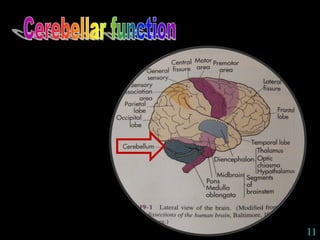
 Cerebellar Function
 Cranial nerve
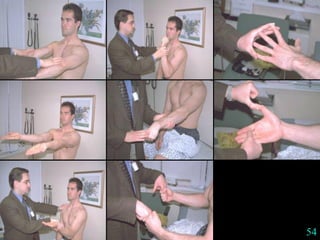
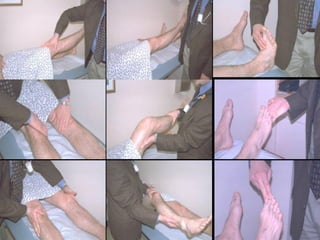
 Motor System
 Sensory System
 Reflexes
 Meningeal Irritation
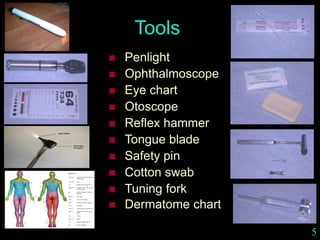
Tools
 Penlight
 Ophthalmoscope
 Eye chart
 Otoscope
 Reflex hammer
 Tongue blade
 Safety pin
 Cotton swab
 Tuning fork
 Dermatome chart
5
6
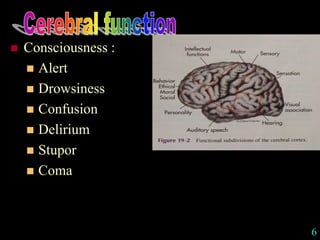
 Consciousness :
 Alert
 Drowsiness
 Confusion
 Delirium
 Stupor
 Coma
7
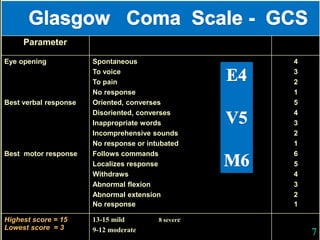
Parameter
Eye opening
Best verbal response
Best motor response
Spontaneous
To voice
To pain
No response
Oriented, converses
Disoriented, converses
Inappropriate words
Incomprehensive sounds
No response or intubated
Follows commands
Localizes response
Withdraws
Abnormal flexion
Abnormal extension
No response
4
3
2
1
5
4
3
2
1
6
5
4
3
2
1
Highest score = 15
Lowest score = 3
13-15 mild 8 severe
9-12 moderate
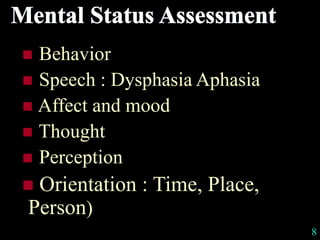
 Behavior
 Speech : Dysphasia Aphasia
 Affect and mood
 Thought
 Perception
 Orientation : Time, Place,
Person)
8
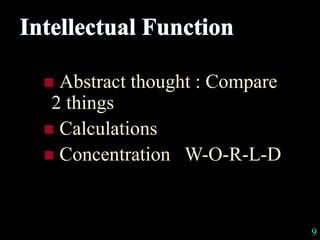
 Abstract thought : Compare
2 things
 Calculations
 Concentration W-O-R-L-D
9
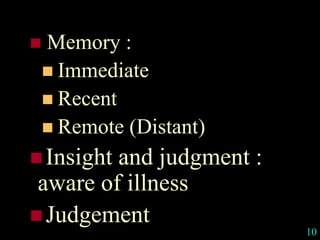
 Memory :
 Immediate
 Recent
 Remote (Distant)
Insight and judgment :
aware of illness
Judgement
10
11
12
13
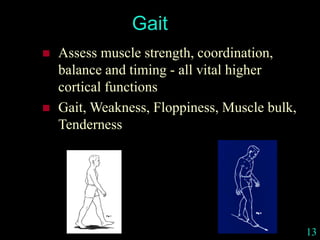
Gait
 Assess muscle strength, coordination,
balance and timing - all vital higher
cortical functions
 Gait, Weakness, Floppiness, Muscle bulk,
Tenderness
14
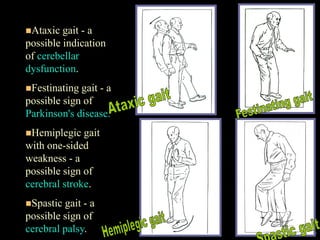
Ataxic gait - a
possible indication
of cerebellar
dysfunction.
Festinating gait - a
possible sign of
Parkinson's disease.
Hemiplegic gait
with one-sided
weakness - a
possible sign of
cerebral stroke.
Spastic gait - a
possible sign of
cerebral palsy.
15
16
17
18
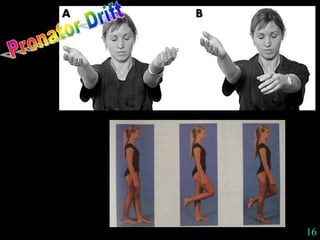
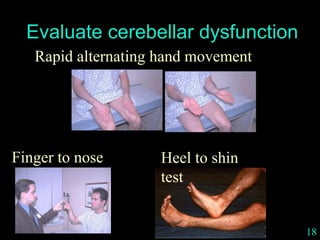
Evaluate cerebellar dysfunction
Rapid alternating hand movement
Heel to shin
test
Finger to nose
19
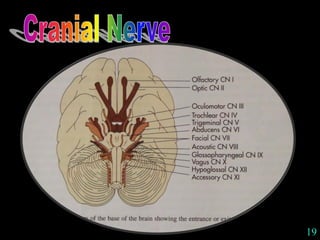
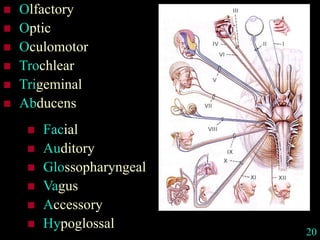
 Olfactory
 Optic
 Oculomotor
 Trochlear
 Trigeminal
 Abducens
 Facial
 Auditory
 Glossopharyngeal
 Vagus
 Accessory
 Hypoglossal
20
21
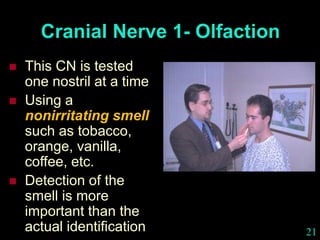
Cranial Nerve 1- Olfaction
 This CN is tested
one nostril at a time
 Using a
nonirritating smell
such as tobacco,
orange, vanilla,
coffee, etc.
 Detection of the
smell is more
important than the
actual identification
22
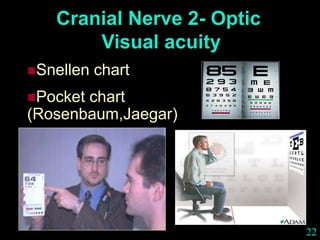
Cranial Nerve 2- Optic
Visual acuity
Snellen chart
Pocket chart
(Rosenbaum,Jaegar)
23
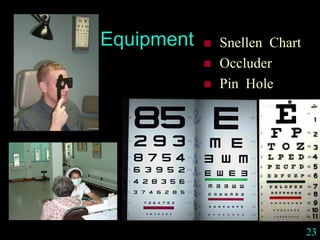
Equipment  Snellen Chart
 Occluder
 Pin Hole
24
25
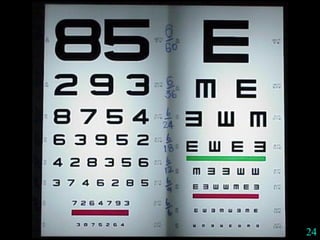
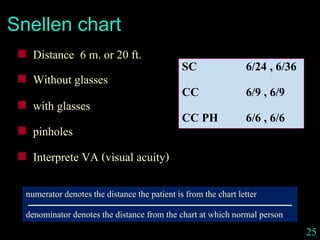
Snellen chart
 Distance 6 m. or 20 ft.
 Without glasses
 with glasses
 pinholes
 Interprete VA (visual acuity)
SC 6/24 , 6/36
CC 6/9 , 6/9
CC PH 6/6 , 6/6
numerator denotes the distance the patient is from the chart letter
denominator denotes the distance from the chart at which normal person
26
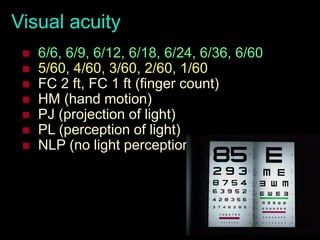
Visual acuity
 6/6, 6/9, 6/12, 6/18, 6/24, 6/36, 6/60
 5/60, 4/60, 3/60, 2/60, 1/60
 FC 2 ft, FC 1 ft (finger count)
 HM (hand motion)
 PJ (projection of light)
 PL (perception of light)
 NLP (no light perception)
27
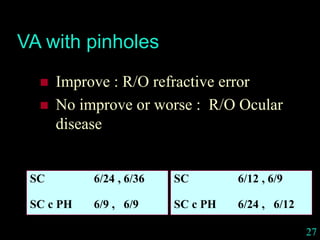
VA with pinholes
 Improve : R/O refractive error
 No improve or worse : R/O Ocular
disease
SC 6/24 , 6/36
SC c PH 6/9 , 6/9
SC 6/12 , 6/9
SC c PH 6/24 , 6/12
28
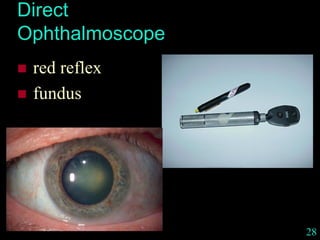
Direct
Ophthalmoscope
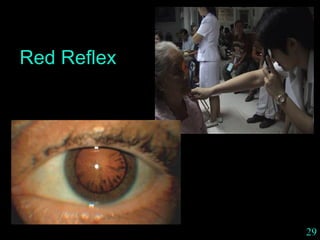
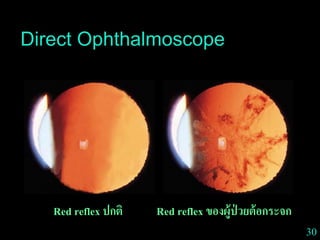
 red reflex
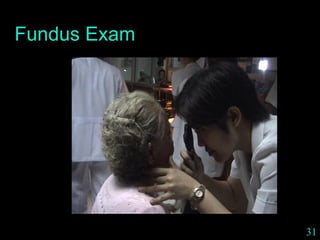
 fundus
29
Red Reflex
30
Direct Ophthalmoscope
Red reflex ปกติ Red reflex ของผู้ป่ วยต้อกระจก
31
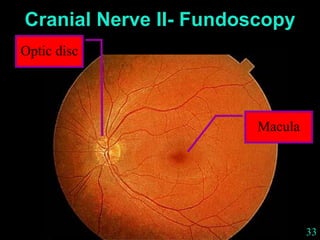
Fundus Exam
32
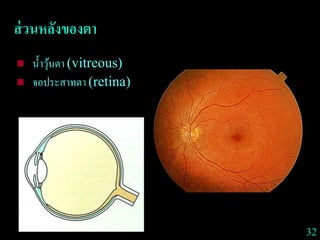
ส่วนหลังของตา
 น้าวุ้นตา (vitreous)
 จอประสาทตา (retina)
33
Macula
Optic disc
Cranial Nerve II- Fundoscopy
34
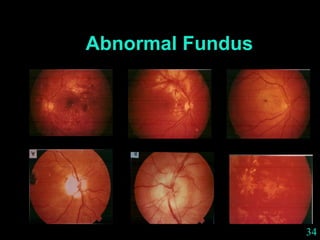
Abnormal Fundus
rangsima@chiangmai.ac.th 35
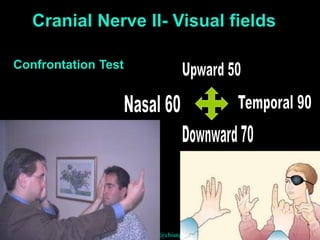
Confrontation Test
Cranial Nerve II- Visual fields
36
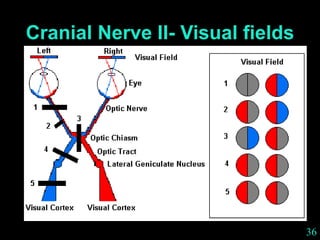
Cranial Nerve II- Visual fields
37
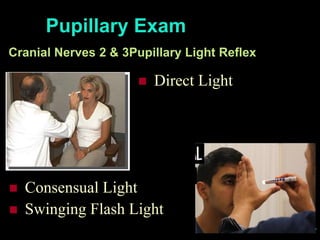
 Direct Light
Cranial Nerves 2 & 3Pupillary Light Reflex
Pupillary Exam
 Consensual Light
 Swinging Flash Light
38
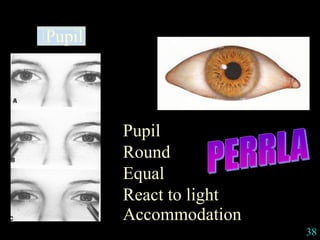
Pupil
Pupil
Round
Equal
React to light
Accommodation
39
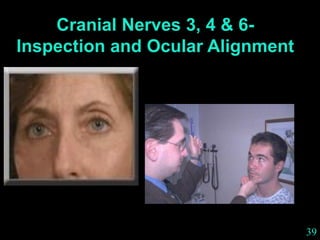
Cranial Nerves 3, 4 & 6-
Inspection and Ocular Alignment
40
41
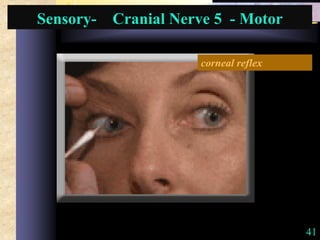
Sensory- Cranial Nerve 5 - Motor
corneal reflex
42
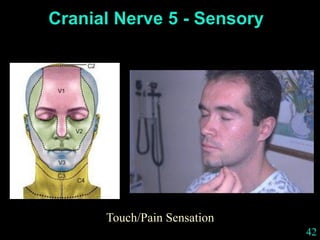
Cranial Nerve 5 - Sensory
Touch/Pain Sensation
43
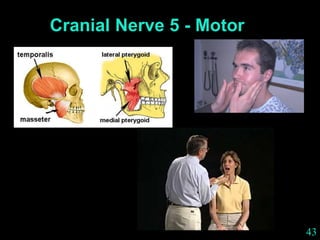
Cranial Nerve 5 - Motor
44
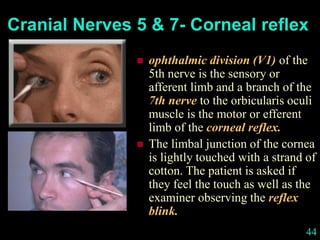
Cranial Nerves 5 & 7- Corneal reflex
 ophthalmic division (V1) of the
5th nerve is the sensory or
afferent limb and a branch of the
7th nerve to the orbicularis oculi
muscle is the motor or efferent
limb of the corneal reflex.
 The limbal junction of the cornea
is lightly touched with a strand of
cotton. The patient is asked if
they feel the touch as well as the
examiner observing the reflex
blink.
45
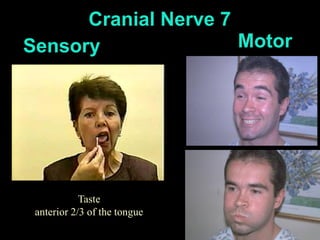
Cranial Nerve 7
Taste
anterior 2/3 of the tongue
Sensory Motor
46
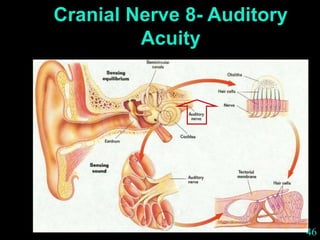
Cranial Nerve 8- Auditory
Acuity
47
48
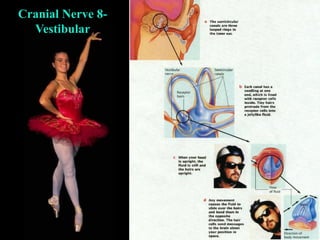
Cranial Nerve 8-
Vestibular
49
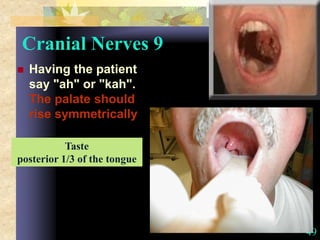
Cranial Nerves 9
 Having the patient
say "ah" or "kah".
The palate should
rise symmetrically
Taste
posterior 1/3 of the tongue
50
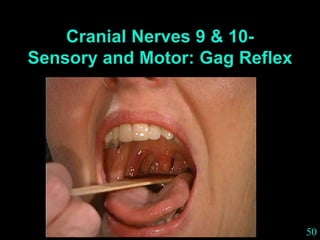
Cranial Nerves 9 & 10-
Sensory and Motor: Gag Reflex
51
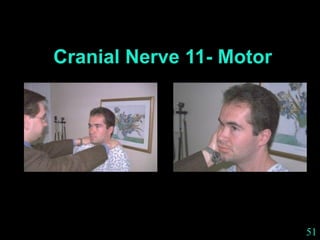
Cranial Nerve 11- Motor
52
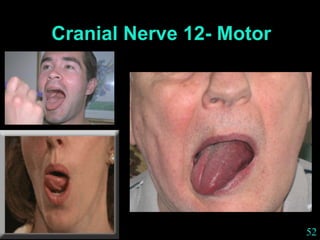
Cranial Nerve 12- Motor
53
54
55
56
57
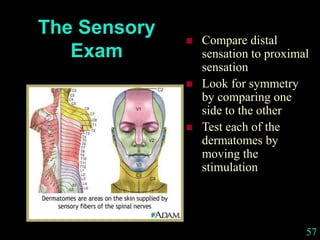
The Sensory
Exam
 Compare distal
sensation to proximal
sensation
 Look for symmetry
by comparing one
side to the other
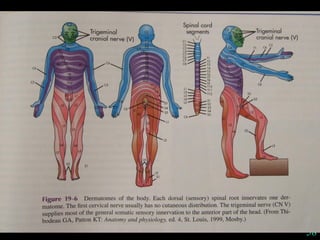
 Test each of the
dermatomes by
moving the
stimulation
58
59
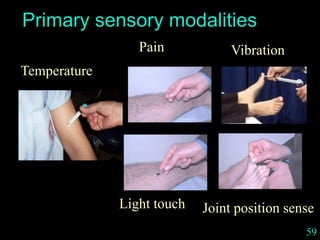
Primary sensory modalities
Temperature
Vibration
Light touch Joint position sense
Pain
60
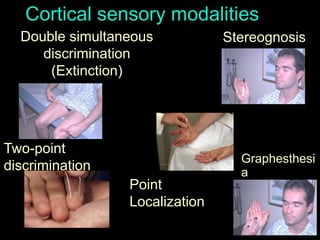
Cortical sensory modalities
Two-point
discrimination
Graphesthesi
a
StereognosisDouble simultaneous
discrimination
(Extinction)
Point
Localization
61
62
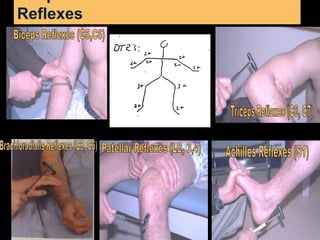
Reflexes
63
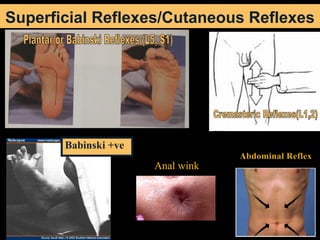
Superficial Reflexes/Cutaneous Reflexes
Babinski +ve
Anal wink
Abdominal Reflex
64
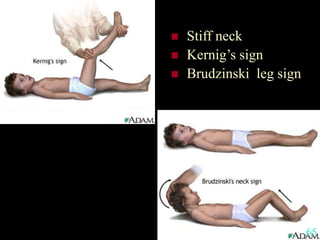
 Stiff neck
 Kernig’s sign
 Brudzinski leg sign
65
66
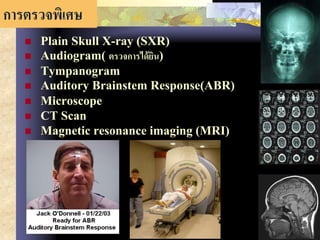
การตรวจพิเศษ
 Plain Skull X-ray (SXR)
 Audiogram( ตรวจการได้ยิน)
 Tympanogram
 Auditory Brainstem Response(ABR)
 Microscope
 CT Scan
 Magnetic resonance imaging (MRI)
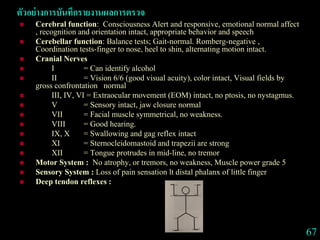
ตัวอย่างการบันทึกรายงานผลการตรวจ
 Cerebral function: Consciousness Alert and responsive, emotional normal affect
, recognition and orientation intact, appropriate behavior and speech
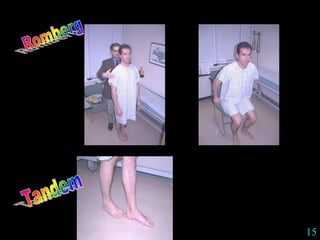
 Cerebellar function: Balance tests; Gait-normal. Romberg-negative ,
Coordination tests-finger to nose, heel to shin, alternating motion intact.
 Cranial Nerves
 I = Can identify alcohol
 II = Vision 6/6 (good visual acuity), color intact, Visual fields by
gross confrontation normal
 III, IV, VI = Extraocular movement (EOM) intact, no ptosis, no nystagmus.
 V = Sensory intact, jaw closure normal
 VII = Facial muscle symmetrical, no weakness.
 VIII = Good hearing.
 IX, X = Swallowing and gag reflex intact
 XI = Sternocleidomastoid and trapezii are strong
 XII = Tongue protrudes in mid-line, no tremor
 Motor System : No atrophy, or tremors, no weakness, Muscle power grade 5
 Sensory System : Loss of pain sensation lt distal phalanx of little finger
 Deep tendon reflexes :
67
Media
 https://vimeo.com/15706190
 https://www.youtube.com/watch?v=KKbdKMtLTXg
 https://www.youtube.com/watch?v=RIHoWvwwouY
 https://www.youtube.com/watch?v=80HQFmdVAoY
 https://www.youtube.com/watch?v=7gbsiOc-kNI
68
69

2016 Neurological Assessment