BACHELOR OF SCIENCE IN NURSING:
HEALTH ASSESSMENT
COURSE MODULE COURSE UNIT WEEK
3 16 14
Adult Physical Assessment: Neurologic System
✓ Read course and unit objectives
✓ Read and comprehend study guide prior to class
attendance
✓ Read and comprehend required learning
✓ Engage in classroom discussions
✓ Participate in weekly discussion board (Canvas)
✓ Answer and submit course unit tasks
At the end of this unit, the students are expected to:
Cognitive:
1. Describe the structure and the function of the central and peripheral nervous systems.
2. Differentiate between normal and abnormal findings of the neurologic system.
3. Perform a physical assessment of the neurologic system using the correct system.
4. Differentiate between general routine screening versus skills needed for focused or
specialty assessment of the neurologic system.
5. Analyze the data from the interview and physical assessment to formulate nursing
diagnosis, collaborative problems, and/or referrals.
Affective:
1. Listen attentively during class discussions
2. Demonstrate tact and respect when challenging other people’s opinions and ideas
3. Accept comments and reactions of classmates on one’s opinions openly and graciously.
Psychomotor:
1. Participate actively during class discussions
2. Confidently express personal opinion and thoughts in front of the class
Weber, J.R., and Kelley, J. H., (2018) Health Assessment in Nursing 6th Edition, Philadelphia:
Wolters Kluwer
NEUROLOGICAL ASSESSMENT
12 Cranial Nerves & Their Functions
ASSESSMENT PROPER
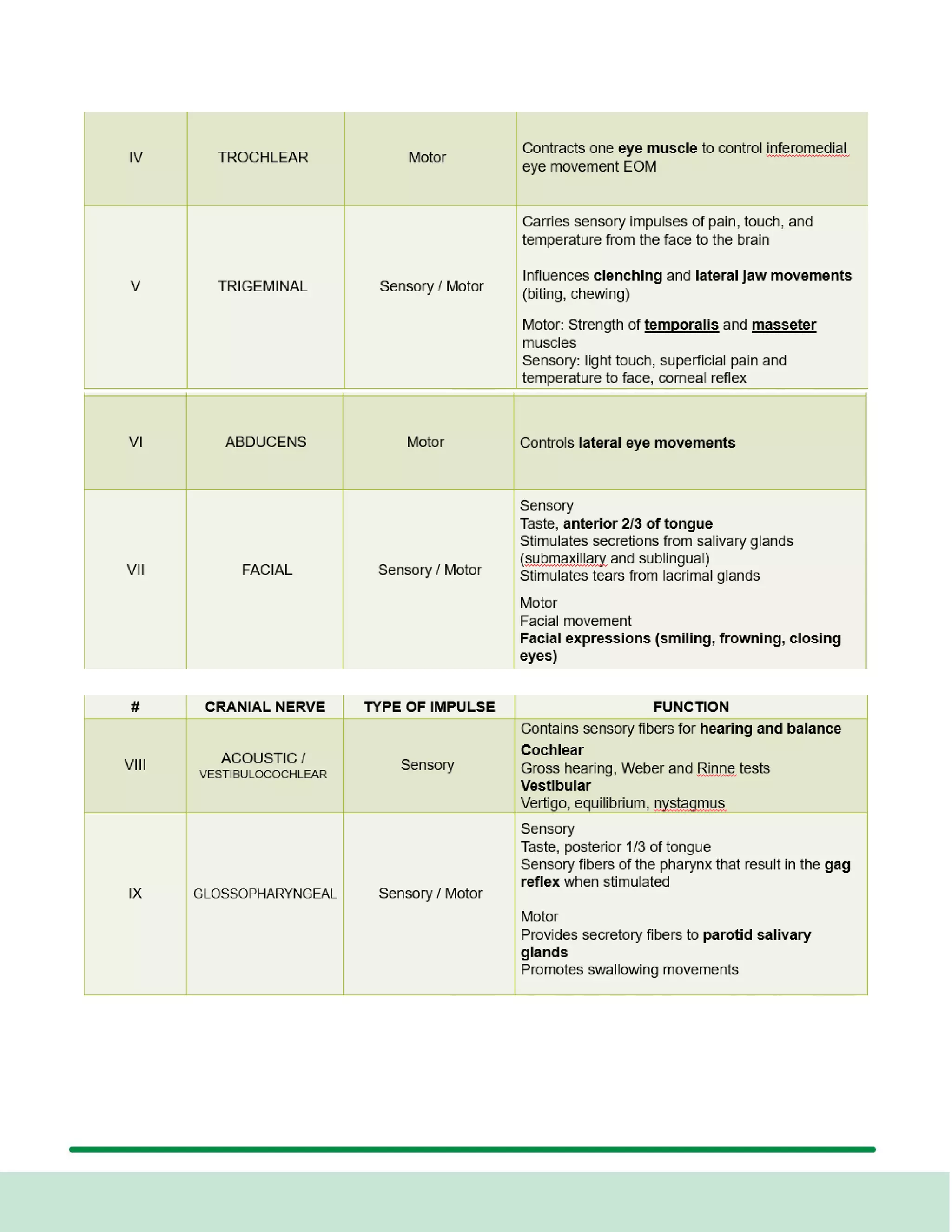
• CN I – OLFACTORY NERVE
o Have client sit in a comfortable position at your eye level
o Ask the client to clear the nose to remove any mucus
o Close eyes, occlude one nostril, and identify a scented
object that you are holding such as soap, coffee, or
vanilla
o Repeat procedure for the other nostril
o Normal
▪ Client correctly identifies scent presented to each
nostril
▪ Some older clients’ sense of smell may be
decreased
o Deviations from normal
▪ Neurogenic Anosmia
▪ inability to smell or identify the correct scent
▪ may indicate
▪ olfactory tract lesion
▪ frontal lobe tumor
▪ congenital, nasal or sinus problems
▪ nerve tissue injury
▪ smoking and use of cocaine
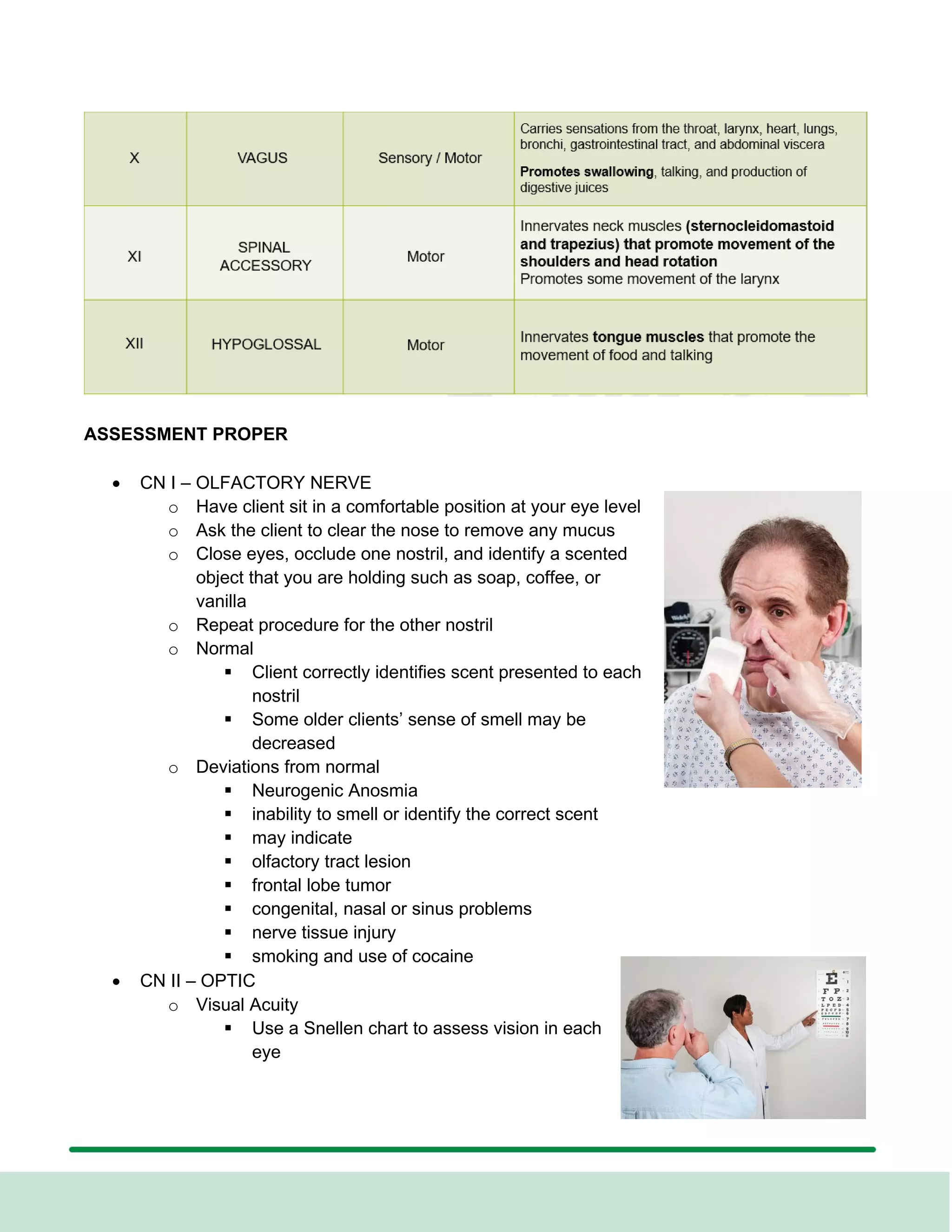
• CN II – OPTIC
o Visual Acuity
▪ Use a Snellen chart to assess vision in each
eye
▪ Normal
• Client has 20/20 vision OD (right eye) and OS (left eye) – (distance
vision)
▪ Deviations from normal
• difficulty reading Snellen chart
• missing letters
• squinting
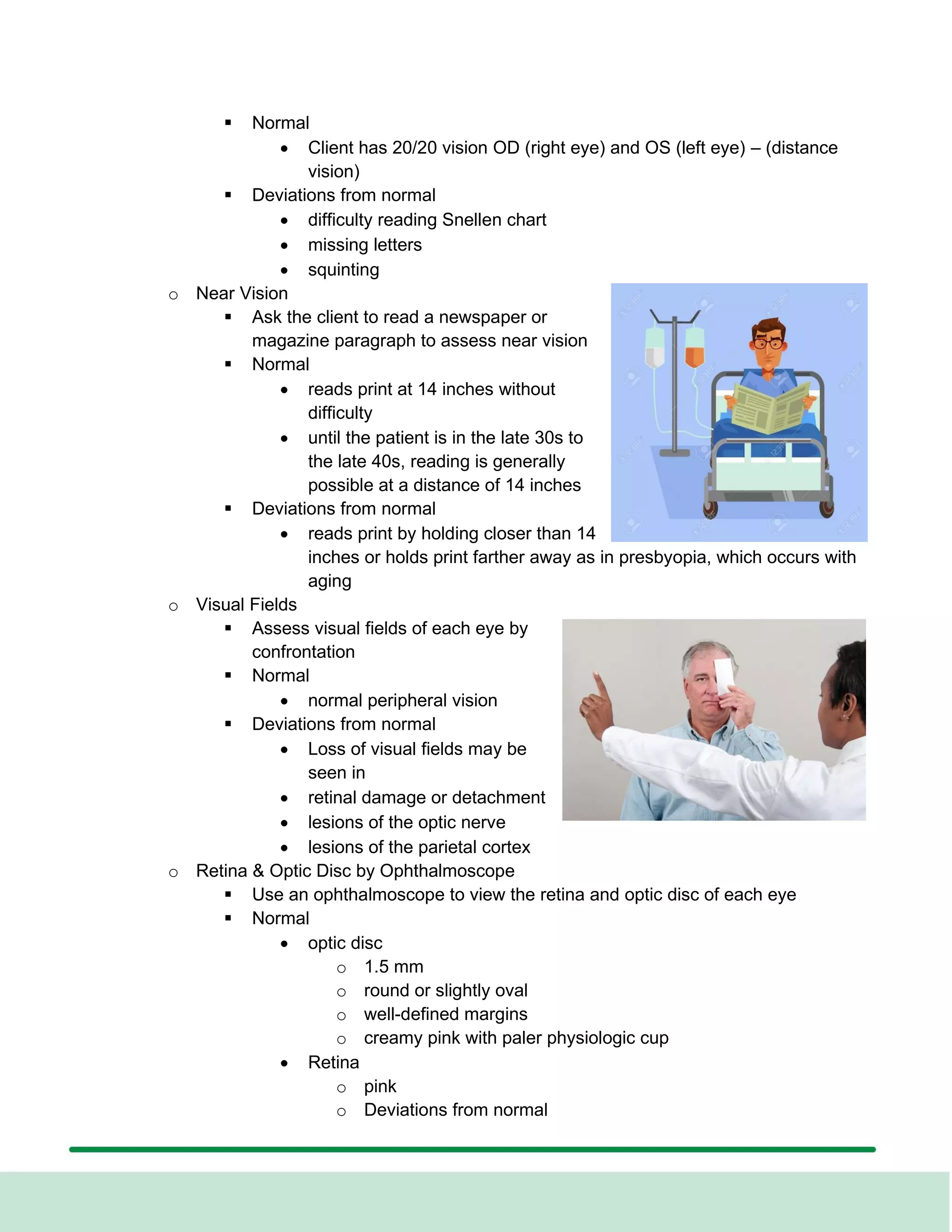
o Near Vision
▪ Ask the client to read a newspaper or
magazine paragraph to assess near vision
▪ Normal
• reads print at 14 inches without
difficulty
• until the patient is in the late 30s to
the late 40s, reading is generally
possible at a distance of 14 inches
▪ Deviations from normal
• reads print by holding closer than 14
inches or holds print farther away as in presbyopia, which occurs with
aging
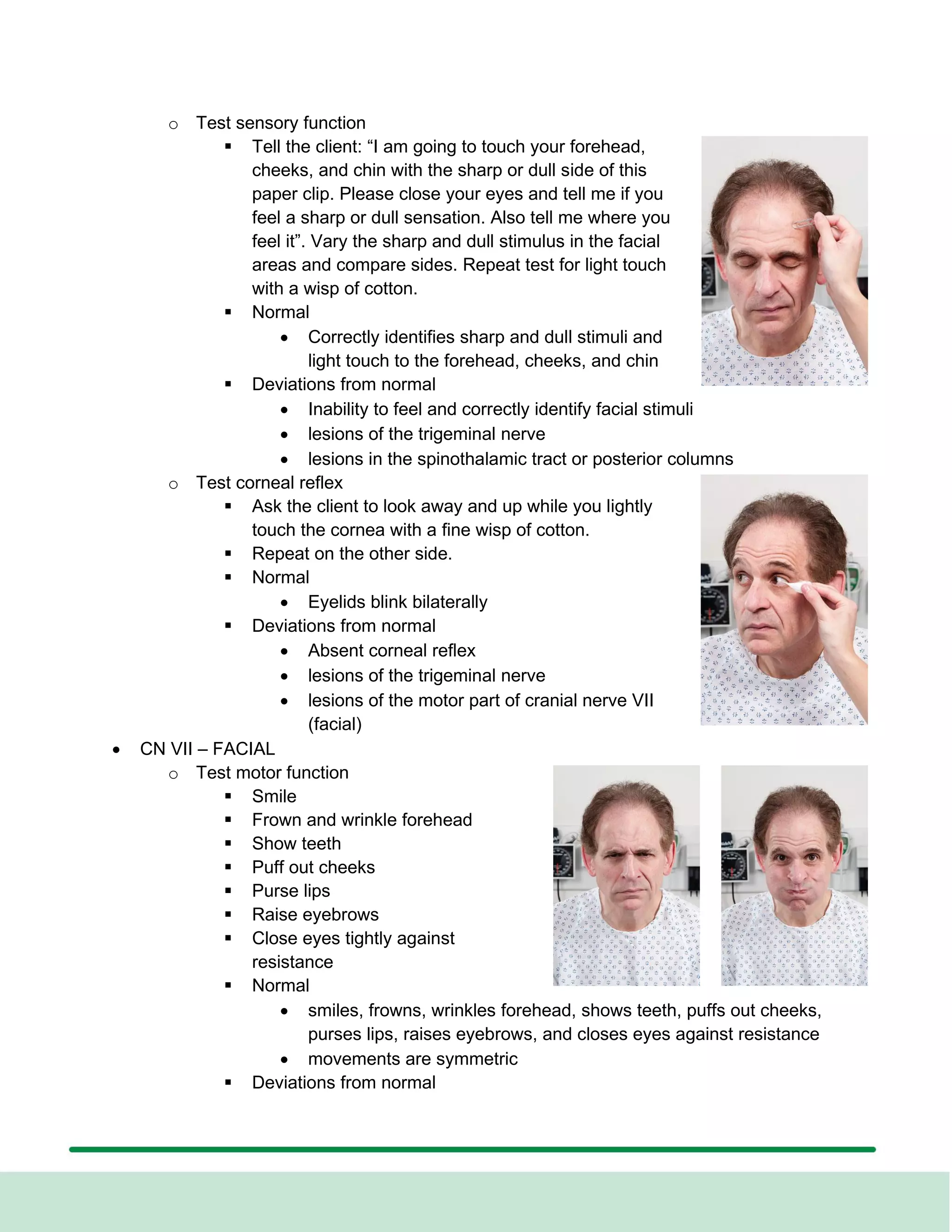
o Visual Fields
▪ Assess visual fields of each eye by
confrontation
▪ Normal
• normal peripheral vision
▪ Deviations from normal
• Loss of visual fields may be
seen in
• retinal damage or detachment
• lesions of the optic nerve
• lesions of the parietal cortex
o Retina & Optic Disc by Ophthalmoscope
▪ Use an ophthalmoscope to view the retina and optic disc of each eye
▪ Normal
• optic disc
o 1.5 mm
o round or slightly oval
o well-defined margins
o creamy pink with paler physiologic cup
• Retina
o pink
o Deviations from normal
▪ papilledema
▪ optic atrophy
• CN III, IV, VI – OCULOMOTOR, TROCHLEAR, ABDUCENS
o Inspect margins of the eyelids of each eye
▪ Assess extraocular movements
▪ Assess pupillary response to light (direct and indirect) and accommodation in
both eyes
▪ Normal
• Eyelid covers about 2 mm of the iris
• Eyes move in a smooth, coordinated motion in all directions (the six
cardinal fields)
• Bilateral illuminated pupils constrict simultaneously
• Pupil opposite the one illuminated constricts simultaneously
▪ Deviations from normal
• Ptosis (drooping of the eyelid) is seen with weak eye muscles
o myasthenia gravis
• Possible causes of abnormal eye movements
o cerebellar disorders
o increased ICP
o paralytic strabismus
• Possible causes of pupil abnormalities
o oculomotor nerve paralysis
o Argyll Robertson pupils
o narcotics abuse
o CN III damage
o lesions of the sympathetic nervous system
o PNS or CNS dysfunction
o CN V lesion
• CN V – TRIGEMINAL
o Test motor function
▪ Ask the client to clench the teeth
while you palpate the temporal and
masseter muscles for contraction
▪ Normal
• Temporal and masseter
muscles contract bilaterally
▪ Deviations from normal
• Decreased contraction in one
of both sides
• Asymmetric strength in moving the jaw may be seen with lesion or
injury of the 5th cranial nerve
• Pain occurs with clenching of the teeth
o Test sensory function
▪ Tell the client: “I am going to touch your forehead,
cheeks, and chin with the sharp or dull side of this
paper clip. Please close your eyes and tell me if you
feel a sharp or dull sensation. Also tell me where you
feel it”. Vary the sharp and dull stimulus in the facial
areas and compare sides. Repeat test for light touch
with a wisp of cotton.
▪ Normal
• Correctly identifies sharp and dull stimuli and
light touch to the forehead, cheeks, and chin
▪ Deviations from normal
• Inability to feel and correctly identify facial stimuli
• lesions of the trigeminal nerve
• lesions in the spinothalamic tract or posterior columns
o Test corneal reflex
▪ Ask the client to look away and up while you lightly
touch the cornea with a fine wisp of cotton.
▪ Repeat on the other side.
▪ Normal
• Eyelids blink bilaterally
▪ Deviations from normal
• Absent corneal reflex
• lesions of the trigeminal nerve
• lesions of the motor part of cranial nerve VII
(facial)
• CN VII – FACIAL
o Test motor function
▪ Smile
▪ Frown and wrinkle forehead
▪ Show teeth
▪ Puff out cheeks
▪ Purse lips
▪ Raise eyebrows
▪ Close eyes tightly against
resistance
▪ Normal
• smiles, frowns, wrinkles forehead, shows teeth, puffs out cheeks,
purses lips, raises eyebrows, and closes eyes against resistance
• movements are symmetric
▪ Deviations from normal
• Inability to close eyes, wrinkle forehead, or raise forehead along with
paralysis of the lower part of the face on the affected side
• Bell's Palsy
• Paralysis of the lower part of the face on the opposite side affected
may be seen with a central lesion that affects the upper motor neurons
• Stroke
o Test sensory function
▪ Not routinely tested, if testing is indicated, however, touch the anterior two-
thirds of the tongue with a moistened applicator dipped in salt, sugar, or
lemon juice
▪ ask the client to identify the flavor
▪ If the client is unsuccessful, repeat the test using one of the other solutions
▪ If needed, repeat the test using the remaining solution
▪ Normal
• identifies correct flavor
▪ Deviations from normal
• inability to identify correct flavor on anterior two-thirds of the tongue
• impairment of cranial nerve VII
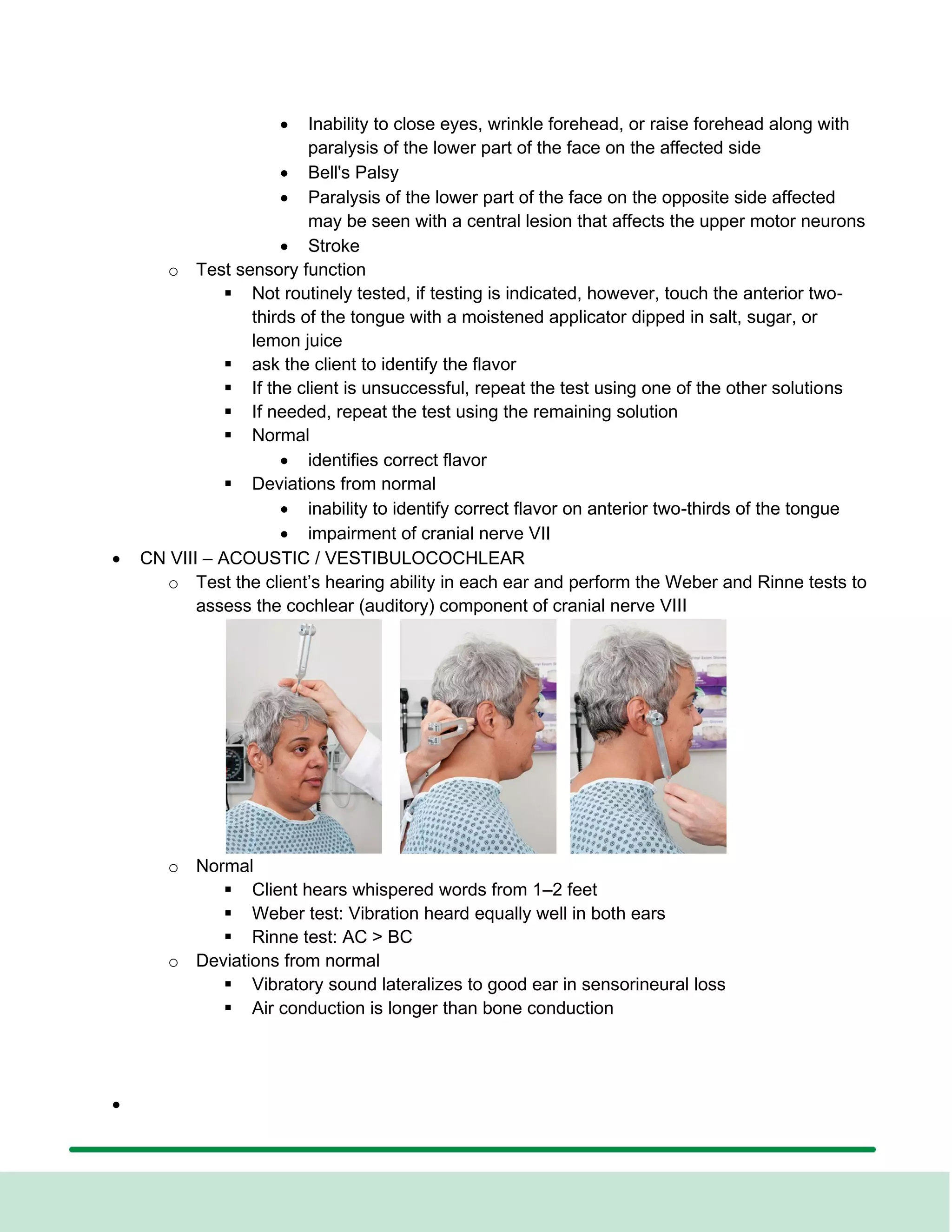
• CN VIII – ACOUSTIC / VESTIBULOCOCHLEAR
o Test the client’s hearing ability in each ear and perform the Weber and Rinne tests to
assess the cochlear (auditory) component of cranial nerve VIII
o Normal
▪ Client hears whispered words from 1–2 feet
▪ Weber test: Vibration heard equally well in both ears
▪ Rinne test: AC > BC
o Deviations from normal
▪ Vibratory sound lateralizes to good ear in sensorineural loss
▪ Air conduction is longer than bone conduction
•
• CN IX, X – GLOSSOPHARYNGEAL, VAGUS
o Test motor function
▪ Ask the client to open mouth wide and say “ah” while
you use a tongue depressor on the client’s tongue
▪ Normal
• Uvula and soft palate rise bilaterally and
symmetrically on phonation
▪ Deviations from normal
• Soft palate does not rise
• bilateral lesions of cranial nerve X (vagus)
• Unilateral rising of the soft palate and deviation of the uvula to the
normal side
• unilateral lesion of cranial nerve X (vagus)
o Test gag reflex
▪ touch the posterior pharynx with the tongue depressor
▪ Normal
• Gag reflex intact
• Some normal clients may have a reduced or absent gag reflex
▪ Deviations from normal
• An absent gag reflex
• lesions of cranial nerve IX (glossopharyngeal) or X (vagus)
o Check ability to swallow
▪ Giving the client a drink of water
▪ Note the voice quality also
▪ Normal
• Swallows without difficulty
• No hoarseness noted
▪ Deviations from normal
• Dysphagia or hoarseness
• lesion of cranial nerve IX
(glossopharyngeal) or X (vagus)
• neurologic disorder
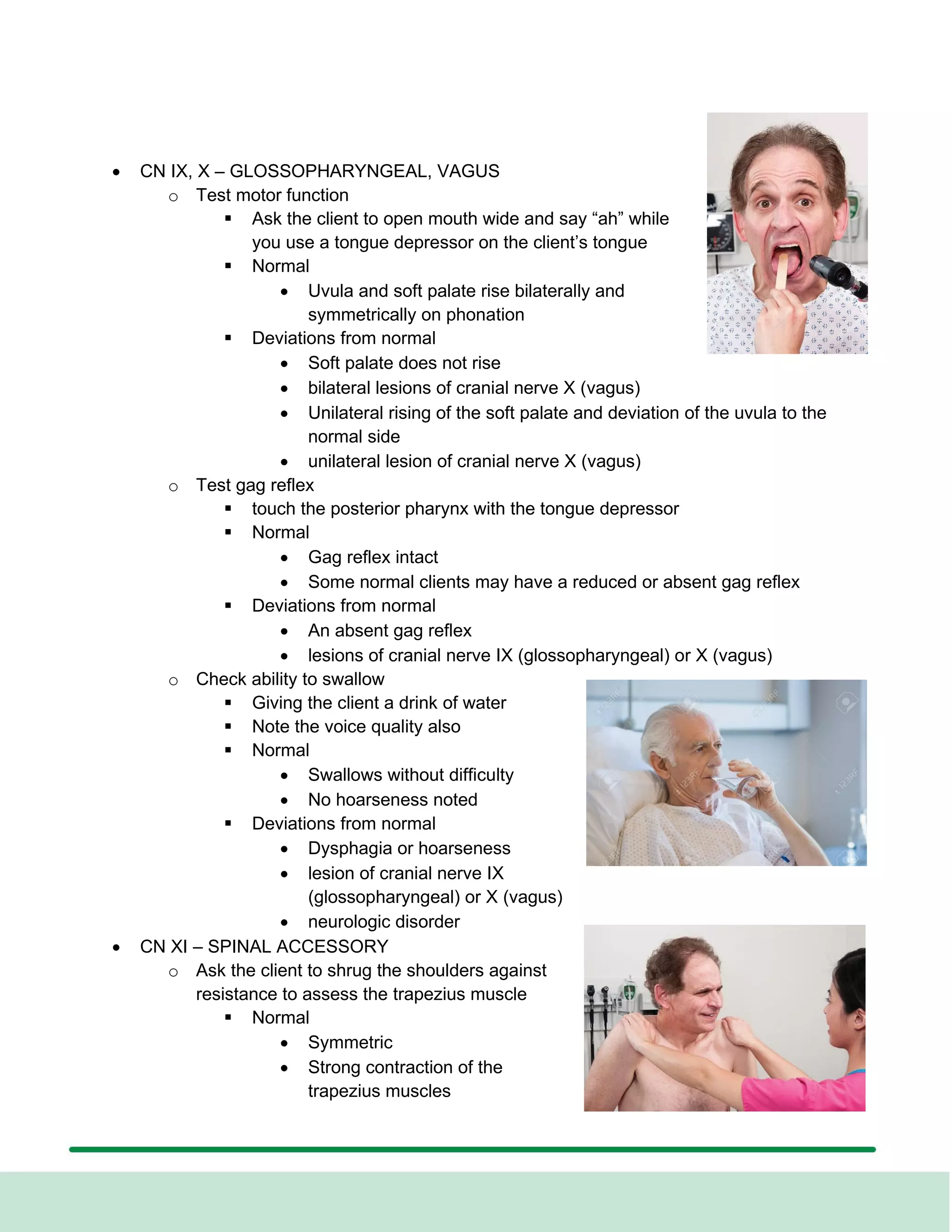
• CN XI – SPINAL ACCESSORY
o Ask the client to shrug the shoulders against
resistance to assess the trapezius muscle
▪ Normal
• Symmetric
• Strong contraction of the
trapezius muscles
▪ Deviations from normal
• Asymmetric muscle contraction or drooping of the shoulder
• paralysis or muscle weakness due to neck injury or torticollis
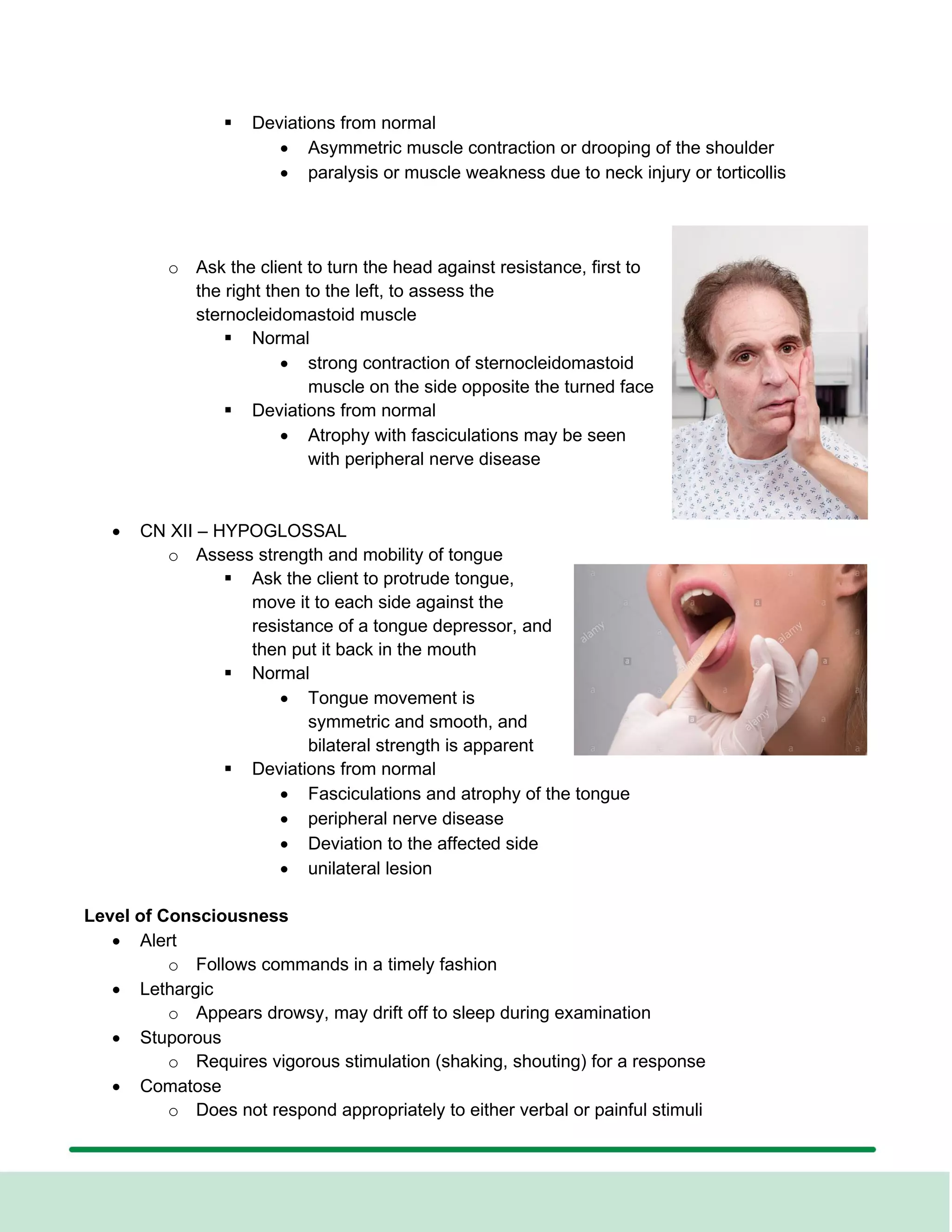
o Ask the client to turn the head against resistance, first to
the right then to the left, to assess the
sternocleidomastoid muscle
▪ Normal
• strong contraction of sternocleidomastoid
muscle on the side opposite the turned face
▪ Deviations from normal
• Atrophy with fasciculations may be seen
with peripheral nerve disease
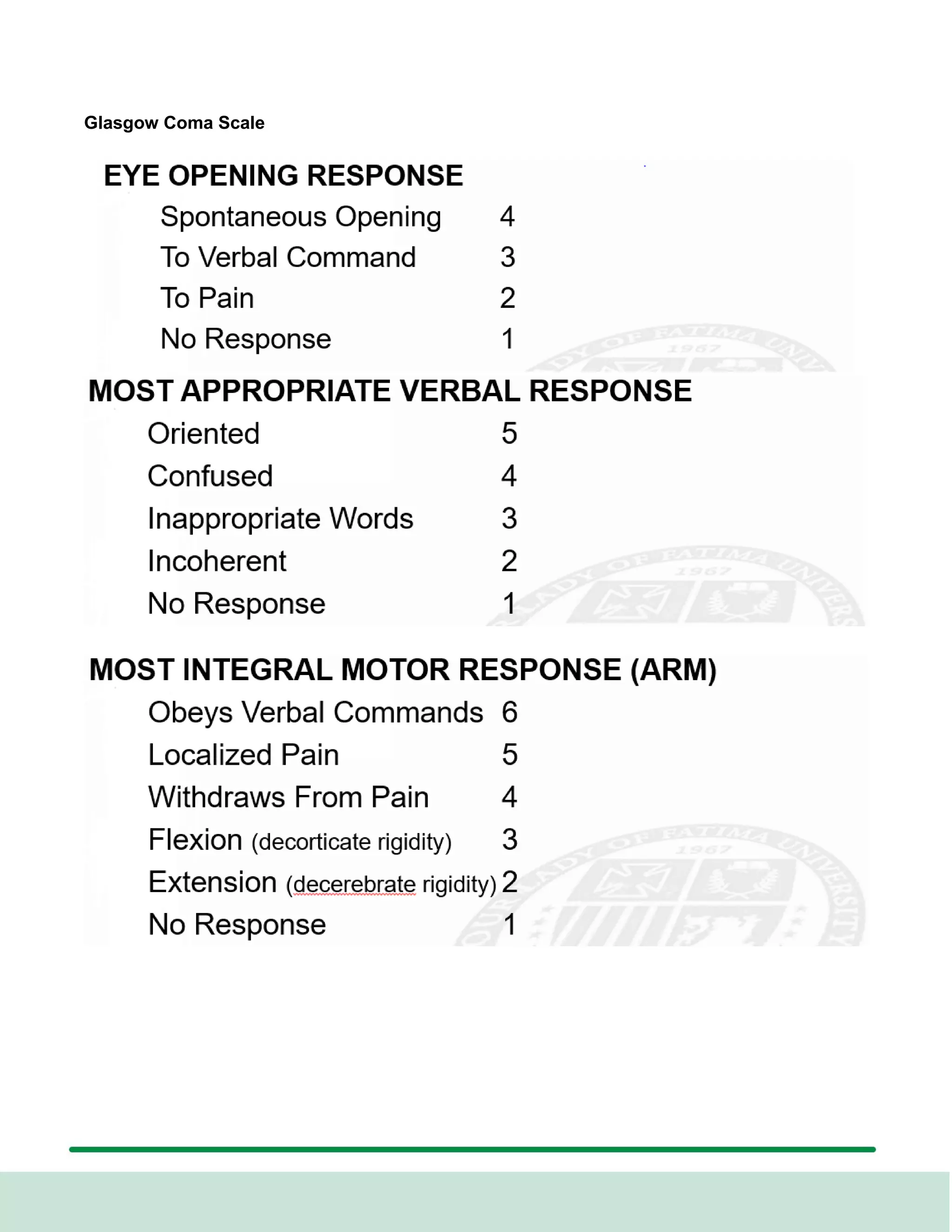
• CN XII – HYPOGLOSSAL
o Assess strength and mobility of tongue
▪ Ask the client to protrude tongue,
move it to each side against the
resistance of a tongue depressor, and
then put it back in the mouth
▪ Normal
• Tongue movement is
symmetric and smooth, and
bilateral strength is apparent
▪ Deviations from normal
• Fasciculations and atrophy of the tongue
• peripheral nerve disease
• Deviation to the affected side
• unilateral lesion
Level of Consciousness
• Alert
o Follows commands in a timely fashion
• Lethargic
o Appears drowsy, may drift off to sleep during examination
• Stuporous
o Requires vigorous stimulation (shaking, shouting) for a response
• Comatose
o Does not respond appropriately to either verbal or painful stimuli
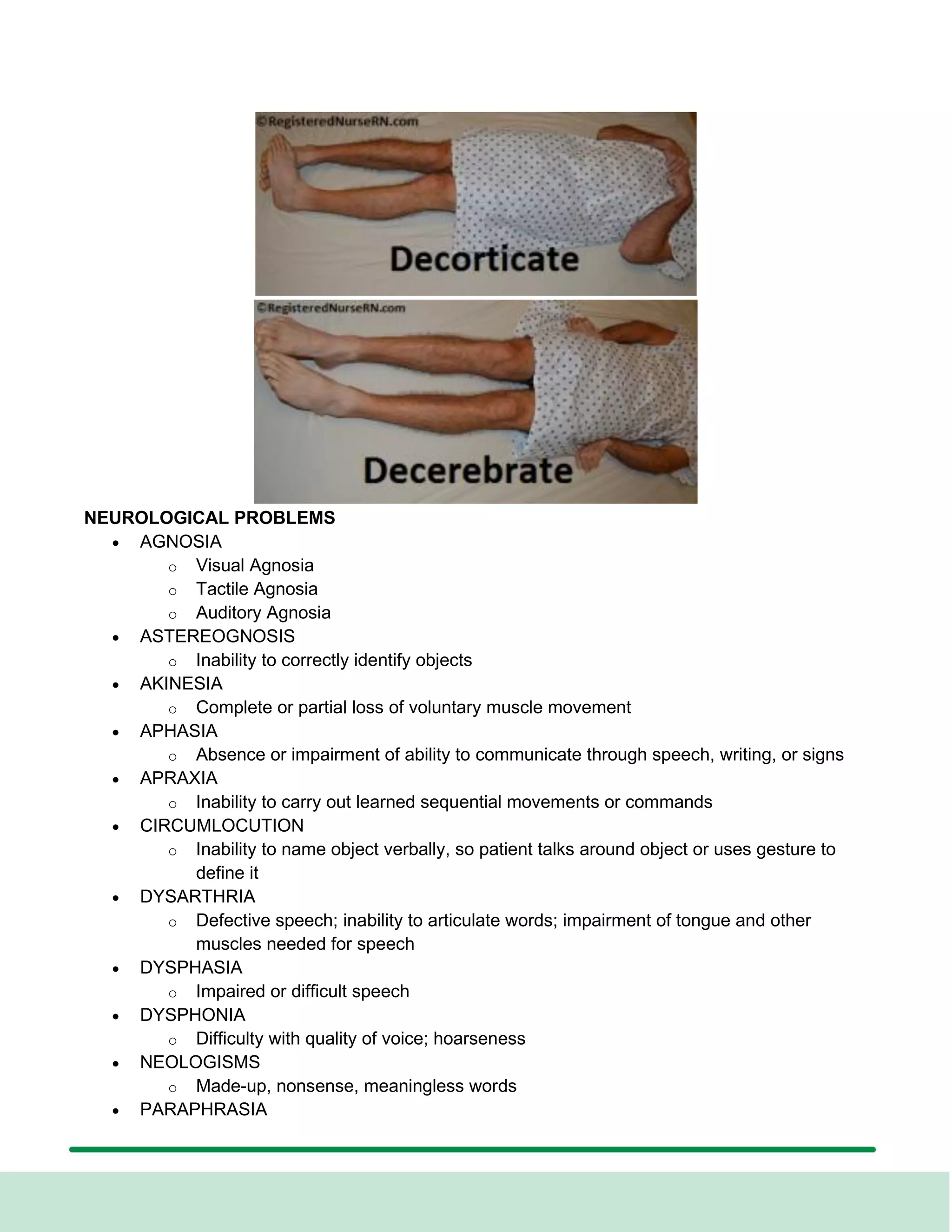
Glasgow Coma Scale
NEUROLOGICAL PROBLEMS
• AGNOSIA
o Visual Agnosia
o Tactile Agnosia
o Auditory Agnosia
• ASTEREOGNOSIS
o Inability to correctly identify objects
• AKINESIA
o Complete or partial loss of voluntary muscle movement
• APHASIA
o Absence or impairment of ability to communicate through speech, writing, or signs
• APRAXIA
o Inability to carry out learned sequential movements or commands
• CIRCUMLOCUTION
o Inability to name object verbally, so patient talks around object or uses gesture to
define it
• DYSARTHRIA
o Defective speech; inability to articulate words; impairment of tongue and other
muscles needed for speech
• DYSPHASIA
o Impaired or difficult speech
• DYSPHONIA
o Difficulty with quality of voice; hoarseness
• NEOLOGISMS
o Made-up, nonsense, meaningless words
• PARAPHRASIA
o Loss of ability to use words correctly and coherently; words are jumbled or misused
• TREMORS
o Involuntary movement of part of body
• INTENSION TREMOR
o Involuntary movement when attempting coordinated movements
• FASCICULATION
o Involuntary contraction or twitching of muscle fibers
REFLEXES
• 4+
o Hyperactive, very brisk, clonus, abnormal and indicative of a disorder
• 3+
o More brisk or active than normal but not indicative of a disorder
• 2+
o Normal usual response
• 1+
o Decreased and less active than normal
• 0
o No response
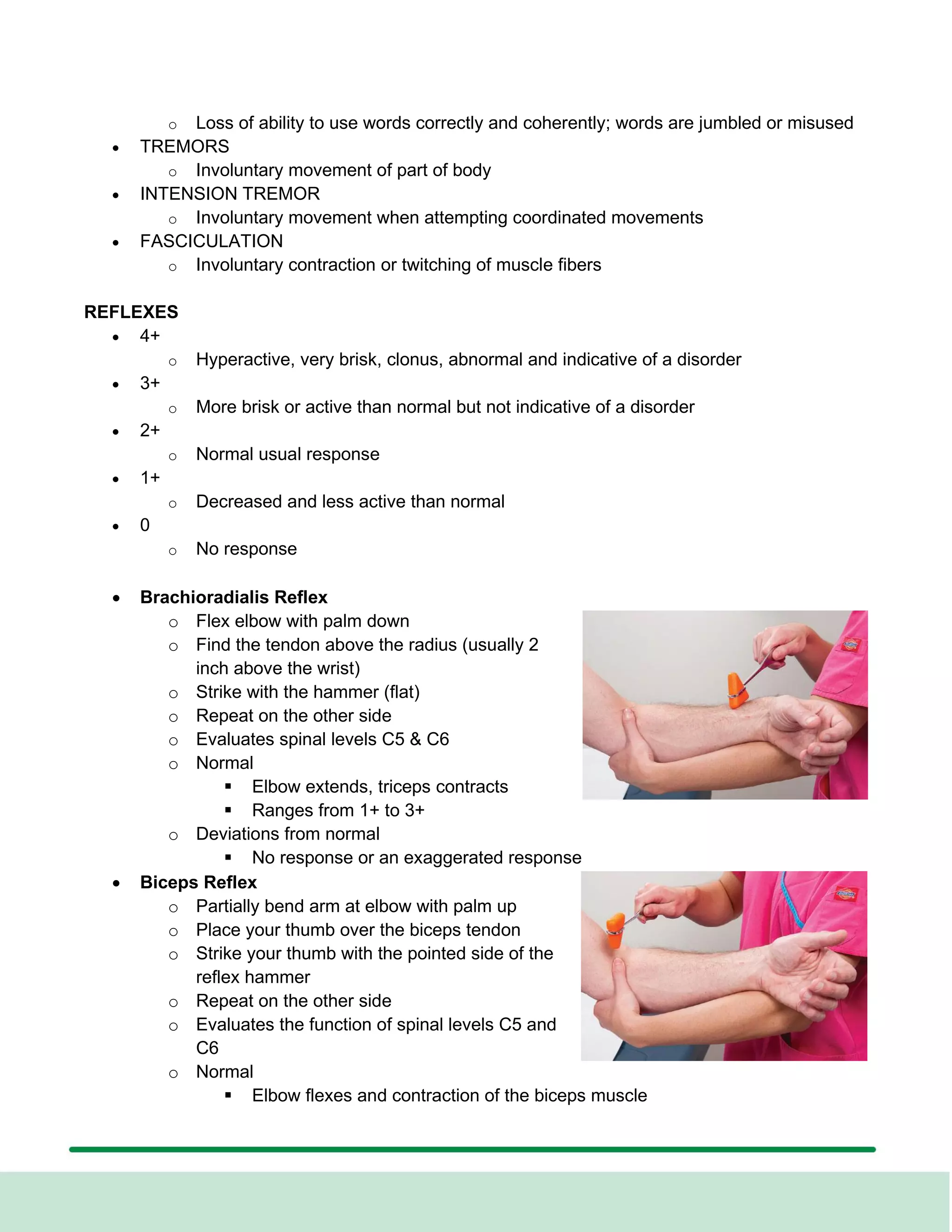
• Brachioradialis Reflex
o Flex elbow with palm down
o Find the tendon above the radius (usually 2
inch above the wrist)
o Strike with the hammer (flat)
o Repeat on the other side
o Evaluates spinal levels C5 & C6
o Normal
▪ Elbow extends, triceps contracts
▪ Ranges from 1+ to 3+
o Deviations from normal
▪ No response or an exaggerated response
• Biceps Reflex
o Partially bend arm at elbow with palm up
o Place your thumb over the biceps tendon
o Strike your thumb with the pointed side of the
reflex hammer
o Repeat on the other side
o Evaluates the function of spinal levels C5 and
C6
o Normal
▪ Elbow flexes and contraction of the biceps muscle
▪ Ranges from 1+ to 3+
▪ Forearm flexes and supinates
▪ Ranges from 1+ to 3+
o Deviations from normal
▪ No response or an exaggerated response
• Triceps Reflex
o Ask client to hang arm freely support it w/ non-
dominant hand
o Find tendon above the olecranon process
o Tap it with the hammer (flat)
o Repeat on the other side
o Evaluates the function of spinal levels C6, C7, and
C8
o Normal
▪ Knee extends, quadriceps muscle contracts
▪ Ranges from 1+ to 3+
o Deviations from normal
▪ No response or exaggerated response
• Patellar Reflex
o Both legs hang freely off the side of the
examination table
o Find the patellar tendon (below patella)
o Strike with hammer (flat)
o Repeat on the other side
o Gently flex the knee and strike the patella (client’s
who cannot sit up)
o Evaluates the function of spinal levels L2, L3, and
L4
o Normal
▪ Plantarflexion of the foot
▪ Ranges from 1+ to 3+
o Deviations from normal
▪ No response or an exaggerated response
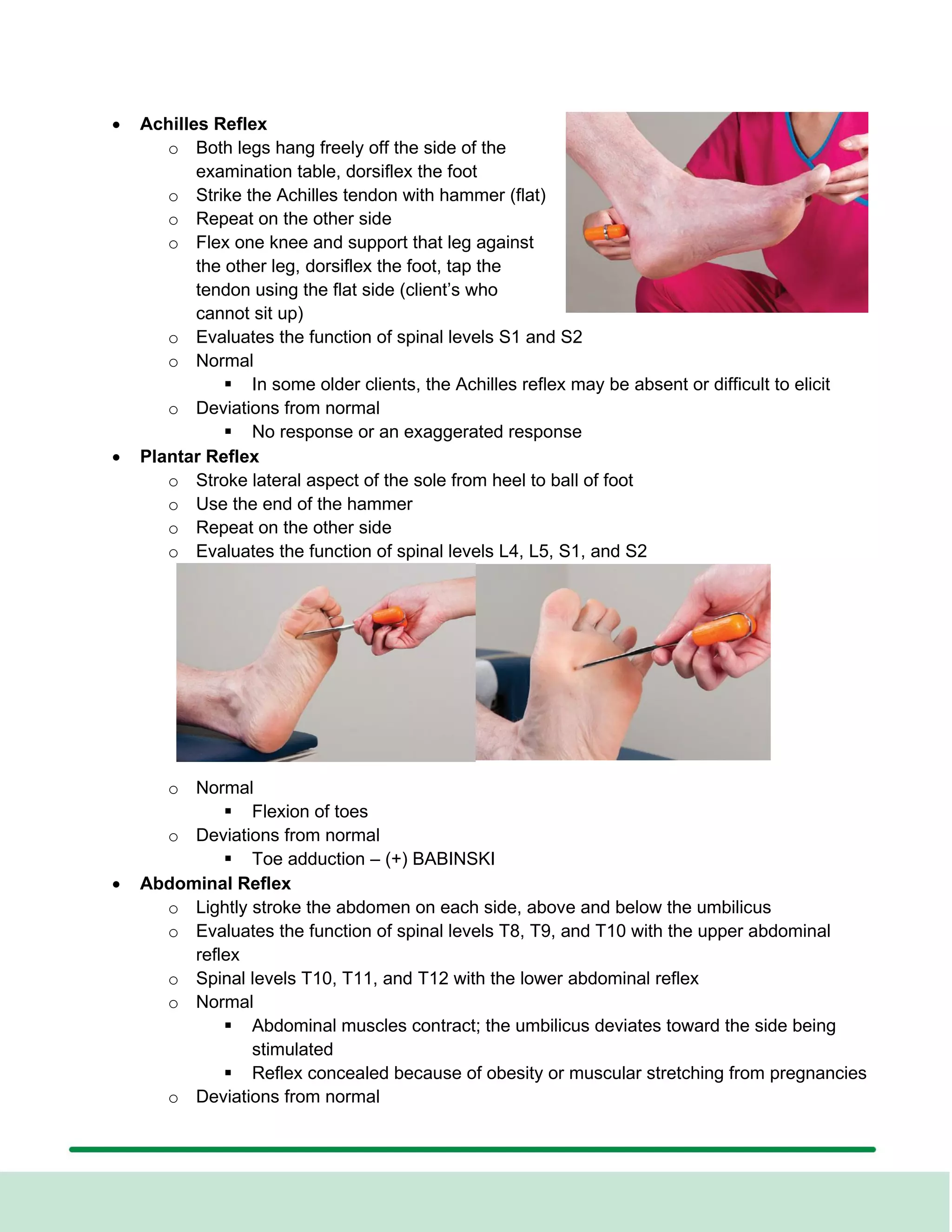
• Achilles Reflex
o Both legs hang freely off the side of the
examination table, dorsiflex the foot
o Strike the Achilles tendon with hammer (flat)
o Repeat on the other side
o Flex one knee and support that leg against
the other leg, dorsiflex the foot, tap the
tendon using the flat side (client’s who
cannot sit up)
o Evaluates the function of spinal levels S1 and S2
o Normal
▪ In some older clients, the Achilles reflex may be absent or difficult to elicit
o Deviations from normal
▪ No response or an exaggerated response
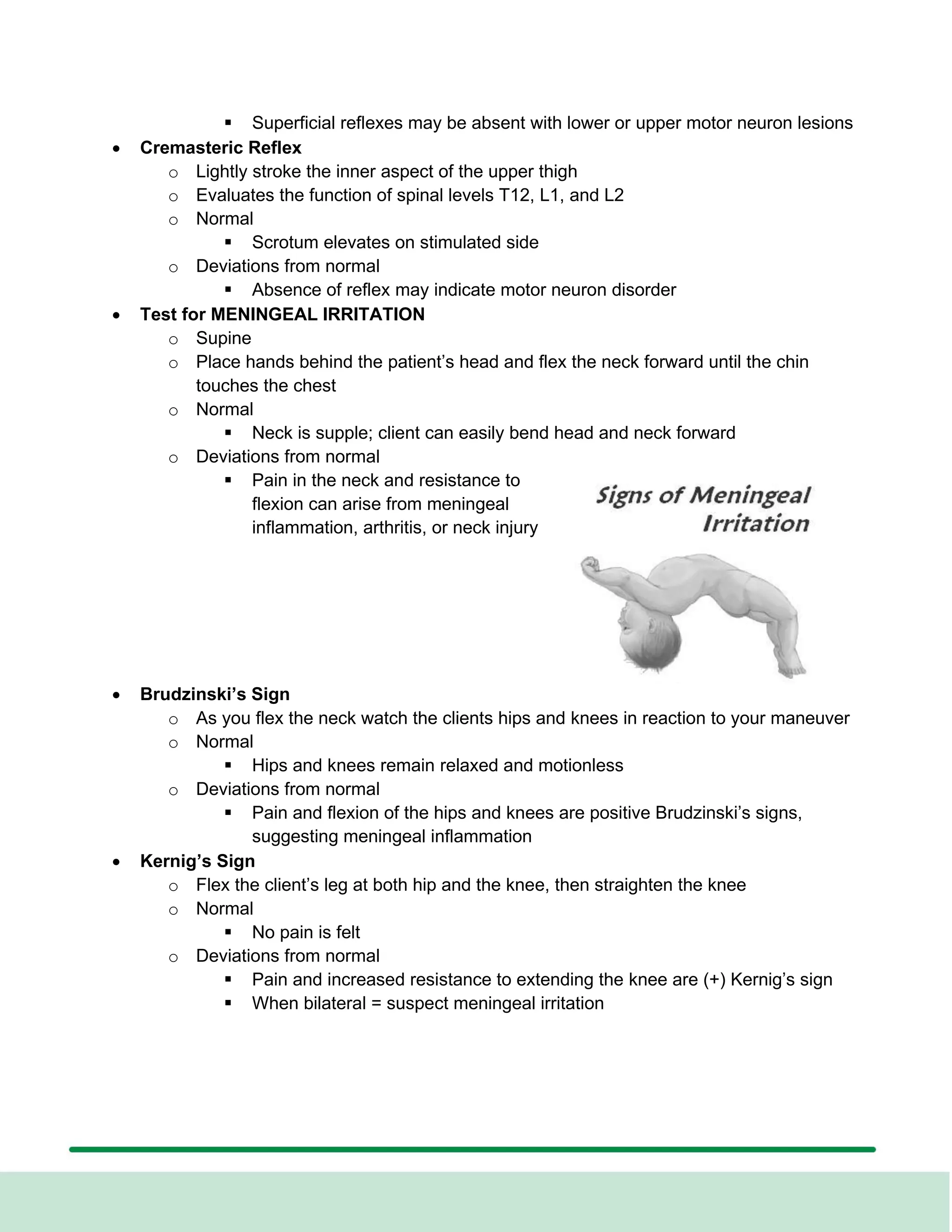
• Plantar Reflex
o Stroke lateral aspect of the sole from heel to ball of foot
o Use the end of the hammer
o Repeat on the other side
o Evaluates the function of spinal levels L4, L5, S1, and S2
o Normal
▪ Flexion of toes
o Deviations from normal
▪ Toe adduction – (+) BABINSKI
• Abdominal Reflex
o Lightly stroke the abdomen on each side, above and below the umbilicus
o Evaluates the function of spinal levels T8, T9, and T10 with the upper abdominal
reflex
o Spinal levels T10, T11, and T12 with the lower abdominal reflex
o Normal
▪ Abdominal muscles contract; the umbilicus deviates toward the side being
stimulated
▪ Reflex concealed because of obesity or muscular stretching from pregnancies
o Deviations from normal
▪ Superficial reflexes may be absent with lower or upper motor neuron lesions
• Cremasteric Reflex
o Lightly stroke the inner aspect of the upper thigh
o Evaluates the function of spinal levels T12, L1, and L2
o Normal
▪ Scrotum elevates on stimulated side
o Deviations from normal
▪ Absence of reflex may indicate motor neuron disorder
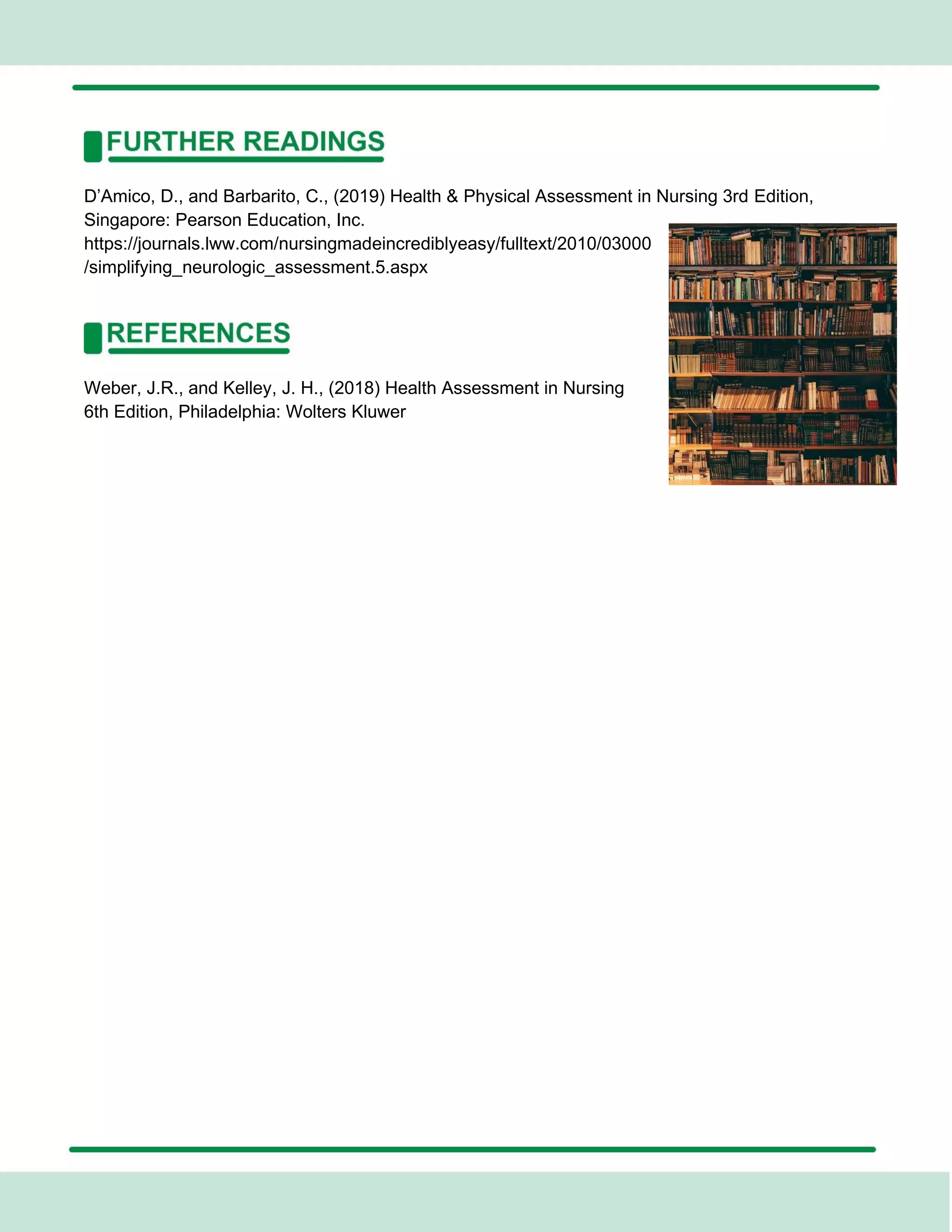
• Test for MENINGEAL IRRITATION
o Supine
o Place hands behind the patient’s head and flex the neck forward until the chin
touches the chest
o Normal
▪ Neck is supple; client can easily bend head and neck forward
o Deviations from normal
▪ Pain in the neck and resistance to
flexion can arise from meningeal
inflammation, arthritis, or neck injury
• Brudzinski’s Sign
o As you flex the neck watch the clients hips and knees in reaction to your maneuver
o Normal
▪ Hips and knees remain relaxed and motionless
o Deviations from normal
▪ Pain and flexion of the hips and knees are positive Brudzinski’s signs,
suggesting meningeal inflammation
• Kernig’s Sign
o Flex the client’s leg at both hip and the knee, then straighten the knee
o Normal
▪ No pain is felt
o Deviations from normal
▪ Pain and increased resistance to extending the knee are (+) Kernig’s sign
▪ When bilateral = suspect meningeal irritation
D’Amico, D., and Barbarito, C., (2019) Health & Physical Assessment in Nursing 3rd Edition,
Singapore: Pearson Education, Inc.
https://journals.lww.com/nursingmadeincrediblyeasy/fulltext/2010/03000
/simplifying_neurologic_assessment.5.aspx
Weber, J.R., and Kelley, J. H., (2018) Health Assessment in Nursing
6th Edition, Philadelphia: Wolters Kluwer

CM3 - CU16 ASSESSMENT OF NEUROLOGIC SYSTEM.pdf

  • 1.
    BACHELOR OF SCIENCEIN NURSING: HEALTH ASSESSMENT COURSE MODULE COURSE UNIT WEEK 3 16 14 Adult Physical Assessment: Neurologic System ✓ Read course and unit objectives ✓ Read and comprehend study guide prior to class attendance ✓ Read and comprehend required learning ✓ Engage in classroom discussions ✓ Participate in weekly discussion board (Canvas) ✓ Answer and submit course unit tasks At the end of this unit, the students are expected to: Cognitive: 1. Describe the structure and the function of the central and peripheral nervous systems. 2. Differentiate between normal and abnormal findings of the neurologic system. 3. Perform a physical assessment of the neurologic system using the correct system. 4. Differentiate between general routine screening versus skills needed for focused or specialty assessment of the neurologic system.
  • 2.
    5. Analyze thedata from the interview and physical assessment to formulate nursing diagnosis, collaborative problems, and/or referrals. Affective: 1. Listen attentively during class discussions 2. Demonstrate tact and respect when challenging other people’s opinions and ideas 3. Accept comments and reactions of classmates on one’s opinions openly and graciously. Psychomotor: 1. Participate actively during class discussions 2. Confidently express personal opinion and thoughts in front of the class Weber, J.R., and Kelley, J. H., (2018) Health Assessment in Nursing 6th Edition, Philadelphia: Wolters Kluwer NEUROLOGICAL ASSESSMENT 12 Cranial Nerves & Their Functions
  • 4.
    ASSESSMENT PROPER • CNI – OLFACTORY NERVE o Have client sit in a comfortable position at your eye level o Ask the client to clear the nose to remove any mucus o Close eyes, occlude one nostril, and identify a scented object that you are holding such as soap, coffee, or vanilla o Repeat procedure for the other nostril o Normal ▪ Client correctly identifies scent presented to each nostril ▪ Some older clients’ sense of smell may be decreased o Deviations from normal ▪ Neurogenic Anosmia ▪ inability to smell or identify the correct scent ▪ may indicate ▪ olfactory tract lesion ▪ frontal lobe tumor ▪ congenital, nasal or sinus problems ▪ nerve tissue injury ▪ smoking and use of cocaine • CN II – OPTIC o Visual Acuity ▪ Use a Snellen chart to assess vision in each eye
  • 5.
    ▪ Normal • Clienthas 20/20 vision OD (right eye) and OS (left eye) – (distance vision) ▪ Deviations from normal • difficulty reading Snellen chart • missing letters • squinting o Near Vision ▪ Ask the client to read a newspaper or magazine paragraph to assess near vision ▪ Normal • reads print at 14 inches without difficulty • until the patient is in the late 30s to the late 40s, reading is generally possible at a distance of 14 inches ▪ Deviations from normal • reads print by holding closer than 14 inches or holds print farther away as in presbyopia, which occurs with aging o Visual Fields ▪ Assess visual fields of each eye by confrontation ▪ Normal • normal peripheral vision ▪ Deviations from normal • Loss of visual fields may be seen in • retinal damage or detachment • lesions of the optic nerve • lesions of the parietal cortex o Retina & Optic Disc by Ophthalmoscope ▪ Use an ophthalmoscope to view the retina and optic disc of each eye ▪ Normal • optic disc o 1.5 mm o round or slightly oval o well-defined margins o creamy pink with paler physiologic cup • Retina o pink o Deviations from normal
  • 6.
    ▪ papilledema ▪ opticatrophy • CN III, IV, VI – OCULOMOTOR, TROCHLEAR, ABDUCENS o Inspect margins of the eyelids of each eye ▪ Assess extraocular movements ▪ Assess pupillary response to light (direct and indirect) and accommodation in both eyes ▪ Normal • Eyelid covers about 2 mm of the iris • Eyes move in a smooth, coordinated motion in all directions (the six cardinal fields) • Bilateral illuminated pupils constrict simultaneously • Pupil opposite the one illuminated constricts simultaneously ▪ Deviations from normal • Ptosis (drooping of the eyelid) is seen with weak eye muscles o myasthenia gravis • Possible causes of abnormal eye movements o cerebellar disorders o increased ICP o paralytic strabismus • Possible causes of pupil abnormalities o oculomotor nerve paralysis o Argyll Robertson pupils o narcotics abuse o CN III damage o lesions of the sympathetic nervous system o PNS or CNS dysfunction o CN V lesion • CN V – TRIGEMINAL o Test motor function ▪ Ask the client to clench the teeth while you palpate the temporal and masseter muscles for contraction ▪ Normal • Temporal and masseter muscles contract bilaterally ▪ Deviations from normal • Decreased contraction in one of both sides • Asymmetric strength in moving the jaw may be seen with lesion or injury of the 5th cranial nerve • Pain occurs with clenching of the teeth
  • 7.
    o Test sensoryfunction ▪ Tell the client: “I am going to touch your forehead, cheeks, and chin with the sharp or dull side of this paper clip. Please close your eyes and tell me if you feel a sharp or dull sensation. Also tell me where you feel it”. Vary the sharp and dull stimulus in the facial areas and compare sides. Repeat test for light touch with a wisp of cotton. ▪ Normal • Correctly identifies sharp and dull stimuli and light touch to the forehead, cheeks, and chin ▪ Deviations from normal • Inability to feel and correctly identify facial stimuli • lesions of the trigeminal nerve • lesions in the spinothalamic tract or posterior columns o Test corneal reflex ▪ Ask the client to look away and up while you lightly touch the cornea with a fine wisp of cotton. ▪ Repeat on the other side. ▪ Normal • Eyelids blink bilaterally ▪ Deviations from normal • Absent corneal reflex • lesions of the trigeminal nerve • lesions of the motor part of cranial nerve VII (facial) • CN VII – FACIAL o Test motor function ▪ Smile ▪ Frown and wrinkle forehead ▪ Show teeth ▪ Puff out cheeks ▪ Purse lips ▪ Raise eyebrows ▪ Close eyes tightly against resistance ▪ Normal • smiles, frowns, wrinkles forehead, shows teeth, puffs out cheeks, purses lips, raises eyebrows, and closes eyes against resistance • movements are symmetric ▪ Deviations from normal
  • 8.
    • Inability toclose eyes, wrinkle forehead, or raise forehead along with paralysis of the lower part of the face on the affected side • Bell's Palsy • Paralysis of the lower part of the face on the opposite side affected may be seen with a central lesion that affects the upper motor neurons • Stroke o Test sensory function ▪ Not routinely tested, if testing is indicated, however, touch the anterior two- thirds of the tongue with a moistened applicator dipped in salt, sugar, or lemon juice ▪ ask the client to identify the flavor ▪ If the client is unsuccessful, repeat the test using one of the other solutions ▪ If needed, repeat the test using the remaining solution ▪ Normal • identifies correct flavor ▪ Deviations from normal • inability to identify correct flavor on anterior two-thirds of the tongue • impairment of cranial nerve VII • CN VIII – ACOUSTIC / VESTIBULOCOCHLEAR o Test the client’s hearing ability in each ear and perform the Weber and Rinne tests to assess the cochlear (auditory) component of cranial nerve VIII o Normal ▪ Client hears whispered words from 1–2 feet ▪ Weber test: Vibration heard equally well in both ears ▪ Rinne test: AC > BC o Deviations from normal ▪ Vibratory sound lateralizes to good ear in sensorineural loss ▪ Air conduction is longer than bone conduction •
  • 9.
    • CN IX,X – GLOSSOPHARYNGEAL, VAGUS o Test motor function ▪ Ask the client to open mouth wide and say “ah” while you use a tongue depressor on the client’s tongue ▪ Normal • Uvula and soft palate rise bilaterally and symmetrically on phonation ▪ Deviations from normal • Soft palate does not rise • bilateral lesions of cranial nerve X (vagus) • Unilateral rising of the soft palate and deviation of the uvula to the normal side • unilateral lesion of cranial nerve X (vagus) o Test gag reflex ▪ touch the posterior pharynx with the tongue depressor ▪ Normal • Gag reflex intact • Some normal clients may have a reduced or absent gag reflex ▪ Deviations from normal • An absent gag reflex • lesions of cranial nerve IX (glossopharyngeal) or X (vagus) o Check ability to swallow ▪ Giving the client a drink of water ▪ Note the voice quality also ▪ Normal • Swallows without difficulty • No hoarseness noted ▪ Deviations from normal • Dysphagia or hoarseness • lesion of cranial nerve IX (glossopharyngeal) or X (vagus) • neurologic disorder • CN XI – SPINAL ACCESSORY o Ask the client to shrug the shoulders against resistance to assess the trapezius muscle ▪ Normal • Symmetric • Strong contraction of the trapezius muscles
  • 10.
    ▪ Deviations fromnormal • Asymmetric muscle contraction or drooping of the shoulder • paralysis or muscle weakness due to neck injury or torticollis o Ask the client to turn the head against resistance, first to the right then to the left, to assess the sternocleidomastoid muscle ▪ Normal • strong contraction of sternocleidomastoid muscle on the side opposite the turned face ▪ Deviations from normal • Atrophy with fasciculations may be seen with peripheral nerve disease • CN XII – HYPOGLOSSAL o Assess strength and mobility of tongue ▪ Ask the client to protrude tongue, move it to each side against the resistance of a tongue depressor, and then put it back in the mouth ▪ Normal • Tongue movement is symmetric and smooth, and bilateral strength is apparent ▪ Deviations from normal • Fasciculations and atrophy of the tongue • peripheral nerve disease • Deviation to the affected side • unilateral lesion Level of Consciousness • Alert o Follows commands in a timely fashion • Lethargic o Appears drowsy, may drift off to sleep during examination • Stuporous o Requires vigorous stimulation (shaking, shouting) for a response • Comatose o Does not respond appropriately to either verbal or painful stimuli
  • 11.
  • 12.
    NEUROLOGICAL PROBLEMS • AGNOSIA oVisual Agnosia o Tactile Agnosia o Auditory Agnosia • ASTEREOGNOSIS o Inability to correctly identify objects • AKINESIA o Complete or partial loss of voluntary muscle movement • APHASIA o Absence or impairment of ability to communicate through speech, writing, or signs • APRAXIA o Inability to carry out learned sequential movements or commands • CIRCUMLOCUTION o Inability to name object verbally, so patient talks around object or uses gesture to define it • DYSARTHRIA o Defective speech; inability to articulate words; impairment of tongue and other muscles needed for speech • DYSPHASIA o Impaired or difficult speech • DYSPHONIA o Difficulty with quality of voice; hoarseness • NEOLOGISMS o Made-up, nonsense, meaningless words • PARAPHRASIA
  • 13.
    o Loss ofability to use words correctly and coherently; words are jumbled or misused • TREMORS o Involuntary movement of part of body • INTENSION TREMOR o Involuntary movement when attempting coordinated movements • FASCICULATION o Involuntary contraction or twitching of muscle fibers REFLEXES • 4+ o Hyperactive, very brisk, clonus, abnormal and indicative of a disorder • 3+ o More brisk or active than normal but not indicative of a disorder • 2+ o Normal usual response • 1+ o Decreased and less active than normal • 0 o No response • Brachioradialis Reflex o Flex elbow with palm down o Find the tendon above the radius (usually 2 inch above the wrist) o Strike with the hammer (flat) o Repeat on the other side o Evaluates spinal levels C5 & C6 o Normal ▪ Elbow extends, triceps contracts ▪ Ranges from 1+ to 3+ o Deviations from normal ▪ No response or an exaggerated response • Biceps Reflex o Partially bend arm at elbow with palm up o Place your thumb over the biceps tendon o Strike your thumb with the pointed side of the reflex hammer o Repeat on the other side o Evaluates the function of spinal levels C5 and C6 o Normal ▪ Elbow flexes and contraction of the biceps muscle
  • 14.
    ▪ Ranges from1+ to 3+ ▪ Forearm flexes and supinates ▪ Ranges from 1+ to 3+ o Deviations from normal ▪ No response or an exaggerated response • Triceps Reflex o Ask client to hang arm freely support it w/ non- dominant hand o Find tendon above the olecranon process o Tap it with the hammer (flat) o Repeat on the other side o Evaluates the function of spinal levels C6, C7, and C8 o Normal ▪ Knee extends, quadriceps muscle contracts ▪ Ranges from 1+ to 3+ o Deviations from normal ▪ No response or exaggerated response • Patellar Reflex o Both legs hang freely off the side of the examination table o Find the patellar tendon (below patella) o Strike with hammer (flat) o Repeat on the other side o Gently flex the knee and strike the patella (client’s who cannot sit up) o Evaluates the function of spinal levels L2, L3, and L4 o Normal ▪ Plantarflexion of the foot ▪ Ranges from 1+ to 3+ o Deviations from normal ▪ No response or an exaggerated response
  • 15.
    • Achilles Reflex oBoth legs hang freely off the side of the examination table, dorsiflex the foot o Strike the Achilles tendon with hammer (flat) o Repeat on the other side o Flex one knee and support that leg against the other leg, dorsiflex the foot, tap the tendon using the flat side (client’s who cannot sit up) o Evaluates the function of spinal levels S1 and S2 o Normal ▪ In some older clients, the Achilles reflex may be absent or difficult to elicit o Deviations from normal ▪ No response or an exaggerated response • Plantar Reflex o Stroke lateral aspect of the sole from heel to ball of foot o Use the end of the hammer o Repeat on the other side o Evaluates the function of spinal levels L4, L5, S1, and S2 o Normal ▪ Flexion of toes o Deviations from normal ▪ Toe adduction – (+) BABINSKI • Abdominal Reflex o Lightly stroke the abdomen on each side, above and below the umbilicus o Evaluates the function of spinal levels T8, T9, and T10 with the upper abdominal reflex o Spinal levels T10, T11, and T12 with the lower abdominal reflex o Normal ▪ Abdominal muscles contract; the umbilicus deviates toward the side being stimulated ▪ Reflex concealed because of obesity or muscular stretching from pregnancies o Deviations from normal
  • 16.
    ▪ Superficial reflexesmay be absent with lower or upper motor neuron lesions • Cremasteric Reflex o Lightly stroke the inner aspect of the upper thigh o Evaluates the function of spinal levels T12, L1, and L2 o Normal ▪ Scrotum elevates on stimulated side o Deviations from normal ▪ Absence of reflex may indicate motor neuron disorder • Test for MENINGEAL IRRITATION o Supine o Place hands behind the patient’s head and flex the neck forward until the chin touches the chest o Normal ▪ Neck is supple; client can easily bend head and neck forward o Deviations from normal ▪ Pain in the neck and resistance to flexion can arise from meningeal inflammation, arthritis, or neck injury • Brudzinski’s Sign o As you flex the neck watch the clients hips and knees in reaction to your maneuver o Normal ▪ Hips and knees remain relaxed and motionless o Deviations from normal ▪ Pain and flexion of the hips and knees are positive Brudzinski’s signs, suggesting meningeal inflammation • Kernig’s Sign o Flex the client’s leg at both hip and the knee, then straighten the knee o Normal ▪ No pain is felt o Deviations from normal ▪ Pain and increased resistance to extending the knee are (+) Kernig’s sign ▪ When bilateral = suspect meningeal irritation
  • 17.
    D’Amico, D., andBarbarito, C., (2019) Health & Physical Assessment in Nursing 3rd Edition, Singapore: Pearson Education, Inc. https://journals.lww.com/nursingmadeincrediblyeasy/fulltext/2010/03000 /simplifying_neurologic_assessment.5.aspx Weber, J.R., and Kelley, J. H., (2018) Health Assessment in Nursing 6th Edition, Philadelphia: Wolters Kluwer