The Neurologic
Examination
Objectives
 Understand the Basic Concepts of Neurologic
Examination
 Learn the Different Parts of Neurologic Examination
 Familiarize the techniques of Eliciting
Abnormalities
Outline
 Basic Concepts of Neurologic Examination
 Mental Status Examination
 Cranial Nerve Examination
 Motor Examination
 Sensory Examination
 Examination of the Reflexes
 Cerebellar Examination
 Miscellaneous Examination
Neurologic Examination
 The cornerstone in the evaluation of Neurologic
patients
Goals
 To facilitate communication
 To provide a baseline examination
 To direct testing and guide the physician on what
laboratory tests to request for the patients.
 To localize the lesion
Instruments for a Neurologic
Examination
 Must have:
 Pocket Snellen chart
 Neurologic hammer
 Pen light
 Disposable pin/toothpicks/cotton
 Tongue Depressor
 Tuning Fork (128 or 256 cps)
 Stethoscope
 BP Apparatus
 Ophthalmoscope
 Otoscope
Guidelines
 Perform the Neurologic Examination in an orderly
fashion
 Finish the examinations for one system before
starting another
 Always examine the left and the right side of the
body and compare
 Compare the proximal against the distal findings
Three Basic Steps
 Data Gathering
 Anatomic Localization
 Etiologic Diagnosis
Parts of Neurologic Examination
 Mental Status
 Cranial Nerves
 Motor Exam
 Sensory Exam
 Reflexes
 Cerebellar Function
 Miscellaneous
I. Mental Status Examination
 During history taking
 Formal cerebral function tests
 Mini-Mental State Exam
I. Mental Status Examination
 Frontal: Sensorium, Speech, Ability to follow
commands, Attention Span, Insight and Judgement,
Fund of Knowledge
 Parietal: Left/Right Orientation, finger agnosia,
Calculation, writing, stereognosis, graphesthesia,
hemineglect, Praxis
 Temporal: Orientation to time/place/person, Memory,
Comprehension
 Occipital: Ability to Identify familiar faces, colors and
Objects
II. Cranial Nerve Exam
 I. Olfactory: test one nostril at a time with eyes closed.
Avoid alcohol as a test material, Use (Vanilla, Coffee,
Tobacco)
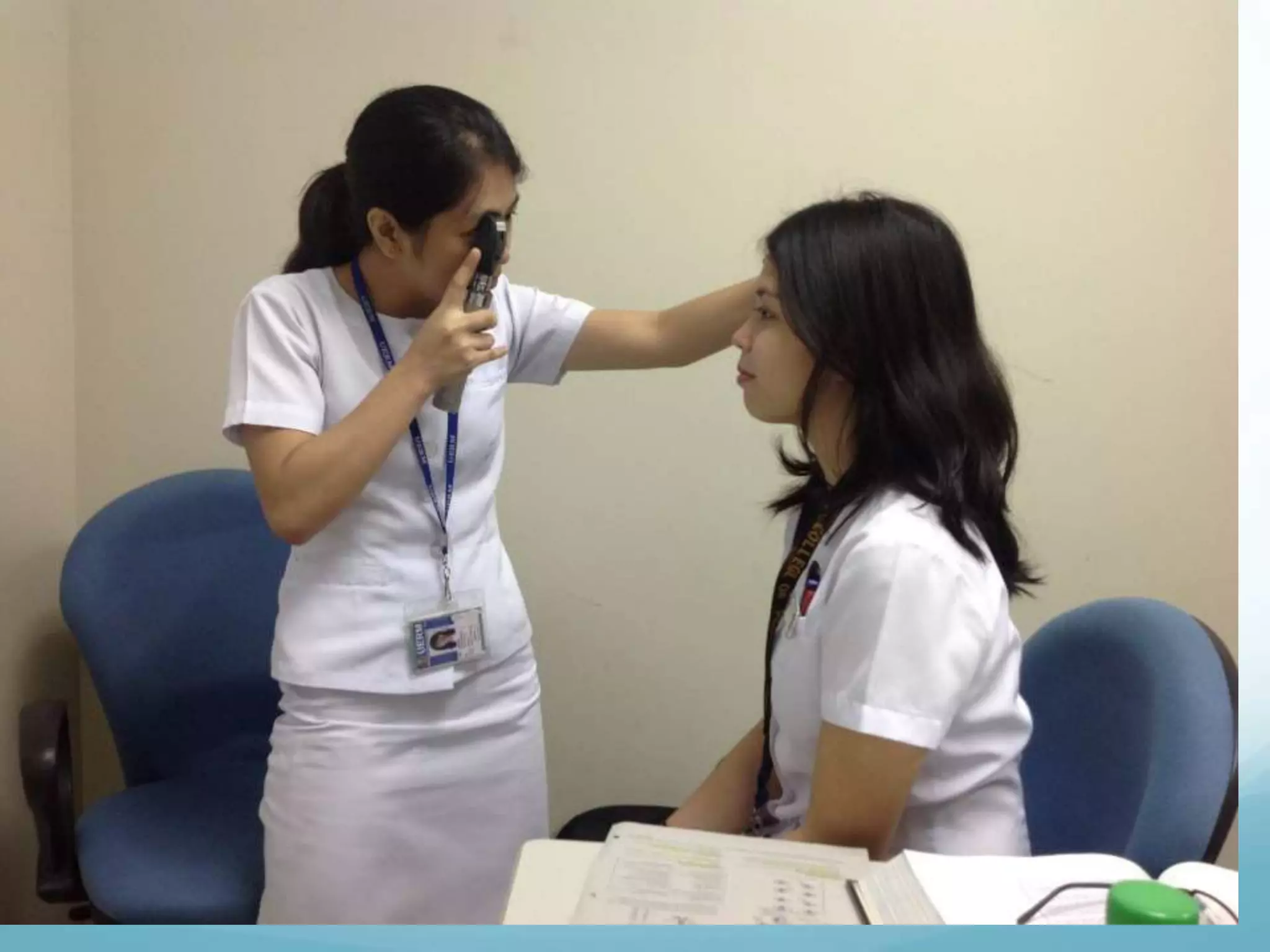
 II. Optic: Visual Acuity (with and without glasses),
visual field examination, Fundoscopy (fundus, disc,
vessels, venous pulse, retina)
 II, III Reaction to light, direct and consensual
 III, IV, VI Oculomotor, Trochlear, Abducens Primary
gaze, Extra Ocular Muscle Movement
Cranial Nerve Exam
 V. Trigeminal Sensory on V1-V2-V3 Motor - jaw
movement (masseter, pterygoids)
 V, VII Corneal Reflex
 VII. Facial – motor - raise eyebrows, close eyes, show
teeth; sensory - taste (ant. 2/3 of tongue)
II. Cranial Nerve Exam
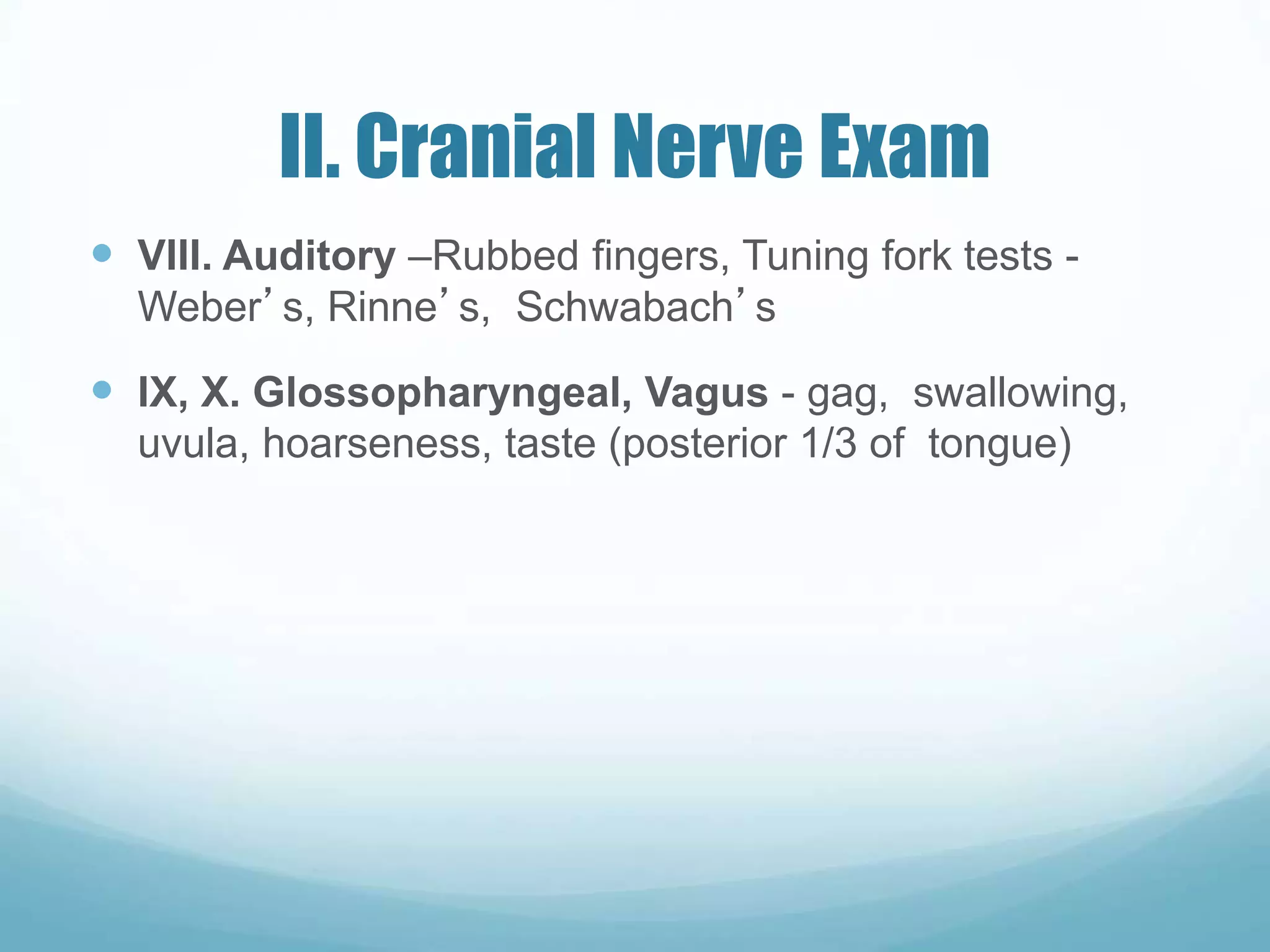
 VIII. Auditory –Rubbed fingers, Tuning fork tests -
Weber’s, Rinne’s, Schwabach’s
 IX, X. Glossopharyngeal, Vagus - gag, swallowing,
uvula, hoarseness, taste (posterior 1/3 of tongue)
II. Cranial Nerve Exam
 XI. Spinal Accesory - raise shoulders, turn head
against resistance
 XII. Hypoglossal - tongue deviation, atrophy,
fasciculation,
III. Motor Exam
 Strength: uppers and lowers, left and right, distal and
proximal
upper: proximal - arms outstretched, distal - grasp
lower: ask patient to walk, proximal - rise from chair,
distal - tiptoe
Scale in grading muscle
strength
0 No movement
1
Flicker or trace of contraction but no
associated movement at a joint
2 Movement with gravity eliminated
3
Movement against gravity but not against
resistance
4- Movement against a mild degree of resistance
4 Movement against moderate resistance
4+ Movement against strong resistance
5 Full power
III. Motor Exam
 Tone - passive movement; Increased: spasticity,
rigidity; Normal, Decreased: hypotonia
 Inspection - atrophy, fasciculations, tenderness or
hypertrophy and any involuntary movements
IV. Sensory Exam
 Touch
 Pin
 Position sense
 Vibration sense
 Temperature
 Graphesthesia
 Stereognosis
 Two-point discrimination
 Lateralization: double
simultaneous stimulation
 Romberg’s
V. Reflexes:
 DTRs
 biceps (C5-C6)
 triceps (C7-C8)
 brachioradialis (C6-C7)
 knee (L2-L4),
 ankle (S1-S2),
 Primitive - snout, suck, grasp
 Babinski, Hoffman’s
Grading Reflexes
Grade Description
4+
3+
2+
1+
0
Hyperactive (with clonus)
Brisker than average, not necessarily
Abnormal
Average, normal
Diminished, low normal
No response
VI. Cerebellar Function
 Coordination: finger-to-nose, alternating pronation-
supination, hand patting, finger tapping
Nystagmus
Tremor
 Gait and Stance
* stand with feet together with eyes open
* normal walking
* tandem walk
VII. Miscellaneous:
 Examination of head and spine: Inspection of the
neck and spine, straight-leg raising sign
 Meningeal signs: Neck rigidity, kernigs, brudzinski
 Carotids: bruits, palpation
Preceptorial Group Activity
 Form into 7 groups
 Each group is assigned a specific part of neurologic
exam to perform.
 Group I: Mental Status Examination
 Group II: Cranial Nerves I, II, III, IV, V, VI
 Group III: Cranial Nerves VII, VIII, IX, X, XI, XII
 Group IV: Motor Examination
 Group V: Sensory Examination
 Group VI: Reflexes
 Group VII: Cerebellar Examination
 Assign a Group leader
Preceptorial Group Activity
 Make a Video Clip on how you perform the assigned
Neurologic Examination
 Criteria: Mastery and Content 50% Creativity 30%
Participation of members 10% Submission on time 10%
 Due on March 19, 2021
 To be submitted in a Google drive together with all the
groups

Neurologic Examination

  • 1.
  • 2.
    Objectives  Understand theBasic Concepts of Neurologic Examination  Learn the Different Parts of Neurologic Examination  Familiarize the techniques of Eliciting Abnormalities
  • 3.
    Outline  Basic Conceptsof Neurologic Examination  Mental Status Examination  Cranial Nerve Examination  Motor Examination  Sensory Examination  Examination of the Reflexes  Cerebellar Examination  Miscellaneous Examination
  • 4.
    Neurologic Examination  Thecornerstone in the evaluation of Neurologic patients
  • 5.
    Goals  To facilitatecommunication  To provide a baseline examination  To direct testing and guide the physician on what laboratory tests to request for the patients.  To localize the lesion
  • 6.
    Instruments for aNeurologic Examination  Must have:  Pocket Snellen chart  Neurologic hammer  Pen light  Disposable pin/toothpicks/cotton  Tongue Depressor  Tuning Fork (128 or 256 cps)  Stethoscope  BP Apparatus  Ophthalmoscope  Otoscope
  • 7.
    Guidelines  Perform theNeurologic Examination in an orderly fashion  Finish the examinations for one system before starting another  Always examine the left and the right side of the body and compare  Compare the proximal against the distal findings
  • 8.
    Three Basic Steps Data Gathering  Anatomic Localization  Etiologic Diagnosis
  • 9.
    Parts of NeurologicExamination  Mental Status  Cranial Nerves  Motor Exam  Sensory Exam  Reflexes  Cerebellar Function  Miscellaneous
  • 10.
    I. Mental StatusExamination  During history taking  Formal cerebral function tests  Mini-Mental State Exam
  • 11.
    I. Mental StatusExamination  Frontal: Sensorium, Speech, Ability to follow commands, Attention Span, Insight and Judgement, Fund of Knowledge  Parietal: Left/Right Orientation, finger agnosia, Calculation, writing, stereognosis, graphesthesia, hemineglect, Praxis  Temporal: Orientation to time/place/person, Memory, Comprehension  Occipital: Ability to Identify familiar faces, colors and Objects
  • 12.
    II. Cranial NerveExam  I. Olfactory: test one nostril at a time with eyes closed. Avoid alcohol as a test material, Use (Vanilla, Coffee, Tobacco)  II. Optic: Visual Acuity (with and without glasses), visual field examination, Fundoscopy (fundus, disc, vessels, venous pulse, retina)  II, III Reaction to light, direct and consensual  III, IV, VI Oculomotor, Trochlear, Abducens Primary gaze, Extra Ocular Muscle Movement
  • 16.
    Cranial Nerve Exam V. Trigeminal Sensory on V1-V2-V3 Motor - jaw movement (masseter, pterygoids)  V, VII Corneal Reflex  VII. Facial – motor - raise eyebrows, close eyes, show teeth; sensory - taste (ant. 2/3 of tongue)
  • 17.
    II. Cranial NerveExam  VIII. Auditory –Rubbed fingers, Tuning fork tests - Weber’s, Rinne’s, Schwabach’s  IX, X. Glossopharyngeal, Vagus - gag, swallowing, uvula, hoarseness, taste (posterior 1/3 of tongue)
  • 18.
    II. Cranial NerveExam  XI. Spinal Accesory - raise shoulders, turn head against resistance  XII. Hypoglossal - tongue deviation, atrophy, fasciculation,
  • 19.
    III. Motor Exam Strength: uppers and lowers, left and right, distal and proximal upper: proximal - arms outstretched, distal - grasp lower: ask patient to walk, proximal - rise from chair, distal - tiptoe
  • 20.
    Scale in gradingmuscle strength 0 No movement 1 Flicker or trace of contraction but no associated movement at a joint 2 Movement with gravity eliminated 3 Movement against gravity but not against resistance 4- Movement against a mild degree of resistance 4 Movement against moderate resistance 4+ Movement against strong resistance 5 Full power
  • 21.
    III. Motor Exam Tone - passive movement; Increased: spasticity, rigidity; Normal, Decreased: hypotonia  Inspection - atrophy, fasciculations, tenderness or hypertrophy and any involuntary movements
  • 22.
    IV. Sensory Exam Touch  Pin  Position sense  Vibration sense  Temperature  Graphesthesia  Stereognosis  Two-point discrimination  Lateralization: double simultaneous stimulation  Romberg’s
  • 23.
    V. Reflexes:  DTRs biceps (C5-C6)  triceps (C7-C8)  brachioradialis (C6-C7)  knee (L2-L4),  ankle (S1-S2),  Primitive - snout, suck, grasp  Babinski, Hoffman’s
  • 24.
    Grading Reflexes Grade Description 4+ 3+ 2+ 1+ 0 Hyperactive(with clonus) Brisker than average, not necessarily Abnormal Average, normal Diminished, low normal No response
  • 25.
    VI. Cerebellar Function Coordination: finger-to-nose, alternating pronation- supination, hand patting, finger tapping Nystagmus Tremor  Gait and Stance * stand with feet together with eyes open * normal walking * tandem walk
  • 26.
    VII. Miscellaneous:  Examinationof head and spine: Inspection of the neck and spine, straight-leg raising sign  Meningeal signs: Neck rigidity, kernigs, brudzinski  Carotids: bruits, palpation
  • 27.
    Preceptorial Group Activity Form into 7 groups  Each group is assigned a specific part of neurologic exam to perform.  Group I: Mental Status Examination  Group II: Cranial Nerves I, II, III, IV, V, VI  Group III: Cranial Nerves VII, VIII, IX, X, XI, XII  Group IV: Motor Examination  Group V: Sensory Examination  Group VI: Reflexes  Group VII: Cerebellar Examination  Assign a Group leader
  • 28.
    Preceptorial Group Activity Make a Video Clip on how you perform the assigned Neurologic Examination  Criteria: Mastery and Content 50% Creativity 30% Participation of members 10% Submission on time 10%  Due on March 19, 2021  To be submitted in a Google drive together with all the groups