How does technology-enhanced learning
contribute to teaching excellence?
> >Slide
How does technology-enhanced learning
contribute to teaching excellence?
Sarah Davies,
Head of higher eduaction and student experience, Jisc
14/03/2017 How does technology-enhanced learning contribute to teaching excellence?2
How do staff engage with institutional
infrastructure designed to promote excellent
teaching with learning technologies?
Professor Rhona Sharpe
Oxford Brookes University
Digifest
March 2017@rjsharpe elesig.net
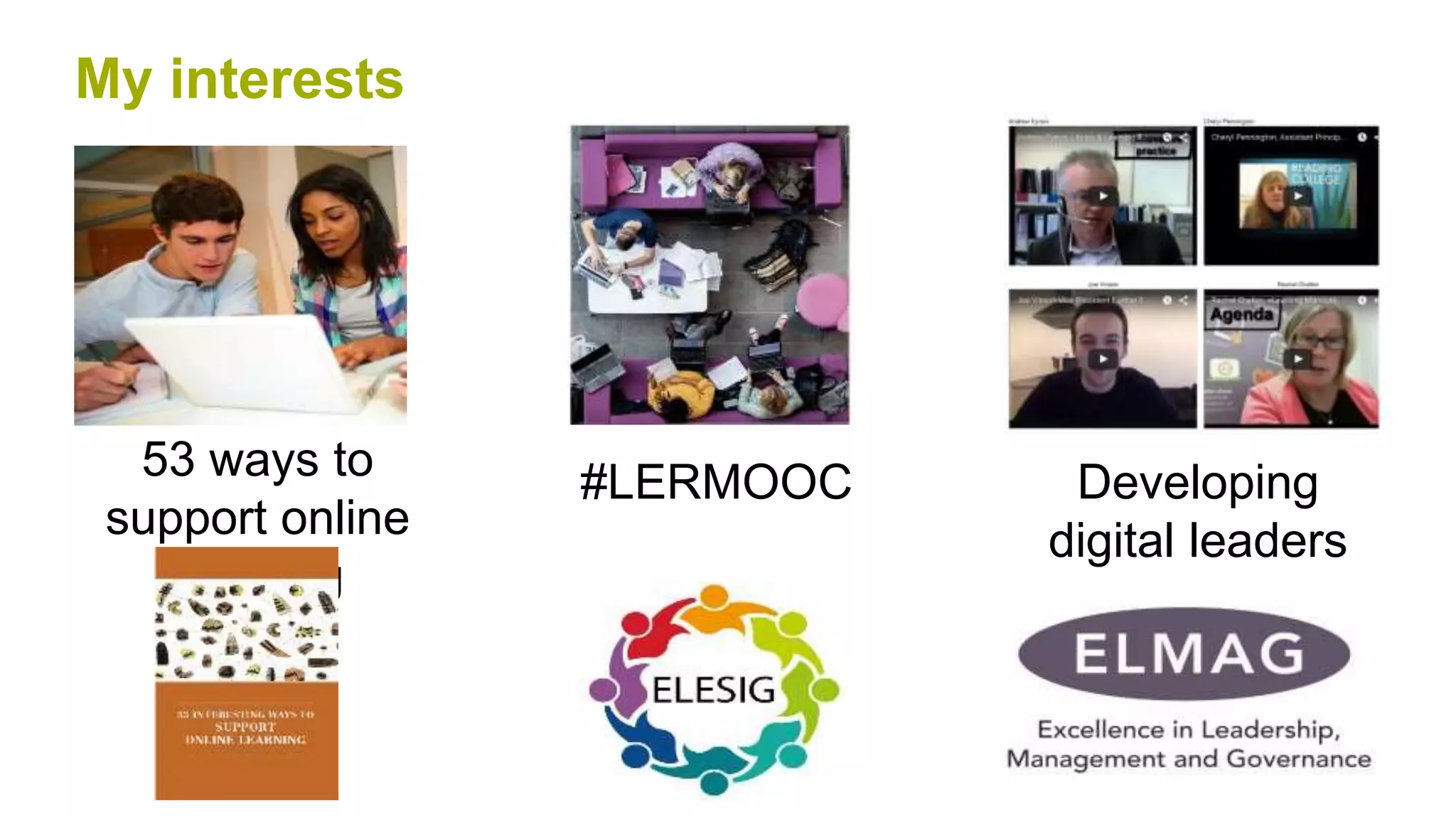
My interests
#LERMOOC53 ways to
support online
learning
Developing
digital leaders
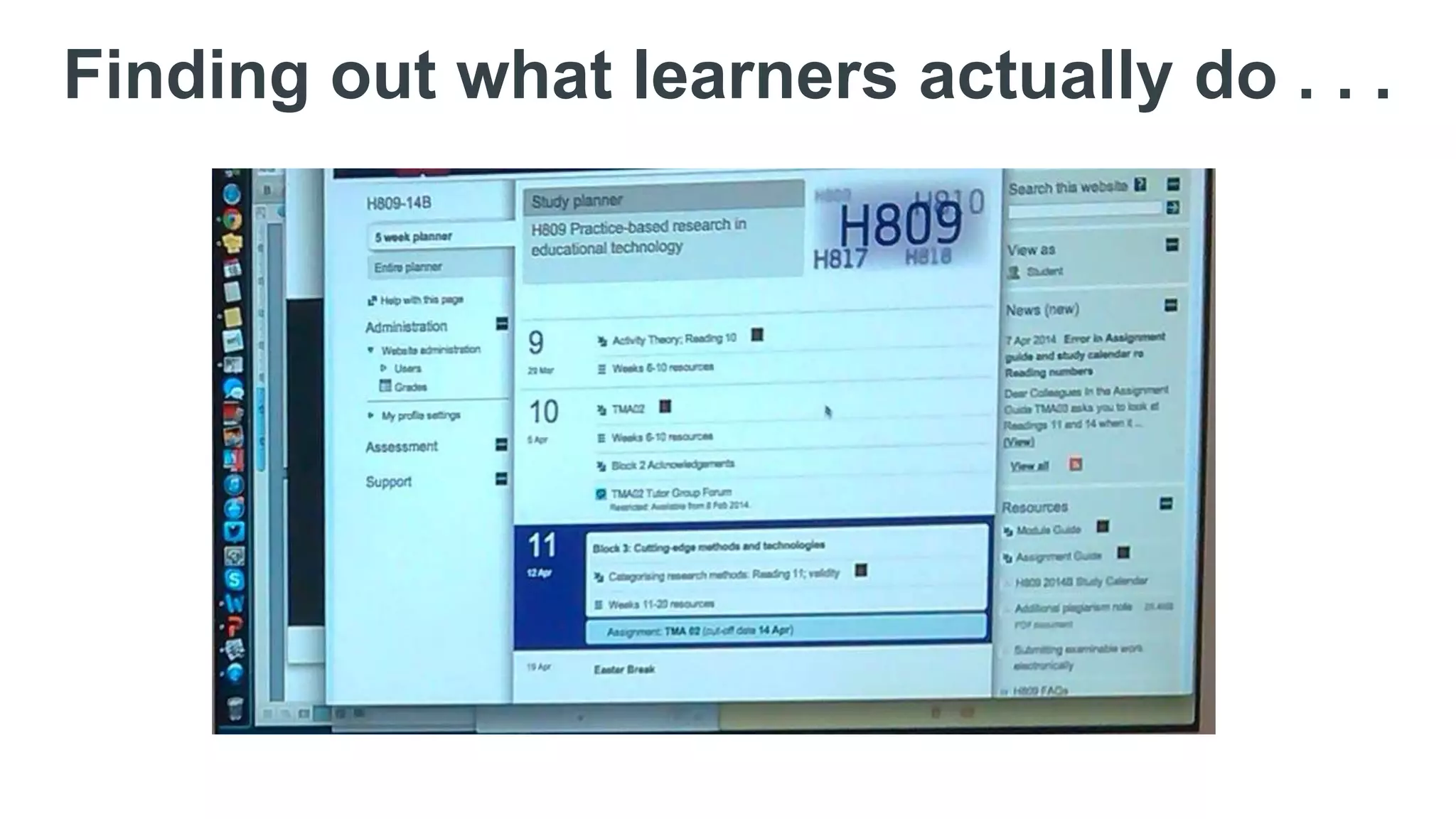
Finding out what learners actually do . . .
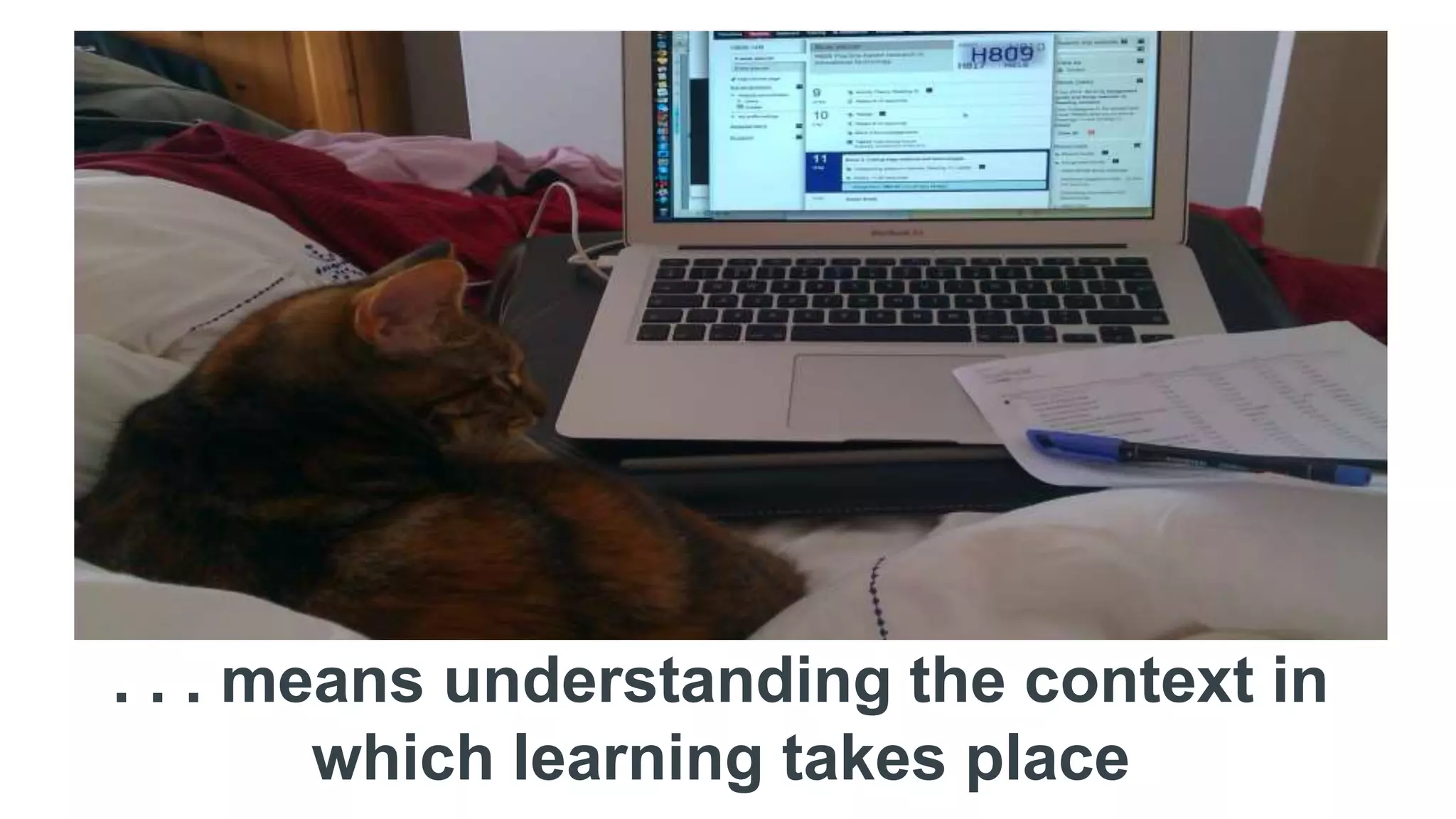
. . . means understanding the context in
which learning takes place
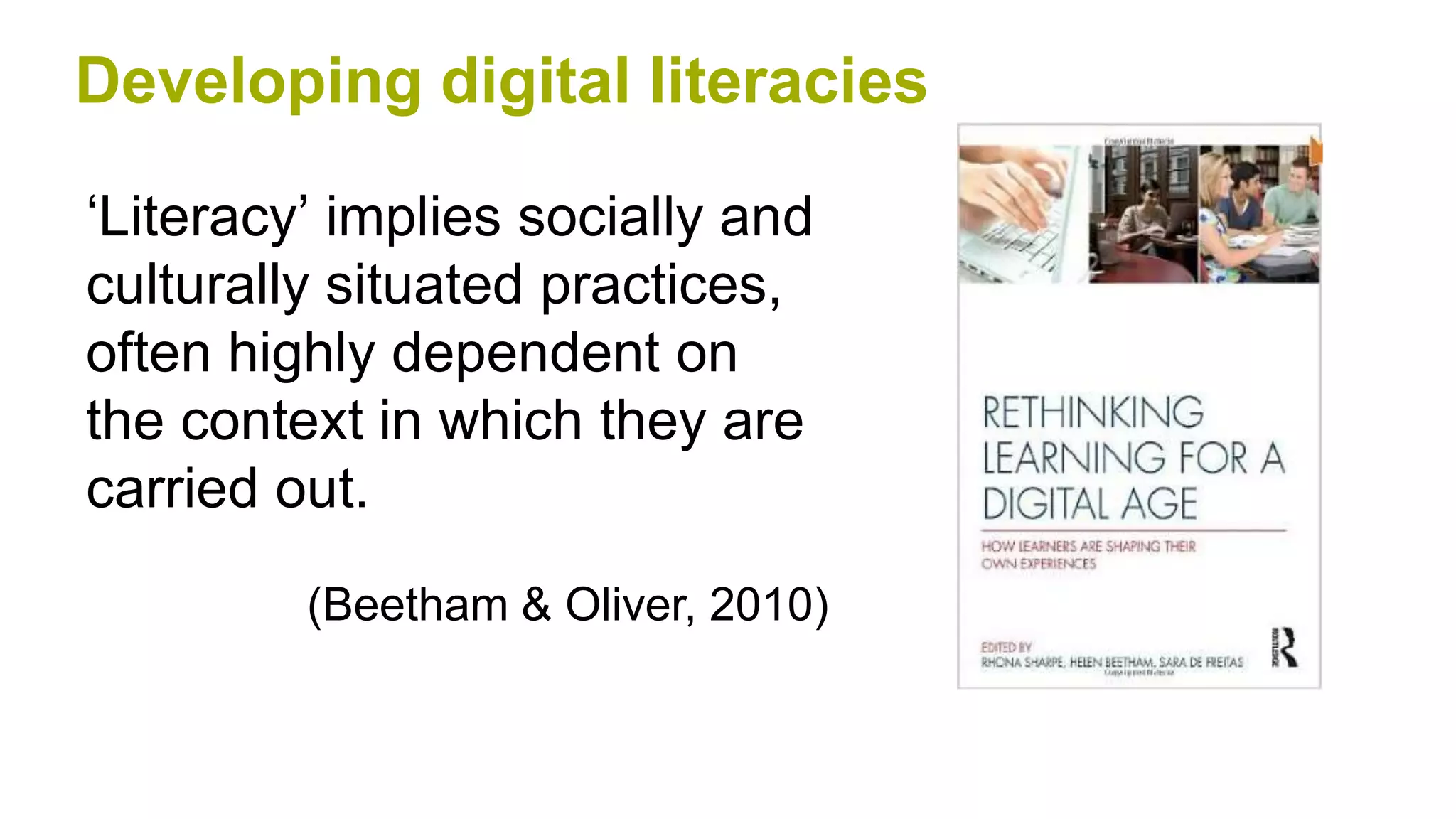
‘Literacy’ implies socially and
culturally situated practices,
often highly dependent on
the context in which they are
carried out.
(Beetham & Oliver, 2010)
Developing digital literacies
unconnected
vulnerable
access-led
assessment of
skills is ongoing
mainstream
pragmatists
Tutor / pedagogy
/institution-led
Technology used to
develop criticality,
self-management
intensive and
specialist
enthusiasts
Learner-led
Technology-led
Social digital literacy
practices are valued
and new practices
made explicit
Learners
who are
Experience
the digital
environment
as:
Best
supported
where:
https://digitalstudent.jiscinvolve.org/wp/fe-and-skills-digital-student-study/fe-digital-students-key-
outputs/
The Learner and their Context, Becta
Chris Davies and Rebecca Eynon
FE Digital Student Study
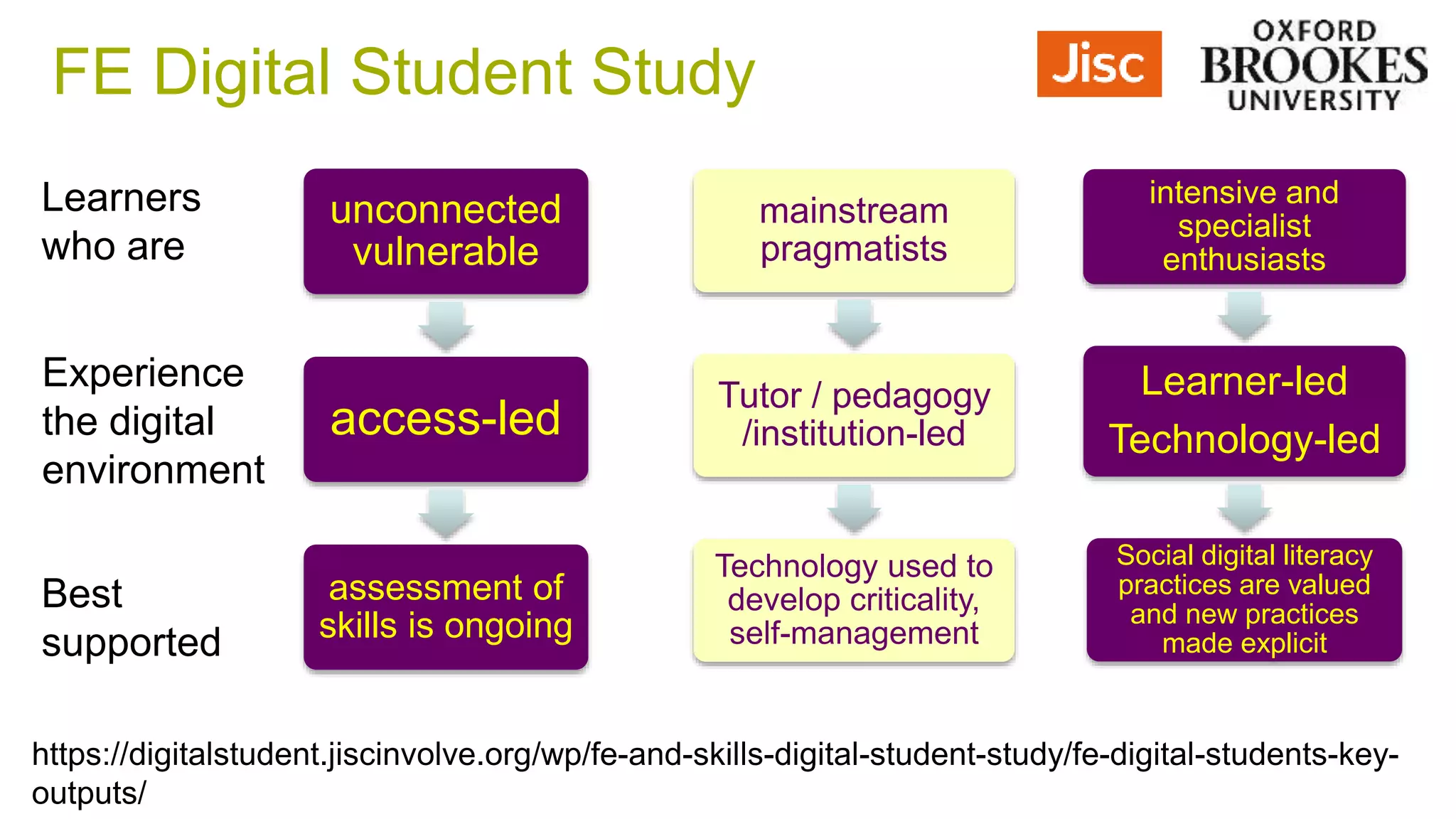
unconnected
vulnerable
access-led
assessment of
skills is ongoing
mainstream
pragmatists
Tutor / pedagogy
/institution-led
Technology used to
develop criticality,
self-management
intensive and
specialist
enthusiasts
Learner-led
Technology-led
Social digital literacy
practices are valued
and new practices
made explicit
Learners
who are
Experience
the digital
environment
Best
supported
FE Digital Student Study
https://digitalstudent.jiscinvolve.org/wp/fe-and-skills-digital-student-study/fe-digital-students-key-
outputs/
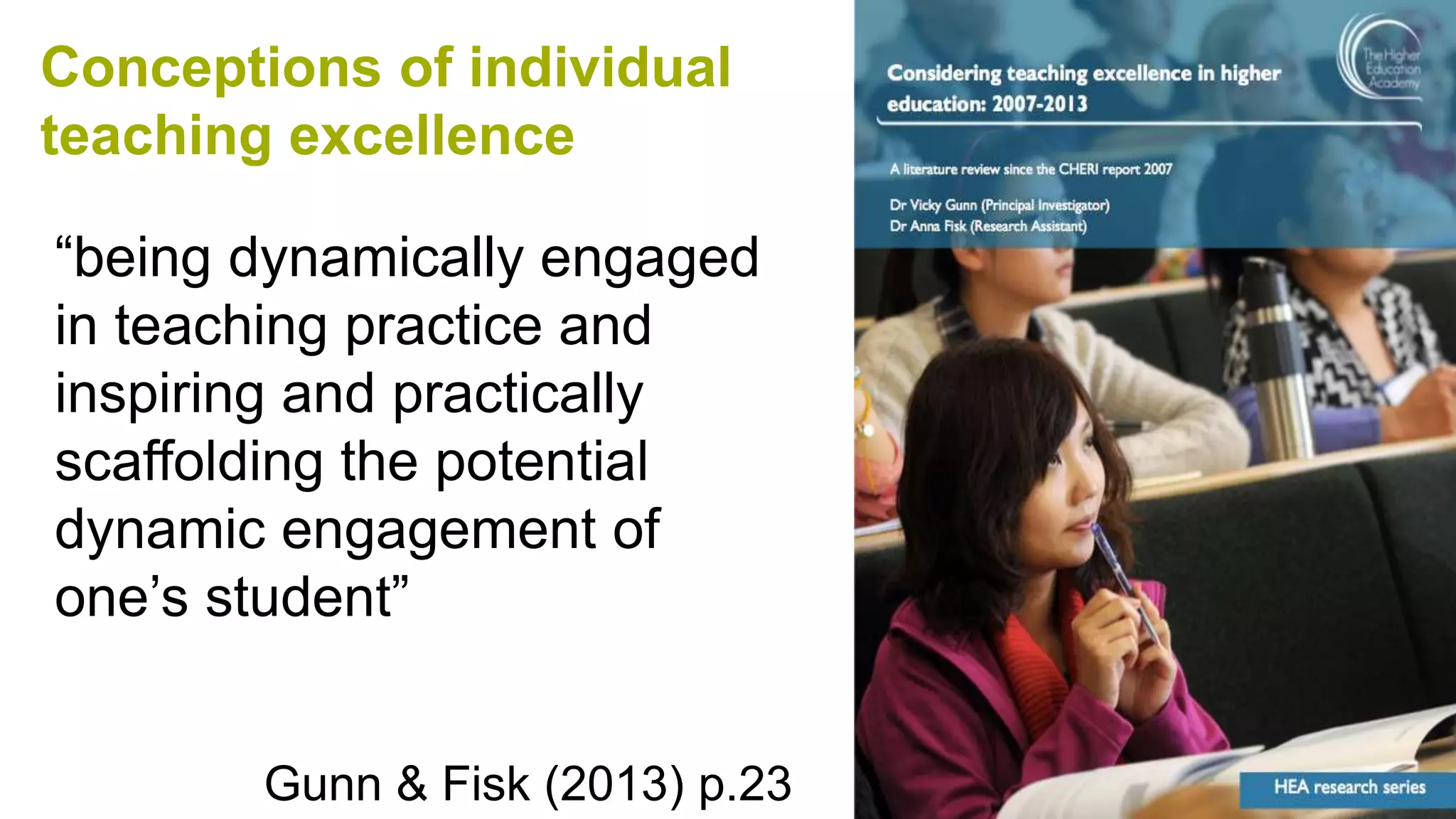
Conceptions of individual
teaching excellence
“being dynamically engaged
in teaching practice and
inspiring and practically
scaffolding the potential
dynamic engagement of
one’s student”
Gunn & Fisk (2013) p.23
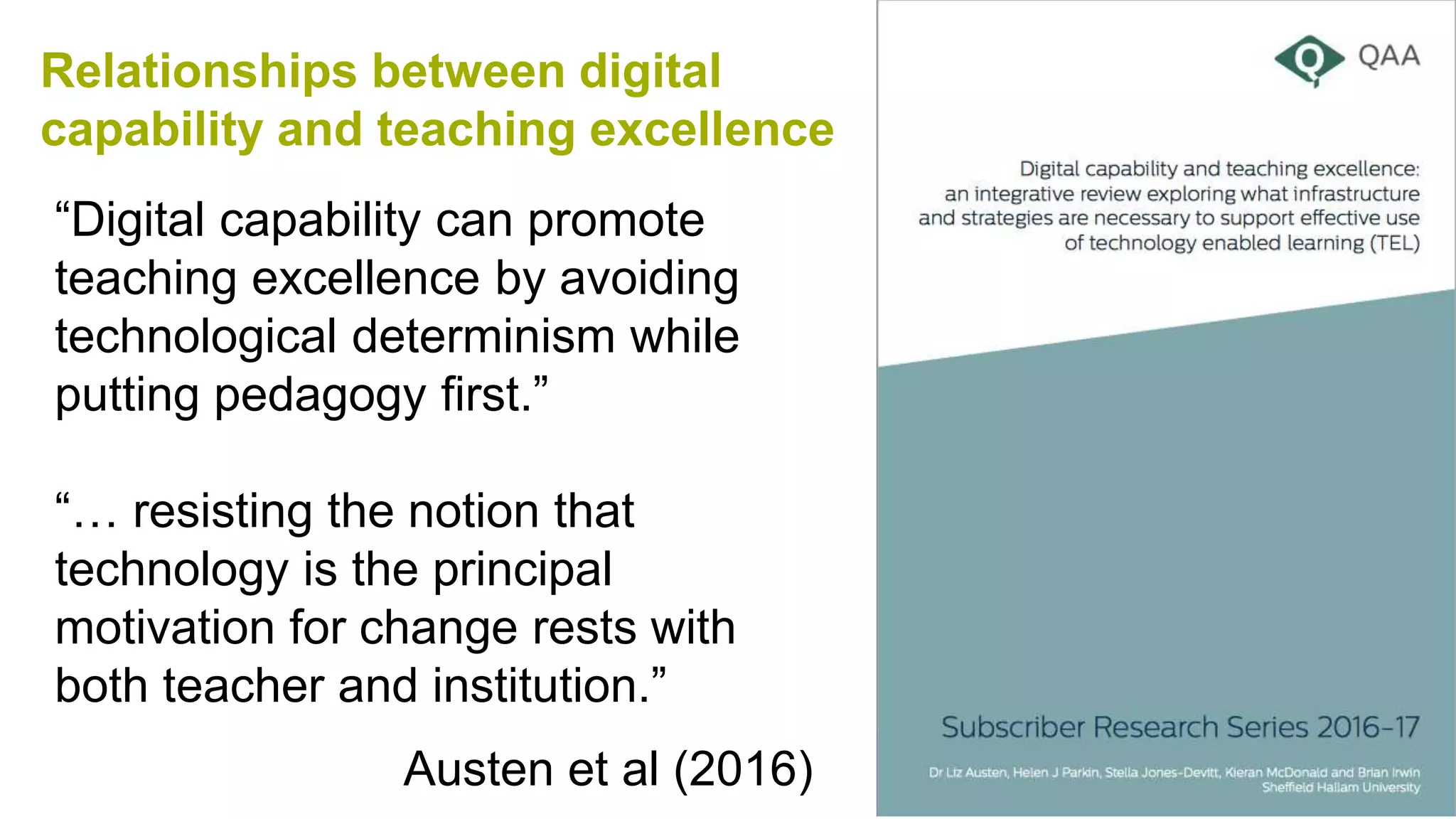
Relationships between digital
capability and teaching excellence
Austen et al (2016)
“Digital capability can promote
teaching excellence by avoiding
technological determinism while
putting pedagogy first.”
“… resisting the notion that
technology is the principal
motivation for change rests with
both teacher and institution.”
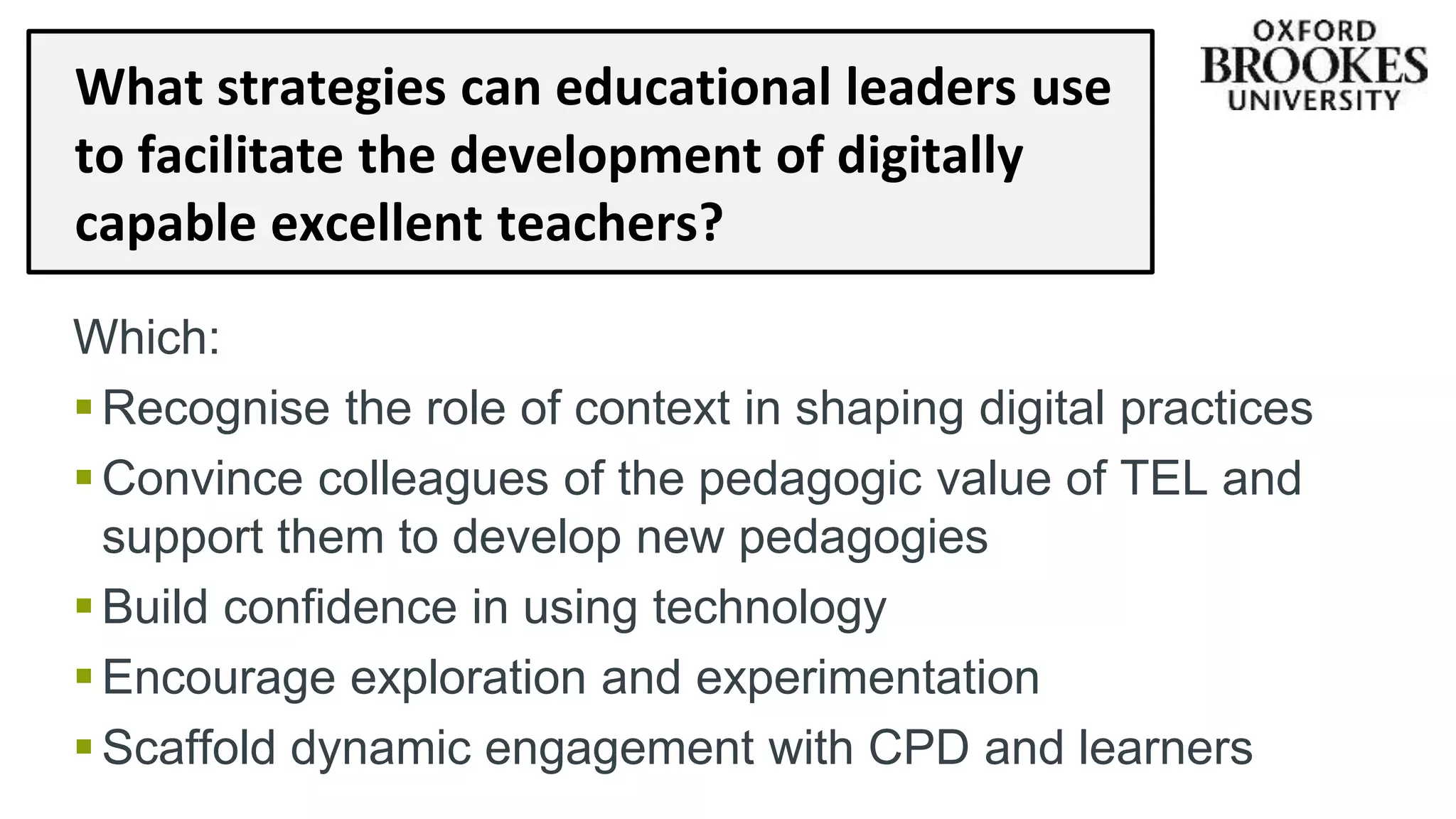
What strategies can educational leaders use
to facilitate the development of digitally
capable excellent teachers?
Which:
Recognise the role of context in shaping digital practices
Convince colleagues of the pedagogic value of TEL and
support them to develop new pedagogies
Build confidence in using technology
Encourage exploration and experimentation
Scaffold dynamic engagement with CPD and learners
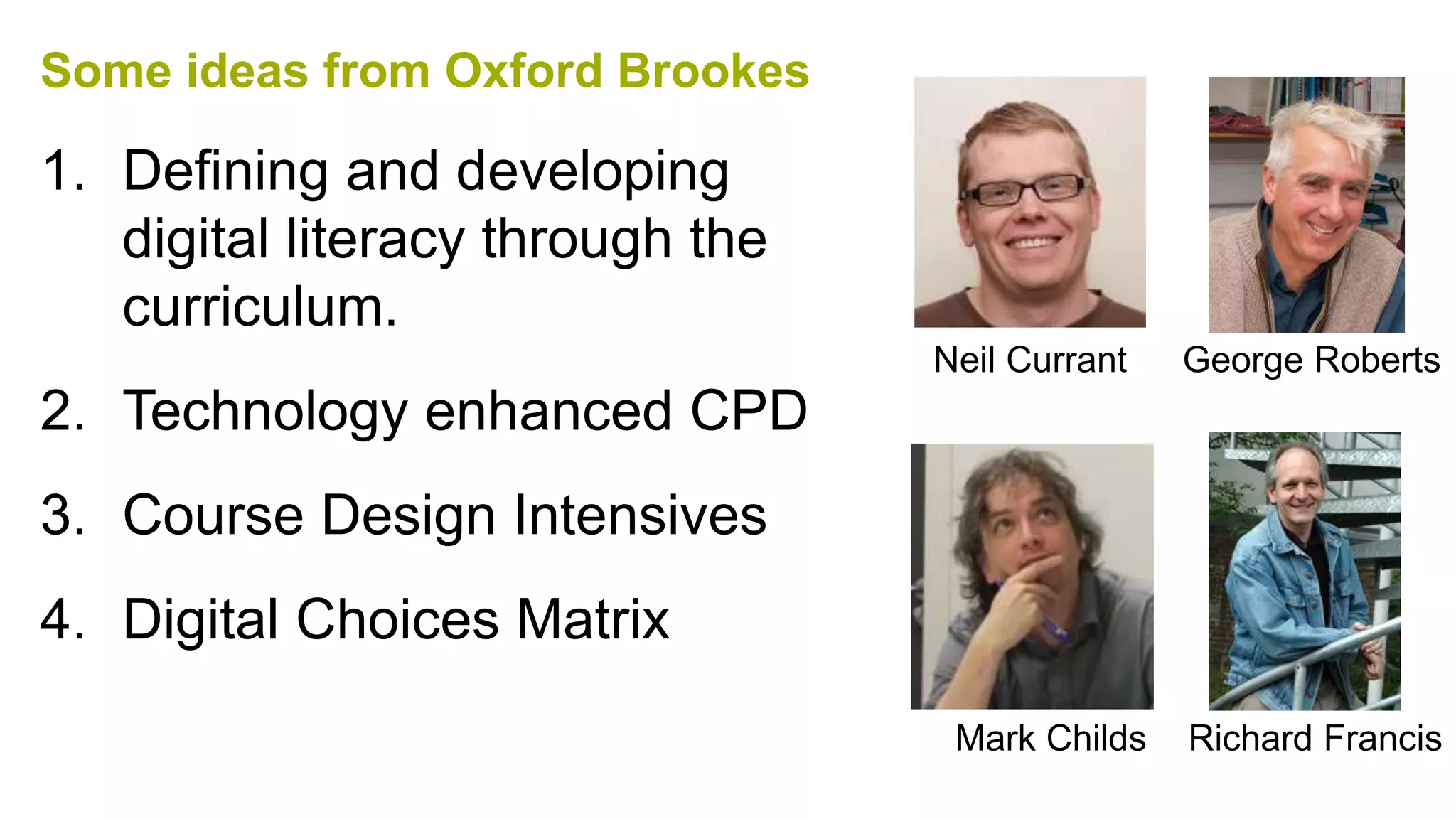
Some ideas from Oxford Brookes
1. Defining and developing
digital literacy through the
curriculum.
2. Technology enhanced CPD
3. Course Design Intensives
4. Digital Choices Matrix
Neil Currant George Roberts
Mark Childs Richard Francis
A. Plan for the inclusion of ICT resources within the
teaching of classes of primary-aged children
B. Application of IT skills within a technical or
commercial environment, particularly CAD systems
and data transfer between such systems.
C. Gather, organise and deploy a variety of digital
sources pertaining to the subject.
D. Present to an audience using appropriate media.
Evaluation Part 1
Staff Engagement
Defining digital literacy within the disciplines
With your neighbour, can you identify the disciplines?
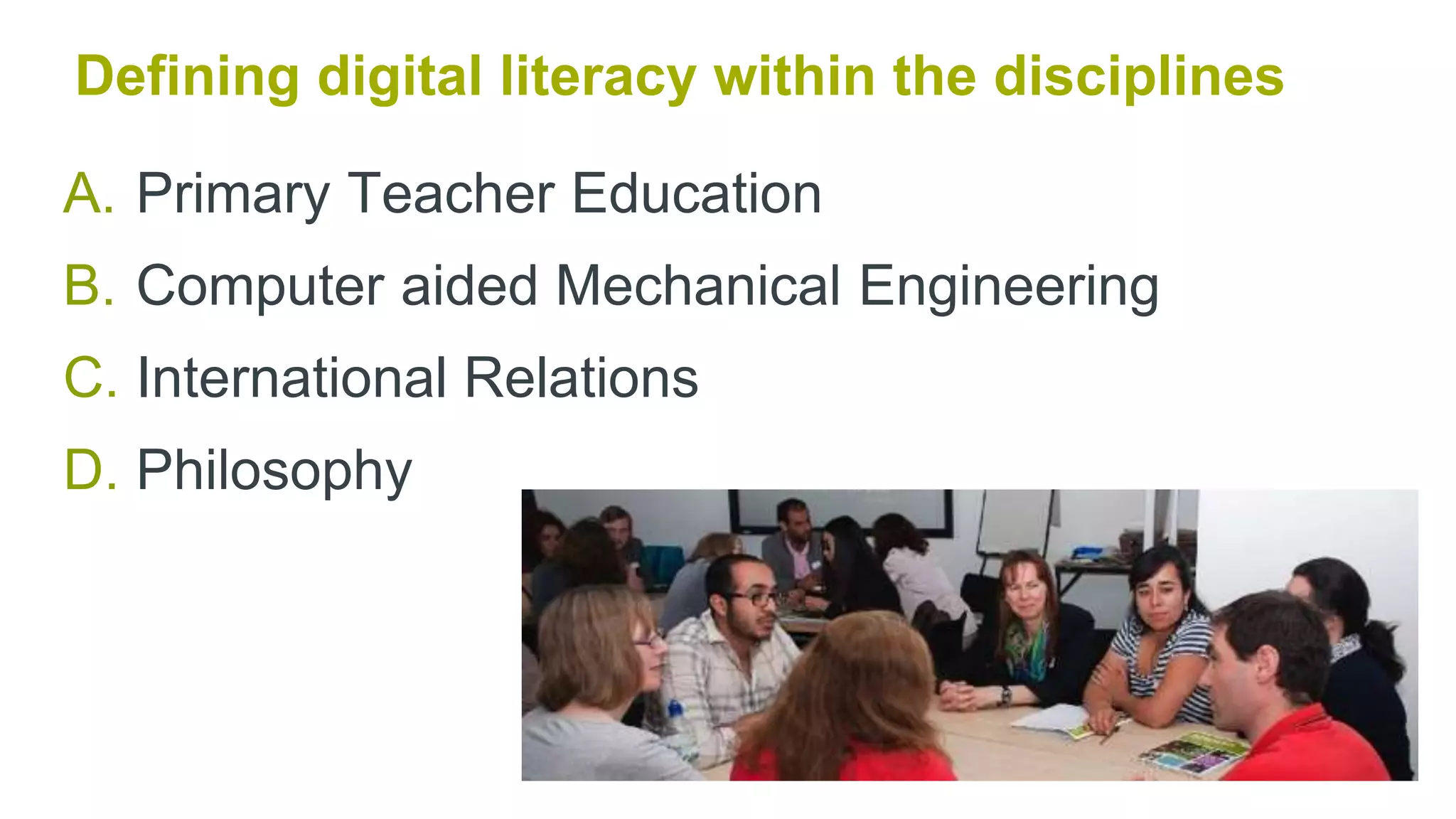
A. Primary Teacher Education
B. Computer aided Mechanical Engineering
C. International Relations
D. Philosophy
Evaluation Part 1
Staff Engagement
Defining digital literacy within the disciplines
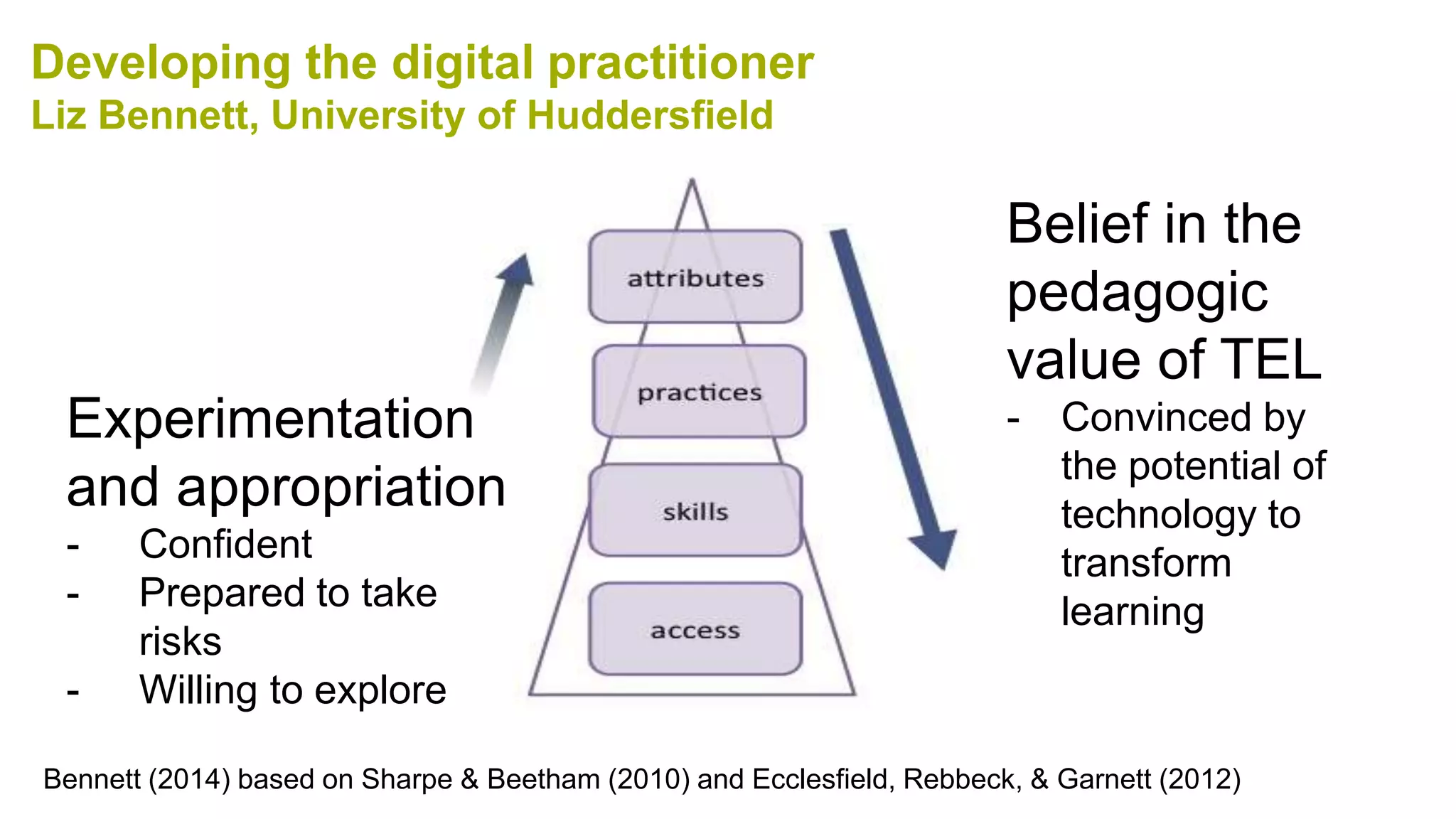
Developing the digital practitioner
Liz Bennett, University of Huddersfield
Bennett (2014) based on Sharpe & Beetham (2010) and Ecclesfield, Rebbeck, & Garnett (2012)
Experimentation
and appropriation
- Confident
- Prepared to take
risks
- Willing to explore
Belief in the
pedagogic
value of TEL
- Convinced by
the potential of
technology to
transform
learning
1. How much has your coursework emphasised
the following mental activities?
2. How often have you done each of the
following?
3. How much has your experience at this
institution contributed to your knowledge, skills
and personal development in these areas?
Engagement questions
Developing digital literacy (Student Engagement)
0
10
20
30
40
50
60
70
Critically evaluating
digital sources of
information
Used technology to
collaborate with
others or engage
with online
communities
Used technology to
reflect on and
record your
learning? ]
Using technology in
innovative or
creative ways
2014
2016
Graduate Attributes as a measure of learning gain
Learning gain in Active
Citizenship Strategic
Excellence project
ABC Learning Gains
project with OU and
Surrey
abclearninggains.com/openbrookes.net/cci/
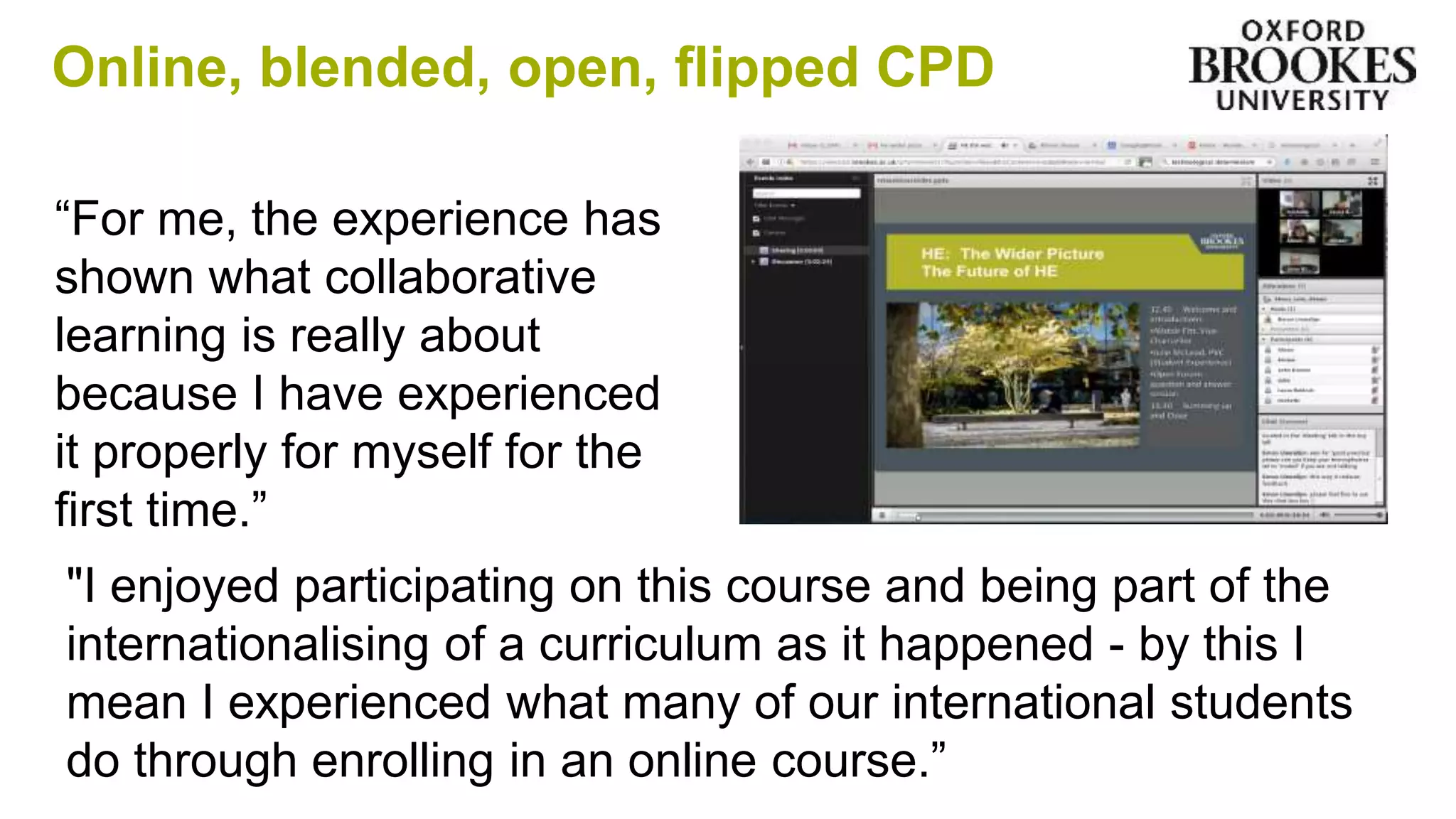
Online, blended, open, flipped CPD
“For me, the experience has
shown what collaborative
learning is really about
because I have experienced
it properly for myself for the
first time.”
"I enjoyed participating on this course and being part of the
internationalising of a curriculum as it happened - by this I
mean I experienced what many of our international students
do through enrolling in an online course.”
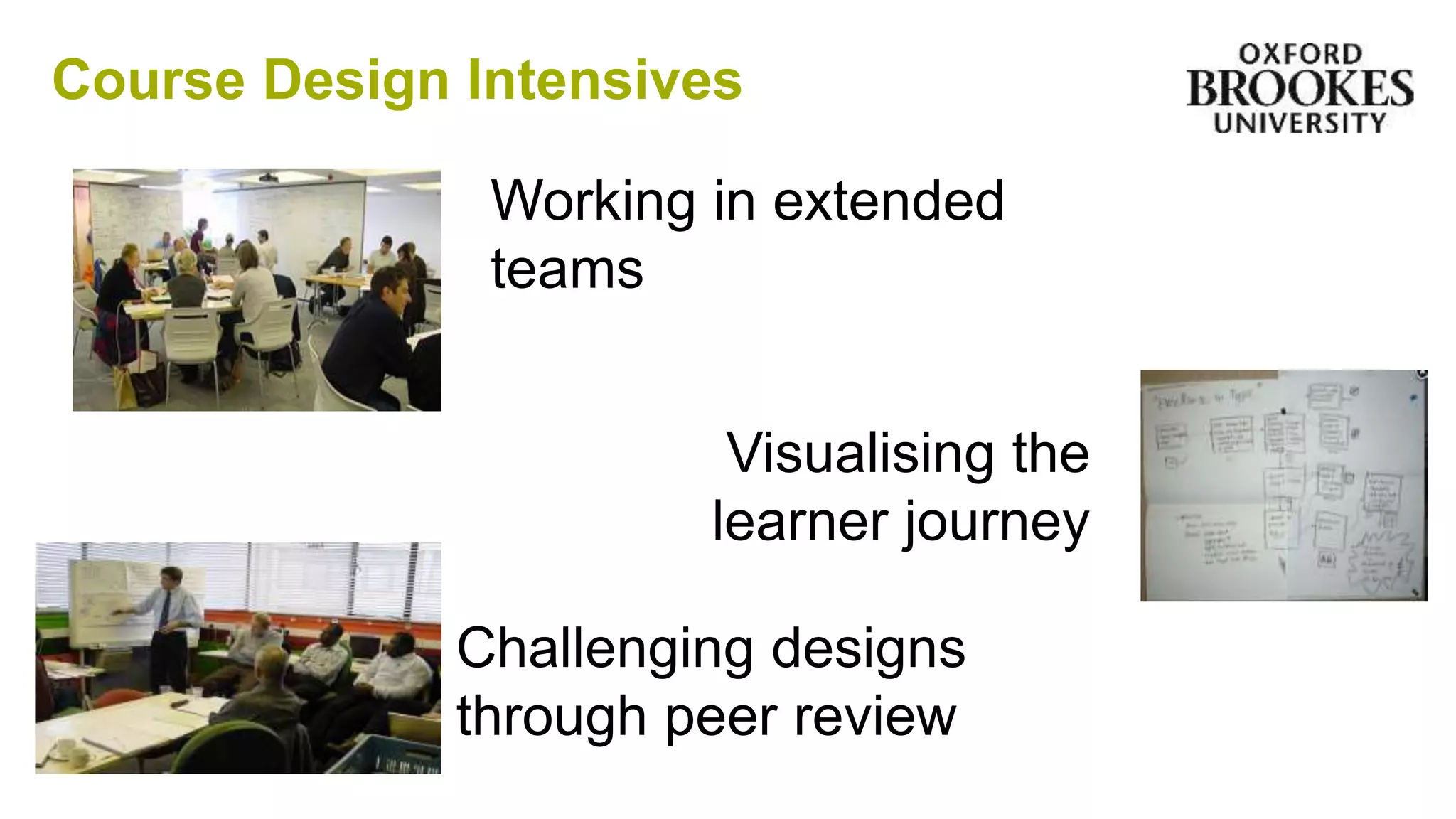
Course Design Intensives
Working in extended
teams
Visualising the
learner journey
Challenging designs
through peer review
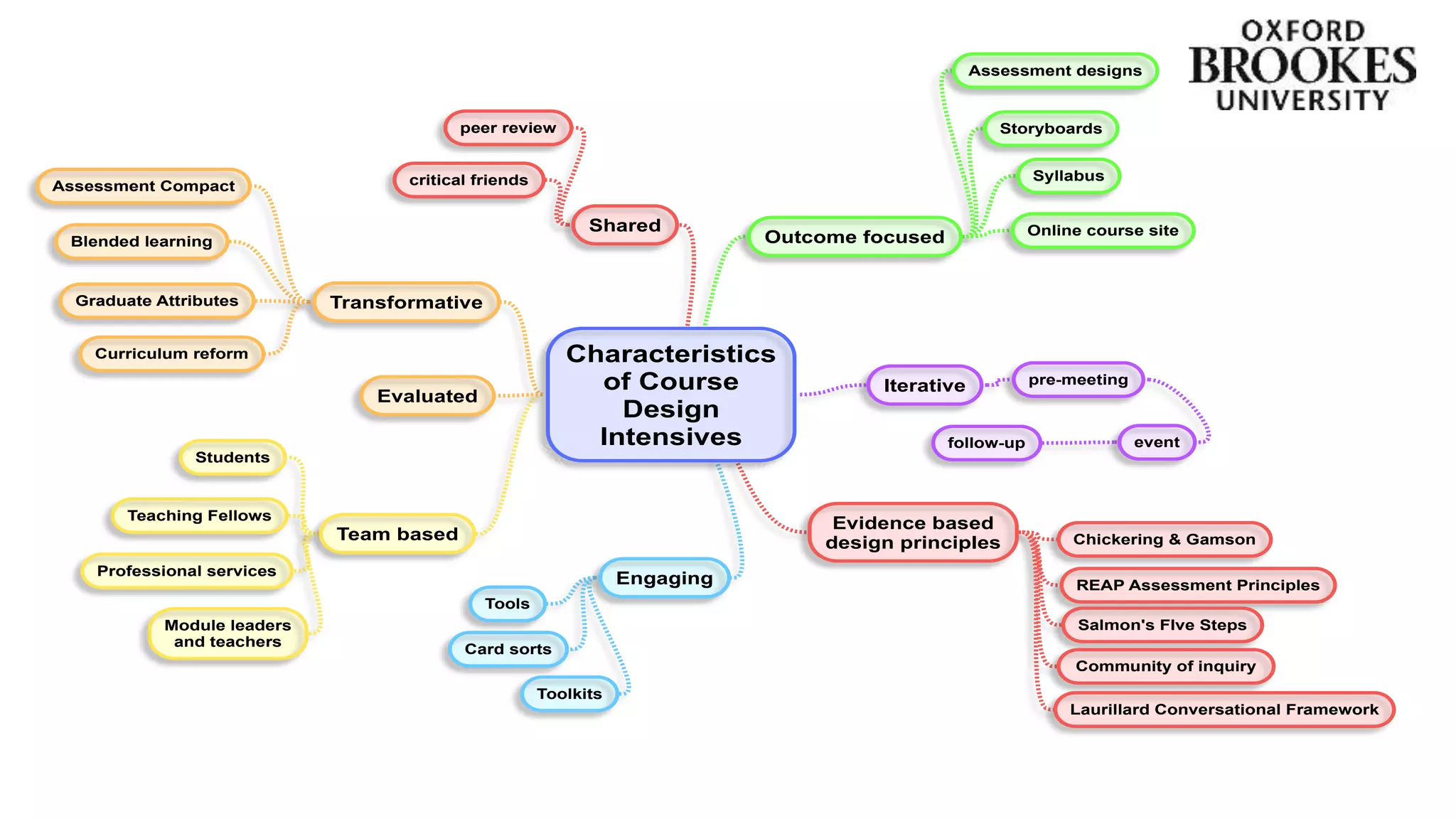
Characteristics
of Course
Design
Intensives
Evidence based
design principles Chickering & Gamson
REAP Assessment Principles
Salmon's FIve Steps
Laurillard Conversational Framework
Community of inquiry
Transformative
Blended learning
Graduate Attributes
Curriculum reform
Assessment Compact
Team based
Professional services
Students
Teaching Fellows
Module leaders
and teachers
Outcome focused
Storyboards
Syllabus
Assessment designs
Online course site
Engaging
Tools
Toolkits
Card sorts
Iterative pre-meeting
eventfollow-up
Shared
critical friends
peer review
Evaluated
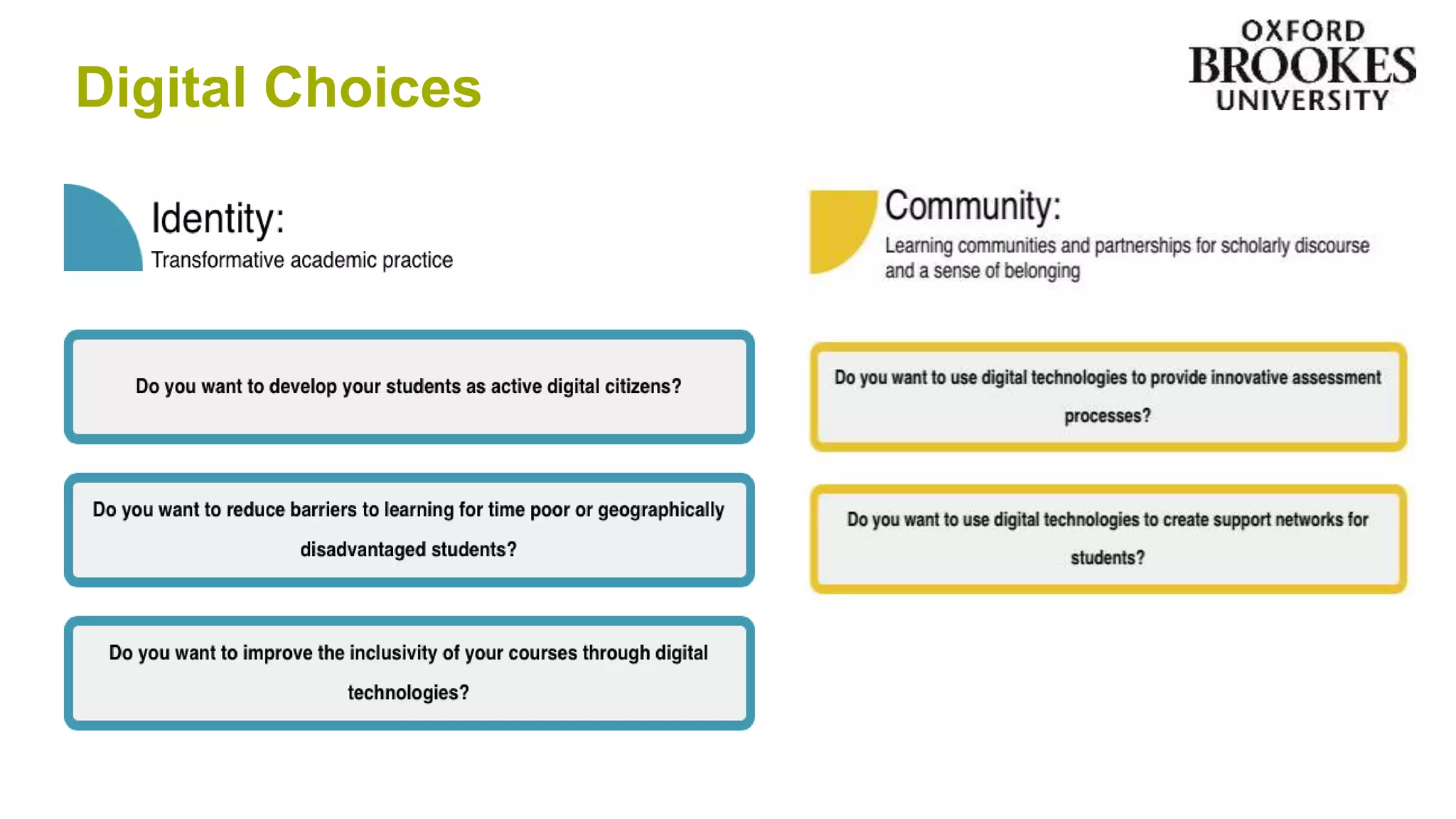
Digital Choices
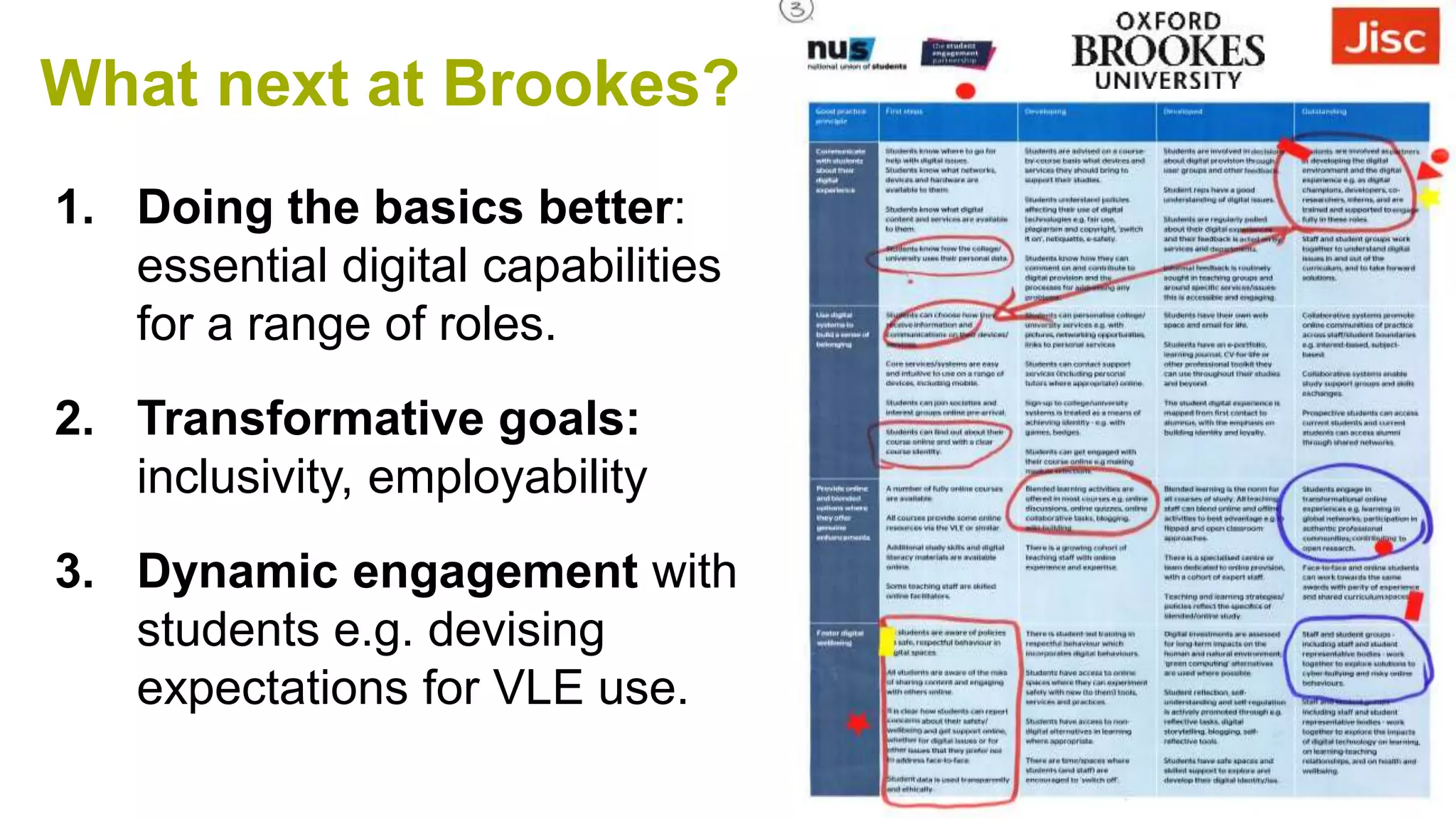
What next at Brookes?
1. Doing the basics better:
essential digital capabilities
for a range of roles.
2. Transformative goals:
inclusivity, employability
3. Dynamic engagement with
students e.g. devising
expectations for VLE use.
Resources
53 Interesting Ways to Support Online Learning available to order
from https://www.brookes.ac.uk/OCSLD/Publications/
Learner Experience Research MOOC (#LERMOOC) Feb – April 2017 at
http://platform.europeanmoocs.eu b
ABC Learning Gains project https://abclearninggains.com
Jisc FE Digital Student projecthttps://digitalstudent.jiscinvolve.org/wp/fe-
and-skills-digital-student-study/
Developing Leaders for a Digital Age
www.moodle.openbrookes.net
Graduate Attributes in Action.
https://wiki.brookes.ac.uk/display/GAA/Home
References
Austen, L., Parkin, H.J., Jones-Devitt, S., McDonald, K. & Irwin B. (2016) Digital
Capability and Teaching Excellence. QAA Subscriber Research Series 2016-17.
Beetham, H. & Oliver, M. (2010) The changing practices of knowledge and learning, in R.
Sharpe, H. Beetham & S. de Freitas, Rethinking Learning for a Digital Age, Routledge.
London & New York.
Bennett, L. (2014) Learning from the early adopter: developing the digital practitioner,
Research in Learning Technology, 22: 21453
Davies C. & Eynon, R. (2010) The learner and their context. Final Report for Becta. University
of Oxford.
Ecclesfield, N., Rebbeck, G. & Garnett, F. (2012) ‘The case of the curious and the
confident the untold story of changing teacher attitudes to e-learning and
‘‘technology in action’’ in the FE sector’, Compass: The Journal of Learning and
Teaching at the University of Greenwich, no. 5, pp. 45 56.
Gunn, V. & Fisk A. (2013) Considering teaching excellence in higher education 2007-2013.
The Higher Education Academy Research Series.
Sharpe, R. & Beetham, H. (2010) Understanding students’ uses of technology for learning:
towards creative appropriation, in R. Sharpe, H. Beetham & S. de Freitas, Rethinking
Learning for a Digital Age, Routledge. London & New York. Available to download from
http://bit.ly/1RhiRNP
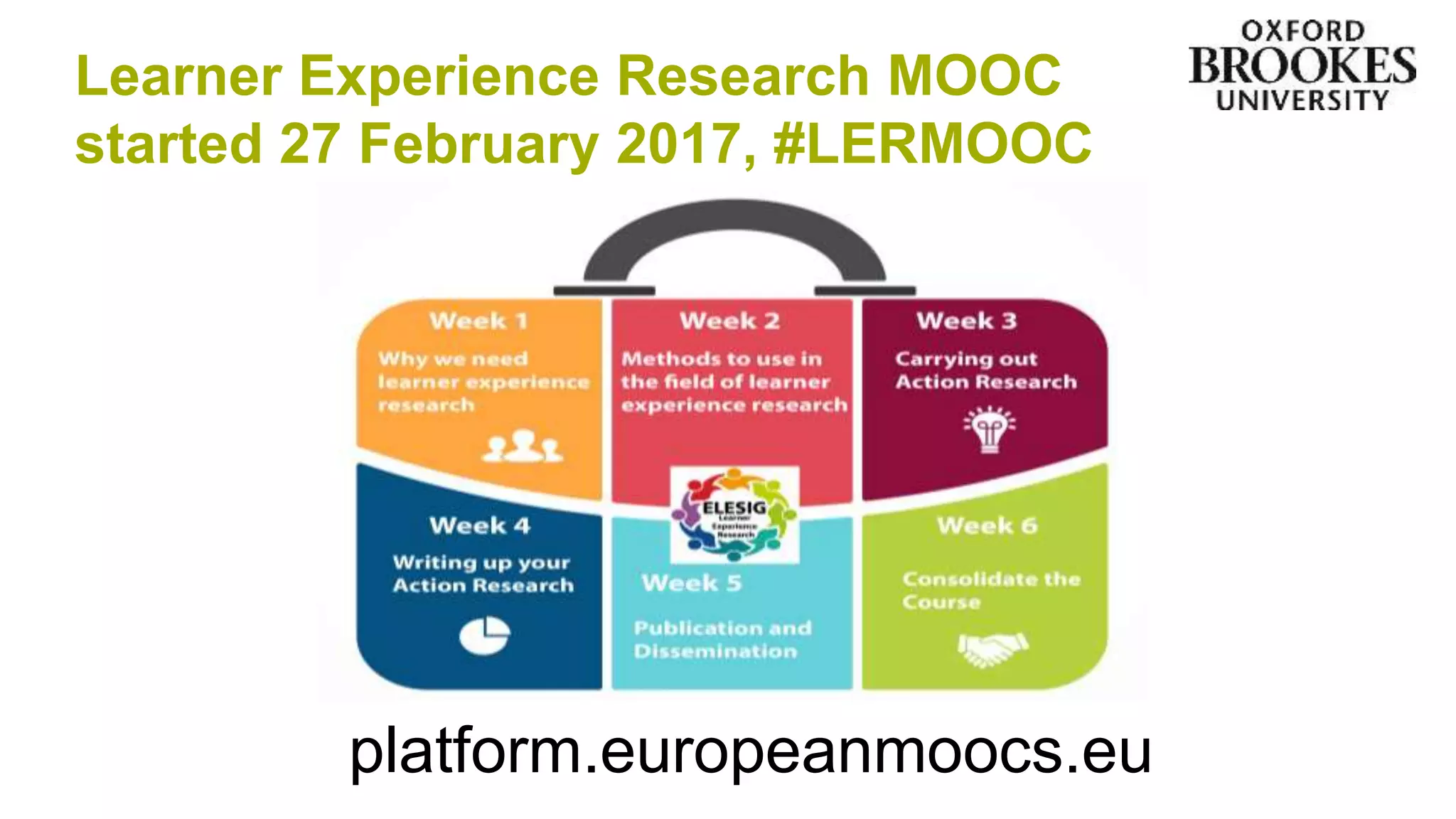
Learner Experience Research MOOC
started 27 February 2017, #LERMOOC
platform.europeanmoocs.eu
> >Slide
How does technology-enhanced learning contribute to teaching
excellence?
Paul Bartholomew, Pro vice-chancellor student experience, Ulster University
14/03/2017 How does technology-enhanced learning contribute to teaching excellence?28
How does technology-enhanced learning
contribute to teaching excellence?
Paul Bartholomew
PVC Education
Ulster University
How does technology-enhanced
learning contribute to teaching
excellence?
It doesn’t.
How does technology-enhanced
learning contribute to teaching
excellence?
Thank you
> >SlideSlide
I think it’s important that I acknowledge that…
>Technology doesn’t enhance learning.
> People do.
> All enhancement activity in Higher
Education requires the deployment of
human labour.
14/03/2017 How does technology-enhanced learning contribute to teaching excellence?32
> >SlideSlide
I think it’s important that I acknowledge that…
> Having a strategy isn’t enough.
> Having an action plan isn’t enough.
> Having a new institutional system isn’t enough.
>Having staff capability isn’t enough.
14/03/2017 How does technology-enhanced learning contribute to teaching excellence?33
> >SlideSlide
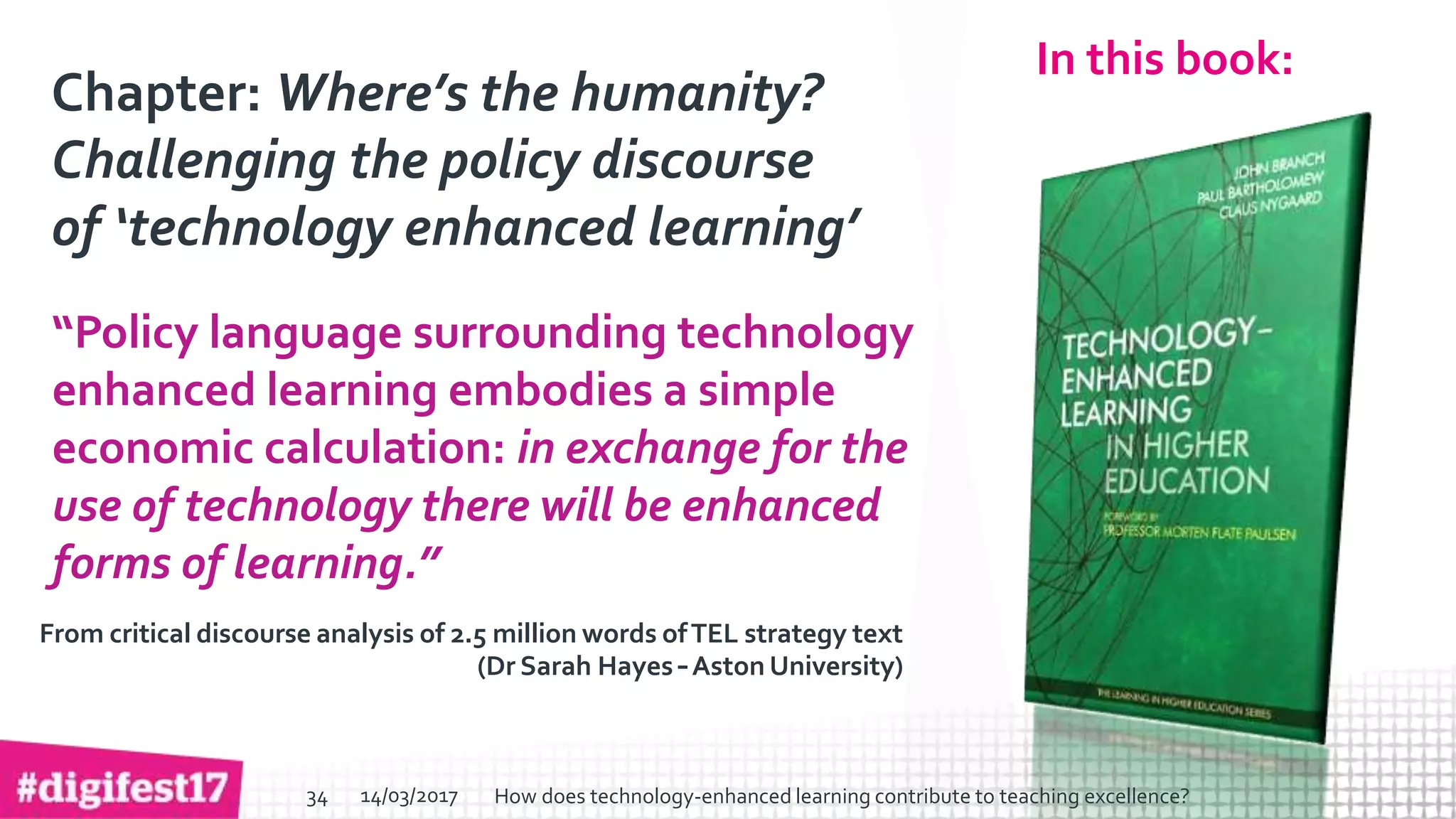
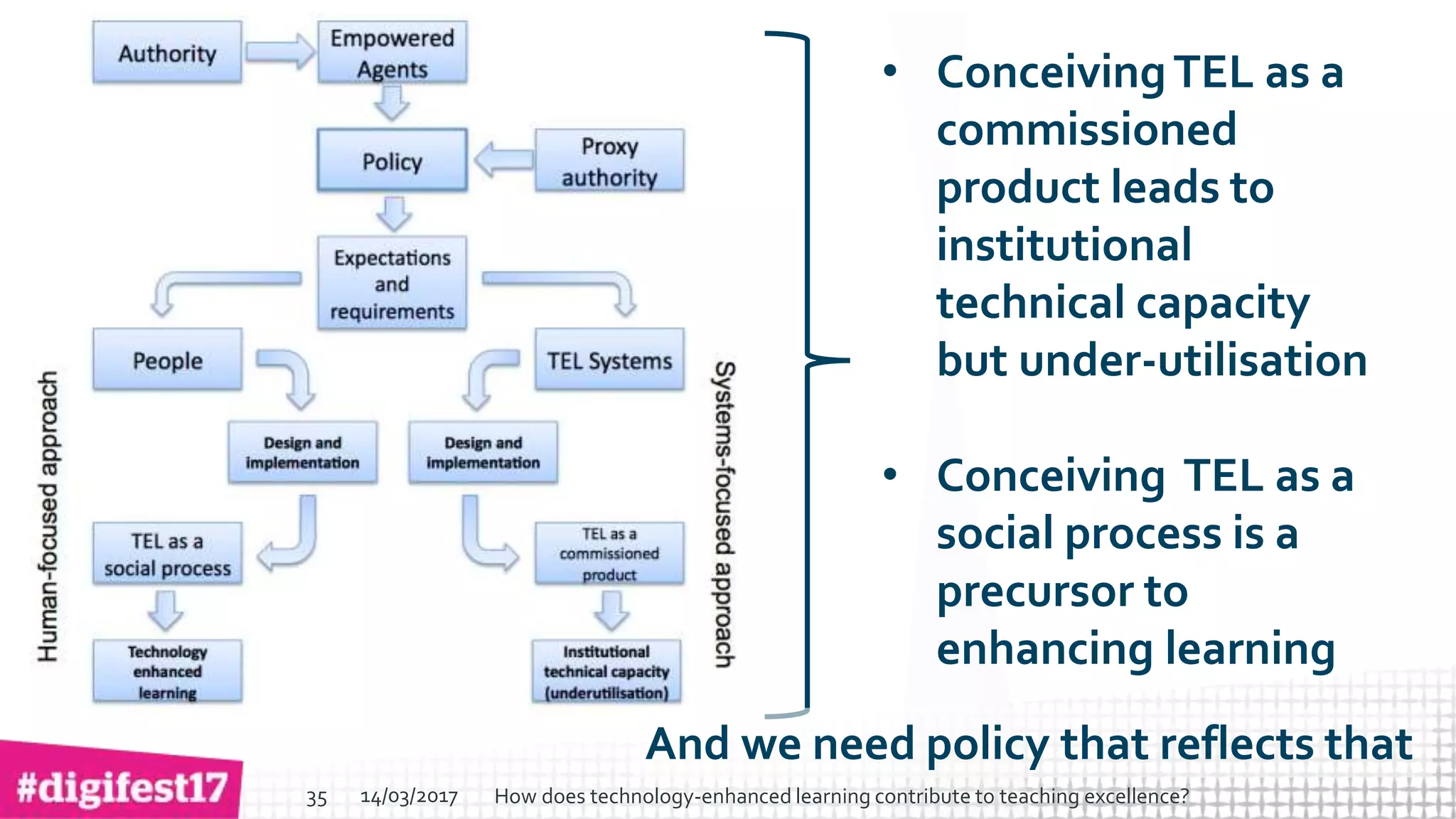
In this book:
Chapter: Where’s the humanity?
Challenging the policy discourse
of ‘technology enhanced learning’
“Policy language surrounding technology
enhanced learning embodies a simple
economic calculation: in exchange for the
use of technology there will be enhanced
forms of learning.”
From critical discourse analysis of 2.5 million words ofTEL strategy text
(Dr Sarah Hayes – Aston University)
14/03/2017 How does technology-enhanced learning contribute to teaching excellence?34
> >SlideSlide
• ConceivingTEL as a
commissioned
product leads to
institutional
technical capacity
but under-utilisation
• Conceiving TEL as a
social process is a
precursor to
enhancing learning
And we need policy that reflects that
14/03/2017 How does technology-enhanced learning contribute to teaching excellence?35
> >SlideSlide
Now that I’ve got that out of the way…
How does technology-enhanced
learning contribute to teaching
excellence?
14/03/2017 How does technology-enhanced learning contribute to teaching excellence?36
> >SlideSlide
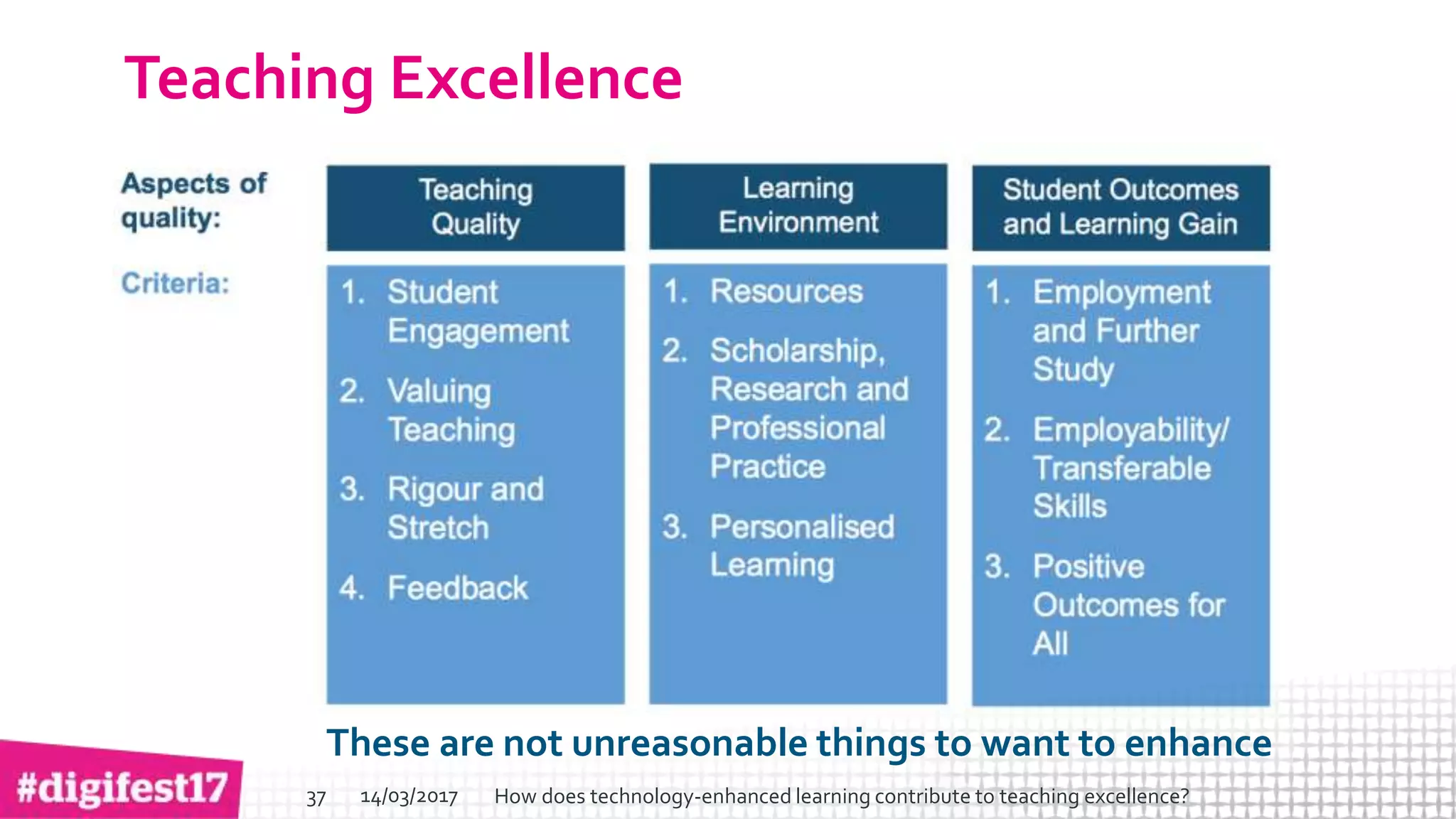
Teaching Excellence
These are not unreasonable things to want to enhance
14/03/2017 How does technology-enhanced learning contribute to teaching excellence?37
> >SlideSlide
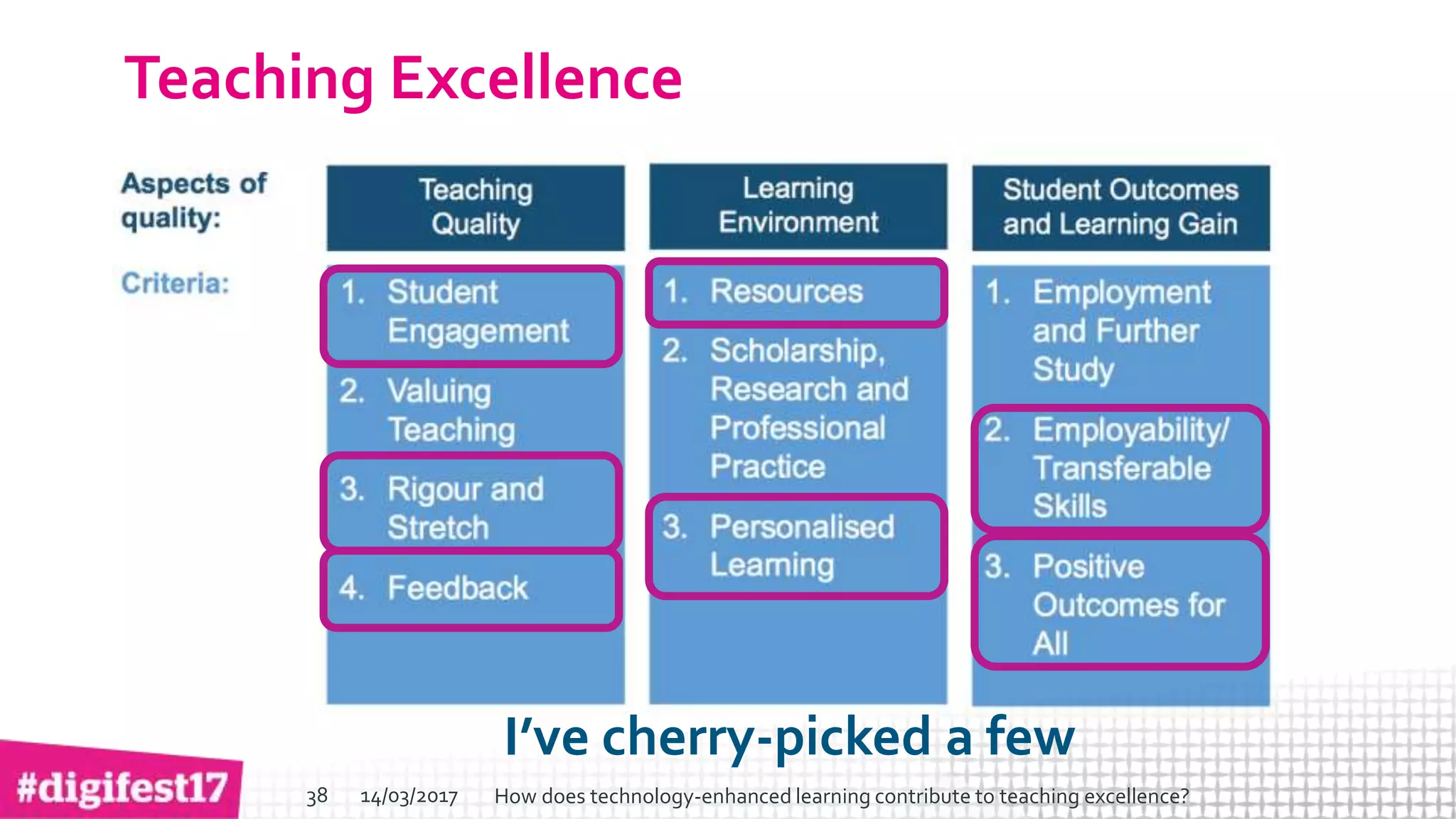
Teaching Excellence
I’ve cherry-picked a few
14/03/2017 How does technology-enhanced learning contribute to teaching excellence?38
> >SlideSlide
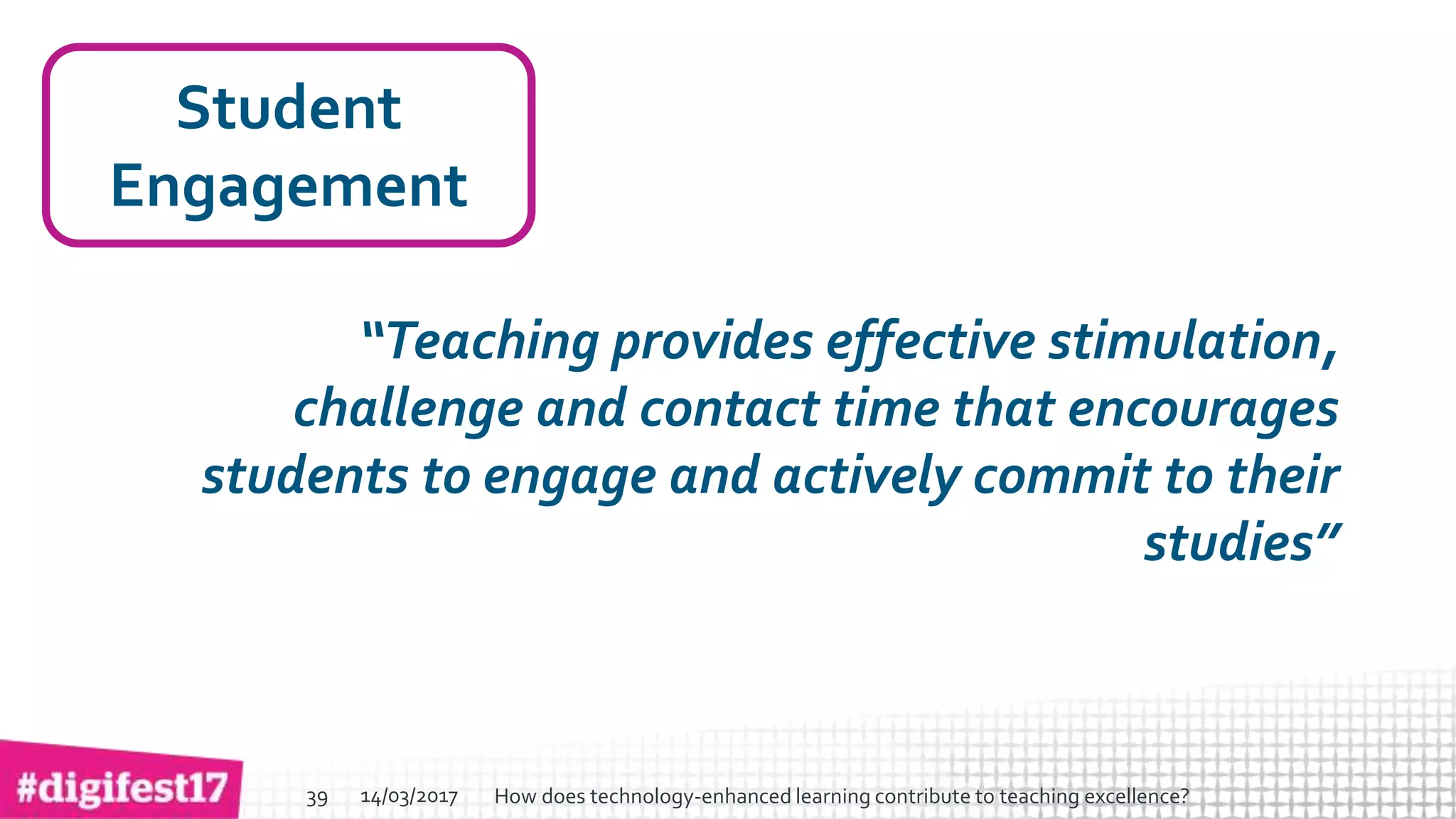
Student
Engagement
“Teaching provides effective stimulation,
challenge and contact time that encourages
students to engage and actively commit to their
studies”
14/03/2017 How does technology-enhanced learning contribute to teaching excellence?39
> >SlideSlide
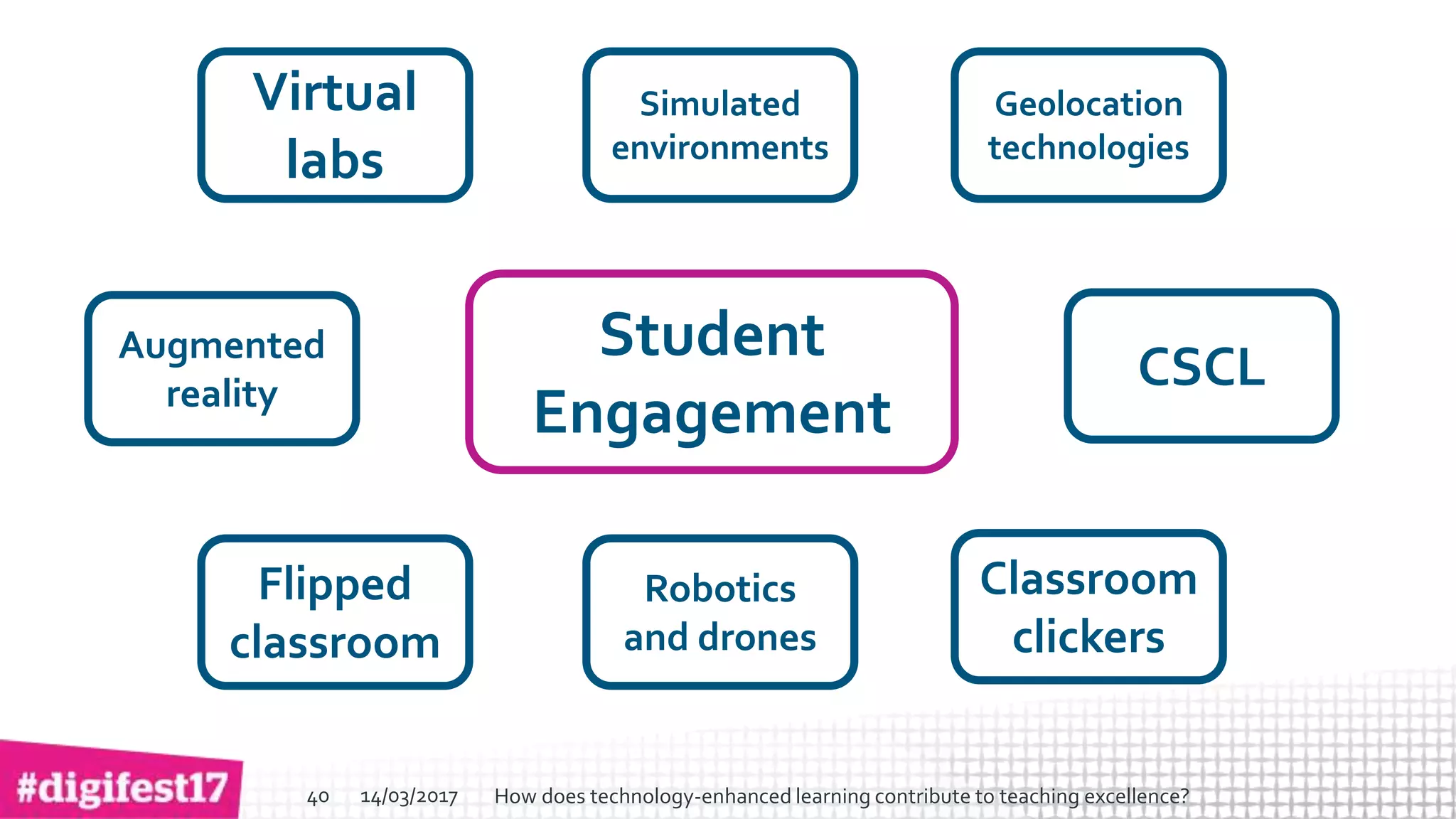
Student
Engagement
Virtual
labs
Simulated
environments
Ge0location
technologies
Augmented
reality
Flipped
classroom
Robotics
and drones
Classroom
clickers
CSCL
14/03/2017 How does technology-enhanced learning contribute to teaching excellence?40
> >SlideSlide
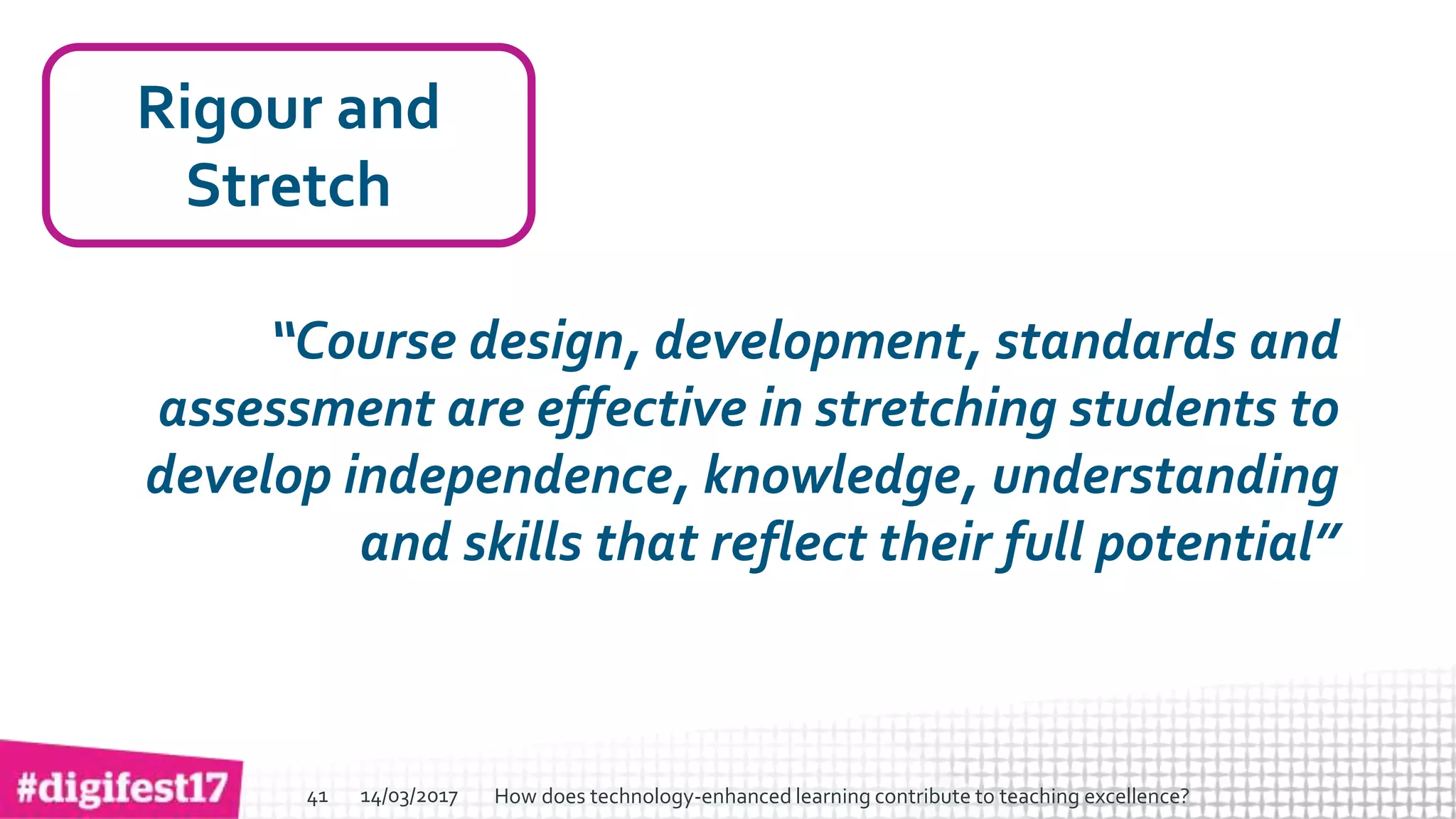
Rigour and
Stretch
“Course design, development, standards and
assessment are effective in stretching students to
develop independence, knowledge, understanding
and skills that reflect their full potential”
14/03/2017 How does technology-enhanced learning contribute to teaching excellence?41
> >SlideSlide
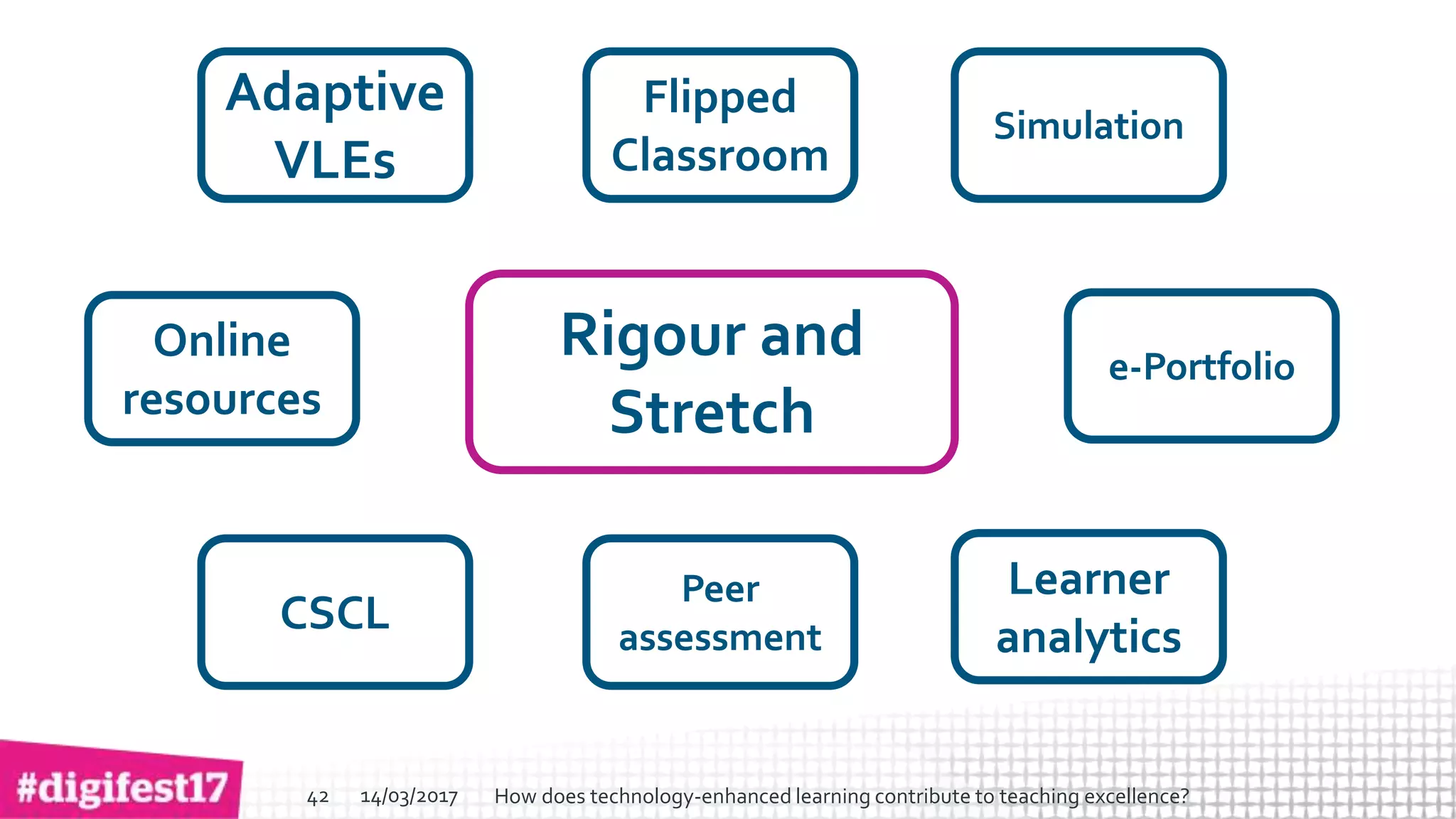
Rigour and
Stretch
Adaptive
VLEs
Flipped
Classroom
Simulation
Online
resources
CSCL
Peer
assessment
Learner
analytics
e-Portfolio
14/03/2017 How does technology-enhanced learning contribute to teaching excellence?42
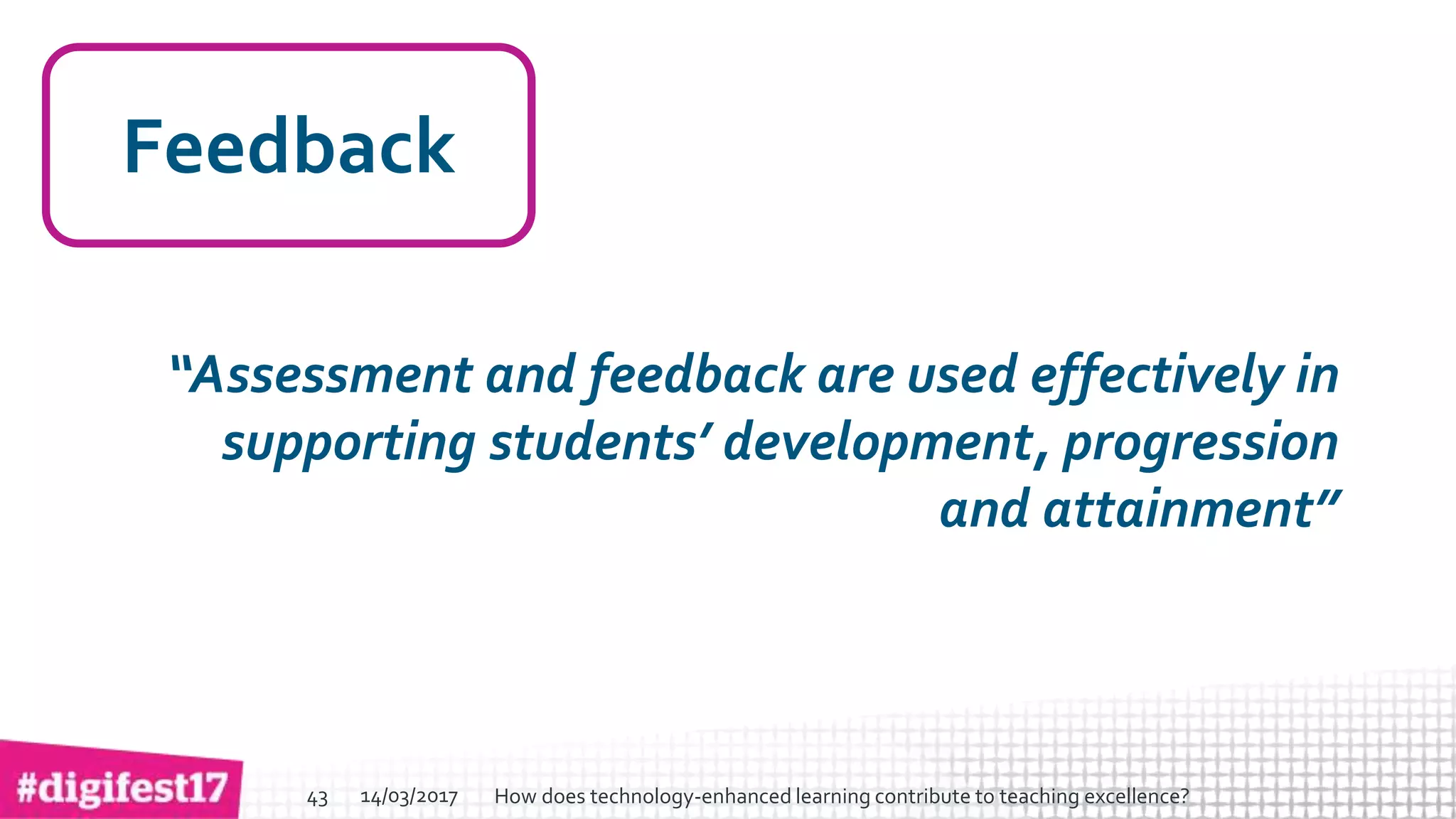
> >SlideSlide
Feedback
“Assessment and feedback are used effectively in
supporting students’ development, progression
and attainment”
14/03/2017 How does technology-enhanced learning contribute to teaching excellence?43
> >SlideSlide
Feedback
Audio
Video
Digital
annotation
Authentic
assessment
(simulation)
Peer
assessment
Learner
analytics
e-submission
Computer
aided
assessment
e-Portfolio
14/03/2017 How does technology-enhanced learning contribute to teaching excellence?44
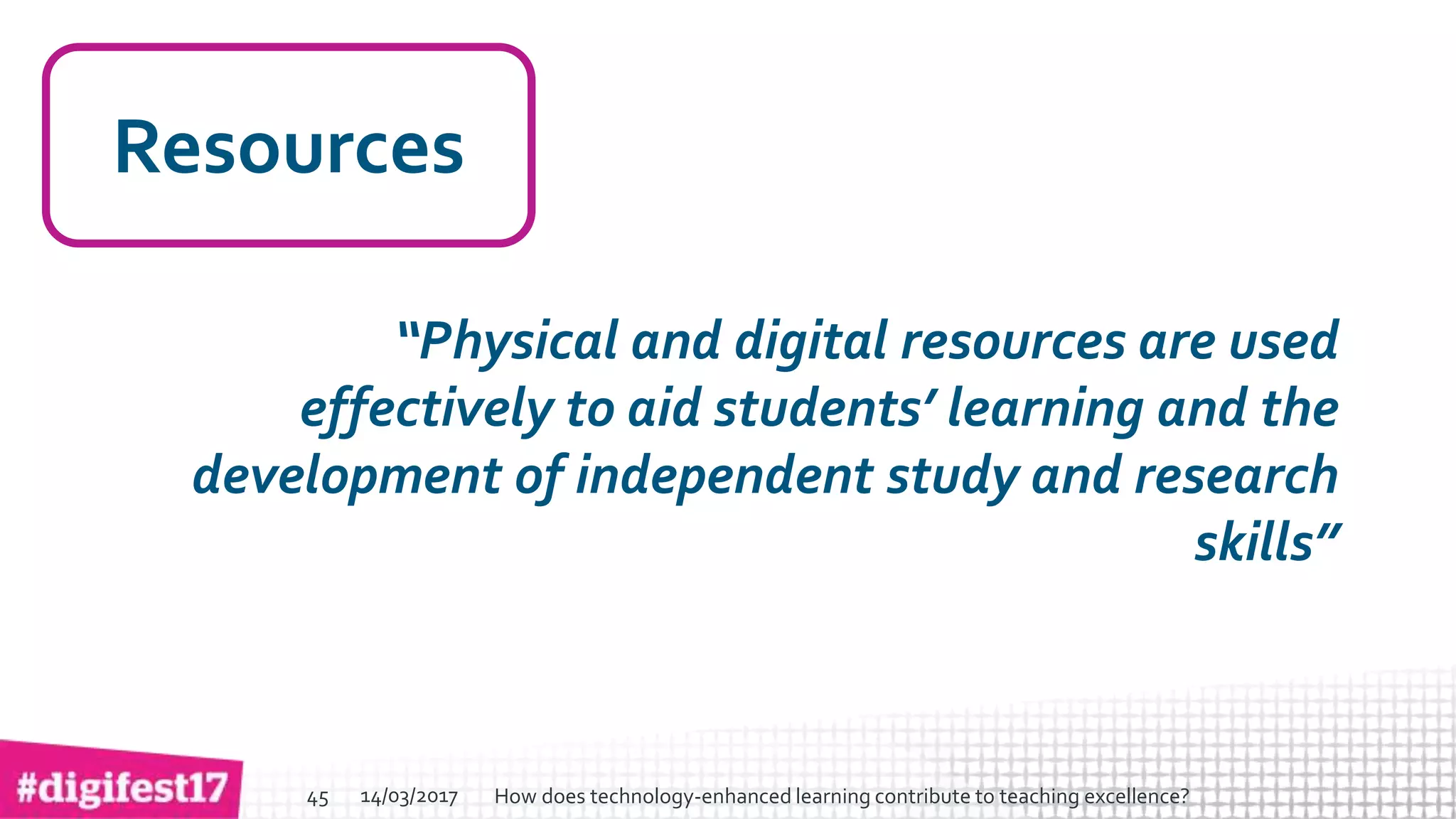
> >SlideSlide
Resources
“Physical and digital resources are used
effectively to aid students’ learning and the
development of independent study and research
skills”
14/03/2017 How does technology-enhanced learning contribute to teaching excellence?45
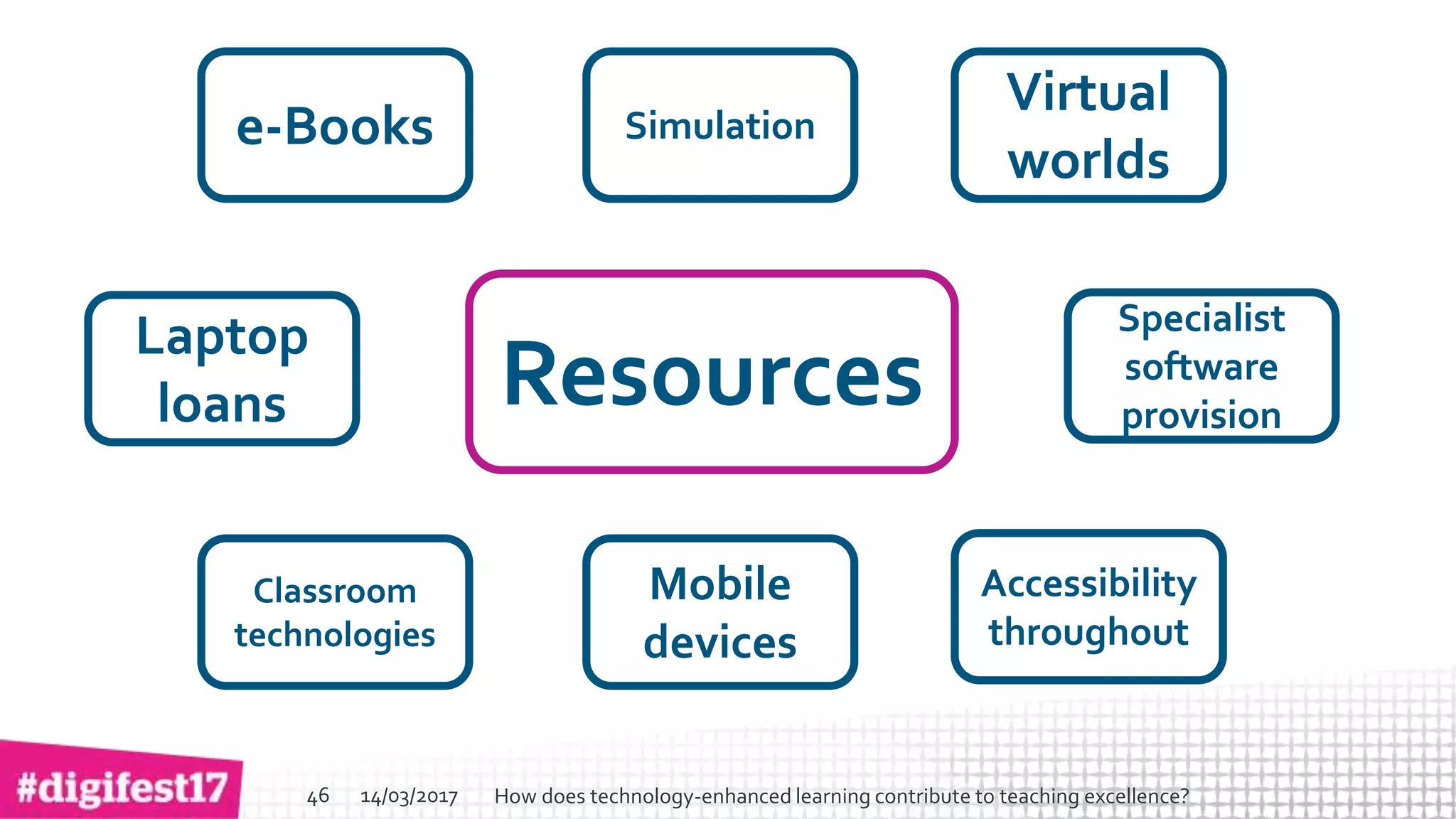
> >SlideSlide
Resources
e-Books Simulation
Virtual
worlds
Laptop
loans
Classroom
technologies
Mobile
devices
Accessibility
throughout
Specialist
software
provision
14/03/2017 How does technology-enhanced learning contribute to teaching excellence?46
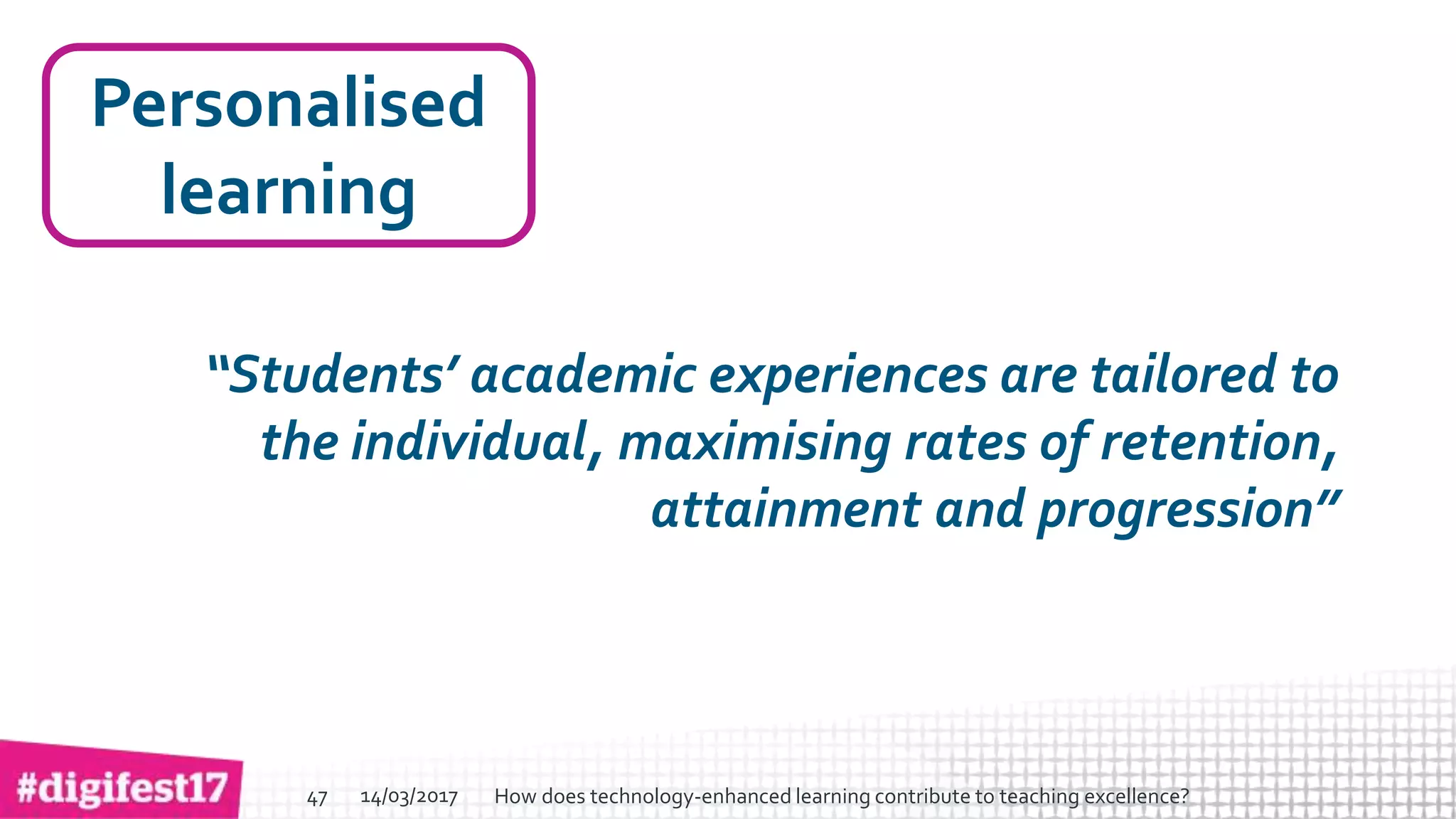
> >SlideSlide
Personalised
learning
“Students’ academic experiences are tailored to
the individual, maximising rates of retention,
attainment and progression”
14/03/2017 How does technology-enhanced learning contribute to teaching excellence?47
> >SlideSlide
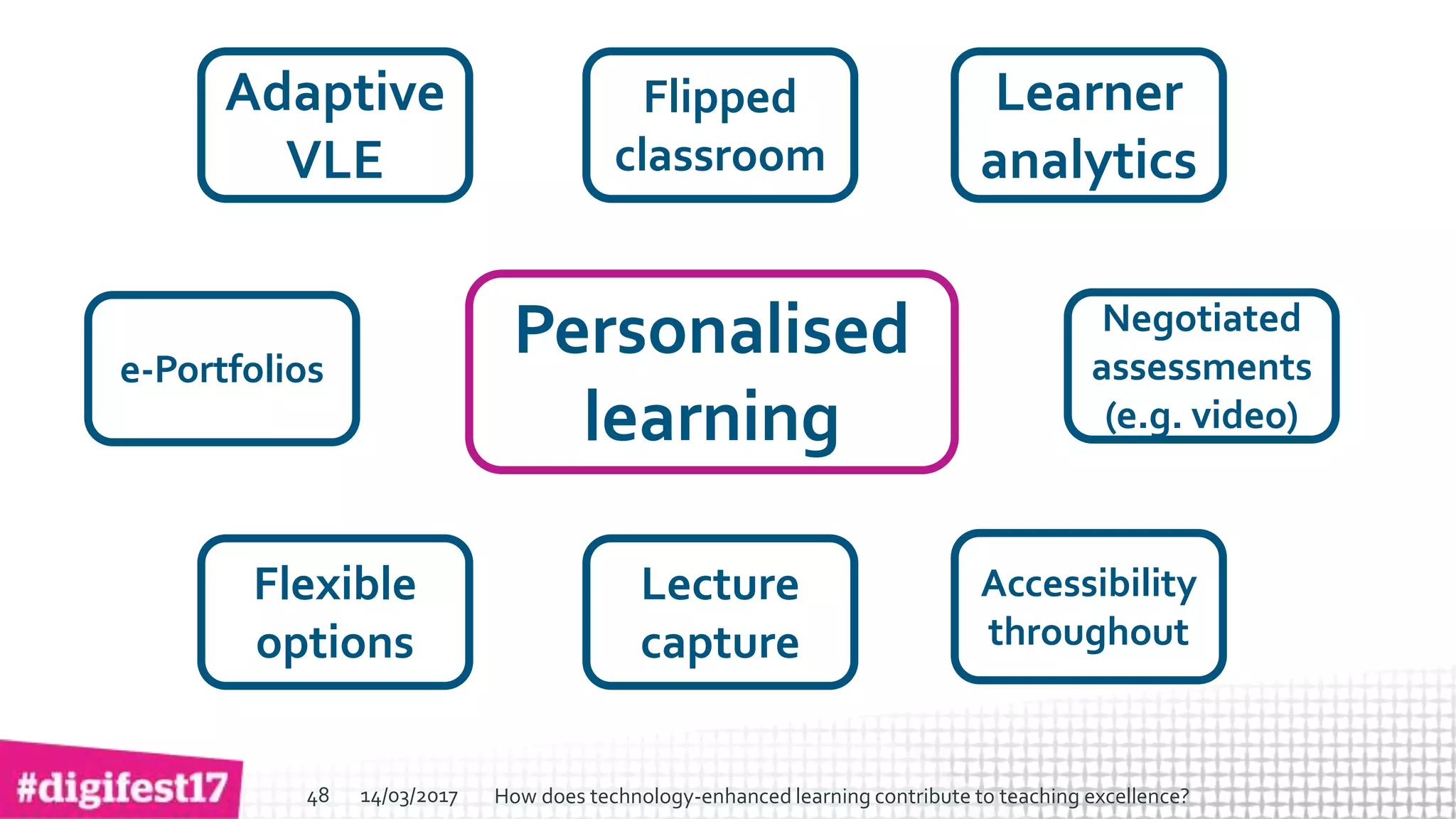
Personalised
learning
Adaptive
VLE
Flipped
classroom
Learner
analytics
e-Portfolios
Flexible
options
Lecture
capture
Accessibility
throughout
Negotiated
assessments
(e.g. video)
14/03/2017 How does technology-enhanced learning contribute to teaching excellence?48
> >SlideSlide
Employability/
transferable skills
“Students acquire knowledge, skills and
attributes that are valued by employers and that
enhance their personal and/or professional lives”
14/03/2017 How does technology-enhanced learning contribute to teaching excellence?49
> >SlideSlide
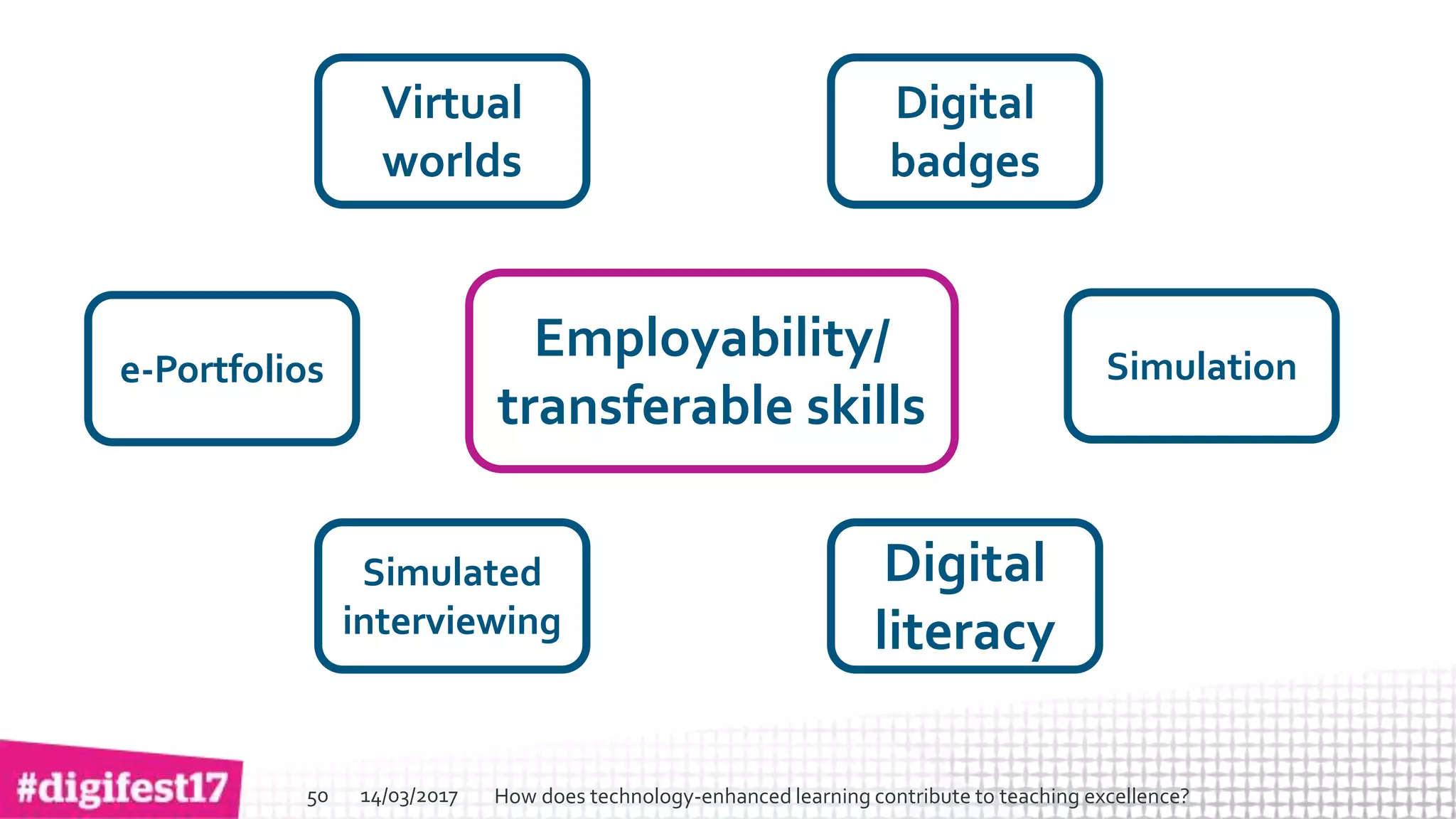
Employability/
transferable skills
Virtual
worlds
e-Portfolios
Simulated
interviewing
Simulation
Digital
literacy
Digital
badges
14/03/2017 How does technology-enhanced learning contribute to teaching excellence?50
> >SlideSlide
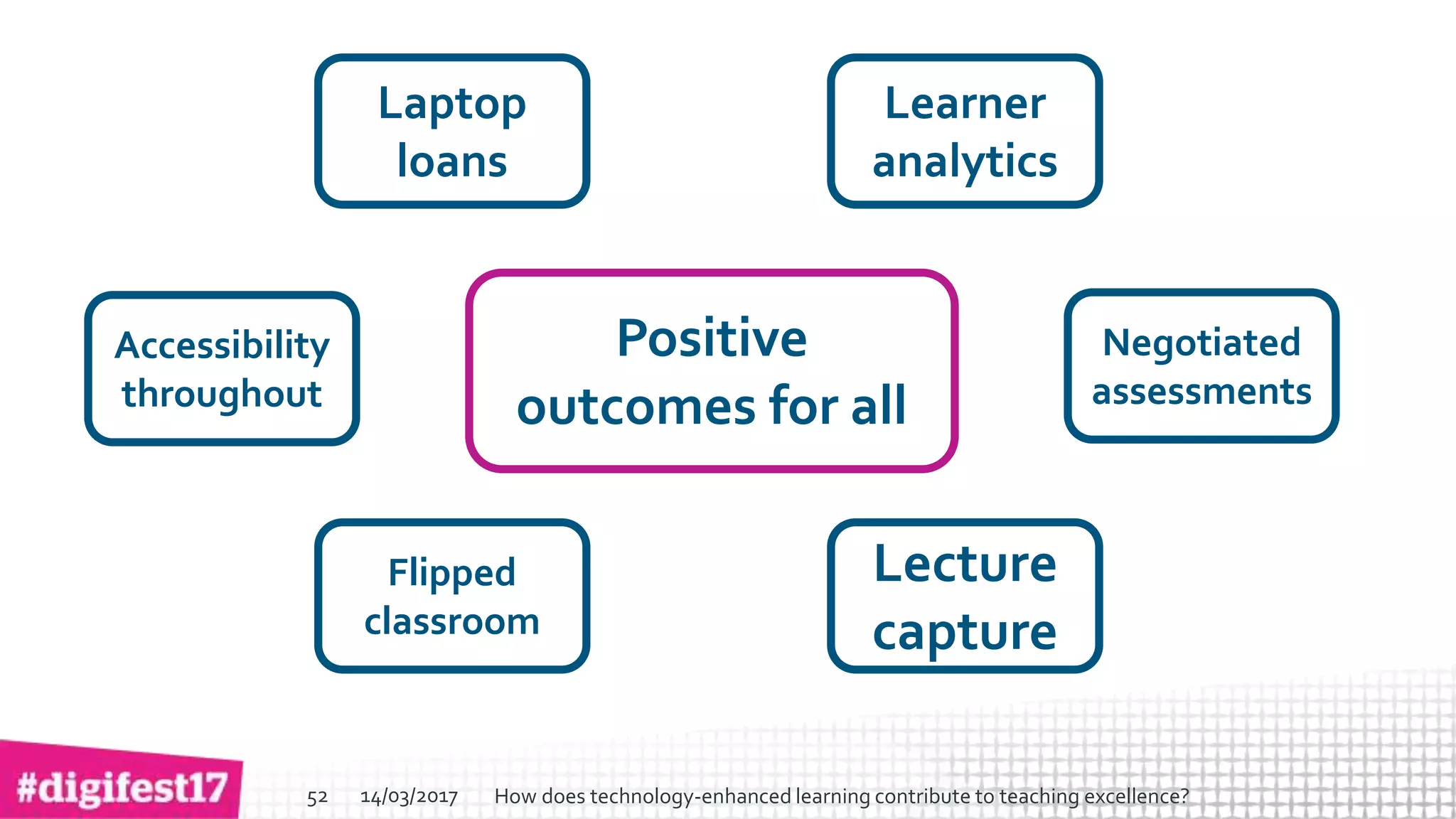
Positive
outcomes for all
“Positive outcomes are achieved by its students
from all backgrounds, in particular those from
disadvantaged backgrounds
or those who are at greater risk of not achieving
positive outcomes”
14/03/2017 How does technology-enhanced learning contribute to teaching excellence?51
> >SlideSlide
Positive
outcomes for all
Laptop
loans
Accessibility
throughout
Flipped
classroom
Negotiated
assessments
Lecture
capture
Learner
analytics
14/03/2017 How does technology-enhanced learning contribute to teaching excellence?52
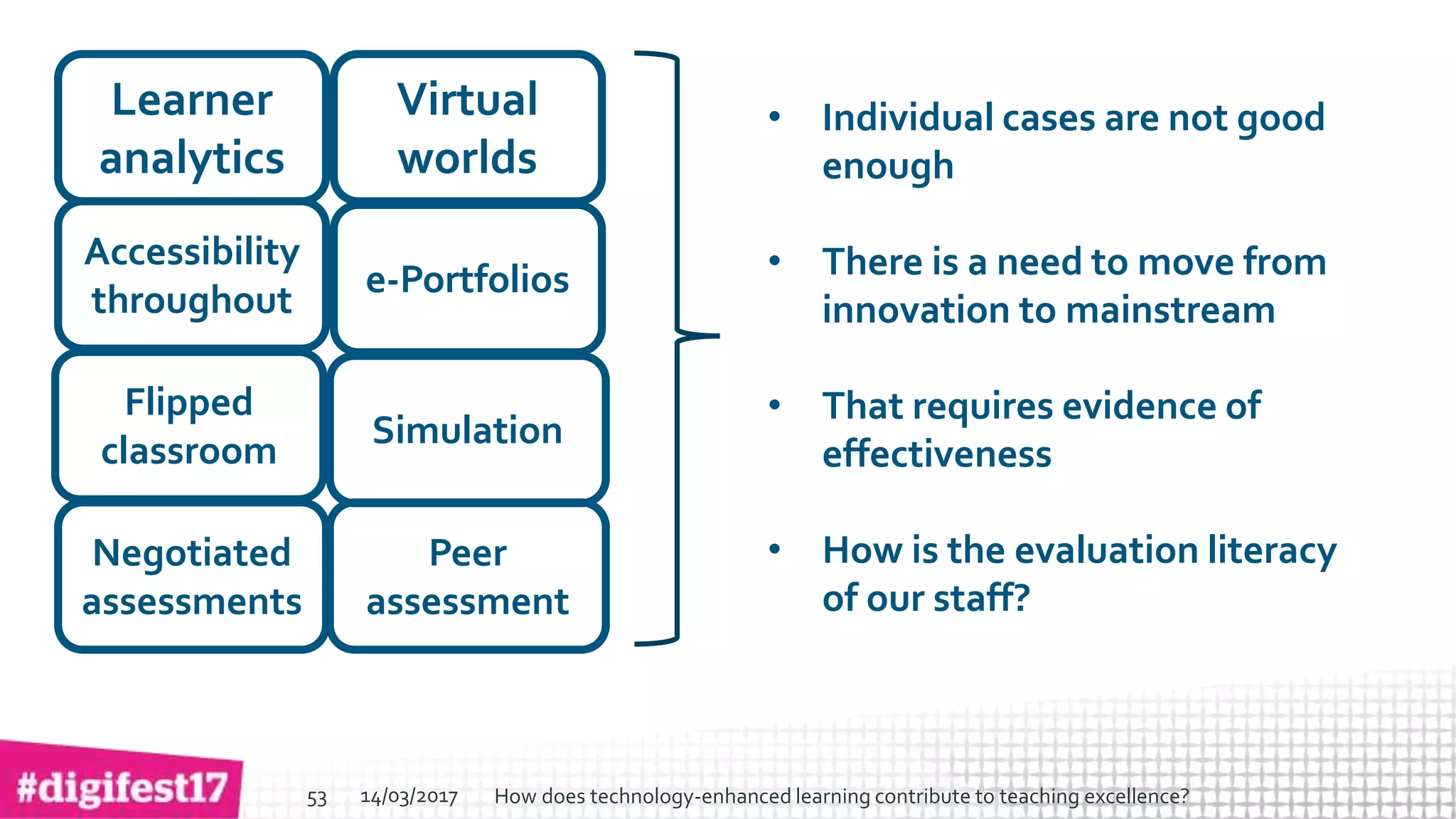
> >SlideSlide
Accessibility
throughout
Flipped
classroom
Negotiated
assessments
Learner
analytics
Virtual
worlds
e-Portfolios
Simulation
Peer
assessment
• Individual cases are not good
enough
• There is a need to move from
innovation to mainstream
• That requires evidence of
effectiveness
• How is the evaluation literacy
of our staff?
14/03/2017 How does technology-enhanced learning contribute to teaching excellence?53
> >SlideSlide
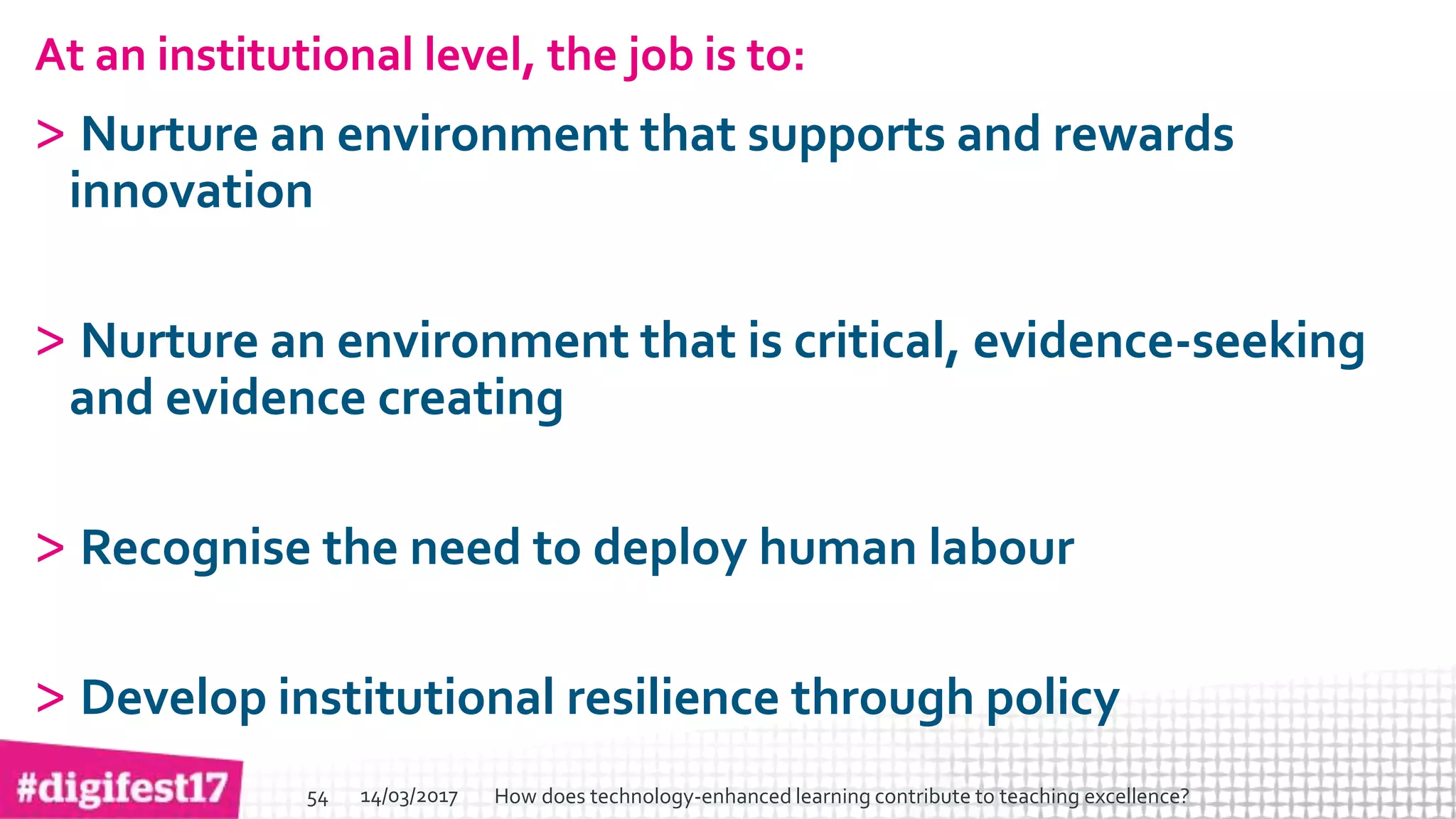
At an institutional level, the job is to:
> Nurture an environment that supports and rewards
innovation
> Nurture an environment that is critical, evidence-seeking
and evidence creating
> Recognise the need to deploy human labour
> Develop institutional resilience through policy
14/03/2017 How does technology-enhanced learning contribute to teaching excellence?54
> >SlideSlide
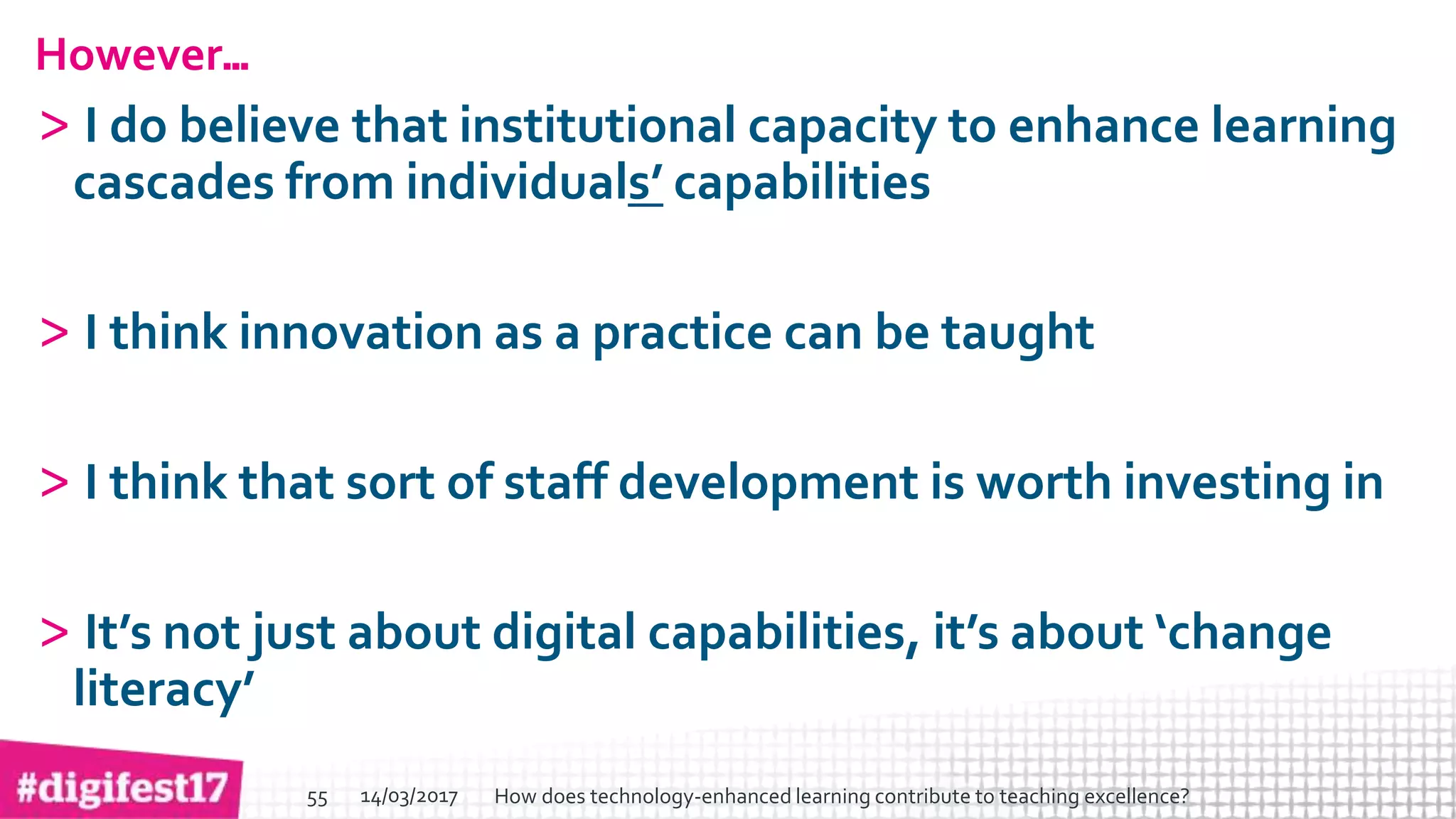
However…
> I do believe that institutional capacity to enhance learning
cascades from individuals’ capabilities
> I think innovation as a practice can be taught
> I think that sort of staff development is worth investing in
> It’s not just about digital capabilities, it’s about ‘change
literacy’
14/03/2017 How does technology-enhanced learning contribute to teaching excellence?55
> >SlideSlide
Thank you
Questions?
14/03/2017 How does technology-enhanced learning contribute to teaching excellence?56
> >Slide
jisc.ac.uk
Except where otherwise noted, this work
is licensed under CC-BY-NC-ND
> >
Sarah Davies,
head of higher eduaction and student
experience, Jisc
Dr Rhona Sharpe,
deputy HR director and head of OCSLD,
Oxford Brookes University
Prof Paul Bartholomew,
pro vice-chancellor student experience,
Ulster University
Contacts
14/03/2017 How does technology-enhanced learning contribute to teaching excellence?57Slide

How does technology-enhanced learning contribute to teaching excellence?

  • 1.
    How does technology-enhancedlearning contribute to teaching excellence?
  • 2.
    > >Slide How doestechnology-enhanced learning contribute to teaching excellence? Sarah Davies, Head of higher eduaction and student experience, Jisc 14/03/2017 How does technology-enhanced learning contribute to teaching excellence?2
  • 3.
    How do staffengage with institutional infrastructure designed to promote excellent teaching with learning technologies? Professor Rhona Sharpe Oxford Brookes University Digifest March 2017@rjsharpe elesig.net
  • 4.
    My interests #LERMOOC53 waysto support online learning Developing digital leaders
  • 5.
    Finding out whatlearners actually do . . .
  • 6.
    . . .means understanding the context in which learning takes place
  • 7.
    ‘Literacy’ implies sociallyand culturally situated practices, often highly dependent on the context in which they are carried out. (Beetham & Oliver, 2010) Developing digital literacies
  • 8.
    unconnected vulnerable access-led assessment of skills isongoing mainstream pragmatists Tutor / pedagogy /institution-led Technology used to develop criticality, self-management intensive and specialist enthusiasts Learner-led Technology-led Social digital literacy practices are valued and new practices made explicit Learners who are Experience the digital environment as: Best supported where: https://digitalstudent.jiscinvolve.org/wp/fe-and-skills-digital-student-study/fe-digital-students-key- outputs/ The Learner and their Context, Becta Chris Davies and Rebecca Eynon FE Digital Student Study
  • 9.
    unconnected vulnerable access-led assessment of skills isongoing mainstream pragmatists Tutor / pedagogy /institution-led Technology used to develop criticality, self-management intensive and specialist enthusiasts Learner-led Technology-led Social digital literacy practices are valued and new practices made explicit Learners who are Experience the digital environment Best supported FE Digital Student Study https://digitalstudent.jiscinvolve.org/wp/fe-and-skills-digital-student-study/fe-digital-students-key- outputs/
  • 10.
    Conceptions of individual teachingexcellence “being dynamically engaged in teaching practice and inspiring and practically scaffolding the potential dynamic engagement of one’s student” Gunn & Fisk (2013) p.23
  • 11.
    Relationships between digital capabilityand teaching excellence Austen et al (2016) “Digital capability can promote teaching excellence by avoiding technological determinism while putting pedagogy first.” “… resisting the notion that technology is the principal motivation for change rests with both teacher and institution.”
  • 12.
    What strategies caneducational leaders use to facilitate the development of digitally capable excellent teachers? Which: Recognise the role of context in shaping digital practices Convince colleagues of the pedagogic value of TEL and support them to develop new pedagogies Build confidence in using technology Encourage exploration and experimentation Scaffold dynamic engagement with CPD and learners
  • 13.
    Some ideas fromOxford Brookes 1. Defining and developing digital literacy through the curriculum. 2. Technology enhanced CPD 3. Course Design Intensives 4. Digital Choices Matrix Neil Currant George Roberts Mark Childs Richard Francis
  • 14.
    A. Plan forthe inclusion of ICT resources within the teaching of classes of primary-aged children B. Application of IT skills within a technical or commercial environment, particularly CAD systems and data transfer between such systems. C. Gather, organise and deploy a variety of digital sources pertaining to the subject. D. Present to an audience using appropriate media. Evaluation Part 1 Staff Engagement Defining digital literacy within the disciplines With your neighbour, can you identify the disciplines?
  • 15.
    A. Primary TeacherEducation B. Computer aided Mechanical Engineering C. International Relations D. Philosophy Evaluation Part 1 Staff Engagement Defining digital literacy within the disciplines
  • 16.
    Developing the digitalpractitioner Liz Bennett, University of Huddersfield Bennett (2014) based on Sharpe & Beetham (2010) and Ecclesfield, Rebbeck, & Garnett (2012) Experimentation and appropriation - Confident - Prepared to take risks - Willing to explore Belief in the pedagogic value of TEL - Convinced by the potential of technology to transform learning
  • 17.
    1. How muchhas your coursework emphasised the following mental activities? 2. How often have you done each of the following? 3. How much has your experience at this institution contributed to your knowledge, skills and personal development in these areas? Engagement questions
  • 18.
    Developing digital literacy(Student Engagement) 0 10 20 30 40 50 60 70 Critically evaluating digital sources of information Used technology to collaborate with others or engage with online communities Used technology to reflect on and record your learning? ] Using technology in innovative or creative ways 2014 2016
  • 19.
    Graduate Attributes asa measure of learning gain Learning gain in Active Citizenship Strategic Excellence project ABC Learning Gains project with OU and Surrey abclearninggains.com/openbrookes.net/cci/
  • 20.
    Online, blended, open,flipped CPD “For me, the experience has shown what collaborative learning is really about because I have experienced it properly for myself for the first time.” "I enjoyed participating on this course and being part of the internationalising of a curriculum as it happened - by this I mean I experienced what many of our international students do through enrolling in an online course.”
  • 21.
    Course Design Intensives Workingin extended teams Visualising the learner journey Challenging designs through peer review
  • 22.
    Characteristics of Course Design Intensives Evidence based designprinciples Chickering & Gamson REAP Assessment Principles Salmon's FIve Steps Laurillard Conversational Framework Community of inquiry Transformative Blended learning Graduate Attributes Curriculum reform Assessment Compact Team based Professional services Students Teaching Fellows Module leaders and teachers Outcome focused Storyboards Syllabus Assessment designs Online course site Engaging Tools Toolkits Card sorts Iterative pre-meeting eventfollow-up Shared critical friends peer review Evaluated
  • 23.
  • 24.
    What next atBrookes? 1. Doing the basics better: essential digital capabilities for a range of roles. 2. Transformative goals: inclusivity, employability 3. Dynamic engagement with students e.g. devising expectations for VLE use.
  • 25.
    Resources 53 Interesting Waysto Support Online Learning available to order from https://www.brookes.ac.uk/OCSLD/Publications/ Learner Experience Research MOOC (#LERMOOC) Feb – April 2017 at http://platform.europeanmoocs.eu b ABC Learning Gains project https://abclearninggains.com Jisc FE Digital Student projecthttps://digitalstudent.jiscinvolve.org/wp/fe- and-skills-digital-student-study/ Developing Leaders for a Digital Age www.moodle.openbrookes.net Graduate Attributes in Action. https://wiki.brookes.ac.uk/display/GAA/Home
  • 26.
    References Austen, L., Parkin,H.J., Jones-Devitt, S., McDonald, K. & Irwin B. (2016) Digital Capability and Teaching Excellence. QAA Subscriber Research Series 2016-17. Beetham, H. & Oliver, M. (2010) The changing practices of knowledge and learning, in R. Sharpe, H. Beetham & S. de Freitas, Rethinking Learning for a Digital Age, Routledge. London & New York. Bennett, L. (2014) Learning from the early adopter: developing the digital practitioner, Research in Learning Technology, 22: 21453 Davies C. & Eynon, R. (2010) The learner and their context. Final Report for Becta. University of Oxford. Ecclesfield, N., Rebbeck, G. & Garnett, F. (2012) ‘The case of the curious and the confident the untold story of changing teacher attitudes to e-learning and ‘‘technology in action’’ in the FE sector’, Compass: The Journal of Learning and Teaching at the University of Greenwich, no. 5, pp. 45 56. Gunn, V. & Fisk A. (2013) Considering teaching excellence in higher education 2007-2013. The Higher Education Academy Research Series. Sharpe, R. & Beetham, H. (2010) Understanding students’ uses of technology for learning: towards creative appropriation, in R. Sharpe, H. Beetham & S. de Freitas, Rethinking Learning for a Digital Age, Routledge. London & New York. Available to download from http://bit.ly/1RhiRNP
  • 27.
    Learner Experience ResearchMOOC started 27 February 2017, #LERMOOC platform.europeanmoocs.eu
  • 28.
    > >Slide How doestechnology-enhanced learning contribute to teaching excellence? Paul Bartholomew, Pro vice-chancellor student experience, Ulster University 14/03/2017 How does technology-enhanced learning contribute to teaching excellence?28
  • 29.
    How does technology-enhancedlearning contribute to teaching excellence? Paul Bartholomew PVC Education Ulster University
  • 30.
    How does technology-enhanced learningcontribute to teaching excellence? It doesn’t.
  • 31.
    How does technology-enhanced learningcontribute to teaching excellence? Thank you
  • 32.
    > >SlideSlide I thinkit’s important that I acknowledge that… >Technology doesn’t enhance learning. > People do. > All enhancement activity in Higher Education requires the deployment of human labour. 14/03/2017 How does technology-enhanced learning contribute to teaching excellence?32
  • 33.
    > >SlideSlide I thinkit’s important that I acknowledge that… > Having a strategy isn’t enough. > Having an action plan isn’t enough. > Having a new institutional system isn’t enough. >Having staff capability isn’t enough. 14/03/2017 How does technology-enhanced learning contribute to teaching excellence?33
  • 34.
    > >SlideSlide In thisbook: Chapter: Where’s the humanity? Challenging the policy discourse of ‘technology enhanced learning’ “Policy language surrounding technology enhanced learning embodies a simple economic calculation: in exchange for the use of technology there will be enhanced forms of learning.” From critical discourse analysis of 2.5 million words ofTEL strategy text (Dr Sarah Hayes – Aston University) 14/03/2017 How does technology-enhanced learning contribute to teaching excellence?34
  • 35.
    > >SlideSlide • ConceivingTELas a commissioned product leads to institutional technical capacity but under-utilisation • Conceiving TEL as a social process is a precursor to enhancing learning And we need policy that reflects that 14/03/2017 How does technology-enhanced learning contribute to teaching excellence?35
  • 36.
    > >SlideSlide Now thatI’ve got that out of the way… How does technology-enhanced learning contribute to teaching excellence? 14/03/2017 How does technology-enhanced learning contribute to teaching excellence?36
  • 37.
    > >SlideSlide Teaching Excellence Theseare not unreasonable things to want to enhance 14/03/2017 How does technology-enhanced learning contribute to teaching excellence?37
  • 38.
    > >SlideSlide Teaching Excellence I’vecherry-picked a few 14/03/2017 How does technology-enhanced learning contribute to teaching excellence?38
  • 39.
    > >SlideSlide Student Engagement “Teaching provideseffective stimulation, challenge and contact time that encourages students to engage and actively commit to their studies” 14/03/2017 How does technology-enhanced learning contribute to teaching excellence?39
  • 40.
  • 41.
    > >SlideSlide Rigour and Stretch “Coursedesign, development, standards and assessment are effective in stretching students to develop independence, knowledge, understanding and skills that reflect their full potential” 14/03/2017 How does technology-enhanced learning contribute to teaching excellence?41
  • 42.
  • 43.
    > >SlideSlide Feedback “Assessment andfeedback are used effectively in supporting students’ development, progression and attainment” 14/03/2017 How does technology-enhanced learning contribute to teaching excellence?43
  • 44.
  • 45.
    > >SlideSlide Resources “Physical anddigital resources are used effectively to aid students’ learning and the development of independent study and research skills” 14/03/2017 How does technology-enhanced learning contribute to teaching excellence?45
  • 46.
  • 47.
    > >SlideSlide Personalised learning “Students’ academicexperiences are tailored to the individual, maximising rates of retention, attainment and progression” 14/03/2017 How does technology-enhanced learning contribute to teaching excellence?47
  • 48.
  • 49.
    > >SlideSlide Employability/ transferable skills “Studentsacquire knowledge, skills and attributes that are valued by employers and that enhance their personal and/or professional lives” 14/03/2017 How does technology-enhanced learning contribute to teaching excellence?49
  • 50.
  • 51.
    > >SlideSlide Positive outcomes forall “Positive outcomes are achieved by its students from all backgrounds, in particular those from disadvantaged backgrounds or those who are at greater risk of not achieving positive outcomes” 14/03/2017 How does technology-enhanced learning contribute to teaching excellence?51
  • 52.
    > >SlideSlide Positive outcomes forall Laptop loans Accessibility throughout Flipped classroom Negotiated assessments Lecture capture Learner analytics 14/03/2017 How does technology-enhanced learning contribute to teaching excellence?52
  • 53.
    > >SlideSlide Accessibility throughout Flipped classroom Negotiated assessments Learner analytics Virtual worlds e-Portfolios Simulation Peer assessment • Individualcases are not good enough • There is a need to move from innovation to mainstream • That requires evidence of effectiveness • How is the evaluation literacy of our staff? 14/03/2017 How does technology-enhanced learning contribute to teaching excellence?53
  • 54.
    > >SlideSlide At aninstitutional level, the job is to: > Nurture an environment that supports and rewards innovation > Nurture an environment that is critical, evidence-seeking and evidence creating > Recognise the need to deploy human labour > Develop institutional resilience through policy 14/03/2017 How does technology-enhanced learning contribute to teaching excellence?54
  • 55.
    > >SlideSlide However… > Ido believe that institutional capacity to enhance learning cascades from individuals’ capabilities > I think innovation as a practice can be taught > I think that sort of staff development is worth investing in > It’s not just about digital capabilities, it’s about ‘change literacy’ 14/03/2017 How does technology-enhanced learning contribute to teaching excellence?55
  • 56.
    > >SlideSlide Thank you Questions? 14/03/2017How does technology-enhanced learning contribute to teaching excellence?56
  • 57.
    > >Slide jisc.ac.uk Except whereotherwise noted, this work is licensed under CC-BY-NC-ND > > Sarah Davies, head of higher eduaction and student experience, Jisc Dr Rhona Sharpe, deputy HR director and head of OCSLD, Oxford Brookes University Prof Paul Bartholomew, pro vice-chancellor student experience, Ulster University Contacts 14/03/2017 How does technology-enhanced learning contribute to teaching excellence?57Slide