Classification of FDG-PET* Brain Data
* Fluorodeoxyglucose positron emission tomography
Deborah Mudali 1,* Michael Biehl 1
Klaus L. Leenders 2 Jos B.T.M. Roerdink 1,3
1 Johann Bernoulli Institute for Mathematics
and Computer Science, University of Groningen, NL
2 Department of Neurology
University Medical Center Groningen, NL
3 Neuroimaging Center
University Medical Center Groningen, NL
* Mbarara University of Science & Technology, Uganda
WSOM, Houston, 2016 2
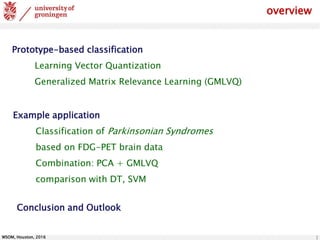
overview
Example application
Classification of Parkinsonian Syndromes
based on FDG-PET brain data
Combination: PCA + GMLVQ
comparison with DT, SVM
Conclusion and Outlook
Prototype-based classification
Learning Vector Quantization
Generalized Matrix Relevance Learning (GMLVQ)
WSOM, Houston, 2016
∙ identification of prototype vectors from labeled example data
∙ (dis)-similarity based classification (e.g. Euclidean distance)
Learning Vector Quantization
N-dimensional data, feature vectors
• initialize prototype vectors
for different classes
competitive learning: Winner-Takes-All LVQ1 [Kohonen, 1990, 1997]
• identify the winner
(closest prototype)
• present a single example
• move the winner
- closer towards the data (same class)
- away from the data (different class)
feature space
WSOM, Houston, 2016
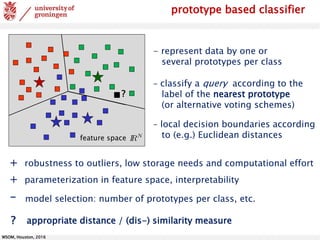
prototype based classifier
- represent data by one or
several prototypes per class
- classify a query according to the
label of the nearest prototype
(or alternative voting schemes)
- local decision boundaries according
to (e.g.) Euclidean distances
+ robustness to outliers, low storage needs and computational effort
- model selection: number of prototypes per class, etc.
feature space
?
? appropriate distance / (dis-) similarity measure
+ parameterization in feature space, interpretability
WSOM, Houston, 2016 5
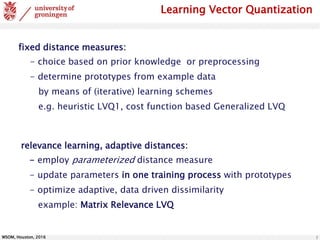
fixed distance measures:
- choice based on prior knowledge or preprocessing
- determine prototypes from example data
by means of (iterative) learning schemes
e.g. heuristic LVQ1, cost function based Generalized LVQ
relevance learning, adaptive distances:
- employ parameterized distance measure
- update parameters in one training process with prototypes
- optimize adaptive, data driven dissimilarity
example: Matrix Relevance LVQ
Learning Vector Quantization
WSOM, Houston, 2016
Relevance Matrix LVQ
generalized quadratic distance in LVQ:
variants: global/local matrices (piecewise quadratic boundaries)
diagonal relevances (single feature weights)
rectangular (low-dim. representation)
[Schneider et al., 2009]
relevance matrix:
quantifies importance of features and pairs of features
summarizes relevance of feature j
( for equally scaled features )
training: optimize prototypes and Λ w.r.t. classification of examples
WSOM, Houston, 2016
cost function based training
one example: Generalized LVQ [Sato & Yamada, 1995]
sigmoidal (linear for small arguments), e.g.
E approximates number of misclassifications
linear
E favors large margin separation of classes, e.g.
two winning prototypes:
minimize
small , large
E favors class-typical prototypes
WSOM, Houston, 2016
cost function based LVQ
There is nothing objective about objective functions
James McClelland
WSOM, Houston, 2016 9
FDG-PET (Fluorodeoxyglucose positron emission tomography, 3d-images)
condition
Glucoseuptake
n=18 HC
Healhy controls
n= 20 PD
Parkinson’s Disease
n=21 MSA
Multiple System Atrophy
n=17 PSP
Progressive Supranuclear
Palsy
classification of FDG-PET data
[http://glimpsproject.com]
WSOM, Houston, 2016 10
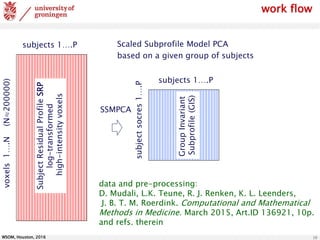
work flow
subjects 1….P
voxels1….N(N≈200000)
SubjectResidualProfileSRP
log-transformed
high-intensityvoxels
GroupInvariant
Subprofile(GIS)
subjectsocres1….P
subjects 1….P
Scaled Subprofile Model PCA
based on a given group of subjects
SSMPCA
data and pre-processing:
D. Mudali, L.K. Teune, R. J. Renken, K. L. Leenders,
J. B. T. M. Roerdink. Computational and Mathematical
Methods in Medicine. March 2015, Art.ID 136921, 10p.
and refs. therein
WSOM, Houston, 2016 11
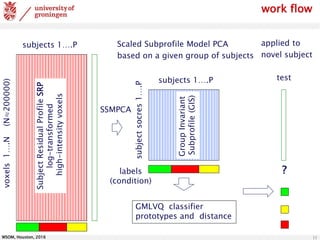
work flow
subjects 1….P
voxels1….N(N≈200000)
SubjectResidualProfileSRP
log-transformed
high-intensityvoxels
GroupInvariant
Subprofile(GIS)
subjectsocres1….P
subjects 1….P
Scaled Subprofile Model PCA
based on a given group of subjects
applied to
novel subject
test
labels
(condition)
GMLVQ classifier
prototypes and distance
?
SSMPCA
WSOM, Houston, 2016 12
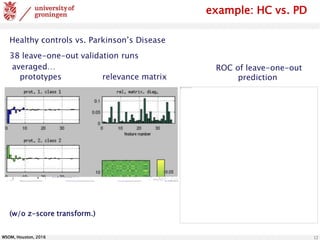
Healthy controls vs. Parkinson’s Disease
38 leave-one-out validation runs
averaged…
prototypes relevance matrix
ROC of leave-one-out
prediction
example: HC vs. PD
(w/o z-score transform.)
WSOM, Houston, 2016 13
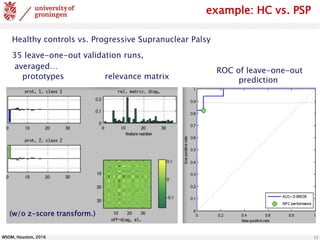
Healthy controls vs. Progressive Supranuclear Palsy
35 leave-one-out validation runs,
averaged…
prototypes relevance matrix
example: HC vs. PSP
ROC of leave-one-out
prediction
(w/o z-score transform.)
WSOM, Houston, 2016 14
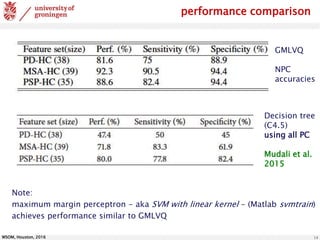
GMLVQ
NPC
accuracies
Note:
maximum margin perceptron - aka SVM with linear kernel - (Matlab svmtrain)
achieves performance similar to GMLVQ
performance comparison
Decision tree
(C4.5)
using all PC
Mudali et al.
2015
WSOM, Houston, 2016 15
four classes: HC / PD / MSA / PSP
leave-one-out confusion matrix for the four-class problem
GM
lin.
77.8 %
65.0 %
64.7 %
76.2 %
class acc.
66.7 %
60.0 %
52.9 %
89.0 %
class acc.(1 vs 1)
WSOM, Houston, 2016 16
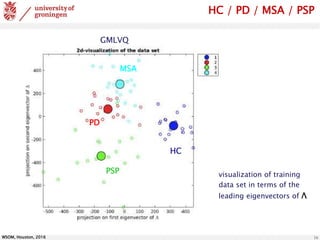
HC / PD / MSA / PSP
HC
PSP
PD
MSA
GMLVQ
visualization of training
data set in terms of the
leading eigenvectors of Λ
WSOM, Houston, 2016 17
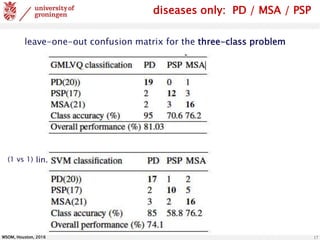
diseases only: PD / MSA / PSP
leave-one-out confusion matrix for the three-class problem
lin.(1 vs 1)
WSOM, Houston, 2016 18
diseases only: PD / MSA / PSP
MSA
PD
PSP
GMLVQ
visualization of training
data set in terms of the
leading eigenvectors of Λ
WSOM, Houston, 2016 19
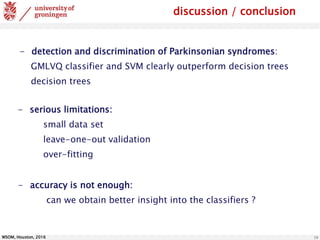
discussion / conclusion
- detection and discrimination of Parkinsonian syndromes:
GMLVQ classifier and SVM clearly outperform decision trees
decision trees
- serious limitations:
small data set
leave-one-out validation
over-fitting
- accuracy is not enough:
can we obtain better insight into the classifiers ?
WSOM, Houston, 2016 20
outlook/work in progress
- optimization of the number of PCs used as features
shown to improve decision tree performance
potential improvement for other classifiers
- larger data sets
- understanding relevances in voxel-space
relevant PC hint at discriminative between-patient variability
PCA:
recent example:
diagnosis of rheumatoid arthritis based on cytokine expression
[L. Yeo et al., Ann. of the Rheumatic Diseases, 2015]
WSOM, Houston, 2016 21
http://matlabserver.cs.rug.nl/gmlvqweb/web/
Matlab code:
Relevance and Matrix adaptation in Learning Vector
Quantization (GRLVQ, GMLVQ and LiRaM LVQ):
http://www.cs.rug.nl/~biehl/
links
Pre- and re-prints etc.:
A no-nonsense beginners’ tool for GMLVQ:
http://www.cs.rug.nl/~biehl/gmlvq
WSOM, Houston, 2016
Questions ?

2016: Classification of FDG-PET Brain Data

  • 1.
    Classification of FDG-PET*Brain Data * Fluorodeoxyglucose positron emission tomography Deborah Mudali 1,* Michael Biehl 1 Klaus L. Leenders 2 Jos B.T.M. Roerdink 1,3 1 Johann Bernoulli Institute for Mathematics and Computer Science, University of Groningen, NL 2 Department of Neurology University Medical Center Groningen, NL 3 Neuroimaging Center University Medical Center Groningen, NL * Mbarara University of Science & Technology, Uganda
  • 2.
    WSOM, Houston, 20162 overview Example application Classification of Parkinsonian Syndromes based on FDG-PET brain data Combination: PCA + GMLVQ comparison with DT, SVM Conclusion and Outlook Prototype-based classification Learning Vector Quantization Generalized Matrix Relevance Learning (GMLVQ)
  • 3.
    WSOM, Houston, 2016 ∙identification of prototype vectors from labeled example data ∙ (dis)-similarity based classification (e.g. Euclidean distance) Learning Vector Quantization N-dimensional data, feature vectors • initialize prototype vectors for different classes competitive learning: Winner-Takes-All LVQ1 [Kohonen, 1990, 1997] • identify the winner (closest prototype) • present a single example • move the winner - closer towards the data (same class) - away from the data (different class) feature space
  • 4.
    WSOM, Houston, 2016 prototypebased classifier - represent data by one or several prototypes per class - classify a query according to the label of the nearest prototype (or alternative voting schemes) - local decision boundaries according to (e.g.) Euclidean distances + robustness to outliers, low storage needs and computational effort - model selection: number of prototypes per class, etc. feature space ? ? appropriate distance / (dis-) similarity measure + parameterization in feature space, interpretability
  • 5.
    WSOM, Houston, 20165 fixed distance measures: - choice based on prior knowledge or preprocessing - determine prototypes from example data by means of (iterative) learning schemes e.g. heuristic LVQ1, cost function based Generalized LVQ relevance learning, adaptive distances: - employ parameterized distance measure - update parameters in one training process with prototypes - optimize adaptive, data driven dissimilarity example: Matrix Relevance LVQ Learning Vector Quantization
  • 6.
    WSOM, Houston, 2016 RelevanceMatrix LVQ generalized quadratic distance in LVQ: variants: global/local matrices (piecewise quadratic boundaries) diagonal relevances (single feature weights) rectangular (low-dim. representation) [Schneider et al., 2009] relevance matrix: quantifies importance of features and pairs of features summarizes relevance of feature j ( for equally scaled features ) training: optimize prototypes and Λ w.r.t. classification of examples
  • 7.
    WSOM, Houston, 2016 costfunction based training one example: Generalized LVQ [Sato & Yamada, 1995] sigmoidal (linear for small arguments), e.g. E approximates number of misclassifications linear E favors large margin separation of classes, e.g. two winning prototypes: minimize small , large E favors class-typical prototypes
  • 8.
    WSOM, Houston, 2016 costfunction based LVQ There is nothing objective about objective functions James McClelland
  • 9.
    WSOM, Houston, 20169 FDG-PET (Fluorodeoxyglucose positron emission tomography, 3d-images) condition Glucoseuptake n=18 HC Healhy controls n= 20 PD Parkinson’s Disease n=21 MSA Multiple System Atrophy n=17 PSP Progressive Supranuclear Palsy classification of FDG-PET data [http://glimpsproject.com]
  • 10.
    WSOM, Houston, 201610 work flow subjects 1….P voxels1….N(N≈200000) SubjectResidualProfileSRP log-transformed high-intensityvoxels GroupInvariant Subprofile(GIS) subjectsocres1….P subjects 1….P Scaled Subprofile Model PCA based on a given group of subjects SSMPCA data and pre-processing: D. Mudali, L.K. Teune, R. J. Renken, K. L. Leenders, J. B. T. M. Roerdink. Computational and Mathematical Methods in Medicine. March 2015, Art.ID 136921, 10p. and refs. therein
  • 11.
    WSOM, Houston, 201611 work flow subjects 1….P voxels1….N(N≈200000) SubjectResidualProfileSRP log-transformed high-intensityvoxels GroupInvariant Subprofile(GIS) subjectsocres1….P subjects 1….P Scaled Subprofile Model PCA based on a given group of subjects applied to novel subject test labels (condition) GMLVQ classifier prototypes and distance ? SSMPCA
  • 12.
    WSOM, Houston, 201612 Healthy controls vs. Parkinson’s Disease 38 leave-one-out validation runs averaged… prototypes relevance matrix ROC of leave-one-out prediction example: HC vs. PD (w/o z-score transform.)
  • 13.
    WSOM, Houston, 201613 Healthy controls vs. Progressive Supranuclear Palsy 35 leave-one-out validation runs, averaged… prototypes relevance matrix example: HC vs. PSP ROC of leave-one-out prediction (w/o z-score transform.)
  • 14.
    WSOM, Houston, 201614 GMLVQ NPC accuracies Note: maximum margin perceptron - aka SVM with linear kernel - (Matlab svmtrain) achieves performance similar to GMLVQ performance comparison Decision tree (C4.5) using all PC Mudali et al. 2015
  • 15.
    WSOM, Houston, 201615 four classes: HC / PD / MSA / PSP leave-one-out confusion matrix for the four-class problem GM lin. 77.8 % 65.0 % 64.7 % 76.2 % class acc. 66.7 % 60.0 % 52.9 % 89.0 % class acc.(1 vs 1)
  • 16.
    WSOM, Houston, 201616 HC / PD / MSA / PSP HC PSP PD MSA GMLVQ visualization of training data set in terms of the leading eigenvectors of Λ
  • 17.
    WSOM, Houston, 201617 diseases only: PD / MSA / PSP leave-one-out confusion matrix for the three-class problem lin.(1 vs 1)
  • 18.
    WSOM, Houston, 201618 diseases only: PD / MSA / PSP MSA PD PSP GMLVQ visualization of training data set in terms of the leading eigenvectors of Λ
  • 19.
    WSOM, Houston, 201619 discussion / conclusion - detection and discrimination of Parkinsonian syndromes: GMLVQ classifier and SVM clearly outperform decision trees decision trees - serious limitations: small data set leave-one-out validation over-fitting - accuracy is not enough: can we obtain better insight into the classifiers ?
  • 20.
    WSOM, Houston, 201620 outlook/work in progress - optimization of the number of PCs used as features shown to improve decision tree performance potential improvement for other classifiers - larger data sets - understanding relevances in voxel-space relevant PC hint at discriminative between-patient variability PCA: recent example: diagnosis of rheumatoid arthritis based on cytokine expression [L. Yeo et al., Ann. of the Rheumatic Diseases, 2015]
  • 21.
    WSOM, Houston, 201621 http://matlabserver.cs.rug.nl/gmlvqweb/web/ Matlab code: Relevance and Matrix adaptation in Learning Vector Quantization (GRLVQ, GMLVQ and LiRaM LVQ): http://www.cs.rug.nl/~biehl/ links Pre- and re-prints etc.: A no-nonsense beginners’ tool for GMLVQ: http://www.cs.rug.nl/~biehl/gmlvq
  • 22.