Departamento de Engenharia de     Faculdade de Engenharia    Unicamp
  Computação e Automação          Elétrica e de Computação
         Industrial


            Online learning in estimation of distribution
            algorithms for dynamic environments
                                André Ricardo Gonçalves
                                Fernando J. Von Zuben
Outline
   Optimization in dynamic environments

   Estimation of distribution algorithms

   Mixture model and online learning

   Proposed method: EDAOGMM

   Experimental results

   Concluding remarks and future works

   References
2
Outline
   Optimization in dynamic environments

   Estimation of distribution algorithms

   Mixture model and online learning

   Proposed method: EDAOGMM

   Experimental results

   Concluding remarks and future works

   References
3
Optimization in dynamic environments
       World is dynamic!

           New events arrive and others canceled at a scheduling
            problem;

           Vehicles must reroute around heavy trac and road repairs;

           Machine breakdown occurs during a production run.


    4
Optimization in dynamic environments
       Dynamic optimization algorithm should be able to react to the
        new environment, updating the internal model and generating
        new candidate solutions;

       Evolutionary algorithms (EAs) appear as promising
        approaches, since they maintain a population of solutions that
        can be adapted by means of a balance between exploration
        and exploitation of the search space;

       EAs approaches: GA, PSO, AIS, EDAs, among others;

       However, to be applied in dynamic environments, they must
        be adapted.

    5
Outline
   Optimization in dynamic environments

   Estimation of distribution algorithms

   Mixture model and online learning

   Proposed method: EDAOGMM

   Experimental results

   Concluding remarks and future works

   References
6
Estimation of distribution algorithms
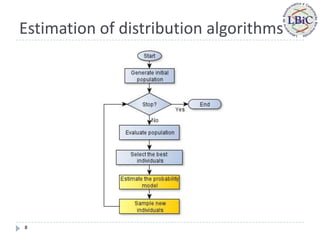
       Estimation of distribution algorithms (EDA) are
        evolutionary methods that use estimation of
        distribution techniques, instead of genetic operators.

       The key aspect in EDAs is how to estimate the true
        distribution of promising solutions.
           Dependence trees, Bayesian networks, mixture models, etc.

       Classication of EDAs based on complexity of
        probabilistic model.

    7
Estimation of distribution algorithms


8
Outline
   Optimization in dynamic environments

   Estimation of distribution algorithms

   Mixture model and online learning

   Proposed method: EDAOGMM

   Experimental results

   Concluding remarks and future works

   References
9
Mixture model and online learning
    Mixture models are flexible estimators;

    In optimization, they are able to capture the
     multimodality of the search space;

    Learning methods, such as Expectation-Maximization
     (EM), are computationally efficient;

    In optimization of dynamic environments, the model
     tends to change constantly;

    EM with online learning appear as a promising approach
     to model dynamic environments.
    10
Mixture model and online learning
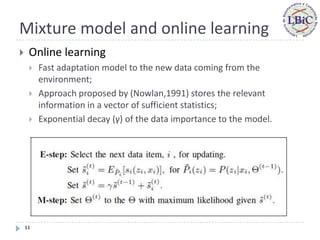
    Online learning
        Fast adaptation model to the new data coming from the
         environment;
        Approach proposed by (Nowlan,1991) stores the relevant
         information in a vector of sufficient statistics;
        Exponential decay (γ) of the data importance to the model.


    11
Outline
    Optimization in dynamic environments

    Estimation of distribution algorithms

    Mixture model and online learning

    Proposed method: EDAOGMM

    Experimental results

    Concluding remarks and future works

    References
12
Proposed method: EDAOGMM
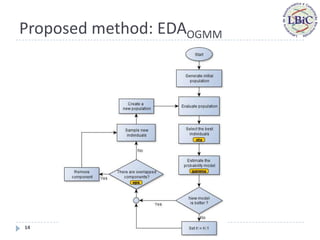
    EDA with online Gaussian mixture model (EDAOGMM)

    Employs an incremental and constructive mixture model (low
     computational cost);

    Self-adjusts the components number by means of BIC;

    Model tends to adapt to the multimodality of search space;

    Employs a “random immigrants” approach to promote
     population diversity;

    13
Proposed method: EDAOGMM


14
Proposed method: EDAOGMM
    Selection method:
        Stochastic selection aids to preserve the population diversity;
        η parameter defines the balance between exploration and
         explotation.

    Diversity control:
        Stochastic selection;
        Random immigrants;
        Controlled reinitializations (δ parameter).

    Components number control:
        Incremental and constructive approach;
        Removal of overlapped components (ε parameter).
    15
Proposed method: EDAOGMM
    New population is composed by 3 subpopulations (dependent
     of the η parameter):
        Sampled by the mixture model;
        Best individuals;
        Random immigrants.


    Overlapped components is a redundant representation of a
     promising region
        Remove the component with lower mixture coefficient;
        Check the overlap using the ε parameter.


    16
Outline
    Optimization in dynamic environments

    Estimation of distribution algorithms

    Mixture model and online learning

    Proposed method: EDAOGMM

    Experimental results

    Concluding remarks and future works

    References
17
Experimental results
    Moving Peaks benchmark (MPB) generator plus a rotation method
     (Li & Yang, 2008);
    Fitness surface are composed by a set of peaks that changes your
     positions, heights and widths over time;
    Maximization problem in a continuous space;
    Seven types of change (T1-T7): small step, large step, random,
     chaotic, recurrent, recurrent with noise and random with
     dimensional changes;

    There are parameters to control the multimodality of the search
     space, severity of changes and the dynamism of the environment;
    Range of search space: [-5,5];
    Problem dimensions: 10 and [5-15].
    18
Experimental results
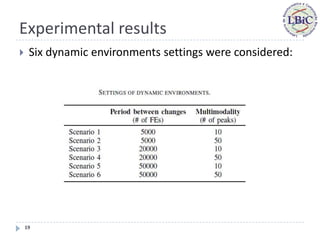
    Six dynamic environments settings were considered:


    19
Experimental results
    Contenders proposed algorithms in the literature:
        Improved Univariate Marginal Distribution Algorithm -
         IUMDA (Liu et al., 2008);
        Tri-EDAG (Yuan et al., 2008);
        Hypermutation Genetic Algorithm - HGA (Cobb,1990).


    Two EDAs and a GA developed for dynamic
     environments.


    20
Experimental results
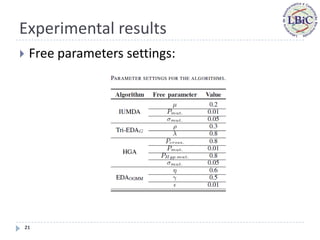
   Free parameters settings:


21
Experimental results
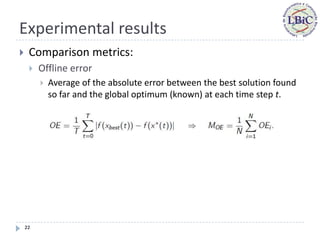
    Comparison metrics:
        Offline error
            Average of the absolute error between the best solution found
             so far and the global optimum (known) at each time step t.


    22
Experimental results
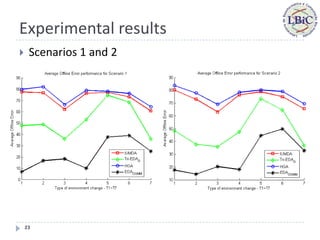
    Scenarios 1 and 2


    23
Experimental results
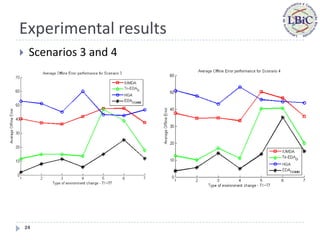
    Scenarios 3 and 4


    24
Experimental results
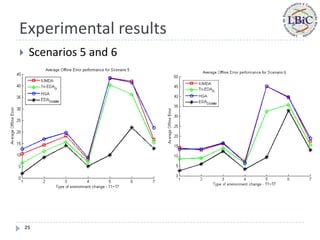
    Scenarios 5 and 6


    25
Outline
    Optimization in dynamic environments

    Estimation of distribution algorithms

    Mixture model and online learning

    Proposed method: EDAOGMM

    Experimental results

    Concluding remarks and future works

    References
26
Concluding remarks and future works
    EDAOGMM outperforms all the contenders, particularly in
     high-frequency changing environments (Scenarios 1 and 2);

    EDAOGMM has a fast convergence because it can explore
     several peaks simultaneously;

    We can detect a less prominent performance in low
     frequency scenarios (5 and 6), indicating that, once
     converged, the EDAOGMM reduces its exploration power;

    So, a continued control to avoid premature convergence is
     desirable.

    27
Concluding remarks and future works
    Future works:
        Incorporate a continued convergence control mechanism;

        Compare EDAOGMM with other algorithms designed to deal
         with dynamic environments;

        Increment the experimental tests aiming at investigating
         scalability and other aspects related to the relative
         performance of the proposed algorithm;

        Performs a parameter sensitivity analisys.

    28
Outline
    Optimization in dynamic environments

    Estimation of distribution algorithms

    Mixture model and online learning

    Proposed method: EDAOGMM

    Experimental results

    Concluding remarks and future works

    References
29
References
    S. Nowlan, “Soft competitive adaptation: neural network learning
     algorithms based on fitting statistical mixtures,” Ph.D. dissertation,
     Carnegie Mellon University, Pittsburgh, PA, USA, 1991.
    C. Li and S. Yang, “A generalized approach to construct benchmark
     problems for dynamic optimization,” in Proc. of the 7th Int. Conf. on
     Simulated Evolution and Learning, 2008.
    X. Liu, Y. Wu, and J. Ye, “An Improved Estimation of Distribution Algorithmin
     Dynamic Environments,” in Fourth International Conference on Natural
     Computation. IEEE Computer Society, 2008, pp. 269–272.
    B. Yuan, M. Orlowska, and S. Sadiq, “Extending a class of continuous
     estimation of distribution algorithms to dynamic problems,” Optimization
     Letters, vol. 2, no. 3, pp. 433–443, 2008.
    H. Cobb, “An investigation into the use of hypermutation as an adaptive
     operator in genetic algorithms having continuous, time-dependent
     nonstationary environments,” Naval Research Laboratory, Tech. Rep., 1990.


    30
Departamento de Engenharia de     Faculdade de Engenharia    Unicamp
  Computação e Automação          Elétrica e de Computação
         Industrial


            Online learning in estimation of distribution
            algorithms for dynamic environments
                                André Ricardo Gonçalves
                                Fernando J. Von Zuben

Online learning in estimation of distribution algorithms for dynamic environments

  • 1.
    Departamento de Engenhariade Faculdade de Engenharia Unicamp Computação e Automação Elétrica e de Computação Industrial Online learning in estimation of distribution algorithms for dynamic environments André Ricardo Gonçalves Fernando J. Von Zuben
  • 2.
    Outline  Optimization in dynamic environments  Estimation of distribution algorithms  Mixture model and online learning  Proposed method: EDAOGMM  Experimental results  Concluding remarks and future works  References 2
  • 3.
    Outline  Optimization in dynamic environments  Estimation of distribution algorithms  Mixture model and online learning  Proposed method: EDAOGMM  Experimental results  Concluding remarks and future works  References 3
  • 4.
    Optimization in dynamicenvironments  World is dynamic!  New events arrive and others canceled at a scheduling problem;  Vehicles must reroute around heavy trac and road repairs;  Machine breakdown occurs during a production run. 4
  • 5.
    Optimization in dynamicenvironments  Dynamic optimization algorithm should be able to react to the new environment, updating the internal model and generating new candidate solutions;  Evolutionary algorithms (EAs) appear as promising approaches, since they maintain a population of solutions that can be adapted by means of a balance between exploration and exploitation of the search space;  EAs approaches: GA, PSO, AIS, EDAs, among others;  However, to be applied in dynamic environments, they must be adapted. 5
  • 6.
    Outline  Optimization in dynamic environments  Estimation of distribution algorithms  Mixture model and online learning  Proposed method: EDAOGMM  Experimental results  Concluding remarks and future works  References 6
  • 7.
    Estimation of distributionalgorithms  Estimation of distribution algorithms (EDA) are evolutionary methods that use estimation of distribution techniques, instead of genetic operators.  The key aspect in EDAs is how to estimate the true distribution of promising solutions.  Dependence trees, Bayesian networks, mixture models, etc.  Classication of EDAs based on complexity of probabilistic model. 7
  • 8.
  • 9.
    Outline  Optimization in dynamic environments  Estimation of distribution algorithms  Mixture model and online learning  Proposed method: EDAOGMM  Experimental results  Concluding remarks and future works  References 9
  • 10.
    Mixture model andonline learning  Mixture models are flexible estimators;  In optimization, they are able to capture the multimodality of the search space;  Learning methods, such as Expectation-Maximization (EM), are computationally efficient;  In optimization of dynamic environments, the model tends to change constantly;  EM with online learning appear as a promising approach to model dynamic environments. 10
  • 11.
    Mixture model andonline learning  Online learning  Fast adaptation model to the new data coming from the environment;  Approach proposed by (Nowlan,1991) stores the relevant information in a vector of sufficient statistics;  Exponential decay (γ) of the data importance to the model. 11
  • 12.
    Outline  Optimization in dynamic environments  Estimation of distribution algorithms  Mixture model and online learning  Proposed method: EDAOGMM  Experimental results  Concluding remarks and future works  References 12
  • 13.
    Proposed method: EDAOGMM  EDA with online Gaussian mixture model (EDAOGMM)  Employs an incremental and constructive mixture model (low computational cost);  Self-adjusts the components number by means of BIC;  Model tends to adapt to the multimodality of search space;  Employs a “random immigrants” approach to promote population diversity; 13
  • 14.
  • 15.
    Proposed method: EDAOGMM  Selection method:  Stochastic selection aids to preserve the population diversity;  η parameter defines the balance between exploration and explotation.  Diversity control:  Stochastic selection;  Random immigrants;  Controlled reinitializations (δ parameter).  Components number control:  Incremental and constructive approach;  Removal of overlapped components (ε parameter). 15
  • 16.
    Proposed method: EDAOGMM  New population is composed by 3 subpopulations (dependent of the η parameter):  Sampled by the mixture model;  Best individuals;  Random immigrants.  Overlapped components is a redundant representation of a promising region  Remove the component with lower mixture coefficient;  Check the overlap using the ε parameter. 16
  • 17.
    Outline  Optimization in dynamic environments  Estimation of distribution algorithms  Mixture model and online learning  Proposed method: EDAOGMM  Experimental results  Concluding remarks and future works  References 17
  • 18.
    Experimental results  Moving Peaks benchmark (MPB) generator plus a rotation method (Li & Yang, 2008);  Fitness surface are composed by a set of peaks that changes your positions, heights and widths over time;  Maximization problem in a continuous space;  Seven types of change (T1-T7): small step, large step, random, chaotic, recurrent, recurrent with noise and random with dimensional changes;  There are parameters to control the multimodality of the search space, severity of changes and the dynamism of the environment;  Range of search space: [-5,5];  Problem dimensions: 10 and [5-15]. 18
  • 19.
    Experimental results  Six dynamic environments settings were considered: 19
  • 20.
    Experimental results  Contenders proposed algorithms in the literature:  Improved Univariate Marginal Distribution Algorithm - IUMDA (Liu et al., 2008);  Tri-EDAG (Yuan et al., 2008);  Hypermutation Genetic Algorithm - HGA (Cobb,1990).  Two EDAs and a GA developed for dynamic environments. 20
  • 21.
    Experimental results  Free parameters settings: 21
  • 22.
    Experimental results  Comparison metrics:  Offline error  Average of the absolute error between the best solution found so far and the global optimum (known) at each time step t. 22
  • 23.
    Experimental results  Scenarios 1 and 2 23
  • 24.
    Experimental results  Scenarios 3 and 4 24
  • 25.
    Experimental results  Scenarios 5 and 6 25
  • 26.
    Outline  Optimization in dynamic environments  Estimation of distribution algorithms  Mixture model and online learning  Proposed method: EDAOGMM  Experimental results  Concluding remarks and future works  References 26
  • 27.
    Concluding remarks andfuture works  EDAOGMM outperforms all the contenders, particularly in high-frequency changing environments (Scenarios 1 and 2);  EDAOGMM has a fast convergence because it can explore several peaks simultaneously;  We can detect a less prominent performance in low frequency scenarios (5 and 6), indicating that, once converged, the EDAOGMM reduces its exploration power;  So, a continued control to avoid premature convergence is desirable. 27
  • 28.
    Concluding remarks andfuture works  Future works:  Incorporate a continued convergence control mechanism;  Compare EDAOGMM with other algorithms designed to deal with dynamic environments;  Increment the experimental tests aiming at investigating scalability and other aspects related to the relative performance of the proposed algorithm;  Performs a parameter sensitivity analisys. 28
  • 29.
    Outline  Optimization in dynamic environments  Estimation of distribution algorithms  Mixture model and online learning  Proposed method: EDAOGMM  Experimental results  Concluding remarks and future works  References 29
  • 30.
    References  S. Nowlan, “Soft competitive adaptation: neural network learning algorithms based on fitting statistical mixtures,” Ph.D. dissertation, Carnegie Mellon University, Pittsburgh, PA, USA, 1991.  C. Li and S. Yang, “A generalized approach to construct benchmark problems for dynamic optimization,” in Proc. of the 7th Int. Conf. on Simulated Evolution and Learning, 2008.  X. Liu, Y. Wu, and J. Ye, “An Improved Estimation of Distribution Algorithmin Dynamic Environments,” in Fourth International Conference on Natural Computation. IEEE Computer Society, 2008, pp. 269–272.  B. Yuan, M. Orlowska, and S. Sadiq, “Extending a class of continuous estimation of distribution algorithms to dynamic problems,” Optimization Letters, vol. 2, no. 3, pp. 433–443, 2008.  H. Cobb, “An investigation into the use of hypermutation as an adaptive operator in genetic algorithms having continuous, time-dependent nonstationary environments,” Naval Research Laboratory, Tech. Rep., 1990. 30
  • 31.
    Departamento de Engenhariade Faculdade de Engenharia Unicamp Computação e Automação Elétrica e de Computação Industrial Online learning in estimation of distribution algorithms for dynamic environments André Ricardo Gonçalves Fernando J. Von Zuben