AND NOT OR
Strategies for coping with
the everything future
Michael Lascarides
National Library of New Zealand
@mlascarides
Friday, February 27, 15
Hello. I'm Michael, and I'm from the National Library of New
Zealand.
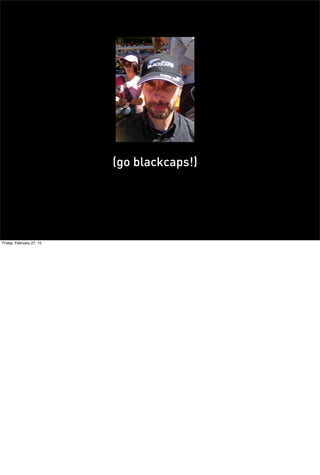
(go blackcaps!)
Friday, February 27, 15
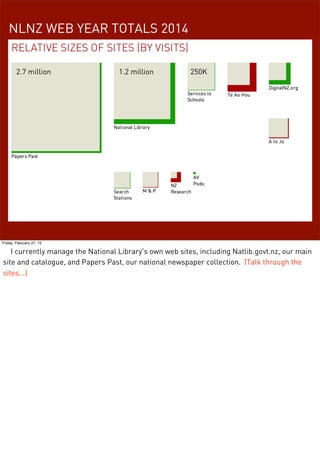
2.7 million 1.2 million 250K
NLNZ WEB YEAR TOTALS 2014
Friday, February 27, 15
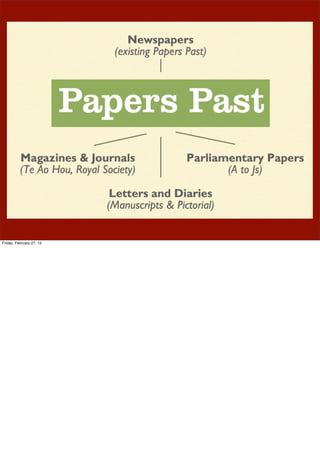
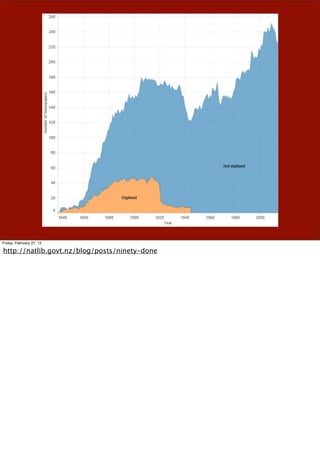
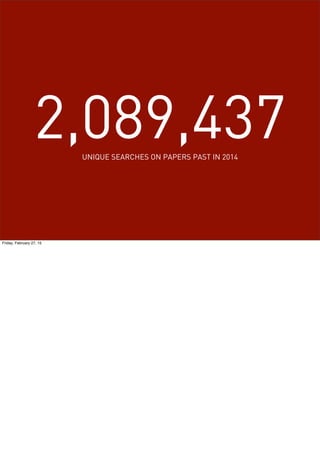
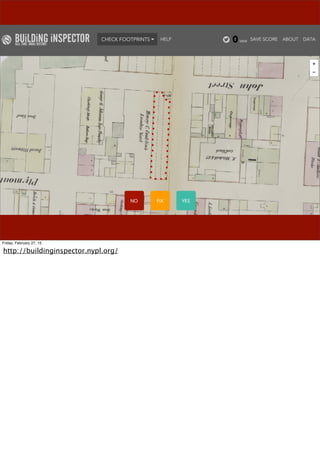
I currently manage the National Library's own web sites, including Natlib.govt.nz, our main
site and catalogue, and Papers Past, our national newspaper collection. (Talk through the
sites...)
Friday, February 27, 15
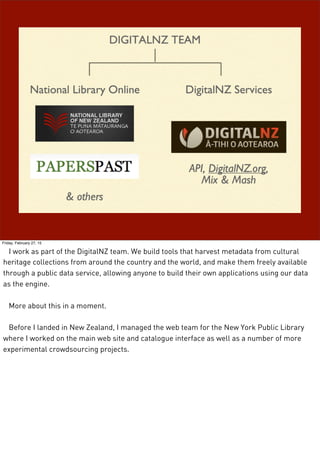
I work as part of the DigitalNZ team. We build tools that harvest metadata from cultural
heritage collections from around the country and the world, and make them freely available
through a public data service, allowing anyone to build their own applications using our data
as the engine.
More about this in a moment.
Before I landed in New Zealand, I managed the web team for the New York Public Library
where I worked on the main web site and catalogue interface as well as a number of more
experimental crowdsourcing projects.
non-librarian
Friday, February 27, 15
Despite having had the wonderful opportunity to work for two incredible libraries, I am not a
library person by training.
I started my career in graphics production for advertising in the mid 1990s and moved into
designing web sites for e-commerce clients when before the first dot com boom, back in the
days when being the web guy was a lot less specialized.
I worked on websites for publishers and fashion designers and women’s skincare products.
In this environment, I learned an awful lot about catering to the needs of customers.
I will say this for working on the commercial web: you never struggle with “assessment”.
You build an enhancement, deploy it to the live site, and in the morning you’re either making
more or less money.
This was excellent training in iterative development and improving through feedback loops:
Build, deploy, explain to boss why sales are up or down, repeat.
BUT
LIBRARIES
ROCK
Friday, February 27, 15
But after decade in the dotcom trenches in New York City and I’d had it. I’d found myself
gravitating towards the user experience design side of the industry, and I was itching to use
my powers for good not evil.
In 2007, I got hired for my first dream job as “Digital User Analyst” for the NYPL.
My brief was a pretty simple one: we know we have a couple of million online visitors a
month, but we don’t know a whole lot about them.
Find out what you can and report back.
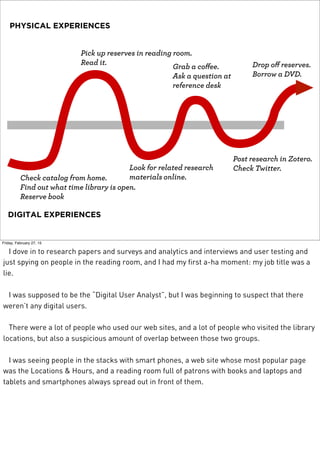
PHYSICAL EXPERIENCES
DIGITAL EXPERIENCES
Check catalog from home.
Find out what time library is open.
Reserve book
Pick up reserves in reading room.
Read it.
Look for related research
materials online.
Grab a coffee.
Ask a question at
reference desk
Post research in Zotero.
Check Twitter.
Drop off reserves.
Borrow a DVD.
Friday, February 27, 15
I dove in to research papers and surveys and analytics and interviews and user testing and
just spying on people in the reading room, and I had my first a-ha moment: my job title was a
lie.
I was supposed to be the “Digital User Analyst”, but I was beginning to suspect that there
weren’t any digital users.
There were a lot of people who used our web sites, and a lot of people who visited the library
locations, but also a suspicious amount of overlap between those two groups.
I was seeing people in the stacks with smart phones, a web site whose most popular page
was the Locations & Hours, and a reading room full of patrons with books and laptops and
tablets and smartphones always spread out in front of them.
e-books or paper books?
Friday, February 27, 15
So as a digital practitioner in the library world, I’ve always been sensitive about boundaries.
Especially ones that might not actually exist.
It is an axiom in cultural evolution
that technologies once invented
are never uninvented.
KEVIN KELLY
Friday, February 27, 15
For me, this quote from Kevin Kelly’s book “What Technology Wants” offered a clue.
Kelly’s book looks at the history of technology and comes to the conclusion that pretty much every
technology we have ever invented is still in use somewhere in the world today.
https://openlibrary.org/books/OL25128088M/What_Technology_Wants
e-books AND paper books
Friday, February 27, 15
This is reassuring for those of us who love print just as much as we love pixels. We don’t
have to choose.
Not only will the e-book not kill the paper book, but it couldn’t even if it wanted to.
This pattern, where the answer to the question “which of these two technologies will be
dominant?” is often “both, depending on whom you talk to and when” occurs frequently these
days, so we get...
MP3s AND vinyl records
Friday, February 27, 15
tweeting a selfie of the
sublime experience of
handling an original historical
manuscript
Friday, February 27, 15
googling more
information about an
artwork in front of you
Friday, February 27, 15
having enthusiastic fans in
your reading room AND
enthusiastic fans in iceland
Friday, February 27, 15
checking out a text on
theoretical physics AND
a dvd of game of thrones
Friday, February 27, 15
knowing that another
institution has a better
answer to a patron’s
query than we do
Friday, February 27, 15
And Not Or can happen at the institutional level as well.
I want my patrons to visit the State Library of New South Wales too.
And I want us to have our act together so we can share everything we know.
AND
NOT
OR
Friday, February 27, 15
So if you love print, rejoice because it’s not going away.
But if you hate e-books, sorry, they’re not going away either.
In fact, we’re on the rapidly accelerating part of the growth curve, where new technologies
and new forms of content are continuing to be introduced in ever increasing numbers.
And this, my fellow library folk, is a big, big challenge. And it’s about to get much bigger.
7 MIND-
BLOWING
FACTS
Friday, February 27, 15
Those of us who work in information industries know that much about the relationship our
patrons have with information has changed in recent decades.
But it’s worth taking a moment to reflect upon the magnitude of that change, and to
understand that, incredibly, it still has so far to go.
[As an aside, not all of these slides have attributions showing on screen, but I’ve added notes
with links and attributions and I will make the slides available for download.]
Friday, February 27, 15
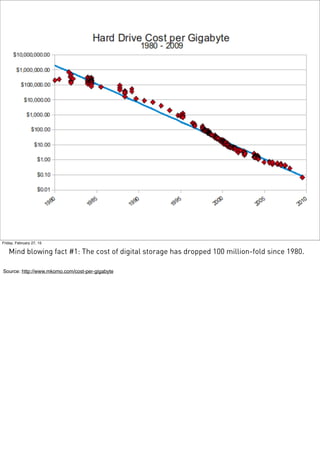
Mind blowing fact #1: The cost of digital storage has dropped 100 million-fold since 1980.
Source: http://www.mkomo.com/cost-per-gigabyte
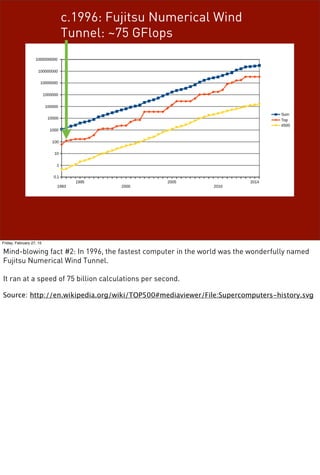
c.1996: Fujitsu Numerical Wind
Tunnel: ~75 GFlops
Friday, February 27, 15
Mind-blowing fact #2: In 1996, the fastest computer in the world was the wonderfully named
Fujitsu Numerical Wind Tunnel.
It ran at a speed of 75 billion calculations per second.
Source: http://en.wikipedia.org/wiki/TOP500#mediaviewer/File:Supercomputers-history.svg
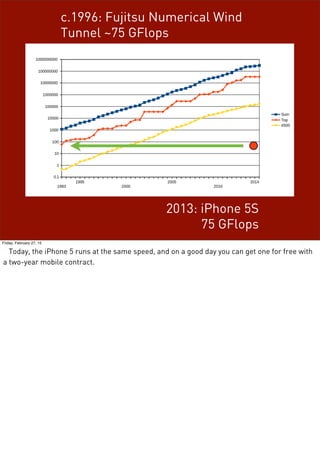
2013: iPhone 5S
75 GFlops
c.1996: Fujitsu Numerical Wind
Tunnel ~75 GFlops
Friday, February 27, 15
Today, the iPhone 5 runs at the same speed, and on a good day you can get one for free with
a two-year mobile contract.
Friday, February 27, 15
Mind-blowing fact #3: This is a visualisation I made a while back of the growth of mobile
phones using data from the World Bank.
[Their database site, by the way, is an awesome resource. I’m using the number for mobile
subscriptions not individual phones, which includes things like sim cards and work phones, so
the number can exceed 100% of the population, but for our purposes it’ll suffice.]
[Also, noticed too late that a little rendering issue pushed the circles out of alignment with
the countries, and mortifyingly, I cropped NZ out of frame!]
The size of the green circles represent the population of each country. I’ll start the clock in a
moment and you can see the circles, slowly and almost imperceptibly start to grow as
population does.
In the early 1980s, the dark green represent the first mobile phones. In the 90s, China and
India start to come on line. By the end of the visualisation in 2012, most countries have more
cellphones than people.
That’s astonishing progress.
Friday, February 27, 15
Mind-blowing fact #3: This is a visualisation I made a while back of the growth of mobile
phones using data from the World Bank.
[Their database site, by the way, is an awesome resource. I’m using the number for mobile
subscriptions not individual phones, which includes things like sim cards and work phones, so
the number can exceed 100% of the population, but for our purposes it’ll suffice.]
[Also, noticed too late that a little rendering issue pushed the circles out of alignment with
the countries, and mortifyingly, I cropped NZ out of frame!]
The size of the green circles represent the population of each country. I’ll start the clock in a
moment and you can see the circles, slowly and almost imperceptibly start to grow as
population does.
In the early 1980s, the dark green represent the first mobile phones. In the 90s, China and
India start to come on line. By the end of the visualisation in 2012, most countries have more
cellphones than people.
That’s astonishing progress.
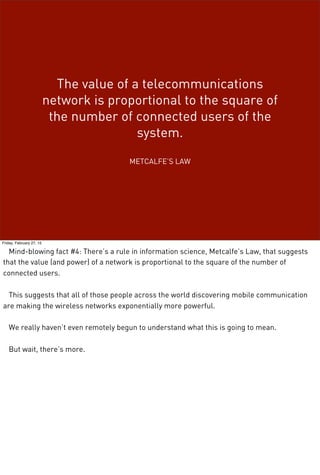
The value of a telecommunications
network is proportional to the square of
the number of connected users of the
system.
METCALFE’S LAW
Friday, February 27, 15
Mind-blowing fact #4: There’s a rule in information science, Metcalfe’s Law, that suggests
that the value (and power) of a network is proportional to the square of the number of
connected users.
This suggests that all of those people across the world discovering mobile communication
are making the wireless networks exponentially more powerful.
We really haven’t even remotely begun to understand what this is going to mean.
But wait, there’s more.
Friday, February 27, 15
Mind-blowing fact #5: Less than a third of the world’s population is on the Internet.
Most of those mobile phones in the previous visualisation? Dumb phones, with just voice and
texting.
But we are starting to go through the same curve all over again with smartphones, bringing
the internet for the first time to the other two thirds of the planet.
And to reiterate, every single one of those phones will be more powerful than the fastest
computer in the world from 20 years ago.
[By the way, this chart is from the researcher Horace Dediu who writes on a blog called
Asymco. He is a wonderful source of great insight about the state of the mobile world.]
http://www.asymco.com/2014/01/03/on-the-future-of-the-internet-and-everything/
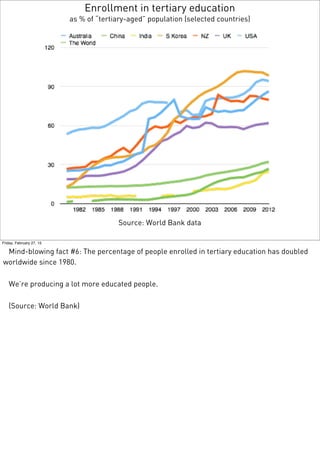
Enrollment in tertiary education
as % of “tertiary-aged” population (selected countries)
Source: World Bank data
Friday, February 27, 15
Mind-blowing fact #6: The percentage of people enrolled in tertiary education has doubled
worldwide since 1980.
We’re producing a lot more educated people.
(Source: World Bank)
There never was a golden age
where everybody could write well.
Writing is hard.
ANDREA ABERNATHY LUNSFORD
Friday, February 27, 15
I think this combination of education and connection is raising the bar for literacy, and it’s
something to remember when you hear horror stories about how texting is ruining the writing
skills of the kids these days.
This quote is from a Stanford professor who published an academic study of the writing
skills of first-year students. Spoiler alert: she found that they’re improving overall.
There are more first-year students than ever, so students who previously wouldn’t even have
been measured are in the mix now.
And her quote references the fact that horror stories about the abysmal quality of first year
writing is largely due to the fact that they’re, well, first-year students.
They’ve always sucked at writing.
Friday, February 27, 15
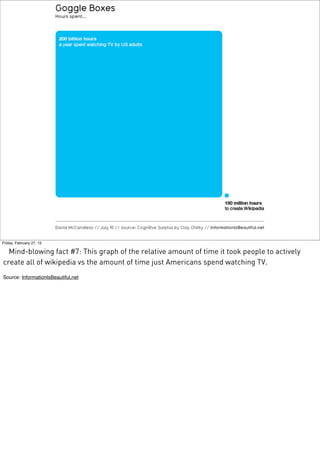
Mind-blowing fact #7: This graph of the relative amount of time it took people to actively
create all of wikipedia vs the amount of time just Americans spend watching TV.
Source: InformationIsBeautiful,net
Friday, February 27, 15
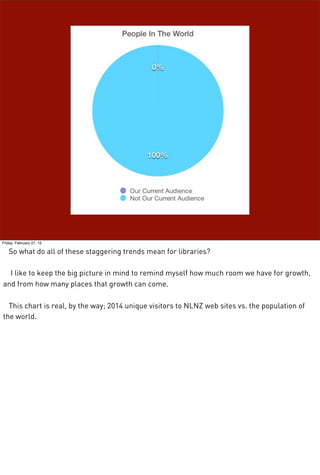
So what do all of these staggering trends mean for libraries?
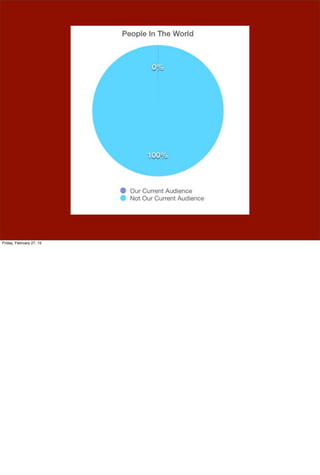
I like to keep the big picture in mind to remind myself how much room we have for growth,
and from how many places that growth can come.
This chart is real, by the way; 2014 unique visitors to NLNZ web sites vs. the population of
the world.
Information is SCARCE


•


Value


is


in


ACCESS
Information is ABUNDANT


•


Value


is


in


RELEVANCE
<< History Now >>2000-ish
Friday, February 27, 15
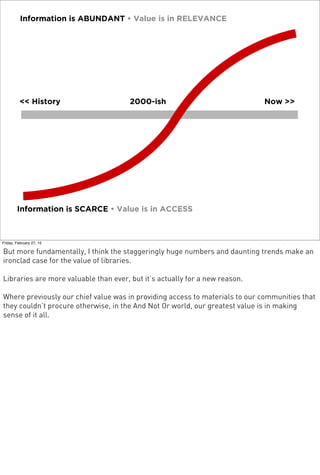
But more fundamentally, I think the staggeringly huge numbers and daunting trends make an
ironclad case for the value of libraries.
Libraries are more valuable than ever, but it’s actually for a new reason.
Where previously our chief value was in providing access to materials to our communities that
they couldn’t procure otherwise, in the And Not Or world, our greatest value is in making
sense of it all.
Information is SCARCE


•


Value


is


in


ACCESS
Information is ABUNDANT


•


Value


is


in


RELEVANCE
<< History Now >>2000-ish
That brief moment when we
wondered if libraries were
relevant anymore...
Friday, February 27, 15
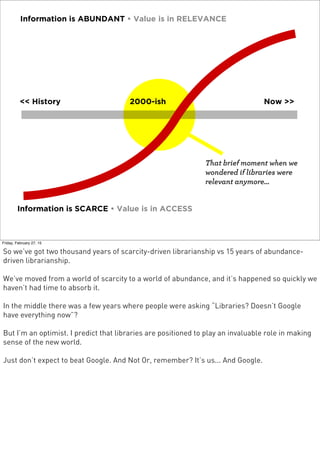
So we’ve got two thousand years of scarcity-driven librarianship vs 15 years of abundance-
driven librarianship.
We’ve moved from a world of scarcity to a world of abundance, and it’s happened so quickly we
haven’t had time to absorb it.
In the middle there was a few years where people were asking “Libraries? Doesn’t Google
have everything now”?
But I’m an optimist. I predict that libraries are positioned to play an invaluable role in making
sense of the new world.
Just don’t expect to beat Google. And Not Or, remember? It’s us... And Google.
Friday, February 27, 15
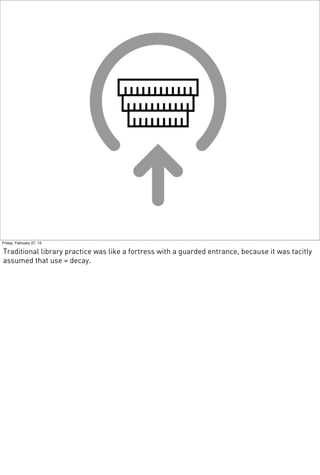
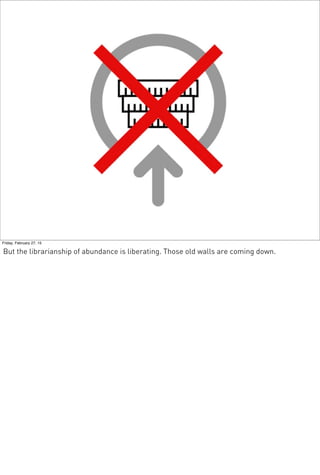
Traditional library practice was like a fortress with a guarded entrance, because it was tacitly
assumed that use = decay.
Friday, February 27, 15
But the librarianship of abundance is liberating. Those old walls are coming down.
Friday, February 27, 15
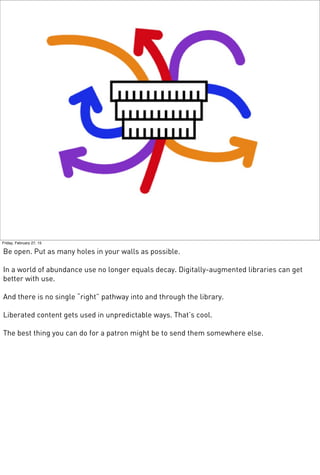
Be open. Put as many holes in your walls as possible.
In a world of abundance use no longer equals decay. Digitally-augmented libraries can get
better with use.
And there is no single “right” pathway into and through the library.
Liberated content gets used in unpredictable ways. That’s cool.
The best thing you can do for a patron might be to send them somewhere else.
Friday, February 27, 15
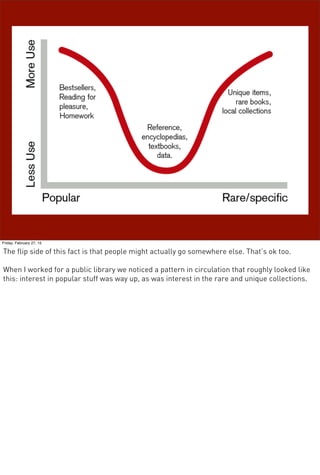
The flip side of this fact is that people might actually go somewhere else. That’s ok too.
When I worked for a public library we noticed a pattern in circulation that roughly looked like
this: interest in popular stuff was way up, as was interest in the rare and unique collections.
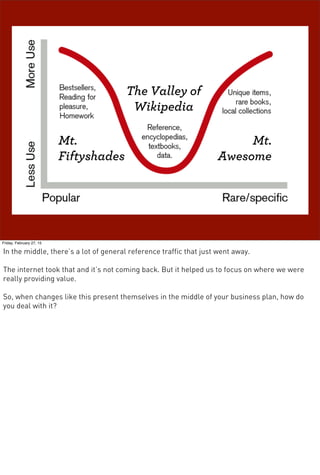
The Valley of
Wikipedia
Mt.
Fiftyshades
Mt.
Awesome
Friday, February 27, 15
In the middle, there’s a lot of general reference traffic that just went away.
The internet took that and it’s not coming back. But it helped us to focus on where we were
really providing value.
So, when changes like this present themselves in the middle of your business plan, how do
you deal with it?
10 COPING
STRATEGIES
FOR THE
AND NOT OR
WORLD
Friday, February 27, 15
I’d like to offer a handful of possible strategies for dealing with our new, digitally enabled,
frequently disrupted, but almost unimaginably potential-filled world.
This list is guaranteed incomplete and it’s contents inadequately tested by time. One size does
definitely not fit all. Use at your own risk.
Please direct all complaints to small group discussions afterwards where we can share better
ideas than these, preferably over beers.
BE
THERE
Coping strategy #1
Friday, February 27, 15
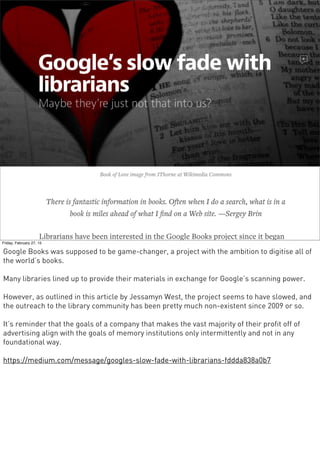
Google Books was supposed to be game-changer, a project with the ambition to digitise all of
the world’s books.
Many libraries lined up to provide their materials in exchange for Google’s scanning power.
However, as outlined in this article by Jessamyn West, the project seems to have slowed, and
the outreach to the library community has been pretty much non-existent since 2009 or so.
It’s reminder that the goals of a company that makes the vast majority of their profit off of
advertising align with the goals of memory institutions only intermittently and not in any
foundational way.
https://medium.com/message/googles-slow-fade-with-librarians-fddda838a0b7
Business
thinking
Friday, February 27, 15
This is the peril of applying business thinking. Sometimes—often—there’s no profit to be had
in cultural heritage institutions.
Rather than feeling sheepish about this fact, we need to own it, and be proud of the fact that
our institutions are needed not because we tick a box in a market plan, but because preserving
and distributing our culture is something that the citizens of great countries expect us to do.
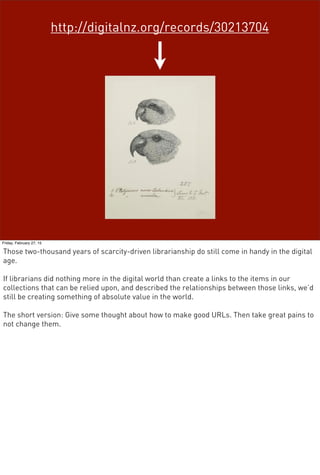
http://digitalnz.org/records/30213704
Friday, February 27, 15
Those two-thousand years of scarcity-driven librarianship do still come in handy in the digital
age.
If librarians did nothing more in the digital world than create a links to the items in our
collections that can be relied upon, and described the relationships between those links, we’d
still be creating something of absolute value in the world.
The short version: Give some thought about how to make good URLs. Then take great pains to
not change them.
Sustainability
Friday, February 27, 15
DO
LESS
Coping strategy #2
Friday, February 27, 15
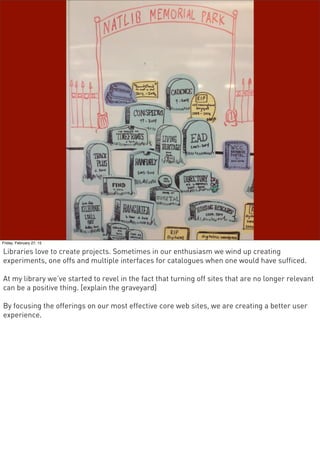
Libraries love to create projects. Sometimes in our enthusiasm we wind up creating
experiments, one offs and multiple interfaces for catalogues when one would have sufficed.
At my library we’ve started to revel in the fact that turning off sites that are no longer relevant
can be a positive thing. [explain the graveyard]
By focusing the offerings on our most effective core web sites, we are creating a better user
experience.
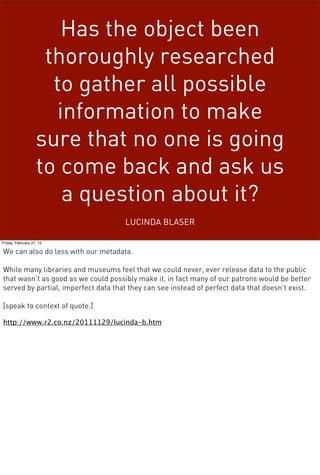
Has the object been
thoroughly researched
to gather all possible
information to make
sure that no one is going
to come back and ask us
a question about it?
LUCINDA BLASER
Friday, February 27, 15
We can also do less with our metadata.
While many libraries and museums feel that we could never, ever release data to the public
that wasn’t as good as we could possibly make it, in fact many of our patrons would be better
served by partial, imperfect data that they can see instead of perfect data that doesn’t exist.
[speak to context of quote.]
http://www.r2.co.nz/20111129/lucinda-b.htm
[ insert
crowdsourcing
presentation
here ]
Friday, February 27, 15
GO
DEEP
Coping strategy #3
Friday, February 27, 15
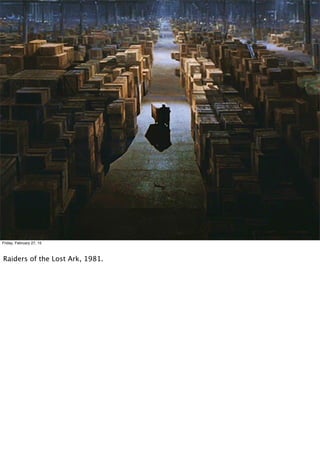
Raiders of the Lost Ark, 1981.
Friday, February 27, 15
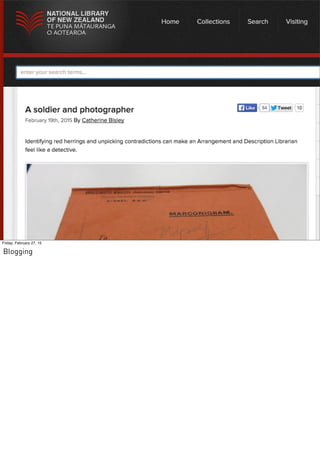
Blogging
Friday, February 27, 15
THE
INVOLVEMENT
OF CURATORS
AND
LIBRARIANS
IS ESSENTIAL
Friday, February 27, 15
MAKE
CONNEC
>TIONS
Coping strategy #4
Friday, February 27, 15
http://digitalnz.org
Friday, February 27, 15
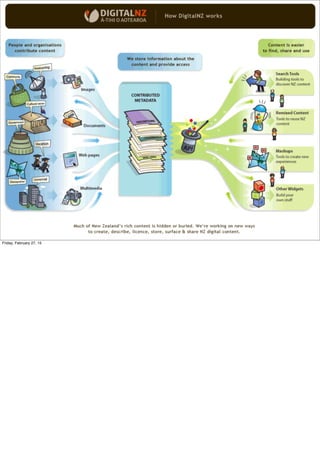
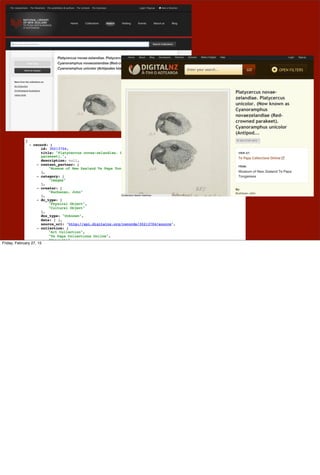
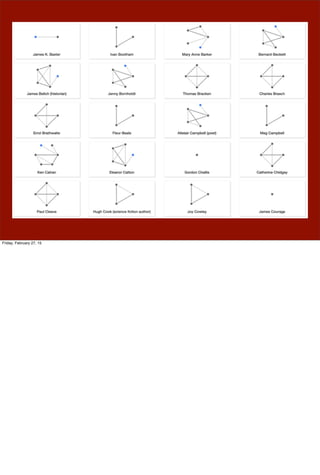
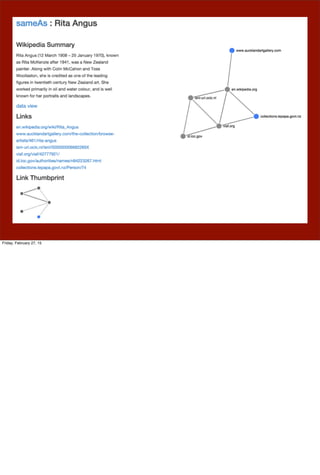
For a better overview of DigitalNZ and Supplejack, please see the web site. It has a great
overview.
Friday, February 27, 15
http://digitalnz.github.io/supplejack/
Friday, February 27, 15
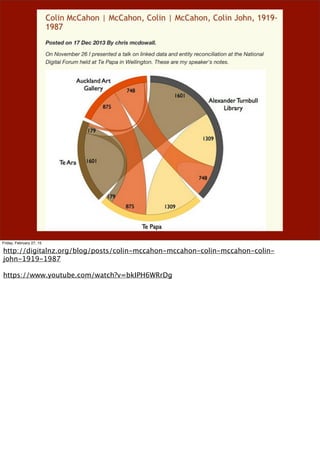
http://digitalnz.org/blog/posts/colin-mccahon-mccahon-colin-mccahon-colin-
john-1919-1987
https://www.youtube.com/watch?v=bkIPH6WRrDg
Friday, February 27, 15
BE
FLEXIBLE
Coping strategy #5
Friday, February 27, 15
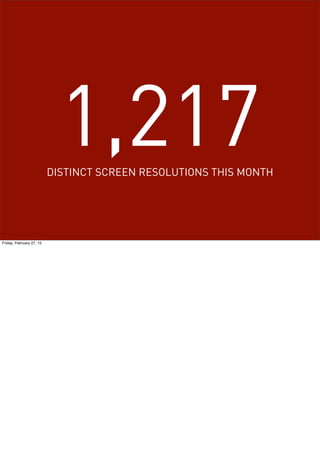
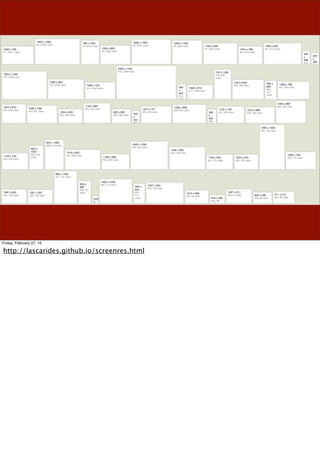
A question for you: How many different screen sizes do the visitors to your website have?
(Last 30 days on natlib....)
1,217DISTINCT SCREEN RESOLUTIONS THIS MONTH
Friday, February 27, 15
http://lascarides.github.io/screenres.html
UNDER
STAND
DISRUP
TION
Coping strategy #6
Friday, February 27, 15

Michael lascarides Keynote NSW.net DE&UX Seminar 2015

  • 1.
    AND NOT OR Strategiesfor coping with the everything future Michael Lascarides National Library of New Zealand @mlascarides Friday, February 27, 15 Hello. I'm Michael, and I'm from the National Library of New Zealand.
  • 2.
  • 3.
    2.7 million 1.2million 250K NLNZ WEB YEAR TOTALS 2014 Friday, February 27, 15 I currently manage the National Library's own web sites, including Natlib.govt.nz, our main site and catalogue, and Papers Past, our national newspaper collection. (Talk through the sites...)
  • 4.
    Friday, February 27,15 I work as part of the DigitalNZ team. We build tools that harvest metadata from cultural heritage collections from around the country and the world, and make them freely available through a public data service, allowing anyone to build their own applications using our data as the engine. More about this in a moment. Before I landed in New Zealand, I managed the web team for the New York Public Library where I worked on the main web site and catalogue interface as well as a number of more experimental crowdsourcing projects.
  • 5.
    non-librarian Friday, February 27,15 Despite having had the wonderful opportunity to work for two incredible libraries, I am not a library person by training. I started my career in graphics production for advertising in the mid 1990s and moved into designing web sites for e-commerce clients when before the first dot com boom, back in the days when being the web guy was a lot less specialized. I worked on websites for publishers and fashion designers and women’s skincare products. In this environment, I learned an awful lot about catering to the needs of customers. I will say this for working on the commercial web: you never struggle with “assessment”. You build an enhancement, deploy it to the live site, and in the morning you’re either making more or less money. This was excellent training in iterative development and improving through feedback loops: Build, deploy, explain to boss why sales are up or down, repeat.
  • 6.
    BUT LIBRARIES ROCK Friday, February 27,15 But after decade in the dotcom trenches in New York City and I’d had it. I’d found myself gravitating towards the user experience design side of the industry, and I was itching to use my powers for good not evil. In 2007, I got hired for my first dream job as “Digital User Analyst” for the NYPL. My brief was a pretty simple one: we know we have a couple of million online visitors a month, but we don’t know a whole lot about them. Find out what you can and report back.
  • 7.
    PHYSICAL EXPERIENCES DIGITAL EXPERIENCES Checkcatalog from home. Find out what time library is open. Reserve book Pick up reserves in reading room. Read it. Look for related research materials online. Grab a coffee. Ask a question at reference desk Post research in Zotero. Check Twitter. Drop off reserves. Borrow a DVD. Friday, February 27, 15 I dove in to research papers and surveys and analytics and interviews and user testing and just spying on people in the reading room, and I had my first a-ha moment: my job title was a lie. I was supposed to be the “Digital User Analyst”, but I was beginning to suspect that there weren’t any digital users. There were a lot of people who used our web sites, and a lot of people who visited the library locations, but also a suspicious amount of overlap between those two groups. I was seeing people in the stacks with smart phones, a web site whose most popular page was the Locations & Hours, and a reading room full of patrons with books and laptops and tablets and smartphones always spread out in front of them.
  • 8.
    e-books or paperbooks? Friday, February 27, 15 So as a digital practitioner in the library world, I’ve always been sensitive about boundaries. Especially ones that might not actually exist.
  • 9.
    It is anaxiom in cultural evolution that technologies once invented are never uninvented. KEVIN KELLY Friday, February 27, 15 For me, this quote from Kevin Kelly’s book “What Technology Wants” offered a clue. Kelly’s book looks at the history of technology and comes to the conclusion that pretty much every technology we have ever invented is still in use somewhere in the world today. https://openlibrary.org/books/OL25128088M/What_Technology_Wants
  • 10.
    e-books AND paperbooks Friday, February 27, 15 This is reassuring for those of us who love print just as much as we love pixels. We don’t have to choose. Not only will the e-book not kill the paper book, but it couldn’t even if it wanted to. This pattern, where the answer to the question “which of these two technologies will be dominant?” is often “both, depending on whom you talk to and when” occurs frequently these days, so we get...
  • 11.
    MP3s AND vinylrecords Friday, February 27, 15
  • 12.
    tweeting a selfieof the sublime experience of handling an original historical manuscript Friday, February 27, 15
  • 13.
    googling more information aboutan artwork in front of you Friday, February 27, 15
  • 14.
    having enthusiastic fansin your reading room AND enthusiastic fans in iceland Friday, February 27, 15
  • 15.
    checking out atext on theoretical physics AND a dvd of game of thrones Friday, February 27, 15
  • 16.
    knowing that another institutionhas a better answer to a patron’s query than we do Friday, February 27, 15 And Not Or can happen at the institutional level as well. I want my patrons to visit the State Library of New South Wales too. And I want us to have our act together so we can share everything we know.
  • 17.
    AND NOT OR Friday, February 27,15 So if you love print, rejoice because it’s not going away. But if you hate e-books, sorry, they’re not going away either. In fact, we’re on the rapidly accelerating part of the growth curve, where new technologies and new forms of content are continuing to be introduced in ever increasing numbers. And this, my fellow library folk, is a big, big challenge. And it’s about to get much bigger.
  • 18.
    7 MIND- BLOWING FACTS Friday, February27, 15 Those of us who work in information industries know that much about the relationship our patrons have with information has changed in recent decades. But it’s worth taking a moment to reflect upon the magnitude of that change, and to understand that, incredibly, it still has so far to go. [As an aside, not all of these slides have attributions showing on screen, but I’ve added notes with links and attributions and I will make the slides available for download.]
  • 19.
    Friday, February 27,15 Mind blowing fact #1: The cost of digital storage has dropped 100 million-fold since 1980. Source: http://www.mkomo.com/cost-per-gigabyte
  • 20.
    c.1996: Fujitsu NumericalWind Tunnel: ~75 GFlops Friday, February 27, 15 Mind-blowing fact #2: In 1996, the fastest computer in the world was the wonderfully named Fujitsu Numerical Wind Tunnel. It ran at a speed of 75 billion calculations per second. Source: http://en.wikipedia.org/wiki/TOP500#mediaviewer/File:Supercomputers-history.svg
  • 21.
    2013: iPhone 5S 75GFlops c.1996: Fujitsu Numerical Wind Tunnel ~75 GFlops Friday, February 27, 15 Today, the iPhone 5 runs at the same speed, and on a good day you can get one for free with a two-year mobile contract.
  • 22.
    Friday, February 27,15 Mind-blowing fact #3: This is a visualisation I made a while back of the growth of mobile phones using data from the World Bank. [Their database site, by the way, is an awesome resource. I’m using the number for mobile subscriptions not individual phones, which includes things like sim cards and work phones, so the number can exceed 100% of the population, but for our purposes it’ll suffice.] [Also, noticed too late that a little rendering issue pushed the circles out of alignment with the countries, and mortifyingly, I cropped NZ out of frame!] The size of the green circles represent the population of each country. I’ll start the clock in a moment and you can see the circles, slowly and almost imperceptibly start to grow as population does. In the early 1980s, the dark green represent the first mobile phones. In the 90s, China and India start to come on line. By the end of the visualisation in 2012, most countries have more cellphones than people. That’s astonishing progress.
  • 23.
    Friday, February 27,15 Mind-blowing fact #3: This is a visualisation I made a while back of the growth of mobile phones using data from the World Bank. [Their database site, by the way, is an awesome resource. I’m using the number for mobile subscriptions not individual phones, which includes things like sim cards and work phones, so the number can exceed 100% of the population, but for our purposes it’ll suffice.] [Also, noticed too late that a little rendering issue pushed the circles out of alignment with the countries, and mortifyingly, I cropped NZ out of frame!] The size of the green circles represent the population of each country. I’ll start the clock in a moment and you can see the circles, slowly and almost imperceptibly start to grow as population does. In the early 1980s, the dark green represent the first mobile phones. In the 90s, China and India start to come on line. By the end of the visualisation in 2012, most countries have more cellphones than people. That’s astonishing progress.
  • 24.
    The value ofa telecommunications network is proportional to the square of the number of connected users of the system. METCALFE’S LAW Friday, February 27, 15 Mind-blowing fact #4: There’s a rule in information science, Metcalfe’s Law, that suggests that the value (and power) of a network is proportional to the square of the number of connected users. This suggests that all of those people across the world discovering mobile communication are making the wireless networks exponentially more powerful. We really haven’t even remotely begun to understand what this is going to mean. But wait, there’s more.
  • 25.
    Friday, February 27,15 Mind-blowing fact #5: Less than a third of the world’s population is on the Internet. Most of those mobile phones in the previous visualisation? Dumb phones, with just voice and texting. But we are starting to go through the same curve all over again with smartphones, bringing the internet for the first time to the other two thirds of the planet. And to reiterate, every single one of those phones will be more powerful than the fastest computer in the world from 20 years ago. [By the way, this chart is from the researcher Horace Dediu who writes on a blog called Asymco. He is a wonderful source of great insight about the state of the mobile world.] http://www.asymco.com/2014/01/03/on-the-future-of-the-internet-and-everything/
  • 26.
    Enrollment in tertiaryeducation as % of “tertiary-aged” population (selected countries) Source: World Bank data Friday, February 27, 15 Mind-blowing fact #6: The percentage of people enrolled in tertiary education has doubled worldwide since 1980. We’re producing a lot more educated people. (Source: World Bank)
  • 27.
    There never wasa golden age where everybody could write well. Writing is hard. ANDREA ABERNATHY LUNSFORD Friday, February 27, 15 I think this combination of education and connection is raising the bar for literacy, and it’s something to remember when you hear horror stories about how texting is ruining the writing skills of the kids these days. This quote is from a Stanford professor who published an academic study of the writing skills of first-year students. Spoiler alert: she found that they’re improving overall. There are more first-year students than ever, so students who previously wouldn’t even have been measured are in the mix now. And her quote references the fact that horror stories about the abysmal quality of first year writing is largely due to the fact that they’re, well, first-year students. They’ve always sucked at writing.
  • 28.
    Friday, February 27,15 Mind-blowing fact #7: This graph of the relative amount of time it took people to actively create all of wikipedia vs the amount of time just Americans spend watching TV. Source: InformationIsBeautiful,net
  • 29.
    Friday, February 27,15 So what do all of these staggering trends mean for libraries? I like to keep the big picture in mind to remind myself how much room we have for growth, and from how many places that growth can come. This chart is real, by the way; 2014 unique visitors to NLNZ web sites vs. the population of the world.
  • 30.
  • 31.
  • 32.
  • 33.
  • 34.
  • 35.
  • 36.
  • 37.
  • 38.
  • 39.
  • 40.
    

RELEVANCE << History Now>>2000-ish Friday, February 27, 15 But more fundamentally, I think the staggeringly huge numbers and daunting trends make an ironclad case for the value of libraries. Libraries are more valuable than ever, but it’s actually for a new reason. Where previously our chief value was in providing access to materials to our communities that they couldn’t procure otherwise, in the And Not Or world, our greatest value is in making sense of it all.
  • 41.
  • 42.
  • 43.
  • 44.
  • 45.
  • 46.
  • 47.
  • 48.
  • 49.
  • 50.
  • 51.
    

RELEVANCE << History Now>>2000-ish That brief moment when we wondered if libraries were relevant anymore... Friday, February 27, 15 So we’ve got two thousand years of scarcity-driven librarianship vs 15 years of abundance- driven librarianship. We’ve moved from a world of scarcity to a world of abundance, and it’s happened so quickly we haven’t had time to absorb it. In the middle there was a few years where people were asking “Libraries? Doesn’t Google have everything now”? But I’m an optimist. I predict that libraries are positioned to play an invaluable role in making sense of the new world. Just don’t expect to beat Google. And Not Or, remember? It’s us... And Google.
  • 52.
    Friday, February 27,15 Traditional library practice was like a fortress with a guarded entrance, because it was tacitly assumed that use = decay.
  • 53.
    Friday, February 27,15 But the librarianship of abundance is liberating. Those old walls are coming down.
  • 54.
    Friday, February 27,15 Be open. Put as many holes in your walls as possible. In a world of abundance use no longer equals decay. Digitally-augmented libraries can get better with use. And there is no single “right” pathway into and through the library. Liberated content gets used in unpredictable ways. That’s cool. The best thing you can do for a patron might be to send them somewhere else.
  • 55.
    Friday, February 27,15 The flip side of this fact is that people might actually go somewhere else. That’s ok too. When I worked for a public library we noticed a pattern in circulation that roughly looked like this: interest in popular stuff was way up, as was interest in the rare and unique collections.
  • 56.
    The Valley of Wikipedia Mt. Fiftyshades Mt. Awesome Friday,February 27, 15 In the middle, there’s a lot of general reference traffic that just went away. The internet took that and it’s not coming back. But it helped us to focus on where we were really providing value. So, when changes like this present themselves in the middle of your business plan, how do you deal with it?
  • 57.
    10 COPING STRATEGIES FOR THE ANDNOT OR WORLD Friday, February 27, 15 I’d like to offer a handful of possible strategies for dealing with our new, digitally enabled, frequently disrupted, but almost unimaginably potential-filled world. This list is guaranteed incomplete and it’s contents inadequately tested by time. One size does definitely not fit all. Use at your own risk. Please direct all complaints to small group discussions afterwards where we can share better ideas than these, preferably over beers.
  • 58.
  • 59.
    Friday, February 27,15 Google Books was supposed to be game-changer, a project with the ambition to digitise all of the world’s books. Many libraries lined up to provide their materials in exchange for Google’s scanning power. However, as outlined in this article by Jessamyn West, the project seems to have slowed, and the outreach to the library community has been pretty much non-existent since 2009 or so. It’s reminder that the goals of a company that makes the vast majority of their profit off of advertising align with the goals of memory institutions only intermittently and not in any foundational way. https://medium.com/message/googles-slow-fade-with-librarians-fddda838a0b7
  • 60.
    Business thinking Friday, February 27,15 This is the peril of applying business thinking. Sometimes—often—there’s no profit to be had in cultural heritage institutions. Rather than feeling sheepish about this fact, we need to own it, and be proud of the fact that our institutions are needed not because we tick a box in a market plan, but because preserving and distributing our culture is something that the citizens of great countries expect us to do.
  • 61.
    http://digitalnz.org/records/30213704 Friday, February 27,15 Those two-thousand years of scarcity-driven librarianship do still come in handy in the digital age. If librarians did nothing more in the digital world than create a links to the items in our collections that can be relied upon, and described the relationships between those links, we’d still be creating something of absolute value in the world. The short version: Give some thought about how to make good URLs. Then take great pains to not change them.
  • 62.
  • 63.
  • 64.
    Friday, February 27,15 Libraries love to create projects. Sometimes in our enthusiasm we wind up creating experiments, one offs and multiple interfaces for catalogues when one would have sufficed. At my library we’ve started to revel in the fact that turning off sites that are no longer relevant can be a positive thing. [explain the graveyard] By focusing the offerings on our most effective core web sites, we are creating a better user experience.
  • 65.
    Has the objectbeen thoroughly researched to gather all possible information to make sure that no one is going to come back and ask us a question about it? LUCINDA BLASER Friday, February 27, 15 We can also do less with our metadata. While many libraries and museums feel that we could never, ever release data to the public that wasn’t as good as we could possibly make it, in fact many of our patrons would be better served by partial, imperfect data that they can see instead of perfect data that doesn’t exist. [speak to context of quote.] http://www.r2.co.nz/20111129/lucinda-b.htm
  • 66.
  • 67.
  • 68.
    Friday, February 27,15 Raiders of the Lost Ark, 1981.
  • 69.
  • 70.
  • 71.
  • 72.
  • 73.
  • 74.
    http://digitalnz.org Friday, February 27,15 For a better overview of DigitalNZ and Supplejack, please see the web site. It has a great overview.
  • 75.
  • 76.
  • 77.
  • 78.
    Friday, February 27,15 http://digitalnz.org/blog/posts/colin-mccahon-mccahon-colin-mccahon-colin- john-1919-1987 https://www.youtube.com/watch?v=bkIPH6WRrDg
  • 79.
  • 80.
  • 81.
    BE FLEXIBLE Coping strategy #5 Friday,February 27, 15 A question for you: How many different screen sizes do the visitors to your website have? (Last 30 days on natlib....)
  • 82.
    1,217DISTINCT SCREEN RESOLUTIONSTHIS MONTH Friday, February 27, 15
  • 83.
    Friday, February 27,15 http://lascarides.github.io/screenres.html
  • 84.