LIANZA 2013
“River’s End”
Nat Torkington	

@gnat / me@gnat.me
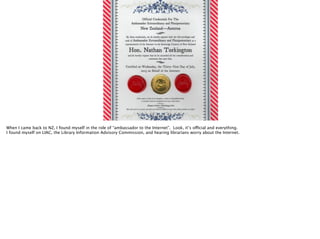
When I came back to NZ, I found myself in the role of “ambassador to the Internet”. Look, it’s official and everything.
I found myself on LIAC, the Library Information Advisory Commission, and hearing librarians worry about the Internet.
Expectations
• “Why don’t politicians listen to us?”	

• “OMG GOOGLE WTF?”	

• “E-books are Satan’s little silicon fingers!”	

• “SSSH!”	

• “Future of the Profession”	

• “relevance”	

• blogs 3D printers
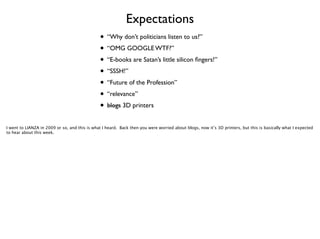
I went to LIANZA in 2009 or so, and this is what I heard. Back then you were worried about blogs, now it’s 3D printers, but this is basically what I expected
to hear about this week.
Messages
• Libraries have a future	

• connected to the purpose of their
organisations	


• around helping people to wrangle
knowledge	


• but people and their needs have changed	

• so learn the medium of your customers
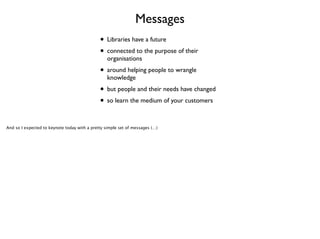
And so I expected to keynote today with a pretty simple set of messages (…)
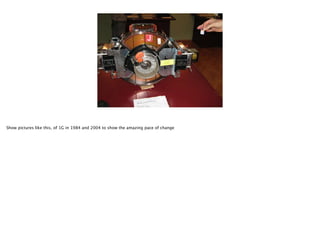
Show pictures like this, of 1G in 1984 and 2004 to show the amazing pace of change
“The future is here, it’s
just not evenly
distributed yet.”
—William Gibson
and use all the futurist quotes. It’s a law that everyone talking about technology and future has to use this one.
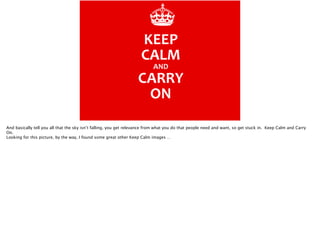
And basically tell you all that the sky isn’t falling, you get relevance from what you do that people need and want, so get stuck in. Keep Calm and Carry
On.
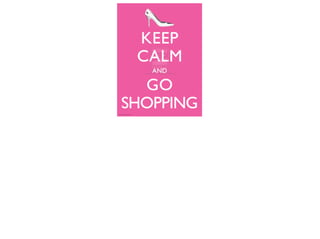
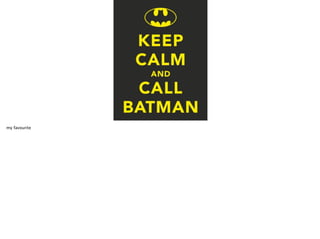
Looking for this picture, by the way, I found some great other Keep Calm images …
my favourite
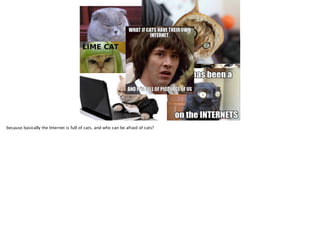
because basically the Internet is full of cats, and who can be afraid of cats?
Messages
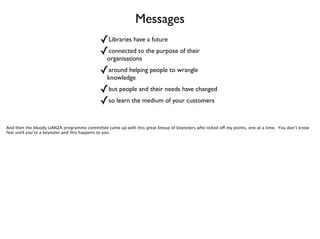
✓Libraries have a future	

✓connected to the purpose of their
organisations	


✓around helping people to wrangle
knowledge	


✓but people and their needs have changed	

✓so learn the medium of your customers
And then the bloody LIANZA programme committee came up with this great lineup of keynoters who ticked off my points, one at a time. You don’t know
fear until you’re a keynoter and this happens to you.
BUGGER
Shit.
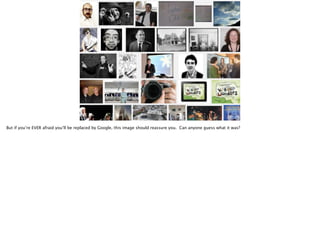
But if you’re EVER afraid you’ll be replaced by Google, this image should reassure you. Can anyone guess what it was?
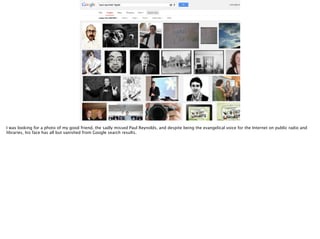
I was looking for a photo of my good friend, the sadly missed Paul Reynolds, and despite being the evangelical voice for the Internet on public radio and
libraries, his face has all but vanished from Google search results.
LIAC

I’m on LIAC, Library Information Advisory Commission. Our role is
“to advise the Minister”

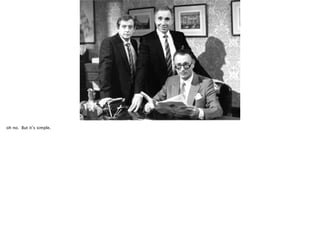
to advise the Minister on information, digital, and Matauranga Maori matters. If you’re like me, you hear that and think
oh no. But it’s simple.
Board

Unlike Te Papa and other institutions, the National Library doesn’t have a governing board. Instead, it has what would be in business
Advisory Board

an advisory board. We can tell the Minister what’s going on and what’s important that he needs to know in order to steer the National Library in the right
direction, but the Minister is not required by law to act on what we say. Influence, not control.
And we don’t pretend for a second to know everything. We figure out what to tell the Minister by talking with
YOU

you, via your industry bodies (LIANZA, SLIS, Museums Aotearoa, etc.). We tell those bodies what we heard and thought, and try to learn and channels what
your industry says too.
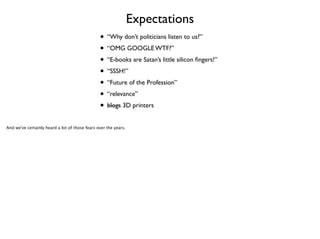
Expectations
• “Why don’t politicians listen to us?”	

• “OMG GOOGLE WTF?”	

• “E-books are Satan’s little silicon fingers!”	

• “SSSH!”	

• “Future of the Profession”	

• “relevance”	

• blogs 3D printers
And we've certainly heard a lot of those fears over the years.
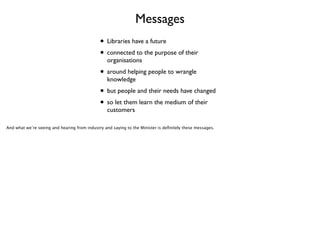
Messages
• Libraries have a future	

• connected to the purpose of their
organisations	


• around helping people to wrangle
knowledge	


• but people and their needs have changed	

• so let them learn the medium of their
customers

And what we’re seeing and hearing from industry and saying to the Minister is definitely these messages.
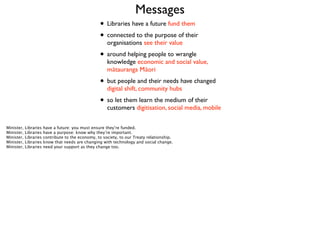
Messages
• Libraries have a future fund them	

• connected to the purpose of their
organisations see their value	


• around helping people to wrangle

knowledge economic and social value,
mātauranga Māori	


• but people and their needs have changed
digital shift, community hubs	


• so let them learn the medium of their

customers digitisation, social media, mobile

Minister,
Minister,
Minister,
Minister,
Minister,

Libraries
Libraries
Libraries
Libraries
Libraries

have a future: you must ensure they’re funded.
have a purpose: know why they’re important.
contribute to the economy, to society, to our Treaty relationship.
know that needs are changing with technology and social change.
need your support as they change too.
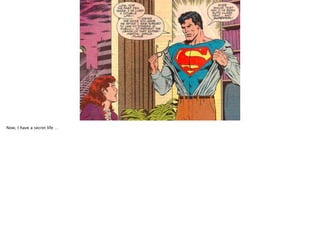
Now, I have a secret life …
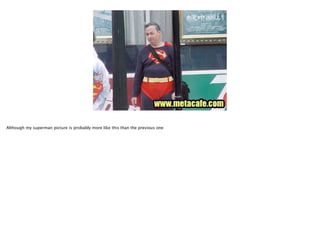
Although my superman picture is probably more like this than the previous one
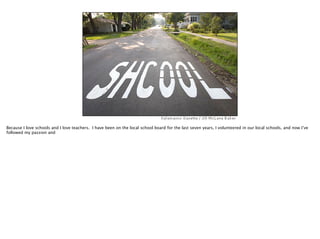
Because I love schools and I love teachers. I have been on the local school board for the last seven years, I volunteered in our local schools, and now I’ve
followed my passion and
I work for a Kiwi-based edtech startup. We came out of the great work at Pt England, and we
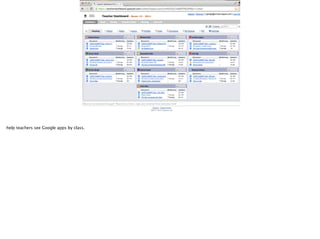
help teachers see Google apps by class.
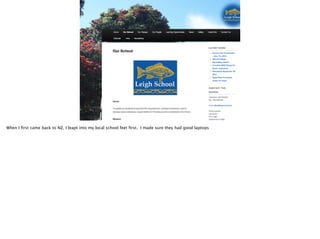
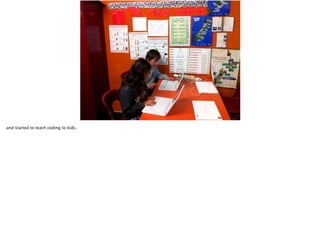
When I first came back to NZ, I leapt into my local school feet first. I made sure they had good laptops
and started to teach coding to kids.
!
And I realised I’d made a classic mistake.
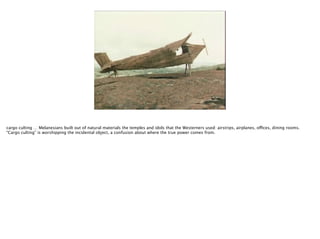
cargo culting … Melanesians built out of natural materials the temples and idols that the Westerners used: airstrips, airplanes, offices, dining rooms. 
“Cargo culting” is worshipping the incidental object, a confusion about where the true power comes from.
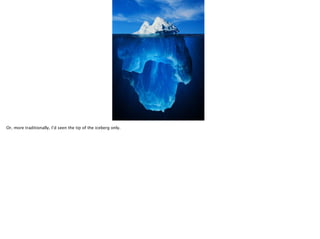
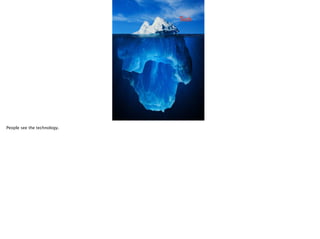
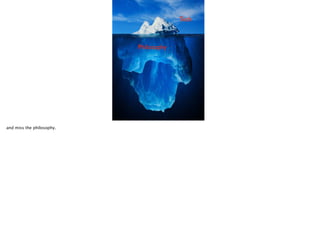
Or, more traditionally, I’d seen the tip of the iceberg only.
Tech

People see the technology.
Tech

Philosophy

and miss the philosophy.
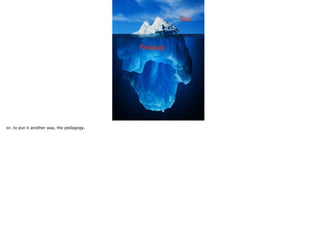
Tech

Pedagogy

or, to put it another way, the pedagogy.
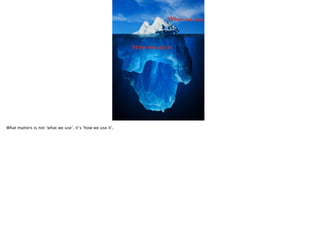
What we use

How we use it

What matters is not ‘what we use’, it’s ‘how we use it’.
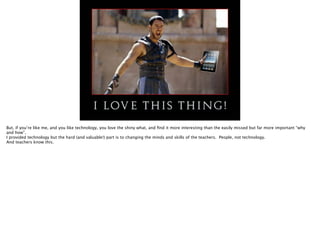
But, if you’re like me, and you like technology, you love the shiny what, and find it more interesting than the easily missed but far more important “why
and how”.
I provided technology but the hard (and valuable!) part is to changing the minds and skills of the teachers. People, not technology.
And teachers know this.
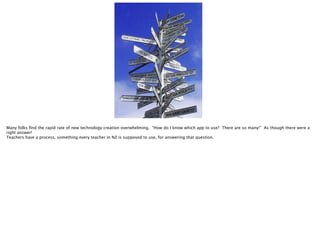
Many folks find the rapid rate of new technology creation overwhelming. “How do I know which app to use? There are so many!” As though there were a
right answer!
Teachers have a process, something every teacher in NZ is supposed to use, for answering that question.
Hypothesis	


Reflection

Evidence

Teaching	

as Inquiry
Evidence

Research

Action
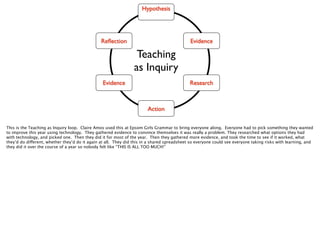
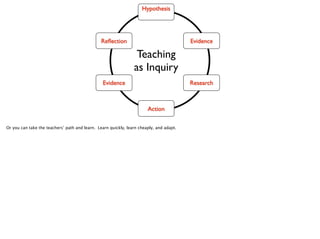
This is the Teaching as Inquiry loop. Claire Amos used this at Epsom Girls Grammar to bring everyone along. Everyone had to pick something they wanted
to improve this year using technology. They gathered evidence to convince themselves it was really a problem. They researched what options they had
with technology, and picked one. Then they did it for most of the year. Then they gathered more evidence, and took the time to see if it worked, what
they’d do different, whether they’d do it again at all. They did this in a shared spreadsheet so everyone could see everyone taking risks with learning, and
they did it over the course of a year so nobody felt like “THIS IS ALL TOO MUCH!”
Action
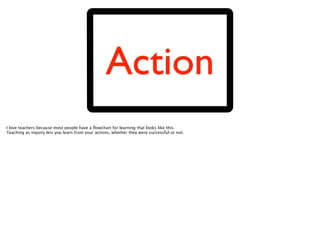
I love teachers because most people have a flowchart for learning that looks like this.
Teaching as inquiry lets you learn from your actions, whether they were successful or not.
Fail
Fast
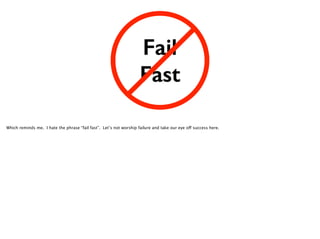
Which reminds me. I hate the phrase “fail fast”. Let’s not worship failure and take our eye off success here.
Learn Fast

The point is to learn fast: before we spend millions on hardware and PD and committing to something that HAD BETTER BLOODY WORK.
Learn Cheaply

We want to learn without spending a lot of time and money.
Succeed Fast

Because we want to succeed as rapidly as possible, and those “big bang” failures slow down our path towards success.
Succeed Cheap

And we want to succeed for as little money as possible. Learn what works with a small step, then take another, and another … don’t just leap off the cliff
and trust there to be a feather bed at the bottom.
LEARN
The point is to LEARN. If you learn, you can succeed. ANYWAY …
My other secret identity is as a geek. Ok, not so secret.
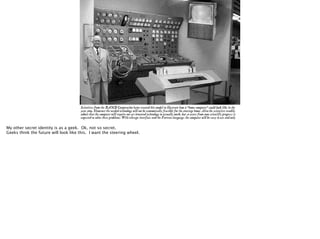
Geeks think the future will look like this. I want the steering wheel.
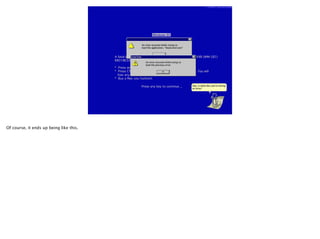
Of course, it ends up being like this.
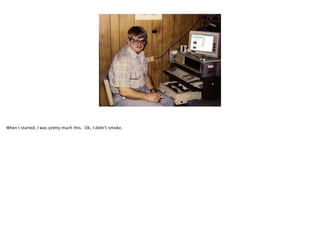
When I started, I was pretty much this. Ok, I didn’t smoke.
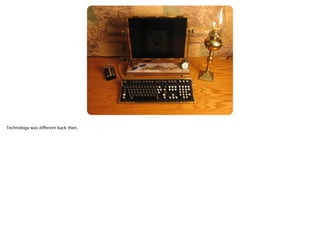
Technology was different back then.
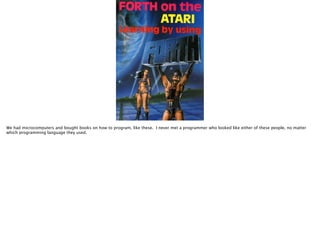
We had microcomputers and bought books on how to program, like these. I never met a programmer who looked like either of these people, no matter
which programming language they used.
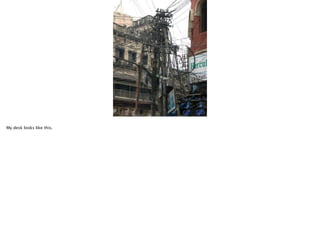
My desk looks like this.
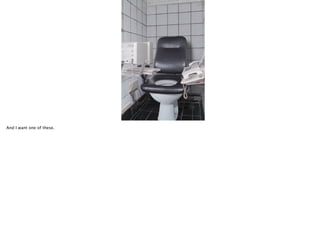
And I want one of these.
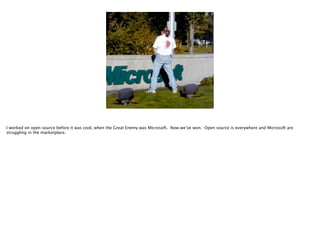
I worked on open source before it was cool, when the Great Enemy was Microsoft. Now we’ve won. Open source is everywhere and Microsoft are
struggling in the marketplace.
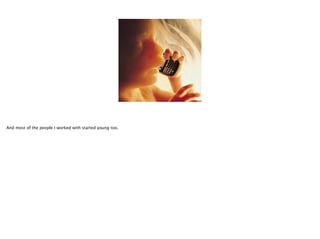
And most of the people I worked with started young too.
Specialist Selection

Why did we become programmers? Each had their own reason: some of us liked the structure, we were good at math and language, or we liked the
problem solving loop where we feel good by fixing bugs, or we liked the control and the computer doing what we wanted it to, or we liked the fact that we
didn’t have to be good at people skills.
Specialist Selection
2.0

Now that’s changing. The face of the profession is changing. We’re teaching EVERYONE to programme! People are saying it’s a basic literacy.
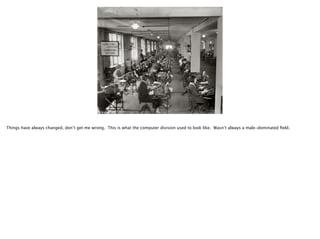
Things have always changed, don’t get me wrong. This is what the computer division used to look like. Wasn’t always a male-dominated field.
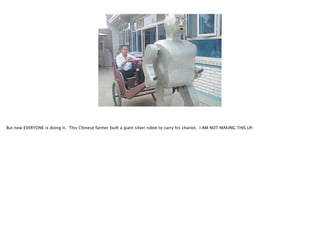
But now EVERYONE is doing it. This Chinese farmer built a giant silver robot to carry his chariot. I AM NOT MAKING THIS UP.
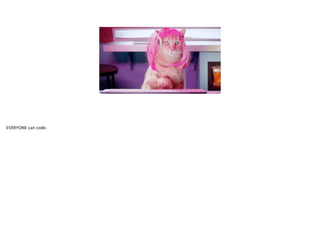
EVERYONE can code.
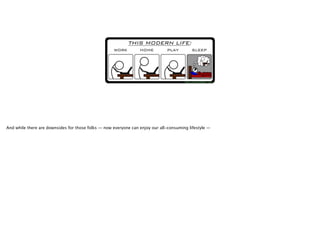
And while there are downsides for those folks — now everyone can enjoy our all-consuming lifestyle —
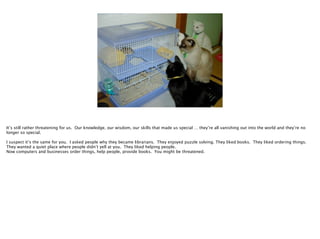
It’s still rather threatening for us. Our knowledge, our wisdom, our skills that made us special … they’re all vanishing out into the world and they’re no
longer so special.

!

I suspect it’s the same for you. I asked people why they became librarians. They enjoyed puzzle solving. They liked books. They liked ordering things.
They wanted a quiet place where people didn’t yell at you. They liked helping people.
Now computers and businesses order things, help people, provide books. You might be threatened.
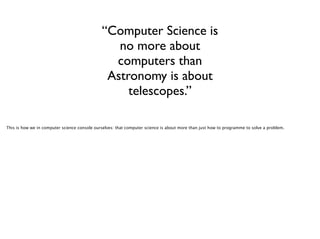
“Computer Science is
no more about
computers than
Astronomy is about
telescopes.”
This is how we in computer science console ourselves: that computer science is about more than just how to programme to solve a problem.
Enough about YOU, Nat

But enough about me. Let’s talk about you. Oh wait, I have been.
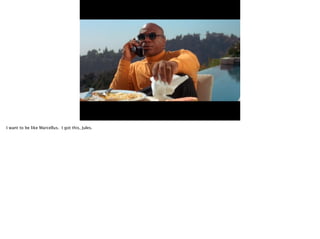
I want to be like Marcellus. I got this, Jules.
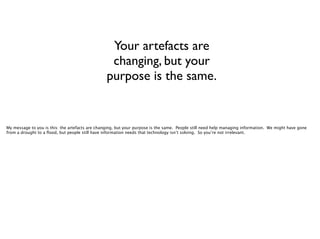
Your artefacts are
changing, but your
purpose is the same.

My message to you is this: the artefacts are changing, but your purpose is the same. People still need help managing information. We might have gone
from a drought to a flood, but people still have information needs that technology isn’t solving. So you’re not irrelevant.
Your skills are
dispersing, but your
profession owns
excellence (vs
adequacy).
And, like my computing profession, you might feel stressed that other people are now taking your skills. Don’t freak out. I can google for my symptoms
but that doesn’t make me a doctor. Google indexing the web doesn’t make it a critical tool. You will always own excellence at the things you do: ordering,
finding, using information. You’ll take from other professions just as they’re taking from you, but excellence in information is still needed.
“Librarians are no
more about books than
Astronomy is about
telescopes.”

You might console yourself with thoughts like this.
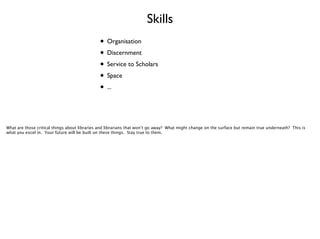
Skills
• Organisation	

• Discernment	

• Service to Scholars	

• Space	

• ...

What are those critical things about libraries and librarians that won’t go away? What might change on the surface but remain true underneath? This is
what you excel in. Your future will be built on these things. Stay true to them.
You are the ultimate
service profession.

The earlier keynoters were all right. You are the ultimate service profession. It’s why you exist and what you’ll do well into the future.
So use Design Thinking
to build with your
users.
This is why design thinking is so important. You need to involve the users in the design and construction of the services you offer. So you can learn
cheaply and quickly, rather than failing slowly and expensively.
So you have a decision.
The Choice

It’s simple.
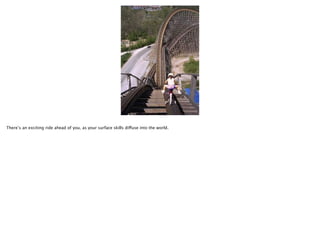
There’s an exciting ride ahead of you, as your surface skills diffuse into the world.
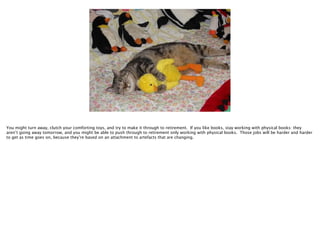
You might turn away, clutch your comforting toys, and try to make it through to retirement. If you like books, stay working with physical books: they
aren’t going away tomorrow, and you might be able to push through to retirement only working with physical books. Those jobs will be harder and harder
to get as time goes on, because they’re based on an attachment to artefacts that are changing.
Hypothesis	


Reflection

Evidence

Teaching	

as Inquiry
Evidence

Research

Action
Or you can take the teachers’ path and learn. Learn quickly, learn cheaply, and adapt.
Make your own damn
future

That way you don’t have to settle for a vision of the future offered by some outsider futurist, you can make your own damn future.
Know This
• You’re heading in the right direction	

• Know your purpose	

• Do with, not to	

• The future is fragmented and unclear	

• So inquire to invent it, cheaply and quickly
Nat Torkington ⤑ @gnat ⤑ me@gnat.me
Thank you.

2013 LIANZA Keynote: River's End

  • 1.
    LIANZA 2013 “River’s End” NatTorkington @gnat / me@gnat.me
  • 2.
    When I cameback to NZ, I found myself in the role of “ambassador to the Internet”. Look, it’s official and everything. I found myself on LIAC, the Library Information Advisory Commission, and hearing librarians worry about the Internet.
  • 3.
    Expectations • “Why don’tpoliticians listen to us?” • “OMG GOOGLE WTF?” • “E-books are Satan’s little silicon fingers!” • “SSSH!” • “Future of the Profession” • “relevance” • blogs 3D printers I went to LIANZA in 2009 or so, and this is what I heard. Back then you were worried about blogs, now it’s 3D printers, but this is basically what I expected to hear about this week.
  • 4.
    Messages • Libraries havea future • connected to the purpose of their organisations • around helping people to wrangle knowledge • but people and their needs have changed • so learn the medium of your customers And so I expected to keynote today with a pretty simple set of messages (…)
  • 5.
    Show pictures likethis, of 1G in 1984 and 2004 to show the amazing pace of change
  • 6.
    “The future ishere, it’s just not evenly distributed yet.” —William Gibson and use all the futurist quotes. It’s a law that everyone talking about technology and future has to use this one.
  • 7.
    And basically tellyou all that the sky isn’t falling, you get relevance from what you do that people need and want, so get stuck in. Keep Calm and Carry On. Looking for this picture, by the way, I found some great other Keep Calm images …
  • 11.
  • 12.
    because basically theInternet is full of cats, and who can be afraid of cats?
  • 13.
    Messages ✓Libraries have afuture ✓connected to the purpose of their organisations ✓around helping people to wrangle knowledge ✓but people and their needs have changed ✓so learn the medium of your customers And then the bloody LIANZA programme committee came up with this great lineup of keynoters who ticked off my points, one at a time. You don’t know fear until you’re a keynoter and this happens to you.
  • 14.
  • 15.
    But if you’reEVER afraid you’ll be replaced by Google, this image should reassure you. Can anyone guess what it was?
  • 16.
    I was lookingfor a photo of my good friend, the sadly missed Paul Reynolds, and despite being the evangelical voice for the Internet on public radio and libraries, his face has all but vanished from Google search results.
  • 17.
    LIAC I’m on LIAC,Library Information Advisory Commission. Our role is
  • 18.
    “to advise theMinister” to advise the Minister on information, digital, and Matauranga Maori matters. If you’re like me, you hear that and think
  • 19.
    oh no. Butit’s simple.
  • 20.
    Board Unlike Te Papaand other institutions, the National Library doesn’t have a governing board. Instead, it has what would be in business
  • 21.
    Advisory Board an advisoryboard. We can tell the Minister what’s going on and what’s important that he needs to know in order to steer the National Library in the right direction, but the Minister is not required by law to act on what we say. Influence, not control. And we don’t pretend for a second to know everything. We figure out what to tell the Minister by talking with
  • 22.
    YOU you, via yourindustry bodies (LIANZA, SLIS, Museums Aotearoa, etc.). We tell those bodies what we heard and thought, and try to learn and channels what your industry says too.
  • 23.
    Expectations • “Why don’tpoliticians listen to us?” • “OMG GOOGLE WTF?” • “E-books are Satan’s little silicon fingers!” • “SSSH!” • “Future of the Profession” • “relevance” • blogs 3D printers And we've certainly heard a lot of those fears over the years.
  • 24.
    Messages • Libraries havea future • connected to the purpose of their organisations • around helping people to wrangle knowledge • but people and their needs have changed • so let them learn the medium of their customers And what we’re seeing and hearing from industry and saying to the Minister is definitely these messages.
  • 25.
    Messages • Libraries havea future fund them • connected to the purpose of their organisations see their value • around helping people to wrangle knowledge economic and social value, mātauranga Māori • but people and their needs have changed digital shift, community hubs • so let them learn the medium of their customers digitisation, social media, mobile Minister, Minister, Minister, Minister, Minister, Libraries Libraries Libraries Libraries Libraries have a future: you must ensure they’re funded. have a purpose: know why they’re important. contribute to the economy, to society, to our Treaty relationship. know that needs are changing with technology and social change. need your support as they change too.
  • 26.
    Now, I havea secret life …
  • 27.
    Although my supermanpicture is probably more like this than the previous one
  • 28.
    Because I loveschools and I love teachers. I have been on the local school board for the last seven years, I volunteered in our local schools, and now I’ve followed my passion and
  • 29.
    I work fora Kiwi-based edtech startup. We came out of the great work at Pt England, and we
  • 30.
    help teachers seeGoogle apps by class.
  • 31.
    When I firstcame back to NZ, I leapt into my local school feet first. I made sure they had good laptops
  • 32.
    and started toteach coding to kids.
  • 33.
    ! And I realisedI’d made a classic mistake.
  • 34.
    cargo culting …Melanesians built out of natural materials the temples and idols that the Westerners used: airstrips, airplanes, offices, dining rooms. “Cargo culting” is worshipping the incidental object, a confusion about where the true power comes from.
  • 35.
    Or, more traditionally,I’d seen the tip of the iceberg only.
  • 36.
  • 37.
  • 38.
    Tech Pedagogy or, to putit another way, the pedagogy.
  • 39.
    What we use Howwe use it What matters is not ‘what we use’, it’s ‘how we use it’.
  • 40.
    But, if you’relike me, and you like technology, you love the shiny what, and find it more interesting than the easily missed but far more important “why and how”. I provided technology but the hard (and valuable!) part is to changing the minds and skills of the teachers. People, not technology. And teachers know this.
  • 41.
    Many folks findthe rapid rate of new technology creation overwhelming. “How do I know which app to use? There are so many!” As though there were a right answer! Teachers have a process, something every teacher in NZ is supposed to use, for answering that question.
  • 42.
    Hypothesis Reflection Evidence Teaching as Inquiry Evidence Research Action This isthe Teaching as Inquiry loop. Claire Amos used this at Epsom Girls Grammar to bring everyone along. Everyone had to pick something they wanted to improve this year using technology. They gathered evidence to convince themselves it was really a problem. They researched what options they had with technology, and picked one. Then they did it for most of the year. Then they gathered more evidence, and took the time to see if it worked, what they’d do different, whether they’d do it again at all. They did this in a shared spreadsheet so everyone could see everyone taking risks with learning, and they did it over the course of a year so nobody felt like “THIS IS ALL TOO MUCH!”
  • 43.
    Action I love teachersbecause most people have a flowchart for learning that looks like this. Teaching as inquiry lets you learn from your actions, whether they were successful or not.
  • 44.
    Fail Fast Which reminds me.I hate the phrase “fail fast”. Let’s not worship failure and take our eye off success here.
  • 45.
    Learn Fast The pointis to learn fast: before we spend millions on hardware and PD and committing to something that HAD BETTER BLOODY WORK.
  • 46.
    Learn Cheaply We wantto learn without spending a lot of time and money.
  • 47.
    Succeed Fast Because wewant to succeed as rapidly as possible, and those “big bang” failures slow down our path towards success.
  • 48.
    Succeed Cheap And wewant to succeed for as little money as possible. Learn what works with a small step, then take another, and another … don’t just leap off the cliff and trust there to be a feather bed at the bottom.
  • 49.
    LEARN The point isto LEARN. If you learn, you can succeed. ANYWAY …
  • 50.
    My other secretidentity is as a geek. Ok, not so secret. Geeks think the future will look like this. I want the steering wheel.
  • 51.
    Of course, itends up being like this.
  • 52.
    When I started,I was pretty much this. Ok, I didn’t smoke.
  • 53.
  • 54.
    We had microcomputersand bought books on how to program, like these. I never met a programmer who looked like either of these people, no matter which programming language they used.
  • 55.
    My desk lookslike this.
  • 56.
    And I wantone of these.
  • 57.
    I worked onopen source before it was cool, when the Great Enemy was Microsoft. Now we’ve won. Open source is everywhere and Microsoft are struggling in the marketplace.
  • 58.
    And most ofthe people I worked with started young too.
  • 59.
    Specialist Selection Why didwe become programmers? Each had their own reason: some of us liked the structure, we were good at math and language, or we liked the problem solving loop where we feel good by fixing bugs, or we liked the control and the computer doing what we wanted it to, or we liked the fact that we didn’t have to be good at people skills.
  • 60.
    Specialist Selection 2.0 Now that’schanging. The face of the profession is changing. We’re teaching EVERYONE to programme! People are saying it’s a basic literacy.
  • 61.
    Things have alwayschanged, don’t get me wrong. This is what the computer division used to look like. Wasn’t always a male-dominated field.
  • 62.
    But now EVERYONEis doing it. This Chinese farmer built a giant silver robot to carry his chariot. I AM NOT MAKING THIS UP.
  • 63.
  • 64.
    And while thereare downsides for those folks — now everyone can enjoy our all-consuming lifestyle —
  • 65.
    It’s still ratherthreatening for us. Our knowledge, our wisdom, our skills that made us special … they’re all vanishing out into the world and they’re no longer so special. ! I suspect it’s the same for you. I asked people why they became librarians. They enjoyed puzzle solving. They liked books. They liked ordering things. They wanted a quiet place where people didn’t yell at you. They liked helping people. Now computers and businesses order things, help people, provide books. You might be threatened.
  • 66.
    “Computer Science is nomore about computers than Astronomy is about telescopes.” This is how we in computer science console ourselves: that computer science is about more than just how to programme to solve a problem.
  • 67.
    Enough about YOU,Nat But enough about me. Let’s talk about you. Oh wait, I have been.
  • 68.
    I want tobe like Marcellus. I got this, Jules.
  • 69.
    Your artefacts are changing,but your purpose is the same. My message to you is this: the artefacts are changing, but your purpose is the same. People still need help managing information. We might have gone from a drought to a flood, but people still have information needs that technology isn’t solving. So you’re not irrelevant.
  • 70.
    Your skills are dispersing,but your profession owns excellence (vs adequacy). And, like my computing profession, you might feel stressed that other people are now taking your skills. Don’t freak out. I can google for my symptoms but that doesn’t make me a doctor. Google indexing the web doesn’t make it a critical tool. You will always own excellence at the things you do: ordering, finding, using information. You’ll take from other professions just as they’re taking from you, but excellence in information is still needed.
  • 71.
    “Librarians are no moreabout books than Astronomy is about telescopes.” You might console yourself with thoughts like this.
  • 72.
    Skills • Organisation • Discernment •Service to Scholars • Space • ... What are those critical things about libraries and librarians that won’t go away? What might change on the surface but remain true underneath? This is what you excel in. Your future will be built on these things. Stay true to them.
  • 73.
    You are theultimate service profession. The earlier keynoters were all right. You are the ultimate service profession. It’s why you exist and what you’ll do well into the future.
  • 74.
    So use DesignThinking to build with your users. This is why design thinking is so important. You need to involve the users in the design and construction of the services you offer. So you can learn cheaply and quickly, rather than failing slowly and expensively.
  • 75.
    So you havea decision.
  • 76.
  • 77.
    There’s an excitingride ahead of you, as your surface skills diffuse into the world.
  • 78.
    You might turnaway, clutch your comforting toys, and try to make it through to retirement. If you like books, stay working with physical books: they aren’t going away tomorrow, and you might be able to push through to retirement only working with physical books. Those jobs will be harder and harder to get as time goes on, because they’re based on an attachment to artefacts that are changing.
  • 79.
    Hypothesis Reflection Evidence Teaching as Inquiry Evidence Research Action Or youcan take the teachers’ path and learn. Learn quickly, learn cheaply, and adapt.
  • 80.
    Make your owndamn future That way you don’t have to settle for a vision of the future offered by some outsider futurist, you can make your own damn future.
  • 81.
    Know This • You’reheading in the right direction • Know your purpose • Do with, not to • The future is fragmented and unclear • So inquire to invent it, cheaply and quickly Nat Torkington ⤑ @gnat ⤑ me@gnat.me Thank you.