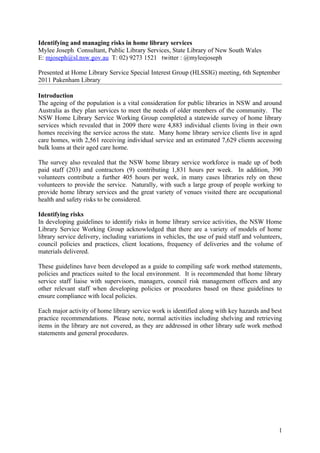
Identifying and managing risks in home library services
Mylee Joseph Consultant, Public Library Services, State Library of New South Wales
E: mjoseph@sl.nsw.gov.au T: 02) 9273 1521 twitter : @myleejoseph

Presented at Home Library Service Special Interest Group (HLSSIG) meeting, 6th September
2011 Pakenham Library

Introduction
The ageing of the population is a vital consideration for public libraries in NSW and around
Australia as they plan services to meet the needs of older members of the community. The
NSW Home Library Service Working Group completed a statewide survey of home library
services which revealed that in 2009 there were 4,883 individual clients living in their own
homes receiving the service across the state. Many home library service clients live in aged
care homes, with 2,561 receiving individual service and an estimated 7,629 clients accessing
bulk loans at their aged care home.

The survey also revealed that the NSW home library service workforce is made up of both
paid staff (203) and contractors (9) contributing 1,831 hours per week. In addition, 390
volunteers contribute a further 405 hours per week, in many cases libraries rely on these
volunteers to provide the service. Naturally, with such a large group of people working to
provide home library services and the great variety of venues visited there are occupational
health and safety risks to be considered.

Identifying risks
In developing guidelines to identify risks in home library service activities, the NSW Home
Library Service Working Group acknowledged that there are a variety of models of home
library service delivery, including variations in vehicles, the use of paid staff and volunteers,
council policies and practices, client locations, frequency of deliveries and the volume of
materials delivered.

These guidelines have been developed as a guide to compiling safe work method statements,
policies and practices suited to the local environment. It is recommended that home library
service staff liaise with supervisors, managers, council risk management officers and any
other relevant staff when developing policies or procedures based on these guidelines to
ensure compliance with local policies.

Each major activity of home library service work is identified along with key hazards and best
practice recommendations. Please note, normal activities including shelving and retrieving
items in the library are not covered, as they are addressed in other library safe work method
statements and general procedures.


                                                                                               1
New members joining the home library service
Activity      - Must provide permission to enter private property
              - Must provide emergency contact details
              - May have to meet eligibility requirements [eg. doctors certificate]
Hazard        - Breach of privacy legislation1 which sets standards for dealing with
                  personal information
              - Clients with dementia may forget they have given permission to enter
                  private property
              - Client may be discovered injured or sick requiring assistance
              - Emergency contact may be difficult to reach
              - Carers may not be able to provide a doctor’s certificate to prove
                  eligibility
Recommend     - Include a privacy statement on HLS application forms
ed best       - Store client records appropriately
practice      - Ensure the emergency contact is aware that the person has joined the
                  library service and that deliveries will be made to the home
              - The HLS policy should provide an entry point for carers who are
                  housebound due to their caring responsibilities
              - Ensure information is provided to clients / carers when they join the
                  service with appropriate Council contact information eg. in case they
                  need to make a complaint.

Risk assessment of delivery locations
Activity        - Delivery locations should be assessed for risks in line with council’s
                    OH&S requirements
                - Records should be kept of delivery run details in case of relief drivers
                    or incidents
                - Identify locations where previous incidents involving council staff
                    have occurred
                - Assess locations where it is hazardous for staff or volunteers to enter
                    unaccompanied
Hazard          - Slip / trip / fall hazards at each delivery site should be assessed
                - Dog attacks
                - Parking may be dangerous / difficult at the site
                - If an accident / incident occurs while completing deliveries
                    management should have access to information about where the staff
                    member is likely to be [route details] and any potential hazards in
                    those locations.
                - Some locations may be addresses that other council officers (rangers,
                    inspectors, etc.) have encountered difficulties.
                - Some locations may be hazardous for a staff member to attend alone.
Recommended - Use a standard checklist for assessing sites on the first visit,
best practice       identifying any issues surrounding parking, dogs, access points, trip
                    hazards etc.
                - Keep site checklists with information on delivery routes in case of
                    relief drivers or incidents
                - Identify any locations where it is risky for staff or volunteers to visit
                    unaccompanied
1
 Privacy and Personal Information Protection Act 1998 (NSW)
http://www.lawlink.nsw.gov.au/lawlink/privacynsw/ll_pnsw.nsf/pages/PNSW_nswprivacy_laws


                                                                                              2
-   Check if a previous incident register is maintained of addresses
                      council officers (rangers, inspectors, etc)
                  -   Staff conducting deliveries should have a means of contacting the
                      library in case of incident [eg. mobile phone or two way radio]

Deliveries
Activity          -   Assess if the vehicle requires modification (eg. cargo drawer) for safe
                      work practice.
                  -   Ensure the vehicle is in a safe condition to operate including any
                      modifications required (eg. cargo drawer).
                  -   Minimise the risk of driving accidents or physical injury
                  -   Volunteers may be using their own vehicles
Hazard            -   Staff or volunteer may be injured conducting deliveries [driving or
                      manual handling]
                  -   Vehicle breakdown
                  -   Driving accident resulting in damage to the vehicle
                  -   Contagious diseases contracted from clients during visits to homes or
                      nursing homes
                  -   Staff or volunteers with colds / flu may be contagious and pass
                      infection on to frail clients
Recommended -         Ensure the vehicle is regularly maintained: implement a checklist for
best practice         any items that should be checked on a regular basis eg. tyre pressure,
                      fuel, coolant etc.
                  -   Ensure the vehicle is fitted with any safety features required eg. cargo
                      drawer, safety barrier, mirrors, beeper when reversing
                  -   Ensure drivers have had appropriate training to operate the vehicle
                      safely
                  -   Ensure there is easy access to the vehicle for loading and unloading
                  -   Ensure vehicle selection prioritises driver safety
                  -   Ensure a safe work method statement is in place for deliveries
                      including manual handling, driving, infection control
                  -   Ensure staff and volunteers are alert to the possibility of infection and
                      take appropriate precautions
                  -   Staff conducting deliveries should have a means of contacting the
                      library in case of incident [eg. mobile phone or two way radio]
                  -   Ensure any insurance issues regarding volunteers using their own
                      vehicles have been addressed.


Staff / volunteer identification
Activity          - Staff and volunteers should be able to be clearly identified while
                      making deliveries
Hazard            -   Staff may be challenged by clients or their families/friends when
                      making deliveries
                  -   Staff may need to demonstrate they are authorised to enter private
                      property
            -         Clients may make claims that items have been stolen from their homes
            -         Unauthorised visits to clients homes by staff or volunteers may occur
Recommended -         Ensure staff and volunteers have some form of official identification


                                                                                                  3
best practice       on display while conducting deliveries [eg. photo identification or
                    name tag]
                -   Ensure volunteers are aware that only trained and authorised
                    volunteers may conduct deliveries [ie. an untrained friend cannot fill
                    in for them]
                -   Consider providing council uniforms for staff conducting deliveries
                -   Ensure a grievance policy and dispute resolution procedure is in place
                    re: HLS staff or volunteers accused of stealing items from homes or
                    behaving inappropriately with clients.
                -   Ensure information is provided to clients / carers when they join the
                    service with appropriate Council contact information in case they need
                    to make a complaint.
                -   Ensure confidentiality is maintained while complaints are investigated
                    to protect staff in case of unproven or vexatious complaints.

Volunteers
Activity        -   Volunteers may visit clients in their homes to make deliveries
                -   Volunteer may be injured conducting deliveries
                -   Volunteers selecting items in the library
Hazard          -   Volunteers represent themselves as employees of council
                -   Volunteers behave inappropriately while conducting library business
                -   Volunteers may be injured manual handling books in the library [eg.
                    while selecting items]
Recommended -       Ensure appropriate screening processes are in place for volunteer
best practice       recruitment
              -     Ensure a code of conduct is provided for all volunteers
              -     Ensure appropriate training and mentoring is provided for volunteers
              -     Ensure any complaints about volunteers are followed up promptly
              -     Ensure any insurance issues regarding volunteers using their own
                    vehicles have been addressed.
                -   Ensure any insurance and OH+S issues regarding volunteers using
                    council vehicles have been addressed.
                -   Ensure volunteers are aware of lines of reporting and procedures in
                    case of grievances

Manual handling
Activity       -    Staff or volunteer may be injured conducting deliveries
Hazard          -   Slip, trip, fall in library loading area or delivery locations
                -   Muscle strains or back injury caused by lifting
                -   Strains caused by opening / closing vehicle

Recommended     -   Ensure a safe work method statement is in place
best practice   -   Ensure the work area is kept clear of trip hazards
                -   Ensure access to the vehicle is clear
                -   Ensure staff and volunteers have received manual handling training
                -   Ensure suitable trolleys and other aids are available for use
                -   Ensure the items are delivered in containers that minimise the risk of
                    overloading
                -   Ensure the workstation height, access, egress is appropriate


                                                                                             4
-   Establish appropriate loan limits and load limits to minimise the risk
                      of injury to staff / volunteers

First aid protocols
Activity         - Staff or volunteers may encounter clients that are sick or injured
                    during the course of making deliveries
Hazard           - Staff may be injured assisting the client
                 - Client may suffer serious injury or death if assistance is not obtained
                 - Staff may inadvertently injure client while assisting
Recommended - Ensure staff and volunteers are aware of appropriate emergency
best practice       response procedures [ie. calling ambulance and emergency contact for
                    client]
                 - Provide access to first aid training for staff

Difficult / distressed clients
Activity           - Many housebound clients can experience variations in their behaviour
                       due to illness, degenerative conditions, medication, isolation and
                       loneliness
Hazard             - Staff / volunteers may encounter a client who is disoriented
                   - Staff / volunteers may be assaulted verbally or physically by a client
Recommended - Ensure staff and volunteers have received basic training in appropriate
best practice          responses when they encounter disoriented / difficult clients
                   - Ensure staff and volunteers are aware of any clients identified as being
                       difficult due to known conditions [eg. dementia]
                   - Ensure incidents are reported to the supervisor and recorded. Where
                       appropriate the emergency contact may need to be notified

Deceased clients
Activity         -    Many housebound clients have serious / chronic illnesses and are in
                      the latter part of their life
Hazard            -   Staff / volunteers may encounter a client who is deceased when they
                      call in to deliver items
                  -   Staff / volunteers may be affected emotionally by the impact of
                      encountering a deceased client or losing a long term client
              -       Library materials may be lost when clients’ effects are dispersed
Recommended -         Ensure staff and volunteers have received training in appropriate
best practice         responses when they encounter deceased clients [ie. contacting the
                      police / ambulance, informing the library manager]
                  -   Ensure staff and volunteers who have been affected are appropriately
                      debriefed by library management / council HR and have access to the
                      employee assistance program if further counselling is required
                  -   Ensure a policy is in place re: HLS staff attending funerals for clients
                  -   Ensure a policy is in place re: writing off items that are lost when
                      clients are deceased / moved into alternative accommodation.


                                                                                                 5
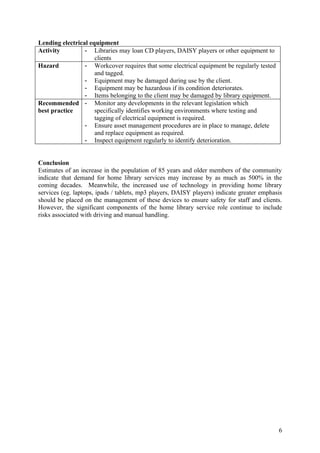
Lending electrical equipment
Activity         - Libraries may loan CD players, DAISY players or other equipment to
                     clients
Hazard           - Workcover requires that some electrical equipment be regularly tested
                     and tagged.
                 - Equipment may be damaged during use by the client.
                 - Equipment may be hazardous if its condition deteriorates.
                 - Items belonging to the client may be damaged by library equipment.
Recommended - Monitor any developments in the relevant legislation which
best practice        specifically identifies working environments where testing and
                     tagging of electrical equipment is required.
                 - Ensure asset management procedures are in place to manage, delete
                     and replace equipment as required.
                 - Inspect equipment regularly to identify deterioration.


Conclusion
Estimates of an increase in the population of 85 years and older members of the community
indicate that demand for home library services may increase by as much as 500% in the
coming decades. Meanwhile, the increased use of technology in providing home library
services (eg. laptops, ipads / tablets, mp3 players, DAISY players) indicate greater emphasis
should be placed on the management of these devices to ensure safety for staff and clients.
However, the significant components of the home library service role continue to include
risks associated with driving and manual handling.


                                                                                           6

Identifying and managing risks in home library services

  • 1.
    Identifying and managingrisks in home library services Mylee Joseph Consultant, Public Library Services, State Library of New South Wales E: mjoseph@sl.nsw.gov.au T: 02) 9273 1521 twitter : @myleejoseph Presented at Home Library Service Special Interest Group (HLSSIG) meeting, 6th September 2011 Pakenham Library Introduction The ageing of the population is a vital consideration for public libraries in NSW and around Australia as they plan services to meet the needs of older members of the community. The NSW Home Library Service Working Group completed a statewide survey of home library services which revealed that in 2009 there were 4,883 individual clients living in their own homes receiving the service across the state. Many home library service clients live in aged care homes, with 2,561 receiving individual service and an estimated 7,629 clients accessing bulk loans at their aged care home. The survey also revealed that the NSW home library service workforce is made up of both paid staff (203) and contractors (9) contributing 1,831 hours per week. In addition, 390 volunteers contribute a further 405 hours per week, in many cases libraries rely on these volunteers to provide the service. Naturally, with such a large group of people working to provide home library services and the great variety of venues visited there are occupational health and safety risks to be considered. Identifying risks In developing guidelines to identify risks in home library service activities, the NSW Home Library Service Working Group acknowledged that there are a variety of models of home library service delivery, including variations in vehicles, the use of paid staff and volunteers, council policies and practices, client locations, frequency of deliveries and the volume of materials delivered. These guidelines have been developed as a guide to compiling safe work method statements, policies and practices suited to the local environment. It is recommended that home library service staff liaise with supervisors, managers, council risk management officers and any other relevant staff when developing policies or procedures based on these guidelines to ensure compliance with local policies. Each major activity of home library service work is identified along with key hazards and best practice recommendations. Please note, normal activities including shelving and retrieving items in the library are not covered, as they are addressed in other library safe work method statements and general procedures. 1
  • 2.
    New members joiningthe home library service Activity - Must provide permission to enter private property - Must provide emergency contact details - May have to meet eligibility requirements [eg. doctors certificate] Hazard - Breach of privacy legislation1 which sets standards for dealing with personal information - Clients with dementia may forget they have given permission to enter private property - Client may be discovered injured or sick requiring assistance - Emergency contact may be difficult to reach - Carers may not be able to provide a doctor’s certificate to prove eligibility Recommend - Include a privacy statement on HLS application forms ed best - Store client records appropriately practice - Ensure the emergency contact is aware that the person has joined the library service and that deliveries will be made to the home - The HLS policy should provide an entry point for carers who are housebound due to their caring responsibilities - Ensure information is provided to clients / carers when they join the service with appropriate Council contact information eg. in case they need to make a complaint. Risk assessment of delivery locations Activity - Delivery locations should be assessed for risks in line with council’s OH&S requirements - Records should be kept of delivery run details in case of relief drivers or incidents - Identify locations where previous incidents involving council staff have occurred - Assess locations where it is hazardous for staff or volunteers to enter unaccompanied Hazard - Slip / trip / fall hazards at each delivery site should be assessed - Dog attacks - Parking may be dangerous / difficult at the site - If an accident / incident occurs while completing deliveries management should have access to information about where the staff member is likely to be [route details] and any potential hazards in those locations. - Some locations may be addresses that other council officers (rangers, inspectors, etc.) have encountered difficulties. - Some locations may be hazardous for a staff member to attend alone. Recommended - Use a standard checklist for assessing sites on the first visit, best practice identifying any issues surrounding parking, dogs, access points, trip hazards etc. - Keep site checklists with information on delivery routes in case of relief drivers or incidents - Identify any locations where it is risky for staff or volunteers to visit unaccompanied 1 Privacy and Personal Information Protection Act 1998 (NSW) http://www.lawlink.nsw.gov.au/lawlink/privacynsw/ll_pnsw.nsf/pages/PNSW_nswprivacy_laws 2
  • 3.
    - Check if a previous incident register is maintained of addresses council officers (rangers, inspectors, etc) - Staff conducting deliveries should have a means of contacting the library in case of incident [eg. mobile phone or two way radio] Deliveries Activity - Assess if the vehicle requires modification (eg. cargo drawer) for safe work practice. - Ensure the vehicle is in a safe condition to operate including any modifications required (eg. cargo drawer). - Minimise the risk of driving accidents or physical injury - Volunteers may be using their own vehicles Hazard - Staff or volunteer may be injured conducting deliveries [driving or manual handling] - Vehicle breakdown - Driving accident resulting in damage to the vehicle - Contagious diseases contracted from clients during visits to homes or nursing homes - Staff or volunteers with colds / flu may be contagious and pass infection on to frail clients Recommended - Ensure the vehicle is regularly maintained: implement a checklist for best practice any items that should be checked on a regular basis eg. tyre pressure, fuel, coolant etc. - Ensure the vehicle is fitted with any safety features required eg. cargo drawer, safety barrier, mirrors, beeper when reversing - Ensure drivers have had appropriate training to operate the vehicle safely - Ensure there is easy access to the vehicle for loading and unloading - Ensure vehicle selection prioritises driver safety - Ensure a safe work method statement is in place for deliveries including manual handling, driving, infection control - Ensure staff and volunteers are alert to the possibility of infection and take appropriate precautions - Staff conducting deliveries should have a means of contacting the library in case of incident [eg. mobile phone or two way radio] - Ensure any insurance issues regarding volunteers using their own vehicles have been addressed. Staff / volunteer identification Activity - Staff and volunteers should be able to be clearly identified while making deliveries Hazard - Staff may be challenged by clients or their families/friends when making deliveries - Staff may need to demonstrate they are authorised to enter private property - Clients may make claims that items have been stolen from their homes - Unauthorised visits to clients homes by staff or volunteers may occur Recommended - Ensure staff and volunteers have some form of official identification 3
  • 4.
    best practice on display while conducting deliveries [eg. photo identification or name tag] - Ensure volunteers are aware that only trained and authorised volunteers may conduct deliveries [ie. an untrained friend cannot fill in for them] - Consider providing council uniforms for staff conducting deliveries - Ensure a grievance policy and dispute resolution procedure is in place re: HLS staff or volunteers accused of stealing items from homes or behaving inappropriately with clients. - Ensure information is provided to clients / carers when they join the service with appropriate Council contact information in case they need to make a complaint. - Ensure confidentiality is maintained while complaints are investigated to protect staff in case of unproven or vexatious complaints. Volunteers Activity - Volunteers may visit clients in their homes to make deliveries - Volunteer may be injured conducting deliveries - Volunteers selecting items in the library Hazard - Volunteers represent themselves as employees of council - Volunteers behave inappropriately while conducting library business - Volunteers may be injured manual handling books in the library [eg. while selecting items] Recommended - Ensure appropriate screening processes are in place for volunteer best practice recruitment - Ensure a code of conduct is provided for all volunteers - Ensure appropriate training and mentoring is provided for volunteers - Ensure any complaints about volunteers are followed up promptly - Ensure any insurance issues regarding volunteers using their own vehicles have been addressed. - Ensure any insurance and OH+S issues regarding volunteers using council vehicles have been addressed. - Ensure volunteers are aware of lines of reporting and procedures in case of grievances Manual handling Activity - Staff or volunteer may be injured conducting deliveries Hazard - Slip, trip, fall in library loading area or delivery locations - Muscle strains or back injury caused by lifting - Strains caused by opening / closing vehicle Recommended - Ensure a safe work method statement is in place best practice - Ensure the work area is kept clear of trip hazards - Ensure access to the vehicle is clear - Ensure staff and volunteers have received manual handling training - Ensure suitable trolleys and other aids are available for use - Ensure the items are delivered in containers that minimise the risk of overloading - Ensure the workstation height, access, egress is appropriate 4
  • 5.
    - Establish appropriate loan limits and load limits to minimise the risk of injury to staff / volunteers First aid protocols Activity - Staff or volunteers may encounter clients that are sick or injured during the course of making deliveries Hazard - Staff may be injured assisting the client - Client may suffer serious injury or death if assistance is not obtained - Staff may inadvertently injure client while assisting Recommended - Ensure staff and volunteers are aware of appropriate emergency best practice response procedures [ie. calling ambulance and emergency contact for client] - Provide access to first aid training for staff Difficult / distressed clients Activity - Many housebound clients can experience variations in their behaviour due to illness, degenerative conditions, medication, isolation and loneliness Hazard - Staff / volunteers may encounter a client who is disoriented - Staff / volunteers may be assaulted verbally or physically by a client Recommended - Ensure staff and volunteers have received basic training in appropriate best practice responses when they encounter disoriented / difficult clients - Ensure staff and volunteers are aware of any clients identified as being difficult due to known conditions [eg. dementia] - Ensure incidents are reported to the supervisor and recorded. Where appropriate the emergency contact may need to be notified Deceased clients Activity - Many housebound clients have serious / chronic illnesses and are in the latter part of their life Hazard - Staff / volunteers may encounter a client who is deceased when they call in to deliver items - Staff / volunteers may be affected emotionally by the impact of encountering a deceased client or losing a long term client - Library materials may be lost when clients’ effects are dispersed Recommended - Ensure staff and volunteers have received training in appropriate best practice responses when they encounter deceased clients [ie. contacting the police / ambulance, informing the library manager] - Ensure staff and volunteers who have been affected are appropriately debriefed by library management / council HR and have access to the employee assistance program if further counselling is required - Ensure a policy is in place re: HLS staff attending funerals for clients - Ensure a policy is in place re: writing off items that are lost when clients are deceased / moved into alternative accommodation. 5
  • 6.
    Lending electrical equipment Activity - Libraries may loan CD players, DAISY players or other equipment to clients Hazard - Workcover requires that some electrical equipment be regularly tested and tagged. - Equipment may be damaged during use by the client. - Equipment may be hazardous if its condition deteriorates. - Items belonging to the client may be damaged by library equipment. Recommended - Monitor any developments in the relevant legislation which best practice specifically identifies working environments where testing and tagging of electrical equipment is required. - Ensure asset management procedures are in place to manage, delete and replace equipment as required. - Inspect equipment regularly to identify deterioration. Conclusion Estimates of an increase in the population of 85 years and older members of the community indicate that demand for home library services may increase by as much as 500% in the coming decades. Meanwhile, the increased use of technology in providing home library services (eg. laptops, ipads / tablets, mp3 players, DAISY players) indicate greater emphasis should be placed on the management of these devices to ensure safety for staff and clients. However, the significant components of the home library service role continue to include risks associated with driving and manual handling. 6