FBW
17-11-2015
Wim Van Criekinge
Bioinformatics.be
GitHub: Hosted GIT
• Largest open source git hosting site
• Public and private options
• User-centric rather than project-centric
• http://github.ugent.be (use your Ugent
login and password)
– Accept invitation from Bioinformatics-I-
2015
URI:
– https://github.ugent.be/Bioinformatics-I-
2015/Python.git
Control Structures
if condition:
statements
[elif condition:
statements] ...
else:
statements
while condition:
statements
for var in sequence:
statements
break
continue
Lists
• Flexible arrays, not Lisp-like linked
lists
• a = [99, "bottles of beer", ["on", "the",
"wall"]]
• Same operators as for strings
• a+b, a*3, a[0], a[-1], a[1:], len(a)
• Item and slice assignment
• a[0] = 98
• a[1:2] = ["bottles", "of", "beer"]
-> [98, "bottles", "of", "beer", ["on", "the", "wall"]]
• del a[-1] # -> [98, "bottles", "of", "beer"]
Dictionaries
• Hash tables, "associative arrays"
• d = {"duck": "eend", "water": "water"}
• Lookup:
• d["duck"] -> "eend"
• d["back"] # raises KeyError exception
• Delete, insert, overwrite:
• del d["water"] # {"duck": "eend", "back": "rug"}
• d["back"] = "rug" # {"duck": "eend", "back":
"rug"}
• d["duck"] = "duik" # {"duck": "duik", "back":
"rug"}
Regex.py
text = 'abbaaabbbbaaaaa'
pattern = 'ab'
for match in re.finditer(pattern, text):
s = match.start()
e = match.end()
print ('Found "%s" at %d:%d' % (text[s:e], s, e))
m = re.search("^([A-Z]) ",line)
if m:
from_letter = m.groups()[0]
Install Biopython
pip is the preferred installer program.
Starting with Python 3.4, it is included
by default with the Python binary
installers.
pip3.5 install Biopython
#pip3.5 install yahoo_finance
from yahoo_finance import Share
yahoo = Share('AAPL')
print (yahoo.get_open())
BioPython
• Make a histogram of the MW (in kDa) of all proteins in
Swiss-Prot
• Find the most basic and most acidic protein in Swiss-Prot?
• Biological relevance of the results ?
From AAIndex
H ZIMJ680104
D Isoelectric point (Zimmerman et al., 1968)
R LIT:2004109b PMID:5700434
A Zimmerman, J.M., Eliezer, N. and Simha, R.
T The characterization of amino acid sequences in proteins by
statistical
methods
J J. Theor. Biol. 21, 170-201 (1968)
C KLEP840101 0.941 FAUJ880111 0.813 FINA910103 0.805
I A/L R/K N/M D/F C/P Q/S E/T G/W H/Y I/V
6.00 10.76 5.41 2.77 5.05 5.65 3.22 5.97 7.59 6.02
5.98 9.74 5.74 5.48 6.30 5.68 5.66 5.89 5.66 5.96
Biopython AAindex ? Dictionary
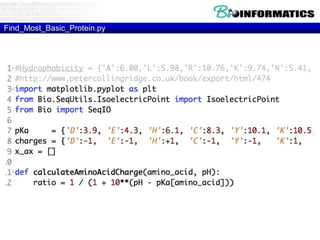
Hydrophobicity = {A:6.00,L:5.98,R:10.76,K:9.74,N:5.41,M:5.74,D:2.77,F:5.48,
C:5.05,P:6.30,Q:5.65,S:5.68,E:3.22,T:5.66,G:5.97,W:5.89,
H:7.59,Y:5.66,I:6.02,V:5.96}
from Bio import SeqIO
c=0
handle = open(r'/Users/wvcrieki/Downloads/uniprot_sprot.dat')
for seq_rec in SeqIO.parse(handle, "swiss"):
print (seq_rec.id)
print (repr(seq_rec.seq))
print (len(seq_rec))
c+=1
if c>5:
break
Find_Most_Basic_Protein.py
Parsing sequences from the net
Parsing GenBank records from the net
Parsing SwissProt sequence from the net
Handles are not always from files
>>>from Bio import Entrez
>>>from Bio import SeqIO
>>>handle = Entrez.efetch(db="nucleotide",rettype="fasta",id="6273291")
>>>seq_record = SeqIO.read(handle,”fasta”)
>>>handle.close()
>>>seq_record.description
>>>from Bio import ExPASy
>>>from Bio import SeqIO
>>>handle = ExPASy.get_sprot_raw("6273291")
>>>seq_record = SeqIO.read(handle,”swiss”)
>>>handle.close()
>>>print seq_record.id
>>>print seq_record.name
>>>prin seq_record.description
Biopython_live.py
Biopython_live.py
Extra Questions (2)
• How many human proteins in Swiss Prot ?
• What is the longest human protein ? The shortest ?
• Calculate for all human proteins their MW and pI, display as
two histograms (2D scatter ?)
• How many human proteins have “cancer” in their description?
• Which genes has the highest number of SNPs/somatic
mutations (COSMIC)
• How many human DNA-repair enzymes are represented in
Swiss Prot (using description / GO)?
• List proteins that only contain alpha-helices based on the
Chou-Fasman algorithm
• List proteins based on the number of predicted
transmembrane regions (Kyte-Doollittle)
 Amino acid sequences fold onto themselves to become a
biologically active molecule.
There are three types of local segments:
Helices: Where protein residues seem to be following the shape
of a spring. The most common are the so-called alpha helices
Extended or Beta-strands: Where residues are in line and
successive residues turn back to each other
Random coils: When the amino acid chain is neither helical nor
extended
Secondary structure of protein
Chou-Fasman Algorithm
Chou, P.Y. and Fasman, G.D. (1974). Conformational parameters for amino acids in helical,
b-sheet, and random coil regions calculated from proteins.Biochemistry 13, 211-221.
Chou, P.Y. and Fasman, G.D. (1974). Prediction of protein conformation. Biochemistry 13,
222-245.
Analyzed the frequency of the 20 amino acids in alpha helices,
Beta sheets and turns.
• Ala (A), Glu (E), Leu (L), and Met (M) are strong predictors of
 helices
• Pro (P) and Gly (G) break  helices.
• When 4 of 5 amino acids have a high probability of being in an alpha helix, it predicts a
alpha helix.
• When 3 of 5 amino acids have a high probability of being in a
b strand, it predicts a b strand.
• 4 amino acids are used to predict turns.
Calculation of Propensities
Pr[i|b-sheet]/Pr[i], Pr[i|-helix]/Pr[i], Pr[i|other]/Pr[i]
determine the probability that amino acid i is in
each structure, normalized by the background
probability that i occurs at all.
Example.
let's say that there are 20,000 amino acids in the database, of
which 2000 are serine, and there are 5000 amino acids in
helical conformation, of which 500 are serine. Then the
helical propensity for serine is: (500/5000) / (2000/20000) =
1.0
Calculation of preference parameters
• Preference parameter > 1.0  specific
residue has a preference for the specific
secondary structure.
• Preference parameter = 1.0  specific
residue does not have a preference for, nor
dislikes the specific secondary structure.
• Preference parameter < 1.0  specific
residue dislikes the specific secondary
structure.
Preference parameters
Residue P(a) P(b) P(t) f(i) f(i+1) f(i+2) f(i+3)
Ala 1.45 0.97 0.57 0.049 0.049 0.034 0.029
Arg 0.79 0.90 1.00 0.051 0.127 0.025 0.101
Asn 0.73 0.65 1.68 0.101 0.086 0.216 0.065
Asp 0.98 0.80 1.26 0.137 0.088 0.069 0.059
Cys 0.77 1.30 1.17 0.089 0.022 0.111 0.089
Gln 1.17 1.23 0.56 0.050 0.089 0.030 0.089
Glu 1.53 0.26 0.44 0.011 0.032 0.053 0.021
Gly 0.53 0.81 1.68 0.104 0.090 0.158 0.113
His 1.24 0.71 0.69 0.083 0.050 0.033 0.033
Ile 1.00 1.60 0.58 0.068 0.034 0.017 0.051
Leu 1.34 1.22 0.53 0.038 0.019 0.032 0.051
Lys 1.07 0.74 1.01 0.060 0.080 0.067 0.073
Met 1.20 1.67 0.67 0.070 0.070 0.036 0.070
Phe 1.12 1.28 0.71 0.031 0.047 0.063 0.063
Pro 0.59 0.62 1.54 0.074 0.272 0.012 0.062
Ser 0.79 0.72 1.56 0.100 0.095 0.095 0.104
Thr 0.82 1.20 1.00 0.062 0.093 0.056 0.068
Trp 1.14 1.19 1.11 0.045 0.000 0.045 0.205
Tyr 0.61 1.29 1.25 0.136 0.025 0.110 0.102
Val 1.14 1.65 0.30 0.023 0.029 0.011 0.029
Applying algorithm
1. Assign parameters (propensities) to residue.
2. Identify regions (nucleation sites) where 4 out of 6 residues have
P(a)>100: a-helix. Extend helix in both directions until four
contiguous residues have an average P(a)<100: end of a-helix. If
segment is longer than 5 residues and P(a)>P(b): a-helix.
3. Repeat this procedure to locate all of the helical regions.
4. Identify regions where 3 out of 5 residues have P(b)>100: b-
sheet. Extend sheet in both directions until four contiguous
residues have an average P(b)<100: end of b-sheet. If P(b)>105
and P(b)>P(a): b-sheet.
5. Rest: P(a)>P(b)  a-helix. P(b)>P(a)  b-sheet.
6. To identify a bend at residue number i, calculate the following
value: p(t) = f(i)f(i+1)f(i+2)f(i+3)
If: (1) p(t) > 0.000075; (2) average P(t)>1.00 in the tetrapeptide;
and (3) averages for tetrapeptide obey P(a)<P(t)>P(b): b-turn.
Extra Questions (2)
• How many human proteins in Swiss Prot ?
• What is the longest human protein ? The shortest ?
• Calculate for all human proteins their MW and pI, display as
two histograms (2D scatter ?)
• How many human proteins have “cancer” in their description?
• Which genes has the highest number of SNPs/somatic
mutations (COSMIC)
• How many human DNA-repair enzymes are represented in
Swiss Prot (using description / GO)?
• List proteins that only contain alpha-helices based on the
Chou-Fasman algorithm
• List proteins based on the number of predicted
transmembrane regions (Kyte-Doollittle)
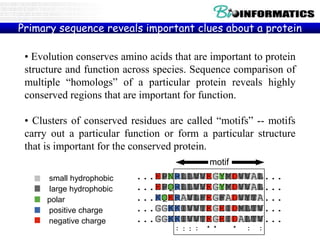
Primary sequence reveals important clues about a protein
DnaG E. coli ...EPNRLLVVEGYMDVVAL...
DnaG S. typ ...EPQRLLVVEGYMDVVAL...
DnaG B. subt ...KQERAVLFEGFADVYTA...
gp4 T3 ...GGKKIVVTEGEIDMLTV...
gp4 T7 ...GGKKIVVTEGEIDALTV...
: *: :: * * : :
small hydrophobic
large hydrophobic
polar
positive charge
negative charge
• Evolution conserves amino acids that are important to protein
structure and function across species. Sequence comparison of
multiple “homologs” of a particular protein reveals highly
conserved regions that are important for function.
• Clusters of conserved residues are called “motifs” -- motifs
carry out a particular function or form a particular structure
that is important for the conserved protein.
motif
 The hydropathy index of an amino acid is a number
representing the hydrophobic or hydrophilic properties of its
side-chain.
 It was proposed by Jack Kyte and Russell Doolittle in 1982.
 The larger the number is, the more hydrophobic the amino
acid. The most hydrophobic amino acids are isoleucine (4.5)
and valine (4.2). The most hydrophilic ones are arginine (-4.5)
and lysine (-3.9).
 This is very important in protein structure; hydrophobic
amino acids tend to be internal in the protein 3D structure,
while hydrophilic amino acids are more commonly found
towards the protein surface.
Hydropathy index of amino acids
(http://gcat.davidson.edu/DGPB/kd/kyte-doolittle.htm)Kyte Doolittle Hydropathy Plot
Possible transmembrane fragment
Window size – 9, strong negative peaks indicate possible surface regions
Surface region of a protein
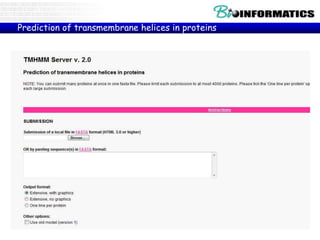
Prediction of transmembrane helices in proteins
(TMHMM)
5-hydroxytryptamine receptor 2A (Mus musculus)
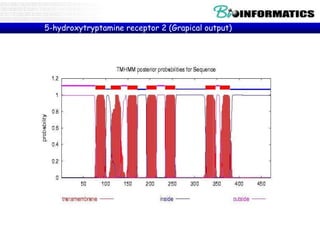
5-hydroxytryptamine receptor 2 (Grapical output)

2015 bioinformatics bio_python_part3

  • 2.
  • 3.
  • 5.
    GitHub: Hosted GIT •Largest open source git hosting site • Public and private options • User-centric rather than project-centric • http://github.ugent.be (use your Ugent login and password) – Accept invitation from Bioinformatics-I- 2015 URI: – https://github.ugent.be/Bioinformatics-I- 2015/Python.git
  • 6.
    Control Structures if condition: statements [elifcondition: statements] ... else: statements while condition: statements for var in sequence: statements break continue
  • 7.
    Lists • Flexible arrays,not Lisp-like linked lists • a = [99, "bottles of beer", ["on", "the", "wall"]] • Same operators as for strings • a+b, a*3, a[0], a[-1], a[1:], len(a) • Item and slice assignment • a[0] = 98 • a[1:2] = ["bottles", "of", "beer"] -> [98, "bottles", "of", "beer", ["on", "the", "wall"]] • del a[-1] # -> [98, "bottles", "of", "beer"]
  • 8.
    Dictionaries • Hash tables,"associative arrays" • d = {"duck": "eend", "water": "water"} • Lookup: • d["duck"] -> "eend" • d["back"] # raises KeyError exception • Delete, insert, overwrite: • del d["water"] # {"duck": "eend", "back": "rug"} • d["back"] = "rug" # {"duck": "eend", "back": "rug"} • d["duck"] = "duik" # {"duck": "duik", "back": "rug"}
  • 9.
    Regex.py text = 'abbaaabbbbaaaaa' pattern= 'ab' for match in re.finditer(pattern, text): s = match.start() e = match.end() print ('Found "%s" at %d:%d' % (text[s:e], s, e)) m = re.search("^([A-Z]) ",line) if m: from_letter = m.groups()[0]
  • 10.
    Install Biopython pip isthe preferred installer program. Starting with Python 3.4, it is included by default with the Python binary installers. pip3.5 install Biopython #pip3.5 install yahoo_finance from yahoo_finance import Share yahoo = Share('AAPL') print (yahoo.get_open())
  • 12.
    BioPython • Make ahistogram of the MW (in kDa) of all proteins in Swiss-Prot • Find the most basic and most acidic protein in Swiss-Prot? • Biological relevance of the results ? From AAIndex H ZIMJ680104 D Isoelectric point (Zimmerman et al., 1968) R LIT:2004109b PMID:5700434 A Zimmerman, J.M., Eliezer, N. and Simha, R. T The characterization of amino acid sequences in proteins by statistical methods J J. Theor. Biol. 21, 170-201 (1968) C KLEP840101 0.941 FAUJ880111 0.813 FINA910103 0.805 I A/L R/K N/M D/F C/P Q/S E/T G/W H/Y I/V 6.00 10.76 5.41 2.77 5.05 5.65 3.22 5.97 7.59 6.02 5.98 9.74 5.74 5.48 6.30 5.68 5.66 5.89 5.66 5.96
  • 13.
    Biopython AAindex ?Dictionary Hydrophobicity = {A:6.00,L:5.98,R:10.76,K:9.74,N:5.41,M:5.74,D:2.77,F:5.48, C:5.05,P:6.30,Q:5.65,S:5.68,E:3.22,T:5.66,G:5.97,W:5.89, H:7.59,Y:5.66,I:6.02,V:5.96} from Bio import SeqIO c=0 handle = open(r'/Users/wvcrieki/Downloads/uniprot_sprot.dat') for seq_rec in SeqIO.parse(handle, "swiss"): print (seq_rec.id) print (repr(seq_rec.seq)) print (len(seq_rec)) c+=1 if c>5: break
  • 14.
  • 15.
  • 17.
    Parsing sequences fromthe net Parsing GenBank records from the net Parsing SwissProt sequence from the net Handles are not always from files >>>from Bio import Entrez >>>from Bio import SeqIO >>>handle = Entrez.efetch(db="nucleotide",rettype="fasta",id="6273291") >>>seq_record = SeqIO.read(handle,”fasta”) >>>handle.close() >>>seq_record.description >>>from Bio import ExPASy >>>from Bio import SeqIO >>>handle = ExPASy.get_sprot_raw("6273291") >>>seq_record = SeqIO.read(handle,”swiss”) >>>handle.close() >>>print seq_record.id >>>print seq_record.name >>>prin seq_record.description
  • 18.
  • 19.
  • 20.
    Extra Questions (2) •How many human proteins in Swiss Prot ? • What is the longest human protein ? The shortest ? • Calculate for all human proteins their MW and pI, display as two histograms (2D scatter ?) • How many human proteins have “cancer” in their description? • Which genes has the highest number of SNPs/somatic mutations (COSMIC) • How many human DNA-repair enzymes are represented in Swiss Prot (using description / GO)? • List proteins that only contain alpha-helices based on the Chou-Fasman algorithm • List proteins based on the number of predicted transmembrane regions (Kyte-Doollittle)
  • 21.
     Amino acidsequences fold onto themselves to become a biologically active molecule. There are three types of local segments: Helices: Where protein residues seem to be following the shape of a spring. The most common are the so-called alpha helices Extended or Beta-strands: Where residues are in line and successive residues turn back to each other Random coils: When the amino acid chain is neither helical nor extended Secondary structure of protein
  • 22.
    Chou-Fasman Algorithm Chou, P.Y.and Fasman, G.D. (1974). Conformational parameters for amino acids in helical, b-sheet, and random coil regions calculated from proteins.Biochemistry 13, 211-221. Chou, P.Y. and Fasman, G.D. (1974). Prediction of protein conformation. Biochemistry 13, 222-245. Analyzed the frequency of the 20 amino acids in alpha helices, Beta sheets and turns. • Ala (A), Glu (E), Leu (L), and Met (M) are strong predictors of  helices • Pro (P) and Gly (G) break  helices. • When 4 of 5 amino acids have a high probability of being in an alpha helix, it predicts a alpha helix. • When 3 of 5 amino acids have a high probability of being in a b strand, it predicts a b strand. • 4 amino acids are used to predict turns.
  • 23.
    Calculation of Propensities Pr[i|b-sheet]/Pr[i],Pr[i|-helix]/Pr[i], Pr[i|other]/Pr[i] determine the probability that amino acid i is in each structure, normalized by the background probability that i occurs at all. Example. let's say that there are 20,000 amino acids in the database, of which 2000 are serine, and there are 5000 amino acids in helical conformation, of which 500 are serine. Then the helical propensity for serine is: (500/5000) / (2000/20000) = 1.0
  • 24.
    Calculation of preferenceparameters • Preference parameter > 1.0  specific residue has a preference for the specific secondary structure. • Preference parameter = 1.0  specific residue does not have a preference for, nor dislikes the specific secondary structure. • Preference parameter < 1.0  specific residue dislikes the specific secondary structure.
  • 25.
    Preference parameters Residue P(a)P(b) P(t) f(i) f(i+1) f(i+2) f(i+3) Ala 1.45 0.97 0.57 0.049 0.049 0.034 0.029 Arg 0.79 0.90 1.00 0.051 0.127 0.025 0.101 Asn 0.73 0.65 1.68 0.101 0.086 0.216 0.065 Asp 0.98 0.80 1.26 0.137 0.088 0.069 0.059 Cys 0.77 1.30 1.17 0.089 0.022 0.111 0.089 Gln 1.17 1.23 0.56 0.050 0.089 0.030 0.089 Glu 1.53 0.26 0.44 0.011 0.032 0.053 0.021 Gly 0.53 0.81 1.68 0.104 0.090 0.158 0.113 His 1.24 0.71 0.69 0.083 0.050 0.033 0.033 Ile 1.00 1.60 0.58 0.068 0.034 0.017 0.051 Leu 1.34 1.22 0.53 0.038 0.019 0.032 0.051 Lys 1.07 0.74 1.01 0.060 0.080 0.067 0.073 Met 1.20 1.67 0.67 0.070 0.070 0.036 0.070 Phe 1.12 1.28 0.71 0.031 0.047 0.063 0.063 Pro 0.59 0.62 1.54 0.074 0.272 0.012 0.062 Ser 0.79 0.72 1.56 0.100 0.095 0.095 0.104 Thr 0.82 1.20 1.00 0.062 0.093 0.056 0.068 Trp 1.14 1.19 1.11 0.045 0.000 0.045 0.205 Tyr 0.61 1.29 1.25 0.136 0.025 0.110 0.102 Val 1.14 1.65 0.30 0.023 0.029 0.011 0.029
  • 26.
    Applying algorithm 1. Assignparameters (propensities) to residue. 2. Identify regions (nucleation sites) where 4 out of 6 residues have P(a)>100: a-helix. Extend helix in both directions until four contiguous residues have an average P(a)<100: end of a-helix. If segment is longer than 5 residues and P(a)>P(b): a-helix. 3. Repeat this procedure to locate all of the helical regions. 4. Identify regions where 3 out of 5 residues have P(b)>100: b- sheet. Extend sheet in both directions until four contiguous residues have an average P(b)<100: end of b-sheet. If P(b)>105 and P(b)>P(a): b-sheet. 5. Rest: P(a)>P(b)  a-helix. P(b)>P(a)  b-sheet. 6. To identify a bend at residue number i, calculate the following value: p(t) = f(i)f(i+1)f(i+2)f(i+3) If: (1) p(t) > 0.000075; (2) average P(t)>1.00 in the tetrapeptide; and (3) averages for tetrapeptide obey P(a)<P(t)>P(b): b-turn.
  • 27.
    Extra Questions (2) •How many human proteins in Swiss Prot ? • What is the longest human protein ? The shortest ? • Calculate for all human proteins their MW and pI, display as two histograms (2D scatter ?) • How many human proteins have “cancer” in their description? • Which genes has the highest number of SNPs/somatic mutations (COSMIC) • How many human DNA-repair enzymes are represented in Swiss Prot (using description / GO)? • List proteins that only contain alpha-helices based on the Chou-Fasman algorithm • List proteins based on the number of predicted transmembrane regions (Kyte-Doollittle)
  • 28.
    Primary sequence revealsimportant clues about a protein DnaG E. coli ...EPNRLLVVEGYMDVVAL... DnaG S. typ ...EPQRLLVVEGYMDVVAL... DnaG B. subt ...KQERAVLFEGFADVYTA... gp4 T3 ...GGKKIVVTEGEIDMLTV... gp4 T7 ...GGKKIVVTEGEIDALTV... : *: :: * * : : small hydrophobic large hydrophobic polar positive charge negative charge • Evolution conserves amino acids that are important to protein structure and function across species. Sequence comparison of multiple “homologs” of a particular protein reveals highly conserved regions that are important for function. • Clusters of conserved residues are called “motifs” -- motifs carry out a particular function or form a particular structure that is important for the conserved protein. motif
  • 29.
     The hydropathyindex of an amino acid is a number representing the hydrophobic or hydrophilic properties of its side-chain.  It was proposed by Jack Kyte and Russell Doolittle in 1982.  The larger the number is, the more hydrophobic the amino acid. The most hydrophobic amino acids are isoleucine (4.5) and valine (4.2). The most hydrophilic ones are arginine (-4.5) and lysine (-3.9).  This is very important in protein structure; hydrophobic amino acids tend to be internal in the protein 3D structure, while hydrophilic amino acids are more commonly found towards the protein surface. Hydropathy index of amino acids
  • 30.
  • 31.
  • 32.
    Window size –9, strong negative peaks indicate possible surface regions Surface region of a protein
  • 33.
    Prediction of transmembranehelices in proteins (TMHMM)
  • 34.
  • 35.