FBW
             11-12-2012


Wim Van Criekinge
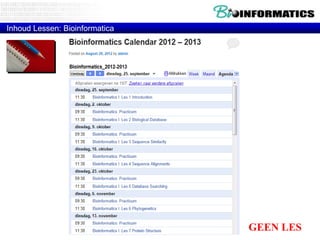
Inhoud Lessen: Bioinformatica


                                GEEN LES
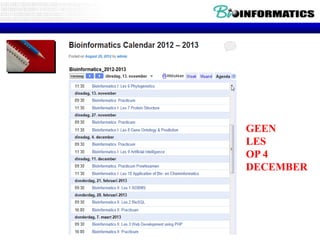
GEEN
LES
OP 4
DECEMBER
Examen
         <html>
         <title>Examen Bioinformatica</title>
         <center>
         <head>
         <script>
         rnd.today=new Date();
         rnd.seed=rnd.today.getTime();
         function rnd() {
               rnd.seed = (rnd.seed*9301+49297) % 233280;
               return rnd.seed/(233280.0);
         };
         function rand(number) {
               return Math.ceil(rnd()*number);
         };
         </SCRIPT>
         </head>
         <body bgcolor="#FFFFFF" text="#00FF00" link="#00FF00">
         <script language="JavaScript">
         document.write('<table>');
         document.write('<tr>');
         document.write('<td><a href="index.html" ><img border=0 src="' + rand(713)   + '.jpg" width="520"
                height="360"></a></td>');
         rand(98);
         document.write('<td><a href="index.html" ><img border=0 src="' + rand(713)   + '.jpg" width="520"
                height="360"></a></td>');
         rand(98);
         document.write('<td><a href="index.html" ><img border=0 src="' + rand(713)   + '.jpg" width="520"
                height="360"></a></td>');
         rand(98);
         document.write('<td><a href="index.html" ><img border=0 src="' + rand(713)   + '.jpg" width="520"
                height="360"></a></td>');
         rand(98);
Comparative Genomics: The biological Rosetta


                           • The keywords can be
                                –   genome structure
                                –   gene-organisation
                                –   known promoter regions
                                –   known critical amino acid residues.
                           • Combination of functional
                             modelorganism knowledge
                           • Structure-function
                           • Identify similar areas of biology
                           • Identify orthologous pathways (might
                             have different endpoints)
Example: Agro


                                           Sequence Genome


                                                  Known “lethal” genes
                                                  from worm, drosphila


                Filter for drugability”,
                tractibility & novelty
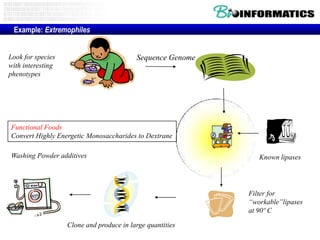
Example: Extremophiles


Look for species                          Sequence Genome
with interesting
phenotypes


Functional Foods
Convert Highly Energetic Monosaccharides to Dextrane

Washing Powder additives                                       Known lipases


                                                            Filter for
                                                            “workable”lipases
                                                            at 90º C

                   Clone and produce in large quantities
Drug Discovery: Design new drugs by computer?


                 Problem: pipeline cost rise linear, NCE steady
                 Money: bypassing difficult, work on attrition

                 Every step requires specific computational tools
Drug Discovery: What is a drug ?

                         • Drugs are generally defined as molecules which
                           affect biological processes.
                         • In order to be effective, the molecule must be
                           present in the body at an adequate concentration
                           for it to act at the specific site in the body where
                           it can exert its effect.
                         • Additionally, the molecule must be safe -- that
                           is, metabolized and eliminated from the body
                           without causing injury.
                         • Assumption: next 50 years still a big market in
                           small chemical entities which can be
                           administered orally in form of a pill (in contrast
                           to antibodies) or gene therapy …
• Taxol a drug which is an unmodified natural
  compound, is the exception
• Most drugs require “work” -> need for target
  driven pipeline
• Humane genome is available so all target are
  identified
• How to validate (within a given disease area) ?
Drug Discovery: What is a target ?

                          • target - a molecule (often a protein) that is instrumental
                            to a disease process (though not necessarily directly
                            involved), which may be targeted with a potential
                            therapeutic.
                          • target identification - identifying a molecule (often a
                            protein) that is instrumental to a disease process (though
                            not necessarily directly involved), with the intention of
                            finding a way to regulate that molecule's activity for
                            therapeutic purposes.
                          • target validation - a crucial step in the drug
                            development process. Following the identification of a
                            potential disease target, target validation verifies that a
                            drug that specifically acts on the target can have a
                            significant therapeutic benefit in the treatment of a given
                            disease.
Functional Genomics ?


               More than running chip experiments !
                               Phenotypic Gap
                                                 Total # genes

                                                 Proposal to prioritize
                                                    hypothetical protein
 Number of genes                                    without annotation, nice
                                                    for bioinformatics and
                                                    biologist

                                                 # genes with
                                                 known function


                        1980     1990   2000   2010
Where is optimal drug target ?
     “Optimal” drug target
     Predict side effect
How to correct disease state


Side effects ?
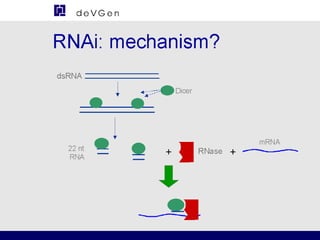
Genome-wide RNAi


                                                          RNAI vector


                                                      proprietary nematode
20.000 genes insert   bacteria producing ds RNA for
                                                       responding to RNAi
      library           each of the 20.000 genes
                                                        20.000 responses
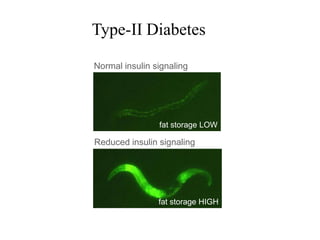
Type-II Diabetes

Normal insulin signaling


                fat storage LOW

Reduced insulin signaling


                fat storage HIGH
Industrialized knock-downs
                      proprietary C.elegans strains
                      • sensitized to silencing
                      • sensitized to relevant pathway


20,000 bacteria
each containing
selected
C. elegans gene


                  select genes with desired phenotypes
Pharma is conservative
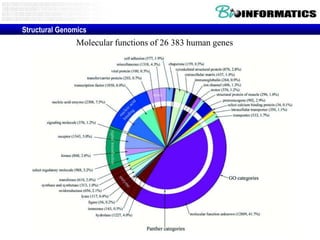
Structural Genomics
               Molecular functions of 26 383 human genes
Lipinsky for the target ?


   Database of all “drugable” human genes
Drug Discovery: Design new drugs by computer?
Drug Discovery: Screening definitions

                          screening - the automated examination and
                          testing of libraries of synthetic and/or organic
                          compounds and extracts to identify potential drug
                          leads, based on the compound's binding affinity
                          for a target molecule.
                          screening library - a large collection of
                          compounds with different chemical properties or
                          shapes, generated either by combinatorial
                          chemistry or some other process or by collecting
                          samples with interesting biological properties.
                          High Throughput Screening: Quick and Dirty…
                          from 5000 compounds per day
Drug Discovery: Screening Throughput

                         • At the beginning of the 1990s, when the
                           term "high-throughput screening" was
                           coined, a department of 20 would
                           typically be able to screen around 1.5
                           million samples in a year, each
                           researcher handling around 75,000
                           samples. Today, four researchers using
                           fully automated robotic technology can
                           screen 50,000 samples a day, or around
                           2.5 million samples each year.
Drug Discovery: HTS – The Wet Lab


      Distribution
      96 / 384 wells


    Read-out
  Fluorescence /
  luminescence


                                    Robotic arm
 Optical Bank
  for stability
Drug Discovery: Chemistry Sources


                         • Available molecules collections from pharma,
                           chemical and agro industry, also from
                           academics (Eastern Europe)
                         • Natural products from fungi, algae, exotic
                           plants, Chinese and ethnobotanic medicines
                         • Combinatorial chemistry: it is the generation
                           of large numbers of diverse chemical
                           compounds (a library) for use in screening
                           assays against disease target molecules.
                         • Computer drug design (from model
                           substrates or X-ray structure)
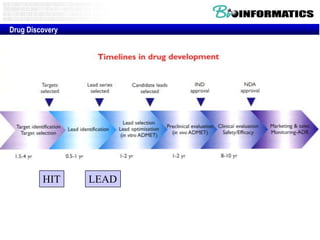
Drug Discovery


         HIT     LEAD
Drug Discovery: HIT


                      • initial screen established
                      • Compounds screened
                      • IC50s established
                      • Structures verified
                      • Minimum of threeindependent
                         chemicalseries to evaluate
                      • Positive in silico PKdata
Drug Discovery: Hit/lead computational approaches


    • When the structure of the target is unknown,
      the activity data can be used to construct a
      pharmacophore model for the positioning of
      key features like hydrogen-bonding and
      hydrophobic groups.
    • Such a model can be used as a template to
      select the most promising candidates from the
      library.
Drug Discovery: Lead ?

                         •   lead compound - a potential drug candidate emerging from a
                             screening process of a large library of compounds.
                         •   It basically affects specifically a biological process.
                             Mechanism of activity (reversible/irreversible,kinetics)
                             established
                         •   Its is effective at a low concentration: usually nanomolar
                             activity
                         •   It is not toxic to live cells
                         •   It has been shown to have some in vivo activity
                         •   It is chemically feasible. Specificity of keycompound(s)
                             fromeach leadseriesagainst selectednumber
                             ofreceptors/enzymes
                         •   Preliminary PK in vivo(rodent) to establishbenchmark for in
                             vitroSAR
                         •   In vitro PK data goodpredictor for in vivoactivity
                         •   Its is of course New and Original.
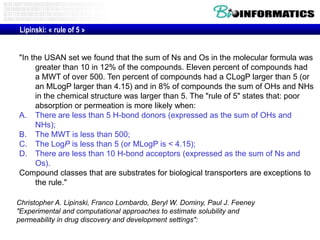
Lipinski: « rule of 5 »


"In the USAN set we found that the sum of Ns and Os in the molecular formula was
     greater than 10 in 12% of the compounds. Eleven percent of compounds had
     a MWT of over 500. Ten percent of compounds had a CLogP larger than 5 (or
     an MLogP larger than 4.15) and in 8% of compounds the sum of OHs and NHs
     in the chemical structure was larger than 5. The "rule of 5" states that: poor
     absorption or permeation is more likely when:
A. There are less than 5 H-bond donors (expressed as the sum of OHs and
     NHs);
B. The MWT is less than 500;
C. The LogP is less than 5 (or MLogP is < 4.15);
D. There are less than 10 H-bond acceptors (expressed as the sum of Ns and
     Os).
Compound classes that are substrates for biological transporters are exceptions to
     the rule."

Christopher A. Lipinski, Franco Lombardo, Beryl W. Dominy, Paul J. Feeney
"Experimental and computational approaches to estimate solubility and
permeability in drug discovery and development settings":
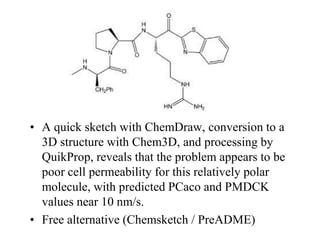
• A quick sketch with ChemDraw, conversion to a
  3D structure with Chem3D, and processing by
  QuikProp, reveals that the problem appears to be
  poor cell permeability for this relatively polar
  molecule, with predicted PCaco and PMDCK
  values near 10 nm/s.
• Free alternative (Chemsketch / PreADME)
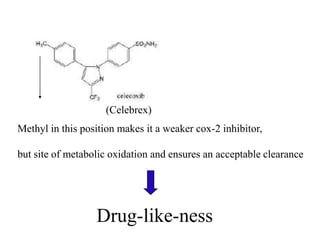
(Celebrex)
Methyl in this position makes it a weaker cox-2 inhibitor,

but site of metabolic oxidation and ensures an acceptable clearance


                  Drug-like-ness
To assist combinatorial chemistry, buy specific compunds
Structural Descriptors: (15 descriptors)
Molecular Formula, Molecular Weight, Formal Charge, The Number of Rotatable Bonds, The Number of Rigid
     Bonds, The Number of Rings, The Number of Aromatic Rings, The Number of H Bond Acceptors, The
     Number of H Bond Donors, The Number of (+) Charged Groups, The Number of (-) Charged Groups, No.
     single, double, triple, aromatic bonds

Topological Descriptors:(350 descriptors)
•   Topological descriptors on the adjustancy and distance matrix
•   Count descriptors
•   Kier & Hall molecular connectivity Indices
•   Kier Shape Indices
•   Galvez topological charge Indices
•   Narumi topological index
•   Autocorrelation descriptor of atomic masses, atomic polarizability, Pauling electronegativity and van der
    Waals radius
•   Information content descriptors
•   Electrotopological state index (E-state)
•   Atomic-Level-Based AI topological descriptors

Physicochemical Descriptor:(10 descriptors)
AlogP98 (calculated logP), SKlogP (calculated logP), SKlogS in pure water (calculated water solubility), SKlogS in
    buffer system (calculated water solubility),SK vap (calculated vapor pressure), SK bp (calculated boiling
    point), SK mp (calculated meling point), AMR (calculated molecular refractivity), APOL(calculated
    polarizability), Water Solvation Free Energy

Geometrical Descriptor:(9 descriptors)
Topological Polar Surface Area, 2D van der Waals Volume, 2D van der Waals Surface Area, 2D van der Waals
    Hydrophobic Surface Area, 2D van der Waals Polar Surface Area, 2D van der Waals H-bond Acceptor Surface
    Area, 2D van der Waals H-bond Donor Surface Area, 2D van der Waals (+) Charged Groups Surface Area, 2D
    van der Waals (-) Charged Groups Surface Area
Drug Discovery: Hit/lead computational approaches


   • What can you do with these descriptors ?

   • Cluster entire chemical library
        – Diversity set
        – Focused set
Drug Discovery: Docking

    • Structure is known, virtual screening -> docking
    • Many different approaches
         –   DOCK
         –   FlexX
         –   Glide
         –   GOLD
    • Including conformational sampling of the ligand
    • Problem:
         – host flexibility
         – solvatation
    • Example: Bissantz et al.
         – Hit rate of 10% for single scoring function
         – Up to 70% with triple scoring (bagging)
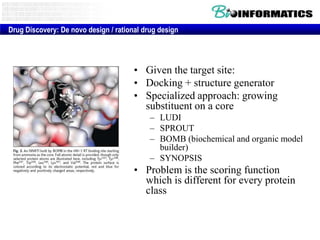
Drug Discovery: De novo design / rational drug design


                                       • Given the target site:
                                       • Docking + structure generator
                                       • Specialized approach: growing
                                         substituent on a core
                                            – LUDI
                                            – SPROUT
                                            – BOMB (biochemical and organic model
                                              builder)
                                            – SYNOPSIS
                                       • Problem is the scoring function
                                         which is different for every protein
                                         class
Drug Discovery: Novel strategies using bio/cheminformatics


   - HTS ? Chemical space is big (1041)
   - Biased sets/focussed libraries ->bioinformatics !!!
   - How ? Use phylogenetics and known structures to define
   accesible (conserved) functional implicated residues to
   define small molecule pharmacophores (minimal
   requirements)
   - Desciptor search (cheminformatics) to construct/select
   biased compound set
   - ensure serendipity by iterative screening of these
   predesigned sets
Drug Discovery


                   Toxigenomics
                 Metabogenomics
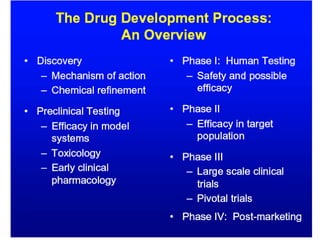
Drug Discovery: Clinical studies

                           • Preclinical - An early phase of development
                             including initial safety assessment
                             Phase I - Evaluation of clinical pharmacology,
                             usually conducted in volunteers
                             Phase II - Determination of dose and initial
                             evaluation of efficacy, conducted in a small
                             number of patients
                             Phase III - Large comparative study
                             (compound versus placebo and/or established
                             treatment) in patients to establish clinical
                             benefit and safety
                             Phase IV - Post marketing study
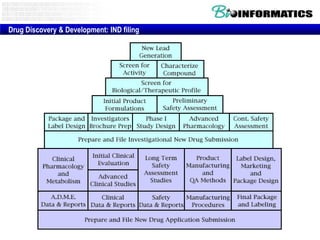
Drug Discovery & Development: IND filing
Hapmap
Pharmacogenomics


                   Predictive/preventive – systems biology
Sneak preview
Bioinformatics (re)loaded
Sneak preview
       Bioinformatics (re)loaded
• Relational datamodels
  – BioSQL (MySQL)
• Data Visualisation
  – Interface
     • Apache
     • PHP
• Large Scale Statistics
  – Using R

Bioinformatica t9-t10-biocheminformatics

  • 2.
    FBW 11-12-2012 Wim Van Criekinge
  • 3.
  • 4.
  • 5.
    Examen <html> <title>Examen Bioinformatica</title> <center> <head> <script> rnd.today=new Date(); rnd.seed=rnd.today.getTime(); function rnd() { rnd.seed = (rnd.seed*9301+49297) % 233280; return rnd.seed/(233280.0); }; function rand(number) { return Math.ceil(rnd()*number); }; </SCRIPT> </head> <body bgcolor="#FFFFFF" text="#00FF00" link="#00FF00"> <script language="JavaScript"> document.write('<table>'); document.write('<tr>'); document.write('<td><a href="index.html" ><img border=0 src="' + rand(713) + '.jpg" width="520" height="360"></a></td>'); rand(98); document.write('<td><a href="index.html" ><img border=0 src="' + rand(713) + '.jpg" width="520" height="360"></a></td>'); rand(98); document.write('<td><a href="index.html" ><img border=0 src="' + rand(713) + '.jpg" width="520" height="360"></a></td>'); rand(98); document.write('<td><a href="index.html" ><img border=0 src="' + rand(713) + '.jpg" width="520" height="360"></a></td>'); rand(98);
  • 6.
    Comparative Genomics: Thebiological Rosetta • The keywords can be – genome structure – gene-organisation – known promoter regions – known critical amino acid residues. • Combination of functional modelorganism knowledge • Structure-function • Identify similar areas of biology • Identify orthologous pathways (might have different endpoints)
  • 8.
    Example: Agro Sequence Genome Known “lethal” genes from worm, drosphila Filter for drugability”, tractibility & novelty
  • 9.
    Example: Extremophiles Look forspecies Sequence Genome with interesting phenotypes Functional Foods Convert Highly Energetic Monosaccharides to Dextrane Washing Powder additives Known lipases Filter for “workable”lipases at 90º C Clone and produce in large quantities
  • 11.
    Drug Discovery: Designnew drugs by computer? Problem: pipeline cost rise linear, NCE steady Money: bypassing difficult, work on attrition Every step requires specific computational tools
  • 12.
    Drug Discovery: Whatis a drug ? • Drugs are generally defined as molecules which affect biological processes. • In order to be effective, the molecule must be present in the body at an adequate concentration for it to act at the specific site in the body where it can exert its effect. • Additionally, the molecule must be safe -- that is, metabolized and eliminated from the body without causing injury. • Assumption: next 50 years still a big market in small chemical entities which can be administered orally in form of a pill (in contrast to antibodies) or gene therapy …
  • 17.
    • Taxol adrug which is an unmodified natural compound, is the exception • Most drugs require “work” -> need for target driven pipeline • Humane genome is available so all target are identified • How to validate (within a given disease area) ?
  • 18.
    Drug Discovery: Whatis a target ? • target - a molecule (often a protein) that is instrumental to a disease process (though not necessarily directly involved), which may be targeted with a potential therapeutic. • target identification - identifying a molecule (often a protein) that is instrumental to a disease process (though not necessarily directly involved), with the intention of finding a way to regulate that molecule's activity for therapeutic purposes. • target validation - a crucial step in the drug development process. Following the identification of a potential disease target, target validation verifies that a drug that specifically acts on the target can have a significant therapeutic benefit in the treatment of a given disease.
  • 19.
    Functional Genomics ? More than running chip experiments ! Phenotypic Gap Total # genes Proposal to prioritize hypothetical protein Number of genes without annotation, nice for bioinformatics and biologist # genes with known function 1980 1990 2000 2010
  • 21.
    Where is optimaldrug target ? “Optimal” drug target Predict side effect How to correct disease state Side effects ?
  • 28.
    Genome-wide RNAi RNAI vector proprietary nematode 20.000 genes insert bacteria producing ds RNA for responding to RNAi library each of the 20.000 genes 20.000 responses
  • 31.
    Type-II Diabetes Normal insulinsignaling fat storage LOW Reduced insulin signaling fat storage HIGH
  • 32.
    Industrialized knock-downs proprietary C.elegans strains • sensitized to silencing • sensitized to relevant pathway 20,000 bacteria each containing selected C. elegans gene select genes with desired phenotypes
  • 33.
  • 35.
    Structural Genomics Molecular functions of 26 383 human genes
  • 37.
    Lipinsky for thetarget ? Database of all “drugable” human genes
  • 38.
    Drug Discovery: Designnew drugs by computer?
  • 39.
    Drug Discovery: Screeningdefinitions screening - the automated examination and testing of libraries of synthetic and/or organic compounds and extracts to identify potential drug leads, based on the compound's binding affinity for a target molecule. screening library - a large collection of compounds with different chemical properties or shapes, generated either by combinatorial chemistry or some other process or by collecting samples with interesting biological properties. High Throughput Screening: Quick and Dirty… from 5000 compounds per day
  • 40.
    Drug Discovery: ScreeningThroughput • At the beginning of the 1990s, when the term "high-throughput screening" was coined, a department of 20 would typically be able to screen around 1.5 million samples in a year, each researcher handling around 75,000 samples. Today, four researchers using fully automated robotic technology can screen 50,000 samples a day, or around 2.5 million samples each year.
  • 41.
    Drug Discovery: HTS– The Wet Lab Distribution 96 / 384 wells Read-out Fluorescence / luminescence Robotic arm Optical Bank for stability
  • 42.
    Drug Discovery: ChemistrySources • Available molecules collections from pharma, chemical and agro industry, also from academics (Eastern Europe) • Natural products from fungi, algae, exotic plants, Chinese and ethnobotanic medicines • Combinatorial chemistry: it is the generation of large numbers of diverse chemical compounds (a library) for use in screening assays against disease target molecules. • Computer drug design (from model substrates or X-ray structure)
  • 43.
  • 44.
    Drug Discovery: HIT • initial screen established • Compounds screened • IC50s established • Structures verified • Minimum of threeindependent chemicalseries to evaluate • Positive in silico PKdata
  • 45.
    Drug Discovery: Hit/leadcomputational approaches • When the structure of the target is unknown, the activity data can be used to construct a pharmacophore model for the positioning of key features like hydrogen-bonding and hydrophobic groups. • Such a model can be used as a template to select the most promising candidates from the library.
  • 46.
    Drug Discovery: Lead? • lead compound - a potential drug candidate emerging from a screening process of a large library of compounds. • It basically affects specifically a biological process. Mechanism of activity (reversible/irreversible,kinetics) established • Its is effective at a low concentration: usually nanomolar activity • It is not toxic to live cells • It has been shown to have some in vivo activity • It is chemically feasible. Specificity of keycompound(s) fromeach leadseriesagainst selectednumber ofreceptors/enzymes • Preliminary PK in vivo(rodent) to establishbenchmark for in vitroSAR • In vitro PK data goodpredictor for in vivoactivity • Its is of course New and Original.
  • 47.
    Lipinski: « ruleof 5 » "In the USAN set we found that the sum of Ns and Os in the molecular formula was greater than 10 in 12% of the compounds. Eleven percent of compounds had a MWT of over 500. Ten percent of compounds had a CLogP larger than 5 (or an MLogP larger than 4.15) and in 8% of compounds the sum of OHs and NHs in the chemical structure was larger than 5. The "rule of 5" states that: poor absorption or permeation is more likely when: A. There are less than 5 H-bond donors (expressed as the sum of OHs and NHs); B. The MWT is less than 500; C. The LogP is less than 5 (or MLogP is < 4.15); D. There are less than 10 H-bond acceptors (expressed as the sum of Ns and Os). Compound classes that are substrates for biological transporters are exceptions to the rule." Christopher A. Lipinski, Franco Lombardo, Beryl W. Dominy, Paul J. Feeney "Experimental and computational approaches to estimate solubility and permeability in drug discovery and development settings":
  • 48.
    • A quicksketch with ChemDraw, conversion to a 3D structure with Chem3D, and processing by QuikProp, reveals that the problem appears to be poor cell permeability for this relatively polar molecule, with predicted PCaco and PMDCK values near 10 nm/s. • Free alternative (Chemsketch / PreADME)
  • 49.
    (Celebrex) Methyl in thisposition makes it a weaker cox-2 inhibitor, but site of metabolic oxidation and ensures an acceptable clearance Drug-like-ness
  • 50.
    To assist combinatorialchemistry, buy specific compunds
  • 52.
    Structural Descriptors: (15descriptors) Molecular Formula, Molecular Weight, Formal Charge, The Number of Rotatable Bonds, The Number of Rigid Bonds, The Number of Rings, The Number of Aromatic Rings, The Number of H Bond Acceptors, The Number of H Bond Donors, The Number of (+) Charged Groups, The Number of (-) Charged Groups, No. single, double, triple, aromatic bonds Topological Descriptors:(350 descriptors) • Topological descriptors on the adjustancy and distance matrix • Count descriptors • Kier & Hall molecular connectivity Indices • Kier Shape Indices • Galvez topological charge Indices • Narumi topological index • Autocorrelation descriptor of atomic masses, atomic polarizability, Pauling electronegativity and van der Waals radius • Information content descriptors • Electrotopological state index (E-state) • Atomic-Level-Based AI topological descriptors Physicochemical Descriptor:(10 descriptors) AlogP98 (calculated logP), SKlogP (calculated logP), SKlogS in pure water (calculated water solubility), SKlogS in buffer system (calculated water solubility),SK vap (calculated vapor pressure), SK bp (calculated boiling point), SK mp (calculated meling point), AMR (calculated molecular refractivity), APOL(calculated polarizability), Water Solvation Free Energy Geometrical Descriptor:(9 descriptors) Topological Polar Surface Area, 2D van der Waals Volume, 2D van der Waals Surface Area, 2D van der Waals Hydrophobic Surface Area, 2D van der Waals Polar Surface Area, 2D van der Waals H-bond Acceptor Surface Area, 2D van der Waals H-bond Donor Surface Area, 2D van der Waals (+) Charged Groups Surface Area, 2D van der Waals (-) Charged Groups Surface Area
  • 53.
    Drug Discovery: Hit/leadcomputational approaches • What can you do with these descriptors ? • Cluster entire chemical library – Diversity set – Focused set
  • 54.
    Drug Discovery: Docking • Structure is known, virtual screening -> docking • Many different approaches – DOCK – FlexX – Glide – GOLD • Including conformational sampling of the ligand • Problem: – host flexibility – solvatation • Example: Bissantz et al. – Hit rate of 10% for single scoring function – Up to 70% with triple scoring (bagging)
  • 55.
    Drug Discovery: Denovo design / rational drug design • Given the target site: • Docking + structure generator • Specialized approach: growing substituent on a core – LUDI – SPROUT – BOMB (biochemical and organic model builder) – SYNOPSIS • Problem is the scoring function which is different for every protein class
  • 56.
    Drug Discovery: Novelstrategies using bio/cheminformatics - HTS ? Chemical space is big (1041) - Biased sets/focussed libraries ->bioinformatics !!! - How ? Use phylogenetics and known structures to define accesible (conserved) functional implicated residues to define small molecule pharmacophores (minimal requirements) - Desciptor search (cheminformatics) to construct/select biased compound set - ensure serendipity by iterative screening of these predesigned sets
  • 57.
    Drug Discovery Toxigenomics Metabogenomics
  • 59.
    Drug Discovery: Clinicalstudies • Preclinical - An early phase of development including initial safety assessment Phase I - Evaluation of clinical pharmacology, usually conducted in volunteers Phase II - Determination of dose and initial evaluation of efficacy, conducted in a small number of patients Phase III - Large comparative study (compound versus placebo and/or established treatment) in patients to establish clinical benefit and safety Phase IV - Post marketing study
  • 62.
    Drug Discovery &Development: IND filing
  • 63.
  • 64.
    Pharmacogenomics Predictive/preventive – systems biology
  • 65.
  • 66.
    Sneak preview Bioinformatics (re)loaded • Relational datamodels – BioSQL (MySQL) • Data Visualisation – Interface • Apache • PHP • Large Scale Statistics – Using R