WELCOME
TO OUR
PRESENTATION
Group name: Infinity
Submitted by:
1. Akteruzzaman
152-15-5671
2.Samyamay Howlader
Niloy 152-15-5913
3. Muzahidul Islam
152-15-5585
4. S.M.Zahiul Islam
152-15-5617
5. Saniatul Haque Taposh
152-15-5545
Submitted to:
Mr. Shaon Bhatta Shuvo
Lecturer
Department of Computer
Science and Engineering
Daffodil International University
SECONDARY STRUCTURE PREDICTION
Chou Fasman Method
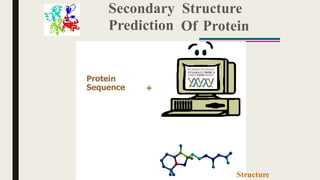
Secondary
Prediction
Structure
Of Protein
Protein
Sequence +
Structure
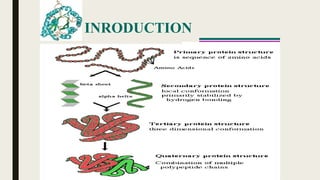
 Primary structure (Amino acid sequence)
↓
Secondary structure (α-helix, β-sheet)
↓
Tertiary structure (Three-dimensional
structure formed by assembly of secondary
structures)
↓
Quaternary structure (Structure formed by
more than one polypeptide chains)
INRODUCTION
Secondary Structure
 Defined as the local conformation of protein backbone
 Primary Structure —folding— Secondary Structure
  helix and  sheet
Secondary Structure
Regular Secondary
Structure
(-helices, -sheets)
Irregular
Secondary
Structure
(Tight turns,
Random coils,
bulges)
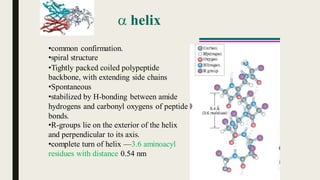
 helix
•common confirmation.
•spiral structure
•Tightly packed coiled polypeptide
backbone, with extending side chains
•Spontaneous
•stabilized by H-bonding between amide
hydrogens and carbonyl oxygens of peptide
bonds.
•R-groups lie on the exterior of the helix
and perpendicular to its axis.
•complete turn of helix —3.6 aminoacyl
residues with distance 0.54 nm
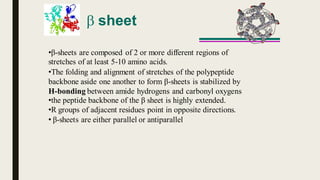
 sheet
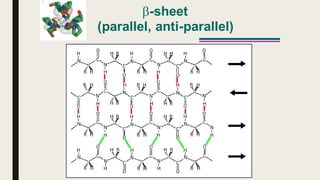
•β-sheets are composed of 2 or more different regions of
stretches of at least 5-10 amino acids.
•The folding and alignment of stretches of the polypeptide
backbone aside one another to form β-sheets is stabilized by
H-bonding between amide hydrogens and carbonyl oxygens
•the peptide backbone of the β sheet is highly extended.
•R groups of adjacent residues point in opposite directions.
• β-sheets are either parallel or antiparallel
-sheet
(parallel, anti-parallel)
What is secondary
structure prediction?
 Given a protein sequence (primary structure)
GHWIATRGQLIREAYEDYRHFSSECPFIP
 Predict its secondary structure content
(C=Coils H=Alpha Helix E=Beta Strands)
CEEEEECHHHHHHHHHHHCCCHHCCCCCC
1st step in prediction of protein structure.
 Technique concerned with determination of secondary structure of
given polypeptide by locating the Coils Alpha Helix Beta Strands in
plypeptide
Why secondary structure
prediction?
o secondary structure —tertiary structure prediction
o Protein function prediction
o Protein classification
o Predicting structural change
o detection and alignment of remote homology between proteins
o on detecting transmembrane regions, solvent-accessible residues,
and other important features of molecules
o Detection of hydrophobic region and hydrophilic region
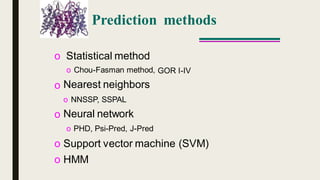
Prediction methods
o Statistical method
o Chou-Fasman method,
Nearest neighbors
o NNSSP, SSPAL
Neural network
o PHD, Psi-Pred, J-Pred
GOR I-IV
o
o
o
o
Support vector machine
HMM
(SVM)
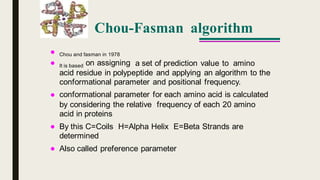
Chou-Fasman algorithm


Chou and fasman in 1978
on assigning a set of prediction value to aminoIt is based
acid residue in polypeptide and applying an algorithm to the
conformational parameter and positional frequency.
conformational parameter for each amino acid is calculated
by considering the relative
acid in proteins
frequency of each 20 amino
By this C=Coils
determined
H=Alpha Helix E=Beta Strands are
Also called preference parameter
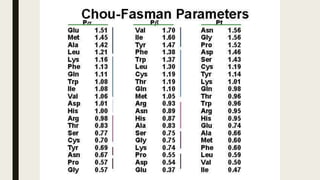
Atable of prediction value or preference parameter for each
of 20 amino acid in alpha helix ,beta plate and turn
already calculated and standardised.
•
To obtain the prediction value the frequency of amino•
acids( i) in structure is divided by of all
protein (s)
• i/s
residences in
The resulting structural parameter of
p(alpha),p(beta),p(turn)vary —0.5 to 1.5 for 20 amino acid
•
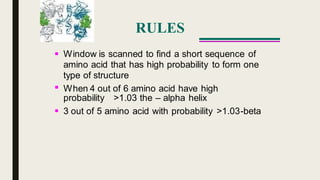
RULES
Window is scanned to find a short sequence of
amino acid that has high probability to form one
type of structure
When 4 out of 6 amino acid have high


probability >1.03 the – alpha helix
 3 out of 5 amino acid with probability >1.03-beta
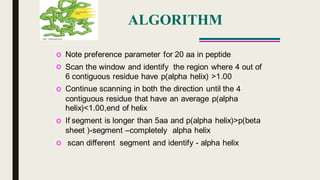
ALGORITHM
o
o
Note preference parameter for 20 aa in peptide
Scan the window and identify the region where 4 out of
6 contiguous residue have p(alpha helix) >1.00
Continue scanning in both the direction until theo 4
contiguous residue that have an average p(alpha
helix)<1.00,end of helix
If segment is longer than 5aa and p(alpha helix)>p(betao
sheet )-segment –completely alpha helix
o scan different segment and identify - alpha helix
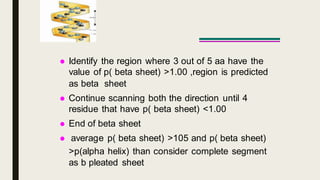
 Identify the region where 3 out of 5 aa have the
value of p( beta sheet) >1.00 ,region is predicted
as beta sheet
 Continue scanning both the direction until 4
residue that have p( beta sheet) <1.00
 End of beta sheet
 average p( beta sheet) >105 and p( beta sheet)
>p(alpha helix) than consider complete segment
as b pleated sheet
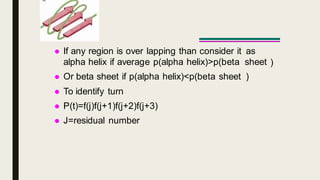
 If any region is over lapping than consider it
alpha helix if average p(alpha helix)>p(beta
 Or beta sheet if p(alpha helix)<p(beta sheet
 To identify turn
 P(t)=f(j)f(j+1)f(j+2)f(j+3)
 J=residual number
as
sheet
)
)
result
Accuracy: ~50%  ~60%
helix alanine,glutamine,leucine,methionine
Helix breaking proline and glycine






Beta
Beta
Turn
sheet isoleucine,valine,tyrosine
breaking proline,aspargine,glutamine
contains proline(30%),serine(14%),lysine,
aspargine(10%)
Glycine(19%),aspartic acid
(`18%),serine(13%),tyrosine(11%)
http://www.accelrys.com/product/gcg-wisconsin-
package/program-list.html


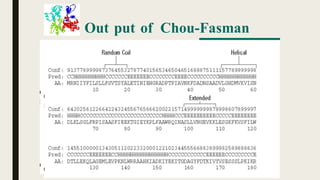
Out put of Chou-Fasman
Thank You.

Bioinfo

  • 1.
  • 2.
    Group name: Infinity Submittedby: 1. Akteruzzaman 152-15-5671 2.Samyamay Howlader Niloy 152-15-5913 3. Muzahidul Islam 152-15-5585 4. S.M.Zahiul Islam 152-15-5617 5. Saniatul Haque Taposh 152-15-5545 Submitted to: Mr. Shaon Bhatta Shuvo Lecturer Department of Computer Science and Engineering Daffodil International University
  • 3.
  • 4.
  • 5.
     Primary structure(Amino acid sequence) ↓ Secondary structure (α-helix, β-sheet) ↓ Tertiary structure (Three-dimensional structure formed by assembly of secondary structures) ↓ Quaternary structure (Structure formed by more than one polypeptide chains) INRODUCTION
  • 6.
    Secondary Structure  Definedas the local conformation of protein backbone  Primary Structure —folding— Secondary Structure   helix and  sheet Secondary Structure Regular Secondary Structure (-helices, -sheets) Irregular Secondary Structure (Tight turns, Random coils, bulges)
  • 7.
     helix •common confirmation. •spiralstructure •Tightly packed coiled polypeptide backbone, with extending side chains •Spontaneous •stabilized by H-bonding between amide hydrogens and carbonyl oxygens of peptide bonds. •R-groups lie on the exterior of the helix and perpendicular to its axis. •complete turn of helix —3.6 aminoacyl residues with distance 0.54 nm
  • 8.
     sheet •β-sheets arecomposed of 2 or more different regions of stretches of at least 5-10 amino acids. •The folding and alignment of stretches of the polypeptide backbone aside one another to form β-sheets is stabilized by H-bonding between amide hydrogens and carbonyl oxygens •the peptide backbone of the β sheet is highly extended. •R groups of adjacent residues point in opposite directions. • β-sheets are either parallel or antiparallel
  • 9.
  • 10.
    What is secondary structureprediction?  Given a protein sequence (primary structure) GHWIATRGQLIREAYEDYRHFSSECPFIP  Predict its secondary structure content (C=Coils H=Alpha Helix E=Beta Strands) CEEEEECHHHHHHHHHHHCCCHHCCCCCC 1st step in prediction of protein structure.  Technique concerned with determination of secondary structure of given polypeptide by locating the Coils Alpha Helix Beta Strands in plypeptide
  • 11.
    Why secondary structure prediction? osecondary structure —tertiary structure prediction o Protein function prediction o Protein classification o Predicting structural change o detection and alignment of remote homology between proteins o on detecting transmembrane regions, solvent-accessible residues, and other important features of molecules o Detection of hydrophobic region and hydrophilic region
  • 12.
    Prediction methods o Statisticalmethod o Chou-Fasman method, Nearest neighbors o NNSSP, SSPAL Neural network o PHD, Psi-Pred, J-Pred GOR I-IV o o o o Support vector machine HMM (SVM)
  • 13.
    Chou-Fasman algorithm   Chou andfasman in 1978 on assigning a set of prediction value to aminoIt is based acid residue in polypeptide and applying an algorithm to the conformational parameter and positional frequency. conformational parameter for each amino acid is calculated by considering the relative acid in proteins frequency of each 20 amino By this C=Coils determined H=Alpha Helix E=Beta Strands are Also called preference parameter
  • 14.
    Atable of predictionvalue or preference parameter for each of 20 amino acid in alpha helix ,beta plate and turn already calculated and standardised. • To obtain the prediction value the frequency of amino• acids( i) in structure is divided by of all protein (s) • i/s residences in The resulting structural parameter of p(alpha),p(beta),p(turn)vary —0.5 to 1.5 for 20 amino acid •
  • 16.
    RULES Window is scannedto find a short sequence of amino acid that has high probability to form one type of structure When 4 out of 6 amino acid have high   probability >1.03 the – alpha helix  3 out of 5 amino acid with probability >1.03-beta
  • 17.
    ALGORITHM o o Note preference parameterfor 20 aa in peptide Scan the window and identify the region where 4 out of 6 contiguous residue have p(alpha helix) >1.00 Continue scanning in both the direction until theo 4 contiguous residue that have an average p(alpha helix)<1.00,end of helix If segment is longer than 5aa and p(alpha helix)>p(betao sheet )-segment –completely alpha helix o scan different segment and identify - alpha helix
  • 18.
     Identify theregion where 3 out of 5 aa have the value of p( beta sheet) >1.00 ,region is predicted as beta sheet  Continue scanning both the direction until 4 residue that have p( beta sheet) <1.00  End of beta sheet  average p( beta sheet) >105 and p( beta sheet) >p(alpha helix) than consider complete segment as b pleated sheet
  • 19.
     If anyregion is over lapping than consider it alpha helix if average p(alpha helix)>p(beta  Or beta sheet if p(alpha helix)<p(beta sheet  To identify turn  P(t)=f(j)f(j+1)f(j+2)f(j+3)  J=residual number as sheet ) )
  • 20.
    result Accuracy: ~50% ~60% helix alanine,glutamine,leucine,methionine Helix breaking proline and glycine       Beta Beta Turn sheet isoleucine,valine,tyrosine breaking proline,aspargine,glutamine contains proline(30%),serine(14%),lysine, aspargine(10%) Glycine(19%),aspartic acid (`18%),serine(13%),tyrosine(11%) http://www.accelrys.com/product/gcg-wisconsin- package/program-list.html  
  • 21.
    Out put ofChou-Fasman
  • 22.