Libraries in Communities

Lee Rainie - @lrainie
Director, Pew Research Center’s Internet Project
Presented to: ALA Midwinter
January 26, 2014
“Tell the truth, and trust the people”
-- Joseph N. Pew, Jr.
http://bit.ly/dUvWe3
http://bit.ly/100qMub
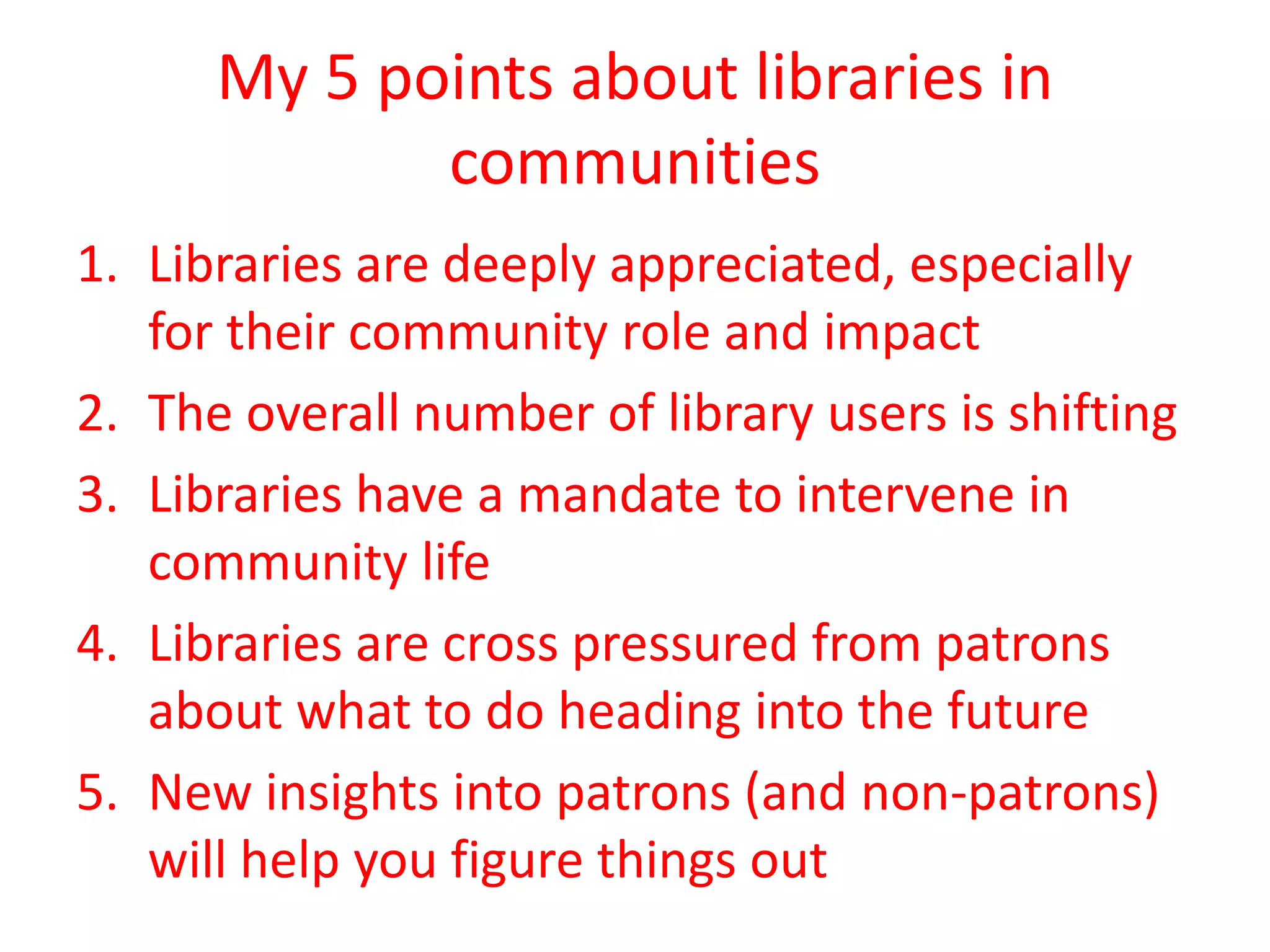
My 5 points about libraries in
communities
1. Libraries are deeply appreciated, especially
for their community role and impact
2. The overall number of library users is shifting
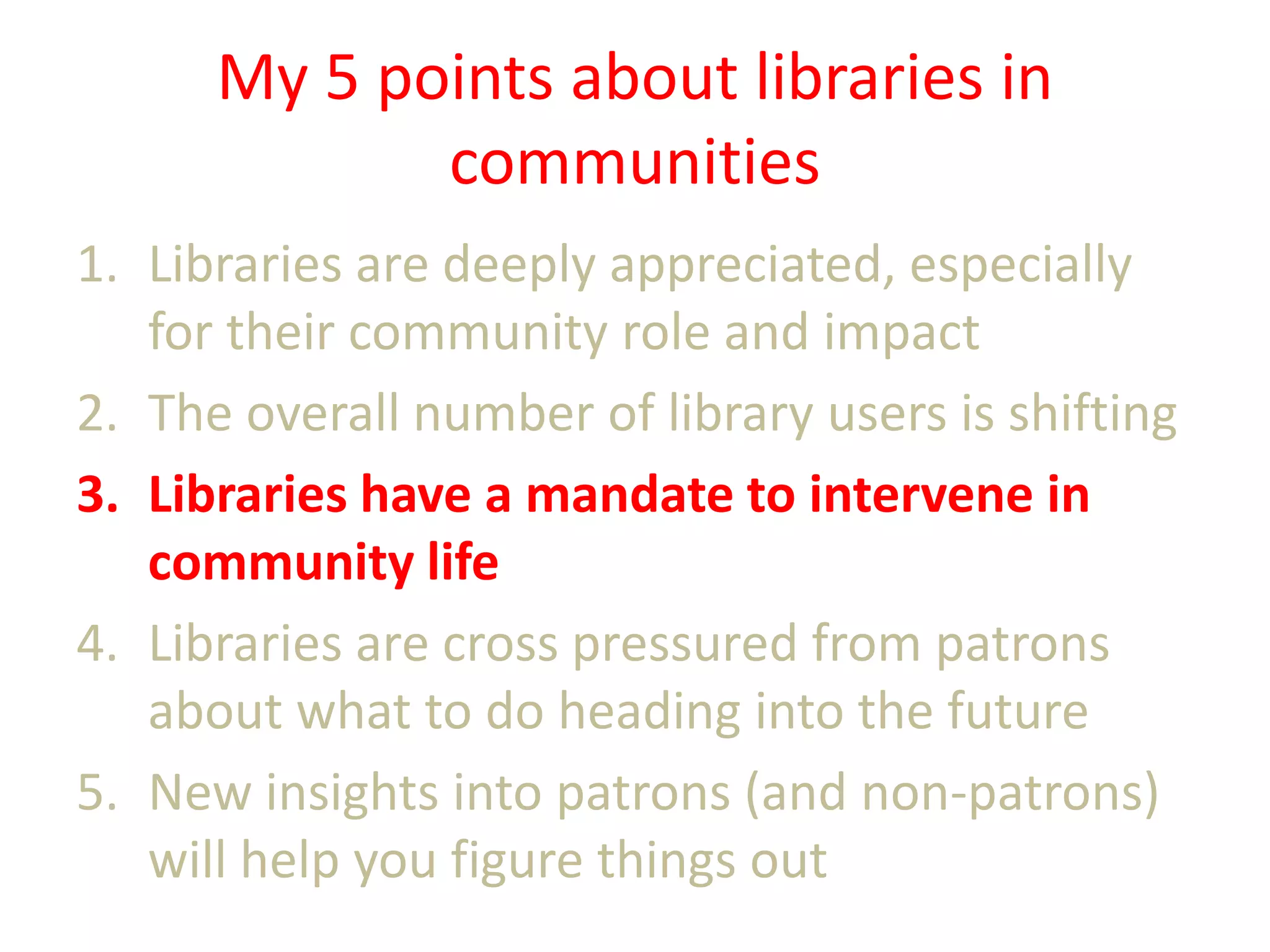
3. Libraries have a mandate to intervene in
community life
4. Libraries are cross pressured from patrons
about what to do heading into the future
5. New insights into patrons (and non-patrons)
will help you figure things out
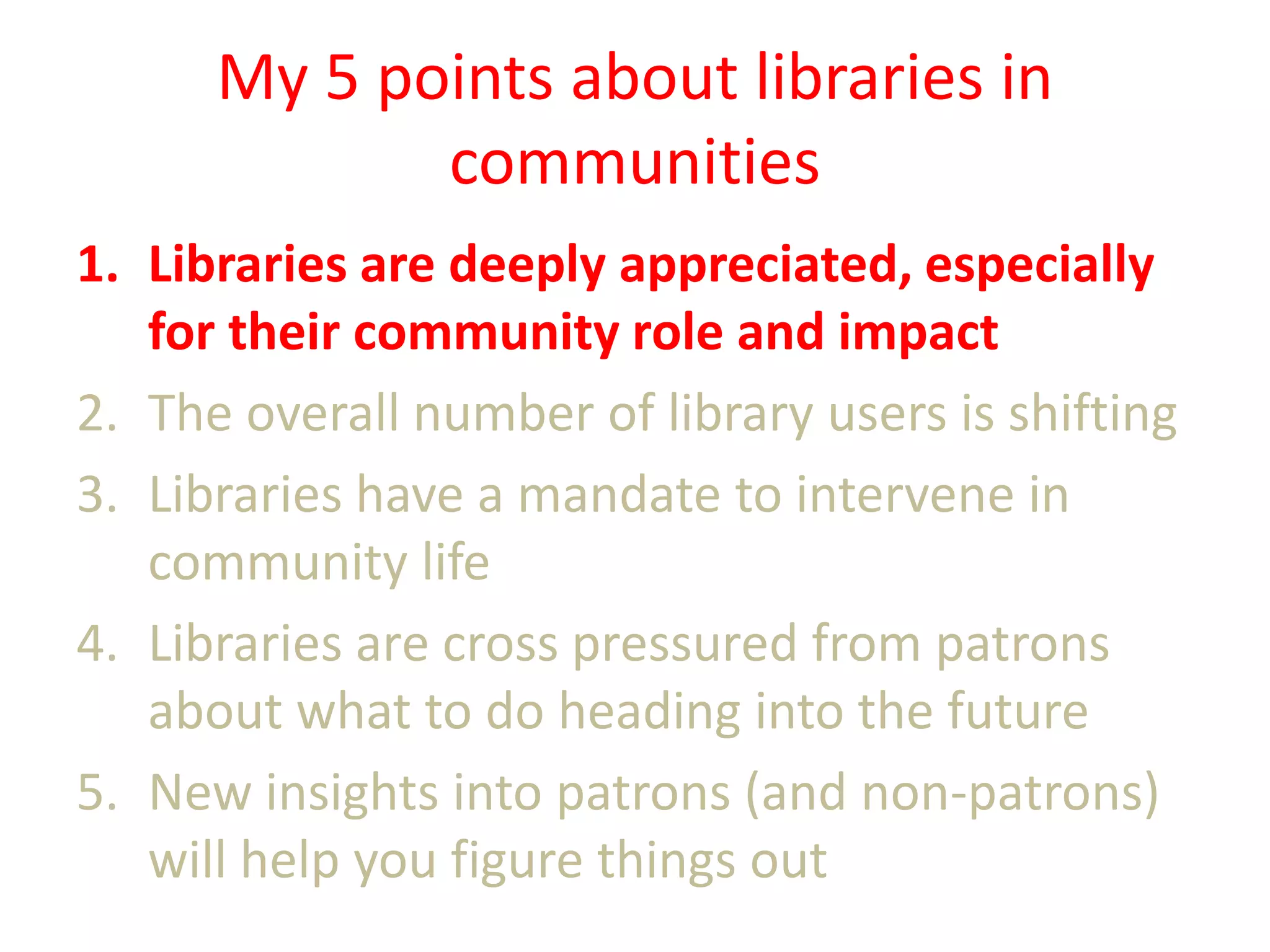
My 5 points about libraries in
communities
1. Libraries are deeply appreciated, especially
for their community role and impact
2. The overall number of library users is shifting
3. Libraries have a mandate to intervene in
community life
4. Libraries are cross pressured from patrons
about what to do heading into the future
5. New insights into patrons (and non-patrons)
will help you figure things out
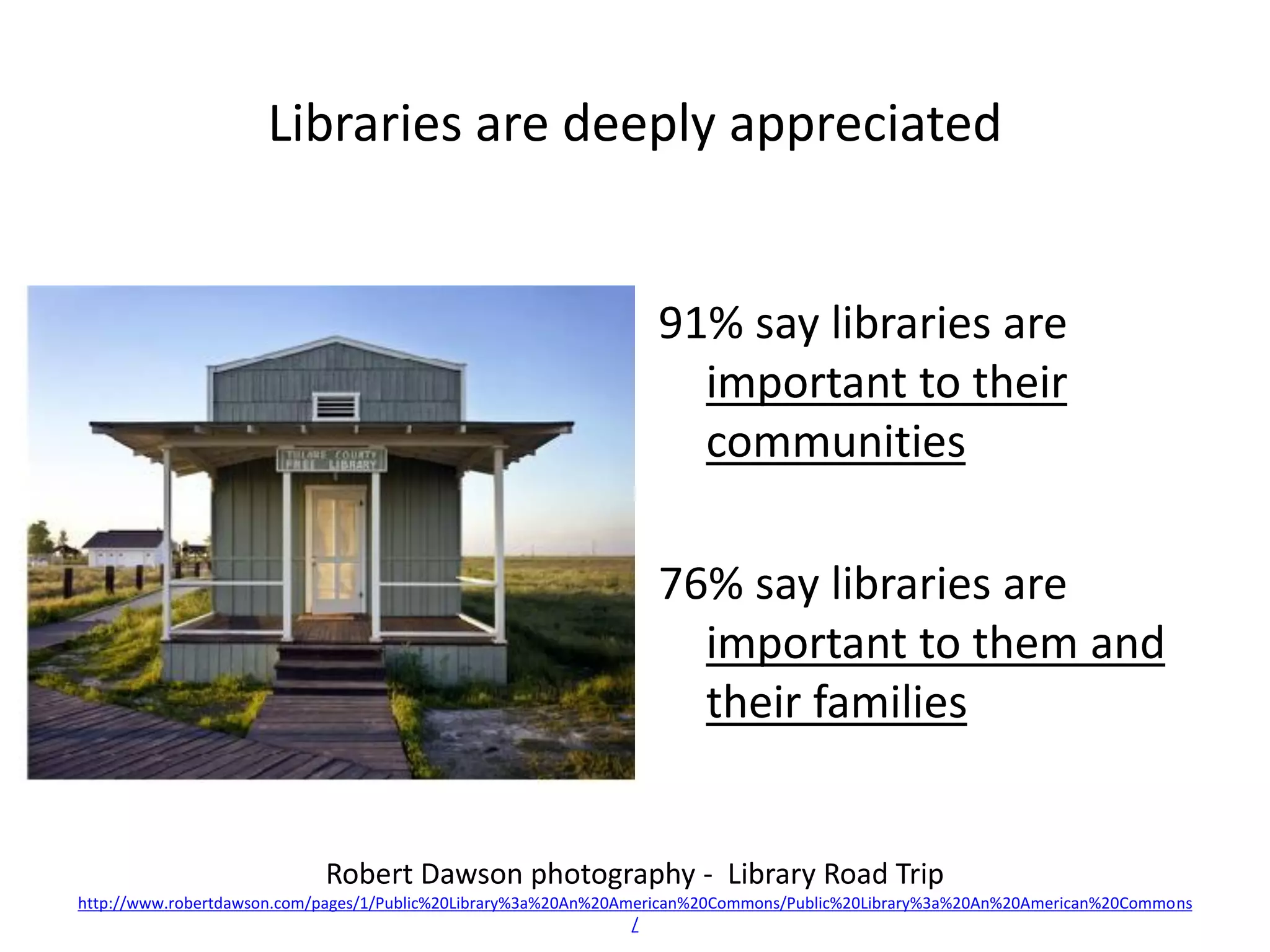
Libraries are deeply appreciated

91% say libraries are
important to their
communities
76% say libraries are
important to them and
their families

Robert Dawson photography - Library Road Trip
http://www.robertdawson.com/pages/1/Public%20Library%3a%20An%20American%20Commons/Public%20Library%3a%20An%20American%20Commons
/
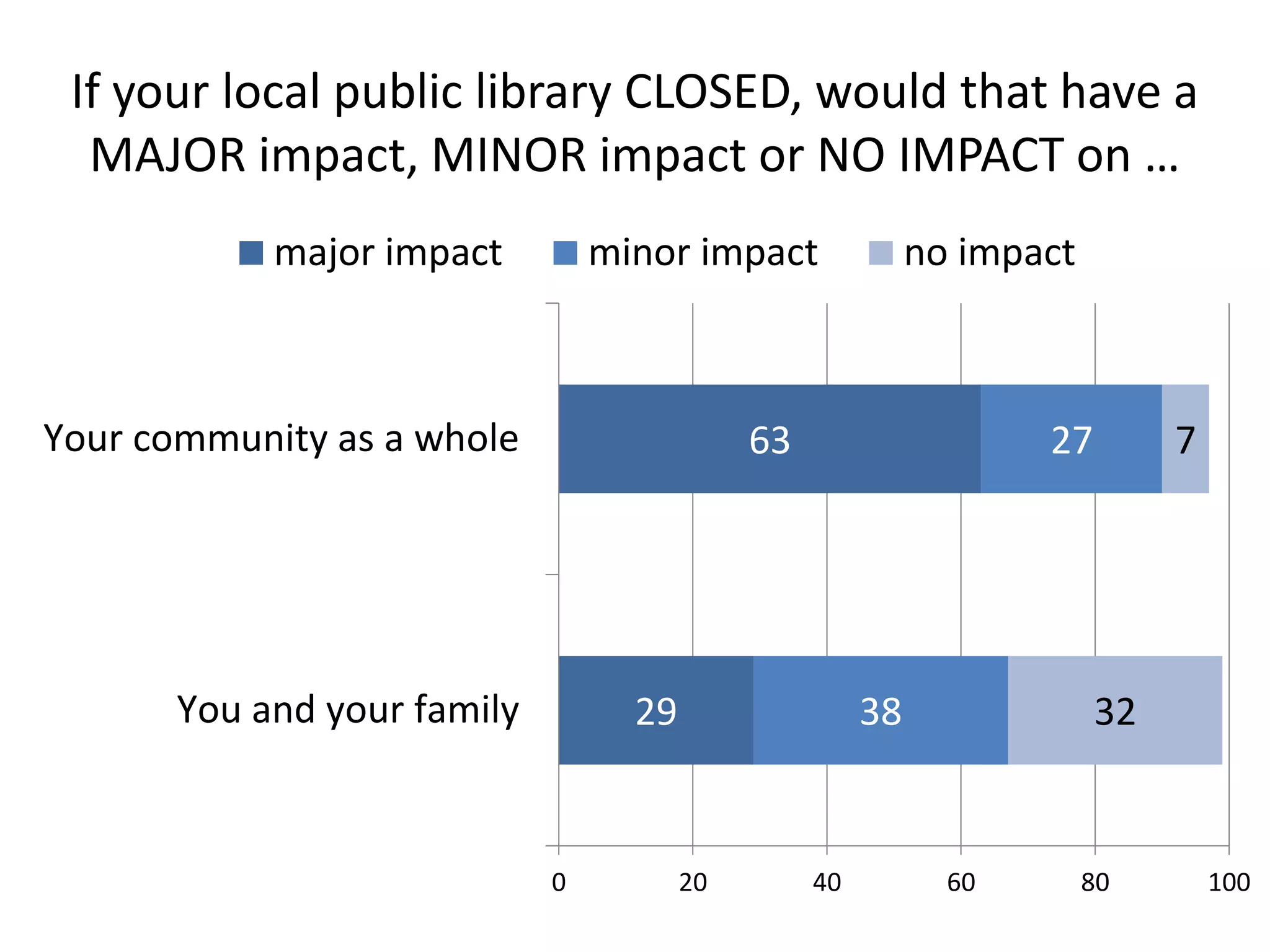
If your local public library CLOSED, would that have a
MAJOR impact, MINOR impact or NO IMPACT on …
major impact

minor impact

Your community as a whole

no impact

63

You and your family

27

29

0

38

20

40

7

32

60

80

100
Agree / disagree questions
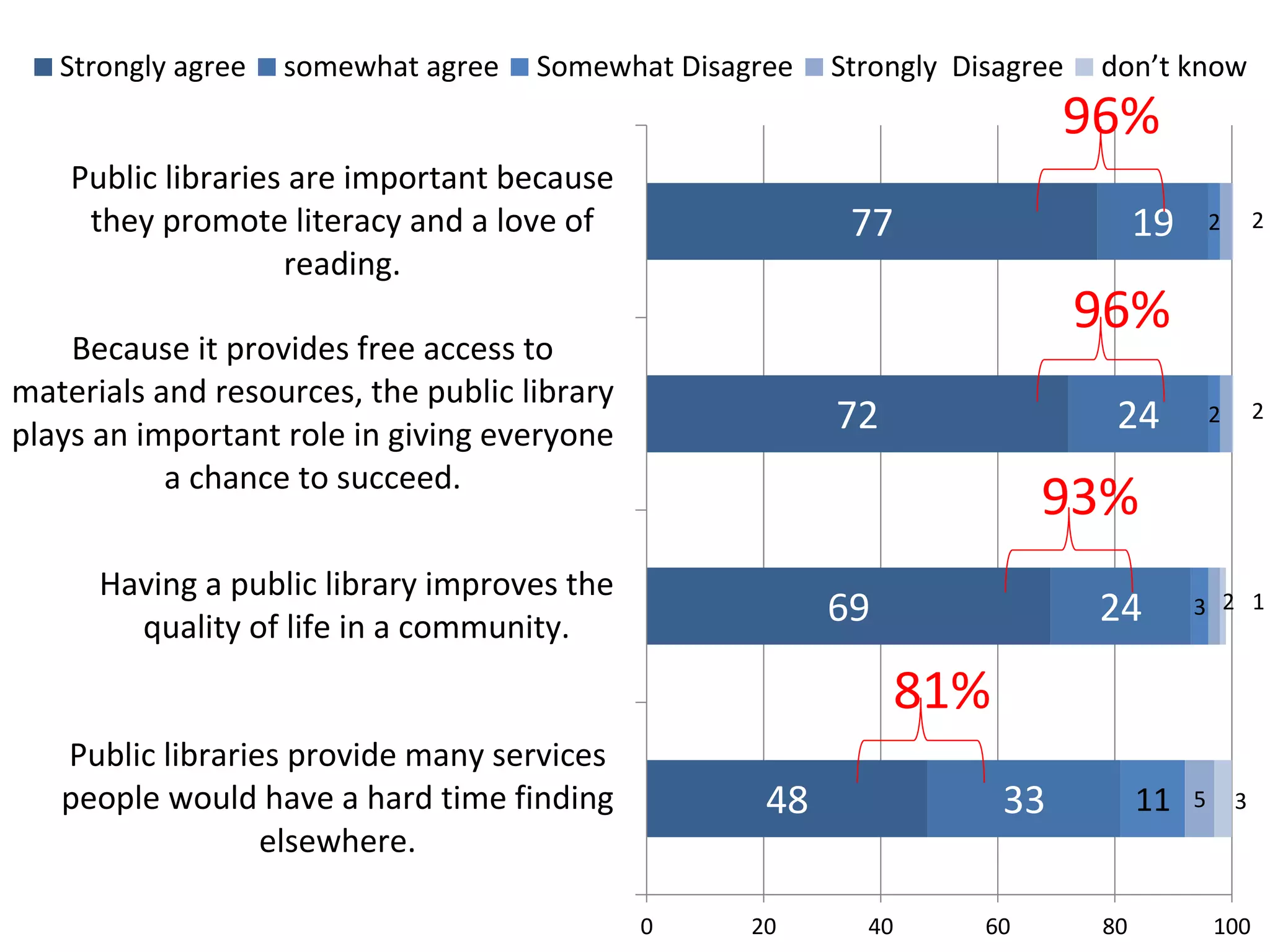
Strongly agree

somewhat agree

Somewhat Disagree

Strongly Disagree

don’t know

96%
Public libraries are important because
they promote literacy and a love of
reading.

77

19

2

2

2

2

96%

Because it provides free access to
materials and resources, the public library
plays an important role in giving everyone
a chance to succeed.

72

Having a public library improves the
quality of life in a community.

69

24

93%
24

3 2 1

81%
Public libraries provide many services
people would have a hard time finding
elsewhere.

48
0

20

33
40

60

11

80

5

3

100
Strongly agree

somewhat agree

Somewhat Disagree

Strongly Disagree

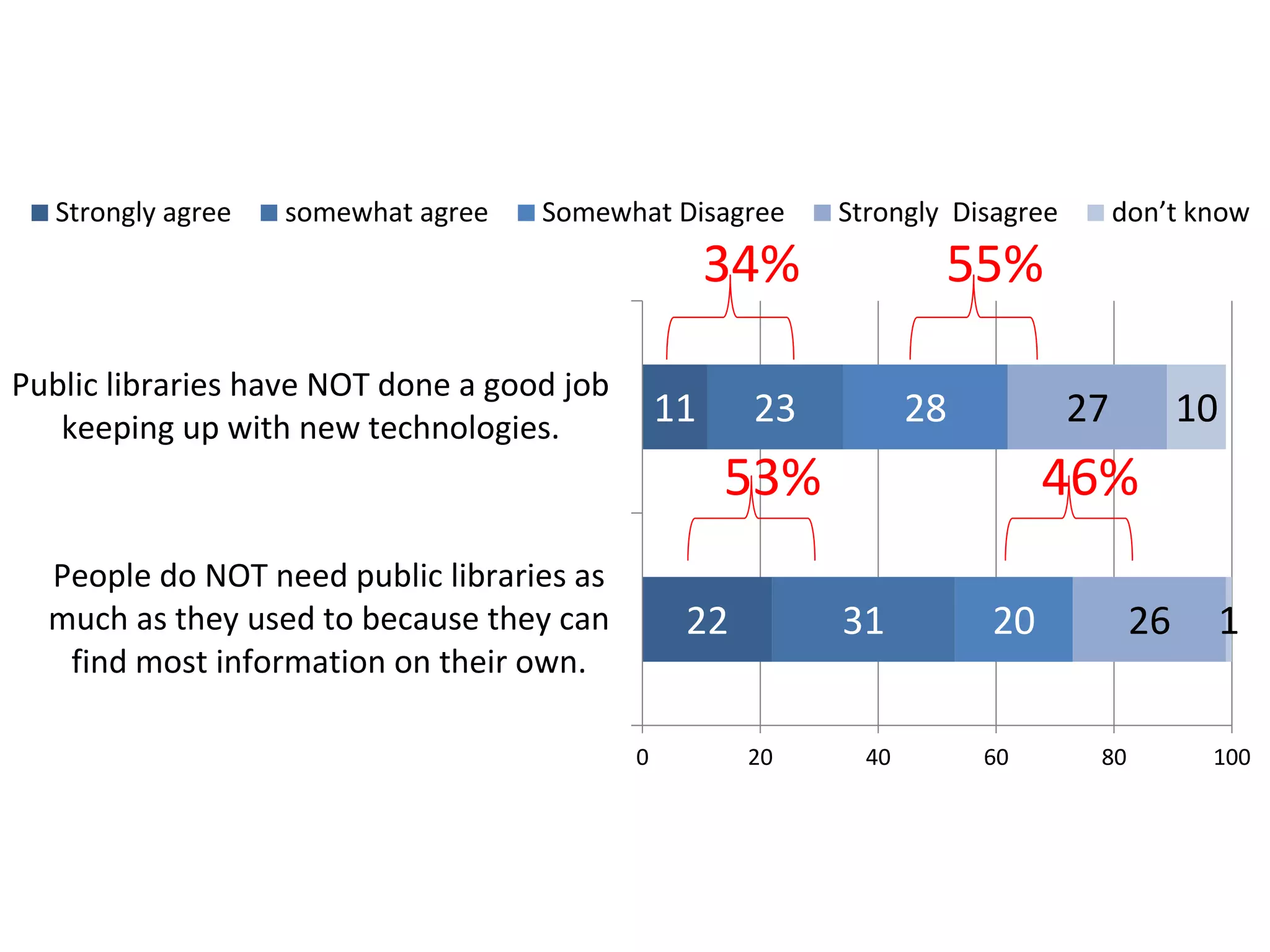
34%
Public libraries have NOT done a good job
keeping up with new technologies.

11

55%

23

28

27

53%
People do NOT need public libraries as
much as they used to because they can
find most information on their own.

22
0

10

46%
31

20

don’t know

40

20
60

26
80

1
100
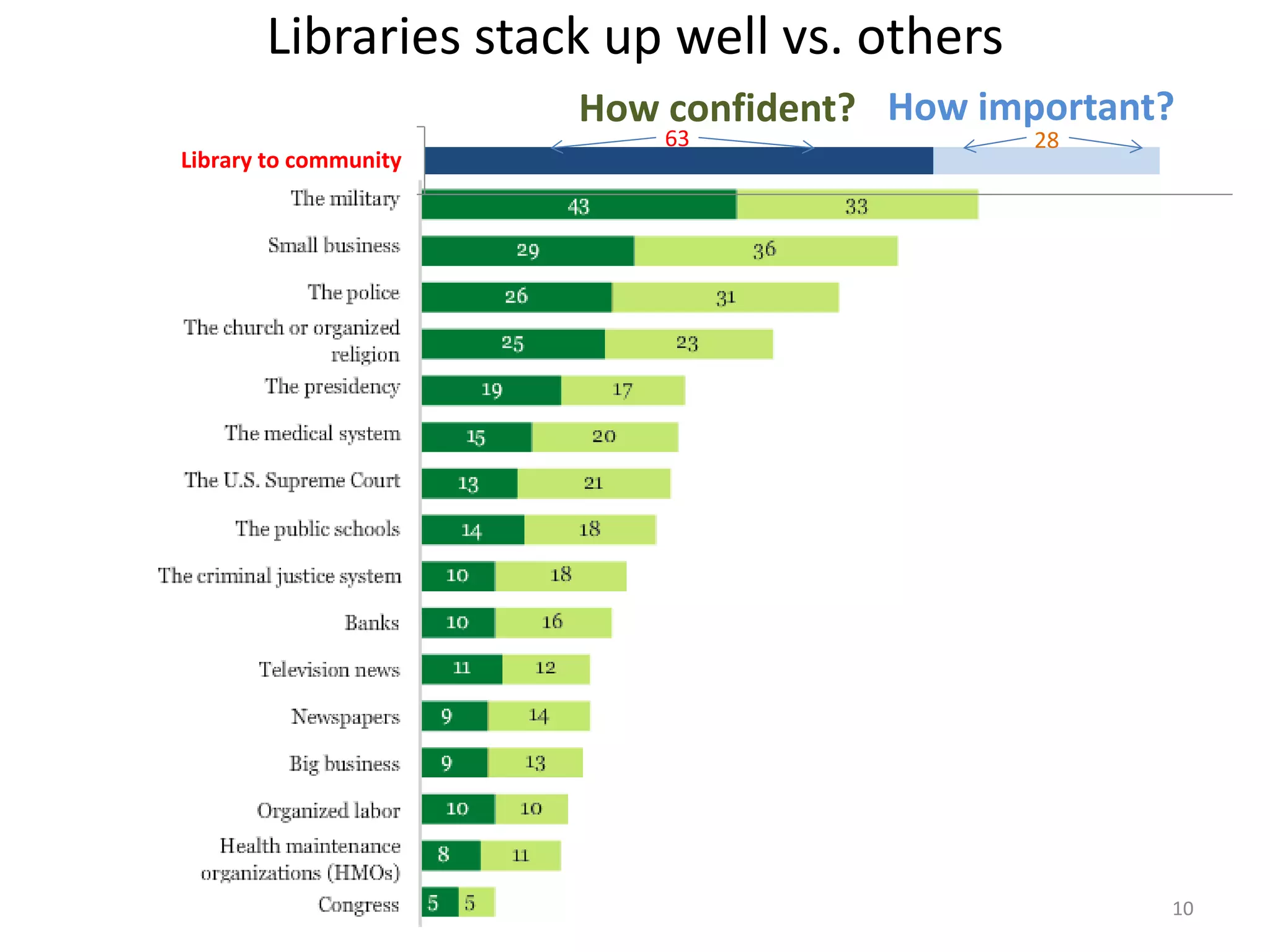
Libraries stack up well vs. others
How confident? How important?
Library to community

63

28

10
My 5 points about libraries in
communities
1. Libraries are deeply appreciated, especially
for their community role and impact
2. The overall number of library users is
shifting
3. Libraries have a mandate to intervene in
community life
4. Libraries are cross pressured from patrons
about what to do heading into the future
5. New insights into patrons (and non-patrons)
will help you figure things out
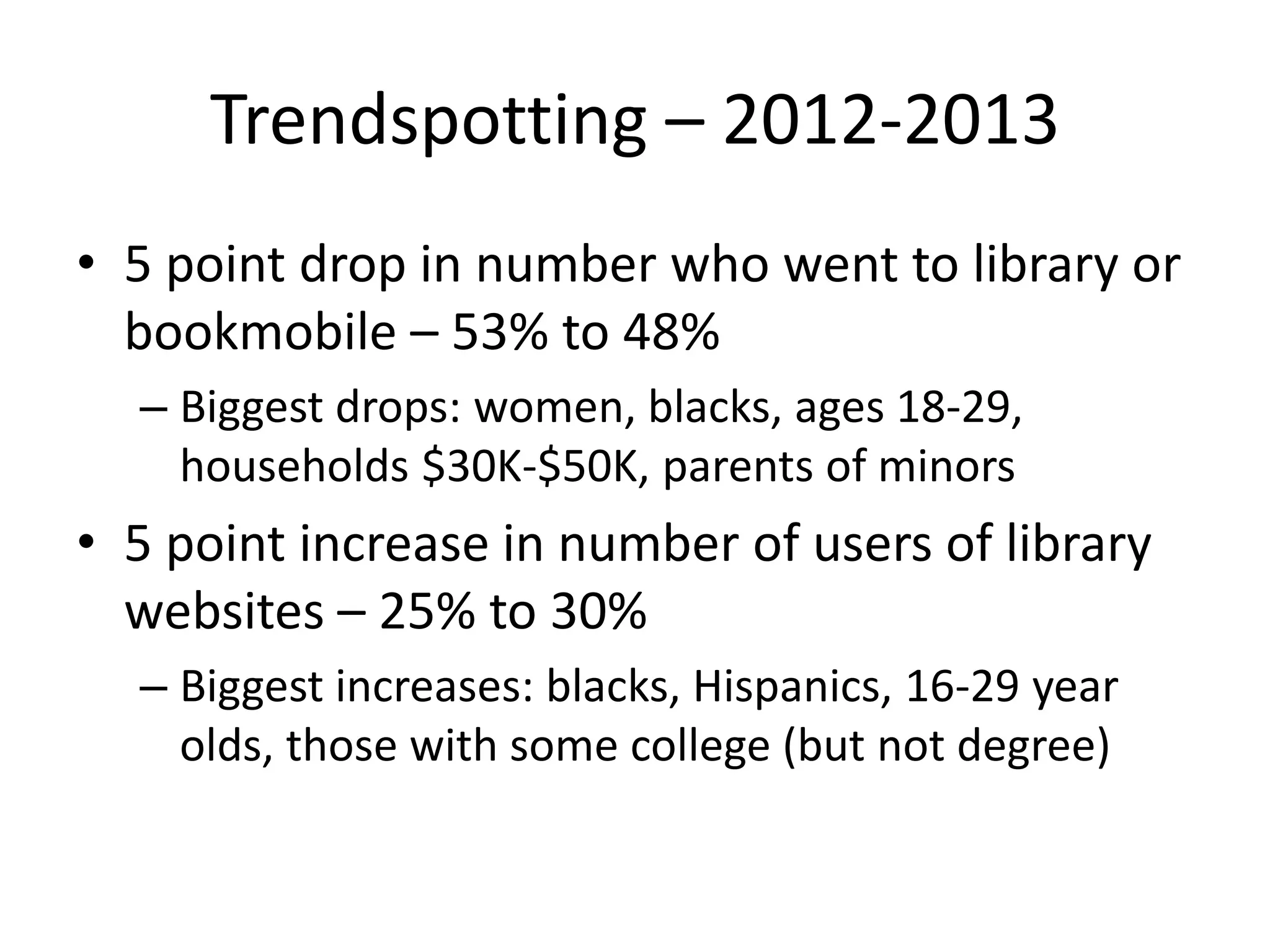
Trendspotting – 2012-2013
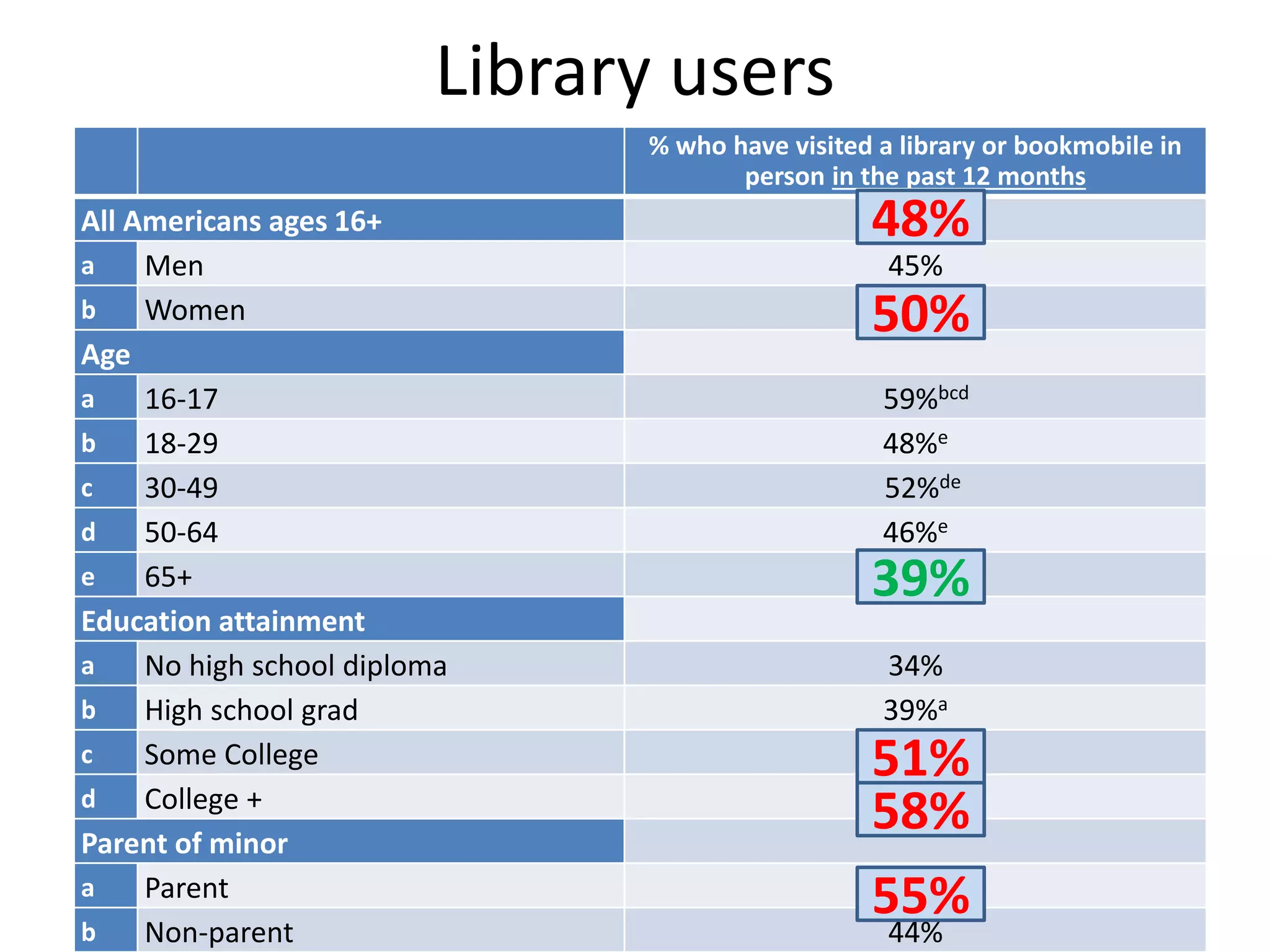
• 5 point drop in number who went to library or
bookmobile – 53% to 48%
– Biggest drops: women, blacks, ages 18-29,
households $30K-$50K, parents of minors

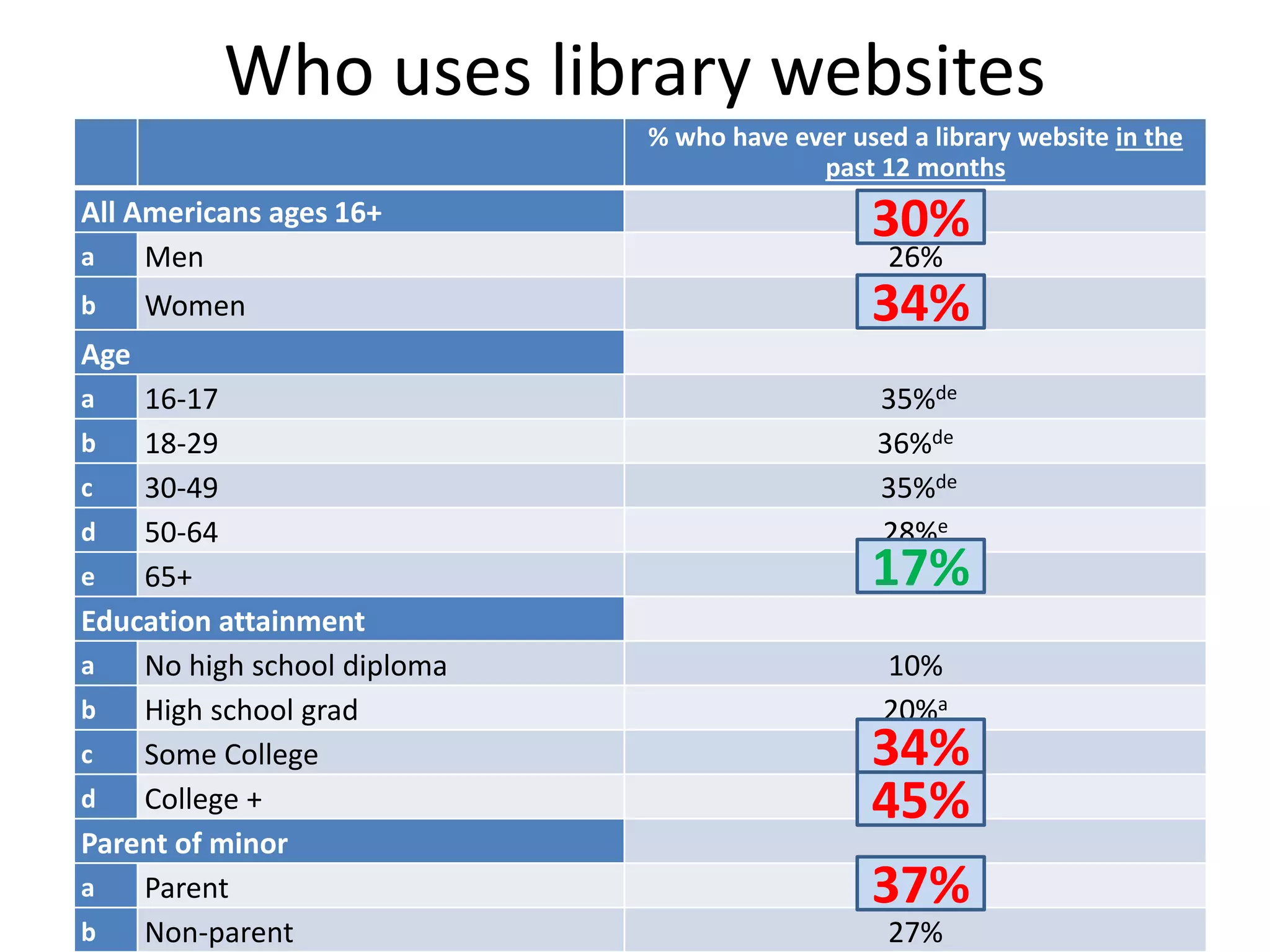
• 5 point increase in number of users of library
websites – 25% to 30%
– Biggest increases: blacks, Hispanics, 16-29 year
olds, those with some college (but not degree)
Library users
% who have visited a library or bookmobile in
person in the past 12 months

All Americans ages 16+
a
Men
b
Women
Age
a
16-17
b
18-29
c
30-49
d
50-64
e
65+
Education attainment
a
No high school diploma
b
High school grad
c
Some College
d
College +
Parent of minor
a
Parent
b
Non-parent

48%
48%
45%
50%a

50%
59%bcd
48%e
52%de
46%e
39%

39%
34%
39%a
51%ab
58%abd

51%
58%
55%
55%
b

44%
Who uses library websites
% who have ever used a library website in the
past 12 months

All Americans ages 16+
a
Men
b

Women

30%
30%
26%
34%
34%
a

Age

16-17
b
18-29
c
30-49
d
50-64
e
65+
Education attainment
a
No high school diploma
b
High school grad
c
Some College
d
College +
Parent of minor
a
Parent
b
Non-parent
a

35%de
36%de
35%de
28%e
17%

17%
10%
20%a
34%ab
45%abc

34%
45%
37%
37%
b

27%
My 5 points about libraries in
communities
1. Libraries are deeply appreciated, especially
for their community role and impact
2. The overall number of library users is shifting
3. Libraries have a mandate to intervene in
community life
4. Libraries are cross pressured from patrons
about what to do heading into the future
5. New insights into patrons (and non-patrons)
will help you figure things out
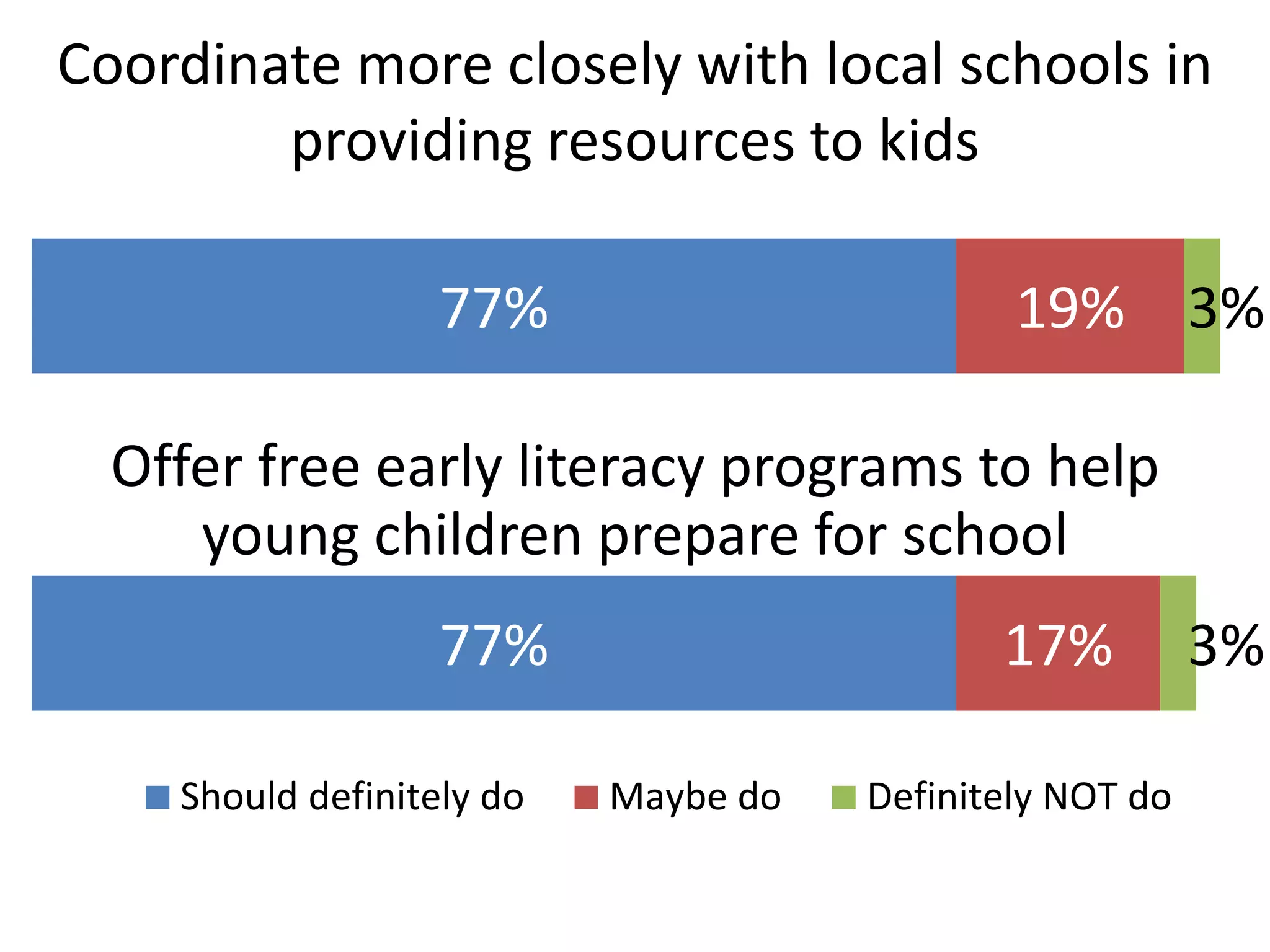
Coordinate more closely with local schools in
providing resources to kids

77%

19% 3%

Offer free early literacy programs to help
young children prepare for school
77%
Should definitely do

17%
Maybe do

Definitely NOT do

3%
My 5 points about libraries in
communities
1. Libraries are deeply appreciated, especially
for their community role and impact
2. The overall number of library users is shifting
3. Libraries have a mandate to intervene in
community life
4. Libraries are cross pressured from patrons
about what to do heading into the future
5. New insights into patrons (and non-patrons)
will help you figure things out
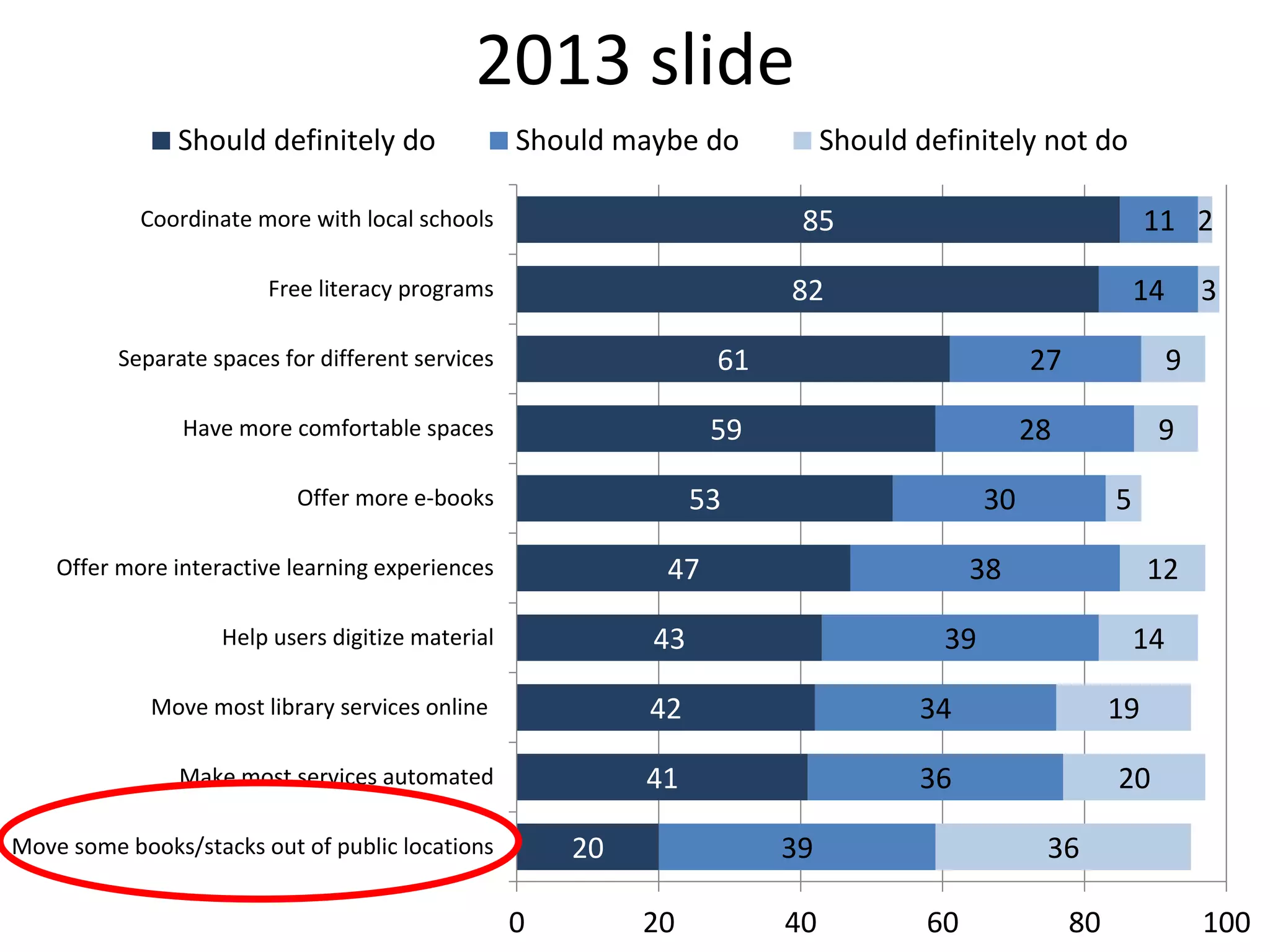
2013 slide
Should definitely do

Should maybe do

Should definitely not do
85

Coordinate more with local schools

11 2

82

Free literacy programs

Separate spaces for different services

61

Have more comfortable spaces

14
27

59

9

30

47

Offer more interactive learning experiences

9

28

53

Offer more e-books

5

38

Help users digitize material

43

Move most library services online

42
41

12

34

Make most services automated

36

20

Move some books/stacks out of public locations

0

39

39
20

40

3

14
19
20
36

60

80

100
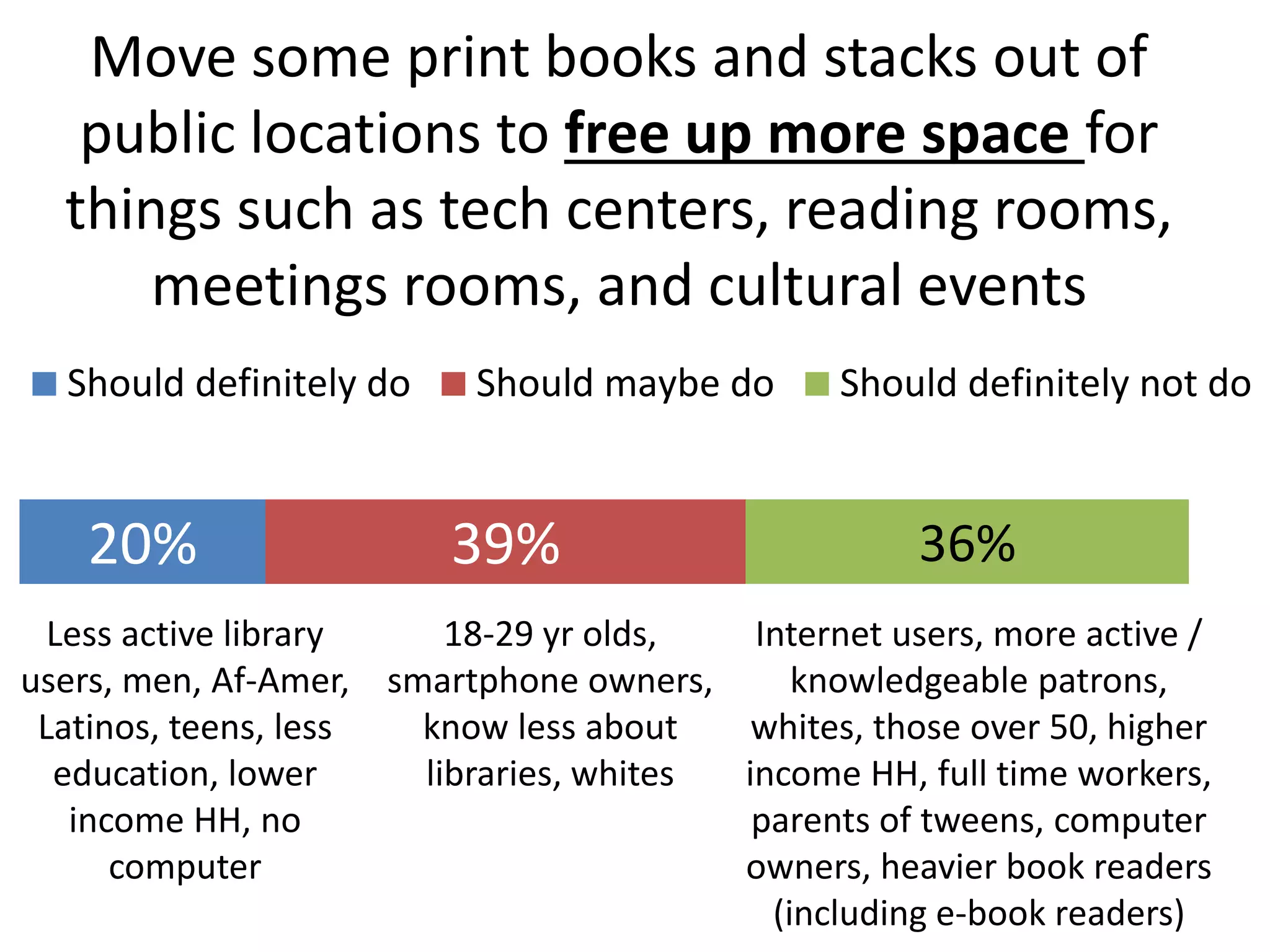
Move some print books and stacks out of
public locations to free up more space for
things such as tech centers, reading rooms,
meetings rooms, and cultural events
Should definitely do

20%

Should maybe do

39%

Less active library
18-29 yr olds,
users, men, Af-Amer, smartphone owners,
Latinos, teens, less
know less about
education, lower
libraries, whites
income HH, no
computer

Should definitely not do

36%
Internet users, more active /
knowledgeable patrons,
whites, those over 50, higher
income HH, full time workers,
parents of tweens, computer
owners, heavier book readers
(including e-book readers)
My 5 points about libraries in
communities
1. Libraries are deeply appreciated, especially
for their community role and impact
2. The overall number of library users is shifting
3. Libraries have a mandate to intervene in
community life
4. Libraries are cross pressured from patrons
about what to do heading into the future
5. New insights into patrons (and non-patrons)
will help you figure things out
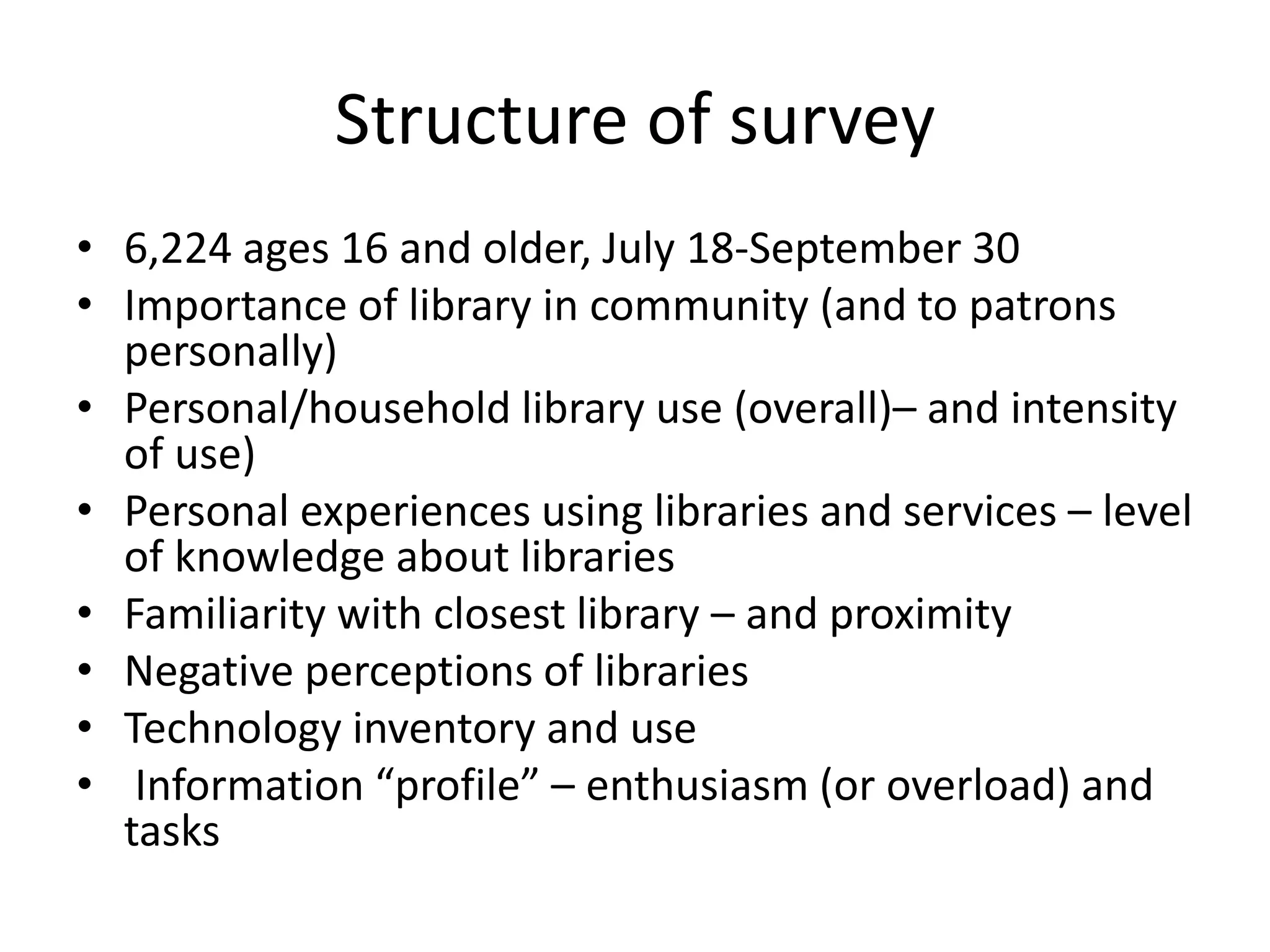
Structure of survey
• 6,224 ages 16 and older, July 18-September 30
• Importance of library in community (and to patrons
personally)
• Personal/household library use (overall)– and intensity
of use)
• Personal experiences using libraries and services – level
of knowledge about libraries
• Familiarity with closest library – and proximity
• Negative perceptions of libraries
• Technology inventory and use
• Information “profile” – enthusiasm (or overload) and
tasks
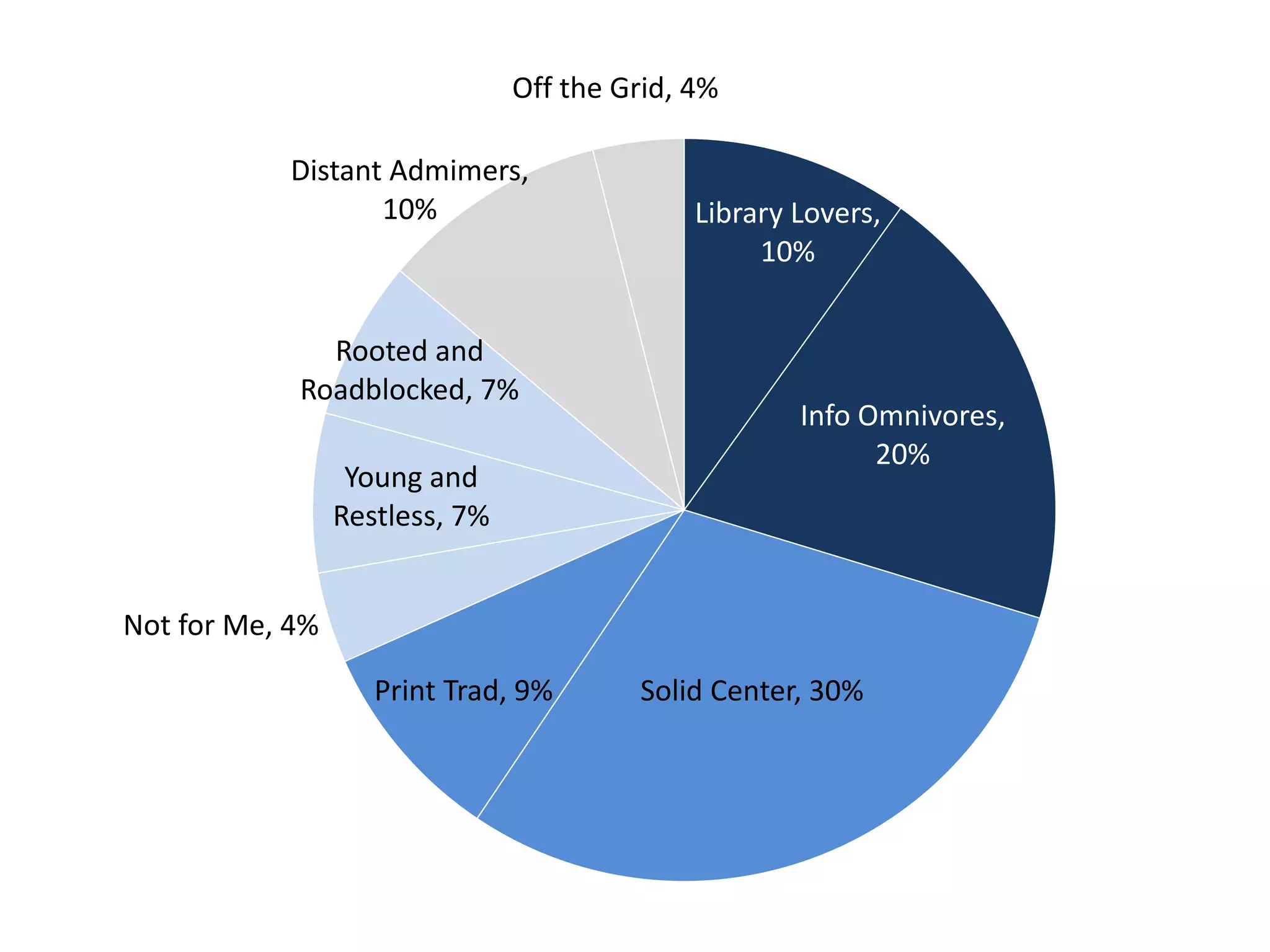
Off the Grid, 4%
Distant Admimers,
10%

Rooted and
Roadblocked, 7%
Young and
Restless, 7%

Library Lovers,
10%

Info Omnivores,
20%

Not for Me, 4%

Print Trad, 9%

Solid Center, 30%
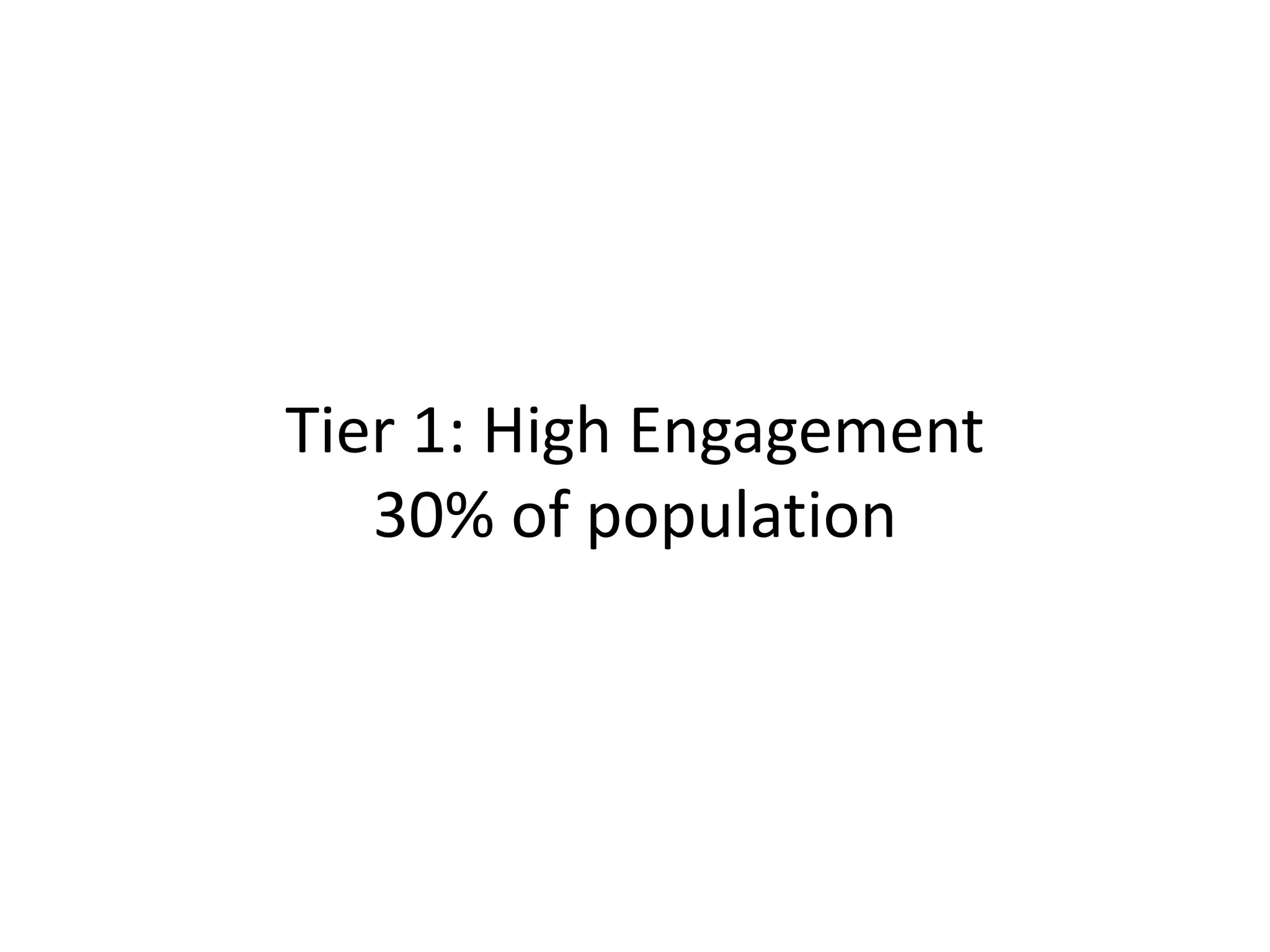
Tier 1: High Engagement
30% of population
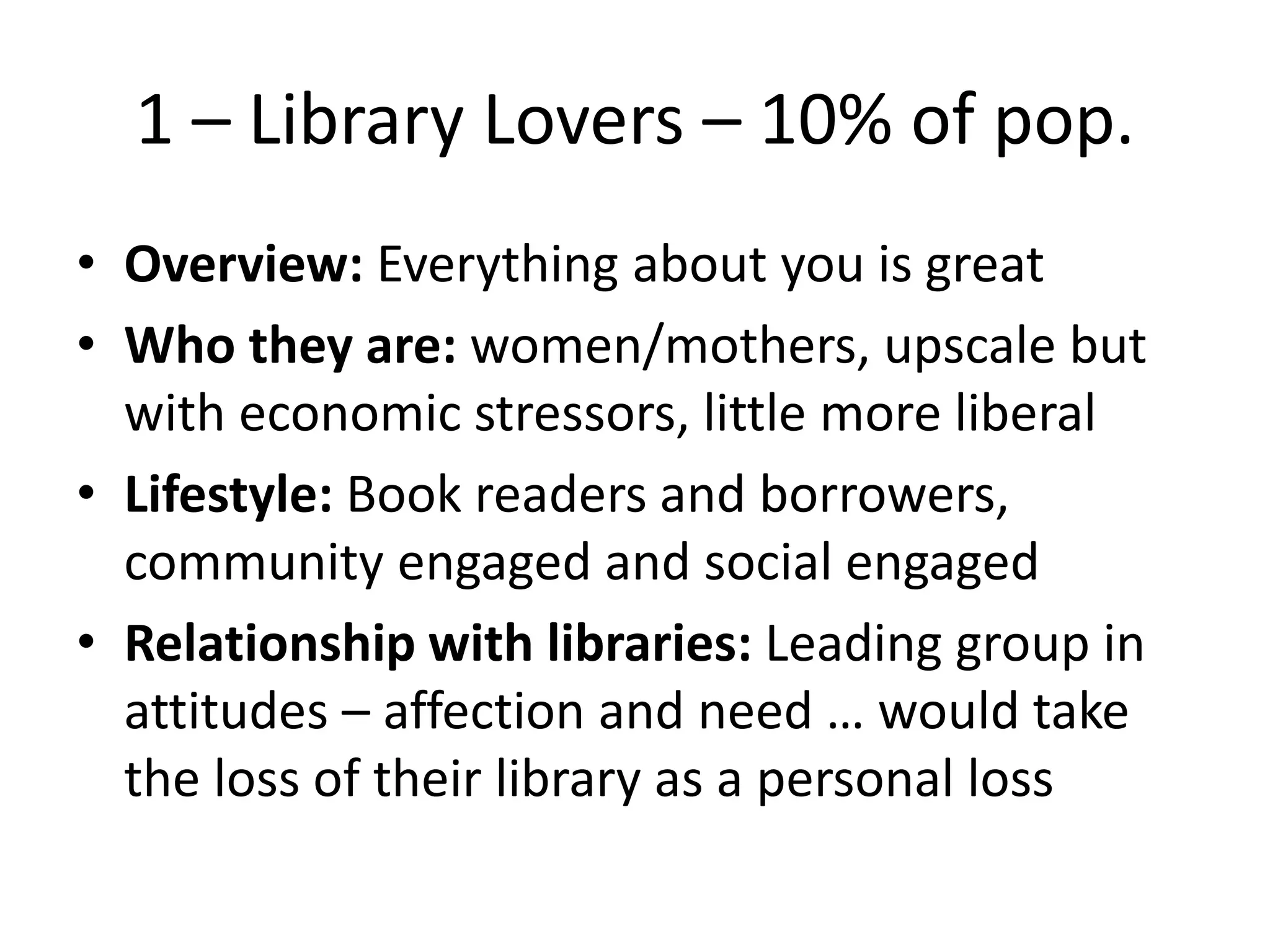
1 – Library Lovers – 10% of pop.
• Overview: Everything about you is great
• Who they are: women/mothers, upscale but
with economic stressors, little more liberal
• Lifestyle: Book readers and borrowers,
community engaged and social engaged
• Relationship with libraries: Leading group in
attitudes – affection and need … would take
the loss of their library as a personal loss
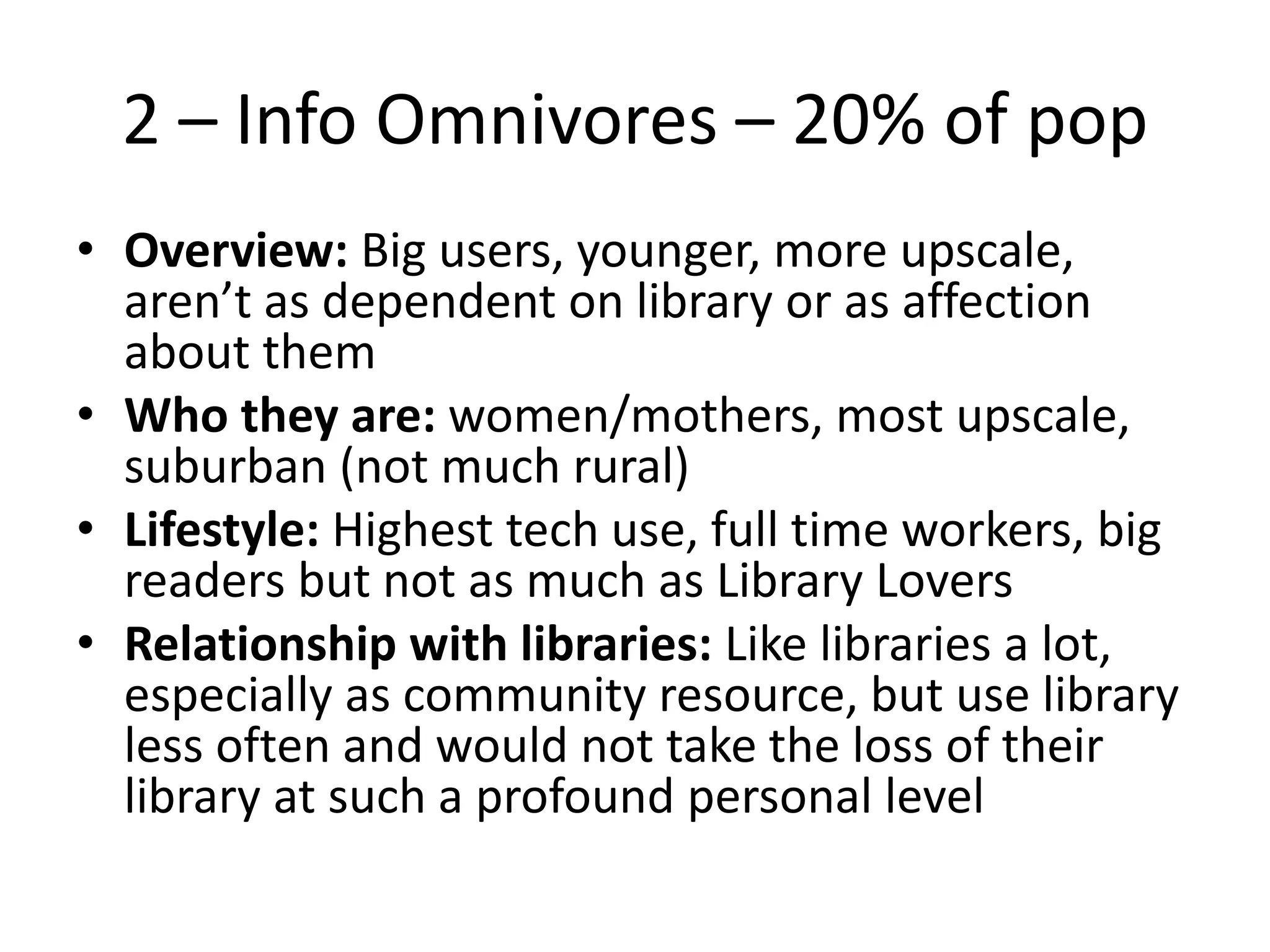
2 – Info Omnivores – 20% of pop
• Overview: Big users, younger, more upscale,
aren’t as dependent on library or as affection
about them
• Who they are: women/mothers, most upscale,
suburban (not much rural)
• Lifestyle: Highest tech use, full time workers, big
readers but not as much as Library Lovers
• Relationship with libraries: Like libraries a lot,
especially as community resource, but use library
less often and would not take the loss of their
library at such a profound personal level
Tier 2: Medium Engagement
39% of population
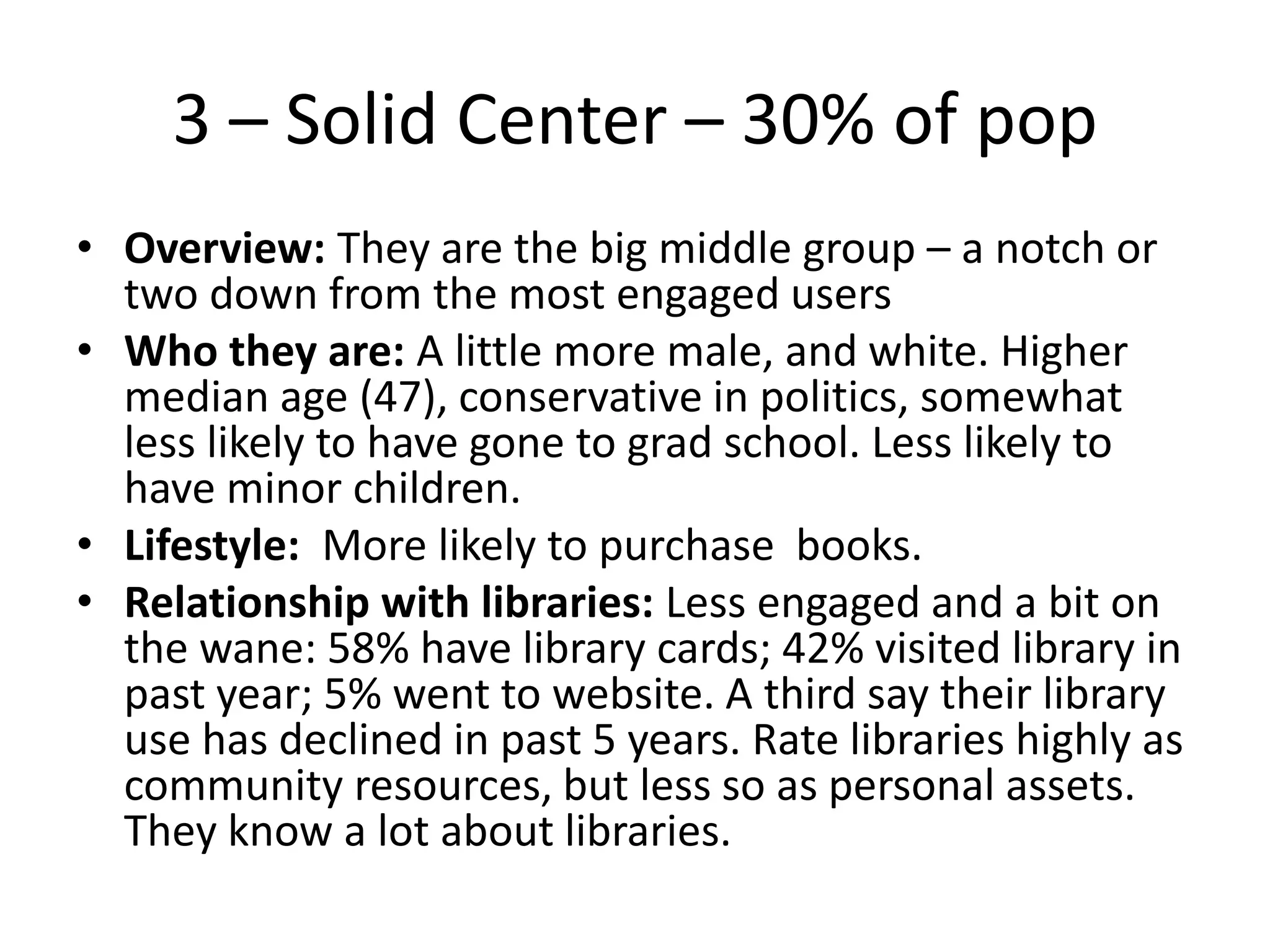
3 – Solid Center – 30% of pop
• Overview: They are the big middle group – a notch or
two down from the most engaged users
• Who they are: A little more male, and white. Higher
median age (47), conservative in politics, somewhat
less likely to have gone to grad school. Less likely to
have minor children.
• Lifestyle: More likely to purchase books.
• Relationship with libraries: Less engaged and a bit on
the wane: 58% have library cards; 42% visited library in
past year; 5% went to website. A third say their library
use has declined in past 5 years. Rate libraries highly as
community resources, but less so as personal assets.
They know a lot about libraries.
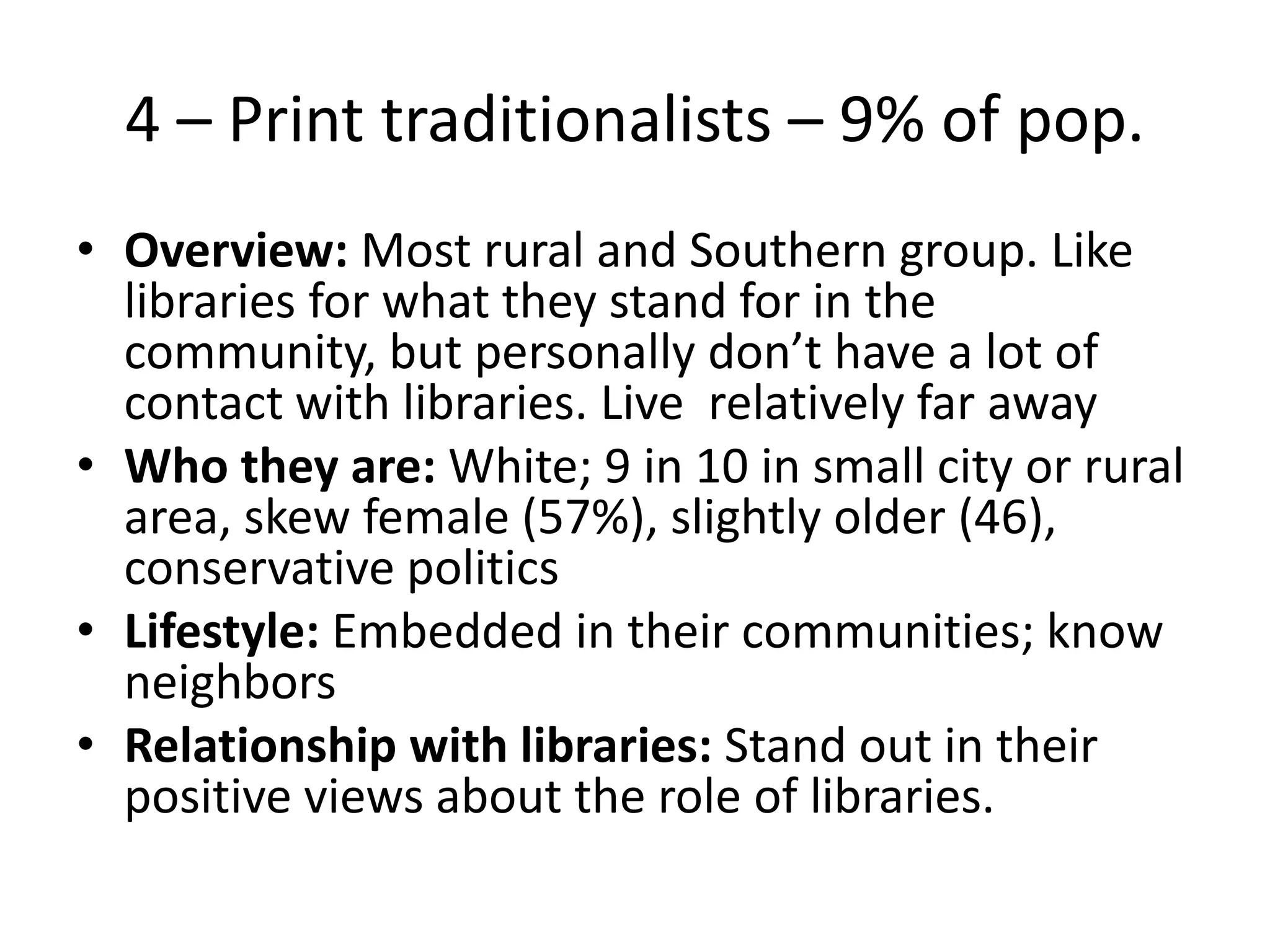
4 – Print traditionalists – 9% of pop.
• Overview: Most rural and Southern group. Like
libraries for what they stand for in the
community, but personally don’t have a lot of
contact with libraries. Live relatively far away
• Who they are: White; 9 in 10 in small city or rural
area, skew female (57%), slightly older (46),
conservative politics
• Lifestyle: Embedded in their communities; know
neighbors
• Relationship with libraries: Stand out in their
positive views about the role of libraries.
Tier 3: Low Engagement
18% of population
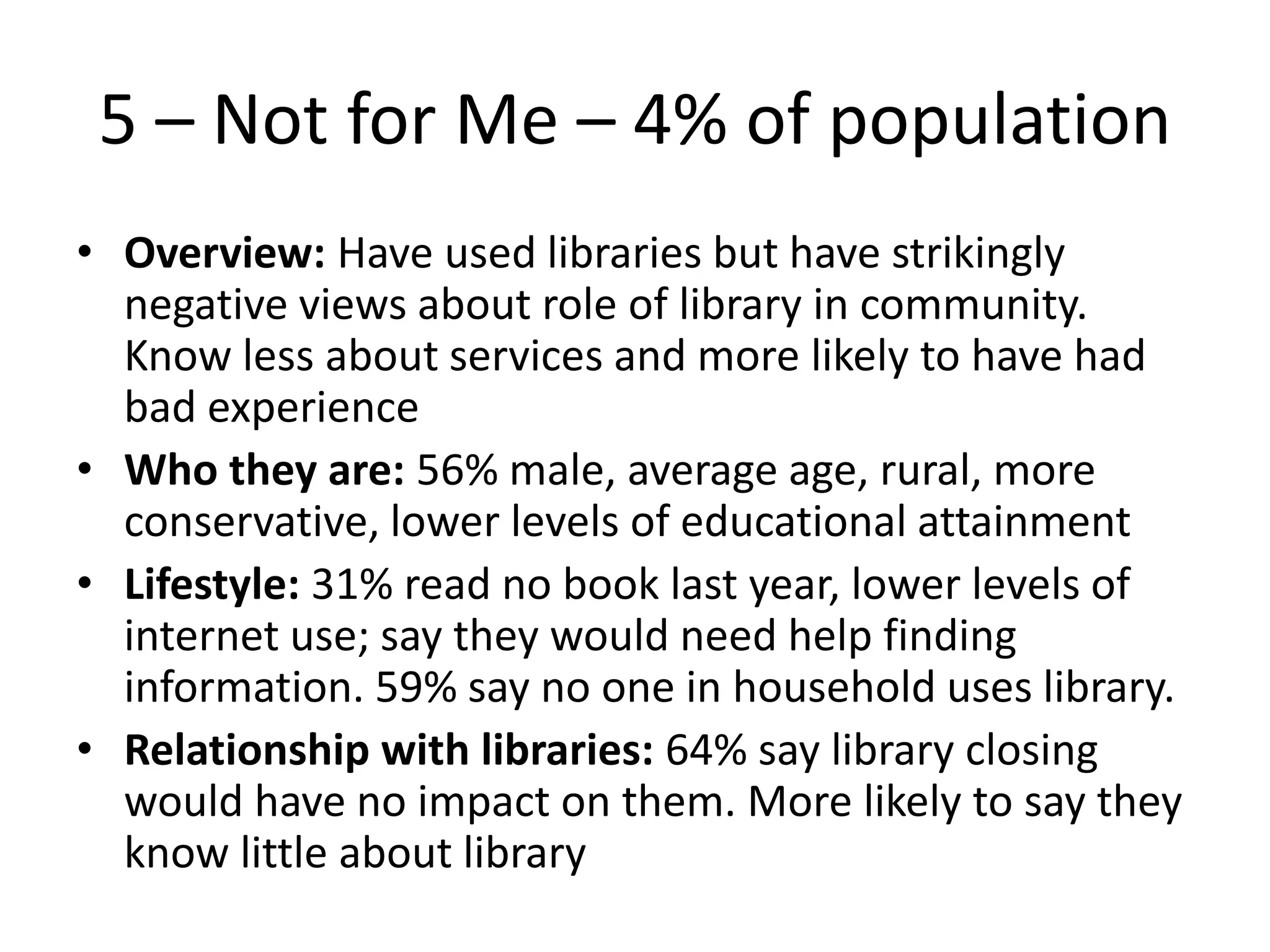
5 – Not for Me – 4% of population
• Overview: Have used libraries but have strikingly
negative views about role of library in community.
Know less about services and more likely to have had
bad experience
• Who they are: 56% male, average age, rural, more
conservative, lower levels of educational attainment
• Lifestyle: 31% read no book last year, lower levels of
internet use; say they would need help finding
information. 59% say no one in household uses library.
• Relationship with libraries: 64% say library closing
would have no impact on them. More likely to say they
know little about library
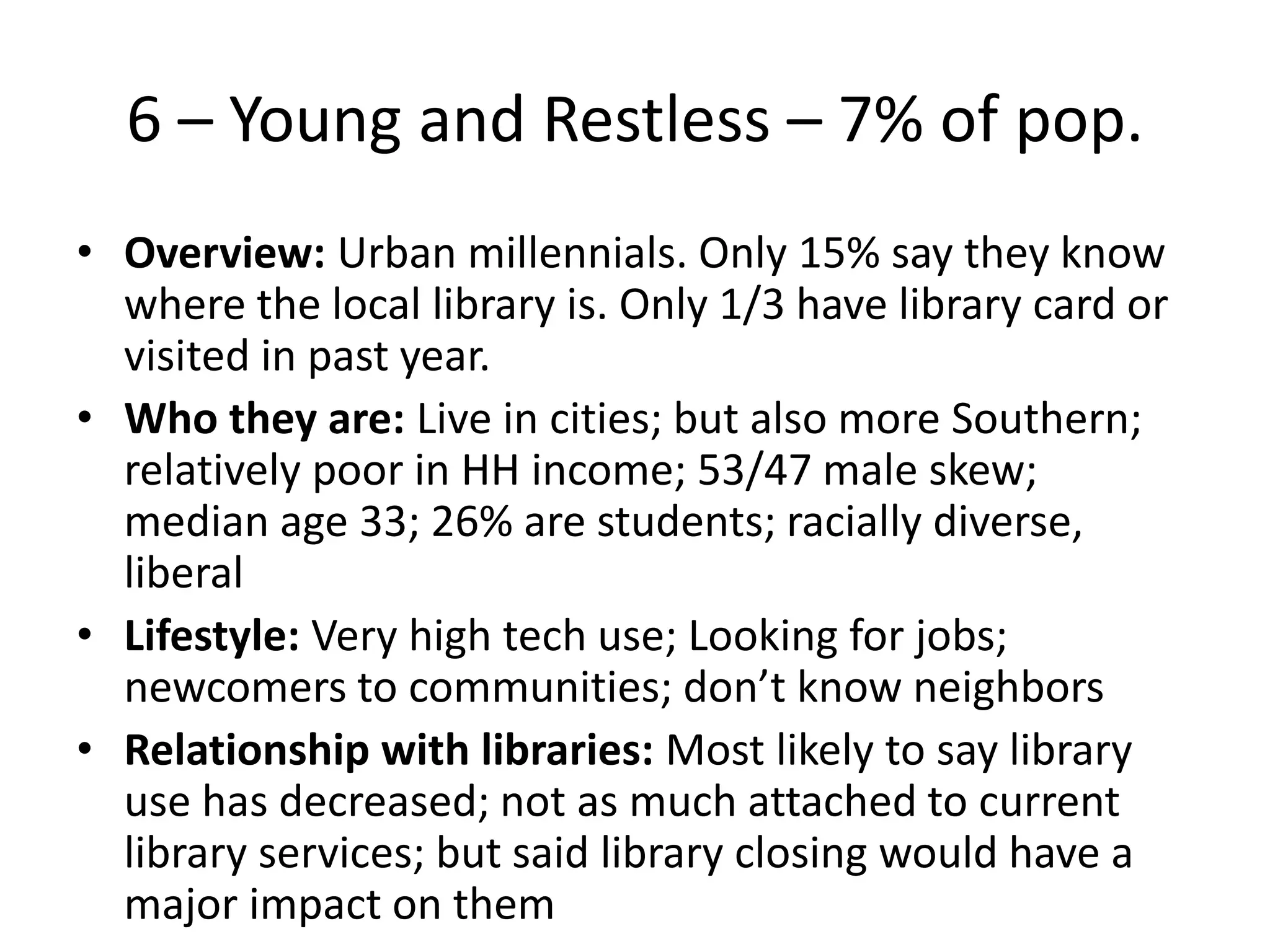
6 – Young and Restless – 7% of pop.
• Overview: Urban millennials. Only 15% say they know
where the local library is. Only 1/3 have library card or
visited in past year.
• Who they are: Live in cities; but also more Southern;
relatively poor in HH income; 53/47 male skew;
median age 33; 26% are students; racially diverse,
liberal
• Lifestyle: Very high tech use; Looking for jobs;
newcomers to communities; don’t know neighbors
• Relationship with libraries: Most likely to say library
use has decreased; not as much attached to current
library services; but said library closing would have a
major impact on them
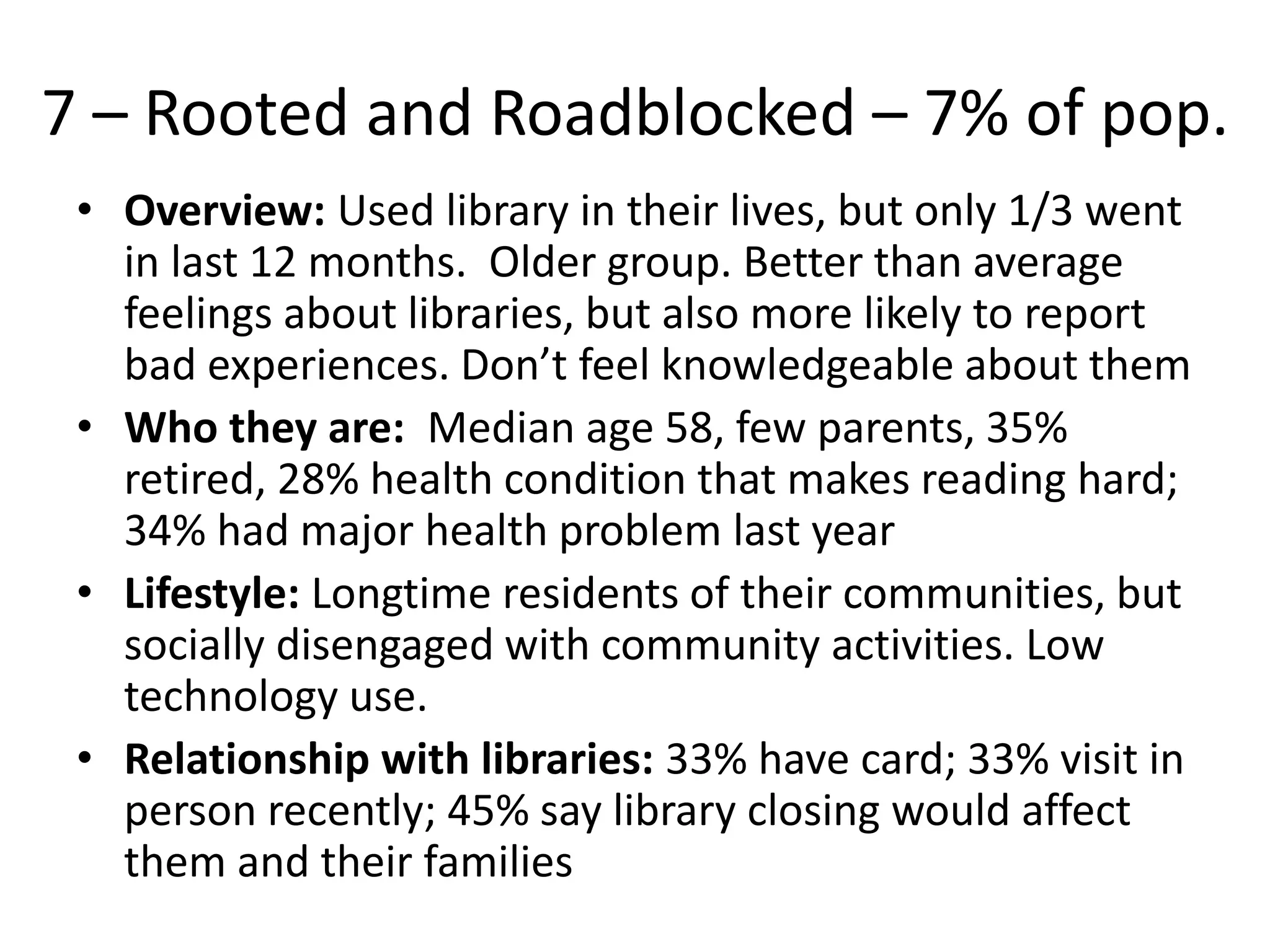
7 – Rooted and Roadblocked – 7% of pop.
• Overview: Used library in their lives, but only 1/3 went
in last 12 months. Older group. Better than average
feelings about libraries, but also more likely to report
bad experiences. Don’t feel knowledgeable about them
• Who they are: Median age 58, few parents, 35%
retired, 28% health condition that makes reading hard;
34% had major health problem last year
• Lifestyle: Longtime residents of their communities, but
socially disengaged with community activities. Low
technology use.
• Relationship with libraries: 33% have card; 33% visit in
person recently; 45% say library closing would affect
them and their families
No personal library use:
14% of population
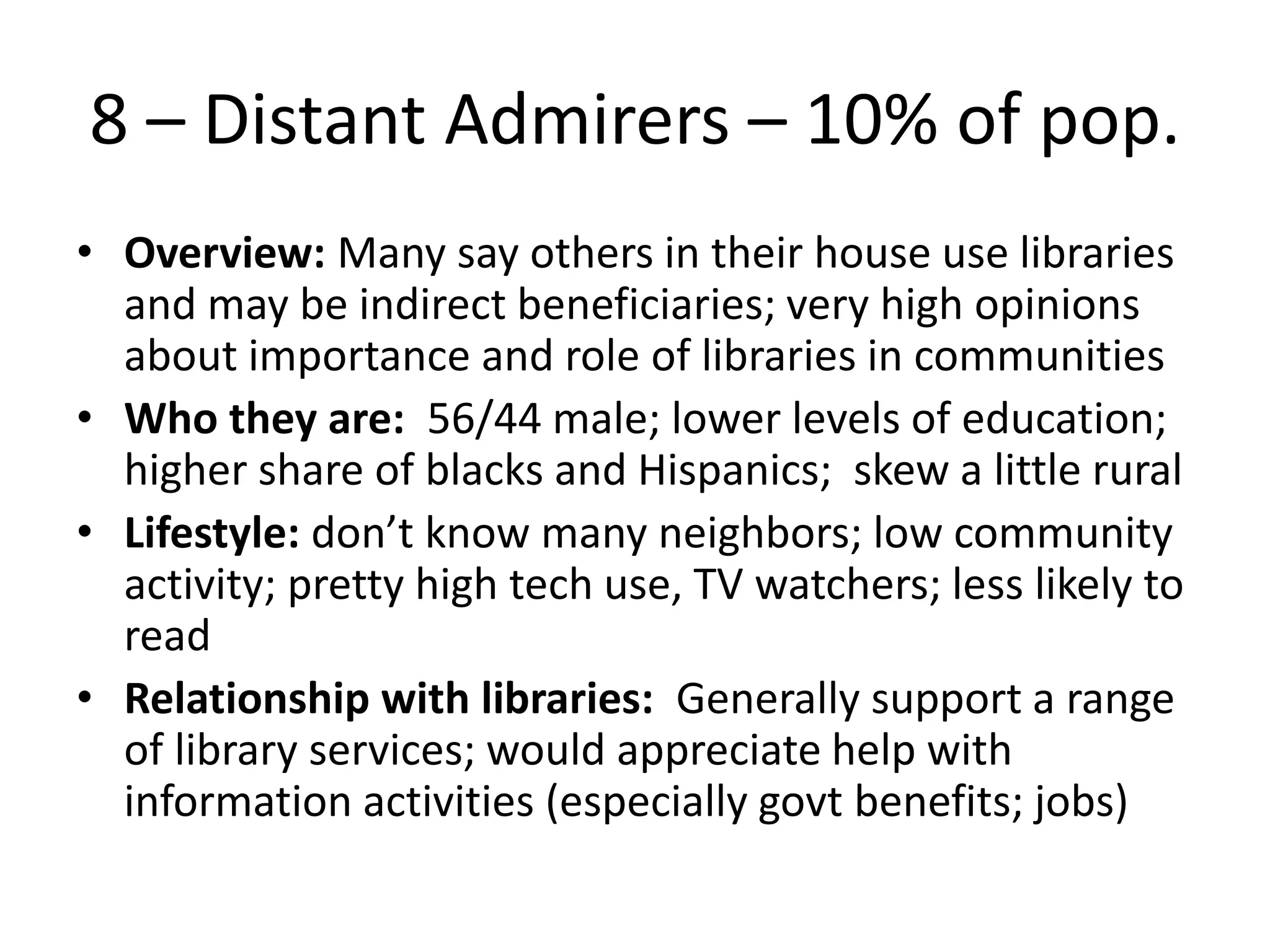
8 – Distant Admirers – 10% of pop.
• Overview: Many say others in their house use libraries
and may be indirect beneficiaries; very high opinions
about importance and role of libraries in communities
• Who they are: 56/44 male; lower levels of education;
higher share of blacks and Hispanics; skew a little rural
• Lifestyle: don’t know many neighbors; low community
activity; pretty high tech use, TV watchers; less likely to
read
• Relationship with libraries: Generally support a range
of library services; would appreciate help with
information activities (especially govt benefits; jobs)
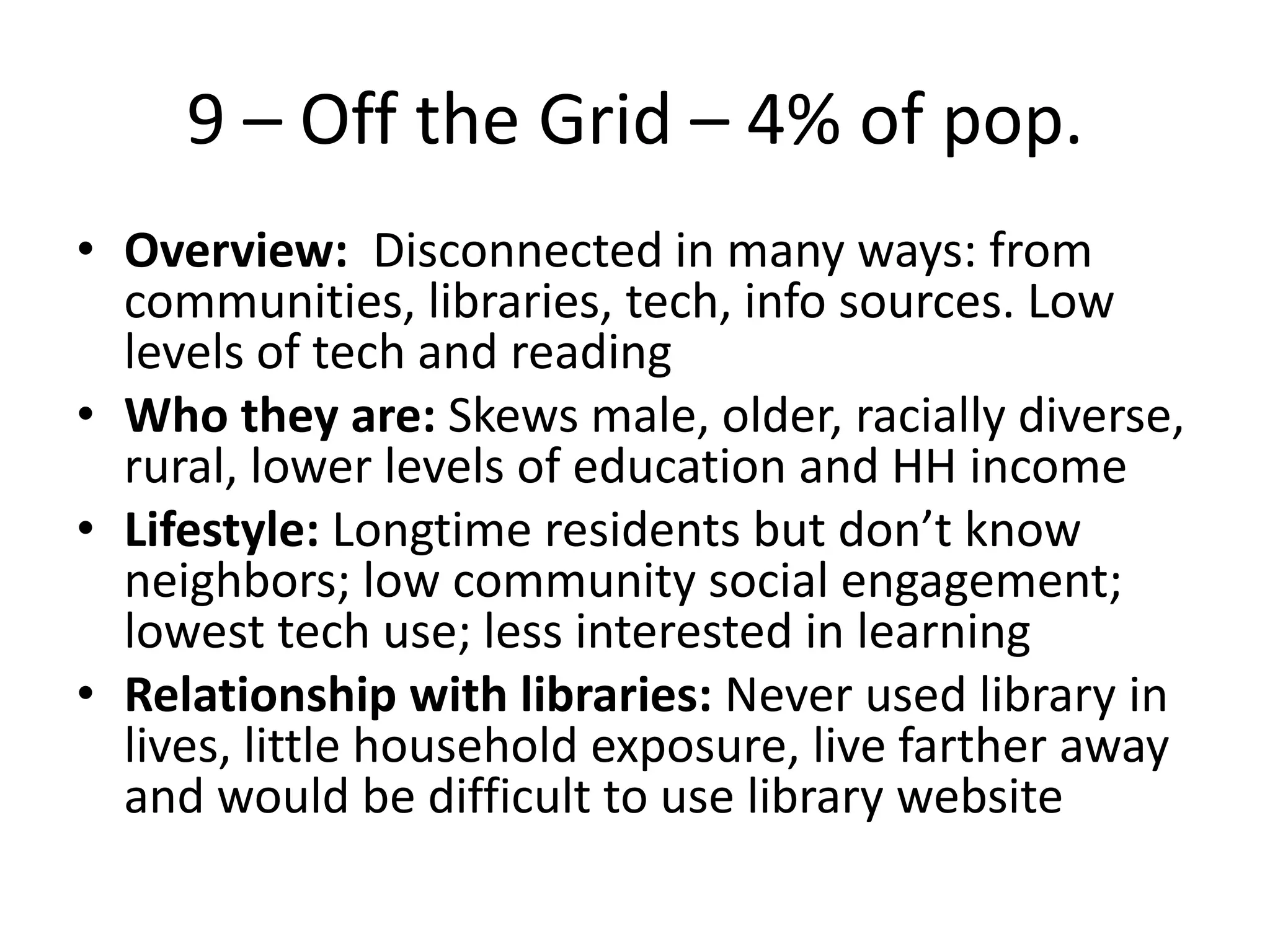
9 – Off the Grid – 4% of pop.
• Overview: Disconnected in many ways: from
communities, libraries, tech, info sources. Low
levels of tech and reading
• Who they are: Skews male, older, racially diverse,
rural, lower levels of education and HH income
• Lifestyle: Longtime residents but don’t know
neighbors; low community social engagement;
lowest tech use; less interested in learning
• Relationship with libraries: Never used library in
lives, little household exposure, live farther away
and would be difficult to use library website
Quiz and widget
What kind of library of library user
are you?

Pew Research Update at ALA Midwinter

  • 1.
    Libraries in Communities LeeRainie - @lrainie Director, Pew Research Center’s Internet Project Presented to: ALA Midwinter January 26, 2014
  • 2.
    “Tell the truth,and trust the people” -- Joseph N. Pew, Jr. http://bit.ly/dUvWe3 http://bit.ly/100qMub
  • 3.
    My 5 pointsabout libraries in communities 1. Libraries are deeply appreciated, especially for their community role and impact 2. The overall number of library users is shifting 3. Libraries have a mandate to intervene in community life 4. Libraries are cross pressured from patrons about what to do heading into the future 5. New insights into patrons (and non-patrons) will help you figure things out
  • 4.
    My 5 pointsabout libraries in communities 1. Libraries are deeply appreciated, especially for their community role and impact 2. The overall number of library users is shifting 3. Libraries have a mandate to intervene in community life 4. Libraries are cross pressured from patrons about what to do heading into the future 5. New insights into patrons (and non-patrons) will help you figure things out
  • 5.
    Libraries are deeplyappreciated 91% say libraries are important to their communities 76% say libraries are important to them and their families Robert Dawson photography - Library Road Trip http://www.robertdawson.com/pages/1/Public%20Library%3a%20An%20American%20Commons/Public%20Library%3a%20An%20American%20Commons /
  • 6.
    If your localpublic library CLOSED, would that have a MAJOR impact, MINOR impact or NO IMPACT on … major impact minor impact Your community as a whole no impact 63 You and your family 27 29 0 38 20 40 7 32 60 80 100
  • 7.
  • 8.
    Strongly agree somewhat agree SomewhatDisagree Strongly Disagree don’t know 96% Public libraries are important because they promote literacy and a love of reading. 77 19 2 2 2 2 96% Because it provides free access to materials and resources, the public library plays an important role in giving everyone a chance to succeed. 72 Having a public library improves the quality of life in a community. 69 24 93% 24 3 2 1 81% Public libraries provide many services people would have a hard time finding elsewhere. 48 0 20 33 40 60 11 80 5 3 100
  • 9.
    Strongly agree somewhat agree SomewhatDisagree Strongly Disagree 34% Public libraries have NOT done a good job keeping up with new technologies. 11 55% 23 28 27 53% People do NOT need public libraries as much as they used to because they can find most information on their own. 22 0 10 46% 31 20 don’t know 40 20 60 26 80 1 100
  • 10.
    Libraries stack upwell vs. others How confident? How important? Library to community 63 28 10
  • 11.
    My 5 pointsabout libraries in communities 1. Libraries are deeply appreciated, especially for their community role and impact 2. The overall number of library users is shifting 3. Libraries have a mandate to intervene in community life 4. Libraries are cross pressured from patrons about what to do heading into the future 5. New insights into patrons (and non-patrons) will help you figure things out
  • 12.
    Trendspotting – 2012-2013 •5 point drop in number who went to library or bookmobile – 53% to 48% – Biggest drops: women, blacks, ages 18-29, households $30K-$50K, parents of minors • 5 point increase in number of users of library websites – 25% to 30% – Biggest increases: blacks, Hispanics, 16-29 year olds, those with some college (but not degree)
  • 13.
    Library users % whohave visited a library or bookmobile in person in the past 12 months All Americans ages 16+ a Men b Women Age a 16-17 b 18-29 c 30-49 d 50-64 e 65+ Education attainment a No high school diploma b High school grad c Some College d College + Parent of minor a Parent b Non-parent 48% 48% 45% 50%a 50% 59%bcd 48%e 52%de 46%e 39% 39% 34% 39%a 51%ab 58%abd 51% 58% 55% 55% b 44%
  • 14.
    Who uses librarywebsites % who have ever used a library website in the past 12 months All Americans ages 16+ a Men b Women 30% 30% 26% 34% 34% a Age 16-17 b 18-29 c 30-49 d 50-64 e 65+ Education attainment a No high school diploma b High school grad c Some College d College + Parent of minor a Parent b Non-parent a 35%de 36%de 35%de 28%e 17% 17% 10% 20%a 34%ab 45%abc 34% 45% 37% 37% b 27%
  • 15.
    My 5 pointsabout libraries in communities 1. Libraries are deeply appreciated, especially for their community role and impact 2. The overall number of library users is shifting 3. Libraries have a mandate to intervene in community life 4. Libraries are cross pressured from patrons about what to do heading into the future 5. New insights into patrons (and non-patrons) will help you figure things out
  • 16.
    Coordinate more closelywith local schools in providing resources to kids 77% 19% 3% Offer free early literacy programs to help young children prepare for school 77% Should definitely do 17% Maybe do Definitely NOT do 3%
  • 17.
    My 5 pointsabout libraries in communities 1. Libraries are deeply appreciated, especially for their community role and impact 2. The overall number of library users is shifting 3. Libraries have a mandate to intervene in community life 4. Libraries are cross pressured from patrons about what to do heading into the future 5. New insights into patrons (and non-patrons) will help you figure things out
  • 18.
    2013 slide Should definitelydo Should maybe do Should definitely not do 85 Coordinate more with local schools 11 2 82 Free literacy programs Separate spaces for different services 61 Have more comfortable spaces 14 27 59 9 30 47 Offer more interactive learning experiences 9 28 53 Offer more e-books 5 38 Help users digitize material 43 Move most library services online 42 41 12 34 Make most services automated 36 20 Move some books/stacks out of public locations 0 39 39 20 40 3 14 19 20 36 60 80 100
  • 19.
    Move some printbooks and stacks out of public locations to free up more space for things such as tech centers, reading rooms, meetings rooms, and cultural events Should definitely do 20% Should maybe do 39% Less active library 18-29 yr olds, users, men, Af-Amer, smartphone owners, Latinos, teens, less know less about education, lower libraries, whites income HH, no computer Should definitely not do 36% Internet users, more active / knowledgeable patrons, whites, those over 50, higher income HH, full time workers, parents of tweens, computer owners, heavier book readers (including e-book readers)
  • 20.
    My 5 pointsabout libraries in communities 1. Libraries are deeply appreciated, especially for their community role and impact 2. The overall number of library users is shifting 3. Libraries have a mandate to intervene in community life 4. Libraries are cross pressured from patrons about what to do heading into the future 5. New insights into patrons (and non-patrons) will help you figure things out
  • 21.
    Structure of survey •6,224 ages 16 and older, July 18-September 30 • Importance of library in community (and to patrons personally) • Personal/household library use (overall)– and intensity of use) • Personal experiences using libraries and services – level of knowledge about libraries • Familiarity with closest library – and proximity • Negative perceptions of libraries • Technology inventory and use • Information “profile” – enthusiasm (or overload) and tasks
  • 22.
    Off the Grid,4% Distant Admimers, 10% Rooted and Roadblocked, 7% Young and Restless, 7% Library Lovers, 10% Info Omnivores, 20% Not for Me, 4% Print Trad, 9% Solid Center, 30%
  • 23.
    Tier 1: HighEngagement 30% of population
  • 24.
    1 – LibraryLovers – 10% of pop. • Overview: Everything about you is great • Who they are: women/mothers, upscale but with economic stressors, little more liberal • Lifestyle: Book readers and borrowers, community engaged and social engaged • Relationship with libraries: Leading group in attitudes – affection and need … would take the loss of their library as a personal loss
  • 25.
    2 – InfoOmnivores – 20% of pop • Overview: Big users, younger, more upscale, aren’t as dependent on library or as affection about them • Who they are: women/mothers, most upscale, suburban (not much rural) • Lifestyle: Highest tech use, full time workers, big readers but not as much as Library Lovers • Relationship with libraries: Like libraries a lot, especially as community resource, but use library less often and would not take the loss of their library at such a profound personal level
  • 26.
    Tier 2: MediumEngagement 39% of population
  • 27.
    3 – SolidCenter – 30% of pop • Overview: They are the big middle group – a notch or two down from the most engaged users • Who they are: A little more male, and white. Higher median age (47), conservative in politics, somewhat less likely to have gone to grad school. Less likely to have minor children. • Lifestyle: More likely to purchase books. • Relationship with libraries: Less engaged and a bit on the wane: 58% have library cards; 42% visited library in past year; 5% went to website. A third say their library use has declined in past 5 years. Rate libraries highly as community resources, but less so as personal assets. They know a lot about libraries.
  • 28.
    4 – Printtraditionalists – 9% of pop. • Overview: Most rural and Southern group. Like libraries for what they stand for in the community, but personally don’t have a lot of contact with libraries. Live relatively far away • Who they are: White; 9 in 10 in small city or rural area, skew female (57%), slightly older (46), conservative politics • Lifestyle: Embedded in their communities; know neighbors • Relationship with libraries: Stand out in their positive views about the role of libraries.
  • 29.
    Tier 3: LowEngagement 18% of population
  • 30.
    5 – Notfor Me – 4% of population • Overview: Have used libraries but have strikingly negative views about role of library in community. Know less about services and more likely to have had bad experience • Who they are: 56% male, average age, rural, more conservative, lower levels of educational attainment • Lifestyle: 31% read no book last year, lower levels of internet use; say they would need help finding information. 59% say no one in household uses library. • Relationship with libraries: 64% say library closing would have no impact on them. More likely to say they know little about library
  • 31.
    6 – Youngand Restless – 7% of pop. • Overview: Urban millennials. Only 15% say they know where the local library is. Only 1/3 have library card or visited in past year. • Who they are: Live in cities; but also more Southern; relatively poor in HH income; 53/47 male skew; median age 33; 26% are students; racially diverse, liberal • Lifestyle: Very high tech use; Looking for jobs; newcomers to communities; don’t know neighbors • Relationship with libraries: Most likely to say library use has decreased; not as much attached to current library services; but said library closing would have a major impact on them
  • 32.
    7 – Rootedand Roadblocked – 7% of pop. • Overview: Used library in their lives, but only 1/3 went in last 12 months. Older group. Better than average feelings about libraries, but also more likely to report bad experiences. Don’t feel knowledgeable about them • Who they are: Median age 58, few parents, 35% retired, 28% health condition that makes reading hard; 34% had major health problem last year • Lifestyle: Longtime residents of their communities, but socially disengaged with community activities. Low technology use. • Relationship with libraries: 33% have card; 33% visit in person recently; 45% say library closing would affect them and their families
  • 33.
    No personal libraryuse: 14% of population
  • 34.
    8 – DistantAdmirers – 10% of pop. • Overview: Many say others in their house use libraries and may be indirect beneficiaries; very high opinions about importance and role of libraries in communities • Who they are: 56/44 male; lower levels of education; higher share of blacks and Hispanics; skew a little rural • Lifestyle: don’t know many neighbors; low community activity; pretty high tech use, TV watchers; less likely to read • Relationship with libraries: Generally support a range of library services; would appreciate help with information activities (especially govt benefits; jobs)
  • 35.
    9 – Offthe Grid – 4% of pop. • Overview: Disconnected in many ways: from communities, libraries, tech, info sources. Low levels of tech and reading • Who they are: Skews male, older, racially diverse, rural, lower levels of education and HH income • Lifestyle: Longtime residents but don’t know neighbors; low community social engagement; lowest tech use; less interested in learning • Relationship with libraries: Never used library in lives, little household exposure, live farther away and would be difficult to use library website
  • 36.
    Quiz and widget Whatkind of library of library user are you?