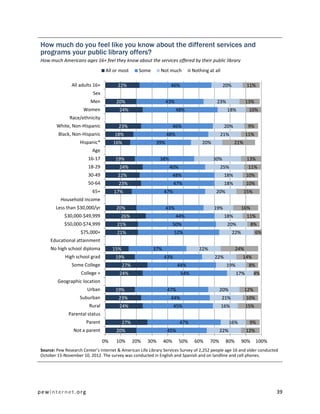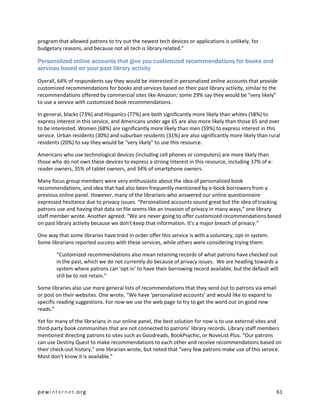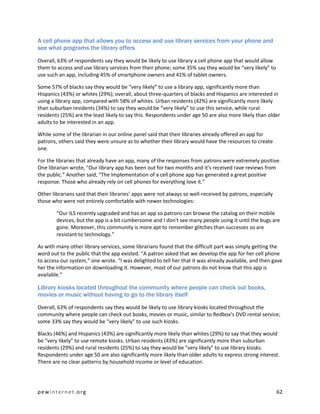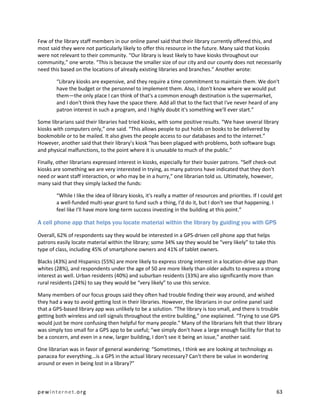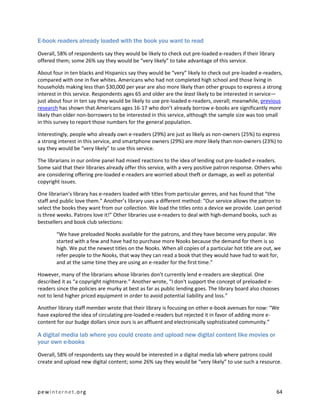
JANUARY 22, 2013


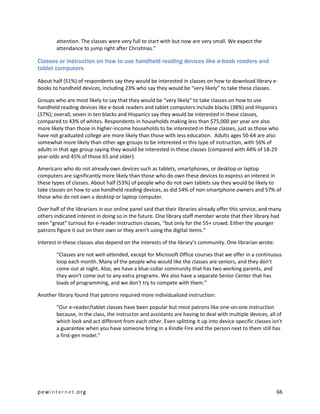
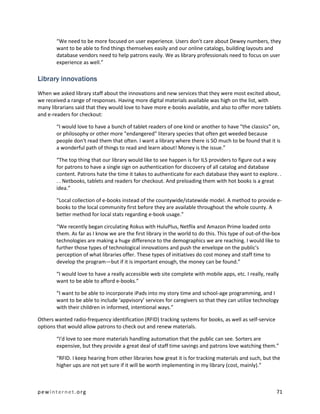
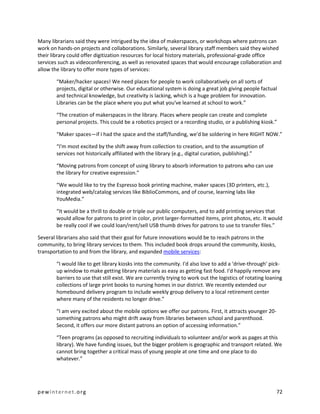
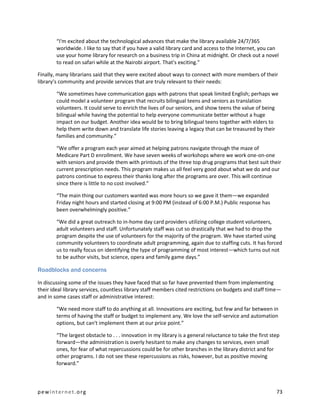
Library services in the digital age
Patrons embrace new technologies – and would welcome more. But many
still want printed books to hold their central place


                                                         Kathryn Zickuhr
                                                         Research Analyst, Pew Internet Project
                                                         Lee Rainie
                                                         Director, Pew Internet Project
                                                         Kristen Purcell
                                                         Associate Director, Research, Pew Internet
                                                         Project


Pew Research Center’s Internet & American Life Project
1615 L St., NW – Suite 700
Washington, D.C. 20036
Phone: 202-419-4500


http://libraries.pewinternet.org/2013/01/22/Library-services/
Table of Contents
Summary of findings .................................................................... 3

About this research ...................................................................... 9

Acknowledgements ....................................................................10

Part 1: The role of libraries in people's lives and
communities ...............................................................................12

Part 2: What people do at libraries and their websites ........22

Part 3: Technology use at libraries ..........................................33

Part 4: What people want from their libraries ......................38

Part 5: The Present and future of libraries ………………………67

Methodology ................................................................................75


pewinternet.org                                                                             2
Summary of findings
The internet has already had a major impact on how people find and access information, and now the
rising popularity of e-books is helping transform Americans’ reading habits. In this changing landscape,
public libraries are trying to adjust their services to these new realities while still serving the needs of
patrons who rely on more traditional resources. In a new survey of Americans’ attitudes and
expectations for public libraries, the Pew Research Center’s Internet & American Life Project finds that
many library patrons are eager to see libraries’ digital services expand, yet also feel that print books
remain important in the digital age.

The availability of free computers and internet access now rivals book lending and reference expertise
as a vital service of libraries. In a national survey of Americans ages 16 and older:

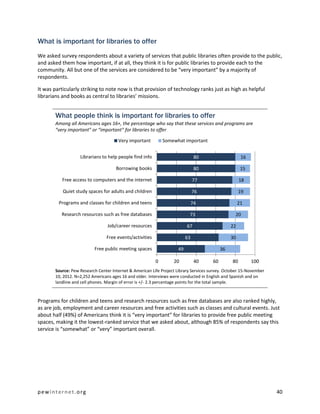
       80% of Americans say borrowing books is a “very important” service libraries provide.
       80% say reference librarians are a “very important” service of libraries.
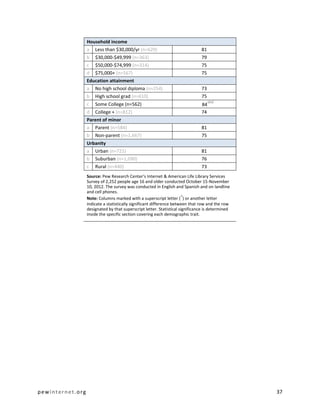
       77% say free access to computers and the internet is a “very important” service of libraries.

Moreover, a notable share of Americans say they would embrace even wider uses of technology at
libraries such as:

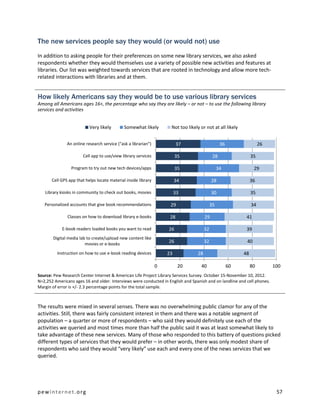
       Online research services allowing patrons to pose questions and get answers from librarians:
        37% of Americans ages 16 and older would “very likely” use an “ask a librarian” type of service,
        and another 36% say they would be “somewhat likely” to do so.
       Apps-based access to library materials and programs: 35% of Americans ages 16 and older
        would “very likely” use that service and another 28% say they would be “somewhat likely” to do
        so.
       Access to technology “petting zoos” to try out new devices: 35% of Americans ages 16 and
        older would “very likely” use that service and another 34% say they would be “somewhat likely”
        to do so.
       GPS-navigation apps to help patrons locate material inside library buildings: 34% of Americans
        ages 16 and older would “very likely” use that service and another 28% say they would be
        “somewhat likely” to do so.
       “Redbox”-style lending machines or kiosks located throughout the community where people
        can check out books, movies or music without having to go to the library itself: 33% of
        Americans ages 16 and older would “very likely” use that service and another 30% say they
        would be “somewhat likely” to do so.
       “Amazon”-style customized book/audio/video recommendation schemes that are based on
        patrons’ prior library behavior: 29% of Americans ages 16 and older would “very likely” use
        that service and another 35% say they would be “somewhat likely” to do so.

When Pew Internet asked the library staff members in an online panel about these services, the three
that were most popular were classes on e-borrowing, classes on how to use handheld reading devices,
and online “ask a librarian” research services. Many librarians said that their libraries were already
offering these resources in various forms, due to demand from their communities.


pewinternet.org                                                                                                3
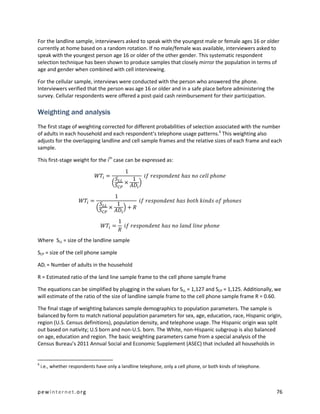
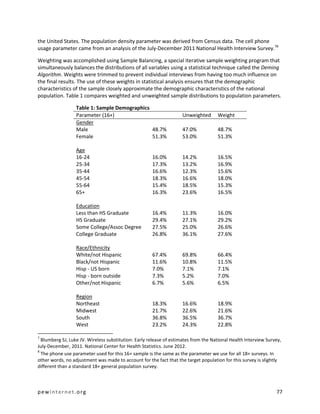
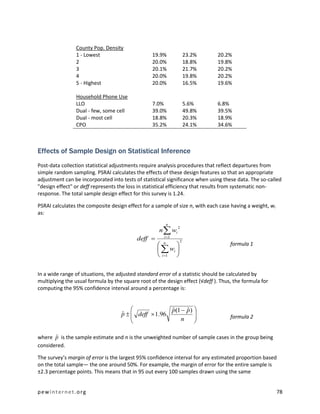
These are some of the key findings from a new national survey of 2,252 Americans ages 16 and older by
the Pew Research Center’s Internet & American Life Project and underwritten by a grant from the Bill &
Melinda Gates Foundation. The interviews were conducted on October 15-November 10, 2012 and done
on cell phone and landlines and in English and Spanish.

Public priorities for libraries
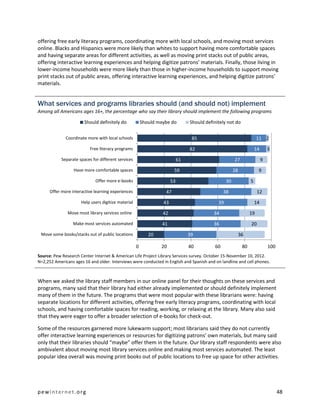
Asked for their thoughts on which services libraries should offer to the public, majorities of Americans
are strongly in favor of:

       Coordinating more closely with local schools: 85% of Americans ages 16 and older say libraries
        should “definitely” do this.
       Offering free literacy programs to help young children: 82% of Americans ages 16 and older say
        libraries should “definitely do” this.
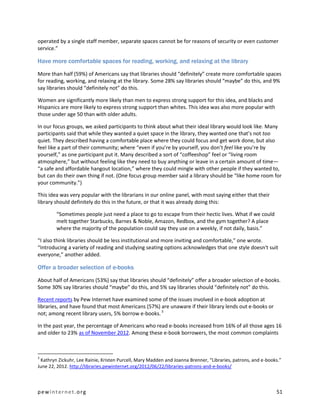
       Having more comfortable spaces for reading, working, and relaxing: 59% of Americans ages 16
        and older say libraries should “definitely do” this.
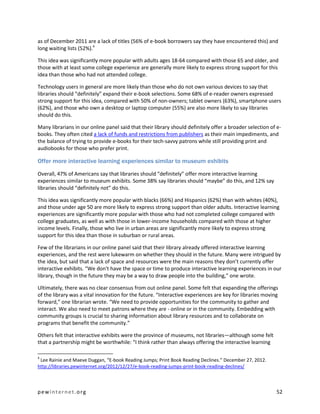
       Offering a broader selection of e-books: 53% of Americans ages 16 and older say libraries
        should “definitely do” this.

These services were also most popular with the library staff members in our online panel, many of
whom said that their library had either already implemented them or should “definitely” implement
them in the future.

At the same time, people have different views about whether libraries should move some printed
books and stacks out of public locations to free up space for tech centers, reading rooms, meeting
rooms, and cultural events: 20% of Americans ages 16 and older said libraries should “definitely” make
those changes; 39% said libraries “maybe” should do that; and 36% said libraries should “definitely not”
change by moving books out of public spaces.

Americans say libraries are important to their families and their communities,
but often do not know all the services libraries offer
Fully 91% of Americans ages 16 and older say public libraries are important to their communities; and
76% say libraries are important to them and their families. And libraries are touchpoints in their
communities for the vast majority of Americans: 84% of Americans ages 16 and older have been to a
library or bookmobile at some point in their lives and 77% say they remember someone else in their
family using public libraries as they were growing up.

Still, just 22% say that they know all or most of the services their libraries offer now. Another 46% say
they know some of what their libraries offer and 31% said they know not much or nothing at all of what
their libraries offer.

Changes in library use in recent years
In the past 12 months, 53% of Americans ages 16 and older visited a library or bookmobile; 25% visited a
library website; and 13% used a handheld device such as a smartphone or tablet computer to access a


pewinternet.org                                                                                            4
library website. All told, 59% of Americans ages 16 and older had at least one of those kinds of
interactions with their public library in the past 12 months. Throughout this report we call them “recent
library users” and some of our analysis is based on what they do at libraries and library websites.

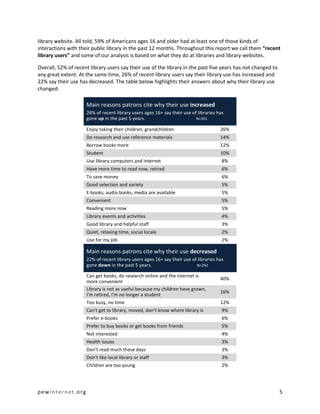
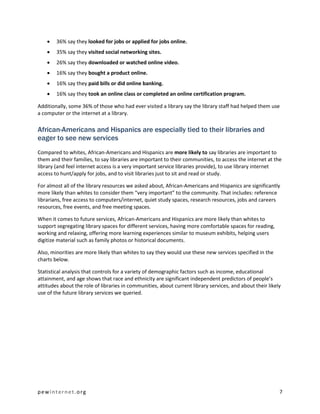
Overall, 52% of recent library users say their use of the library in the past five years has not changed to
any great extent. At the same time, 26% of recent library users say their library use has increased and
22% say their use has decreased. The table below highlights their answers about why their library use
changed:

                     Main reasons patrons cite why their use increased
                     26% of recent library users ages 16+ say their use of libraries has
                     gone up in the past 5 years.                         N=351

                     Enjoy taking their children, grandchildren                       26%
                     Do research and use reference materials                          14%
                     Borrow books more                                                12%
                     Student                                                          10%
                     Use library computers and internet                                8%
                     Have more time to read now, retired                               6%
                     To save money                                                     6%
                     Good selection and variety                                        5%
                     E-books, audio books, media are available                         5%
                     Convenient                                                        5%
                     Reading more now                                                  5%
                     Library events and activities                                     4%
                     Good library and helpful staff                                    3%
                     Quiet, relaxing time, social locale                               2%
                     Use for my job                                                    2%

                     Main reasons patrons cite why their use decreased
                     22% of recent library users ages 16+ say their use of libraries has
                     gone down in the past 5 years.                       N=292

                     Can get books, do research online and the internet is
                                                                                      40%
                     more convenient
                     Library is not as useful because my children have grown,
                                                                                      16%
                     I'm retired, I'm no longer a student
                     Too busy, no time                                                12%
                     Can't get to library, moved, don't know where library is          9%
                     Prefer e-books                                                    6%
                     Prefer to buy books or get books from friends                     5%
                     Not interested                                                    4%
                     Health issues                                                     3%
                     Don't read much these days                                        3%
                     Don't like local library or staff                                 3%
                     Children are too young                                            2%


pewinternet.org                                                                                               5
Source: Pew Research Center Internet & American Life Project Library
                    Services Survey. October 15-November 10, 2012. N for recent library users
                    ages 16+=1,361. Interviews were conducted in English and Spanish and on
                    landline and cell phones.


How people use libraries
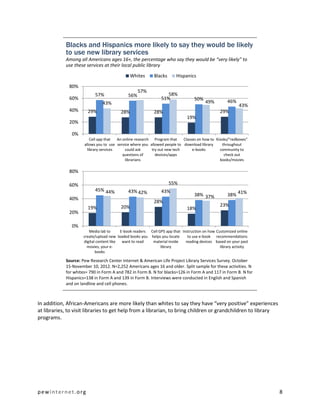
Of the 53% of Americans who visited a library or bookmobile in person in the past 12 months, here are
the activities they say they do at the library:

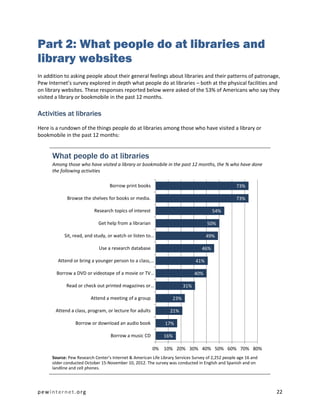
      73% of library patrons in the past 12 months say they visit to browse the shelves for books or
       media.
      73% say they visit to borrow print books.
      54% say they visit to research topics that interest them.
      50% say they visit to get help from a librarian. Asked how often they get help from library staff
       in such things as answering research questions, 31% of library patrons in the past 12 months say
       they frequently get help, 39% say they sometimes get help, 23% say they hardly ever get help,
       and 7% say they never get help.
      49% say they visit to sit, read, and study, or watch or listen to media.
      46% say they visit to use a research database.
      41% say they visit to attend or bring a younger person to a class, program, or event designed
       for children or teens.
      40% say they visit to borrow a DVD or videotape of a movie or TV show.
      31% say they visit to read or check out printed magazines or newspapers.
      23% say they visit to attend a meeting of a group to which they belong.
      21% say they visit to attend a class, program, or lecture for adults.
      17% say they visit to borrow or download an audio book.
      16% say they visit to borrow a music CD.

Internet use at libraries
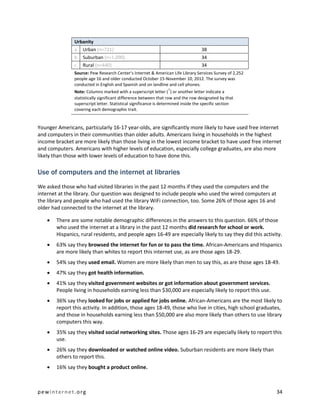
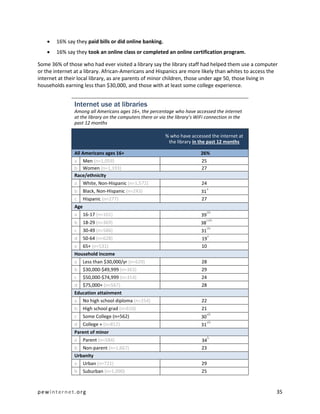
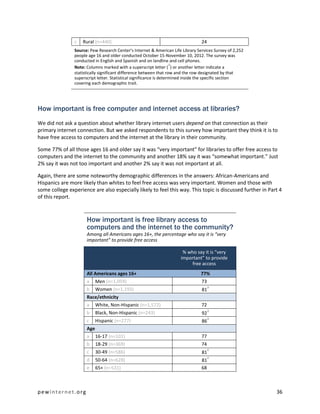
Some 26% of Americans ages 16 and older say they used the computers there or the WiFi connection to
go online. Here’s what they did on that free internet access:

      66% of those who used the internet at a library in the past 12 months did research for school or
       work.
      63% say they browsed the internet for fun or to pass the time.
      54% say they used email.
      47% say they got health information.
      41% say they visited government websites or got information about government services.


pewinternet.org                                                                                         6
   36% say they looked for jobs or applied for jobs online.
       35% say they visited social networking sites.
       26% say they downloaded or watched online video.
       16% say they bought a product online.
       16% say they paid bills or did online banking.
       16% say they took an online class or completed an online certification program.

Additionally, some 36% of those who had ever visited a library say the library staff had helped them use
a computer or the internet at a library.

African-Americans and Hispanics are especially tied to their libraries and
eager to see new services
Compared to whites, African-Americans and Hispanics are more likely to say libraries are important to
them and their families, to say libraries are important to their communities, to access the internet at the
library (and feel internet access is a very important service libraries provide), to use library internet
access to hunt/apply for jobs, and to visit libraries just to sit and read or study.

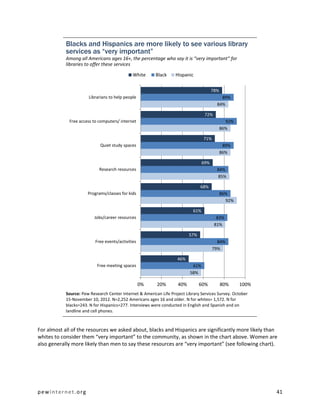
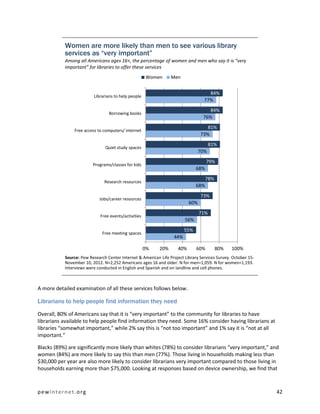
For almost all of the library resources we asked about, African-Americans and Hispanics are significantly
more likely than whites to consider them “very important” to the community. That includes: reference
librarians, free access to computers/internet, quiet study spaces, research resources, jobs and careers
resources, free events, and free meeting spaces.

When it comes to future services, African-Americans and Hispanics are more likely than whites to
support segregating library spaces for different services, having more comfortable spaces for reading,
working and relaxing, offering more learning experiences similar to museum exhibits, helping users
digitize material such as family photos or historical documents.

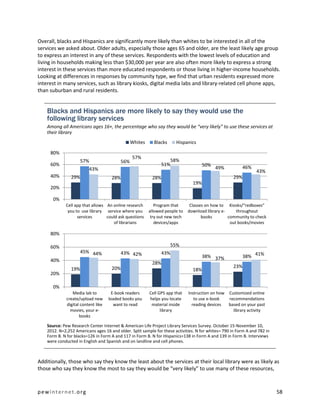
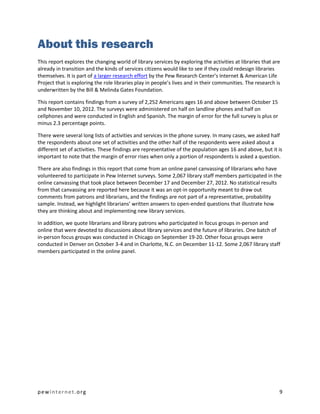
Also, minorities are more likely than whites to say they would use these new services specified in the
charts below.

Statistical analysis that controls for a variety of demographic factors such as income, educational
attainment, and age shows that race and ethnicity are significant independent predictors of people’s
attitudes about the role of libraries in communities, about current library services, and about their likely
use of the future library services we queried.


pewinternet.org                                                                                            7
Blacks and Hispanics more likely to say they would be likely
            to use new library services
            Among all Americans ages 16+, the percentage who say they would be “very likely” to
            use these services at their local public library

                                               Whites       Blacks      Hispanics

              80%
                                                   57%
                           57%               56%                   58%
              60%                                               51%               50%
                               43%                                                      49%         46%
                                                                                                          43%
              40%      29%               28%               28%                                  29%
                                                                              19%
              20%

               0%
                         Cell app that  An online research Program that     Classes on how to Kiosks/“redboxes”
                     allows you to use service where you allowed people to download library      throughout
                       library services     could ask      try out new tech      e-books        community to
                                           questions of      devices/apps                         check out
                                            librarians                                          books/movies

              80%

              60%                                                    55%
                           45% 44%           43% 42%            43%
                                                                                  38% 37%           38% 41%
              40%
                                                           28%
                                         20%                                                    23%
                       19%                                                    18%
              20%

               0%
                        Media lab to      E-book readers Cell GPS app that Instruction on how Customized online
                     create/upload new loaded books you helps you locate      to use e-book recommendations
                     digital content like  want to read   material inside    reading devices based on your past
                       movies, your e-                         library                          library activity
                            books

            Source: Pew Research Center Internet & American Life Project Library Services Survey. October
            15-November 10, 2012. N=2,252 Americans ages 16 and older. Split sample for these activities. N
            for whites= 790 in Form A and 782 in Form B. N for blacks=126 in Form A and 117 in Form B. N for
            Hispanics=138 in Form A and 139 in Form B. Interviews were conducted in English and Spanish
            and on landline and cell phones.


In addition, African-Americans are more likely than whites to say they have “very positive” experiences
at libraries, to visit libraries to get help from a librarian, to bring children or grandchildren to library
programs.


pewinternet.org                                                                                                    8
About this research
This report explores the changing world of library services by exploring the activities at libraries that are
already in transition and the kinds of services citizens would like to see if they could redesign libraries
themselves. It is part of a larger research effort by the Pew Research Center’s Internet & American Life
Project that is exploring the role libraries play in people’s lives and in their communities. The research is
underwritten by the Bill & Melinda Gates Foundation.

This report contains findings from a survey of 2,252 Americans ages 16 and above between October 15
and November 10, 2012. The surveys were administered on half on landline phones and half on
cellphones and were conducted in English and Spanish. The margin of error for the full survey is plus or
minus 2.3 percentage points.

There were several long lists of activities and services in the phone survey. In many cases, we asked half
the respondents about one set of activities and the other half of the respondents were asked about a
different set of activities. These findings are representative of the population ages 16 and above, but it is
important to note that the margin of error rises when only a portion of respondents is asked a question.

There are also findings in this report that come from an online panel canvassing of librarians who have
volunteered to participate in Pew Internet surveys. Some 2,067 library staff members participated in the
online canvassing that took place between December 17 and December 27, 2012. No statistical results
from that canvassing are reported here because it was an opt-in opportunity meant to draw out
comments from patrons and librarians, and the findings are not part of a representative, probability
sample. Instead, we highlight librarians’ written answers to open-ended questions that illustrate how
they are thinking about and implementing new library services.

In addition, we quote librarians and library patrons who participated in focus groups in-person and
online that were devoted to discussions about library services and the future of libraries. One batch of
in-person focus groups was conducted in Chicago on September 19-20. Other focus groups were
conducted in Denver on October 3-4 and in Charlotte, N.C. on December 11-12. Some 2,067 library staff
members participated in the online panel.


pewinternet.org                                                                                             9
Acknowledgements
About Pew Internet
The Pew Research Center’s Internet & American Life Project is an initiative of the Pew Research Center,
a nonprofit “fact tank” that provides information on the issues, attitudes, and trends shaping America
and the world. The Pew Internet Project explores the impact of the internet on children, families,
communities, the work place, schools, health care and civic/political life. The Project is nonpartisan and
takes no position on policy issues. Support for the Project is provided by The Pew Charitable Trusts.
More information is available at pewinternet.org.

Advisors for this research
A number of experts have helped Pew Internet in this research effort:

Larra Clark, American Library Association, Office for Information Technology Policy
Mike Crandall, Professor, Information School, University of Washington
Allison Davis, Senior Vice President, GMMB
Catherine De Rosa, Vice President, OCLC
LaToya Devezin, American Library Association Spectrum Scholar and librarian, Louisiana
Amy Eshelman, Program Leader for Education, Urban Libraries Council
Sarah Houghton, Director, San Rafael Public Library, California
Mimi Ito, Research Director of Digital Media and Learning Hub, University of California Humanities
Research Institute
Patrick Losinski, Chief Executive Officer, Columbus Library, Ohio
Jo McGill, Director, Northern Territory Library, Australia
Dwight McInvaill, Director, Georgetown County Library, South Carolina
Bobbi Newman, Blogger, Librarian By Day
Carlos Manjarrez, Director, Office of Planning, Research and Evaluation, Institute of Museum and Library
Services
Johana Orellana-Cabrera, American Library Association Spectrum Scholar and librarian in TX.
Mayur Patel, Vice President for Strategy and Assessment, John S. and James L. Knight Foundation
Karen Archer Perry, Senior Program Officer, Global Libraries, Bill & Melinda Gates Foundation
Sharman Smith, Executive Director, Mississippi Library Commission
Michael Kelley, Editor-in-Chief, Library Journal


pewinternet.org                                                                                        10
Disclaimer from the Bill & Melinda Gates Foundation
This report is based on research funded in part by the Bill & Melinda Gates Foundation. The findings and
conclusions contained within are those of the author and do not necessarily reflect positions or policies
of the Bill & Melinda Gates Foundation.


pewinternet.org                                                                                        11
Part 1: The role of libraries in people’s
lives and communities
The starting point of this research was to understand how people currently use their libraries. In the
past 12 months, 53% of Americans ages 16 and older visited a library or bookmobile; 25% visited a
library website; and 13% used a handheld device such as a smartphone or tablet computer to access a
library website. All told, 59% of Americans ages 16 and older had at least one of those kinds of
interactions with their public library in the past 12 months.

In our survey, we asked people about their general library patronage—if they had experiences with
libraries in childhood, how often they visit libraries or library websites, and what sort of experiences
they have had in these visits. We also asked people how important libraries are, not only to them and
their family, but also to their community as a whole.

Family members’ library use from childhood
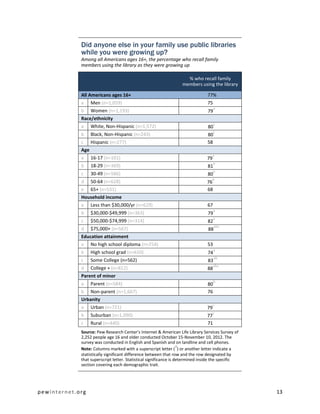
Most Americans have longstanding connections to local libraries, but a fifth have no memory of family
members using the library. Some 77% say they remember someone else in their family using public
libraries as they were growing up; one in five (20%) say that no one in their family used the library.

Women are more likely than men to say they remember a family member using the library when they
were growing up, and respondents with higher levels of education and living in households with higher
income levels are significantly more likely to say this as well. Hispanics are significantly less likely than
whites or blacks to say that a family member used the library, and adults ages 65 and older are
somewhat less likely than younger Americans to say this. Additionally, people living in urban or
suburban areas are more likely to report that a family member used the library when they were growing
up than those living in rural areas.


pewinternet.org                                                                                            12
Did anyone else in your family use public libraries
             while you were growing up?
             Among all Americans ages 16+, the percentage who recall family
             members using the library as they were growing up

                                                                    % who recall family
                                                                  members using the library

             All Americans ages 16+                                            77%
             a Men (n=1,059)                                                   75
                                                                                    a
             b    Women (n=1,193)                                              79
             Race/ethnicity
                                                                                    c
             a    White, Non-Hispanic (n=1,572)                                80
                                                                                    c
             b    Black, Non-Hispanic (n=243)                                  80
             c Hispanic (n=277)                                                58
             Age
                                                                                  e
             a    16-17 (n=101)                                                79
                                                                                    e
             b    18-29 (n=369)                                                81
                                                                                    e
             c    30-49 (n=586)                                                80
                                                                                  e
             d    50-64 (n=628)                                                76
             e 65+ (n=531)                                                     68
             Household income
             a Less than $30,000/yr (n=629)                                    67
                                                                                    a
             b    $30,000-$49,999 (n=363)                                      79
                                                                                    a
             c    $50,000-$74,999 (n=314)                                      82
                                                                                    abc
             d    $75,000+ (n=567)                                              88
             Education attainment
             a No high school diploma (n=254)                                  53
                                                                                    a
             b    High school grad (n=610)                                     74
                                                                                    ab
             c    Some College (n=562)                                         83
                                                                                    abc
             d    College + (n=812)                                            88
             Parent of minor
                                                                                    b
             a    Parent (n=584)                                               80
             b Non-parent (n=1,667)                                            76
             Urbanity
                                                                                    c
             a    Urban (n=721)                                                79
                                                                                    c
             b    Suburban (n=1,090)                                           77
             c    Rural (n=440)                                                71
             Source: Pew Research Center’s Internet & American Life Library Services Survey of
             2,252 people age 16 and older conducted October 15-November 10, 2012. The
             survey was conducted in English and Spanish and on landline and cell phones.
                                                                   a
             Note: Columns marked with a superscript letter ( ) or another letter indicate a
             statistically significant difference between that row and the row designated by
             that superscript letter. Statistical significance is determined inside the specific
             section covering each demographic trait.


pewinternet.org                                                                                    13
Americans’ library use
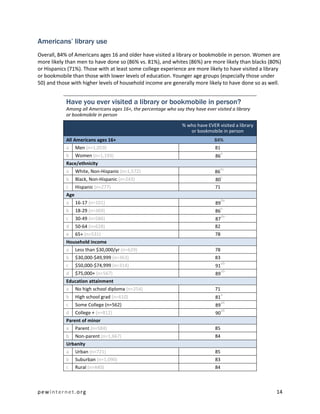
Overall, 84% of Americans ages 16 and older have visited a library or bookmobile in person. Women are
more likely than men to have done so (86% vs. 81%), and whites (86%) are more likely than blacks (80%)
or Hispanics (71%). Those with at least some college experience are more likely to have visited a library
or bookmobile than those with lower levels of education. Younger age groups (especially those under
50) and those with higher levels of household income are generally more likely to have done so as well.


            Have you ever visited a library or bookmobile in person?
            Among all Americans ages 16+, the percentage who say they have ever visited a library
            or bookmobile in person

                                                                 % who have EVER visited a library
                                                                    or bookmobile in person
            All Americans ages 16+                                              84%
            a Men (n=1,059)                                                     81
                                                                                     a
            b   Women (n=1,193)                                                 86
            Race/ethnicity
                                                                                   bc
            a   White, Non-Hispanic (n=1,572)                                   86
                                                                                     c
            b   Black, Non-Hispanic (n=243)                                     80
            c Hispanic (n=277)                                                  71
            Age
                                                                                     de
            a   16-17 (n=101)                                                   89
                                                                                     e
            b   18-29 (n=369)                                                   86
                                                                                     de
            c   30-49 (n=586)                                                   87
            d 50-64 (n=628)                                                     82
            e 65+ (n=531)                                                       78
            Household income
            a Less than $30,000/yr (n=629)                                      78
            b   $30,000-$49,999 (n=363)                                         83
                                                                                     ab
            c   $50,000-$74,999 (n=314)                                         91
                                                                                     ab
            d   $75,000+ (n=567)                                                89
            Education attainment
            a No high school diploma (n=254)                                    71
                                                                                     a
            b   High school grad (n=610)                                        81
                                                                                     ab
            c   Some College (n=562)                                            89
                                                                                     ab
            d   College + (n=812)                                               90
            Parent of minor
            a Parent (n=584)                                                    85
            b Non-parent (n=1,667)                                              84
            Urbanity
            a Urban (n=721)                                                     85
            b Suburban (n=1,090)                                                83
            c Rural (n=440)                                                     84


pewinternet.org                                                                                        14
Source: Pew Research Center’s Internet & American Life Library Services Survey of 2,252 people
            age 16 and older conducted October 15-November 10, 2012. The survey was conducted in English
            and Spanish and on landline and cell phones.
                                                                a
            Note: Columns marked with a superscript letter ( ) or another letter indicate a statistically
            significant difference between that row and the row designated by that superscript letter.
            Statistical significance is determined inside the specific section covering each demographic trait.


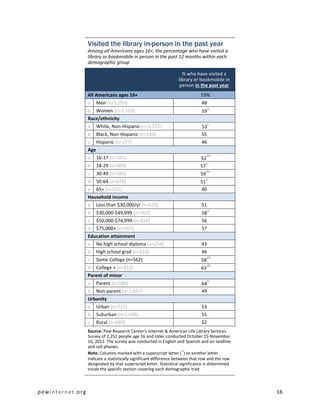
About 64% of those who had ever visited a public library say they had visited a public library or
bookmobile in person in the past twelve months. This means that 53% of all Americans ages 16 and
older visited a public library or bookmobile in person in the past year.

Women are more likely than men to have visited a library or bookmobile in the past year (59% vs. 48%),
and those under the age of 65 are more likely than older adults to have done so as well. Americans who
have at least some college experience are also significantly more likely than those who have not
attended college to have visited a library in the past year.

Finally, those who remember a family member using the library while they were growing up are not only
significantly more likely than those with no family experiences to have ever visited a library in person
(90% vs. 64%), but are also more likely to have visited a library in the past year (59% vs. 34%).


pewinternet.org                                                                                                   15
Visited the library in-person in the past year
                  Among all Americans ages 16+, the percentage who have visited a
                  library or bookmobile in person in the past 12 months within each
                  demographic group

                                                                    % who have visited a
                                                                  library or bookmobile in
                                                                   person in the past year
                  All Americans ages 16+                                      53%
                  a Men (n=1,059)                                             48
                                                                                    a
                  b   Women (n=1,193)                                          59
                  Race/ethnicity
                                                                                    c
                  a   White, Non-Hispanic (n=1,572)                            53
                  b Black, Non-Hispanic (n=243)                                55
                  c Hispanic (n=277)                                           46
                  Age
                                                                                   de
                  a   16-17 (n=101)                                            62
                                                                                 e
                  b   18-29 (n=369)                                           57
                                                                                   de
                  c   30-49 (n=586)                                           59
                                                                                 e
                  d   50-64 (n=628)                                           51
                  e 65+ (n=531)                                               40
                  Household income
                  a Less than $30,000/yr (n=629)                               51
                                                                                    a
                  b   $30,000-$49,999 (n=363)                                  58
                  c $50,000-$74,999 (n=314)                                    56
                  d $75,000+ (n=567)                                           57
                  Education attainment
                  a No high school diploma (n=254)                             43
                  b High school grad (n=610)                                   46
                                                                                   ab
                  c   Some College (n=562)                                     58
                                                                                   ab
                  d   College + (n=812)                                        63
                  Parent of minor
                                                                                    b
                  a   Parent (n=584)                                           64
                  b   Non-parent (n=1,667)                                     49
                  Urbanity
                  a Urban (n=721)                                              53
                  b Suburban (n=1,090)                                         55
                  c Rural (n=440)                                              52
                  Source: Pew Research Center’s Internet & American Life Library Services
                  Survey of 2,252 people age 16 and older conducted October 15-November
                  10, 2012. The survey was conducted in English and Spanish and on landline
                  and cell phones.
                                                                      a
                  Note: Columns marked with a superscript letter ( ) or another letter
                  indicate a statistically significant difference between that row and the row
                  designated by that superscript letter. Statistical significance is determined
                  inside the specific section covering each demographic trait.


pewinternet.org                                                                                   16
A snapshot of Americans’ library use habits
     Among all Americans ages 16+, the percentage who have visited a library or bookmobile in the past
     year with the following frequency

                                                                      At least       Less than
                                                                                                     Not within
                                                       At least       monthly,        monthly,
                                                                                                      the past
                                                       weekly         but not        but within
                                                                                                        year
                                                                       weekly        past year

     All ages 16+                                         8%              25%            20%             47%
     Men (n=1,059)                                        6               22             19              52
     Women (n=1,193)                                      10              28             21              42
     Race/ethnicity
     White, Non-Hispanic (n=1,572)                        7               24             23              47
     Black, Non-Hispanic (n=243)                          11              28             16              45
     Hispanic (n=277)                                     7               24             14              54
     Age
     16-17 (n=101)                                        10              31             21              38
     18-29 (n=369)                                        8               26             23              43
     30-49 (n=586)                                        10              30             20              41
     50-64 (n=628)                                        7               21             23              50
     65+ (n=531)                                          7               20             13              60
     Household income
     Less than $30,000/yr (n=629)                         11              24             16              49
     $30,000-$49,999 (n=363)                              10              28             20              42
     $50,000-$74,999 (n=314)                              7               30             19              45
     $75,000+ (n=567)                                     5               25             27              43
     Education attainment
     No high school diploma (n=254)                        8              18             17              57
     High school grad (n=610)                              6              22             18              54
     Some College (n=562)                                 10              26             23              42
     College + (n=812)                                    9               32             22              37
     Parent of minor
     Parent (n=584)                                        7              26             19              47
     Non-parent (n=1,667)                                  9              25             21              45
     Urbanity
     Urban (n=721)                                        8               23             20              48
     Suburban (n=1,090)                                   11              33             21              36
     Rural (n=440)                                        7               22             20              51
     Source: Pew Research Center’s Internet & American Life Library Services Survey of 2,252 people age 16 and
     older conducted October 15-November 10, 2012. The survey was conducted in English and Spanish and on
     landline and cell phones.


pewinternet.org                                                                                                   17
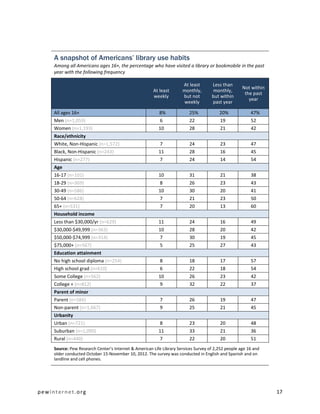
Among those who have visited a public library in person in the past year:

          3% say they go every day or almost every day
          12% say they go at least once a week
          19% go several times a month
          28% go about once a month
          38% go less often than that

Although many activities at libraries do not always require a library card, many others—such as
borrowing books—do. Currently, 63% of Americans ages 16 and older have a library card, up from 58%
in December 2011.

Experiences at libraries are positive
Among those who had ever used a public library, almost all respondents say that their experiences using
public libraries are either very positive (57%) or mostly positive (41%); only about 1% say their
experiences had been mostly negative.

Women, blacks, and adults ages 30 and older are significantly more likely than other groups to report
“very positive” experiences at public libraries, as are Americans with at least a high school education.
Respondents ages 16-17 are the least likely to report “very positive” experiences, with a majority (62%)
reporting “mostly positive” experiences.

How important libraries are to individuals and their communities
In our December 2011 survey, we asked people how important libraries are to them and their families.
For this survey, we asked respondents two questions: How important libraries are to them and their
families, and also how important libraries are to their communities as a whole.

How important are libraries to you and your family?

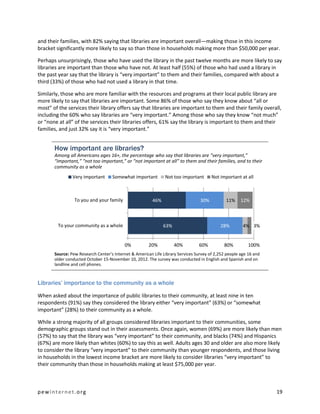
Overall, a majority of Americans (76% of all respondents) say that libraries are important to them and
their families, and 46% say that libraries are “very important”—up from 38% saying libraries are “very
important” in December 2011.1 Women (51%) are more likely than men (40%) to say that libraries are
“very important” to them and their families, and blacks (60%) and Hispanics (55%) are more likely to say
this than whites (41%).

In addition, adults ages 30 and older (50%) are also more likely than adults ages 18-29 (38%) to say that
libraries are “very important” to them and their families. Just 18% of 16-17 year-olds say this, though
they are among the heaviest users of libraries. Those ages 16-17 are more likely to say that libraries are
“somewhat important” (47%) or “not too important” (21%) to them and their families. Additionally, 52%
of those in households making less than $30,000 per year say that libraries are “very important” to them


1
    In February 2012, question was a standalone question.


pewinternet.org                                                                                        18
and their families, with 82% saying that libraries are important overall—making those in this income
bracket significantly more likely to say so than those in households making more than $50,000 per year.

Perhaps unsurprisingly, those who have used the library in the past twelve months are more likely to say
libraries are important than those who have not. At least half (55%) of those who had used a library in
the past year say that the library is “very important” to them and their families, compared with about a
third (33%) of those who had not used a library in that time.

Similarly, those who are more familiar with the resources and programs at their local public library are
more likely to say that libraries are important. Some 86% of those who say they know about “all or
most” of the services their library offers say that libraries are important to them and their family overall,
including the 60% who say libraries are “very important.” Among those who say they know “not much”
or “none at all” of the services their libraries offers, 61% say the library is important to them and their
families, and just 32% say it is “very important.”


       How important are libraries?
       Among all Americans ages 16+, the percentage who say that libraries are “very important,”
       “important,” “not too important,” or “not important at all” to them and their families, and to their
       community as a whole
                Very important      Somewhat important         Not too important       Not important at all


                 To you and your family                  46%                     30%          11%     12%


         To your community as a whole                          63%                         28%         4% 3%


                                          0%           20%           40%        60%          80%          100%
       Source: Pew Research Center’s Internet & American Life Library Services Survey of 2,252 people age 16 and
       older conducted October 15-November 10, 2012. The survey was conducted in English and Spanish and on
       landline and cell phones.


Libraries’ importance to the community as a whole

When asked about the importance of public libraries to their community, at least nine in ten
respondents (91%) say they considered the library either “very important” (63%) or “somewhat
important” (28%) to their community as a whole.

While a strong majority of all groups considered libraries important to their communities, some
demographic groups stand out in their assessments. Once again, women (69%) are more likely than men
(57%) to say that the library was “very important” to their community, and blacks (74%) and Hispanics
(67%) are more likely than whites (60%) to say this as well. Adults ages 30 and older are also more likely
to consider the library “very important” to their community than younger respondents, and those living
in households in the lowest income bracket are more likely to consider libraries “very important” to
their community than those in households making at least $75,000 per year.


pewinternet.org                                                                                                    19
Even among those who had not used the library in the past year, at least half (53%) say they consider
public libraries “very important” to their community as a whole, with 85% considering libraries
important to their community overall. By comparison, 70% of those who had used the library in the past
year consider libraries “very important” to their community, and 94% consider them important to their
community overall.

Meanwhile, about three-quarters (74%) of those who are very familiar with their library’s services
consider libraries “very important” to their community, compared with 49% of those who are generally
unfamiliar with their library’s services; 94% of those very familiar with their library’s services say
libraries are important to their community overall, as do 84% of those who know little to nothing about
their library’s offerings.


               How important are libraries?
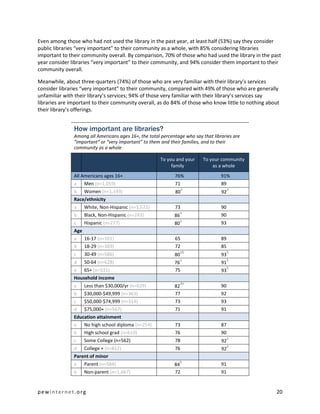
               Among all Americans ages 16+, the total percentage who say that libraries are
               “important” or “very important” to them and their families, and to their
               community as a whole

                                                       To you and your    To your community
                                                            family            as a whole
               All Americans ages 16+                        76%                   91%
               a Men (n=1,059)                               71                    89
                                                                  a                     a
               b   Women (n=1,193)                           80                    92
               Race/ethnicity
               a   White, Non-Hispanic (n=1,572)             73                    90
                                                                a
               b   Black, Non-Hispanic (n=243)               86                    90
                                                                a
               c   Hispanic (n=277)                          80                    93
               Age
               a 16-17 (n=101)                               65                    89
               b 18-29 (n=369)                               72                    85
                                                                  ab                    b
               c   30-49 (n=586)                             80                    93
                                                                a                       b
               d   50-64 (n=628)                             76                    91
                                                                                        b
               e   65+ (n=531)                               75                    93
               Household income
                                                                  de
               a   Less than $30,000/yr (n=629)              82                    90
               b $30,000-$49,999 (n=363)                     77                    92
               c   $50,000-$74,999 (n=314)                   73                    93
               d $75,000+ (n=567)                            71                    91
               Education attainment
               a No high school diploma (n=254)              73                    87
               b   High school grad (n=610)                  76                    90
                                                                                        a
               c   Some College (n=562)                      78                    92
                                                                                        a
               d   College + (n=812)                         76                    92
               Parent of minor
                                                                b
               a   Parent (n=584)                            84                    91
               b   Non-parent (n=1,667)                      72                    91


pewinternet.org                                                                                      20
Urbanity
               a Urban (n=721)                                        75                        91
               b    Suburban (n=1,090)                                77                        91
               c    Rural (n=440)                                     73                        89
               Source: Pew Research Center’s Internet & American Life Library Services Survey of 2,252
               people age 16 and older conducted October 15-November 10, 2012. The survey was
               conducted in English and Spanish and on landline and cell phones.
                                                                    a
               Note: Columns marked with a superscript letter ( ) or another letter indicate a
               statistically significant difference between that row and the row designated by that
               superscript letter. Statistical significance is determined inside the specific section covering
               each demographic trait.


In our focus groups, most participants said that they valued having libraries in their communities and
would miss them if they were gone, especially as many were still dealing with the effects of the
recession. One participant said, “I think our community would [miss our public library] because our
library is extremely well used. The online system came into it its own right about the time the economy
changed. Our library is extremely heavily used by people who five or six years ago might have been
buying books,” but now can’t afford to.

Even the focus group participants who didn’t use their local libraries much said that they would miss
them if they were gone. One said that she wanted to live in the sort of community that had a library,
even though she personally had not used it yet. Another said that while the loss of her local library
would probably not affect her personally, “I look at myself as a member of a community and so it would
deeply affect my community”—and therefore have an impact on her as well. Another said: “I prefer to
have libraries open to communities where people could not afford what I can afford.”


pewinternet.org                                                                                                  21
Part 2: What people do at libraries and
library websites
In addition to asking people about their general feelings about libraries and their patterns of patronage,
Pew Internet’s survey explored in depth what people do at libraries – both at the physical facilities and
on library websites. These responses reported below were asked of the 53% of Americans who say they
visited a library or bookmobile in the past 12 months.

Activities at libraries
Here is a rundown of the things people do at libraries among those who have visited a library or
bookmobile in the past 12 months:


      What people do at libraries
      Among those who have visited a library or bookmobile in the past 12 months, the % who have done
      the following activities

                                   Borrow print books                                               73%

             Browse the shelves for books or media.                                                 73%

                           Research topics of interest                                  54%

                             Get help from a librarian                               50%

            Sit, read, and study, or watch or listen to …                            49%

                             Use a research database                              46%

        Attend or bring a younger person to a class, …                         41%

        Borrow a DVD or videotape of a movie or TV …                           40%

             Read or check out printed magazines or …                    31%

                         Attend a meeting of a group               23%

       Attend a class, program, or lecture for adults             21%

                 Borrow or download an audio book              17%

                                   Borrow a music CD           16%

                                                         0% 10% 20% 30% 40% 50% 60% 70% 80%
      Source: Pew Research Center’s Internet & American Life Library Services Survey of 2,252 people age 16 and
      older conducted October 15-November 10, 2012. The survey was conducted in English and Spanish and on
      landline and cell phones.


pewinternet.org                                                                                                   22
Browse the shelves for books or media

Almost two-thirds (73%) of library patrons in the past 12 months say they visit to browse the shelves for
books or media. Women patrons are more likely than men to say they do this, as are parents of minor
children, and people with at least some college experience.

Many of our focus group members mentioned how they enjoyed browsing the shelves at their local
public library. One liked the process of discovery—“The cover can draw you in.” Even when they had
reserved materials online, several liked to browse for books, movies, or music.

Borrow print books

Almost two-thirds (73%) of library patrons in the past 12 months also say they visit to borrow print
books. Women are more likely than men to do this, as are parents of minor children and those with at
least some college experience.

Our focus group members mentioned borrowing books more than any other activity. Several said they
had recently started to borrow books more recently due to changes in economic circumstances, or when
they retired. Others said that they began to borrow books more as their tastes in books changed, or
when they simply ran out of space:

        “As I got older, I bought more books and we moved a lot. As an adult, I moved a lot with our
        profession and I carted probably a roomful of books . . . Finally, I said ‘enough’ and we started
        going back to the library because we’re like this is—I don’t need to own all this anymore. So,
        now it’s more of ‘Let’s see if they have it at the library first before we buy it’ [mentality].”

Research topics that interest them

Some 54% of those who visited a library in the past 12 months say they visit to research topics that
interest them.

Get help from a librarian

About half (50%) of those who have visited the library in the past year say they visit to get help from a
librarian. African-Americans are more likely than whites to say they visit to get help from a librarian, as
are those ages 50 and older and those who live in households earning less than $50,000. In addition,
some non-technology users are more likely to say they get help from librarians: That is true of those
who do not own tablet computers, those who do not own e-book readers, and those who do not own
smartphones.

Sit, read, and study, or watch or listen to media

Some 49% of those who visited a library in the past 12 months say they visit just to sit, read, and study,
or watch or listen to media. African-American and Latino patrons are more likely to say they do this than
whites. Those ages 18-29 are especially likely to cite this as a reason for their library visit in the past 12
months, as are urban residents and those living in households earning less than $50,000.

Use a research database

About 46% of those who visited a library in the past 12 months say they visit to use a research database.


pewinternet.org                                                                                             23
Attend or bring a younger person to a class, program, or event designed for children or
teens

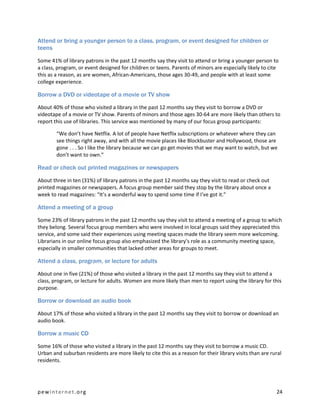
Some 41% of library patrons in the past 12 months say they visit to attend or bring a younger person to
a class, program, or event designed for children or teens. Parents of minors are especially likely to cite
this as a reason, as are women, African-Americans, those ages 30-49, and people with at least some
college experience.

Borrow a DVD or videotape of a movie or TV show

About 40% of those who visited a library in the past 12 months say they visit to borrow a DVD or
videotape of a movie or TV show. Parents of minors and those ages 30-64 are more likely than others to
report this use of libraries. This service was mentioned by many of our focus group participants:

        “We don’t have Netflix. A lot of people have Netflix subscriptions or whatever where they can
        see things right away, and with all the movie places like Blockbuster and Hollywood, those are
        gone . . . So I like the library because we can go get movies that we may want to watch, but we
        don’t want to own.”

Read or check out printed magazines or newspapers

About three in ten (31%) of library patrons in the past 12 months say they visit to read or check out
printed magazines or newspapers. A focus group member said they stop by the library about once a
week to read magazines: “It’s a wonderful way to spend some time if I’ve got it.”

Attend a meeting of a group

Some 23% of library patrons in the past 12 months say they visit to attend a meeting of a group to which
they belong. Several focus group members who were involved in local groups said they appreciated this
service, and some said their experiences using meeting spaces made the library seem more welcoming.
Librarians in our online focus group also emphasized the library’s role as a community meeting space,
especially in smaller communities that lacked other areas for groups to meet.

Attend a class, program, or lecture for adults

About one in five (21%) of those who visited a library in the past 12 months say they visit to attend a
class, program, or lecture for adults. Women are more likely than men to report using the library for this
purpose.

Borrow or download an audio book

About 17% of those who visited a library in the past 12 months say they visit to borrow or download an
audio book.

Borrow a music CD

Some 16% of those who visited a library in the past 12 months say they visit to borrow a music CD.
Urban and suburban residents are more likely to cite this as a reason for their library visits than are rural
residents.


pewinternet.org                                                                                           24
How frequently people receive assistance from library staff
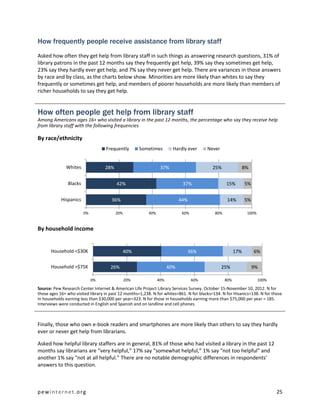
Asked how often they get help from library staff in such things as answering research questions, 31% of
library patrons in the past 12 months say they frequently get help, 39% say they sometimes get help,
23% say they hardly ever get help, and 7% say they never get help. There are variances in those answers
by race and by class, as the charts below show. Minorities are more likely than whites to say they
frequently or sometimes get help, and members of poorer households are more likely than members of
richer households to say they get help.


How often people get help from library staff
Among Americans ages 16+ who visited a library in the past 12 months, the percentage who say they receive help
from library staff with the following frequencies

By race/ethnicity
                                   Frequently        Sometimes         Hardly ever      Never


              Whites               28%                          37%                       25%                 8%


               Blacks                    42%                                37%                   15%         5%


            Hispanics                 36%                                  44%                     14%        5%

                        0%               20%             40%                60%             80%                100%


By household income


      Household <$30K                          40%                            36%                       17%        6%

      Household >$75K                26%                             40%                        25%                9%

                             0%                20%             40%                60%             80%                 100%

Source: Pew Research Center Internet & American Life Project Library Services Survey. October 15-November 10, 2012. N for
those ages 16+ who visited library in past 12 months=1,238. N for whites=861. N for blacks=134. N for Hisanics=138. N for those
in households earning less than $30,000 per year=323. N for those in households earning more than $75,000 per year = 185.
Interviews were conducted in English and Spanish and on landline and cell phones.


Finally, those who own e-book readers and smartphones are more likely than others to say they hardly
ever or never get help from librarians.

Asked how helpful library staffers are in general, 81% of those who had visited a library in the past 12
months say librarians are “very helpful,” 17% say “somewhat helpful,” 1% say “not too helpful” and
another 1% say “not at all helpful.” There are no notable demographic differences in respondents’
answers to this question.


pewinternet.org                                                                                                              25
In our focus groups, many people reported having only positive impressions of libraries and librarians,
especially if they had positive experiences growing up. One focus group member said:

        “When I was younger, there was one librarian in particular, she remembered my name and
        every time I would come in with my mom I would take out stacks and stacks of books . . . I
        started getting really into reading more because of her and she would [compliment] me about
        how much I was reading, and it was like a challenge to me. How much can I read? How much
        can I read in this week so I can come back the next week and get more books. So for me, it was a
        very positive environment as a child.”

However, some participants, including some who mentioned that their libraries have experienced
cutbacks recently, said that library staff were very busy, and weren’t able to give them the individual
attention they remembered and valued from their childhood. One participant said that it seemed like
there were so many programs going on, the librarians could seem too busy to just help people find
books. At the same time, impressions and library experiences often varied in different areas even within
the same city.

A few focus group members said that they often feel intimidated when visiting some library branches.
These focus groups members said they weren’t very familiar with the Dewey Decimal system, which
made it hard to find what they were looking for even if they were told the call number or pointed in the
general direction; some said that library staff members they interacted with would become “frustrated”
with them for not understanding such a basic concept:

        “I live by our library, close by, walking distance. I got intimated by trying to find the books. It
        was like they say ‘it’s number-number-number and letter,’ like 100-EB or whatever it is. I’d be
        like, ‘What?’ [Laughter] . . . Now I have more fun [reserving books] online and waiting for it to
        show up and enjoying that. But when I went by myself . . . it was too [complicated].”

Use of library websites
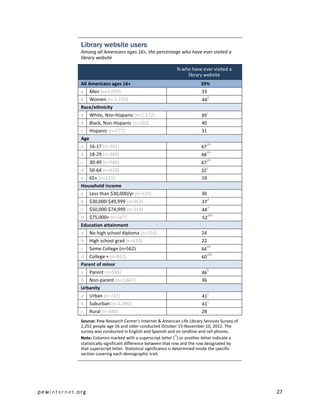
In all, the Pew Internet Project survey finds that 39% of Americans ages 16 and older have gone to a
library website at one time or another and, of them, 64% visited a library site in the previous 12 months.
That translates into 25% of all Americans ages 16+ who visited a library website in the past year.

Those who are most likely to have visited library websites are parents of minors, women, those with
college educations, those under age 50, and people living in households earning $75,000 or more.


pewinternet.org                                                                                               26
Library website users
             Among all Americans ages 16+, the percentage who have ever visited a
             library website

                                                               % who have ever visited a
                                                                   library website
             All Americans ages 16+                                         39%
             a Men (n=1,059)                                                33
                                                                                 a
             b    Women (n=1,193)                                           44
             Race/ethnicity
                                                                                 c
             a    White, Non-Hispanic (n=1,572)                             39
             b Black, Non-Hispanic (n=243)                                  40
             c Hispanic (n=277)                                             31
             Age
                                                                               de
             a    16-17 (n=101)                                             47
                                                                               de
             b    18-29 (n=369)                                             48
                                                                               de
             c    30-49 (n=586)                                             47
                                                                               e
             d    50-64 (n=628)                                             32
             e 65+ (n=531)                                                  19
             Household income
             a Less than $30,000/yr (n=629)                                 30
                                                                                 a
             b    $30,000-$49,999 (n=363)                                   37
                                                                                 a
             c    $50,000-$74,999 (n=314)                                   44
                                                                                 abc
             d    $75,000+ (n=567)                                           52
             Education attainment
             a No high school diploma (n=254)                               24
             b    High school grad (n=610)                                  22
                                                                                 ab
             c    Some College (n=562)                                      44
                                                                                 abc
             d    College + (n=812)                                         60
             Parent of minor
                                                                                 b
             a    Parent (n=584)                                            46
             b Non-parent (n=1,667)                                         36
             Urbanity
                                                                                 c
             a    Urban (n=721)                                             41
                                                                                 c
             b    Suburban (n=1,090)                                        41
             c    Rural (n=440)                                             28
             Source: Pew Research Center’s Internet & American Life Library Services Survey of
             2,252 people age 16 and older conducted October 15-November 10, 2012. The
             survey was conducted in English and Spanish and on landline and cell phones.
                                                                   a
             Note: Columns marked with a superscript letter ( ) or another letter indicate a
             statistically significant difference between that row and the row designated by
             that superscript letter. Statistical significance is determined inside the specific
             section covering each demographic trait.


pewinternet.org                                                                                    27
The 25% of Americans ages 16 and older who went to a library website in the past 12 months tended to
do so with modest frequency:

       3% of them went every day or almost every day
       9% went at least once a week
       15% went several times a month
       27% went at least once a month
       46% went less often than that

When they were on the sites, users sampled a wide variety of library services and there tended to be
little variance by different demographic categories. Of those 25% of Americans who went to a library
website in the past 12 months:

       82% of them searched the library catalog for books (including audiobooks and e-books), CDs,
        and DVDs.
       72% got basic library information such as the hours of operation, location of branches, or
        directions.
       62% reserved books (including audiobooks and e-books), CDs, and DVDs.
       51% renewed a book, DVD, or CD. Those ages 30-49 and parents of minor children are especially
        likely to have done this.
       51% used an online database. Those ages 18-29 are particularly likely to have done this.
       48% looked for information about library programs or events. Those ages 50-64 are especially
        likely to do this.
       44% got research or homework help.
       30% read book reviews or got book recommendations.
       30% checked whether they owed fines or paid the fines online. Those ages 30-49 are
        particularly likely to have done this.
       27% signed up for library programs and events.
       22% borrowed or downloaded an e-book.
       6% reserved a meeting room.

Several focus group members said that they wished their libraries promoted their website more. One
said, “Even when I receive the emails, they never reference the website. I didn’t even know they had a
website . . . If you want people to use it, you have to know about it.”

In general, focus group members said that their libraries’ websites are useful for finding basic
information (hours, location), but a bit of a hassle to navigate for more complicated purposes. Some said
that even finding and reserving books could be overly complicated, and others said that the interfaces
seemed outdated. There wasn’t much sense that participants wanted their libraries’ websites to be a
“community portal” in their own right—if they were using email or Facebook, they wanted their libraries
to be using those methods of communication, but few seemed to think of their library’s website as a
place to go for more general information in the first place. One focus participant said:


pewinternet.org                                                                                        28
“I look up like free kids’ events and there’s this website … that sometimes has like free
        admission for kids—or if it’s seasonal I’ll literally type in ‘free pumpkin patches for kids’ [in a
        search engine] so I can take them to a pumpkin patch or something like that. But I wouldn’t
        have even thought to [search for] ‘library free event for kids’. I wouldn’t have even thought that
        the library would be a resource at all.”

Changes in library use in recent years
The rise of the internet – especially broadband connections – and the spread of mobile connectivity
could potentially affect people’s use of their libraries. The Pew Internet survey asked recent library users
about their use of libraries over the last five years. Recent library users are those who those who visited
a public library in person in the past 12 months, or those who have gone on a public library website in
the past 12 months, or those who have used a cell phone, e-reader or tablet to visit a public library
website or access public library resources in the past 12 months. They amount to 59% of those who are
ages 16 and older in the general population.

The results showed there is fluidity in library patronage patterns:

       26% of recent library users say their own use of local libraries has increased in the past five
        years.
       22% say their use has decreased.
       52% say their use has stayed the same during that time period.

There are some demographic patterns to patronage changes: When it comes to those who have
increased their use of libraries parents of minors are more likely than non-parents to say their library
use has increased (30% vs. 23%), those with at least some college experience are more likely than those
with high school diplomas to say their use has gone up (29% vs. 19%), and suburban residents (28%) are
more likely than rural residents (20%) to report increased library use.

Those who say their library use has declined in the past five years are more likely to be non-parents
(25%) than parents (17%) and those who are in the 18-29 age bracket (32%), compared to others who
are younger or older. Rural residents (61%) and those ages 65 and older (60%) are particularly likely to
say their library use has not changed in the past five years.

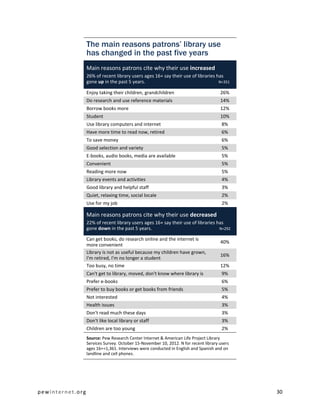
The following table shows the reasons people gave when we asked why their library use had increased
or decreased:


pewinternet.org                                                                                           29
The main reasons patrons’ library use
                  has changed in the past five years
                  Main reasons patrons cite why their use increased
                  26% of recent library users ages 16+ say their use of libraries has
                  gone up in the past 5 years.                                     N=351

                  Enjoy taking their children, grandchildren                          26%
                  Do research and use reference materials                             14%
                  Borrow books more                                                   12%
                  Student                                                             10%
                  Use library computers and internet                                   8%
                  Have more time to read now, retired                                  6%
                  To save money                                                        6%
                  Good selection and variety                                           5%
                  E-books, audio books, media are available                            5%
                  Convenient                                                           5%
                  Reading more now                                                     5%
                  Library events and activities                                        4%
                  Good library and helpful staff                                       3%
                  Quiet, relaxing time, social locale                                  2%
                  Use for my job                                                       2%

                  Main reasons patrons cite why their use decreased
                  22% of recent library users ages 16+ say their use of libraries has
                  gone down in the past 5 years.                                   N=292

                  Can get books, do research online and the internet is
                                                                                      40%
                  more convenient
                  Library is not as useful because my children have grown,
                                                                                      16%
                  I'm retired, I'm no longer a student
                  Too busy, no time                                                   12%
                  Can't get to library, moved, don't know where library is             9%
                  Prefer e-books                                                       6%
                  Prefer to buy books or get books from friends                        5%
                  Not interested                                                       4%
                  Health issues                                                        3%
                  Don't read much these days                                           3%
                  Don't like local library or staff                                    3%
                  Children are too young                                               2%
                  Source: Pew Research Center Internet & American Life Project Library
                  Services Survey. October 15-November 10, 2012. N for recent library users
                  ages 16+=1,361. Interviews were conducted in English and Spanish and on
                  landline and cell phones.


pewinternet.org                                                                               30
Many of these reasons were echoed by both the members of our in-person focus groups, many of whom
mentioned some common patterns they’ve noticed in their own library use. Many patrons discussed
how they had used the library frequently as children, but then visited public libraries less often in middle
and high school. Their library use would pick up again for academic reasons in college, but not for
pleasure reading. Many people said they “rediscovered” the library when they became parents, and
again when they retired. They also cited changing habits as individual circumstances changed, such as
the loss of a job or income (job searches, learning new skills).

A few focus group also said that discovering a new library service, such as e-book borrowing, would
rekindle their interest in the library—and lead to an increase in use of other services. Some simply
wished for more programs for single adults. One said that it seemed like all the programs at their library
were “either for the senior citizens or for the really young children, like puppet shows [and] magic
shows. There’s no really in between for those teenagers, young adults, adults.”

Another thread in our focus group discussions was library hours. Several said that budget cutbacks had
led their local libraries to scale back their hours, to the point that it was difficult to find time to stop by—
especially when libraries didn’t have hours in the evenings or on weekends. “It’s not open much at all,”
one said. “I mean a few hours a day and you can’t do a whole lot in that small amount of time.” Others
said that their library’s schedule changed so often that they had trouble remembering when it would be
open—and eventually stopped going at all.

Technology users and library use
As we noted earlier in this report, technology owners are somewhat more attached to their libraries
than non-users. Internet users, tablet users, and smartphone users are more likely to have ever gone to
libraries and more likely to have library cards. However, they are no more likely than non-owners to
have visited a library or bookmobile in the past 12 months.

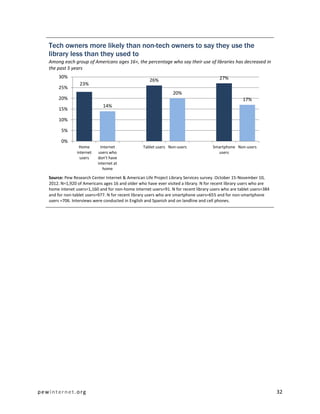
Asked to assess their library use over the past five years, recent library users who are home internet
users, tablet users and smartphone owners are somewhat more likely than non-users to say their use
has declined. And they are especially likely to say that the reason for their diminished use stems from
the fact they can do research online.


pewinternet.org                                                                                              31
Tech owners more likely than non-tech owners to say they use the
   library less than they used to
   Among each group of Americans ages 16+, the percentage who say their use of libraries has decreased in
   the past 5 years
        30%                                                                              27%
                                                      26%
                  23%
        25%
                                                                  20%
        20%                                                                                          17%
                              14%
        15%

        10%

         5%

         0%
                  Home        Internet            Tablet users Non-users              Smartphone Non-users
                 internet   users who                                                   users
                   users    don't have
                            internet at
                               home

   Source: Pew Research Center Internet & American Life Project Library Services survey. October 15-November 10,
   2012. N=1,920 of Americans ages 16 and older who have ever visited a library. N for recent library users who are
   home intenet users=1,160 and for non-home internet users=91. N for recent library users who are tablet users=384
   and for non-tablet users=977. N for recent library users who are smartphone users=655 and for non-smartphone
   users =706. Interviews were conducted in English and Spanish and on landline and cell phones.


pewinternet.org                                                                                                       32
Part 3: Technology use at libraries
Some 73% of Americans ages 16 and over say there are places in their community where they can access
the internet or use a computer for free.2 And 35% say they have used those free access points.


                Those who have used free internet and computers in
                their communities
                Among all Americans ages 16+, the percentage who have accessed the internet
                and computers at a free location outside their home, work, or school

                                                        % who have accessed the internet and
                                                            computers at a free location
                All Americans ages 16+                                   35%
                a Men (n=1,059)                                          37
                b Women (n=1,193)                                        33
                Race/ethnicity
                a White, Non-Hispanic (n=1,572)                          35
                b Black, Non-Hispanic (n=243)                            38
                c Hispanic (n=277)                                       30
                Age
                                                                              bcde
                a   16-17 (n=101)                                        55
                                                                              de
                b   18-29 (n=369)                                        41
                                                                              de
                c   30-49 (n=586)                                        42
                                                                              e
                d   50-64 (n=628)                                        29
                e 65+ (n=531)                                            20
                Household income
                a   Less than $30,000/yr (n=629)                         32
                b   $30,000-$49,999 (n=363)                              37
                c   $50,000-$74,999 (n=314)                              37
                                                                              a
                d   $75,000+ (n=567)                                     43
                Education attainment
                a No high school diploma (n=254)                         28
                b   High school grad (n=610)                             28
                                                                              ab
                c   Some College (n=562)                                 37
                                                                           abc
                d   College + (n=812)                                    45
                Parent of minor
                                                                              b
                a   Parent (n=584)                                       42
                b   Non-parent (n=1,667)                                 32

2
 The American Library Association reports that 62% of libraries report they are the only source of free public
access to computers and the Internet in their communities. Study available at:
http://www.ala.org/research/sites/ala.org.research/files/content/initiatives/plftas/2011_2012/2012%20PLFTAS%2
0Key%20Findings.pdf


pewinternet.org                                                                                            33
Urbanity
                a Urban (n=721)                                                     38
                b   Suburban (n=1,090)                                              34
                c   Rural (n=440)                                                   34
                Source: Pew Research Center’s Internet & American Life Library Services Survey of 2,252
                people age 16 and older conducted October 15-November 10, 2012. The survey was
                conducted in English and Spanish and on landline and cell phones.
                                                                  a
                Note: Columns marked with a superscript letter ( ) or another letter indicate a
                statistically significant difference between that row and the row designated by that
                superscript letter. Statistical significance is determined inside the specific section
                covering each demographic trait.


Younger Americans, particularly 16-17 year-olds, are significantly more likely to have used free internet
and computers in their communities than older adults. Americans living in households in the highest
income bracket are more likely than those living in the lowest income bracket to have used free internet
and computers. Americans with higher levels of education, especially college graduates, are also more
likely than those with lower levels of education to have done this.

Use of computers and the internet at libraries
We asked those who had visited libraries in the past 12 months if they used the computers and the
internet at the library. Our question was designed to include people who used the wired computers at
the library and people who had used the library WiFi connection, too. Some 26% of those ages 16 and
older had connected to the internet at the library.

       There are some notable demographic differences in the answers to this question. 66% of those
        who used the internet at a library in the past 12 months did research for school or work.
        Hispanics, rural residents, and people ages 16-49 are especially likely to say they did this activity.
       63% say they browsed the internet for fun or to pass the time. African-Americans and Hispanics
        are more likely than whites to report this internet use, as are those ages 18-29.
       54% say they used email. Women are more likely than men to say this, as are those ages 18-49.
       47% say they got health information.
       41% say they visited government websites or got information about government services.
        People living in households earning less than $30,000 are especially likely to report this use.
       36% say they looked for jobs or applied for jobs online. African-Americans are the most likely to
        report this activity. In addition, those ages 18-49, those who live in cities, high school graduates,
        and those in households earning less than $50,000 are also more likely than others to use library
        computers this way.
       35% say they visited social networking sites. Those ages 16-29 are especially likely to report this
        use.
       26% say they downloaded or watched online video. Suburban residents are more likely than
        others to report this.
       16% say they bought a product online.


pewinternet.org                                                                                            34
   16% say they paid bills or did online banking.
       16% say they took an online class or completed an online certification program.

Some 36% of those who had ever visited a library say the library staff had helped them use a computer
or the internet at a library. African-Americans and Hispanics are more likely than whites to access the
internet at their local library, as are parents of minor children, those under age 50, those living in
households earning less than $30,000, and those with at least some college experience.


               Internet use at libraries
               Among all Americans ages 16+, the percentage who have accessed the internet
               at the library on the computers there or via the library’s WiFi connection in the
               past 12 months

                                                          % who have accessed the internet at
                                                           the library in the past 12 months

               All Americans ages 16+                                       26%
               a Men (n=1,059)                                              25
               b Women (n=1,193)                                            27
               Race/ethnicity
               a   White, Non-Hispanic (n=1,572)                            24
                                                                                 a
               b   Black, Non-Hispanic (n=243)                              31
               c Hispanic (n=277)                                           27
               Age
                                                                                 de
               a   16-17 (n=101)                                            39
                                                                              cde
               b   18-29 (n=369)                                            38
                                                                                 de
               c   30-49 (n=586)                                            31
                                                                                 e
               d   50-64 (n=628)                                            19
               e 65+ (n=531)                                                10
               Household income
               a Less than $30,000/yr (n=629)                               28
               b $30,000-$49,999 (n=363)                                    29
               c $50,000-$74,999 (n=314)                                    24
               d $75,000+ (n=567)                                           28
               Education attainment
               a No high school diploma (n=254)                             22
               b   High school grad (n=610)                                 21
                                                                                 ab
               c   Some College (n=562)                                     30
                                                                                 ab
               d   College + (n=812)                                        31
               Parent of minor
                                                                                 b
               a   Parent (n=584)                                           34
               b Non-parent (n=1,667)                                       23
               Urbanity
               a Urban (n=721)                                              29
               b Suburban (n=1,090)                                         25


pewinternet.org                                                                                       35
c   Rural (n=440)                                                24
                Source: Pew Research Center’s Internet & American Life Library Services Survey of 2,252
                people age 16 and older conducted October 15-November 10, 2012. The survey was
                conducted in English and Spanish and on landline and cell phones.
                                                                     a
                Note: Columns marked with a superscript letter ( ) or another letter indicate a
                statistically significant difference between that row and the row designated by that
                superscript letter. Statistical significance is determined inside the specific section
                covering each demographic trait.


How important is free computer and internet access at libraries?
We did not ask a question about whether library internet users depend on that connection as their
primary internet connection. But we asked respondents to this survey how important they think it is to
have free access to computers and the internet at the library in their community.

Some 77% of all those ages 16 and older say it was “very important” for libraries to offer free access to
computers and the internet to the community and another 18% say it was “somewhat important.” Just
2% say it was not too important and another 2% say it was not important at all.

Again, there are some noteworthy demographic differences in the answers: African-Americans and
Hispanics are more likely than whites to feel free access was very important. Women and those with
some college experience are also especially likely to feel this way. This topic is discussed further in Part 4
of this report.


                      How important is free library access to
                      computers and the internet to the community?
                      Among all Americans ages 16+, the percentage who say it is “very
                      important” to provide free access

                                                                       % who say it is “very
                                                                      important” to provide
                                                                           free access
                      All Americans ages 16+                                     77%
                      a   Men (n=1,059)                                          73
                                                                                      a
                      b   Women (n=1,193)                                        81
                      Race/ethnicity
                      a White, Non-Hispanic (n=1,572)                            72
                                                                                      a
                      b   Black, Non-Hispanic (n=243)                            92
                                                                                      a
                      c   Hispanic (n=277)                                       86
                      Age
                      a 16-17 (n=101)                                            77
                      b 18-29 (n=369)                                            74
                                                                                      e
                      c   30-49 (n=586)                                          81
                                                                                      e
                      d   50-64 (n=628)                                          81
                      e   65+ (n=531)                                            68


pewinternet.org                                                                                            36
Household income
                  a Less than $30,000/yr (n=629)                               81
                  b $30,000-$49,999 (n=363)                                    79
                  c $50,000-$74,999 (n=314)                                    75
                  d $75,000+ (n=567)                                           75
                  Education attainment
                  a No high school diploma (n=254)                             73
                  b High school grad (n=610)                                   75
                                                                                    abd
                  c   Some College (n=562)                                     84
                  d College + (n=812)                                          74
                  Parent of minor
                  a Parent (n=584)                                             81
                  b Non-parent (n=1,667)                                       75
                  Urbanity
                  a Urban (n=721)                                              81
                  b Suburban (n=1,090)                                         76
                  c Rural (n=440)                                              73
                  Source: Pew Research Center’s Internet & American Life Library Services
                  Survey of 2,252 people age 16 and older conducted October 15-November
                  10, 2012. The survey was conducted in English and Spanish and on landline
                  and cell phones.
                                                                      a
                  Note: Columns marked with a superscript letter ( ) or another letter
                  indicate a statistically significant difference between that row and the row
                  designated by that superscript letter. Statistical significance is determined
                  inside the specific section covering each demographic trait.


pewinternet.org                                                                                   37
Part 4: What people want from their
libraries
In addition to asking people how they use their local public libraries, we also asked them about how
much they felt they know about the different services and programs their library offers. We also
examined how important Americans feel various library services are to their communities, and explored
what sort of activities and resources people might be interested in using at libraries in the future.

How much people know about what their library offers
In general, Americans feel somewhat well-informed about the various services offered by their local
libraries. While about one in five (22%) feel they are aware of “all or most” of the services and programs
their public library offers, a plurality (46%) feel they just know of “some” of what their library offers.
Another 20% say they know “not much” about services offered by their library, and 11% say they know
“nothing at all” about what is available at their library.

Whites (23%) are more likely than Hispanics (16%) to say they know “all or some” of what their library
offers, while Hispanics are more likely to say that they know “nothing at all”—21% say this, more than
twice the rate among whites (9%) or blacks (11%). Women are also more likely to consider themselves
well-informed of library services than men, and those with higher levels of education are more likely to
say they’re aware of at least some services than those with less education. Respondents under the age
of 30 are also less likely to say they know much about library services than older adults, particularly
those ages 30-64.

One aspect mentioned very often, both in focus groups and in qualitative work from previous research,
is that people wish they were more aware of the full range of services offered by their libraries. One
focus group member loved her local library and rated it highly in all areas—except communication;
“there’s so much good stuff going on but no one tells anybody.” Another said, “they do so many
fabulous things, [but] they have horrible marketing.”

However, focus group members say that having resources and events listed on their library’s website
wasn’t enough—as several participants pointed out, they probably weren’t going to go to the website to
look for events (or even to sign up for email newsletters) unless they already knew that the library had
those events. Instead, they said they usually stumbled across listings either at their library in-person,
when trying to do something else online, or by seeing signage outside the library as they were driving
past. One parent loved their library and described it as “unbelievable,” but said that she only heard
about events when they were already in the library with their children, on their way to participate in
another activity or event. This parent said that they often weren’t even aware of events until she heard
the announcement that the event was about to start, when it was too late for her family to change
plans.

Many of the librarians in our in-person focus groups agreed that it was difficult to reach patrons and tell
them about all the services the library offered. Several said that almost every day, they will be speaking
with a patron who had come in for a specific service, and would mention other services or resources and
hear the patron reply, “I didn’t know that was available.”


pewinternet.org                                                                                         38
How much do you feel like you know about the different services and
programs your public library offers?
How much Americans ages 16+ feel they know about the services offered by their public library
                                 All or most       Some      Not much          Nothing at all

               All adults 16+          22%                         46%                          20%           11%
                          Sex
                         Men          20%                        43%                       23%               13%
                     Women              24%                            48%                        18%         10%
              Race/ethnicity
        White, Non-Hispanic            23%                            46%                        20%          9%
         Black, Non-Hispanic         18%                         48%                          21%            11%
                    Hispanic*        16%                   39%                      20%                21%
                          Age
                        16-17         19%                    38%                          30%                 13%
                        18-29           24%                        40%                        25%             11%
                        30-49          22%                            48%                        18%         10%
                        50-64          23%                            47%                        18%         10%
                          65+        17%                        47%                        20%               15%
          Household income
       Less than $30,000/yr           20%                        43%                      19%               16%
            $30,000-$49,999              26%                           44%                       18%          11%
            $50,000-$74,999            21%                            50%                         20%             8%
                    $75,000+           21%                            52%                             22%          6%
     Educational attainment
     No high school diploma          15%                  37%                     22%                  24%
            High school grad          19%                       43%                       22%               14%
               Some College                27%                         44%                       19%          8%
                    College +           24%                              54%                           17%         4%
        Geographic location
                       Urban          19%                        47%                          20%            12%
                    Suburban           23%                         44%                          21%          10%
                        Rural           24%                           45%                       16%          15%
              Parental status
                       Parent              27%                           47%                        16%        9%
                Not a parent          20%                        45%                          22%            12%

                                0%    10%        20%   30%      40%      50%    60%     70%      80%        90%    100%
Source: Pew Research Center’s Internet & American Life Library Services Survey of 2,252 people age 16 and older conducted
October 15-November 10, 2012. The survey was conducted in English and Spanish and on landline and cell phones.


pewinternet.org                                                                                                           39
What is important for libraries to offer
We asked survey respondents about a variety of services that public libraries often provide to the public,
and asked them how important, if at all, they think it is for public libraries to provide each to the
community. All but one of the services are considered to be “very important” by a majority of
respondents.

It was particularly striking to note now is that provision of technology ranks just as high as helpful
librarians and books as central to libraries’ missions.


       What people think is important for libraries to offer
       Among all Americans ages 16+, the percentage who say that these services and programs are
       “very important” or “important” for libraries to offer

                                      Very important         Somewhat important


                   Librarians to help people find info                         80                     16

                                     Borrowing books                           80                     15

           Free access to computers and the internet                          77                     18

           Quiet study spaces for adults and children                         76                     19

         Programs and classes for children and teens                          74                     21

          Research resources such as free databases                       73                     20

                                 Job/career resources                    67                     22

                                Free events/activities                   63                     30

                          Free public meeting spaces                49                     36

                                                         0        20           40     60        80         100
       Source: Pew Research Center Internet & American Life Project Library Services survey. October 15-November
       10, 2012. N=2,252 Americans ages 16 and older. Interviews were conducted in English and Spanish and on
       landline and cell phones. Margin of error is +/- 2.3 percentage points for the total sample.


Programs for children and teens and research resources such as free databases are also ranked highly,
as are job, employment and career resources and free activities such as classes and cultural events. Just
about half (49%) of Americans think it is “very important” for libraries to provide free public meeting
spaces, making it the lowest-ranked service that we asked about, although 85% of respondents say this
service is “somewhat” or “very” important overall.


pewinternet.org                                                                                                    40
Blacks and Hispanics are more likely to see various library
            services as “very important”
            Among all Americans ages 16+, the percentage who say it is “very important” for
            libraries to offer these services

                                               White     Black      Hispanic

                                                                                         78%
                       Librarians to help people                                             89%
                                                                                           84%

                                                                                    72%
             Free access to computers/ internet                                                  92%
                                                                                               86%

                                                                                   71%
                             Quiet study spaces                                                 89%
                                                                                               86%

                                                                                   69%
                             Research resources                                            84%
                                                                                           85%

                                                                                 68%
                       Programs/classes for kids                                               86%
                                                                                                 92%

                                                                             61%
                          Jobs/career resources                                            83%
                                                                                          81%

                                                                           57%
                           Free events/activities                                          84%
                                                                                         79%

                                                                     46%
                           Free meeting spaces                              61%
                                                                           58%

                                                    0%    20%        40%         60%           80%     100%
            Source: Pew Research Center Internet & American Life Project Library Services Survey. October
            15-November 10, 2012. N=2,252 Americans ages 16 and older. N for whites= 1,572. N for
            blacks=243. N for Hispanics=277. Interviews were conducted in English and Spanish and on
            landline and cell phones.


For almost all of the resources we asked about, blacks and Hispanics are significantly more likely than
whites to consider them “very important” to the community, as shown in the chart above. Women are
also generally more likely than men to say these resources are “very important” (see following chart).


pewinternet.org                                                                                               41
Women are more likely than men to see various library
           services as “very important”
           Among all Americans ages 16+, the percentage of women and men who say it is “very
           important” for libraries to offer these services
                                                      Women      Men


                                                                                    84%
                         Librarians to help people
                                                                                  77%
                                                                                    84%
                                 Borrowing books
                                                                                 76%
                                                                                   81%
                Free access to computers/ internet
                                                                                73%
                                                                                      81%
                               Quiet study spaces
                                                                                70%
                                                                                    79%
                         Programs/classes for kids
                                                                              68%
                                                                                    78%
                               Research resources
                                                                              68%
                                                                                73%
                            Jobs/career resources
                                                                          60%
                                                                                71%
                             Free events/activities
                                                                        56%
                                                                        55%
                              Free meeting spaces
                                                                  44%

                                                      0%   20%      40%       60%         80%   100%
           Source: Pew Research Center Internet & American Life Project Library Services Survey. October 15-
           November 10, 2012. N=2,252 Americans ages 16 and older. N for men=1,059. N for women=1,193.
           Interviews were conducted in English and Spanish and on landline and cell phones.


A more detailed examination of all these services follows below.

Librarians to help people find information they need

Overall, 80% of Americans say that it is “very important” to the community for libraries to have
librarians available to help people find information they need. Some 16% consider having librarians at
libraries “somewhat important,” while 2% say this is “not too important” and 1% say it is “not at all
important.”

Blacks (89%) are significantly more likely than whites (78%) to consider librarians “very important,” and
women (84%) are more likely to say this than men (77%). Those living in households making less than
$30,000 per year are also more likely to consider librarians very important compared to those living in
households earning more than $75,000. Looking at responses based on device ownership, we find that


pewinternet.org                                                                                                42
those who own technological devices such as tablets, e-readers, and smartphones are just as likely as
non-users to consider librarians “very important” to the community.

Our focus groups considered librarians to be very important to libraries in general, and many had very
positive memories of interactions with librarians from their childhoods. Even when they suggested
automating certain services for the sake of convenience, our focus groups overwhelmingly saw a future
with librarians as an integral part of libraries.

Several library staff members who participated in our online panel said that they felt patrons were not
always aware of the research assistance librarians can offer. One wrote, “Often a patron will troll
through the internet for hours trying to find a form or information source that I could provide them in a
matter of moments.” Another librarian said that most people, including students, didn’t know about the
research resources offered by the library other than books: “Most students have no idea what a
database is and therefore get their information from Google, while the tremendous resources available
online from our library go unknown and unused.”

Borrowing books

Overall, 80% of Americans say that it is “very important” for libraries to provide books to the community
for borrowing. Another 15% consider book borrowing “somewhat important,” while 2% say this is “not
too important” and 2% say it is “not at all important.”

Women (84%) are significantly more likely than men (76%) to consider book borrowing to be “very
important” to the community. Adults ages 30-64 are more likely than other age groups to say this, as are
those who had at least some college experience compared with those who had not attended college.

Tablet users (84%) and e-reader users (83%) are significantly more likely than Americans who do not
own these devices to consider book borrowing at libraries “very important.”

Most focus group members felt that books are essential to libraries, although a few vocal opponents
disagreed.

Free access to computers and the internet

As noted in Part 3 of this report, three-quarters (77%) of Americans think it is “very important” for public
libraries to provide free access to computers and the internet to the community. Another 18% consider
free computer and internet access “somewhat important,” while 2% say this is “not too important” and
2% say it is “not at all important.”

The vast majority of blacks (92%) and Hispanics (86%) consider the free access to computer and the
internet that libraries provide “very important” to the community, making them significantly more than
whites (72%) to say this. Additionally, women (81%) are more likely than men (73%) to consider this
access “very important,” as are adults ages 30-64 (81%) compared with other age groups.

Smartphone users (82%) are significantly more likely than Americans who do not own these devices
(72%) to consider free access to computers and the internet “very important.”

The librarian in our online panel overwhelmingly said that providing access to computers and the
internet was an important service for libraries. “Our most popular area is the public access computers,”
one library staff member wrote. “They are constantly full.” A rural librarian told us:


pewinternet.org                                                                                          43
“As a public library in a poverty stricken rural community we provide the only link to the outside
        world through our computers. Our citizens do not have internet service or computers at home.
        Many do not have transportation and there is no public transportation which leaves many adults
        and children isolated. We, at the library, are working to develop a way to provide internet
        access and computers to everyone in our county.”

Many librarians emphasized that they see the role of a library as a place to enable access to information,
regardless of the format. Several said that this focus on access is even more important in the digital age
than before. “I believe public libraries should move away from being ‘houses of knowledge’ and move
more towards being ‘houses of access.’” One wrote. “This is what the public is asking for and we are
here to serve them.” Another librarian said:

        “I believe libraries need to provide computers and Internet access for patrons who cannot afford
        these items or cannot purchase high speed Internet access in their home area. Many job
        applications, etc. are online now which widens the digital divide unless libraries provide this
        service.”

Quiet study spaces for adults and children

Some 76% of Americans think it is “very important” to the community for public libraries to provide
quiet study spaces for adults and children. Another 19% consider quiet study spaces “somewhat
important,” while 2% say they are “not too important” and 2% say they are “not at all important.”

Almost nine in ten blacks (89%) and Hispanics (86%) consider libraries’ quiet study spaces to be “very
important” to the community, making them significantly more than whites (71%) to say this.
Additionally, women (81%) are more likely than men (70%) to consider this resource “very important,”
as are Americans who have not graduated from college (78%) compared with college graduates (69%).
Adults ages 50-64 are also somewhat more likely than other age groups to consider quiet study spaces
“very important,” although Americans under the age of 50 are most likely to consider these areas
important overall.

Those living in urban areas (81%) are also significantly more likely than those living in suburban (73%) or
rural (73%) communities to say quiet study spaces are “very important.”

Some members of the focus groups were adamant about needing areas they can use that are absolutely
quiet. Others also suggested separate small conference/study rooms where you can close the door to
work or have meetings. One said, “I wish there a way in which you could lock off spaces because I work
remotely from home and I'd love to be able to go someplace else to work to change it up.”

Programs and classes for children and teens

Almost three-quarters (74%) of Americans think it is “very important” for public libraries to provide
programs and classes for children and teens. Another 21% consider these programs “somewhat
important,” while 2% say they are “not too important” and 2% say they are “not at all important.”

Some 92% of Hispanics and 86% of blacks consider these classes to be “very important” to the
community, making them significantly more than whites (68%) to say this. Additionally, women (79%)
are more likely than men (68%) to consider this resource “very important,” as are Americans in
households making less than $75,000 per year (79%) compared with those in households earning more
(65%).


pewinternet.org                                                                                          44
Parents in our focus groups almost uniformly appreciated children’s programming at their local libraries.
Some parents said that they would appreciate extended hours at libraries so their children could spend
time there in a monitored environment; others wished there were more activities on weekends, instead
of during the work day.

Many librarians in the online canvassing wrote about their experiences creating “hangout” spaces and
activities for teens, citing importance of keeping teens engaged with the library as they grow older.
“Interacting with children and young adults at their schools is an important aspect of encouraging these
groups to use the library at a young age,” one wrote. “These groups may be more likely to use the
library as adults if they are comfortable there as children.”

Finally, keeping these spaces apart from the main reading room areas of the library seemed to be an
important point for many of our focus group members, as many of them complained about increased
noise levels during our sessions.

Research resources such as free databases

Some 73% of Americans say it is “very important” for public libraries to provide research resources such
as free databases to the community. One in five (20%) consider these resources “somewhat important,”
while 2% say they are “not too important” and 2% say they are “not at all important.”

Blacks (84%) and Hispanics (85%) are significantly more likely than whites (69%) to say that these
research resources are “very important” to the community, and women (78%) are more likely than men
(68%) to say this. Those under the age of 65 are more likely than older adults to think these resources
are important to the community. Americans living in urban areas (79%) are also significantly more likely
than those living in suburban areas (69%) to say research resources are “very important.”

Computer users and smartphone users are just as likely as people who do not own these devices to
think it is “very important” for libraries to provide research resources; however, tablet users (67%) are
significantly less likely than non-users (75%) to consider these research resources “very important.”

“My experience is that we are busy, people want us more hours, but they are largely unaware of our
online resources,” one library staff member in our online panel wrote. “When you share the information
with them (eBooks, databases, online classes) they are excited, but unless we tell them in person they
(mostly) do not know about them.”

The level of patron interest in databases seemed to vary based on the interests and needs of its patrons.
Another library staff member wrote that while e-books and other digital resources were very popular
with patrons, “on-line databases such as Mango and ancestry.com have not elicited much of a response
at all.”

Job, employment and career resources

Some 67% of Americans think it is “very important” to the community for public libraries to provide job,
employment and career resources. Another 22% consider these resources “somewhat important,” while
5% say they are “not too important” and 2% say they are “not at all important.”

About eight in ten blacks (83%) and Hispanics (81%) consider libraries’ career resources to be “very
important” to the community, compared with about six in ten whites (61%), and women (73%) are more
likely than men (60%) to say this. Those who had not completed college and those living in lower-


pewinternet.org                                                                                         45
income households are also generally more likely to say these resources are “very important.”
Additionally, Americans under the age of 65 are most likely to consider these resources important
overall compared with those ages 65 and older.

Those living in urban areas (71%) are also significantly more likely than those living in suburban areas
(64%) to say employment-related resources are “very important.” Finally, people who have computers,
tablets, or smartphones are less likely than those who do not own these devices to consider job
resources at libraries to be “very important.”

In our focus groups, awareness and use of career-related resources seems to vary widely by library, as
well as by city. A few focus group members said that they relied heavily on these services in their job
searches; other focus group members weren’t aware of these services at all.

Library staff members in our online panel often emphasized the importance of employment-related
resources, especially for patrons who are less comfortable with technology or lack resources at home.
“There are large parts of this community that have less than 20% of the population with computers at
home. We have job seekers that leave the library phone as their contact,” one librarian wrote. Another
said: “Many of our town residents/patrons have no internet access and, some who do, are still using a
dial-up network. Offering internet access for e-mail, job searching, and personal research are a vital
component to the services we provide.”

Many librarians said they felt that offering computers and other resources for job-seekers was
increasingly important as technology became more vital to the job search process. “Libraries need to be
able to meet the needs of the patron,” one librarian wrote, and “[in] this day and age the patron needs
have become more focused on technology. This means that they may not have the ability to acquire the
knowledge needed to apply for a job, write a résumé, use a computer, use applications on a computer
or just use a device that they might need to help them in different areas of their life.”

Free events and activities, such as classes and cultural events, for people of all ages

Over six in ten Americans (63%) say it is “very important” for public libraries to provide free events and
activities, such as classes and cultural events, for people of all ages. Three in ten (30%) consider these
activities “somewhat important,” while 4% say they are “not too important” and 2% say they are “not at
all important.”

Some 84% of blacks and 79% of Hispanics consider these events to be “very important” to the
community, compared with 57% of whites. Women (71%) are also more likely than men (56%) to say
this, as are those who had not completed college (67%) compared with college graduates (53%). Those
living in lower-income households are also somewhat more likely to consider these activities important
compared with those in higher-income households. Americans living in urban areas (71%) are also
significantly more likely than those living in suburban areas (59%) to say research resources are “very
important.”

Members of our focus groups appreciated the free activities offered by their local libraries—when they
were aware of them. One participant valued these activities as “something that will bring you out of
your house and meet your neighbors and say, ‘Hi.’” The main issue many of them cited was simply
finding out about these activities in the first place. Many focus group members mentioned stumbling
across a list of activities as their library only by accident, when they were on the website for another
purpose.


pewinternet.org                                                                                           46
The librarians in our online panel often said that they considered free community activities very
important to the library’s core mission. “The library's role in the community is shifting to that of a
storage facility to a community center,” one wrote. Many said that they enjoyed partnering with other
local institutions and organizations to expand the types of activities they could offer.

Many library staff members said that activities for young children and families were a core offering of
their libraries. “We consistently bring in nice sized crowds for all of our storytimes, and our other
afterschool programs and holiday activities also are well received,” one wrote. “We have also brought in
local artists to display their works and the exhibits are always widely liked by the staff and our patrons.”

Free public meeting spaces

About half (49%) of Americans say it is “very important” to the community for public libraries to provide
free public meeting spaces. Another 36% consider this “somewhat important,” while 9% say this is “not
too important” and 4% say it is “not at all important.”

Blacks (61%) and Hispanics (58%) are more likely than whites (46%) to consider free public meeting
spaces at libraries to be “very important” to the community, and women (55%) are more likely than men
(44%) to say this. Americans who have not graduated from college (53%) are also more likely to consider
this “very important” compared with college graduates (41%).

Focus group members who were involved with local organizations or more casual groups often
mentioned the importance of libraries for public meeting spaces. Many librarians in our online panel
whose libraries offered these meeting spaces also mentioned their popularity. “Our community loves
the meeting rooms. We are booked for months in advance with the larger rooms and our ‘as available’
small study rooms are always full,” one library staff member wrote. “We just wish we had more of
them!”

Public priorities for libraries
We also asked our national survey respondents, as well as our focus groups, about some different ways
public libraries could change the way they serve the public, and whether or not they thought public
libraries should implement these changes (if they do not offer these services already). In a separate,
qualitative questionnaire aimed at public library staff members, we also asked librarians and other
library workers their thoughts on these services.

In general, Americans are most adamant that libraries should devote resources to services for children;
over eight in ten Americans say that libraries should “definitely” coordinate more closely with local
schools in providing resources to kids (85%), and a similar number (82%) strongly support libraries
offering free early literacy programs to help young children prepare for school. The services about which
our national survey respondents are more ambivalent involved moving library services online and
automating services (such as installing self-checkout stations). The least popular idea was moving some
print books out of public locations to free up more space for things such as tech centers, reading rooms,
meetings rooms, and cultural events; just one-fifth of respondents say libraries should “definitely” do
this, while almost four in ten (39%) say libraries should “maybe” do this and almost as many (36%) say
libraries should “definitely not” do this.

Younger Americans were more often in favor of these ideas than older adults, including having more
comfortable spaces for reading, working, and relaxing, offering more interactive learning exhibits,


pewinternet.org                                                                                          47
offering free early literacy programs, coordinating more with local schools, and moving most services
online. Blacks and Hispanics were more likely than whites to support having more comfortable spaces
and having separate areas for different activities, as well as moving print stacks out of public areas,
offering interactive learning experiences and helping digitize patrons’ materials. Finally, those living in
lower-income households were more likely than those in higher-income households to support moving
print stacks out of public areas, offering interactive learning experiences, and helping digitize patrons’
materials.


What services and programs libraries should (and should not) implement
Among all Americans ages 16+, the percentage who say their library should implement the following programs

                        Should definitely do             Should maybe do         Should definitely not do


              Coordinate more with local schools                                  85                                    11 2
                           Free literacy programs                                82                                    14       3
            Separate spaces for different services                          61                          27                  9
                  Have more comfortable spaces                          59                              28              9
                              Offer more e-books                       53                          30              5
      Offer more interactive learning experiences                  47                            38                     12
                      Help users digitize material                43                          39                       14
               Move most library services online                  42                        34                     19
                  Make most services automated                    41                        36                     20
 Move some books/stacks out of public locations             20                   39                          36

                                                     0           20              40         60                80                100
Source: Pew Research Center Internet & American Life Project Library Services survey. October 15-November 10, 2012.
N=2,252 Americans ages 16 and older. Interviews were conducted in English and Spanish and on landline and cell phones.


When we asked the library staff members in our online panel for their thoughts on these services and
programs, many said that their library had either already implemented or should definitely implement
many of them in the future. The programs that were most popular with these librarians were: having
separate locations for different activities, offering free early literacy programs, coordinating with local
schools, and having comfortable spaces for reading, working, or relaxing at the library. Many also said
that they were eager to offer a broader selection of e-books for check-out.

Some of the resources garnered more lukewarm support; most librarians said they do not currently
offer interactive learning experiences or resources for digitizing patrons’ own materials, but many said
only that their libraries should “maybe” offer them in the future. Our library staff respondents were also
ambivalent about moving most library services online and making most services automated. The least
popular idea overall was moving print books out of public locations to free up space for other activities.


pewinternet.org                                                                                                                       48
The following subsections explore librarians’ responses in further detail, but many described the various
factors they take into account when thinking about what services they should offer, such as the specific
needs of the communities they serve, budgets and staff time, and staff members’ experience with new
technologies. While each response was unique, the following quote from a library staff member touches
on many of the issues that librarians said they consider:

        “We attempt to meet the needs of our community. Due to the fact that the needs of the
        community are very diverse, our services are also diverse. We have made room for many
        activities at the library such as tutoring, meetings, family gatherings such as wedding showers,
        study space or just a space to hang out. We have also become mindful of different learning
        styles and now offer hands-on learners interactive exhibits and developmentally disabled
        individuals a special needs storytime. We offer equipment to help with digitizing materials but
        do not have enough staff to help everyone with their project, although when time allows we do
        often get pulled into the process and help to get people started. … Print books are still very
        popular with older patrons and those who are financially challenged. Electronic materials are
        certainly a great addition to our collection but, because not everyone has internet access at
        home or can afford to buy an e-reader or tablet computer, we cannot abandon the print
        materials. Again, we serve a diverse community.”

Here is a more detailed analysis of the different services different groups would like to see implemented
at libraries.

Coordinate more closely with local schools in providing resources to kids

Overall, 85% of respondents say that libraries should “definitely” coordinate more closely with local
schools in providing resources to kids. Some 11% say libraries should “maybe” do this, and 2% say
libraries should “definitely not” do this.

Americans ages 16-64 are significantly more likely than older adults to express strong support for this
idea, as are those who live in urban or suburban areas compared with those living in rural areas.

Focus group members were very much in support of this idea. Many said that they would love to see
libraries offer resources such as homework help and tutoring, as well as afterschool study programs.
Some participants said that they wished their library had enough copies of the books assigned to their
children as readings in class, especially when the school library only has a few copies that are quickly
checked out.

Most of the librarians in our online panel either said that their library was already doing this, or should
definitely do this in the future. “I think libraries should work very closely with area schools in an effort to
enable kids to successfully complete their homework and research projects,” a library staff member
wrote. “I am aware that some libraries already have collaborative relationships established with their
school districts. I would very much like to do that with my local school district.”

However, many said that doing so was often complicated, as one librarian pointed out: “Coordinating
with schools is a two-way street that takes time and persistence to build.” Another wrote:

        “Although we should definitely work more closely with our public schools, it's virtually
        impossible as their jammed schedules leave almost no time for outside agencies to work in the
        schools. I think our niche is the early literacy market from birth to Kindergarten—whether it's
        working with individual families, daycares, or preschools. One branch [in our system] has been


pewinternet.org                                                                                             49
most successful by taking storytimes to daycares and working with the youngest populations.
        The result has been that the older children now come to storytime at the library as they can
        walk to and from the event.”

Offer free early literacy programs to help young children prepare for school

Another popular service was free early literacy programs to help young children prepare for school,
which 82% of respondents say that libraries should “definitely” offer. Another 14% say libraries should
“maybe” do this, and 3% say libraries should “definitely not” do this.

Adults ages 65 and older are significantly less likely than younger Americans to say that libraries should
“definitely” do this, with 69% of this oldest age group expressing strong support (compared with more
than eight in ten younger respondents). Those who had not completed high school are also generally
more likely to express strong support for this idea. Finally, those who live in urban areas are significantly
more likely to say that libraries should “definitely” do this than those in suburban or rural areas.

Many librarians in our online panel said that their libraries already offer early literacy programs and
considered them a core part of their library’s mission. “Libraries have been, and always been, important
to childhood literacy/education,” one wrote, adding that “they need to expand traditional storytimes to
incorporate interactive learning experiences, virtual experiences for kids and teens.”

However, the librarians whose libraries who do not currently offer early literacy programs were
sometimes unsure as to whether this was a service they should clearly offer. “Although I think libraries
should work with schools and early literacy programs, I think there should be specially trained
individuals in those roles,” another library staff member wrote.

Have completely separate locations or spaces for different services

A majority (61%) of Americans say that libraries should “definitely” have completely separate locations
or spaces for different services, such as children’s services, computer labs, reading spaces, and meeting
rooms. Some 27% say libraries should “maybe” do this, and 9% say libraries should “definitely not” do
this.

There are few differences between different demographic groups in support for this idea, although
blacks and Hispanics are more likely to express strong support for this idea than whites.

A common sentiment in the focus groups was the need to keep children’s areas, teen hangout spaces,
and computer-centric areas separate from the main reading or lounge areas, to keep noise levels and
other distractions down to a minimum. Many librarians in our online panel agreed, “When possible I
think that it works well to keep the computer, group meeting, and children's area noise away from the
quieter reading areas,” one said. “Staff and [patrons] both seem to appreciate this.”

Others have seen drastic changes: “We moved our teen library away from our adult patrons and it has
made a world of difference. The teens behavior has gotten so much better we no longer need a security
guard at the library.”

Many of the library staff members in our online panel said that their libraries already have separate
locations for different services, although those who do not currently offer it were split on whether their
library should definitely do this or should only “maybe” do this. Those who said their library was less
likely to do this often cited issues of space, or funding; one pointed out that “in small libraries, often


pewinternet.org                                                                                            50
operated by a single staff member, separate spaces cannot be for reasons of security or even customer
service.”

Have more comfortable spaces for reading, working, and relaxing at the library

More than half (59%) of Americans say that libraries should “definitely” create more comfortable spaces
for reading, working, and relaxing at the library. Some 28% say libraries should “maybe” do this, and 9%
say libraries should “definitely not” do this.

Women are significantly more likely than men to express strong support for this idea, and blacks and
Hispanics are more likely to express strong support than whites. This idea was also more popular with
those under age 50 than with older adults.

In our focus groups, we asked participants to think about what their ideal library would look like. Many
participants said that while they wanted a quiet space in the library, they wanted one that’s not too
quiet. They described having a comfortable place where they could focus and get work done, but also
feel like a part of their community; where “even if you’re by yourself, you don’t feel like you’re by
yourself,” as one participant put it. Many described a sort of “coffeeshop” feel or “living room
atmosphere,” but without feeling like they need to buy anything or leave in a certain amount of time—
“a safe and affordable hangout location,” where they could mingle with other people if they wanted to,
but can do their own thing if not. (One focus group member said a library should be “like home room for
your community.”)

This idea was very popular with the librarians in our online panel, with most saying either that their
library should definitely do this in the future, or that it was already doing this:

        “Sometimes people just need a place to go to escape from their hectic lives. What if we could
        melt together Starbucks, Barnes & Noble, Amazon, Redbox, and the gym together? A place
        where the majority of the population could say they use on a weekly, if not daily, basis.”

“I also think libraries should be less institutional and more inviting and comfortable,” one wrote.
“Introducing a variety of reading and studying seating options acknowledges that one style doesn't suit
everyone,” another added.

Offer a broader selection of e-books

About half of Americans (53%) say that libraries should “definitely” offer a broader selection of e-books.
Some 30% say libraries should “maybe” do this, and 5% say libraries should “definitely not” do this.

Recent reports by Pew Internet have examined some of the issues involved in e-book adoption at
libraries, and have found that most Americans (57%) are unaware if their library lends out e-books or
not; among recent library users, 5% borrow e-books. 3

In the past year, the percentage of Americans who read e-books increased from 16% of all those ages 16
and older to 23% as of November 2012. Among these e-book borrowers, the most common complaints


3
 Kathryn Zickuhr, Lee Rainie, Kristen Purcell, Mary Madden and Joanna Brenner, “Libraries, patrons, and e-books.”
June 22, 2012. http://libraries.pewinternet.org/2012/06/22/libraries-patrons-and-e-books/


pewinternet.org                                                                                               51
as of December 2011 are a lack of titles (56% of e-book borrowers say they have encountered this) and
long waiting lists (52%).4

This idea was significantly more popular with adults ages 18-64 compared with those 65 and older, and
those with at least some college experience are generally more likely to express strong support for this
idea than those who had not attended college.

Technology users in general are more likely than those who do not own various devices to say that
libraries should “definitely” expand their e-book selections. Some 68% of e-reader owners expressed
strong support for this idea, compared with 50% of non-owners; tablet owners (63%), smartphone users
(62%), and those who own a desktop or laptop computer (55%) are also more likely to say libraries
should do this.

Many librarians in our online panel said that their library should definitely offer a broader selection of e-
books. They often cited a lack of funds and restrictions from publishers as their main impediments, and
the balance of trying to provide e-books for their tech-savvy patrons while still providing print and
audiobooks for those who prefer print.

Offer more interactive learning experiences similar to museum exhibits

Overall, 47% of Americans say that libraries should “definitely” offer more interactive learning
experiences similar to museum exhibits. Some 38% say libraries should “maybe” do this, and 12% say
libraries should “definitely not” do this.

This idea was significantly more popular with blacks (66%) and Hispanics (62%) than with whites (40%),
and those under age 50 are more likely to express strong support than older adults. Interactive learning
experiences are significantly more popular with those who had not completed college compared with
college graduates, as well as with those in lower-income households compared with those at higher
income levels. Finally, those who live in urban areas are significantly more likely to express strong
support for this idea than those in suburban or rural areas.

Few of the librarians in our online panel said that their library already offered interactive learning
experiences, and the rest were lukewarm on whether they should in the future. Many were intrigued by
the idea, but said that a lack of space and resources were the main reasons they don’t currently offer
interactive exhibits. “We don't have the space or time to produce interactive learning experiences in our
library, though in the future they may be a way to draw people into the building,” one wrote.

Ultimately, there was no clear consensus from out online panel. Some felt that expanding the offerings
of the library was a vital innovation for the future. “Interactive experiences are key for libraries moving
forward,” one librarian wrote. “We need to provide opportunities for the community to gather and
interact. We also need to meet patrons where they are - online or in the community. Embedding with
community groups is crucial to sharing information about library resources and to collaborate on
programs that benefit the community.”

Others felt that interactive exhibits were the province of museums, not libraries—although some felt
that a partnership might be worthwhile: “I think rather than always offering the interactive learning

4
 Lee Rainie and Maeve Duggan, “E-book Reading Jumps; Print Book Reading Declines.” December 27, 2012.
http://libraries.pewinternet.org/2012/12/27/e-book-reading-jumps-print-book-reading-declines/


pewinternet.org                                                                                            52
experiences and programs, libraries could do a better job partnering with groups offering services in the
communities. Be a presence outside of the library. “

However, some library staff weren’t convinced that interactives had a place at the library. “I was torn
about the interactive experiences,” another library staff member said. “In some ways that sounds nice,
but I'm not really sure how that would work out in reality. I think it is important that libraries be an oasis
for quiet thought.”Another librarian was more blunt: “Interactive exhibits would be counter-productive
to the quiet atmosphere for which we strive.”

Help users digitize material such as family photos or historical documents

Some 43% of Americans think that libraries should “definitely” help patrons digitize material such as
family photos or historical documents. Some 39% say libraries should “maybe” do this, and 14% say
libraries should “definitely not” do this.

This idea was also more popular with blacks (56%) and Hispanics (62%) compared with whites (39%).
Adults ages 30-64 are also more likely to express strong support for this idea than adults over the age of
65. Finally, this idea was significantly more popular with those who had not completed college
compared with college graduates, as well as with those in lower-income households compared with
those at higher income levels.

Many library staff members in our online panel said that their library should “maybe” do this, but had no
strong feelings. Along with offering more museum-like interactive learning experiences, this potential
service had the fewest number of librarians saying that their library already offers this. One of the main
concerns was that library staff would have to spend a significant portion of their time helping patrons
use the hardware—at a time when many librarians already say that they are spending much of their
time helping patrons with other “tech support”-type questions. One librarian wrote, “While I think that
helping patrons digitize materials might be an interesting idea, I think that it would eat up valuable time
for librarians and other staff. I think a class TEACHING these skills might work out better than just
providing scanners and assuming patrons know how to use them, or helping patrons use them
individually. If we added scanners, I am pretty sure that most of my day would be helping patrons with
that one thing.”

Move most library services online so users can access them without having to visit the
library

About four in ten Americans (42%) say that libraries should “definitely” move most library services
online so users can access them without having to visit the library. Another 34% say libraries should
“maybe” do this, and almost one in five (19%) say libraries should “definitely not” do this.

Looking at respondents by community type, we find that those living in urban areas (52%) are most
likely to say that libraries should “definitely” do this, significantly more likely than those living in
suburban areas (40%), while those living in rural areas (31%) are the least likely to say this. Additionally,
Hispanics (58%) are significantly more likely than whites (38%) to express a strong preference for this
idea.

Focus group members had mixed thoughts on this idea. On the one hand, many said that they would like
to be able to do more online, or have more self-service options in the library. On the other hand, many
participants also said that they really missed the personal connection they had with librarians when they
are children, and wished they had that sort of relationship with their library now—that their librarians


pewinternet.org                                                                                            53
knew them well enough to recommend books, library services, or other resources to them, based on
their interests and family needs. One focus group member said that she “always” asks her librarians for
book recommendations:

        [My daughter’s] really into pirates right now or whatever … I don’t have time to look around. I
        got two screaming kids. [Laughter] [I say] “Help me find something quick” and they can always
        think of something.

Another focus groups member said that she found it easier to reserve books online because she has
difficulty finding them in the library otherwise: “I just go online and I reserve [the book] and then I just
pick it up. If I have to go inside and do the Dewey Decimal System or whatever, the card numbers—it’s
so frustrating.”

Overall, some focus group participants saw the library as a destination (a place to take the family for an
afternoon, for instance), and others see it as a resource (a place to get books and other items). Others
said that their library used changed throughout the year, or at different points in their lives—they might
like to spend hours there in the summer, when the kids are out of school, but may be busier during the
school year and only able to stop by to pick up and drop off books.

These thoughts were echoed by members of our librarian panel, who were generally ambivalent about
the prospect of moving most library services online. “I do not think it is critical to move everything
online,” one said. “Most people come to the library because they want to be in the physical location.
They may access some things online. But many of our patrons enjoy the experience of coming to the
library for programs and social interaction.”

Another librarian pointed out that “moving most services online would not serve people who 1) do not
have easy access to a computer or the Internet, 2) need assistance using particular services, 3) like to
interact with library staff on a regular basis. We are not just service centers, we are also community
centers.”

Make most services automated

About four in ten Americans (41%) say that libraries should “definitely” make most services automated,
so people can find what they need and check out material on their own without help from staff. Some
36% say libraries should “maybe” do this, and one in five (20%) say libraries should “definitely not” do
this. Those with no family/childhood library experience are significantly more likely to say that libraries
should definitely do this (51% vs. 37%).

Again, many of the members of our online librarian panel did not generally view automating most
services as a useful path. One library staff member wrote:

        “We have discussed automated check out with our patrons, and they have a fierce dislike of the
        idea. Not because they fear technology—they are very literate and up to date on all things
        electronic—but because they cherish the interaction with a real live person at the desk and they
        love being greeted by name. One patron said ‘I am so tired of being anonymous everywhere
        else... here I feel welcome and wanted every time I come in the door.’ We don't want to lose
        that personal connection with our patrons!”

“Automated services means worse services,” another librarian wrote, and echoed the issues cited by
members of our in-person patron focus groups: “If we are not there to chat as books get checked in or


pewinternet.org                                                                                            54
out, we miss an opportunity to give patrons information they might not know, to recommend books
(etc.) based on what they are reading, to answer questions as they naturally arise during conversation.”

Yet while few (if any) of the librarians felt that most services should be automated, some staff members
whose libraries had already implemented some automated services found that they served as a useful
option for busier patrons. One noted that families with small children in particular appreciated of the
self-checkout option: “The children feel a sense of accomplishment when they do their own books
through the scanner. Older patrons, however, like the personal service provided at the circulation desk
by our clerks.”

Some librarians noted that for patrons, it was often a matter of preference. “It's important to have both
[self check-out and staff assistance], providing people service at the level they choose,” one wrote.
Another librarian felt that more resistance had some from the staff than patrons:

        “We offer self-checkout and an automated payment center. People (like me) who prefer to
        pump their own gas love the self-service kiosks. Even though I explained to staff that self-
        checkout is primarily a privacy option for users, and that no staff cuts are planned, some are
        reluctant to encourage use of the kiosks, even when people are lined up waiting for service.”

Others found that while self-service options can be helpful, automated systems can bring their own
headaches:

        “Our library has self checkout machines at each location and the staff and public have a love-
        hate relationship with them for a variety of reasons (e.g. they break down, problems with
        patron's cards send them to the circulation desk, etc.). We encourage their use and there are
        still lines at the checkout desks.”

Ultimately, this issue seems to depend heavily on the wants and needs of the library’s community, as
another librarian discussed:

        “Our community is heavily weighted toward retirees who are struggling with the new
        technologies. Over 50% of our children in our schools qualify for free and reduced lunch, so
        assuming that they have access to the Internet at home is not a good idea. We would be doing a
        great disservice to our library users if we fully automated or provided most of our materials
        online. As our digital natives age then it would make sense to provide services in formats that
        are usable by them.”

The main goal that many librarians in our online panel expressed is simply to balance the needs of busy
patrons with the personal connection they want from their library:

        “We have added self-check stations, and the patrons love them. We offer remote access to
        some materials, and both staff and patrons love the convenience. We are in the process of
        launching a major e-books collection, and the patrons are clamoring for it. That said, we find
        that patrons continue to see our library as destination, and they seek out our staff because of
        the service we offer and deliver. They tell us that themselves, and the traffic in our library
        confirms it.”


pewinternet.org                                                                                           55
Move some print books and stacks out of public locations to free up more space

Just one in five Americans (20%) say that libraries should “definitely” move some print books and stacks
out of public locations to free up more space for things such as tech centers, reading rooms, meetings
rooms, and cultural events. Meanwhile, almost four in ten (39%) say libraries should “maybe” do this,
and almost as many (36%) say libraries should “definitely not” do this.

People who do not own a desktop or laptop computer are significantly more likely than those who down
own a home computer to say that this is something libraries should “definitely” do (27% vs. 19%), while
computer owners are more likely to say that this is something libraries should “definitely not” do (38%
vs. 26%).

The librarians in our online panel expressed the least amount of support for this idea overall, and many
said that their library was very unlikely to do this. Others whose libraries had tried to move books out
the main areas had encountered mixed results. One librarian wrote:

        “We've gotten rid of a large part of our print collection to make room for a middle school teen
        area which has caused consternation among both staff (who are now babysitters) and adult
        patrons (many of whom are avoiding us because of the noise and constant interaction between
        teens and police). We installed a coffee machine which (after many spills on both the carpeting
        and keyboards) was finally removed. We purchased video games and within one month, 80%
        were stolen. In sum, staff is stressed and patrons complain about the lack of print materials and
        quiet study space.”

Others encountered strong pushback from their patrons:

        “The community was in an uproar about moving stacks out of public locations because they
        were not consulted, and it was not communicated to them that the technology that would allow
        them to continue to ‘browse’ the shelves electronically and quickly and easily request retrieval
        of materials.”

But other library staff members said their libraries were very successful in freeing up space for other
services. “We have removed an area of stacks to make a place for a teen lounge,” one librarian wrote.
“Everyone thinks it is a great idea.” Another said:

        “We have removed most of our print reference collections to make room for seating and display
        space without receiving a single complaint from the public. I think some of the staff were
        originally skeptical but are on board now. We don't have space to waste on things people don't
        use. It's not about us—it's about the community.”


pewinternet.org                                                                                           56
The new services people say they would (or would not) use
In addition to asking people for their preferences on some new library services, we also asked
respondents whether they would themselves use a variety of possible new activities and features at
libraries. Our list was weighted towards services that are rooted in technology and allow more tech-
related interactions with libraries and at them.


How likely Americans say they would be to use various library services
Among all Americans ages 16+, the percentage who say they are likely – or not – to use the following library
services and activities


                           Very likely        Somewhat likely        Not too likely or not at all likely


               An online research service ("ask a librarian")             37                      36                  26

                       Cell app to use/view library services             35                  28                  35

                 Program to try out new tech devices/apps                35                      34               29

       Cell GPS app that helps locate material inside library            34                 28                   36

   Library kiosks in community to check out books, movies                33                 30                   35

   Personalized accounts that give book recommendations              29                     35                   34

               Classes on how to download library e-books            28                29                    41

            E-book readers loaded books you want to read            26                 32                    39
       Digital media lab to create/upload new content like
                        movies or e-books
                                                                    26                 32                    40

         Instruction on how to use e-book reading devices           23            28                        48

                                                                0         20        40                 60        80        100
Source: Pew Research Center Internet & American Life Project Library Services Survey. October 15-November 10, 2012.
N=2,252 Americans ages 16 and older. Interviews were conducted in English and Spanish and on landline and cell phones.
Margin of error is +/- 2.3 percentage points for the total sample.


The results were mixed in several senses. There was no overwhelming public clamor for any of the
activities. Still, there was fairly consistent interest in them and there was a notable segment of
population – a quarter or more of respondents – who said they would definitely use each of the
activities we queried and most times more than half the public said it was at least somewhat likely to
take advantage of these new services. Many of those who responded to this battery of questions picked
different types of services that they would prefer – in other words, there was only modest share of
respondents who said they would “very likely” use each and every one of the news services that we
queried.


pewinternet.org                                                                                                             57
Overall, blacks and Hispanics are significantly more likely than whites to be interested in all of the
services we asked about. Older adults, especially those ages 65 and older, are the least likely age group
to express an interest in any of these services. Respondents with the lowest levels of education and
living in households making less than $30,000 per year are also often more likely to express a strong
interest in these services than more educated respondents or those living in higher-income households.
Looking at differences in responses by community type, we find that urban residents expressed more
interest in many services, such as library kiosks, digital media labs and library-related cell phone apps,
than suburban and rural residents.


    Blacks and Hispanics are more likely to say they would use the
    following library services
    Among all Americans ages 16+, the percentage who say they would be “very likely” to use these services at
    their library
                                                  Whites     Blacks      Hispanics

     80%
                                                  57%
                      57%                   56%                         58%
     60%                                                          51%                  50%
                            43%                                                              49%           46%
                                                                                                                 43%
     40%        29%                   28%                   28%                                      29%
                                                                                 19%
     20%

       0%
             Cell app that allows An online research          Program that      Classes on how to Kiosks/“redboxes”
              you to use library service where you         allowed people to   download library e-     throughout
                   services       could ask questions       try out new tech          books        community to check
                                     of librarians            devices/apps                          out books/movies

     80%

     60%                                                                55%
                      45% 44%               43% 42%               43%
                                                                                       38% 37%             38% 41%
     40%
                                                            28%
                                      20%                                                            23%
                19%                                                              18%
     20%

       0%
                 Media lab to          E-book readers      Cell GPS app that   Instruction on how Customized online
              create/upload new      loaded books you      helps you locate       to use e-book   recommendations
              digital content like      want to read        material inside      reading devices  based on your past
                movies, your e-                                  library                            library activity
                     books

    Source: Pew Research Center Internet & American Life Project Library Services Survey. October 15-November 10,
    2012. N=2,252 Americans ages 16 and older. Split sample for these activities. N for whites= 790 in Form A and 782 in
    Form B. N for blacks=126 in Form A and 117 in Form B. N for Hispanics=138 in Form A and 139 in Form B. Interviews
    were conducted in English and Spanish and on landline and cell phones.


Additionally, those who say they know the least about the services at their local library were as likely as
those who say they know the most to say they would be “very likely” to use many of these resources,


pewinternet.org                                                                                                            58
including classes on e-borrowing, digital media labs, an online research service, and the device try-out
program.

When we asked the library staff members in our online panel about these services, and the three that
were most popular were classes on e-borrowing, classes on how to use handheld reading devices, and
online “ask a librarian” research services. In fact, many librarians said that their libraries were already
offering these resources in various forms, due to demand from their communities. However, our
librarian panel had mixed views on cell phone apps that would allow patrons to access library resources,
a gadget “petting zoo” that would allow patrons to try out new devices, and pre-loaded e-readers that
would be available for check-out. The main issue with all three of these potential services was having
the cost and resources required to not only launch these initiatives, but keep them sufficiently up-to-
date. There were also worries that pre-loaded e-readers available for check-out could be broken or
stolen. The librarians also had mixed thoughts about offering personalized online accounts that could
generate reading recommendations based on a patrons’ previous activity, generally due to the privacy
issues that such a service could raise.

Our librarian panel was most ambivalent about offering a cell phone app with GPS and library kiosks
located around the community, with both seen as expensive and irrelevant for all but the largest
libraries or communities. Digital media labs were the least popular potential service that we asked
about; few already had these at their libraries, and while many librarians said they might be interested
in offering these labs, they also foresaw issues such as the high costs of technological resources, a lack of
staff time or expertise, and a lack of interest in their communities.

Ultimately, as one library staff member wrote in our online panel, “every library is different and what
works some places doesn't work others.”

An online research service where you could pose questions and get responses from
librarians

Almost three-quarters (73%) of respondents say they would be interested in an “Ask a Librarian” online
research service, where they could pose questions and get responses from librarians; some 37% say they
would be “very likely” to use this type of resource.

Some 87% of blacks and 88% of Hispanics expressed an interest in this resource, compared with 67% of
whites, and over half of blacks and Hispanics say they would be “very likely” to use an online research
service. At least three-quarters of Americans under age 65 expressed an interest in this resource,
compared with 55% of those ages 65 and older.

Additionally, smartphone owners are more likely than non-owners to express an interest in this service
overall; some 79% of smartphone users say they would be “likely” or “very likely” to use this service,
compared with 68% of non-owners.

It seemed as though the libraries in our online panel either already offered this service (about half of the
librarians said this), or were unlikely to do so in the future. The response from those who have already
implemented this type of service was generally positive:

        “People love our Ask a Librarian service and our one on one appointments. We only have a few
        minutes to spend with people in the call center or on the service floor, so when they need help


pewinternet.org                                                                                            59
with e-books or research, we set them up with a librarian with good skills in that area for up to
        an hour. They really get their questions answered that way. “

However, others had more mixed experiences. “We used to participate in an 24/7 [online research]
program,” one librarian wrote. “At first it was at no charge to us, then we were charged a relatively high
fee, and then we dropped out. Very few of our patrons were taking advantage of it—not a good use of
our scarce funds.” Another librarian also had less-than-positive experiences with the service: “It seemed
to be used more by pranksters, than patrons, mundane questions such as library hours, late fees,
information readily available on our webpage. It's been discontinued.”

For other libraries, it was simply a matter of staff time: “The online research with live librarians seems
unlikely for our system because I don't think we have the staff and availability to guarantee that a
librarian would always be available at a station to immediately respond to online live queries.”

A program that allowed people to try out the newest tech devices or applications
Overall, 69% of respondents say they would be interested in a “technology petting zoo” program that
allowed people to try out the newest tech devices or applications; some 35% say they would be “very
likely” to use such a service.

Over half of blacks (51%) and Hispanics (58%) expressed a strong interest in this resource, compared
with 28% of whites. Urban residents (39%) are more likely than rural (29%) residents to express a strong
interest in this service. Americans under age 65 are also more likely than those 65 and older to say they
would be likely to use such a resource.

Perhaps unsurprisingly, Americans who already own gadgets such as tablets and smartphones are
significantly more likely than those who do not own these devices to indicate a strong interest in this
service. Some 41% of tablet owners say they would be “very likely” to use this service (vs. 33% of non-
owners), as did 39% of smartphone owners (vs. 32% of non-owners).

Many of the librarians in our online panel said that their libraries already offered opportunities for
patrons to try out new devices, and that the try-out programs had been well-received overall. “We have
held "petting zoos" for new technology, particularly for e-readers and tablets,” one wrote. “They are
well-attended but it is a struggle to keep up with the absolute latest offerings.” Another said:

        “Staff and patrons were grateful for ‘petting zoo’ programs with e-readers and tablets. It helped
        patrons decide which device, if any, they wanted to purchase. Both patrons and staff were
        grateful to handle the devices our patrons use, so we can be more helpful when patrons ask
        about them.”

Another librarian said that the program was popular, but the devices would soon be out-of-date: “It's
expensive to stay up with all of the new gadgets, so I see us transitioning this program—perhaps to
more of a crowdsourced technology petting zoo where community members are invited to bring in their
devices and share with each other.”

Many of the librarians who said their libraries did not offer this service were not sure that they would be
able to offer it in the near future. “It would be great to offer a ‘petting zoo’ for new devices or apps, but
small rural branch libraries do not have the staffing to make it work,” one librarian said. Another library
staff member said that a tech try-out program would not be a prudent use of the library’s funds: “A


pewinternet.org                                                                                              60
program that allowed patrons to try out the newest tech devices or applications is unlikely, for
budgetary reasons, and because not all tech is library related.”

Personalized online accounts that give you customized recommendations for books and
services based on your past library activity

Overall, 64% of respondents say they would be interested in personalized online accounts that provide
customized recommendations for books and services based on their past library activity, similar to the
recommendations offered by commercial sites like Amazon; some 29% say they would be “very likely”
to use a service with customized book recommendations.

In general, blacks (73%) and Hispanics (77%) are both significantly more likely than whites (58%) to
express interest in this service, and Americans under age 65 are also more likely than those 65 and over
to be interested. Women (68%) are significantly more likely than men (59%) to express interest in this
service. Urban residents (30%) and suburban residents (31%) are also significantly more likely than rural
residents (20%) to say they would be “very likely” to use this resource.

Americans who use technological devices (including cell phones or computers) are more likely than
those who do not own these devices to express a strong interest in this resource, including 37% of e-
reader owners, 35% of tablet owners, and 34% of smartphone owners.

Many focus group members were very enthusiastic about the idea of personalized book
recommendations, and idea that had also been frequently mentioned by e-book borrowers from a
previous online panel. However, many of the librarians who answered our online questionnaire
expressed hesitance due to privacy issues. “Personalized accounts sound great but the idea of tracking
patrons use and having that data on file seems like an invasion of privacy in many ways,” one library
staff member wrote. Another agreed: “We are never going to offer customized recommendations based
on past library activity because we don't keep that information. It's a major breach of privacy.”

One way that some libraries have tried in order offer this service is with a voluntary, opt-in system.
Some librarians reported success with these services, while others were considering trying them:

        “Customized recommendations also mean retaining records of what patrons have checked out
        in the past, which we do not currently do because of privacy issues. We are heading towards a
        system where patrons can ‘opt in’ to have their borrowing record available, but the default will
        still be to not retain.”

Some libraries also use more general lists of recommendations that they send out to patrons via email
or post on their websites. One wrote, “We have ‘personalized accounts’ and would like to expand to
specific reading suggestions. For now we use the web page to try to get the word out on good new
reads.”

Yet for many of the librarians in our online panel, the best solution for now is to use external sites and
third-party book communities that are not connected to patrons’ library records. Library staff members
mentioned directing patrons to sites such as Goodreads, BookPsychic, or NoveList Plus. “Our patrons
can use Destiny Quest to make recommendations to each other and receive recommendations based on
their check-out history,” one librarian wrote, but noted that “very few patrons make use of this service.
Most don't know it is available.”


pewinternet.org                                                                                          61
A cell phone app that allows you to access and use library services from your phone and
see what programs the library offers

Overall, 63% of respondents say they would be likely to use library a cell phone app that would allow
them to access and use library services from their phone; some 35% say they would be “very likely” to
use such an app, including 45% of smartphone owners and 41% of tablet owners.

Some 57% of blacks say they would be “very likely” to use a library app, significantly more than
Hispanics (43%) or whites (29%); overall, about three-quarters of blacks and Hispanics are interested in
using a library app, compared with 58% of whites. Urban residents (42%) are significantly more likely
than suburban residents (34%) to say they would be “very likely” to use this service, while rural
residents (25%) are the least likely to say this. Respondents under age 50 are also more likely than older
adults to be interested in an app.

While some of the librarian in our online panel said that their libraries already offered an app for
patrons, others said they were unsure as to whether their library would have the resources to create
one.

For the libraries that already have an app, many of the responses from patrons were extremely positive.
One librarian wrote, “Our library app has been out for two months and it's received rave reviews from
the public.” Another said, “The implementation of a cell phone app has generated a great positive
response. Those who already rely on cell phones for everything love it.”

Other librarians said that their libraries’ apps were not always so well-received by patrons, especially
those who were not entirely comfortable with newer technologies:

        “Our ILS recently upgraded and has an app so patrons can browse the catalog on their mobile
        devices, but the app is a bit cumbersome and I don't see many people using it until the bugs are
        gone. Moreover, this community is more apt to remember glitches than successes so are
        resistant to technology.”

As with many other library services, some librarians found that the difficult part was simply getting the
word out to the public that the app existed. “A patron asked that we develop the app for her cell phone
to access our system,” one wrote. “I was delighted to tell her that it was already available, and then gave
her the information on downloading it. However, most of our patrons do not know that this app is
available.”

Library kiosks located throughout the community where people can check out books,
movies or music without having to go to the library itself

Overall, 63% of respondents say they would be likely to use library kiosks located throughout the
community where people can check out books, movies or music, similar to Redbox’s DVD rental service;
some 33% say they would be “very likely” to use such kiosks.

Blacks (46%) and Hispanics (43%) are significantly more likely than whites (29%) to say that they would
be “very likely” to use remote kiosks. Urban residents (43%) are significantly more than suburban
residents (29%) and rural residents (25%) to say they would be “very likely” to use library kiosks.
Respondents under age 50 are also significantly more likely than older adults to express strong interest.
There are no clear patterns by household income or level of education.


pewinternet.org                                                                                            62
Few of the library staff members in our online panel said that their library currently offered this, and
most said they were not particularly likely to offer this resource in the future. Many said that kiosks
were not relevant to their community. “Our library is least likely to have kiosks throughout our
community,” one wrote. “This is because the smaller size of our city and our county does not necessarily
need this based on the locations of already existing libraries and branches.” Another wrote:

        “Library kiosks are expensive, and they require a time commitment to maintain them. We don't
        have the budget or the personnel to implement them. Also, I don't know where we would put
        them—the only place I can think of that's a common enough destination is the supermarket,
        and I don't think they have the space there. Add all that to the fact that I've never heard of any
        patron interest in such a program, and I highly doubt it's something we'll ever start.”

Some librarians said their libraries had tried kiosks, with some positive results. “We have several library
kiosks with computers only,” one said. “This allows people to put holds on books to be delivered by
bookmobile or to be mailed. It also gives the people access to our databases and to the internet.”
However, another said that their library’s kiosk “has been plagued with problems, both software bugs
and physical malfunctions, to the point where it is unusable to much of the public.”

Finally, other librarians expressed interest in kiosks, especially for their busier patrons. “Self check-out
kiosks are something we are very interested in trying, as many patrons have indicated that they don't
need or want staff interaction, or who may be in a hurry,” one librarian told us. Ultimately, however,
many said that they simply lacked the funds:

        “While I like the idea of library kiosks, it's really a matter of resources and priorities. If I could get
        a well-funded multi-year grant to fund such a thing, I'd do it, but I don't see that happening. I
        feel like I'll have more long-term success investing in the building at this point.”

A cell phone app that helps you locate material within the library by guiding you with GPS

Overall, 62% of respondents say they would be interested in a GPS-driven cell phone app that helps
patrons easily locate material within the library; some 34% say they would be “very likely” to take this
type of class, including 45% of smartphone owners and 41% of tablet owners.

Blacks (43%) and Hispanics (55%) are more likely to express strong interest in a location-drive app than
whites (28%), and respondents under the age of 50 are more likely than older adults to express a strong
interest as well. Urban residents (40%) and suburban residents (33%) are also significantly more than
rural residents (24%) to say they would be “very likely” to use this service.

Many members of our focus groups said they often had trouble finding their way around, and wished
they had a way to avoid getting lost in their libraries. However, the librarians in our online panel said
that a GPS-based library app was unlikely to be a solution. “The library is too small, and there is trouble
getting both wireless and cell signals throughout the entire building,” one explained. “Trying to use GPS
would just be more confusing then helpful for many people.” Many of the librarians felt that their library
was simply too small for a GPS app to be useful; “we simply don't have a large enough facility for that to
be a concern, and even in a new, larger building, I don't see it being an issue,” another said.

One librarian was in favor of general wandering: “Sometimes, I think we are looking at technology as
panacea for everything...is a GPS in the actual library necessary? Can't there be value in wondering
around or even in being lost in a library?”


pewinternet.org                                                                                                63
E-book readers already loaded with the book you want to read

Overall, 58% of respondents say they would be likely to check out pre-loaded e-readers if their library
offered them; some 26% say they would be “very likely” to take advantage of this service.

About four in ten blacks and Hispanics say they would be “very” likely to check out pre-loaded e-readers,
compared with one in five whites. Americans who had not completed high school and those living in
households making less than $30,000 per year are also more likely than other groups to express a strong
interest in this service. Respondents ages 65 and older are the least likely to be interested in service—
just about four in ten say they would be likely to use pre-loaded e-readers, overall; meanwhile, previous
research has shown that Americans ages 16-17 who don’t already borrow e-books are significantly more
likely than older non-borrowers to be interested in this service, although the sample size was too small
in this survey to report those numbers for the general population.

Interestingly, people who already own e-readers (29%) are just as likely as non-owners (25%) to express
a strong interest in this service, and smartphone owners (29%) are more likely than non-owners (23%) to
say they would be “very likely” to use this service.

The librarians in our online panel had mixed reactions to the idea of lending out pre-loaded e-readers.
Some said that their libraries already offer this service, with a very positive patron response. Others who
are considering offering pre-loaded e-readers are worried about theft or damage, as well as potential
copyright issues.

One librarian’s library has e-readers loaded with titles from particular genres, and has found that “the
staff and public love them.” Another’s library uses a different method: “Our service allows the patron to
select the books they want from our collection. We load the titles onto a device we provide. Loan period
is three weeks. Patrons love it!” Other libraries use e-readers to deal with high-demand books, such as
bestsellers and book club selections:

        “We have preloaded Nooks available for the patrons, and they have become very popular. We
        started with a few and have had to purchase more Nooks because the demand for them is so
        high. We put the newest titles on the Nooks. When all copies of a particular hot title are out, we
        refer people to the Nooks, that way they can read a book that they would have had to wait for,
        and at the same time they are using an e-reader for the first time.”

However, many of the librarians whose libraries don’t currently lend e-readers are skeptical. One
described it as “a copyright nightmare.” Another wrote, “I don't support the concept of preloaded e-
readers since the policies are murky at best as far as public lending goes. The library board also chooses
not to lend higher priced equipment in order to avoid potential liability and loss.”

Another library staff member wrote that their library is focusing on other e-book avenues for now: “We
have explored the idea of circulating pre-loaded e-readers but rejected it in favor of adding more e-
content for our budge dollars since ours is an affluent and electronically sophisticated community.”

A digital media lab where you could create and upload new digital content like movies or
your own e-books

Overall, 58% of respondents say they would be interested in a digital media lab where patrons could
create and upload new digital content; some 26% say they would be “very likely” to use such a resource.


pewinternet.org                                                                                           64
Though just 18% of whites expressed a strong interest in a digital media lab, 45% of blacks and 44% of
Hispanics say they would be “very likely” to use one. Additionally, about a third (32%) of adults 65 and
older say they would be likely to use such a lab overall, compared with over half of younger
respondents. Finally, urban residents (65%) are more likely than suburban (57%) and rural (48%)
residents to express an interest in this service overall.

Both Americans who do not have a computer and Americans who do own a tablet expressed particularly
strong interest in this resource. Almost a third (32%) of people who do not own a desktop or laptop
computer say they would be “very likely” to use a digital media lab, compared with 24% of those who do
own a computer, and 33% of tablet users say they would be very likely to use it, compared with 24% of
non-tablet owners.

The librarians in our online panel expressed some interest in this idea, but not a strong interest; few said
that their libraries already offer this. Some mentioned staff time, technology resources, budget
concerns, and space as primary factors. Others mentioned liability issues related to user-created
content. One library staff member wrote:

        “Regarding the digital media lab, this is another great idea, but I see a number of barriers to us
        implementing such a thing at this point. Space is a huge one, but staff knowledge and money are
        also significant. We are exploring being part of a grant program on creating e-books, so that's
        something we may offer some classes on, at least.”

Classes on how to download library e-books to handheld devices

Overall, 57% of respondents say they would be interested in classes on how to download library e-books
to handheld devices; some 28% say they would be “very likely” to take this type of class, including 34%
of e-reader owners. Overall, 63% of e-reader owners and 58% of tablet owners say they would be likely
to use this resource.

Blacks (50%) and Hispanics (49%) are significantly more likely than whites (19%) to say they would be
“very likely” to take classes on e-book borrowing. Looking at respondents by age group, Americans
under the age of 65 are the most likely to express an interest in these classes, with adults ages 30-64
expressing the strongest interest. Urban residents (64%) are more likely than suburban (54%) and rural
(54%) residents to express an interest in this service overall. Those living in households making less than
$30,000 per year are also more likely than the highest income levels to be interested in this resource.

Classes on e-borrowing were among the most popular services among our panel of librarian, with many
saying that they already offer these and the rest indicating at least some interest in offering these
classes in the future. “People love our eBook download classes,” one librarian wrote. “They are some of
the highest attended classes.”

While some librarians said that patrons ultimately prefer one-on-one attention, especially due to the
wide variety of e-readers available, others said that classes were a useful way to keep patrons’
technology-related questions from occupying too much of staff members’ time:

        “The downloadable book classes and device classes [at our library] were necessary to free up
        reference staff for actual reference questions. Our reference staff are very busy and stopping to
        teach every other patron how to use the download service was a poor use of resources. The
        older patrons appreciate the hands on classes where they get the librarian's undivided


pewinternet.org                                                                                            65
attention. The classes were very full to start with but now are very small. We expect the
        attendance to jump right after Christmas.”

Classes or instruction on how to use handheld reading devices like e-book readers and
tablet computers

About half (51%) of respondents say they would be interested in classes on how to download library e-
books to handheld devices, including 23% who say they would be “very likely” to take these classes.

Groups who are most likely to say that they would be “very likely” to take classes on how to use
handheld reading devices like e-book readers and tablet computers include blacks (38%) and Hispanics
(37%); overall, seven in ten blacks and Hispanics say they would be interested in these classes,
compared to 43% of whites. Respondents in households making less than $75,000 per year are also
more likely than those in higher-income households to be interested in these classes, just as those who
have not graduated college are more likely than those with less education. Adults ages 50-64 are also
somewhat more likely than other age groups to be interested in this type of instruction, with 56% of
adults in that age group saying they would be interested in these classes (compared with 44% of 18-29
year-olds and 45% of those 65 and older).

Americans who do not already own devices such as tablets, smartphones, or desktop or laptop
computers are significantly more likely than those who do own these devices to express an interest in
these types of classes. About half (53%) of people who do not own tablets say they would be likely to
take classes on how to use handheld reading devices, as did 54% of non-smartphone owners and 57% of
those who do not own a desktop or laptop computer.

Over half of the librarians in our online panel said that their libraries already offer this service, and many
others indicated interest in doing so in the future. One library staff member wrote that their library had
seen “great” turnout for e-reader instruction classes, “but only for the 55+ crowd. Either the younger
patrons figure it out on their own or they aren’t using the digital items.”

Interest in these classes also depend on the interests of the library’s community. One librarian wrote:

        “Classes are not well-attended, except for Microsoft Office courses that we offer in a continuous
        loop each month. Many of the people who would like the classes are seniors, and they don't
        come out at night. Also, we have a blue-collar community that has two working parents, and
        they won't come out to any extra programs. We also have a separate Senior Center that has
        loads of programming, and we don't try to compete with them.”

Another library found that patrons required more individualized instruction:

        “Our e-reader/tablet classes have been popular but most patrons like one-on-one instruction
        because, in the class, the instructor and assistants are having to deal with multiple devices, all of
        which look and act different from each other. Even splitting it up into device-specific classes isn't
        a guarantee when you have someone bring in a Kindle Fire and the person next to them still has
        a first-gen model.”


pewinternet.org                                                                                            66
Part 5: The present and future of libraries
Libraries’ strengths
In addition to asking our online panel of library staff members about various services that libraries do
offer or might offer in the future, we also asked about what they considered to be libraries’ strengths.
One common theme was libraries’ role as a community center, and their connection to patrons and
other local institutions:

        “I think our strength is in our ties to the community, and the relationships we build with our
        customers. That should be our focus, and should drive how we develop our programs and
        services in the future.”

        “Libraries are community centers. We are very aware of what is happening locally and have
        research services and books to meet that demand.”

        “Public libraries are very good at partnering with nonprofits, schools, and businesses, which
        raises the awareness of the importance of literacy in the community. It expands our reach.
        Libraries should focus on literacy (all kinds), partnerships, 21st Century skills, community needs
        (health, etc.), and providing welcoming spaces where people can gather.”

        “Public libraries continue to be the place where community members can come together to
        learn, socialize, meet, do business, and educate their children. We do this very well and should
        continue to focus on this strength.”

        “A warm, welcoming and friendly space is hard to find these days, and the public library has the
        remarkable opportunity to become a community gathering place in communities where such a
        space is sorely missing.”

        “My public library's strength is in providing entertainment. Most patrons are looking for fiction
        books, audio books, DVDs. We are a community center for local information and camaraderie,
        like a general store. People are often isolated from one another, and the library provides a place
        to exchange ideas of all sorts.”

        “Public libraries excel at providing a social hub for any community: free wi-fi, free cards, access
        to interlibrary loan services, or simply a warm, well-lit place to get out of the weather and feel
        safe.”

Providing access to books was often cited, but the broader theme was one of providing access to
information, in every form:

         “A public library is a community buying coop. Very few people can afford access to so many
        resources on their own, so we pool our taxes together to create the collection and services.”

        “[Our strength is] connecting the community with technology and knowledge.”

        “The library is the meeting point of knowledge and information; it is a place where creativity can
        be nurtured. Patrons are not judged or graded, but come in and are free to access all the library
        has to offer. Libraries should continue to offer all means of giving access to knowledge that they


pewinternet.org                                                                                            67
currently offer (books, CDs, DVDs, computers, ebooks) and stay on top of new ways to access
        knowledge (iPads, cloud computing, software tools, etc.)”

In addition to simply providing access to information, many librarians said that libraries’ strengths lie in
literacy efforts that help people find and use that information on their own; this included not only early
childhood literacy efforts and reading programs for children and teens, but also helping patrons learn
how to use computers, e-readers, and other devices:

         “One of our biggest services and strengths is helping those who do not have a computer at
        home and/or are unfamiliar with computers and need assistance. Libraries have become the
        community ‘tech help’ center. We also help patrons find government documents on the web.
        Often this is the only place these documents are available. We also help patron search for jobs
        and fill out online job applications.”

        “We should be THE destination for parents with young children, both for entertainment and
        education.”

        “[Our strengths are] providing early literacy for kids, providing help for students of all ages,
        providing information and pleasure reading and viewing for adults and seniors. Keeping up with
        technology for our patrons. Providing a sense of community: we work very closely with many
        agencies in our community that serve kids, teens, adults and seniors. We try to coordinate
        services not complete.”

        “[Libraries] are the poor man's university. We provide literacy, and outreach, and research, and
        job and career assistance, and assistance to small businesses, and so many other essential
        services to the community and society.”

What should be libraries’ “guiding principle”?
We also asked library staff what they thought was the main mission of public libraries—what libraries’
“guiding principle” should be as they faced new circumstances and considered various changes:

        “To offer knowledge and information to the community through books, online resources,
        programs and to encourage a life-long love of reading whether for education, enlightenment or
        entertainment.”

        “Public libraries should be about educating the public to survive in today's world. That involves
        not only the basic literacy that comes with books, but also a digital literacy to interact with the
        government and economy as it becomes increasingly paperless.”

        “Libraries should be the social hub of the community and to do that the customers have to be
        able to use cell phones in the library, congregate around computers, sit and visit, laugh out loud
        and be noisy. The main part of the library should be devoted to this and quiet spaces should not
        be in any open areas, but should be in smaller cubicles.”

        “To help their communities become the best they can be, by addressing community deficiencies.
        It's much more than focusing on ‘reading’ literacy. “

        “[Libraries should be] unbiased information facilitators.”


pewinternet.org                                                                                           68
“The public library should be the disseminator of reference materials, reading materials and the
        provider of computer access to the general public. The guiding principle should be to keep
        abreast of all ways to get info to the public and to provide it free of charge. The library should
        always provide programs to introduce young readers to the world of literacy and research.”

        “To meet the communities’ needs for information, acculturation, literacy and personal contact.”

        “I think our guiding principle should be ‘access.’ We provide access to the world of information
        and entertainment.”

        “We are free to all, and free for all: all are welcome.”

        “Libraries should be a community gathering place.”

        “In my opinion, the idea of connection is what is most important. We are here to help people
        find their place in the community, provide access to information and services, and help people
        connect through the stories they love.”

Things to change
We also asked library staff about what things libraries should change going forward. Many spoke of a
need to be more flexible, to adapt to new technologies and open the library to more activities. Others
felt that some libraries were chasing new technology trends and programming at the expense of their
core competencies.

         “[We need to stop] holding on to collections trying to have the breadth and depth that we had
        in the `80s. What people want now is different, and how they access it is different. We have to
        give up on being the ‘archival public library’ and move toward instant services.”

        “We are at a crossroads in our area where we are dealing with an older generation who doesn't
        mind change as long as they can still check out the books they want and the new generation
        who wants and needs updates which we cannot afford.”

        “As our population ages, focus of special services to seniors—hearing devices, viewing devices,
        help services like carrying books to their cars, grabbers to get books off shelves, computer
        classes directed to seniors, programming specific to seniors, have walkers and wheelchairs
        available.”

        “It seems that many libraries are struggling with an identity crisis, the next and newest thing to
        offer patrons around the corner. Our staff sometimes feels pushed and prodded to offer so may
        services with limited staff, space and time.”

        “I am concerned about the constant demand to ‘keep up with technology’ when information is
        where I place my emphasis. There will always be another device, another way to access the
        information, and I am now in a position where I am like a salesman, not a librarian.”

        “Stop trying to be all things to all people. Find out what communities want from us and provide
        that service.”


pewinternet.org                                                                                          69
Another thread was making libraries more accessible and welcoming to more members of the
community:

        “We need to change the concept of the library as a restricted, quiet space—we bustle, we rock,
        we engage, but so many people in the community do not know this.”

        “Library workers should look for more ways to seek patrons out. Everyone needs help but no
        one wants to ask, myself included. I have been impressed by the reference training I have seen
        at my library in order to better help people access information. More of this would be great.”

        “Engage the digital natives. Promote online services more. Promote [libraries’] place as a neutral
        space. Promote the added value of professional.”

Many librarians also said that public libraries should partner more with other organizations and go out
into the community to engage with new audiences:

         “Some libraries believe that customers should come to the library—we can't [wait] for folks to
        come in to our buildings. We have to be extremely proactive and get out into our communities
        to show all the services we offer to support our communities.”

        “Public librarians should reach out to school librarians, academic librarians, special librarians in
        the community as all libraries and library personnel in many ways have a common goals of
        providing unbiased information, promoting reading, promoting learning, promoting community,
        etc. We can do all of this better together rather than trying to do it separately.”

        “Libraries need to be more in the face of the public. There are thousands of people out there
        who have never been encouraged to use the library, who think it is just for scholars and
        computer users.”

        “Libraries are not good at marketing their resources and services. People don't know what the
        library offers. The library is not on many people's radar. That is one of the biggest problems at
        my library.”

Along the same lines, several library staff members said that they felt the current layout of most
libraries was an impediment to patrons, who are often confused by the Dewey Decimal system and may
have difficulty finding or browsing for books:

        “Libraries should explore other ways to organize our materials (Deweyless? bookstore model?).
        Our goal is to make our resources easy to find. Libraries need to look at modern ways to do that.
        Libraries should look at what barriers (rules) we have that impede the use of our resources.”

        “We are losing the concept of browsing and the new bookstore model adopted by some
        libraries is not the answer. I have worked in a library with it and when it was new patrons
        thought it was a good thing. The more they had to use it the less they liked it and it was
        eventually changed back.”

        “Allow for straying from the Dewey Decimal system and even [alphabetize] by author. I know a
        lot of libraries have done this but ours hasn't. As a librarian, I love [the Dewey Decimal system]
        because I can find most any particular item right where it is supposed to be! But as a patron and
        a mom I find it cumbersome.”


pewinternet.org                                                                                             70
“We need to be more focused on user experience. Users don't care about Dewey numbers, they
        want to be able to find things themselves easily and our online catalogs, building layouts and
        database vendors need to help patrons easily. We as library professionals need to focus on user
        experience as well.”

Library innovations
When we asked library staff about the innovations and new services that they were most excited about,
we received a range of responses. Having more digital materials available was high on the list, with
many librarians said that they would love to have more e-books available, and also to offer more tablets
and e-readers for checkout:

        “I would love to have a bunch of tablet readers of one kind or another to have "the classics" on,
        or philosophy or other more "endangered" literary species that often get weeded because
        people don't read them that often. I want a library where there is SO much to be found that it is
        a wonderful path of things to read and learn about! Money is the issue.”

        “The top thing that our library would like to see happen is for ILS providers to figure out a way
        for patrons to have a single sign on authentication for discovery of all catalog and database
        content. Patrons hate the time it takes to authenticate for each database they want to explore. .
        . . Netbooks, tablets and readers for checkout. And preloading them with hot books is a great
        idea.”

        “Local collection of e-books instead of the countywide/statewide model. A method to provide e-
        books to the local community first before they are available throughout the whole county. A
        better method for local stats regarding e-book usage.”

        “We recently began circulating Rokus with HuluPlus, Netflix and Amazon Prime loaded onto
        them. As far as I know we are the first library in the world to do this. This type of out-of-the-box
        technologies are making a huge difference to the demographics we are reaching. I would like to
        further those types of technological innovations and push the envelope on the public's
        perception of what libraries offer. These types of initiatives do cost money and staff time to
        develop the program—but if it is important enough, the money can be found.”

        “I would love to have a really accessible web site complete with mobile apps, etc. I really, really
        want to be able to afford e-books.”

        “I want to be able to incorporate iPads into my story time and school-age programming, and I
        want to be able to include ‘appvisory’ services for caregivers so that they can utilize technology
        with their children in informed, intentional ways.”

Others wanted radio-frequency identification (RFID) tracking systems for books, as well as self-service
options that would allow patrons to check out and renew materials.

        “I'd love to see more materials handling automation that the public can see. Sorters are
        expensive, but they provide a great deal of staff time savings and patrons love watching them.”

        “RFID. I keep hearing from other libraries how great it is for tracking materials and such, but the
        higher ups are not yet sure if it will be worth implementing in my library (cost, mainly).”


pewinternet.org                                                                                           71
Many librarians said they were intrigued by the idea of makerspaces, or workshops where patrons can
work on hands-on projects and collaborations. Similarly, several library staff members said they wished
their library could offer digitization resources for local history materials, professional-grade office
services such as videoconferencing, as well as renovated spaces that would encourage collaboration and
allow the library to offer more types of services:

       “Maker/hacker spaces! We need places for people to work collaboratively on all sorts of
       projects, digital or otherwise. Our educational system is doing a great job giving people factual
       and technical knowledge, but creativity is lacking, which is a huge problem for innovation.
       Libraries can be the place where you put what you've learned at school to work.”

       “The creation of makerspaces in the library. Places where people can create and complete
       personal projects. This could be a robotics project or a recording studio, or a publishing kiosk.”

       “Maker spaces—if I had the space and the staff/funding, we'd be soldering in here RIGHT NOW.”

       “I'm most excited by the shift away from collection to creation, and to the assumption of
       services not historically affiliated with the library (e.g., digital curation, publishing).”

       “Moving patrons from concept of using library to absorb information to patrons who can use
       the library for creative expression.”

       “We would like to try the Espresso book printing machine, maker spaces (3D printers, etc.),
       integrated web/catalog services like BiblioCommons, and of course, learning labs like
       YouMedia.”

       “It would be a thrill to double or triple our public computers, and to add printing services that
       would allow for patrons to print in color, print larger-formatted items, print photos, etc. It would
       be really cool if we could loan/rent/sell USB thumb drives for patrons to use to transfer files.”

Several librarians also said that their goal for future innovations would be to reach patrons in the
community, to bring library services to them. This included book drops around the community, kiosks,
transportation to and from the library, and expanded mobile services:

       “I would like to get library kiosks into the community. I'd also love to add a ‘drive-through’ pick-
       up window to make getting library materials as easy as getting fast food. I'd happily remove any
       barriers to use that still exist. We are currently trying to work out the logistics of rotating loaning
       collections of large print books to nursing homes in our district. We recently extended our
       homebound delivery program to include weekly group delivery to a local retirement center
       where many of the residents no longer drive.”

       “I am very excited about the mobile options we offer our patrons. First, it attracts younger 20-
       something patrons who might drift away from libraries between school and parenthood.
       Second, it offers our more distant patrons an option of accessing information.”

       “Teen programs (as opposed to recruiting individuals to volunteer and/or work as pages at this
       library). We have funding issues, but the bigger problem is geographic and transport related. We
       cannot bring together a critical mass of young people at one time and one place to do
       whatever.”


pewinternet.org                                                                                            72
“I'm excited about the technological advances that make the library available 24/7/365
        worldwide. I like to say that if you have a valid library card and access to the Internet, you can
        use your home library for research on a business trip in China at midnight. Or check out a novel
        to read on safari while at the Nairobi airport. That's exciting.”

Finally, many librarians said that they were excited about ways to connect with more members of their
library’s community and provide services that are truly relevant to their needs:

        “We sometimes have communication gaps with patrons that speak limited English; perhaps we
        could model a volunteer program that recruits bilingual teens and seniors as translation
        volunteers. It could serve to enrich the lives of our seniors, and show teens the value of being
        bilingual while having the potential to help everyone communicate better without a huge
        impact on our budget. Another idea would be to bring bilingual teens together with elders to
        help them write down and translate life stories leaving a legacy that can be treasured by their
        families and community.”

        “We offer a program each year aimed at helping patrons navigate through the maze of
        Medicare Part D enrollment. We have seven weeks of workshops where we work one-on-one
        with seniors and provide them with printouts of the three top drug programs that best suit their
        current prescription needs. This program makes us all feel very good about what we do and our
        patrons continue to express their thanks long after the programs are over. This will continue
        since there is little to no cost involved.”

        “The main thing our customers wanted was more hours so we gave it them—we expanded
        Friday night hours and started closing at 9:00 PM (instead of 6:00 P.M.) Public response has
        been overwhelmingly positive.”

        “We did a great outreach to in-home day card providers utilizing college student volunteers,
        adult volunteers and staff. Unfortunately staff was cut so drastically that we had to drop the
        program despite the use of volunteers for the majority of the program. We have started using
        community volunteers to coordinate adult programming, again due to staffing cuts. It has forced
        us to really focus on identifying the type of programming of most interest—which turns out not
        to be author visits, but science, opera and family game days.”

Roadblocks and concerns

In discussing some of the issues they have faced that so far have prevented them from implementing
their ideal library services, countless library staff members cited restrictions on budgets and staff time—
and in some cases staff or administrative interest:

        “We need more staff to do anything at all. Innovations are exciting, but few and far between in
        terms of having the staff or budget to implement any. We love the self-service and automation
        options, but can't implement them at our price point.”

        “The largest obstacle to . . . innovation in my library is a general reluctance to take the first step
        forward—the administration is overly hesitant to make any changes to services, even small
        ones, for fear of what repercussions could be for other branches in the library district and for
        other programs. I do not see these repercussions as risks, however, but as positive moving
        forward.”


pewinternet.org                                                                                             73
“We have over 150 people on a waiting list for our computer classes to be offered next month.
       The demand is high but there are just not enough staff and they will not pay for anymore staff.”

       “Everyone struggles to keep up with the changing technology, but that has been part of
       librarianship for a long time.”

Other librarians had concerns about some of the potential innovations and changes that they’ve
encountered:

        “I am not personally excited about the mobile technology—it doesn't apply to me or most of
       my staff. We are considered dinosaurs, but we have our reservations based upon our own
       experiences about the need for privacy, possibility of identity theft, social media problems. We
       understand that the younger generation will live like this probably forever, not especially
       concerned about negative issues at all. On that note, I would enjoy learning and watching more
       real-life examples of various apps for mobile devices. With time, some of us old-timers will
       probably relate to some of it, just like we have adjusted to computers.”

       “I am pretty negative about the ‘maker’ movement in libraries. If I had wanted to teach people
       how to make stuff I would have been a teacher. I think libraries are more about helping people
       learn for themselves. We set them on the path of learning, but do not hold their hands walking
       down the road. I don't want to see libraries become publishers or creators.”

       “I really don't like what I see at the library I where I work. We're pushing out the patrons who
       really need us. We're placing too much emphasis on being a place to ‘hang out’ rather than
       meeting the needs of our patrons. Our administration turns a deaf ear to our pleas for the
       materials and education our patrons ask us for (more books, classes, etc.) and instead are
       fixated on e-books and coffee machines.”

       “We need to train ourselves to be more knowledgeable about the new formats of digital
       materials we are offering. At my branch, we often refer user problems with e-readers and other
       devices to those staffers who own such devices personally or have experience with them. We all
       need to know how to address such queries.”

       “I think I am a bit old-fashioned. I am in no way against automation or e-materials, [but] I do not
       think it is our job to push them on the communities. I want them available. I want people to be
       comfortable with them and be able to utilize them through our offerings. I do not want to
       empty the library of hands-on material because automated materials are available unless I
       know/believe automation is the best option. Look at the LPs coming back. How can we say
       hands-on materials are a thing of the past?”


pewinternet.org                                                                                           74
Methodology
Library Services Survey
Prepared by Princeton Survey Research Associates International
for the Pew Research Center’s Internet & American Life Project

November 2012

SUMMARY
The Library Services Survey obtained telephone interviews with a nationally representative sample of
2,252 people ages 16 and older living in the United States. Interviews were conducted via landline
(nLL=1,127) and cell phone (nC=1,125, including 543 without a landline phone). The survey was
conducted by Princeton Survey Research Associates International. The interviews were administered in
English and Spanish by Princeton Data Source from October 15 to November 10, 2012. Statistical results
are weighted to correct known demographic discrepancies. The margin of sampling error for results
based on the complete set of weighted data is ±2.3 percentage points. Results based on the 1,945
internet users5 have a margin of sampling error of ±2.5 percentage points.

Details on the design, execution and analysis of the survey are discussed below.

Design and Data Collection Procedures
Sample Design
A combination of landline and cellular random digit dial (RDD) samples was used to represent all adults
in the United States who have access to either a landline or cellular telephone. Both samples were
provided by Survey Sampling International, LLC (SSI) according to PSRAI specifications.

Numbers for the landline sample were drawn with probabilities in proportion to their share of listed
telephone households from active blocks (area code + exchange + two-digit block number) that
contained three or more residential directory listings. The cellular sample was not list-assisted, but was
drawn through a systematic sampling from dedicated wireless 100-blocks and shared service 100-blocks
with no directory-listed landline numbers.
Contact Procedures
Interviews were conducted from October 15 to November 10, 2012. As many as 7 attempts were made
to contact every sampled telephone number. Sample was released for interviewing in replicates, which
are representative subsamples of the larger sample. Using replicates to control the release of sample
ensures that complete call procedures are followed for the entire sample. Calls were staggered over
times of day and days of the week to maximize the chance of making contact with potential
respondents. Interviewing was spread as evenly as possible across the days in field. Each telephone
number was called at least one time during the day in an attempt to complete an interview.

5
 Internet user is defined based on those accessing the internet occasionally, sending or receiving email, and/or
accessing the internet on a cell phone, tablet, or other mobile handheld device.


pewinternet.org                                                                                                    75
For the landline sample, interviewers asked to speak with the youngest male or female ages 16 or older
currently at home based on a random rotation. If no male/female was available, interviewers asked to
speak with the youngest person age 16 or older of the other gender. This systematic respondent
selection technique has been shown to produce samples that closely mirror the population in terms of
age and gender when combined with cell interviewing.

For the cellular sample, interviews were conducted with the person who answered the phone.
Interviewers verified that the person was age 16 or older and in a safe place before administering the
survey. Cellular respondents were offered a post-paid cash reimbursement for their participation.

Weighting and analysis
The first stage of weighting corrected for different probabilities of selection associated with the number
of adults in each household and each respondent’s telephone usage patterns.6 This weighting also
adjusts for the overlapping landline and cell sample frames and the relative sizes of each frame and each
sample.

This first-stage weight for the ith case can be expressed as:


Where SLL = size of the landline sample

SCP = size of the cell phone sample

ADi = Number of adults in the household

R = Estimated ratio of the land line sample frame to the cell phone sample frame

The equations can be simplified by plugging in the values for SLL = 1,127 and SCP = 1,125. Additionally, we
will estimate of the ratio of the size of landline sample frame to the cell phone sample frame R = 0.60.

The final stage of weighting balances sample demographics to population parameters. The sample is
balanced by form to match national population parameters for sex, age, education, race, Hispanic origin,
region (U.S. Census definitions), population density, and telephone usage. The Hispanic origin was split
out based on nativity; U.S born and non-U.S. born. The White, non-Hispanic subgroup is also balanced
on age, education and region. The basic weighting parameters came from a special analysis of the
Census Bureau’s 2011 Annual Social and Economic Supplement (ASEC) that included all households in


6
    i.e., whether respondents have only a landline telephone, only a cell phone, or both kinds of telephone.


pewinternet.org                                                                                                76
the United States. The population density parameter was derived from Census data. The cell phone
usage parameter came from an analysis of the July-December 2011 National Health Interview Survey.78

Weighting was accomplished using Sample Balancing, a special iterative sample weighting program that
simultaneously balances the distributions of all variables using a statistical technique called the Deming
Algorithm. Weights were trimmed to prevent individual interviews from having too much influence on
the final results. The use of these weights in statistical analysis ensures that the demographic
characteristics of the sample closely approximate the demographic characteristics of the national
population. Table 1 compares weighted and unweighted sample distributions to population parameters.

                  Table 1: Sample Demographics
                  Parameter (16+)                                   Unweighted       Weight
                  Gender
                  Male                         48.7%                47.0%            48.7%
                  Female                       51.3%                53.0%            51.3%

                  Age
                  16-24                               16.0%         14.2%            16.5%
                  25-34                               17.3%         13.2%            16.9%
                  35-44                               16.6%         12.3%            15.6%
                  45-54                               18.3%         16.6%            18.0%
                  55-64                               15.4%         18.5%            15.3%
                  65+                                 16.3%         23.6%            16.5%

                  Education
                  Less than HS Graduate               16.4%         11.3%            16.0%
                  HS Graduate                         29.4%         27.1%            29.2%
                  Some College/Assoc Degree           27.5%         25.0%            26.6%
                  College Graduate                    26.8%         36.1%            27.6%

                  Race/Ethnicity
                  White/not Hispanic                  67.4%         69.8%            66.4%
                  Black/not Hispanic                  11.6%         10.8%            11.5%
                  Hisp - US born                      7.0%          7.1%             7.1%
                  Hisp - born outside                 7.3%          5.2%             7.0%
                  Other/not Hispanic                  6.7%          5.6%             6.5%

                  Region
                  Northeast                           18.3%         16.6%            18.9%
                  Midwest                             21.7%         22.6%            21.6%
                  South                               36.8%         36.5%            36.7%
                  West                                23.2%         24.3%            22.8%

7
  Blumberg SJ, Luke JV. Wireless substitution: Early release of estimates from the National Health Interview Survey,
July-December, 2011. National Center for Health Statistics. June 2012.
8
  The phone use parameter used for this 16+ sample is the same as the parameter we use for all 18+ surveys. In
other words, no adjustment was made to account for the fact that the target population for this survey is slightly
different than a standard 18+ general population survey.


pewinternet.org                                                                                                  77
County Pop. Density
                1 - Lowest                        19.9%            23.2%      20.2%
                2                                 20.0%            18.8%      19.8%
                3                                 20.1%            21.7%      20.2%
                4                                 20.0%            19.8%      20.2%
                5 - Highest                       20.0%            16.5%      19.6%

                Household Phone Use
                LLO                               7.0%             5.6%       6.8%
                Dual - few, some cell             39.0%            49.8%      39.5%
                Dual - most cell                  18.8%            20.3%      18.9%
                CPO                               35.2%            24.1%      34.6%


Effects of Sample Design on Statistical Inference
Post-data collection statistical adjustments require analysis procedures that reflect departures from
simple random sampling. PSRAI calculates the effects of these design features so that an appropriate
adjustment can be incorporated into tests of statistical significance when using these data. The so-called
"design effect" or deff represents the loss in statistical efficiency that results from systematic non-
response. The total sample design effect for this survey is 1.24.

PSRAI calculates the composite design effect for a sample of size n, with each case having a weight, wi
as:
                                                           n
                                                     n  wi
                                                               2


                                           deff       i 1
                                                               2
                                                      n
                                                                                   formula 1
                                                      wi 
                                                     i 1 

In a wide range of situations, the adjusted standard error of a statistic should be calculated by
multiplying the usual formula by the square root of the design effect (√deff ). Thus, the formula for
computing the 95% confidence interval around a percentage is:


                                                     p(1  p ) 
                                                      ˆ     ˆ
                                    p   deff  1.96
                                    ˆ                          
                                                                                   formula 2
                                                         n     

       ˆ
where p is the sample estimate and n is the unweighted number of sample cases in the group being
considered.

The survey’s margin of error is the largest 95% confidence interval for any estimated proportion based
on the total sample— the one around 50%. For example, the margin of error for the entire sample is
±2.3 percentage points. This means that in 95 out every 100 samples drawn using the same


pewinternet.org                                                                                           78
methodology, estimated proportions based on the entire sample will be no more than 2.3 percentage
points away from their true values in the population. The margin of error for estimates based on form 1
or form 2 respondents is ±3.3 percentage points. It is important to remember that sampling fluctuations
are only one possible source of error in a survey estimate. Other sources, such as respondent selection
bias, questionnaire wording and reporting inaccuracy, may contribute additional error of greater or
lesser magnitude.

Response Rate
Table 2 reports the disposition of all sampled telephone numbers ever dialed from the original
telephone number samples. The response rate estimates the fraction of all eligible respondents in the
sample that were ultimately interviewed. At PSRAI it is calculated by taking the product of three
component rates:9

       Contact rate – the proportion of working numbers where a request for interview was made10
       Cooperation rate – the proportion of contacted numbers where a consent for interview was at
        least initially obtained, versus those refused
       Completion rate – the proportion of initially cooperating and eligible interviews that were
        completed
Thus the response rate for the landline sample was 11.4 percent. The response rate for the cellular
sample was 11 percent.


9
  PSRAI’s disposition codes and reporting are consistent with the American Association for Public Opinion Research
standards.
10
   PSRAI assumes that 75 percent of cases that result in a constant disposition of “No answer” or “Busy” are
actually not working numbers.


pewinternet.org                                                                                                79
Table 2: Sample Disposition
                  Landline Cell
                  27,813     23,844 Total Numbers Dialed

                  1,100    404      Non-residential
                  1,120    45       Computer/Fax
                  8        ----     Cell phone
                  13,815   9,183    Other not working
                  1,577    321      Additional projected not working
                  10,193   13,891   Working numbers
                  36.6%    58.3%    Working Rate

                  526      107      No Answer / Busy
                  3,296    4,073    Voice Mail
                  27       11       Other Non-Contact
                  6,344    9,700    Contacted numbers
                  62.2%    69.8%    Contact Rate

                  373      1,504    Callback
                  4,749    6,630    Refusal
                  1,222    1,566    Cooperating numbers
                  19.3%    16.1%    Cooperation Rate

                  40       42       Language Barrier
                  ----     375      Screen out / Child's cell phone
                  1,182    1,149    Eligible numbers
                  96.7%    73.4%    Eligibility Rate

                  55       24       Break-off
                  1,127    1,125    Completes
                  95.3%    97.9%    Completion Rate

                  11.4%    11.0%    Response Rate


pewinternet.org                                                        80

Pip library services report_012213

  • 1.
    JANUARY 22, 2013 Libraryservices in the digital age Patrons embrace new technologies – and would welcome more. But many still want printed books to hold their central place Kathryn Zickuhr Research Analyst, Pew Internet Project Lee Rainie Director, Pew Internet Project Kristen Purcell Associate Director, Research, Pew Internet Project Pew Research Center’s Internet & American Life Project 1615 L St., NW – Suite 700 Washington, D.C. 20036 Phone: 202-419-4500 http://libraries.pewinternet.org/2013/01/22/Library-services/
  • 2.
    Table of Contents Summaryof findings .................................................................... 3 About this research ...................................................................... 9 Acknowledgements ....................................................................10 Part 1: The role of libraries in people's lives and communities ...............................................................................12 Part 2: What people do at libraries and their websites ........22 Part 3: Technology use at libraries ..........................................33 Part 4: What people want from their libraries ......................38 Part 5: The Present and future of libraries ………………………67 Methodology ................................................................................75 pewinternet.org 2
  • 3.
    Summary of findings Theinternet has already had a major impact on how people find and access information, and now the rising popularity of e-books is helping transform Americans’ reading habits. In this changing landscape, public libraries are trying to adjust their services to these new realities while still serving the needs of patrons who rely on more traditional resources. In a new survey of Americans’ attitudes and expectations for public libraries, the Pew Research Center’s Internet & American Life Project finds that many library patrons are eager to see libraries’ digital services expand, yet also feel that print books remain important in the digital age. The availability of free computers and internet access now rivals book lending and reference expertise as a vital service of libraries. In a national survey of Americans ages 16 and older:  80% of Americans say borrowing books is a “very important” service libraries provide.  80% say reference librarians are a “very important” service of libraries.  77% say free access to computers and the internet is a “very important” service of libraries. Moreover, a notable share of Americans say they would embrace even wider uses of technology at libraries such as:  Online research services allowing patrons to pose questions and get answers from librarians: 37% of Americans ages 16 and older would “very likely” use an “ask a librarian” type of service, and another 36% say they would be “somewhat likely” to do so.  Apps-based access to library materials and programs: 35% of Americans ages 16 and older would “very likely” use that service and another 28% say they would be “somewhat likely” to do so.  Access to technology “petting zoos” to try out new devices: 35% of Americans ages 16 and older would “very likely” use that service and another 34% say they would be “somewhat likely” to do so.  GPS-navigation apps to help patrons locate material inside library buildings: 34% of Americans ages 16 and older would “very likely” use that service and another 28% say they would be “somewhat likely” to do so.  “Redbox”-style lending machines or kiosks located throughout the community where people can check out books, movies or music without having to go to the library itself: 33% of Americans ages 16 and older would “very likely” use that service and another 30% say they would be “somewhat likely” to do so.  “Amazon”-style customized book/audio/video recommendation schemes that are based on patrons’ prior library behavior: 29% of Americans ages 16 and older would “very likely” use that service and another 35% say they would be “somewhat likely” to do so. When Pew Internet asked the library staff members in an online panel about these services, the three that were most popular were classes on e-borrowing, classes on how to use handheld reading devices, and online “ask a librarian” research services. Many librarians said that their libraries were already offering these resources in various forms, due to demand from their communities. pewinternet.org 3
  • 4.
    These are someof the key findings from a new national survey of 2,252 Americans ages 16 and older by the Pew Research Center’s Internet & American Life Project and underwritten by a grant from the Bill & Melinda Gates Foundation. The interviews were conducted on October 15-November 10, 2012 and done on cell phone and landlines and in English and Spanish. Public priorities for libraries Asked for their thoughts on which services libraries should offer to the public, majorities of Americans are strongly in favor of:  Coordinating more closely with local schools: 85% of Americans ages 16 and older say libraries should “definitely” do this.  Offering free literacy programs to help young children: 82% of Americans ages 16 and older say libraries should “definitely do” this.  Having more comfortable spaces for reading, working, and relaxing: 59% of Americans ages 16 and older say libraries should “definitely do” this.  Offering a broader selection of e-books: 53% of Americans ages 16 and older say libraries should “definitely do” this. These services were also most popular with the library staff members in our online panel, many of whom said that their library had either already implemented them or should “definitely” implement them in the future. At the same time, people have different views about whether libraries should move some printed books and stacks out of public locations to free up space for tech centers, reading rooms, meeting rooms, and cultural events: 20% of Americans ages 16 and older said libraries should “definitely” make those changes; 39% said libraries “maybe” should do that; and 36% said libraries should “definitely not” change by moving books out of public spaces. Americans say libraries are important to their families and their communities, but often do not know all the services libraries offer Fully 91% of Americans ages 16 and older say public libraries are important to their communities; and 76% say libraries are important to them and their families. And libraries are touchpoints in their communities for the vast majority of Americans: 84% of Americans ages 16 and older have been to a library or bookmobile at some point in their lives and 77% say they remember someone else in their family using public libraries as they were growing up. Still, just 22% say that they know all or most of the services their libraries offer now. Another 46% say they know some of what their libraries offer and 31% said they know not much or nothing at all of what their libraries offer. Changes in library use in recent years In the past 12 months, 53% of Americans ages 16 and older visited a library or bookmobile; 25% visited a library website; and 13% used a handheld device such as a smartphone or tablet computer to access a pewinternet.org 4
  • 5.
    library website. Alltold, 59% of Americans ages 16 and older had at least one of those kinds of interactions with their public library in the past 12 months. Throughout this report we call them “recent library users” and some of our analysis is based on what they do at libraries and library websites. Overall, 52% of recent library users say their use of the library in the past five years has not changed to any great extent. At the same time, 26% of recent library users say their library use has increased and 22% say their use has decreased. The table below highlights their answers about why their library use changed: Main reasons patrons cite why their use increased 26% of recent library users ages 16+ say their use of libraries has gone up in the past 5 years. N=351 Enjoy taking their children, grandchildren 26% Do research and use reference materials 14% Borrow books more 12% Student 10% Use library computers and internet 8% Have more time to read now, retired 6% To save money 6% Good selection and variety 5% E-books, audio books, media are available 5% Convenient 5% Reading more now 5% Library events and activities 4% Good library and helpful staff 3% Quiet, relaxing time, social locale 2% Use for my job 2% Main reasons patrons cite why their use decreased 22% of recent library users ages 16+ say their use of libraries has gone down in the past 5 years. N=292 Can get books, do research online and the internet is 40% more convenient Library is not as useful because my children have grown, 16% I'm retired, I'm no longer a student Too busy, no time 12% Can't get to library, moved, don't know where library is 9% Prefer e-books 6% Prefer to buy books or get books from friends 5% Not interested 4% Health issues 3% Don't read much these days 3% Don't like local library or staff 3% Children are too young 2% pewinternet.org 5
  • 6.
    Source: Pew ResearchCenter Internet & American Life Project Library Services Survey. October 15-November 10, 2012. N for recent library users ages 16+=1,361. Interviews were conducted in English and Spanish and on landline and cell phones. How people use libraries Of the 53% of Americans who visited a library or bookmobile in person in the past 12 months, here are the activities they say they do at the library:  73% of library patrons in the past 12 months say they visit to browse the shelves for books or media.  73% say they visit to borrow print books.  54% say they visit to research topics that interest them.  50% say they visit to get help from a librarian. Asked how often they get help from library staff in such things as answering research questions, 31% of library patrons in the past 12 months say they frequently get help, 39% say they sometimes get help, 23% say they hardly ever get help, and 7% say they never get help.  49% say they visit to sit, read, and study, or watch or listen to media.  46% say they visit to use a research database.  41% say they visit to attend or bring a younger person to a class, program, or event designed for children or teens.  40% say they visit to borrow a DVD or videotape of a movie or TV show.  31% say they visit to read or check out printed magazines or newspapers.  23% say they visit to attend a meeting of a group to which they belong.  21% say they visit to attend a class, program, or lecture for adults.  17% say they visit to borrow or download an audio book.  16% say they visit to borrow a music CD. Internet use at libraries Some 26% of Americans ages 16 and older say they used the computers there or the WiFi connection to go online. Here’s what they did on that free internet access:  66% of those who used the internet at a library in the past 12 months did research for school or work.  63% say they browsed the internet for fun or to pass the time.  54% say they used email.  47% say they got health information.  41% say they visited government websites or got information about government services. pewinternet.org 6
  • 7.
    36% say they looked for jobs or applied for jobs online.  35% say they visited social networking sites.  26% say they downloaded or watched online video.  16% say they bought a product online.  16% say they paid bills or did online banking.  16% say they took an online class or completed an online certification program. Additionally, some 36% of those who had ever visited a library say the library staff had helped them use a computer or the internet at a library. African-Americans and Hispanics are especially tied to their libraries and eager to see new services Compared to whites, African-Americans and Hispanics are more likely to say libraries are important to them and their families, to say libraries are important to their communities, to access the internet at the library (and feel internet access is a very important service libraries provide), to use library internet access to hunt/apply for jobs, and to visit libraries just to sit and read or study. For almost all of the library resources we asked about, African-Americans and Hispanics are significantly more likely than whites to consider them “very important” to the community. That includes: reference librarians, free access to computers/internet, quiet study spaces, research resources, jobs and careers resources, free events, and free meeting spaces. When it comes to future services, African-Americans and Hispanics are more likely than whites to support segregating library spaces for different services, having more comfortable spaces for reading, working and relaxing, offering more learning experiences similar to museum exhibits, helping users digitize material such as family photos or historical documents. Also, minorities are more likely than whites to say they would use these new services specified in the charts below. Statistical analysis that controls for a variety of demographic factors such as income, educational attainment, and age shows that race and ethnicity are significant independent predictors of people’s attitudes about the role of libraries in communities, about current library services, and about their likely use of the future library services we queried. pewinternet.org 7
  • 8.
    Blacks and Hispanicsmore likely to say they would be likely to use new library services Among all Americans ages 16+, the percentage who say they would be “very likely” to use these services at their local public library Whites Blacks Hispanics 80% 57% 57% 56% 58% 60% 51% 50% 43% 49% 46% 43% 40% 29% 28% 28% 29% 19% 20% 0% Cell app that An online research Program that Classes on how to Kiosks/“redboxes” allows you to use service where you allowed people to download library throughout library services could ask try out new tech e-books community to questions of devices/apps check out librarians books/movies 80% 60% 55% 45% 44% 43% 42% 43% 38% 37% 38% 41% 40% 28% 20% 23% 19% 18% 20% 0% Media lab to E-book readers Cell GPS app that Instruction on how Customized online create/upload new loaded books you helps you locate to use e-book recommendations digital content like want to read material inside reading devices based on your past movies, your e- library library activity books Source: Pew Research Center Internet & American Life Project Library Services Survey. October 15-November 10, 2012. N=2,252 Americans ages 16 and older. Split sample for these activities. N for whites= 790 in Form A and 782 in Form B. N for blacks=126 in Form A and 117 in Form B. N for Hispanics=138 in Form A and 139 in Form B. Interviews were conducted in English and Spanish and on landline and cell phones. In addition, African-Americans are more likely than whites to say they have “very positive” experiences at libraries, to visit libraries to get help from a librarian, to bring children or grandchildren to library programs. pewinternet.org 8
  • 9.
    About this research Thisreport explores the changing world of library services by exploring the activities at libraries that are already in transition and the kinds of services citizens would like to see if they could redesign libraries themselves. It is part of a larger research effort by the Pew Research Center’s Internet & American Life Project that is exploring the role libraries play in people’s lives and in their communities. The research is underwritten by the Bill & Melinda Gates Foundation. This report contains findings from a survey of 2,252 Americans ages 16 and above between October 15 and November 10, 2012. The surveys were administered on half on landline phones and half on cellphones and were conducted in English and Spanish. The margin of error for the full survey is plus or minus 2.3 percentage points. There were several long lists of activities and services in the phone survey. In many cases, we asked half the respondents about one set of activities and the other half of the respondents were asked about a different set of activities. These findings are representative of the population ages 16 and above, but it is important to note that the margin of error rises when only a portion of respondents is asked a question. There are also findings in this report that come from an online panel canvassing of librarians who have volunteered to participate in Pew Internet surveys. Some 2,067 library staff members participated in the online canvassing that took place between December 17 and December 27, 2012. No statistical results from that canvassing are reported here because it was an opt-in opportunity meant to draw out comments from patrons and librarians, and the findings are not part of a representative, probability sample. Instead, we highlight librarians’ written answers to open-ended questions that illustrate how they are thinking about and implementing new library services. In addition, we quote librarians and library patrons who participated in focus groups in-person and online that were devoted to discussions about library services and the future of libraries. One batch of in-person focus groups was conducted in Chicago on September 19-20. Other focus groups were conducted in Denver on October 3-4 and in Charlotte, N.C. on December 11-12. Some 2,067 library staff members participated in the online panel. pewinternet.org 9
  • 10.
    Acknowledgements About Pew Internet ThePew Research Center’s Internet & American Life Project is an initiative of the Pew Research Center, a nonprofit “fact tank” that provides information on the issues, attitudes, and trends shaping America and the world. The Pew Internet Project explores the impact of the internet on children, families, communities, the work place, schools, health care and civic/political life. The Project is nonpartisan and takes no position on policy issues. Support for the Project is provided by The Pew Charitable Trusts. More information is available at pewinternet.org. Advisors for this research A number of experts have helped Pew Internet in this research effort: Larra Clark, American Library Association, Office for Information Technology Policy Mike Crandall, Professor, Information School, University of Washington Allison Davis, Senior Vice President, GMMB Catherine De Rosa, Vice President, OCLC LaToya Devezin, American Library Association Spectrum Scholar and librarian, Louisiana Amy Eshelman, Program Leader for Education, Urban Libraries Council Sarah Houghton, Director, San Rafael Public Library, California Mimi Ito, Research Director of Digital Media and Learning Hub, University of California Humanities Research Institute Patrick Losinski, Chief Executive Officer, Columbus Library, Ohio Jo McGill, Director, Northern Territory Library, Australia Dwight McInvaill, Director, Georgetown County Library, South Carolina Bobbi Newman, Blogger, Librarian By Day Carlos Manjarrez, Director, Office of Planning, Research and Evaluation, Institute of Museum and Library Services Johana Orellana-Cabrera, American Library Association Spectrum Scholar and librarian in TX. Mayur Patel, Vice President for Strategy and Assessment, John S. and James L. Knight Foundation Karen Archer Perry, Senior Program Officer, Global Libraries, Bill & Melinda Gates Foundation Sharman Smith, Executive Director, Mississippi Library Commission Michael Kelley, Editor-in-Chief, Library Journal pewinternet.org 10
  • 11.
    Disclaimer from theBill & Melinda Gates Foundation This report is based on research funded in part by the Bill & Melinda Gates Foundation. The findings and conclusions contained within are those of the author and do not necessarily reflect positions or policies of the Bill & Melinda Gates Foundation. pewinternet.org 11
  • 12.
    Part 1: Therole of libraries in people’s lives and communities The starting point of this research was to understand how people currently use their libraries. In the past 12 months, 53% of Americans ages 16 and older visited a library or bookmobile; 25% visited a library website; and 13% used a handheld device such as a smartphone or tablet computer to access a library website. All told, 59% of Americans ages 16 and older had at least one of those kinds of interactions with their public library in the past 12 months. In our survey, we asked people about their general library patronage—if they had experiences with libraries in childhood, how often they visit libraries or library websites, and what sort of experiences they have had in these visits. We also asked people how important libraries are, not only to them and their family, but also to their community as a whole. Family members’ library use from childhood Most Americans have longstanding connections to local libraries, but a fifth have no memory of family members using the library. Some 77% say they remember someone else in their family using public libraries as they were growing up; one in five (20%) say that no one in their family used the library. Women are more likely than men to say they remember a family member using the library when they were growing up, and respondents with higher levels of education and living in households with higher income levels are significantly more likely to say this as well. Hispanics are significantly less likely than whites or blacks to say that a family member used the library, and adults ages 65 and older are somewhat less likely than younger Americans to say this. Additionally, people living in urban or suburban areas are more likely to report that a family member used the library when they were growing up than those living in rural areas. pewinternet.org 12
  • 13.
    Did anyone elsein your family use public libraries while you were growing up? Among all Americans ages 16+, the percentage who recall family members using the library as they were growing up % who recall family members using the library All Americans ages 16+ 77% a Men (n=1,059) 75 a b Women (n=1,193) 79 Race/ethnicity c a White, Non-Hispanic (n=1,572) 80 c b Black, Non-Hispanic (n=243) 80 c Hispanic (n=277) 58 Age e a 16-17 (n=101) 79 e b 18-29 (n=369) 81 e c 30-49 (n=586) 80 e d 50-64 (n=628) 76 e 65+ (n=531) 68 Household income a Less than $30,000/yr (n=629) 67 a b $30,000-$49,999 (n=363) 79 a c $50,000-$74,999 (n=314) 82 abc d $75,000+ (n=567) 88 Education attainment a No high school diploma (n=254) 53 a b High school grad (n=610) 74 ab c Some College (n=562) 83 abc d College + (n=812) 88 Parent of minor b a Parent (n=584) 80 b Non-parent (n=1,667) 76 Urbanity c a Urban (n=721) 79 c b Suburban (n=1,090) 77 c Rural (n=440) 71 Source: Pew Research Center’s Internet & American Life Library Services Survey of 2,252 people age 16 and older conducted October 15-November 10, 2012. The survey was conducted in English and Spanish and on landline and cell phones. a Note: Columns marked with a superscript letter ( ) or another letter indicate a statistically significant difference between that row and the row designated by that superscript letter. Statistical significance is determined inside the specific section covering each demographic trait. pewinternet.org 13
  • 14.
    Americans’ library use Overall,84% of Americans ages 16 and older have visited a library or bookmobile in person. Women are more likely than men to have done so (86% vs. 81%), and whites (86%) are more likely than blacks (80%) or Hispanics (71%). Those with at least some college experience are more likely to have visited a library or bookmobile than those with lower levels of education. Younger age groups (especially those under 50) and those with higher levels of household income are generally more likely to have done so as well. Have you ever visited a library or bookmobile in person? Among all Americans ages 16+, the percentage who say they have ever visited a library or bookmobile in person % who have EVER visited a library or bookmobile in person All Americans ages 16+ 84% a Men (n=1,059) 81 a b Women (n=1,193) 86 Race/ethnicity bc a White, Non-Hispanic (n=1,572) 86 c b Black, Non-Hispanic (n=243) 80 c Hispanic (n=277) 71 Age de a 16-17 (n=101) 89 e b 18-29 (n=369) 86 de c 30-49 (n=586) 87 d 50-64 (n=628) 82 e 65+ (n=531) 78 Household income a Less than $30,000/yr (n=629) 78 b $30,000-$49,999 (n=363) 83 ab c $50,000-$74,999 (n=314) 91 ab d $75,000+ (n=567) 89 Education attainment a No high school diploma (n=254) 71 a b High school grad (n=610) 81 ab c Some College (n=562) 89 ab d College + (n=812) 90 Parent of minor a Parent (n=584) 85 b Non-parent (n=1,667) 84 Urbanity a Urban (n=721) 85 b Suburban (n=1,090) 83 c Rural (n=440) 84 pewinternet.org 14
  • 15.
    Source: Pew ResearchCenter’s Internet & American Life Library Services Survey of 2,252 people age 16 and older conducted October 15-November 10, 2012. The survey was conducted in English and Spanish and on landline and cell phones. a Note: Columns marked with a superscript letter ( ) or another letter indicate a statistically significant difference between that row and the row designated by that superscript letter. Statistical significance is determined inside the specific section covering each demographic trait. About 64% of those who had ever visited a public library say they had visited a public library or bookmobile in person in the past twelve months. This means that 53% of all Americans ages 16 and older visited a public library or bookmobile in person in the past year. Women are more likely than men to have visited a library or bookmobile in the past year (59% vs. 48%), and those under the age of 65 are more likely than older adults to have done so as well. Americans who have at least some college experience are also significantly more likely than those who have not attended college to have visited a library in the past year. Finally, those who remember a family member using the library while they were growing up are not only significantly more likely than those with no family experiences to have ever visited a library in person (90% vs. 64%), but are also more likely to have visited a library in the past year (59% vs. 34%). pewinternet.org 15
  • 16.
    Visited the libraryin-person in the past year Among all Americans ages 16+, the percentage who have visited a library or bookmobile in person in the past 12 months within each demographic group % who have visited a library or bookmobile in person in the past year All Americans ages 16+ 53% a Men (n=1,059) 48 a b Women (n=1,193) 59 Race/ethnicity c a White, Non-Hispanic (n=1,572) 53 b Black, Non-Hispanic (n=243) 55 c Hispanic (n=277) 46 Age de a 16-17 (n=101) 62 e b 18-29 (n=369) 57 de c 30-49 (n=586) 59 e d 50-64 (n=628) 51 e 65+ (n=531) 40 Household income a Less than $30,000/yr (n=629) 51 a b $30,000-$49,999 (n=363) 58 c $50,000-$74,999 (n=314) 56 d $75,000+ (n=567) 57 Education attainment a No high school diploma (n=254) 43 b High school grad (n=610) 46 ab c Some College (n=562) 58 ab d College + (n=812) 63 Parent of minor b a Parent (n=584) 64 b Non-parent (n=1,667) 49 Urbanity a Urban (n=721) 53 b Suburban (n=1,090) 55 c Rural (n=440) 52 Source: Pew Research Center’s Internet & American Life Library Services Survey of 2,252 people age 16 and older conducted October 15-November 10, 2012. The survey was conducted in English and Spanish and on landline and cell phones. a Note: Columns marked with a superscript letter ( ) or another letter indicate a statistically significant difference between that row and the row designated by that superscript letter. Statistical significance is determined inside the specific section covering each demographic trait. pewinternet.org 16
  • 17.
    A snapshot ofAmericans’ library use habits Among all Americans ages 16+, the percentage who have visited a library or bookmobile in the past year with the following frequency At least Less than Not within At least monthly, monthly, the past weekly but not but within year weekly past year All ages 16+ 8% 25% 20% 47% Men (n=1,059) 6 22 19 52 Women (n=1,193) 10 28 21 42 Race/ethnicity White, Non-Hispanic (n=1,572) 7 24 23 47 Black, Non-Hispanic (n=243) 11 28 16 45 Hispanic (n=277) 7 24 14 54 Age 16-17 (n=101) 10 31 21 38 18-29 (n=369) 8 26 23 43 30-49 (n=586) 10 30 20 41 50-64 (n=628) 7 21 23 50 65+ (n=531) 7 20 13 60 Household income Less than $30,000/yr (n=629) 11 24 16 49 $30,000-$49,999 (n=363) 10 28 20 42 $50,000-$74,999 (n=314) 7 30 19 45 $75,000+ (n=567) 5 25 27 43 Education attainment No high school diploma (n=254) 8 18 17 57 High school grad (n=610) 6 22 18 54 Some College (n=562) 10 26 23 42 College + (n=812) 9 32 22 37 Parent of minor Parent (n=584) 7 26 19 47 Non-parent (n=1,667) 9 25 21 45 Urbanity Urban (n=721) 8 23 20 48 Suburban (n=1,090) 11 33 21 36 Rural (n=440) 7 22 20 51 Source: Pew Research Center’s Internet & American Life Library Services Survey of 2,252 people age 16 and older conducted October 15-November 10, 2012. The survey was conducted in English and Spanish and on landline and cell phones. pewinternet.org 17
  • 18.
    Among those whohave visited a public library in person in the past year:  3% say they go every day or almost every day  12% say they go at least once a week  19% go several times a month  28% go about once a month  38% go less often than that Although many activities at libraries do not always require a library card, many others—such as borrowing books—do. Currently, 63% of Americans ages 16 and older have a library card, up from 58% in December 2011. Experiences at libraries are positive Among those who had ever used a public library, almost all respondents say that their experiences using public libraries are either very positive (57%) or mostly positive (41%); only about 1% say their experiences had been mostly negative. Women, blacks, and adults ages 30 and older are significantly more likely than other groups to report “very positive” experiences at public libraries, as are Americans with at least a high school education. Respondents ages 16-17 are the least likely to report “very positive” experiences, with a majority (62%) reporting “mostly positive” experiences. How important libraries are to individuals and their communities In our December 2011 survey, we asked people how important libraries are to them and their families. For this survey, we asked respondents two questions: How important libraries are to them and their families, and also how important libraries are to their communities as a whole. How important are libraries to you and your family? Overall, a majority of Americans (76% of all respondents) say that libraries are important to them and their families, and 46% say that libraries are “very important”—up from 38% saying libraries are “very important” in December 2011.1 Women (51%) are more likely than men (40%) to say that libraries are “very important” to them and their families, and blacks (60%) and Hispanics (55%) are more likely to say this than whites (41%). In addition, adults ages 30 and older (50%) are also more likely than adults ages 18-29 (38%) to say that libraries are “very important” to them and their families. Just 18% of 16-17 year-olds say this, though they are among the heaviest users of libraries. Those ages 16-17 are more likely to say that libraries are “somewhat important” (47%) or “not too important” (21%) to them and their families. Additionally, 52% of those in households making less than $30,000 per year say that libraries are “very important” to them 1 In February 2012, question was a standalone question. pewinternet.org 18
  • 19.
    and their families,with 82% saying that libraries are important overall—making those in this income bracket significantly more likely to say so than those in households making more than $50,000 per year. Perhaps unsurprisingly, those who have used the library in the past twelve months are more likely to say libraries are important than those who have not. At least half (55%) of those who had used a library in the past year say that the library is “very important” to them and their families, compared with about a third (33%) of those who had not used a library in that time. Similarly, those who are more familiar with the resources and programs at their local public library are more likely to say that libraries are important. Some 86% of those who say they know about “all or most” of the services their library offers say that libraries are important to them and their family overall, including the 60% who say libraries are “very important.” Among those who say they know “not much” or “none at all” of the services their libraries offers, 61% say the library is important to them and their families, and just 32% say it is “very important.” How important are libraries? Among all Americans ages 16+, the percentage who say that libraries are “very important,” “important,” “not too important,” or “not important at all” to them and their families, and to their community as a whole Very important Somewhat important Not too important Not important at all To you and your family 46% 30% 11% 12% To your community as a whole 63% 28% 4% 3% 0% 20% 40% 60% 80% 100% Source: Pew Research Center’s Internet & American Life Library Services Survey of 2,252 people age 16 and older conducted October 15-November 10, 2012. The survey was conducted in English and Spanish and on landline and cell phones. Libraries’ importance to the community as a whole When asked about the importance of public libraries to their community, at least nine in ten respondents (91%) say they considered the library either “very important” (63%) or “somewhat important” (28%) to their community as a whole. While a strong majority of all groups considered libraries important to their communities, some demographic groups stand out in their assessments. Once again, women (69%) are more likely than men (57%) to say that the library was “very important” to their community, and blacks (74%) and Hispanics (67%) are more likely than whites (60%) to say this as well. Adults ages 30 and older are also more likely to consider the library “very important” to their community than younger respondents, and those living in households in the lowest income bracket are more likely to consider libraries “very important” to their community than those in households making at least $75,000 per year. pewinternet.org 19
  • 20.
    Even among thosewho had not used the library in the past year, at least half (53%) say they consider public libraries “very important” to their community as a whole, with 85% considering libraries important to their community overall. By comparison, 70% of those who had used the library in the past year consider libraries “very important” to their community, and 94% consider them important to their community overall. Meanwhile, about three-quarters (74%) of those who are very familiar with their library’s services consider libraries “very important” to their community, compared with 49% of those who are generally unfamiliar with their library’s services; 94% of those very familiar with their library’s services say libraries are important to their community overall, as do 84% of those who know little to nothing about their library’s offerings. How important are libraries? Among all Americans ages 16+, the total percentage who say that libraries are “important” or “very important” to them and their families, and to their community as a whole To you and your To your community family as a whole All Americans ages 16+ 76% 91% a Men (n=1,059) 71 89 a a b Women (n=1,193) 80 92 Race/ethnicity a White, Non-Hispanic (n=1,572) 73 90 a b Black, Non-Hispanic (n=243) 86 90 a c Hispanic (n=277) 80 93 Age a 16-17 (n=101) 65 89 b 18-29 (n=369) 72 85 ab b c 30-49 (n=586) 80 93 a b d 50-64 (n=628) 76 91 b e 65+ (n=531) 75 93 Household income de a Less than $30,000/yr (n=629) 82 90 b $30,000-$49,999 (n=363) 77 92 c $50,000-$74,999 (n=314) 73 93 d $75,000+ (n=567) 71 91 Education attainment a No high school diploma (n=254) 73 87 b High school grad (n=610) 76 90 a c Some College (n=562) 78 92 a d College + (n=812) 76 92 Parent of minor b a Parent (n=584) 84 91 b Non-parent (n=1,667) 72 91 pewinternet.org 20
  • 21.
    Urbanity a Urban (n=721) 75 91 b Suburban (n=1,090) 77 91 c Rural (n=440) 73 89 Source: Pew Research Center’s Internet & American Life Library Services Survey of 2,252 people age 16 and older conducted October 15-November 10, 2012. The survey was conducted in English and Spanish and on landline and cell phones. a Note: Columns marked with a superscript letter ( ) or another letter indicate a statistically significant difference between that row and the row designated by that superscript letter. Statistical significance is determined inside the specific section covering each demographic trait. In our focus groups, most participants said that they valued having libraries in their communities and would miss them if they were gone, especially as many were still dealing with the effects of the recession. One participant said, “I think our community would [miss our public library] because our library is extremely well used. The online system came into it its own right about the time the economy changed. Our library is extremely heavily used by people who five or six years ago might have been buying books,” but now can’t afford to. Even the focus group participants who didn’t use their local libraries much said that they would miss them if they were gone. One said that she wanted to live in the sort of community that had a library, even though she personally had not used it yet. Another said that while the loss of her local library would probably not affect her personally, “I look at myself as a member of a community and so it would deeply affect my community”—and therefore have an impact on her as well. Another said: “I prefer to have libraries open to communities where people could not afford what I can afford.” pewinternet.org 21
  • 22.
    Part 2: Whatpeople do at libraries and library websites In addition to asking people about their general feelings about libraries and their patterns of patronage, Pew Internet’s survey explored in depth what people do at libraries – both at the physical facilities and on library websites. These responses reported below were asked of the 53% of Americans who say they visited a library or bookmobile in the past 12 months. Activities at libraries Here is a rundown of the things people do at libraries among those who have visited a library or bookmobile in the past 12 months: What people do at libraries Among those who have visited a library or bookmobile in the past 12 months, the % who have done the following activities Borrow print books 73% Browse the shelves for books or media. 73% Research topics of interest 54% Get help from a librarian 50% Sit, read, and study, or watch or listen to … 49% Use a research database 46% Attend or bring a younger person to a class, … 41% Borrow a DVD or videotape of a movie or TV … 40% Read or check out printed magazines or … 31% Attend a meeting of a group 23% Attend a class, program, or lecture for adults 21% Borrow or download an audio book 17% Borrow a music CD 16% 0% 10% 20% 30% 40% 50% 60% 70% 80% Source: Pew Research Center’s Internet & American Life Library Services Survey of 2,252 people age 16 and older conducted October 15-November 10, 2012. The survey was conducted in English and Spanish and on landline and cell phones. pewinternet.org 22
  • 23.
    Browse the shelvesfor books or media Almost two-thirds (73%) of library patrons in the past 12 months say they visit to browse the shelves for books or media. Women patrons are more likely than men to say they do this, as are parents of minor children, and people with at least some college experience. Many of our focus group members mentioned how they enjoyed browsing the shelves at their local public library. One liked the process of discovery—“The cover can draw you in.” Even when they had reserved materials online, several liked to browse for books, movies, or music. Borrow print books Almost two-thirds (73%) of library patrons in the past 12 months also say they visit to borrow print books. Women are more likely than men to do this, as are parents of minor children and those with at least some college experience. Our focus group members mentioned borrowing books more than any other activity. Several said they had recently started to borrow books more recently due to changes in economic circumstances, or when they retired. Others said that they began to borrow books more as their tastes in books changed, or when they simply ran out of space: “As I got older, I bought more books and we moved a lot. As an adult, I moved a lot with our profession and I carted probably a roomful of books . . . Finally, I said ‘enough’ and we started going back to the library because we’re like this is—I don’t need to own all this anymore. So, now it’s more of ‘Let’s see if they have it at the library first before we buy it’ [mentality].” Research topics that interest them Some 54% of those who visited a library in the past 12 months say they visit to research topics that interest them. Get help from a librarian About half (50%) of those who have visited the library in the past year say they visit to get help from a librarian. African-Americans are more likely than whites to say they visit to get help from a librarian, as are those ages 50 and older and those who live in households earning less than $50,000. In addition, some non-technology users are more likely to say they get help from librarians: That is true of those who do not own tablet computers, those who do not own e-book readers, and those who do not own smartphones. Sit, read, and study, or watch or listen to media Some 49% of those who visited a library in the past 12 months say they visit just to sit, read, and study, or watch or listen to media. African-American and Latino patrons are more likely to say they do this than whites. Those ages 18-29 are especially likely to cite this as a reason for their library visit in the past 12 months, as are urban residents and those living in households earning less than $50,000. Use a research database About 46% of those who visited a library in the past 12 months say they visit to use a research database. pewinternet.org 23
  • 24.
    Attend or bringa younger person to a class, program, or event designed for children or teens Some 41% of library patrons in the past 12 months say they visit to attend or bring a younger person to a class, program, or event designed for children or teens. Parents of minors are especially likely to cite this as a reason, as are women, African-Americans, those ages 30-49, and people with at least some college experience. Borrow a DVD or videotape of a movie or TV show About 40% of those who visited a library in the past 12 months say they visit to borrow a DVD or videotape of a movie or TV show. Parents of minors and those ages 30-64 are more likely than others to report this use of libraries. This service was mentioned by many of our focus group participants: “We don’t have Netflix. A lot of people have Netflix subscriptions or whatever where they can see things right away, and with all the movie places like Blockbuster and Hollywood, those are gone . . . So I like the library because we can go get movies that we may want to watch, but we don’t want to own.” Read or check out printed magazines or newspapers About three in ten (31%) of library patrons in the past 12 months say they visit to read or check out printed magazines or newspapers. A focus group member said they stop by the library about once a week to read magazines: “It’s a wonderful way to spend some time if I’ve got it.” Attend a meeting of a group Some 23% of library patrons in the past 12 months say they visit to attend a meeting of a group to which they belong. Several focus group members who were involved in local groups said they appreciated this service, and some said their experiences using meeting spaces made the library seem more welcoming. Librarians in our online focus group also emphasized the library’s role as a community meeting space, especially in smaller communities that lacked other areas for groups to meet. Attend a class, program, or lecture for adults About one in five (21%) of those who visited a library in the past 12 months say they visit to attend a class, program, or lecture for adults. Women are more likely than men to report using the library for this purpose. Borrow or download an audio book About 17% of those who visited a library in the past 12 months say they visit to borrow or download an audio book. Borrow a music CD Some 16% of those who visited a library in the past 12 months say they visit to borrow a music CD. Urban and suburban residents are more likely to cite this as a reason for their library visits than are rural residents. pewinternet.org 24
  • 25.
    How frequently peoplereceive assistance from library staff Asked how often they get help from library staff in such things as answering research questions, 31% of library patrons in the past 12 months say they frequently get help, 39% say they sometimes get help, 23% say they hardly ever get help, and 7% say they never get help. There are variances in those answers by race and by class, as the charts below show. Minorities are more likely than whites to say they frequently or sometimes get help, and members of poorer households are more likely than members of richer households to say they get help. How often people get help from library staff Among Americans ages 16+ who visited a library in the past 12 months, the percentage who say they receive help from library staff with the following frequencies By race/ethnicity Frequently Sometimes Hardly ever Never Whites 28% 37% 25% 8% Blacks 42% 37% 15% 5% Hispanics 36% 44% 14% 5% 0% 20% 40% 60% 80% 100% By household income Household <$30K 40% 36% 17% 6% Household >$75K 26% 40% 25% 9% 0% 20% 40% 60% 80% 100% Source: Pew Research Center Internet & American Life Project Library Services Survey. October 15-November 10, 2012. N for those ages 16+ who visited library in past 12 months=1,238. N for whites=861. N for blacks=134. N for Hisanics=138. N for those in households earning less than $30,000 per year=323. N for those in households earning more than $75,000 per year = 185. Interviews were conducted in English and Spanish and on landline and cell phones. Finally, those who own e-book readers and smartphones are more likely than others to say they hardly ever or never get help from librarians. Asked how helpful library staffers are in general, 81% of those who had visited a library in the past 12 months say librarians are “very helpful,” 17% say “somewhat helpful,” 1% say “not too helpful” and another 1% say “not at all helpful.” There are no notable demographic differences in respondents’ answers to this question. pewinternet.org 25
  • 26.
    In our focusgroups, many people reported having only positive impressions of libraries and librarians, especially if they had positive experiences growing up. One focus group member said: “When I was younger, there was one librarian in particular, she remembered my name and every time I would come in with my mom I would take out stacks and stacks of books . . . I started getting really into reading more because of her and she would [compliment] me about how much I was reading, and it was like a challenge to me. How much can I read? How much can I read in this week so I can come back the next week and get more books. So for me, it was a very positive environment as a child.” However, some participants, including some who mentioned that their libraries have experienced cutbacks recently, said that library staff were very busy, and weren’t able to give them the individual attention they remembered and valued from their childhood. One participant said that it seemed like there were so many programs going on, the librarians could seem too busy to just help people find books. At the same time, impressions and library experiences often varied in different areas even within the same city. A few focus group members said that they often feel intimidated when visiting some library branches. These focus groups members said they weren’t very familiar with the Dewey Decimal system, which made it hard to find what they were looking for even if they were told the call number or pointed in the general direction; some said that library staff members they interacted with would become “frustrated” with them for not understanding such a basic concept: “I live by our library, close by, walking distance. I got intimated by trying to find the books. It was like they say ‘it’s number-number-number and letter,’ like 100-EB or whatever it is. I’d be like, ‘What?’ [Laughter] . . . Now I have more fun [reserving books] online and waiting for it to show up and enjoying that. But when I went by myself . . . it was too [complicated].” Use of library websites In all, the Pew Internet Project survey finds that 39% of Americans ages 16 and older have gone to a library website at one time or another and, of them, 64% visited a library site in the previous 12 months. That translates into 25% of all Americans ages 16+ who visited a library website in the past year. Those who are most likely to have visited library websites are parents of minors, women, those with college educations, those under age 50, and people living in households earning $75,000 or more. pewinternet.org 26
  • 27.
    Library website users Among all Americans ages 16+, the percentage who have ever visited a library website % who have ever visited a library website All Americans ages 16+ 39% a Men (n=1,059) 33 a b Women (n=1,193) 44 Race/ethnicity c a White, Non-Hispanic (n=1,572) 39 b Black, Non-Hispanic (n=243) 40 c Hispanic (n=277) 31 Age de a 16-17 (n=101) 47 de b 18-29 (n=369) 48 de c 30-49 (n=586) 47 e d 50-64 (n=628) 32 e 65+ (n=531) 19 Household income a Less than $30,000/yr (n=629) 30 a b $30,000-$49,999 (n=363) 37 a c $50,000-$74,999 (n=314) 44 abc d $75,000+ (n=567) 52 Education attainment a No high school diploma (n=254) 24 b High school grad (n=610) 22 ab c Some College (n=562) 44 abc d College + (n=812) 60 Parent of minor b a Parent (n=584) 46 b Non-parent (n=1,667) 36 Urbanity c a Urban (n=721) 41 c b Suburban (n=1,090) 41 c Rural (n=440) 28 Source: Pew Research Center’s Internet & American Life Library Services Survey of 2,252 people age 16 and older conducted October 15-November 10, 2012. The survey was conducted in English and Spanish and on landline and cell phones. a Note: Columns marked with a superscript letter ( ) or another letter indicate a statistically significant difference between that row and the row designated by that superscript letter. Statistical significance is determined inside the specific section covering each demographic trait. pewinternet.org 27
  • 28.
    The 25% ofAmericans ages 16 and older who went to a library website in the past 12 months tended to do so with modest frequency:  3% of them went every day or almost every day  9% went at least once a week  15% went several times a month  27% went at least once a month  46% went less often than that When they were on the sites, users sampled a wide variety of library services and there tended to be little variance by different demographic categories. Of those 25% of Americans who went to a library website in the past 12 months:  82% of them searched the library catalog for books (including audiobooks and e-books), CDs, and DVDs.  72% got basic library information such as the hours of operation, location of branches, or directions.  62% reserved books (including audiobooks and e-books), CDs, and DVDs.  51% renewed a book, DVD, or CD. Those ages 30-49 and parents of minor children are especially likely to have done this.  51% used an online database. Those ages 18-29 are particularly likely to have done this.  48% looked for information about library programs or events. Those ages 50-64 are especially likely to do this.  44% got research or homework help.  30% read book reviews or got book recommendations.  30% checked whether they owed fines or paid the fines online. Those ages 30-49 are particularly likely to have done this.  27% signed up for library programs and events.  22% borrowed or downloaded an e-book.  6% reserved a meeting room. Several focus group members said that they wished their libraries promoted their website more. One said, “Even when I receive the emails, they never reference the website. I didn’t even know they had a website . . . If you want people to use it, you have to know about it.” In general, focus group members said that their libraries’ websites are useful for finding basic information (hours, location), but a bit of a hassle to navigate for more complicated purposes. Some said that even finding and reserving books could be overly complicated, and others said that the interfaces seemed outdated. There wasn’t much sense that participants wanted their libraries’ websites to be a “community portal” in their own right—if they were using email or Facebook, they wanted their libraries to be using those methods of communication, but few seemed to think of their library’s website as a place to go for more general information in the first place. One focus participant said: pewinternet.org 28
  • 29.
    “I look uplike free kids’ events and there’s this website … that sometimes has like free admission for kids—or if it’s seasonal I’ll literally type in ‘free pumpkin patches for kids’ [in a search engine] so I can take them to a pumpkin patch or something like that. But I wouldn’t have even thought to [search for] ‘library free event for kids’. I wouldn’t have even thought that the library would be a resource at all.” Changes in library use in recent years The rise of the internet – especially broadband connections – and the spread of mobile connectivity could potentially affect people’s use of their libraries. The Pew Internet survey asked recent library users about their use of libraries over the last five years. Recent library users are those who those who visited a public library in person in the past 12 months, or those who have gone on a public library website in the past 12 months, or those who have used a cell phone, e-reader or tablet to visit a public library website or access public library resources in the past 12 months. They amount to 59% of those who are ages 16 and older in the general population. The results showed there is fluidity in library patronage patterns:  26% of recent library users say their own use of local libraries has increased in the past five years.  22% say their use has decreased.  52% say their use has stayed the same during that time period. There are some demographic patterns to patronage changes: When it comes to those who have increased their use of libraries parents of minors are more likely than non-parents to say their library use has increased (30% vs. 23%), those with at least some college experience are more likely than those with high school diplomas to say their use has gone up (29% vs. 19%), and suburban residents (28%) are more likely than rural residents (20%) to report increased library use. Those who say their library use has declined in the past five years are more likely to be non-parents (25%) than parents (17%) and those who are in the 18-29 age bracket (32%), compared to others who are younger or older. Rural residents (61%) and those ages 65 and older (60%) are particularly likely to say their library use has not changed in the past five years. The following table shows the reasons people gave when we asked why their library use had increased or decreased: pewinternet.org 29
  • 30.
    The main reasonspatrons’ library use has changed in the past five years Main reasons patrons cite why their use increased 26% of recent library users ages 16+ say their use of libraries has gone up in the past 5 years. N=351 Enjoy taking their children, grandchildren 26% Do research and use reference materials 14% Borrow books more 12% Student 10% Use library computers and internet 8% Have more time to read now, retired 6% To save money 6% Good selection and variety 5% E-books, audio books, media are available 5% Convenient 5% Reading more now 5% Library events and activities 4% Good library and helpful staff 3% Quiet, relaxing time, social locale 2% Use for my job 2% Main reasons patrons cite why their use decreased 22% of recent library users ages 16+ say their use of libraries has gone down in the past 5 years. N=292 Can get books, do research online and the internet is 40% more convenient Library is not as useful because my children have grown, 16% I'm retired, I'm no longer a student Too busy, no time 12% Can't get to library, moved, don't know where library is 9% Prefer e-books 6% Prefer to buy books or get books from friends 5% Not interested 4% Health issues 3% Don't read much these days 3% Don't like local library or staff 3% Children are too young 2% Source: Pew Research Center Internet & American Life Project Library Services Survey. October 15-November 10, 2012. N for recent library users ages 16+=1,361. Interviews were conducted in English and Spanish and on landline and cell phones. pewinternet.org 30
  • 31.
    Many of thesereasons were echoed by both the members of our in-person focus groups, many of whom mentioned some common patterns they’ve noticed in their own library use. Many patrons discussed how they had used the library frequently as children, but then visited public libraries less often in middle and high school. Their library use would pick up again for academic reasons in college, but not for pleasure reading. Many people said they “rediscovered” the library when they became parents, and again when they retired. They also cited changing habits as individual circumstances changed, such as the loss of a job or income (job searches, learning new skills). A few focus group also said that discovering a new library service, such as e-book borrowing, would rekindle their interest in the library—and lead to an increase in use of other services. Some simply wished for more programs for single adults. One said that it seemed like all the programs at their library were “either for the senior citizens or for the really young children, like puppet shows [and] magic shows. There’s no really in between for those teenagers, young adults, adults.” Another thread in our focus group discussions was library hours. Several said that budget cutbacks had led their local libraries to scale back their hours, to the point that it was difficult to find time to stop by— especially when libraries didn’t have hours in the evenings or on weekends. “It’s not open much at all,” one said. “I mean a few hours a day and you can’t do a whole lot in that small amount of time.” Others said that their library’s schedule changed so often that they had trouble remembering when it would be open—and eventually stopped going at all. Technology users and library use As we noted earlier in this report, technology owners are somewhat more attached to their libraries than non-users. Internet users, tablet users, and smartphone users are more likely to have ever gone to libraries and more likely to have library cards. However, they are no more likely than non-owners to have visited a library or bookmobile in the past 12 months. Asked to assess their library use over the past five years, recent library users who are home internet users, tablet users and smartphone owners are somewhat more likely than non-users to say their use has declined. And they are especially likely to say that the reason for their diminished use stems from the fact they can do research online. pewinternet.org 31
  • 32.
    Tech owners morelikely than non-tech owners to say they use the library less than they used to Among each group of Americans ages 16+, the percentage who say their use of libraries has decreased in the past 5 years 30% 27% 26% 23% 25% 20% 20% 17% 14% 15% 10% 5% 0% Home Internet Tablet users Non-users Smartphone Non-users internet users who users users don't have internet at home Source: Pew Research Center Internet & American Life Project Library Services survey. October 15-November 10, 2012. N=1,920 of Americans ages 16 and older who have ever visited a library. N for recent library users who are home intenet users=1,160 and for non-home internet users=91. N for recent library users who are tablet users=384 and for non-tablet users=977. N for recent library users who are smartphone users=655 and for non-smartphone users =706. Interviews were conducted in English and Spanish and on landline and cell phones. pewinternet.org 32
  • 33.
    Part 3: Technologyuse at libraries Some 73% of Americans ages 16 and over say there are places in their community where they can access the internet or use a computer for free.2 And 35% say they have used those free access points. Those who have used free internet and computers in their communities Among all Americans ages 16+, the percentage who have accessed the internet and computers at a free location outside their home, work, or school % who have accessed the internet and computers at a free location All Americans ages 16+ 35% a Men (n=1,059) 37 b Women (n=1,193) 33 Race/ethnicity a White, Non-Hispanic (n=1,572) 35 b Black, Non-Hispanic (n=243) 38 c Hispanic (n=277) 30 Age bcde a 16-17 (n=101) 55 de b 18-29 (n=369) 41 de c 30-49 (n=586) 42 e d 50-64 (n=628) 29 e 65+ (n=531) 20 Household income a Less than $30,000/yr (n=629) 32 b $30,000-$49,999 (n=363) 37 c $50,000-$74,999 (n=314) 37 a d $75,000+ (n=567) 43 Education attainment a No high school diploma (n=254) 28 b High school grad (n=610) 28 ab c Some College (n=562) 37 abc d College + (n=812) 45 Parent of minor b a Parent (n=584) 42 b Non-parent (n=1,667) 32 2 The American Library Association reports that 62% of libraries report they are the only source of free public access to computers and the Internet in their communities. Study available at: http://www.ala.org/research/sites/ala.org.research/files/content/initiatives/plftas/2011_2012/2012%20PLFTAS%2 0Key%20Findings.pdf pewinternet.org 33
  • 34.
    Urbanity a Urban (n=721) 38 b Suburban (n=1,090) 34 c Rural (n=440) 34 Source: Pew Research Center’s Internet & American Life Library Services Survey of 2,252 people age 16 and older conducted October 15-November 10, 2012. The survey was conducted in English and Spanish and on landline and cell phones. a Note: Columns marked with a superscript letter ( ) or another letter indicate a statistically significant difference between that row and the row designated by that superscript letter. Statistical significance is determined inside the specific section covering each demographic trait. Younger Americans, particularly 16-17 year-olds, are significantly more likely to have used free internet and computers in their communities than older adults. Americans living in households in the highest income bracket are more likely than those living in the lowest income bracket to have used free internet and computers. Americans with higher levels of education, especially college graduates, are also more likely than those with lower levels of education to have done this. Use of computers and the internet at libraries We asked those who had visited libraries in the past 12 months if they used the computers and the internet at the library. Our question was designed to include people who used the wired computers at the library and people who had used the library WiFi connection, too. Some 26% of those ages 16 and older had connected to the internet at the library.  There are some notable demographic differences in the answers to this question. 66% of those who used the internet at a library in the past 12 months did research for school or work. Hispanics, rural residents, and people ages 16-49 are especially likely to say they did this activity.  63% say they browsed the internet for fun or to pass the time. African-Americans and Hispanics are more likely than whites to report this internet use, as are those ages 18-29.  54% say they used email. Women are more likely than men to say this, as are those ages 18-49.  47% say they got health information.  41% say they visited government websites or got information about government services. People living in households earning less than $30,000 are especially likely to report this use.  36% say they looked for jobs or applied for jobs online. African-Americans are the most likely to report this activity. In addition, those ages 18-49, those who live in cities, high school graduates, and those in households earning less than $50,000 are also more likely than others to use library computers this way.  35% say they visited social networking sites. Those ages 16-29 are especially likely to report this use.  26% say they downloaded or watched online video. Suburban residents are more likely than others to report this.  16% say they bought a product online. pewinternet.org 34
  • 35.
    16% say they paid bills or did online banking.  16% say they took an online class or completed an online certification program. Some 36% of those who had ever visited a library say the library staff had helped them use a computer or the internet at a library. African-Americans and Hispanics are more likely than whites to access the internet at their local library, as are parents of minor children, those under age 50, those living in households earning less than $30,000, and those with at least some college experience. Internet use at libraries Among all Americans ages 16+, the percentage who have accessed the internet at the library on the computers there or via the library’s WiFi connection in the past 12 months % who have accessed the internet at the library in the past 12 months All Americans ages 16+ 26% a Men (n=1,059) 25 b Women (n=1,193) 27 Race/ethnicity a White, Non-Hispanic (n=1,572) 24 a b Black, Non-Hispanic (n=243) 31 c Hispanic (n=277) 27 Age de a 16-17 (n=101) 39 cde b 18-29 (n=369) 38 de c 30-49 (n=586) 31 e d 50-64 (n=628) 19 e 65+ (n=531) 10 Household income a Less than $30,000/yr (n=629) 28 b $30,000-$49,999 (n=363) 29 c $50,000-$74,999 (n=314) 24 d $75,000+ (n=567) 28 Education attainment a No high school diploma (n=254) 22 b High school grad (n=610) 21 ab c Some College (n=562) 30 ab d College + (n=812) 31 Parent of minor b a Parent (n=584) 34 b Non-parent (n=1,667) 23 Urbanity a Urban (n=721) 29 b Suburban (n=1,090) 25 pewinternet.org 35
  • 36.
    c Rural (n=440) 24 Source: Pew Research Center’s Internet & American Life Library Services Survey of 2,252 people age 16 and older conducted October 15-November 10, 2012. The survey was conducted in English and Spanish and on landline and cell phones. a Note: Columns marked with a superscript letter ( ) or another letter indicate a statistically significant difference between that row and the row designated by that superscript letter. Statistical significance is determined inside the specific section covering each demographic trait. How important is free computer and internet access at libraries? We did not ask a question about whether library internet users depend on that connection as their primary internet connection. But we asked respondents to this survey how important they think it is to have free access to computers and the internet at the library in their community. Some 77% of all those ages 16 and older say it was “very important” for libraries to offer free access to computers and the internet to the community and another 18% say it was “somewhat important.” Just 2% say it was not too important and another 2% say it was not important at all. Again, there are some noteworthy demographic differences in the answers: African-Americans and Hispanics are more likely than whites to feel free access was very important. Women and those with some college experience are also especially likely to feel this way. This topic is discussed further in Part 4 of this report. How important is free library access to computers and the internet to the community? Among all Americans ages 16+, the percentage who say it is “very important” to provide free access % who say it is “very important” to provide free access All Americans ages 16+ 77% a Men (n=1,059) 73 a b Women (n=1,193) 81 Race/ethnicity a White, Non-Hispanic (n=1,572) 72 a b Black, Non-Hispanic (n=243) 92 a c Hispanic (n=277) 86 Age a 16-17 (n=101) 77 b 18-29 (n=369) 74 e c 30-49 (n=586) 81 e d 50-64 (n=628) 81 e 65+ (n=531) 68 pewinternet.org 36
  • 37.
    Household income a Less than $30,000/yr (n=629) 81 b $30,000-$49,999 (n=363) 79 c $50,000-$74,999 (n=314) 75 d $75,000+ (n=567) 75 Education attainment a No high school diploma (n=254) 73 b High school grad (n=610) 75 abd c Some College (n=562) 84 d College + (n=812) 74 Parent of minor a Parent (n=584) 81 b Non-parent (n=1,667) 75 Urbanity a Urban (n=721) 81 b Suburban (n=1,090) 76 c Rural (n=440) 73 Source: Pew Research Center’s Internet & American Life Library Services Survey of 2,252 people age 16 and older conducted October 15-November 10, 2012. The survey was conducted in English and Spanish and on landline and cell phones. a Note: Columns marked with a superscript letter ( ) or another letter indicate a statistically significant difference between that row and the row designated by that superscript letter. Statistical significance is determined inside the specific section covering each demographic trait. pewinternet.org 37
  • 38.
    Part 4: Whatpeople want from their libraries In addition to asking people how they use their local public libraries, we also asked them about how much they felt they know about the different services and programs their library offers. We also examined how important Americans feel various library services are to their communities, and explored what sort of activities and resources people might be interested in using at libraries in the future. How much people know about what their library offers In general, Americans feel somewhat well-informed about the various services offered by their local libraries. While about one in five (22%) feel they are aware of “all or most” of the services and programs their public library offers, a plurality (46%) feel they just know of “some” of what their library offers. Another 20% say they know “not much” about services offered by their library, and 11% say they know “nothing at all” about what is available at their library. Whites (23%) are more likely than Hispanics (16%) to say they know “all or some” of what their library offers, while Hispanics are more likely to say that they know “nothing at all”—21% say this, more than twice the rate among whites (9%) or blacks (11%). Women are also more likely to consider themselves well-informed of library services than men, and those with higher levels of education are more likely to say they’re aware of at least some services than those with less education. Respondents under the age of 30 are also less likely to say they know much about library services than older adults, particularly those ages 30-64. One aspect mentioned very often, both in focus groups and in qualitative work from previous research, is that people wish they were more aware of the full range of services offered by their libraries. One focus group member loved her local library and rated it highly in all areas—except communication; “there’s so much good stuff going on but no one tells anybody.” Another said, “they do so many fabulous things, [but] they have horrible marketing.” However, focus group members say that having resources and events listed on their library’s website wasn’t enough—as several participants pointed out, they probably weren’t going to go to the website to look for events (or even to sign up for email newsletters) unless they already knew that the library had those events. Instead, they said they usually stumbled across listings either at their library in-person, when trying to do something else online, or by seeing signage outside the library as they were driving past. One parent loved their library and described it as “unbelievable,” but said that she only heard about events when they were already in the library with their children, on their way to participate in another activity or event. This parent said that they often weren’t even aware of events until she heard the announcement that the event was about to start, when it was too late for her family to change plans. Many of the librarians in our in-person focus groups agreed that it was difficult to reach patrons and tell them about all the services the library offered. Several said that almost every day, they will be speaking with a patron who had come in for a specific service, and would mention other services or resources and hear the patron reply, “I didn’t know that was available.” pewinternet.org 38
  • 39.
    How much doyou feel like you know about the different services and programs your public library offers? How much Americans ages 16+ feel they know about the services offered by their public library All or most Some Not much Nothing at all All adults 16+ 22% 46% 20% 11% Sex Men 20% 43% 23% 13% Women 24% 48% 18% 10% Race/ethnicity White, Non-Hispanic 23% 46% 20% 9% Black, Non-Hispanic 18% 48% 21% 11% Hispanic* 16% 39% 20% 21% Age 16-17 19% 38% 30% 13% 18-29 24% 40% 25% 11% 30-49 22% 48% 18% 10% 50-64 23% 47% 18% 10% 65+ 17% 47% 20% 15% Household income Less than $30,000/yr 20% 43% 19% 16% $30,000-$49,999 26% 44% 18% 11% $50,000-$74,999 21% 50% 20% 8% $75,000+ 21% 52% 22% 6% Educational attainment No high school diploma 15% 37% 22% 24% High school grad 19% 43% 22% 14% Some College 27% 44% 19% 8% College + 24% 54% 17% 4% Geographic location Urban 19% 47% 20% 12% Suburban 23% 44% 21% 10% Rural 24% 45% 16% 15% Parental status Parent 27% 47% 16% 9% Not a parent 20% 45% 22% 12% 0% 10% 20% 30% 40% 50% 60% 70% 80% 90% 100% Source: Pew Research Center’s Internet & American Life Library Services Survey of 2,252 people age 16 and older conducted October 15-November 10, 2012. The survey was conducted in English and Spanish and on landline and cell phones. pewinternet.org 39
  • 40.
    What is importantfor libraries to offer We asked survey respondents about a variety of services that public libraries often provide to the public, and asked them how important, if at all, they think it is for public libraries to provide each to the community. All but one of the services are considered to be “very important” by a majority of respondents. It was particularly striking to note now is that provision of technology ranks just as high as helpful librarians and books as central to libraries’ missions. What people think is important for libraries to offer Among all Americans ages 16+, the percentage who say that these services and programs are “very important” or “important” for libraries to offer Very important Somewhat important Librarians to help people find info 80 16 Borrowing books 80 15 Free access to computers and the internet 77 18 Quiet study spaces for adults and children 76 19 Programs and classes for children and teens 74 21 Research resources such as free databases 73 20 Job/career resources 67 22 Free events/activities 63 30 Free public meeting spaces 49 36 0 20 40 60 80 100 Source: Pew Research Center Internet & American Life Project Library Services survey. October 15-November 10, 2012. N=2,252 Americans ages 16 and older. Interviews were conducted in English and Spanish and on landline and cell phones. Margin of error is +/- 2.3 percentage points for the total sample. Programs for children and teens and research resources such as free databases are also ranked highly, as are job, employment and career resources and free activities such as classes and cultural events. Just about half (49%) of Americans think it is “very important” for libraries to provide free public meeting spaces, making it the lowest-ranked service that we asked about, although 85% of respondents say this service is “somewhat” or “very” important overall. pewinternet.org 40
  • 41.
    Blacks and Hispanicsare more likely to see various library services as “very important” Among all Americans ages 16+, the percentage who say it is “very important” for libraries to offer these services White Black Hispanic 78% Librarians to help people 89% 84% 72% Free access to computers/ internet 92% 86% 71% Quiet study spaces 89% 86% 69% Research resources 84% 85% 68% Programs/classes for kids 86% 92% 61% Jobs/career resources 83% 81% 57% Free events/activities 84% 79% 46% Free meeting spaces 61% 58% 0% 20% 40% 60% 80% 100% Source: Pew Research Center Internet & American Life Project Library Services Survey. October 15-November 10, 2012. N=2,252 Americans ages 16 and older. N for whites= 1,572. N for blacks=243. N for Hispanics=277. Interviews were conducted in English and Spanish and on landline and cell phones. For almost all of the resources we asked about, blacks and Hispanics are significantly more likely than whites to consider them “very important” to the community, as shown in the chart above. Women are also generally more likely than men to say these resources are “very important” (see following chart). pewinternet.org 41
  • 42.
    Women are morelikely than men to see various library services as “very important” Among all Americans ages 16+, the percentage of women and men who say it is “very important” for libraries to offer these services Women Men 84% Librarians to help people 77% 84% Borrowing books 76% 81% Free access to computers/ internet 73% 81% Quiet study spaces 70% 79% Programs/classes for kids 68% 78% Research resources 68% 73% Jobs/career resources 60% 71% Free events/activities 56% 55% Free meeting spaces 44% 0% 20% 40% 60% 80% 100% Source: Pew Research Center Internet & American Life Project Library Services Survey. October 15- November 10, 2012. N=2,252 Americans ages 16 and older. N for men=1,059. N for women=1,193. Interviews were conducted in English and Spanish and on landline and cell phones. A more detailed examination of all these services follows below. Librarians to help people find information they need Overall, 80% of Americans say that it is “very important” to the community for libraries to have librarians available to help people find information they need. Some 16% consider having librarians at libraries “somewhat important,” while 2% say this is “not too important” and 1% say it is “not at all important.” Blacks (89%) are significantly more likely than whites (78%) to consider librarians “very important,” and women (84%) are more likely to say this than men (77%). Those living in households making less than $30,000 per year are also more likely to consider librarians very important compared to those living in households earning more than $75,000. Looking at responses based on device ownership, we find that pewinternet.org 42
  • 43.
    those who owntechnological devices such as tablets, e-readers, and smartphones are just as likely as non-users to consider librarians “very important” to the community. Our focus groups considered librarians to be very important to libraries in general, and many had very positive memories of interactions with librarians from their childhoods. Even when they suggested automating certain services for the sake of convenience, our focus groups overwhelmingly saw a future with librarians as an integral part of libraries. Several library staff members who participated in our online panel said that they felt patrons were not always aware of the research assistance librarians can offer. One wrote, “Often a patron will troll through the internet for hours trying to find a form or information source that I could provide them in a matter of moments.” Another librarian said that most people, including students, didn’t know about the research resources offered by the library other than books: “Most students have no idea what a database is and therefore get their information from Google, while the tremendous resources available online from our library go unknown and unused.” Borrowing books Overall, 80% of Americans say that it is “very important” for libraries to provide books to the community for borrowing. Another 15% consider book borrowing “somewhat important,” while 2% say this is “not too important” and 2% say it is “not at all important.” Women (84%) are significantly more likely than men (76%) to consider book borrowing to be “very important” to the community. Adults ages 30-64 are more likely than other age groups to say this, as are those who had at least some college experience compared with those who had not attended college. Tablet users (84%) and e-reader users (83%) are significantly more likely than Americans who do not own these devices to consider book borrowing at libraries “very important.” Most focus group members felt that books are essential to libraries, although a few vocal opponents disagreed. Free access to computers and the internet As noted in Part 3 of this report, three-quarters (77%) of Americans think it is “very important” for public libraries to provide free access to computers and the internet to the community. Another 18% consider free computer and internet access “somewhat important,” while 2% say this is “not too important” and 2% say it is “not at all important.” The vast majority of blacks (92%) and Hispanics (86%) consider the free access to computer and the internet that libraries provide “very important” to the community, making them significantly more than whites (72%) to say this. Additionally, women (81%) are more likely than men (73%) to consider this access “very important,” as are adults ages 30-64 (81%) compared with other age groups. Smartphone users (82%) are significantly more likely than Americans who do not own these devices (72%) to consider free access to computers and the internet “very important.” The librarian in our online panel overwhelmingly said that providing access to computers and the internet was an important service for libraries. “Our most popular area is the public access computers,” one library staff member wrote. “They are constantly full.” A rural librarian told us: pewinternet.org 43
  • 44.
    “As a publiclibrary in a poverty stricken rural community we provide the only link to the outside world through our computers. Our citizens do not have internet service or computers at home. Many do not have transportation and there is no public transportation which leaves many adults and children isolated. We, at the library, are working to develop a way to provide internet access and computers to everyone in our county.” Many librarians emphasized that they see the role of a library as a place to enable access to information, regardless of the format. Several said that this focus on access is even more important in the digital age than before. “I believe public libraries should move away from being ‘houses of knowledge’ and move more towards being ‘houses of access.’” One wrote. “This is what the public is asking for and we are here to serve them.” Another librarian said: “I believe libraries need to provide computers and Internet access for patrons who cannot afford these items or cannot purchase high speed Internet access in their home area. Many job applications, etc. are online now which widens the digital divide unless libraries provide this service.” Quiet study spaces for adults and children Some 76% of Americans think it is “very important” to the community for public libraries to provide quiet study spaces for adults and children. Another 19% consider quiet study spaces “somewhat important,” while 2% say they are “not too important” and 2% say they are “not at all important.” Almost nine in ten blacks (89%) and Hispanics (86%) consider libraries’ quiet study spaces to be “very important” to the community, making them significantly more than whites (71%) to say this. Additionally, women (81%) are more likely than men (70%) to consider this resource “very important,” as are Americans who have not graduated from college (78%) compared with college graduates (69%). Adults ages 50-64 are also somewhat more likely than other age groups to consider quiet study spaces “very important,” although Americans under the age of 50 are most likely to consider these areas important overall. Those living in urban areas (81%) are also significantly more likely than those living in suburban (73%) or rural (73%) communities to say quiet study spaces are “very important.” Some members of the focus groups were adamant about needing areas they can use that are absolutely quiet. Others also suggested separate small conference/study rooms where you can close the door to work or have meetings. One said, “I wish there a way in which you could lock off spaces because I work remotely from home and I'd love to be able to go someplace else to work to change it up.” Programs and classes for children and teens Almost three-quarters (74%) of Americans think it is “very important” for public libraries to provide programs and classes for children and teens. Another 21% consider these programs “somewhat important,” while 2% say they are “not too important” and 2% say they are “not at all important.” Some 92% of Hispanics and 86% of blacks consider these classes to be “very important” to the community, making them significantly more than whites (68%) to say this. Additionally, women (79%) are more likely than men (68%) to consider this resource “very important,” as are Americans in households making less than $75,000 per year (79%) compared with those in households earning more (65%). pewinternet.org 44
  • 45.
    Parents in ourfocus groups almost uniformly appreciated children’s programming at their local libraries. Some parents said that they would appreciate extended hours at libraries so their children could spend time there in a monitored environment; others wished there were more activities on weekends, instead of during the work day. Many librarians in the online canvassing wrote about their experiences creating “hangout” spaces and activities for teens, citing importance of keeping teens engaged with the library as they grow older. “Interacting with children and young adults at their schools is an important aspect of encouraging these groups to use the library at a young age,” one wrote. “These groups may be more likely to use the library as adults if they are comfortable there as children.” Finally, keeping these spaces apart from the main reading room areas of the library seemed to be an important point for many of our focus group members, as many of them complained about increased noise levels during our sessions. Research resources such as free databases Some 73% of Americans say it is “very important” for public libraries to provide research resources such as free databases to the community. One in five (20%) consider these resources “somewhat important,” while 2% say they are “not too important” and 2% say they are “not at all important.” Blacks (84%) and Hispanics (85%) are significantly more likely than whites (69%) to say that these research resources are “very important” to the community, and women (78%) are more likely than men (68%) to say this. Those under the age of 65 are more likely than older adults to think these resources are important to the community. Americans living in urban areas (79%) are also significantly more likely than those living in suburban areas (69%) to say research resources are “very important.” Computer users and smartphone users are just as likely as people who do not own these devices to think it is “very important” for libraries to provide research resources; however, tablet users (67%) are significantly less likely than non-users (75%) to consider these research resources “very important.” “My experience is that we are busy, people want us more hours, but they are largely unaware of our online resources,” one library staff member in our online panel wrote. “When you share the information with them (eBooks, databases, online classes) they are excited, but unless we tell them in person they (mostly) do not know about them.” The level of patron interest in databases seemed to vary based on the interests and needs of its patrons. Another library staff member wrote that while e-books and other digital resources were very popular with patrons, “on-line databases such as Mango and ancestry.com have not elicited much of a response at all.” Job, employment and career resources Some 67% of Americans think it is “very important” to the community for public libraries to provide job, employment and career resources. Another 22% consider these resources “somewhat important,” while 5% say they are “not too important” and 2% say they are “not at all important.” About eight in ten blacks (83%) and Hispanics (81%) consider libraries’ career resources to be “very important” to the community, compared with about six in ten whites (61%), and women (73%) are more likely than men (60%) to say this. Those who had not completed college and those living in lower- pewinternet.org 45
  • 46.
    income households arealso generally more likely to say these resources are “very important.” Additionally, Americans under the age of 65 are most likely to consider these resources important overall compared with those ages 65 and older. Those living in urban areas (71%) are also significantly more likely than those living in suburban areas (64%) to say employment-related resources are “very important.” Finally, people who have computers, tablets, or smartphones are less likely than those who do not own these devices to consider job resources at libraries to be “very important.” In our focus groups, awareness and use of career-related resources seems to vary widely by library, as well as by city. A few focus group members said that they relied heavily on these services in their job searches; other focus group members weren’t aware of these services at all. Library staff members in our online panel often emphasized the importance of employment-related resources, especially for patrons who are less comfortable with technology or lack resources at home. “There are large parts of this community that have less than 20% of the population with computers at home. We have job seekers that leave the library phone as their contact,” one librarian wrote. Another said: “Many of our town residents/patrons have no internet access and, some who do, are still using a dial-up network. Offering internet access for e-mail, job searching, and personal research are a vital component to the services we provide.” Many librarians said they felt that offering computers and other resources for job-seekers was increasingly important as technology became more vital to the job search process. “Libraries need to be able to meet the needs of the patron,” one librarian wrote, and “[in] this day and age the patron needs have become more focused on technology. This means that they may not have the ability to acquire the knowledge needed to apply for a job, write a résumé, use a computer, use applications on a computer or just use a device that they might need to help them in different areas of their life.” Free events and activities, such as classes and cultural events, for people of all ages Over six in ten Americans (63%) say it is “very important” for public libraries to provide free events and activities, such as classes and cultural events, for people of all ages. Three in ten (30%) consider these activities “somewhat important,” while 4% say they are “not too important” and 2% say they are “not at all important.” Some 84% of blacks and 79% of Hispanics consider these events to be “very important” to the community, compared with 57% of whites. Women (71%) are also more likely than men (56%) to say this, as are those who had not completed college (67%) compared with college graduates (53%). Those living in lower-income households are also somewhat more likely to consider these activities important compared with those in higher-income households. Americans living in urban areas (71%) are also significantly more likely than those living in suburban areas (59%) to say research resources are “very important.” Members of our focus groups appreciated the free activities offered by their local libraries—when they were aware of them. One participant valued these activities as “something that will bring you out of your house and meet your neighbors and say, ‘Hi.’” The main issue many of them cited was simply finding out about these activities in the first place. Many focus group members mentioned stumbling across a list of activities as their library only by accident, when they were on the website for another purpose. pewinternet.org 46
  • 47.
    The librarians inour online panel often said that they considered free community activities very important to the library’s core mission. “The library's role in the community is shifting to that of a storage facility to a community center,” one wrote. Many said that they enjoyed partnering with other local institutions and organizations to expand the types of activities they could offer. Many library staff members said that activities for young children and families were a core offering of their libraries. “We consistently bring in nice sized crowds for all of our storytimes, and our other afterschool programs and holiday activities also are well received,” one wrote. “We have also brought in local artists to display their works and the exhibits are always widely liked by the staff and our patrons.” Free public meeting spaces About half (49%) of Americans say it is “very important” to the community for public libraries to provide free public meeting spaces. Another 36% consider this “somewhat important,” while 9% say this is “not too important” and 4% say it is “not at all important.” Blacks (61%) and Hispanics (58%) are more likely than whites (46%) to consider free public meeting spaces at libraries to be “very important” to the community, and women (55%) are more likely than men (44%) to say this. Americans who have not graduated from college (53%) are also more likely to consider this “very important” compared with college graduates (41%). Focus group members who were involved with local organizations or more casual groups often mentioned the importance of libraries for public meeting spaces. Many librarians in our online panel whose libraries offered these meeting spaces also mentioned their popularity. “Our community loves the meeting rooms. We are booked for months in advance with the larger rooms and our ‘as available’ small study rooms are always full,” one library staff member wrote. “We just wish we had more of them!” Public priorities for libraries We also asked our national survey respondents, as well as our focus groups, about some different ways public libraries could change the way they serve the public, and whether or not they thought public libraries should implement these changes (if they do not offer these services already). In a separate, qualitative questionnaire aimed at public library staff members, we also asked librarians and other library workers their thoughts on these services. In general, Americans are most adamant that libraries should devote resources to services for children; over eight in ten Americans say that libraries should “definitely” coordinate more closely with local schools in providing resources to kids (85%), and a similar number (82%) strongly support libraries offering free early literacy programs to help young children prepare for school. The services about which our national survey respondents are more ambivalent involved moving library services online and automating services (such as installing self-checkout stations). The least popular idea was moving some print books out of public locations to free up more space for things such as tech centers, reading rooms, meetings rooms, and cultural events; just one-fifth of respondents say libraries should “definitely” do this, while almost four in ten (39%) say libraries should “maybe” do this and almost as many (36%) say libraries should “definitely not” do this. Younger Americans were more often in favor of these ideas than older adults, including having more comfortable spaces for reading, working, and relaxing, offering more interactive learning exhibits, pewinternet.org 47
  • 48.
    offering free earlyliteracy programs, coordinating more with local schools, and moving most services online. Blacks and Hispanics were more likely than whites to support having more comfortable spaces and having separate areas for different activities, as well as moving print stacks out of public areas, offering interactive learning experiences and helping digitize patrons’ materials. Finally, those living in lower-income households were more likely than those in higher-income households to support moving print stacks out of public areas, offering interactive learning experiences, and helping digitize patrons’ materials. What services and programs libraries should (and should not) implement Among all Americans ages 16+, the percentage who say their library should implement the following programs Should definitely do Should maybe do Should definitely not do Coordinate more with local schools 85 11 2 Free literacy programs 82 14 3 Separate spaces for different services 61 27 9 Have more comfortable spaces 59 28 9 Offer more e-books 53 30 5 Offer more interactive learning experiences 47 38 12 Help users digitize material 43 39 14 Move most library services online 42 34 19 Make most services automated 41 36 20 Move some books/stacks out of public locations 20 39 36 0 20 40 60 80 100 Source: Pew Research Center Internet & American Life Project Library Services survey. October 15-November 10, 2012. N=2,252 Americans ages 16 and older. Interviews were conducted in English and Spanish and on landline and cell phones. When we asked the library staff members in our online panel for their thoughts on these services and programs, many said that their library had either already implemented or should definitely implement many of them in the future. The programs that were most popular with these librarians were: having separate locations for different activities, offering free early literacy programs, coordinating with local schools, and having comfortable spaces for reading, working, or relaxing at the library. Many also said that they were eager to offer a broader selection of e-books for check-out. Some of the resources garnered more lukewarm support; most librarians said they do not currently offer interactive learning experiences or resources for digitizing patrons’ own materials, but many said only that their libraries should “maybe” offer them in the future. Our library staff respondents were also ambivalent about moving most library services online and making most services automated. The least popular idea overall was moving print books out of public locations to free up space for other activities. pewinternet.org 48
  • 49.
    The following subsectionsexplore librarians’ responses in further detail, but many described the various factors they take into account when thinking about what services they should offer, such as the specific needs of the communities they serve, budgets and staff time, and staff members’ experience with new technologies. While each response was unique, the following quote from a library staff member touches on many of the issues that librarians said they consider: “We attempt to meet the needs of our community. Due to the fact that the needs of the community are very diverse, our services are also diverse. We have made room for many activities at the library such as tutoring, meetings, family gatherings such as wedding showers, study space or just a space to hang out. We have also become mindful of different learning styles and now offer hands-on learners interactive exhibits and developmentally disabled individuals a special needs storytime. We offer equipment to help with digitizing materials but do not have enough staff to help everyone with their project, although when time allows we do often get pulled into the process and help to get people started. … Print books are still very popular with older patrons and those who are financially challenged. Electronic materials are certainly a great addition to our collection but, because not everyone has internet access at home or can afford to buy an e-reader or tablet computer, we cannot abandon the print materials. Again, we serve a diverse community.” Here is a more detailed analysis of the different services different groups would like to see implemented at libraries. Coordinate more closely with local schools in providing resources to kids Overall, 85% of respondents say that libraries should “definitely” coordinate more closely with local schools in providing resources to kids. Some 11% say libraries should “maybe” do this, and 2% say libraries should “definitely not” do this. Americans ages 16-64 are significantly more likely than older adults to express strong support for this idea, as are those who live in urban or suburban areas compared with those living in rural areas. Focus group members were very much in support of this idea. Many said that they would love to see libraries offer resources such as homework help and tutoring, as well as afterschool study programs. Some participants said that they wished their library had enough copies of the books assigned to their children as readings in class, especially when the school library only has a few copies that are quickly checked out. Most of the librarians in our online panel either said that their library was already doing this, or should definitely do this in the future. “I think libraries should work very closely with area schools in an effort to enable kids to successfully complete their homework and research projects,” a library staff member wrote. “I am aware that some libraries already have collaborative relationships established with their school districts. I would very much like to do that with my local school district.” However, many said that doing so was often complicated, as one librarian pointed out: “Coordinating with schools is a two-way street that takes time and persistence to build.” Another wrote: “Although we should definitely work more closely with our public schools, it's virtually impossible as their jammed schedules leave almost no time for outside agencies to work in the schools. I think our niche is the early literacy market from birth to Kindergarten—whether it's working with individual families, daycares, or preschools. One branch [in our system] has been pewinternet.org 49
  • 50.
    most successful bytaking storytimes to daycares and working with the youngest populations. The result has been that the older children now come to storytime at the library as they can walk to and from the event.” Offer free early literacy programs to help young children prepare for school Another popular service was free early literacy programs to help young children prepare for school, which 82% of respondents say that libraries should “definitely” offer. Another 14% say libraries should “maybe” do this, and 3% say libraries should “definitely not” do this. Adults ages 65 and older are significantly less likely than younger Americans to say that libraries should “definitely” do this, with 69% of this oldest age group expressing strong support (compared with more than eight in ten younger respondents). Those who had not completed high school are also generally more likely to express strong support for this idea. Finally, those who live in urban areas are significantly more likely to say that libraries should “definitely” do this than those in suburban or rural areas. Many librarians in our online panel said that their libraries already offer early literacy programs and considered them a core part of their library’s mission. “Libraries have been, and always been, important to childhood literacy/education,” one wrote, adding that “they need to expand traditional storytimes to incorporate interactive learning experiences, virtual experiences for kids and teens.” However, the librarians whose libraries who do not currently offer early literacy programs were sometimes unsure as to whether this was a service they should clearly offer. “Although I think libraries should work with schools and early literacy programs, I think there should be specially trained individuals in those roles,” another library staff member wrote. Have completely separate locations or spaces for different services A majority (61%) of Americans say that libraries should “definitely” have completely separate locations or spaces for different services, such as children’s services, computer labs, reading spaces, and meeting rooms. Some 27% say libraries should “maybe” do this, and 9% say libraries should “definitely not” do this. There are few differences between different demographic groups in support for this idea, although blacks and Hispanics are more likely to express strong support for this idea than whites. A common sentiment in the focus groups was the need to keep children’s areas, teen hangout spaces, and computer-centric areas separate from the main reading or lounge areas, to keep noise levels and other distractions down to a minimum. Many librarians in our online panel agreed, “When possible I think that it works well to keep the computer, group meeting, and children's area noise away from the quieter reading areas,” one said. “Staff and [patrons] both seem to appreciate this.” Others have seen drastic changes: “We moved our teen library away from our adult patrons and it has made a world of difference. The teens behavior has gotten so much better we no longer need a security guard at the library.” Many of the library staff members in our online panel said that their libraries already have separate locations for different services, although those who do not currently offer it were split on whether their library should definitely do this or should only “maybe” do this. Those who said their library was less likely to do this often cited issues of space, or funding; one pointed out that “in small libraries, often pewinternet.org 50
  • 51.
    operated by asingle staff member, separate spaces cannot be for reasons of security or even customer service.” Have more comfortable spaces for reading, working, and relaxing at the library More than half (59%) of Americans say that libraries should “definitely” create more comfortable spaces for reading, working, and relaxing at the library. Some 28% say libraries should “maybe” do this, and 9% say libraries should “definitely not” do this. Women are significantly more likely than men to express strong support for this idea, and blacks and Hispanics are more likely to express strong support than whites. This idea was also more popular with those under age 50 than with older adults. In our focus groups, we asked participants to think about what their ideal library would look like. Many participants said that while they wanted a quiet space in the library, they wanted one that’s not too quiet. They described having a comfortable place where they could focus and get work done, but also feel like a part of their community; where “even if you’re by yourself, you don’t feel like you’re by yourself,” as one participant put it. Many described a sort of “coffeeshop” feel or “living room atmosphere,” but without feeling like they need to buy anything or leave in a certain amount of time— “a safe and affordable hangout location,” where they could mingle with other people if they wanted to, but can do their own thing if not. (One focus group member said a library should be “like home room for your community.”) This idea was very popular with the librarians in our online panel, with most saying either that their library should definitely do this in the future, or that it was already doing this: “Sometimes people just need a place to go to escape from their hectic lives. What if we could melt together Starbucks, Barnes & Noble, Amazon, Redbox, and the gym together? A place where the majority of the population could say they use on a weekly, if not daily, basis.” “I also think libraries should be less institutional and more inviting and comfortable,” one wrote. “Introducing a variety of reading and studying seating options acknowledges that one style doesn't suit everyone,” another added. Offer a broader selection of e-books About half of Americans (53%) say that libraries should “definitely” offer a broader selection of e-books. Some 30% say libraries should “maybe” do this, and 5% say libraries should “definitely not” do this. Recent reports by Pew Internet have examined some of the issues involved in e-book adoption at libraries, and have found that most Americans (57%) are unaware if their library lends out e-books or not; among recent library users, 5% borrow e-books. 3 In the past year, the percentage of Americans who read e-books increased from 16% of all those ages 16 and older to 23% as of November 2012. Among these e-book borrowers, the most common complaints 3 Kathryn Zickuhr, Lee Rainie, Kristen Purcell, Mary Madden and Joanna Brenner, “Libraries, patrons, and e-books.” June 22, 2012. http://libraries.pewinternet.org/2012/06/22/libraries-patrons-and-e-books/ pewinternet.org 51
  • 52.
    as of December2011 are a lack of titles (56% of e-book borrowers say they have encountered this) and long waiting lists (52%).4 This idea was significantly more popular with adults ages 18-64 compared with those 65 and older, and those with at least some college experience are generally more likely to express strong support for this idea than those who had not attended college. Technology users in general are more likely than those who do not own various devices to say that libraries should “definitely” expand their e-book selections. Some 68% of e-reader owners expressed strong support for this idea, compared with 50% of non-owners; tablet owners (63%), smartphone users (62%), and those who own a desktop or laptop computer (55%) are also more likely to say libraries should do this. Many librarians in our online panel said that their library should definitely offer a broader selection of e- books. They often cited a lack of funds and restrictions from publishers as their main impediments, and the balance of trying to provide e-books for their tech-savvy patrons while still providing print and audiobooks for those who prefer print. Offer more interactive learning experiences similar to museum exhibits Overall, 47% of Americans say that libraries should “definitely” offer more interactive learning experiences similar to museum exhibits. Some 38% say libraries should “maybe” do this, and 12% say libraries should “definitely not” do this. This idea was significantly more popular with blacks (66%) and Hispanics (62%) than with whites (40%), and those under age 50 are more likely to express strong support than older adults. Interactive learning experiences are significantly more popular with those who had not completed college compared with college graduates, as well as with those in lower-income households compared with those at higher income levels. Finally, those who live in urban areas are significantly more likely to express strong support for this idea than those in suburban or rural areas. Few of the librarians in our online panel said that their library already offered interactive learning experiences, and the rest were lukewarm on whether they should in the future. Many were intrigued by the idea, but said that a lack of space and resources were the main reasons they don’t currently offer interactive exhibits. “We don't have the space or time to produce interactive learning experiences in our library, though in the future they may be a way to draw people into the building,” one wrote. Ultimately, there was no clear consensus from out online panel. Some felt that expanding the offerings of the library was a vital innovation for the future. “Interactive experiences are key for libraries moving forward,” one librarian wrote. “We need to provide opportunities for the community to gather and interact. We also need to meet patrons where they are - online or in the community. Embedding with community groups is crucial to sharing information about library resources and to collaborate on programs that benefit the community.” Others felt that interactive exhibits were the province of museums, not libraries—although some felt that a partnership might be worthwhile: “I think rather than always offering the interactive learning 4 Lee Rainie and Maeve Duggan, “E-book Reading Jumps; Print Book Reading Declines.” December 27, 2012. http://libraries.pewinternet.org/2012/12/27/e-book-reading-jumps-print-book-reading-declines/ pewinternet.org 52
  • 53.
    experiences and programs,libraries could do a better job partnering with groups offering services in the communities. Be a presence outside of the library. “ However, some library staff weren’t convinced that interactives had a place at the library. “I was torn about the interactive experiences,” another library staff member said. “In some ways that sounds nice, but I'm not really sure how that would work out in reality. I think it is important that libraries be an oasis for quiet thought.”Another librarian was more blunt: “Interactive exhibits would be counter-productive to the quiet atmosphere for which we strive.” Help users digitize material such as family photos or historical documents Some 43% of Americans think that libraries should “definitely” help patrons digitize material such as family photos or historical documents. Some 39% say libraries should “maybe” do this, and 14% say libraries should “definitely not” do this. This idea was also more popular with blacks (56%) and Hispanics (62%) compared with whites (39%). Adults ages 30-64 are also more likely to express strong support for this idea than adults over the age of 65. Finally, this idea was significantly more popular with those who had not completed college compared with college graduates, as well as with those in lower-income households compared with those at higher income levels. Many library staff members in our online panel said that their library should “maybe” do this, but had no strong feelings. Along with offering more museum-like interactive learning experiences, this potential service had the fewest number of librarians saying that their library already offers this. One of the main concerns was that library staff would have to spend a significant portion of their time helping patrons use the hardware—at a time when many librarians already say that they are spending much of their time helping patrons with other “tech support”-type questions. One librarian wrote, “While I think that helping patrons digitize materials might be an interesting idea, I think that it would eat up valuable time for librarians and other staff. I think a class TEACHING these skills might work out better than just providing scanners and assuming patrons know how to use them, or helping patrons use them individually. If we added scanners, I am pretty sure that most of my day would be helping patrons with that one thing.” Move most library services online so users can access them without having to visit the library About four in ten Americans (42%) say that libraries should “definitely” move most library services online so users can access them without having to visit the library. Another 34% say libraries should “maybe” do this, and almost one in five (19%) say libraries should “definitely not” do this. Looking at respondents by community type, we find that those living in urban areas (52%) are most likely to say that libraries should “definitely” do this, significantly more likely than those living in suburban areas (40%), while those living in rural areas (31%) are the least likely to say this. Additionally, Hispanics (58%) are significantly more likely than whites (38%) to express a strong preference for this idea. Focus group members had mixed thoughts on this idea. On the one hand, many said that they would like to be able to do more online, or have more self-service options in the library. On the other hand, many participants also said that they really missed the personal connection they had with librarians when they are children, and wished they had that sort of relationship with their library now—that their librarians pewinternet.org 53
  • 54.
    knew them wellenough to recommend books, library services, or other resources to them, based on their interests and family needs. One focus group member said that she “always” asks her librarians for book recommendations: [My daughter’s] really into pirates right now or whatever … I don’t have time to look around. I got two screaming kids. [Laughter] [I say] “Help me find something quick” and they can always think of something. Another focus groups member said that she found it easier to reserve books online because she has difficulty finding them in the library otherwise: “I just go online and I reserve [the book] and then I just pick it up. If I have to go inside and do the Dewey Decimal System or whatever, the card numbers—it’s so frustrating.” Overall, some focus group participants saw the library as a destination (a place to take the family for an afternoon, for instance), and others see it as a resource (a place to get books and other items). Others said that their library used changed throughout the year, or at different points in their lives—they might like to spend hours there in the summer, when the kids are out of school, but may be busier during the school year and only able to stop by to pick up and drop off books. These thoughts were echoed by members of our librarian panel, who were generally ambivalent about the prospect of moving most library services online. “I do not think it is critical to move everything online,” one said. “Most people come to the library because they want to be in the physical location. They may access some things online. But many of our patrons enjoy the experience of coming to the library for programs and social interaction.” Another librarian pointed out that “moving most services online would not serve people who 1) do not have easy access to a computer or the Internet, 2) need assistance using particular services, 3) like to interact with library staff on a regular basis. We are not just service centers, we are also community centers.” Make most services automated About four in ten Americans (41%) say that libraries should “definitely” make most services automated, so people can find what they need and check out material on their own without help from staff. Some 36% say libraries should “maybe” do this, and one in five (20%) say libraries should “definitely not” do this. Those with no family/childhood library experience are significantly more likely to say that libraries should definitely do this (51% vs. 37%). Again, many of the members of our online librarian panel did not generally view automating most services as a useful path. One library staff member wrote: “We have discussed automated check out with our patrons, and they have a fierce dislike of the idea. Not because they fear technology—they are very literate and up to date on all things electronic—but because they cherish the interaction with a real live person at the desk and they love being greeted by name. One patron said ‘I am so tired of being anonymous everywhere else... here I feel welcome and wanted every time I come in the door.’ We don't want to lose that personal connection with our patrons!” “Automated services means worse services,” another librarian wrote, and echoed the issues cited by members of our in-person patron focus groups: “If we are not there to chat as books get checked in or pewinternet.org 54
  • 55.
    out, we missan opportunity to give patrons information they might not know, to recommend books (etc.) based on what they are reading, to answer questions as they naturally arise during conversation.” Yet while few (if any) of the librarians felt that most services should be automated, some staff members whose libraries had already implemented some automated services found that they served as a useful option for busier patrons. One noted that families with small children in particular appreciated of the self-checkout option: “The children feel a sense of accomplishment when they do their own books through the scanner. Older patrons, however, like the personal service provided at the circulation desk by our clerks.” Some librarians noted that for patrons, it was often a matter of preference. “It's important to have both [self check-out and staff assistance], providing people service at the level they choose,” one wrote. Another librarian felt that more resistance had some from the staff than patrons: “We offer self-checkout and an automated payment center. People (like me) who prefer to pump their own gas love the self-service kiosks. Even though I explained to staff that self- checkout is primarily a privacy option for users, and that no staff cuts are planned, some are reluctant to encourage use of the kiosks, even when people are lined up waiting for service.” Others found that while self-service options can be helpful, automated systems can bring their own headaches: “Our library has self checkout machines at each location and the staff and public have a love- hate relationship with them for a variety of reasons (e.g. they break down, problems with patron's cards send them to the circulation desk, etc.). We encourage their use and there are still lines at the checkout desks.” Ultimately, this issue seems to depend heavily on the wants and needs of the library’s community, as another librarian discussed: “Our community is heavily weighted toward retirees who are struggling with the new technologies. Over 50% of our children in our schools qualify for free and reduced lunch, so assuming that they have access to the Internet at home is not a good idea. We would be doing a great disservice to our library users if we fully automated or provided most of our materials online. As our digital natives age then it would make sense to provide services in formats that are usable by them.” The main goal that many librarians in our online panel expressed is simply to balance the needs of busy patrons with the personal connection they want from their library: “We have added self-check stations, and the patrons love them. We offer remote access to some materials, and both staff and patrons love the convenience. We are in the process of launching a major e-books collection, and the patrons are clamoring for it. That said, we find that patrons continue to see our library as destination, and they seek out our staff because of the service we offer and deliver. They tell us that themselves, and the traffic in our library confirms it.” pewinternet.org 55
  • 56.
    Move some printbooks and stacks out of public locations to free up more space Just one in five Americans (20%) say that libraries should “definitely” move some print books and stacks out of public locations to free up more space for things such as tech centers, reading rooms, meetings rooms, and cultural events. Meanwhile, almost four in ten (39%) say libraries should “maybe” do this, and almost as many (36%) say libraries should “definitely not” do this. People who do not own a desktop or laptop computer are significantly more likely than those who down own a home computer to say that this is something libraries should “definitely” do (27% vs. 19%), while computer owners are more likely to say that this is something libraries should “definitely not” do (38% vs. 26%). The librarians in our online panel expressed the least amount of support for this idea overall, and many said that their library was very unlikely to do this. Others whose libraries had tried to move books out the main areas had encountered mixed results. One librarian wrote: “We've gotten rid of a large part of our print collection to make room for a middle school teen area which has caused consternation among both staff (who are now babysitters) and adult patrons (many of whom are avoiding us because of the noise and constant interaction between teens and police). We installed a coffee machine which (after many spills on both the carpeting and keyboards) was finally removed. We purchased video games and within one month, 80% were stolen. In sum, staff is stressed and patrons complain about the lack of print materials and quiet study space.” Others encountered strong pushback from their patrons: “The community was in an uproar about moving stacks out of public locations because they were not consulted, and it was not communicated to them that the technology that would allow them to continue to ‘browse’ the shelves electronically and quickly and easily request retrieval of materials.” But other library staff members said their libraries were very successful in freeing up space for other services. “We have removed an area of stacks to make a place for a teen lounge,” one librarian wrote. “Everyone thinks it is a great idea.” Another said: “We have removed most of our print reference collections to make room for seating and display space without receiving a single complaint from the public. I think some of the staff were originally skeptical but are on board now. We don't have space to waste on things people don't use. It's not about us—it's about the community.” pewinternet.org 56
  • 57.
    The new servicespeople say they would (or would not) use In addition to asking people for their preferences on some new library services, we also asked respondents whether they would themselves use a variety of possible new activities and features at libraries. Our list was weighted towards services that are rooted in technology and allow more tech- related interactions with libraries and at them. How likely Americans say they would be to use various library services Among all Americans ages 16+, the percentage who say they are likely – or not – to use the following library services and activities Very likely Somewhat likely Not too likely or not at all likely An online research service ("ask a librarian") 37 36 26 Cell app to use/view library services 35 28 35 Program to try out new tech devices/apps 35 34 29 Cell GPS app that helps locate material inside library 34 28 36 Library kiosks in community to check out books, movies 33 30 35 Personalized accounts that give book recommendations 29 35 34 Classes on how to download library e-books 28 29 41 E-book readers loaded books you want to read 26 32 39 Digital media lab to create/upload new content like movies or e-books 26 32 40 Instruction on how to use e-book reading devices 23 28 48 0 20 40 60 80 100 Source: Pew Research Center Internet & American Life Project Library Services Survey. October 15-November 10, 2012. N=2,252 Americans ages 16 and older. Interviews were conducted in English and Spanish and on landline and cell phones. Margin of error is +/- 2.3 percentage points for the total sample. The results were mixed in several senses. There was no overwhelming public clamor for any of the activities. Still, there was fairly consistent interest in them and there was a notable segment of population – a quarter or more of respondents – who said they would definitely use each of the activities we queried and most times more than half the public said it was at least somewhat likely to take advantage of these new services. Many of those who responded to this battery of questions picked different types of services that they would prefer – in other words, there was only modest share of respondents who said they would “very likely” use each and every one of the news services that we queried. pewinternet.org 57
  • 58.
    Overall, blacks andHispanics are significantly more likely than whites to be interested in all of the services we asked about. Older adults, especially those ages 65 and older, are the least likely age group to express an interest in any of these services. Respondents with the lowest levels of education and living in households making less than $30,000 per year are also often more likely to express a strong interest in these services than more educated respondents or those living in higher-income households. Looking at differences in responses by community type, we find that urban residents expressed more interest in many services, such as library kiosks, digital media labs and library-related cell phone apps, than suburban and rural residents. Blacks and Hispanics are more likely to say they would use the following library services Among all Americans ages 16+, the percentage who say they would be “very likely” to use these services at their library Whites Blacks Hispanics 80% 57% 57% 56% 58% 60% 51% 50% 43% 49% 46% 43% 40% 29% 28% 28% 29% 19% 20% 0% Cell app that allows An online research Program that Classes on how to Kiosks/“redboxes” you to use library service where you allowed people to download library e- throughout services could ask questions try out new tech books community to check of librarians devices/apps out books/movies 80% 60% 55% 45% 44% 43% 42% 43% 38% 37% 38% 41% 40% 28% 20% 23% 19% 18% 20% 0% Media lab to E-book readers Cell GPS app that Instruction on how Customized online create/upload new loaded books you helps you locate to use e-book recommendations digital content like want to read material inside reading devices based on your past movies, your e- library library activity books Source: Pew Research Center Internet & American Life Project Library Services Survey. October 15-November 10, 2012. N=2,252 Americans ages 16 and older. Split sample for these activities. N for whites= 790 in Form A and 782 in Form B. N for blacks=126 in Form A and 117 in Form B. N for Hispanics=138 in Form A and 139 in Form B. Interviews were conducted in English and Spanish and on landline and cell phones. Additionally, those who say they know the least about the services at their local library were as likely as those who say they know the most to say they would be “very likely” to use many of these resources, pewinternet.org 58
  • 59.
    including classes one-borrowing, digital media labs, an online research service, and the device try-out program. When we asked the library staff members in our online panel about these services, and the three that were most popular were classes on e-borrowing, classes on how to use handheld reading devices, and online “ask a librarian” research services. In fact, many librarians said that their libraries were already offering these resources in various forms, due to demand from their communities. However, our librarian panel had mixed views on cell phone apps that would allow patrons to access library resources, a gadget “petting zoo” that would allow patrons to try out new devices, and pre-loaded e-readers that would be available for check-out. The main issue with all three of these potential services was having the cost and resources required to not only launch these initiatives, but keep them sufficiently up-to- date. There were also worries that pre-loaded e-readers available for check-out could be broken or stolen. The librarians also had mixed thoughts about offering personalized online accounts that could generate reading recommendations based on a patrons’ previous activity, generally due to the privacy issues that such a service could raise. Our librarian panel was most ambivalent about offering a cell phone app with GPS and library kiosks located around the community, with both seen as expensive and irrelevant for all but the largest libraries or communities. Digital media labs were the least popular potential service that we asked about; few already had these at their libraries, and while many librarians said they might be interested in offering these labs, they also foresaw issues such as the high costs of technological resources, a lack of staff time or expertise, and a lack of interest in their communities. Ultimately, as one library staff member wrote in our online panel, “every library is different and what works some places doesn't work others.” An online research service where you could pose questions and get responses from librarians Almost three-quarters (73%) of respondents say they would be interested in an “Ask a Librarian” online research service, where they could pose questions and get responses from librarians; some 37% say they would be “very likely” to use this type of resource. Some 87% of blacks and 88% of Hispanics expressed an interest in this resource, compared with 67% of whites, and over half of blacks and Hispanics say they would be “very likely” to use an online research service. At least three-quarters of Americans under age 65 expressed an interest in this resource, compared with 55% of those ages 65 and older. Additionally, smartphone owners are more likely than non-owners to express an interest in this service overall; some 79% of smartphone users say they would be “likely” or “very likely” to use this service, compared with 68% of non-owners. It seemed as though the libraries in our online panel either already offered this service (about half of the librarians said this), or were unlikely to do so in the future. The response from those who have already implemented this type of service was generally positive: “People love our Ask a Librarian service and our one on one appointments. We only have a few minutes to spend with people in the call center or on the service floor, so when they need help pewinternet.org 59
  • 60.
    with e-books orresearch, we set them up with a librarian with good skills in that area for up to an hour. They really get their questions answered that way. “ However, others had more mixed experiences. “We used to participate in an 24/7 [online research] program,” one librarian wrote. “At first it was at no charge to us, then we were charged a relatively high fee, and then we dropped out. Very few of our patrons were taking advantage of it—not a good use of our scarce funds.” Another librarian also had less-than-positive experiences with the service: “It seemed to be used more by pranksters, than patrons, mundane questions such as library hours, late fees, information readily available on our webpage. It's been discontinued.” For other libraries, it was simply a matter of staff time: “The online research with live librarians seems unlikely for our system because I don't think we have the staff and availability to guarantee that a librarian would always be available at a station to immediately respond to online live queries.” A program that allowed people to try out the newest tech devices or applications Overall, 69% of respondents say they would be interested in a “technology petting zoo” program that allowed people to try out the newest tech devices or applications; some 35% say they would be “very likely” to use such a service. Over half of blacks (51%) and Hispanics (58%) expressed a strong interest in this resource, compared with 28% of whites. Urban residents (39%) are more likely than rural (29%) residents to express a strong interest in this service. Americans under age 65 are also more likely than those 65 and older to say they would be likely to use such a resource. Perhaps unsurprisingly, Americans who already own gadgets such as tablets and smartphones are significantly more likely than those who do not own these devices to indicate a strong interest in this service. Some 41% of tablet owners say they would be “very likely” to use this service (vs. 33% of non- owners), as did 39% of smartphone owners (vs. 32% of non-owners). Many of the librarians in our online panel said that their libraries already offered opportunities for patrons to try out new devices, and that the try-out programs had been well-received overall. “We have held "petting zoos" for new technology, particularly for e-readers and tablets,” one wrote. “They are well-attended but it is a struggle to keep up with the absolute latest offerings.” Another said: “Staff and patrons were grateful for ‘petting zoo’ programs with e-readers and tablets. It helped patrons decide which device, if any, they wanted to purchase. Both patrons and staff were grateful to handle the devices our patrons use, so we can be more helpful when patrons ask about them.” Another librarian said that the program was popular, but the devices would soon be out-of-date: “It's expensive to stay up with all of the new gadgets, so I see us transitioning this program—perhaps to more of a crowdsourced technology petting zoo where community members are invited to bring in their devices and share with each other.” Many of the librarians who said their libraries did not offer this service were not sure that they would be able to offer it in the near future. “It would be great to offer a ‘petting zoo’ for new devices or apps, but small rural branch libraries do not have the staffing to make it work,” one librarian said. Another library staff member said that a tech try-out program would not be a prudent use of the library’s funds: “A pewinternet.org 60
  • 61.
    program that allowedpatrons to try out the newest tech devices or applications is unlikely, for budgetary reasons, and because not all tech is library related.” Personalized online accounts that give you customized recommendations for books and services based on your past library activity Overall, 64% of respondents say they would be interested in personalized online accounts that provide customized recommendations for books and services based on their past library activity, similar to the recommendations offered by commercial sites like Amazon; some 29% say they would be “very likely” to use a service with customized book recommendations. In general, blacks (73%) and Hispanics (77%) are both significantly more likely than whites (58%) to express interest in this service, and Americans under age 65 are also more likely than those 65 and over to be interested. Women (68%) are significantly more likely than men (59%) to express interest in this service. Urban residents (30%) and suburban residents (31%) are also significantly more likely than rural residents (20%) to say they would be “very likely” to use this resource. Americans who use technological devices (including cell phones or computers) are more likely than those who do not own these devices to express a strong interest in this resource, including 37% of e- reader owners, 35% of tablet owners, and 34% of smartphone owners. Many focus group members were very enthusiastic about the idea of personalized book recommendations, and idea that had also been frequently mentioned by e-book borrowers from a previous online panel. However, many of the librarians who answered our online questionnaire expressed hesitance due to privacy issues. “Personalized accounts sound great but the idea of tracking patrons use and having that data on file seems like an invasion of privacy in many ways,” one library staff member wrote. Another agreed: “We are never going to offer customized recommendations based on past library activity because we don't keep that information. It's a major breach of privacy.” One way that some libraries have tried in order offer this service is with a voluntary, opt-in system. Some librarians reported success with these services, while others were considering trying them: “Customized recommendations also mean retaining records of what patrons have checked out in the past, which we do not currently do because of privacy issues. We are heading towards a system where patrons can ‘opt in’ to have their borrowing record available, but the default will still be to not retain.” Some libraries also use more general lists of recommendations that they send out to patrons via email or post on their websites. One wrote, “We have ‘personalized accounts’ and would like to expand to specific reading suggestions. For now we use the web page to try to get the word out on good new reads.” Yet for many of the librarians in our online panel, the best solution for now is to use external sites and third-party book communities that are not connected to patrons’ library records. Library staff members mentioned directing patrons to sites such as Goodreads, BookPsychic, or NoveList Plus. “Our patrons can use Destiny Quest to make recommendations to each other and receive recommendations based on their check-out history,” one librarian wrote, but noted that “very few patrons make use of this service. Most don't know it is available.” pewinternet.org 61
  • 62.
    A cell phoneapp that allows you to access and use library services from your phone and see what programs the library offers Overall, 63% of respondents say they would be likely to use library a cell phone app that would allow them to access and use library services from their phone; some 35% say they would be “very likely” to use such an app, including 45% of smartphone owners and 41% of tablet owners. Some 57% of blacks say they would be “very likely” to use a library app, significantly more than Hispanics (43%) or whites (29%); overall, about three-quarters of blacks and Hispanics are interested in using a library app, compared with 58% of whites. Urban residents (42%) are significantly more likely than suburban residents (34%) to say they would be “very likely” to use this service, while rural residents (25%) are the least likely to say this. Respondents under age 50 are also more likely than older adults to be interested in an app. While some of the librarian in our online panel said that their libraries already offered an app for patrons, others said they were unsure as to whether their library would have the resources to create one. For the libraries that already have an app, many of the responses from patrons were extremely positive. One librarian wrote, “Our library app has been out for two months and it's received rave reviews from the public.” Another said, “The implementation of a cell phone app has generated a great positive response. Those who already rely on cell phones for everything love it.” Other librarians said that their libraries’ apps were not always so well-received by patrons, especially those who were not entirely comfortable with newer technologies: “Our ILS recently upgraded and has an app so patrons can browse the catalog on their mobile devices, but the app is a bit cumbersome and I don't see many people using it until the bugs are gone. Moreover, this community is more apt to remember glitches than successes so are resistant to technology.” As with many other library services, some librarians found that the difficult part was simply getting the word out to the public that the app existed. “A patron asked that we develop the app for her cell phone to access our system,” one wrote. “I was delighted to tell her that it was already available, and then gave her the information on downloading it. However, most of our patrons do not know that this app is available.” Library kiosks located throughout the community where people can check out books, movies or music without having to go to the library itself Overall, 63% of respondents say they would be likely to use library kiosks located throughout the community where people can check out books, movies or music, similar to Redbox’s DVD rental service; some 33% say they would be “very likely” to use such kiosks. Blacks (46%) and Hispanics (43%) are significantly more likely than whites (29%) to say that they would be “very likely” to use remote kiosks. Urban residents (43%) are significantly more than suburban residents (29%) and rural residents (25%) to say they would be “very likely” to use library kiosks. Respondents under age 50 are also significantly more likely than older adults to express strong interest. There are no clear patterns by household income or level of education. pewinternet.org 62
  • 63.
    Few of thelibrary staff members in our online panel said that their library currently offered this, and most said they were not particularly likely to offer this resource in the future. Many said that kiosks were not relevant to their community. “Our library is least likely to have kiosks throughout our community,” one wrote. “This is because the smaller size of our city and our county does not necessarily need this based on the locations of already existing libraries and branches.” Another wrote: “Library kiosks are expensive, and they require a time commitment to maintain them. We don't have the budget or the personnel to implement them. Also, I don't know where we would put them—the only place I can think of that's a common enough destination is the supermarket, and I don't think they have the space there. Add all that to the fact that I've never heard of any patron interest in such a program, and I highly doubt it's something we'll ever start.” Some librarians said their libraries had tried kiosks, with some positive results. “We have several library kiosks with computers only,” one said. “This allows people to put holds on books to be delivered by bookmobile or to be mailed. It also gives the people access to our databases and to the internet.” However, another said that their library’s kiosk “has been plagued with problems, both software bugs and physical malfunctions, to the point where it is unusable to much of the public.” Finally, other librarians expressed interest in kiosks, especially for their busier patrons. “Self check-out kiosks are something we are very interested in trying, as many patrons have indicated that they don't need or want staff interaction, or who may be in a hurry,” one librarian told us. Ultimately, however, many said that they simply lacked the funds: “While I like the idea of library kiosks, it's really a matter of resources and priorities. If I could get a well-funded multi-year grant to fund such a thing, I'd do it, but I don't see that happening. I feel like I'll have more long-term success investing in the building at this point.” A cell phone app that helps you locate material within the library by guiding you with GPS Overall, 62% of respondents say they would be interested in a GPS-driven cell phone app that helps patrons easily locate material within the library; some 34% say they would be “very likely” to take this type of class, including 45% of smartphone owners and 41% of tablet owners. Blacks (43%) and Hispanics (55%) are more likely to express strong interest in a location-drive app than whites (28%), and respondents under the age of 50 are more likely than older adults to express a strong interest as well. Urban residents (40%) and suburban residents (33%) are also significantly more than rural residents (24%) to say they would be “very likely” to use this service. Many members of our focus groups said they often had trouble finding their way around, and wished they had a way to avoid getting lost in their libraries. However, the librarians in our online panel said that a GPS-based library app was unlikely to be a solution. “The library is too small, and there is trouble getting both wireless and cell signals throughout the entire building,” one explained. “Trying to use GPS would just be more confusing then helpful for many people.” Many of the librarians felt that their library was simply too small for a GPS app to be useful; “we simply don't have a large enough facility for that to be a concern, and even in a new, larger building, I don't see it being an issue,” another said. One librarian was in favor of general wandering: “Sometimes, I think we are looking at technology as panacea for everything...is a GPS in the actual library necessary? Can't there be value in wondering around or even in being lost in a library?” pewinternet.org 63
  • 64.
    E-book readers alreadyloaded with the book you want to read Overall, 58% of respondents say they would be likely to check out pre-loaded e-readers if their library offered them; some 26% say they would be “very likely” to take advantage of this service. About four in ten blacks and Hispanics say they would be “very” likely to check out pre-loaded e-readers, compared with one in five whites. Americans who had not completed high school and those living in households making less than $30,000 per year are also more likely than other groups to express a strong interest in this service. Respondents ages 65 and older are the least likely to be interested in service— just about four in ten say they would be likely to use pre-loaded e-readers, overall; meanwhile, previous research has shown that Americans ages 16-17 who don’t already borrow e-books are significantly more likely than older non-borrowers to be interested in this service, although the sample size was too small in this survey to report those numbers for the general population. Interestingly, people who already own e-readers (29%) are just as likely as non-owners (25%) to express a strong interest in this service, and smartphone owners (29%) are more likely than non-owners (23%) to say they would be “very likely” to use this service. The librarians in our online panel had mixed reactions to the idea of lending out pre-loaded e-readers. Some said that their libraries already offer this service, with a very positive patron response. Others who are considering offering pre-loaded e-readers are worried about theft or damage, as well as potential copyright issues. One librarian’s library has e-readers loaded with titles from particular genres, and has found that “the staff and public love them.” Another’s library uses a different method: “Our service allows the patron to select the books they want from our collection. We load the titles onto a device we provide. Loan period is three weeks. Patrons love it!” Other libraries use e-readers to deal with high-demand books, such as bestsellers and book club selections: “We have preloaded Nooks available for the patrons, and they have become very popular. We started with a few and have had to purchase more Nooks because the demand for them is so high. We put the newest titles on the Nooks. When all copies of a particular hot title are out, we refer people to the Nooks, that way they can read a book that they would have had to wait for, and at the same time they are using an e-reader for the first time.” However, many of the librarians whose libraries don’t currently lend e-readers are skeptical. One described it as “a copyright nightmare.” Another wrote, “I don't support the concept of preloaded e- readers since the policies are murky at best as far as public lending goes. The library board also chooses not to lend higher priced equipment in order to avoid potential liability and loss.” Another library staff member wrote that their library is focusing on other e-book avenues for now: “We have explored the idea of circulating pre-loaded e-readers but rejected it in favor of adding more e- content for our budge dollars since ours is an affluent and electronically sophisticated community.” A digital media lab where you could create and upload new digital content like movies or your own e-books Overall, 58% of respondents say they would be interested in a digital media lab where patrons could create and upload new digital content; some 26% say they would be “very likely” to use such a resource. pewinternet.org 64
  • 65.
    Though just 18%of whites expressed a strong interest in a digital media lab, 45% of blacks and 44% of Hispanics say they would be “very likely” to use one. Additionally, about a third (32%) of adults 65 and older say they would be likely to use such a lab overall, compared with over half of younger respondents. Finally, urban residents (65%) are more likely than suburban (57%) and rural (48%) residents to express an interest in this service overall. Both Americans who do not have a computer and Americans who do own a tablet expressed particularly strong interest in this resource. Almost a third (32%) of people who do not own a desktop or laptop computer say they would be “very likely” to use a digital media lab, compared with 24% of those who do own a computer, and 33% of tablet users say they would be very likely to use it, compared with 24% of non-tablet owners. The librarians in our online panel expressed some interest in this idea, but not a strong interest; few said that their libraries already offer this. Some mentioned staff time, technology resources, budget concerns, and space as primary factors. Others mentioned liability issues related to user-created content. One library staff member wrote: “Regarding the digital media lab, this is another great idea, but I see a number of barriers to us implementing such a thing at this point. Space is a huge one, but staff knowledge and money are also significant. We are exploring being part of a grant program on creating e-books, so that's something we may offer some classes on, at least.” Classes on how to download library e-books to handheld devices Overall, 57% of respondents say they would be interested in classes on how to download library e-books to handheld devices; some 28% say they would be “very likely” to take this type of class, including 34% of e-reader owners. Overall, 63% of e-reader owners and 58% of tablet owners say they would be likely to use this resource. Blacks (50%) and Hispanics (49%) are significantly more likely than whites (19%) to say they would be “very likely” to take classes on e-book borrowing. Looking at respondents by age group, Americans under the age of 65 are the most likely to express an interest in these classes, with adults ages 30-64 expressing the strongest interest. Urban residents (64%) are more likely than suburban (54%) and rural (54%) residents to express an interest in this service overall. Those living in households making less than $30,000 per year are also more likely than the highest income levels to be interested in this resource. Classes on e-borrowing were among the most popular services among our panel of librarian, with many saying that they already offer these and the rest indicating at least some interest in offering these classes in the future. “People love our eBook download classes,” one librarian wrote. “They are some of the highest attended classes.” While some librarians said that patrons ultimately prefer one-on-one attention, especially due to the wide variety of e-readers available, others said that classes were a useful way to keep patrons’ technology-related questions from occupying too much of staff members’ time: “The downloadable book classes and device classes [at our library] were necessary to free up reference staff for actual reference questions. Our reference staff are very busy and stopping to teach every other patron how to use the download service was a poor use of resources. The older patrons appreciate the hands on classes where they get the librarian's undivided pewinternet.org 65
  • 66.
    attention. The classeswere very full to start with but now are very small. We expect the attendance to jump right after Christmas.” Classes or instruction on how to use handheld reading devices like e-book readers and tablet computers About half (51%) of respondents say they would be interested in classes on how to download library e- books to handheld devices, including 23% who say they would be “very likely” to take these classes. Groups who are most likely to say that they would be “very likely” to take classes on how to use handheld reading devices like e-book readers and tablet computers include blacks (38%) and Hispanics (37%); overall, seven in ten blacks and Hispanics say they would be interested in these classes, compared to 43% of whites. Respondents in households making less than $75,000 per year are also more likely than those in higher-income households to be interested in these classes, just as those who have not graduated college are more likely than those with less education. Adults ages 50-64 are also somewhat more likely than other age groups to be interested in this type of instruction, with 56% of adults in that age group saying they would be interested in these classes (compared with 44% of 18-29 year-olds and 45% of those 65 and older). Americans who do not already own devices such as tablets, smartphones, or desktop or laptop computers are significantly more likely than those who do own these devices to express an interest in these types of classes. About half (53%) of people who do not own tablets say they would be likely to take classes on how to use handheld reading devices, as did 54% of non-smartphone owners and 57% of those who do not own a desktop or laptop computer. Over half of the librarians in our online panel said that their libraries already offer this service, and many others indicated interest in doing so in the future. One library staff member wrote that their library had seen “great” turnout for e-reader instruction classes, “but only for the 55+ crowd. Either the younger patrons figure it out on their own or they aren’t using the digital items.” Interest in these classes also depend on the interests of the library’s community. One librarian wrote: “Classes are not well-attended, except for Microsoft Office courses that we offer in a continuous loop each month. Many of the people who would like the classes are seniors, and they don't come out at night. Also, we have a blue-collar community that has two working parents, and they won't come out to any extra programs. We also have a separate Senior Center that has loads of programming, and we don't try to compete with them.” Another library found that patrons required more individualized instruction: “Our e-reader/tablet classes have been popular but most patrons like one-on-one instruction because, in the class, the instructor and assistants are having to deal with multiple devices, all of which look and act different from each other. Even splitting it up into device-specific classes isn't a guarantee when you have someone bring in a Kindle Fire and the person next to them still has a first-gen model.” pewinternet.org 66
  • 67.
    Part 5: Thepresent and future of libraries Libraries’ strengths In addition to asking our online panel of library staff members about various services that libraries do offer or might offer in the future, we also asked about what they considered to be libraries’ strengths. One common theme was libraries’ role as a community center, and their connection to patrons and other local institutions: “I think our strength is in our ties to the community, and the relationships we build with our customers. That should be our focus, and should drive how we develop our programs and services in the future.” “Libraries are community centers. We are very aware of what is happening locally and have research services and books to meet that demand.” “Public libraries are very good at partnering with nonprofits, schools, and businesses, which raises the awareness of the importance of literacy in the community. It expands our reach. Libraries should focus on literacy (all kinds), partnerships, 21st Century skills, community needs (health, etc.), and providing welcoming spaces where people can gather.” “Public libraries continue to be the place where community members can come together to learn, socialize, meet, do business, and educate their children. We do this very well and should continue to focus on this strength.” “A warm, welcoming and friendly space is hard to find these days, and the public library has the remarkable opportunity to become a community gathering place in communities where such a space is sorely missing.” “My public library's strength is in providing entertainment. Most patrons are looking for fiction books, audio books, DVDs. We are a community center for local information and camaraderie, like a general store. People are often isolated from one another, and the library provides a place to exchange ideas of all sorts.” “Public libraries excel at providing a social hub for any community: free wi-fi, free cards, access to interlibrary loan services, or simply a warm, well-lit place to get out of the weather and feel safe.” Providing access to books was often cited, but the broader theme was one of providing access to information, in every form: “A public library is a community buying coop. Very few people can afford access to so many resources on their own, so we pool our taxes together to create the collection and services.” “[Our strength is] connecting the community with technology and knowledge.” “The library is the meeting point of knowledge and information; it is a place where creativity can be nurtured. Patrons are not judged or graded, but come in and are free to access all the library has to offer. Libraries should continue to offer all means of giving access to knowledge that they pewinternet.org 67
  • 68.
    currently offer (books,CDs, DVDs, computers, ebooks) and stay on top of new ways to access knowledge (iPads, cloud computing, software tools, etc.)” In addition to simply providing access to information, many librarians said that libraries’ strengths lie in literacy efforts that help people find and use that information on their own; this included not only early childhood literacy efforts and reading programs for children and teens, but also helping patrons learn how to use computers, e-readers, and other devices: “One of our biggest services and strengths is helping those who do not have a computer at home and/or are unfamiliar with computers and need assistance. Libraries have become the community ‘tech help’ center. We also help patrons find government documents on the web. Often this is the only place these documents are available. We also help patron search for jobs and fill out online job applications.” “We should be THE destination for parents with young children, both for entertainment and education.” “[Our strengths are] providing early literacy for kids, providing help for students of all ages, providing information and pleasure reading and viewing for adults and seniors. Keeping up with technology for our patrons. Providing a sense of community: we work very closely with many agencies in our community that serve kids, teens, adults and seniors. We try to coordinate services not complete.” “[Libraries] are the poor man's university. We provide literacy, and outreach, and research, and job and career assistance, and assistance to small businesses, and so many other essential services to the community and society.” What should be libraries’ “guiding principle”? We also asked library staff what they thought was the main mission of public libraries—what libraries’ “guiding principle” should be as they faced new circumstances and considered various changes: “To offer knowledge and information to the community through books, online resources, programs and to encourage a life-long love of reading whether for education, enlightenment or entertainment.” “Public libraries should be about educating the public to survive in today's world. That involves not only the basic literacy that comes with books, but also a digital literacy to interact with the government and economy as it becomes increasingly paperless.” “Libraries should be the social hub of the community and to do that the customers have to be able to use cell phones in the library, congregate around computers, sit and visit, laugh out loud and be noisy. The main part of the library should be devoted to this and quiet spaces should not be in any open areas, but should be in smaller cubicles.” “To help their communities become the best they can be, by addressing community deficiencies. It's much more than focusing on ‘reading’ literacy. “ “[Libraries should be] unbiased information facilitators.” pewinternet.org 68
  • 69.
    “The public libraryshould be the disseminator of reference materials, reading materials and the provider of computer access to the general public. The guiding principle should be to keep abreast of all ways to get info to the public and to provide it free of charge. The library should always provide programs to introduce young readers to the world of literacy and research.” “To meet the communities’ needs for information, acculturation, literacy and personal contact.” “I think our guiding principle should be ‘access.’ We provide access to the world of information and entertainment.” “We are free to all, and free for all: all are welcome.” “Libraries should be a community gathering place.” “In my opinion, the idea of connection is what is most important. We are here to help people find their place in the community, provide access to information and services, and help people connect through the stories they love.” Things to change We also asked library staff about what things libraries should change going forward. Many spoke of a need to be more flexible, to adapt to new technologies and open the library to more activities. Others felt that some libraries were chasing new technology trends and programming at the expense of their core competencies. “[We need to stop] holding on to collections trying to have the breadth and depth that we had in the `80s. What people want now is different, and how they access it is different. We have to give up on being the ‘archival public library’ and move toward instant services.” “We are at a crossroads in our area where we are dealing with an older generation who doesn't mind change as long as they can still check out the books they want and the new generation who wants and needs updates which we cannot afford.” “As our population ages, focus of special services to seniors—hearing devices, viewing devices, help services like carrying books to their cars, grabbers to get books off shelves, computer classes directed to seniors, programming specific to seniors, have walkers and wheelchairs available.” “It seems that many libraries are struggling with an identity crisis, the next and newest thing to offer patrons around the corner. Our staff sometimes feels pushed and prodded to offer so may services with limited staff, space and time.” “I am concerned about the constant demand to ‘keep up with technology’ when information is where I place my emphasis. There will always be another device, another way to access the information, and I am now in a position where I am like a salesman, not a librarian.” “Stop trying to be all things to all people. Find out what communities want from us and provide that service.” pewinternet.org 69
  • 70.
    Another thread wasmaking libraries more accessible and welcoming to more members of the community: “We need to change the concept of the library as a restricted, quiet space—we bustle, we rock, we engage, but so many people in the community do not know this.” “Library workers should look for more ways to seek patrons out. Everyone needs help but no one wants to ask, myself included. I have been impressed by the reference training I have seen at my library in order to better help people access information. More of this would be great.” “Engage the digital natives. Promote online services more. Promote [libraries’] place as a neutral space. Promote the added value of professional.” Many librarians also said that public libraries should partner more with other organizations and go out into the community to engage with new audiences: “Some libraries believe that customers should come to the library—we can't [wait] for folks to come in to our buildings. We have to be extremely proactive and get out into our communities to show all the services we offer to support our communities.” “Public librarians should reach out to school librarians, academic librarians, special librarians in the community as all libraries and library personnel in many ways have a common goals of providing unbiased information, promoting reading, promoting learning, promoting community, etc. We can do all of this better together rather than trying to do it separately.” “Libraries need to be more in the face of the public. There are thousands of people out there who have never been encouraged to use the library, who think it is just for scholars and computer users.” “Libraries are not good at marketing their resources and services. People don't know what the library offers. The library is not on many people's radar. That is one of the biggest problems at my library.” Along the same lines, several library staff members said that they felt the current layout of most libraries was an impediment to patrons, who are often confused by the Dewey Decimal system and may have difficulty finding or browsing for books: “Libraries should explore other ways to organize our materials (Deweyless? bookstore model?). Our goal is to make our resources easy to find. Libraries need to look at modern ways to do that. Libraries should look at what barriers (rules) we have that impede the use of our resources.” “We are losing the concept of browsing and the new bookstore model adopted by some libraries is not the answer. I have worked in a library with it and when it was new patrons thought it was a good thing. The more they had to use it the less they liked it and it was eventually changed back.” “Allow for straying from the Dewey Decimal system and even [alphabetize] by author. I know a lot of libraries have done this but ours hasn't. As a librarian, I love [the Dewey Decimal system] because I can find most any particular item right where it is supposed to be! But as a patron and a mom I find it cumbersome.” pewinternet.org 70
  • 71.
    “We need tobe more focused on user experience. Users don't care about Dewey numbers, they want to be able to find things themselves easily and our online catalogs, building layouts and database vendors need to help patrons easily. We as library professionals need to focus on user experience as well.” Library innovations When we asked library staff about the innovations and new services that they were most excited about, we received a range of responses. Having more digital materials available was high on the list, with many librarians said that they would love to have more e-books available, and also to offer more tablets and e-readers for checkout: “I would love to have a bunch of tablet readers of one kind or another to have "the classics" on, or philosophy or other more "endangered" literary species that often get weeded because people don't read them that often. I want a library where there is SO much to be found that it is a wonderful path of things to read and learn about! Money is the issue.” “The top thing that our library would like to see happen is for ILS providers to figure out a way for patrons to have a single sign on authentication for discovery of all catalog and database content. Patrons hate the time it takes to authenticate for each database they want to explore. . . . Netbooks, tablets and readers for checkout. And preloading them with hot books is a great idea.” “Local collection of e-books instead of the countywide/statewide model. A method to provide e- books to the local community first before they are available throughout the whole county. A better method for local stats regarding e-book usage.” “We recently began circulating Rokus with HuluPlus, Netflix and Amazon Prime loaded onto them. As far as I know we are the first library in the world to do this. This type of out-of-the-box technologies are making a huge difference to the demographics we are reaching. I would like to further those types of technological innovations and push the envelope on the public's perception of what libraries offer. These types of initiatives do cost money and staff time to develop the program—but if it is important enough, the money can be found.” “I would love to have a really accessible web site complete with mobile apps, etc. I really, really want to be able to afford e-books.” “I want to be able to incorporate iPads into my story time and school-age programming, and I want to be able to include ‘appvisory’ services for caregivers so that they can utilize technology with their children in informed, intentional ways.” Others wanted radio-frequency identification (RFID) tracking systems for books, as well as self-service options that would allow patrons to check out and renew materials. “I'd love to see more materials handling automation that the public can see. Sorters are expensive, but they provide a great deal of staff time savings and patrons love watching them.” “RFID. I keep hearing from other libraries how great it is for tracking materials and such, but the higher ups are not yet sure if it will be worth implementing in my library (cost, mainly).” pewinternet.org 71
  • 72.
    Many librarians saidthey were intrigued by the idea of makerspaces, or workshops where patrons can work on hands-on projects and collaborations. Similarly, several library staff members said they wished their library could offer digitization resources for local history materials, professional-grade office services such as videoconferencing, as well as renovated spaces that would encourage collaboration and allow the library to offer more types of services: “Maker/hacker spaces! We need places for people to work collaboratively on all sorts of projects, digital or otherwise. Our educational system is doing a great job giving people factual and technical knowledge, but creativity is lacking, which is a huge problem for innovation. Libraries can be the place where you put what you've learned at school to work.” “The creation of makerspaces in the library. Places where people can create and complete personal projects. This could be a robotics project or a recording studio, or a publishing kiosk.” “Maker spaces—if I had the space and the staff/funding, we'd be soldering in here RIGHT NOW.” “I'm most excited by the shift away from collection to creation, and to the assumption of services not historically affiliated with the library (e.g., digital curation, publishing).” “Moving patrons from concept of using library to absorb information to patrons who can use the library for creative expression.” “We would like to try the Espresso book printing machine, maker spaces (3D printers, etc.), integrated web/catalog services like BiblioCommons, and of course, learning labs like YouMedia.” “It would be a thrill to double or triple our public computers, and to add printing services that would allow for patrons to print in color, print larger-formatted items, print photos, etc. It would be really cool if we could loan/rent/sell USB thumb drives for patrons to use to transfer files.” Several librarians also said that their goal for future innovations would be to reach patrons in the community, to bring library services to them. This included book drops around the community, kiosks, transportation to and from the library, and expanded mobile services: “I would like to get library kiosks into the community. I'd also love to add a ‘drive-through’ pick- up window to make getting library materials as easy as getting fast food. I'd happily remove any barriers to use that still exist. We are currently trying to work out the logistics of rotating loaning collections of large print books to nursing homes in our district. We recently extended our homebound delivery program to include weekly group delivery to a local retirement center where many of the residents no longer drive.” “I am very excited about the mobile options we offer our patrons. First, it attracts younger 20- something patrons who might drift away from libraries between school and parenthood. Second, it offers our more distant patrons an option of accessing information.” “Teen programs (as opposed to recruiting individuals to volunteer and/or work as pages at this library). We have funding issues, but the bigger problem is geographic and transport related. We cannot bring together a critical mass of young people at one time and one place to do whatever.” pewinternet.org 72
  • 73.
    “I'm excited aboutthe technological advances that make the library available 24/7/365 worldwide. I like to say that if you have a valid library card and access to the Internet, you can use your home library for research on a business trip in China at midnight. Or check out a novel to read on safari while at the Nairobi airport. That's exciting.” Finally, many librarians said that they were excited about ways to connect with more members of their library’s community and provide services that are truly relevant to their needs: “We sometimes have communication gaps with patrons that speak limited English; perhaps we could model a volunteer program that recruits bilingual teens and seniors as translation volunteers. It could serve to enrich the lives of our seniors, and show teens the value of being bilingual while having the potential to help everyone communicate better without a huge impact on our budget. Another idea would be to bring bilingual teens together with elders to help them write down and translate life stories leaving a legacy that can be treasured by their families and community.” “We offer a program each year aimed at helping patrons navigate through the maze of Medicare Part D enrollment. We have seven weeks of workshops where we work one-on-one with seniors and provide them with printouts of the three top drug programs that best suit their current prescription needs. This program makes us all feel very good about what we do and our patrons continue to express their thanks long after the programs are over. This will continue since there is little to no cost involved.” “The main thing our customers wanted was more hours so we gave it them—we expanded Friday night hours and started closing at 9:00 PM (instead of 6:00 P.M.) Public response has been overwhelmingly positive.” “We did a great outreach to in-home day card providers utilizing college student volunteers, adult volunteers and staff. Unfortunately staff was cut so drastically that we had to drop the program despite the use of volunteers for the majority of the program. We have started using community volunteers to coordinate adult programming, again due to staffing cuts. It has forced us to really focus on identifying the type of programming of most interest—which turns out not to be author visits, but science, opera and family game days.” Roadblocks and concerns In discussing some of the issues they have faced that so far have prevented them from implementing their ideal library services, countless library staff members cited restrictions on budgets and staff time— and in some cases staff or administrative interest: “We need more staff to do anything at all. Innovations are exciting, but few and far between in terms of having the staff or budget to implement any. We love the self-service and automation options, but can't implement them at our price point.” “The largest obstacle to . . . innovation in my library is a general reluctance to take the first step forward—the administration is overly hesitant to make any changes to services, even small ones, for fear of what repercussions could be for other branches in the library district and for other programs. I do not see these repercussions as risks, however, but as positive moving forward.” pewinternet.org 73
  • 74.
    “We have over150 people on a waiting list for our computer classes to be offered next month. The demand is high but there are just not enough staff and they will not pay for anymore staff.” “Everyone struggles to keep up with the changing technology, but that has been part of librarianship for a long time.” Other librarians had concerns about some of the potential innovations and changes that they’ve encountered: “I am not personally excited about the mobile technology—it doesn't apply to me or most of my staff. We are considered dinosaurs, but we have our reservations based upon our own experiences about the need for privacy, possibility of identity theft, social media problems. We understand that the younger generation will live like this probably forever, not especially concerned about negative issues at all. On that note, I would enjoy learning and watching more real-life examples of various apps for mobile devices. With time, some of us old-timers will probably relate to some of it, just like we have adjusted to computers.” “I am pretty negative about the ‘maker’ movement in libraries. If I had wanted to teach people how to make stuff I would have been a teacher. I think libraries are more about helping people learn for themselves. We set them on the path of learning, but do not hold their hands walking down the road. I don't want to see libraries become publishers or creators.” “I really don't like what I see at the library I where I work. We're pushing out the patrons who really need us. We're placing too much emphasis on being a place to ‘hang out’ rather than meeting the needs of our patrons. Our administration turns a deaf ear to our pleas for the materials and education our patrons ask us for (more books, classes, etc.) and instead are fixated on e-books and coffee machines.” “We need to train ourselves to be more knowledgeable about the new formats of digital materials we are offering. At my branch, we often refer user problems with e-readers and other devices to those staffers who own such devices personally or have experience with them. We all need to know how to address such queries.” “I think I am a bit old-fashioned. I am in no way against automation or e-materials, [but] I do not think it is our job to push them on the communities. I want them available. I want people to be comfortable with them and be able to utilize them through our offerings. I do not want to empty the library of hands-on material because automated materials are available unless I know/believe automation is the best option. Look at the LPs coming back. How can we say hands-on materials are a thing of the past?” pewinternet.org 74
  • 75.
    Methodology Library Services Survey Preparedby Princeton Survey Research Associates International for the Pew Research Center’s Internet & American Life Project November 2012 SUMMARY The Library Services Survey obtained telephone interviews with a nationally representative sample of 2,252 people ages 16 and older living in the United States. Interviews were conducted via landline (nLL=1,127) and cell phone (nC=1,125, including 543 without a landline phone). The survey was conducted by Princeton Survey Research Associates International. The interviews were administered in English and Spanish by Princeton Data Source from October 15 to November 10, 2012. Statistical results are weighted to correct known demographic discrepancies. The margin of sampling error for results based on the complete set of weighted data is ±2.3 percentage points. Results based on the 1,945 internet users5 have a margin of sampling error of ±2.5 percentage points. Details on the design, execution and analysis of the survey are discussed below. Design and Data Collection Procedures Sample Design A combination of landline and cellular random digit dial (RDD) samples was used to represent all adults in the United States who have access to either a landline or cellular telephone. Both samples were provided by Survey Sampling International, LLC (SSI) according to PSRAI specifications. Numbers for the landline sample were drawn with probabilities in proportion to their share of listed telephone households from active blocks (area code + exchange + two-digit block number) that contained three or more residential directory listings. The cellular sample was not list-assisted, but was drawn through a systematic sampling from dedicated wireless 100-blocks and shared service 100-blocks with no directory-listed landline numbers. Contact Procedures Interviews were conducted from October 15 to November 10, 2012. As many as 7 attempts were made to contact every sampled telephone number. Sample was released for interviewing in replicates, which are representative subsamples of the larger sample. Using replicates to control the release of sample ensures that complete call procedures are followed for the entire sample. Calls were staggered over times of day and days of the week to maximize the chance of making contact with potential respondents. Interviewing was spread as evenly as possible across the days in field. Each telephone number was called at least one time during the day in an attempt to complete an interview. 5 Internet user is defined based on those accessing the internet occasionally, sending or receiving email, and/or accessing the internet on a cell phone, tablet, or other mobile handheld device. pewinternet.org 75
  • 76.
    For the landlinesample, interviewers asked to speak with the youngest male or female ages 16 or older currently at home based on a random rotation. If no male/female was available, interviewers asked to speak with the youngest person age 16 or older of the other gender. This systematic respondent selection technique has been shown to produce samples that closely mirror the population in terms of age and gender when combined with cell interviewing. For the cellular sample, interviews were conducted with the person who answered the phone. Interviewers verified that the person was age 16 or older and in a safe place before administering the survey. Cellular respondents were offered a post-paid cash reimbursement for their participation. Weighting and analysis The first stage of weighting corrected for different probabilities of selection associated with the number of adults in each household and each respondent’s telephone usage patterns.6 This weighting also adjusts for the overlapping landline and cell sample frames and the relative sizes of each frame and each sample. This first-stage weight for the ith case can be expressed as: Where SLL = size of the landline sample SCP = size of the cell phone sample ADi = Number of adults in the household R = Estimated ratio of the land line sample frame to the cell phone sample frame The equations can be simplified by plugging in the values for SLL = 1,127 and SCP = 1,125. Additionally, we will estimate of the ratio of the size of landline sample frame to the cell phone sample frame R = 0.60. The final stage of weighting balances sample demographics to population parameters. The sample is balanced by form to match national population parameters for sex, age, education, race, Hispanic origin, region (U.S. Census definitions), population density, and telephone usage. The Hispanic origin was split out based on nativity; U.S born and non-U.S. born. The White, non-Hispanic subgroup is also balanced on age, education and region. The basic weighting parameters came from a special analysis of the Census Bureau’s 2011 Annual Social and Economic Supplement (ASEC) that included all households in 6 i.e., whether respondents have only a landline telephone, only a cell phone, or both kinds of telephone. pewinternet.org 76
  • 77.
    the United States.The population density parameter was derived from Census data. The cell phone usage parameter came from an analysis of the July-December 2011 National Health Interview Survey.78 Weighting was accomplished using Sample Balancing, a special iterative sample weighting program that simultaneously balances the distributions of all variables using a statistical technique called the Deming Algorithm. Weights were trimmed to prevent individual interviews from having too much influence on the final results. The use of these weights in statistical analysis ensures that the demographic characteristics of the sample closely approximate the demographic characteristics of the national population. Table 1 compares weighted and unweighted sample distributions to population parameters. Table 1: Sample Demographics Parameter (16+) Unweighted Weight Gender Male 48.7% 47.0% 48.7% Female 51.3% 53.0% 51.3% Age 16-24 16.0% 14.2% 16.5% 25-34 17.3% 13.2% 16.9% 35-44 16.6% 12.3% 15.6% 45-54 18.3% 16.6% 18.0% 55-64 15.4% 18.5% 15.3% 65+ 16.3% 23.6% 16.5% Education Less than HS Graduate 16.4% 11.3% 16.0% HS Graduate 29.4% 27.1% 29.2% Some College/Assoc Degree 27.5% 25.0% 26.6% College Graduate 26.8% 36.1% 27.6% Race/Ethnicity White/not Hispanic 67.4% 69.8% 66.4% Black/not Hispanic 11.6% 10.8% 11.5% Hisp - US born 7.0% 7.1% 7.1% Hisp - born outside 7.3% 5.2% 7.0% Other/not Hispanic 6.7% 5.6% 6.5% Region Northeast 18.3% 16.6% 18.9% Midwest 21.7% 22.6% 21.6% South 36.8% 36.5% 36.7% West 23.2% 24.3% 22.8% 7 Blumberg SJ, Luke JV. Wireless substitution: Early release of estimates from the National Health Interview Survey, July-December, 2011. National Center for Health Statistics. June 2012. 8 The phone use parameter used for this 16+ sample is the same as the parameter we use for all 18+ surveys. In other words, no adjustment was made to account for the fact that the target population for this survey is slightly different than a standard 18+ general population survey. pewinternet.org 77
  • 78.
    County Pop. Density 1 - Lowest 19.9% 23.2% 20.2% 2 20.0% 18.8% 19.8% 3 20.1% 21.7% 20.2% 4 20.0% 19.8% 20.2% 5 - Highest 20.0% 16.5% 19.6% Household Phone Use LLO 7.0% 5.6% 6.8% Dual - few, some cell 39.0% 49.8% 39.5% Dual - most cell 18.8% 20.3% 18.9% CPO 35.2% 24.1% 34.6% Effects of Sample Design on Statistical Inference Post-data collection statistical adjustments require analysis procedures that reflect departures from simple random sampling. PSRAI calculates the effects of these design features so that an appropriate adjustment can be incorporated into tests of statistical significance when using these data. The so-called "design effect" or deff represents the loss in statistical efficiency that results from systematic non- response. The total sample design effect for this survey is 1.24. PSRAI calculates the composite design effect for a sample of size n, with each case having a weight, wi as: n n  wi 2 deff  i 1 2  n  formula 1   wi   i 1  In a wide range of situations, the adjusted standard error of a statistic should be calculated by multiplying the usual formula by the square root of the design effect (√deff ). Thus, the formula for computing the 95% confidence interval around a percentage is:  p(1  p )  ˆ ˆ p   deff  1.96 ˆ    formula 2  n  ˆ where p is the sample estimate and n is the unweighted number of sample cases in the group being considered. The survey’s margin of error is the largest 95% confidence interval for any estimated proportion based on the total sample— the one around 50%. For example, the margin of error for the entire sample is ±2.3 percentage points. This means that in 95 out every 100 samples drawn using the same pewinternet.org 78
  • 79.
    methodology, estimated proportionsbased on the entire sample will be no more than 2.3 percentage points away from their true values in the population. The margin of error for estimates based on form 1 or form 2 respondents is ±3.3 percentage points. It is important to remember that sampling fluctuations are only one possible source of error in a survey estimate. Other sources, such as respondent selection bias, questionnaire wording and reporting inaccuracy, may contribute additional error of greater or lesser magnitude. Response Rate Table 2 reports the disposition of all sampled telephone numbers ever dialed from the original telephone number samples. The response rate estimates the fraction of all eligible respondents in the sample that were ultimately interviewed. At PSRAI it is calculated by taking the product of three component rates:9  Contact rate – the proportion of working numbers where a request for interview was made10  Cooperation rate – the proportion of contacted numbers where a consent for interview was at least initially obtained, versus those refused  Completion rate – the proportion of initially cooperating and eligible interviews that were completed Thus the response rate for the landline sample was 11.4 percent. The response rate for the cellular sample was 11 percent. 9 PSRAI’s disposition codes and reporting are consistent with the American Association for Public Opinion Research standards. 10 PSRAI assumes that 75 percent of cases that result in a constant disposition of “No answer” or “Busy” are actually not working numbers. pewinternet.org 79
  • 80.
    Table 2: SampleDisposition Landline Cell 27,813 23,844 Total Numbers Dialed 1,100 404 Non-residential 1,120 45 Computer/Fax 8 ---- Cell phone 13,815 9,183 Other not working 1,577 321 Additional projected not working 10,193 13,891 Working numbers 36.6% 58.3% Working Rate 526 107 No Answer / Busy 3,296 4,073 Voice Mail 27 11 Other Non-Contact 6,344 9,700 Contacted numbers 62.2% 69.8% Contact Rate 373 1,504 Callback 4,749 6,630 Refusal 1,222 1,566 Cooperating numbers 19.3% 16.1% Cooperation Rate 40 42 Language Barrier ---- 375 Screen out / Child's cell phone 1,182 1,149 Eligible numbers 96.7% 73.4% Eligibility Rate 55 24 Break-off 1,127 1,125 Completes 95.3% 97.9% Completion Rate 11.4% 11.0% Response Rate pewinternet.org 80