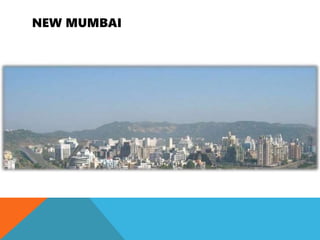
NEW MUMBAI
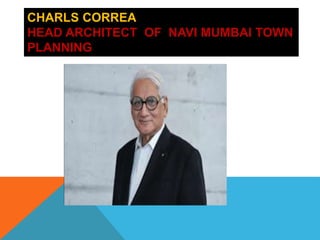
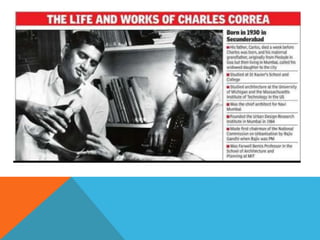
CHARLS CORREA
HEAD ARCHITECT OF NAVI MUMBAI TOWN
PLANNING
A phenomenal rate of urban growth has been experienced
by India during the 25 years following independence and
Bombay has had its due share in it. The population of
Greater Bombay rose from 2.966 millions in 1951 to 4.152
millions in 1961 and to 5.970 millions in 1971, registering
40.0 and 43.80 per cent growths during the first and
second decades respectively. The rapid rate of growth of
population, made possible by the increasing industrial and
commercial importance of the city, resulted in a fast
deterioration in the quality of life for the majority of people
living in the city. Development inputs could not keep pace
with the rapidly growing population, industry, trade and
commerce. Besides, there are physical limitations to the
growth of a city built on a long and narrow peninsula,
which has very few connections with the mainland.
History of New Mumbai
The Government of Maharashtra has been alive to the
emerging problems of this metropolis. Responsible public
opinion was equally vigilant and several constructive
suggestions appeared from time to time in the press and
elsewhere. All this helped in keeping the problems of
Bombay in the forefront of public awareness. In 1958, the
Govt. of Bombay appointed a study group under the
Chairmanship of Shri S.G. Barve, Secretary to Government,
Public Works Department, to consider the problems relating
to congestion of traffic, deficiency of open spaces and play
fields, shortage of housing and over concentration of
industry in the metropolitan and suburban areas of Bombay,
and to recommend specific measures to deal with these.
The Barve Group reported in February 1959. One of its major
recommendations was that a rail-cum-road bridge be built
across the Thane Creek to connect peninsular Bombay with
the mainland. The group felt that the bridge would accelerate
development across the Creek, relieve pressure on the city’s
railways and roadways, and draw away industrial and
residential concentrations eastward to the mainland. The
Group hoped that the eastward development would be orderly
and would take place in a planned manner.
The Government of Maharashtra accepted the Barve Group
recommendation. Another Committee under the Chairmanship
of Prof. D.R. Gadgil, then Director of the Gokhale Institute of
Politics and Economics, Poona was formed and asked “to
formulate broad principles of regional planning for the
metropolitan regions of Bombay Panvel and Poona and to
make recommendations for the establishment of Metropolitan
Authorities for preparation and execution of such plans”.
The Gadgil Committee inter-alia made two
important recommendations which have influenced
the planning for Navi Mumbai. One, a planned
decentralisation of industries with severe
restrictions on further industrial growth in the
Bombay region. Two, development of the mainland
area as a multi-nucleated settlement, each
settlement smaller in size than 2.5 lacs population.
These multi-nucleated settlements are called
nodes in the plan, where the entire development is
proposed as a series of nodes strung out along
mass transit area. The nodes proposed by us are,
however, more closely spaced than the multi-
nucleated settlements envisaged by Dr. Gadgil.
But the principle remains of individual settlements,
self-contained in respect of schools and shopping
and other essential services and separated from
each other by green spaces.
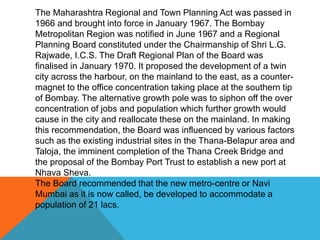
The Maharashtra Regional and Town Planning Act was passed in
1966 and brought into force in January 1967. The Bombay
Metropolitan Region was notified in June 1967 and a Regional
Planning Board constituted under the Chairmanship of Shri L.G.
Rajwade, I.C.S. The Draft Regional Plan of the Board was
finalised in January 1970. It proposed the development of a twin
city across the harbour, on the mainland to the east, as a counter-
magnet to the office concentration taking place at the southern tip
of Bombay. The alternative growth pole was to siphon off the over
concentration of jobs and population which further growth would
cause in the city and reallocate these on the mainland. In making
this recommendation, the Board was influenced by various factors
such as the existing industrial sites in the Thana-Belapur area and
Taloja, the imminent completion of the Thana Creek Bridge and
the proposal of the Bombay Port Trust to establish a new port at
Nhava Sheva.
The Board recommended that the new metro-centre or Navi
Mumbai as it is now called, be developed to accommodate a
population of 21 lacs.
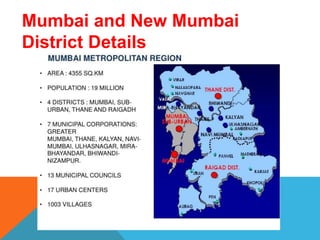
Mumbai and New Mumbai
District Details
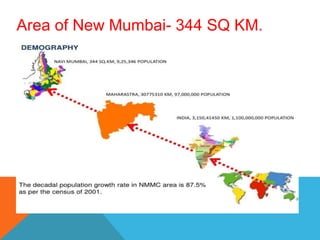
Area of New Mumbai- 344 SQ KM.
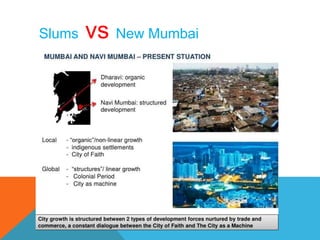
Slums vs New Mumbai
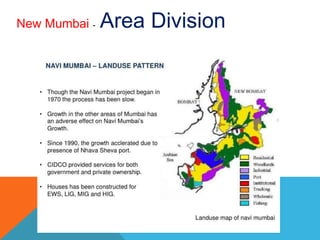
New Mumbai - Area Division
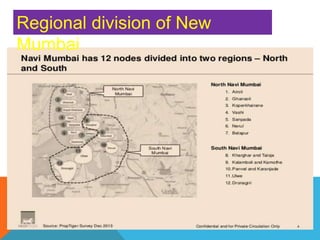
Regional division of New
Mumbai
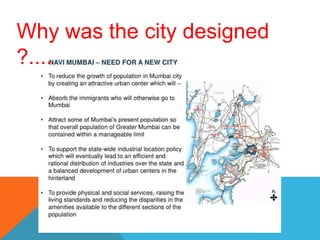
Why was the city designed
?....
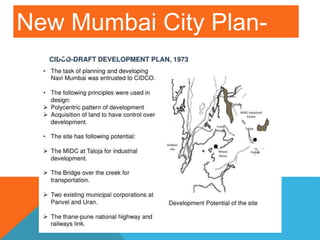
New Mumbai City Plan-
1973
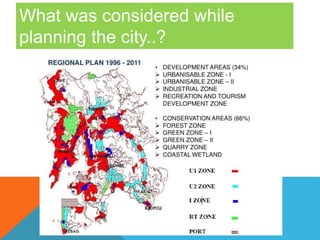
What was considered while
planning the city..?
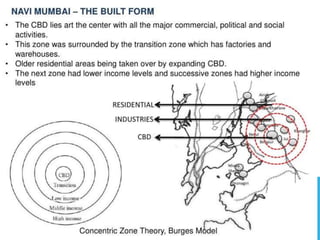
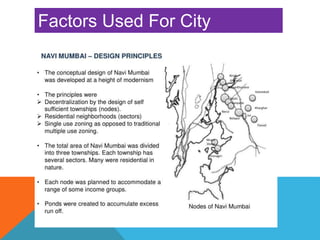
Factors Used For City
Planning
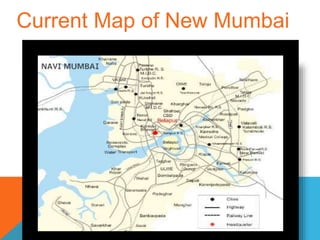
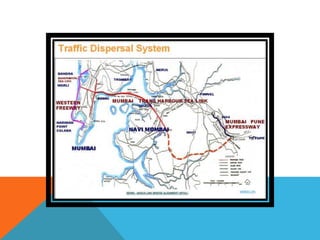
Current Map of New Mumbai
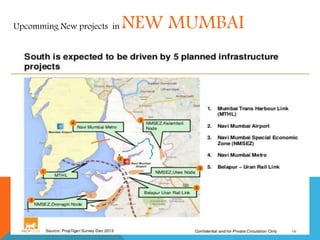
Upcomming New projects in NEW MUMBAI
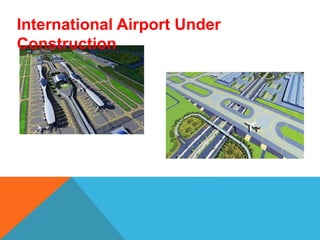
International Airport Under
Construction
THANKYOU !

New mumbai

  • 1.
  • 3.
    CHARLS CORREA HEAD ARCHITECTOF NAVI MUMBAI TOWN PLANNING
  • 5.
    A phenomenal rateof urban growth has been experienced by India during the 25 years following independence and Bombay has had its due share in it. The population of Greater Bombay rose from 2.966 millions in 1951 to 4.152 millions in 1961 and to 5.970 millions in 1971, registering 40.0 and 43.80 per cent growths during the first and second decades respectively. The rapid rate of growth of population, made possible by the increasing industrial and commercial importance of the city, resulted in a fast deterioration in the quality of life for the majority of people living in the city. Development inputs could not keep pace with the rapidly growing population, industry, trade and commerce. Besides, there are physical limitations to the growth of a city built on a long and narrow peninsula, which has very few connections with the mainland. History of New Mumbai
  • 6.
    The Government ofMaharashtra has been alive to the emerging problems of this metropolis. Responsible public opinion was equally vigilant and several constructive suggestions appeared from time to time in the press and elsewhere. All this helped in keeping the problems of Bombay in the forefront of public awareness. In 1958, the Govt. of Bombay appointed a study group under the Chairmanship of Shri S.G. Barve, Secretary to Government, Public Works Department, to consider the problems relating to congestion of traffic, deficiency of open spaces and play fields, shortage of housing and over concentration of industry in the metropolitan and suburban areas of Bombay, and to recommend specific measures to deal with these.
  • 7.
    The Barve Groupreported in February 1959. One of its major recommendations was that a rail-cum-road bridge be built across the Thane Creek to connect peninsular Bombay with the mainland. The group felt that the bridge would accelerate development across the Creek, relieve pressure on the city’s railways and roadways, and draw away industrial and residential concentrations eastward to the mainland. The Group hoped that the eastward development would be orderly and would take place in a planned manner. The Government of Maharashtra accepted the Barve Group recommendation. Another Committee under the Chairmanship of Prof. D.R. Gadgil, then Director of the Gokhale Institute of Politics and Economics, Poona was formed and asked “to formulate broad principles of regional planning for the metropolitan regions of Bombay Panvel and Poona and to make recommendations for the establishment of Metropolitan Authorities for preparation and execution of such plans”.
  • 8.
    The Gadgil Committeeinter-alia made two important recommendations which have influenced the planning for Navi Mumbai. One, a planned decentralisation of industries with severe restrictions on further industrial growth in the Bombay region. Two, development of the mainland area as a multi-nucleated settlement, each settlement smaller in size than 2.5 lacs population. These multi-nucleated settlements are called nodes in the plan, where the entire development is proposed as a series of nodes strung out along mass transit area. The nodes proposed by us are, however, more closely spaced than the multi- nucleated settlements envisaged by Dr. Gadgil. But the principle remains of individual settlements, self-contained in respect of schools and shopping and other essential services and separated from each other by green spaces.
  • 9.
    The Maharashtra Regionaland Town Planning Act was passed in 1966 and brought into force in January 1967. The Bombay Metropolitan Region was notified in June 1967 and a Regional Planning Board constituted under the Chairmanship of Shri L.G. Rajwade, I.C.S. The Draft Regional Plan of the Board was finalised in January 1970. It proposed the development of a twin city across the harbour, on the mainland to the east, as a counter- magnet to the office concentration taking place at the southern tip of Bombay. The alternative growth pole was to siphon off the over concentration of jobs and population which further growth would cause in the city and reallocate these on the mainland. In making this recommendation, the Board was influenced by various factors such as the existing industrial sites in the Thana-Belapur area and Taloja, the imminent completion of the Thana Creek Bridge and the proposal of the Bombay Port Trust to establish a new port at Nhava Sheva. The Board recommended that the new metro-centre or Navi Mumbai as it is now called, be developed to accommodate a population of 21 lacs.
  • 10.
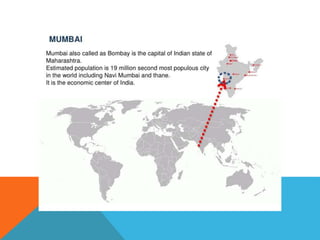
    Mumbai and NewMumbai District Details
  • 11.
    Area of NewMumbai- 344 SQ KM.
  • 12.
  • 13.
    New Mumbai -Area Division
  • 14.
  • 15.
    Why was thecity designed ?....
  • 16.
    New Mumbai CityPlan- 1973
  • 17.
    What was consideredwhile planning the city..?
  • 19.
    Factors Used ForCity Planning
  • 20.
    Current Map ofNew Mumbai
  • 21.
  • 22.
  • 26.