MAULANA AZAD NATIONAL INSTITUTE OF TECHNOLOGY
Department of Architecture & Planning PRAVEEN MUKATI
RIVERFRONT DEVELOPMENT
RIVER FRONT DEVELOPMENT
DISSERTATION
BACHELOR’S OF PLANNING
By
PRAVEEN MUKATI
Scholar No. 141109029
Under the Guidance of
Dr. Navneet Munoth
DEPARTMENT OF ARCHITECTURE AND PLANNING
MAULANA AZAD NATIONAL INSTITUTE OF TECHNOLOGY
BHOPAL – 462003 (M.P.), INDIA
2
MAULANA AZAD NATIONAL INSTITUTE OF TECHNOLOGY
Department of Architecture & Planning PRAVEEN MUKATI
RIVERFRONT DEVELOPMENT
MAULANA AZAD NATIONAL INSTITUTE OF TECHNOLOGY
(An Institute of National Importance)
Bhopal- 462003
DEPARTMENT OF ARCHITECTURE AND PLANNING
DECLARATION
We, hereby, declare that the following report, which is being presented in the Dissertation entitled
River front development is the partial fulfilment of the requirements of the Fourth Year (Seventh
Semester) Dissertation in field of Planning. It is an authentic documentation of our own original work
carried out under the guidance of Dr Navneet Munoth. the work has been carried out entirely at
Maulana Azad National Institute of Technology (M.A.N.I.T.), Bhopal. The following project and its report,
in part or whole, has not been presented or submitted by us for any purpose in any other institute or
organization. We, hereby, declare that the facts mentioned above are true to the best of our knowledge.
In case of any unlikely discrepancy that may possibly occur, we will be the one to take responsibility.
PRAVEEN MUKATI
141109029
B.PLANNING
7TH
SEMESTER, 4TH
YEAR
M.A.N.I.T., Bhopal
3
MAULANA AZAD NATIONAL INSTITUTE OF TECHNOLOGY
Department of Architecture & Planning PRAVEEN MUKATI
RIVERFRONT DEVELOPMENT
MAULANA AZAD NATIONAL INSTITUTE OF TECHNOLOGY
(An Institute of National Importance)
Bhopal- 462003
DEPARTMENT OF ARCHITECTURE AND PLANNING
CERTIFICATE
This is to certify that Praveen Mukati is a student of Fourth Year B.Plan (Planning) have
successfully completed her Dissertation on Riverfront development , in the partial fulfilment of
the requirements of their Bachelor Of Planning degree.
Dr. Navneet munoth
(Project Coordinator)
SESSION 2017-18
4
MAULANA AZAD NATIONAL INSTITUTE OF TECHNOLOGY
Department of Architecture & Planning PRAVEEN MUKATI
RIVERFRONT DEVELOPMENT
ACKNOWLEDGEMENT
With due respect, I express my deep sense of gratitude to my respected and learned coordinator, Dr.
Navneet Munoth , for her valuable help and guidance. I am thankful for the encouragement that she
has given me in completing this study successfully. Her rigorous evaluation and constructive critism was
of great assistance. It is imperative for me to mention the fact that this Dissertation Report could not
have been accomplished without the periodic suggestions and advice of Dr Navneet Munoth . I am also
grateful to my respected director Dr. N.S.Raghuvanshi Sir for permitting me to utilize all the necessary
facilities of the college. Needless to mention is the additional help and support extended by my
respected HOD, Dr. Anupama Sharma, in allowing me to use the departmental laboratories and other
services. I am also thankful to the other entire faculty, staff members and laboratory attendants of my
department for their kind co-operation and help. Last but certainly not the least, I would like to express
my deep appreciation towards my family and friends for providing the much needed support and
encouragement.
Praveen Mukati
141109029
B. Planning
7th
semester
5
MAULANA AZAD NATIONAL INSTITUTE OF TECHNOLOGY
Department of Architecture & Planning PRAVEEN MUKATI
RIVERFRONT DEVELOPMENT
CONTENTS
LIST OF FIGURE.........................................................................................................................................7
LIST OF TABLE..........................................................................................................................................7
INTRODUCTION ........................................................................................................................................9
1.1 CONTEXTUAL BACKGROUND- .............................................................................................9
1.2 AIM AND OBJECTIVES.................................................................................................................10
1.3 RATIONALE FOR THE STUDY .............................................................................................................11
1.4SCOPE AND LIMITATIONS ..................................................................................................................12
1.5METHODOLOGY.............................................................................................................................12
1.6CONCEPTUAL DEFINITION..............................................................................................................13
CHAPTER 2 . LITERATURE REVIEW ...................................................................................................13
2.1 DEFINING RIVER FRONT DEVELOPMENT ..............................................................................13
2.2 TYPES OF RIVERFRONTS...........................................................................................................16
2.3 TREND OF WATER FRONT DEVELOPMENTS WORLDWIDE ...............................................16
2.4 ELEMENTS OF SUCCESSFUL RIVERFRONT DEVELOPMENT ............................................17
2.5 RIVERFRONT DEVELOPMENTS:................................................................................................18
2.6 SPECIAL CHARACTERISTICS OF RIVERFRONT AREA.........................................................18
2.7 GENERAL PRINCIPLES FOR RIVERFRONT DEVELOPMENT ...............................................19
2.8 IMPORTANCE OF PUBLIC SPACES............................................................................................19
2.9 ADVANTAGES & BENEFITS OF RIVERFRONT DEVELOPMENT.........................................20
CHAPTER 3 RIVER FRONT DEVELOPMENT IN INDIA....................................................................................21
To analyze the present pattern of different riverfront development projects in the country.:- .......21
Sabarmati Riverfront development: ...................................................................................................21
Gomti Riverfront Development ..........................................................................................................23
Yamuna Riverfront Development .......................................................................................................25
Hindon Riverfront Project...................................................................................................................25
Pune riverfront development .............................................................................................................26
Godavari river development...............................................................................................................28
3.1 ANALYSIS OF BEST PRACTICES OF INDIA AND TWO INTERNATIONAL CASE STUDIES ......................30
3.2 CASE STUDY 1: ANALYSIS OF SABARMATI RIVERFRONT DEVELOPMENT ........................................30
3.2.1 SABARMATI AND GROWTH OF AHMEDABAD............................................................................31
3.2.2 OBJECTIVES: ...............................................................................................................................31
6
MAULANA AZAD NATIONAL INSTITUTE OF TECHNOLOGY
Department of Architecture & Planning PRAVEEN MUKATI
RIVERFRONT DEVELOPMENT
3.2.3CHARACTERISTICS OF RIVERFRONT AREA...................................................................................31
Success Stories....................................................................................................................................34
3.3 CASE STUDY 2 : MALAYSIA RIVERFRONT ..........................................................................................34
3.3.1 CHARACTERISTICS OF THE RIVER FRONT AREA .........................................................................34
3.3.2KUTCHING RIVERFRONT: ............................................................................................................35
3.3.3LANDUSE AROUND RIVERFRONT AREA IN KUTCHING................................................................37
3.3.4 STRATEGIES .................................................................................. Error! Bookmark not defined.
3.4 CASE STUDY 3: THAMES RIVERFRONT DEVELOPMENT....................................................38
3.4.1 THE ROLE OF THE RIVERFRONT IN THE THAMES GATEWAY......................................................38
3.4.2 VISION FOR RIVERFRONT DEVELOPMENT .................................................................................39
3.5 LEARNING’S FROM THE CASE STUDIES.............................................................................................39
3.5.1 RIVERFRONT QUALITIES............................................................................................................39
3.5.2NEED OF RIVERFRONT DEVELOPMENT PLANNING.....................................................................40
3.6 CASE STUDIES REVIEW......................................................................................................................40
Case studies ........................................................................................................................................40
3.7 RECOMMENDATION .....................................................................................................................41
CHAPTER 4 CONCLUSION............................................................................................................................42
BIBLIOGRAPHY ............................................................................................................................................44
Bibliography ................................................................................................................................................44
7
MAULANA AZAD NATIONAL INSTITUTE OF TECHNOLOGY
Department of Architecture & Planning PRAVEEN MUKATI
RIVERFRONT DEVELOPMENT
LIST OF FIGURE
Page no
Figure 1 trend of riverfront development 17
Figure 2Elements of Successful Riverfront Development 31
Figure 3 growth of the city Ahmedabad 30
Figure 4 land use Sabarmati 34
Figure 5 kutching river front 35
Figure 6 landuse plan kutching 36
Figure 7 Riverfront kutching landuse plan 37
LIST OF TABLE
Page no
Tab 1: Special Characteristics of Riverfront Area 17
Tab2: Characteristics of Sabarmati 31
Tab 3: Characteristics of Sabarmati 31
Tab 4: Sabarmati Landuse Categories 32
Tab 5: Characteristics of the River front Area 33
Tab 6: Kutching Riverfront Details 35
8
MAULANA AZAD NATIONAL INSTITUTE OF TECHNOLOGY
Department of Architecture & Planning PRAVEEN MUKATI
RIVERFRONT DEVELOPMENT
ABSTRACT
People are drawn to water. Human interaction with water is foremost feature that calls for
riverfront development. People have a strong desire to feel it, reach it; and thus it
becomes very important that approach to water should be given, public space production
along the river shore should be primary purpose. This dissertation focused to develop a
set of guidelines that contribute to the establishment of socio interactive spaces at
riverfront. Research will also explore on current riverfront developments and notion of
place identity and place making by the development of recreational spaces. Different case
studies and their analysis will provide the strategies of a successful riverfront with
meaningful socio interactive spaces. From the synthesis of findings a set of design
attributes are framed.
Keywords: Riverfront, socio interactive, environment, spaces.
9
MAULANA AZAD NATIONAL INSTITUTE OF TECHNOLOGY
Department of Architecture & Planning PRAVEEN MUKATI
RIVERFRONT DEVELOPMENT
INTRODUCTION
People in cities want a riverfront as a place of public enjoyment. They seek riverfront
where there is enormous visual and physical eye catching sites remain all day the
throughout. People also want riverfront to serve many purposes and a place that
contributes to the quality of daily life in all of its aspect-economic ,social and cultural”
This chapter introduces the thesis through a summary of the background research. It
presents the context of the study by discussing the salient issues, and introduces the
physical location of the study area. The aim, objectives, scope and limitations of the
study are laid out along with the methodology
1.1 CONTEXTUAL BACKGROUND-
Rivers are an inherent part of the development of the human settlement. They have been
fundamentally involved in the process of settlement location and its continuous
formation. The greatest civilizations of the world have formed and lourished along the
banks of rivers. Whether it was the Egyptian civilization along the Nile River or the Indus
valley civilization, rivers have been vital as the providers of water for sustaining life as
well as the agrarian societies. Thus strong relationships existed between man and rivers,
the later often being revered as Gods, not only in ancient times but till date. From daily
activities to religious ceremonies, fairs and festivals, the river formed an integral part of
human life
In general, a is the zone of interaction between urban development’s and the water and a
riverfront area is considered as a unique and irreplaceable resource where it is the
interface between land, water, air, sun and productive plants. Moreover, the riverfront is
characterized as a place integrating land with water and having a natural attraction to
people. In fact, the seashore and are the most attractive water features for human
settlement and, in most countries; the land in front of water is developed earlier than the
inland areas.
Riverfront development refers to any development in front of water and a water body; a
river, lake, ocean, bay, creek or river edges. In the development area, considered that a
riverfront development may not necessarily need to be directly fronting water but may
only need to look attached to the water. They believe that commanding a view of water
can still be considered as a riverfront property.
An official definition by the US Federal Coastal Zone Management Act, Office of Ocean
and Coastal Resources (OOCR) (1972) defines the term urban riverfront or port as, “any
developed area that is densely populated and is being used for, or has been used for,
urban residential, recreational, commercial, shipping, or industrial purposes”.
A more detailed definition by Guo (1998) as cited in Dong (2004, p. 7) described the
riverfront as the interface point where land and water meet, between approximately 200
10
MAULANA AZAD NATIONAL INSTITUTE OF TECHNOLOGY
Department of Architecture & Planning PRAVEEN MUKATI
RIVERFRONT DEVELOPMENT
to 300 meters from the water line and 1 to 2 km to the land site and also takes in land
within 20 minutes walking distance. Wu & Gao, 2002, as cited in Dong (2004, p. 7)
added the riverfront area should have multiple features which incorporate each other and
surrounded by structural and nonstructural objects to form a focal point.
In many cities in the world, riverfront areas began as commercial centers, transportation
hubs and manufacturing centers, as a central focus for them. However, due to complex
and multiple problems such as technology change, the historic preservation movement,
increased environmental awareness and urban renewal, a dramatic change in riverfront
areas was brought about and they became large spaces of unused property in the past
thirty years or so.
The first riverfront development projects were started in North American cities, in
particular Baltimore and Boston, in the 1960s. Nowadays, riverfront development is a
global trend and thousands of schemes are being carried out in large metropolises,
medium-sized cities and even small towns all over
the world. Whereas the early examples of riverfront development primarily focused on
leisure and retail, contemporary schemes have a broader scope; many are set up with the
aim to create attractive mixed urban environments that appeal to the imagination of
people and persuade them to work there, to live there, or to visit these.
Breen & Rigby (1996) assign developed riverfronts into six distinct groups: commercial
riverfronts; cultural, educational and environmental riverfronts; historic riverfronts;
recreational riverfronts; residential riverfronts; and working riverfronts.
.
1.2 AIM AND OBJECTIVES
Aim
“The aim of this project would be transforming city as a unique cultural platform with
recreational and entertainment facilities serving the city, its people and tourists with new
dimension, meaning and scale of development. The riverfront development shall be
envisaged as a city’s identity on its river front development
Research questions & Objectives
. There are few questions, which help us in the fragmentation of the objectives. The
questions are to
 What are the factors which help the city to rejuvenate the urban life and the space
through improved quality of life, facilitating recreational and cultural activities,
11
MAULANA AZAD NATIONAL INSTITUTE OF TECHNOLOGY
Department of Architecture & Planning PRAVEEN MUKATI
RIVERFRONT DEVELOPMENT
organizing informal businesses and designing better public spaces with creative
amenities. ?
 What are the planning responses for related riverfront development in Indian context?
 What measures, policies and practices, the government and riverfront development
management authorities initiated?
 What are the factor responsible for the development of public spaces?
 What are the adverse effect of riverfront development on social, economic and
geographical.?
Objectives
Objective 1: Ecological preservation:
 Identify and implement environmental protection priorities to protect water
quality and other sensitive natural features;
 Stop the flow of sewage, keep the river clean and pollution-free;
 Revitalize riverfront neighborhoods, rejuvenate River
Objective 2: Create Social/ Public space:
 Make the riverfront accessible to the public
 Create riverfront parks to enjoy the water.
Objective 3: Designing Development that is in harmony with the natural character
of the area.
 The urban form integrated with landscape, thereby, creating an enriching
experience by responding to the context of water, existing diversity of activities,
and forming a visually dominant landmark. Encourage development of appropriate
design, scale, and use to improve the utilization of public lands and to improve
residents’ quality of life.
 Create a memorable identity for river and the city
1.3 RATIONALE FOR THE STUDY
Due to the lack of waste management system, vacant land along the river edges is used as
a dumping site. Generally dumping wastes are coming from shops, households and small
scale industries. There is direct discharge of city sewage in to the river . Poor people are
using river berms for open defecation or for construction of small huts for their
livelihoods. Rivers now converted into channel which carries sewage and drains.
Poor people are encroached river edges berms for the settlements .river has been
encroached by the low lying slums. Due to the floods occur in to river at rainy season.
These slums are prone to flood. Other than these problems there are some environmental
12
MAULANA AZAD NATIONAL INSTITUTE OF TECHNOLOGY
Department of Architecture & Planning PRAVEEN MUKATI
RIVERFRONT DEVELOPMENT
issues like River creates unhygienic environment due to the degradation of organic waste
existing in the river edges and river edges also becomes a breeding of mosquitoes, flies
etc.
Flooding of roads by sewage occurs due to encroachment, silting and solid waste
dumping on the drainage channels, which leads to the river edgess in the city.
The drains empty themselves in to the river edgess polluting the river edgess and also the
environment along the river .no proper utilization of public spaces an government land
presents on the river edges.
1.4SCOPE AND LIMITATIONS
The scope of this research covers the identification of factor which are responsible for the
developments of riverfront. Another scope from the research how to attract the peoples
towards the riverfront development. A rational public space design for both social and
ecological benefits, as well as integration of river rejuvenation. Proper utilization of
riparian zones and edges through the river edges Maintenance of water pollution which
occurs due to discharge of water from river.rehabilation of slum which are located at the
river edges. Mitigation measures and proposals has to be given for the protection of city
from floods. Poor environment condition, drainage and sewerage system, ecological
preservation is not done very clearly, non availability of better quality of environment ..
1.5METHODOLOGY
• Step 1- Selection Of Broad Theme River Front Development and understanding
the concept.
• Step 2-Analyzing The Scope Of Riverfront Development Government
Intervention, Policy ,Urdpfi Guidelines ,Act And Rules
• Step 3- Research On The Riverfront Development Through Various Successful
Case Studies
• Step 4- Analyze Case Studies’ aim, Objectives , Scope And Limitation Of The
Successful Case Studies And Analyze Successful Factors Of Riverfront
Development And Review Of Case Studies.
• Step 5-According To Successful Case Studies Analysis. And Through Research
The Question Raised And On The Basis Of Question, Our Objective Decided.
• Step 6- Aim and objective
• Step 7- rationale of the study
13
MAULANA AZAD NATIONAL INSTITUTE OF TECHNOLOGY
Department of Architecture & Planning PRAVEEN MUKATI
RIVERFRONT DEVELOPMENT
• Step 8-Literature study and review
• Step 9- riverfront development in India
• Step 10-analysis of best practices of river front development in India and
international case studies
• Step 11-recommendation for the riverfront development
1.6CONCEPTUAL DEFINITION
A riverfront is a region along a river; often in larger cities that border a river, the
riverfront will be lined with marinas, docks, parks, trees, or minor attractions. Today
many riverfronts are a staple of modernism and city beautification.
Types of riverfront development-
-The Natural Riverfront, comprising beaches, wetlands, wildlife habitats, sensitive
ecosystems and the water itself.
- The Public Riverfront, including parks, esplanades, piers, street ends, vistas and
waterways that offer public open spaces and riverfront views.
- The Working Riverfront, where water dependent, maritime and industrial uses cluster or
where various transportation and municipal facilities are dispersed
CHAPTER 2 . LITERATURE REVIEW
This chapter presents a review of some literature sources referred for this research. This
dissertation began with a literature review process, which was essential in identifying the
direction of investigation, deciding the study area for detailed inquiry, and in
understanding the background and context. The review of literature contributed to a
conceptualization of the dissertation framework which has been presented in one of the
subsequent chapters.
2.1 DEFINING RIVER FRONT DEVELOPMENT
literature reviews are important as their purpose is: - to give a background relevant to the
topic; - to identity the concepts related to the area and formulate hypothesis; - to identity
appropriate methodology in the research design, methods of measurement and techniques
and analysis; - to identity the data source; and - to learn how to structure a dissertation
Definition by different scholars-
14
MAULANA AZAD NATIONAL INSTITUTE OF TECHNOLOGY
Department of Architecture & Planning PRAVEEN MUKATI
RIVERFRONT DEVELOPMENT
“A riverfront is a significant resource and a challenging opportunity for a city; a chance
to be an escape valve for the pressure-cooker of crowded city life, a chance to be a bright,
breathing edge of city living and can be achieved by providing meaningful interactive
spaces.”Arthur Cotton Moor
Many problems concerning river front developments can be traced back to their
historical development. As river front developments developed in the tide of
commercialism, they seem to have lost their civic qualities. Court squares, parks, plazas
and other public areas, once used as places for public assembly, exhibiting purposes,
passing the time of the day, and meeting and conversing with friends and acquaintances,
have gradually given way to parking lots and expansion of commercial activities. These
areas that made each city distinctive expressed the character of the community as a
whole. Wrenn (1983) describes the present situation in a historical context.
"Urban river front developments in North America have historically suffered from a
lack of vision and management in their adaptations to successive demands for new
functions. Traditionally river front development and growth has been disjointed and
incremental, characterized by a web of loosely related decisions and actions by dozens of
political jurisdictions and hundreds of entrepreneurs".
According to Tsukio (1984), throughout history, river front developments went through
three major phases of transition: "The first transition came about with the enlargement of
urban scale. With the expansion of the region, and industry, with its pollution, trouble
occurred when everyone wanted to do something at the same place, namely the river
front development". Every person had the priority to be closer to the river front
development. As congestion increased and pollution became unbearable, people who
could fmance an industry without water dependence moved farther inland.
An official definition by the US Federal Coastal Zone Management Act, Office of
Ocean and Coastal Resources (OOCR) (1972) defines the term urban river front
development or port as, “any developed area that is densely populated and is being used
for, or has been used for, urban residential, recreational, commercial, shipping, or
industrial purposes”
.
In many cities in the world, river front development areas began as commercial centers,
transportation hubs and manufacturing centers, as a central focus for them. However, due
to complex and multiple problems such as technology change, the historic preservation
movement, increased environmental awareness and urban renewal, a dramatic change in
river front development areas was brought about and they became large spaces of unused
property in the past thirty years or so.
15
MAULANA AZAD NATIONAL INSTITUTE OF TECHNOLOGY
Department of Architecture & Planning PRAVEEN MUKATI
RIVERFRONT DEVELOPMENT
The first river front development projects were started in North American cities, in
particular Baltimore and Boston, in the 1960s. Nowadays, river front development is a
global trend and thousands of schemes are being carried out in large metropolises,
medium-sized cities and even small towns all over the world. Whereas the early examples
of river front development primarily focused on leisure and retail, contemporary schemes
have a broader scope; many are set up with the aim to create attractive mixed urban
environments that appeal to the imagination of people and persuade them to work there,
to live there, or to visit these.
Breen & Rigby (1996) assign developed river front developments into six distinct
groups: commercial river front developments; cultural, educational and environmental
river front developments; historic river front developments; recreational river front
developments; residential river front developments; and working river front
developments.
River front developments which had once been the center of urban life lost its
predominance. However, in the recent years there is a definite direction in which a new
role for river front developments is emerging. A totally new direction is underway to
bring back life into these abandoned riverfronts. This can be summed up simply by
saying, it was a plan to take them (riverfronts) away from industry and give them back to
people.
Definition by Guo (1998) as cited in Dong (2004) defines the “river front development
as the area in the city where land meets water, spatially, an area including 200m-300m
from the interface to the water side and 1km-2km (that is about a 15min- 20min walking
distance) to the land side” (p. 7). Wu and Gao (2002) as cited in Dong (2004) present that
“It is an integrated system consisting of multiple features, of which the water forms the
centre, and enclosed by substantial objects” (p. 7). Goodwin (1999) argues that river
front development boundaries are difficult to determine and in some instances planning
efforts might focus on a small part of a larger indistinct river front development area.
The term ‘River front development’ in this research includes all the attributes of river
front development developments summarized from the discussion of various definitions.
Along with new development projects at the water, if the terms ‘River front development
Revitalization’ and ‘Rejuvenation’ are used, they are considered to be new river front
development developments. They are considered to be developments of existing river
front development areas displaying substantial blight or neglect. If the term ‘River front
development Redevelopment’ is used, it specifically refers to development of existing
river front development developments with new commercial/economic potential. Existing
16
MAULANA AZAD NATIONAL INSTITUTE OF TECHNOLOGY
Department of Architecture & Planning PRAVEEN MUKATI
RIVERFRONT DEVELOPMENT
ports, shipment hubs, coastal /beachfront developments, boat clubs, etc. have been
considered to be potential ‘redevelopment’ projects
“The concept of a river front development district helps to identify distinct nodes of
revitalization activity within long urban shoreline reaches” (p. 242). Various
terminologies are also used in literature instead of ‘river front development’; these
include city port, harbor front, riverside, river edge, water edge, and river front (Hussein,
2006), (Yassin, et al., 2010) and (Timur, 2013). The urbanized areas could also be cities
and towns of various sizes and population densities. Additionally, the water body may be
‘a river, lake, ocean, bay, creek or river edges’ or artificial (Timur, 2013, p.170).
The definition of ‘River front development’ therefore depends on the characteristics of
the river front development site, the planning framework and development approach.
Various planning authorities, local communities, investors, and other stake holders
including local residents may be involved in any river front development process.
Depending on the site, river front development developments could be new river front
development projects to acquire new facilities, investments and operators to the
area/region. They could also be development projects to preserve natural habitats along
with developing supportive public amenities. River front development developments
could also be regeneration / rejuvenation / revitalization projects, which aim to improve
existing areas, addressing deterioration and blight.
2.2 TYPES OF RIVERFRONTS
As per NEW YORK CITY COMPREHENSIVE RIVERFRONT PLAN, there are four
principal functions of the riverfront:
-The Natural Riverfront, comprising beaches, wetlands, wildlife habitats, sensitive
ecosystems and the water itself.
- The Public Riverfront, including parks, esplanades, piers, street ends, vistas and
waterways that offer public open spaces and riverfront views.
- The Working Riverfront, where water dependent, maritime and industrial uses cluster or
where various transportation and municipal facilities are dispersed.
- The Redeveloping Riverfront, where land uses have recently changed or where vacant
and underutilized properties suggest potential for beneficial change.
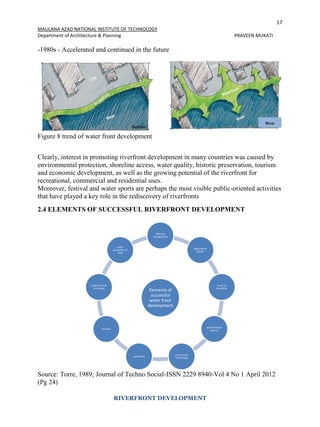
2.3 TREND OF WATER FRONT DEVELOPMENTS WORLDWIDE
-1960s - Massive riverfront development began and consequently initiated the world-
wide era of riverfront revitalization.
-1970s - Urban riverfront redevelopment bloomed,
17
MAULANA AZAD NATIONAL INSTITUTE OF TECHNOLOGY
Department of Architecture & Planning PRAVEEN MUKATI
RIVERFRONT DEVELOPMENT
-1980s - Accelerated and continued in the future
Figure 8 trend of water front development
Clearly, interest in promoting riverfront development in many countries was caused by
environmental protection, shoreline access, water quality, historic preservation, tourism
and economic development, as well as the growing potential of the riverfront for
recreational, commercial and residential uses.
Moreover, festival and water sports are perhaps the most visible public-oriented activities
that have played a key role in the rediscovery of riverfronts
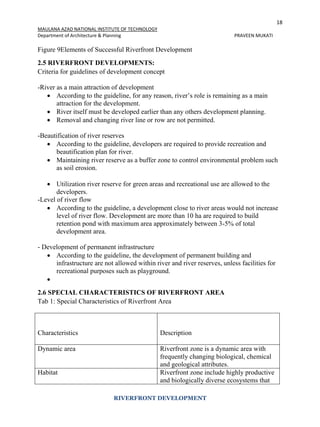
2.4 ELEMENTS OF SUCCESSFUL RIVERFRONT DEVELOPMENT
Source: Torre, 1989; Journal of Techno Social-ISSN 2229 8940-Vol 4 No 1 April 2012
(Pg 24)
Elements of
successful
water front
development
effective
management
beginingthe
project
financial
faesibility
environmental
approvl
construction
technology
authencity
function
project theme
and image
public
perceptionof
need
18
MAULANA AZAD NATIONAL INSTITUTE OF TECHNOLOGY
Department of Architecture & Planning PRAVEEN MUKATI
RIVERFRONT DEVELOPMENT
Figure 9Elements of Successful Riverfront Development
2.5 RIVERFRONT DEVELOPMENTS:
Criteria for guidelines of development concept
-River as a main attraction of development
 According to the guideline, for any reason, river’s role is remaining as a main
attraction for the development.
 River itself must be developed earlier than any others development planning.
 Removal and changing river line or row are not permitted.
-Beautification of river reserves
 According to the guideline, developers are required to provide recreation and
beautification plan for river.
 Maintaining river reserve as a buffer zone to control environmental problem such
as soil erosion.
 Utilization river reserve for green areas and recreational use are allowed to the
developers.
-Level of river flow
 According to the guideline, a development close to river areas would not increase
level of river flow. Development are more than 10 ha are required to build
retention pond with maximum area approximately between 3-5% of total
development area.
- Development of permanent infrastructure
 According to the guideline, the development of permanent building and
infrastructure are not allowed within river and river reserves, unless facilities for
recreational purposes such as playground.

2.6 SPECIAL CHARACTERISTICS OF RIVERFRONT AREA
Tab 1: Special Characteristics of Riverfront Area
Characteristics Description
Dynamic area Riverfront zone is a dynamic area with
frequently changing biological, chemical
and geological attributes.
Habitat Riverfront zone include highly productive
and biologically diverse ecosystems that
19
MAULANA AZAD NATIONAL INSTITUTE OF TECHNOLOGY
Department of Architecture & Planning PRAVEEN MUKATI
RIVERFRONT DEVELOPMENT
offer crucial nursery habitats for many
species.
Natural defense Riverfront zone features such as mangrove
forests serves a critical natural defense
against natural hazards (flooding, erosion
and storms).
Pollution moderator Water ecosystems may act to reduce the
impacts of pollution originating from land
such as, wetlands absorbing excess
nutrient sediments, human waste
Source: ‘An Evolution of Riverfront Development in Malaysia ‘ By Azlina Binti Md.
Yassin Submitted on 16Th Pacific Rim Real Estate Society Conference, Wellington 24-
27 January 2010
2.7 GENERAL PRINCIPLES FOR RIVERFRONT DEVELOPMENT
Riverfront development planning is often guided by four priorities: balanced land use;
respect for limited resources; improved public access; and safeguards for environmental
quality. The general principles for riverfront development are set out below:
 Interconnected, linear riverfront development with broad public access
• Encouraging the use of the greenway as a daily commuter path and
recreational amenity.
• Demonstrating the connection between access, greenway development and
market demand.
• Creating a coherent, visually pleasing order to the water’s edge
 Protection and enhancement of the natural environment
• Documenting the ecological state of the riverfronts in order to preserve this
environmentally diverse natural habitat.
• Preventing and, where possible, eliminating inappropriate uses and
practices from the rivers’ edge.
• Protecting existing natural areas from development.
 Reclaim the city’s identity as one of the best water cities
• Raising public expectations of what the city’s riverfront offers.
• Attracting people, investment and the best aspects of urban living to the
riverfront..
2.8 IMPORTANCE OF PUBLIC SPACES
A public space may be a gathering spot or part of a neighborhood, downtown, special
district, riverfront, or other area within the public realm that helps promote social
20
MAULANA AZAD NATIONAL INSTITUTE OF TECHNOLOGY
Department of Architecture & Planning PRAVEEN MUKATI
RIVERFRONT DEVELOPMENT
interaction and a sense of community Examples include spaces such as plazas, town
squares, parks, marketplaces, public commons and malls, public greens, piers, special
areas within convention centers or grounds, sites within public buildings, lobbies,
concourses, or public spaces within private buildings. As with all categories of Great
Places, it is important to identify what sets a space apart from others spaces to qualify it
for a Great Spaces designation. Public Spaces must be at least 10 years old.
2.9 ADVANTAGES & BENEFITS OF RIVERFRONT DEVELOPMENT
The benefits and advantages of developing water front are manifold ranging from
economic benefits, environmental benefits to social/ community benefits. These benefits
are detailed below.
 With the development of riverfront there would be creation of jobs in developing
the front, jobs as it gives way to starting up of a host of commercial activities in
that region and also indirect job creation associated with the set of activities.
 Source of revenue for government – government would be able to earn revenue in
terms of taxes from the commercial activities in the region. The commercial
activities include shops, restaurants, sport activities, transportation, boating etc
which can be leased out or giving to private players to operate.
 Development of tourism in the region – with the development of riverfront the
tourism in the region can be increased by offering a variety of attractions like
water sports, entertainment arenas, parks, shopping areas, etc.
 Economic spin-off’s – rise in the value of properties in and around the region,
acting as a catalyst for redevelopment and renewal of nearby places
 Habitat protection and restoration Conservation of water in the river
Human/Environmental connections • Conservation and development of land •
Conservation of flora and fauna
 Maintenance of river bank.
 Water conservation practices - Development of projects would ensure a proper
design of projects in conserving river and maintenance of rivers flowing through
large cities.
 Beautification of the riverfront with a natural outlook will provide the general
public with an open space for leisure and recreation.
 Providing employment opportunities for nearby people and helping in
development of region.
 Encouraging recreational activities like walking, jogging, biking, sports activities,
etc
 Improving quality of life of nearby community by revitalizing the neighborhood
21
MAULANA AZAD NATIONAL INSTITUTE OF TECHNOLOGY
Department of Architecture & Planning PRAVEEN MUKATI
RIVERFRONT DEVELOPMENT
CHAPTER 3 RIVER FRONT DEVELOPMENT IN INDIA
There is a wave of riverfront developments in India. UP governments ambitious project
Gomti riverfront development in Lucknow is under construction which is influenced
from first riverfront development project, Gujarat’s Sabarmati Riverfront development.
There are several other similar riverfronts proposed on the banks of rivers in India.
-Bulky Riverfront Projects
Riverfront developments are cost rich projects that take few years of rigorous work for
development. It takes diversion of resources, government budget, labor, etc.
Looking briefly at these projects indicates that the discourse mainly revolves around the
commercial and recreational activities. Concrete Wall Embankments, reclamation of the
river in floodplains and commercialization of the reclaimed land are the innate
components of these projects.
Recreational Activities that are promoted on the riverfronts typically include shopping
malls, boat trips, theme parks, restaurants, walk ways and parking lots in the paved and
encroached river bed. Every riverfront project talks about the c commercial beautification
of the river but none emphasizes on the betterment of its condition and ecology.
Is it just a cosmetic beautification of rivers or does it really rejuvenates or betters the
condition of rivers? The riverfront developments that mainly aims to beautify for
commercial purposes essentially changes the ecological and social landscapes of the
river, transforming it into an urban commercial space rather than a natural, social,
cultural, ecological landscape.
To analyze the present pattern of different riverfront development projects in the
country.:-
Sabarmati Riverfront development:
Sabarmati riverfront development was the first project in the group of riverfront projects
in India. Sabarmati riverfront on river Sabarmati in Ahmedabad was proposed in 1960
but the construction started in year 2005.
It is acclaimed pioneering in urban transformation and envisaged to develop 11.25
Km stretch on the banks of the river but ground reality is different and the project
22
MAULANA AZAD NATIONAL INSTITUTE OF TECHNOLOGY
Department of Architecture & Planning PRAVEEN MUKATI
RIVERFRONT DEVELOPMENT
has done little to no development of the river. Instead has deteriorated the river
ecology.
The 11.25 km long stretch is made of concrete embankments on both sides with
walkways. The estimated cost of the project is Rs.1200 crores which will be recovered by
selling of parts of reclaimed land for commercial and residential purpose. The reclaimed
land is used for public as well as private development. More than 85% of the reclaimed
land will be used for public infrastructure, recreational parks, sports facilities and gardens
while nearly 14% will be used for commercial and residential purpose.
In 2003, the project was extended to cover an 11.25 km stretch from 10.4 km stretch with
reclamation of 202.79 hectares (501.1 acres) and was put on fast track. Project was
inaugurated by then Chief minister of the state Narendra modi on 15 August 2012.
Ahmedabad Municipal Corporation (AMC) claims that the after the project, riverfront
has added vibrancy to the urban landscape of Ahmedabad with its well-designed
gardens, open spaces, walkways, along with activities which contribute to economic
growth.
The average width of the river channel was 382 meters (1,253ft.) and the narrowest cross-
section 330 meters (1,080 ft.). It is uniformly narrowed to 263 meters (863 ft.) without
affecting its flood carrying capacity and the riverbed land is reclaimed on the both east
and west banks to construct 11.25 km long riverfront. The total of 202.79 hectares of land
is reclaimed.
It also claims that it improves/has improved environment by reducing erosion of the
banks and flooding of low-lying areas of the city by the walls constructed on the both
banks. The new integrated sewage and storm-water system intercepts 38 former sewage
and industrial effluent discharge points and route it to sewage treatment plants located
south of Vasna Barrage. Thus reducing the water pollution in the river. The water level in
the river is retained through Vasna Barrage and the losing water is replenished by the
Narmada Canal. It enabled the groundwater recharge and the recreational facilities like
boating in the river. It also replenishes river by treated sewage water. Though the project
has been labeled as “best practice” by several financing institutions, it has also drawn flak
for poor rehabilitation of the displaced(rehabilitation happened only after High Court
orders following a public interest petition) disrupting the nexus of shelter, livelihood and
services of urban poor, lack of transparency in the execution, not improving the water
quality and for tampering with the carrying capacity of the river.
It is strange that Environment Impact Assessment of the project was not conducted
neither any credible public consultation process held.
23
MAULANA AZAD NATIONAL INSTITUTE OF TECHNOLOGY
Department of Architecture & Planning PRAVEEN MUKATI
RIVERFRONT DEVELOPMENT
. The project has only transferred the water from both banks to the river downstream from
Vasna barrage, which is situated downstream from the city. The Vasna barrage stops and
stores the water released from Narmada Main Canal that crosses the river about 10.4 km
upstream from the barrage. Thus this 11.25 km stretch of the river now holds the
Narmada water and huge losses from the stretch are losses for the drought prone areas.
The project was stalled during August 2006 to March 2007 due to heavy floods. Prior to
the floods, the river’s maximum carrying capacity was calculated at 4.75 lakh cusecs on
basis of the rainfall over last 100 years. The floods however proved the calculation
wrong.
The irony is, this project is considered pioneering project in the group of upcoming
riverfronts in India and is laying the guide lines for them despite being no less than a
failure.
Sabarmati riverfront has distorted the ecology of the river to space the commercial
greed of few.
The water quality of the river is extremely poor and has declined in discourse. The
cosmetic treatment of the water stretch has depleted the water and Sabarmati and water in
the river is of river Narmada.
Components of Sabarmati Riverfront development Project:
 The 11.25 km long stretch would be made of concrete embankments on both sides
with walkways.
 The estimated cost of the project is Rs.1200 crores which will be recovered by
selling of parts of reclaimed land for commercial and residential purpose.
 The average width of the river channel was 382 meters (1,253 ft.) and now it is
further narrowed and jacketed within 263 meters (863 ft.)
 The riverfront with its open spaces, walkways, well-designed gardens along with
activities will contribute to economic growth.
 It claims that it improves environment by reducing erosion of the banks and
flooding of low-lying areas of the city by the walls constructed on the both banks.
 The water level in the river is retained through Vasna Barrage and the losing water
is replenished by the Narmada Canal.
 The shelter, livelihood and services of urban poor were disrupted and displaced
poorly to reclaim the river land.
Gomti Riverfront Development
24
MAULANA AZAD NATIONAL INSTITUTE OF TECHNOLOGY
Department of Architecture & Planning PRAVEEN MUKATI
RIVERFRONT DEVELOPMENT
Gomti riverfront is an example of a wrong lead produced by River Sabarmati. Gomti
Riverfront started in 2012 under the aspiring government led by then newly elected chief
minister Akhilesh yadav. Gomti riverfront was proposed to rejuvenate the present
condition of the river Gomti. In addition to it, it would beautify the embankments, to
build them for commercial and recreational activities.
The project aims at building concrete riverbanks of length 12 km stretching from Pucca
pull to Shaheed path. The state government has made irrigation department the nodal
agency of the project to revive the river in three ways. There will be extensive cleaning of
the river bed and water flow will be regularized through river channelization. Besides, the
surroundings will be made beautiful. There will be walking plazas, cycling and jogging
tracks and ghats along the banks. It also aims at joining sharda canal with the river to
maintain the water level in the times of crisis.
If look closely, this projects mainly speaks about the cosmetic beautification of the river.
Building of concrete walls in the riverbeds has disturbed the ecology of the river.
Maximum natural water sources in the depth have depleted and the water has dried up.
In the Environment impact assessment report conduct by IIT Roorkee, IIT Roorkee had
warned about the consequences of this project. Limiting the river within the channel of
250 meter wide concrete wall would suffocate the river and advert times would blow
away the bridges like Pucca Pull (Hardinge Bridge) with it. When floodplains are paved
with the concrete and cement, excess water would flood the city in times of flood.
The project has raised several concerns and received flak from various environment
experts all-around. Several drains are still falling un-intercepted in the river causing
pollution. Excess tax payers’ money is being wasted on this venture but nothing about the
expenses is there in the public domain. People are totally unaware about their money
being wasted. Irrigation department denied rendering information asked by
Ballotboxindia in the RTI.
Definitely, the project has attracted the people of the city at it is added into their list of
hangout points. Several selfie points with enormous lighting and space certainly entice
anybody in there. But it may be easy and soothing to one’s eyes but the adverse impact it
holds is frightening. Project was estimated at Rs 1300 crores and was scheduled to end by
the 2016. But it is still in progress.
Key features of Gomti Riverfront development project:
 The project aims at building concrete riverbanks of length 12 km stretching from
Pucca pull to Shaheed path.
25
MAULANA AZAD NATIONAL INSTITUTE OF TECHNOLOGY
Department of Architecture & Planning PRAVEEN MUKATI
RIVERFRONT DEVELOPMENT
 There will be walking plazas, cycling and jogging tracks and ghats along the
banks.
 It also aims at joining sharda canal with the river to maintain the water level in the
times of crisis.
 River has been jacketed within 100-120 meters
Yamuna Riverfront Development
Though still on paper, Delhi government has plans ready for the Yamuna riverfront
development project. Delhi government aims at improving the abysmal condition of river
Yamuna that runs in miserable condition through Delhi. As estimated, it will take two
years to develop a 5 km stretch of Yamuna with Rs 200 crores. As proposed, after
development of stretch to beautify about a quarter of the river stretch it will have
medicinal gardens, a biodiversity park and a modern wrestling ring.The river will also
have canoeing and rowing facility. The stretch on the quarter length of the river in
upstream of wazirabad will also sport cycle tracks and recreational activities. Bird
watching and nature trails will also be facilitated. It will be a ‘concrete free’ riverfront
development and to keep it ecological use of bamboo and wood will be made.
Key features of Yamuna Riverfront development:
 development of a 5 km stretch of Yamuna River with Rs 200 crores
 It will be a ‘concrete free’ riverfront development and to keep it ecological, use of
bamboo and wood will be made.
 The developed river stretch will have medicinal gardens, a biodiversity park and a
modern wrestling ring. Bird watching and nature trails will also be facilitated.
 The stretch on the quarter length of the river in upstream of wazirabad will also
sport cycle tracks and recreational activities. The river will also have canoeing and
rowing facility.
Hindon Riverfront Project
Alike other kins, Hindon riverfront also talks about restoring the Hindon river ecology
and make it clean. The hindon riverfront project would stretch 22 km up to Greater
Noida. A green corridor is proposed to be developed across 600 hectares Noida flood
plains that will avail picnic spots to general public. In the first phase, about 200 acres will
be acquired and converted into the riverfront area. The project involves developing
facilities like parks, yoga centres, picnic spots and sports centres.
The proposed plan also entails eco-friendly cycle tracks, green belts and parks in green
corridor. The project would also take care of the untreated sewerage falling in the river
26
MAULANA AZAD NATIONAL INSTITUTE OF TECHNOLOGY
Department of Architecture & Planning PRAVEEN MUKATI
RIVERFRONT DEVELOPMENT
to rejuvenate it by sewage treatment plants. The projects DPR is still under preparation
and is expected to complete by the mid of 2017.
Key features of Hindon Riverfront project:
 The hindon riverfront project would stretch 22 km up to Greater Noida.
 A green corridor is proposed to be developed across 600 hectares Noida flood
plains that will avail picnic spots to general public. The project involves
developing facilities like parks, yoga centres, picnic spots and sports centres.
 The proposed plan also entails eco-friendly cycle tracks, green belts and parks in
green corridor.
 The project would also take care of the untreated sewerage falling in the river to
rejuvenate it by sewage treatment plants.
Pune riverfront development
The two rivers Mula and Mutha that flow through the heart of Pune city have deteriorated
beyond limit and Pune Municipal Corporation under the aegis of JNNURM (Jawaharlal
Nehru National Urban Renewal Mission) has planned a project along 44 km stretch of
Mula and Mutha to envisage the channelizing of the river, introducing barrages to
maintain water levels, development of riparian zone as entertainment and shopping
groups, even Parking lots, introducing navigation in the river etc.
Project plan has several short comings and has been put to break before its start. The
project does not say a word about treating water quality, but has plans to build drainage
lines inside the riverbed and carry the sewage out of Pune city limits. This hardly
qualifies as river rejuvenation or restoration. A case has been filed against this project in
National Green Tribunal.
Key features of the Pune Riverfront development project:
 Riverfront development project along 44 km stretch of Mula and Mutha to
envisage the channelizing of the river
 Introducing barrages to maintain water levels
 Development of riparian zone as entertainment and shopping groups, even Parking
lots, introducing navigation in the river etc.
Brahmaputra Riverfront development
Assam government had inaugurated the Brahmaputra riverfront project in 2013 under
Assam infrastructure financing authority. The 20 km stretch along river in the city will
undergo revamp as a part of the project. While the plan talks of revitalization of the river
27
MAULANA AZAD NATIONAL INSTITUTE OF TECHNOLOGY
Department of Architecture & Planning PRAVEEN MUKATI
RIVERFRONT DEVELOPMENT
ecology and Strengthening of riverbanks through soil bio engineering it has several urban
features on its agenda like promenade, Ghats, Plazas and Parks; buildings, conference
facilities, Parking lots, ferry terminals, Bus and para transport stops, Urban utilities and
drainage, Improved infrastructure for floating restaurants, Public amenities; Dhobi Ghats,
etc. The project will also restrict any construction within the 400 meters of the river. The
Assam government plans to boost tourism in the state with this lavish project.
Assam government also wants to end criminal or nefarious activities along the river bank
and reclaim the encroached land by them by this project.
But thing to notice is that while on one hand the city is struggling to cope up with the
flood prone nature of the Brahmaputra River, State Government of Assam plans to take
up an ambitious project to develop the city riverfront. On the request of GMDA
(Guwahati metropolitan development authority), National Institute of Hydrology (NIH),
Roorkee is carrying out a study which includes river shifting analysis for studying
stability of the river banks, flow variations to determine the perennial water depth,
estimate of floods of various return periods for design of river embankments, estimate of
water surface profiles employing hydro-dynamic river flow model and design parameters
for river embankments. The Brahmaputra Riverfront Development Project however has
been inaugurated even before the requisite studies have been completed.
Key components of the project:
 Continuity and access along the river
 Linkages from the city to the riverfront
 Restructuring Land Use
 Development of cultural precinct in the Government areas
 Revitalization of the river ecology
 Strengthening of riverbanks through soil bio engineering
 Riverside Promenade, Ghats, Plazas and Parks
 Buildings for social infrastructure-museums, art gallery, conservatory, conference
facilities and youth centre
 Local produce markets
 Lighting, Street Furniture & Public Art
 Heritage management & conservation
 Improved cross sections of roads with emphasis on pedestrian safety and NMV
usage.
 Improved MV movement
 Parking facilities
 Ferry terminals
 Bus and para transport stops
 Urban utilities and drainage
28
MAULANA AZAD NATIONAL INSTITUTE OF TECHNOLOGY
Department of Architecture & Planning PRAVEEN MUKATI
RIVERFRONT DEVELOPMENT
 Improved infrastructure for floating restaurants
 Public amenities
 Riverfront management infrastructure
 Reorganization of cremation activity
 Signage
 Dhobi ghats
 Development controls and norms
Godavari river development
The city of Nashik has been blessed with the passage of rivers Godavari and Darna. 18
km stretch along both banks of Godavari River need to be developed with amenities,
Gardens and parking spaces, community facility so that essentially the area is useful in
handling congestion in the Kumbh mela period as well as create places of relaxation for
citizens of Nashik.
Earlier the Nashik Municipal Corporation (NMC) had tried to improve the riverfront
small stretch by constructing small ghats, Jogging track and retaining walls at some
stretches of the left bank of river about 3 km long under the Goda Park project. But it is
felt that these efforts are not sufficient for the conservation of river front.
Godavari Riverfront Development at Nanded focuses on regeneration of the river. The
North Bank will be integrated with the existing urban fabric while the less developed
South Bank is proposed as an eco-park.
Key components of the 13.5 km long project:
 Ghats, walking paths and promenades with laser shows, musical fountains, rope-
way, multi-purpose meeting hall, garden,
 water sports, canteen, etc.
 Buildings for social infrastructure
 Revival of natural drainage systems
 Revenue generation systems
 Parks, gardens, street planting and eco-systems
 Lighting
 Street furniture, art, sculptures
 Reorganizing cremation activity
 Solid waste management
The project has received funds from the National River Conservation Directorate as well
as JNNURM.
29
MAULANA AZAD NATIONAL INSTITUTE OF TECHNOLOGY
Department of Architecture & Planning PRAVEEN MUKATI
RIVERFRONT DEVELOPMENT
On the other hand there are several court orders against Nashik Municipal Corporation
pending about severe water pollution in the River including Ram Kund where holy dip on
Kumbh Mela is supposed to be taken.
Looking the key features of riverfront projects and accessing their significance
After reading about the above listed riverfront development models in India it appears as
they are false propaganda for the restoration and rejuvenation of the rivers. Every
riverfront has common components of economic gain on the cost of river ecology.
Every riverfront development model speaks about the construction of pavements in the
river bed and the flood plains. Reclaiming or 'encroaching' in coarse and ideal word, and
then selling the land piece to builders for commercial activities to derive benefits.
Rivers are being jacketing and narrowed far within their actual width. Binding the river
into narrowed concrete channels would affect its flow pattern that may can impact river's
flooding capacity and its aquatic life. Concrete in the riverbed would cut off source of
water in the river. Citing this as probable outcome, these projects intend to connect the
rivers with the nearby rivers and canals so to avoid them from drying up. Similar thing
happened when Sabarmati water dried up and it was transferred and stored from Narmada
main canal. Gomti is also proposed at connecting with Sharda canal so to avoid such
times.
Every riverfront development model aims at glorifying 'selfie point' concept to attract
crowd and give them space for their leisure times. But far away from truth, they are
unaware how adversely such constructions affect our ecology.
Main problem with river systems is their pollution. Instead of tapping the drains falling
into rivers with sewage. Projects instead of fixing this problem in first phase of the
project are preferring to develop the river pavements as they can start bringing through
recreational activities. Such hefty projects become source of money for the politicians
and tax payers' money is not utilized properly for other social purposes.
30
MAULANA AZAD NATIONAL INSTITUTE OF TECHNOLOGY
Department of Architecture & Planning PRAVEEN MUKATI
RIVERFRONT DEVELOPMENT
3.1 ANALYSIS OF BEST PRACTICES OF INDIA AND TWO INTERNATIONAL CASE
STUDIES
In this Case Studies, I review & analyzed Malaysia Riverfront (Kutching); Thames
Riverfront Development & Ahmedabad (Sabarmati Riverfront).
Basically this three riverfront projects are situated within or close to downtown area and
play important role in the functioning of the city. And the study areas primarily need to
include public open space providing potential for various outdoor activities like
recreation. And Mostly the impact & effect of riverfront development projects illustrated
in the particular location in terms of economy, people’s health, recreational & tourism
activities. Some of the riverfront development projects are basically recreational purposes
& some of them housing purposes. It may vary as per the distance from CBD & its
requirements & needs. Also each of the cases must be considered as successful riverfront
development, by their investors, consumers, private and Government agencies.
3.2 CASE STUDY 1: ANALYSIS OF SABARMATI RIVERFRONT DEVELOPMENT
Sabarmati river has been an integral part in the life of Ahmedabad since the time the city
was founded in 1411 along the river banks. Besides being an important source of water, it
provided a backdrop to cultural and recreational activities. During the dry seasons, the
river bed became a place for farming. With time it also offered place for various informal
economic activities, and the river banks were used by informal squatter settlements.
Gradually, however, the intensive uses took their toll on the river. Untreated sewage
flowed into the river through storm water outfalls and dumping of industrial waste posed
a major health and environmental hazard. The river bank settlements were disastrously
prone to floods and lacked basic infrastructure facilities. Lackluster development took
shape along the riverfront. Such conditions made the river inaccessible and it became a
virtual divide between the two parts of the city. Slowly, the city turned its back towards
the river.
There had been a long-standing acknowledgement that the riverfront could be turned into
a major urban asset from its undesirable state. Proposals to achieve the same have been
made since the 1960s and it was finally in 1998 that this multi-dimensional project was
envisioned and undertaken by the city.
31
MAULANA AZAD NATIONAL INSTITUTE OF TECHNOLOGY
Department of Architecture & Planning PRAVEEN MUKATI
RIVERFRONT DEVELOPMENT
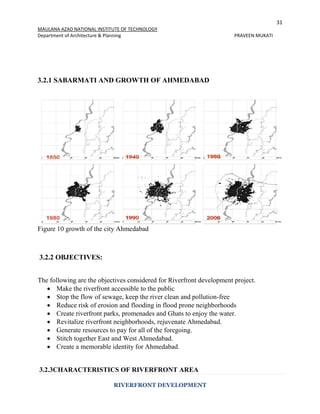
3.2.1 SABARMATI AND GROWTH OF AHMEDABAD
Figure 10 growth of the city Ahmedabad
3.2.2 OBJECTIVES:
The following are the objectives considered for Riverfront development project.
 Make the riverfront accessible to the public
 Stop the flow of sewage, keep the river clean and pollution-free
 Reduce risk of erosion and flooding in flood prone neighborhoods
 Create riverfront parks, promenades and Ghats to enjoy the water.
 Revitalize riverfront neighborhoods, rejuvenate Ahmedabad.
 Generate resources to pay for all of the foregoing.
 Stitch together East and West Ahmedabad.
 Create a memorable identity for Ahmedabad.
3.2.3CHARACTERISTICS OF RIVERFRONT AREA
32
MAULANA AZAD NATIONAL INSTITUTE OF TECHNOLOGY
Department of Architecture & Planning PRAVEEN MUKATI
RIVERFRONT DEVELOPMENT
Tab2: Characteristics of Sabarmati
Case study Areas Sabarmati Riverfront
Features
Name of water body Sabarmati River
Type of Project Recreational
Company Sabarmati River Front Development
Corporation Limited (SRFDCL)
Amenities Restaurants, River Access, Shops, Riverfront
Settlements, Gardens, Walkways, Amusement
parks, Golf Course, Water sports
Views River Views & City
Proximity to River 50m
Proximity to CBD 1 KM
Tab 3: Characteristics of Sabarmati
Sabarmati Riverfront
Financial Sources The project has been planned as a self-
financing project. The revenues would be
generated from the sale of proclaimed land.
Construction Period Start on Early 2005 & Complete on Nov 2012
Development Area Includes both banks of the Sabarmati for a 10.5
kms, stretch, creating approximately 185
hectares of reclaimed land.
Developer Ahmedabad Municipal Corporation Setup
Special Purpose Vehicle - Sabarmati River
Front Development Corporation Limited
(SRFDCL) for
Consultants HCP Design, Planning and Management Pvt.
Ltd
Concept It is an environmental improvement, Social and
Urban rejuvenation project by development of
riverfront along Sabarmati River in the
commercial capital of State. The Objective of
the project is to improve spatial structure and
habitat conditions of the river and adjoining
areas. Basically it is an Urban renewal project
33
MAULANA AZAD NATIONAL INSTITUTE OF TECHNOLOGY
Department of Architecture & Planning PRAVEEN MUKATI
RIVERFRONT DEVELOPMENT
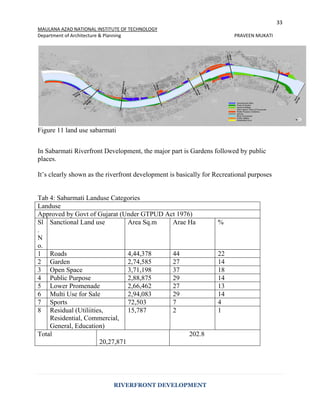
Figure 11 land use sabarmati
In Sabarmati Riverfront Development, the major part is Gardens followed by public
places.
It’s clearly shown as the riverfront development is basically for Recreational purposes
Tab 4: Sabarmati Landuse Categories
Landuse
Approved by Govt of Gujarat (Under GTPUD Act 1976)
Sl
.
N
o.
Sanctional Land use Area Sq.m Arae Ha %
1 Roads 4,44,378 44 22
2 Garden 2,74,585 27 14
3 Open Space 3,71,198 37 18
4 Public Purpose 2,88,875 29 14
5 Lower Promenade 2,66,462 27 13
6 Multi Use for Sale 2,94,083 29 14
7 Sports 72,503 7 4
8 Residual (Utiliities,
Residential, Commercial,
General, Education)
15,787 2 1
Total
20,27,871
202.8
34
MAULANA AZAD NATIONAL INSTITUTE OF TECHNOLOGY
Department of Architecture & Planning PRAVEEN MUKATI
RIVERFRONT DEVELOPMENT
Success Stories
 The Sabarmati Riverfront Project add almost 10,00,000 sq. mts. of parks,
promenades and plazas to Ahmedabad.
 The Sabarmati Riverfront Project help provide Ahmedabad with many new
cultural trade and social institutions (36,000 Sq.m).
 Creating of City Level Recreational Activities – Water Sports and Floating
restaurants.
 Tourist attraction.
 Recharge of Ground water Aquifers of the city
 Continuous Green coverage along the river corridor.
 Elimination of Flood Hazard.
 Creating Vibrant Urban neighborhoods and beautification of the city.
3.3 CASE STUDY 2 : MALAYSIA RIVERFRONT
Riverfront Areas : Kutching Riverfront. Malacca Riverfront, Glenmarie Riverfront
Riverfront development in Malaysia emerged after the growth of societies along the river
edges and this subsequently initiated the emergence of port towns and several other urban
forms. During that time, riverfront areas were the busiest places to cater for business and
trading, and these further transformed riverfront areas into focal points for Malaysians.
Population growth, economic growth, urbanization and increased technology have
transformed many Malaysian river systems from water industries into non water
industries. Due to these changes, the function of riverfront areas has also changed and the
current pattern of riverfront development in Malaysia now focuses more on mixed-use
development and recreation, while incorporating Malaysian cultural and historical values
3.3.1 CHARACTERISTICS OF THE RIVER FRONT AREA
Characteristics of the River front Area
Case study Areas Kutching Riverfront Malacca Riverfront Glenmarie Riverfront
Features
Name of water body Sarawak River Malacca River Langat River
35
MAULANA AZAD NATIONAL INSTITUTE OF TECHNOLOGY
Department of Architecture & Planning PRAVEEN MUKATI
RIVERFRONT DEVELOPMENT
Tab 5: Characteristics of the River front Area
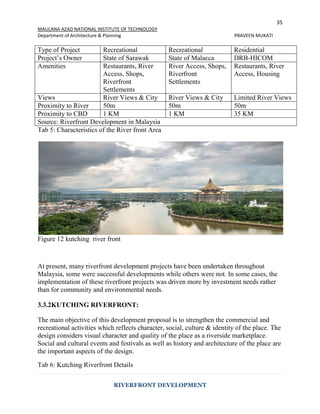
Figure 12 kutching river front
At present, many riverfront development projects have been undertaken throughout
Malaysia, some were successful developments while others were not. In some cases, the
implementation of these riverfront projects was driven more by investment needs rather
than for community and environmental needs.
3.3.2KUTCHING RIVERFRONT:
The main objective of this development proposal is to strengthen the commercial and
recreational activities which reflects character, social, culture & identity of the place. The
design considers visual character and quality of the place as a riverside marketplace.
Social and cultural events and festivals as well as history and architecture of the place are
the important aspects of the design.
Tab 6: Kutching Riverfront Details
Type of Project Recreational Recreational Residential
Project’s Owner State of Sarawak State of Malacca DRB-HICOM
Amenities Restaurants, River
Access, Shops,
Riverfront
Settlements
River Access, Shops,
Riverfront
Settlements
Restaurants, River
Access, Housing
Views River Views & City River Views & City Limited River Views
Proximity to River 50m 50m 50m
Proximity to CBD 1 KM 1 KM 35 KM
Source: Riverfront Development in Malaysia
36
MAULANA AZAD NATIONAL INSTITUTE OF TECHNOLOGY
Department of Architecture & Planning PRAVEEN MUKATI
RIVERFRONT DEVELOPMENT
Financial Sources Fully funded by the State Government
Institutional The master plan of the project implementation was prepared by SEDC
and Land
Arrangement Corporation Development Authority (LCDA) and approved by state
government.
Construction
Period
Began in 1991 & Completed in August 1993
Development
Area
Approximately one mile along the south bank of the river, encompassing
the river
frontage to the historic business center of the township.
Developer Sarawak Economic Development Corporation (SEDC), Sarawak,
Malaysia.
Contractors PPES Bena Sdn Bhd + Uraco (M) Sdn Bhd
Consultants ConyBeare Morrison & Partner (Australia) + United Consultants
(Sarawak, Malaysia).
Project cost 89.90 Million (Malaysian Ringgit)
Concept An urban river park that blends the historical and cultural setting with
the provision of facilities and activities for tourists and the community,
particular families. Possible
features to be considered as follows: Esplanade / pedestrian links,
Malls Entertainment area. Family outing areas and children’s
playground. Tourist attraction areas and Possible center for river cruise.
Source: ‘ An Evolution of Riverfront Development in Malaysia ‘ By
Azlina Binti Md. Yassin Submitted on 16Th
Pacific Rim Real Estate
Society Conference, Wellington 24-27 January 2010.
37
MAULANA AZAD NATIONAL INSTITUTE OF TECHNOLOGY
Department of Architecture & Planning PRAVEEN MUKATI
RIVERFRONT DEVELOPMENT
3.3.3LANDUSE AROUND RIVERFRONT AREA IN KUTCHING
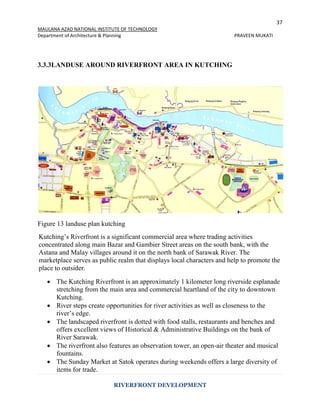
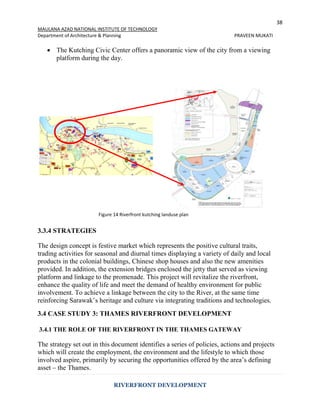
Figure 13 landuse plan kutching
Kutching’s Riverfront is a significant commercial area where trading activities
concentrated along main Bazar and Gambier Street areas on the south bank, with the
Astana and Malay villages around it on the north bank of Sarawak River. The
marketplace serves as public realm that displays local characters and help to promote the
place to outsider.
 The Kutching Riverfront is an approximately 1 kilometer long riverside esplanade
stretching from the main area and commercial heartland of the city to downtown
Kutching.
 River steps create opportunities for river activities as well as closeness to the
river’s edge.
 The landscaped riverfront is dotted with food stalls, restaurants and benches and
offers excellent views of Historical & Administrative Buildings on the bank of
River Sarawak.
 The riverfront also features an observation tower, an open-air theater and musical
fountains.
 The Sunday Market at Satok operates during weekends offers a large diversity of
items for trade.
38
MAULANA AZAD NATIONAL INSTITUTE OF TECHNOLOGY
Department of Architecture & Planning PRAVEEN MUKATI
RIVERFRONT DEVELOPMENT
 The Kutching Civic Center offers a panoramic view of the city from a viewing
platform during the day.
3.3.4 STRATEGIES
The design concept is festive market which represents the positive cultural traits,
trading activities for seasonal and diurnal times displaying a variety of daily and local
products in the colonial buildings, Chinese shop houses and also the new amenities
provided. In addition, the extension bridges enclosed the jetty that served as viewing
platform and linkage to the promenade. This project will revitalize the riverfront,
enhance the quality of life and meet the demand of healthy environment for public
involvement. To achieve a linkage between the city to the River, at the same time
reinforcing Sarawak’s heritage and culture via integrating traditions and technologies.
3.4 CASE STUDY 3: THAMES RIVERFRONT DEVELOPMENT
3.4.1 THE ROLE OF THE RIVERFRONT IN THE THAMES GATEWAY
The strategy set out in this document identifies a series of policies, actions and projects
which will create the employment, the environment and the lifestyle to which those
involved aspire, primarily by securing the opportunities offered by the area’s defining
asset – the Thames.
Figure 14 Riverfront kutching landuse plan
39
MAULANA AZAD NATIONAL INSTITUTE OF TECHNOLOGY
Department of Architecture & Planning PRAVEEN MUKATI
RIVERFRONT DEVELOPMENT
However, as the objectives of the strategy make clear, “the reality will be made tangible
by contributing to and delivering a clear vision of the region’s future, and in particular the
role of the riverfront in that vision.”
The fundamental point of departure of the Riverfront Strategy is to harness the
development benefits that potentially emanate from the River Thames
In very simple terms, the Thames, its riparian environs and related sensitive
habitats provide or contribute to the three crucial components – or “pillars” - of a
sustainable growth strategy.
 A Lifestyle
 An Environment
 A Gateway
3.4.2 VISION FOR RIVERFRONT DEVELOPMENT
 Contribute to the delivery of an outstanding quality of life experience for the
sub regions, citizens and to become a destination of choice for visitors
 Capturing the tremendous opportunities that the River Thames offers to the
TGSE sub-region in terms of contributing to sustainable growth, the gateway
function and employment.
 Balancing the growth and development pressures that emerge from and impinge
upon these very same assets
 Strategy Principles
 Sharing the river
 Safeguarding the gateway function

3.5 LEARNING’S FROM THE CASE STUDIES
3.5.1 RIVERFRONT QUALITIES
From the above studies, the following are the qualities are listed out in the riverfront
destinations.
1) Access and Linkage
2) Edge Uses
3) Attractions & Destinations
4) Identity & Image
40
MAULANA AZAD NATIONAL INSTITUTE OF TECHNOLOGY
Department of Architecture & Planning PRAVEEN MUKATI
RIVERFRONT DEVELOPMENT
5) Amenities
6) Water Uses
7) Flexibility in Design
8) Seasonal Strategy
9) Landuse Management
10)Diverse Funding Sources.
3.5.2NEED OF RIVERFRONT DEVELOPMENT PLANNING
The Riverfront developments are contribute to the quality of life in all of its aspects like
Economic, Social cultural.
1) To develop city as a major commercial and service center with international class
facilities.
2) To project on city as riverfront city with attractive investment opportunity
to further enhances the economic growth and stability.
3) To establish cities as one of the major tourism attraction center of the
country with international class facilities.
4) Appealing leisure and entertainment function contained with landscape &
fountains.
5) Manifesting cities nature with urban economic development.
6) Increase the Overall living standard of people in the cities contain with riverfront.
7) Making excellent living environment.
8) Fully Accessible to Public & fully guaranteed as a Public riverfront.
3.6 CASE STUDIES REVIEW
Case studies
Malaysia riverfront development
1) To Help the local Vendors in terms
of Wet Market & Dry Market
2) Commercial Oriented Development
3) Recreational development like
walkways & Yoga Mediation center
4) River Beautification works
41
MAULANA AZAD NATIONAL INSTITUTE OF TECHNOLOGY
Department of Architecture & Planning PRAVEEN MUKATI
RIVERFRONT DEVELOPMENT
Sabarmati riverfront development 1) City Oriented Development
2) To Attract investors & boost
economic growth
3) River Revitalization
4) Infrastructure Development
5) Recreational development
Thames Riverfront Development 1) Urban Reform Project
2) Flood Mitigation works
3) Recreational development
4) Public Space Creation
5) Slum Rehabilitation works
6) Groundwater Recharge
7) Infrastructure development
3.7 RECOMMENDATION
A well-designed edge is one where waterfront access, resilience, and ecological benefits
are all incorporated into an integrated design. While each site and project has its own
characteristics and goals guiding its outcome, these principles established a framework
for the creation of WEDG by MWA in conjunction with the interdisciplinary task force
and end-users:
Enhance Ecology
Waterfront edge designs should protect existing aquatic habitats and use designs,
materials, and shoreline arrangements to improve the ecological function of the coastal
zone and strive to be consistent with regional
Encourage Maritime Use
Edge design should create a waterfront that is usable by the maritime community,
commercial and recreational, where appropriate and feasible, thereby maximizing the
maritime use and integrity of the harbour and waterfront. Edge design should enhance
water-dependent uses, maritime business, maritime activity, and recreational boating
activity. Use a Science- Based,
Evaluative Process for Restoration
Project decision makers should use all available science regarding ecological features of
waterfront edge design. Projects with innovative ecological features should be monitored
based on evidence in the literature and pre-project baseline ecological conditions to
determine their effectiveness. Monitoring data should be used to improve designs over
time
Promote Resiliency
42
MAULANA AZAD NATIONAL INSTITUTE OF TECHNOLOGY
Department of Architecture & Planning PRAVEEN MUKATI
RIVERFRONT DEVELOPMENT
Waterfront edge designs must accommodate, mitigate, or be adaptable to the effects of
sea level rise and increased coastal flooding. Increases in precipitation may lead to
increased storm-water runoff, and green infrastructure and planted edge design can play
an important role in improving water quality.
Enhance Public Access, Especially for Boats:
Waterfront edge design should incorporate good public access designs—which
accommodate the highest number of uses including the widest range of boat types—that
closely reflect user input. Recreation and opportunities to support human interaction with
the water should be encouraged where appropriate, and designs should not preclude
adding features that improve public access in the future.
Commit to Equity and Community Input:
Waterfront edge designs should seek to serve the diverse needs of all types of
surrounding communities and land uses and be developed with local community and user
input. Waterfront edge designs in underserved communities and communities with lack
of waterfront access should be designed with special attention to their needs through
robust outreach and feedback gathering processes.
Encourage Cost-Effective Solutions:
The costs of a project should be assessed given risks including those from climate
change, initial capital costs, ongoing maintenance requirements, and other factors. Project
designs should be assessed for the economic burden it places on owners and stakeholders.
Analyses of a project’s vulnerability to and consequences of changing coastal conditions
due to sea level rise and coastal flooding should be considered in determining the cost-
effectiveness of designs.
CHAPTER 4 CONCLUSION
River front of Sabarmati, Malaysia and Thames river front development fulfills the
demand and models of Thames
1. Overall environmental improvement
2. Creating high quality public open spaces
3. Providing adequate public access to the river
4. Rehabilitating the slums
5. Creating vibrant urban neighborhoods
6. Providing city level infrastructure
43
MAULANA AZAD NATIONAL INSTITUTE OF TECHNOLOGY
Department of Architecture & Planning PRAVEEN MUKATI
RIVERFRONT DEVELOPMENT
Main conclusion getting from the following case studies -
Showcase the river’s history
-History plays an important role in shaping a place.
-It gives any place its unique identity.
-It can also be used to educate people about the place.
• Activate the riverfront
-Recreation/Fitness
-Tourism improves the economic wealth of the city.
• Public accessibility
-Limit obstacles and connect to the river.
-Convenient means for visitors to access the waterfront area.
-Trails, walkways, beaches, along rivers provided.
-There should be multiple entry points to the river so as to have a
successful riverfront with active use.
• Local participation Engage with the water
-Existing activities like fishing, boating, repair yards etc. along the river give it a
character. -Newer development should not totally take away the existing activities
• Liability
-Building near water can be hazardous for people.
-With easy accessibility to water there are certain liabilities like drowning or falling from
walkways with no railing on them.
• Bank stabilization
-The accessibility factor along with bank stabilization measures.
• Employ high quality architectural materials and sustainable
engineering practices
-By selecting building materials, heights, native plants for landscaping, reusing disturbed
areas and building within the context.
44
MAULANA AZAD NATIONAL INSTITUTE OF TECHNOLOGY
Department of Architecture & Planning PRAVEEN MUKATI
RIVERFRONT DEVELOPMENT
BIBLIOGRAPHY
Bibliography
Authority, s. P. (2014). Sabarmatiriverfront dvelopment. Ahemdabad: sabarmati river front development corporation
limited.
Srfdcl brings ‘riverfront house’ to convince investors in Sabarmati". The Indian express. 4 December 2014. Retrieved 24
April 2016.
Jawaharlal Nehru indiragandhi udyan national urban renewal mission (2006). "profile of the city
Ahmedabad" (pdf). Ahmedabad municipal corporation .Ahmedabad, urban development authority and cept university,
Ahmedabad. Ahmedabad municipal corporation. Retrieved 22 july 2008.
concerns over Sabarmati riverfront development project". Retrieved 2017-03-09.
Boon, b m (Jan – April 2007); proposed landscape redevelopment for commercial riverside marketplace along jalan
bambier at kutching waterfront, sarawak (accessed on: 15 june, 2012)
http://fabserver.utm.my/download/studentprojectkutchingwaterfront.pdf
Nicholas,s and rio, v d (April 2006); park marina area concept plan riverfront revitalization in redding, ca (accessed on:15
may 2012) http://digitalcommons.calpoly.edu/
Li, m (2003); urban regeneration through public space: dalian china (accessed on: 15 march 2012)
http://etd.uwaterloo.ca/etd/m9li2004.pdf
Goup (2008); riverfront development at allahabad, uttar pradesh (accessed on: 14 December 2011, at 03:16 pm)
http://awas.up.nic.in/pdf/allahabad/rfq-rfd.pdf
Rahman, n i a (1997); development of river park planning model with application to islamic perspective (accessed on: 14
December 2011, at 03:16 pm) http://eprints.ptar.uitm.edu.my/2399/1/141_nik_i_ab_rahman_97_24.pdf
Chambers, j p (1998): the urban place: places for jay to sit (8 December 2011, at 02:44 pm)
http://scholar.lib.vt.edu/theses/available/etd-81098-20362/unrestricted/etd.pdf
Yasin, a b md (2011): developing new guidelines for riverfront development in malaysia (accessed on: 3r April 2012 at
12:53 am) http://researcharchive.lincoln.ac.nz/dspace/handle/10182/4267
Funk, j (1985); New Albany riverfront development (accessed on: 3rd April 2012 at 12:53 am)
http://www.bsu.edu/libraries/virtualpress/student/architecture/pdfs/f86_1985funkjames.pdf

RIVER FRONT DEVELOPMENT

  • 1.
    MAULANA AZAD NATIONALINSTITUTE OF TECHNOLOGY Department of Architecture & Planning PRAVEEN MUKATI RIVERFRONT DEVELOPMENT RIVER FRONT DEVELOPMENT DISSERTATION BACHELOR’S OF PLANNING By PRAVEEN MUKATI Scholar No. 141109029 Under the Guidance of Dr. Navneet Munoth DEPARTMENT OF ARCHITECTURE AND PLANNING MAULANA AZAD NATIONAL INSTITUTE OF TECHNOLOGY BHOPAL – 462003 (M.P.), INDIA
  • 2.
    2 MAULANA AZAD NATIONALINSTITUTE OF TECHNOLOGY Department of Architecture & Planning PRAVEEN MUKATI RIVERFRONT DEVELOPMENT MAULANA AZAD NATIONAL INSTITUTE OF TECHNOLOGY (An Institute of National Importance) Bhopal- 462003 DEPARTMENT OF ARCHITECTURE AND PLANNING DECLARATION We, hereby, declare that the following report, which is being presented in the Dissertation entitled River front development is the partial fulfilment of the requirements of the Fourth Year (Seventh Semester) Dissertation in field of Planning. It is an authentic documentation of our own original work carried out under the guidance of Dr Navneet Munoth. the work has been carried out entirely at Maulana Azad National Institute of Technology (M.A.N.I.T.), Bhopal. The following project and its report, in part or whole, has not been presented or submitted by us for any purpose in any other institute or organization. We, hereby, declare that the facts mentioned above are true to the best of our knowledge. In case of any unlikely discrepancy that may possibly occur, we will be the one to take responsibility. PRAVEEN MUKATI 141109029 B.PLANNING 7TH SEMESTER, 4TH YEAR M.A.N.I.T., Bhopal
  • 3.
    3 MAULANA AZAD NATIONALINSTITUTE OF TECHNOLOGY Department of Architecture & Planning PRAVEEN MUKATI RIVERFRONT DEVELOPMENT MAULANA AZAD NATIONAL INSTITUTE OF TECHNOLOGY (An Institute of National Importance) Bhopal- 462003 DEPARTMENT OF ARCHITECTURE AND PLANNING CERTIFICATE This is to certify that Praveen Mukati is a student of Fourth Year B.Plan (Planning) have successfully completed her Dissertation on Riverfront development , in the partial fulfilment of the requirements of their Bachelor Of Planning degree. Dr. Navneet munoth (Project Coordinator) SESSION 2017-18
  • 4.
    4 MAULANA AZAD NATIONALINSTITUTE OF TECHNOLOGY Department of Architecture & Planning PRAVEEN MUKATI RIVERFRONT DEVELOPMENT ACKNOWLEDGEMENT With due respect, I express my deep sense of gratitude to my respected and learned coordinator, Dr. Navneet Munoth , for her valuable help and guidance. I am thankful for the encouragement that she has given me in completing this study successfully. Her rigorous evaluation and constructive critism was of great assistance. It is imperative for me to mention the fact that this Dissertation Report could not have been accomplished without the periodic suggestions and advice of Dr Navneet Munoth . I am also grateful to my respected director Dr. N.S.Raghuvanshi Sir for permitting me to utilize all the necessary facilities of the college. Needless to mention is the additional help and support extended by my respected HOD, Dr. Anupama Sharma, in allowing me to use the departmental laboratories and other services. I am also thankful to the other entire faculty, staff members and laboratory attendants of my department for their kind co-operation and help. Last but certainly not the least, I would like to express my deep appreciation towards my family and friends for providing the much needed support and encouragement. Praveen Mukati 141109029 B. Planning 7th semester
  • 5.
    5 MAULANA AZAD NATIONALINSTITUTE OF TECHNOLOGY Department of Architecture & Planning PRAVEEN MUKATI RIVERFRONT DEVELOPMENT CONTENTS LIST OF FIGURE.........................................................................................................................................7 LIST OF TABLE..........................................................................................................................................7 INTRODUCTION ........................................................................................................................................9 1.1 CONTEXTUAL BACKGROUND- .............................................................................................9 1.2 AIM AND OBJECTIVES.................................................................................................................10 1.3 RATIONALE FOR THE STUDY .............................................................................................................11 1.4SCOPE AND LIMITATIONS ..................................................................................................................12 1.5METHODOLOGY.............................................................................................................................12 1.6CONCEPTUAL DEFINITION..............................................................................................................13 CHAPTER 2 . LITERATURE REVIEW ...................................................................................................13 2.1 DEFINING RIVER FRONT DEVELOPMENT ..............................................................................13 2.2 TYPES OF RIVERFRONTS...........................................................................................................16 2.3 TREND OF WATER FRONT DEVELOPMENTS WORLDWIDE ...............................................16 2.4 ELEMENTS OF SUCCESSFUL RIVERFRONT DEVELOPMENT ............................................17 2.5 RIVERFRONT DEVELOPMENTS:................................................................................................18 2.6 SPECIAL CHARACTERISTICS OF RIVERFRONT AREA.........................................................18 2.7 GENERAL PRINCIPLES FOR RIVERFRONT DEVELOPMENT ...............................................19 2.8 IMPORTANCE OF PUBLIC SPACES............................................................................................19 2.9 ADVANTAGES & BENEFITS OF RIVERFRONT DEVELOPMENT.........................................20 CHAPTER 3 RIVER FRONT DEVELOPMENT IN INDIA....................................................................................21 To analyze the present pattern of different riverfront development projects in the country.:- .......21 Sabarmati Riverfront development: ...................................................................................................21 Gomti Riverfront Development ..........................................................................................................23 Yamuna Riverfront Development .......................................................................................................25 Hindon Riverfront Project...................................................................................................................25 Pune riverfront development .............................................................................................................26 Godavari river development...............................................................................................................28 3.1 ANALYSIS OF BEST PRACTICES OF INDIA AND TWO INTERNATIONAL CASE STUDIES ......................30 3.2 CASE STUDY 1: ANALYSIS OF SABARMATI RIVERFRONT DEVELOPMENT ........................................30 3.2.1 SABARMATI AND GROWTH OF AHMEDABAD............................................................................31 3.2.2 OBJECTIVES: ...............................................................................................................................31
  • 6.
    6 MAULANA AZAD NATIONALINSTITUTE OF TECHNOLOGY Department of Architecture & Planning PRAVEEN MUKATI RIVERFRONT DEVELOPMENT 3.2.3CHARACTERISTICS OF RIVERFRONT AREA...................................................................................31 Success Stories....................................................................................................................................34 3.3 CASE STUDY 2 : MALAYSIA RIVERFRONT ..........................................................................................34 3.3.1 CHARACTERISTICS OF THE RIVER FRONT AREA .........................................................................34 3.3.2KUTCHING RIVERFRONT: ............................................................................................................35 3.3.3LANDUSE AROUND RIVERFRONT AREA IN KUTCHING................................................................37 3.3.4 STRATEGIES .................................................................................. Error! Bookmark not defined. 3.4 CASE STUDY 3: THAMES RIVERFRONT DEVELOPMENT....................................................38 3.4.1 THE ROLE OF THE RIVERFRONT IN THE THAMES GATEWAY......................................................38 3.4.2 VISION FOR RIVERFRONT DEVELOPMENT .................................................................................39 3.5 LEARNING’S FROM THE CASE STUDIES.............................................................................................39 3.5.1 RIVERFRONT QUALITIES............................................................................................................39 3.5.2NEED OF RIVERFRONT DEVELOPMENT PLANNING.....................................................................40 3.6 CASE STUDIES REVIEW......................................................................................................................40 Case studies ........................................................................................................................................40 3.7 RECOMMENDATION .....................................................................................................................41 CHAPTER 4 CONCLUSION............................................................................................................................42 BIBLIOGRAPHY ............................................................................................................................................44 Bibliography ................................................................................................................................................44
  • 7.
    7 MAULANA AZAD NATIONALINSTITUTE OF TECHNOLOGY Department of Architecture & Planning PRAVEEN MUKATI RIVERFRONT DEVELOPMENT LIST OF FIGURE Page no Figure 1 trend of riverfront development 17 Figure 2Elements of Successful Riverfront Development 31 Figure 3 growth of the city Ahmedabad 30 Figure 4 land use Sabarmati 34 Figure 5 kutching river front 35 Figure 6 landuse plan kutching 36 Figure 7 Riverfront kutching landuse plan 37 LIST OF TABLE Page no Tab 1: Special Characteristics of Riverfront Area 17 Tab2: Characteristics of Sabarmati 31 Tab 3: Characteristics of Sabarmati 31 Tab 4: Sabarmati Landuse Categories 32 Tab 5: Characteristics of the River front Area 33 Tab 6: Kutching Riverfront Details 35
  • 8.
    8 MAULANA AZAD NATIONALINSTITUTE OF TECHNOLOGY Department of Architecture & Planning PRAVEEN MUKATI RIVERFRONT DEVELOPMENT ABSTRACT People are drawn to water. Human interaction with water is foremost feature that calls for riverfront development. People have a strong desire to feel it, reach it; and thus it becomes very important that approach to water should be given, public space production along the river shore should be primary purpose. This dissertation focused to develop a set of guidelines that contribute to the establishment of socio interactive spaces at riverfront. Research will also explore on current riverfront developments and notion of place identity and place making by the development of recreational spaces. Different case studies and their analysis will provide the strategies of a successful riverfront with meaningful socio interactive spaces. From the synthesis of findings a set of design attributes are framed. Keywords: Riverfront, socio interactive, environment, spaces.
  • 9.
    9 MAULANA AZAD NATIONALINSTITUTE OF TECHNOLOGY Department of Architecture & Planning PRAVEEN MUKATI RIVERFRONT DEVELOPMENT INTRODUCTION People in cities want a riverfront as a place of public enjoyment. They seek riverfront where there is enormous visual and physical eye catching sites remain all day the throughout. People also want riverfront to serve many purposes and a place that contributes to the quality of daily life in all of its aspect-economic ,social and cultural” This chapter introduces the thesis through a summary of the background research. It presents the context of the study by discussing the salient issues, and introduces the physical location of the study area. The aim, objectives, scope and limitations of the study are laid out along with the methodology 1.1 CONTEXTUAL BACKGROUND- Rivers are an inherent part of the development of the human settlement. They have been fundamentally involved in the process of settlement location and its continuous formation. The greatest civilizations of the world have formed and lourished along the banks of rivers. Whether it was the Egyptian civilization along the Nile River or the Indus valley civilization, rivers have been vital as the providers of water for sustaining life as well as the agrarian societies. Thus strong relationships existed between man and rivers, the later often being revered as Gods, not only in ancient times but till date. From daily activities to religious ceremonies, fairs and festivals, the river formed an integral part of human life In general, a is the zone of interaction between urban development’s and the water and a riverfront area is considered as a unique and irreplaceable resource where it is the interface between land, water, air, sun and productive plants. Moreover, the riverfront is characterized as a place integrating land with water and having a natural attraction to people. In fact, the seashore and are the most attractive water features for human settlement and, in most countries; the land in front of water is developed earlier than the inland areas. Riverfront development refers to any development in front of water and a water body; a river, lake, ocean, bay, creek or river edges. In the development area, considered that a riverfront development may not necessarily need to be directly fronting water but may only need to look attached to the water. They believe that commanding a view of water can still be considered as a riverfront property. An official definition by the US Federal Coastal Zone Management Act, Office of Ocean and Coastal Resources (OOCR) (1972) defines the term urban riverfront or port as, “any developed area that is densely populated and is being used for, or has been used for, urban residential, recreational, commercial, shipping, or industrial purposes”. A more detailed definition by Guo (1998) as cited in Dong (2004, p. 7) described the riverfront as the interface point where land and water meet, between approximately 200
  • 10.
    10 MAULANA AZAD NATIONALINSTITUTE OF TECHNOLOGY Department of Architecture & Planning PRAVEEN MUKATI RIVERFRONT DEVELOPMENT to 300 meters from the water line and 1 to 2 km to the land site and also takes in land within 20 minutes walking distance. Wu & Gao, 2002, as cited in Dong (2004, p. 7) added the riverfront area should have multiple features which incorporate each other and surrounded by structural and nonstructural objects to form a focal point. In many cities in the world, riverfront areas began as commercial centers, transportation hubs and manufacturing centers, as a central focus for them. However, due to complex and multiple problems such as technology change, the historic preservation movement, increased environmental awareness and urban renewal, a dramatic change in riverfront areas was brought about and they became large spaces of unused property in the past thirty years or so. The first riverfront development projects were started in North American cities, in particular Baltimore and Boston, in the 1960s. Nowadays, riverfront development is a global trend and thousands of schemes are being carried out in large metropolises, medium-sized cities and even small towns all over the world. Whereas the early examples of riverfront development primarily focused on leisure and retail, contemporary schemes have a broader scope; many are set up with the aim to create attractive mixed urban environments that appeal to the imagination of people and persuade them to work there, to live there, or to visit these. Breen & Rigby (1996) assign developed riverfronts into six distinct groups: commercial riverfronts; cultural, educational and environmental riverfronts; historic riverfronts; recreational riverfronts; residential riverfronts; and working riverfronts. . 1.2 AIM AND OBJECTIVES Aim “The aim of this project would be transforming city as a unique cultural platform with recreational and entertainment facilities serving the city, its people and tourists with new dimension, meaning and scale of development. The riverfront development shall be envisaged as a city’s identity on its river front development Research questions & Objectives . There are few questions, which help us in the fragmentation of the objectives. The questions are to  What are the factors which help the city to rejuvenate the urban life and the space through improved quality of life, facilitating recreational and cultural activities,
  • 11.
    11 MAULANA AZAD NATIONALINSTITUTE OF TECHNOLOGY Department of Architecture & Planning PRAVEEN MUKATI RIVERFRONT DEVELOPMENT organizing informal businesses and designing better public spaces with creative amenities. ?  What are the planning responses for related riverfront development in Indian context?  What measures, policies and practices, the government and riverfront development management authorities initiated?  What are the factor responsible for the development of public spaces?  What are the adverse effect of riverfront development on social, economic and geographical.? Objectives Objective 1: Ecological preservation:  Identify and implement environmental protection priorities to protect water quality and other sensitive natural features;  Stop the flow of sewage, keep the river clean and pollution-free;  Revitalize riverfront neighborhoods, rejuvenate River Objective 2: Create Social/ Public space:  Make the riverfront accessible to the public  Create riverfront parks to enjoy the water. Objective 3: Designing Development that is in harmony with the natural character of the area.  The urban form integrated with landscape, thereby, creating an enriching experience by responding to the context of water, existing diversity of activities, and forming a visually dominant landmark. Encourage development of appropriate design, scale, and use to improve the utilization of public lands and to improve residents’ quality of life.  Create a memorable identity for river and the city 1.3 RATIONALE FOR THE STUDY Due to the lack of waste management system, vacant land along the river edges is used as a dumping site. Generally dumping wastes are coming from shops, households and small scale industries. There is direct discharge of city sewage in to the river . Poor people are using river berms for open defecation or for construction of small huts for their livelihoods. Rivers now converted into channel which carries sewage and drains. Poor people are encroached river edges berms for the settlements .river has been encroached by the low lying slums. Due to the floods occur in to river at rainy season. These slums are prone to flood. Other than these problems there are some environmental
  • 12.
    12 MAULANA AZAD NATIONALINSTITUTE OF TECHNOLOGY Department of Architecture & Planning PRAVEEN MUKATI RIVERFRONT DEVELOPMENT issues like River creates unhygienic environment due to the degradation of organic waste existing in the river edges and river edges also becomes a breeding of mosquitoes, flies etc. Flooding of roads by sewage occurs due to encroachment, silting and solid waste dumping on the drainage channels, which leads to the river edgess in the city. The drains empty themselves in to the river edgess polluting the river edgess and also the environment along the river .no proper utilization of public spaces an government land presents on the river edges. 1.4SCOPE AND LIMITATIONS The scope of this research covers the identification of factor which are responsible for the developments of riverfront. Another scope from the research how to attract the peoples towards the riverfront development. A rational public space design for both social and ecological benefits, as well as integration of river rejuvenation. Proper utilization of riparian zones and edges through the river edges Maintenance of water pollution which occurs due to discharge of water from river.rehabilation of slum which are located at the river edges. Mitigation measures and proposals has to be given for the protection of city from floods. Poor environment condition, drainage and sewerage system, ecological preservation is not done very clearly, non availability of better quality of environment .. 1.5METHODOLOGY • Step 1- Selection Of Broad Theme River Front Development and understanding the concept. • Step 2-Analyzing The Scope Of Riverfront Development Government Intervention, Policy ,Urdpfi Guidelines ,Act And Rules • Step 3- Research On The Riverfront Development Through Various Successful Case Studies • Step 4- Analyze Case Studies’ aim, Objectives , Scope And Limitation Of The Successful Case Studies And Analyze Successful Factors Of Riverfront Development And Review Of Case Studies. • Step 5-According To Successful Case Studies Analysis. And Through Research The Question Raised And On The Basis Of Question, Our Objective Decided. • Step 6- Aim and objective • Step 7- rationale of the study
  • 13.
    13 MAULANA AZAD NATIONALINSTITUTE OF TECHNOLOGY Department of Architecture & Planning PRAVEEN MUKATI RIVERFRONT DEVELOPMENT • Step 8-Literature study and review • Step 9- riverfront development in India • Step 10-analysis of best practices of river front development in India and international case studies • Step 11-recommendation for the riverfront development 1.6CONCEPTUAL DEFINITION A riverfront is a region along a river; often in larger cities that border a river, the riverfront will be lined with marinas, docks, parks, trees, or minor attractions. Today many riverfronts are a staple of modernism and city beautification. Types of riverfront development- -The Natural Riverfront, comprising beaches, wetlands, wildlife habitats, sensitive ecosystems and the water itself. - The Public Riverfront, including parks, esplanades, piers, street ends, vistas and waterways that offer public open spaces and riverfront views. - The Working Riverfront, where water dependent, maritime and industrial uses cluster or where various transportation and municipal facilities are dispersed CHAPTER 2 . LITERATURE REVIEW This chapter presents a review of some literature sources referred for this research. This dissertation began with a literature review process, which was essential in identifying the direction of investigation, deciding the study area for detailed inquiry, and in understanding the background and context. The review of literature contributed to a conceptualization of the dissertation framework which has been presented in one of the subsequent chapters. 2.1 DEFINING RIVER FRONT DEVELOPMENT literature reviews are important as their purpose is: - to give a background relevant to the topic; - to identity the concepts related to the area and formulate hypothesis; - to identity appropriate methodology in the research design, methods of measurement and techniques and analysis; - to identity the data source; and - to learn how to structure a dissertation Definition by different scholars-
  • 14.
    14 MAULANA AZAD NATIONALINSTITUTE OF TECHNOLOGY Department of Architecture & Planning PRAVEEN MUKATI RIVERFRONT DEVELOPMENT “A riverfront is a significant resource and a challenging opportunity for a city; a chance to be an escape valve for the pressure-cooker of crowded city life, a chance to be a bright, breathing edge of city living and can be achieved by providing meaningful interactive spaces.”Arthur Cotton Moor Many problems concerning river front developments can be traced back to their historical development. As river front developments developed in the tide of commercialism, they seem to have lost their civic qualities. Court squares, parks, plazas and other public areas, once used as places for public assembly, exhibiting purposes, passing the time of the day, and meeting and conversing with friends and acquaintances, have gradually given way to parking lots and expansion of commercial activities. These areas that made each city distinctive expressed the character of the community as a whole. Wrenn (1983) describes the present situation in a historical context. "Urban river front developments in North America have historically suffered from a lack of vision and management in their adaptations to successive demands for new functions. Traditionally river front development and growth has been disjointed and incremental, characterized by a web of loosely related decisions and actions by dozens of political jurisdictions and hundreds of entrepreneurs". According to Tsukio (1984), throughout history, river front developments went through three major phases of transition: "The first transition came about with the enlargement of urban scale. With the expansion of the region, and industry, with its pollution, trouble occurred when everyone wanted to do something at the same place, namely the river front development". Every person had the priority to be closer to the river front development. As congestion increased and pollution became unbearable, people who could fmance an industry without water dependence moved farther inland. An official definition by the US Federal Coastal Zone Management Act, Office of Ocean and Coastal Resources (OOCR) (1972) defines the term urban river front development or port as, “any developed area that is densely populated and is being used for, or has been used for, urban residential, recreational, commercial, shipping, or industrial purposes” . In many cities in the world, river front development areas began as commercial centers, transportation hubs and manufacturing centers, as a central focus for them. However, due to complex and multiple problems such as technology change, the historic preservation movement, increased environmental awareness and urban renewal, a dramatic change in river front development areas was brought about and they became large spaces of unused property in the past thirty years or so.
  • 15.
    15 MAULANA AZAD NATIONALINSTITUTE OF TECHNOLOGY Department of Architecture & Planning PRAVEEN MUKATI RIVERFRONT DEVELOPMENT The first river front development projects were started in North American cities, in particular Baltimore and Boston, in the 1960s. Nowadays, river front development is a global trend and thousands of schemes are being carried out in large metropolises, medium-sized cities and even small towns all over the world. Whereas the early examples of river front development primarily focused on leisure and retail, contemporary schemes have a broader scope; many are set up with the aim to create attractive mixed urban environments that appeal to the imagination of people and persuade them to work there, to live there, or to visit these. Breen & Rigby (1996) assign developed river front developments into six distinct groups: commercial river front developments; cultural, educational and environmental river front developments; historic river front developments; recreational river front developments; residential river front developments; and working river front developments. River front developments which had once been the center of urban life lost its predominance. However, in the recent years there is a definite direction in which a new role for river front developments is emerging. A totally new direction is underway to bring back life into these abandoned riverfronts. This can be summed up simply by saying, it was a plan to take them (riverfronts) away from industry and give them back to people. Definition by Guo (1998) as cited in Dong (2004) defines the “river front development as the area in the city where land meets water, spatially, an area including 200m-300m from the interface to the water side and 1km-2km (that is about a 15min- 20min walking distance) to the land side” (p. 7). Wu and Gao (2002) as cited in Dong (2004) present that “It is an integrated system consisting of multiple features, of which the water forms the centre, and enclosed by substantial objects” (p. 7). Goodwin (1999) argues that river front development boundaries are difficult to determine and in some instances planning efforts might focus on a small part of a larger indistinct river front development area. The term ‘River front development’ in this research includes all the attributes of river front development developments summarized from the discussion of various definitions. Along with new development projects at the water, if the terms ‘River front development Revitalization’ and ‘Rejuvenation’ are used, they are considered to be new river front development developments. They are considered to be developments of existing river front development areas displaying substantial blight or neglect. If the term ‘River front development Redevelopment’ is used, it specifically refers to development of existing river front development developments with new commercial/economic potential. Existing
  • 16.
    16 MAULANA AZAD NATIONALINSTITUTE OF TECHNOLOGY Department of Architecture & Planning PRAVEEN MUKATI RIVERFRONT DEVELOPMENT ports, shipment hubs, coastal /beachfront developments, boat clubs, etc. have been considered to be potential ‘redevelopment’ projects “The concept of a river front development district helps to identify distinct nodes of revitalization activity within long urban shoreline reaches” (p. 242). Various terminologies are also used in literature instead of ‘river front development’; these include city port, harbor front, riverside, river edge, water edge, and river front (Hussein, 2006), (Yassin, et al., 2010) and (Timur, 2013). The urbanized areas could also be cities and towns of various sizes and population densities. Additionally, the water body may be ‘a river, lake, ocean, bay, creek or river edges’ or artificial (Timur, 2013, p.170). The definition of ‘River front development’ therefore depends on the characteristics of the river front development site, the planning framework and development approach. Various planning authorities, local communities, investors, and other stake holders including local residents may be involved in any river front development process. Depending on the site, river front development developments could be new river front development projects to acquire new facilities, investments and operators to the area/region. They could also be development projects to preserve natural habitats along with developing supportive public amenities. River front development developments could also be regeneration / rejuvenation / revitalization projects, which aim to improve existing areas, addressing deterioration and blight. 2.2 TYPES OF RIVERFRONTS As per NEW YORK CITY COMPREHENSIVE RIVERFRONT PLAN, there are four principal functions of the riverfront: -The Natural Riverfront, comprising beaches, wetlands, wildlife habitats, sensitive ecosystems and the water itself. - The Public Riverfront, including parks, esplanades, piers, street ends, vistas and waterways that offer public open spaces and riverfront views. - The Working Riverfront, where water dependent, maritime and industrial uses cluster or where various transportation and municipal facilities are dispersed. - The Redeveloping Riverfront, where land uses have recently changed or where vacant and underutilized properties suggest potential for beneficial change. 2.3 TREND OF WATER FRONT DEVELOPMENTS WORLDWIDE -1960s - Massive riverfront development began and consequently initiated the world- wide era of riverfront revitalization. -1970s - Urban riverfront redevelopment bloomed,
  • 17.
    17 MAULANA AZAD NATIONALINSTITUTE OF TECHNOLOGY Department of Architecture & Planning PRAVEEN MUKATI RIVERFRONT DEVELOPMENT -1980s - Accelerated and continued in the future Figure 8 trend of water front development Clearly, interest in promoting riverfront development in many countries was caused by environmental protection, shoreline access, water quality, historic preservation, tourism and economic development, as well as the growing potential of the riverfront for recreational, commercial and residential uses. Moreover, festival and water sports are perhaps the most visible public-oriented activities that have played a key role in the rediscovery of riverfronts 2.4 ELEMENTS OF SUCCESSFUL RIVERFRONT DEVELOPMENT Source: Torre, 1989; Journal of Techno Social-ISSN 2229 8940-Vol 4 No 1 April 2012 (Pg 24) Elements of successful water front development effective management beginingthe project financial faesibility environmental approvl construction technology authencity function project theme and image public perceptionof need
  • 18.
    18 MAULANA AZAD NATIONALINSTITUTE OF TECHNOLOGY Department of Architecture & Planning PRAVEEN MUKATI RIVERFRONT DEVELOPMENT Figure 9Elements of Successful Riverfront Development 2.5 RIVERFRONT DEVELOPMENTS: Criteria for guidelines of development concept -River as a main attraction of development  According to the guideline, for any reason, river’s role is remaining as a main attraction for the development.  River itself must be developed earlier than any others development planning.  Removal and changing river line or row are not permitted. -Beautification of river reserves  According to the guideline, developers are required to provide recreation and beautification plan for river.  Maintaining river reserve as a buffer zone to control environmental problem such as soil erosion.  Utilization river reserve for green areas and recreational use are allowed to the developers. -Level of river flow  According to the guideline, a development close to river areas would not increase level of river flow. Development are more than 10 ha are required to build retention pond with maximum area approximately between 3-5% of total development area. - Development of permanent infrastructure  According to the guideline, the development of permanent building and infrastructure are not allowed within river and river reserves, unless facilities for recreational purposes such as playground.  2.6 SPECIAL CHARACTERISTICS OF RIVERFRONT AREA Tab 1: Special Characteristics of Riverfront Area Characteristics Description Dynamic area Riverfront zone is a dynamic area with frequently changing biological, chemical and geological attributes. Habitat Riverfront zone include highly productive and biologically diverse ecosystems that
  • 19.
    19 MAULANA AZAD NATIONALINSTITUTE OF TECHNOLOGY Department of Architecture & Planning PRAVEEN MUKATI RIVERFRONT DEVELOPMENT offer crucial nursery habitats for many species. Natural defense Riverfront zone features such as mangrove forests serves a critical natural defense against natural hazards (flooding, erosion and storms). Pollution moderator Water ecosystems may act to reduce the impacts of pollution originating from land such as, wetlands absorbing excess nutrient sediments, human waste Source: ‘An Evolution of Riverfront Development in Malaysia ‘ By Azlina Binti Md. Yassin Submitted on 16Th Pacific Rim Real Estate Society Conference, Wellington 24- 27 January 2010 2.7 GENERAL PRINCIPLES FOR RIVERFRONT DEVELOPMENT Riverfront development planning is often guided by four priorities: balanced land use; respect for limited resources; improved public access; and safeguards for environmental quality. The general principles for riverfront development are set out below:  Interconnected, linear riverfront development with broad public access • Encouraging the use of the greenway as a daily commuter path and recreational amenity. • Demonstrating the connection between access, greenway development and market demand. • Creating a coherent, visually pleasing order to the water’s edge  Protection and enhancement of the natural environment • Documenting the ecological state of the riverfronts in order to preserve this environmentally diverse natural habitat. • Preventing and, where possible, eliminating inappropriate uses and practices from the rivers’ edge. • Protecting existing natural areas from development.  Reclaim the city’s identity as one of the best water cities • Raising public expectations of what the city’s riverfront offers. • Attracting people, investment and the best aspects of urban living to the riverfront.. 2.8 IMPORTANCE OF PUBLIC SPACES A public space may be a gathering spot or part of a neighborhood, downtown, special district, riverfront, or other area within the public realm that helps promote social
  • 20.
    20 MAULANA AZAD NATIONALINSTITUTE OF TECHNOLOGY Department of Architecture & Planning PRAVEEN MUKATI RIVERFRONT DEVELOPMENT interaction and a sense of community Examples include spaces such as plazas, town squares, parks, marketplaces, public commons and malls, public greens, piers, special areas within convention centers or grounds, sites within public buildings, lobbies, concourses, or public spaces within private buildings. As with all categories of Great Places, it is important to identify what sets a space apart from others spaces to qualify it for a Great Spaces designation. Public Spaces must be at least 10 years old. 2.9 ADVANTAGES & BENEFITS OF RIVERFRONT DEVELOPMENT The benefits and advantages of developing water front are manifold ranging from economic benefits, environmental benefits to social/ community benefits. These benefits are detailed below.  With the development of riverfront there would be creation of jobs in developing the front, jobs as it gives way to starting up of a host of commercial activities in that region and also indirect job creation associated with the set of activities.  Source of revenue for government – government would be able to earn revenue in terms of taxes from the commercial activities in the region. The commercial activities include shops, restaurants, sport activities, transportation, boating etc which can be leased out or giving to private players to operate.  Development of tourism in the region – with the development of riverfront the tourism in the region can be increased by offering a variety of attractions like water sports, entertainment arenas, parks, shopping areas, etc.  Economic spin-off’s – rise in the value of properties in and around the region, acting as a catalyst for redevelopment and renewal of nearby places  Habitat protection and restoration Conservation of water in the river Human/Environmental connections • Conservation and development of land • Conservation of flora and fauna  Maintenance of river bank.  Water conservation practices - Development of projects would ensure a proper design of projects in conserving river and maintenance of rivers flowing through large cities.  Beautification of the riverfront with a natural outlook will provide the general public with an open space for leisure and recreation.  Providing employment opportunities for nearby people and helping in development of region.  Encouraging recreational activities like walking, jogging, biking, sports activities, etc  Improving quality of life of nearby community by revitalizing the neighborhood
  • 21.
    21 MAULANA AZAD NATIONALINSTITUTE OF TECHNOLOGY Department of Architecture & Planning PRAVEEN MUKATI RIVERFRONT DEVELOPMENT CHAPTER 3 RIVER FRONT DEVELOPMENT IN INDIA There is a wave of riverfront developments in India. UP governments ambitious project Gomti riverfront development in Lucknow is under construction which is influenced from first riverfront development project, Gujarat’s Sabarmati Riverfront development. There are several other similar riverfronts proposed on the banks of rivers in India. -Bulky Riverfront Projects Riverfront developments are cost rich projects that take few years of rigorous work for development. It takes diversion of resources, government budget, labor, etc. Looking briefly at these projects indicates that the discourse mainly revolves around the commercial and recreational activities. Concrete Wall Embankments, reclamation of the river in floodplains and commercialization of the reclaimed land are the innate components of these projects. Recreational Activities that are promoted on the riverfronts typically include shopping malls, boat trips, theme parks, restaurants, walk ways and parking lots in the paved and encroached river bed. Every riverfront project talks about the c commercial beautification of the river but none emphasizes on the betterment of its condition and ecology. Is it just a cosmetic beautification of rivers or does it really rejuvenates or betters the condition of rivers? The riverfront developments that mainly aims to beautify for commercial purposes essentially changes the ecological and social landscapes of the river, transforming it into an urban commercial space rather than a natural, social, cultural, ecological landscape. To analyze the present pattern of different riverfront development projects in the country.:- Sabarmati Riverfront development: Sabarmati riverfront development was the first project in the group of riverfront projects in India. Sabarmati riverfront on river Sabarmati in Ahmedabad was proposed in 1960 but the construction started in year 2005. It is acclaimed pioneering in urban transformation and envisaged to develop 11.25 Km stretch on the banks of the river but ground reality is different and the project
  • 22.
    22 MAULANA AZAD NATIONALINSTITUTE OF TECHNOLOGY Department of Architecture & Planning PRAVEEN MUKATI RIVERFRONT DEVELOPMENT has done little to no development of the river. Instead has deteriorated the river ecology. The 11.25 km long stretch is made of concrete embankments on both sides with walkways. The estimated cost of the project is Rs.1200 crores which will be recovered by selling of parts of reclaimed land for commercial and residential purpose. The reclaimed land is used for public as well as private development. More than 85% of the reclaimed land will be used for public infrastructure, recreational parks, sports facilities and gardens while nearly 14% will be used for commercial and residential purpose. In 2003, the project was extended to cover an 11.25 km stretch from 10.4 km stretch with reclamation of 202.79 hectares (501.1 acres) and was put on fast track. Project was inaugurated by then Chief minister of the state Narendra modi on 15 August 2012. Ahmedabad Municipal Corporation (AMC) claims that the after the project, riverfront has added vibrancy to the urban landscape of Ahmedabad with its well-designed gardens, open spaces, walkways, along with activities which contribute to economic growth. The average width of the river channel was 382 meters (1,253ft.) and the narrowest cross- section 330 meters (1,080 ft.). It is uniformly narrowed to 263 meters (863 ft.) without affecting its flood carrying capacity and the riverbed land is reclaimed on the both east and west banks to construct 11.25 km long riverfront. The total of 202.79 hectares of land is reclaimed. It also claims that it improves/has improved environment by reducing erosion of the banks and flooding of low-lying areas of the city by the walls constructed on the both banks. The new integrated sewage and storm-water system intercepts 38 former sewage and industrial effluent discharge points and route it to sewage treatment plants located south of Vasna Barrage. Thus reducing the water pollution in the river. The water level in the river is retained through Vasna Barrage and the losing water is replenished by the Narmada Canal. It enabled the groundwater recharge and the recreational facilities like boating in the river. It also replenishes river by treated sewage water. Though the project has been labeled as “best practice” by several financing institutions, it has also drawn flak for poor rehabilitation of the displaced(rehabilitation happened only after High Court orders following a public interest petition) disrupting the nexus of shelter, livelihood and services of urban poor, lack of transparency in the execution, not improving the water quality and for tampering with the carrying capacity of the river. It is strange that Environment Impact Assessment of the project was not conducted neither any credible public consultation process held.
  • 23.
    23 MAULANA AZAD NATIONALINSTITUTE OF TECHNOLOGY Department of Architecture & Planning PRAVEEN MUKATI RIVERFRONT DEVELOPMENT . The project has only transferred the water from both banks to the river downstream from Vasna barrage, which is situated downstream from the city. The Vasna barrage stops and stores the water released from Narmada Main Canal that crosses the river about 10.4 km upstream from the barrage. Thus this 11.25 km stretch of the river now holds the Narmada water and huge losses from the stretch are losses for the drought prone areas. The project was stalled during August 2006 to March 2007 due to heavy floods. Prior to the floods, the river’s maximum carrying capacity was calculated at 4.75 lakh cusecs on basis of the rainfall over last 100 years. The floods however proved the calculation wrong. The irony is, this project is considered pioneering project in the group of upcoming riverfronts in India and is laying the guide lines for them despite being no less than a failure. Sabarmati riverfront has distorted the ecology of the river to space the commercial greed of few. The water quality of the river is extremely poor and has declined in discourse. The cosmetic treatment of the water stretch has depleted the water and Sabarmati and water in the river is of river Narmada. Components of Sabarmati Riverfront development Project:  The 11.25 km long stretch would be made of concrete embankments on both sides with walkways.  The estimated cost of the project is Rs.1200 crores which will be recovered by selling of parts of reclaimed land for commercial and residential purpose.  The average width of the river channel was 382 meters (1,253 ft.) and now it is further narrowed and jacketed within 263 meters (863 ft.)  The riverfront with its open spaces, walkways, well-designed gardens along with activities will contribute to economic growth.  It claims that it improves environment by reducing erosion of the banks and flooding of low-lying areas of the city by the walls constructed on the both banks.  The water level in the river is retained through Vasna Barrage and the losing water is replenished by the Narmada Canal.  The shelter, livelihood and services of urban poor were disrupted and displaced poorly to reclaim the river land. Gomti Riverfront Development
  • 24.
    24 MAULANA AZAD NATIONALINSTITUTE OF TECHNOLOGY Department of Architecture & Planning PRAVEEN MUKATI RIVERFRONT DEVELOPMENT Gomti riverfront is an example of a wrong lead produced by River Sabarmati. Gomti Riverfront started in 2012 under the aspiring government led by then newly elected chief minister Akhilesh yadav. Gomti riverfront was proposed to rejuvenate the present condition of the river Gomti. In addition to it, it would beautify the embankments, to build them for commercial and recreational activities. The project aims at building concrete riverbanks of length 12 km stretching from Pucca pull to Shaheed path. The state government has made irrigation department the nodal agency of the project to revive the river in three ways. There will be extensive cleaning of the river bed and water flow will be regularized through river channelization. Besides, the surroundings will be made beautiful. There will be walking plazas, cycling and jogging tracks and ghats along the banks. It also aims at joining sharda canal with the river to maintain the water level in the times of crisis. If look closely, this projects mainly speaks about the cosmetic beautification of the river. Building of concrete walls in the riverbeds has disturbed the ecology of the river. Maximum natural water sources in the depth have depleted and the water has dried up. In the Environment impact assessment report conduct by IIT Roorkee, IIT Roorkee had warned about the consequences of this project. Limiting the river within the channel of 250 meter wide concrete wall would suffocate the river and advert times would blow away the bridges like Pucca Pull (Hardinge Bridge) with it. When floodplains are paved with the concrete and cement, excess water would flood the city in times of flood. The project has raised several concerns and received flak from various environment experts all-around. Several drains are still falling un-intercepted in the river causing pollution. Excess tax payers’ money is being wasted on this venture but nothing about the expenses is there in the public domain. People are totally unaware about their money being wasted. Irrigation department denied rendering information asked by Ballotboxindia in the RTI. Definitely, the project has attracted the people of the city at it is added into their list of hangout points. Several selfie points with enormous lighting and space certainly entice anybody in there. But it may be easy and soothing to one’s eyes but the adverse impact it holds is frightening. Project was estimated at Rs 1300 crores and was scheduled to end by the 2016. But it is still in progress. Key features of Gomti Riverfront development project:  The project aims at building concrete riverbanks of length 12 km stretching from Pucca pull to Shaheed path.
  • 25.
    25 MAULANA AZAD NATIONALINSTITUTE OF TECHNOLOGY Department of Architecture & Planning PRAVEEN MUKATI RIVERFRONT DEVELOPMENT  There will be walking plazas, cycling and jogging tracks and ghats along the banks.  It also aims at joining sharda canal with the river to maintain the water level in the times of crisis.  River has been jacketed within 100-120 meters Yamuna Riverfront Development Though still on paper, Delhi government has plans ready for the Yamuna riverfront development project. Delhi government aims at improving the abysmal condition of river Yamuna that runs in miserable condition through Delhi. As estimated, it will take two years to develop a 5 km stretch of Yamuna with Rs 200 crores. As proposed, after development of stretch to beautify about a quarter of the river stretch it will have medicinal gardens, a biodiversity park and a modern wrestling ring.The river will also have canoeing and rowing facility. The stretch on the quarter length of the river in upstream of wazirabad will also sport cycle tracks and recreational activities. Bird watching and nature trails will also be facilitated. It will be a ‘concrete free’ riverfront development and to keep it ecological use of bamboo and wood will be made. Key features of Yamuna Riverfront development:  development of a 5 km stretch of Yamuna River with Rs 200 crores  It will be a ‘concrete free’ riverfront development and to keep it ecological, use of bamboo and wood will be made.  The developed river stretch will have medicinal gardens, a biodiversity park and a modern wrestling ring. Bird watching and nature trails will also be facilitated.  The stretch on the quarter length of the river in upstream of wazirabad will also sport cycle tracks and recreational activities. The river will also have canoeing and rowing facility. Hindon Riverfront Project Alike other kins, Hindon riverfront also talks about restoring the Hindon river ecology and make it clean. The hindon riverfront project would stretch 22 km up to Greater Noida. A green corridor is proposed to be developed across 600 hectares Noida flood plains that will avail picnic spots to general public. In the first phase, about 200 acres will be acquired and converted into the riverfront area. The project involves developing facilities like parks, yoga centres, picnic spots and sports centres. The proposed plan also entails eco-friendly cycle tracks, green belts and parks in green corridor. The project would also take care of the untreated sewerage falling in the river
  • 26.
    26 MAULANA AZAD NATIONALINSTITUTE OF TECHNOLOGY Department of Architecture & Planning PRAVEEN MUKATI RIVERFRONT DEVELOPMENT to rejuvenate it by sewage treatment plants. The projects DPR is still under preparation and is expected to complete by the mid of 2017. Key features of Hindon Riverfront project:  The hindon riverfront project would stretch 22 km up to Greater Noida.  A green corridor is proposed to be developed across 600 hectares Noida flood plains that will avail picnic spots to general public. The project involves developing facilities like parks, yoga centres, picnic spots and sports centres.  The proposed plan also entails eco-friendly cycle tracks, green belts and parks in green corridor.  The project would also take care of the untreated sewerage falling in the river to rejuvenate it by sewage treatment plants. Pune riverfront development The two rivers Mula and Mutha that flow through the heart of Pune city have deteriorated beyond limit and Pune Municipal Corporation under the aegis of JNNURM (Jawaharlal Nehru National Urban Renewal Mission) has planned a project along 44 km stretch of Mula and Mutha to envisage the channelizing of the river, introducing barrages to maintain water levels, development of riparian zone as entertainment and shopping groups, even Parking lots, introducing navigation in the river etc. Project plan has several short comings and has been put to break before its start. The project does not say a word about treating water quality, but has plans to build drainage lines inside the riverbed and carry the sewage out of Pune city limits. This hardly qualifies as river rejuvenation or restoration. A case has been filed against this project in National Green Tribunal. Key features of the Pune Riverfront development project:  Riverfront development project along 44 km stretch of Mula and Mutha to envisage the channelizing of the river  Introducing barrages to maintain water levels  Development of riparian zone as entertainment and shopping groups, even Parking lots, introducing navigation in the river etc. Brahmaputra Riverfront development Assam government had inaugurated the Brahmaputra riverfront project in 2013 under Assam infrastructure financing authority. The 20 km stretch along river in the city will undergo revamp as a part of the project. While the plan talks of revitalization of the river
  • 27.
    27 MAULANA AZAD NATIONALINSTITUTE OF TECHNOLOGY Department of Architecture & Planning PRAVEEN MUKATI RIVERFRONT DEVELOPMENT ecology and Strengthening of riverbanks through soil bio engineering it has several urban features on its agenda like promenade, Ghats, Plazas and Parks; buildings, conference facilities, Parking lots, ferry terminals, Bus and para transport stops, Urban utilities and drainage, Improved infrastructure for floating restaurants, Public amenities; Dhobi Ghats, etc. The project will also restrict any construction within the 400 meters of the river. The Assam government plans to boost tourism in the state with this lavish project. Assam government also wants to end criminal or nefarious activities along the river bank and reclaim the encroached land by them by this project. But thing to notice is that while on one hand the city is struggling to cope up with the flood prone nature of the Brahmaputra River, State Government of Assam plans to take up an ambitious project to develop the city riverfront. On the request of GMDA (Guwahati metropolitan development authority), National Institute of Hydrology (NIH), Roorkee is carrying out a study which includes river shifting analysis for studying stability of the river banks, flow variations to determine the perennial water depth, estimate of floods of various return periods for design of river embankments, estimate of water surface profiles employing hydro-dynamic river flow model and design parameters for river embankments. The Brahmaputra Riverfront Development Project however has been inaugurated even before the requisite studies have been completed. Key components of the project:  Continuity and access along the river  Linkages from the city to the riverfront  Restructuring Land Use  Development of cultural precinct in the Government areas  Revitalization of the river ecology  Strengthening of riverbanks through soil bio engineering  Riverside Promenade, Ghats, Plazas and Parks  Buildings for social infrastructure-museums, art gallery, conservatory, conference facilities and youth centre  Local produce markets  Lighting, Street Furniture & Public Art  Heritage management & conservation  Improved cross sections of roads with emphasis on pedestrian safety and NMV usage.  Improved MV movement  Parking facilities  Ferry terminals  Bus and para transport stops  Urban utilities and drainage
  • 28.
    28 MAULANA AZAD NATIONALINSTITUTE OF TECHNOLOGY Department of Architecture & Planning PRAVEEN MUKATI RIVERFRONT DEVELOPMENT  Improved infrastructure for floating restaurants  Public amenities  Riverfront management infrastructure  Reorganization of cremation activity  Signage  Dhobi ghats  Development controls and norms Godavari river development The city of Nashik has been blessed with the passage of rivers Godavari and Darna. 18 km stretch along both banks of Godavari River need to be developed with amenities, Gardens and parking spaces, community facility so that essentially the area is useful in handling congestion in the Kumbh mela period as well as create places of relaxation for citizens of Nashik. Earlier the Nashik Municipal Corporation (NMC) had tried to improve the riverfront small stretch by constructing small ghats, Jogging track and retaining walls at some stretches of the left bank of river about 3 km long under the Goda Park project. But it is felt that these efforts are not sufficient for the conservation of river front. Godavari Riverfront Development at Nanded focuses on regeneration of the river. The North Bank will be integrated with the existing urban fabric while the less developed South Bank is proposed as an eco-park. Key components of the 13.5 km long project:  Ghats, walking paths and promenades with laser shows, musical fountains, rope- way, multi-purpose meeting hall, garden,  water sports, canteen, etc.  Buildings for social infrastructure  Revival of natural drainage systems  Revenue generation systems  Parks, gardens, street planting and eco-systems  Lighting  Street furniture, art, sculptures  Reorganizing cremation activity  Solid waste management The project has received funds from the National River Conservation Directorate as well as JNNURM.
  • 29.
    29 MAULANA AZAD NATIONALINSTITUTE OF TECHNOLOGY Department of Architecture & Planning PRAVEEN MUKATI RIVERFRONT DEVELOPMENT On the other hand there are several court orders against Nashik Municipal Corporation pending about severe water pollution in the River including Ram Kund where holy dip on Kumbh Mela is supposed to be taken. Looking the key features of riverfront projects and accessing their significance After reading about the above listed riverfront development models in India it appears as they are false propaganda for the restoration and rejuvenation of the rivers. Every riverfront has common components of economic gain on the cost of river ecology. Every riverfront development model speaks about the construction of pavements in the river bed and the flood plains. Reclaiming or 'encroaching' in coarse and ideal word, and then selling the land piece to builders for commercial activities to derive benefits. Rivers are being jacketing and narrowed far within their actual width. Binding the river into narrowed concrete channels would affect its flow pattern that may can impact river's flooding capacity and its aquatic life. Concrete in the riverbed would cut off source of water in the river. Citing this as probable outcome, these projects intend to connect the rivers with the nearby rivers and canals so to avoid them from drying up. Similar thing happened when Sabarmati water dried up and it was transferred and stored from Narmada main canal. Gomti is also proposed at connecting with Sharda canal so to avoid such times. Every riverfront development model aims at glorifying 'selfie point' concept to attract crowd and give them space for their leisure times. But far away from truth, they are unaware how adversely such constructions affect our ecology. Main problem with river systems is their pollution. Instead of tapping the drains falling into rivers with sewage. Projects instead of fixing this problem in first phase of the project are preferring to develop the river pavements as they can start bringing through recreational activities. Such hefty projects become source of money for the politicians and tax payers' money is not utilized properly for other social purposes.
  • 30.
    30 MAULANA AZAD NATIONALINSTITUTE OF TECHNOLOGY Department of Architecture & Planning PRAVEEN MUKATI RIVERFRONT DEVELOPMENT 3.1 ANALYSIS OF BEST PRACTICES OF INDIA AND TWO INTERNATIONAL CASE STUDIES In this Case Studies, I review & analyzed Malaysia Riverfront (Kutching); Thames Riverfront Development & Ahmedabad (Sabarmati Riverfront). Basically this three riverfront projects are situated within or close to downtown area and play important role in the functioning of the city. And the study areas primarily need to include public open space providing potential for various outdoor activities like recreation. And Mostly the impact & effect of riverfront development projects illustrated in the particular location in terms of economy, people’s health, recreational & tourism activities. Some of the riverfront development projects are basically recreational purposes & some of them housing purposes. It may vary as per the distance from CBD & its requirements & needs. Also each of the cases must be considered as successful riverfront development, by their investors, consumers, private and Government agencies. 3.2 CASE STUDY 1: ANALYSIS OF SABARMATI RIVERFRONT DEVELOPMENT Sabarmati river has been an integral part in the life of Ahmedabad since the time the city was founded in 1411 along the river banks. Besides being an important source of water, it provided a backdrop to cultural and recreational activities. During the dry seasons, the river bed became a place for farming. With time it also offered place for various informal economic activities, and the river banks were used by informal squatter settlements. Gradually, however, the intensive uses took their toll on the river. Untreated sewage flowed into the river through storm water outfalls and dumping of industrial waste posed a major health and environmental hazard. The river bank settlements were disastrously prone to floods and lacked basic infrastructure facilities. Lackluster development took shape along the riverfront. Such conditions made the river inaccessible and it became a virtual divide between the two parts of the city. Slowly, the city turned its back towards the river. There had been a long-standing acknowledgement that the riverfront could be turned into a major urban asset from its undesirable state. Proposals to achieve the same have been made since the 1960s and it was finally in 1998 that this multi-dimensional project was envisioned and undertaken by the city.
  • 31.
    31 MAULANA AZAD NATIONALINSTITUTE OF TECHNOLOGY Department of Architecture & Planning PRAVEEN MUKATI RIVERFRONT DEVELOPMENT 3.2.1 SABARMATI AND GROWTH OF AHMEDABAD Figure 10 growth of the city Ahmedabad 3.2.2 OBJECTIVES: The following are the objectives considered for Riverfront development project.  Make the riverfront accessible to the public  Stop the flow of sewage, keep the river clean and pollution-free  Reduce risk of erosion and flooding in flood prone neighborhoods  Create riverfront parks, promenades and Ghats to enjoy the water.  Revitalize riverfront neighborhoods, rejuvenate Ahmedabad.  Generate resources to pay for all of the foregoing.  Stitch together East and West Ahmedabad.  Create a memorable identity for Ahmedabad. 3.2.3CHARACTERISTICS OF RIVERFRONT AREA
  • 32.
    32 MAULANA AZAD NATIONALINSTITUTE OF TECHNOLOGY Department of Architecture & Planning PRAVEEN MUKATI RIVERFRONT DEVELOPMENT Tab2: Characteristics of Sabarmati Case study Areas Sabarmati Riverfront Features Name of water body Sabarmati River Type of Project Recreational Company Sabarmati River Front Development Corporation Limited (SRFDCL) Amenities Restaurants, River Access, Shops, Riverfront Settlements, Gardens, Walkways, Amusement parks, Golf Course, Water sports Views River Views & City Proximity to River 50m Proximity to CBD 1 KM Tab 3: Characteristics of Sabarmati Sabarmati Riverfront Financial Sources The project has been planned as a self- financing project. The revenues would be generated from the sale of proclaimed land. Construction Period Start on Early 2005 & Complete on Nov 2012 Development Area Includes both banks of the Sabarmati for a 10.5 kms, stretch, creating approximately 185 hectares of reclaimed land. Developer Ahmedabad Municipal Corporation Setup Special Purpose Vehicle - Sabarmati River Front Development Corporation Limited (SRFDCL) for Consultants HCP Design, Planning and Management Pvt. Ltd Concept It is an environmental improvement, Social and Urban rejuvenation project by development of riverfront along Sabarmati River in the commercial capital of State. The Objective of the project is to improve spatial structure and habitat conditions of the river and adjoining areas. Basically it is an Urban renewal project
  • 33.
    33 MAULANA AZAD NATIONALINSTITUTE OF TECHNOLOGY Department of Architecture & Planning PRAVEEN MUKATI RIVERFRONT DEVELOPMENT Figure 11 land use sabarmati In Sabarmati Riverfront Development, the major part is Gardens followed by public places. It’s clearly shown as the riverfront development is basically for Recreational purposes Tab 4: Sabarmati Landuse Categories Landuse Approved by Govt of Gujarat (Under GTPUD Act 1976) Sl . N o. Sanctional Land use Area Sq.m Arae Ha % 1 Roads 4,44,378 44 22 2 Garden 2,74,585 27 14 3 Open Space 3,71,198 37 18 4 Public Purpose 2,88,875 29 14 5 Lower Promenade 2,66,462 27 13 6 Multi Use for Sale 2,94,083 29 14 7 Sports 72,503 7 4 8 Residual (Utiliities, Residential, Commercial, General, Education) 15,787 2 1 Total 20,27,871 202.8
  • 34.
    34 MAULANA AZAD NATIONALINSTITUTE OF TECHNOLOGY Department of Architecture & Planning PRAVEEN MUKATI RIVERFRONT DEVELOPMENT Success Stories  The Sabarmati Riverfront Project add almost 10,00,000 sq. mts. of parks, promenades and plazas to Ahmedabad.  The Sabarmati Riverfront Project help provide Ahmedabad with many new cultural trade and social institutions (36,000 Sq.m).  Creating of City Level Recreational Activities – Water Sports and Floating restaurants.  Tourist attraction.  Recharge of Ground water Aquifers of the city  Continuous Green coverage along the river corridor.  Elimination of Flood Hazard.  Creating Vibrant Urban neighborhoods and beautification of the city. 3.3 CASE STUDY 2 : MALAYSIA RIVERFRONT Riverfront Areas : Kutching Riverfront. Malacca Riverfront, Glenmarie Riverfront Riverfront development in Malaysia emerged after the growth of societies along the river edges and this subsequently initiated the emergence of port towns and several other urban forms. During that time, riverfront areas were the busiest places to cater for business and trading, and these further transformed riverfront areas into focal points for Malaysians. Population growth, economic growth, urbanization and increased technology have transformed many Malaysian river systems from water industries into non water industries. Due to these changes, the function of riverfront areas has also changed and the current pattern of riverfront development in Malaysia now focuses more on mixed-use development and recreation, while incorporating Malaysian cultural and historical values 3.3.1 CHARACTERISTICS OF THE RIVER FRONT AREA Characteristics of the River front Area Case study Areas Kutching Riverfront Malacca Riverfront Glenmarie Riverfront Features Name of water body Sarawak River Malacca River Langat River
  • 35.
    35 MAULANA AZAD NATIONALINSTITUTE OF TECHNOLOGY Department of Architecture & Planning PRAVEEN MUKATI RIVERFRONT DEVELOPMENT Tab 5: Characteristics of the River front Area Figure 12 kutching river front At present, many riverfront development projects have been undertaken throughout Malaysia, some were successful developments while others were not. In some cases, the implementation of these riverfront projects was driven more by investment needs rather than for community and environmental needs. 3.3.2KUTCHING RIVERFRONT: The main objective of this development proposal is to strengthen the commercial and recreational activities which reflects character, social, culture & identity of the place. The design considers visual character and quality of the place as a riverside marketplace. Social and cultural events and festivals as well as history and architecture of the place are the important aspects of the design. Tab 6: Kutching Riverfront Details Type of Project Recreational Recreational Residential Project’s Owner State of Sarawak State of Malacca DRB-HICOM Amenities Restaurants, River Access, Shops, Riverfront Settlements River Access, Shops, Riverfront Settlements Restaurants, River Access, Housing Views River Views & City River Views & City Limited River Views Proximity to River 50m 50m 50m Proximity to CBD 1 KM 1 KM 35 KM Source: Riverfront Development in Malaysia
  • 36.
    36 MAULANA AZAD NATIONALINSTITUTE OF TECHNOLOGY Department of Architecture & Planning PRAVEEN MUKATI RIVERFRONT DEVELOPMENT Financial Sources Fully funded by the State Government Institutional The master plan of the project implementation was prepared by SEDC and Land Arrangement Corporation Development Authority (LCDA) and approved by state government. Construction Period Began in 1991 & Completed in August 1993 Development Area Approximately one mile along the south bank of the river, encompassing the river frontage to the historic business center of the township. Developer Sarawak Economic Development Corporation (SEDC), Sarawak, Malaysia. Contractors PPES Bena Sdn Bhd + Uraco (M) Sdn Bhd Consultants ConyBeare Morrison & Partner (Australia) + United Consultants (Sarawak, Malaysia). Project cost 89.90 Million (Malaysian Ringgit) Concept An urban river park that blends the historical and cultural setting with the provision of facilities and activities for tourists and the community, particular families. Possible features to be considered as follows: Esplanade / pedestrian links, Malls Entertainment area. Family outing areas and children’s playground. Tourist attraction areas and Possible center for river cruise. Source: ‘ An Evolution of Riverfront Development in Malaysia ‘ By Azlina Binti Md. Yassin Submitted on 16Th Pacific Rim Real Estate Society Conference, Wellington 24-27 January 2010.
  • 37.
    37 MAULANA AZAD NATIONALINSTITUTE OF TECHNOLOGY Department of Architecture & Planning PRAVEEN MUKATI RIVERFRONT DEVELOPMENT 3.3.3LANDUSE AROUND RIVERFRONT AREA IN KUTCHING Figure 13 landuse plan kutching Kutching’s Riverfront is a significant commercial area where trading activities concentrated along main Bazar and Gambier Street areas on the south bank, with the Astana and Malay villages around it on the north bank of Sarawak River. The marketplace serves as public realm that displays local characters and help to promote the place to outsider.  The Kutching Riverfront is an approximately 1 kilometer long riverside esplanade stretching from the main area and commercial heartland of the city to downtown Kutching.  River steps create opportunities for river activities as well as closeness to the river’s edge.  The landscaped riverfront is dotted with food stalls, restaurants and benches and offers excellent views of Historical & Administrative Buildings on the bank of River Sarawak.  The riverfront also features an observation tower, an open-air theater and musical fountains.  The Sunday Market at Satok operates during weekends offers a large diversity of items for trade.
  • 38.
    38 MAULANA AZAD NATIONALINSTITUTE OF TECHNOLOGY Department of Architecture & Planning PRAVEEN MUKATI RIVERFRONT DEVELOPMENT  The Kutching Civic Center offers a panoramic view of the city from a viewing platform during the day. 3.3.4 STRATEGIES The design concept is festive market which represents the positive cultural traits, trading activities for seasonal and diurnal times displaying a variety of daily and local products in the colonial buildings, Chinese shop houses and also the new amenities provided. In addition, the extension bridges enclosed the jetty that served as viewing platform and linkage to the promenade. This project will revitalize the riverfront, enhance the quality of life and meet the demand of healthy environment for public involvement. To achieve a linkage between the city to the River, at the same time reinforcing Sarawak’s heritage and culture via integrating traditions and technologies. 3.4 CASE STUDY 3: THAMES RIVERFRONT DEVELOPMENT 3.4.1 THE ROLE OF THE RIVERFRONT IN THE THAMES GATEWAY The strategy set out in this document identifies a series of policies, actions and projects which will create the employment, the environment and the lifestyle to which those involved aspire, primarily by securing the opportunities offered by the area’s defining asset – the Thames. Figure 14 Riverfront kutching landuse plan
  • 39.
    39 MAULANA AZAD NATIONALINSTITUTE OF TECHNOLOGY Department of Architecture & Planning PRAVEEN MUKATI RIVERFRONT DEVELOPMENT However, as the objectives of the strategy make clear, “the reality will be made tangible by contributing to and delivering a clear vision of the region’s future, and in particular the role of the riverfront in that vision.” The fundamental point of departure of the Riverfront Strategy is to harness the development benefits that potentially emanate from the River Thames In very simple terms, the Thames, its riparian environs and related sensitive habitats provide or contribute to the three crucial components – or “pillars” - of a sustainable growth strategy.  A Lifestyle  An Environment  A Gateway 3.4.2 VISION FOR RIVERFRONT DEVELOPMENT  Contribute to the delivery of an outstanding quality of life experience for the sub regions, citizens and to become a destination of choice for visitors  Capturing the tremendous opportunities that the River Thames offers to the TGSE sub-region in terms of contributing to sustainable growth, the gateway function and employment.  Balancing the growth and development pressures that emerge from and impinge upon these very same assets  Strategy Principles  Sharing the river  Safeguarding the gateway function  3.5 LEARNING’S FROM THE CASE STUDIES 3.5.1 RIVERFRONT QUALITIES From the above studies, the following are the qualities are listed out in the riverfront destinations. 1) Access and Linkage 2) Edge Uses 3) Attractions & Destinations 4) Identity & Image
  • 40.
    40 MAULANA AZAD NATIONALINSTITUTE OF TECHNOLOGY Department of Architecture & Planning PRAVEEN MUKATI RIVERFRONT DEVELOPMENT 5) Amenities 6) Water Uses 7) Flexibility in Design 8) Seasonal Strategy 9) Landuse Management 10)Diverse Funding Sources. 3.5.2NEED OF RIVERFRONT DEVELOPMENT PLANNING The Riverfront developments are contribute to the quality of life in all of its aspects like Economic, Social cultural. 1) To develop city as a major commercial and service center with international class facilities. 2) To project on city as riverfront city with attractive investment opportunity to further enhances the economic growth and stability. 3) To establish cities as one of the major tourism attraction center of the country with international class facilities. 4) Appealing leisure and entertainment function contained with landscape & fountains. 5) Manifesting cities nature with urban economic development. 6) Increase the Overall living standard of people in the cities contain with riverfront. 7) Making excellent living environment. 8) Fully Accessible to Public & fully guaranteed as a Public riverfront. 3.6 CASE STUDIES REVIEW Case studies Malaysia riverfront development 1) To Help the local Vendors in terms of Wet Market & Dry Market 2) Commercial Oriented Development 3) Recreational development like walkways & Yoga Mediation center 4) River Beautification works
  • 41.
    41 MAULANA AZAD NATIONALINSTITUTE OF TECHNOLOGY Department of Architecture & Planning PRAVEEN MUKATI RIVERFRONT DEVELOPMENT Sabarmati riverfront development 1) City Oriented Development 2) To Attract investors & boost economic growth 3) River Revitalization 4) Infrastructure Development 5) Recreational development Thames Riverfront Development 1) Urban Reform Project 2) Flood Mitigation works 3) Recreational development 4) Public Space Creation 5) Slum Rehabilitation works 6) Groundwater Recharge 7) Infrastructure development 3.7 RECOMMENDATION A well-designed edge is one where waterfront access, resilience, and ecological benefits are all incorporated into an integrated design. While each site and project has its own characteristics and goals guiding its outcome, these principles established a framework for the creation of WEDG by MWA in conjunction with the interdisciplinary task force and end-users: Enhance Ecology Waterfront edge designs should protect existing aquatic habitats and use designs, materials, and shoreline arrangements to improve the ecological function of the coastal zone and strive to be consistent with regional Encourage Maritime Use Edge design should create a waterfront that is usable by the maritime community, commercial and recreational, where appropriate and feasible, thereby maximizing the maritime use and integrity of the harbour and waterfront. Edge design should enhance water-dependent uses, maritime business, maritime activity, and recreational boating activity. Use a Science- Based, Evaluative Process for Restoration Project decision makers should use all available science regarding ecological features of waterfront edge design. Projects with innovative ecological features should be monitored based on evidence in the literature and pre-project baseline ecological conditions to determine their effectiveness. Monitoring data should be used to improve designs over time Promote Resiliency
  • 42.
    42 MAULANA AZAD NATIONALINSTITUTE OF TECHNOLOGY Department of Architecture & Planning PRAVEEN MUKATI RIVERFRONT DEVELOPMENT Waterfront edge designs must accommodate, mitigate, or be adaptable to the effects of sea level rise and increased coastal flooding. Increases in precipitation may lead to increased storm-water runoff, and green infrastructure and planted edge design can play an important role in improving water quality. Enhance Public Access, Especially for Boats: Waterfront edge design should incorporate good public access designs—which accommodate the highest number of uses including the widest range of boat types—that closely reflect user input. Recreation and opportunities to support human interaction with the water should be encouraged where appropriate, and designs should not preclude adding features that improve public access in the future. Commit to Equity and Community Input: Waterfront edge designs should seek to serve the diverse needs of all types of surrounding communities and land uses and be developed with local community and user input. Waterfront edge designs in underserved communities and communities with lack of waterfront access should be designed with special attention to their needs through robust outreach and feedback gathering processes. Encourage Cost-Effective Solutions: The costs of a project should be assessed given risks including those from climate change, initial capital costs, ongoing maintenance requirements, and other factors. Project designs should be assessed for the economic burden it places on owners and stakeholders. Analyses of a project’s vulnerability to and consequences of changing coastal conditions due to sea level rise and coastal flooding should be considered in determining the cost- effectiveness of designs. CHAPTER 4 CONCLUSION River front of Sabarmati, Malaysia and Thames river front development fulfills the demand and models of Thames 1. Overall environmental improvement 2. Creating high quality public open spaces 3. Providing adequate public access to the river 4. Rehabilitating the slums 5. Creating vibrant urban neighborhoods 6. Providing city level infrastructure
  • 43.
    43 MAULANA AZAD NATIONALINSTITUTE OF TECHNOLOGY Department of Architecture & Planning PRAVEEN MUKATI RIVERFRONT DEVELOPMENT Main conclusion getting from the following case studies - Showcase the river’s history -History plays an important role in shaping a place. -It gives any place its unique identity. -It can also be used to educate people about the place. • Activate the riverfront -Recreation/Fitness -Tourism improves the economic wealth of the city. • Public accessibility -Limit obstacles and connect to the river. -Convenient means for visitors to access the waterfront area. -Trails, walkways, beaches, along rivers provided. -There should be multiple entry points to the river so as to have a successful riverfront with active use. • Local participation Engage with the water -Existing activities like fishing, boating, repair yards etc. along the river give it a character. -Newer development should not totally take away the existing activities • Liability -Building near water can be hazardous for people. -With easy accessibility to water there are certain liabilities like drowning or falling from walkways with no railing on them. • Bank stabilization -The accessibility factor along with bank stabilization measures. • Employ high quality architectural materials and sustainable engineering practices -By selecting building materials, heights, native plants for landscaping, reusing disturbed areas and building within the context.
  • 44.
    44 MAULANA AZAD NATIONALINSTITUTE OF TECHNOLOGY Department of Architecture & Planning PRAVEEN MUKATI RIVERFRONT DEVELOPMENT BIBLIOGRAPHY Bibliography Authority, s. P. (2014). Sabarmatiriverfront dvelopment. Ahemdabad: sabarmati river front development corporation limited. Srfdcl brings ‘riverfront house’ to convince investors in Sabarmati". The Indian express. 4 December 2014. Retrieved 24 April 2016. Jawaharlal Nehru indiragandhi udyan national urban renewal mission (2006). "profile of the city Ahmedabad" (pdf). Ahmedabad municipal corporation .Ahmedabad, urban development authority and cept university, Ahmedabad. Ahmedabad municipal corporation. Retrieved 22 july 2008. concerns over Sabarmati riverfront development project". Retrieved 2017-03-09. Boon, b m (Jan – April 2007); proposed landscape redevelopment for commercial riverside marketplace along jalan bambier at kutching waterfront, sarawak (accessed on: 15 june, 2012) http://fabserver.utm.my/download/studentprojectkutchingwaterfront.pdf Nicholas,s and rio, v d (April 2006); park marina area concept plan riverfront revitalization in redding, ca (accessed on:15 may 2012) http://digitalcommons.calpoly.edu/ Li, m (2003); urban regeneration through public space: dalian china (accessed on: 15 march 2012) http://etd.uwaterloo.ca/etd/m9li2004.pdf Goup (2008); riverfront development at allahabad, uttar pradesh (accessed on: 14 December 2011, at 03:16 pm) http://awas.up.nic.in/pdf/allahabad/rfq-rfd.pdf Rahman, n i a (1997); development of river park planning model with application to islamic perspective (accessed on: 14 December 2011, at 03:16 pm) http://eprints.ptar.uitm.edu.my/2399/1/141_nik_i_ab_rahman_97_24.pdf Chambers, j p (1998): the urban place: places for jay to sit (8 December 2011, at 02:44 pm) http://scholar.lib.vt.edu/theses/available/etd-81098-20362/unrestricted/etd.pdf Yasin, a b md (2011): developing new guidelines for riverfront development in malaysia (accessed on: 3r April 2012 at 12:53 am) http://researcharchive.lincoln.ac.nz/dspace/handle/10182/4267 Funk, j (1985); New Albany riverfront development (accessed on: 3rd April 2012 at 12:53 am) http://www.bsu.edu/libraries/virtualpress/student/architecture/pdfs/f86_1985funkjames.pdf