
Using Design-based Research
                         to Transform Technology Use
                            in Flexible Learning and
                                    Teaching

                                Professor Mike Keppell
                                   Executive Director
                           Australian Digital Futures Institute

                                                                  1

Tuesday, 6 November 12                                                1
Overview
           ‣    My Background
           ‣    Defining design-based research
           ‣    Characteristics of design-based research
           ‣    ‘Many names’ of design-based research
           ‣    Example projects
           ‣    Five-year Teaching Fellowship Scheme
           ‣    ADFI and design-based research


                                                           2

Tuesday, 6 November 12                                         2
Background
  ‣    Instructional design
  ‣    Higher education
  ‣    Adult learning
  ‣    Educational technology
  ‣    Lifelong learning
  ‣    Learning and teaching
  ‣    Worked at five different universities in
       leadership roles.


                                                  3

Tuesday, 6 November 12                                3
Focus

                         Design            Educational
                                           Technology


                                  Innovation             Solving
   Authentic
   Learning                                              real-world
   Interactions                                          issues
                                  Transformation

                                                                      4

Tuesday, 6 November 12                                                    4
Tuesday, 6 November 12   5
Tuesday, 6 November 12   6
Defining design-based
   research
           ‣    Design-based research is a core strategy and
                approach that considers how our
                developments benefit the user, group or
                society and how our developments provide
                design principles for future practice and
                research.

           ‣    Design-based research advances design,
                research and practice concurrently (Wang
                and Hannafin, 2005).

           ‣
                                                               7

Tuesday, 6 November 12                                             7
Defining design-based
   research
     ‣    Wang and Hannafin (2005) define design-
          based research as:
     ‣     “a systematic but flexible methodology
          aimed to improve educational practices
          through iterative analysis, design,
          development, and implementation, based
          on collaboration among researchers and
          practitioners in real-world settings, and
          leading to contextually sensitive design
          principles and theories” (p. 7).

                                                      8

Tuesday, 6 November 12                                    8
Characteristics
    ‣    Pragmatic - solving current real-world problems by
         designing and carrying out interventions as well as
         extending theories and refining principles.

    ‣    Grounded - design based research is grounded in
         both theory and the real-world context – research
         is conducted in real-world contexts along with the
         complexities, dynamics and limitations of authentic
         practice.

    ‣    Interactive - requires interactive collaboration
         among researchers and practitioners


                                                               9

Tuesday, 6 November 12                                             9
Characteristics
   ‣   Iterative and flexible - continuously developed and
       refined through an iterative design process from
       analysis to design to evaluation and redesign

   ‣   Integrative - need to integrate a variety of
       research methods and approaches from both
       qualitative and quantitative research paradigms

   ‣   Contextual - imperative that design-based
       researchers keep detailed records of processes and
       findings so others can examine them in relation to
       their own context and needs


                                                             10

Tuesday, 6 November 12                                            10
Reeves (2000)


                         11

Tuesday, 6 November 12        11
Tuesday, 6 November 12   12
Many names
    ‣   Design-based research
    ‣   Design science
    ‣   Development research
    ‣   Design experiments
    ‣   Formative research
    ‣   Educational design research (McKenney &
        Reeves, 2012).

                                                  13

Tuesday, 6 November 12                                 13
Examples
     Project                      Problem


                                  Eliciting and conceptualising unfamiliar
     PhD Focus
                                  content from subject matter experts

                                  How to reduce anxiety in children going to
     Master of Nursing
                                  hospital

     Learning Oriented            How to change the assessment culture
     Assessment Project           reliant on high stake examinations

     Spaces for Knowledge         How to include student input into the design
     Generation                   of next generation learning spaces

                                  How to foster innovation in blended and
     Teaching Fellowship Scheme
                                  flexible learning


                                                                                 14

Tuesday, 6 November 12                                                                14
Working with subject
    matter experts
           ‣    Analysis/Problem: bottleneck between ID &
                SME

           ‣    Developed: designed a process and taught
                the process to another ID

           ‣    Evaluated: researched in a military setting

           ‣    Reflection:Refined process (Keppell, 1997).


                                                              15

Tuesday, 6 November 12                                             15
Working with subject
    matter experts
      ‣   Determine the philosophical assumptions of the SME

      ‣   Adapt the interview format to the SME

      ‣   Develop generic questions to utilise in the interview

      ‣   Use mapping strategies to reorganise the content

      ‣   Use the map as a communication prop

      ‣   Transform the knowledge map into a storyboard


                                                                  16

Tuesday, 6 November 12                                                 16
Reeves (2000)


                         17

Tuesday, 6 November 12        17
Reducing anxiety in
   children going to hospital
           ‣    Analysis/problem: How to reduce anxiety of
                children going to hospital

           ‣    Development: CD-ROM and booklet for
                parents and children

           ‣    Evaluation/Research: pilot of intervention
                with families

           ‣    Reflection: Refined product

                                                             18

Tuesday, 6 November 12                                            18
Reducing anxiety in
   children going to hospital
           ‣    Marijke Shanley (2005) - Master of Nursing
                Thesis entitled: A multimedia approach to
                preparing children and their families for
                hospitalisation.

           ‣    Next step: relevance for childrens hospitals


                                                               19

Tuesday, 6 November 12                                              19
Reeves (2000)


                         20

Tuesday, 6 November 12        20
Changing a traditional
              assessment culture


                                       21

Tuesday, 6 November 12                      21
Changing a traditional
   assessment culture
           ‣    Analysis/problem: How to infuse learning into
                assessment

           ‣    Development: learning-oriented assessment

           ‣    Evaluation/Research: pilot of intervention
                with several academics

           ‣    Reflection: Refined assessment for
                subsequent implementation

                                                                22

Tuesday, 6 November 12                                               22
Tuesday, 6 November 12   23
Changing a traditional
   assessment culture
                 Keppell, M., Au, E., Ma, A. & Chan, C.
                 (2006). Peer learning and learning-oriented
                 assessment in technology-enhanced
                 environments. Assessment and Evaluation in
                 Higher Education, 31(4), 453-464.

           Keppell, M. & Carless, D. (2006). Learning-
           oriented assessment: A technology-based case
           study. Assessment in Education, 13(2),
           153-165.

                                                               24

Tuesday, 6 November 12                                              24
Spaces for Knowledge
            Generation


                                   25

Tuesday, 6 November 12                  25
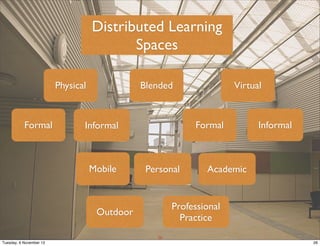
Distributed Learning
                                           Spaces

                         Physical              Blended                Virtual


           Formal               Informal                    Formal          Informal


                                    Mobile      Personal       Academic


                                                       Professional
                                     Outdoor
                                                         Practice
                                                  26
Tuesday, 6 November 12                                                                 26
Tuesday, 6 November 12   27
Seven principles of
    learning space design

     n   The SKG project has established seven principles of
          learning space design which support a collaborative
          and student-centred approach to learning:
     n   Comfort: a space which creates a physical and
          mental sense of ease and well-being
     n   Aesthetics: pleasure which includes the
          recognition of symmetry, harmony, simplicity and
          fitness for purpose
     n   Flow: the state of mind felt by the learner when
          totally involved in the learning experience


                                                                28

Tuesday, 6 November 12                                               28
Seven principles of
   learning space design

     •Equity: consideration of the needs of cultural and
         physical differences
     •Blending: a mixture of technological and face-to-face
         pedagogical resources
     •Affordances: the “action possibilities” the learning
         environment provides the users, including such things
         as kitchens, natural light, wifi, private spaces, writing
         surfaces, sofas, and so on.
     •Repurposing: the potential for multiple usage of a
         space (Souter, Riddle, Keppell, 2010) (http://
         www.skgproject.com)


                                                                     29

Tuesday, 6 November 12                                                    29
Seven principles of
    learning space design

     n   Utilised for both design and evaluation of learning
          spaces


                                                                30

Tuesday, 6 November 12                                               30
Tuesday, 6 November 12   31
Tuesday, 6 November 12   32
Further Information
         n SKG   Report: http://
             documents.skgproject.com/
             skg-final-report.pdf

         n Book  Chapter: http://
             www.slideshare.net/
             mkeppell/distributed-
             spaces-for-learning

         n Mike’s Blog: http://mike-
             keppell.blogspot.com.au/


                                         33

Tuesday, 6 November 12                        33
Teaching Fellowship
                         Scheme


                                               34

Tuesday, 6 November 12                              34
Teaching Fellowship Scheme

     n Funded           by DVC (Academic)
     n Development     of potential leaders through
         Distributive leadership
     n Facilitatecollaborative professional
         relationships
     n Proactively         redesign courses and subjects
     n Promote    and facilitate CSU Interact as a
         pivotal teaching and learning hub.


                                                            35

Tuesday, 6 November 12                                           35
Teaching Fellowship Scheme

      n 24   Fellows from across 17 different schools,
           four campuses and all four Faculties from
           2008 - 2012
      n The   Fellowship scheme provided a .5
           release from regular teaching duties
           over a 12 month period.
      n The   Teaching Fellows had access to
           mentoring, writing workshops, design
           support, project management and a
           community of practice.


                                                          36

Tuesday, 6 November 12                                         36
Example projects

    n Design   and implement a virtual microscopy
         teaching resource
    n Design            of twelve subjects in Information
         Studies
    n To   refine and implement changes to the
         pedagogy, support and learning experience
         within the newly created cross-campus B.Ed
         (EC & Primary)
    n Development      of a blending learning model
         that will stimulate increased technology
         adoption by Faculty
    n
                                                             37

Tuesday, 6 November 12                                            37
Example projects

    n   The virtual horticultural crop: An innovative blended
         learning approach in distance education
    n   Professional development for blended learning and
         teaching in the 21st century digital classroom
    n   Pattern Recognition for Learning through Simulation
         using Captivate in Policing
    n   Campus Learning: Exploring the nexus between
         space, time, teaching and learning
    n   Shifting to student-centred facilitation of learning:
         Development of blended professional development
         initiatives for police educators within a student
         problem-based learning (PBL) environment


                                                                 38

Tuesday, 6 November 12                                                38
Flexible learning

           n “Flexible learning” provides opportunities to
               improve the student learning experience
               through flexibility in time, pace, place,
               mode of study, teaching approach, forms
               of assessment and staffing. It may utilise
               a wide range of media, environments,
               learning spaces and technologies for learning
               and teaching.


                                                               39

Tuesday, 6 November 12                                              39
Blended & Flexible Learning


       n “Blended  and flexible learning” is a
           design approach that examines the
           relationships between flexible
           learning opportunities, in order to
           optimise student engagement and
           equivalence in learning outcomes
           regardless of mode of study (Garrison &
           Vaughan, 2008; Keppell, 2010).


                                                     40

Tuesday, 6 November 12                                    40
Research

           n Analysis/problem:   Need for innovation in
               blended and flexible learning
           n Development:    Teaching fellows redesigned at
               the coalface in their own discipline
           n Evaluation:   interviews: before, during and
               after the project - Transformative learning &
               Distributive leadership
           n Reflection: Refined after each year e.g.
               conducted interviews six months after
               project. Continued for five years.


                                                               41

Tuesday, 6 November 12                                              41
Reeves (2000)


                         42

Tuesday, 6 November 12        42
Transformative learning

       n An  enhanced understanding of pedagogy
           and of their own pedagogical approach.
       n An  increased capacity and willingness to
           reflect upon their own practice.
       n A  willingness to think critically about
           received ideas and conventional approaches.
       n Readiness    to innovate, to accept
           technological change and to build effective
           pedagogic connections between face-to-face
           and online teaching strategies.


                                                         43

Tuesday, 6 November 12                                        43
Transformative learning

     n Renewed    confidence with regard to leading
         and adopting change and innovation among
         their peers and within their own schools.
     n Being   empowered to negotiate perceived
         technological and institutional barriers to
         change.
     n Preparedness       to maximize the time/
         space opportunity of the Fellowship to
         actively engage in meaningful and relevant
         activities for their individual context.


                                                       44

Tuesday, 6 November 12                                      44
Learning leadership
    n A  strategy where the TFS provides the time
        and space to implement and reflect.
    n A  strategy supported by senior management
        and aligned with CSU strategic directions
        sees the strategy supported across many
        levels of the institution.
    n The   fostering of a community of practice,
        through relationships with EDs, FLI staff,
        Fellows and others that encourages
        innovative research and practice in BFL


                                                     45

Tuesday, 6 November 12                                    45
Learning leadership
    n Fellows  demonstrating a willingness to
        collaborate, support and share practice.
    n The   TFS providing opportunities for the
        development of skills and expertise that
        is recognised and accessed by peers.
    n The  TFS supporting Fellows to have the
        confidence to take risks and experiment
        with something new.
    n Fellows  demonstrating a willingness to
        engage in external activities and
        relationships, nationally and internationally.

                                                         46

Tuesday, 6 November 12                                        46
Outputs

           n Scholarly   outcomes have included:
           n 14    external conference presentations, 17
                internal conference presentations, an ARC
                discovery grant application, 26 refereed
                publications and a number of internal
                research collaborations resulting from the FLI
                Teaching Fellowship Program.


                                                                 47

Tuesday, 6 November 12                                                47
Leadership roles
    n   Dr Yann Guisard (Teaching Fellow (TF) 2010) was appointed as a
         Course Director, Faculty of Science, 2011.
    n   Dr Lucy Webster (TF 2009) was appointed to the School of Medical
         Sciences' Learning and Teaching Committee in 2009 and in 2011
         won an ALTC Citation for Outstanding Contributions to Student
         Learning, and also in 2011 was awarded the CSU Vice-Chancellor's
         Award for Teaching and Learning.
    n   Kay Plummer (TF 2010) was appointed as Pilot Leader of the
         Bachelor of Business Studies course pilot as one of five course teams
         involved in the CSUDI Pilot program, 2010. In 2011, Ms Plummer
         was appointed Sub-Dean Learning and Teaching for the Faculty
         of Business.
    n   Dr Richard Taffe (TF 2010) was appointed Course Director as part
         of a trial of this role in late 2009/early 2010 and has been appointed
         the inaugural Chair of the Director's Forum, 2011. Managing the
         Pathways Programs and in building connections with external
         education organisations and bodies.


                                                                                  48

Tuesday, 6 November 12                                                                 48
Leadership roles

           n   Dr John Rafferty (TF 2011) has been an Associate Head of School
                since the start of 2011, and is currently the co-chair of the Murray
                School of Education's Learning and Teaching Committee. Dr Rafferty
                was awarded the Vice-Chancellors Award for Excellence in
                Sustainability in 2011 and has been awarded substantial funding
                for several sustainability and environmental projects.
           n   Dr Jenni Munday (TF 2008) has been an Associate Head of School
                since the start of 2011, was acting Sub-Dean Learning and
                Teaching during semester 1, 2011 and acting Head of School for 3
                months in late 2011.
           n   Dr Jennifer Sappey (TF 2008) was awarded the Vice Chancellor
                and Faculty of Arts Awards for Teaching Excellence in 2009
                and also received an ALTC Citation for Outstanding contribution to
                student learning 2010.


                                                                                       49

Tuesday, 6 November 12                                                                      49
Keppell, M. J., O’Dwyer, C., Lyon, B., &
       Childs, M. (2010). Transforming
       distance education curricula through
       distributive leadership. ALT-J, 18:3, 165
       - 178.

      Childs, M., Brown, M., Keppell, M., Nicholas,
      Z., Hunter, C. & Hard, N. (2012). Learning
      leadership in Higher Education: the big and
      small actions of many people. DeHub,
      Australia (draft document).

                                                      50

Tuesday, 6 November 12                                     50
Horizon trends
        ‣   People expect to be able to work, learn, and
            study whenever and wherever they want.
        ‣   The abundance of resources and
            relationships made easily accessible via the
            Internet is increasingly challenging us to
            revisit our roles as educators.
        ‣   Increasingly, students want to use their own
            technology for learning.
        ‣   Teaching paradigms across all sectors are
            shifting to include online learning, hybrid
            learning and collaborative models.
                                                           51

Tuesday, 6 November 12                                          51
Horizon trends
        ‣   Massively Open Online Courses (MOOCs) are
            proliferating.
        ‣   Many institutions are looking to open — often free
            — online universities to supplement the current
            courses at brick-and-mortar institutions.
        ‣   Higher education institutions have always been
            seen as critical paths to educational
            credentialing, but challenges from competing
            sources are redefining what these paths can look
            like.


                                                                 52

Tuesday, 6 November 12                                                52
Horizon Challenges
        ‣   Personalized learning
        ‣   Digital media literacy is continuing its rise in
            importance as a key skill in every discipline and
            profession.
        ‣   Critical for educators to build and participate in
            networks where they can share pedagogical research
            and best practices.
        ‣   Appropriate metrics of evaluation lag behind the
            emergence of new scholarly forms of authoring,
            publishing, and researching.


                                                                 53

Tuesday, 6 November 12                                                53
ADFI
           ‣    Innovation and research

           ‣    Literacies for the future

           ‣    Mobility

           ‣    Digital communities

           ‣    Learning spaces

           ‣    Personal Learning Environments


                                                 54

Tuesday, 6 November 12                                54
55

Tuesday, 6 November 12        55
Questions?


                                      56

Tuesday, 6 November 12                     56

2012_Nov_RMIT

  • 1.
    Using Design-based Research to Transform Technology Use in Flexible Learning and Teaching Professor Mike Keppell Executive Director Australian Digital Futures Institute 1 Tuesday, 6 November 12 1
  • 2.
    Overview ‣ My Background ‣ Defining design-based research ‣ Characteristics of design-based research ‣ ‘Many names’ of design-based research ‣ Example projects ‣ Five-year Teaching Fellowship Scheme ‣ ADFI and design-based research 2 Tuesday, 6 November 12 2
  • 3.
    Background ‣ Instructional design ‣ Higher education ‣ Adult learning ‣ Educational technology ‣ Lifelong learning ‣ Learning and teaching ‣ Worked at five different universities in leadership roles. 3 Tuesday, 6 November 12 3
  • 4.
    Focus Design Educational Technology Innovation Solving Authentic Learning real-world Interactions issues Transformation 4 Tuesday, 6 November 12 4
  • 5.
  • 6.
  • 7.
    Defining design-based research ‣ Design-based research is a core strategy and approach that considers how our developments benefit the user, group or society and how our developments provide design principles for future practice and research. ‣ Design-based research advances design, research and practice concurrently (Wang and Hannafin, 2005). ‣ 7 Tuesday, 6 November 12 7
  • 8.
    Defining design-based research ‣ Wang and Hannafin (2005) define design- based research as: ‣ “a systematic but flexible methodology aimed to improve educational practices through iterative analysis, design, development, and implementation, based on collaboration among researchers and practitioners in real-world settings, and leading to contextually sensitive design principles and theories” (p. 7). 8 Tuesday, 6 November 12 8
  • 9.
    Characteristics ‣ Pragmatic - solving current real-world problems by designing and carrying out interventions as well as extending theories and refining principles. ‣ Grounded - design based research is grounded in both theory and the real-world context – research is conducted in real-world contexts along with the complexities, dynamics and limitations of authentic practice. ‣ Interactive - requires interactive collaboration among researchers and practitioners 9 Tuesday, 6 November 12 9
  • 10.
    Characteristics ‣ Iterative and flexible - continuously developed and refined through an iterative design process from analysis to design to evaluation and redesign ‣ Integrative - need to integrate a variety of research methods and approaches from both qualitative and quantitative research paradigms ‣ Contextual - imperative that design-based researchers keep detailed records of processes and findings so others can examine them in relation to their own context and needs 10 Tuesday, 6 November 12 10
  • 11.
    Reeves (2000) 11 Tuesday, 6 November 12 11
  • 12.
  • 13.
    Many names ‣ Design-based research ‣ Design science ‣ Development research ‣ Design experiments ‣ Formative research ‣ Educational design research (McKenney & Reeves, 2012). 13 Tuesday, 6 November 12 13
  • 14.
    Examples Project Problem Eliciting and conceptualising unfamiliar PhD Focus content from subject matter experts How to reduce anxiety in children going to Master of Nursing hospital Learning Oriented How to change the assessment culture Assessment Project reliant on high stake examinations Spaces for Knowledge How to include student input into the design Generation of next generation learning spaces How to foster innovation in blended and Teaching Fellowship Scheme flexible learning 14 Tuesday, 6 November 12 14
  • 15.
    Working with subject matter experts ‣ Analysis/Problem: bottleneck between ID & SME ‣ Developed: designed a process and taught the process to another ID ‣ Evaluated: researched in a military setting ‣ Reflection:Refined process (Keppell, 1997). 15 Tuesday, 6 November 12 15
  • 16.
    Working with subject matter experts ‣ Determine the philosophical assumptions of the SME ‣ Adapt the interview format to the SME ‣ Develop generic questions to utilise in the interview ‣ Use mapping strategies to reorganise the content ‣ Use the map as a communication prop ‣ Transform the knowledge map into a storyboard 16 Tuesday, 6 November 12 16
  • 17.
    Reeves (2000) 17 Tuesday, 6 November 12 17
  • 18.
    Reducing anxiety in children going to hospital ‣ Analysis/problem: How to reduce anxiety of children going to hospital ‣ Development: CD-ROM and booklet for parents and children ‣ Evaluation/Research: pilot of intervention with families ‣ Reflection: Refined product 18 Tuesday, 6 November 12 18
  • 19.
    Reducing anxiety in children going to hospital ‣ Marijke Shanley (2005) - Master of Nursing Thesis entitled: A multimedia approach to preparing children and their families for hospitalisation. ‣ Next step: relevance for childrens hospitals 19 Tuesday, 6 November 12 19
  • 20.
    Reeves (2000) 20 Tuesday, 6 November 12 20
  • 21.
    Changing a traditional assessment culture 21 Tuesday, 6 November 12 21
  • 22.
    Changing a traditional assessment culture ‣ Analysis/problem: How to infuse learning into assessment ‣ Development: learning-oriented assessment ‣ Evaluation/Research: pilot of intervention with several academics ‣ Reflection: Refined assessment for subsequent implementation 22 Tuesday, 6 November 12 22
  • 23.
  • 24.
    Changing a traditional assessment culture Keppell, M., Au, E., Ma, A. & Chan, C. (2006). Peer learning and learning-oriented assessment in technology-enhanced environments. Assessment and Evaluation in Higher Education, 31(4), 453-464. Keppell, M. & Carless, D. (2006). Learning- oriented assessment: A technology-based case study. Assessment in Education, 13(2), 153-165. 24 Tuesday, 6 November 12 24
  • 25.
    Spaces for Knowledge Generation 25 Tuesday, 6 November 12 25
  • 26.
    Distributed Learning Spaces Physical Blended Virtual Formal Informal Formal Informal Mobile Personal Academic Professional Outdoor Practice 26 Tuesday, 6 November 12 26
  • 27.
  • 28.
    Seven principles of learning space design n The SKG project has established seven principles of learning space design which support a collaborative and student-centred approach to learning: n Comfort: a space which creates a physical and mental sense of ease and well-being n Aesthetics: pleasure which includes the recognition of symmetry, harmony, simplicity and fitness for purpose n Flow: the state of mind felt by the learner when totally involved in the learning experience 28 Tuesday, 6 November 12 28
  • 29.
    Seven principles of learning space design •Equity: consideration of the needs of cultural and physical differences •Blending: a mixture of technological and face-to-face pedagogical resources •Affordances: the “action possibilities” the learning environment provides the users, including such things as kitchens, natural light, wifi, private spaces, writing surfaces, sofas, and so on. •Repurposing: the potential for multiple usage of a space (Souter, Riddle, Keppell, 2010) (http:// www.skgproject.com) 29 Tuesday, 6 November 12 29
  • 30.
    Seven principles of learning space design n Utilised for both design and evaluation of learning spaces 30 Tuesday, 6 November 12 30
  • 31.
  • 32.
  • 33.
    Further Information n SKG Report: http:// documents.skgproject.com/ skg-final-report.pdf n Book Chapter: http:// www.slideshare.net/ mkeppell/distributed- spaces-for-learning n Mike’s Blog: http://mike- keppell.blogspot.com.au/ 33 Tuesday, 6 November 12 33
  • 34.
    Teaching Fellowship Scheme 34 Tuesday, 6 November 12 34
  • 35.
    Teaching Fellowship Scheme n Funded by DVC (Academic) n Development of potential leaders through Distributive leadership n Facilitatecollaborative professional relationships n Proactively redesign courses and subjects n Promote and facilitate CSU Interact as a pivotal teaching and learning hub. 35 Tuesday, 6 November 12 35
  • 36.
    Teaching Fellowship Scheme n 24 Fellows from across 17 different schools, four campuses and all four Faculties from 2008 - 2012 n The Fellowship scheme provided a .5 release from regular teaching duties over a 12 month period. n The Teaching Fellows had access to mentoring, writing workshops, design support, project management and a community of practice. 36 Tuesday, 6 November 12 36
  • 37.
    Example projects n Design and implement a virtual microscopy teaching resource n Design of twelve subjects in Information Studies n To refine and implement changes to the pedagogy, support and learning experience within the newly created cross-campus B.Ed (EC & Primary) n Development of a blending learning model that will stimulate increased technology adoption by Faculty n 37 Tuesday, 6 November 12 37
  • 38.
    Example projects n The virtual horticultural crop: An innovative blended learning approach in distance education n Professional development for blended learning and teaching in the 21st century digital classroom n Pattern Recognition for Learning through Simulation using Captivate in Policing n Campus Learning: Exploring the nexus between space, time, teaching and learning n Shifting to student-centred facilitation of learning: Development of blended professional development initiatives for police educators within a student problem-based learning (PBL) environment 38 Tuesday, 6 November 12 38
  • 39.
    Flexible learning n “Flexible learning” provides opportunities to improve the student learning experience through flexibility in time, pace, place, mode of study, teaching approach, forms of assessment and staffing. It may utilise a wide range of media, environments, learning spaces and technologies for learning and teaching. 39 Tuesday, 6 November 12 39
  • 40.
    Blended & FlexibleLearning n “Blended and flexible learning” is a design approach that examines the relationships between flexible learning opportunities, in order to optimise student engagement and equivalence in learning outcomes regardless of mode of study (Garrison & Vaughan, 2008; Keppell, 2010). 40 Tuesday, 6 November 12 40
  • 41.
    Research n Analysis/problem: Need for innovation in blended and flexible learning n Development: Teaching fellows redesigned at the coalface in their own discipline n Evaluation: interviews: before, during and after the project - Transformative learning & Distributive leadership n Reflection: Refined after each year e.g. conducted interviews six months after project. Continued for five years. 41 Tuesday, 6 November 12 41
  • 42.
    Reeves (2000) 42 Tuesday, 6 November 12 42
  • 43.
    Transformative learning n An enhanced understanding of pedagogy and of their own pedagogical approach. n An increased capacity and willingness to reflect upon their own practice. n A willingness to think critically about received ideas and conventional approaches. n Readiness to innovate, to accept technological change and to build effective pedagogic connections between face-to-face and online teaching strategies. 43 Tuesday, 6 November 12 43
  • 44.
    Transformative learning n Renewed confidence with regard to leading and adopting change and innovation among their peers and within their own schools. n Being empowered to negotiate perceived technological and institutional barriers to change. n Preparedness to maximize the time/ space opportunity of the Fellowship to actively engage in meaningful and relevant activities for their individual context. 44 Tuesday, 6 November 12 44
  • 45.
    Learning leadership n A strategy where the TFS provides the time and space to implement and reflect. n A strategy supported by senior management and aligned with CSU strategic directions sees the strategy supported across many levels of the institution. n The fostering of a community of practice, through relationships with EDs, FLI staff, Fellows and others that encourages innovative research and practice in BFL 45 Tuesday, 6 November 12 45
  • 46.
    Learning leadership n Fellows demonstrating a willingness to collaborate, support and share practice. n The TFS providing opportunities for the development of skills and expertise that is recognised and accessed by peers. n The TFS supporting Fellows to have the confidence to take risks and experiment with something new. n Fellows demonstrating a willingness to engage in external activities and relationships, nationally and internationally. 46 Tuesday, 6 November 12 46
  • 47.
    Outputs n Scholarly outcomes have included: n 14 external conference presentations, 17 internal conference presentations, an ARC discovery grant application, 26 refereed publications and a number of internal research collaborations resulting from the FLI Teaching Fellowship Program. 47 Tuesday, 6 November 12 47
  • 48.
    Leadership roles n Dr Yann Guisard (Teaching Fellow (TF) 2010) was appointed as a Course Director, Faculty of Science, 2011. n Dr Lucy Webster (TF 2009) was appointed to the School of Medical Sciences' Learning and Teaching Committee in 2009 and in 2011 won an ALTC Citation for Outstanding Contributions to Student Learning, and also in 2011 was awarded the CSU Vice-Chancellor's Award for Teaching and Learning. n Kay Plummer (TF 2010) was appointed as Pilot Leader of the Bachelor of Business Studies course pilot as one of five course teams involved in the CSUDI Pilot program, 2010. In 2011, Ms Plummer was appointed Sub-Dean Learning and Teaching for the Faculty of Business. n Dr Richard Taffe (TF 2010) was appointed Course Director as part of a trial of this role in late 2009/early 2010 and has been appointed the inaugural Chair of the Director's Forum, 2011. Managing the Pathways Programs and in building connections with external education organisations and bodies. 48 Tuesday, 6 November 12 48
  • 49.
    Leadership roles n Dr John Rafferty (TF 2011) has been an Associate Head of School since the start of 2011, and is currently the co-chair of the Murray School of Education's Learning and Teaching Committee. Dr Rafferty was awarded the Vice-Chancellors Award for Excellence in Sustainability in 2011 and has been awarded substantial funding for several sustainability and environmental projects. n Dr Jenni Munday (TF 2008) has been an Associate Head of School since the start of 2011, was acting Sub-Dean Learning and Teaching during semester 1, 2011 and acting Head of School for 3 months in late 2011. n Dr Jennifer Sappey (TF 2008) was awarded the Vice Chancellor and Faculty of Arts Awards for Teaching Excellence in 2009 and also received an ALTC Citation for Outstanding contribution to student learning 2010. 49 Tuesday, 6 November 12 49
  • 50.
    Keppell, M. J.,O’Dwyer, C., Lyon, B., & Childs, M. (2010). Transforming distance education curricula through distributive leadership. ALT-J, 18:3, 165 - 178. Childs, M., Brown, M., Keppell, M., Nicholas, Z., Hunter, C. & Hard, N. (2012). Learning leadership in Higher Education: the big and small actions of many people. DeHub, Australia (draft document). 50 Tuesday, 6 November 12 50
  • 51.
    Horizon trends ‣ People expect to be able to work, learn, and study whenever and wherever they want. ‣ The abundance of resources and relationships made easily accessible via the Internet is increasingly challenging us to revisit our roles as educators. ‣ Increasingly, students want to use their own technology for learning. ‣ Teaching paradigms across all sectors are shifting to include online learning, hybrid learning and collaborative models. 51 Tuesday, 6 November 12 51
  • 52.
    Horizon trends ‣ Massively Open Online Courses (MOOCs) are proliferating. ‣ Many institutions are looking to open — often free — online universities to supplement the current courses at brick-and-mortar institutions. ‣ Higher education institutions have always been seen as critical paths to educational credentialing, but challenges from competing sources are redefining what these paths can look like. 52 Tuesday, 6 November 12 52
  • 53.
    Horizon Challenges ‣ Personalized learning ‣ Digital media literacy is continuing its rise in importance as a key skill in every discipline and profession. ‣ Critical for educators to build and participate in networks where they can share pedagogical research and best practices. ‣ Appropriate metrics of evaluation lag behind the emergence of new scholarly forms of authoring, publishing, and researching. 53 Tuesday, 6 November 12 53
  • 54.
    ADFI ‣ Innovation and research ‣ Literacies for the future ‣ Mobility ‣ Digital communities ‣ Learning spaces ‣ Personal Learning Environments 54 Tuesday, 6 November 12 54
  • 55.
  • 56.
    Questions? 56 Tuesday, 6 November 12 56