realising 21st century learning environments: an overview
The Mayfield Project is a year-long research project conducted
by architects, educators and planning professionals that is
coordinated by the Council for Educational Facility Planners
International (CEFPI).
Research completed by the NSW team explored contemporary
pedagogical approaches to 21st Century Learning and
teaching environments, and resulted in the production of a
toolkit that provides architects and educators with a common
vocabulary for spatial and educational concepts that underpin
21st Century Learning environments.
This booklet provides an overview of the main elements of
the toolkit: an interactive website that explores how to realise
21st Century Learning environments.
mayfieldnsw2014.wordpress.com
Mayfield 2014 NSW Team: Daina Cunningham, Pamela
Doherty, Kenny Giblin, Cathy Kubany, Edward La, Noam Raz,
Alison Sheil, Lyndall Smith.
Thank you to our facilitator, Felicity Lewis and mentors
Alastair Blyth, Shayne Evans and Vicki Steer.
teamwork +
collaboration
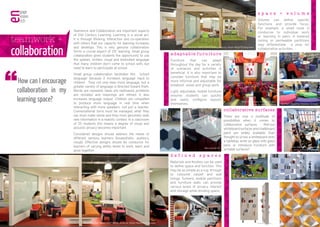
Teamwork and Collaboration are important aspects
of 21st Century Learning. Learning is a social act.
It is through thinking, interaction and co-operation
with others that our capacity for learning increases
and develops. This is why genuine  collaboration
forms a crucial aspect of 21C learning. Small group
collaboration gives students the opportunity to use
the spoken, written, visual and embodied language
that many children don’t come to school with, but
need to learn to participate at school.
Small group collaboration facilitates this  ‘school
language’ because it increases language input to
children.  They not only hear more language, but a
greater variety of language is directed toward them.
Words are repeated, ideas are rephrased, problems
are restated and meanings are refined. It also
increases language output. Children are compelled
to produce more language in real time when
interacting with more speakers- not just a teacher.
Conversational turns must be managed, what they
say must make sense and they must genuinely seek
new information in a realistic context. In a classroom
of 25 students this means a degree of visual and
acoustic privacy becomes important
Considered designs should address the needs of
different sensory learners (kinaesthetic, auditory,
visual). Effective designs should be conducive for
learners of varying ability levels to work, learn and
grow together.
d e f i n e d s p a c e s
Materials and finishes can be used
to define space and function. This
may be as simple as a rug, through
to coloured carpet and wall
linings. Screens, mobile partitions
and furniture walls can provide
various levels of privacy, interest
and storage while dividing space.
collaborative surfaces
There are now a multitude of
possibilities when it comes to
collaborative surfaces. Roll-out
whiteboardsurfacesandchalkboard
paint are widely available. Ever
thought to screw a whiteboard onto
a tabletop, write on glass with glass
pens or introduce furniture with
writable surfaces?
a d apt a ble f u r n it u r e
Furniture that can adapt
throughout the day for a variety
of scenarios and activities is
beneficial. It is also important to
consider furniture that may be
more informal and adjustable for
breakout areas and group work.
Light, adjustable, mobile furniture
ensures students can quickly
and easily configure layouts
themselves.
s p a c e + v o l u m e
Volume can define specific
functions and provide focus.
For example, a small nook is
conducive to individual work
or learning in pairs. A lowered
ceiling or permeable partitions
may differentiate a zone for
collaborative activities.
How can I encourage
collaboration in my
learning space?
Muse Bassline, NBRS+PARTNERS, photo by Simon Wood Photography
West Hill Primary School, London,
photo by Hufton + Crow
Merrylands PS
Merrylands PS
St Luke’s Cathoic Primary School
Northern Beaches Christian School
Weiz Centre for Innovation,
photo by Sara Rubinstein
Muse Bassline, NBRS+PARTNERS, photo by Simon Wood Photography
Capital One Innovation Lab, Virginia,
OTJ Architects
Project based learning (also known as PBL) differs
from the industrial model of education. Where the
industrial model distributes generic and abstract
modes of learning to masses of students, PBL
seeks to facilitate individualised, real-world
learning through the application of classroom skills
to real life, or simulated problems.
Project based learning yields a range of academic
benefits and helps to facilitate a number of 21C
competencies. Well-designed projects have
been shown to generate deeper understanding
in students while helping them to retain the
embedded academic concepts for longer periods
of time. Critical thinking is engaged; problem
solving skills are promoted; and most importantly,
motivation becomes intrinsic to the student.
Interdisciplinary in nature, PBL inherently requires
changes in both curriculum and learning space. To
cater for PBL, learning spaces need to attend to
both the individual learner and the scope of an
entire project; enable collaboration, collation and
reflection; and provide for the presentation and
assessment of learning.
l e a r n i n g
project-based
What will encourage
my students to apply
knowledge and skills to
real life problems?
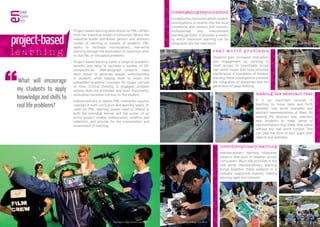
investigating beyond school
Escaping the classroom allows student
investigations to extend into the local
community and connect with industry
professionals and international
learning partners. It provides a means
by which classroom learning can be
integrated into the real-world.
making the abstract real
It is an important concept in
teaching to move back and forth
between real world examples and
abstract representations of them. By
making the abstract real, teachers
help students to make sense of
representations that make little sense
without any real world context. This
can take the form of text, plays, built
objects and websites.
interdisciplinary learning
Interdisciplinary learning integrates
subjects that exist in isolation across
curriculums. Much like activities in the
real world, interdisciplinary learning
brings together these subjects in a
mutually supportive manner, making
learning agile and relevant.
r e a l - w o r l d p r o b l e m s
Students gain increased motivation
and engagement by working in
small groups to investigate broad
real world issues that have personal
significance. A foundation of modern
learning, these investigations promote
the integration of disciplines and the
generation of deep thinking.
ULAB, UTS SydneyGungahlin College, CanberraThornbury High School, Victoria Gary Comer Youth Centre, Chicago
Brisbane Waters College
Merrylands East Public School
Learning by presentation allows students to
utilise the multimedia world in which they live. By
allowing for an increased scope of presentation of
knowledge and achievements, students are able to
choose a medium through which they are best able
to show off their learning achievement. Learning
by presentation can also be utilised where students
are challenged to present a piece of a broader
educational concept.
Research shows that presenting an explanation to
others can help deep learning by translating explicit
knowledge into implicit know-how, integrating prior
knowledge and engaging both the presenter and
audience. Learning presentation skills also helps
develop learners’ confidence, communication skills
and empathy.
Learning space design becomes important in
considering how best to support learners in this
aspect, whether it is through the use of technology,
creative arts, speech or traditional written form.
learning by
presentation
I want my students
to be able to choose
a medium through
which they are best
able to show off their
learningachievement.
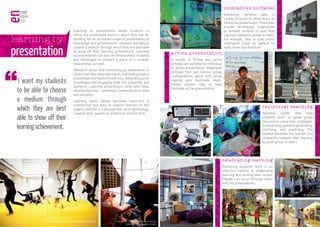
a c t ive pr e s ent at ion
A variety of formal and casual
settings are suitable for individual
or group presentation. Adaptable
settings that aid various group
configurations, assist with sense
making and illuminate multi-
media content help to best
facilitate active presentation.
celebrati ng lea rn i ng
Displaying students work is an
effective method of celebrating
learning and inviting peer review.
Display can occur through static
and live presentations.
r ecipr oca l t ea ch i n g
Teachers model, then help
students learn to guide group
discussions using four strategies:
summarising,questiongenerating,
clarifying, and predicting. The
student becomes the teacher and
coherently explains their learning
to small group of peers.
i nteractive su rfaces
Interactive surfaces take a
variety of forms to allow direct or
interactivepresentation. These may
include technology, magnetised
or writable surfaces or ones that
can have elements pinned to them.
For example, clear or solid colour
smartpaint could be applied to
walls, floors and furniture.
NBCS, Sydney Taka-Tuka Land Kindergarten, Berlin
NBCS, Sydney
RELEARN 2013, photo by Peter Dodrell
Marrickville West PSSteelcase ......
Designer Pinboards Australia
Gungahlin College, Canberra, photo by
Eddison Photographic Studio Wanalirri Catholic School, Derby, WA
Vittra School, Stockholm, RosanBosch Architects
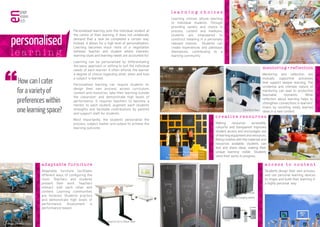
personalised
l e a r n i n g
8
Personalised learning puts the individual student at
the centre of their learning. It does not unilaterally
demand that a task be completed a certain way.
Instead, it allows for a high level of personalisation.
Learning becomes much more of a negotiation
between teacher and student where interests,
learning styes and learning needs are accounted for.
Learning can be personalised by differentiating
the pace, approach or setting to suit the individual
needs of each learner. It often affords the learner
a degree of choice regarding what, when and how
a subject is learned.
Personalised learning can require students to:
design their own process; access curriculum,
content and resources; take their learning outside
the classroom; and demonstrate high levels of
performance. It requires teachers to become a
mentor to each student, augment each students
strengths and facilitate contributions by parents
and support staff for students.
Most importantly, the students personalise the
process, subject matter and output to achieve the
learning outcome.
l e a r n i n g c h o i c e s
Learning choices attune learning
to individual students. Through
providing variety and choice in
process, content and mediums,
students are empowered to
construct meaning in a personally
relevant manner. Students can
create experiences and pathways
themselves, contributing to a
learning community.
photo of
g l a s g o w
library?
a c c e s s t o c o n t e n t
Students design their own process,
and use personal learning devices
to shape and build their learning in
a highly personal way.
c r e a t i v e r e s o u r c e s
Making resources accessible,
colourful and transparent improves
student access and encourages use
of learning equipment and resources.
Being creative with the materials and
resources available, students can
test and share ideas, making their
unique learning visible. Students
store their works in progress.
a d apt able f u r n it u r e
Adaptable furniture facilitates
different ways of configuring the
room. Teachers and students
present their work. Teachers
interact with each other and
content. Learning communities
are fostered. Students practice
and demonstrate high levels of
performance. Assessment is
performance-based.
HowcanIcater
foravarietyof
preferenceswithin
onelearningspace?
Haworth furniture at The Hub, Adelaide
Vitra Work Bays
Saltire Centre, Glasgow
ULAB, UTS, Sydney
Anansi Playground Building,
Netherlands, Mulders vanden Berk
Architects. Photo by Wim Hanenberg
WeCharge,
Laptop charging station
Haworth Sit to Stand Table
Steelcase Node Chairs
mentoring + ref lection
Mentoring and reflection are
mutually supportive processes
that support deeper learning. The
incidental and intimate nature of
mentoring can lead to productive
teachable moments. While
reflection about learning helps to
strengthen connections in learners’
brains by revisiting newly learned
ideas in a new context.
vocabulary
a common
This toolkit attempts to make the design of 21st
century learning environments more accessible
Through the Mayfield Project 2014, we have seen
how crucial it is to share a common vocabulary.
There is a plethora of ‘buzz words’ surrounding
21st Century Learning, which can be a hindrance to
many, architects and educators alike. The following
glossary breaks down terminology surrounding
both spatial and educational concepts.
“Caves, Campfires and Watering Holes” – Examples of archetypal learning spaces
suited to different forms of interaction and popularised by school planners and designers
including Prakash Nair and Randall Fielding, and the futurist David Thornburg. The concepts
have been used to inform the design of both physical and virtual environments.
Collaboration Spaces – Environments suited to social, interactive activities, typically
conducted in pairs or small groups. Students engaged in collaborative learning benefit from
each other’s differing resources, abilities and prior knowledge. Spaces need to be versatile to
suit asymmetrical roles and learning styles.
Differentiated Environments – Spaces arranged to suit the differing needs of individual
learners. Environments may be differentiated to accommodate personalised curriculum
content, to suit individual learning styles, to accommodate hands-on support, or variations in
the length of time learners need to complete a task.
Flexible, Versatile, Agile and Adaptable Learning Spaces – Spaces that can
support a range of pedagogical approaches or learning styles. This can be achieved
through the intrinsic versatility of a space, or elements that can be adapted to allow
spaces to be used in different ways at different times. These types of spaces allow for
change immediately and over time as external influences evolve.
Indoor – Outdoor Connections – Glazing and opening doors to allow students to move
between indoor and outdoor settings to access fresh air, daylight, space to burn off pent up
energy, and choose settings where they will learn best.
Learning Clusters – Clustering spaces to define small learning communities or curriculum
areas, often around social / collaborative hubs. Transparency and connectivity between areas
within the cluster can help reinforce social learning opportunities and
support student choice regarding where and how to learn.
Learning Commons – Informal learning areas suited to independent
or group study, project work and differentiated instruction, often thought
of as the evolution of library environments. Learning Commons are
frequently resource and IT-rich, with versatile, adaptable furnishings to
support online education, collaboration, content creation and display,
meetings, and independent study.
Learning Studios – Versatile learning areas suited to a range of
different and potentially concurrent activities. Learning studios are often
associated with L-shaped or irregular layouts defining distinct activity
zones and breakout spaces, and equipment for practical activities.
Outdoor Classroom – Outdoor learning setting presenting
opportunities for critical reflection, sensory stimulation and experiential
education where the natural world is both the setting and subject of study.
Sociopetal Space – Use of environments to promote social interaction,
for example seating or table arrangements that allow students to face
each other and discuss a topic.
Sociofugal Space – Use of environments to discourage social
interaction, for example the arrangement of furniture to face a single
speaker, or to support private study without distraction or interruption
by others.
Technology Enabled Active Learning Space (TEAL) – An IT-
rich large group environment merging lectures, simulations, and hands-
on experiments to create a rich collaborative learning experience.
Students work in small groups with laptops networked for the display of
visualisations and simulations on overhead screens.
“The Third Teacher” – Concept derived from Reggio Emilia where
the instructive power of the environment is used as a “third teacher” to
communicate the values of the “hidden curriculum”, or present aspects of
the formal curriculum though display.
Traditional Classroom – Early twentieth century setting for teacher-
led instruction, generally comprising an enclosed rectangular space sized
for a fixed number of students. Traditional classrooms are best suited to
activities where all students learn the same content at the same time,
from the same person, following a pre-defined timetable.
Transparency – Creation of visual connections between formal and
informal learning areas, allowing students to gain a passive awareness of
the learning taking place around them, help them direct their learning, and
navigate the curriculum.
spatial concepts
Age-appropriate Learning – Learning activities based on an
understanding of a student’s stage of cognitive, physical and
socio-emotional development.
Authentic Learning – Exploring real world problems and issues
through activities which are meaningful in relation to a student’s
everyday experience.
Blended Learning – Education integrating on-line with face-to-
face activities so that technology not only supplements but also
transforms students’ learning.
Collaborative Learning – Approaches involving shared
intellectual effort by two or more learners engaged in a common
task, so that all students can maximise their learning through
interaction, shared understanding and creation,.
Constructivist Pedagogies – Teaching practices that
acknowledge how students construct knowledge and meaning
through their experience, and how the role of the educator is
to develop students’ learning skills through experimentation
and collaboration. Pioneers of constructivist pedagogies include
Piaget, Dewey, Vygotsky, and Freire amongst others.
Deep vs. Surface Learning – Deep-holistic immersive learning
through an understanding of issues in the round, as opposed to
the superficial reproduction of information.
Engaged Schools – Schools developing a diverse range of
programs to make schools more engaging places to learn through
activities such as inter-disciplinary project-based learning,
learning outside the four walls of the classrooms, acknowledging
students’ extended learning relationships, and encouraging
parents and local employers as active partners in education.
Experiential Learning– Learning acquired through reflection
on direct experience. David Kolb’s Experiential Learning Model
emphasises a four stage cycle of learning: Concrete Experience,
Reflective Observation, Abstract Conceptualization and Active
Experimentation.
Interdisciplinary Learning – Much like activities in the real
world, interdisciplinary learning brings together subjects from
across the curriculum in a mutually supportive manner and easily
lends itself to project based learning.
Inquiry-Based Learning – Approach grounded in the writings
of John Dewey where knowledge is built up from experience and
process. Students engage in self-directed activities to identify
what they need to learn and find resources to increase their
understanding. Common approaches include fieldwork, case studies, and individual or
group research, often using on-line resources.
Learning Modalities – How students use their senses in learning. Educators commonly
refer to four modalities: visual, auditory, kinesthetic and tactile.
Learning Styles – Recognition that individual students differ in how they learn and
their preferences for different modes of learning, for example David Kolb’s “Experiential
Learning Model” and Howard Gardner’s “Multiple Intelligences”.
Lifelong Learning – Acknowledgement that learning does not just occur prior to
entering the workforce but should sustain an individual throughout their life and career.
The approach is associated both with promotion of vocational learning amongst older
students, and the need to reinforce long-term versatile learning skills and a love of
learning, rather than a specific curriculum.
Multiple Intelligences – Theory developed by Howard Gardner which acknowledges
how students learn following differing cognitive abilities: musical–rhythmic and
harmonic, visual–spatial, verbal–linguistic, logical–mathematical, bodily–kinaesthetic,
interpersonal, intrapersonal, naturalistic, and existential.
Pedagogy – The method and practice of teaching.
Personalised Learning – Differentiating the pace, approach or setting to suit the
individual needs of each learner, often affording a degree of choice regarding what,
when and how a subject is learned.
Practice-Based Learning – Learning through practical activities modelled on
professional, work-place or other real world scenarios and fieldwork.
Problem-Based Learning – Learning about a subject through problem solving,
generally in groups. Students identify what they already know, what they need to know,
and how and where to access new information to resolve the problem. The role of the
instructor is as a facilitator, supporting, guiding, and monitoring the learning process.
Project-Based Learning – Active and engaged learning where students explore real-
world problems and challenges to obtain a deeper knowledge of the subjects studied.
Reflective Practice – Systematic self-improvement through educators studying their
own teaching methods to determine which practices work best for students.
School within School / Small Learning Community– Creation of small learning
communities within a larger school, each with separate educational programs, to achieve
a greater sense of intimacy, improve communication, social commitment, and better
meet the need of specific student cohorts.
Stage not Age – Progression based on each student’s personal stage of development
and attainment, rather than age-based cohorts.
Team Teaching – Group of teachers, often representing different areas of educational
approach or subject knowledge, working together to plan, conduct, and evaluate learning
activities for the same group of students.
Educational Concepts
lifelong
The interactive toolkit in greater detail:
mayfieldnsw2014.wordpress.com
what will you do to
For further information regarding CEFPI:
cefpi.org.au
A motivating School Principal
http://www.sbs.com.au/ondemand/video/289487427985/Principal-embracing-technology-and-motivating-students
The Science of Learning
http://prezi.com/kbmbhdzygvg8/cefpi/
The NSW Mayfield Project Toolkit (produced by NSW team incl. Cathy & Lyndall)
http://mayfieldnsw2014.wordpress.com/
Some CEFPI award-winning schools
http://cefpi.org.au/awards/2014-awards/2014-award-winners-and-commendations/
some good links

CK_MAYFIELDBOOKLET

  • 1.
    realising 21st centurylearning environments: an overview
  • 2.
    The Mayfield Projectis a year-long research project conducted by architects, educators and planning professionals that is coordinated by the Council for Educational Facility Planners International (CEFPI). Research completed by the NSW team explored contemporary pedagogical approaches to 21st Century Learning and teaching environments, and resulted in the production of a toolkit that provides architects and educators with a common vocabulary for spatial and educational concepts that underpin 21st Century Learning environments. This booklet provides an overview of the main elements of the toolkit: an interactive website that explores how to realise 21st Century Learning environments. mayfieldnsw2014.wordpress.com Mayfield 2014 NSW Team: Daina Cunningham, Pamela Doherty, Kenny Giblin, Cathy Kubany, Edward La, Noam Raz, Alison Sheil, Lyndall Smith. Thank you to our facilitator, Felicity Lewis and mentors Alastair Blyth, Shayne Evans and Vicki Steer.
  • 3.
    teamwork + collaboration Teamwork andCollaboration are important aspects of 21st Century Learning. Learning is a social act. It is through thinking, interaction and co-operation with others that our capacity for learning increases and develops. This is why genuine  collaboration forms a crucial aspect of 21C learning. Small group collaboration gives students the opportunity to use the spoken, written, visual and embodied language that many children don’t come to school with, but need to learn to participate at school. Small group collaboration facilitates this  ‘school language’ because it increases language input to children.  They not only hear more language, but a greater variety of language is directed toward them. Words are repeated, ideas are rephrased, problems are restated and meanings are refined. It also increases language output. Children are compelled to produce more language in real time when interacting with more speakers- not just a teacher. Conversational turns must be managed, what they say must make sense and they must genuinely seek new information in a realistic context. In a classroom of 25 students this means a degree of visual and acoustic privacy becomes important Considered designs should address the needs of different sensory learners (kinaesthetic, auditory, visual). Effective designs should be conducive for learners of varying ability levels to work, learn and grow together. d e f i n e d s p a c e s Materials and finishes can be used to define space and function. This may be as simple as a rug, through to coloured carpet and wall linings. Screens, mobile partitions and furniture walls can provide various levels of privacy, interest and storage while dividing space. collaborative surfaces There are now a multitude of possibilities when it comes to collaborative surfaces. Roll-out whiteboardsurfacesandchalkboard paint are widely available. Ever thought to screw a whiteboard onto a tabletop, write on glass with glass pens or introduce furniture with writable surfaces? a d apt a ble f u r n it u r e Furniture that can adapt throughout the day for a variety of scenarios and activities is beneficial. It is also important to consider furniture that may be more informal and adjustable for breakout areas and group work. Light, adjustable, mobile furniture ensures students can quickly and easily configure layouts themselves. s p a c e + v o l u m e Volume can define specific functions and provide focus. For example, a small nook is conducive to individual work or learning in pairs. A lowered ceiling or permeable partitions may differentiate a zone for collaborative activities. How can I encourage collaboration in my learning space? Muse Bassline, NBRS+PARTNERS, photo by Simon Wood Photography West Hill Primary School, London, photo by Hufton + Crow Merrylands PS Merrylands PS St Luke’s Cathoic Primary School Northern Beaches Christian School Weiz Centre for Innovation, photo by Sara Rubinstein Muse Bassline, NBRS+PARTNERS, photo by Simon Wood Photography Capital One Innovation Lab, Virginia, OTJ Architects
  • 4.
    Project based learning(also known as PBL) differs from the industrial model of education. Where the industrial model distributes generic and abstract modes of learning to masses of students, PBL seeks to facilitate individualised, real-world learning through the application of classroom skills to real life, or simulated problems. Project based learning yields a range of academic benefits and helps to facilitate a number of 21C competencies. Well-designed projects have been shown to generate deeper understanding in students while helping them to retain the embedded academic concepts for longer periods of time. Critical thinking is engaged; problem solving skills are promoted; and most importantly, motivation becomes intrinsic to the student. Interdisciplinary in nature, PBL inherently requires changes in both curriculum and learning space. To cater for PBL, learning spaces need to attend to both the individual learner and the scope of an entire project; enable collaboration, collation and reflection; and provide for the presentation and assessment of learning. l e a r n i n g project-based What will encourage my students to apply knowledge and skills to real life problems? investigating beyond school Escaping the classroom allows student investigations to extend into the local community and connect with industry professionals and international learning partners. It provides a means by which classroom learning can be integrated into the real-world. making the abstract real It is an important concept in teaching to move back and forth between real world examples and abstract representations of them. By making the abstract real, teachers help students to make sense of representations that make little sense without any real world context. This can take the form of text, plays, built objects and websites. interdisciplinary learning Interdisciplinary learning integrates subjects that exist in isolation across curriculums. Much like activities in the real world, interdisciplinary learning brings together these subjects in a mutually supportive manner, making learning agile and relevant. r e a l - w o r l d p r o b l e m s Students gain increased motivation and engagement by working in small groups to investigate broad real world issues that have personal significance. A foundation of modern learning, these investigations promote the integration of disciplines and the generation of deep thinking. ULAB, UTS SydneyGungahlin College, CanberraThornbury High School, Victoria Gary Comer Youth Centre, Chicago Brisbane Waters College Merrylands East Public School
  • 5.
    Learning by presentationallows students to utilise the multimedia world in which they live. By allowing for an increased scope of presentation of knowledge and achievements, students are able to choose a medium through which they are best able to show off their learning achievement. Learning by presentation can also be utilised where students are challenged to present a piece of a broader educational concept. Research shows that presenting an explanation to others can help deep learning by translating explicit knowledge into implicit know-how, integrating prior knowledge and engaging both the presenter and audience. Learning presentation skills also helps develop learners’ confidence, communication skills and empathy. Learning space design becomes important in considering how best to support learners in this aspect, whether it is through the use of technology, creative arts, speech or traditional written form. learning by presentation I want my students to be able to choose a medium through which they are best able to show off their learningachievement. a c t ive pr e s ent at ion A variety of formal and casual settings are suitable for individual or group presentation. Adaptable settings that aid various group configurations, assist with sense making and illuminate multi- media content help to best facilitate active presentation. celebrati ng lea rn i ng Displaying students work is an effective method of celebrating learning and inviting peer review. Display can occur through static and live presentations. r ecipr oca l t ea ch i n g Teachers model, then help students learn to guide group discussions using four strategies: summarising,questiongenerating, clarifying, and predicting. The student becomes the teacher and coherently explains their learning to small group of peers. i nteractive su rfaces Interactive surfaces take a variety of forms to allow direct or interactivepresentation. These may include technology, magnetised or writable surfaces or ones that can have elements pinned to them. For example, clear or solid colour smartpaint could be applied to walls, floors and furniture. NBCS, Sydney Taka-Tuka Land Kindergarten, Berlin NBCS, Sydney RELEARN 2013, photo by Peter Dodrell Marrickville West PSSteelcase ...... Designer Pinboards Australia Gungahlin College, Canberra, photo by Eddison Photographic Studio Wanalirri Catholic School, Derby, WA Vittra School, Stockholm, RosanBosch Architects
  • 6.
    personalised l e ar n i n g 8 Personalised learning puts the individual student at the centre of their learning. It does not unilaterally demand that a task be completed a certain way. Instead, it allows for a high level of personalisation. Learning becomes much more of a negotiation between teacher and student where interests, learning styes and learning needs are accounted for. Learning can be personalised by differentiating the pace, approach or setting to suit the individual needs of each learner. It often affords the learner a degree of choice regarding what, when and how a subject is learned. Personalised learning can require students to: design their own process; access curriculum, content and resources; take their learning outside the classroom; and demonstrate high levels of performance. It requires teachers to become a mentor to each student, augment each students strengths and facilitate contributions by parents and support staff for students. Most importantly, the students personalise the process, subject matter and output to achieve the learning outcome. l e a r n i n g c h o i c e s Learning choices attune learning to individual students. Through providing variety and choice in process, content and mediums, students are empowered to construct meaning in a personally relevant manner. Students can create experiences and pathways themselves, contributing to a learning community. photo of g l a s g o w library? a c c e s s t o c o n t e n t Students design their own process, and use personal learning devices to shape and build their learning in a highly personal way. c r e a t i v e r e s o u r c e s Making resources accessible, colourful and transparent improves student access and encourages use of learning equipment and resources. Being creative with the materials and resources available, students can test and share ideas, making their unique learning visible. Students store their works in progress. a d apt able f u r n it u r e Adaptable furniture facilitates different ways of configuring the room. Teachers and students present their work. Teachers interact with each other and content. Learning communities are fostered. Students practice and demonstrate high levels of performance. Assessment is performance-based. HowcanIcater foravarietyof preferenceswithin onelearningspace? Haworth furniture at The Hub, Adelaide Vitra Work Bays Saltire Centre, Glasgow ULAB, UTS, Sydney Anansi Playground Building, Netherlands, Mulders vanden Berk Architects. Photo by Wim Hanenberg WeCharge, Laptop charging station Haworth Sit to Stand Table Steelcase Node Chairs mentoring + ref lection Mentoring and reflection are mutually supportive processes that support deeper learning. The incidental and intimate nature of mentoring can lead to productive teachable moments. While reflection about learning helps to strengthen connections in learners’ brains by revisiting newly learned ideas in a new context.
  • 7.
    vocabulary a common This toolkitattempts to make the design of 21st century learning environments more accessible Through the Mayfield Project 2014, we have seen how crucial it is to share a common vocabulary. There is a plethora of ‘buzz words’ surrounding 21st Century Learning, which can be a hindrance to many, architects and educators alike. The following glossary breaks down terminology surrounding both spatial and educational concepts. “Caves, Campfires and Watering Holes” – Examples of archetypal learning spaces suited to different forms of interaction and popularised by school planners and designers including Prakash Nair and Randall Fielding, and the futurist David Thornburg. The concepts have been used to inform the design of both physical and virtual environments. Collaboration Spaces – Environments suited to social, interactive activities, typically conducted in pairs or small groups. Students engaged in collaborative learning benefit from each other’s differing resources, abilities and prior knowledge. Spaces need to be versatile to suit asymmetrical roles and learning styles. Differentiated Environments – Spaces arranged to suit the differing needs of individual learners. Environments may be differentiated to accommodate personalised curriculum content, to suit individual learning styles, to accommodate hands-on support, or variations in the length of time learners need to complete a task. Flexible, Versatile, Agile and Adaptable Learning Spaces – Spaces that can support a range of pedagogical approaches or learning styles. This can be achieved through the intrinsic versatility of a space, or elements that can be adapted to allow spaces to be used in different ways at different times. These types of spaces allow for change immediately and over time as external influences evolve. Indoor – Outdoor Connections – Glazing and opening doors to allow students to move between indoor and outdoor settings to access fresh air, daylight, space to burn off pent up energy, and choose settings where they will learn best. Learning Clusters – Clustering spaces to define small learning communities or curriculum areas, often around social / collaborative hubs. Transparency and connectivity between areas within the cluster can help reinforce social learning opportunities and support student choice regarding where and how to learn. Learning Commons – Informal learning areas suited to independent or group study, project work and differentiated instruction, often thought of as the evolution of library environments. Learning Commons are frequently resource and IT-rich, with versatile, adaptable furnishings to support online education, collaboration, content creation and display, meetings, and independent study. Learning Studios – Versatile learning areas suited to a range of different and potentially concurrent activities. Learning studios are often associated with L-shaped or irregular layouts defining distinct activity zones and breakout spaces, and equipment for practical activities. Outdoor Classroom – Outdoor learning setting presenting opportunities for critical reflection, sensory stimulation and experiential education where the natural world is both the setting and subject of study. Sociopetal Space – Use of environments to promote social interaction, for example seating or table arrangements that allow students to face each other and discuss a topic. Sociofugal Space – Use of environments to discourage social interaction, for example the arrangement of furniture to face a single speaker, or to support private study without distraction or interruption by others. Technology Enabled Active Learning Space (TEAL) – An IT- rich large group environment merging lectures, simulations, and hands- on experiments to create a rich collaborative learning experience. Students work in small groups with laptops networked for the display of visualisations and simulations on overhead screens. “The Third Teacher” – Concept derived from Reggio Emilia where the instructive power of the environment is used as a “third teacher” to communicate the values of the “hidden curriculum”, or present aspects of the formal curriculum though display. Traditional Classroom – Early twentieth century setting for teacher- led instruction, generally comprising an enclosed rectangular space sized for a fixed number of students. Traditional classrooms are best suited to activities where all students learn the same content at the same time, from the same person, following a pre-defined timetable. Transparency – Creation of visual connections between formal and informal learning areas, allowing students to gain a passive awareness of the learning taking place around them, help them direct their learning, and navigate the curriculum. spatial concepts
  • 8.
    Age-appropriate Learning –Learning activities based on an understanding of a student’s stage of cognitive, physical and socio-emotional development. Authentic Learning – Exploring real world problems and issues through activities which are meaningful in relation to a student’s everyday experience. Blended Learning – Education integrating on-line with face-to- face activities so that technology not only supplements but also transforms students’ learning. Collaborative Learning – Approaches involving shared intellectual effort by two or more learners engaged in a common task, so that all students can maximise their learning through interaction, shared understanding and creation,. Constructivist Pedagogies – Teaching practices that acknowledge how students construct knowledge and meaning through their experience, and how the role of the educator is to develop students’ learning skills through experimentation and collaboration. Pioneers of constructivist pedagogies include Piaget, Dewey, Vygotsky, and Freire amongst others. Deep vs. Surface Learning – Deep-holistic immersive learning through an understanding of issues in the round, as opposed to the superficial reproduction of information. Engaged Schools – Schools developing a diverse range of programs to make schools more engaging places to learn through activities such as inter-disciplinary project-based learning, learning outside the four walls of the classrooms, acknowledging students’ extended learning relationships, and encouraging parents and local employers as active partners in education. Experiential Learning– Learning acquired through reflection on direct experience. David Kolb’s Experiential Learning Model emphasises a four stage cycle of learning: Concrete Experience, Reflective Observation, Abstract Conceptualization and Active Experimentation. Interdisciplinary Learning – Much like activities in the real world, interdisciplinary learning brings together subjects from across the curriculum in a mutually supportive manner and easily lends itself to project based learning. Inquiry-Based Learning – Approach grounded in the writings of John Dewey where knowledge is built up from experience and process. Students engage in self-directed activities to identify what they need to learn and find resources to increase their understanding. Common approaches include fieldwork, case studies, and individual or group research, often using on-line resources. Learning Modalities – How students use their senses in learning. Educators commonly refer to four modalities: visual, auditory, kinesthetic and tactile. Learning Styles – Recognition that individual students differ in how they learn and their preferences for different modes of learning, for example David Kolb’s “Experiential Learning Model” and Howard Gardner’s “Multiple Intelligences”. Lifelong Learning – Acknowledgement that learning does not just occur prior to entering the workforce but should sustain an individual throughout their life and career. The approach is associated both with promotion of vocational learning amongst older students, and the need to reinforce long-term versatile learning skills and a love of learning, rather than a specific curriculum. Multiple Intelligences – Theory developed by Howard Gardner which acknowledges how students learn following differing cognitive abilities: musical–rhythmic and harmonic, visual–spatial, verbal–linguistic, logical–mathematical, bodily–kinaesthetic, interpersonal, intrapersonal, naturalistic, and existential. Pedagogy – The method and practice of teaching. Personalised Learning – Differentiating the pace, approach or setting to suit the individual needs of each learner, often affording a degree of choice regarding what, when and how a subject is learned. Practice-Based Learning – Learning through practical activities modelled on professional, work-place or other real world scenarios and fieldwork. Problem-Based Learning – Learning about a subject through problem solving, generally in groups. Students identify what they already know, what they need to know, and how and where to access new information to resolve the problem. The role of the instructor is as a facilitator, supporting, guiding, and monitoring the learning process. Project-Based Learning – Active and engaged learning where students explore real- world problems and challenges to obtain a deeper knowledge of the subjects studied. Reflective Practice – Systematic self-improvement through educators studying their own teaching methods to determine which practices work best for students. School within School / Small Learning Community– Creation of small learning communities within a larger school, each with separate educational programs, to achieve a greater sense of intimacy, improve communication, social commitment, and better meet the need of specific student cohorts. Stage not Age – Progression based on each student’s personal stage of development and attainment, rather than age-based cohorts. Team Teaching – Group of teachers, often representing different areas of educational approach or subject knowledge, working together to plan, conduct, and evaluate learning activities for the same group of students. Educational Concepts lifelong
  • 9.
    The interactive toolkitin greater detail: mayfieldnsw2014.wordpress.com what will you do to For further information regarding CEFPI: cefpi.org.au
  • 10.
    A motivating SchoolPrincipal http://www.sbs.com.au/ondemand/video/289487427985/Principal-embracing-technology-and-motivating-students The Science of Learning http://prezi.com/kbmbhdzygvg8/cefpi/ The NSW Mayfield Project Toolkit (produced by NSW team incl. Cathy & Lyndall) http://mayfieldnsw2014.wordpress.com/ Some CEFPI award-winning schools http://cefpi.org.au/awards/2014-awards/2014-award-winners-and-commendations/ some good links