HSA AND THE MODERN GPU
Lee Howes
AMD Heterogeneous System Software
2 | IEEE Workshop: Data Parallelism for Multi-Core Chips and GPU | 27 October 2012 | Public
HSA AND THE MODERN GPU
 In this brief talk we will cover three topics:
– Changes to the shader core and memory system
– Changes to the use of pointers
– Architected definitions to use these new features
 We’ll look both at how the hardware is becoming more flexible, and how the changes will benefit OpenCL
implementations.
3 | IEEE Workshop: Data Parallelism for Multi-Core Chips and GPU | 27 October 2012 | Public
THE HD7970
AND
GRAPHICS CORE NEXT
4 | IEEE Workshop: Data Parallelism for Multi-Core Chips and GPU | 27 October 2012 | Public
GPU EXECUTION AS WAS
 We often view GPU programming as a set of independent threads, more reasonably known as “work
items” in OpenCL:
kernel void blah(global float *input, global float *output) {
output[get_global_id(0)] = input[get_global_id(0)];
}
 Which we flatten to an intermediate language known as AMD IL:
 Note that AMD IL contains short vector instructions
mov r255, r1021.xyz0
mov r255, r255.x000
mov r256, l9.xxxx
ishl r255.x___, r255.xxxx, r256.xxxx
iadd r253.x___, r2.xxxx, r255.xxxx
mov r255, r1022.xyz0
mov r255, r255.x000
ishl r255.x___, r255.xxxx, r256.xxxx
iadd r254.x___, r1.xxxx, r255.xxxx
mov r1010.x___, r254.xxxx
uav_raw_load_id(11)_cached r1011.x___, r1010.xxxx
mov r254.x___, r1011.xxxx
mov r1011.x___, r254.xxxx
mov r1010.x___, r253.xxxx
uav_raw_store_id(11) mem.x___, r1010.xxxx, r1011.xxxx
ret
5 | IEEE Workshop: Data Parallelism for Multi-Core Chips and GPU | 27 October 2012 | Public
MAPPING TO THE HARDWARE
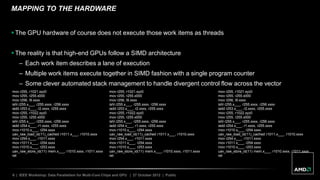
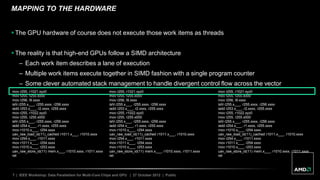
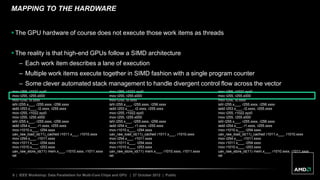
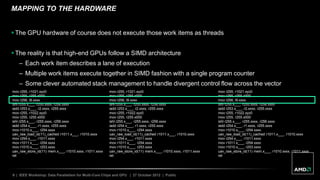
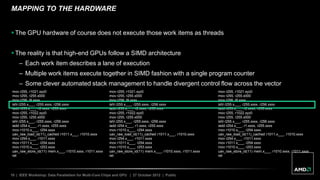
 The GPU hardware of course does not execute those work items as threads
 The reality is that high-end GPUs follow a SIMD architecture
– Each work item describes a lane of execution
– Multiple work items execute together in SIMD fashion with a single program counter
– Some clever automated stack management to handle divergent control flow across the vector
6 | IEEE Workshop: Data Parallelism for Multi-Core Chips and GPU | 27 October 2012 | Public
MAPPING TO THE HARDWARE
 The GPU hardware of course does not execute those work items as threads
 The reality is that high-end GPUs follow a SIMD architecture
– Each work item describes a lane of execution
– Multiple work items execute together in SIMD fashion with a single program counter
– Some clever automated stack management to handle divergent control flow across the vector
mov r255, r1021.xyz0
mov r255, r255.x000
mov r256, l9.xxxx
ishl r255.x___, r255.xxxx, r256.xxxx
iadd r253.x___, r2.xxxx, r255.xxxx
mov r255, r1022.xyz0
mov r255, r255.x000
ishl r255.x___, r255.xxxx, r256.xxxx
iadd r254.x___, r1.xxxx, r255.xxxx
mov r1010.x___, r254.xxxx
uav_raw_load_id(11)_cached r1011.x___, r1010.xxxx
mov r254.x___, r1011.xxxx
mov r1011.x___, r254.xxxx
mov r1010.x___, r253.xxxx
uav_raw_store_id(11) mem.x___, r1010.xxxx, r1011.xxxx
ret
mov r255, r1021.xyz0
mov r255, r255.x000
mov r256, l9.xxxx
ishl r255.x___, r255.xxxx, r256.xxxx
iadd r253.x___, r2.xxxx, r255.xxxx
mov r255, r1022.xyz0
mov r255, r255.x000
ishl r255.x___, r255.xxxx, r256.xxxx
iadd r254.x___, r1.xxxx, r255.xxxx
mov r1010.x___, r254.xxxx
uav_raw_load_id(11)_cached r1011.x___, r1010.xxxx
mov r254.x___, r1011.xxxx
mov r1011.x___, r254.xxxx
mov r1010.x___, r253.xxxx
uav_raw_store_id(11) mem.x___, r1010.xxxx, r1011.xxxx
ret
mov r255, r1021.xyz0
mov r255, r255.x000
mov r256, l9.xxxx
ishl r255.x___, r255.xxxx, r256.xxxx
iadd r253.x___, r2.xxxx, r255.xxxx
mov r255, r1022.xyz0
mov r255, r255.x000
ishl r255.x___, r255.xxxx, r256.xxxx
iadd r254.x___, r1.xxxx, r255.xxxx
mov r1010.x___, r254.xxxx
uav_raw_load_id(11)_cached r1011.x___, r1010.xxxx
mov r254.x___, r1011.xxxx
mov r1011.x___, r254.xxxx
mov r1010.x___, r253.xxxx
uav_raw_store_id(11) mem.x___, r1010.xxxx, r1011.xxxx
ret
7 | IEEE Workshop: Data Parallelism for Multi-Core Chips and GPU | 27 October 2012 | Public
MAPPING TO THE HARDWARE
 The GPU hardware of course does not execute those work items as threads
 The reality is that high-end GPUs follow a SIMD architecture
– Each work item describes a lane of execution
– Multiple work items execute together in SIMD fashion with a single program counter
– Some clever automated stack management to handle divergent control flow across the vector
mov r255, r1021.xyz0
mov r255, r255.x000
mov r256, l9.xxxx
ishl r255.x___, r255.xxxx, r256.xxxx
iadd r253.x___, r2.xxxx, r255.xxxx
mov r255, r1022.xyz0
mov r255, r255.x000
ishl r255.x___, r255.xxxx, r256.xxxx
iadd r254.x___, r1.xxxx, r255.xxxx
mov r1010.x___, r254.xxxx
uav_raw_load_id(11)_cached r1011.x___, r1010.xxxx
mov r254.x___, r1011.xxxx
mov r1011.x___, r254.xxxx
mov r1010.x___, r253.xxxx
uav_raw_store_id(11) mem.x___, r1010.xxxx, r1011.xxxx
ret
mov r255, r1021.xyz0
mov r255, r255.x000
mov r256, l9.xxxx
ishl r255.x___, r255.xxxx, r256.xxxx
iadd r253.x___, r2.xxxx, r255.xxxx
mov r255, r1022.xyz0
mov r255, r255.x000
ishl r255.x___, r255.xxxx, r256.xxxx
iadd r254.x___, r1.xxxx, r255.xxxx
mov r1010.x___, r254.xxxx
uav_raw_load_id(11)_cached r1011.x___, r1010.xxxx
mov r254.x___, r1011.xxxx
mov r1011.x___, r254.xxxx
mov r1010.x___, r253.xxxx
uav_raw_store_id(11) mem.x___, r1010.xxxx, r1011.xxxx
ret
mov r255, r1021.xyz0
mov r255, r255.x000
mov r256, l9.xxxx
ishl r255.x___, r255.xxxx, r256.xxxx
iadd r253.x___, r2.xxxx, r255.xxxx
mov r255, r1022.xyz0
mov r255, r255.x000
ishl r255.x___, r255.xxxx, r256.xxxx
iadd r254.x___, r1.xxxx, r255.xxxx
mov r1010.x___, r254.xxxx
uav_raw_load_id(11)_cached r1011.x___, r1010.xxxx
mov r254.x___, r1011.xxxx
mov r1011.x___, r254.xxxx
mov r1010.x___, r253.xxxx
uav_raw_store_id(11) mem.x___, r1010.xxxx, r1011.xxxx
ret
8 | IEEE Workshop: Data Parallelism for Multi-Core Chips and GPU | 27 October 2012 | Public
MAPPING TO THE HARDWARE
 The GPU hardware of course does not execute those work items as threads
 The reality is that high-end GPUs follow a SIMD architecture
– Each work item describes a lane of execution
– Multiple work items execute together in SIMD fashion with a single program counter
– Some clever automated stack management to handle divergent control flow across the vector
mov r255, r1021.xyz0
mov r255, r255.x000
mov r256, l9.xxxx
ishl r255.x___, r255.xxxx, r256.xxxx
iadd r253.x___, r2.xxxx, r255.xxxx
mov r255, r1022.xyz0
mov r255, r255.x000
ishl r255.x___, r255.xxxx, r256.xxxx
iadd r254.x___, r1.xxxx, r255.xxxx
mov r1010.x___, r254.xxxx
uav_raw_load_id(11)_cached r1011.x___, r1010.xxxx
mov r254.x___, r1011.xxxx
mov r1011.x___, r254.xxxx
mov r1010.x___, r253.xxxx
uav_raw_store_id(11) mem.x___, r1010.xxxx, r1011.xxxx
ret
mov r255, r1021.xyz0
mov r255, r255.x000
mov r256, l9.xxxx
ishl r255.x___, r255.xxxx, r256.xxxx
iadd r253.x___, r2.xxxx, r255.xxxx
mov r255, r1022.xyz0
mov r255, r255.x000
ishl r255.x___, r255.xxxx, r256.xxxx
iadd r254.x___, r1.xxxx, r255.xxxx
mov r1010.x___, r254.xxxx
uav_raw_load_id(11)_cached r1011.x___, r1010.xxxx
mov r254.x___, r1011.xxxx
mov r1011.x___, r254.xxxx
mov r1010.x___, r253.xxxx
uav_raw_store_id(11) mem.x___, r1010.xxxx, r1011.xxxx
ret
mov r255, r1021.xyz0
mov r255, r255.x000
mov r256, l9.xxxx
ishl r255.x___, r255.xxxx, r256.xxxx
iadd r253.x___, r2.xxxx, r255.xxxx
mov r255, r1022.xyz0
mov r255, r255.x000
ishl r255.x___, r255.xxxx, r256.xxxx
iadd r254.x___, r1.xxxx, r255.xxxx
mov r1010.x___, r254.xxxx
uav_raw_load_id(11)_cached r1011.x___, r1010.xxxx
mov r254.x___, r1011.xxxx
mov r1011.x___, r254.xxxx
mov r1010.x___, r253.xxxx
uav_raw_store_id(11) mem.x___, r1010.xxxx, r1011.xxxx
ret
9 | IEEE Workshop: Data Parallelism for Multi-Core Chips and GPU | 27 October 2012 | Public
MAPPING TO THE HARDWARE
 The GPU hardware of course does not execute those work items as threads
 The reality is that high-end GPUs follow a SIMD architecture
– Each work item describes a lane of execution
– Multiple work items execute together in SIMD fashion with a single program counter
– Some clever automated stack management to handle divergent control flow across the vector
mov r255, r1021.xyz0
mov r255, r255.x000
mov r256, l9.xxxx
ishl r255.x___, r255.xxxx, r256.xxxx
iadd r253.x___, r2.xxxx, r255.xxxx
mov r255, r1022.xyz0
mov r255, r255.x000
ishl r255.x___, r255.xxxx, r256.xxxx
iadd r254.x___, r1.xxxx, r255.xxxx
mov r1010.x___, r254.xxxx
uav_raw_load_id(11)_cached r1011.x___, r1010.xxxx
mov r254.x___, r1011.xxxx
mov r1011.x___, r254.xxxx
mov r1010.x___, r253.xxxx
uav_raw_store_id(11) mem.x___, r1010.xxxx, r1011.xxxx
ret
mov r255, r1021.xyz0
mov r255, r255.x000
mov r256, l9.xxxx
ishl r255.x___, r255.xxxx, r256.xxxx
iadd r253.x___, r2.xxxx, r255.xxxx
mov r255, r1022.xyz0
mov r255, r255.x000
ishl r255.x___, r255.xxxx, r256.xxxx
iadd r254.x___, r1.xxxx, r255.xxxx
mov r1010.x___, r254.xxxx
uav_raw_load_id(11)_cached r1011.x___, r1010.xxxx
mov r254.x___, r1011.xxxx
mov r1011.x___, r254.xxxx
mov r1010.x___, r253.xxxx
uav_raw_store_id(11) mem.x___, r1010.xxxx, r1011.xxxx
ret
mov r255, r1021.xyz0
mov r255, r255.x000
mov r256, l9.xxxx
ishl r255.x___, r255.xxxx, r256.xxxx
iadd r253.x___, r2.xxxx, r255.xxxx
mov r255, r1022.xyz0
mov r255, r255.x000
ishl r255.x___, r255.xxxx, r256.xxxx
iadd r254.x___, r1.xxxx, r255.xxxx
mov r1010.x___, r254.xxxx
uav_raw_load_id(11)_cached r1011.x___, r1010.xxxx
mov r254.x___, r1011.xxxx
mov r1011.x___, r254.xxxx
mov r1010.x___, r253.xxxx
uav_raw_store_id(11) mem.x___, r1010.xxxx, r1011.xxxx
ret
10 | IEEE Workshop: Data Parallelism for Multi-Core Chips and GPU | 27 October 2012 | Public
MAPPING TO THE HARDWARE
 The GPU hardware of course does not execute those work items as threads
 The reality is that high-end GPUs follow a SIMD architecture
– Each work item describes a lane of execution
– Multiple work items execute together in SIMD fashion with a single program counter
– Some clever automated stack management to handle divergent control flow across the vector
mov r255, r1021.xyz0
mov r255, r255.x000
mov r256, l9.xxxx
ishl r255.x___, r255.xxxx, r256.xxxx
iadd r253.x___, r2.xxxx, r255.xxxx
mov r255, r1022.xyz0
mov r255, r255.x000
ishl r255.x___, r255.xxxx, r256.xxxx
iadd r254.x___, r1.xxxx, r255.xxxx
mov r1010.x___, r254.xxxx
uav_raw_load_id(11)_cached r1011.x___, r1010.xxxx
mov r254.x___, r1011.xxxx
mov r1011.x___, r254.xxxx
mov r1010.x___, r253.xxxx
uav_raw_store_id(11) mem.x___, r1010.xxxx, r1011.xxxx
ret
mov r255, r1021.xyz0
mov r255, r255.x000
mov r256, l9.xxxx
ishl r255.x___, r255.xxxx, r256.xxxx
iadd r253.x___, r2.xxxx, r255.xxxx
mov r255, r1022.xyz0
mov r255, r255.x000
ishl r255.x___, r255.xxxx, r256.xxxx
iadd r254.x___, r1.xxxx, r255.xxxx
mov r1010.x___, r254.xxxx
uav_raw_load_id(11)_cached r1011.x___, r1010.xxxx
mov r254.x___, r1011.xxxx
mov r1011.x___, r254.xxxx
mov r1010.x___, r253.xxxx
uav_raw_store_id(11) mem.x___, r1010.xxxx, r1011.xxxx
ret
mov r255, r1021.xyz0
mov r255, r255.x000
mov r256, l9.xxxx
ishl r255.x___, r255.xxxx, r256.xxxx
iadd r253.x___, r2.xxxx, r255.xxxx
mov r255, r1022.xyz0
mov r255, r255.x000
ishl r255.x___, r255.xxxx, r256.xxxx
iadd r254.x___, r1.xxxx, r255.xxxx
mov r1010.x___, r254.xxxx
uav_raw_load_id(11)_cached r1011.x___, r1010.xxxx
mov r254.x___, r1011.xxxx
mov r1011.x___, r254.xxxx
mov r1010.x___, r253.xxxx
uav_raw_store_id(11) mem.x___, r1010.xxxx, r1011.xxxx
ret
11 | IEEE Workshop: Data Parallelism for Multi-Core Chips and GPU | 27 October 2012 | Public
IT WAS NEVER QUITE THAT SIMPLE
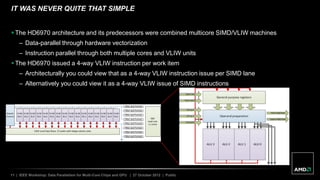
 The HD6970 architecture and its predecessors were combined multicore SIMD/VLIW machines
– Data-parallel through hardware vectorization
– Instruction parallel through both multiple cores and VLIW units
 The HD6970 issued a 4-way VLIW instruction per work item
– Architecturally you could view that as a 4-way VLIW instruction issue per SIMD lane
– Alternatively you could view it as a 4-way VLIW issue of SIMD instructions
12 | IEEE Workshop: Data Parallelism for Multi-Core Chips and GPU | 27 October 2012 | Public
WHAT DOES THAT MEAN TO THE PROGRAMMER?
 The IL we saw earlier ends up compiling to something like this:
; -------- Disassembly --------------------
00 ALU: ADDR(32) CNT(9) KCACHE0(CB1:0-15) KCACHE1(CB0:0-15)
0 w: LSHL ____, R0.x, 2
1 z: ADD_INT ____, KC0[0].x, PV0.w
2 y: LSHR R0.y, PV1.z, 2
3 x: MULLO_INT R1.x, R1.x, KC1[1].x
y: MULLO_INT ____, R1.x, KC1[1].x
z: MULLO_INT ____, R1.x, KC1[1].x
w: MULLO_INT ____, R1.x, KC1[1].x
01 TEX: ADDR(48) CNT(1)
4 VFETCH R2.x___, R0.y, fc153
FETCH_TYPE(NO_INDEX_OFFSET)
02 ALU: ADDR(41) CNT(7) KCACHE0(CB0:0-15) KCACHE1(CB1:0-15)
5 w: ADD_INT ____, R0.x, R1.x
6 z: ADD_INT ____, PV5.w, KC0[6].x
7 y: LSHL ____, PV6.z, 2
8 x: ADD_INT ____, KC1[1].x, PV7.y
9 x: LSHR R0.x, PV8.x, 2
03 MEM_RAT_CACHELESS_STORE_DWORD__NI: RAT(11)[R0].x___, R2, ARRAY_SIZE(4) MARK VPM
04 END
END_OF_PROGRAM
13 | IEEE Workshop: Data Parallelism for Multi-Core Chips and GPU | 27 October 2012 | Public
WHAT DOES THAT MEAN TO THE PROGRAMMER?
 The IL we saw earlier ends up compiling to something like this:
; -------- Disassembly --------------------
00 ALU: ADDR(32) CNT(9) KCACHE0(CB1:0-15) KCACHE1(CB0:0-15)
0 w: LSHL ____, R0.x, 2
1 z: ADD_INT ____, KC0[0].x, PV0.w
2 y: LSHR R0.y, PV1.z, 2
3 x: MULLO_INT R1.x, R1.x, KC1[1].x
y: MULLO_INT ____, R1.x, KC1[1].x
z: MULLO_INT ____, R1.x, KC1[1].x
w: MULLO_INT ____, R1.x, KC1[1].x
01 TEX: ADDR(48) CNT(1)
4 VFETCH R2.x___, R0.y, fc153
FETCH_TYPE(NO_INDEX_OFFSET)
02 ALU: ADDR(41) CNT(7) KCACHE0(CB0:0-15) KCACHE1(CB1:0-15)
5 w: ADD_INT ____, R0.x, R1.x
6 z: ADD_INT ____, PV5.w, KC0[6].x
7 y: LSHL ____, PV6.z, 2
8 x: ADD_INT ____, KC1[1].x, PV7.y
9 x: LSHR R0.x, PV8.x, 2
03 MEM_RAT_CACHELESS_STORE_DWORD__NI: RAT(11)[R0].x___, R2, ARRAY_SIZE(4) MARK VPM
04 END
END_OF_PROGRAM
Clause header
Work executed by the
shared scalar unit
14 | IEEE Workshop: Data Parallelism for Multi-Core Chips and GPU | 27 October 2012 | Public
WHAT DOES THAT MEAN TO THE PROGRAMMER?
 The IL we saw earlier ends up compiling to something like this:
; -------- Disassembly --------------------
00 ALU: ADDR(32) CNT(9) KCACHE0(CB1:0-15) KCACHE1(CB0:0-15)
0 w: LSHL ____, R0.x, 2
1 z: ADD_INT ____, KC0[0].x, PV0.w
2 y: LSHR R0.y, PV1.z, 2
3 x: MULLO_INT R1.x, R1.x, KC1[1].x
y: MULLO_INT ____, R1.x, KC1[1].x
z: MULLO_INT ____, R1.x, KC1[1].x
w: MULLO_INT ____, R1.x, KC1[1].x
01 TEX: ADDR(48) CNT(1)
4 VFETCH R2.x___, R0.y, fc153
FETCH_TYPE(NO_INDEX_OFFSET)
02 ALU: ADDR(41) CNT(7) KCACHE0(CB0:0-15) KCACHE1(CB1:0-15)
5 w: ADD_INT ____, R0.x, R1.x
6 z: ADD_INT ____, PV5.w, KC0[6].x
7 y: LSHL ____, PV6.z, 2
8 x: ADD_INT ____, KC1[1].x, PV7.y
9 x: LSHR R0.x, PV8.x, 2
03 MEM_RAT_CACHELESS_STORE_DWORD__NI: RAT(11)[R0].x___, R2, ARRAY_SIZE(4) MARK VPM
04 END
END_OF_PROGRAM
Clause body
Units of work dispatched
by the shared scalar unit
Clause header
Work executed by the
shared scalar unit
15 | IEEE Workshop: Data Parallelism for Multi-Core Chips and GPU | 27 October 2012 | Public
WHAT DOES THAT MEAN TO THE PROGRAMMER?
 The IL we saw earlier ends up compiling to something like this:
; -------- Disassembly --------------------
00 ALU: ADDR(32) CNT(9) KCACHE0(CB1:0-15) KCACHE1(CB0:0-15)
0 w: LSHL ____, R0.x, 2
1 z: ADD_INT ____, KC0[0].x, PV0.w
2 y: LSHR R0.y, PV1.z, 2
3 x: MULLO_INT R1.x, R1.x, KC1[1].x
y: MULLO_INT ____, R1.x, KC1[1].x
z: MULLO_INT ____, R1.x, KC1[1].x
w: MULLO_INT ____, R1.x, KC1[1].x
01 TEX: ADDR(48) CNT(1)
4 VFETCH R2.x___, R0.y, fc153
FETCH_TYPE(NO_INDEX_OFFSET)
02 ALU: ADDR(41) CNT(7) KCACHE0(CB0:0-15) KCACHE1(CB1:0-15)
5 w: ADD_INT ____, R0.x, R1.x
6 z: ADD_INT ____, PV5.w, KC0[6].x
7 y: LSHL ____, PV6.z, 2
8 x: ADD_INT ____, KC1[1].x, PV7.y
9 x: LSHR R0.x, PV8.x, 2
03 MEM_RAT_CACHELESS_STORE_DWORD__NI: RAT(11)[R0].x___, R2, ARRAY_SIZE(4) MARK VPM
04 END
END_OF_PROGRAM
Clause body
Units of work dispatched
by the shared scalar unit
Clause header
Work executed by the
shared scalar unit
VLIW instruction packet
Compiler-generated instruction level
parallelism for the VLIW unit.
Each instruction (x, y, z, w) executed
across the vector.
16 | IEEE Workshop: Data Parallelism for Multi-Core Chips and GPU | 27 October 2012 | Public
WHAT DOES THAT MEAN TO THE PROGRAMMER?
 The IL we saw earlier ends up compiling to something like this:
; -------- Disassembly --------------------
00 ALU: ADDR(32) CNT(9) KCACHE0(CB1:0-15) KCACHE1(CB0:0-15)
0 w: LSHL ____, R0.x, 2
1 z: ADD_INT ____, KC0[0].x, PV0.w
2 y: LSHR R0.y, PV1.z, 2
3 x: MULLO_INT R1.x, R1.x, KC1[1].x
y: MULLO_INT ____, R1.x, KC1[1].x
z: MULLO_INT ____, R1.x, KC1[1].x
w: MULLO_INT ____, R1.x, KC1[1].x
01 TEX: ADDR(48) CNT(1)
4 VFETCH R2.x___, R0.y, fc153
FETCH_TYPE(NO_INDEX_OFFSET)
02 ALU: ADDR(41) CNT(7) KCACHE0(CB0:0-15) KCACHE1(CB1:0-15)
5 w: ADD_INT ____, R0.x, R1.x
6 z: ADD_INT ____, PV5.w, KC0[6].x
7 y: LSHL ____, PV6.z, 2
8 x: ADD_INT ____, KC1[1].x, PV7.y
9 x: LSHR R0.x, PV8.x, 2
03 MEM_RAT_CACHELESS_STORE_DWORD__NI: RAT(11)[R0].x___, R2, ARRAY_SIZE(4) MARK VPM
04 END
END_OF_PROGRAM
Clause body
Units of work dispatched
by the shared scalar unit
Clause header
Work executed by the
shared scalar unit
VLIW instruction packet
Compiler-generated instruction level
parallelism for the VLIW unit.
Each instruction (x, y, z, w) executed
across the vector.
Notice the poor occupancy of VLIW slots
17 | IEEE Workshop: Data Parallelism for Multi-Core Chips and GPU | 27 October 2012 | Public
WHY DID WE SEE INEFFICIENCY?
 The architecture was well suited to graphics workloads:
– VLIW was easily filled by the vector-heavy graphics kernels
– Minimal control flow meant that the monolithic, shared thread scheduler was relatively efficient
 Unfortunately, workloads change with time.
 So how did we change the architecture to improve the situation?
18 | IEEE Workshop: Data Parallelism for Multi-Core Chips and GPU | 27 October 2012 | Public
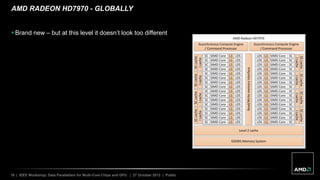
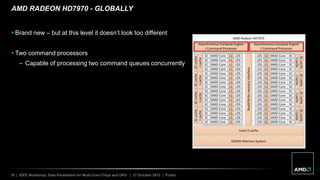
AMD RADEON HD7970 - GLOBALLY
 Brand new – but at this level it doesn’t look too different




19 | IEEE Workshop: Data Parallelism for Multi-Core Chips and GPU | 27 October 2012 | Public
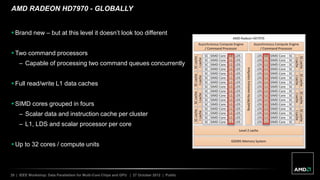
AMD RADEON HD7970 - GLOBALLY
 Brand new – but at this level it doesn’t look too different
 Two command processors
– Capable of processing two command queues concurrently



20 | IEEE Workshop: Data Parallelism for Multi-Core Chips and GPU | 27 October 2012 | Public
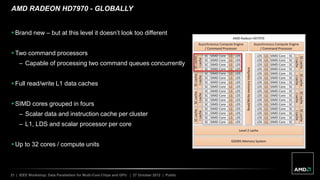
AMD RADEON HD7970 - GLOBALLY
 Brand new – but at this level it doesn’t look too different
 Two command processors
– Capable of processing two command queues concurrently
 Full read/write L1 data caches
 SIMD cores grouped in fours
– Scalar data and instruction cache per cluster
– L1, LDS and scalar processor per core
 Up to 32 cores / compute units
21 | IEEE Workshop: Data Parallelism for Multi-Core Chips and GPU | 27 October 2012 | Public
AMD RADEON HD7970 - GLOBALLY
 Brand new – but at this level it doesn’t look too different
 Two command processors
– Capable of processing two command queues concurrently
 Full read/write L1 data caches
 SIMD cores grouped in fours
– Scalar data and instruction cache per cluster
– L1, LDS and scalar processor per core
 Up to 32 cores / compute units
22 | IEEE Workshop: Data Parallelism for Multi-Core Chips and GPU | 27 October 2012 | Public
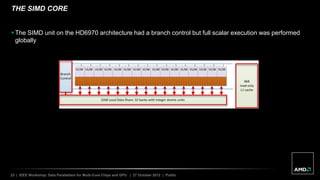
THE SIMD CORE
 The SIMD unit on the HD6970 architecture had a branch control but full scalar execution was performed
globally
23 | IEEE Workshop: Data Parallelism for Multi-Core Chips and GPU | 27 October 2012 | Public
THE SIMD CORE
 The SIMD unit on the HD6970 architecture had a branch control but full scalar execution was performed
globally
24 | IEEE Workshop: Data Parallelism for Multi-Core Chips and GPU | 27 October 2012 | Public
THE SIMD CORE
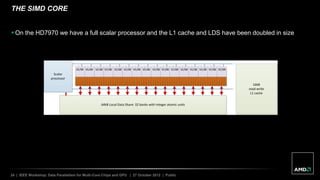
 On the HD7970 we have a full scalar processor and the L1 cache and LDS have been doubled in size

25 | IEEE Workshop: Data Parallelism for Multi-Core Chips and GPU | 27 October 2012 | Public
THE SIMD CORE
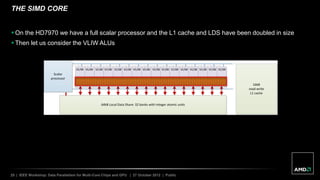
 On the HD7970 we have a full scalar processor and the L1 cache and LDS have been doubled in size
 Then let us consider the VLIW ALUs
26 | IEEE Workshop: Data Parallelism for Multi-Core Chips and GPU | 27 October 2012 | Public
THE SIMD CORE
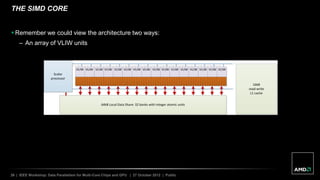
 Remember we could view the architecture two ways:
– An array of VLIW units
27 | IEEE Workshop: Data Parallelism for Multi-Core Chips and GPU | 27 October 2012 | Public
THE SIMD CORE
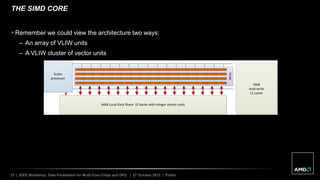
 Remember we could view the architecture two ways:
– An array of VLIW units
– A VLIW cluster of vector units
28 | IEEE Workshop: Data Parallelism for Multi-Core Chips and GPU | 27 October 2012 | Public
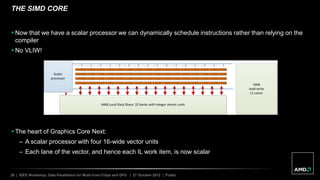
THE SIMD CORE
 Now that we have a scalar processor we can dynamically schedule instructions rather than relying on the
compiler
 No VLIW!
 The heart of Graphics Core Next:
– A scalar processor with four 16-wide vector units
– Each lane of the vector, and hence each IL work item, is now scalar
29 | IEEE Workshop: Data Parallelism for Multi-Core Chips and GPU | 27 October 2012 | Public
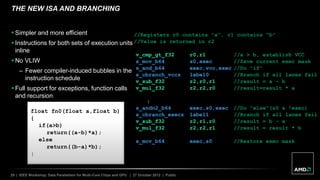
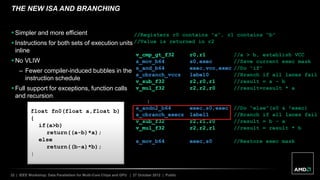
THE NEW ISA AND BRANCHING
float fn0(float a,float b)
{
if(a>b)
return((a-b)*a);
else
return((b-a)*b);
}
//Registers r0 contains “a”, r1 contains “b”
//Value is returned in r2
v_cmp_gt_f32 r0,r1 //a > b, establish VCC
s_mov_b64 s0,exec //Save current exec mask
s_and_b64 exec,vcc,exec //Do “if”
s_cbranch_vccz label0 //Branch if all lanes fail
v_sub_f32 r2,r0,r1 //result = a – b
v_mul_f32 r2,r2,r0 //result=result * a
label0:
s_andn2_b64 exec,s0,exec //Do “else”(s0 & !exec)
s_cbranch_execz label1 //Branch if all lanes fail
v_sub_f32 r2,r1,r0 //result = b – a
v_mul_f32 r2,r2,r1 //result = result * b
label1:
s_mov_b64 exec,s0 //Restore exec mask
 Simpler and more efficient
 Instructions for both sets of execution units
inline
 No VLIW
– Fewer compiler-induced bubbles in the
instruction schedule
 Full support for exceptions, function calls
and recursion
30 | IEEE Workshop: Data Parallelism for Multi-Core Chips and GPU | 27 October 2012 | Public
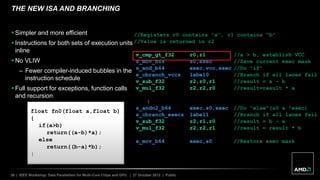
THE NEW ISA AND BRANCHING
float fn0(float a,float b)
{
if(a>b)
return((a-b)*a);
else
return((b-a)*b);
}
//Registers r0 contains “a”, r1 contains “b”
//Value is returned in r2
v_cmp_gt_f32 r0,r1 //a > b, establish VCC
s_mov_b64 s0,exec //Save current exec mask
s_and_b64 exec,vcc,exec //Do “if”
s_cbranch_vccz label0 //Branch if all lanes fail
v_sub_f32 r2,r0,r1 //result = a – b
v_mul_f32 r2,r2,r0 //result=result * a
label0:
s_andn2_b64 exec,s0,exec //Do “else”(s0 & !exec)
s_cbranch_execz label1 //Branch if all lanes fail
v_sub_f32 r2,r1,r0 //result = b – a
v_mul_f32 r2,r2,r1 //result = result * b
label1:
s_mov_b64 exec,s0 //Restore exec mask
 Simpler and more efficient
 Instructions for both sets of execution units
inline
 No VLIW
– Fewer compiler-induced bubbles in the
instruction schedule
 Full support for exceptions, function calls
and recursion
31 | IEEE Workshop: Data Parallelism for Multi-Core Chips and GPU | 27 October 2012 | Public
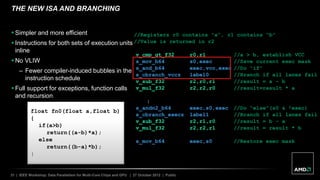
THE NEW ISA AND BRANCHING
float fn0(float a,float b)
{
if(a>b)
return((a-b)*a);
else
return((b-a)*b);
}
//Registers r0 contains “a”, r1 contains “b”
//Value is returned in r2
v_cmp_gt_f32 r0,r1 //a > b, establish VCC
s_mov_b64 s0,exec //Save current exec mask
s_and_b64 exec,vcc,exec //Do “if”
s_cbranch_vccz label0 //Branch if all lanes fail
v_sub_f32 r2,r0,r1 //result = a – b
v_mul_f32 r2,r2,r0 //result=result * a
label0:
s_andn2_b64 exec,s0,exec //Do “else”(s0 & !exec)
s_cbranch_execz label1 //Branch if all lanes fail
v_sub_f32 r2,r1,r0 //result = b – a
v_mul_f32 r2,r2,r1 //result = result * b
label1:
s_mov_b64 exec,s0 //Restore exec mask
 Simpler and more efficient
 Instructions for both sets of execution units
inline
 No VLIW
– Fewer compiler-induced bubbles in the
instruction schedule
 Full support for exceptions, function calls
and recursion
32 | IEEE Workshop: Data Parallelism for Multi-Core Chips and GPU | 27 October 2012 | Public
THE NEW ISA AND BRANCHING
float fn0(float a,float b)
{
if(a>b)
return((a-b)*a);
else
return((b-a)*b);
}
//Registers r0 contains “a”, r1 contains “b”
//Value is returned in r2
v_cmp_gt_f32 r0,r1 //a > b, establish VCC
s_mov_b64 s0,exec //Save current exec mask
s_and_b64 exec,vcc,exec //Do “if”
s_cbranch_vccz label0 //Branch if all lanes fail
v_sub_f32 r2,r0,r1 //result = a – b
v_mul_f32 r2,r2,r0 //result=result * a
label0:
s_andn2_b64 exec,s0,exec //Do “else”(s0 & !exec)
s_cbranch_execz label1 //Branch if all lanes fail
v_sub_f32 r2,r1,r0 //result = b – a
v_mul_f32 r2,r2,r1 //result = result * b
label1:
s_mov_b64 exec,s0 //Restore exec mask
 Simpler and more efficient
 Instructions for both sets of execution units
inline
 No VLIW
– Fewer compiler-induced bubbles in the
instruction schedule
 Full support for exceptions, function calls
and recursion
33 | IEEE Workshop: Data Parallelism for Multi-Core Chips and GPU | 27 October 2012 | Public
64kB
read-write
L1 cache
Instruction
decode etc
512kB
read-write
L2 cacheFMISC SSE
FMUL SSE
FADD SSE
Scalar
units
(3 scalar
ALUs, branch
control etc)
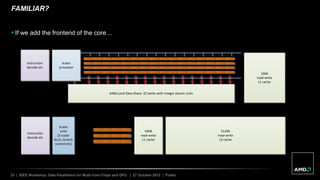
FAMILIAR?
 If we add the frontend of the core…
64kB Local Data Share: 32 banks with integer atomic units
16kB
read-write
L1 cache
Scalar
processor
Instruction
decode etc
“Graphics Core Next” core
“Barcelona” core
34 | IEEE Workshop: Data Parallelism for Multi-Core Chips and GPU | 27 October 2012 | Public
64kB
read-write
L1 cache
Instruction
decode etc
512kB
read-write
L2 cacheFMISC SSE
FMUL SSE
FADD SSE
Scalar
units
(3 scalar
ALUs, branch
control etc)
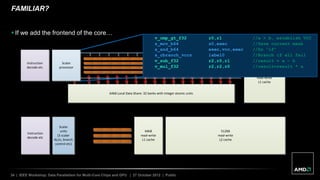
FAMILIAR?
 If we add the frontend of the core…
64kB Local Data Share: 32 banks with integer atomic units
16kB
read-write
L1 cache
Scalar
processor
Instruction
decode etc
“Graphics Core Next” core
“Barcelona” core
v_cmp_gt_f32 r0,r1 //a > b, establish VCC
s_mov_b64 s0,exec //Save current mask
s_and_b64 exec,vcc,exec //Do “if”
s_cbranch_vccz label0 //Branch if all fail
v_sub_f32 r2,r0,r1 //result = a – b
v_mul_f32 r2,r2,r0 //result=result * a
35 | IEEE Workshop: Data Parallelism for Multi-Core Chips and GPU | 27 October 2012 | Public
64kB
read-write
L1 cache
Instruction
decode etc
512kB
read-write
L2 cacheFMISC SSE
FMUL SSE
FADD SSE
Scalar
units
(3 scalar
ALUs, branch
control etc)
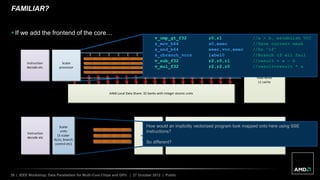
FAMILIAR?
 If we add the frontend of the core…
64kB Local Data Share: 32 banks with integer atomic units
16kB
read-write
L1 cache
Scalar
processor
Instruction
decode etc
“Graphics Core Next” core
“Barcelona” core
v_cmp_gt_f32 r0,r1 //a > b, establish VCC
s_mov_b64 s0,exec //Save current mask
s_and_b64 exec,vcc,exec //Do “if”
s_cbranch_vccz label0 //Branch if all fail
v_sub_f32 r2,r0,r1 //result = a – b
v_mul_f32 r2,r2,r0 //result=result * a
How would an implicitly vectorized program look mapped onto here using SSE
instructions?
So different?
36 | IEEE Workshop: Data Parallelism for Multi-Core Chips and GPU | 27 October 2012 | Public
SHARED VIRTUAL MEMORY
37 | IEEE Workshop: Data Parallelism for Multi-Core Chips and GPU | 27 October 2012 | Public
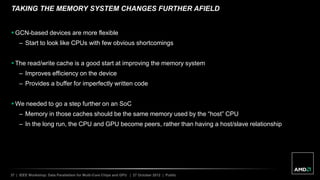
TAKING THE MEMORY SYSTEM CHANGES FURTHER AFIELD
 GCN-based devices are more flexible
– Start to look like CPUs with few obvious shortcomings
 The read/write cache is a good start at improving the memory system
– Improves efficiency on the device
– Provides a buffer for imperfectly written code
 We needed to go a step further on an SoC
– Memory in those caches should be the same memory used by the “host” CPU
– In the long run, the CPU and GPU become peers, rather than having a host/slave relationship
38 | IEEE Workshop: Data Parallelism for Multi-Core Chips and GPU | 27 October 2012 | Public
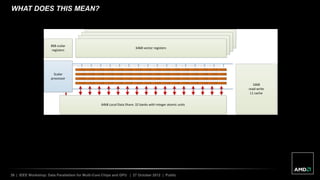
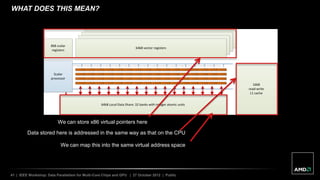
WHAT DOES THIS MEAN?
39 | IEEE Workshop: Data Parallelism for Multi-Core Chips and GPU | 27 October 2012 | Public
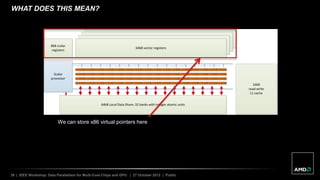
WHAT DOES THIS MEAN?
We can store x86 virtual pointers here
40 | IEEE Workshop: Data Parallelism for Multi-Core Chips and GPU | 27 October 2012 | Public
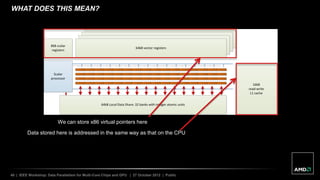
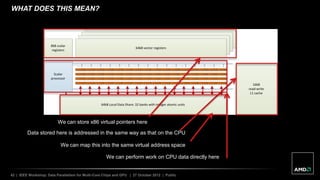
WHAT DOES THIS MEAN?
We can store x86 virtual pointers here
Data stored here is addressed in the same way as that on the CPU
41 | IEEE Workshop: Data Parallelism for Multi-Core Chips and GPU | 27 October 2012 | Public
WHAT DOES THIS MEAN?
We can store x86 virtual pointers here
Data stored here is addressed in the same way as that on the CPU
We can map this into the same virtual address space
42 | IEEE Workshop: Data Parallelism for Multi-Core Chips and GPU | 27 October 2012 | Public
WHAT DOES THIS MEAN?
We can store x86 virtual pointers here
Data stored here is addressed in the same way as that on the CPU
We can map this into the same virtual address space
We can perform work on CPU data directly here
43 | IEEE Workshop: Data Parallelism for Multi-Core Chips and GPU | 27 October 2012 | Public
USE CASES FOR THIS ARE FAIRLY OBVIOUS
 Pointer chasing algorithms with mixed GPU/CPU use
 Algorithms that construct data on the CPU, use it on the GPU
 Allows for more fine-grained data use without explicit copies
 Covers cases where explicit copies are difficult:
– Picture OS allocated data that the OpenCL runtime doesn’t know about
 However, that wasn’t quite enough to achieve our goals…
44 | IEEE Workshop: Data Parallelism for Multi-Core Chips and GPU | 27 October 2012 | Public
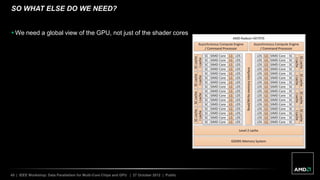
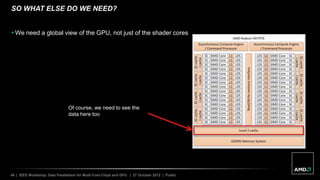
SO WHAT ELSE DO WE NEED?


45 | IEEE Workshop: Data Parallelism for Multi-Core Chips and GPU | 27 October 2012 | Public
SO WHAT ELSE DO WE NEED?
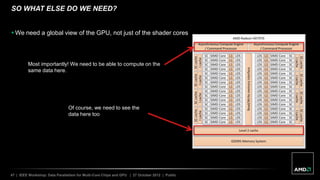
 We need a global view of the GPU, not just of the shader cores

46 | IEEE Workshop: Data Parallelism for Multi-Core Chips and GPU | 27 October 2012 | Public
SO WHAT ELSE DO WE NEED?
 We need a global view of the GPU, not just of the shader cores

Of course, we need to see the
data here too
47 | IEEE Workshop: Data Parallelism for Multi-Core Chips and GPU | 27 October 2012 | Public
SO WHAT ELSE DO WE NEED?
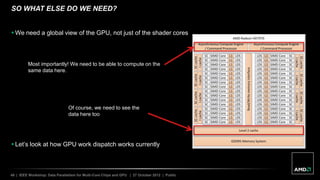
 We need a global view of the GPU, not just of the shader cores

Of course, we need to see the
data here too
Most importantly! We need to be able to compute on the
same data here.
48 | IEEE Workshop: Data Parallelism for Multi-Core Chips and GPU | 27 October 2012 | Public
SO WHAT ELSE DO WE NEED?
 We need a global view of the GPU, not just of the shader cores
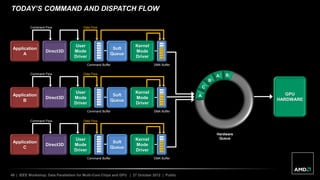
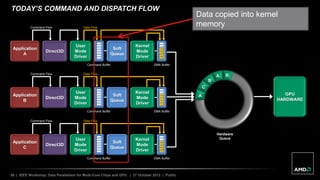
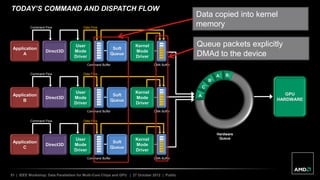
 Let’s look at how GPU work dispatch works currently
Of course, we need to see the
data here too
Most importantly! We need to be able to compute on the
same data here.
49 | IEEE Workshop: Data Parallelism for Multi-Core Chips and GPU | 27 October 2012 | Public
Command Flow Data Flow
Soft
Queue
Kernel
Mode
Driver
Application
A
Command Buffer
User
Mode
Driver
Direct3D
DMA Buffer
Command Flow Data Flow
Soft
Queue
Kernel
Mode
Driver
Application
C
Command Buffer
User
Mode
Driver
Direct3D
DMA Buffer
Command Flow Data Flow
Soft
Queue
Kernel
Mode
Driver
Application
B
Command Buffer
User
Mode
Driver
Direct3D
DMA Buffer
TODAY’S COMMAND AND DISPATCH FLOW
Hardware
Queue
A GPU
HARDWARE
C
B
A B
50 | IEEE Workshop: Data Parallelism for Multi-Core Chips and GPU | 27 October 2012 | Public
Command Flow Data Flow
Soft
Queue
Kernel
Mode
Driver
Application
A
Command Buffer
User
Mode
Driver
Direct3D
DMA Buffer
Command Flow Data Flow
Soft
Queue
Kernel
Mode
Driver
Application
C
Command Buffer
User
Mode
Driver
Direct3D
DMA Buffer
Command Flow Data Flow
Soft
Queue
Kernel
Mode
Driver
Application
B
Command Buffer
User
Mode
Driver
Direct3D
DMA Buffer
TODAY’S COMMAND AND DISPATCH FLOW
Hardware
Queue
A GPU
HARDWARE
C
B
A B
Data copied into kernel
memory
51 | IEEE Workshop: Data Parallelism for Multi-Core Chips and GPU | 27 October 2012 | Public
Command Flow Data Flow
Soft
Queue
Kernel
Mode
Driver
Application
A
Command Buffer
User
Mode
Driver
Direct3D
DMA Buffer
Command Flow Data Flow
Soft
Queue
Kernel
Mode
Driver
Application
C
Command Buffer
User
Mode
Driver
Direct3D
DMA Buffer
Command Flow Data Flow
Soft
Queue
Kernel
Mode
Driver
Application
B
Command Buffer
User
Mode
Driver
Direct3D
DMA Buffer
TODAY’S COMMAND AND DISPATCH FLOW
Hardware
Queue
A GPU
HARDWARE
C
B
A B
Data copied into kernel
memory
Queue packets explicitly
DMAd to the device
52 | IEEE Workshop: Data Parallelism for Multi-Core Chips and GPU | 27 October 2012 | Public
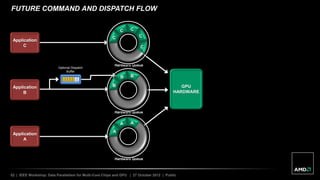
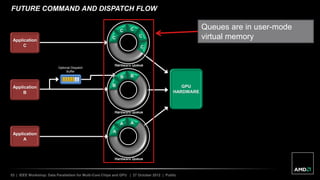
FUTURE COMMAND AND DISPATCH FLOW
Application
A
Application
B
Application
C
Optional Dispatch
Buffer
GPU
HARDWARE
Hardware Queue
A
A A
Hardware Queue
B
B B
Hardware Queue
C
C C
C
C
53 | IEEE Workshop: Data Parallelism for Multi-Core Chips and GPU | 27 October 2012 | Public
FUTURE COMMAND AND DISPATCH FLOW
Application
A
Application
B
Application
C
Optional Dispatch
Buffer
GPU
HARDWARE
Hardware Queue
A
A A
Hardware Queue
B
B B
Hardware Queue
C
C C
C
C
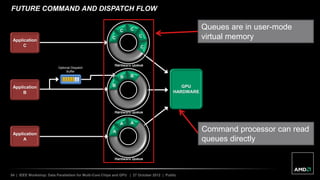
Queues are in user-mode
virtual memory
54 | IEEE Workshop: Data Parallelism for Multi-Core Chips and GPU | 27 October 2012 | Public
FUTURE COMMAND AND DISPATCH FLOW
Application
A
Application
B
Application
C
Optional Dispatch
Buffer
GPU
HARDWARE
Hardware Queue
A
A A
Hardware Queue
B
B B
Hardware Queue
C
C C
C
C
Queues are in user-mode
virtual memory
Command processor can read
queues directly
55 | IEEE Workshop: Data Parallelism for Multi-Core Chips and GPU | 27 October 2012 | Public
FUTURE COMMAND AND DISPATCH FLOW
Application
A
Application
B
Application
C
Optional Dispatch
Buffer
GPU
HARDWARE
Hardware Queue
A
A A
Hardware Queue
B
B B
Hardware Queue
C
C C
C
C
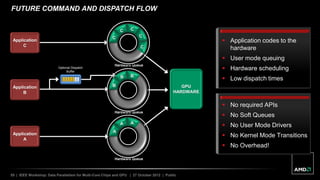
 No required APIs
 No Soft Queues
 No User Mode Drivers
 No Kernel Mode Transitions
 No Overhead!
 Application codes to the
hardware
 User mode queuing
 Hardware scheduling
 Low dispatch times
56 | IEEE Workshop: Data Parallelism for Multi-Core Chips and GPU | 27 October 2012 | Public
ARCHITECTED ACCESS
57 | IEEE Workshop: Data Parallelism for Multi-Core Chips and GPU | 27 October 2012 | Public
HETEROGENEOUS SYSTEM ARCHITECTURE – AN OPEN PLATFORM
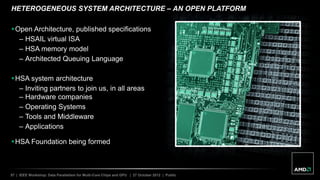
Open Architecture, published specifications
– HSAIL virtual ISA
– HSA memory model
– Architected Queuing Language
HSA system architecture
– Inviting partners to join us, in all areas
– Hardware companies
– Operating Systems
– Tools and Middleware
– Applications
HSA Foundation being formed
58 | IEEE Workshop: Data Parallelism for Multi-Core Chips and GPU | 27 October 2012 | Public
ARCHITECTED INTERFACES
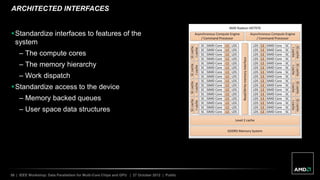
Standardize interfaces to features of the
system
– The compute cores
– The memory hierarchy
– Work dispatch
Standardize access to the device
– Memory backed queues
– User space data structures
59 | IEEE Workshop: Data Parallelism for Multi-Core Chips and GPU | 27 October 2012 | Public
HSA INTERMEDIATE LAYER - HSAIL
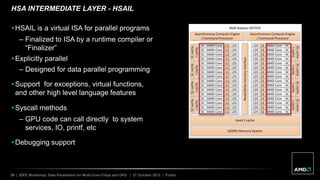
HSAIL is a virtual ISA for parallel programs
– Finalized to ISA by a runtime compiler or
“Finalizer”
Explicitly parallel
– Designed for data parallel programming
Support for exceptions, virtual functions,
and other high level language features
Syscall methods
– GPU code can call directly to system
services, IO, printf, etc
Debugging support
60 | IEEE Workshop: Data Parallelism for Multi-Core Chips and GPU | 27 October 2012 | Public
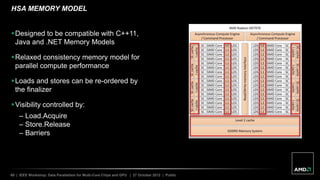
HSA MEMORY MODEL
Designed to be compatible with C++11,
Java and .NET Memory Models
Relaxed consistency memory model for
parallel compute performance
Loads and stores can be re-ordered by
the finalizer
Visibility controlled by:
– Load.Acquire
– Store.Release
– Barriers
61 | IEEE Workshop: Data Parallelism for Multi-Core Chips and GPU | 27 October 2012 | Public
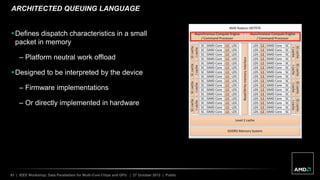
ARCHITECTED QUEUING LANGUAGE
Defines dispatch characteristics in a small
packet in memory
– Platform neutral work offload
Designed to be interpreted by the device
– Firmware implementations
– Or directly implemented in hardware
62 | IEEE Workshop: Data Parallelism for Multi-Core Chips and GPU | 27 October 2012 | Public
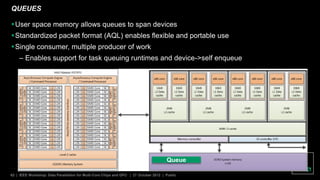
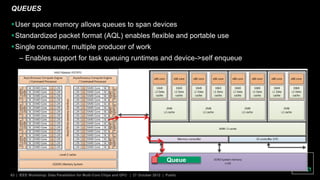
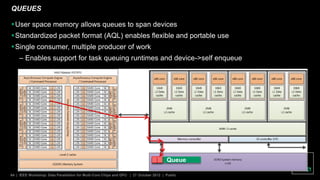
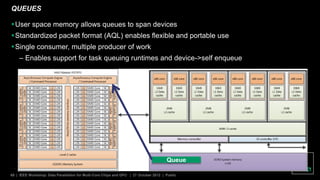
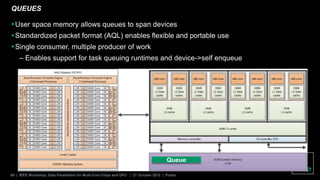
QUEUES
User space memory allows queues to span devices
Standardized packet format (AQL) enables flexible and portable use
Single consumer, multiple producer of work
– Enables support for task queuing runtimes and device->self enqueue
Queue
63 | IEEE Workshop: Data Parallelism for Multi-Core Chips and GPU | 27 October 2012 | Public
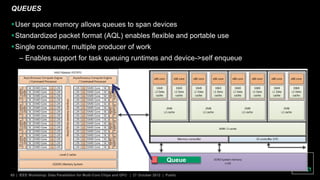
QUEUES
User space memory allows queues to span devices
Standardized packet format (AQL) enables flexible and portable use
Single consumer, multiple producer of work
– Enables support for task queuing runtimes and device->self enqueue
Queue
64 | IEEE Workshop: Data Parallelism for Multi-Core Chips and GPU | 27 October 2012 | Public
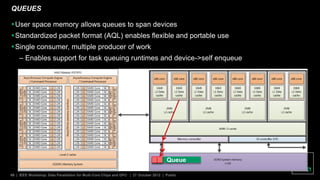
QUEUES
User space memory allows queues to span devices
Standardized packet format (AQL) enables flexible and portable use
Single consumer, multiple producer of work
– Enables support for task queuing runtimes and device->self enqueue
Queue
65 | IEEE Workshop: Data Parallelism for Multi-Core Chips and GPU | 27 October 2012 | Public
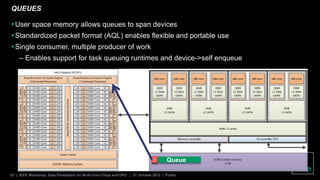
QUEUES
User space memory allows queues to span devices
Standardized packet format (AQL) enables flexible and portable use
Single consumer, multiple producer of work
– Enables support for task queuing runtimes and device->self enqueue
Queue
66 | IEEE Workshop: Data Parallelism for Multi-Core Chips and GPU | 27 October 2012 | Public
QUEUES
User space memory allows queues to span devices
Standardized packet format (AQL) enables flexible and portable use
Single consumer, multiple producer of work
– Enables support for task queuing runtimes and device->self enqueue
Queue
67 | IEEE Workshop: Data Parallelism for Multi-Core Chips and GPU | 27 October 2012 | Public
QUEUES
User space memory allows queues to span devices
Standardized packet format (AQL) enables flexible and portable use
Single consumer, multiple producer of work
– Enables support for task queuing runtimes and device->self enqueue
Queue
68 | IEEE Workshop: Data Parallelism for Multi-Core Chips and GPU | 27 October 2012 | Public
QUEUES
User space memory allows queues to span devices
Standardized packet format (AQL) enables flexible and portable use
Single consumer, multiple producer of work
– Enables support for task queuing runtimes and device->self enqueue
Queue
69 | IEEE Workshop: Data Parallelism for Multi-Core Chips and GPU | 27 October 2012 | Public
QUEUES
User space memory allows queues to span devices
Standardized packet format (AQL) enables flexible and portable use
Single consumer, multiple producer of work
– Enables support for task queuing runtimes and device->self enqueue
Queue
70 | IEEE Workshop: Data Parallelism for Multi-Core Chips and GPU | 27 October 2012 | Public
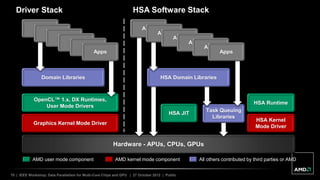
Hardware - APUs, CPUs, GPUs
AMD user mode component AMD kernel mode component All others contributed by third parties or AMD
Driver Stack
Domain Libraries
OpenCL™ 1.x, DX Runtimes,
User Mode Drivers
Graphics Kernel Mode Driver
Apps
Apps
Apps
Apps
Apps
Apps
HSA Software Stack
Task Queuing
Libraries
HSA Domain Libraries
HSA Kernel
Mode Driver
HSA Runtime
HSA JIT
Apps
Apps
Apps
Apps
Apps
Apps
71 | IEEE Workshop: Data Parallelism for Multi-Core Chips and GPU | 27 October 2012 | Public
OPENCL™ AND HSA
HSA is an optimized platform architecture
for OpenCL™
– Not an alternative to OpenCL™
OpenCL™ on HSA will benefit from
– Avoidance of wasteful copies
– Low latency dispatch
– Improved memory model
– Pointers shared between CPU and GPU
HSA also exposes a lower level programming
interface, for those that want the ultimate in
control and performance
– Optimized libraries may choose the lower
level interface
72 | IEEE Workshop: Data Parallelism for Multi-Core Chips and GPU | 27 October 2012 | Public
QUESTIONS
73 | IEEE Workshop: Data Parallelism for Multi-Core Chips and GPU | 27 October 2012 | Public
Disclaimer & Attribution
The information presented in this document is for informational purposes only and may contain technical inaccuracies, omissions
and typographical errors.
The information contained herein is subject to change and may be rendered inaccurate for many reasons, including but not limited
to product and roadmap changes, component and motherboard version changes, new model and/or product releases, product
differences between differing manufacturers, software changes, BIOS flashes, firmware upgrades, or the like. There is no
obligation to update or otherwise correct or revise this information. However, we reserve the right to revise this information and to
make changes from time to time to the content hereof without obligation to notify any person of such revisions or changes.
NO REPRESENTATIONS OR WARRANTIES ARE MADE WITH RESPECT TO THE CONTENTS HEREOF AND NO
RESPONSIBILITY IS ASSUMED FOR ANY INACCURACIES, ERRORS OR OMISSIONS THAT MAY APPEAR IN THIS
INFORMATION.
ALL IMPLIED WARRANTIES OF MERCHANTABILITY OR FITNESS FOR ANY PARTICULAR PURPOSE ARE EXPRESSLY
DISCLAIMED. IN NO EVENT WILL ANY LIABILITY TO ANY PERSON BE INCURRED FOR ANY DIRECT, INDIRECT, SPECIAL
OR OTHER CONSEQUENTIAL DAMAGES ARISING FROM THE USE OF ANY INFORMATION CONTAINED HEREIN, EVEN IF
EXPRESSLY ADVISED OF THE POSSIBILITY OF SUCH DAMAGES.
AMD, the AMD arrow logo, and combinations thereof are trademarks of Advanced Micro Devices, Inc. All other names used in
this presentation are for informational purposes only and may be trademarks of their respective owners.
© 2011 Advanced Micro Devices, Inc.

201210 howes-hsa and-the_modern_gpu

  • 1.
    HSA AND THEMODERN GPU Lee Howes AMD Heterogeneous System Software
  • 2.
    2 | IEEEWorkshop: Data Parallelism for Multi-Core Chips and GPU | 27 October 2012 | Public HSA AND THE MODERN GPU  In this brief talk we will cover three topics: – Changes to the shader core and memory system – Changes to the use of pointers – Architected definitions to use these new features  We’ll look both at how the hardware is becoming more flexible, and how the changes will benefit OpenCL implementations.
  • 3.
    3 | IEEEWorkshop: Data Parallelism for Multi-Core Chips and GPU | 27 October 2012 | Public THE HD7970 AND GRAPHICS CORE NEXT
  • 4.
    4 | IEEEWorkshop: Data Parallelism for Multi-Core Chips and GPU | 27 October 2012 | Public GPU EXECUTION AS WAS  We often view GPU programming as a set of independent threads, more reasonably known as “work items” in OpenCL: kernel void blah(global float *input, global float *output) { output[get_global_id(0)] = input[get_global_id(0)]; }  Which we flatten to an intermediate language known as AMD IL:  Note that AMD IL contains short vector instructions mov r255, r1021.xyz0 mov r255, r255.x000 mov r256, l9.xxxx ishl r255.x___, r255.xxxx, r256.xxxx iadd r253.x___, r2.xxxx, r255.xxxx mov r255, r1022.xyz0 mov r255, r255.x000 ishl r255.x___, r255.xxxx, r256.xxxx iadd r254.x___, r1.xxxx, r255.xxxx mov r1010.x___, r254.xxxx uav_raw_load_id(11)_cached r1011.x___, r1010.xxxx mov r254.x___, r1011.xxxx mov r1011.x___, r254.xxxx mov r1010.x___, r253.xxxx uav_raw_store_id(11) mem.x___, r1010.xxxx, r1011.xxxx ret
  • 5.
    5 | IEEEWorkshop: Data Parallelism for Multi-Core Chips and GPU | 27 October 2012 | Public MAPPING TO THE HARDWARE  The GPU hardware of course does not execute those work items as threads  The reality is that high-end GPUs follow a SIMD architecture – Each work item describes a lane of execution – Multiple work items execute together in SIMD fashion with a single program counter – Some clever automated stack management to handle divergent control flow across the vector
  • 6.
    6 | IEEEWorkshop: Data Parallelism for Multi-Core Chips and GPU | 27 October 2012 | Public MAPPING TO THE HARDWARE  The GPU hardware of course does not execute those work items as threads  The reality is that high-end GPUs follow a SIMD architecture – Each work item describes a lane of execution – Multiple work items execute together in SIMD fashion with a single program counter – Some clever automated stack management to handle divergent control flow across the vector mov r255, r1021.xyz0 mov r255, r255.x000 mov r256, l9.xxxx ishl r255.x___, r255.xxxx, r256.xxxx iadd r253.x___, r2.xxxx, r255.xxxx mov r255, r1022.xyz0 mov r255, r255.x000 ishl r255.x___, r255.xxxx, r256.xxxx iadd r254.x___, r1.xxxx, r255.xxxx mov r1010.x___, r254.xxxx uav_raw_load_id(11)_cached r1011.x___, r1010.xxxx mov r254.x___, r1011.xxxx mov r1011.x___, r254.xxxx mov r1010.x___, r253.xxxx uav_raw_store_id(11) mem.x___, r1010.xxxx, r1011.xxxx ret mov r255, r1021.xyz0 mov r255, r255.x000 mov r256, l9.xxxx ishl r255.x___, r255.xxxx, r256.xxxx iadd r253.x___, r2.xxxx, r255.xxxx mov r255, r1022.xyz0 mov r255, r255.x000 ishl r255.x___, r255.xxxx, r256.xxxx iadd r254.x___, r1.xxxx, r255.xxxx mov r1010.x___, r254.xxxx uav_raw_load_id(11)_cached r1011.x___, r1010.xxxx mov r254.x___, r1011.xxxx mov r1011.x___, r254.xxxx mov r1010.x___, r253.xxxx uav_raw_store_id(11) mem.x___, r1010.xxxx, r1011.xxxx ret mov r255, r1021.xyz0 mov r255, r255.x000 mov r256, l9.xxxx ishl r255.x___, r255.xxxx, r256.xxxx iadd r253.x___, r2.xxxx, r255.xxxx mov r255, r1022.xyz0 mov r255, r255.x000 ishl r255.x___, r255.xxxx, r256.xxxx iadd r254.x___, r1.xxxx, r255.xxxx mov r1010.x___, r254.xxxx uav_raw_load_id(11)_cached r1011.x___, r1010.xxxx mov r254.x___, r1011.xxxx mov r1011.x___, r254.xxxx mov r1010.x___, r253.xxxx uav_raw_store_id(11) mem.x___, r1010.xxxx, r1011.xxxx ret
  • 7.
    7 | IEEEWorkshop: Data Parallelism for Multi-Core Chips and GPU | 27 October 2012 | Public MAPPING TO THE HARDWARE  The GPU hardware of course does not execute those work items as threads  The reality is that high-end GPUs follow a SIMD architecture – Each work item describes a lane of execution – Multiple work items execute together in SIMD fashion with a single program counter – Some clever automated stack management to handle divergent control flow across the vector mov r255, r1021.xyz0 mov r255, r255.x000 mov r256, l9.xxxx ishl r255.x___, r255.xxxx, r256.xxxx iadd r253.x___, r2.xxxx, r255.xxxx mov r255, r1022.xyz0 mov r255, r255.x000 ishl r255.x___, r255.xxxx, r256.xxxx iadd r254.x___, r1.xxxx, r255.xxxx mov r1010.x___, r254.xxxx uav_raw_load_id(11)_cached r1011.x___, r1010.xxxx mov r254.x___, r1011.xxxx mov r1011.x___, r254.xxxx mov r1010.x___, r253.xxxx uav_raw_store_id(11) mem.x___, r1010.xxxx, r1011.xxxx ret mov r255, r1021.xyz0 mov r255, r255.x000 mov r256, l9.xxxx ishl r255.x___, r255.xxxx, r256.xxxx iadd r253.x___, r2.xxxx, r255.xxxx mov r255, r1022.xyz0 mov r255, r255.x000 ishl r255.x___, r255.xxxx, r256.xxxx iadd r254.x___, r1.xxxx, r255.xxxx mov r1010.x___, r254.xxxx uav_raw_load_id(11)_cached r1011.x___, r1010.xxxx mov r254.x___, r1011.xxxx mov r1011.x___, r254.xxxx mov r1010.x___, r253.xxxx uav_raw_store_id(11) mem.x___, r1010.xxxx, r1011.xxxx ret mov r255, r1021.xyz0 mov r255, r255.x000 mov r256, l9.xxxx ishl r255.x___, r255.xxxx, r256.xxxx iadd r253.x___, r2.xxxx, r255.xxxx mov r255, r1022.xyz0 mov r255, r255.x000 ishl r255.x___, r255.xxxx, r256.xxxx iadd r254.x___, r1.xxxx, r255.xxxx mov r1010.x___, r254.xxxx uav_raw_load_id(11)_cached r1011.x___, r1010.xxxx mov r254.x___, r1011.xxxx mov r1011.x___, r254.xxxx mov r1010.x___, r253.xxxx uav_raw_store_id(11) mem.x___, r1010.xxxx, r1011.xxxx ret
  • 8.
    8 | IEEEWorkshop: Data Parallelism for Multi-Core Chips and GPU | 27 October 2012 | Public MAPPING TO THE HARDWARE  The GPU hardware of course does not execute those work items as threads  The reality is that high-end GPUs follow a SIMD architecture – Each work item describes a lane of execution – Multiple work items execute together in SIMD fashion with a single program counter – Some clever automated stack management to handle divergent control flow across the vector mov r255, r1021.xyz0 mov r255, r255.x000 mov r256, l9.xxxx ishl r255.x___, r255.xxxx, r256.xxxx iadd r253.x___, r2.xxxx, r255.xxxx mov r255, r1022.xyz0 mov r255, r255.x000 ishl r255.x___, r255.xxxx, r256.xxxx iadd r254.x___, r1.xxxx, r255.xxxx mov r1010.x___, r254.xxxx uav_raw_load_id(11)_cached r1011.x___, r1010.xxxx mov r254.x___, r1011.xxxx mov r1011.x___, r254.xxxx mov r1010.x___, r253.xxxx uav_raw_store_id(11) mem.x___, r1010.xxxx, r1011.xxxx ret mov r255, r1021.xyz0 mov r255, r255.x000 mov r256, l9.xxxx ishl r255.x___, r255.xxxx, r256.xxxx iadd r253.x___, r2.xxxx, r255.xxxx mov r255, r1022.xyz0 mov r255, r255.x000 ishl r255.x___, r255.xxxx, r256.xxxx iadd r254.x___, r1.xxxx, r255.xxxx mov r1010.x___, r254.xxxx uav_raw_load_id(11)_cached r1011.x___, r1010.xxxx mov r254.x___, r1011.xxxx mov r1011.x___, r254.xxxx mov r1010.x___, r253.xxxx uav_raw_store_id(11) mem.x___, r1010.xxxx, r1011.xxxx ret mov r255, r1021.xyz0 mov r255, r255.x000 mov r256, l9.xxxx ishl r255.x___, r255.xxxx, r256.xxxx iadd r253.x___, r2.xxxx, r255.xxxx mov r255, r1022.xyz0 mov r255, r255.x000 ishl r255.x___, r255.xxxx, r256.xxxx iadd r254.x___, r1.xxxx, r255.xxxx mov r1010.x___, r254.xxxx uav_raw_load_id(11)_cached r1011.x___, r1010.xxxx mov r254.x___, r1011.xxxx mov r1011.x___, r254.xxxx mov r1010.x___, r253.xxxx uav_raw_store_id(11) mem.x___, r1010.xxxx, r1011.xxxx ret
  • 9.
    9 | IEEEWorkshop: Data Parallelism for Multi-Core Chips and GPU | 27 October 2012 | Public MAPPING TO THE HARDWARE  The GPU hardware of course does not execute those work items as threads  The reality is that high-end GPUs follow a SIMD architecture – Each work item describes a lane of execution – Multiple work items execute together in SIMD fashion with a single program counter – Some clever automated stack management to handle divergent control flow across the vector mov r255, r1021.xyz0 mov r255, r255.x000 mov r256, l9.xxxx ishl r255.x___, r255.xxxx, r256.xxxx iadd r253.x___, r2.xxxx, r255.xxxx mov r255, r1022.xyz0 mov r255, r255.x000 ishl r255.x___, r255.xxxx, r256.xxxx iadd r254.x___, r1.xxxx, r255.xxxx mov r1010.x___, r254.xxxx uav_raw_load_id(11)_cached r1011.x___, r1010.xxxx mov r254.x___, r1011.xxxx mov r1011.x___, r254.xxxx mov r1010.x___, r253.xxxx uav_raw_store_id(11) mem.x___, r1010.xxxx, r1011.xxxx ret mov r255, r1021.xyz0 mov r255, r255.x000 mov r256, l9.xxxx ishl r255.x___, r255.xxxx, r256.xxxx iadd r253.x___, r2.xxxx, r255.xxxx mov r255, r1022.xyz0 mov r255, r255.x000 ishl r255.x___, r255.xxxx, r256.xxxx iadd r254.x___, r1.xxxx, r255.xxxx mov r1010.x___, r254.xxxx uav_raw_load_id(11)_cached r1011.x___, r1010.xxxx mov r254.x___, r1011.xxxx mov r1011.x___, r254.xxxx mov r1010.x___, r253.xxxx uav_raw_store_id(11) mem.x___, r1010.xxxx, r1011.xxxx ret mov r255, r1021.xyz0 mov r255, r255.x000 mov r256, l9.xxxx ishl r255.x___, r255.xxxx, r256.xxxx iadd r253.x___, r2.xxxx, r255.xxxx mov r255, r1022.xyz0 mov r255, r255.x000 ishl r255.x___, r255.xxxx, r256.xxxx iadd r254.x___, r1.xxxx, r255.xxxx mov r1010.x___, r254.xxxx uav_raw_load_id(11)_cached r1011.x___, r1010.xxxx mov r254.x___, r1011.xxxx mov r1011.x___, r254.xxxx mov r1010.x___, r253.xxxx uav_raw_store_id(11) mem.x___, r1010.xxxx, r1011.xxxx ret
  • 10.
    10 | IEEEWorkshop: Data Parallelism for Multi-Core Chips and GPU | 27 October 2012 | Public MAPPING TO THE HARDWARE  The GPU hardware of course does not execute those work items as threads  The reality is that high-end GPUs follow a SIMD architecture – Each work item describes a lane of execution – Multiple work items execute together in SIMD fashion with a single program counter – Some clever automated stack management to handle divergent control flow across the vector mov r255, r1021.xyz0 mov r255, r255.x000 mov r256, l9.xxxx ishl r255.x___, r255.xxxx, r256.xxxx iadd r253.x___, r2.xxxx, r255.xxxx mov r255, r1022.xyz0 mov r255, r255.x000 ishl r255.x___, r255.xxxx, r256.xxxx iadd r254.x___, r1.xxxx, r255.xxxx mov r1010.x___, r254.xxxx uav_raw_load_id(11)_cached r1011.x___, r1010.xxxx mov r254.x___, r1011.xxxx mov r1011.x___, r254.xxxx mov r1010.x___, r253.xxxx uav_raw_store_id(11) mem.x___, r1010.xxxx, r1011.xxxx ret mov r255, r1021.xyz0 mov r255, r255.x000 mov r256, l9.xxxx ishl r255.x___, r255.xxxx, r256.xxxx iadd r253.x___, r2.xxxx, r255.xxxx mov r255, r1022.xyz0 mov r255, r255.x000 ishl r255.x___, r255.xxxx, r256.xxxx iadd r254.x___, r1.xxxx, r255.xxxx mov r1010.x___, r254.xxxx uav_raw_load_id(11)_cached r1011.x___, r1010.xxxx mov r254.x___, r1011.xxxx mov r1011.x___, r254.xxxx mov r1010.x___, r253.xxxx uav_raw_store_id(11) mem.x___, r1010.xxxx, r1011.xxxx ret mov r255, r1021.xyz0 mov r255, r255.x000 mov r256, l9.xxxx ishl r255.x___, r255.xxxx, r256.xxxx iadd r253.x___, r2.xxxx, r255.xxxx mov r255, r1022.xyz0 mov r255, r255.x000 ishl r255.x___, r255.xxxx, r256.xxxx iadd r254.x___, r1.xxxx, r255.xxxx mov r1010.x___, r254.xxxx uav_raw_load_id(11)_cached r1011.x___, r1010.xxxx mov r254.x___, r1011.xxxx mov r1011.x___, r254.xxxx mov r1010.x___, r253.xxxx uav_raw_store_id(11) mem.x___, r1010.xxxx, r1011.xxxx ret
  • 11.
    11 | IEEEWorkshop: Data Parallelism for Multi-Core Chips and GPU | 27 October 2012 | Public IT WAS NEVER QUITE THAT SIMPLE  The HD6970 architecture and its predecessors were combined multicore SIMD/VLIW machines – Data-parallel through hardware vectorization – Instruction parallel through both multiple cores and VLIW units  The HD6970 issued a 4-way VLIW instruction per work item – Architecturally you could view that as a 4-way VLIW instruction issue per SIMD lane – Alternatively you could view it as a 4-way VLIW issue of SIMD instructions
  • 12.
    12 | IEEEWorkshop: Data Parallelism for Multi-Core Chips and GPU | 27 October 2012 | Public WHAT DOES THAT MEAN TO THE PROGRAMMER?  The IL we saw earlier ends up compiling to something like this: ; -------- Disassembly -------------------- 00 ALU: ADDR(32) CNT(9) KCACHE0(CB1:0-15) KCACHE1(CB0:0-15) 0 w: LSHL ____, R0.x, 2 1 z: ADD_INT ____, KC0[0].x, PV0.w 2 y: LSHR R0.y, PV1.z, 2 3 x: MULLO_INT R1.x, R1.x, KC1[1].x y: MULLO_INT ____, R1.x, KC1[1].x z: MULLO_INT ____, R1.x, KC1[1].x w: MULLO_INT ____, R1.x, KC1[1].x 01 TEX: ADDR(48) CNT(1) 4 VFETCH R2.x___, R0.y, fc153 FETCH_TYPE(NO_INDEX_OFFSET) 02 ALU: ADDR(41) CNT(7) KCACHE0(CB0:0-15) KCACHE1(CB1:0-15) 5 w: ADD_INT ____, R0.x, R1.x 6 z: ADD_INT ____, PV5.w, KC0[6].x 7 y: LSHL ____, PV6.z, 2 8 x: ADD_INT ____, KC1[1].x, PV7.y 9 x: LSHR R0.x, PV8.x, 2 03 MEM_RAT_CACHELESS_STORE_DWORD__NI: RAT(11)[R0].x___, R2, ARRAY_SIZE(4) MARK VPM 04 END END_OF_PROGRAM
  • 13.
    13 | IEEEWorkshop: Data Parallelism for Multi-Core Chips and GPU | 27 October 2012 | Public WHAT DOES THAT MEAN TO THE PROGRAMMER?  The IL we saw earlier ends up compiling to something like this: ; -------- Disassembly -------------------- 00 ALU: ADDR(32) CNT(9) KCACHE0(CB1:0-15) KCACHE1(CB0:0-15) 0 w: LSHL ____, R0.x, 2 1 z: ADD_INT ____, KC0[0].x, PV0.w 2 y: LSHR R0.y, PV1.z, 2 3 x: MULLO_INT R1.x, R1.x, KC1[1].x y: MULLO_INT ____, R1.x, KC1[1].x z: MULLO_INT ____, R1.x, KC1[1].x w: MULLO_INT ____, R1.x, KC1[1].x 01 TEX: ADDR(48) CNT(1) 4 VFETCH R2.x___, R0.y, fc153 FETCH_TYPE(NO_INDEX_OFFSET) 02 ALU: ADDR(41) CNT(7) KCACHE0(CB0:0-15) KCACHE1(CB1:0-15) 5 w: ADD_INT ____, R0.x, R1.x 6 z: ADD_INT ____, PV5.w, KC0[6].x 7 y: LSHL ____, PV6.z, 2 8 x: ADD_INT ____, KC1[1].x, PV7.y 9 x: LSHR R0.x, PV8.x, 2 03 MEM_RAT_CACHELESS_STORE_DWORD__NI: RAT(11)[R0].x___, R2, ARRAY_SIZE(4) MARK VPM 04 END END_OF_PROGRAM Clause header Work executed by the shared scalar unit
  • 14.
    14 | IEEEWorkshop: Data Parallelism for Multi-Core Chips and GPU | 27 October 2012 | Public WHAT DOES THAT MEAN TO THE PROGRAMMER?  The IL we saw earlier ends up compiling to something like this: ; -------- Disassembly -------------------- 00 ALU: ADDR(32) CNT(9) KCACHE0(CB1:0-15) KCACHE1(CB0:0-15) 0 w: LSHL ____, R0.x, 2 1 z: ADD_INT ____, KC0[0].x, PV0.w 2 y: LSHR R0.y, PV1.z, 2 3 x: MULLO_INT R1.x, R1.x, KC1[1].x y: MULLO_INT ____, R1.x, KC1[1].x z: MULLO_INT ____, R1.x, KC1[1].x w: MULLO_INT ____, R1.x, KC1[1].x 01 TEX: ADDR(48) CNT(1) 4 VFETCH R2.x___, R0.y, fc153 FETCH_TYPE(NO_INDEX_OFFSET) 02 ALU: ADDR(41) CNT(7) KCACHE0(CB0:0-15) KCACHE1(CB1:0-15) 5 w: ADD_INT ____, R0.x, R1.x 6 z: ADD_INT ____, PV5.w, KC0[6].x 7 y: LSHL ____, PV6.z, 2 8 x: ADD_INT ____, KC1[1].x, PV7.y 9 x: LSHR R0.x, PV8.x, 2 03 MEM_RAT_CACHELESS_STORE_DWORD__NI: RAT(11)[R0].x___, R2, ARRAY_SIZE(4) MARK VPM 04 END END_OF_PROGRAM Clause body Units of work dispatched by the shared scalar unit Clause header Work executed by the shared scalar unit
  • 15.
    15 | IEEEWorkshop: Data Parallelism for Multi-Core Chips and GPU | 27 October 2012 | Public WHAT DOES THAT MEAN TO THE PROGRAMMER?  The IL we saw earlier ends up compiling to something like this: ; -------- Disassembly -------------------- 00 ALU: ADDR(32) CNT(9) KCACHE0(CB1:0-15) KCACHE1(CB0:0-15) 0 w: LSHL ____, R0.x, 2 1 z: ADD_INT ____, KC0[0].x, PV0.w 2 y: LSHR R0.y, PV1.z, 2 3 x: MULLO_INT R1.x, R1.x, KC1[1].x y: MULLO_INT ____, R1.x, KC1[1].x z: MULLO_INT ____, R1.x, KC1[1].x w: MULLO_INT ____, R1.x, KC1[1].x 01 TEX: ADDR(48) CNT(1) 4 VFETCH R2.x___, R0.y, fc153 FETCH_TYPE(NO_INDEX_OFFSET) 02 ALU: ADDR(41) CNT(7) KCACHE0(CB0:0-15) KCACHE1(CB1:0-15) 5 w: ADD_INT ____, R0.x, R1.x 6 z: ADD_INT ____, PV5.w, KC0[6].x 7 y: LSHL ____, PV6.z, 2 8 x: ADD_INT ____, KC1[1].x, PV7.y 9 x: LSHR R0.x, PV8.x, 2 03 MEM_RAT_CACHELESS_STORE_DWORD__NI: RAT(11)[R0].x___, R2, ARRAY_SIZE(4) MARK VPM 04 END END_OF_PROGRAM Clause body Units of work dispatched by the shared scalar unit Clause header Work executed by the shared scalar unit VLIW instruction packet Compiler-generated instruction level parallelism for the VLIW unit. Each instruction (x, y, z, w) executed across the vector.
  • 16.
    16 | IEEEWorkshop: Data Parallelism for Multi-Core Chips and GPU | 27 October 2012 | Public WHAT DOES THAT MEAN TO THE PROGRAMMER?  The IL we saw earlier ends up compiling to something like this: ; -------- Disassembly -------------------- 00 ALU: ADDR(32) CNT(9) KCACHE0(CB1:0-15) KCACHE1(CB0:0-15) 0 w: LSHL ____, R0.x, 2 1 z: ADD_INT ____, KC0[0].x, PV0.w 2 y: LSHR R0.y, PV1.z, 2 3 x: MULLO_INT R1.x, R1.x, KC1[1].x y: MULLO_INT ____, R1.x, KC1[1].x z: MULLO_INT ____, R1.x, KC1[1].x w: MULLO_INT ____, R1.x, KC1[1].x 01 TEX: ADDR(48) CNT(1) 4 VFETCH R2.x___, R0.y, fc153 FETCH_TYPE(NO_INDEX_OFFSET) 02 ALU: ADDR(41) CNT(7) KCACHE0(CB0:0-15) KCACHE1(CB1:0-15) 5 w: ADD_INT ____, R0.x, R1.x 6 z: ADD_INT ____, PV5.w, KC0[6].x 7 y: LSHL ____, PV6.z, 2 8 x: ADD_INT ____, KC1[1].x, PV7.y 9 x: LSHR R0.x, PV8.x, 2 03 MEM_RAT_CACHELESS_STORE_DWORD__NI: RAT(11)[R0].x___, R2, ARRAY_SIZE(4) MARK VPM 04 END END_OF_PROGRAM Clause body Units of work dispatched by the shared scalar unit Clause header Work executed by the shared scalar unit VLIW instruction packet Compiler-generated instruction level parallelism for the VLIW unit. Each instruction (x, y, z, w) executed across the vector. Notice the poor occupancy of VLIW slots
  • 17.
    17 | IEEEWorkshop: Data Parallelism for Multi-Core Chips and GPU | 27 October 2012 | Public WHY DID WE SEE INEFFICIENCY?  The architecture was well suited to graphics workloads: – VLIW was easily filled by the vector-heavy graphics kernels – Minimal control flow meant that the monolithic, shared thread scheduler was relatively efficient  Unfortunately, workloads change with time.  So how did we change the architecture to improve the situation?
  • 18.
    18 | IEEEWorkshop: Data Parallelism for Multi-Core Chips and GPU | 27 October 2012 | Public AMD RADEON HD7970 - GLOBALLY  Brand new – but at this level it doesn’t look too different    
  • 19.
    19 | IEEEWorkshop: Data Parallelism for Multi-Core Chips and GPU | 27 October 2012 | Public AMD RADEON HD7970 - GLOBALLY  Brand new – but at this level it doesn’t look too different  Two command processors – Capable of processing two command queues concurrently   
  • 20.
    20 | IEEEWorkshop: Data Parallelism for Multi-Core Chips and GPU | 27 October 2012 | Public AMD RADEON HD7970 - GLOBALLY  Brand new – but at this level it doesn’t look too different  Two command processors – Capable of processing two command queues concurrently  Full read/write L1 data caches  SIMD cores grouped in fours – Scalar data and instruction cache per cluster – L1, LDS and scalar processor per core  Up to 32 cores / compute units
  • 21.
    21 | IEEEWorkshop: Data Parallelism for Multi-Core Chips and GPU | 27 October 2012 | Public AMD RADEON HD7970 - GLOBALLY  Brand new – but at this level it doesn’t look too different  Two command processors – Capable of processing two command queues concurrently  Full read/write L1 data caches  SIMD cores grouped in fours – Scalar data and instruction cache per cluster – L1, LDS and scalar processor per core  Up to 32 cores / compute units
  • 22.
    22 | IEEEWorkshop: Data Parallelism for Multi-Core Chips and GPU | 27 October 2012 | Public THE SIMD CORE  The SIMD unit on the HD6970 architecture had a branch control but full scalar execution was performed globally
  • 23.
    23 | IEEEWorkshop: Data Parallelism for Multi-Core Chips and GPU | 27 October 2012 | Public THE SIMD CORE  The SIMD unit on the HD6970 architecture had a branch control but full scalar execution was performed globally
  • 24.
    24 | IEEEWorkshop: Data Parallelism for Multi-Core Chips and GPU | 27 October 2012 | Public THE SIMD CORE  On the HD7970 we have a full scalar processor and the L1 cache and LDS have been doubled in size 
  • 25.
    25 | IEEEWorkshop: Data Parallelism for Multi-Core Chips and GPU | 27 October 2012 | Public THE SIMD CORE  On the HD7970 we have a full scalar processor and the L1 cache and LDS have been doubled in size  Then let us consider the VLIW ALUs
  • 26.
    26 | IEEEWorkshop: Data Parallelism for Multi-Core Chips and GPU | 27 October 2012 | Public THE SIMD CORE  Remember we could view the architecture two ways: – An array of VLIW units
  • 27.
    27 | IEEEWorkshop: Data Parallelism for Multi-Core Chips and GPU | 27 October 2012 | Public THE SIMD CORE  Remember we could view the architecture two ways: – An array of VLIW units – A VLIW cluster of vector units
  • 28.
    28 | IEEEWorkshop: Data Parallelism for Multi-Core Chips and GPU | 27 October 2012 | Public THE SIMD CORE  Now that we have a scalar processor we can dynamically schedule instructions rather than relying on the compiler  No VLIW!  The heart of Graphics Core Next: – A scalar processor with four 16-wide vector units – Each lane of the vector, and hence each IL work item, is now scalar
  • 29.
    29 | IEEEWorkshop: Data Parallelism for Multi-Core Chips and GPU | 27 October 2012 | Public THE NEW ISA AND BRANCHING float fn0(float a,float b) { if(a>b) return((a-b)*a); else return((b-a)*b); } //Registers r0 contains “a”, r1 contains “b” //Value is returned in r2 v_cmp_gt_f32 r0,r1 //a > b, establish VCC s_mov_b64 s0,exec //Save current exec mask s_and_b64 exec,vcc,exec //Do “if” s_cbranch_vccz label0 //Branch if all lanes fail v_sub_f32 r2,r0,r1 //result = a – b v_mul_f32 r2,r2,r0 //result=result * a label0: s_andn2_b64 exec,s0,exec //Do “else”(s0 & !exec) s_cbranch_execz label1 //Branch if all lanes fail v_sub_f32 r2,r1,r0 //result = b – a v_mul_f32 r2,r2,r1 //result = result * b label1: s_mov_b64 exec,s0 //Restore exec mask  Simpler and more efficient  Instructions for both sets of execution units inline  No VLIW – Fewer compiler-induced bubbles in the instruction schedule  Full support for exceptions, function calls and recursion
  • 30.
    30 | IEEEWorkshop: Data Parallelism for Multi-Core Chips and GPU | 27 October 2012 | Public THE NEW ISA AND BRANCHING float fn0(float a,float b) { if(a>b) return((a-b)*a); else return((b-a)*b); } //Registers r0 contains “a”, r1 contains “b” //Value is returned in r2 v_cmp_gt_f32 r0,r1 //a > b, establish VCC s_mov_b64 s0,exec //Save current exec mask s_and_b64 exec,vcc,exec //Do “if” s_cbranch_vccz label0 //Branch if all lanes fail v_sub_f32 r2,r0,r1 //result = a – b v_mul_f32 r2,r2,r0 //result=result * a label0: s_andn2_b64 exec,s0,exec //Do “else”(s0 & !exec) s_cbranch_execz label1 //Branch if all lanes fail v_sub_f32 r2,r1,r0 //result = b – a v_mul_f32 r2,r2,r1 //result = result * b label1: s_mov_b64 exec,s0 //Restore exec mask  Simpler and more efficient  Instructions for both sets of execution units inline  No VLIW – Fewer compiler-induced bubbles in the instruction schedule  Full support for exceptions, function calls and recursion
  • 31.
    31 | IEEEWorkshop: Data Parallelism for Multi-Core Chips and GPU | 27 October 2012 | Public THE NEW ISA AND BRANCHING float fn0(float a,float b) { if(a>b) return((a-b)*a); else return((b-a)*b); } //Registers r0 contains “a”, r1 contains “b” //Value is returned in r2 v_cmp_gt_f32 r0,r1 //a > b, establish VCC s_mov_b64 s0,exec //Save current exec mask s_and_b64 exec,vcc,exec //Do “if” s_cbranch_vccz label0 //Branch if all lanes fail v_sub_f32 r2,r0,r1 //result = a – b v_mul_f32 r2,r2,r0 //result=result * a label0: s_andn2_b64 exec,s0,exec //Do “else”(s0 & !exec) s_cbranch_execz label1 //Branch if all lanes fail v_sub_f32 r2,r1,r0 //result = b – a v_mul_f32 r2,r2,r1 //result = result * b label1: s_mov_b64 exec,s0 //Restore exec mask  Simpler and more efficient  Instructions for both sets of execution units inline  No VLIW – Fewer compiler-induced bubbles in the instruction schedule  Full support for exceptions, function calls and recursion
  • 32.
    32 | IEEEWorkshop: Data Parallelism for Multi-Core Chips and GPU | 27 October 2012 | Public THE NEW ISA AND BRANCHING float fn0(float a,float b) { if(a>b) return((a-b)*a); else return((b-a)*b); } //Registers r0 contains “a”, r1 contains “b” //Value is returned in r2 v_cmp_gt_f32 r0,r1 //a > b, establish VCC s_mov_b64 s0,exec //Save current exec mask s_and_b64 exec,vcc,exec //Do “if” s_cbranch_vccz label0 //Branch if all lanes fail v_sub_f32 r2,r0,r1 //result = a – b v_mul_f32 r2,r2,r0 //result=result * a label0: s_andn2_b64 exec,s0,exec //Do “else”(s0 & !exec) s_cbranch_execz label1 //Branch if all lanes fail v_sub_f32 r2,r1,r0 //result = b – a v_mul_f32 r2,r2,r1 //result = result * b label1: s_mov_b64 exec,s0 //Restore exec mask  Simpler and more efficient  Instructions for both sets of execution units inline  No VLIW – Fewer compiler-induced bubbles in the instruction schedule  Full support for exceptions, function calls and recursion
  • 33.
    33 | IEEEWorkshop: Data Parallelism for Multi-Core Chips and GPU | 27 October 2012 | Public 64kB read-write L1 cache Instruction decode etc 512kB read-write L2 cacheFMISC SSE FMUL SSE FADD SSE Scalar units (3 scalar ALUs, branch control etc) FAMILIAR?  If we add the frontend of the core… 64kB Local Data Share: 32 banks with integer atomic units 16kB read-write L1 cache Scalar processor Instruction decode etc “Graphics Core Next” core “Barcelona” core
  • 34.
    34 | IEEEWorkshop: Data Parallelism for Multi-Core Chips and GPU | 27 October 2012 | Public 64kB read-write L1 cache Instruction decode etc 512kB read-write L2 cacheFMISC SSE FMUL SSE FADD SSE Scalar units (3 scalar ALUs, branch control etc) FAMILIAR?  If we add the frontend of the core… 64kB Local Data Share: 32 banks with integer atomic units 16kB read-write L1 cache Scalar processor Instruction decode etc “Graphics Core Next” core “Barcelona” core v_cmp_gt_f32 r0,r1 //a > b, establish VCC s_mov_b64 s0,exec //Save current mask s_and_b64 exec,vcc,exec //Do “if” s_cbranch_vccz label0 //Branch if all fail v_sub_f32 r2,r0,r1 //result = a – b v_mul_f32 r2,r2,r0 //result=result * a
  • 35.
    35 | IEEEWorkshop: Data Parallelism for Multi-Core Chips and GPU | 27 October 2012 | Public 64kB read-write L1 cache Instruction decode etc 512kB read-write L2 cacheFMISC SSE FMUL SSE FADD SSE Scalar units (3 scalar ALUs, branch control etc) FAMILIAR?  If we add the frontend of the core… 64kB Local Data Share: 32 banks with integer atomic units 16kB read-write L1 cache Scalar processor Instruction decode etc “Graphics Core Next” core “Barcelona” core v_cmp_gt_f32 r0,r1 //a > b, establish VCC s_mov_b64 s0,exec //Save current mask s_and_b64 exec,vcc,exec //Do “if” s_cbranch_vccz label0 //Branch if all fail v_sub_f32 r2,r0,r1 //result = a – b v_mul_f32 r2,r2,r0 //result=result * a How would an implicitly vectorized program look mapped onto here using SSE instructions? So different?
  • 36.
    36 | IEEEWorkshop: Data Parallelism for Multi-Core Chips and GPU | 27 October 2012 | Public SHARED VIRTUAL MEMORY
  • 37.
    37 | IEEEWorkshop: Data Parallelism for Multi-Core Chips and GPU | 27 October 2012 | Public TAKING THE MEMORY SYSTEM CHANGES FURTHER AFIELD  GCN-based devices are more flexible – Start to look like CPUs with few obvious shortcomings  The read/write cache is a good start at improving the memory system – Improves efficiency on the device – Provides a buffer for imperfectly written code  We needed to go a step further on an SoC – Memory in those caches should be the same memory used by the “host” CPU – In the long run, the CPU and GPU become peers, rather than having a host/slave relationship
  • 38.
    38 | IEEEWorkshop: Data Parallelism for Multi-Core Chips and GPU | 27 October 2012 | Public WHAT DOES THIS MEAN?
  • 39.
    39 | IEEEWorkshop: Data Parallelism for Multi-Core Chips and GPU | 27 October 2012 | Public WHAT DOES THIS MEAN? We can store x86 virtual pointers here
  • 40.
    40 | IEEEWorkshop: Data Parallelism for Multi-Core Chips and GPU | 27 October 2012 | Public WHAT DOES THIS MEAN? We can store x86 virtual pointers here Data stored here is addressed in the same way as that on the CPU
  • 41.
    41 | IEEEWorkshop: Data Parallelism for Multi-Core Chips and GPU | 27 October 2012 | Public WHAT DOES THIS MEAN? We can store x86 virtual pointers here Data stored here is addressed in the same way as that on the CPU We can map this into the same virtual address space
  • 42.
    42 | IEEEWorkshop: Data Parallelism for Multi-Core Chips and GPU | 27 October 2012 | Public WHAT DOES THIS MEAN? We can store x86 virtual pointers here Data stored here is addressed in the same way as that on the CPU We can map this into the same virtual address space We can perform work on CPU data directly here
  • 43.
    43 | IEEEWorkshop: Data Parallelism for Multi-Core Chips and GPU | 27 October 2012 | Public USE CASES FOR THIS ARE FAIRLY OBVIOUS  Pointer chasing algorithms with mixed GPU/CPU use  Algorithms that construct data on the CPU, use it on the GPU  Allows for more fine-grained data use without explicit copies  Covers cases where explicit copies are difficult: – Picture OS allocated data that the OpenCL runtime doesn’t know about  However, that wasn’t quite enough to achieve our goals…
  • 44.
    44 | IEEEWorkshop: Data Parallelism for Multi-Core Chips and GPU | 27 October 2012 | Public SO WHAT ELSE DO WE NEED?  
  • 45.
    45 | IEEEWorkshop: Data Parallelism for Multi-Core Chips and GPU | 27 October 2012 | Public SO WHAT ELSE DO WE NEED?  We need a global view of the GPU, not just of the shader cores 
  • 46.
    46 | IEEEWorkshop: Data Parallelism for Multi-Core Chips and GPU | 27 October 2012 | Public SO WHAT ELSE DO WE NEED?  We need a global view of the GPU, not just of the shader cores  Of course, we need to see the data here too
  • 47.
    47 | IEEEWorkshop: Data Parallelism for Multi-Core Chips and GPU | 27 October 2012 | Public SO WHAT ELSE DO WE NEED?  We need a global view of the GPU, not just of the shader cores  Of course, we need to see the data here too Most importantly! We need to be able to compute on the same data here.
  • 48.
    48 | IEEEWorkshop: Data Parallelism for Multi-Core Chips and GPU | 27 October 2012 | Public SO WHAT ELSE DO WE NEED?  We need a global view of the GPU, not just of the shader cores  Let’s look at how GPU work dispatch works currently Of course, we need to see the data here too Most importantly! We need to be able to compute on the same data here.
  • 49.
    49 | IEEEWorkshop: Data Parallelism for Multi-Core Chips and GPU | 27 October 2012 | Public Command Flow Data Flow Soft Queue Kernel Mode Driver Application A Command Buffer User Mode Driver Direct3D DMA Buffer Command Flow Data Flow Soft Queue Kernel Mode Driver Application C Command Buffer User Mode Driver Direct3D DMA Buffer Command Flow Data Flow Soft Queue Kernel Mode Driver Application B Command Buffer User Mode Driver Direct3D DMA Buffer TODAY’S COMMAND AND DISPATCH FLOW Hardware Queue A GPU HARDWARE C B A B
  • 50.
    50 | IEEEWorkshop: Data Parallelism for Multi-Core Chips and GPU | 27 October 2012 | Public Command Flow Data Flow Soft Queue Kernel Mode Driver Application A Command Buffer User Mode Driver Direct3D DMA Buffer Command Flow Data Flow Soft Queue Kernel Mode Driver Application C Command Buffer User Mode Driver Direct3D DMA Buffer Command Flow Data Flow Soft Queue Kernel Mode Driver Application B Command Buffer User Mode Driver Direct3D DMA Buffer TODAY’S COMMAND AND DISPATCH FLOW Hardware Queue A GPU HARDWARE C B A B Data copied into kernel memory
  • 51.
    51 | IEEEWorkshop: Data Parallelism for Multi-Core Chips and GPU | 27 October 2012 | Public Command Flow Data Flow Soft Queue Kernel Mode Driver Application A Command Buffer User Mode Driver Direct3D DMA Buffer Command Flow Data Flow Soft Queue Kernel Mode Driver Application C Command Buffer User Mode Driver Direct3D DMA Buffer Command Flow Data Flow Soft Queue Kernel Mode Driver Application B Command Buffer User Mode Driver Direct3D DMA Buffer TODAY’S COMMAND AND DISPATCH FLOW Hardware Queue A GPU HARDWARE C B A B Data copied into kernel memory Queue packets explicitly DMAd to the device
  • 52.
    52 | IEEEWorkshop: Data Parallelism for Multi-Core Chips and GPU | 27 October 2012 | Public FUTURE COMMAND AND DISPATCH FLOW Application A Application B Application C Optional Dispatch Buffer GPU HARDWARE Hardware Queue A A A Hardware Queue B B B Hardware Queue C C C C C
  • 53.
    53 | IEEEWorkshop: Data Parallelism for Multi-Core Chips and GPU | 27 October 2012 | Public FUTURE COMMAND AND DISPATCH FLOW Application A Application B Application C Optional Dispatch Buffer GPU HARDWARE Hardware Queue A A A Hardware Queue B B B Hardware Queue C C C C C Queues are in user-mode virtual memory
  • 54.
    54 | IEEEWorkshop: Data Parallelism for Multi-Core Chips and GPU | 27 October 2012 | Public FUTURE COMMAND AND DISPATCH FLOW Application A Application B Application C Optional Dispatch Buffer GPU HARDWARE Hardware Queue A A A Hardware Queue B B B Hardware Queue C C C C C Queues are in user-mode virtual memory Command processor can read queues directly
  • 55.
    55 | IEEEWorkshop: Data Parallelism for Multi-Core Chips and GPU | 27 October 2012 | Public FUTURE COMMAND AND DISPATCH FLOW Application A Application B Application C Optional Dispatch Buffer GPU HARDWARE Hardware Queue A A A Hardware Queue B B B Hardware Queue C C C C C  No required APIs  No Soft Queues  No User Mode Drivers  No Kernel Mode Transitions  No Overhead!  Application codes to the hardware  User mode queuing  Hardware scheduling  Low dispatch times
  • 56.
    56 | IEEEWorkshop: Data Parallelism for Multi-Core Chips and GPU | 27 October 2012 | Public ARCHITECTED ACCESS
  • 57.
    57 | IEEEWorkshop: Data Parallelism for Multi-Core Chips and GPU | 27 October 2012 | Public HETEROGENEOUS SYSTEM ARCHITECTURE – AN OPEN PLATFORM Open Architecture, published specifications – HSAIL virtual ISA – HSA memory model – Architected Queuing Language HSA system architecture – Inviting partners to join us, in all areas – Hardware companies – Operating Systems – Tools and Middleware – Applications HSA Foundation being formed
  • 58.
    58 | IEEEWorkshop: Data Parallelism for Multi-Core Chips and GPU | 27 October 2012 | Public ARCHITECTED INTERFACES Standardize interfaces to features of the system – The compute cores – The memory hierarchy – Work dispatch Standardize access to the device – Memory backed queues – User space data structures
  • 59.
    59 | IEEEWorkshop: Data Parallelism for Multi-Core Chips and GPU | 27 October 2012 | Public HSA INTERMEDIATE LAYER - HSAIL HSAIL is a virtual ISA for parallel programs – Finalized to ISA by a runtime compiler or “Finalizer” Explicitly parallel – Designed for data parallel programming Support for exceptions, virtual functions, and other high level language features Syscall methods – GPU code can call directly to system services, IO, printf, etc Debugging support
  • 60.
    60 | IEEEWorkshop: Data Parallelism for Multi-Core Chips and GPU | 27 October 2012 | Public HSA MEMORY MODEL Designed to be compatible with C++11, Java and .NET Memory Models Relaxed consistency memory model for parallel compute performance Loads and stores can be re-ordered by the finalizer Visibility controlled by: – Load.Acquire – Store.Release – Barriers
  • 61.
    61 | IEEEWorkshop: Data Parallelism for Multi-Core Chips and GPU | 27 October 2012 | Public ARCHITECTED QUEUING LANGUAGE Defines dispatch characteristics in a small packet in memory – Platform neutral work offload Designed to be interpreted by the device – Firmware implementations – Or directly implemented in hardware
  • 62.
    62 | IEEEWorkshop: Data Parallelism for Multi-Core Chips and GPU | 27 October 2012 | Public QUEUES User space memory allows queues to span devices Standardized packet format (AQL) enables flexible and portable use Single consumer, multiple producer of work – Enables support for task queuing runtimes and device->self enqueue Queue
  • 63.
    63 | IEEEWorkshop: Data Parallelism for Multi-Core Chips and GPU | 27 October 2012 | Public QUEUES User space memory allows queues to span devices Standardized packet format (AQL) enables flexible and portable use Single consumer, multiple producer of work – Enables support for task queuing runtimes and device->self enqueue Queue
  • 64.
    64 | IEEEWorkshop: Data Parallelism for Multi-Core Chips and GPU | 27 October 2012 | Public QUEUES User space memory allows queues to span devices Standardized packet format (AQL) enables flexible and portable use Single consumer, multiple producer of work – Enables support for task queuing runtimes and device->self enqueue Queue
  • 65.
    65 | IEEEWorkshop: Data Parallelism for Multi-Core Chips and GPU | 27 October 2012 | Public QUEUES User space memory allows queues to span devices Standardized packet format (AQL) enables flexible and portable use Single consumer, multiple producer of work – Enables support for task queuing runtimes and device->self enqueue Queue
  • 66.
    66 | IEEEWorkshop: Data Parallelism for Multi-Core Chips and GPU | 27 October 2012 | Public QUEUES User space memory allows queues to span devices Standardized packet format (AQL) enables flexible and portable use Single consumer, multiple producer of work – Enables support for task queuing runtimes and device->self enqueue Queue
  • 67.
    67 | IEEEWorkshop: Data Parallelism for Multi-Core Chips and GPU | 27 October 2012 | Public QUEUES User space memory allows queues to span devices Standardized packet format (AQL) enables flexible and portable use Single consumer, multiple producer of work – Enables support for task queuing runtimes and device->self enqueue Queue
  • 68.
    68 | IEEEWorkshop: Data Parallelism for Multi-Core Chips and GPU | 27 October 2012 | Public QUEUES User space memory allows queues to span devices Standardized packet format (AQL) enables flexible and portable use Single consumer, multiple producer of work – Enables support for task queuing runtimes and device->self enqueue Queue
  • 69.
    69 | IEEEWorkshop: Data Parallelism for Multi-Core Chips and GPU | 27 October 2012 | Public QUEUES User space memory allows queues to span devices Standardized packet format (AQL) enables flexible and portable use Single consumer, multiple producer of work – Enables support for task queuing runtimes and device->self enqueue Queue
  • 70.
    70 | IEEEWorkshop: Data Parallelism for Multi-Core Chips and GPU | 27 October 2012 | Public Hardware - APUs, CPUs, GPUs AMD user mode component AMD kernel mode component All others contributed by third parties or AMD Driver Stack Domain Libraries OpenCL™ 1.x, DX Runtimes, User Mode Drivers Graphics Kernel Mode Driver Apps Apps Apps Apps Apps Apps HSA Software Stack Task Queuing Libraries HSA Domain Libraries HSA Kernel Mode Driver HSA Runtime HSA JIT Apps Apps Apps Apps Apps Apps
  • 71.
    71 | IEEEWorkshop: Data Parallelism for Multi-Core Chips and GPU | 27 October 2012 | Public OPENCL™ AND HSA HSA is an optimized platform architecture for OpenCL™ – Not an alternative to OpenCL™ OpenCL™ on HSA will benefit from – Avoidance of wasteful copies – Low latency dispatch – Improved memory model – Pointers shared between CPU and GPU HSA also exposes a lower level programming interface, for those that want the ultimate in control and performance – Optimized libraries may choose the lower level interface
  • 72.
    72 | IEEEWorkshop: Data Parallelism for Multi-Core Chips and GPU | 27 October 2012 | Public QUESTIONS
  • 73.
    73 | IEEEWorkshop: Data Parallelism for Multi-Core Chips and GPU | 27 October 2012 | Public Disclaimer & Attribution The information presented in this document is for informational purposes only and may contain technical inaccuracies, omissions and typographical errors. The information contained herein is subject to change and may be rendered inaccurate for many reasons, including but not limited to product and roadmap changes, component and motherboard version changes, new model and/or product releases, product differences between differing manufacturers, software changes, BIOS flashes, firmware upgrades, or the like. There is no obligation to update or otherwise correct or revise this information. However, we reserve the right to revise this information and to make changes from time to time to the content hereof without obligation to notify any person of such revisions or changes. NO REPRESENTATIONS OR WARRANTIES ARE MADE WITH RESPECT TO THE CONTENTS HEREOF AND NO RESPONSIBILITY IS ASSUMED FOR ANY INACCURACIES, ERRORS OR OMISSIONS THAT MAY APPEAR IN THIS INFORMATION. ALL IMPLIED WARRANTIES OF MERCHANTABILITY OR FITNESS FOR ANY PARTICULAR PURPOSE ARE EXPRESSLY DISCLAIMED. IN NO EVENT WILL ANY LIABILITY TO ANY PERSON BE INCURRED FOR ANY DIRECT, INDIRECT, SPECIAL OR OTHER CONSEQUENTIAL DAMAGES ARISING FROM THE USE OF ANY INFORMATION CONTAINED HEREIN, EVEN IF EXPRESSLY ADVISED OF THE POSSIBILITY OF SUCH DAMAGES. AMD, the AMD arrow logo, and combinations thereof are trademarks of Advanced Micro Devices, Inc. All other names used in this presentation are for informational purposes only and may be trademarks of their respective owners. © 2011 Advanced Micro Devices, Inc.