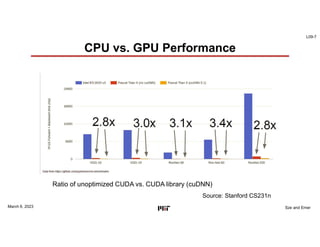
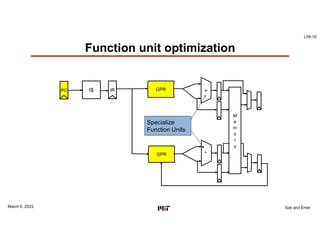
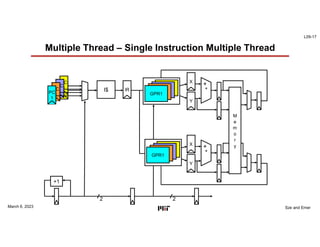
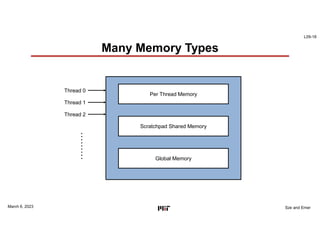
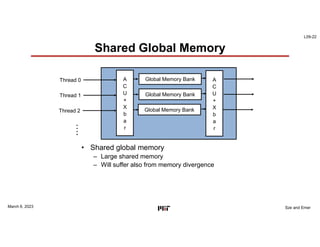
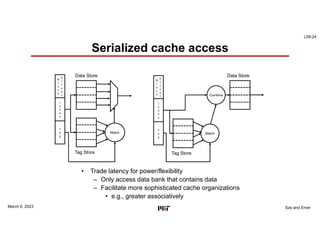
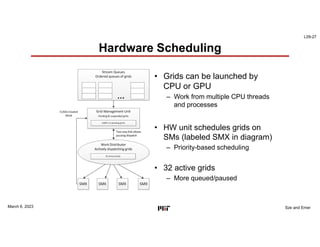
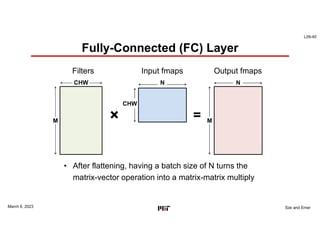
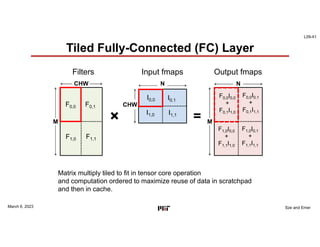
This document discusses GPU architectures for deep learning. GPUs achieve high efficiency through massive parallelism and specialized hardware. They combine CPU and ASIC approaches to find a balance between performance and programmability. GPUs employ techniques like single-instruction multiple-thread execution and specialized function units. They have a memory hierarchy including registers, shared memory, caches, and global memory. Programming models like CUDA and OpenCL allow developers to write kernels for GPU execution, though performance depends on architecture tuning. Fully-connected neural network layers are used as an example computation that maps efficiently to GPU parallelism.













![L09-31
Sze and Emer
Fully Connected Computation
F[M0 C0 H0 W0] F[M0 C0 H0 W1] …
F[M0 C0 H1 W0] F[M0 C0 H1 W1] …
F[M0 C0 H2 W0] F[M0 C0 H2 W1] …
.
.
F[M0 C1 H0 W0] F[M0 C1 H0 W1] …
F[M0 C1 H1 W0] F[M0 C1 H1 W1] …
F[M0 C1 H2 W0] F[M0 C1 H2 W1] …
.
.
.
F[M1 C0 H0 W0] F[M1 C0 H0 W1] …
F[M1 C0 H1 W0] F[M1 C0 H1 W1] …
F[M1 C0 H2 W0] F[M1 C0 H2 W1] …
.
.
.
I[C0 H0 W0] I[C0 H0 W1] …
I[C0 H1 W0] I[C0 H1 W1] …
I[C0 H2 W0] I[C0 H2 W1] …
.
.
I[C1 H0 W0] I[C1 H0 W1] …
I[C1 H1 W0] I[C1 H1 W1] …
I[C1 H2 W0] I[C1 H2 W1] …
.
.
.
March 6, 2023
int i[C*H*W]; # Input activations
int f[M*C*H*W]; # Filter Weights
int o[M]; # Output activations
for (m = 0; m < M; m++) {
o[m] = 0;
CHWm = C*H*W*m;
for (chw = 0; chw < C*H*W; chw++) {
o[m] += i[chw] * f[CHWm + chw];
}
}](https://image.slidesharecdn.com/l09-handout-230406024856-0b9de807/85/L09-handout-pdf-31-320.jpg)
![L09-32
Sze and Emer
FC - CUDA Main Program
int i[C*H*W], *gpu_i; # Input activations
int f[M*C*H*W], *gpu_f; # Filter Weights
int o[M], *gpu_o; # Output activations
# Allocate space on GPU
cudaMalloc((void**) &gpu_i, sizeof(int)*C*H*W);
cudaMalloc((void**) &gpu_f, sizeof(int)*M*C*H*W);
# Copy data to GPU
cudaMemcpy(gpu_i, i, sizeof(int)*C*H*W);
cudaMemcpy(gpu_f, f, sizeof(int)*M*C*H*W);
# Run kernel
fc<<<M/256 + 1, 256>>>(gpu_i, gpu_f, gpu_o, C*H*W, M);
# Copy result back and free device memory
cudaMemcpy(o, gpu_o, sizeof(int)*M, cudaMemCpyDevicetoHost);
cudaFree(gpu_i);
...
Thread block size
Num thread blocks
March 6, 2023](https://image.slidesharecdn.com/l09-handout-230406024856-0b9de807/85/L09-handout-pdf-32-320.jpg)
![L09-33
Sze and Emer
FC – CUDA Terminology
• CUDA code launches 256 threads per block
• CUDA vs vector terminology:
– Thread = 1 iteration of scalar loop [1 element in vector loop]
– Block = Body of vectorized loop [VL=256 in this example]
• Warp size = 32 [Number of vector lanes]
– Grid = Vectorizable loop
[ vector terminology ]
March 6, 2023](https://image.slidesharecdn.com/l09-handout-230406024856-0b9de807/85/L09-handout-pdf-33-320.jpg)
![L09-34
Sze and Emer
FC - CUDA Kernel
__global__
void fc(int *i, int *f, int *o, const int CHW, const int M){
int tid=threadIdx.x + blockIdx.x * blockDim.x;
int m = tid
int sum = 0;
if (m < M){
for (int chw=0; chw <CHW; chw ++) {
sum += i[chw]*f[(m*CHW)+chw];
}
o[m] = sum;
}
}
Any consequences of f[(m*CHW)+chw]?
Any consequences of f[(chw*M)+m]?
tid is “output
channel” number
March 6, 2023
Calculate “global
thead id (tid)](https://image.slidesharecdn.com/l09-handout-230406024856-0b9de807/85/L09-handout-pdf-34-320.jpg)



![L09-43
Sze and Emer
Vector vs GPU Terminology
March 6, 2023
[H&P5, Fig 4.25]](https://image.slidesharecdn.com/l09-handout-230406024856-0b9de807/85/L09-handout-pdf-43-320.jpg)