Primitive processing and
advanced shading architecture
for embedded space
Maxim Kazakov Eisaku Ohbuchi
Digital Media Professionals, Inc
Contributions
• Vertex cache-accelerated fixed
and variable size primitive
processing
• One-pass on-chip
implementation of various
geometry processing
algorithms
• Enables geometry
reconstruction from
compact description
• Configurable per-fragment
shading
• Dot product+LUT machine
• Various shading models can
be mapped
• On-chip material
description
• Reduced memory bandwidth requirements
• Realized in embedded-space architecture
Motivation
• Bring appealing shading to embedded space
• Make complex geometry processing available for
embedded applications
• Sufficient performance
• Meet embedded space limitations
• Minimize gate size, power consumption and memory
traffic growth
• Heterogeneous architecture as a solution
Related work
• Partially programmable IPs [Woo et al. 2004; Donghyun Kim 2005; Imai et al. 2004;
Kameyama et al. 2003] gradually replaced by programmable [IMG, NVIDIA,ARM etc] ones
• Subdivision/high-order surfaces tessellation as geometry compression
• Specifically tailored solutions [Uesaki et al. 2004; Pedersen 2004]
• Multipass techniques [Shiue et al. 2005;Andrews and Baker 2006]
• Geometry shader-based ones [Loop et al. 2009]
• Real-time BRDF rendering
• BRDF factorization into 2D functions [Heidrich and Seidel 1999]
• Half vector-based parametrizations [Kautz and McCool 1999]
• Factorization into combination of 1D functions [Lawrence et al. 2004; Lawrence et al.
2006]
• Fixed HW implementation for certain shading models [Ohbuchi and Unno 2002]
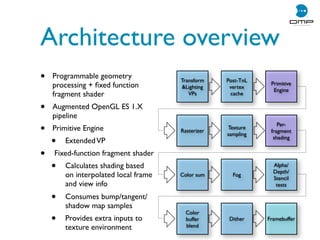
Architecture overview
• Programmable geometry
processing + fixed function
fragment shader
• Augmented OpenGL ES 1.X
pipeline
• Primitive Engine
• ExtendedVP
• Fixed-function fragment shader
• Calculates shading based
on interpolated local frame
and view info
• Consumes bump/tangent/
shadow map samples
• Provides extra inputs to
texture environment
Primitive
Engine
Transform
&Lighting
VPs
Post-TnL
vertex
cache
Rasterizer
Texture
sampling
Per-
fragment
shading
Color sum Fog
Alpha/
Depth/
Stencil
tests
Color
buffer
blend
Dither Framebuffer
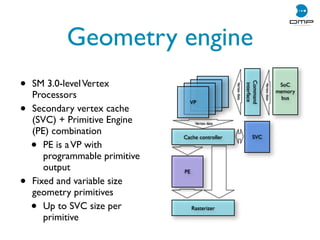
Geometry engine
• SM 3.0-levelVertex
Processors
• Secondary vertex cache
(SVC) + Primitive Engine
(PE) combination
• PE is aVP with
programmable primitive
output
• Fixed and variable size
geometry primitives
• Up to SVC size per
primitive
Command
interface
VP
Vertexdata
Cache controller SVC
Rasterizer
PE
Vertex data
SoC
memory
bus
Vertexdata
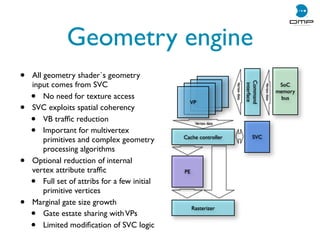
Geometry engine
• All geometry shader`s geometry
input comes from SVC
• No need for texture access
• SVC exploits spatial coherency
• VB traffic reduction
• Important for multivertex
primitives and complex geometry
processing algorithms
• Optional reduction of internal
vertex attribute traffic
• Full set of attribs for a few initial
primitive vertices
• Marginal gate size growth
• Gate estate sharing withVPs
• Limited modification of SVC logic
Command
interface
VP
Vertexdata
Cache controller SVC
Rasterizer
PE
Vertex data
SoC
memory
bus
Vertexdata
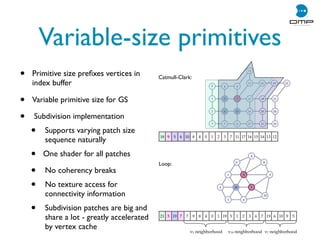
Variable-size primitives
• Primitive size prefixes vertices in
index buffer
• Variable primitive size for GS
• Subdivision implementation
• Supports varying patch size
sequence naturally
• One shader for all patches
• No coherency breaks
• No texture access for
connectivity information
• Subdivision patches are big and
share a lot - greatly accelerated
by vertex cache
1
4 8
2
3
6
5 9
10
7 11
13
15
16
17
0
12
14
19
20
21
23
24
25
18 22
8
10
4
19
63
0
2
1 9
7
5
18 9 5 6 10 8 4 0 1 2 3 7 11 17 16 15 14 13 12
Catmull-Clark:
21 5 19 7 7 9 8 4 0 1 19 5 1 2 3 6 7 19 6 10 9 5
v5 neighborhood v19 neighborhood v7 neighborhood
Loop:
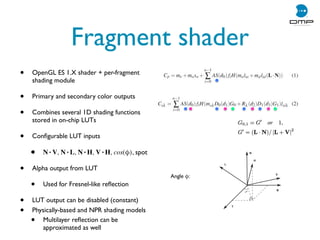
Fragment shader
• OpenGL ES 1.X shader + per-fragment
shading module
• Primary and secondary color outputs
• Combines several 1D shading functions
stored in on-chip LUTs
• Configurable LUT inputs
• N·V, N·L, N·H, V·H, cos(φ), spot
• Alpha output from LUT
• Used for Fresnel-like reflection
• LUT output can be disabled (constant)
• Physically-based and NPR shading models
• Multilayer reflection can be
approximated as well
G0,1 = G
or 1,
G
= (L · N)/ |L + V|
2
L
V
N
H
φ
T
B
Angle φ:
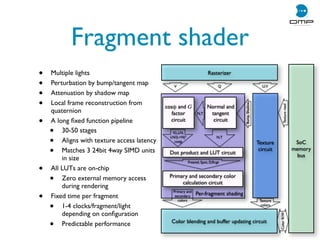
Fragment shader
• Multiple lights
• Perturbation by bump/tangent map
• Attenuation by shadow map
• Local frame reconstruction from
quaternion
• A long fixed function pipeline
• 30-50 stages
• Aligns with texture access latency
• Matches 3 24bit 4way SIMD units
in size
• All LUTs are on-chip
• Zero external memory access
during rendering
• Fixed time per fragment
• 1-4 clocks/fragment/light
depending on configuration
• Predictable performance
Rasterizer
Texture
circuit
Per-fragment shading
cosφ and G
factor
circuit
Normal and
tangent
circuit
Dot product and LUT circuit
Primary and secondary color
calculation circuit
SoC
memory
bus
Color blending and buffer updating circuit
U,VV Q
N,T
N,T
V,L,LN,
LN/|L+N|2
cosφ
Bump,Shadow
Fresnel, Spot, D,Rrgb
Primary and
secondary
colors Texture
colors
Textureread
ColorR/W
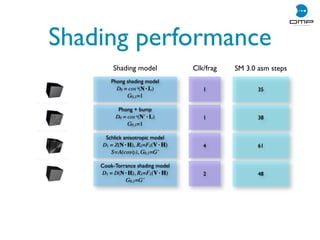
Shading performance
Shading model Clk/frag SM 3.0 asm steps
Phong shading model
D0 = cos s(N·L)
G0,1=1
1 35
Phong + bump
D0 = cos s(N’·L)
G0,1=1
1 38
Schlick anisotropic model
D1 = Z(N·H), Rλ=Fλ(V·H)
S=A(cosφ), G0,1=G’
4 61
Cook-Torrance shading model
D1 = D(N·H), Rλ=Fλ(V·H)
G0,1=G’
2 48
1.X API
• Dedicated APIs in the case of 1.X
library
• In spirit of 1.X API for FS
• Light reflection environment
(similar to texture
environment)
• 8 API functions
• Per-fragment shading and
LUT management
• A lot of extra tokens
• Preconfigured geometry shaders
selected according to a primitive
type
• Subdivision, silhouette, particle
systems
glActiveLightDMP ( GL_LIGHT0_DMP ) ;
glLightEnviDMP ( GL_LIGHT_ENV_LUT_INPUT_SELECTOR_D0_DMP
, GL_LIGHT_ENV_LN_DMP ) ;
glLightEnviDMP ( GL_LIGHT_ENV_LAYER_CONFIG_DMP
, GL_LIGHT_ENV_LAYER_CONFIG0_DMP ) ;
glLightEnviDMP ( GL_LIGHT_ENV_GEOM_FACTOR0_DMP, GL_FALSE ) ;
GLfloat lut[512] ;
for ( j = 1 ; j  128 ; j++ ){
! lut[j] = powf( (float)j/127.f, 30.f ) ;
! lut[j+255] = lut[j] - lut[j-1] ;
}
glMaterialLutDMP ( 2, lut ) ;
glMaterialfv ( GL_FRAGMENT_FRONT_AND_BACK_DMP
, GL_MATERIAL_LUT_D0_DMP, 2 ) ;
GLushort indices[] = {
! ! 14, 0, 1, 2, 3, 4, 5, 6, 7, 8, 9, 10, 11, 12, 13
! ! } ;
glDrawElements ( GL_SUBD_PRIM_DMP, 15
, GL_UNSIGNED_SHORT, indices ) ;
2.0 API
• Preinstalled fragment shader
object
• Exposes predefined (~200)
uniforms for all parameters of
fragment pipeline
• Predefined attributes for
binding withVS/GS
• GL program objects are great
in setting all params with a
single glUseProgram call
• Other extensions to switch a
set of LUTs in one call
• Minimal modifications of app/
content creation chain
glAttachShader( progid, GL_DMP_FRAGMENT_SHADER_DMP );
glUniform1i( glGetUniformLocation( progid
, dmp_LightEnv.lutInputD0)
, GL_LIGHT_ENV_LN_DMP );
glUniform1i( glGetUniformLocation( progid
, dmp_LightEnv.config)
, GL_LIGHT_ENV_LAYER_CONFIG0_DMP );
glUniform1i( glGetUniformLocation( progid
, dmp_FragmentLightSource[0].geomFactor0), GL_FALSE);
GLfloat lut[512] ;
for ( j = 1 ; j  128 ; j++ ){
! lut[j] = powf( (float)j/127.f, 30.f ) ;
! lut[j+255] = lut[j] - lut[j-1] ;
}
glBindTexture(GL_LUT_TEXTURE0_DMP, lutid);
glTexImage1D( GL_LUT_TEXTURE0_DMP, 0, GL_LUMINANCEF_DMP, 512, 0
, GL_LUMINANCEF_DMP, GL_FLOAT, lut);
glUniform1i( glGetUniformLocation( progid
, dmp_FragmentMaterial.samplerD0), 0);
varying vec3 dmp_lrView;
varying vec3 dmp_lrQuat;
....
dmp_lrView! = -gl_Position.xyz;
gl_Position = u_projection_matrix * gl_Position;
gl_TexCoord[1] = vec4(a_texcoord1.x, a_texcoord1.y, 0.0, 1.0);
gl_FrontColor = u_material_constant_color0;
2.0 API
• StandardVS shader API
• GL 3.2-like GS API
• Extended primitive type
for variable-size and
non-standard fixed-size
ones
• GLSL`s gl_VerticesIn is
not a constant
GLushort indices[] = {
! ! 14, 0, 1, 2, 3, 4, 5, 6, 7, 8, 9, 10, 11, 12, 13
! ! } ;
glUniform1f( glGetUniformLocation(progid
, subdivisionlevel), 2);
glDrawElements( GL_GEOMETRY_PRIMITIVE_DMP, 15
, GL_UNSIGNED_SHORT, indices ) ;
void main(void){
vec4 sc, se, v20 ;
float val = (gl_VerticesIn-8)/2 ;
if ( 3.0==val ) { // valence 3
sc = gl_PositionIn[2] + gl_PositionIn[4] + gl_PositionIn[12] ;
se = gl_PositionIn[1] + gl_PositionIn[3] +
gl_PositionIn[gl_VerticesIn-1] ;
e00 = gl_PositionIn[gl_VerticesIn-1] ;
e0k04 = gl_PositionIn[3] ;
c0k04 = gl_PositionIn[12];
} else { // 4 or more
sc = sumc() ;
se = sume() ;
e00 != gl_PositionIn[13];
e0k04! = gl_PositionIn[3] ;
c0k04! = gl_PositionIn[gl_VerticesIn-2];
}
...
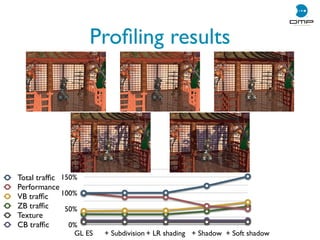
Profiling results
0%
50%
100%
150%
GL ES + Subdivision + LR shading + Shadow + Soft shadow
Total traffic
Performance
VB traffic
ZB traffic
Texture
CB traffic
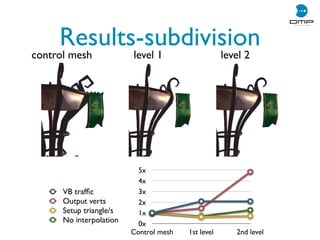
Results-subdivision
0x
1x
2x
3x
4x
5x
Control mesh 1st level 2nd level
VB traffic
Output verts
Setup triangle/s
No interpolation
control mesh level 1 level 2
Results-subdivision
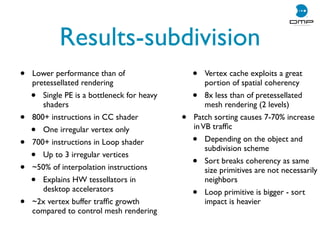
• Lower performance than of
pretessellated rendering
• Single PE is a bottleneck for heavy
shaders
• 800+ instructions in CC shader
• One irregular vertex only
• 700+ instructions in Loop shader
• Up to 3 irregular vertices
• ~50% of interpolation instructions
• Explains HW tessellators in
desktop accelerators
• ~2x vertex buffer traffic growth
compared to control mesh rendering
• Vertex cache exploits a great
portion of spatial coherency
• 8x less than of pretessellated
mesh rendering (2 levels)
• Patch sorting causes 7-70% increase
inVB traffic
• Depending on the object and
subdivision scheme
• Sort breaks coherency as same
size primitives are not necessarily
neighbors
• Loop primitive is bigger - sort
impact is heavier
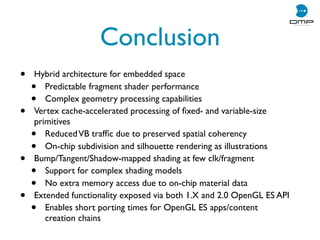
Conclusion
• Hybrid architecture for embedded space
• Predictable fragment shader performance
• Complex geometry processing capabilities
• Vertex cache-accelerated processing of fixed- and variable-size
primitives
• ReducedVB traffic due to preserved spatial coherency
• On-chip subdivision and silhouette rendering as illustrations
• Bump/Tangent/Shadow-mapped shading at few clk/fragment
• Support for complex shading models
• No extra memory access due to on-chip material data
• Extended functionality exposed via both 1.X and 2.0 OpenGL ES API
• Enables short porting times for OpenGL ES apps/content
creation chains

Hpg2011 papers kazakov

  • 1.
    Primitive processing and advancedshading architecture for embedded space Maxim Kazakov Eisaku Ohbuchi Digital Media Professionals, Inc
  • 2.
    Contributions • Vertex cache-acceleratedfixed and variable size primitive processing • One-pass on-chip implementation of various geometry processing algorithms • Enables geometry reconstruction from compact description • Configurable per-fragment shading • Dot product+LUT machine • Various shading models can be mapped • On-chip material description • Reduced memory bandwidth requirements • Realized in embedded-space architecture
  • 3.
    Motivation • Bring appealingshading to embedded space • Make complex geometry processing available for embedded applications • Sufficient performance • Meet embedded space limitations • Minimize gate size, power consumption and memory traffic growth • Heterogeneous architecture as a solution
  • 4.
    Related work • Partiallyprogrammable IPs [Woo et al. 2004; Donghyun Kim 2005; Imai et al. 2004; Kameyama et al. 2003] gradually replaced by programmable [IMG, NVIDIA,ARM etc] ones • Subdivision/high-order surfaces tessellation as geometry compression • Specifically tailored solutions [Uesaki et al. 2004; Pedersen 2004] • Multipass techniques [Shiue et al. 2005;Andrews and Baker 2006] • Geometry shader-based ones [Loop et al. 2009] • Real-time BRDF rendering • BRDF factorization into 2D functions [Heidrich and Seidel 1999] • Half vector-based parametrizations [Kautz and McCool 1999] • Factorization into combination of 1D functions [Lawrence et al. 2004; Lawrence et al. 2006] • Fixed HW implementation for certain shading models [Ohbuchi and Unno 2002]
  • 5.
    Architecture overview • Programmablegeometry processing + fixed function fragment shader • Augmented OpenGL ES 1.X pipeline • Primitive Engine • ExtendedVP • Fixed-function fragment shader • Calculates shading based on interpolated local frame and view info • Consumes bump/tangent/ shadow map samples • Provides extra inputs to texture environment Primitive Engine Transform &Lighting VPs Post-TnL vertex cache Rasterizer Texture sampling Per- fragment shading Color sum Fog Alpha/ Depth/ Stencil tests Color buffer blend Dither Framebuffer
  • 6.
    Geometry engine • SM3.0-levelVertex Processors • Secondary vertex cache (SVC) + Primitive Engine (PE) combination • PE is aVP with programmable primitive output • Fixed and variable size geometry primitives • Up to SVC size per primitive Command interface VP Vertexdata Cache controller SVC Rasterizer PE Vertex data SoC memory bus Vertexdata
  • 7.
    Geometry engine • Allgeometry shader`s geometry input comes from SVC • No need for texture access • SVC exploits spatial coherency • VB traffic reduction • Important for multivertex primitives and complex geometry processing algorithms • Optional reduction of internal vertex attribute traffic • Full set of attribs for a few initial primitive vertices • Marginal gate size growth • Gate estate sharing withVPs • Limited modification of SVC logic Command interface VP Vertexdata Cache controller SVC Rasterizer PE Vertex data SoC memory bus Vertexdata
  • 8.
    Variable-size primitives • Primitivesize prefixes vertices in index buffer • Variable primitive size for GS • Subdivision implementation • Supports varying patch size sequence naturally • One shader for all patches • No coherency breaks • No texture access for connectivity information • Subdivision patches are big and share a lot - greatly accelerated by vertex cache 1 4 8 2 3 6 5 9 10 7 11 13 15 16 17 0 12 14 19 20 21 23 24 25 18 22 8 10 4 19 63 0 2 1 9 7 5 18 9 5 6 10 8 4 0 1 2 3 7 11 17 16 15 14 13 12 Catmull-Clark: 21 5 19 7 7 9 8 4 0 1 19 5 1 2 3 6 7 19 6 10 9 5 v5 neighborhood v19 neighborhood v7 neighborhood Loop:
  • 9.
    Fragment shader • OpenGLES 1.X shader + per-fragment shading module • Primary and secondary color outputs • Combines several 1D shading functions stored in on-chip LUTs • Configurable LUT inputs • N·V, N·L, N·H, V·H, cos(φ), spot • Alpha output from LUT • Used for Fresnel-like reflection • LUT output can be disabled (constant) • Physically-based and NPR shading models • Multilayer reflection can be approximated as well G0,1 = G or 1, G = (L · N)/ |L + V| 2 L V N H φ T B Angle φ:
  • 10.
    Fragment shader • Multiplelights • Perturbation by bump/tangent map • Attenuation by shadow map • Local frame reconstruction from quaternion • A long fixed function pipeline • 30-50 stages • Aligns with texture access latency • Matches 3 24bit 4way SIMD units in size • All LUTs are on-chip • Zero external memory access during rendering • Fixed time per fragment • 1-4 clocks/fragment/light depending on configuration • Predictable performance Rasterizer Texture circuit Per-fragment shading cosφ and G factor circuit Normal and tangent circuit Dot product and LUT circuit Primary and secondary color calculation circuit SoC memory bus Color blending and buffer updating circuit U,VV Q N,T N,T V,L,LN, LN/|L+N|2 cosφ Bump,Shadow Fresnel, Spot, D,Rrgb Primary and secondary colors Texture colors Textureread ColorR/W
  • 11.
    Shading performance Shading modelClk/frag SM 3.0 asm steps Phong shading model D0 = cos s(N·L) G0,1=1 1 35 Phong + bump D0 = cos s(N’·L) G0,1=1 1 38 Schlick anisotropic model D1 = Z(N·H), Rλ=Fλ(V·H) S=A(cosφ), G0,1=G’ 4 61 Cook-Torrance shading model D1 = D(N·H), Rλ=Fλ(V·H) G0,1=G’ 2 48
  • 12.
    1.X API • DedicatedAPIs in the case of 1.X library • In spirit of 1.X API for FS • Light reflection environment (similar to texture environment) • 8 API functions • Per-fragment shading and LUT management • A lot of extra tokens • Preconfigured geometry shaders selected according to a primitive type • Subdivision, silhouette, particle systems glActiveLightDMP ( GL_LIGHT0_DMP ) ; glLightEnviDMP ( GL_LIGHT_ENV_LUT_INPUT_SELECTOR_D0_DMP , GL_LIGHT_ENV_LN_DMP ) ; glLightEnviDMP ( GL_LIGHT_ENV_LAYER_CONFIG_DMP , GL_LIGHT_ENV_LAYER_CONFIG0_DMP ) ; glLightEnviDMP ( GL_LIGHT_ENV_GEOM_FACTOR0_DMP, GL_FALSE ) ; GLfloat lut[512] ; for ( j = 1 ; j 128 ; j++ ){ ! lut[j] = powf( (float)j/127.f, 30.f ) ; ! lut[j+255] = lut[j] - lut[j-1] ; } glMaterialLutDMP ( 2, lut ) ; glMaterialfv ( GL_FRAGMENT_FRONT_AND_BACK_DMP , GL_MATERIAL_LUT_D0_DMP, 2 ) ; GLushort indices[] = { ! ! 14, 0, 1, 2, 3, 4, 5, 6, 7, 8, 9, 10, 11, 12, 13 ! ! } ; glDrawElements ( GL_SUBD_PRIM_DMP, 15 , GL_UNSIGNED_SHORT, indices ) ;
  • 13.
    2.0 API • Preinstalledfragment shader object • Exposes predefined (~200) uniforms for all parameters of fragment pipeline • Predefined attributes for binding withVS/GS • GL program objects are great in setting all params with a single glUseProgram call • Other extensions to switch a set of LUTs in one call • Minimal modifications of app/ content creation chain glAttachShader( progid, GL_DMP_FRAGMENT_SHADER_DMP ); glUniform1i( glGetUniformLocation( progid , dmp_LightEnv.lutInputD0) , GL_LIGHT_ENV_LN_DMP ); glUniform1i( glGetUniformLocation( progid , dmp_LightEnv.config) , GL_LIGHT_ENV_LAYER_CONFIG0_DMP ); glUniform1i( glGetUniformLocation( progid , dmp_FragmentLightSource[0].geomFactor0), GL_FALSE); GLfloat lut[512] ; for ( j = 1 ; j 128 ; j++ ){ ! lut[j] = powf( (float)j/127.f, 30.f ) ; ! lut[j+255] = lut[j] - lut[j-1] ; } glBindTexture(GL_LUT_TEXTURE0_DMP, lutid); glTexImage1D( GL_LUT_TEXTURE0_DMP, 0, GL_LUMINANCEF_DMP, 512, 0 , GL_LUMINANCEF_DMP, GL_FLOAT, lut); glUniform1i( glGetUniformLocation( progid , dmp_FragmentMaterial.samplerD0), 0); varying vec3 dmp_lrView; varying vec3 dmp_lrQuat; .... dmp_lrView! = -gl_Position.xyz; gl_Position = u_projection_matrix * gl_Position; gl_TexCoord[1] = vec4(a_texcoord1.x, a_texcoord1.y, 0.0, 1.0); gl_FrontColor = u_material_constant_color0;
  • 14.
    2.0 API • StandardVSshader API • GL 3.2-like GS API • Extended primitive type for variable-size and non-standard fixed-size ones • GLSL`s gl_VerticesIn is not a constant GLushort indices[] = { ! ! 14, 0, 1, 2, 3, 4, 5, 6, 7, 8, 9, 10, 11, 12, 13 ! ! } ; glUniform1f( glGetUniformLocation(progid , subdivisionlevel), 2); glDrawElements( GL_GEOMETRY_PRIMITIVE_DMP, 15 , GL_UNSIGNED_SHORT, indices ) ; void main(void){ vec4 sc, se, v20 ; float val = (gl_VerticesIn-8)/2 ; if ( 3.0==val ) { // valence 3 sc = gl_PositionIn[2] + gl_PositionIn[4] + gl_PositionIn[12] ; se = gl_PositionIn[1] + gl_PositionIn[3] + gl_PositionIn[gl_VerticesIn-1] ; e00 = gl_PositionIn[gl_VerticesIn-1] ; e0k04 = gl_PositionIn[3] ; c0k04 = gl_PositionIn[12]; } else { // 4 or more sc = sumc() ; se = sume() ; e00 != gl_PositionIn[13]; e0k04! = gl_PositionIn[3] ; c0k04! = gl_PositionIn[gl_VerticesIn-2]; } ...
  • 15.
    Profiling results 0% 50% 100% 150% GL ES+ Subdivision + LR shading + Shadow + Soft shadow Total traffic Performance VB traffic ZB traffic Texture CB traffic
  • 16.
    Results-subdivision 0x 1x 2x 3x 4x 5x Control mesh 1stlevel 2nd level VB traffic Output verts Setup triangle/s No interpolation control mesh level 1 level 2
  • 17.
    Results-subdivision • Lower performancethan of pretessellated rendering • Single PE is a bottleneck for heavy shaders • 800+ instructions in CC shader • One irregular vertex only • 700+ instructions in Loop shader • Up to 3 irregular vertices • ~50% of interpolation instructions • Explains HW tessellators in desktop accelerators • ~2x vertex buffer traffic growth compared to control mesh rendering • Vertex cache exploits a great portion of spatial coherency • 8x less than of pretessellated mesh rendering (2 levels) • Patch sorting causes 7-70% increase inVB traffic • Depending on the object and subdivision scheme • Sort breaks coherency as same size primitives are not necessarily neighbors • Loop primitive is bigger - sort impact is heavier
  • 18.
    Conclusion • Hybrid architecturefor embedded space • Predictable fragment shader performance • Complex geometry processing capabilities • Vertex cache-accelerated processing of fixed- and variable-size primitives • ReducedVB traffic due to preserved spatial coherency • On-chip subdivision and silhouette rendering as illustrations • Bump/Tangent/Shadow-mapped shading at few clk/fragment • Support for complex shading models • No extra memory access due to on-chip material data • Extended functionality exposed via both 1.X and 2.0 OpenGL ES API • Enables short porting times for OpenGL ES apps/content creation chains