Developing a Continuous
Improvement Plan for Your
Clinical and Safety Systems
                  November 5, 2012

                  Parambir Singh
                  Vice President of
                  Clinical Trial Management Solutions
                  BioPharm Systems


              1                          PREVIOUS
                                         PREVIOUS       NEXT
                                                        NEXT
Welcome & Introductions

Param Singh
Vice President of Clinical Trial Management Solutions
BioPharm Systems, Inc.
• CTMS practice director since 2007
   – Expertise in managing all phases and styles of clinical trials
   – Leads the team that implements, supports, and enhances Oracle’s
     LabPas and Siebel Clinical solutions
• Extensive Siebel Clinical implementation experience
   – 11+ years of experience implementing Siebel Clinical
   – 15+ implementations
   – Spearheaded the creation of the Siebel Clinical “accelerator”
     ASCEND
                                    2                        PREVIOUS
                                                             PREVIOUS   NEXT
                                                                        NEXT
Agenda

• Importance of a Continuous Improvement Plan
    – Establish Change Control Board
    – Define Enhancement Processes
• Sources of Input
    – Meetings & Frequency
•   How to Manage Enhancements
•   How to Prioritize Enhancements
•   When to Make Enhancements
•   Best Practices for Continuous Improvement Plans
•   Q&A

                                  3               PREVIOUS
                                                  PREVIOUS   NEXT
                                                             NEXT
Common Scenario

•   Just completed the initial system implementation
•   End users are trained, but not yet in the system
•   Not all desired requirements included in the initial release
•   May potentially roll out the system to other business units
•   The annual project budget meeting is coming up

                      WHAT TO DO NEXT?


                                 4                     PREVIOUS
                                                       PREVIOUS    NEXT
                                                                   NEXT
Importance of a Continuous Improvement Plan

• Bridges the gap for post production support
• Less anxious end users
• Helps focus on business critical requirements
• Encourages end user communication and feedback
• Allows system to be flexible if business process changes
• Establishes an objective way to evaluate potential
  enhancements
• Increases system acceptance and usability


                              5                   PREVIOUS
                                                  PREVIOUS   NEXT
                                                             NEXT
Establish Change Control Board

                          Business
                       Representative
         Clinical                       IT Project
       Administrator                    Manager


                        Change
                        Control
                         Board


                              6                      PREVIOUS
                                                     PREVIOUS   NEXT
                                                                NEXT
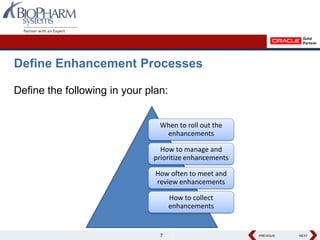
Define Enhancement Processes

Define the following in your plan:


                                When to roll out the
                                 enhancements

                                How to manage and
                              prioritize enhancements

                               How often to meet and
                               review enhancements

                                     How to collect
                                     enhancements


                                7                       PREVIOUS
                                                        PREVIOUS   NEXT
                                                                   NEXT
Sources of Input

                               Deferred
                             Requirements

                User
             Community                      User Feedback
             Conference

                             Enhancement
                              Request Log


            Infrastructure
                                            Help Desk Log
              Roadmap


                               Training
                              Feedback


                                   8                        PREVIOUS
                                                            PREVIOUS   NEXT
                                                                       NEXT
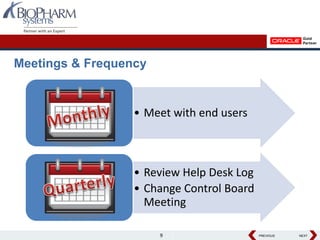
Meetings & Frequency


                  • Meet with end users


                  • Review Help Desk Log
                  • Change Control Board
                    Meeting

                       9                   PREVIOUS
                                           PREVIOUS   NEXT
                                                      NEXT
How to Manage Enhancements

• Use a spreadsheet to track requests
• Categorize each request as an enhancement or defect
• Assess each request from different perspectives
   –   Business operation criticality
   –   Design/development complexity
   –   Validation effort
   –   Impacted modules and upgrade risks


                                  10            PREVIOUS
                                                PREVIOUS   NEXT
                                                           NEXT
Assess by Business Operation Criticality

•   Identify business requestor
•   Capture clear business request details
•   Provide justification for enhancement
•   Determine impact on daily operations
•   Identify potential alternatives/workarounds
•   Capture request date
•   Capture requestor’s initial priority ranking on the
    enhancement


                                 11                       PREVIOUS
                                                          PREVIOUS   NEXT
                                                                     NEXT
Assess by Design/Development Complexity

•   Level of effort required
•   Custom coding needs
•   Leverage in-house resources
•   Fit with current system architecture
•   Identify alternative approaches


                                12         PREVIOUS
                                           PREVIOUS   NEXT
                                                      NEXT
Assess by Validation Effort

• Level of validation required
• Validation scenario complexity
• Regression testing needs


                             13    PREVIOUS
                                   PREVIOUS   NEXT
                                              NEXT
Assess by Impacted Modules and Upgrade Risks

•   Impact on existing functionality
•   Number of modules impacted
•   Impact on existing integration
•   Impact on future upgrades


                                 14    PREVIOUS
                                       PREVIOUS   NEXT
                                                  NEXT
How to Prioritize Enhancements

• Provide business justification
• All business units should evaluate
• Rank requirements by level of importance
   – High / Medium / Low
   – Numerical
      • For example, in a 10 item enhancement list, ask users to rank them
        from 1 to 10, and with no two items sharing the same ranking (all
        unique)


                                     15                         PREVIOUS
                                                                PREVIOUS     NEXT
                                                                             NEXT
When to Make Enhancements

• Initial Enhancements
   – At least 3 months after the initial release
   – Provide end users an opportunity to get familiar with the system
   – Provides time to gather and refine list of enhancements
• Subsequent Releases
   – Depend on budget available
   – May have minor releases every 3 or 6 months
   – Can roll the enhancements in with a major release such as
     integration


                                   16                        PREVIOUS
                                                             PREVIOUS   NEXT
                                                                        NEXT
Continuous Improvement Process

                               Collect
                           enhancement list


                                               Review, assess,
         Kickoff project                        and prioritize
                                              enhancement list


             Create change              Determine scope
             control charter               of project


                                  17                             PREVIOUS
                                                                 PREVIOUS   NEXT
                                                                            NEXT
Best Practices for Continuous Improvement Plans

• Start thinking of the plan prior to the initial go-live
• Schedule recurring meetings to establish the continuous
  improvement process
• After initial release, ensure users have a chance to use the
  system and understand its functionality before planning
  any additional releases
• Note: The continuous improvement process can also result
  in non-system changes, such as training material updates,
  business process re-engineering, etc.


                              18                    PREVIOUS
                                                    PREVIOUS   NEXT
                                                               NEXT
Thank you for attending!

Questions?


                       19   PREVIOUS
                            PREVIOUS   NEXT
                                       NEXT
Contact Us

• North America Sales Contact:
   – Rod Roderick
   – rroderick@biopharm.com
   – +1 877 654 0033
• Europe/Middle East/Africa Sales Contact:
   – Rudolf Coetzee
   – rcoetzee@biopharm.com
   – +44 (0) 1865 910200
• General Inquiries:
   – info@biopharm.com

                              20             PREVIOUS
                                             PREVIOUS   NEXT
                                                        NEXT
Presenter – Param Singh

• Contact
   – psingh@biopharm.com
   – +1 210 454 5192
Param has been working in the life sciences industry his
entire career. As vice president of CTMS at BioPharm, he
developed the CTMS practice to become one of the best in
the industry.
With a knack for resource and project management, Param
leads a highly skilled team of implementation specialists and
continues to build lasting relationships with clients.

                               21                   PREVIOUS
                                                    PREVIOUS    NEXT
                                                                NEXT

Developing a Continuous Improvement Plan for Your Clinical and Safety Systems

  • 1.
    Developing a Continuous ImprovementPlan for Your Clinical and Safety Systems November 5, 2012 Parambir Singh Vice President of Clinical Trial Management Solutions BioPharm Systems 1 PREVIOUS PREVIOUS NEXT NEXT
  • 2.
    Welcome & Introductions ParamSingh Vice President of Clinical Trial Management Solutions BioPharm Systems, Inc. • CTMS practice director since 2007 – Expertise in managing all phases and styles of clinical trials – Leads the team that implements, supports, and enhances Oracle’s LabPas and Siebel Clinical solutions • Extensive Siebel Clinical implementation experience – 11+ years of experience implementing Siebel Clinical – 15+ implementations – Spearheaded the creation of the Siebel Clinical “accelerator” ASCEND 2 PREVIOUS PREVIOUS NEXT NEXT
  • 3.
    Agenda • Importance ofa Continuous Improvement Plan – Establish Change Control Board – Define Enhancement Processes • Sources of Input – Meetings & Frequency • How to Manage Enhancements • How to Prioritize Enhancements • When to Make Enhancements • Best Practices for Continuous Improvement Plans • Q&A 3 PREVIOUS PREVIOUS NEXT NEXT
  • 4.
    Common Scenario • Just completed the initial system implementation • End users are trained, but not yet in the system • Not all desired requirements included in the initial release • May potentially roll out the system to other business units • The annual project budget meeting is coming up WHAT TO DO NEXT? 4 PREVIOUS PREVIOUS NEXT NEXT
  • 5.
    Importance of aContinuous Improvement Plan • Bridges the gap for post production support • Less anxious end users • Helps focus on business critical requirements • Encourages end user communication and feedback • Allows system to be flexible if business process changes • Establishes an objective way to evaluate potential enhancements • Increases system acceptance and usability 5 PREVIOUS PREVIOUS NEXT NEXT
  • 6.
    Establish Change ControlBoard Business Representative Clinical IT Project Administrator Manager Change Control Board 6 PREVIOUS PREVIOUS NEXT NEXT
  • 7.
    Define Enhancement Processes Definethe following in your plan: When to roll out the enhancements How to manage and prioritize enhancements How often to meet and review enhancements How to collect enhancements 7 PREVIOUS PREVIOUS NEXT NEXT
  • 8.
    Sources of Input Deferred Requirements User Community User Feedback Conference Enhancement Request Log Infrastructure Help Desk Log Roadmap Training Feedback 8 PREVIOUS PREVIOUS NEXT NEXT
  • 9.
    Meetings & Frequency • Meet with end users • Review Help Desk Log • Change Control Board Meeting 9 PREVIOUS PREVIOUS NEXT NEXT
  • 10.
    How to ManageEnhancements • Use a spreadsheet to track requests • Categorize each request as an enhancement or defect • Assess each request from different perspectives – Business operation criticality – Design/development complexity – Validation effort – Impacted modules and upgrade risks 10 PREVIOUS PREVIOUS NEXT NEXT
  • 11.
    Assess by BusinessOperation Criticality • Identify business requestor • Capture clear business request details • Provide justification for enhancement • Determine impact on daily operations • Identify potential alternatives/workarounds • Capture request date • Capture requestor’s initial priority ranking on the enhancement 11 PREVIOUS PREVIOUS NEXT NEXT
  • 12.
    Assess by Design/DevelopmentComplexity • Level of effort required • Custom coding needs • Leverage in-house resources • Fit with current system architecture • Identify alternative approaches 12 PREVIOUS PREVIOUS NEXT NEXT
  • 13.
    Assess by ValidationEffort • Level of validation required • Validation scenario complexity • Regression testing needs 13 PREVIOUS PREVIOUS NEXT NEXT
  • 14.
    Assess by ImpactedModules and Upgrade Risks • Impact on existing functionality • Number of modules impacted • Impact on existing integration • Impact on future upgrades 14 PREVIOUS PREVIOUS NEXT NEXT
  • 15.
    How to PrioritizeEnhancements • Provide business justification • All business units should evaluate • Rank requirements by level of importance – High / Medium / Low – Numerical • For example, in a 10 item enhancement list, ask users to rank them from 1 to 10, and with no two items sharing the same ranking (all unique) 15 PREVIOUS PREVIOUS NEXT NEXT
  • 16.
    When to MakeEnhancements • Initial Enhancements – At least 3 months after the initial release – Provide end users an opportunity to get familiar with the system – Provides time to gather and refine list of enhancements • Subsequent Releases – Depend on budget available – May have minor releases every 3 or 6 months – Can roll the enhancements in with a major release such as integration 16 PREVIOUS PREVIOUS NEXT NEXT
  • 17.
    Continuous Improvement Process Collect enhancement list Review, assess, Kickoff project and prioritize enhancement list Create change Determine scope control charter of project 17 PREVIOUS PREVIOUS NEXT NEXT
  • 18.
    Best Practices forContinuous Improvement Plans • Start thinking of the plan prior to the initial go-live • Schedule recurring meetings to establish the continuous improvement process • After initial release, ensure users have a chance to use the system and understand its functionality before planning any additional releases • Note: The continuous improvement process can also result in non-system changes, such as training material updates, business process re-engineering, etc. 18 PREVIOUS PREVIOUS NEXT NEXT
  • 19.
    Thank you forattending! Questions? 19 PREVIOUS PREVIOUS NEXT NEXT
  • 20.
    Contact Us • NorthAmerica Sales Contact: – Rod Roderick – rroderick@biopharm.com – +1 877 654 0033 • Europe/Middle East/Africa Sales Contact: – Rudolf Coetzee – rcoetzee@biopharm.com – +44 (0) 1865 910200 • General Inquiries: – info@biopharm.com 20 PREVIOUS PREVIOUS NEXT NEXT
  • 21.
    Presenter – ParamSingh • Contact – psingh@biopharm.com – +1 210 454 5192 Param has been working in the life sciences industry his entire career. As vice president of CTMS at BioPharm, he developed the CTMS practice to become one of the best in the industry. With a knack for resource and project management, Param leads a highly skilled team of implementation specialists and continues to build lasting relationships with clients. 21 PREVIOUS PREVIOUS NEXT NEXT