第九屆台灣靜電放電防護技術暨可靠度技術研討會 
2010 Taiwan ESD and Reliability Conference 
SCR based on-chip ESD protection for LNA’s in 90nm and 40nm CMOS 
B. Keppens, I. Backers, J. Binnemans, B. Sorgeloos, O. Marichal, K. Verhaege 
Sofics BVBA 
BD@sofics.com 
Scan the code and get additional related content: Download PDF version, find relevant datasheets, similar content or a link to presentation
2 
第九屆台灣靜電放電防護技術暨可靠度技術研討會 
2010 Taiwan ESD and Reliability Conference 
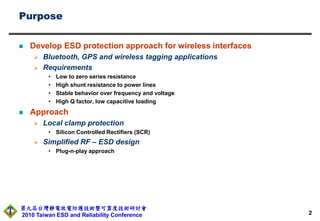
Purpose 
Develop ESD protection approach for wireless interfaces 
Bluetooth, GPS and wireless tagging applications 
Requirements 
•Low to zero series resistance 
•High shunt resistance to power lines 
•Stable behavior over frequency and voltage 
•High Q factor, low capacitive loading 
Approach 
Local clamp protection 
•Silicon Controlled Rectifiers (SCR) 
Simplified RF – ESD design 
•Plug-n-play approach
3 
第九屆台灣靜電放電防護技術暨可靠度技術研討會 
2010 Taiwan ESD and Reliability Conference 
Outline 
Introduction 
Strong growth in wireless interfaces 
Protection approaches 
90nm product 
40nm product 
Conclusion
4 
第九屆台灣靜電放電防護技術暨可靠度技術研討會 
2010 Taiwan ESD and Reliability Conference 
Intro: History 
“I do not think that the wireless waves I have discovered will have any practical application.” 
Heinrich Rudolf Hertz (1857−1894)
5 
第九屆台灣靜電放電防護技術暨可靠度技術研討會 
2010 Taiwan ESD and Reliability Conference 
Intro: Explosive growth of wireless interfaces 
Wireless interfaces: very diverse and growing [3] 
Broad set of standards and versions [4] 
Increasing bandwidth
6 
第九屆台灣靜電放電防護技術暨可靠度技術研討會 
2010 Taiwan ESD and Reliability Conference 
Intro: Available spectrum hard to find 
Example: US spectrum almost completely assigned [2] 
Many wireless protocols/versions: need generic ESD solutions
7 
第九屆台灣靜電放電防護技術暨可靠度技術研討會 
2010 Taiwan ESD and Reliability Conference 
Intro: ESD protection influences RF performance 
Example: RF ESD protection 
Lower gain (S21) 
Higher noise figure (NF) 
Degraded input reflection coefficient (S11) 
Unique ESD solutions required 
Low parasitic capacitance 
Low pad resistance 
High Q factor 
Low leakage 
[12]
8 
第九屆台灣靜電放電防護技術暨可靠度技術研討會 
2010 Taiwan ESD and Reliability Conference 
Outline 
Introduction 
Protection approaches 
Plug-n-play 
LC cancellation 
ESD-RF Co-design 
90nm case study 
40nm case study 
Conclusion
9 
第九屆台灣靜電放電防護技術暨可靠度技術研討會 
2010 Taiwan ESD and Reliability Conference 
Approach 1: Plug-n-play 
Minimize parasitic capacitance of ESD devices 
Parasitic capacitance chosen not to degrade RF performance 
Most used approach: 
•dual diode and efficient power clamp 
Alternative: 
•Local protection clamps 
•Select optimal protection device [15-21] 
00.20.40.60.811.21.41.60246810ggnMOSLVTSCR Cj(0) [pF] It2 [A] 20m50m75m100m150m200m
10 
第九屆台灣靜電放電防護技術暨可靠度技術研討會 
2010 Taiwan ESD and Reliability Conference 
Approach 2: LC cancellation 
ESD protection using filters and cancellation 
LC resonator isolates the ESD protection device from the RF input. 
Resonator is tuned to the operation frequency of the RF circuit. 
Does not require high-Q ESD protection device 
References [10, 13, 22]
11 
第九屆台灣靜電放電防護技術暨可靠度技術研討會 
2010 Taiwan ESD and Reliability Conference 
Approach 3: ESD – RF co-design 
Full (or partial) circuit ESD co-design 
ESD protection is integrated in RF design 
More designer freedom 
Designer has to know both RF and ESD! 
References [23, 24]
12 
第九屆台灣靜電放電防護技術暨可靠度技術研討會 
2010 Taiwan ESD and Reliability Conference 
Plug-n-play approach selected in this work 
Researchers claim “low-cap. plug-n-play” is limited to 5GHz 
References: 10, 13, 22-24 
This presentation contradicts these claims 
Plug-n-play approach proven for 8.5GHz in TSMC 90nm 
Solutions measured up to 20GHz in TSMC 40nm LP 
Solutions: 
•Silicon controlled rectifier clamps 
•Low capacitive loading 
•Low leakage – High Q 
•No pad resistance
13 
第九屆台灣靜電放電防護技術暨可靠度技術研討會 
2010 Taiwan ESD and Reliability Conference 
Outline 
Introduction 
Protection approaches 
90nm product 
Application 
Protection concept 
Results 
40nm product 
Conclusion
14 
第九屆台灣靜電放電防護技術暨可靠度技術研討會 
2010 Taiwan ESD and Reliability Conference 
90nm product: 8.5 GHz LNA 
 Application: RF - tagging 
 8.5GHz wireless interface 
 Location aware 
 10 year lifetime from 1 coin battery 
 802.15.4a standard: Alternate PHY for Zigbee devices 
 Protection concept 
 Design window failure voltage: 11.4V 
 Dual diode approach not possible 
• Only narrow Vdd connection available 
 Local clamp 
• SCR triggered by dynamically biased MOS
15 
第九屆台灣靜電放電防護技術暨可靠度技術研討會 
2010 Taiwan ESD and Reliability Conference 
90nm product: Capacitive loading 
 Parasitic capacitance: calculation based on foundry data 
 Maximum 100fF allowed
16 
第九屆台灣靜電放電防護技術暨可靠度技術研討會 
2010 Taiwan ESD and Reliability Conference 
90nm product: Results 
ESD protection for LNA IO 
ESD: >2kV HBM 
Latch-up immune 
Low capacitive: <100fF 
Low leakage: <0.1nA 
Small area: <3000um2 
CUP: ESD under bond pad
17 
第九屆台灣靜電放電防護技術暨可靠度技術研討會 
2010 Taiwan ESD and Reliability Conference 
Outline 
Introduction 
Protection approaches 
90nm product 
40nm product 
Application 
Protection concepts – comparison 
Solution selection 
Conclusion
18 
第九屆台灣靜電放電防護技術暨可靠度技術研討會 
2010 Taiwan ESD and Reliability Conference 
40nm product: GPS/Bluetooth application 
Application in 40nm 
Bluetooth interface 
GPS interface 
ESD protection for LNA IO 
Compared various ESD concepts 
S-Parameters measured from 1 to 20GHz 
Requirements 
Capacitance < 200fF 
Q-factor > 40 
2kV HBM 
GND (local) 
IO 
GND (local) 
GND (global) 
VDD 
OPEN 
DUT 
SHORT 
OPEN 
DUT 
SHORT
19 
第九屆台灣靜電放電防護技術暨可靠度技術研討會 
2010 Taiwan ESD and Reliability Conference 
40nm product: Various protection concepts 
 Various ESD device types investigated for high speed RF 
applications 
 Low parasitic capacitance, high Q-factor, high ESD performance 
0 
100 
200 
300 
400 
500 
0 1 2 3 4 5 6 7 
Cap. [fF] 
Device 
type 
0 
20 
40 
60 
80 
Q10-0factor 
Parasitic 
capacitance 
Q-factor 
5-6kV HBM
20 
第九屆台灣靜電放電防護技術暨可靠度技術研討會 
2010 Taiwan ESD and Reliability Conference 
40nm product: Comparison of 2 device types 
 Comparison of final selected devices 
 ESD-on-SCR 
 DTSCR 
ESD-ON-SCR DTSCR 
G2 G2 
A A
21 
第九屆台灣靜電放電防護技術暨可靠度技術研討會 
2010 Taiwan ESD and Reliability Conference 
40nm product: S-parameters comparison 
 Stable behavior for two finally selected protection devices 
across voltage (@ 5GHz) and across frequency (@ 0V bias) 
100 
120 
140 
160 
180 
200 
0 0.2 0.4 0.6 0.8 1 
C [fF] 
V [V] 
DTSCR 
ESD-on-SCR 
100 
120 
140 
160 
180 
200 
0 5 10 15 20 
C [fF] 
Freq [GHz] 
DTSCR 
ESD-on-SCR
22 
第九屆台灣靜電放電防護技術暨可靠度技術研討會 
2010 Taiwan ESD and Reliability Conference 
40nm product: ESD/TLP comparison 
 TLP results 
 Same failure level ~2.6A 
 Lower trigger voltage for ESD-on-SCR 
10-9 10-8 10-7 10-6 10-5 10-4 10-3 10-2 Leak [A] 
0 
0.5 
1 
1.5 
2 
2.5 
3 
3.5 
0 1 2 3 4 5 
I [A] 
V [V] 
ESD-on-SCR 
DTSCR 
0 
0.05 
0.1 
0.15 
0 0.5 1 1.5 2 2.5 3 3.5 
I [A] 
V [V] 
ESD-on-SCR 
DTSCR 
Zoom
23 
第九屆台灣靜電放電防護技術暨可靠度技術研討會 
2010 Taiwan ESD and Reliability Conference 
40nm product: Leakage comparison 
 Leakage: 
 ESD-on-SCR has much lower leakage 
10-12 
10-11 
10-10 
10-9 
10-8 
10-7 
10-6 
0 0.2 0.4 0.6 0.8 1 1.2 1.4 
I [A] 
V [V] 
85°C 
25°C 
120°C 
DTSCR 
10-12 
10-11 
10-10 
10-9 
10-8 
10-7 
10-6 
0 0.2 0.4 0.6 0.8 1 1.2 1.4 
I [A] 
V [V] 
85°C 
25°C 
120°C 
ESD-on-SCR
24 
第九屆台灣靜電放電防護技術暨可靠度技術研討會 
2010 Taiwan ESD and Reliability Conference 
40nm product: Comparison summary 
Comparison summary 
DTSCR 
ESD-on-SCR 
Device 
Leakage @ 1.32V 
Parasitic capacitance 
Q- factor 
Area [um²] 
ESD performance 
25°C [A] 
85°C [A] 
125°C [A] 
Total [fF] 
To VSS [fF] 
To VDD [fF] 
HBM [kV] 
MM [V] 
TLP [A] 
ESD-on- SCR 
7.5p 
12.7p 
18.5p 
177 
116 
61 
71 
622 
5.2 
300 
2.51 
DTSCR 
85.3p 
13.2n 
174.0n 
178 
170 
8 
43 
1286 
4.5 
240 
2.59 
25.97um 
53.66um 
11.59um 
ESD-ON-SCR 
DTSCR 
53.66um 
especially desirable for common mode power rejection ratio
25 
第九屆台灣靜電放電防護技術暨可靠度技術研討會 
2010 Taiwan ESD and Reliability Conference 
40nm product: Selected solution: ESD-on-SCR 
 ESD-on-SCR: Ideal for small signal RF LNA circuit 
 Leakage 10pA 
 Parasitic capacitance* 180fF 
 Q-factor 71 
 ESD performance 5.2kV 
 Silicon area 622um² 
* S-parameter measurement including metalization 
10-12 
10-11 
10-10 
10-9 
10-8 
10-7 
10-6 
0 0.2 0.4 0.6 0.8 1 1.2 1.4 
I [A] 
V [V] 
85°C 
25°C 
120°C
26 
第九屆台灣靜電放電防護技術暨可靠度技術研討會 
2010 Taiwan ESD and Reliability Conference 
Outline 
Introduction 
Protection approaches 
90nm product 
40nm product 
Conclusion
27 
第九屆台灣靜電放電防護技術暨可靠度技術研討會 
2010 Taiwan ESD and Reliability Conference 
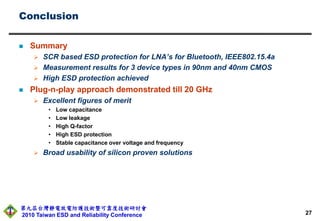
Conclusion 
Summary 
SCR based ESD protection for LNA’s for Bluetooth, IEEE802.15.4a 
Measurement results for 3 device types in 90nm and 40nm CMOS 
High ESD protection achieved 
Plug-n-play approach demonstrated till 20 GHz 
Excellent figures of merit 
•Low capacitance 
•Low leakage 
•High Q-factor 
•High ESD protection 
•Stable capacitance over voltage and frequency 
Broad usability of silicon proven solutions

SCR based On-chip ESD protection for LNA

  • 1.
    第九屆台灣靜電放電防護技術暨可靠度技術研討會 2010 TaiwanESD and Reliability Conference SCR based on-chip ESD protection for LNA’s in 90nm and 40nm CMOS B. Keppens, I. Backers, J. Binnemans, B. Sorgeloos, O. Marichal, K. Verhaege Sofics BVBA BD@sofics.com Scan the code and get additional related content: Download PDF version, find relevant datasheets, similar content or a link to presentation
  • 2.
    2 第九屆台灣靜電放電防護技術暨可靠度技術研討會 2010Taiwan ESD and Reliability Conference Purpose Develop ESD protection approach for wireless interfaces Bluetooth, GPS and wireless tagging applications Requirements •Low to zero series resistance •High shunt resistance to power lines •Stable behavior over frequency and voltage •High Q factor, low capacitive loading Approach Local clamp protection •Silicon Controlled Rectifiers (SCR) Simplified RF – ESD design •Plug-n-play approach
  • 3.
    3 第九屆台灣靜電放電防護技術暨可靠度技術研討會 2010Taiwan ESD and Reliability Conference Outline Introduction Strong growth in wireless interfaces Protection approaches 90nm product 40nm product Conclusion
  • 4.
    4 第九屆台灣靜電放電防護技術暨可靠度技術研討會 2010Taiwan ESD and Reliability Conference Intro: History “I do not think that the wireless waves I have discovered will have any practical application.” Heinrich Rudolf Hertz (1857−1894)
  • 5.
    5 第九屆台灣靜電放電防護技術暨可靠度技術研討會 2010Taiwan ESD and Reliability Conference Intro: Explosive growth of wireless interfaces Wireless interfaces: very diverse and growing [3] Broad set of standards and versions [4] Increasing bandwidth
  • 6.
    6 第九屆台灣靜電放電防護技術暨可靠度技術研討會 2010Taiwan ESD and Reliability Conference Intro: Available spectrum hard to find Example: US spectrum almost completely assigned [2] Many wireless protocols/versions: need generic ESD solutions
  • 7.
    7 第九屆台灣靜電放電防護技術暨可靠度技術研討會 2010Taiwan ESD and Reliability Conference Intro: ESD protection influences RF performance Example: RF ESD protection Lower gain (S21) Higher noise figure (NF) Degraded input reflection coefficient (S11) Unique ESD solutions required Low parasitic capacitance Low pad resistance High Q factor Low leakage [12]
  • 8.
    8 第九屆台灣靜電放電防護技術暨可靠度技術研討會 2010Taiwan ESD and Reliability Conference Outline Introduction Protection approaches Plug-n-play LC cancellation ESD-RF Co-design 90nm case study 40nm case study Conclusion
  • 9.
    9 第九屆台灣靜電放電防護技術暨可靠度技術研討會 2010Taiwan ESD and Reliability Conference Approach 1: Plug-n-play Minimize parasitic capacitance of ESD devices Parasitic capacitance chosen not to degrade RF performance Most used approach: •dual diode and efficient power clamp Alternative: •Local protection clamps •Select optimal protection device [15-21] 00.20.40.60.811.21.41.60246810ggnMOSLVTSCR Cj(0) [pF] It2 [A] 20m50m75m100m150m200m
  • 10.
    10 第九屆台灣靜電放電防護技術暨可靠度技術研討會 2010Taiwan ESD and Reliability Conference Approach 2: LC cancellation ESD protection using filters and cancellation LC resonator isolates the ESD protection device from the RF input. Resonator is tuned to the operation frequency of the RF circuit. Does not require high-Q ESD protection device References [10, 13, 22]
  • 11.
    11 第九屆台灣靜電放電防護技術暨可靠度技術研討會 2010Taiwan ESD and Reliability Conference Approach 3: ESD – RF co-design Full (or partial) circuit ESD co-design ESD protection is integrated in RF design More designer freedom Designer has to know both RF and ESD! References [23, 24]
  • 12.
    12 第九屆台灣靜電放電防護技術暨可靠度技術研討會 2010Taiwan ESD and Reliability Conference Plug-n-play approach selected in this work Researchers claim “low-cap. plug-n-play” is limited to 5GHz References: 10, 13, 22-24 This presentation contradicts these claims Plug-n-play approach proven for 8.5GHz in TSMC 90nm Solutions measured up to 20GHz in TSMC 40nm LP Solutions: •Silicon controlled rectifier clamps •Low capacitive loading •Low leakage – High Q •No pad resistance
  • 13.
    13 第九屆台灣靜電放電防護技術暨可靠度技術研討會 2010Taiwan ESD and Reliability Conference Outline Introduction Protection approaches 90nm product Application Protection concept Results 40nm product Conclusion
  • 14.
    14 第九屆台灣靜電放電防護技術暨可靠度技術研討會 2010Taiwan ESD and Reliability Conference 90nm product: 8.5 GHz LNA  Application: RF - tagging  8.5GHz wireless interface  Location aware  10 year lifetime from 1 coin battery  802.15.4a standard: Alternate PHY for Zigbee devices  Protection concept  Design window failure voltage: 11.4V  Dual diode approach not possible • Only narrow Vdd connection available  Local clamp • SCR triggered by dynamically biased MOS
  • 15.
    15 第九屆台灣靜電放電防護技術暨可靠度技術研討會 2010Taiwan ESD and Reliability Conference 90nm product: Capacitive loading  Parasitic capacitance: calculation based on foundry data  Maximum 100fF allowed
  • 16.
    16 第九屆台灣靜電放電防護技術暨可靠度技術研討會 2010Taiwan ESD and Reliability Conference 90nm product: Results ESD protection for LNA IO ESD: >2kV HBM Latch-up immune Low capacitive: <100fF Low leakage: <0.1nA Small area: <3000um2 CUP: ESD under bond pad
  • 17.
    17 第九屆台灣靜電放電防護技術暨可靠度技術研討會 2010Taiwan ESD and Reliability Conference Outline Introduction Protection approaches 90nm product 40nm product Application Protection concepts – comparison Solution selection Conclusion
  • 18.
    18 第九屆台灣靜電放電防護技術暨可靠度技術研討會 2010Taiwan ESD and Reliability Conference 40nm product: GPS/Bluetooth application Application in 40nm Bluetooth interface GPS interface ESD protection for LNA IO Compared various ESD concepts S-Parameters measured from 1 to 20GHz Requirements Capacitance < 200fF Q-factor > 40 2kV HBM GND (local) IO GND (local) GND (global) VDD OPEN DUT SHORT OPEN DUT SHORT
  • 19.
    19 第九屆台灣靜電放電防護技術暨可靠度技術研討會 2010Taiwan ESD and Reliability Conference 40nm product: Various protection concepts  Various ESD device types investigated for high speed RF applications  Low parasitic capacitance, high Q-factor, high ESD performance 0 100 200 300 400 500 0 1 2 3 4 5 6 7 Cap. [fF] Device type 0 20 40 60 80 Q10-0factor Parasitic capacitance Q-factor 5-6kV HBM
  • 20.
    20 第九屆台灣靜電放電防護技術暨可靠度技術研討會 2010Taiwan ESD and Reliability Conference 40nm product: Comparison of 2 device types  Comparison of final selected devices  ESD-on-SCR  DTSCR ESD-ON-SCR DTSCR G2 G2 A A
  • 21.
    21 第九屆台灣靜電放電防護技術暨可靠度技術研討會 2010Taiwan ESD and Reliability Conference 40nm product: S-parameters comparison  Stable behavior for two finally selected protection devices across voltage (@ 5GHz) and across frequency (@ 0V bias) 100 120 140 160 180 200 0 0.2 0.4 0.6 0.8 1 C [fF] V [V] DTSCR ESD-on-SCR 100 120 140 160 180 200 0 5 10 15 20 C [fF] Freq [GHz] DTSCR ESD-on-SCR
  • 22.
    22 第九屆台灣靜電放電防護技術暨可靠度技術研討會 2010Taiwan ESD and Reliability Conference 40nm product: ESD/TLP comparison  TLP results  Same failure level ~2.6A  Lower trigger voltage for ESD-on-SCR 10-9 10-8 10-7 10-6 10-5 10-4 10-3 10-2 Leak [A] 0 0.5 1 1.5 2 2.5 3 3.5 0 1 2 3 4 5 I [A] V [V] ESD-on-SCR DTSCR 0 0.05 0.1 0.15 0 0.5 1 1.5 2 2.5 3 3.5 I [A] V [V] ESD-on-SCR DTSCR Zoom
  • 23.
    23 第九屆台灣靜電放電防護技術暨可靠度技術研討會 2010Taiwan ESD and Reliability Conference 40nm product: Leakage comparison  Leakage:  ESD-on-SCR has much lower leakage 10-12 10-11 10-10 10-9 10-8 10-7 10-6 0 0.2 0.4 0.6 0.8 1 1.2 1.4 I [A] V [V] 85°C 25°C 120°C DTSCR 10-12 10-11 10-10 10-9 10-8 10-7 10-6 0 0.2 0.4 0.6 0.8 1 1.2 1.4 I [A] V [V] 85°C 25°C 120°C ESD-on-SCR
  • 24.
    24 第九屆台灣靜電放電防護技術暨可靠度技術研討會 2010Taiwan ESD and Reliability Conference 40nm product: Comparison summary Comparison summary DTSCR ESD-on-SCR Device Leakage @ 1.32V Parasitic capacitance Q- factor Area [um²] ESD performance 25°C [A] 85°C [A] 125°C [A] Total [fF] To VSS [fF] To VDD [fF] HBM [kV] MM [V] TLP [A] ESD-on- SCR 7.5p 12.7p 18.5p 177 116 61 71 622 5.2 300 2.51 DTSCR 85.3p 13.2n 174.0n 178 170 8 43 1286 4.5 240 2.59 25.97um 53.66um 11.59um ESD-ON-SCR DTSCR 53.66um especially desirable for common mode power rejection ratio
  • 25.
    25 第九屆台灣靜電放電防護技術暨可靠度技術研討會 2010Taiwan ESD and Reliability Conference 40nm product: Selected solution: ESD-on-SCR  ESD-on-SCR: Ideal for small signal RF LNA circuit  Leakage 10pA  Parasitic capacitance* 180fF  Q-factor 71  ESD performance 5.2kV  Silicon area 622um² * S-parameter measurement including metalization 10-12 10-11 10-10 10-9 10-8 10-7 10-6 0 0.2 0.4 0.6 0.8 1 1.2 1.4 I [A] V [V] 85°C 25°C 120°C
  • 26.
    26 第九屆台灣靜電放電防護技術暨可靠度技術研討會 2010Taiwan ESD and Reliability Conference Outline Introduction Protection approaches 90nm product 40nm product Conclusion
  • 27.
    27 第九屆台灣靜電放電防護技術暨可靠度技術研討會 2010Taiwan ESD and Reliability Conference Conclusion Summary SCR based ESD protection for LNA’s for Bluetooth, IEEE802.15.4a Measurement results for 3 device types in 90nm and 40nm CMOS High ESD protection achieved Plug-n-play approach demonstrated till 20 GHz Excellent figures of merit •Low capacitance •Low leakage •High Q-factor •High ESD protection •Stable capacitance over voltage and frequency Broad usability of silicon proven solutions