Colour Technology
Why use Colours? Identification Branding Convey a Mood or a Style Choice
Introduction Assessment and Measurement of Colour. Factors Affecting Colour Matching. Methods of Colouring.
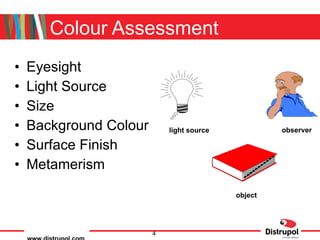
Colour Assessment Eyesight Light Source Size Background Colour Surface Finish Metamerism observer object light source
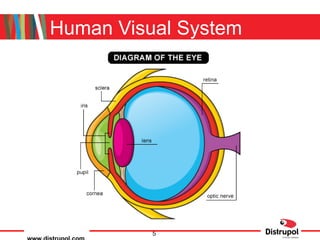
Human Visual System
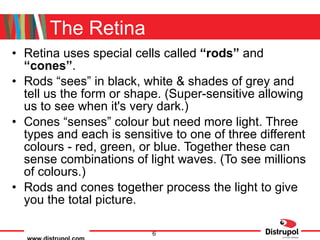
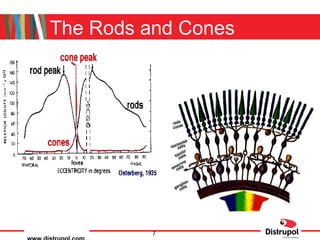
The Retina Retina uses special cells called  “rods”  and  “cones” . Rods “sees” in black, white & shades of grey and tell us the form or shape. (Super-sensitive allowing us to see when it's very dark.) Cones “senses” colour but need more light. Three types and each is sensitive to one of three different colours - red, green, or blue. Together these can sense combinations of light waves. (To see millions of colours.) Rods and cones together process the light to give you the total picture.

The Rods and Cones
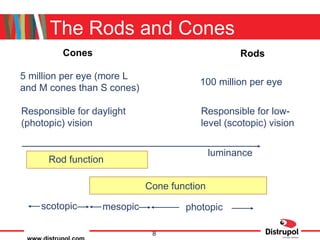
The Rods and Cones 5 million per eye (more L  and M cones than S cones) 100 million per eye  Responsible for daylight  (photopic) vision Responsible for low- level (scotopic) vision Cone function Rod function scotopic mesopic photopic luminance Cones Rods
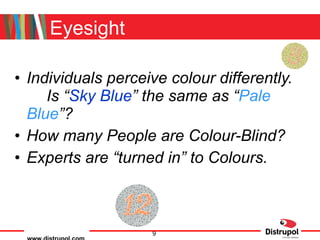
Eyesight Individuals perceive colour differently. Is “ Sky Blue ” the same as “ Pale Blue ”? How many People are Colour-Blind? Experts are “turned in” to Colours.
Light source A  red  object in  red  light, appear  red  - as all the  red   light is reflected. A  red  object in  blue  light, appear  black  - as no  red  light to reflect back. The difference between say daylight and the Tungsten Lights used in homes, could be significant!!
Size A small area of colour may look very different to a large area of the SAME colour. Hence, it is important when decorating to paint a sufficiently large area.
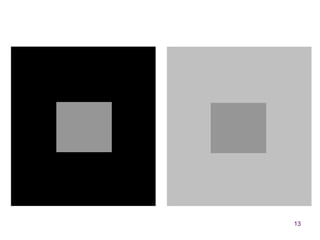
Background colour Colours viewed against a strong, vivid coloured backgrounds, appears very different against a neutral or pastel coloured background.
 
Surface finish A high gloss finish always appears darker than a matt finish of the same colour.
Metamerism Change in appearance of a colour under different light source. Describe the relative changes in colour between two samples, i.e. Good match in day light, different in fluorescent shop lighting. Occurs when different colourants are used in each sample.
Colour Measurement Colour Space Colour Measuring Devices Colorimeters Spectrophotometers Metamerism Light Sources and Illuminates
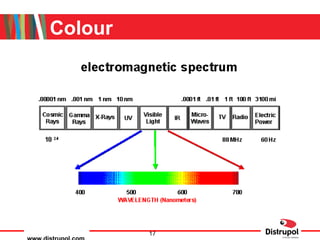
Colour
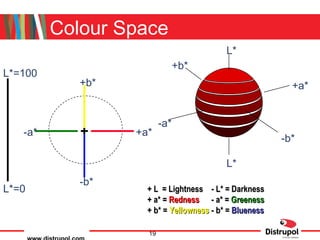
Colour Space To measure colour objectively, to communicate differences in quantifiable terms. Principle  is that all colours can be inside a “Colour Space” i.e. this space being a sphere. Each colour can then be give a position in the colour space.  Differences between colours can be quantified by comparing the values of the co-ordinates.
Colour Space + L  = Lightness  - L* = Darkness + a* =  Redness - a* =  Greeness + b* =  Yellowness  - b* =  Blueness +a* +b* -a* -b* L*=100 L*=0 L* L* -a* +a* -b* +b*
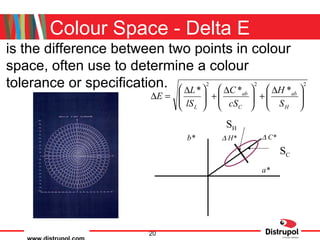
Colour Space - Delta E a* b*  C*  H* is the difference between two points in colour space, often use to determine a colour tolerance or specification. S C S H
Colour Space A different system (Yxy) is used for transparent colours. Y = percentage of light transmitted x = balance between  blue  and  red  light y = balance between  blue  and  green  light
More on Metamerism Two colours with the same L*,a*,b* values which are arrived at by a different route will show metamerism. Their colour will be different if the light source is changed.
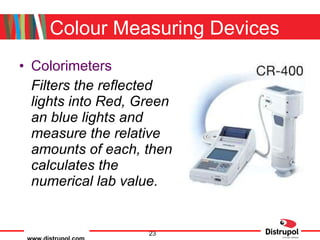
Colour Measuring Devices Colorimeters Filters the reflected lights into Red, Green an blue lights and measure the relative amounts of each, then calculates the numerical lab value.
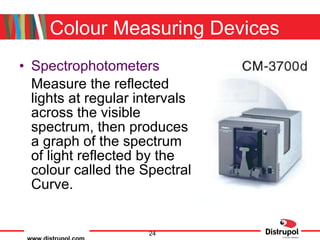
Colour Measuring Devices Spectrophotometers Measure the reflected lights at regular intervals across the visible spectrum, then produces a graph of the spectrum of light reflected by the colour called the Spectral Curve.
Colour Measuring  Devices Spectrophotometers more accurate than colorimeters. Spectrophotometers better at identifying metamerism than colorimeters. Differences between the human eye and colour measuring devices > Possible to have an accurate reading but does not visually look right!!!!
Light sources and illuminants The three most widely used are; D65 Simulation of Daylight (Artificial  Daylight). A Normal domestic tungsten light. TL84  Standard fluorescent tube used in  most shops and showrooms.
Colour Matching Standard Colour Systems  The Material Colorants Legal Restrictions
Standard Colour Systems Colours presented as printed paper patterns books. (RAL and PANTONE system.) Building industry has its own set of BS colours. NCS (Scandinavian) a measuring system rather than a fixed set of colours.
The Material Processing temperatures and chemical characteristics, means a colourant can work in one polymer, but degrade or discolour in another. The more different the standard material is to the match material, the less likely an accurate  match. A painted sheet match to Nylon 6.6, the colourants used in paint will not survive 290 o C.
The colourants-Pigments Very fine powdered chemicals dispersed in the polymers. Poor dispersion results in a weaker colour and often a grainy surface. Inorganic pigments are mineral based, i.e. Metal Oxides & Sulphides. Organic pigments are chemical compounds, less heat stable and more difficult to disperse. Usually give richer and more vivid colours. Less pigment is required.
The colourants-Dyes Chemical substances that dissolves in the polymer. Chemically interact, as such allows light to pass through. When use in transparent materials remain transparent. A limit how much dye can be added to a polymer,  the dye can bleed out! Insoluble in Polyolefins.
Legal Restrictions Food, Medical and Toy - mainly base on purity and inability to extract the colourant from the finish item. Cadmium pigments - base on the premise when the Plastic part is incinerated, they can release Cadmium metals. Applies mainly in the packaging industry. If a colour is required for safety purposes, then Cadmium pigments can be use regardless of the Cadmium legislation. Many companies have a “Cadmium Free” policy regardless of the details of the legislation.
Methods of colouring Dry Colour Masterbatch Liquid Colour Fully Compounded Colour
Dry Colour or Dry Blend The colourants are mixed with the polymer. Some dispersion aids may be added and often a “wetting agent” to help bind the powder onto the surface. Advantages :  Cheap because the conversion cost is low. Quick to prepare. Very small lot. Disadvantages :  Can be very Messy, can affect drying, colour can vary with different machine due to dispersion.
Masterbatch Compounds contains very high levels of colourants (up to 80%), then mixed at a fixed ratio to give a specific colour. “ Polymer Specific” - Carrier is the same material as the base material. “ Universal” - Carrier will readily mix with a wide variety of polymers. Advantages :  Better colour control, cleaner and less drying problems than Dry-colour. A stock range of colours and specific colours can be develop. Disadvantages :  May not always be compatible with the base polymer. Accuracy depends on the Moulder with mixing.
Liquid colour Similar to masterbatches, contains a high level of colourants, but the carrier is a liquid. Advantages :  Better colour control than Dry blend. More even distribution than masterbatch. Stock range of colours. Disadvantages :  Special dosing equipment is required. Spillage is messy. Colour can depends on processing. Properties can be affected by the liquid carrier.
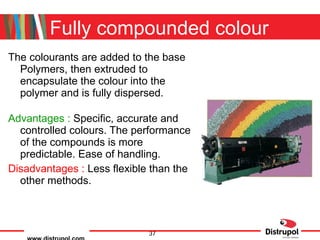
Fully compounded colour The colourants are added to the base Polymers, then extruded to encapsulate the colour into the polymer and is fully dispersed. Advantages :  Specific, accurate and controlled colours. The performance of the compounds is more predictable. Ease of handling. Disadvantages :  Less flexible than the other methods.
A Polymer for Every Application

Colour technology

  • 1.
  • 2.
    Why use Colours?Identification Branding Convey a Mood or a Style Choice
  • 3.
    Introduction Assessment andMeasurement of Colour. Factors Affecting Colour Matching. Methods of Colouring.
  • 4.
    Colour Assessment EyesightLight Source Size Background Colour Surface Finish Metamerism observer object light source
  • 5.
  • 6.
    The Retina Retinauses special cells called “rods” and “cones” . Rods “sees” in black, white & shades of grey and tell us the form or shape. (Super-sensitive allowing us to see when it's very dark.) Cones “senses” colour but need more light. Three types and each is sensitive to one of three different colours - red, green, or blue. Together these can sense combinations of light waves. (To see millions of colours.) Rods and cones together process the light to give you the total picture.
  • 7.
  • 8.
    The Rods andCones 5 million per eye (more L and M cones than S cones) 100 million per eye Responsible for daylight (photopic) vision Responsible for low- level (scotopic) vision Cone function Rod function scotopic mesopic photopic luminance Cones Rods
  • 9.
    Eyesight Individuals perceivecolour differently. Is “ Sky Blue ” the same as “ Pale Blue ”? How many People are Colour-Blind? Experts are “turned in” to Colours.
  • 10.
    Light source A red object in red light, appear red - as all the red light is reflected. A red object in blue light, appear black - as no red light to reflect back. The difference between say daylight and the Tungsten Lights used in homes, could be significant!!
  • 11.
    Size A smallarea of colour may look very different to a large area of the SAME colour. Hence, it is important when decorating to paint a sufficiently large area.
  • 12.
    Background colour Coloursviewed against a strong, vivid coloured backgrounds, appears very different against a neutral or pastel coloured background.
  • 13.
  • 14.
    Surface finish Ahigh gloss finish always appears darker than a matt finish of the same colour.
  • 15.
    Metamerism Change inappearance of a colour under different light source. Describe the relative changes in colour between two samples, i.e. Good match in day light, different in fluorescent shop lighting. Occurs when different colourants are used in each sample.
  • 16.
    Colour Measurement ColourSpace Colour Measuring Devices Colorimeters Spectrophotometers Metamerism Light Sources and Illuminates
  • 17.
  • 18.
    Colour Space Tomeasure colour objectively, to communicate differences in quantifiable terms. Principle is that all colours can be inside a “Colour Space” i.e. this space being a sphere. Each colour can then be give a position in the colour space. Differences between colours can be quantified by comparing the values of the co-ordinates.
  • 19.
    Colour Space +L = Lightness - L* = Darkness + a* = Redness - a* = Greeness + b* = Yellowness - b* = Blueness +a* +b* -a* -b* L*=100 L*=0 L* L* -a* +a* -b* +b*
  • 20.
    Colour Space -Delta E a* b*  C*  H* is the difference between two points in colour space, often use to determine a colour tolerance or specification. S C S H
  • 21.
    Colour Space Adifferent system (Yxy) is used for transparent colours. Y = percentage of light transmitted x = balance between blue and red light y = balance between blue and green light
  • 22.
    More on MetamerismTwo colours with the same L*,a*,b* values which are arrived at by a different route will show metamerism. Their colour will be different if the light source is changed.
  • 23.
    Colour Measuring DevicesColorimeters Filters the reflected lights into Red, Green an blue lights and measure the relative amounts of each, then calculates the numerical lab value.
  • 24.
    Colour Measuring DevicesSpectrophotometers Measure the reflected lights at regular intervals across the visible spectrum, then produces a graph of the spectrum of light reflected by the colour called the Spectral Curve.
  • 25.
    Colour Measuring Devices Spectrophotometers more accurate than colorimeters. Spectrophotometers better at identifying metamerism than colorimeters. Differences between the human eye and colour measuring devices > Possible to have an accurate reading but does not visually look right!!!!
  • 26.
    Light sources andilluminants The three most widely used are; D65 Simulation of Daylight (Artificial Daylight). A Normal domestic tungsten light. TL84 Standard fluorescent tube used in most shops and showrooms.
  • 27.
    Colour Matching StandardColour Systems The Material Colorants Legal Restrictions
  • 28.
    Standard Colour SystemsColours presented as printed paper patterns books. (RAL and PANTONE system.) Building industry has its own set of BS colours. NCS (Scandinavian) a measuring system rather than a fixed set of colours.
  • 29.
    The Material Processingtemperatures and chemical characteristics, means a colourant can work in one polymer, but degrade or discolour in another. The more different the standard material is to the match material, the less likely an accurate match. A painted sheet match to Nylon 6.6, the colourants used in paint will not survive 290 o C.
  • 30.
    The colourants-Pigments Veryfine powdered chemicals dispersed in the polymers. Poor dispersion results in a weaker colour and often a grainy surface. Inorganic pigments are mineral based, i.e. Metal Oxides & Sulphides. Organic pigments are chemical compounds, less heat stable and more difficult to disperse. Usually give richer and more vivid colours. Less pigment is required.
  • 31.
    The colourants-Dyes Chemicalsubstances that dissolves in the polymer. Chemically interact, as such allows light to pass through. When use in transparent materials remain transparent. A limit how much dye can be added to a polymer, the dye can bleed out! Insoluble in Polyolefins.
  • 32.
    Legal Restrictions Food,Medical and Toy - mainly base on purity and inability to extract the colourant from the finish item. Cadmium pigments - base on the premise when the Plastic part is incinerated, they can release Cadmium metals. Applies mainly in the packaging industry. If a colour is required for safety purposes, then Cadmium pigments can be use regardless of the Cadmium legislation. Many companies have a “Cadmium Free” policy regardless of the details of the legislation.
  • 33.
    Methods of colouringDry Colour Masterbatch Liquid Colour Fully Compounded Colour
  • 34.
    Dry Colour orDry Blend The colourants are mixed with the polymer. Some dispersion aids may be added and often a “wetting agent” to help bind the powder onto the surface. Advantages : Cheap because the conversion cost is low. Quick to prepare. Very small lot. Disadvantages : Can be very Messy, can affect drying, colour can vary with different machine due to dispersion.
  • 35.
    Masterbatch Compounds containsvery high levels of colourants (up to 80%), then mixed at a fixed ratio to give a specific colour. “ Polymer Specific” - Carrier is the same material as the base material. “ Universal” - Carrier will readily mix with a wide variety of polymers. Advantages : Better colour control, cleaner and less drying problems than Dry-colour. A stock range of colours and specific colours can be develop. Disadvantages : May not always be compatible with the base polymer. Accuracy depends on the Moulder with mixing.
  • 36.
    Liquid colour Similarto masterbatches, contains a high level of colourants, but the carrier is a liquid. Advantages : Better colour control than Dry blend. More even distribution than masterbatch. Stock range of colours. Disadvantages : Special dosing equipment is required. Spillage is messy. Colour can depends on processing. Properties can be affected by the liquid carrier.
  • 37.
    Fully compounded colourThe colourants are added to the base Polymers, then extruded to encapsulate the colour into the polymer and is fully dispersed. Advantages : Specific, accurate and controlled colours. The performance of the compounds is more predictable. Ease of handling. Disadvantages : Less flexible than the other methods.
  • 38.
    A Polymer forEvery Application