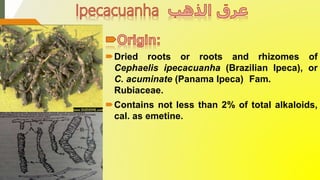


Dried roots or roots and rhizomes of
Cephaelis ipecacuanha (Brazilian Ipeca), or
C. acuminate (Panama Ipeca) Fam.
Rubiaceae.
Contains not less than 2% of total alkaloids,
cal. as emetine.
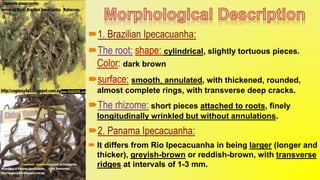
1. Brazilian Ipecacuanha:
The root: shape: cylindrical, slightly tortuous pieces.
Color: dark brown
surface: smooth, annulated, with thickened, rounded,
almost complete rings, with transverse deep cracks.
The rhizome: short pieces attached to roots, finely
longitudinally wrinkled but without annulations.
2. Panama Ipecacuanha:
 It differs from Rio Ipecacuanha in being larger (longer and
thicker), greyish-brown or reddish-brown, with transverse
ridges at intervals of 1-3 mm.
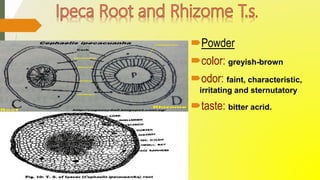
Powder
color: greyish-brown
odor: faint, characteristic,
irritating and sternutatory
taste: bitter acrid.
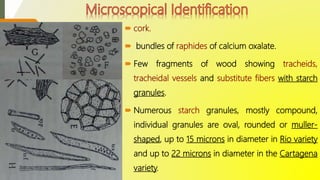
 cork.
 bundles of raphides of calcium oxalate.
 Few fragments of wood showing tracheids,
tracheidal vessels and substitute fibers with starch
granules.
 Numerous starch granules, mostly compound,
individual granules are oval, rounded or muller-
shaped, up to 15 microns in diameter in Rio variety
and up to 22 microns in diameter in the Cartagena
variety.
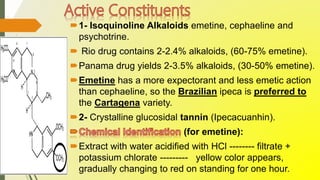
1- Isoquinoline Alkaloids emetine, cephaeline and
psychotrine.
 Rio drug contains 2-2.4% alkaloids, (60-75% emetine).
Panama drug yields 2-3.5% alkaloids, (30-50% emetine).
Emetine has a more expectorant and less emetic action
than cephaeline, so the Brazilian ipeca is preferred to
the Cartagena variety.
2- Crystalline glucosidal tannin (Ipecacuanhin).
(for emetine):
Extract with water acidified with HCl -------- filtrate +
potassium chlorate --------- yellow color appears,
gradually changing to red on standing for one hour.
Emesis Induction in Acute Poisoning.
expectorant (subemetic dose) in productive cough in doses of
up to about 1.4 mg of total alkaloids.
Emetine is a tissue amoebicide acting principally in the
bowel wall(amoebic dysentery) and in the liver (Hepatic
amoebiasis).
antitumor properties (alkaloids)
Undulated ‫المموجه‬ Ipecacuanha: Richardsonia scabra (Rubiaceae)
Lesser Striated Ipecacuanha: Manaettia ignita (Rubiaceae)
Greater Striated Ipecacuanha: Psychotria emetica ( Rubiaceae)
same family and no emetine
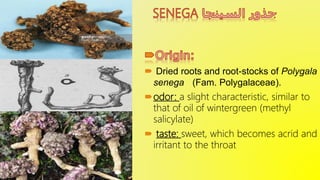
 Dried roots and root-stocks of Polygala
senega (Fam. Polygalaceae).
odor: a slight characteristic, similar to
that of oil of wintergreen (methyl
salicylate)
 taste: sweet, which becomes acrid and
irritant to the throat
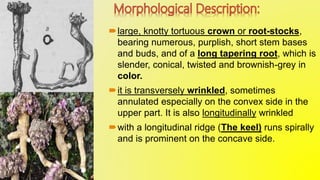
large, knotty tortuous crown or root-stocks,
bearing numerous, purplish, short stem bases
and buds, and of a long tapering root, which is
slender, conical, twisted and brownish-grey in
color.
it is transversely wrinkled, sometimes
annulated especially on the convex side in the
upper part. It is also longitudinally wrinkled
with a longitudinal ridge (The keel) runs spirally
and is prominent on the concave side.
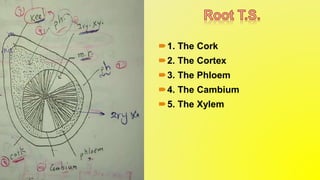
1. The Cork
2. The Cortex
3. The Phloem
4. The Cambium
5. The Xylem
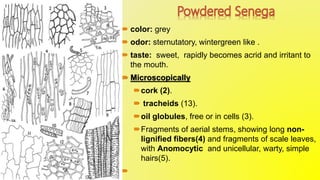
 color: grey
 odor: sternutatory, wintergreen like .
 taste: sweet, rapidly becomes acrid and irritant to
the mouth.
 Microscopically
cork (2).
 tracheids (13).
oil globules, free or in cells (3).
Fragments of aerial stems, showing long non-
lignified fibers(4) and fragments of scale leaves,
with Anomocytic and unicellular, warty, simple
hairs(5).

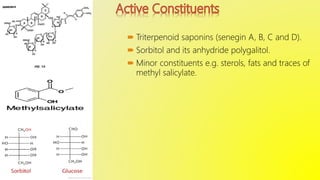
 Triterpenoid saponins (senegin A, B, C and D).
 Sorbitol and its anhydride polygalitol.
 Minor constituents e.g. sterols, fats and traces of
methyl salicylate.
 Test for saponins: Shake the aqueous decoction of Senega; a
persistent froth is formed.
 Ether extract acidified with dilute HCl. Divide into two portions:
Test for salicylic acid: Add one portion of the extract to 20 mL of
warm water in an evaporating dish and then add one drop of
FeCl3 T.S.; a reddish-violet color is produced.
Test for phytosterol: Evaporate the other portion to dryness and
dissolve the residue in 2 mL of chloroform. Transfer to a test tube
and add few drops of sulfuric acid carefully on the side of the
tube; a deep reddish-brown ring is formed between the two
layers and the sulfuric acid layer shows a faint greenish
fluorescence within 24 hours.
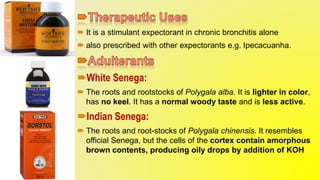
 It is a stimulant expectorant in chronic bronchitis alone
 also prescribed with other expectorants e.g. Ipecacuanha.
White Senega:
 The roots and rootstocks of Polygala alba. It is lighter in color,
has no keel. It has a normal woody taste and is less active.
Indian Senega:
 The roots and root-stocks of Polygala chinensis. It resembles
official Senega, but the cells of the cortex contain amorphous
brown contents, producing oily drops by addition of KOH
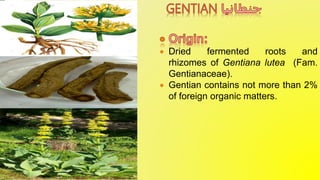
 Dried fermented roots and
rhizomes of Gentiana lutea (Fam.
Gentianaceae).
 Gentian contains not more than 2%
of foreign organic matters.
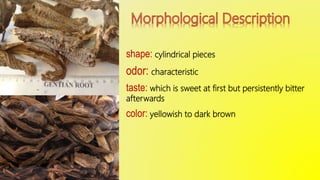
shape: cylindrical pieces
odor: characteristic
taste: which is sweet at first but persistently bitter
afterwards
color: yellowish to dark brown
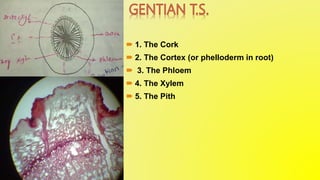
 1. The Cork
 2. The Cortex (or phelloderm in root)
 3. The Phloem
 4. The Xylem
 5. The Pith
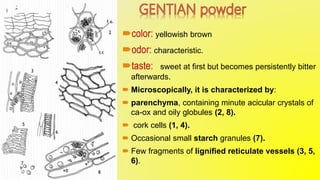
color: yellowish brown
odor: characteristic.
taste: sweet at first but becomes persistently bitter
afterwards.
 Microscopically, it is characterized by:
 parenchyma, containing minute acicular crystals of
ca-ox and oily globules (2, 8).
 cork cells (1, 4).
 Occasional small starch granules (7).
 Few fragments of lignified reticulate vessels (3, 5,
6).
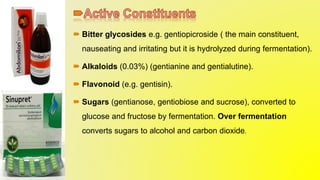
 Bitter glycosides e.g. gentiopicroside ( the main constituent,
nauseating and irritating but it is hydrolyzed during fermentation).
 Alkaloids (0.03%) (gentianine and gentialutine).
 Flavonoid (e.g. gentisin).
 Sugars (gentianose, gentiobiose and sucrose), converted to
glucose and fructose by fermentation. Over fermentation
converts sugars to alcohol and carbon dioxide.
 Appetite loss; digestive disorders: As stomachic because it
promotes secretion of saliva secretion and gastric juice and
stimulates appetite.
 A bitter tonic
 It kills plasmodia (malaria causing organisms) and worms.
 In the preparation used for
a) Respiratory-tract disorders; sinusitis
b) Anxiety; insomnia
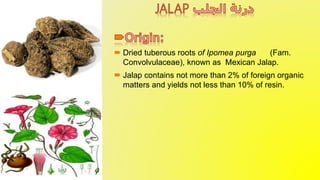
 Dried tuberous roots of Ipomea purga (Fam.
Convolvulaceae), known as Mexican Jalap.
 Jalap contains not more than 2% of foreign organic
matters and yields not less than 10% of resin.
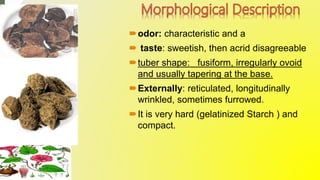
odor: characteristic and a
 taste: sweetish, then acrid disagreeable
tuber shape: fusiform, irregularly ovoid
and usually tapering at the base.
Externally: reticulated, longitudinally
wrinkled, sometimes furrowed.
It is very hard (gelatinized Starch ) and
compact.
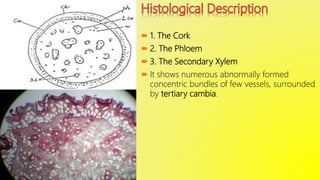
 1. The Cork
 2. The Phloem
 3. The Secondary Xylem
 It shows numerous abnormally formed
concentric bundles of few vessels, surrounded
by tertiary cambia.
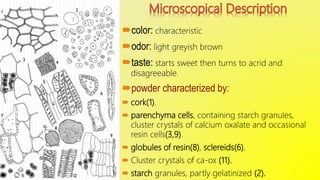
color: characteristic
odor: light greyish brown
taste: starts sweet then turns to acrid and
disagreeable.
powder characterized by:
 cork(1).
 parenchyma cells, containing starch granules,
cluster crystals of calcium oxalate and occasional
resin cells(3,9).
 globules of resin(8), sclereids(6).
 Cluster crystals of ca-ox (11).
 starch granules, partly gelatinized (2).
 Jalap resin, (Glycosidal resin) (4-18%), and is 90% soluble in ether known as jalapin
(or convolvulin).
 Coloring matter and phytosterol.
 With Iodine T.S.: The contents of resin cells stained yellow.
 With alkanna tincture: The contents of resin cells stained red.
 It is a hydragogue cathartic, it exerts a laxative effect in small doses and a purgative
effect in large doses. An antispasmodic e.g. Belladonna is prescribed with Jalap to
decrease its griping effect.
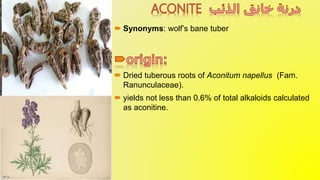
 Synonyms: wolf’s bane tuber
 Dried tuberous roots of Aconitum napellus (Fam.
Ranunculaceae).
 yields not less than 0.6% of total alkaloids calculated
as aconitine.
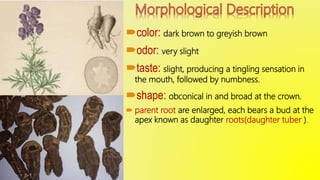
color: dark brown to greyish brown
odor: very slight
taste: slight, producing a tingling sensation in
the mouth, followed by numbness.
shape: obconical in and broad at the crown.
 parent root are enlarged, each bears a bud at the
apex known as daughter roots(daughter tuber ).
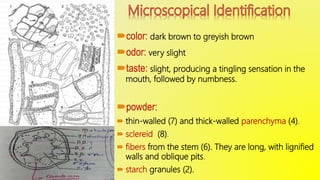
color: dark brown to greyish brown
odor: very slight
taste: slight, producing a tingling sensation in the
mouth, followed by numbness.
powder:
 thin-walled (7) and thick-walled parenchyma (4).
 sclereid (8).
 fibers from the stem (6). They are long, with lignified
walls and oblique pits.
 starch granules (2).
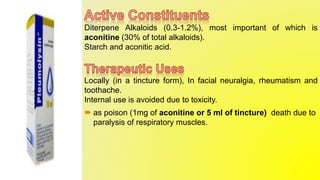
Diterpene Alkaloids (0.3-1.2%), most important of which is
aconitine (30% of total alkaloids).
Starch and aconitic acid.
Locally (in a tincture form), In facial neuralgia, rheumatism and
toothache.
Internal use is avoided due to toxicity.
 as poison (1mg of aconitine or 5 ml of tincture) death due to
paralysis of respiratory muscles.
  Ipecacuanha, SENEGA, GENTIAN, JALAP and ACONITE

Ipecacuanha, SENEGA, GENTIAN, JALAP and ACONITE

  • 2.
    Dried roots orroots and rhizomes of Cephaelis ipecacuanha (Brazilian Ipeca), or C. acuminate (Panama Ipeca) Fam. Rubiaceae. Contains not less than 2% of total alkaloids, cal. as emetine.
  • 3.
    1. Brazilian Ipecacuanha: Theroot: shape: cylindrical, slightly tortuous pieces. Color: dark brown surface: smooth, annulated, with thickened, rounded, almost complete rings, with transverse deep cracks. The rhizome: short pieces attached to roots, finely longitudinally wrinkled but without annulations. 2. Panama Ipecacuanha:  It differs from Rio Ipecacuanha in being larger (longer and thicker), greyish-brown or reddish-brown, with transverse ridges at intervals of 1-3 mm.
  • 4.
    Powder color: greyish-brown odor: faint,characteristic, irritating and sternutatory taste: bitter acrid.
  • 5.
     cork.  bundlesof raphides of calcium oxalate.  Few fragments of wood showing tracheids, tracheidal vessels and substitute fibers with starch granules.  Numerous starch granules, mostly compound, individual granules are oval, rounded or muller- shaped, up to 15 microns in diameter in Rio variety and up to 22 microns in diameter in the Cartagena variety.
  • 6.
    1- Isoquinoline Alkaloidsemetine, cephaeline and psychotrine.  Rio drug contains 2-2.4% alkaloids, (60-75% emetine). Panama drug yields 2-3.5% alkaloids, (30-50% emetine). Emetine has a more expectorant and less emetic action than cephaeline, so the Brazilian ipeca is preferred to the Cartagena variety. 2- Crystalline glucosidal tannin (Ipecacuanhin). (for emetine): Extract with water acidified with HCl -------- filtrate + potassium chlorate --------- yellow color appears, gradually changing to red on standing for one hour.
  • 7.
    Emesis Induction inAcute Poisoning. expectorant (subemetic dose) in productive cough in doses of up to about 1.4 mg of total alkaloids. Emetine is a tissue amoebicide acting principally in the bowel wall(amoebic dysentery) and in the liver (Hepatic amoebiasis). antitumor properties (alkaloids) Undulated ‫المموجه‬ Ipecacuanha: Richardsonia scabra (Rubiaceae) Lesser Striated Ipecacuanha: Manaettia ignita (Rubiaceae) Greater Striated Ipecacuanha: Psychotria emetica ( Rubiaceae) same family and no emetine
  • 9.
     Dried rootsand root-stocks of Polygala senega (Fam. Polygalaceae). odor: a slight characteristic, similar to that of oil of wintergreen (methyl salicylate)  taste: sweet, which becomes acrid and irritant to the throat
  • 10.
    large, knotty tortuouscrown or root-stocks, bearing numerous, purplish, short stem bases and buds, and of a long tapering root, which is slender, conical, twisted and brownish-grey in color. it is transversely wrinkled, sometimes annulated especially on the convex side in the upper part. It is also longitudinally wrinkled with a longitudinal ridge (The keel) runs spirally and is prominent on the concave side.
  • 11.
    1. The Cork 2.The Cortex 3. The Phloem 4. The Cambium 5. The Xylem
  • 12.
     color: grey odor: sternutatory, wintergreen like .  taste: sweet, rapidly becomes acrid and irritant to the mouth.  Microscopically cork (2).  tracheids (13). oil globules, free or in cells (3). Fragments of aerial stems, showing long non- lignified fibers(4) and fragments of scale leaves, with Anomocytic and unicellular, warty, simple hairs(5). 
  • 13.
     Triterpenoid saponins(senegin A, B, C and D).  Sorbitol and its anhydride polygalitol.  Minor constituents e.g. sterols, fats and traces of methyl salicylate.
  • 14.
     Test forsaponins: Shake the aqueous decoction of Senega; a persistent froth is formed.  Ether extract acidified with dilute HCl. Divide into two portions: Test for salicylic acid: Add one portion of the extract to 20 mL of warm water in an evaporating dish and then add one drop of FeCl3 T.S.; a reddish-violet color is produced. Test for phytosterol: Evaporate the other portion to dryness and dissolve the residue in 2 mL of chloroform. Transfer to a test tube and add few drops of sulfuric acid carefully on the side of the tube; a deep reddish-brown ring is formed between the two layers and the sulfuric acid layer shows a faint greenish fluorescence within 24 hours.
  • 15.
     It isa stimulant expectorant in chronic bronchitis alone  also prescribed with other expectorants e.g. Ipecacuanha. White Senega:  The roots and rootstocks of Polygala alba. It is lighter in color, has no keel. It has a normal woody taste and is less active. Indian Senega:  The roots and root-stocks of Polygala chinensis. It resembles official Senega, but the cells of the cortex contain amorphous brown contents, producing oily drops by addition of KOH
  • 16.
     Dried fermentedroots and rhizomes of Gentiana lutea (Fam. Gentianaceae).  Gentian contains not more than 2% of foreign organic matters.
  • 17.
    shape: cylindrical pieces odor:characteristic taste: which is sweet at first but persistently bitter afterwards color: yellowish to dark brown
  • 18.
     1. TheCork  2. The Cortex (or phelloderm in root)  3. The Phloem  4. The Xylem  5. The Pith
  • 19.
    color: yellowish brown odor:characteristic. taste: sweet at first but becomes persistently bitter afterwards.  Microscopically, it is characterized by:  parenchyma, containing minute acicular crystals of ca-ox and oily globules (2, 8).  cork cells (1, 4).  Occasional small starch granules (7).  Few fragments of lignified reticulate vessels (3, 5, 6).
  • 20.
     Bitter glycosidese.g. gentiopicroside ( the main constituent, nauseating and irritating but it is hydrolyzed during fermentation).  Alkaloids (0.03%) (gentianine and gentialutine).  Flavonoid (e.g. gentisin).  Sugars (gentianose, gentiobiose and sucrose), converted to glucose and fructose by fermentation. Over fermentation converts sugars to alcohol and carbon dioxide.
  • 21.
     Appetite loss;digestive disorders: As stomachic because it promotes secretion of saliva secretion and gastric juice and stimulates appetite.  A bitter tonic  It kills plasmodia (malaria causing organisms) and worms.  In the preparation used for a) Respiratory-tract disorders; sinusitis b) Anxiety; insomnia
  • 22.
     Dried tuberousroots of Ipomea purga (Fam. Convolvulaceae), known as Mexican Jalap.  Jalap contains not more than 2% of foreign organic matters and yields not less than 10% of resin.
  • 23.
    odor: characteristic anda  taste: sweetish, then acrid disagreeable tuber shape: fusiform, irregularly ovoid and usually tapering at the base. Externally: reticulated, longitudinally wrinkled, sometimes furrowed. It is very hard (gelatinized Starch ) and compact.
  • 24.
     1. TheCork  2. The Phloem  3. The Secondary Xylem  It shows numerous abnormally formed concentric bundles of few vessels, surrounded by tertiary cambia.
  • 25.
    color: characteristic odor: lightgreyish brown taste: starts sweet then turns to acrid and disagreeable. powder characterized by:  cork(1).  parenchyma cells, containing starch granules, cluster crystals of calcium oxalate and occasional resin cells(3,9).  globules of resin(8), sclereids(6).  Cluster crystals of ca-ox (11).  starch granules, partly gelatinized (2).
  • 26.
     Jalap resin,(Glycosidal resin) (4-18%), and is 90% soluble in ether known as jalapin (or convolvulin).  Coloring matter and phytosterol.  With Iodine T.S.: The contents of resin cells stained yellow.  With alkanna tincture: The contents of resin cells stained red.  It is a hydragogue cathartic, it exerts a laxative effect in small doses and a purgative effect in large doses. An antispasmodic e.g. Belladonna is prescribed with Jalap to decrease its griping effect.
  • 27.
     Synonyms: wolf’sbane tuber  Dried tuberous roots of Aconitum napellus (Fam. Ranunculaceae).  yields not less than 0.6% of total alkaloids calculated as aconitine.
  • 28.
    color: dark brownto greyish brown odor: very slight taste: slight, producing a tingling sensation in the mouth, followed by numbness. shape: obconical in and broad at the crown.  parent root are enlarged, each bears a bud at the apex known as daughter roots(daughter tuber ).
  • 29.
    color: dark brownto greyish brown odor: very slight taste: slight, producing a tingling sensation in the mouth, followed by numbness. powder:  thin-walled (7) and thick-walled parenchyma (4).  sclereid (8).  fibers from the stem (6). They are long, with lignified walls and oblique pits.  starch granules (2).
  • 30.
    Diterpene Alkaloids (0.3-1.2%),most important of which is aconitine (30% of total alkaloids). Starch and aconitic acid. Locally (in a tincture form), In facial neuralgia, rheumatism and toothache. Internal use is avoided due to toxicity.  as poison (1mg of aconitine or 5 ml of tincture) death due to paralysis of respiratory muscles.