Bifacial BIPV
Challenges for glass and
encapsulation
Bernd Koll/ Kuraray Europe GmbH
Bifi PV Workshop, Chambery May 26/27, 2014
Content
5/27/2014 2
BIPV basics
Challenges for BIPV module glass
Challenges for BIPV module encapsulation
Glass and encapsulants for laminated PV safety glass
Summary
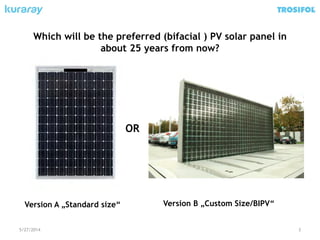
Which will be the preferred (bifacial ) PV solar panel in
about 25 years from now?
5/27/2014 3
Version A „Standard size“
OR
Version B „Custom Size/BIPV“
5/27/2014 4
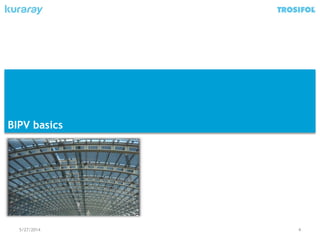
BIPV basics
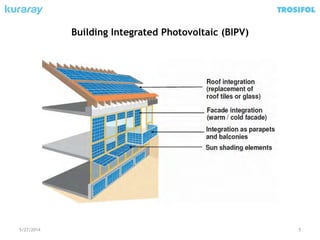
Building Integrated Photovoltaic (BIPV)
5/27/2014 5
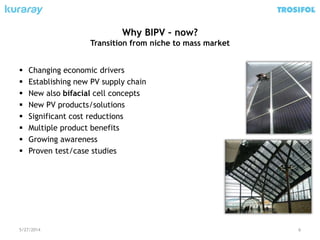
Why BIPV – now?
Transition from niche to mass market
 Changing economic drivers
 Establishing new PV supply chain
 New also bifacial cell concepts
 New PV products/solutions
 Significant cost reductions
 Multiple product benefits
 Growing awareness
 Proven test/case studies
5/27/2014 6
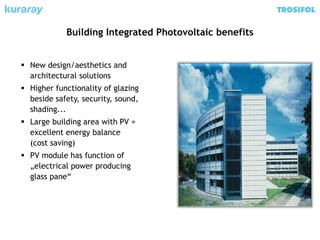
 New design/aesthetics and
architectural solutions
 Higher functionality of glazing
beside safety, security, sound,
shading...
 Large building area with PV =
excellent energy balance
(cost saving)
 PV module has function of
„electrical power producing
glass pane“
Building Integrated Photovoltaic benefits
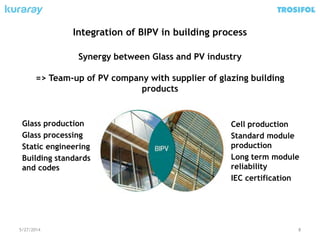
Integration of BIPV in building process
5/27/2014 8
Synergy between Glass and PV industry
=> Team-up of PV company with supplier of glazing building
products
Glass production
Glass processing
Static engineering
Building standards
and codes
Cell production
Standard module
production
Long term module
reliability
IEC certification
5/27/2014 9
Challenges for BIPV module glass
PV glass developments for standard PV modules
5/27/2014 10
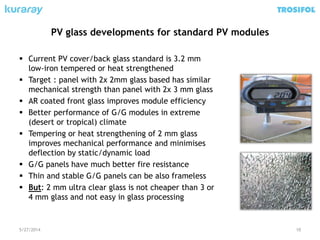
 Current PV cover/back glass standard is 3.2 mm
low-iron tempered or heat strengthened
 Target : panel with 2x 2mm glass based has similar
mechanical strength than panel with 2x 3 mm glass
 AR coated front glass improves module efficiency
 Better performance of G/G modules in extreme
(desert or tropical) climate
 Tempering or heat strengthening of 2 mm glass
improves mechanical performance and minimises
deflection by static/dynamic load
 G/G panels have much better fire resistance
 Thin and stable G/G panels can be also frameless
 But: 2 mm ultra clear glass is not cheaper than 3 or
4 mm glass and not easy in glass processing
Glass for architectural glazings
 Standard architectural glass thickness is from 4 mm
up to 25 mm float/annealed glass
 In some cases also 3 mm float glass is used (double
or triple Insulating Glass Units)
 Standard clear glass is preferred, but also low iron
glass is used (~ 1/3 of glass consumption)
 Tempered (TG) or heat strengthened (HSG) glass
improves glazing stability
 Laminated glass consists of minimum 2 x 3 mm
float glass and 0.38 mm interlayer
 Laminated glass has to fulfil several (EU) safety
glazing norms, regulations and building codes
 G/G solar panels are generally not regulated
according to EU glazing standards and need
therefore (national) building products approval
5/27/2014 11
5/27/2014 12
Challenges for BIPV module encapsulation
PV module encapsulant properties
5/27/2014 13
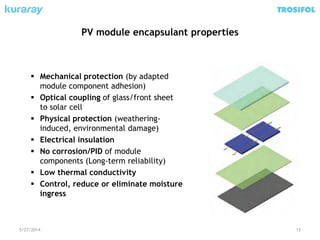
 Mechanical protection (by adapted
module component adhesion)
 Optical coupling of glass/front sheet
to solar cell
 Physical protection (weathering-
induced, environmental damage)
 Electrical insulation
 No corrosion/PID of module
components (Long-term reliability)
 Low thermal conductivity
 Control, reduce or eliminate moisture
ingress
5/27/2014 14
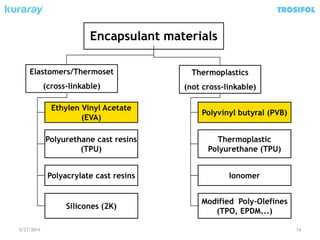
Encapsulant materials
Thermoplastics
(not cross-linkable)
Elastomers/Thermoset
(cross-linkable)
Polyvinyl butyral (PVB)
Thermoplastic
Polyurethane (TPU)
Ionomer
Modified Poly-Olefines
(TPO, EPDM...)
Ethylen Vinyl Acetate
(EVA)
Polyurethane cast resins
(TPU)
Polyacrylate cast resins
Silicones (2K)
(Bifacial) module encapsulants
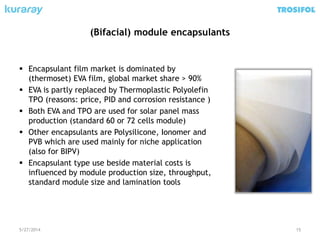
 Encapsulant film market is dominated by
(thermoset) EVA film, global market share > 90%
 EVA is partly replaced by Thermoplastic Polyolefin
TPO (reasons: price, PID and corrosion resistance )
 Both EVA and TPO are used for solar panel mass
production (standard 60 or 72 cells module)
 Other encapsulants are Polysilicone, Ionomer and
PVB which are used mainly for niche application
(also for BIPV)
 Encapsulant type use beside material costs is
influenced by module production size, throughput,
standard module size and lamination tools
5/27/2014 15
5/27/2014 16
Glass and encapsulants for laminated PV safety glass
Laminated modules for BIPV roof application
 Have to be laminated safety glass
with high performance
 Reason: no splinter loss in case of
destruction
 Also high post-breakage behaviour
(public traffic areas)
 Regulated in international building
codes and safety regulations
 Static load stable (e.g. snow load)
 Safety requirements regulated by
ball drop test acc. to standards EN
12543-4 and DIN 52338
5/27/2014 17
Minimum requirement for laminated (BIPV) safety glass
 Ball drop test with 1 kg steel ball according to EN
12543-4 and DIN 52338
 Minimum LSG glass/encapsulant make-up:
2 x 3 mm float and 0.4 mm film
 Falling height is 4.0 m
 Test at room temperature (23°C)
 Test is passed, if steel ball does not fall through
the glass samples (3 test pieces)
 Test fulfilled with the encapsulants: PVB,
Ionomer, TPU
 Test not fulfilled with the encapsulants: EVA,
Polyolefines TPO, Silicones, cast resins
 Conclusion: main PV module encapsulants like
EVA and TPO have low safety performance
5/27/2014 18
Above test passed, below not passed
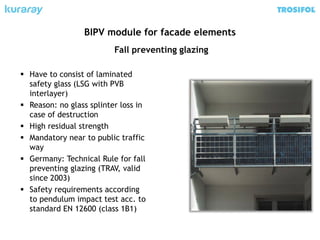
Fall preventing glazing
 Have to consist of laminated
safety glass (LSG with PVB
interlayer)
 Reason: no glass splinter loss in
case of destruction
 High residual strength
 Mandatory near to public traffic
way
 Germany: Technical Rule for fall
preventing glazing (TRAV, valid
since 2003)
 Safety requirements according
to pendulum impact test acc. to
standard EN 12600 (class 1B1)
BIPV module for facade elements
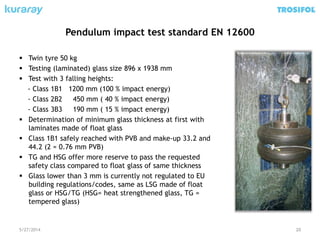
Pendulum impact test standard EN 12600
 Twin tyre 50 kg
 Testing (laminated) glass size 896 x 1938 mm
 Test with 3 falling heights:
- Class 1B1 1200 mm (100 % impact energy)
- Class 2B2 450 mm ( 40 % impact energy)
- Class 3B3 190 mm ( 15 % impact energy)
 Determination of minimum glass thickness at first with
laminates made of float glass
 Class 1B1 safely reached with PVB and make-up 33.2 and
44.2 (2 = 0.76 mm PVB)
 TG and HSG offer more reserve to pass the requested
safety class compared to float glass of same thickness
 Glass lower than 3 mm is currently not regulated to EU
building regulations/codes, same as LSG made of float
glass or HSG/TG (HSG= heat strengthened glass, TG =
tempered glass)
5/27/2014 20
Pendulum impact test results EN 12600
LSG with 2x2 mm HSG or 2x3 float/0.9-1.0 mm film
5/27/2014 21
Film type HSG 2 mm float HSG 2 mm cast float 3 mm
EVA
(Architectural)
2B2 2B2 2B2
EVA (Solar) 2B2 2B2 2B2
Polyolefine TPO 1 1B1*narrow 2B2 2B2
Polyolefine TPO 2 1B1*narrow 1B1*narrow 2B2
Ionomer 1B1 1B1 1B1
Silicone 2B2 2B2 2B2
Polyurethane TPU 1B1 1B1 1B1
PVB 1B1 1B1 1B1
Pendulum impact test comparison PVB/EVA
LSG made of 2 x 3 mm float glass, class 1B1 (1200 mm)
5/27/2014 22
PVB 1.00 mm, 1B1 passed EVA 0.95 mm, 1B1 not passed
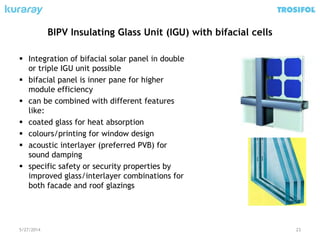
BIPV Insulating Glass Unit (IGU) with bifacial cells
 Integration of bifacial solar panel in double
or triple IGU unit possible
 bifacial panel is inner pane for higher
module efficiency
 can be combined with different features
like:
 coated glass for heat absorption
 colours/printing for window design
 acoustic interlayer (preferred PVB) for
sound damping
 specific safety or security properties by
improved glass/interlayer combinations for
both facade and roof glazings
5/27/2014 23
Buildings account for almost half of global CO2 emission. Yet there is
enough building surface to generate all our electricity needs
 Still in infancy – less than 2% PV market share
 Globally installed BIPV modules 2013: ~400 MW
 Higher value/margins worth $5 bn in 2016
Constrained by:
 Varying module certification and building standards
 Different installation skills/processes
 Lack of suitable products/supply chain
 No mass production/custom size
 New cell concepts like bifacial need 2 glass panes
 Facade and roof glazing PV elements require valid
safety & security standards safely fulfilled by PVB,
Ionomer and TPU encapsulant combined with
float/heat strengthened/tempered glass
5/27/2014 24
BIPV market as a chance for high performance encapsulants
5/27/2014 25
Summary
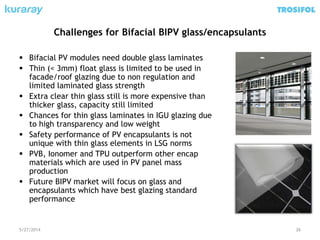
Challenges for Bifacial BIPV glass/encapsulants
 Bifacial PV modules need double glass laminates
 Thin (< 3mm) float glass is limited to be used in
facade/roof glazing due to non regulation and
limited laminated glass strength
 Extra clear thin glass still is more expensive than
thicker glass, capacity still limited
 Chances for thin glass laminates in IGU glazing due
to high transparency and low weight
 Safety performance of PV encapsulants is not
unique with thin glass elements in LSG norms
 PVB, Ionomer and TPU outperform other encap
materials which are used in PV panel mass
production
 Future BIPV market will focus on glass and
encapsulants which have best glazing standard
performance
5/27/2014 26
Thank you for your kind attention!
Your questions,please!
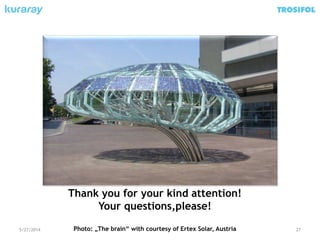
Photo: „The brain“ with courtesy of Ertex Solar, Austria5/27/2014 27

17 bernd koll ok

  • 1.
    Bifacial BIPV Challenges forglass and encapsulation Bernd Koll/ Kuraray Europe GmbH Bifi PV Workshop, Chambery May 26/27, 2014
  • 2.
    Content 5/27/2014 2 BIPV basics Challengesfor BIPV module glass Challenges for BIPV module encapsulation Glass and encapsulants for laminated PV safety glass Summary
  • 3.
    Which will bethe preferred (bifacial ) PV solar panel in about 25 years from now? 5/27/2014 3 Version A „Standard size“ OR Version B „Custom Size/BIPV“
  • 4.
  • 5.
  • 6.
    Why BIPV –now? Transition from niche to mass market  Changing economic drivers  Establishing new PV supply chain  New also bifacial cell concepts  New PV products/solutions  Significant cost reductions  Multiple product benefits  Growing awareness  Proven test/case studies 5/27/2014 6
  • 7.
     New design/aestheticsand architectural solutions  Higher functionality of glazing beside safety, security, sound, shading...  Large building area with PV = excellent energy balance (cost saving)  PV module has function of „electrical power producing glass pane“ Building Integrated Photovoltaic benefits
  • 8.
    Integration of BIPVin building process 5/27/2014 8 Synergy between Glass and PV industry => Team-up of PV company with supplier of glazing building products Glass production Glass processing Static engineering Building standards and codes Cell production Standard module production Long term module reliability IEC certification
  • 9.
    5/27/2014 9 Challenges forBIPV module glass
  • 10.
    PV glass developmentsfor standard PV modules 5/27/2014 10  Current PV cover/back glass standard is 3.2 mm low-iron tempered or heat strengthened  Target : panel with 2x 2mm glass based has similar mechanical strength than panel with 2x 3 mm glass  AR coated front glass improves module efficiency  Better performance of G/G modules in extreme (desert or tropical) climate  Tempering or heat strengthening of 2 mm glass improves mechanical performance and minimises deflection by static/dynamic load  G/G panels have much better fire resistance  Thin and stable G/G panels can be also frameless  But: 2 mm ultra clear glass is not cheaper than 3 or 4 mm glass and not easy in glass processing
  • 11.
    Glass for architecturalglazings  Standard architectural glass thickness is from 4 mm up to 25 mm float/annealed glass  In some cases also 3 mm float glass is used (double or triple Insulating Glass Units)  Standard clear glass is preferred, but also low iron glass is used (~ 1/3 of glass consumption)  Tempered (TG) or heat strengthened (HSG) glass improves glazing stability  Laminated glass consists of minimum 2 x 3 mm float glass and 0.38 mm interlayer  Laminated glass has to fulfil several (EU) safety glazing norms, regulations and building codes  G/G solar panels are generally not regulated according to EU glazing standards and need therefore (national) building products approval 5/27/2014 11
  • 12.
    5/27/2014 12 Challenges forBIPV module encapsulation
  • 13.
    PV module encapsulantproperties 5/27/2014 13  Mechanical protection (by adapted module component adhesion)  Optical coupling of glass/front sheet to solar cell  Physical protection (weathering- induced, environmental damage)  Electrical insulation  No corrosion/PID of module components (Long-term reliability)  Low thermal conductivity  Control, reduce or eliminate moisture ingress
  • 14.
    5/27/2014 14 Encapsulant materials Thermoplastics (notcross-linkable) Elastomers/Thermoset (cross-linkable) Polyvinyl butyral (PVB) Thermoplastic Polyurethane (TPU) Ionomer Modified Poly-Olefines (TPO, EPDM...) Ethylen Vinyl Acetate (EVA) Polyurethane cast resins (TPU) Polyacrylate cast resins Silicones (2K)
  • 15.
    (Bifacial) module encapsulants Encapsulant film market is dominated by (thermoset) EVA film, global market share > 90%  EVA is partly replaced by Thermoplastic Polyolefin TPO (reasons: price, PID and corrosion resistance )  Both EVA and TPO are used for solar panel mass production (standard 60 or 72 cells module)  Other encapsulants are Polysilicone, Ionomer and PVB which are used mainly for niche application (also for BIPV)  Encapsulant type use beside material costs is influenced by module production size, throughput, standard module size and lamination tools 5/27/2014 15
  • 16.
    5/27/2014 16 Glass andencapsulants for laminated PV safety glass
  • 17.
    Laminated modules forBIPV roof application  Have to be laminated safety glass with high performance  Reason: no splinter loss in case of destruction  Also high post-breakage behaviour (public traffic areas)  Regulated in international building codes and safety regulations  Static load stable (e.g. snow load)  Safety requirements regulated by ball drop test acc. to standards EN 12543-4 and DIN 52338 5/27/2014 17
  • 18.
    Minimum requirement forlaminated (BIPV) safety glass  Ball drop test with 1 kg steel ball according to EN 12543-4 and DIN 52338  Minimum LSG glass/encapsulant make-up: 2 x 3 mm float and 0.4 mm film  Falling height is 4.0 m  Test at room temperature (23°C)  Test is passed, if steel ball does not fall through the glass samples (3 test pieces)  Test fulfilled with the encapsulants: PVB, Ionomer, TPU  Test not fulfilled with the encapsulants: EVA, Polyolefines TPO, Silicones, cast resins  Conclusion: main PV module encapsulants like EVA and TPO have low safety performance 5/27/2014 18 Above test passed, below not passed
  • 19.
    Fall preventing glazing Have to consist of laminated safety glass (LSG with PVB interlayer)  Reason: no glass splinter loss in case of destruction  High residual strength  Mandatory near to public traffic way  Germany: Technical Rule for fall preventing glazing (TRAV, valid since 2003)  Safety requirements according to pendulum impact test acc. to standard EN 12600 (class 1B1) BIPV module for facade elements
  • 20.
    Pendulum impact teststandard EN 12600  Twin tyre 50 kg  Testing (laminated) glass size 896 x 1938 mm  Test with 3 falling heights: - Class 1B1 1200 mm (100 % impact energy) - Class 2B2 450 mm ( 40 % impact energy) - Class 3B3 190 mm ( 15 % impact energy)  Determination of minimum glass thickness at first with laminates made of float glass  Class 1B1 safely reached with PVB and make-up 33.2 and 44.2 (2 = 0.76 mm PVB)  TG and HSG offer more reserve to pass the requested safety class compared to float glass of same thickness  Glass lower than 3 mm is currently not regulated to EU building regulations/codes, same as LSG made of float glass or HSG/TG (HSG= heat strengthened glass, TG = tempered glass) 5/27/2014 20
  • 21.
    Pendulum impact testresults EN 12600 LSG with 2x2 mm HSG or 2x3 float/0.9-1.0 mm film 5/27/2014 21 Film type HSG 2 mm float HSG 2 mm cast float 3 mm EVA (Architectural) 2B2 2B2 2B2 EVA (Solar) 2B2 2B2 2B2 Polyolefine TPO 1 1B1*narrow 2B2 2B2 Polyolefine TPO 2 1B1*narrow 1B1*narrow 2B2 Ionomer 1B1 1B1 1B1 Silicone 2B2 2B2 2B2 Polyurethane TPU 1B1 1B1 1B1 PVB 1B1 1B1 1B1
  • 22.
    Pendulum impact testcomparison PVB/EVA LSG made of 2 x 3 mm float glass, class 1B1 (1200 mm) 5/27/2014 22 PVB 1.00 mm, 1B1 passed EVA 0.95 mm, 1B1 not passed
  • 23.
    BIPV Insulating GlassUnit (IGU) with bifacial cells  Integration of bifacial solar panel in double or triple IGU unit possible  bifacial panel is inner pane for higher module efficiency  can be combined with different features like:  coated glass for heat absorption  colours/printing for window design  acoustic interlayer (preferred PVB) for sound damping  specific safety or security properties by improved glass/interlayer combinations for both facade and roof glazings 5/27/2014 23
  • 24.
    Buildings account foralmost half of global CO2 emission. Yet there is enough building surface to generate all our electricity needs  Still in infancy – less than 2% PV market share  Globally installed BIPV modules 2013: ~400 MW  Higher value/margins worth $5 bn in 2016 Constrained by:  Varying module certification and building standards  Different installation skills/processes  Lack of suitable products/supply chain  No mass production/custom size  New cell concepts like bifacial need 2 glass panes  Facade and roof glazing PV elements require valid safety & security standards safely fulfilled by PVB, Ionomer and TPU encapsulant combined with float/heat strengthened/tempered glass 5/27/2014 24 BIPV market as a chance for high performance encapsulants
  • 25.
  • 26.
    Challenges for BifacialBIPV glass/encapsulants  Bifacial PV modules need double glass laminates  Thin (< 3mm) float glass is limited to be used in facade/roof glazing due to non regulation and limited laminated glass strength  Extra clear thin glass still is more expensive than thicker glass, capacity still limited  Chances for thin glass laminates in IGU glazing due to high transparency and low weight  Safety performance of PV encapsulants is not unique with thin glass elements in LSG norms  PVB, Ionomer and TPU outperform other encap materials which are used in PV panel mass production  Future BIPV market will focus on glass and encapsulants which have best glazing standard performance 5/27/2014 26
  • 27.
    Thank you foryour kind attention! Your questions,please! Photo: „The brain“ with courtesy of Ertex Solar, Austria5/27/2014 27