© 2015, IJCSE All Rights Reserved 1
International Journal of Computer Sciences and EngineeringInternational Journal of Computer Sciences and EngineeringInternational Journal of Computer Sciences and EngineeringInternational Journal of Computer Sciences and Engineering Open Access
Research Paper Volume-3, Issue-8 E-ISSN: 2347-2693
Improving the performance of Mobile Wireless Sensor Networks
using modified DBSCAN
Abhinav Gupta1*
and Prabhdeep Singh2
Department of Computer Science and Engineering, Punjab Technical University, INDIA
www.ijcseonline.org
Received: Jul /15/2015 Revised: Jul/26/2015 Accepted: Aug/20/2015 Published: Aug/30/ 2015
Abstract— In wireless sensor networks the nodes are most of times static in nature. But in Mobile wireless sensor networks the
nodes are mobile in nature, in such kind of networks if the emphasis is given on the clustering then the cluster head sometimes
tend to move out of the cluster. The paper analyzes ECBR-MWSN which takes into account mobility, remaining energy and
distance to the base station while making selection for the cluster head nodes. The proposed work however has tried to reduce
the time taken in rotation of cluster heads. The performance of network was analyzed using throughput, delay and packet
delivery ratio which showed a significant improvement.
Keywords - ECBR-MWSN, Cluster head, Throughput of Network, delay, Packet Delivery Ratio, Routing Protocol, Sensor
Nodes, Mobile Sink.)
I. INTRODUCTION
Recent years have witnessed an increasing interest in
using wireless sensor networks (WSNs) in many
applications, including environmental monitoring and
military field surveillance. In these applications, tiny sensors
are deployed and left unattended to continuously report
parameters such as temperature, pressure, humidity, light,
and chemical activity. Reports transmitted by these sensors
are collected by observers (e.g., base stations). The dense
deployment and unattended nature of WSNs make it quite
difficult to recharge node batteries. Therefore, energy
efficiency is a major design goal in these networks.
A wireless sensor network is an infrastructure comprised of
sensing (measuring), computing, and communication
elements that gives an administrator the ability to instrument,
observe, and react to events and phenomena in a specified
environment. WSN is a very large array of diverse sensor
nodes that are interconnected by a communication network.
The sensing data are shared between the sensor nodes and
are used as input for a distributed estimation system. The
fundamental objectives for WSN are reliability, accuracy,
flexibility, cost effectiveness, and ease of deployment. WSN
is made up of individual multifunctional sensor nodes.
II. RELATED WORKS
In[1] The authors have talked about hotspot problem. In
WSN, sensors close to the sink need to hand-off the
information of the nodes far from the sink and subsequently
they deplete their energy rapidly. It consequences in
network partitioning and hence decreases the lifetime of
network. This problem is termed as hotspot problem.
Recently, formation of hotspot or energy hole close to the
sink has risen as a critical issue for data gathering in WSN.
In this paper, authors discussed about the hotspot problem
and proposed a Mobile Sink based Routing Protocol
(MSRP) for Prolonging Network Lifetime in Clustered
Wireless Sensor Networks. In MSRP, mobile sink moves in
the clustered WSN to gather sensed data from the CHs
inside its region. Mobile sink has to maintain the information
data about the residual energy of the CHs while gathering
the data. Mobile sink, considering the residual energy of
CHs move to the CHs having higher energy. Therefore, the
hotspot problem is minimized as the next neighbor of the
sink is high energy node and it changes as a result of regular
sink movement. This protocol is effective in the efficient
utilization of WSN energy and enhances the network life
time.
In [2] authors propose a new strategy in which nodes send
their data to the sink via multi-hop path of reduced length
and all nodes maintain a buffer in which they store their
data before sink comes closer to them. This exempts the
different sensors to relay the data. This strategy is effective
in saving the energy along with a check that no data has
been lost due to buffer overflow. WSN lifetime is optimized
through controlled sink mobility and limited buffer capacity
using Linear Program (LP). LP determines the time a sink
stays at a particular location, data transfer rate between the
nodes and the quantity of buffered packets. The proposed
solution claims to achieve better lifetime, generate and
transmit more data to the mobile sink and more load
balancing among the nodes. A distributed algorithm is
derived from the numerical results of data collection in
WSN. In [3] authors proposed an efficient routing protocol
for single mobile sink and multiple mobile sinks for
gathering of the data in WSNs. In this scheme, the next
position of the sink is determined by using biased random
walk method. After this the optimal data transmission path
is found using rendezvous point selection with splitting tree
technique. If the sink moves within the range of the
International Journal of Computer Sciences and Engineering Vol.-3(8),PP(06-10) August 2015, E-ISSN: 2347-2693
© 2015, IJCSE All Rights Reserved 7
rendezvous point, it receives the gathered data and if it
moves out of the range, it chooses a relay node from its
neighbours to pass the packets from meeting point to the
sink. The scheme suggested here is effective in reducing the
signal overhead and improving the triangular routing
problem. The sink behaves like a vehicle and collects the
data from the sensor. The proposed model effectively
supports sink mobility with low overhead and delay when
compared with Intelligent Agent-based Routing protocol
(IAR) and also increases the reliability and delivery ratio
when the number of sources increases.
In [4] authors propose a novel clustering scheme EECS for
wireless sensor networks, which are suitable for data
gathering applications at regular intervals. Clustering is an
effective topology control approach in wireless sensor
networks which can increase network scalability and
lifetime. In this approach cluster heads are elected among
the nodes having more residual energy through local radio
communication by having well cluster head distribution.
This novel method is used to balance the load between the
cluster heads and proves that EECS surpass LEACH
significantly with increasing the network lifetime over 35%.
In [5], authors propose a novel network construction and
routing method by defining three different duties for sensor
nodes i.e. node gateways, cluster heads and cluster members
and then by applying a hierarchical structure from sink to
the normal sensor nodes. The proposed method provides an
efficient rationale to support the maximum coverage to
recover the missing data with node mobility and to reduce
the energy wastage. In this way the lifetime of the network
improves significantly.
In [6] author uses optimum approach i.e. Leach-C to
increase the lifetime of a wireless sensor networks. In this
approach, cluster heads are distributed all over the network
for better performance. Sink collects the data from each
cluster heads by finding the optimum path with the help of
travelling salesman problem. Here energy consumption is
reduced by using Leach-C and travelling sales problem.
Mobile sink gathers data, hence, reducing the energy
consumption and so extends the network lifetime.
The authors in [7] talks about maximizing lifetime of the
network. The major problem WSNs facing today is the
limited energy availability of nodes. This paper discusses the
controlled sink mobility in clustered sensor networks where
all cluster heads send buffered data to the sink in a specified
period of time called data reporting time (drt). In the
proposed scheme, cluster heads data is collected by sink in
drt time span, thus, maximizing the lifetime of the network
with the help of MILP(Mixed Integer linear Programming)
model. The scheme is then compared with the other related
schemes by using other means of simulation scenarios.
In [8] the authors focused upon sleep and wake approach to
increase the lifetime of the network. These days energy
efficient routing protocols are considered as best solution to
the WSNs routing. In this paper, mobile sink collects the
data from all sensor nodes and transmit it through the
network. There are different methods to utilize the
transmission energy of the sensor node. The distance
between transmitter and receiver is calculated before
available transmission and then lowest transmission power
is calculated and determined. Lowest transmission power is
used to transmit the measurement data. During normal
operating condition, sensor nodes are set to sleep/wake up
mode for saving the energy.
III. EXISTING WORK
Group communication in wireless sensor networks (WSNs)
is emerging as an important communication paradigm. A
WSN is typically organized as a hierarchical tree network,
with leaf sensor nodes sending data to a root base station
collection point via a multi-hop wireless routing network.
Each micro sensor node is resource-constrained, with
severe limitations on its energy lifetime, memory, CPU,
and radio bandwidth. It is often important for the base
station to communicate to groups of resource-constrained
sensor nodes.
One of the most important challenges of WSNs design is
develop a method or protocol so that the randomly
deployed numerous sensor nodes behave in a collaborative
and organized way. Each sensor node wants to maximize
its own utility function. In addition, the entire network
needs balance in resource assignments to perform in a way
that is useful and efficient. So it becomes extremely
important to design a method which can save energy of the
nodes so that nodes in the network may work for long
duration and the lifetime of the network can be increased.
In the study done by RU Anitha in [9] the authors have put
forward concept of enhanced clustering in the wireless
sensor network where the nodes are also mobile. In this
concept the clustering is done by sink node using
DBSCAN algorithm [10]. The algorithm starts with nodes
broadcasting the information about their residual energy,
distance to the base station and mobility factor to the base
station node. The cluster head selection is done taking
primary factors into consideration - residual energy of the
nodes and the mobility factor, the secondary factor which
International Journal of Computer Sciences and Engineering Vol.-3(8),PP(06-10) August 2015, E-ISSN: 2347-2693
© 2015, IJCSE All Rights Reserved 8
is taken into consideration is distance to the base station.
However, this approach causes delay as the nodes have to
broadcast their information to the base station at the start of
every round. There arises a need where the cluster head
selection between the rounds is one as fast as possible to
reduce the delay.
IV. Proposed Work
We first divide the networks into group of nodes called
clusters. We use the concept of the initiator node, initiator
node will be one that will start the clustering process.
Initially a random node from the cluster will be chosen as
initiator. Initiator will send hello message to the nodes.
Each node will reply to initiator node along with their
remaining energy levels and mobility information. The
initiator will chose the one with lowest mobility and
highest energy as the cluster head. After that it will decide
the schedule after which next node will become the cluster
head and broadcast the schedule to the nodes in the
clusters. In this we will modify the cluster head rotation
phase to reduce the delay between the rounds.
V. Results and Discussion
The concept of prevention of black hole attack by using
secure clustering was implemented in NS2.35. The
performance of the network was analyzed using three
parameters which are crucial to performance of the
network namely packet delivery ratio, throughput and
delay. The parameters which were used for simulation are
described in the table below.
Simulation Parameters Table:
Channel Wireless Channel
Propagation Model Two Ray Ground
Antenna Omni-Directional
Queue Drop Tail
Number of nodes 50
Initial Energy 100 Joules
The results were analyzed using three parameters-
throughput, packet delivery ratio and delay.
Throughput - It is defined as amount of data received at the
base station in the network. For better performance of the
network, the throughput must be more.
Packet Delivery Ratio - It is defined as ratio of number of
packets received to the number of packets sent. If the
dropping in any network is more the packer delivery ratio
tends to be less and vice versa. The value for PDR must be
more.
Delay - It is time taken for data packets to reach the base
station in the network. A major part of the delay is caused
due to cluster formation and rotation of cluster heads in the
network.
The values obtained are shown in the table:
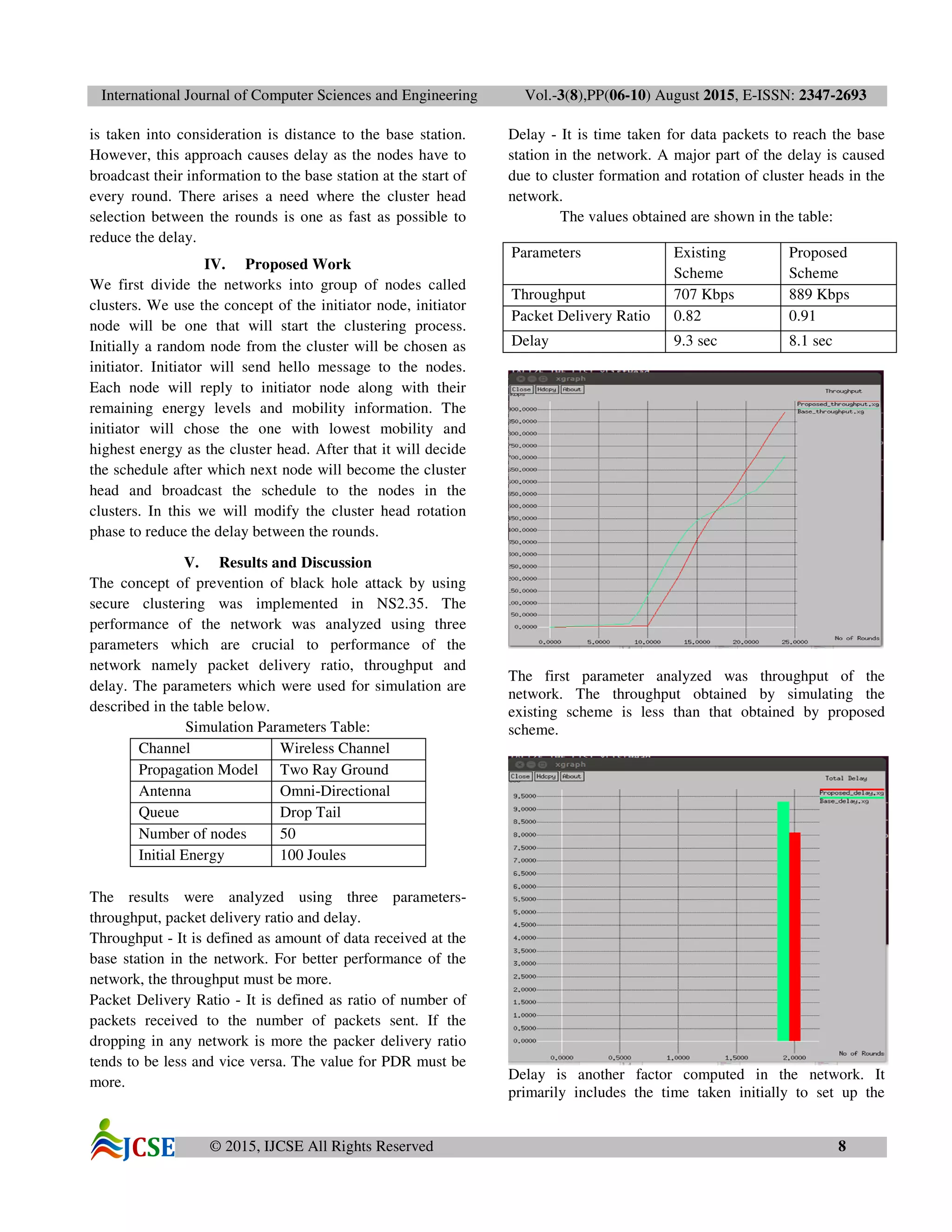
The first parameter analyzed was throughput of the
network. The throughput obtained by simulating the
existing scheme is less than that obtained by proposed
scheme.
Delay is another factor computed in the network. It
primarily includes the time taken initially to set up the
Parameters Existing
Scheme
Proposed
Scheme
Throughput 707 Kbps 889 Kbps
Packet Delivery Ratio 0.82 0.91
Delay 9.3 sec 8.1 sec
International Journal of Computer Sciences and Engineering Vol.-3(8),PP(06-10) August 2015, E-ISSN: 2347-2693
© 2015, IJCSE All Rights Reserved 9
clusters in the network and the time taken in between the
rounds to select the cluster heads in the network
The third factor computed is packet delivery ratio. It is one
of the main factors which is important to analyze while
checking on the performance of the network. The packet
delivery ratio obtained using proposed scheme is more than
that obtained using existing scheme.
VI. Conclusion and Future Work
The present work has worked upon the existing clustering
algorithm ECBR-MWSN (enhanced cluster based routing
for mobile wireless sensor networks). It considered three
parameters while selecting the cluster heads for the clusters
formed in the network. Remaining energy of the nodes and
mobility of the nodes has been considered as the primary
factor while distance to the base station was considered as
the secondary factor while selecting cluster heads. However
the proposed scheme required broadcasting on the part of
nodes every time round starts. In the proposed work we
have tried to select the cluster heads using the concept of
initiator nodes but not by base station. The initiator node
selects the cluster head for subsequent rounds at the start of
the first round only. The existing and proposed scheme
were analyzed using the three parameters namely
throughput, packet delivery ratio and delay of the network.
All the three factors showed better performance using
proposed scheme as compared to existing scheme.
In future the proposed scheme can be used to analyze
various other parameters such as energy consumption and
various parameters such as number of nodes and mobility of
the nodes can also varied to analyze the performance of the
network. Also genetic optimization can be used while
selecting the cluster heads and as far as routing of the data
from cluster heads to the base station is concerned the data
can be sent using ant colony optimization instead of simple
multi hop scenario.
ACKNOWLEDGMETS
The paper has been written with the kind assistance,
guidance and active support of my department who have
helped me in this work. I would like to thank all the
individuals whose encouragement and support has made the
completion of this work possible.
REFERENCES
[1] B. Nazir; H. Hasbullah, "Mobile Sink based Routing
Protocol (MSRP) for Prolonging Network Lifetime in
Clustered Wireless Sensor Network," International
Conference on Computer Applications and Industrial
Electronics (ICCAIE), pp.624-629, 5-8 Dec.2010.
[2] T. Rault, A. Bouabdallah, Y. Challal, "WSN lifetime
optimization through controlled sink mobility and
packet buffering," Global Information Infrastructure
Symposium,pp.1-6, 28-31 Oct. 2013.
[3] Madhumathy, P.; Sivakumar, D., "Enabling energy
efficient sensory data collection using multiple mobile
sink," Communications, China, vol.11, no.10, pp.29-37,
Oct. 2014.
[4] Mao Ye; Chengfa Li; Guihai Chen; Jie Wu, "EECS: An
Energy Efficient Clustering Scheme in Wireless Sensor
Networks," 24th IEEE International Performance,
Computing, and Communications Conference, pp.535-
540, 7-9 April 2005.
[5] A. Hosen, S. Kim and G. Cho, “An Energy efficient
Cluster Formation and Maintenance Scheme for
Wireless Sensor Networks”, Journal of Information and
Communication Convergence Engineering, 2012.
[6] P. Dekate, “An Efficient Algorithm for Sink Mobility to
Extend Lifetime of Homogeneous Wireless Sensor
Networks”, International Journal of Current
Engineering and Technology, vol. 4, no. 3,pp. 2277-
4106, 2014.
[7] Tashtarian, F.; Moghaddam, M.H.Y.; Effati, S., "Energy
efficient data gathering algorithm in hierarchical
wireless sensor networks with mobile sink," 2nd
International eConference on Computer and
Knowledge Engineering (ICCKE), pp.232-237, 18-19
Oct. 2012.
International Journal of Computer Sciences and Engineering Vol.-3(8),PP(06-10) August 2015, E-ISSN: 2347-2693
© 2015, IJCSE All Rights Reserved 10
[8] Palaskar, S.P.; Chavhan, N.A., "Design and
Implementation of Energy Efficient Node Data
Transmission by Using Mobile Sink Node," Fourth
International Conference on Communication Systems
and Network Technologies (CSNT), 2014 , vol., no.,
pp.79,82, 7-9 April 2014.
[9] R.U. Anitha, Dr. P Kamalakkannan, "Enhanced cluster
based routing protocol for mobile nodes in wireless
sensor networks," Proceedings of 2013 International
Conference on Pattern Recognition, Informatics and
Mobile Engineering (PRIME) Feb 21-22, 2013
[10] Jiawei Han, Micheline Kamber, "Data Mining:
Concepts and Techniques," Morgan Kaufmann
Publishers, 2002.

2 ijcse-01208

  • 1.
    © 2015, IJCSEAll Rights Reserved 1 International Journal of Computer Sciences and EngineeringInternational Journal of Computer Sciences and EngineeringInternational Journal of Computer Sciences and EngineeringInternational Journal of Computer Sciences and Engineering Open Access Research Paper Volume-3, Issue-8 E-ISSN: 2347-2693 Improving the performance of Mobile Wireless Sensor Networks using modified DBSCAN Abhinav Gupta1* and Prabhdeep Singh2 Department of Computer Science and Engineering, Punjab Technical University, INDIA www.ijcseonline.org Received: Jul /15/2015 Revised: Jul/26/2015 Accepted: Aug/20/2015 Published: Aug/30/ 2015 Abstract— In wireless sensor networks the nodes are most of times static in nature. But in Mobile wireless sensor networks the nodes are mobile in nature, in such kind of networks if the emphasis is given on the clustering then the cluster head sometimes tend to move out of the cluster. The paper analyzes ECBR-MWSN which takes into account mobility, remaining energy and distance to the base station while making selection for the cluster head nodes. The proposed work however has tried to reduce the time taken in rotation of cluster heads. The performance of network was analyzed using throughput, delay and packet delivery ratio which showed a significant improvement. Keywords - ECBR-MWSN, Cluster head, Throughput of Network, delay, Packet Delivery Ratio, Routing Protocol, Sensor Nodes, Mobile Sink.) I. INTRODUCTION Recent years have witnessed an increasing interest in using wireless sensor networks (WSNs) in many applications, including environmental monitoring and military field surveillance. In these applications, tiny sensors are deployed and left unattended to continuously report parameters such as temperature, pressure, humidity, light, and chemical activity. Reports transmitted by these sensors are collected by observers (e.g., base stations). The dense deployment and unattended nature of WSNs make it quite difficult to recharge node batteries. Therefore, energy efficiency is a major design goal in these networks. A wireless sensor network is an infrastructure comprised of sensing (measuring), computing, and communication elements that gives an administrator the ability to instrument, observe, and react to events and phenomena in a specified environment. WSN is a very large array of diverse sensor nodes that are interconnected by a communication network. The sensing data are shared between the sensor nodes and are used as input for a distributed estimation system. The fundamental objectives for WSN are reliability, accuracy, flexibility, cost effectiveness, and ease of deployment. WSN is made up of individual multifunctional sensor nodes. II. RELATED WORKS In[1] The authors have talked about hotspot problem. In WSN, sensors close to the sink need to hand-off the information of the nodes far from the sink and subsequently they deplete their energy rapidly. It consequences in network partitioning and hence decreases the lifetime of network. This problem is termed as hotspot problem. Recently, formation of hotspot or energy hole close to the sink has risen as a critical issue for data gathering in WSN. In this paper, authors discussed about the hotspot problem and proposed a Mobile Sink based Routing Protocol (MSRP) for Prolonging Network Lifetime in Clustered Wireless Sensor Networks. In MSRP, mobile sink moves in the clustered WSN to gather sensed data from the CHs inside its region. Mobile sink has to maintain the information data about the residual energy of the CHs while gathering the data. Mobile sink, considering the residual energy of CHs move to the CHs having higher energy. Therefore, the hotspot problem is minimized as the next neighbor of the sink is high energy node and it changes as a result of regular sink movement. This protocol is effective in the efficient utilization of WSN energy and enhances the network life time. In [2] authors propose a new strategy in which nodes send their data to the sink via multi-hop path of reduced length and all nodes maintain a buffer in which they store their data before sink comes closer to them. This exempts the different sensors to relay the data. This strategy is effective in saving the energy along with a check that no data has been lost due to buffer overflow. WSN lifetime is optimized through controlled sink mobility and limited buffer capacity using Linear Program (LP). LP determines the time a sink stays at a particular location, data transfer rate between the nodes and the quantity of buffered packets. The proposed solution claims to achieve better lifetime, generate and transmit more data to the mobile sink and more load balancing among the nodes. A distributed algorithm is derived from the numerical results of data collection in WSN. In [3] authors proposed an efficient routing protocol for single mobile sink and multiple mobile sinks for gathering of the data in WSNs. In this scheme, the next position of the sink is determined by using biased random walk method. After this the optimal data transmission path is found using rendezvous point selection with splitting tree technique. If the sink moves within the range of the
  • 2.
    International Journal ofComputer Sciences and Engineering Vol.-3(8),PP(06-10) August 2015, E-ISSN: 2347-2693 © 2015, IJCSE All Rights Reserved 7 rendezvous point, it receives the gathered data and if it moves out of the range, it chooses a relay node from its neighbours to pass the packets from meeting point to the sink. The scheme suggested here is effective in reducing the signal overhead and improving the triangular routing problem. The sink behaves like a vehicle and collects the data from the sensor. The proposed model effectively supports sink mobility with low overhead and delay when compared with Intelligent Agent-based Routing protocol (IAR) and also increases the reliability and delivery ratio when the number of sources increases. In [4] authors propose a novel clustering scheme EECS for wireless sensor networks, which are suitable for data gathering applications at regular intervals. Clustering is an effective topology control approach in wireless sensor networks which can increase network scalability and lifetime. In this approach cluster heads are elected among the nodes having more residual energy through local radio communication by having well cluster head distribution. This novel method is used to balance the load between the cluster heads and proves that EECS surpass LEACH significantly with increasing the network lifetime over 35%. In [5], authors propose a novel network construction and routing method by defining three different duties for sensor nodes i.e. node gateways, cluster heads and cluster members and then by applying a hierarchical structure from sink to the normal sensor nodes. The proposed method provides an efficient rationale to support the maximum coverage to recover the missing data with node mobility and to reduce the energy wastage. In this way the lifetime of the network improves significantly. In [6] author uses optimum approach i.e. Leach-C to increase the lifetime of a wireless sensor networks. In this approach, cluster heads are distributed all over the network for better performance. Sink collects the data from each cluster heads by finding the optimum path with the help of travelling salesman problem. Here energy consumption is reduced by using Leach-C and travelling sales problem. Mobile sink gathers data, hence, reducing the energy consumption and so extends the network lifetime. The authors in [7] talks about maximizing lifetime of the network. The major problem WSNs facing today is the limited energy availability of nodes. This paper discusses the controlled sink mobility in clustered sensor networks where all cluster heads send buffered data to the sink in a specified period of time called data reporting time (drt). In the proposed scheme, cluster heads data is collected by sink in drt time span, thus, maximizing the lifetime of the network with the help of MILP(Mixed Integer linear Programming) model. The scheme is then compared with the other related schemes by using other means of simulation scenarios. In [8] the authors focused upon sleep and wake approach to increase the lifetime of the network. These days energy efficient routing protocols are considered as best solution to the WSNs routing. In this paper, mobile sink collects the data from all sensor nodes and transmit it through the network. There are different methods to utilize the transmission energy of the sensor node. The distance between transmitter and receiver is calculated before available transmission and then lowest transmission power is calculated and determined. Lowest transmission power is used to transmit the measurement data. During normal operating condition, sensor nodes are set to sleep/wake up mode for saving the energy. III. EXISTING WORK Group communication in wireless sensor networks (WSNs) is emerging as an important communication paradigm. A WSN is typically organized as a hierarchical tree network, with leaf sensor nodes sending data to a root base station collection point via a multi-hop wireless routing network. Each micro sensor node is resource-constrained, with severe limitations on its energy lifetime, memory, CPU, and radio bandwidth. It is often important for the base station to communicate to groups of resource-constrained sensor nodes. One of the most important challenges of WSNs design is develop a method or protocol so that the randomly deployed numerous sensor nodes behave in a collaborative and organized way. Each sensor node wants to maximize its own utility function. In addition, the entire network needs balance in resource assignments to perform in a way that is useful and efficient. So it becomes extremely important to design a method which can save energy of the nodes so that nodes in the network may work for long duration and the lifetime of the network can be increased. In the study done by RU Anitha in [9] the authors have put forward concept of enhanced clustering in the wireless sensor network where the nodes are also mobile. In this concept the clustering is done by sink node using DBSCAN algorithm [10]. The algorithm starts with nodes broadcasting the information about their residual energy, distance to the base station and mobility factor to the base station node. The cluster head selection is done taking primary factors into consideration - residual energy of the nodes and the mobility factor, the secondary factor which
  • 3.
    International Journal ofComputer Sciences and Engineering Vol.-3(8),PP(06-10) August 2015, E-ISSN: 2347-2693 © 2015, IJCSE All Rights Reserved 8 is taken into consideration is distance to the base station. However, this approach causes delay as the nodes have to broadcast their information to the base station at the start of every round. There arises a need where the cluster head selection between the rounds is one as fast as possible to reduce the delay. IV. Proposed Work We first divide the networks into group of nodes called clusters. We use the concept of the initiator node, initiator node will be one that will start the clustering process. Initially a random node from the cluster will be chosen as initiator. Initiator will send hello message to the nodes. Each node will reply to initiator node along with their remaining energy levels and mobility information. The initiator will chose the one with lowest mobility and highest energy as the cluster head. After that it will decide the schedule after which next node will become the cluster head and broadcast the schedule to the nodes in the clusters. In this we will modify the cluster head rotation phase to reduce the delay between the rounds. V. Results and Discussion The concept of prevention of black hole attack by using secure clustering was implemented in NS2.35. The performance of the network was analyzed using three parameters which are crucial to performance of the network namely packet delivery ratio, throughput and delay. The parameters which were used for simulation are described in the table below. Simulation Parameters Table: Channel Wireless Channel Propagation Model Two Ray Ground Antenna Omni-Directional Queue Drop Tail Number of nodes 50 Initial Energy 100 Joules The results were analyzed using three parameters- throughput, packet delivery ratio and delay. Throughput - It is defined as amount of data received at the base station in the network. For better performance of the network, the throughput must be more. Packet Delivery Ratio - It is defined as ratio of number of packets received to the number of packets sent. If the dropping in any network is more the packer delivery ratio tends to be less and vice versa. The value for PDR must be more. Delay - It is time taken for data packets to reach the base station in the network. A major part of the delay is caused due to cluster formation and rotation of cluster heads in the network. The values obtained are shown in the table: The first parameter analyzed was throughput of the network. The throughput obtained by simulating the existing scheme is less than that obtained by proposed scheme. Delay is another factor computed in the network. It primarily includes the time taken initially to set up the Parameters Existing Scheme Proposed Scheme Throughput 707 Kbps 889 Kbps Packet Delivery Ratio 0.82 0.91 Delay 9.3 sec 8.1 sec
  • 4.
    International Journal ofComputer Sciences and Engineering Vol.-3(8),PP(06-10) August 2015, E-ISSN: 2347-2693 © 2015, IJCSE All Rights Reserved 9 clusters in the network and the time taken in between the rounds to select the cluster heads in the network The third factor computed is packet delivery ratio. It is one of the main factors which is important to analyze while checking on the performance of the network. The packet delivery ratio obtained using proposed scheme is more than that obtained using existing scheme. VI. Conclusion and Future Work The present work has worked upon the existing clustering algorithm ECBR-MWSN (enhanced cluster based routing for mobile wireless sensor networks). It considered three parameters while selecting the cluster heads for the clusters formed in the network. Remaining energy of the nodes and mobility of the nodes has been considered as the primary factor while distance to the base station was considered as the secondary factor while selecting cluster heads. However the proposed scheme required broadcasting on the part of nodes every time round starts. In the proposed work we have tried to select the cluster heads using the concept of initiator nodes but not by base station. The initiator node selects the cluster head for subsequent rounds at the start of the first round only. The existing and proposed scheme were analyzed using the three parameters namely throughput, packet delivery ratio and delay of the network. All the three factors showed better performance using proposed scheme as compared to existing scheme. In future the proposed scheme can be used to analyze various other parameters such as energy consumption and various parameters such as number of nodes and mobility of the nodes can also varied to analyze the performance of the network. Also genetic optimization can be used while selecting the cluster heads and as far as routing of the data from cluster heads to the base station is concerned the data can be sent using ant colony optimization instead of simple multi hop scenario. ACKNOWLEDGMETS The paper has been written with the kind assistance, guidance and active support of my department who have helped me in this work. I would like to thank all the individuals whose encouragement and support has made the completion of this work possible. REFERENCES [1] B. Nazir; H. Hasbullah, "Mobile Sink based Routing Protocol (MSRP) for Prolonging Network Lifetime in Clustered Wireless Sensor Network," International Conference on Computer Applications and Industrial Electronics (ICCAIE), pp.624-629, 5-8 Dec.2010. [2] T. Rault, A. Bouabdallah, Y. Challal, "WSN lifetime optimization through controlled sink mobility and packet buffering," Global Information Infrastructure Symposium,pp.1-6, 28-31 Oct. 2013. [3] Madhumathy, P.; Sivakumar, D., "Enabling energy efficient sensory data collection using multiple mobile sink," Communications, China, vol.11, no.10, pp.29-37, Oct. 2014. [4] Mao Ye; Chengfa Li; Guihai Chen; Jie Wu, "EECS: An Energy Efficient Clustering Scheme in Wireless Sensor Networks," 24th IEEE International Performance, Computing, and Communications Conference, pp.535- 540, 7-9 April 2005. [5] A. Hosen, S. Kim and G. Cho, “An Energy efficient Cluster Formation and Maintenance Scheme for Wireless Sensor Networks”, Journal of Information and Communication Convergence Engineering, 2012. [6] P. Dekate, “An Efficient Algorithm for Sink Mobility to Extend Lifetime of Homogeneous Wireless Sensor Networks”, International Journal of Current Engineering and Technology, vol. 4, no. 3,pp. 2277- 4106, 2014. [7] Tashtarian, F.; Moghaddam, M.H.Y.; Effati, S., "Energy efficient data gathering algorithm in hierarchical wireless sensor networks with mobile sink," 2nd International eConference on Computer and Knowledge Engineering (ICCKE), pp.232-237, 18-19 Oct. 2012.
  • 5.
    International Journal ofComputer Sciences and Engineering Vol.-3(8),PP(06-10) August 2015, E-ISSN: 2347-2693 © 2015, IJCSE All Rights Reserved 10 [8] Palaskar, S.P.; Chavhan, N.A., "Design and Implementation of Energy Efficient Node Data Transmission by Using Mobile Sink Node," Fourth International Conference on Communication Systems and Network Technologies (CSNT), 2014 , vol., no., pp.79,82, 7-9 April 2014. [9] R.U. Anitha, Dr. P Kamalakkannan, "Enhanced cluster based routing protocol for mobile nodes in wireless sensor networks," Proceedings of 2013 International Conference on Pattern Recognition, Informatics and Mobile Engineering (PRIME) Feb 21-22, 2013 [10] Jiawei Han, Micheline Kamber, "Data Mining: Concepts and Techniques," Morgan Kaufmann Publishers, 2002.