© 2015, IJCSE All Rights Reserved 115
International Journal of Computer Sciences and EngineeringInternational Journal of Computer Sciences and EngineeringInternational Journal of Computer Sciences and EngineeringInternational Journal of Computer Sciences and Engineering Open Access
Research Paper Volume-3, Issue-8 E-ISSN: 2347-2693
Enhanced Suffix Stripping Algorithm to Improve Information Retrieval
Sundar Singh1
, R K Pateriya2
1*,2
Department of Computer Science & Engineering
Maulana Azad National Institute of Technology Bhopal, India, 462003
www.ijcseonline.org
Received: Jul /11/2015 Revised: Jul/27/2015 Accepted: Aug/16/2015 Published: Aug/30/ 2015
Abstract— Stemming algorithms are used to convert the words in text into their grammatical base form, and are mainly used to
increase the Information Retrieval System’s efficiency. Several algorithms exist with altered techniques. The most widely used
is the Porter Stemming algorithm. However, it still has several drawbacks, although many attempts were made to improve its
structure. This paper discloses the inaccuracies encountered during the stemming process and proposes the corresponding
solutions.
Keywords— Stemming, stop word, Text mining, NLP, IR.
I. INTRODUCTION
Stemming is a technique used to reduce words to their root
form called stem, by removing derivational and inflectional
affixes. Most of the existing stemming algorithms uses affix
stripping technique. This technique has wide application in
NLP, Text mining and information retrieval. Stemming
improves the performance of information retrieval systems
by decreasing the index size. There are many stemming
algorithms implemented for English language. Many of
these algorithms are working successfully in information
retrieval system. However there are many drawbacks in
stemming algorithms, since these algorithms can’t fully
describe English morphology [1].
Fig. 1: Various steps in IR
Porter stemming algorithm is most widely used algorithm for
English language .It is efficiently working in many
informational retrieval systems.it also have some kind of
errors like over-stemming and under-stemming because
English morphology is very wide .By adding new rules in
porter’s algorithm will make it more efficient in the context
of information retrieval. Enhanced suffix stripping algorithm
is having the less amount of over-stemming and under-
stemming errors with less amount of index size [2].
These are various steps in IR first upload a document or type
a paragraph or text which is to be stemmed. After that
normalize the text data such that it is converted into either
lower case or upper case. All the special characters are
removed in this stage. In the 3rd step remove stop words.
Stop words are connecting words like is, are, the, am, be, etc.
these words do not have their own meaning. In the 4th step
stemming will be done, all words are converted into their
root or base or stem form [3]. Then indexing of all the stems
will be done. Stemming reduced the index size
approximately 1/2 of its previous word count. Then
information retrieval will be done.
II. LITERATURE REVIEW
A. Porter’s Algorithm
Porter stemming algorithm is one of the most famous
stemming method proposed by martin porter in 1980. It
comprises 60 rules in five steps. It is based on suffix
stripping technique. The data passes through different steps
one by one, so it is a multi-pass algorithm. Many
reformations and enhancements have been done and
proposed on the basic algorithm. It is based on the idea that
there are approx. 1200 suffixes in the English language,
mostly made up of a grouping of smaller and multiple
suffixes. The algorithm has five steps, and within each step,
rules are applied until one of them passes the conditions. If a
rule is matched, the suffix is removed consequently, and the
next step is performed. The resultant stemmed word at the
end of the fifth step is returned by the algorithm. Many
version of porter stemming are released [4].
The rules look like the following pattern:
<Condition> <suffix> → <new suffix>
For example, a rule (m>0) EED → EE means “if the word
has at least one “vowel and consonant” pair plus EED
International Journal of Computer Sciences and Engineering Vol.-3(8), PP(115-119) Aug 2015, E-ISSN: 2347-2693
© 2015, IJCSE All Rights Reserved 116
ending, change the ending to EE”. Example “agreed” is
converted as “agree” whereas “feed” remains unaffected.
This algorithm has about 60 rules in five steps. It is most
widely used algorithm for the purpose of stemming but it has
many errors in the rules. Several modifications have been
done on porter algorithm but it still have over stemming and
under stemming kind of problems.
Advantages of this algorithm are its efficiency and less time
consumption. The main disadvantage of this algorithm is
that it has over stemming and under stemming type of
problems [5,6].
Stemming rules are represented by the single form.
[C](VC){m}[V].
Here 'm' will be called the measure, number of VC pairs of
any word.
The rules for removing a suffix will be given in the form.
(Condition) S1 S2
This means that if a word ends with the suffix S1, and the
stem before S1 satisfies the given condition, S1 is replaced
by S2. The condition is usually given in terms of m. and m is
calculated by only condition part not S1.
The `condition' part may also contain the following:
*S - the stem ends with S (and similarly for the other
letters).
*v* - the stem contains a vowel.
*d - the stem ends with a double consonant (e.g. -TT, -SS).
*o - the stem ends cvc, where the second C is not W, X or Y
(e.g: -WIL, -HOP)[2].
In a set of rules written beneath each other, only one is
obeyed, and this tills the one with the longest matching S1
for the given word. For example
sses - ss
ies i
ss ss
s
In the rules below, examples of their application, successful
or otherwise, are given on the right in lower case. The
algorithm now follows:
Step 1a
(Condition)S1 S2 Word Stem
sses ss Caresses caress
ies i Ponies poni
Ties ti
ss ss Caress caress
s Cats cat
Step 1b
(Condition)S1 S2 Word Stem
(m>0) eed ee Feed feed
Agreed agree
(*v*) ed plastered plaster
bled bled
(m>0)(*v*) ing Motoring motor
Sing sing
at ate conflat(ed) conflate
bl ble troubl(ed) trouble
iz ize siz(ed) size
fall(ing) fall
hiss(ing) hiss
(m=1 and *o) E fail(ing) fail
fil(ing) file
The rule to map to a single letter causes the removal of one
of the double letter pair. The -E is put back on -AT, -BL and
-IZ, so that the suffixes -ATE, -BLE and -IZE can be
recognized later. This E may be removed in step 4.
Step 1c
(Condition)S1 S2 Word Stem
(*v*) Y -> I happy happi
Sky sky
Step 1, deals with plurals and past participles. The
subsequent steps are straighter forward.
Step 2
(Condition)S1 S2 Word Stem
(m>0) ational ate relational relate
(m>0) tional tion conditional condition
rational rational
(m>0) enci ence valenci valence
(m>0) anci ance hesitanci hesitance
(m>0) izer ize digitizer digitize
(m>0) abli able conformabli conformable
(m>0) alli al radicalli radical
(m>0) entli ent differentli different
(m>0) eli e vileli vile
(m>0) ousli ous analogousli analogous
(m>0) ization ize vietnamization vietnamize
(m>0) ation ate predication predicate
(m>0) ator ate operator operate
(m>0) alism al feudalism feudal
(m>0) iveness ive decisiveness decisive
(m>0)fulness ful hopefulness decisive
(m>0)ousness ous callousness callous
(m>0) aliti al formaliti formal
(m>0) iviti ive sensitiviti sensitive
(m>0) biliti ble sensibiliti sensible
The test for the string S1 can be made fast by doing a
program switch on the penultimate letter of the word being
tested. This gives a fairly even breakdown of the possible
values of the string S1. It will be seen in fact that the S1-
strings in step 2 are presented here in the alphabetical order
International Journal of Computer Sciences and Engineering Vol.-3(8), PP(115-119) Aug 2015, E-ISSN: 2347-2693
© 2015, IJCSE All Rights Reserved 117
of their penultimate letter. Similar techniques may be applied
in the other steps.
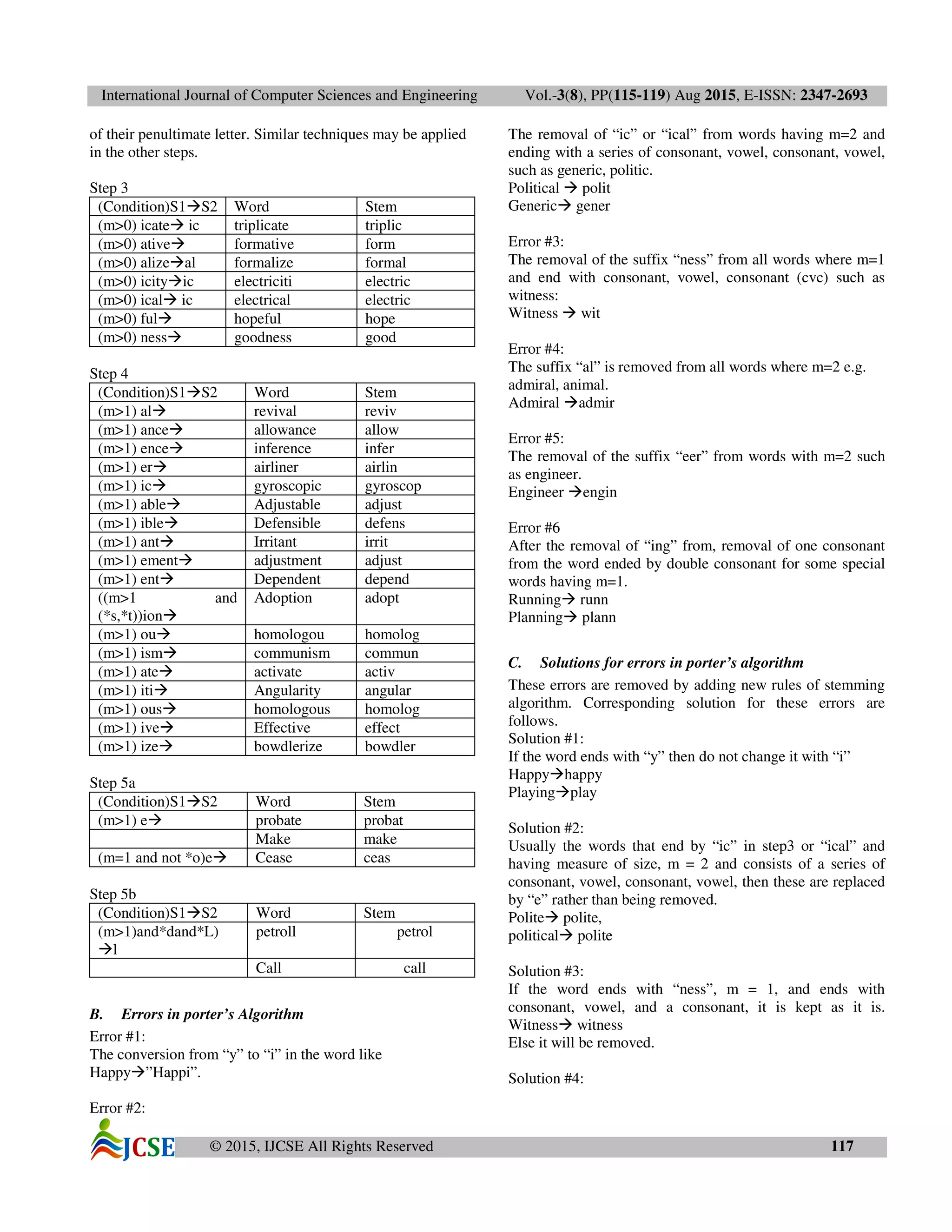
Step 3
(Condition)S1 S2 Word Stem
(m>0) icate ic triplicate triplic
(m>0) ative formative form
(m>0) alize al formalize formal
(m>0) icity ic electriciti electric
(m>0) ical ic electrical electric
(m>0) ful hopeful hope
(m>0) ness goodness good
Step 4
(Condition)S1 S2 Word Stem
(m>1) al revival reviv
(m>1) ance allowance allow
(m>1) ence inference infer
(m>1) er airliner airlin
(m>1) ic gyroscopic gyroscop
(m>1) able Adjustable adjust
(m>1) ible Defensible defens
(m>1) ant Irritant irrit
(m>1) ement adjustment adjust
(m>1) ent Dependent depend
((m>1 and
(*s,*t))ion
Adoption adopt
(m>1) ou homologou homolog
(m>1) ism communism commun
(m>1) ate activate activ
(m>1) iti Angularity angular
(m>1) ous homologous homolog
(m>1) ive Effective effect
(m>1) ize bowdlerize bowdler
Step 5a
(Condition)S1 S2 Word Stem
(m>1) e probate probat
Make make
(m=1 and not *o)e Cease ceas
Step 5b
(Condition)S1 S2 Word Stem
(m>1)and*dand*L)
l
petroll petrol
Call call
B. Errors in porter’s Algorithm
Error #1:
The conversion from “y” to “i” in the word like
Happy ”Happi”.
Error #2:
The removal of “ic” or “ical” from words having m=2 and
ending with a series of consonant, vowel, consonant, vowel,
such as generic, politic.
Political polit
Generic gener
Error #3:
The removal of the suffix “ness” from all words where m=1
and end with consonant, vowel, consonant (cvc) such as
witness:
Witness wit
Error #4:
The suffix “al” is removed from all words where m=2 e.g.
admiral, animal.
Admiral admir
Error #5:
The removal of the suffix “eer” from words with m=2 such
as engineer.
Engineer engin
Error #6
After the removal of “ing” from, removal of one consonant
from the word ended by double consonant for some special
words having m=1.
Running runn
Planning plann
C. Solutions for errors in porter’s algorithm
These errors are removed by adding new rules of stemming
algorithm. Corresponding solution for these errors are
follows.
Solution #1:
If the word ends with “y” then do not change it with “i”
Happy happy
Playing play
Solution #2:
Usually the words that end by “ic” in step3 or “ical” and
having measure of size, m = 2 and consists of a series of
consonant, vowel, consonant, vowel, then these are replaced
by “e” rather than being removed.
Polite polite,
political polite
Solution #3:
If the word ends with “ness”, m = 1, and ends with
consonant, vowel, and a consonant, it is kept as it is.
Witness witness
Else it will be removed.
Solution #4:
International Journal of Computer Sciences and Engineering Vol.-3(8), PP(115-119) Aug 2015, E-ISSN: 2347-2693
© 2015, IJCSE All Rights Reserved 118
If it ends by “iral” and m = 2 then it is replaced by “ire”. Or
if it ends by “al”, m = 2, and it consists of a series of
consonant, vowel, consonant, vowel, it is replaced by “e”.
General Genere
Admiral admire
Solution #5:
If the word ends with “eer” and having m = 1, then “eer” is
replaced by “e”.
Engineer engine
Solution #6:
If the word ends by nn after removing “ing” and having m=1
then replace “nn” by “n”.
Running run
Planning plan.
These modifications make the enhanced suffix stripping
algorithm more efficient in the context of information
retrieval system.
III. RESULT ANALYSIS
A. Analysis on text data
These modifications make the enhanced algorithm more
efficient and more error free .Analysis based on text data is
given below.
S.no No. of
words
Meaning full
words
Stems
Porter's Algo. 170 120 80
E.S.S.Algo. 170 120 72
Table 1: Analysis on text data
Fig. 2 Analysis on text data
Analysis on text data shows that the porter stemming
algorithm reduced the document size upto 47.05% and the
enhanced suffix stripping algorithm (E.S.S.Algo.) reduced
the document size upto 42.35% so the index size is reduced
upto 42.35%. Less index size take less time to map relevant
document to the input query so the efficiency of IR system is
increased.
B. Analysis based on errors
There are mainly two types of errors in stemming process
over stemming and under stemming. An ideal stemmer
should stem words belonging to the same group to a
common stem [7,,8]. If a stemmed group includes more than
one unique stem, then the stemmer has made under
stemming errors. However, if a stem of a certain group
occurs in other stemmed groups, the stemmer has made over
stemming errors. This allows the computation of the over
stemming and under stemming Indexes (UI and OI) [9 10].
An ideal stemmer should stem words belonging to the same
group to a common stem. If a stemmed group includes more
than one unique stem, then the stemmer has made under
stemming errors [11,12,13]. However, if a stem of a certain
group occurs in other stemmed groups, the stemmer has
made over stemming errors. This allows the computation of
the over stemming and under stemming Indexes (UI and OI)
.These are given in table no: 2.
Word list A Word list B
S.no U.I O.I U.I O.I
E.S.S.Algo. 0.2432 0.0341 0.2127 0.0485
Porter's Algo. 0.3236 0.0462 0.2648 0.0532
Table 2: Error analysis
List A List B
Fig. 3 Error analysis
International Journal of Computer Sciences and Engineering Vol.-3(8), PP(115-119) Aug 2015, E-ISSN: 2347-2693
© 2015, IJCSE All Rights Reserved 119
Above analysis shows that the Enhanced suffix stripping
Algorithm have over all low value of under stemming index
and over stemming index. By adding new rules the
stemming errors are reduced and make more efficient in the
context of information retrieval because less error make
more relevant document will be retrieved.
IV. CONCLUSION
The Enhanced suffix stripping Algorithm has over all low
value of under stemming index and over stemming index. By
adding new rules the stemming errors are reduced and make
more efficient in the context of information retrieval because
less error make more relevant document will be retrieved. A
statistical stemmer may be language independent it does not
every time give a trustworthy and correct stem. Fig. 2 and 3
shows the better performance of Enhanced suffixed stripping
algorithm in the context of index size and number of errors.
In above enhanced suffix stripping algorithm index size is
reduced upto 42.35% as compared to 47.05% in porter’s
algorithm. and the over stemming and under stemming index
size is also reduced means by using E.S.S Algo in IR system
in less amount of time we will get more relevant documents.
V. REFERENCE
[1] Porter M.F. “An algorithm for suffix stripping”
Program. 1980; 14, 130.
[2] Porter M.F. “Snowball: A language for stemming
algorithms”. 2001
[3] Eiman Tamah Al-Shammari “Towards An Error-Free
Stemming”, in Proceedings of ADIS European
Conference Data Mining 2008, pp. 160-163.
[4] “A Survey on various stemming algorithms”
International Journal of Computer Engineering In
research trends(IJCERT), VOLUME 2, ISSUE 5, May
2015, PP 310-315
[5] Frakes W.B. “Term conflation for information
retrieval”. Proceedings of the 7th annual international
ACM SIGIR conference on Research and development
in information retrieval. 1984, 383-389.
[6] Frakes William B. “Strength and similarity of affix
removal stemming algorithms”. ACM SIGIR Forum,
Volume 37, No. 1. 2003, 26-30.
[7] M. Nithya, “Clustering Technique with Porter stemmer
and Hyper graph Algorithms for Multi-featured Query
Processing”, International Journal of Modern
Engineering Research (IJMER), Vol.2, Issue.3, pp-960-
965, May-June 2012
[8] Galvez Carmen and Moya-Aneg•n F˜lix. “An
Evaluation of conflation accuracy using finite-state
transducers”. Journal of Documentation 62(3). 2006,
328-349
[9] J. B. Lovins, “Development of a stemming algorithm,”
Mechanical Translation and Computer Linguistic.,
vol.11, no.1/2, pp. 22-31, 1968.
[10]Harman Donna. “How effective is suffixing?” Journal
of the American Society for Information Science. 1991;
42, 7-15 7.
[11]Funchun Peng, Nawaaz Ahmed, Xin Li and Yumao Lu.
“Context sensitive stemming for web search”.
Proceedings of the 30th annual international
ACMSIGIR conference on Research and development
in information retrieval. 2007, 639-646.
[12]R. Sun, C.-H. Ong, and T.-S. Chua. “Mining
Dependency Relations for Query Expansion in Passage
Retrieval”. In SIGIR, 2006.
[13]Kjetil , Randi, “News Item Extraction for Text Mining
in Web Newspapers” WIRI’05,IEEE ,2009
Author Profile
Sundar Singh has received B.Tech in
Computer Science & Engineering from Gautam
Buddh Technical University Lucknow, India in
2012. He is pursuing M.Tech in Advance
computing from Maulana Azad National
Institute of Technology Bhopal, India. His
research area includes Natural Language
processing and Information Retrieval.
Dr. R.K. Pateriya is an Associate professor in
the Department of Computer Science &
Engineering, at Maulana Azad National
Institute of Technology, Bhopal, India. He is a
member of the IEEE. His current research
interests includes Cloud computing, E-
commerce, Security, Natural Language
Processing and Information Retrieval etc. He
has published more than 100 papers in national and international
research journals.

22 ijcse-01208

  • 1.
    © 2015, IJCSEAll Rights Reserved 115 International Journal of Computer Sciences and EngineeringInternational Journal of Computer Sciences and EngineeringInternational Journal of Computer Sciences and EngineeringInternational Journal of Computer Sciences and Engineering Open Access Research Paper Volume-3, Issue-8 E-ISSN: 2347-2693 Enhanced Suffix Stripping Algorithm to Improve Information Retrieval Sundar Singh1 , R K Pateriya2 1*,2 Department of Computer Science & Engineering Maulana Azad National Institute of Technology Bhopal, India, 462003 www.ijcseonline.org Received: Jul /11/2015 Revised: Jul/27/2015 Accepted: Aug/16/2015 Published: Aug/30/ 2015 Abstract— Stemming algorithms are used to convert the words in text into their grammatical base form, and are mainly used to increase the Information Retrieval System’s efficiency. Several algorithms exist with altered techniques. The most widely used is the Porter Stemming algorithm. However, it still has several drawbacks, although many attempts were made to improve its structure. This paper discloses the inaccuracies encountered during the stemming process and proposes the corresponding solutions. Keywords— Stemming, stop word, Text mining, NLP, IR. I. INTRODUCTION Stemming is a technique used to reduce words to their root form called stem, by removing derivational and inflectional affixes. Most of the existing stemming algorithms uses affix stripping technique. This technique has wide application in NLP, Text mining and information retrieval. Stemming improves the performance of information retrieval systems by decreasing the index size. There are many stemming algorithms implemented for English language. Many of these algorithms are working successfully in information retrieval system. However there are many drawbacks in stemming algorithms, since these algorithms can’t fully describe English morphology [1]. Fig. 1: Various steps in IR Porter stemming algorithm is most widely used algorithm for English language .It is efficiently working in many informational retrieval systems.it also have some kind of errors like over-stemming and under-stemming because English morphology is very wide .By adding new rules in porter’s algorithm will make it more efficient in the context of information retrieval. Enhanced suffix stripping algorithm is having the less amount of over-stemming and under- stemming errors with less amount of index size [2]. These are various steps in IR first upload a document or type a paragraph or text which is to be stemmed. After that normalize the text data such that it is converted into either lower case or upper case. All the special characters are removed in this stage. In the 3rd step remove stop words. Stop words are connecting words like is, are, the, am, be, etc. these words do not have their own meaning. In the 4th step stemming will be done, all words are converted into their root or base or stem form [3]. Then indexing of all the stems will be done. Stemming reduced the index size approximately 1/2 of its previous word count. Then information retrieval will be done. II. LITERATURE REVIEW A. Porter’s Algorithm Porter stemming algorithm is one of the most famous stemming method proposed by martin porter in 1980. It comprises 60 rules in five steps. It is based on suffix stripping technique. The data passes through different steps one by one, so it is a multi-pass algorithm. Many reformations and enhancements have been done and proposed on the basic algorithm. It is based on the idea that there are approx. 1200 suffixes in the English language, mostly made up of a grouping of smaller and multiple suffixes. The algorithm has five steps, and within each step, rules are applied until one of them passes the conditions. If a rule is matched, the suffix is removed consequently, and the next step is performed. The resultant stemmed word at the end of the fifth step is returned by the algorithm. Many version of porter stemming are released [4]. The rules look like the following pattern: <Condition> <suffix> → <new suffix> For example, a rule (m>0) EED → EE means “if the word has at least one “vowel and consonant” pair plus EED
  • 2.
    International Journal ofComputer Sciences and Engineering Vol.-3(8), PP(115-119) Aug 2015, E-ISSN: 2347-2693 © 2015, IJCSE All Rights Reserved 116 ending, change the ending to EE”. Example “agreed” is converted as “agree” whereas “feed” remains unaffected. This algorithm has about 60 rules in five steps. It is most widely used algorithm for the purpose of stemming but it has many errors in the rules. Several modifications have been done on porter algorithm but it still have over stemming and under stemming kind of problems. Advantages of this algorithm are its efficiency and less time consumption. The main disadvantage of this algorithm is that it has over stemming and under stemming type of problems [5,6]. Stemming rules are represented by the single form. [C](VC){m}[V]. Here 'm' will be called the measure, number of VC pairs of any word. The rules for removing a suffix will be given in the form. (Condition) S1 S2 This means that if a word ends with the suffix S1, and the stem before S1 satisfies the given condition, S1 is replaced by S2. The condition is usually given in terms of m. and m is calculated by only condition part not S1. The `condition' part may also contain the following: *S - the stem ends with S (and similarly for the other letters). *v* - the stem contains a vowel. *d - the stem ends with a double consonant (e.g. -TT, -SS). *o - the stem ends cvc, where the second C is not W, X or Y (e.g: -WIL, -HOP)[2]. In a set of rules written beneath each other, only one is obeyed, and this tills the one with the longest matching S1 for the given word. For example sses - ss ies i ss ss s In the rules below, examples of their application, successful or otherwise, are given on the right in lower case. The algorithm now follows: Step 1a (Condition)S1 S2 Word Stem sses ss Caresses caress ies i Ponies poni Ties ti ss ss Caress caress s Cats cat Step 1b (Condition)S1 S2 Word Stem (m>0) eed ee Feed feed Agreed agree (*v*) ed plastered plaster bled bled (m>0)(*v*) ing Motoring motor Sing sing at ate conflat(ed) conflate bl ble troubl(ed) trouble iz ize siz(ed) size fall(ing) fall hiss(ing) hiss (m=1 and *o) E fail(ing) fail fil(ing) file The rule to map to a single letter causes the removal of one of the double letter pair. The -E is put back on -AT, -BL and -IZ, so that the suffixes -ATE, -BLE and -IZE can be recognized later. This E may be removed in step 4. Step 1c (Condition)S1 S2 Word Stem (*v*) Y -> I happy happi Sky sky Step 1, deals with plurals and past participles. The subsequent steps are straighter forward. Step 2 (Condition)S1 S2 Word Stem (m>0) ational ate relational relate (m>0) tional tion conditional condition rational rational (m>0) enci ence valenci valence (m>0) anci ance hesitanci hesitance (m>0) izer ize digitizer digitize (m>0) abli able conformabli conformable (m>0) alli al radicalli radical (m>0) entli ent differentli different (m>0) eli e vileli vile (m>0) ousli ous analogousli analogous (m>0) ization ize vietnamization vietnamize (m>0) ation ate predication predicate (m>0) ator ate operator operate (m>0) alism al feudalism feudal (m>0) iveness ive decisiveness decisive (m>0)fulness ful hopefulness decisive (m>0)ousness ous callousness callous (m>0) aliti al formaliti formal (m>0) iviti ive sensitiviti sensitive (m>0) biliti ble sensibiliti sensible The test for the string S1 can be made fast by doing a program switch on the penultimate letter of the word being tested. This gives a fairly even breakdown of the possible values of the string S1. It will be seen in fact that the S1- strings in step 2 are presented here in the alphabetical order
  • 3.
    International Journal ofComputer Sciences and Engineering Vol.-3(8), PP(115-119) Aug 2015, E-ISSN: 2347-2693 © 2015, IJCSE All Rights Reserved 117 of their penultimate letter. Similar techniques may be applied in the other steps. Step 3 (Condition)S1 S2 Word Stem (m>0) icate ic triplicate triplic (m>0) ative formative form (m>0) alize al formalize formal (m>0) icity ic electriciti electric (m>0) ical ic electrical electric (m>0) ful hopeful hope (m>0) ness goodness good Step 4 (Condition)S1 S2 Word Stem (m>1) al revival reviv (m>1) ance allowance allow (m>1) ence inference infer (m>1) er airliner airlin (m>1) ic gyroscopic gyroscop (m>1) able Adjustable adjust (m>1) ible Defensible defens (m>1) ant Irritant irrit (m>1) ement adjustment adjust (m>1) ent Dependent depend ((m>1 and (*s,*t))ion Adoption adopt (m>1) ou homologou homolog (m>1) ism communism commun (m>1) ate activate activ (m>1) iti Angularity angular (m>1) ous homologous homolog (m>1) ive Effective effect (m>1) ize bowdlerize bowdler Step 5a (Condition)S1 S2 Word Stem (m>1) e probate probat Make make (m=1 and not *o)e Cease ceas Step 5b (Condition)S1 S2 Word Stem (m>1)and*dand*L) l petroll petrol Call call B. Errors in porter’s Algorithm Error #1: The conversion from “y” to “i” in the word like Happy ”Happi”. Error #2: The removal of “ic” or “ical” from words having m=2 and ending with a series of consonant, vowel, consonant, vowel, such as generic, politic. Political polit Generic gener Error #3: The removal of the suffix “ness” from all words where m=1 and end with consonant, vowel, consonant (cvc) such as witness: Witness wit Error #4: The suffix “al” is removed from all words where m=2 e.g. admiral, animal. Admiral admir Error #5: The removal of the suffix “eer” from words with m=2 such as engineer. Engineer engin Error #6 After the removal of “ing” from, removal of one consonant from the word ended by double consonant for some special words having m=1. Running runn Planning plann C. Solutions for errors in porter’s algorithm These errors are removed by adding new rules of stemming algorithm. Corresponding solution for these errors are follows. Solution #1: If the word ends with “y” then do not change it with “i” Happy happy Playing play Solution #2: Usually the words that end by “ic” in step3 or “ical” and having measure of size, m = 2 and consists of a series of consonant, vowel, consonant, vowel, then these are replaced by “e” rather than being removed. Polite polite, political polite Solution #3: If the word ends with “ness”, m = 1, and ends with consonant, vowel, and a consonant, it is kept as it is. Witness witness Else it will be removed. Solution #4:
  • 4.
    International Journal ofComputer Sciences and Engineering Vol.-3(8), PP(115-119) Aug 2015, E-ISSN: 2347-2693 © 2015, IJCSE All Rights Reserved 118 If it ends by “iral” and m = 2 then it is replaced by “ire”. Or if it ends by “al”, m = 2, and it consists of a series of consonant, vowel, consonant, vowel, it is replaced by “e”. General Genere Admiral admire Solution #5: If the word ends with “eer” and having m = 1, then “eer” is replaced by “e”. Engineer engine Solution #6: If the word ends by nn after removing “ing” and having m=1 then replace “nn” by “n”. Running run Planning plan. These modifications make the enhanced suffix stripping algorithm more efficient in the context of information retrieval system. III. RESULT ANALYSIS A. Analysis on text data These modifications make the enhanced algorithm more efficient and more error free .Analysis based on text data is given below. S.no No. of words Meaning full words Stems Porter's Algo. 170 120 80 E.S.S.Algo. 170 120 72 Table 1: Analysis on text data Fig. 2 Analysis on text data Analysis on text data shows that the porter stemming algorithm reduced the document size upto 47.05% and the enhanced suffix stripping algorithm (E.S.S.Algo.) reduced the document size upto 42.35% so the index size is reduced upto 42.35%. Less index size take less time to map relevant document to the input query so the efficiency of IR system is increased. B. Analysis based on errors There are mainly two types of errors in stemming process over stemming and under stemming. An ideal stemmer should stem words belonging to the same group to a common stem [7,,8]. If a stemmed group includes more than one unique stem, then the stemmer has made under stemming errors. However, if a stem of a certain group occurs in other stemmed groups, the stemmer has made over stemming errors. This allows the computation of the over stemming and under stemming Indexes (UI and OI) [9 10]. An ideal stemmer should stem words belonging to the same group to a common stem. If a stemmed group includes more than one unique stem, then the stemmer has made under stemming errors [11,12,13]. However, if a stem of a certain group occurs in other stemmed groups, the stemmer has made over stemming errors. This allows the computation of the over stemming and under stemming Indexes (UI and OI) .These are given in table no: 2. Word list A Word list B S.no U.I O.I U.I O.I E.S.S.Algo. 0.2432 0.0341 0.2127 0.0485 Porter's Algo. 0.3236 0.0462 0.2648 0.0532 Table 2: Error analysis List A List B Fig. 3 Error analysis
  • 5.
    International Journal ofComputer Sciences and Engineering Vol.-3(8), PP(115-119) Aug 2015, E-ISSN: 2347-2693 © 2015, IJCSE All Rights Reserved 119 Above analysis shows that the Enhanced suffix stripping Algorithm have over all low value of under stemming index and over stemming index. By adding new rules the stemming errors are reduced and make more efficient in the context of information retrieval because less error make more relevant document will be retrieved. IV. CONCLUSION The Enhanced suffix stripping Algorithm has over all low value of under stemming index and over stemming index. By adding new rules the stemming errors are reduced and make more efficient in the context of information retrieval because less error make more relevant document will be retrieved. A statistical stemmer may be language independent it does not every time give a trustworthy and correct stem. Fig. 2 and 3 shows the better performance of Enhanced suffixed stripping algorithm in the context of index size and number of errors. In above enhanced suffix stripping algorithm index size is reduced upto 42.35% as compared to 47.05% in porter’s algorithm. and the over stemming and under stemming index size is also reduced means by using E.S.S Algo in IR system in less amount of time we will get more relevant documents. V. REFERENCE [1] Porter M.F. “An algorithm for suffix stripping” Program. 1980; 14, 130. [2] Porter M.F. “Snowball: A language for stemming algorithms”. 2001 [3] Eiman Tamah Al-Shammari “Towards An Error-Free Stemming”, in Proceedings of ADIS European Conference Data Mining 2008, pp. 160-163. [4] “A Survey on various stemming algorithms” International Journal of Computer Engineering In research trends(IJCERT), VOLUME 2, ISSUE 5, May 2015, PP 310-315 [5] Frakes W.B. “Term conflation for information retrieval”. Proceedings of the 7th annual international ACM SIGIR conference on Research and development in information retrieval. 1984, 383-389. [6] Frakes William B. “Strength and similarity of affix removal stemming algorithms”. ACM SIGIR Forum, Volume 37, No. 1. 2003, 26-30. [7] M. Nithya, “Clustering Technique with Porter stemmer and Hyper graph Algorithms for Multi-featured Query Processing”, International Journal of Modern Engineering Research (IJMER), Vol.2, Issue.3, pp-960- 965, May-June 2012 [8] Galvez Carmen and Moya-Aneg•n F˜lix. “An Evaluation of conflation accuracy using finite-state transducers”. Journal of Documentation 62(3). 2006, 328-349 [9] J. B. Lovins, “Development of a stemming algorithm,” Mechanical Translation and Computer Linguistic., vol.11, no.1/2, pp. 22-31, 1968. [10]Harman Donna. “How effective is suffixing?” Journal of the American Society for Information Science. 1991; 42, 7-15 7. [11]Funchun Peng, Nawaaz Ahmed, Xin Li and Yumao Lu. “Context sensitive stemming for web search”. Proceedings of the 30th annual international ACMSIGIR conference on Research and development in information retrieval. 2007, 639-646. [12]R. Sun, C.-H. Ong, and T.-S. Chua. “Mining Dependency Relations for Query Expansion in Passage Retrieval”. In SIGIR, 2006. [13]Kjetil , Randi, “News Item Extraction for Text Mining in Web Newspapers” WIRI’05,IEEE ,2009 Author Profile Sundar Singh has received B.Tech in Computer Science & Engineering from Gautam Buddh Technical University Lucknow, India in 2012. He is pursuing M.Tech in Advance computing from Maulana Azad National Institute of Technology Bhopal, India. His research area includes Natural Language processing and Information Retrieval. Dr. R.K. Pateriya is an Associate professor in the Department of Computer Science & Engineering, at Maulana Azad National Institute of Technology, Bhopal, India. He is a member of the IEEE. His current research interests includes Cloud computing, E- commerce, Security, Natural Language Processing and Information Retrieval etc. He has published more than 100 papers in national and international research journals.