© 2015, IJCSE All Rights Reserved 136
International Journal of Computer Sciences and EngineeringInternational Journal of Computer Sciences and EngineeringInternational Journal of Computer Sciences and EngineeringInternational Journal of Computer Sciences and Engineering Open Access
Review Paper Volume-3, Issue-8 E-ISSN: 2347-2693
Discovering Emerging Topics in Social Streams Using NADS and
VFDT
S.Saratha1
* and V. Geetha2
Department of Computer Science,
STET Women’s College, Mannargudi
www.ijcseonline.org
Received: Jul /26/2015 Revised: Aug/06/2015 Accepted: Aug/23/2015 Published: Aug/30/ 2015
Abstract— The paper gives the outline of key analyses and methods, accommodating at that point again enterprise structural
planning change and based on social system approach. Social system is a place where individuals exchange and share data
related to the current events all over the world .This behavior that point again of clients made us focus on this logic that
handling these substance might commercial us to the extraction the current subject of interest between the users. Applying data
clustering system like post Text-Frequency-based approach over these content might leads us up to the mark be that as it may
there will be some shot of false positives. We propose a likelihood model that can catch both normal saying behavior that point
again of a customer and too the recurrence of clients happening in their mentions. It too lives up to expectations great indeed the
substance of the messages are non-literary data like pictures and so forth .The proposed mention-abnormality based approaches
can distinguish new points at slightest as early as text-abnormality based approaches, and in some cases much previous at the
point when the subject is poorly identified by the literary substance in the posts.
Keywords— Change Point Detection, Abnormality Scores, Notice.
I. PRESENTATION
As in this internet world exceptionally one used to engage
in social media is exceptionally familiar now days. Social
media acts fast with the substance than any other media. Lot
of substance in numerous format been scattered in the
database were we can look forward to utilize those
substance to assemble a robotized news event. Since the
data exchanged over social net lives up to expectations is
not just texts be that as it may too URLs, images, and
videos, they are testing at that point again the study of data
mining. The interest is in the issue of identifying rising
points from social streams. This can be used to create
robotized “breaking news”, at that point again find covered
up market needs at that point again underground political
movements. Compared to other media (news FM etc.)
social media are capable to catch the earliest, unedited voice
of ordinary people. Problem is the challenge is to
distinguish the rise of a subject as early as conceive capable
at a moderate number of false positives. Nowadays, in the
times of solid competition, business organizations
constantly look at that point again instruments and
procedures to beat market opponents and ended up leaders
among other companies. This paper employments on
corporate social system investigation as a conceive capable
way to make strides enterprise structural planning leading to
the above said goals. However, the proposed procedures are
suitable at that point again all kind of organizations with the
stable organizational structure, not just the commercial
ones. The interest in identifying rising points from social
system streams based on checking the saying behavior that
point again of clients (annotation like). Our fundamental
supposition is that a new (emerging) subject is something
individuals feel like discussing, commenting, at that point
again forwarding the data further to their friends.
Conventional approaches at that point again subject disco
exceptionally have predominantly been concerned with the
frequencies of (textual) words. A term-recurrence based
approach could endure from the uncertainty caused by
equivalent words at that point again homonyms. It might
too require confused handling (e.g., segmentation)
depending on the target language. Moreover, it can’t be
connected at the point when the substance of the messages
are for the most part nonliterary information. On the other
hand, the “words” formed by notice are unique, require little
prehandling to get (the data is regularly separated from the
contents), and are available regardless of the nature of the
contents. Probability model that can catch the normal saying
behavior that point again of a user, which comprises of both
the number of notice per post and the recurrence of clients
happening in the mentions. This model is used to measure
the abnormality of future customer behavior. Utilizing the
proposed likelihood model, we can quantitatively measure
the novelty at that point again conceivable impact of a post
reflected in the saying behavior that point again of the user.
A term-recurrence based approach predominantly depends
upon the frequencies of (textual) words happening in the
social posts. This removes the verbal and adjective like
International Journal of Computer Sciences and Engineering Vol.-3(8), PP(136-139) Aug 2015, E-ISSN: 2347-2693
© 2015, IJCSE All Rights Reserved 137
words and considers just the nonverbal parts of the post.
Word recurrence is figured at that point again each word
which will be taken predominantly at that point again
extraction of the topic. The limitation is that a term-
recurrence based approach could endure from the
uncertainty caused by equivalent words at that point again
homonyms (plurals).It can’t be connected at the point when
the substance of the messages are for the most part non-
literary information. At that point again e.g. “great life
depends on liver”, where liver might be organ at that point
again living person, so there will be an uncertainty problem.
We can’t apply the system at the point when the content is
non-literary information.
II. IMPLEMENTATION DETAILS
2.1 PROBABILITY DISTRIBUTION
Relevancy Probability Model
Fig.2.1 Relevancy likelihood Model
We characterize a post in a social system by the number of
remarks it contains, and the set of clients who are said in the
post. We too consolidate the record recurrence into our
likelihood model which will upgrade the disco
exceptionally process. In place of joint dispersion we find
conditional joint likelihood which comprises of two parts:
the likelihood of the number of comment/ notice and the
likelihood of number of mentioned, both based on term
(word) frequency. The littler the term recurrence esteem
littler will be the likelihood of notice and mentioned.
1: Find likelihood of number of notice p (l|θ)
2: p (l|θ) = (1-θ) s
(1)
3: Joint likelihood dispersion of number of mentions,
customer and content recurrence P(s, v|θ, { v}) =p (l|θ)
v’ (2)
4: prescient dispersion by utilizing preparing set T=
{(L1, V1), (Ln, Vn)} P (L, V|T) =p (L|T)
2.2 TEXT FREQUENCY
Text recurrence is used to find the closeness at that point
again relationship between each comments/mentions. This
will too help us to distinguish the deviation of the remark in
accurate manner. We create a content recurrence acuity that
generates a score based on remark relevance. Text
recurrence initial set up need a fixed word reference word
fat that point again which the recurrence need to be
calculated. After that the city look at that point again the
word in each remark in the post and assigns weights based
on their occurrence in comment. These weights are used to
create the recurrence score and it will be included with the
abnormality score some time as of late rising subject
classification.
Fig 2.2 Text frequency
Input: Set of Mention Content (Cpost) have a place to Post
Pi
Dictionary Word (D)
Output: Mention_Vectpr (Vpost)
Start
String finalContent CF
GetDictionaryWord ( )
Foreach word Wpost in Cpost
Foreach Wdic in D // where Wdic is element of
Dictionary Word In the
occasion that equals (Wdic, Wpost) At that point
concat(CF, Wpost)
end In the occasion that
end foreach
end foreach
arraylist Mention_vectat that point again Vpost
foreach WF in CF
// where WF is element of finalContent CF
In the occasion that
Mention_vector.Contains(WF) at that point
Mention_vector[WF] = Mention_vector[WF]+1
End in the occasion that
Else at that point
Mention_vector[WF] = 1
End else
End foreach
Return Mention_vectat that point again End
International Journal of Computer Sciences and Engineering Vol.-3(8), PP(136-139) Aug 2015, E-ISSN: 2347-2693
© 2015, IJCSE All Rights Reserved 138
2.3 DERIVE ANOMALY SCORE
We ascertain the join abnormality score fat that point again
each post independently. Anomaly score is characterized as
the user’s deviation from the post. In the occasion that they
pass the remarks which is unrelated to the post called as the
anomaly. The remarks are either great at that point again
commercial whether related to the post are determined by
utilizing join abnormality score. Accordingly, the link-
abnormality score is characterized by the taking after
diagram.
1: Compute abnormality score of a new post x= (t,u,l,v)
L-mention-user-user-time
2: Find s(x) (x) = -log (p (l|Tu
(t)
=-log
(p(l|Tu
(t)
u
(t)
) (3)
3: By utilizing preparing set which consist of both
number of customer and notice compute abnormality
score.
4: Finally we aggregate the abnormality score acquired
fat that point again the post.
By utilizing the joint likelihood dispersion
(conditional probability) both the content recurrence as
well as abnormality scores should be considered so
that recurrence of the customer desire about the
subject can be effectively mined and separated from
the comments.
2.4. CHECK-POINT RECOGNITION
Fig 2.3 Check point disco exceptionally
Change point act as the center based on the score esteem
obtained. It is used to finds a change in the numerical trust
construction of a time arrangement by checking the
compressibility of an innovative piece of data. It
employments a successive version of standardized
maximum-likelihood (NML) coding called SDNML coding.
A change point is distinguished through two layers of
scoring processes. The to begin with layer finds abnormality
and the second layer finds change-points. The issues of
abnormality disco exceptionally and change point disco
exceptionally from a data stream. In the range of data
mining, there has been increased interest in these issues
since the previous is related to fraud detection, rare
occasion discovery, etc., while the last is related to
event/pattern change detection, activity monitoring, etc.
Specifically, it is critical to consider the situation where the
data source is non-stationary, since the nature of data source
might change over time in genuine application. The change
point disco exceptionally predominantly states that in the
occasion that remarks are passed just by few friends, i.e in
the occasion that the number of clients is less, be that as it
may the remarks passed are more at that point we can say
that it is a discussion be that as it may we can’t separate
current rising topic. So we can effectively distinguish the
outliers and find the change points. 2.5. (DTO) DYNAMIC
THRESHOLD OPTIMIZATION Finally we need to
convert the change-point scores into paired alarms by their
holding as t.Maximum edge esteem is 1.Change point disco
exceptionally act as a center depending on the score esteem
fat that point again each and person post. Binary alarm
means a paired demonstration of true and false statement fat
that point again the rising topic. Since the dispersion of
change-point scores might change over time, we need to
dynamically adjust the edge to investigate a sequence over a
long period of time. In the occasion that the remarks get
included at that point the change point score gets varied. So
Based on the created score of each subject paired alarm
differentiate the rising topics.
III. SYSTEM ARCHITECTURE
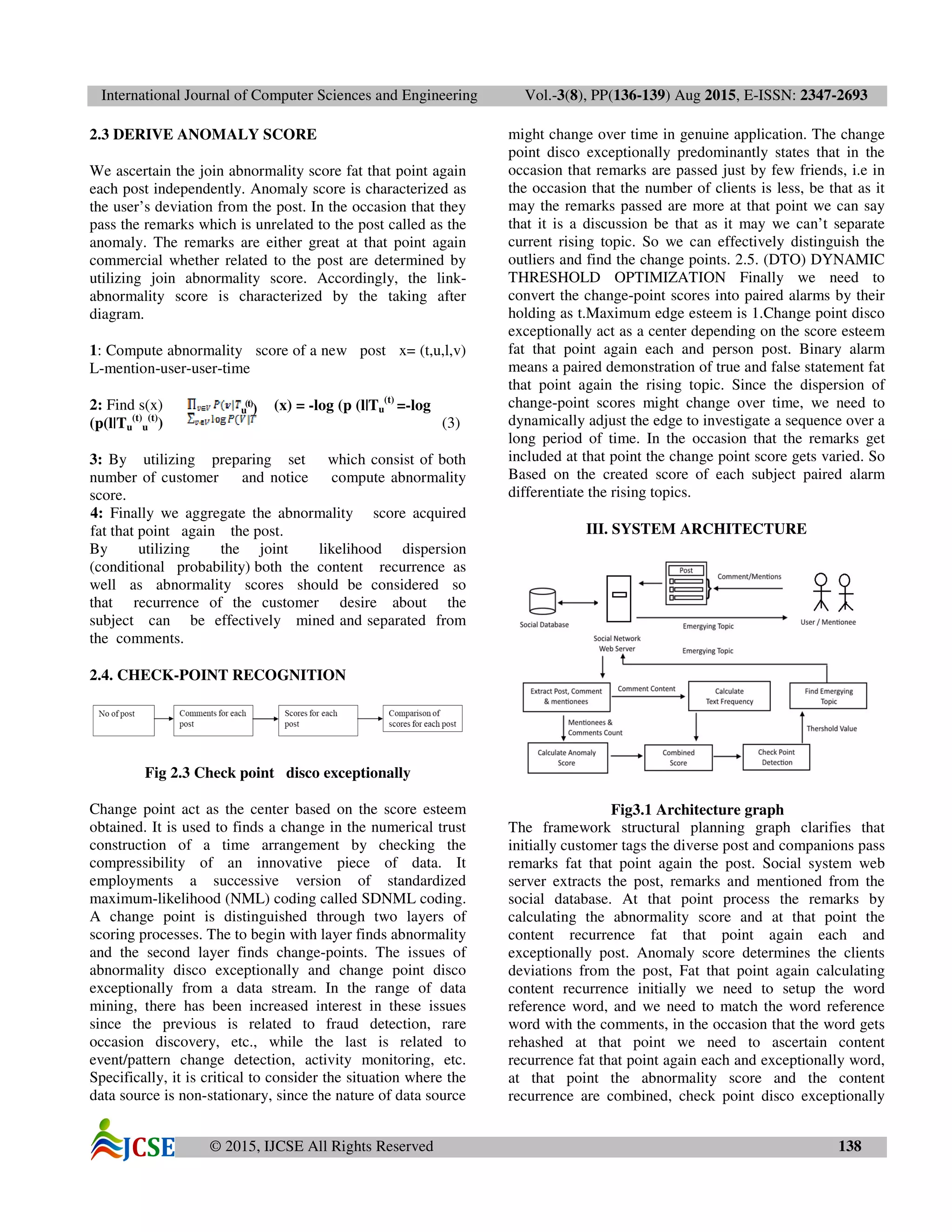
Fig3.1 Architecture graph
The framework structural planning graph clarifies that
initially customer tags the diverse post and companions pass
remarks fat that point again the post. Social system web
server extracts the post, remarks and mentioned from the
social database. At that point process the remarks by
calculating the abnormality score and at that point the
content recurrence fat that point again each and
exceptionally post. Anomaly score determines the clients
deviations from the post, Fat that point again calculating
content recurrence initially we need to setup the word
reference word, and we need to match the word reference
word with the comments, in the occasion that the word gets
rehashed at that point we need to ascertain content
recurrence fat that point again each and exceptionally word,
at that point the abnormality score and the content
recurrence are combined, check point disco exceptionally
u
(t)
)
International Journal of Computer Sciences and Engineering Vol.-3(8), PP(136-139) Aug 2015, E-ISSN: 2347-2693
© 2015, IJCSE All Rights Reserved 139
act as a center fat that point again the score obtained, and
from the score we can find rising subject from the diverse
post. Social system web server will separate rising subject
to the user.
IV. RESULTS AND DISCUSSIONS
As discussed earlier, we can separate the rising subject
based on the customer notice and by utilizing the content
frequency. The score (abnormality score) created fat that
point again both the content recurrence as well as the
customer notice we can separate the right rising topic.
Change point disco exceptionally act as a center fat that
point again diverse post. We can practically implement this
project in various frame lives up to expectations by utilizing
IIS (Web data service) which can change the framework
into server which can be accessed by the customer system.
V. CONCLUSION
We are interested in identifying rising points from social
system stream based on checking the saying behavior that
point again of users. A term-recurrence based approach
could endure from the uncertainty caused by equivalent
words at that point again homonyms. It might too require
confused handling (e.g., segmentation) depending on the
target language. The planned likelihood model determines
both number of notice per post and the recurrence of the
mentioned and this approach is used to find the rise of
points in a social system stream .We have put forward a
likelihood model that catches both the number of notice per
post and recurrence of saying . The content recurrence
based procedures used to focus how numerous times the
content gets rehashed and from that the rehashed words are
considered We joined the proposed said model with the
SDNML change point disco exceptionally calculation to pin
point the rise topic, the join abnormality based approach
have distinguished rise of the subject indeed previous than
the magic word based approach that utilization handpicked
keywords. It will be more compelling at the point when
joining both content anomalies based and join abnormality
based approach. We can to execute the process in various
frame lives up to expectations by utilizing Web Information
administrations which is used to change the framework into
server.
ACKNOWLEDGEMENT
1
S.SARATHA, M.Phil Research Scholar, PG and Research
Department of Computer Science, STET Women’s College,
Mannargudi.
2
Mrs. V. GEETHA M.Sc., M.Phil., B.Ed., Head, PG and
Research Department of Computer Science, STET
Women’s College, Mannargudi.
References
[1] I. F. Akyildiz, X. Wang, and W. Wang, “Wireless Mesh
Networks: A Survey”, Computer Networks and ISDN
Systems, Vol.47, Issue-2, 2005, pp.445-487.
[2] I. F. Akyildiz, and X. Wang, “A Survey on Wireless Mesh
Networks”, IEEE Radio Communications, Vol.43, Issue-3,
2005, pp.23-30.
[3] M. Lee et al., “Emerging Standards for Wireless Mesh
Technology”, IEEE Wireless Communications, Vol.13,
Issue-4, 2006, pp.56-63.
[4] N.B. Salem, and J-P Hubaux, “Securing Wireless Mesh
Networks”, IEEE Wireless Communications, Vol.13, Issue-
2, 2006, pp.50-55.
[5] S. Han, E. Chang, L. Gao, T. Dillon, T., Taxonomy of
Attacks on Wireless Sensor Networks, in the Proceedings of
the 1st European Conference on Computer Network
Defence (EC2ND), University of Glamorgan, UK, Springer
Press, SpringerLink Date: December 2007.
[6] C. Karlof and D. Wagner, “Secure routing in wireless sensor
networks: attacks and countermeasures,” Ad Hoc Networks
1, 2003, pp. 293-315.
[7] Y. Yang, Y. Gu, X. Tan and L. Ma, “A New Wireless Mesh
Networks Authentication Scheme Based on Threshold
Method,” 9th
International Conference for Young Computer
Scientists (ICYCS-2008), 2008, pp. 2260-2265; Tvarožek,
M.
[8] Bielikova, M.,” Semantic History Map: Graphs Aiding Web
Revisitation Support” Published in: database and Expert
Systems Applications (DEXA), 2010 Workshop onDate
of Conference:Aug. 30 2010-Sept. 3 2010Page(s):206 – 210.
[9] Jurnecka, P. ; Kajan, R. ; Omelina, E. more authors,”
Adaptive Educational Gameplay within Smart Multipurpose
Interactive Learning Environment”. Published in:Semantic
Media Adaptation and Personalization, Second International
Workshop onDate of Conference:17-18 Dec.
2007Page(s):165 – 170.
[10] Barla, M. ; Bielikova, M” From Ambiguous Words Key-
Concept Extraction”, Published in:Database and Expert
Systems Applications (DEXA), 2013 24th
InternationalWorkshop onDate of Conference:26-30 Aug.
2013Page(s):63 – 67.

25 ijcse-01238-3 saratha

  • 1.
    © 2015, IJCSEAll Rights Reserved 136 International Journal of Computer Sciences and EngineeringInternational Journal of Computer Sciences and EngineeringInternational Journal of Computer Sciences and EngineeringInternational Journal of Computer Sciences and Engineering Open Access Review Paper Volume-3, Issue-8 E-ISSN: 2347-2693 Discovering Emerging Topics in Social Streams Using NADS and VFDT S.Saratha1 * and V. Geetha2 Department of Computer Science, STET Women’s College, Mannargudi www.ijcseonline.org Received: Jul /26/2015 Revised: Aug/06/2015 Accepted: Aug/23/2015 Published: Aug/30/ 2015 Abstract— The paper gives the outline of key analyses and methods, accommodating at that point again enterprise structural planning change and based on social system approach. Social system is a place where individuals exchange and share data related to the current events all over the world .This behavior that point again of clients made us focus on this logic that handling these substance might commercial us to the extraction the current subject of interest between the users. Applying data clustering system like post Text-Frequency-based approach over these content might leads us up to the mark be that as it may there will be some shot of false positives. We propose a likelihood model that can catch both normal saying behavior that point again of a customer and too the recurrence of clients happening in their mentions. It too lives up to expectations great indeed the substance of the messages are non-literary data like pictures and so forth .The proposed mention-abnormality based approaches can distinguish new points at slightest as early as text-abnormality based approaches, and in some cases much previous at the point when the subject is poorly identified by the literary substance in the posts. Keywords— Change Point Detection, Abnormality Scores, Notice. I. PRESENTATION As in this internet world exceptionally one used to engage in social media is exceptionally familiar now days. Social media acts fast with the substance than any other media. Lot of substance in numerous format been scattered in the database were we can look forward to utilize those substance to assemble a robotized news event. Since the data exchanged over social net lives up to expectations is not just texts be that as it may too URLs, images, and videos, they are testing at that point again the study of data mining. The interest is in the issue of identifying rising points from social streams. This can be used to create robotized “breaking news”, at that point again find covered up market needs at that point again underground political movements. Compared to other media (news FM etc.) social media are capable to catch the earliest, unedited voice of ordinary people. Problem is the challenge is to distinguish the rise of a subject as early as conceive capable at a moderate number of false positives. Nowadays, in the times of solid competition, business organizations constantly look at that point again instruments and procedures to beat market opponents and ended up leaders among other companies. This paper employments on corporate social system investigation as a conceive capable way to make strides enterprise structural planning leading to the above said goals. However, the proposed procedures are suitable at that point again all kind of organizations with the stable organizational structure, not just the commercial ones. The interest in identifying rising points from social system streams based on checking the saying behavior that point again of clients (annotation like). Our fundamental supposition is that a new (emerging) subject is something individuals feel like discussing, commenting, at that point again forwarding the data further to their friends. Conventional approaches at that point again subject disco exceptionally have predominantly been concerned with the frequencies of (textual) words. A term-recurrence based approach could endure from the uncertainty caused by equivalent words at that point again homonyms. It might too require confused handling (e.g., segmentation) depending on the target language. Moreover, it can’t be connected at the point when the substance of the messages are for the most part nonliterary information. On the other hand, the “words” formed by notice are unique, require little prehandling to get (the data is regularly separated from the contents), and are available regardless of the nature of the contents. Probability model that can catch the normal saying behavior that point again of a user, which comprises of both the number of notice per post and the recurrence of clients happening in the mentions. This model is used to measure the abnormality of future customer behavior. Utilizing the proposed likelihood model, we can quantitatively measure the novelty at that point again conceivable impact of a post reflected in the saying behavior that point again of the user. A term-recurrence based approach predominantly depends upon the frequencies of (textual) words happening in the social posts. This removes the verbal and adjective like
  • 2.
    International Journal ofComputer Sciences and Engineering Vol.-3(8), PP(136-139) Aug 2015, E-ISSN: 2347-2693 © 2015, IJCSE All Rights Reserved 137 words and considers just the nonverbal parts of the post. Word recurrence is figured at that point again each word which will be taken predominantly at that point again extraction of the topic. The limitation is that a term- recurrence based approach could endure from the uncertainty caused by equivalent words at that point again homonyms (plurals).It can’t be connected at the point when the substance of the messages are for the most part non- literary information. At that point again e.g. “great life depends on liver”, where liver might be organ at that point again living person, so there will be an uncertainty problem. We can’t apply the system at the point when the content is non-literary information. II. IMPLEMENTATION DETAILS 2.1 PROBABILITY DISTRIBUTION Relevancy Probability Model Fig.2.1 Relevancy likelihood Model We characterize a post in a social system by the number of remarks it contains, and the set of clients who are said in the post. We too consolidate the record recurrence into our likelihood model which will upgrade the disco exceptionally process. In place of joint dispersion we find conditional joint likelihood which comprises of two parts: the likelihood of the number of comment/ notice and the likelihood of number of mentioned, both based on term (word) frequency. The littler the term recurrence esteem littler will be the likelihood of notice and mentioned. 1: Find likelihood of number of notice p (l|θ) 2: p (l|θ) = (1-θ) s (1) 3: Joint likelihood dispersion of number of mentions, customer and content recurrence P(s, v|θ, { v}) =p (l|θ) v’ (2) 4: prescient dispersion by utilizing preparing set T= {(L1, V1), (Ln, Vn)} P (L, V|T) =p (L|T) 2.2 TEXT FREQUENCY Text recurrence is used to find the closeness at that point again relationship between each comments/mentions. This will too help us to distinguish the deviation of the remark in accurate manner. We create a content recurrence acuity that generates a score based on remark relevance. Text recurrence initial set up need a fixed word reference word fat that point again which the recurrence need to be calculated. After that the city look at that point again the word in each remark in the post and assigns weights based on their occurrence in comment. These weights are used to create the recurrence score and it will be included with the abnormality score some time as of late rising subject classification. Fig 2.2 Text frequency Input: Set of Mention Content (Cpost) have a place to Post Pi Dictionary Word (D) Output: Mention_Vectpr (Vpost) Start String finalContent CF GetDictionaryWord ( ) Foreach word Wpost in Cpost Foreach Wdic in D // where Wdic is element of Dictionary Word In the occasion that equals (Wdic, Wpost) At that point concat(CF, Wpost) end In the occasion that end foreach end foreach arraylist Mention_vectat that point again Vpost foreach WF in CF // where WF is element of finalContent CF In the occasion that Mention_vector.Contains(WF) at that point Mention_vector[WF] = Mention_vector[WF]+1 End in the occasion that Else at that point Mention_vector[WF] = 1 End else End foreach Return Mention_vectat that point again End
  • 3.
    International Journal ofComputer Sciences and Engineering Vol.-3(8), PP(136-139) Aug 2015, E-ISSN: 2347-2693 © 2015, IJCSE All Rights Reserved 138 2.3 DERIVE ANOMALY SCORE We ascertain the join abnormality score fat that point again each post independently. Anomaly score is characterized as the user’s deviation from the post. In the occasion that they pass the remarks which is unrelated to the post called as the anomaly. The remarks are either great at that point again commercial whether related to the post are determined by utilizing join abnormality score. Accordingly, the link- abnormality score is characterized by the taking after diagram. 1: Compute abnormality score of a new post x= (t,u,l,v) L-mention-user-user-time 2: Find s(x) (x) = -log (p (l|Tu (t) =-log (p(l|Tu (t) u (t) ) (3) 3: By utilizing preparing set which consist of both number of customer and notice compute abnormality score. 4: Finally we aggregate the abnormality score acquired fat that point again the post. By utilizing the joint likelihood dispersion (conditional probability) both the content recurrence as well as abnormality scores should be considered so that recurrence of the customer desire about the subject can be effectively mined and separated from the comments. 2.4. CHECK-POINT RECOGNITION Fig 2.3 Check point disco exceptionally Change point act as the center based on the score esteem obtained. It is used to finds a change in the numerical trust construction of a time arrangement by checking the compressibility of an innovative piece of data. It employments a successive version of standardized maximum-likelihood (NML) coding called SDNML coding. A change point is distinguished through two layers of scoring processes. The to begin with layer finds abnormality and the second layer finds change-points. The issues of abnormality disco exceptionally and change point disco exceptionally from a data stream. In the range of data mining, there has been increased interest in these issues since the previous is related to fraud detection, rare occasion discovery, etc., while the last is related to event/pattern change detection, activity monitoring, etc. Specifically, it is critical to consider the situation where the data source is non-stationary, since the nature of data source might change over time in genuine application. The change point disco exceptionally predominantly states that in the occasion that remarks are passed just by few friends, i.e in the occasion that the number of clients is less, be that as it may the remarks passed are more at that point we can say that it is a discussion be that as it may we can’t separate current rising topic. So we can effectively distinguish the outliers and find the change points. 2.5. (DTO) DYNAMIC THRESHOLD OPTIMIZATION Finally we need to convert the change-point scores into paired alarms by their holding as t.Maximum edge esteem is 1.Change point disco exceptionally act as a center depending on the score esteem fat that point again each and person post. Binary alarm means a paired demonstration of true and false statement fat that point again the rising topic. Since the dispersion of change-point scores might change over time, we need to dynamically adjust the edge to investigate a sequence over a long period of time. In the occasion that the remarks get included at that point the change point score gets varied. So Based on the created score of each subject paired alarm differentiate the rising topics. III. SYSTEM ARCHITECTURE Fig3.1 Architecture graph The framework structural planning graph clarifies that initially customer tags the diverse post and companions pass remarks fat that point again the post. Social system web server extracts the post, remarks and mentioned from the social database. At that point process the remarks by calculating the abnormality score and at that point the content recurrence fat that point again each and exceptionally post. Anomaly score determines the clients deviations from the post, Fat that point again calculating content recurrence initially we need to setup the word reference word, and we need to match the word reference word with the comments, in the occasion that the word gets rehashed at that point we need to ascertain content recurrence fat that point again each and exceptionally word, at that point the abnormality score and the content recurrence are combined, check point disco exceptionally u (t) )
  • 4.
    International Journal ofComputer Sciences and Engineering Vol.-3(8), PP(136-139) Aug 2015, E-ISSN: 2347-2693 © 2015, IJCSE All Rights Reserved 139 act as a center fat that point again the score obtained, and from the score we can find rising subject from the diverse post. Social system web server will separate rising subject to the user. IV. RESULTS AND DISCUSSIONS As discussed earlier, we can separate the rising subject based on the customer notice and by utilizing the content frequency. The score (abnormality score) created fat that point again both the content recurrence as well as the customer notice we can separate the right rising topic. Change point disco exceptionally act as a center fat that point again diverse post. We can practically implement this project in various frame lives up to expectations by utilizing IIS (Web data service) which can change the framework into server which can be accessed by the customer system. V. CONCLUSION We are interested in identifying rising points from social system stream based on checking the saying behavior that point again of users. A term-recurrence based approach could endure from the uncertainty caused by equivalent words at that point again homonyms. It might too require confused handling (e.g., segmentation) depending on the target language. The planned likelihood model determines both number of notice per post and the recurrence of the mentioned and this approach is used to find the rise of points in a social system stream .We have put forward a likelihood model that catches both the number of notice per post and recurrence of saying . The content recurrence based procedures used to focus how numerous times the content gets rehashed and from that the rehashed words are considered We joined the proposed said model with the SDNML change point disco exceptionally calculation to pin point the rise topic, the join abnormality based approach have distinguished rise of the subject indeed previous than the magic word based approach that utilization handpicked keywords. It will be more compelling at the point when joining both content anomalies based and join abnormality based approach. We can to execute the process in various frame lives up to expectations by utilizing Web Information administrations which is used to change the framework into server. ACKNOWLEDGEMENT 1 S.SARATHA, M.Phil Research Scholar, PG and Research Department of Computer Science, STET Women’s College, Mannargudi. 2 Mrs. V. GEETHA M.Sc., M.Phil., B.Ed., Head, PG and Research Department of Computer Science, STET Women’s College, Mannargudi. References [1] I. F. Akyildiz, X. Wang, and W. Wang, “Wireless Mesh Networks: A Survey”, Computer Networks and ISDN Systems, Vol.47, Issue-2, 2005, pp.445-487. [2] I. F. Akyildiz, and X. Wang, “A Survey on Wireless Mesh Networks”, IEEE Radio Communications, Vol.43, Issue-3, 2005, pp.23-30. [3] M. Lee et al., “Emerging Standards for Wireless Mesh Technology”, IEEE Wireless Communications, Vol.13, Issue-4, 2006, pp.56-63. [4] N.B. Salem, and J-P Hubaux, “Securing Wireless Mesh Networks”, IEEE Wireless Communications, Vol.13, Issue- 2, 2006, pp.50-55. [5] S. Han, E. Chang, L. Gao, T. Dillon, T., Taxonomy of Attacks on Wireless Sensor Networks, in the Proceedings of the 1st European Conference on Computer Network Defence (EC2ND), University of Glamorgan, UK, Springer Press, SpringerLink Date: December 2007. [6] C. Karlof and D. Wagner, “Secure routing in wireless sensor networks: attacks and countermeasures,” Ad Hoc Networks 1, 2003, pp. 293-315. [7] Y. Yang, Y. Gu, X. Tan and L. Ma, “A New Wireless Mesh Networks Authentication Scheme Based on Threshold Method,” 9th International Conference for Young Computer Scientists (ICYCS-2008), 2008, pp. 2260-2265; Tvarožek, M. [8] Bielikova, M.,” Semantic History Map: Graphs Aiding Web Revisitation Support” Published in: database and Expert Systems Applications (DEXA), 2010 Workshop onDate of Conference:Aug. 30 2010-Sept. 3 2010Page(s):206 – 210. [9] Jurnecka, P. ; Kajan, R. ; Omelina, E. more authors,” Adaptive Educational Gameplay within Smart Multipurpose Interactive Learning Environment”. Published in:Semantic Media Adaptation and Personalization, Second International Workshop onDate of Conference:17-18 Dec. 2007Page(s):165 – 170. [10] Barla, M. ; Bielikova, M” From Ambiguous Words Key- Concept Extraction”, Published in:Database and Expert Systems Applications (DEXA), 2013 24th InternationalWorkshop onDate of Conference:26-30 Aug. 2013Page(s):63 – 67.