
DP-Net  Consultation Workshop Climate Change and Disaster
Activities Inception Workshop Induction Workshop Literature Review Transect Exercise (Gandak, Karnali and Koshi) Regional Workshop  Synthesis Workshop Wider Reference group consultation workshop Consultation with the group members
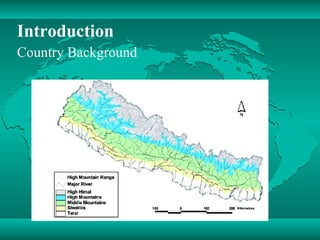
Introduction Country Background
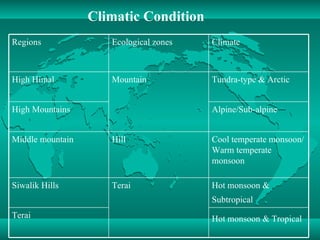
Climatic Condition Hot monsoon & Tropical   Terai Hot monsoon & Subtropical   Terai Siwalik Hills Cool temperate monsoon/Warm temperate monsoon  Hill Middle mountain Alpine/Sub-alpine  High Mountains  Tundra-type & Arctic  Mountain High Himal  Climate Ecological zones Regions
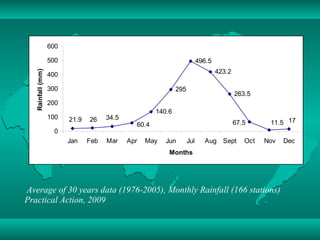
Average of 30 years data (1976-2005), Monthly Rainfall (166 stations) Practical Action, 2009
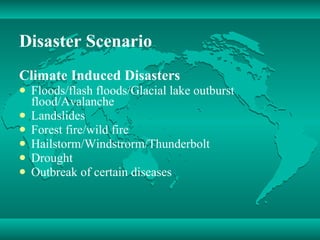
Disaster Scenario Climate Induced Disasters Floods/flash floods/Glacial lake outburst flood/Avalanche  Landslides  Forest fire/wild fire Hailstorm/Windstrorm/Thunderbolt Drought  Outbreak of certain diseases
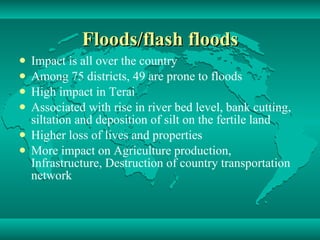
Floods/flash floods Impact is all over the country Among 75 districts, 49 are prone to floods High impact in Terai Associated with rise in river bed level, bank cutting, siltation and deposition of silt on the fertile land Higher loss of lives and properties More impact on Agriculture production, Infrastructure, Destruction of country transportation network
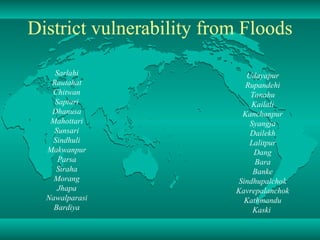
Sarlahi Rautahat Chitwan Saptari Dhanusa Mahottari Sunsari Sindhuli Makwanpur Parsa Siraha Morang Jhapa Nawalparasi Bardiya Udayapur Rupandehi Tanahu Kailali Kanchanpur Syangja Dailekh Lalitpur Dang Bara Banke Sindhupalchok Kavrepalanchok Kathmandu Kaski   District vulnerability from Floods District vulnerability from Floods
Glacial lake outburst floods By breaking the natural moraine dams Impact on the down stream community  GLOF potential lakes Tsho Rolpa, Imja, Thulagi, Lumding, Lower Barun and West Chamjang
Landslides/debris flow Higher loss of lives (211 lives per annum) High Impact on mountain and hill region Major Highway linking the roads are vulnerable
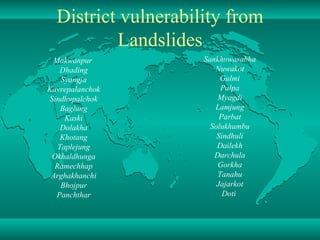
District vulnerability from Landslides Makwanpur  Dhading Syangja Kavrepalanchok Sindhupalchok Baglung Kaski Dolakha Khotang Taplejung Okhaldhunga Ramechhap Arghakhanchi Bhojpur Panchthar Sankhuwasabha Nuwakot Gulmi Palpa Myagdi Lamjung Parbat Solukhumbu Sindhuli Dailekh Darchula Gorkha Tanahu Jajarkot Doti
Thunderstorm/windstorm/hailstorm Thunderstorm- Claims lives Windstorm-  Claims lives and public properties Hailstorm- Destruction of crops specially in the mountainous district Drought Affects a large number of populations Out of 75 district 40 district are food deficit
Heat and Cold Wave Lives killer Now cold wave is getting severe Forest fire Increasing tendency of forest fire Last year it claimed 43 lives and caused a loss of about Rs 134,415,000   Outbreak of Certain Diseases
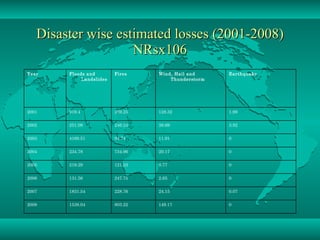
Disaster wise estimated losses (2001-2008) NRsx106 0 149.17 803.22 1538.04 2008 0.07 24.15 228.76 1831.54 2007 0 2.65 247.75 131.56 2006 0 0.77 121.03 219.29 2005 0 20.17 734.96 234.78 2004 0 11.91 94.74 4169.51 2003 3.82 38.69 246.25 251.09 2002 1.99 128.32 239.25 919.4 2001 Earthquake Wind, Hail and Thunderstorm Fires Floods and Landslides Year
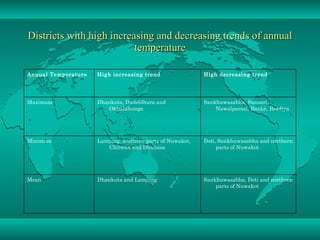
Impacts of Climate Change Climate change will be expected to alter both rainfall and snowfall patterns. The temperature will increase and cause a warming over the entire country. The rate of temperature increase is greater in higher altitudes and in the winter.
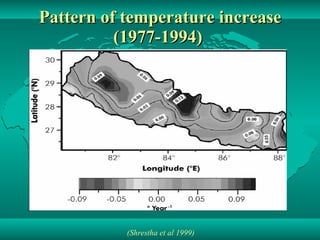
Pattern of temperature increase (1977-1994)  (Shrestha et al 1999)
Districts with high increasing and decreasing trends of annual temperature Sankhuwasabha, Doti and northern parts of Nuwakot Dhankuta and Lamjung Mean Doti, Sankhuwasabha and northern parts of Nuwakot Lamjung, southern parts of Nuwakot, Chitwan and Dhanusa Minimum Sankhuwasabha, Sunsari, Nawalparasi, Banke, Bardiya Dhankuta, Dadeldhura and Okhaldhunga Maximum High decreasing trend High increasing trend Annual Temperature
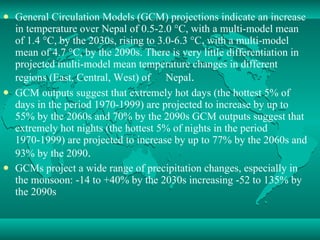
General Circulation Models (GCM) projections indicate an increase in temperature over Nepal of 0.5-2.0 °C, with a multi-model mean of 1.4 °C, by the 2030s, rising to 3.0-6.3 °C, with a multi-model mean of 4.7 °C, by the 2090s. There is very little differentiation in projected multi-model mean temperature changes in different regions (East, Central, West) of   Nepal .   GCM outputs suggest that extremely hot days (the hottest 5% of days in the period 1970-1999) are projected to increase by up to 55% by the 2060s and 70% by the 2090s GCM outputs suggest that extremely hot nights (the hottest 5% of nights in the period 1970-1999) are projected to increase by up to 77% by the 2060s and 93% by the 2090 .  GCMs project a wide range of precipitation changes, especially in the monsoon: -14 to +40% by the 2030s increasing -52 to 135% by the 2090s
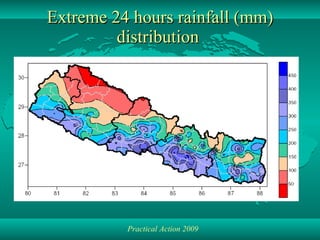
Extreme weather events such as droughts, storms, floods/inundation, and avalanches are expected to increase along with river side erosion.  Glacial melt in Himalaya will increase flooding and avalanches (Dig Tsho GLOF event of 1985). This will be followed by decreased river flows and water supplies, as the glacier recede. The receding of the glacier will result changes in regional water resources and these are projected to have negative impacts on hydropower generation, irrigation, and drinking water supply, which exacerbates the already constrained access to water down streams.  High intensity rainfall will trigger the landslides events on the hill and mountains regions. (Matatirtha landslide event of 2002) High intensity rainfall in the hill regions consequently causes floods in Terai (Flood events of 1993)
Extreme 24 hours rainfall (mm) distribution   Practical Action 2009
Due to decrease in gradient flow of river while entering Terai plain from the steep hill region, Terai will be highly impacted with rise in river bed level, which consequently causes inundation and results in destruction of agriculture land. (Koshi Inundation of 2008) Washing away big area of cultivated land along with the houses including livestock and inhabitants and damage to settlements and disruption of other infrastructures in particular transport and trade due to flooding is an additional potential impact of climate change. Influence on the agriculture, forestry, bio-diversity and outbreak of the certain water and vector borne diseases are also the other potential impacts of the climate change. Temperature rise can accelerate drying of biomasses, which will increase the incidences of forest fires across the nation. (Last year forest fire, this year forest fire) Decrease rainfall, snowfall and increase of temperature will increase the incidence of drought.
Factors Related to vulnerability Poverty and Economic hardship  Insufficient knowledge on disaster management/Low literacy rates Poor quality physical infrastructure; prevalence of non-engineered construction Inadequate forecasting facilities Unplanned settlement; development of settlements and public services in hazardous areas and marginal lands
Deforestation/More dependency on natural resources  Inadequate awareness and concentration of knowledge only in academic centers  Rapid population growth, Population migration/displacement with the deterioration of livelihood opportunities Land degradation caused by human activities including build settlements, cultivation of steep slopes, fuel wood collection
Acts Natural Calamity Relief Act 1982 Though amended twice (1989, 1992) still mostly focused on the rescue and relief   Local Self-Governance Act 1999 The duties and responsibilities of each of the local bodies (VDC, DDC and municipalities) are not clearly stated in disaster management
National Strategy for Disaster Risk Management (NSDRM) based on HFA principle The focus of disaster management in Nepal is changing from reactive (relief and response) to proactive (preparedness) risk reduction, as can be seen in the NSDRM The Ministry of Home Affairs (MoHA) is the national agency responsible for coordination of various aspects of disaster management, including preparedness, response, recovery and mitigation of disasters.
Some Undertaken Local Coping/Adaptation Option Conduction of awareness raising programme  Provision of irrigation system to cope with changing rainfall  Mapping of flood hazards Afforestation Priority given for the preparedness programme Construction of embankments, check dams and spurs to limit the negative impacts of flooding and river site cutting
Rain Water Harvesting and Soil Moisture Conservation Improvement of Degraded Land  Mitigation of River Bank Cutting Slope Stabilization and Management Construction of house with higher plinth level Initiation of programme like food for work for post disaster phase Initiation of the community fund in some places
Suggested Adaptation options Mainstreaming Climate Change Adaptation options with HFA principle Developing and implementing land use/zoning policies Maintaining up to date hazard and vulnerability maps Training and capacity building for disaster and water resource management  Working with the community to increase public awareness and develop early warning systems and evacuation plans  Afforestation and reforestation programs (for reduction of flooding/landslide risk)  Proactive and inclusive efforts to prioritize the need of the poor women  Forecasting and disaster preparedness for GLOF, flooding and drought events  Livelihood diversification
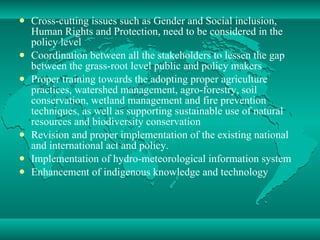
Cross-cutting issues such as Gender and Social inclusion, Human Rights and Protection, need to be considered in the policy level Coordination between all the stakeholders to lessen the gap between the grass-root level public and policy makers Proper training towards the adopting proper agriculture practices, watershed management, agro-forestry, soil conservation, wetland management and fire prevention techniques, as well as supporting sustainable use of natural resources and biodiversity conservation Revision and proper implementation of the existing national and international act and policy. Implementation of hydro-meteorological information system Enhancement of indigenous knowledge and technology
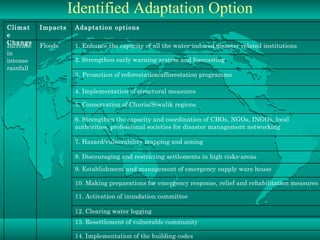
Identified Adaptation Option 14. Implementation of the building codes 13. Resettlement of vulnerable community 12. Clearing water logging 11. Activation of inundation committee  10. Making preparations for emergency response, relief and rehabilitation measures  9. Establishment and management of emergency supply ware house 8. Discouraging and restricting settlements in high risks-areas 7. Hazard/vulnerability mapping and zoning 6. Strengthen the capacity and coordination of CBOs, NGOs, INGOs, local authorities, professional societies for disaster management networking 5. Conservation of Churia/Siwalik regions  4. Implementation of structural measures  3.   Promotion of reforestation/afforestation programme  2. Strengthen early warning system and forecasting 1. Enhance the capacity of all the water-induced disaster related institutions  Floods Increase in intense rainfall Adaptation options Impacts Climate Change
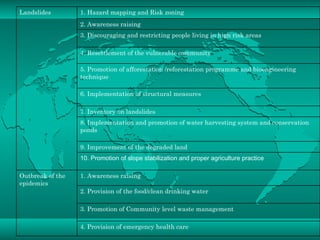
4. Provision of emergency health care 3. Promotion of Community level waste management 2. Provision of the food/clean drinking water  1. Awareness raising  Outbreak of the epidemics 10. Promotion of slope stabilization and proper agriculture practice 9. Improvement of the degraded land 8. Implementation and promotion of water harvesting system and conservation ponds 7. Inventory on landslides 6. Implementation of structural measures 5. Promotion of afforestation /reforestation programme and bioengineering technique 4. Resettlement of the vulnerable community 3. Discouraging and restricting people living in high risk areas 2. Awareness raising 1. Hazard mapping and Risk zoning Landslides
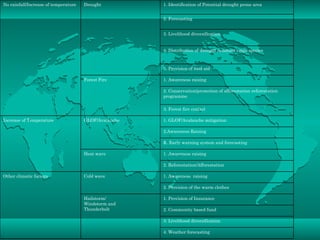
4. Weather forecasting 3. Livelihood diversification 2. Community based fund 1. Provision of Insurance Hailstorm/ Windstorm and Thunderbolt 2. Provision of the warm clothes 1. Awareness  raising  Cold wave Other climatic factors 2. Reforestation/Afforestation  1. Awareness raising  Heat wave 3.  Early warning system and forecasting 2.Awareness Raising  1. GLOF/Avalanche mitigation  GLOF/Avalanche Increase of Temperature 3. Forest fire control 2. Conservation/promotion of afforestation reforestation programme 1. Awareness raising Forest Fire 5. Provision of food aid 4. Distribution of drought resistant crops species  3. Livelihood diversification 2. Forecasting  1. Identification of Potential drought prone area Drought No rainfall/Increase of temperature
Thank you very much

2. dr. usha dp net

  • 1.
    DP-Net ConsultationWorkshop Climate Change and Disaster
  • 2.
    Activities Inception WorkshopInduction Workshop Literature Review Transect Exercise (Gandak, Karnali and Koshi) Regional Workshop Synthesis Workshop Wider Reference group consultation workshop Consultation with the group members
  • 3.
  • 4.
    Climatic Condition Hotmonsoon & Tropical Terai Hot monsoon & Subtropical Terai Siwalik Hills Cool temperate monsoon/Warm temperate monsoon Hill Middle mountain Alpine/Sub-alpine High Mountains Tundra-type & Arctic Mountain High Himal Climate Ecological zones Regions
  • 5.
    Average of 30years data (1976-2005), Monthly Rainfall (166 stations) Practical Action, 2009
  • 6.
    Disaster Scenario ClimateInduced Disasters Floods/flash floods/Glacial lake outburst flood/Avalanche Landslides Forest fire/wild fire Hailstorm/Windstrorm/Thunderbolt Drought Outbreak of certain diseases
  • 7.
    Floods/flash floods Impactis all over the country Among 75 districts, 49 are prone to floods High impact in Terai Associated with rise in river bed level, bank cutting, siltation and deposition of silt on the fertile land Higher loss of lives and properties More impact on Agriculture production, Infrastructure, Destruction of country transportation network
  • 8.
    Sarlahi Rautahat ChitwanSaptari Dhanusa Mahottari Sunsari Sindhuli Makwanpur Parsa Siraha Morang Jhapa Nawalparasi Bardiya Udayapur Rupandehi Tanahu Kailali Kanchanpur Syangja Dailekh Lalitpur Dang Bara Banke Sindhupalchok Kavrepalanchok Kathmandu Kaski District vulnerability from Floods District vulnerability from Floods
  • 9.
    Glacial lake outburstfloods By breaking the natural moraine dams Impact on the down stream community GLOF potential lakes Tsho Rolpa, Imja, Thulagi, Lumding, Lower Barun and West Chamjang
  • 10.
    Landslides/debris flow Higherloss of lives (211 lives per annum) High Impact on mountain and hill region Major Highway linking the roads are vulnerable
  • 11.
    District vulnerability fromLandslides Makwanpur Dhading Syangja Kavrepalanchok Sindhupalchok Baglung Kaski Dolakha Khotang Taplejung Okhaldhunga Ramechhap Arghakhanchi Bhojpur Panchthar Sankhuwasabha Nuwakot Gulmi Palpa Myagdi Lamjung Parbat Solukhumbu Sindhuli Dailekh Darchula Gorkha Tanahu Jajarkot Doti
  • 12.
    Thunderstorm/windstorm/hailstorm Thunderstorm- Claimslives Windstorm- Claims lives and public properties Hailstorm- Destruction of crops specially in the mountainous district Drought Affects a large number of populations Out of 75 district 40 district are food deficit
  • 13.
    Heat and ColdWave Lives killer Now cold wave is getting severe Forest fire Increasing tendency of forest fire Last year it claimed 43 lives and caused a loss of about Rs 134,415,000 Outbreak of Certain Diseases
  • 14.
    Disaster wise estimatedlosses (2001-2008) NRsx106 0 149.17 803.22 1538.04 2008 0.07 24.15 228.76 1831.54 2007 0 2.65 247.75 131.56 2006 0 0.77 121.03 219.29 2005 0 20.17 734.96 234.78 2004 0 11.91 94.74 4169.51 2003 3.82 38.69 246.25 251.09 2002 1.99 128.32 239.25 919.4 2001 Earthquake Wind, Hail and Thunderstorm Fires Floods and Landslides Year
  • 15.
    Impacts of ClimateChange Climate change will be expected to alter both rainfall and snowfall patterns. The temperature will increase and cause a warming over the entire country. The rate of temperature increase is greater in higher altitudes and in the winter.
  • 16.
    Pattern of temperatureincrease (1977-1994) (Shrestha et al 1999)
  • 17.
    Districts with highincreasing and decreasing trends of annual temperature Sankhuwasabha, Doti and northern parts of Nuwakot Dhankuta and Lamjung Mean Doti, Sankhuwasabha and northern parts of Nuwakot Lamjung, southern parts of Nuwakot, Chitwan and Dhanusa Minimum Sankhuwasabha, Sunsari, Nawalparasi, Banke, Bardiya Dhankuta, Dadeldhura and Okhaldhunga Maximum High decreasing trend High increasing trend Annual Temperature
  • 18.
    General Circulation Models(GCM) projections indicate an increase in temperature over Nepal of 0.5-2.0 °C, with a multi-model mean of 1.4 °C, by the 2030s, rising to 3.0-6.3 °C, with a multi-model mean of 4.7 °C, by the 2090s. There is very little differentiation in projected multi-model mean temperature changes in different regions (East, Central, West) of   Nepal .   GCM outputs suggest that extremely hot days (the hottest 5% of days in the period 1970-1999) are projected to increase by up to 55% by the 2060s and 70% by the 2090s GCM outputs suggest that extremely hot nights (the hottest 5% of nights in the period 1970-1999) are projected to increase by up to 77% by the 2060s and 93% by the 2090 . GCMs project a wide range of precipitation changes, especially in the monsoon: -14 to +40% by the 2030s increasing -52 to 135% by the 2090s
  • 19.
    Extreme weather eventssuch as droughts, storms, floods/inundation, and avalanches are expected to increase along with river side erosion. Glacial melt in Himalaya will increase flooding and avalanches (Dig Tsho GLOF event of 1985). This will be followed by decreased river flows and water supplies, as the glacier recede. The receding of the glacier will result changes in regional water resources and these are projected to have negative impacts on hydropower generation, irrigation, and drinking water supply, which exacerbates the already constrained access to water down streams. High intensity rainfall will trigger the landslides events on the hill and mountains regions. (Matatirtha landslide event of 2002) High intensity rainfall in the hill regions consequently causes floods in Terai (Flood events of 1993)
  • 20.
    Extreme 24 hoursrainfall (mm) distribution Practical Action 2009
  • 21.
    Due to decreasein gradient flow of river while entering Terai plain from the steep hill region, Terai will be highly impacted with rise in river bed level, which consequently causes inundation and results in destruction of agriculture land. (Koshi Inundation of 2008) Washing away big area of cultivated land along with the houses including livestock and inhabitants and damage to settlements and disruption of other infrastructures in particular transport and trade due to flooding is an additional potential impact of climate change. Influence on the agriculture, forestry, bio-diversity and outbreak of the certain water and vector borne diseases are also the other potential impacts of the climate change. Temperature rise can accelerate drying of biomasses, which will increase the incidences of forest fires across the nation. (Last year forest fire, this year forest fire) Decrease rainfall, snowfall and increase of temperature will increase the incidence of drought.
  • 22.
    Factors Related tovulnerability Poverty and Economic hardship Insufficient knowledge on disaster management/Low literacy rates Poor quality physical infrastructure; prevalence of non-engineered construction Inadequate forecasting facilities Unplanned settlement; development of settlements and public services in hazardous areas and marginal lands
  • 23.
    Deforestation/More dependency onnatural resources Inadequate awareness and concentration of knowledge only in academic centers Rapid population growth, Population migration/displacement with the deterioration of livelihood opportunities Land degradation caused by human activities including build settlements, cultivation of steep slopes, fuel wood collection
  • 24.
    Acts Natural CalamityRelief Act 1982 Though amended twice (1989, 1992) still mostly focused on the rescue and relief Local Self-Governance Act 1999 The duties and responsibilities of each of the local bodies (VDC, DDC and municipalities) are not clearly stated in disaster management
  • 25.
    National Strategy forDisaster Risk Management (NSDRM) based on HFA principle The focus of disaster management in Nepal is changing from reactive (relief and response) to proactive (preparedness) risk reduction, as can be seen in the NSDRM The Ministry of Home Affairs (MoHA) is the national agency responsible for coordination of various aspects of disaster management, including preparedness, response, recovery and mitigation of disasters.
  • 26.
    Some Undertaken LocalCoping/Adaptation Option Conduction of awareness raising programme Provision of irrigation system to cope with changing rainfall Mapping of flood hazards Afforestation Priority given for the preparedness programme Construction of embankments, check dams and spurs to limit the negative impacts of flooding and river site cutting
  • 27.
    Rain Water Harvestingand Soil Moisture Conservation Improvement of Degraded Land Mitigation of River Bank Cutting Slope Stabilization and Management Construction of house with higher plinth level Initiation of programme like food for work for post disaster phase Initiation of the community fund in some places
  • 28.
    Suggested Adaptation optionsMainstreaming Climate Change Adaptation options with HFA principle Developing and implementing land use/zoning policies Maintaining up to date hazard and vulnerability maps Training and capacity building for disaster and water resource management Working with the community to increase public awareness and develop early warning systems and evacuation plans Afforestation and reforestation programs (for reduction of flooding/landslide risk) Proactive and inclusive efforts to prioritize the need of the poor women Forecasting and disaster preparedness for GLOF, flooding and drought events Livelihood diversification
  • 29.
    Cross-cutting issues suchas Gender and Social inclusion, Human Rights and Protection, need to be considered in the policy level Coordination between all the stakeholders to lessen the gap between the grass-root level public and policy makers Proper training towards the adopting proper agriculture practices, watershed management, agro-forestry, soil conservation, wetland management and fire prevention techniques, as well as supporting sustainable use of natural resources and biodiversity conservation Revision and proper implementation of the existing national and international act and policy. Implementation of hydro-meteorological information system Enhancement of indigenous knowledge and technology
  • 30.
    Identified Adaptation Option14. Implementation of the building codes 13. Resettlement of vulnerable community 12. Clearing water logging 11. Activation of inundation committee 10. Making preparations for emergency response, relief and rehabilitation measures 9. Establishment and management of emergency supply ware house 8. Discouraging and restricting settlements in high risks-areas 7. Hazard/vulnerability mapping and zoning 6. Strengthen the capacity and coordination of CBOs, NGOs, INGOs, local authorities, professional societies for disaster management networking 5. Conservation of Churia/Siwalik regions 4. Implementation of structural measures 3. Promotion of reforestation/afforestation programme 2. Strengthen early warning system and forecasting 1. Enhance the capacity of all the water-induced disaster related institutions Floods Increase in intense rainfall Adaptation options Impacts Climate Change
  • 31.
    4. Provision ofemergency health care 3. Promotion of Community level waste management 2. Provision of the food/clean drinking water 1. Awareness raising Outbreak of the epidemics 10. Promotion of slope stabilization and proper agriculture practice 9. Improvement of the degraded land 8. Implementation and promotion of water harvesting system and conservation ponds 7. Inventory on landslides 6. Implementation of structural measures 5. Promotion of afforestation /reforestation programme and bioengineering technique 4. Resettlement of the vulnerable community 3. Discouraging and restricting people living in high risk areas 2. Awareness raising 1. Hazard mapping and Risk zoning Landslides
  • 32.
    4. Weather forecasting3. Livelihood diversification 2. Community based fund 1. Provision of Insurance Hailstorm/ Windstorm and Thunderbolt 2. Provision of the warm clothes 1. Awareness raising Cold wave Other climatic factors 2. Reforestation/Afforestation 1. Awareness raising Heat wave 3. Early warning system and forecasting 2.Awareness Raising 1. GLOF/Avalanche mitigation GLOF/Avalanche Increase of Temperature 3. Forest fire control 2. Conservation/promotion of afforestation reforestation programme 1. Awareness raising Forest Fire 5. Provision of food aid 4. Distribution of drought resistant crops species 3. Livelihood diversification 2. Forecasting 1. Identification of Potential drought prone area Drought No rainfall/Increase of temperature
  • 33.