Climate Change in Nepal:
Impacts and Adaptation through
LAPA
By
Pradeep Baral
Context
 Weather: It describes the state of the air at a particular place and time-whether it is warm or cold,
wet or dry, and how cloudy or windy it is. In other words, weather is what conditions of the atmosphere
are over a short period of time.
 Climate: The average and statistics of variations of weather in a geographical region. The averaging
period is typically several decades.
 Climate Change:
The Inter-governmental Panel on Climate Change (IPCC) defines climate change as: “a change in the
state of the climate that can be identified (e.g., by using statistical tests) by changes in the mean and/or
the variability of its properties, and that persists for an extended period, typically decades or longer.
Climate change may be due to natural internal processes or external forcing, or to persistent
anthropogenic changes in the composition of the atmosphere or in land use”.
The United Nations Framework Convention on Climate Change (UNFCCC) defines climate change as “a
change of climate which is attributed directly or indirectly to human activity that alters the composition
of the global atmosphere and which is in addition to natural climate variability observed over
comparable time periods”.
2
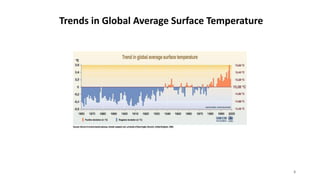
 Global average surface air temperature has increased, especially since about 1950.
 The average temperature of the world has increased by 0.74 degree Celsius over the last 100 years
(1906-2005).
 2005 and 1998 were the warmest two years in the instrumental global surface air temperature record
since 1850. Eleven of the last 12 years (1995 to 2006)-1996 exception-rank among the 12 warmest years
on record since 1850.
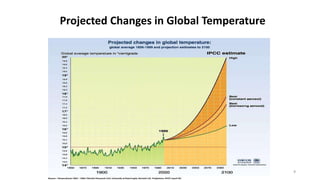
 Climate models calculate that the global mean surface temperature could rise by about 1 to 4.5
centigrade by 2100.
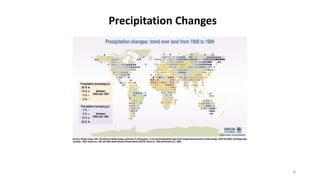
 Average global precipitation has also increased by 0.5-1% annually. It is decreasing in equatorial region
and increasing in higher latitude. Precipitation has increased over land at high latitudes of the Northern
Hemisphere, especially during the cold season. Decrease in precipitation occurred in steps after the
1960s over the subtropics and the tropics from Africa to Indonesia.
3
Contd….
Trends in Global Average Surface Temperature
4
Projected Changes in Global Temperature
5
Precipitation Changes
6
Nepal Context
 Nepal is the fourth most vulnerable country in terms of climate risks and 30th in
terms of water-induced disaster. Climate change is posing additional threat to Nepal.
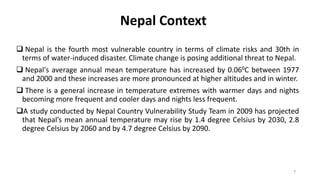
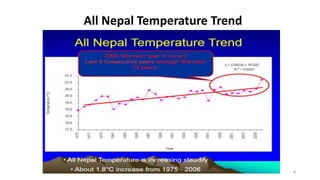
 Nepal's average annual mean temperature has increased by 0.060C between 1977
and 2000 and these increases are more pronounced at higher altitudes and in winter.
 There is a general increase in temperature extremes with warmer days and nights
becoming more frequent and cooler days and nights less frequent.
A study conducted by Nepal Country Vulnerability Study Team in 2009 has projected
that Nepal’s mean annual temperature may rise by 1.4 degree Celsius by 2030, 2.8
degree Celsius by 2060 and by 4.7 degree Celsius by 2090.
7
All Nepal Temperature Trend
8
Cont…
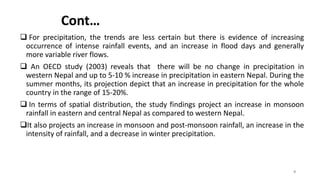
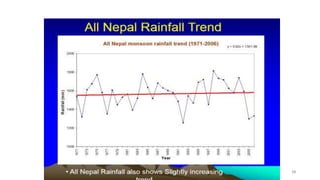
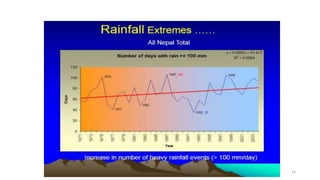
 For precipitation, the trends are less certain but there is evidence of increasing
occurrence of intense rainfall events, and an increase in flood days and generally
more variable river flows.
 An OECD study (2003) reveals that there will be no change in precipitation in
western Nepal and up to 5-10 % increase in precipitation in eastern Nepal. During the
summer months, its projection depict that an increase in precipitation for the whole
country in the range of 15-20%.
 In terms of spatial distribution, the study findings project an increase in monsoon
rainfall in eastern and central Nepal as compared to western Nepal.
It also projects an increase in monsoon and post-monsoon rainfall, an increase in the
intensity of rainfall, and a decrease in winter precipitation.
9
10

11
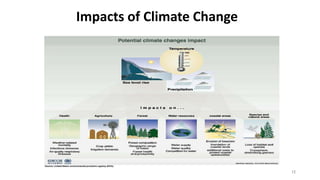
Impacts of Climate Change
12
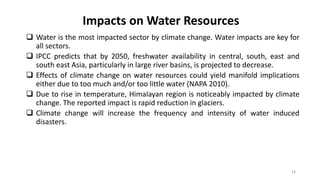
Impacts on Water Resources
 Water is the most impacted sector by climate change. Water impacts are key for
all sectors.
 IPCC predicts that by 2050, freshwater availability in central, south, east and
south east Asia, particularly in large river basins, is projected to decrease.
 Effects of climate change on water resources could yield manifold implications
either due to too much and/or too little water (NAPA 2010).
 Due to rise in temperature, Himalayan region is noticeably impacted by climate
change. The reported impact is rapid reduction in glaciers.
 Climate change will increase the frequency and intensity of water induced
disasters.
13
Cont…
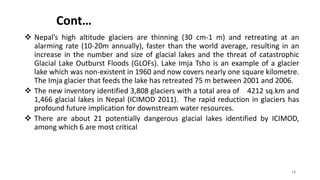
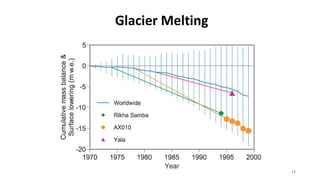
 Nepal’s high altitude glaciers are thinning (30 cm-1 m) and retreating at an
alarming rate (10-20m annually), faster than the world average, resulting in an
increase in the number and size of glacial lakes and the threat of catastrophic
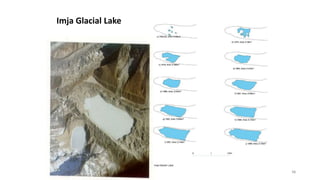
Glacial Lake Outburst Floods (GLOFs). Lake Imja Tsho is an example of a glacier
lake which was non-existent in 1960 and now covers nearly one square kilometre.
The Imja glacier that feeds the lake has retreated 75 m between 2001 and 2006.
 The new inventory identified 3,808 glaciers with a total area of 4212 sq.km and
1,466 glacial lakes in Nepal (ICIMOD 2011). The rapid reduction in glaciers has
profound future implication for downstream water resources.
 There are about 21 potentially dangerous glacial lakes identified by ICIMOD,
among which 6 are most critical
14
Glacier Melting
15
Imja Glacial Lake
16
Impacts on Agriculture
17
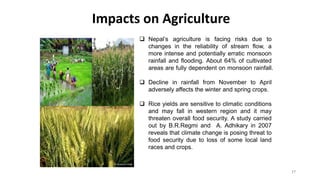
 Nepal’s agriculture is facing risks due to
changes in the reliability of stream flow, a
more intense and potentially erratic monsoon
rainfall and flooding. About 64% of cultivated
areas are fully dependent on monsoon rainfall.
 Decline in rainfall from November to April
adversely affects the winter and spring crops.
 Rice yields are sensitive to climatic conditions
and may fall in western region and it may
threaten overall food security. A study carried
out by B.R.Regmi and A. Adhikary in 2007
reveals that climate change is posing threat to
food security due to loss of some local land
races and crops.
Cont…
18
 Initial National Communication,2004 states that with the increase of temperature beyond 4
degree Celsius, the yield of Terai rice is projected to decrease. The effect of temperature on rice
crops in the hills is little more severe than in the Terai. But in mountain region it is better, but rice
is grown negligibly there.
 The yield of wheat is projected to fall down with the rise in temperature in Terai. The effect of
temperature on wheat yield in the hills is less than in Terai. There is insignificant decline of wheat
yield in mountain environment with rise in temperature.
 The rise in temperature will affect yield of maize crops in Terai more than wheat and rice crops.
It affects less in the hills than in Terai but increases production of maize in mountain areas.
Impact on Livestock
19
Livestock production is highly sensitive to climate change.
Rising temperature increases lignifications of plant tissues
and reduces the digestibility (Minson, 1990), reducing meat
and milk production in range-based livestock production
system.
Increased heat stress is another pathway affecting the
livestock production. The increased heat alters heat exchange
between animal and environment affecting the feed intake and
metabolism (SCA, 1990; Mader and Davis, 2004). Such
stresses will affect growth and productivity of the animals. But,
effects vary from species to species.
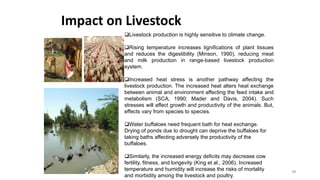
Water buffaloes need frequent bath for heat exchange.
Drying of ponds due to drought can deprive the buffaloes for
taking baths affecting adversely the productivity of the
buffaloes.
Similarly, the increased energy deficits may decrease cow
fertility, fitness, and longevity (King et al., 2006). Increased
temperature and humidity will increase the risks of mortality
and morbidity among the livestock and poultry.
Impacts on Forests and Biodiversity
20
 IPCC predicts that approximately 20 to 30% of plant and
animal species assessed so far are likely to be at
increased risk of extinction if increases in global average
temperature exceed 1.5 to 2.5 degree Celsius.
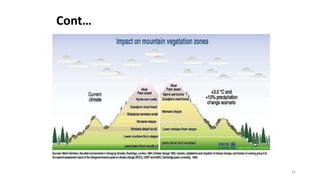
 Increased temperature and rainfall variability have
resulted into shifts in agro-ecological zones, prolonged
dry spells, and higher incidences of pests and diseases.
 New alien and invasive species are emerging and their
habitat is spreading at a fast rate.
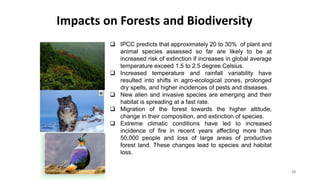
 Migration of the forest towards the higher altitude,
change in their composition, and extinction of species.
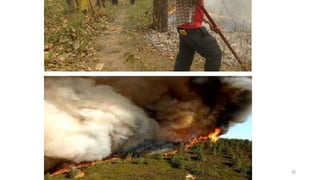
 Extreme climatic conditions have led to increased
incidence of fire in recent years affecting more than
50,000 people and loss of large areas of productive
forest land. These changes lead to species and habitat
loss.
Cont…
21
Cont…
22
Impact on Health
23
 Climate change has both direct and indirect impact on health.
 Drought, heat waves, and flash floods have direct impacts on health.
 Climate-induced economic dislocation, conflict, crop failure, and associated malnutrition and
hunger, and the spread and aggravated intensity of infectious diseases due to changing
environmental conditions have indirect impacts on health.
 The infectious diseases include the vector-borne diseases such as malaria, kala-azar, dengue,
Japanese enchepalities and water related diseases such as diarrhea.
 IPCC IV Assessment Report, 2007 reveals that endemic morbidity and mortality due to
diarrheal disease associated with floods and droughts are expected to rise in East, South and
South East Asia due to projected changes in the hydrological cycle.
Adaptation Initiatives
24
 The government of Nepal prepared the NAPA in 2010 to address its urgent and immediate adaptation
needs through a consultative and country-driven process.
 NAPA is a strategic tool to access climatic vulnerability, and symmetrically respond to climate change
adaptation issues by developing appropriate adaptation measures.
 Out of about 250 adaptation options proposed by the Thematic Working Groups (TWG), nine
integrated projects have been identified as the urgent and immediate national adaptation priority.
 The government of Nepal has approved the National Framework on Local Adaptation Plans for Action
(LAPA Framework) in 2011 that helps to integrate climate adaptation and resilience aspects in local and
national plans.
Cont…
25
 The government of Nepal has approved the National Framework on Local Adaptation Plans for
Action (LAPA Framework) in 2011 that helps to integrate climate adaptation and resilience aspects in
local and national plans.
 Agriculture, forestry, health, water and sanitation, watersheds and micro-finance have been
identified as the main entry points. But it states that education, local infrastructure, disasters and other
environment-related areas may also be taken as entry points.
 Since 2013, the government is implementing 70 Local Adaptation Plan for Actions in 69 village
development committees and one municipality of 14 districts in the Mid and Far Western regions of
Nepal with support from Nepal Climate Support Programme: Building Climate Resilience in Nepal
Project funded by UNDP/DFID/EU
LAPA Process
26
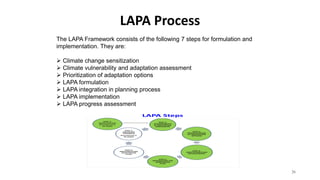
The LAPA Framework consists of the following 7 steps for formulation and
implementation. They are:
 Climate change sensitization
 Climate vulnerability and adaptation assessment
 Prioritization of adaptation options
 LAPA formulation
 LAPA integration in planning process
 LAPA implementation
 LAPA progress assessment
STEP 2:
VULNERABILITY
& ADAPTATION
ASSESSMENT
STEP 3:
PRIORITISATION
OF ADAPTATION
OPTIONS
STEP 4:
ADAPTATION PLAN
DEVELOPMENT
STEP 5:
INTEGRATING THE
ADAPTATION
PLAN
STEP 6:
IMPLEMENTING
ADAPTATION
PLAN
STEP 7:
ASSESSING
PROGRESS
{Carried out in
all steps}
LAPA Steps
STEP 1:
SENSITISATION
{Carried out in
all steps}
27
Thank You
27

Climate change in nepal

  • 1.
    Climate Change inNepal: Impacts and Adaptation through LAPA By Pradeep Baral
  • 2.
    Context  Weather: Itdescribes the state of the air at a particular place and time-whether it is warm or cold, wet or dry, and how cloudy or windy it is. In other words, weather is what conditions of the atmosphere are over a short period of time.  Climate: The average and statistics of variations of weather in a geographical region. The averaging period is typically several decades.  Climate Change: The Inter-governmental Panel on Climate Change (IPCC) defines climate change as: “a change in the state of the climate that can be identified (e.g., by using statistical tests) by changes in the mean and/or the variability of its properties, and that persists for an extended period, typically decades or longer. Climate change may be due to natural internal processes or external forcing, or to persistent anthropogenic changes in the composition of the atmosphere or in land use”. The United Nations Framework Convention on Climate Change (UNFCCC) defines climate change as “a change of climate which is attributed directly or indirectly to human activity that alters the composition of the global atmosphere and which is in addition to natural climate variability observed over comparable time periods”. 2
  • 3.
     Global averagesurface air temperature has increased, especially since about 1950.  The average temperature of the world has increased by 0.74 degree Celsius over the last 100 years (1906-2005).  2005 and 1998 were the warmest two years in the instrumental global surface air temperature record since 1850. Eleven of the last 12 years (1995 to 2006)-1996 exception-rank among the 12 warmest years on record since 1850.  Climate models calculate that the global mean surface temperature could rise by about 1 to 4.5 centigrade by 2100.  Average global precipitation has also increased by 0.5-1% annually. It is decreasing in equatorial region and increasing in higher latitude. Precipitation has increased over land at high latitudes of the Northern Hemisphere, especially during the cold season. Decrease in precipitation occurred in steps after the 1960s over the subtropics and the tropics from Africa to Indonesia. 3 Contd….
  • 4.
    Trends in GlobalAverage Surface Temperature 4
  • 5.
    Projected Changes inGlobal Temperature 5
  • 6.
  • 7.
    Nepal Context  Nepalis the fourth most vulnerable country in terms of climate risks and 30th in terms of water-induced disaster. Climate change is posing additional threat to Nepal.  Nepal's average annual mean temperature has increased by 0.060C between 1977 and 2000 and these increases are more pronounced at higher altitudes and in winter.  There is a general increase in temperature extremes with warmer days and nights becoming more frequent and cooler days and nights less frequent. A study conducted by Nepal Country Vulnerability Study Team in 2009 has projected that Nepal’s mean annual temperature may rise by 1.4 degree Celsius by 2030, 2.8 degree Celsius by 2060 and by 4.7 degree Celsius by 2090. 7
  • 8.
  • 9.
    Cont…  For precipitation,the trends are less certain but there is evidence of increasing occurrence of intense rainfall events, and an increase in flood days and generally more variable river flows.  An OECD study (2003) reveals that there will be no change in precipitation in western Nepal and up to 5-10 % increase in precipitation in eastern Nepal. During the summer months, its projection depict that an increase in precipitation for the whole country in the range of 15-20%.  In terms of spatial distribution, the study findings project an increase in monsoon rainfall in eastern and central Nepal as compared to western Nepal. It also projects an increase in monsoon and post-monsoon rainfall, an increase in the intensity of rainfall, and a decrease in winter precipitation. 9
  • 10.
  • 11.
  • 12.
  • 13.
    Impacts on WaterResources  Water is the most impacted sector by climate change. Water impacts are key for all sectors.  IPCC predicts that by 2050, freshwater availability in central, south, east and south east Asia, particularly in large river basins, is projected to decrease.  Effects of climate change on water resources could yield manifold implications either due to too much and/or too little water (NAPA 2010).  Due to rise in temperature, Himalayan region is noticeably impacted by climate change. The reported impact is rapid reduction in glaciers.  Climate change will increase the frequency and intensity of water induced disasters. 13
  • 14.
    Cont…  Nepal’s highaltitude glaciers are thinning (30 cm-1 m) and retreating at an alarming rate (10-20m annually), faster than the world average, resulting in an increase in the number and size of glacial lakes and the threat of catastrophic Glacial Lake Outburst Floods (GLOFs). Lake Imja Tsho is an example of a glacier lake which was non-existent in 1960 and now covers nearly one square kilometre. The Imja glacier that feeds the lake has retreated 75 m between 2001 and 2006.  The new inventory identified 3,808 glaciers with a total area of 4212 sq.km and 1,466 glacial lakes in Nepal (ICIMOD 2011). The rapid reduction in glaciers has profound future implication for downstream water resources.  There are about 21 potentially dangerous glacial lakes identified by ICIMOD, among which 6 are most critical 14
  • 15.
  • 16.
  • 17.
    Impacts on Agriculture 17 Nepal’s agriculture is facing risks due to changes in the reliability of stream flow, a more intense and potentially erratic monsoon rainfall and flooding. About 64% of cultivated areas are fully dependent on monsoon rainfall.  Decline in rainfall from November to April adversely affects the winter and spring crops.  Rice yields are sensitive to climatic conditions and may fall in western region and it may threaten overall food security. A study carried out by B.R.Regmi and A. Adhikary in 2007 reveals that climate change is posing threat to food security due to loss of some local land races and crops.
  • 18.
    Cont… 18  Initial NationalCommunication,2004 states that with the increase of temperature beyond 4 degree Celsius, the yield of Terai rice is projected to decrease. The effect of temperature on rice crops in the hills is little more severe than in the Terai. But in mountain region it is better, but rice is grown negligibly there.  The yield of wheat is projected to fall down with the rise in temperature in Terai. The effect of temperature on wheat yield in the hills is less than in Terai. There is insignificant decline of wheat yield in mountain environment with rise in temperature.  The rise in temperature will affect yield of maize crops in Terai more than wheat and rice crops. It affects less in the hills than in Terai but increases production of maize in mountain areas.
  • 19.
    Impact on Livestock 19 Livestockproduction is highly sensitive to climate change. Rising temperature increases lignifications of plant tissues and reduces the digestibility (Minson, 1990), reducing meat and milk production in range-based livestock production system. Increased heat stress is another pathway affecting the livestock production. The increased heat alters heat exchange between animal and environment affecting the feed intake and metabolism (SCA, 1990; Mader and Davis, 2004). Such stresses will affect growth and productivity of the animals. But, effects vary from species to species. Water buffaloes need frequent bath for heat exchange. Drying of ponds due to drought can deprive the buffaloes for taking baths affecting adversely the productivity of the buffaloes. Similarly, the increased energy deficits may decrease cow fertility, fitness, and longevity (King et al., 2006). Increased temperature and humidity will increase the risks of mortality and morbidity among the livestock and poultry.
  • 20.
    Impacts on Forestsand Biodiversity 20  IPCC predicts that approximately 20 to 30% of plant and animal species assessed so far are likely to be at increased risk of extinction if increases in global average temperature exceed 1.5 to 2.5 degree Celsius.  Increased temperature and rainfall variability have resulted into shifts in agro-ecological zones, prolonged dry spells, and higher incidences of pests and diseases.  New alien and invasive species are emerging and their habitat is spreading at a fast rate.  Migration of the forest towards the higher altitude, change in their composition, and extinction of species.  Extreme climatic conditions have led to increased incidence of fire in recent years affecting more than 50,000 people and loss of large areas of productive forest land. These changes lead to species and habitat loss.
  • 21.
  • 22.
  • 23.
    Impact on Health 23 Climate change has both direct and indirect impact on health.  Drought, heat waves, and flash floods have direct impacts on health.  Climate-induced economic dislocation, conflict, crop failure, and associated malnutrition and hunger, and the spread and aggravated intensity of infectious diseases due to changing environmental conditions have indirect impacts on health.  The infectious diseases include the vector-borne diseases such as malaria, kala-azar, dengue, Japanese enchepalities and water related diseases such as diarrhea.  IPCC IV Assessment Report, 2007 reveals that endemic morbidity and mortality due to diarrheal disease associated with floods and droughts are expected to rise in East, South and South East Asia due to projected changes in the hydrological cycle.
  • 24.
    Adaptation Initiatives 24  Thegovernment of Nepal prepared the NAPA in 2010 to address its urgent and immediate adaptation needs through a consultative and country-driven process.  NAPA is a strategic tool to access climatic vulnerability, and symmetrically respond to climate change adaptation issues by developing appropriate adaptation measures.  Out of about 250 adaptation options proposed by the Thematic Working Groups (TWG), nine integrated projects have been identified as the urgent and immediate national adaptation priority.  The government of Nepal has approved the National Framework on Local Adaptation Plans for Action (LAPA Framework) in 2011 that helps to integrate climate adaptation and resilience aspects in local and national plans.
  • 25.
    Cont… 25  The governmentof Nepal has approved the National Framework on Local Adaptation Plans for Action (LAPA Framework) in 2011 that helps to integrate climate adaptation and resilience aspects in local and national plans.  Agriculture, forestry, health, water and sanitation, watersheds and micro-finance have been identified as the main entry points. But it states that education, local infrastructure, disasters and other environment-related areas may also be taken as entry points.  Since 2013, the government is implementing 70 Local Adaptation Plan for Actions in 69 village development committees and one municipality of 14 districts in the Mid and Far Western regions of Nepal with support from Nepal Climate Support Programme: Building Climate Resilience in Nepal Project funded by UNDP/DFID/EU
  • 26.
    LAPA Process 26 The LAPAFramework consists of the following 7 steps for formulation and implementation. They are:  Climate change sensitization  Climate vulnerability and adaptation assessment  Prioritization of adaptation options  LAPA formulation  LAPA integration in planning process  LAPA implementation  LAPA progress assessment STEP 2: VULNERABILITY & ADAPTATION ASSESSMENT STEP 3: PRIORITISATION OF ADAPTATION OPTIONS STEP 4: ADAPTATION PLAN DEVELOPMENT STEP 5: INTEGRATING THE ADAPTATION PLAN STEP 6: IMPLEMENTING ADAPTATION PLAN STEP 7: ASSESSING PROGRESS {Carried out in all steps} LAPA Steps STEP 1: SENSITISATION {Carried out in all steps}
  • 27.